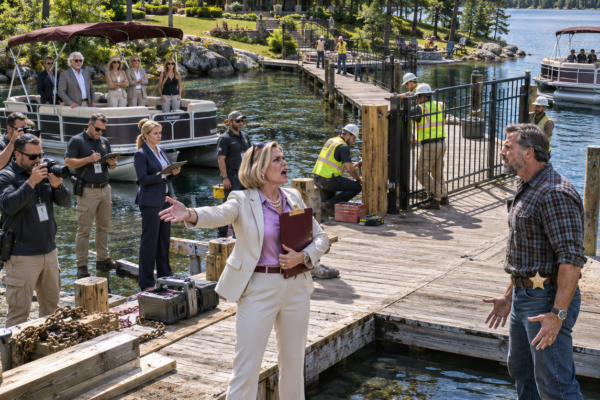
𝗙𝗨𝗟𝗟 𝗦𝗧𝗢𝗥𝗬 Vanessa Put an Excavator Through My Father’s Library Before She Understood What People Were Really Protecting
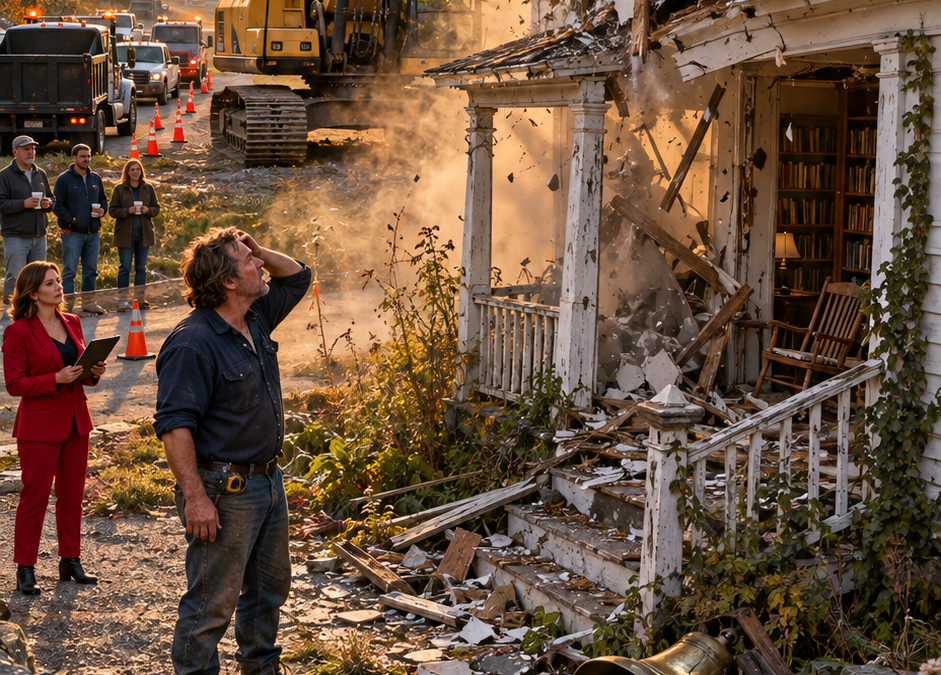
𝗙𝗨𝗟𝗟 𝗦𝗧𝗢𝗥𝗬
I opened my mouth.
Nothing came out.
She walked away.
Behind me, something shifted inside the damaged roof, and a handful of plaster hit the floor.
I stood there with dust on my shirt, my father’s bell heavy in my pocket, and the first ugly thought finally landed.
Vanessa had not come onto my land because nobody cared about the old library.
She had come because she was convinced nobody cared enough to stop her.
By noon, I had blue tarps stretched across the hole in the roof and two sheets of plywood screwed over the broken window frames. The temperature had climbed past ninety, and sweat kept running down the back of my neck while I worked. Every time the wind caught the tarp, it snapped above me like a flag.
I found one of Dad’s old framing hammers in the maintenance closet.
Hickory handle. Sixteen-ounce head. His initials burned into the grip with a soldering iron.
E.W.
I had not touched it since we buried him four years earlier.
Whitaker Library had never really been a library in the official sense.
My grandfather, Walter Whitaker, bought this land in 1959, when the nearest subdivision was twelve miles away and this whole stretch was pasture, pecan trees, and dirt roads. The building started as a feed shed. Then the textile mill in town closed its reading room, and Grandpa hauled home three truckloads of books because he could not stand watching them get thrown away.
Dad took over in 1983.
He added windows, built shelves, installed a wood stove, and somehow turned a crooked farm building into the place half the town grew up in.
There were no scanners.
No membership cards.
No late fees.
Dad kept a coffee can near the door for donations and a yellow legal pad for people who wanted to write down what they borrowed. Most people didn’t. He never cared.
“Books come back,” he used to tell me. “Maybe not the same books, but they come back.”
Saturday mornings smelled like coffee, floor wax, and old paper. Kids sprawled under the windows reading comic books. Retired men argued over newspapers. During the winter of 1996, an ice storm knocked power out across the county, and Dad kept the stove burning for three straight days. People slept between the shelves because our generator kept the lights on.
That brass bell over the door rang so often he finally wrapped a dish towel around it at night.
Somewhere along the way, somebody painted a sign for him.
Take something. Leave something.
Dad hung it over the desk and never explained it.
He didn’t have to.
Then he died, and the place became mine.
I told myself I was preserving it. I replaced rotten siding, patched the chimney, paid the electric bill, fixed leaks before they reached the shelves. I am a restoration carpenter. Give me a warped sash window or a hundred-year-old staircase, and I can usually tell you exactly what it needs.
People were harder.
After Dad was gone, every visitor seemed to bring him back into the room for five minutes. They would tell me where he used to sit, what he recommended they read, how he let them stay late, how he kept coffee on when he knew someone was lonely and pretending they had only come for a book.
I started closing at six.
Then five.
Then weekends only.
Eventually, I put a lockbox on the door and told people to call me if they needed access.
Fewer people called.
I told myself times had changed. Everybody had phones now. The county library downtown had computers and air conditioning. Nobody needed an old room full of donated books on private farmland.
That afternoon, while I swept broken plaster from beneath the damaged roof, I found the checkout pad on the desk.
The last entry was eleven months old.
Denise Parker.
Two children’s books.
Returned.
I stared at her name longer than I wanted to.
Around four, a white SUV slowed on the road. A woman lowered her window, took a picture of the damage, then drove away. By five, two teenagers stopped their bikes near the fence and looked at the excavator tracks.
Neither came inside.
The building was technically open. The door stood six inches wide.
Nobody crossed the porch.
I finally understood what Vanessa had understood before I did.
An empty building is easy to call useless.
At seven that evening, I showered, changed into a clean navy shirt, and drove toward the HOA clubhouse.
At the entrance to Whitaker Ridge, one of Vanessa’s campaign signs for the redevelopment had been planted beside the road. A glossy rendering of glass walls and blue water glowed under the streetlight.
Your New Community Space Is Coming.
Beneath it, in smaller letters:
Replacing the abandoned Whitaker Library.
I stopped my truck.
The engine idled beneath me.
Abandoned.
I could still smell sawdust on my hands even after washing them twice.
I looked back toward my property. From there, I could just see the library roof above the trees. Blue tarp moving in the evening wind. One light burned behind the front window because I had forgotten to switch it off.
Dad never forgot.
He used to leave that lamp on deliberately until the last person went home.
I had spent four years protecting every board he touched.
Vanessa had spent a few months convincing everyone those boards were all that remained.
I pulled onto the shoulder and sat there until a car came up behind me.
Then I put the truck in gear.
I still intended to walk into that meeting and tell Vanessa Crowley exactly where my property line was.
But for the first time since the excavator hit the roof, I was not sure that was the argument I needed to win.
The HOA clubhouse smelled like lemon cleaner, burnt coffee, and new carpet.
By the time I walked in, Vanessa had already filled every folding chair. People stood along the back wall. A projector washed the far end of the room in bright white light.
And there it was again.
The glass clubhouse.
The pool.
The stone patio.
All glowing against a sunset that had never existed.
Vanessa stood beside the screen in that red pantsuit, one hand wrapped around a wireless remote.
“And that,” she said, “is how Whitaker Ridge finally gets the community space it deserves.”
Applause rolled through the room.
I stayed near the door.
On the screen, the old library was not there.
Not renovated.
Not moved.
Gone.
Vanessa clicked again.
A list appeared.
Fitness room.
Co-working lounge.
Children’s activity room.
Meeting hall.
Outdoor pool.
“The existing structure,” she said, “has deteriorated beyond practical community use.”
“You mean my library.”
Heads turned.
Vanessa looked at me and smiled.
“Nolan, I’m glad you came.”
I walked down the center aisle with my deed folded inside a manila envelope. My boots sounded heavy against the tile.
“Your contractor put an excavator through my roof this morning.”
The room went quiet.
Vanessa lowered the remote.
“The land-use agreement was still being finalized, but our counsel advised us the approved schedule allowed preliminary site work to begin.”
“On land you don’t own.”
I pulled out the deed.
“Parcel 17B. Thirty-one acres. The library sits forty-three feet inside my eastern property line.”
I laid the paper on the front table.
For half a second, I thought I had ended it.
Vanessa did not even touch the deed.
“No one is disputing your family’s historical ownership.”
“Then we’re done.”
“No, Nolan. We’re discussing community access, long-standing use, a redevelopment agreement still under review, and a project approved after months of public consultation.”
She turned toward the audience before I could answer.
“One hundred eighty-six households were surveyed. Seventy-eight percent supported replacing the existing structure.”
A few people nodded.
“Replacing something doesn’t make the land yours.”
“This isn’t about taking something from you.”
She clicked the remote.
A photograph of Whitaker Library appeared.
Not the library I remembered.
This one had peeling paint, weeds around the porch, dark windows. The picture had been taken sometime last winter.
“This,” Vanessa said, “is what we’re replacing.”
Then came the rendering again.
Bright.
Clean.
Full of smiling families.
I heard somebody behind me whisper, “Look at the kids’ room.”
Vanessa had picked her battlefield better than I had.
I was holding a deed.
She was showing people a future.
“That building was open to this town for sixty years,” I said.
“Was,” Vanessa replied.
One word.
Clean as a knife.
Denise Parker raised her hand from the third row.
“Nolan, my girls loved that place when your dad ran it.”
She paused.
“But I tried taking my grandson there twice this spring. It was locked.”
I looked at her.
“You could have called me.”
“I shouldn’t have to call the owner to use a community library.”
A few quiet voices agreed.
I felt the edge of the envelope bend under my fingers.
Vanessa did not interrupt.
She did not need to.
A younger father stood near the wall.
“My HOA dues keep going up. If we’re paying for amenities, I’d rather my kids actually have something they can use.”
“The library isn’t funded by your dues,” I said.
“Exactly,” Vanessa answered. “Because it isn’t functioning as a community facility anymore.”
That landed.
I looked around the room and saw people I had known for years avoiding my eyes.
Nobody was cheering for an excavator tearing into my property.
That would have been easier.
They simply believed Vanessa was offering them more than I was.
I folded the deed and slid it back into the envelope.
“So what’s the promise?” I asked.
Vanessa blinked.
“Excuse me?”
I pointed at the rendering.
“You keep calling it a replacement. What exactly replaces what?”
Her shoulders loosened. She thought I had finally started negotiating.
“A modern facility accessible to all Whitaker Ridge residents.”
“Same access?”
“Better access.”
“No extra membership?”
“Covered through the project structure.”
“Kids’ space?”
“Yes.”
“Meeting room?”
“Yes.”
“Available year-round?”
Her smile returned.
“That’s the point.”
I nodded once and stepped away from the table.
“Good.”
Something in my voice made her watch me more carefully.
Near the exit, a stack of glossy brochures sat beside the coffee urn. I took one.
Outside, the night air had cooled. Sprinklers clicked across the clubhouse lawn, throwing silver arcs beneath the parking lot lights.
I reached my truck and opened the brochure under the cab light. Vanessa’s photograph was on the back beside a paragraph about building a better future. I almost tossed it onto the passenger seat.
Then one line on the front caught my eye.
Guaranteed replacement facility available to all members.
I read it twice.
Guaranteed.
Vanessa had needed people to believe the old library could be replaced.
So she had promised them something better, bigger, cleaner, available to everyone.
She had spent months turning that promise into the reason people were willing to watch an excavator tear into my father’s roof.
I looked through the windshield toward the glowing clubhouse windows. People were still inside admiring her renderings.
For the first time all day, I stopped thinking about how to prove Vanessa had no right to take something from me.
I started thinking about everything she had just promised to give them.
The next morning, I did something Vanessa Crowley was not expecting.
I called her.
She answered on the third ring.
“Nolan.”
I could hear a coffee shop behind her. Cups clinking. Milk steaming.
“If the offer to discuss redevelopment is real,” I said, “I’m ready to discuss it.”
Silence.
Just long enough to tell me I had surprised her.
“Ten o’clock,” she said. “HOA office.”
“Make it public.”
Another pause.
“Why?”
“Because you said this is for the community.”
At ten, twenty-three residents were sitting in the meeting room when I walked in. Vanessa stood at the front beside two board members and a man named Preston Keading, the project manager from Bellweather Development. Rolled plans covered the table.
I carried no deed this time.
Only Vanessa’s brochure.
She noticed.
“I’m glad we’re moving toward cooperation,” she said.
“Maybe.”
I placed the brochure between us.
“You called this a replacement facility.”
“It is.”
“Then tell everyone what replacement means.”
Vanessa folded her arms.
“We covered this Tuesday.”
“Cover it again.”
I could feel people shifting behind me.
She gave me that controlled little smile.
“A modern community clubhouse available to Whitaker Ridge residents without a separate membership fee.”
“Correct.”
“Children’s room?”
“Yes.”
“Meeting space?”
“Yes.”
“Year-round access?”
“Within normal operating hours.”
“And you can build it without a special assessment.”
That changed the room.
Preston glanced at Vanessa.
She caught it.
“The project is funded,” she said.
“That wasn’t my question.”
One board member, Harold Green, leaned toward his microphone.
“Vanessa, I think residents deserve clarity on that.”
Her fingers tightened around the remote.
“There is no planned special assessment.”
I nodded.
“Then put that in the project terms.”
Vanessa stared at me.
“You are making demands after spending yesterday insisting we had no authority to proceed.”
“I still own the land.”
“Then why are you here?”
“Because seventy-eight percent of my neighbors apparently want what you promised them.”
That quieted her.
I tapped the brochure.
“If I consider allowing redevelopment, the promises that convinced them need to be real.”
Preston unrolled the site plan.
“We can draft access and performance conditions.”
Vanessa shot him a look.
He pretended not to see it.
I kept going.
“No final demolition until financing is documented. Public construction milestones. Community access defined before turnover. Any material reduction in the promised facilities requires another resident vote.”
Vanessa interrupted.
“This is excessive.”
“So was putting an excavator through my roof before I agreed to anything.”
Nobody moved.
Somewhere in the back, an air vent rattled.
Harold cleared his throat.
“That seems reasonable.”
Vanessa turned toward him.
“We have a schedule.”
“Then meeting the conditions shouldn’t affect it,” I said.
That was the first time I saw uncertainty cross her face.
Not fear.
Calculation.
She looked at Preston.
Then at the residents.
She had spent months telling them this project was ready. Saying no now would mean admitting it was not.
“Fine,” she said. “We’ll formalize the commitments.”
“All of them.”
“All reasonable commitments.”
“The ones printed on this brochure are reasonable enough to demolish my library over.”
A woman near the back murmured, “He’s got a point.”
Vanessa heard it.
Her chin lifted.
“All advertised core amenities,” she said. “No special assessment currently anticipated. Resident access as represented. Construction completion within eight months.”
Preston turned his head.
“Eight months is aggressive.”
Vanessa looked straight at me.
“We can do it.”
There it was.
Pride had just done more work for me than any attorney could have.
I reached for the pen Harold slid across the table, but stopped before touching it.
“One more condition.”
Vanessa waited.
“The remaining library stays standing until you demonstrate the replacement can actually be completed.”
Her expression hardened.
“You’re preserving a ruin in the middle of an active construction site.”
“I’m preserving the thing you claim you can replace.”
She stared at me across six feet of polished table. Behind her, the rendering showed sunlight pouring through glass walls that had not been built yet.
Finally, she nodded.
“Agreed.”
Three days later, temporary fencing went up around the damaged portion of Whitaker Library. The excavator moved away from the roof and began clearing the approved section of ground beside it instead.
For the first time since this started, I could sleep without expecting steel teeth through another wall.
But Vanessa moved fast.
Survey stakes appeared. Dump trucks rolled in before seven every morning. Concrete forms followed, then rebar. She sent weekly progress emails with photographs and phrases like on schedule and building our future.
People started smiling at me again because they thought the fight was over.
Maybe they thought I had finally become reasonable.
One Friday afternoon, I stood on the library porch watching a concrete truck rotate slowly across the field. Vanessa walked up beside the construction fence in her red pantsuit, sunglasses, and clean shoes in a place where everything else was dust.
“See?” she said. “Nobody had to lose.”
I looked at the fresh foundation, then at the blue tarp still covering the hole in my father’s roof.
“Eight months?”
She smiled.
“Probably seven.”
“No assessment?”
“Correct.”
“Everything you promised?”
She took off her sunglasses.
“Nolan, I know men like you hate admitting when somebody else has the better idea.”
I pulled the brass bell from my pocket. I had cleaned the dust off it the night before.
“And I know people who promise things before they know what they cost.”
Her smile thinned.
“You worry about your building.”
She turned and walked back toward her SUV.
I watched her go, then looked down at the old bell in my hand.
I had spent the first day trying to stop Vanessa from taking something.
Now I had changed the game.
If she wanted that library gone, she first had to give the town everything she had promised in its place.
For the first time, the excavator was not the thing I was watching.
By the sixth week, the clubhouse had walls.
It also had problems.
The first one came through my kitchen faucet at 7:12 on a Monday morning. I turned the handle and got three seconds of brown water, then air.
Outside, a Bellweather excavator sat motionless beside a trench near the subdivision entrance. Four workers were staring into a hole full of muddy water.
I walked over and found Preston Keading with his hard hat pushed back and his phone pressed to his ear.
“What happened?” I asked.
He covered the phone.
“Old six-inch water main. Wasn’t where the utility map showed it.”
Behind us, garage doors were opening. People came outside holding empty coffee mugs and asking why their showers had stopped.
Vanessa arrived twenty minutes later in her white SUV. She stepped around the mud in red heels and started giving orders before Preston finished explaining.
“How long?”
“Best case, tonight.”
“Make it noon.”
Preston looked at her.
“That’s not how broken water mains work.”
By afternoon, bottled water was stacked outside the HOA office. By evening, the line was repaired, but the road had been cut open and patched with a black strip of asphalt that looked like a scar.
Vanessa called it an unforeseen infrastructure conflict.
Two weeks later, construction trucks cracked the curb near the playground entrance. Vanessa closed half the playground for safety.
Then the pool pump failed.
Normally, the HOA would have replaced it before the weekend.
Instead, a printed notice appeared on the gate.
Repair temporarily deferred.
I stood beside Harold Green while three kids pressed their faces against the locked fence.
“Why deferred?” I asked.
Harold rubbed the bridge of his nose.
“Vanessa moved some maintenance money around to the clubhouse.”
He did not answer the rest.
He did not need to.
The project kept moving.
That was the strange part.
Every time something broke around it, the clubhouse got taller. Steel went up. Roof trusses arrived. Windows were ordered. Vanessa’s weekly emails became brighter as the neighborhood around the project got rougher.
Progress continues.
Future taking shape.
The photographs never showed the cracked curb, the locked pool, or the bottled water stacked beside the HOA office.
Then the change orders started.
I did not discover them in a file cabinet.
Preston told me himself.
He came over one afternoon while I was replacing rotten trim on the library’s west window.
“You ever open up an old wall and find three problems behind the one you were fixing?” he asked.
“Every week of my life.”
He nodded toward the clubhouse.
“Same thing, except mine has commas.”
Drainage revisions.
Electrical service upgrades.
Soil stabilization.
Fire suppression changes.
None sounded dramatic alone. Together, they meant Vanessa’s fixed future was not fixed anymore.
“Does she know?” I asked.
Preston gave me a tired look.
“She signs the changes.”
That evening, thunder rolled in from the west. The air turned green-gray, and I climbed onto the library roof to tighten the tarp before the storm hit.
I got one corner secured before the wind ripped another loose.
Rain came sideways. Cold drops stung my face. I climbed down, grabbed another rope, and heard water hitting wood inside.
Not dripping.
Pouring.
I pushed through the front door.
Water streamed through the section the excavator had opened six weeks earlier, ran across the ceiling joists, and spilled onto the reading room floor.
I started moving books.
Armful after armful.
History.
Children’s books.
Old paperbacks already swollen at the edges before I could reach them.
Then Denise Parker appeared in the doorway wearing a yellow raincoat.
“Where do you need me?”
Before I answered, Tom Redmond came in behind her with plastic storage tubs.
Then Mrs. Bell.
Then two teenagers I had seen outside on their bikes.
Nobody had called them.
They had seen the light.
We worked until the floor was slick under our boots and our shirts stuck to our backs. I was dragging a box away from the north wall when I heard a deep wooden crack.
I turned.
The long oak shelf Dad had built in 1989 leaned forward, paused, then folded onto itself. Books slid into the water.
I stood there holding the box.
Denise touched my arm.
“Nolan.”
“I know.”
But I did not move.
Dad had cut every joint in that shelf by hand. I had sanded the boards beside him when I was nine.
There was no fixing it.
Not everything old survives because you want it to.
We saved what we could.
Near midnight, the storm moved east. People carried the last dry boxes to my workshop. I stayed behind with a push broom. Water reflected the bare work lights in broken yellow strips.
Under the collapsed shelf, I found the old wooden sign.
Take something. Leave something.
One corner had split.
I wiped mud from the letters with my sleeve.
Through the open doorway, I could see the new clubhouse skeleton across the field wrapped in white construction sheathing.
Vanessa had promised the town something better, and she was burning through everything around her to keep that promise alive.
I looked at the ruined shelf, then at the muddy footprints covering the library floor.
Mine were not the only ones anymore.
Seven months after Vanessa put steel teeth through my father’s roof, she cut a red ribbon in front of the building that was supposed to replace it.
I stood at the edge of the crowd with sawdust still caught in the seams of my boots.
The clubhouse looked almost exactly like the rendering.
Greystone.
Tall glass.
Black steel frames.
Fresh sod laid so recently I could still smell wet soil beneath the sharp scent of new paint. Somebody had even planted ornamental maples along the walkway.
Vanessa stood beneath a white canopy with oversized scissors in her hands.
Her red pantsuit matched the ribbon.
“Whitaker Ridge deserves more than nostalgia,” she told the crowd. “It deserves a future.”
Applause.
Cameras came up.
She cut the ribbon.
For a few minutes, I had to admit it looked like she had won.
People poured through the doors. Kids ran toward the activity room. Couples admired the fitness equipment. Denise touched the quartz countertop in the meeting lounge and gave me an uncomfortable little shrug.
“It is nice.”
“Yeah,” I said. “It is.”
That was the part I had not prepared myself for.
I had spent months watching the neighborhood pay for Vanessa’s promise in broken curbs, deferred repairs, construction noise, and closed amenities. Some part of me expected the finished building to expose her automatically.
Instead, sunlight poured through twenty-foot windows.
Everything smelled new.
Everything worked.
Vanessa found me beside the lobby doors.
“Seven months and nineteen days,” she said. “Under eight months.”
“You counted.”
“I knew you would.”
She leaned closer.
“You can stop waiting for this to fail, Nolan.”
Then she walked away to shake hands.
I almost believed her.
A boy of maybe eight stood near a wall-mounted screen with his mother. I recognized him from the night of the storm. He had carried wet children’s books into my workshop.
He tugged her sleeve.
“Where’s the library?”
She looked around.
“Maybe the kids’ room.”
It was not.
The children’s activity room had two game tables, a television, and locked cabinets full of craft supplies.
No shelves.
The boy found me again ten minutes later.
“Mr. Whitaker, where did all the books go?”
Vanessa was close enough to hear him.
She answered before I could.
“The county library has a wonderful collection downtown.”
The boy frowned.
“That’s nine miles away.”
An older voice came from behind us.
“What time do you close?”
Mr. Arthur Bell stood with his cane tucked under one arm.
Vanessa smiled.
“Ten p.m. weekdays. Nine on weekends.”
“The old library stayed open when folks needed it.”
“We have insurance requirements now, Arthur.”
Denise joined us.
“Can my reading group use the meeting room Thursday nights?”
A young employee behind the desk checked a tablet.
“Room reservations are available to registered HOA households.”
Denise blinked.
“Half my group lives across County Road Six.”
“Then a resident will need to sponsor them.”
Another mother asked about the free after-school reading hour.
The employee shook her head.
“We don’t currently have programming staff for that.”
The questions started coming faster than Vanessa could redirect them.
Could high school students use the meeting room without an adult?
No.
Could the volunteer tax-help group return in February?
Only with an approved reservation and liability paperwork.
Could people from outside Whitaker Ridge come in like they had at the library?
Guests required resident accompaniment.
Nobody was shouting.
That made it worse.
They were simply discovering the difference between what they had been promised and what they had received.
I walked outside across the field behind temporary fencing.
The surviving half of Whitaker Library sat beneath its patched roof.
Ugly.
Crooked.
Still there.
The old sign was drying in my workshop. The brass bell was in my truck.
Vanessa followed me onto the patio.
“Don’t do this,” she said.
“Do what?”
“Stand there looking satisfied because people have questions on opening day.”
I turned toward her.
“I’m not satisfied.”
And I wasn’t.
My father’s shelf was gone. Hundreds of books were still boxed in my workshop. The eastern room had been torn open to the weather because Vanessa could not wait for permission.
Nothing about that felt like winning.
“You promised a replacement,” I said.
“You’re standing in it.”
“You replaced the square footage.”
Her eyes narrowed.
“That’s what buildings are, Nolan.”
Behind us, the glass doors opened, and Arthur Bell stepped outside. He looked across the field at the old library.
“Elias used to leave a lamp on for us,” he said quietly.
Vanessa exhaled through her nose.
“This facility is not Elias Whitaker’s library.”
Arthur nodded.
“That’s exactly what we’re telling you.”
He walked away.
Vanessa watched him go.
For once, she had no answer ready.
I looked through the clubhouse glass at the polished floors, the televisions, the fitness machines, all the expensive things she had promised.
Then I looked across at the battered little building people had carried books out of in the rain.
That was when I finally understood the mistake both Vanessa and I had made.
We had spent seven months arguing over which building deserved to stand.
The town had never protected Whitaker Library because of the building.
They protected what happened when the door was open.
And Vanessa had just spent a fortune proving she could not replace that.
The morning after the ribbon cutting, I took the padlock off Whitaker Library.
Not temporarily.
Not for an event.
I removed the whole steel hasp from the door frame, filled the screw holes with wood putty, and dropped the hardware into my toolbox.
The brass bell went back above the door. It hung a little crooked because the original bracket had bent when the excavator hit the roof.
But when I tested it, the sound was clean.
Clang.
I stood there listening until it faded into the rafters.
Then I called Denise Parker.
“You still have those children’s books?”
She showed up forty minutes later with three plastic tubs and both grandkids. Tom Redmond brought folding tables. Arthur Bell arrived carrying an old green reading lamp wrapped in a bath towel.
By noon, my workshop looked like somebody had kicked an anthill.
Boxes opened.
Damp books sorted.
Shelves measured.
Coffee appeared without anyone admitting who made it.
I spent two days rebuilding only what we needed to make the surviving room safe.
Not beautiful.
Safe.
I sistered two damaged joists, replaced the wet subfloor near the east wall, rewired three outlets, and built simple pine shelves where Dad’s oak unit had collapsed. The work cost me almost four thousand dollars and three restoration jobs I had to postpone.
One client canceled.
I watched his voicemail notification disappear from my phone while I was driving screws into a shelf and kept working.
On Saturday morning, I opened the door at eight.
No ceremony.
No ribbon.
I switched on Arthur’s green lamp, set Dad’s repaired wooden sign above the desk, and waited.
Take something. Leave something.
For ten minutes, nobody came.
Then the bell rang.
The boy from the clubhouse opening walked in carrying two books against his chest.
“These got wet in the storm,” he said. “My mom dried them.”
He put them on the desk.
“Can I take another one?”
I looked at the sign.
“That’s the deal.”
By eleven, I could not hear the old wall clock over the room.
Denise’s reading group occupied the back corner. Two high school kids had laptops open at the long table. Arthur was teaching a little girl how to use the card catalog, even though we had not used it properly in twenty years.
Somebody brought muffins.
Somebody else brought a box fan because the room was getting warm.
Every time the door opened, the brass bell rang.
Across the field, the new clubhouse stood behind its glass walls, spotless and quiet.
Vanessa arrived at 12:37.
I saw the red pantsuit through the window before she reached the porch.
She stopped at the doorway.
The bell rang when she pushed it open.
Conversation softened.
“What is this?” she asked.
I kept tightening a loose screw on the circulation desk.
“Saturday.”
“You reopened the building.”
“The part that’s safe.”
“During an active redevelopment project on my property?”
Her eyes moved around the room. She saw Denise, Arthur, the teenagers, the same family she had stood beside while cutting her ribbon.
“You’re undermining the new facility.”
Denise looked up from a picture book.
“We’re reading.”
Vanessa ignored her.
“Nolan, we had an agreement.”
“We did. You were going to replace this.”
I gestured around the room.
“So far, you’ve built somewhere I need permission to sit with my neighbors.”
Her face tightened.
“This building was supposed to remain inactive pending final demolition.”
“Show me where I agreed to inactive.”
She could not.
I had agreed not to obstruct approved work beside it. I had agreed to keep people out of damaged sections.
I had never agreed to keep the surviving room empty.
Vanessa stepped closer.
“You know exactly what you’re doing.”
“Yeah.”
I set the screwdriver down.
“Took me long enough.”
She left without another word.
That should have worried me more than shouting would have.
Over the next three weeks, the library filled itself.
A retired teacher volunteered Tuesdays. A mechanic built a rolling book cart from scrap steel. Denise started an after-school hour. People from outside Whitaker Ridge came back because nobody asked for an HOA address at the door.
I stopped deciding what the place needed before anyone else could speak.
When someone offered time, I gave them a key.
That was harder than rebuilding the roof.
Dad had trusted people with this place.
I had spent four years trusting locks.
One Thursday evening, I came down the ladder after installing a replacement porch light and found Vanessa standing beside her SUV across the field.
She was not looking at me.
She was watching the library.
Twenty-three cars lined the gravel shoulder.
Through the windows, every chair was occupied.
Behind her, the clubhouse fitness room glowed blue and white through the glass. Three treadmills were running. The meeting lounge was empty.
The next morning, a fluorescent orange notice was stapled to my fence.
Final Demolition Mobilization.
Monday, 6:00 a.m.
I read it twice.
Vanessa had stopped trying to prove her replacement was better.
Now she just needed the original gone.
I folded the notice and put it in my pocket beside the old brass key to the front door. Then I walked inside and looked at the people already gathering around Dad’s sign.
Vanessa thought Monday morning would be about a building again.
I was not going to make that mistake twice.
At 5:42 Monday morning, headlights began sliding through the trees.
Not excavator lights.
Cars.
Pickups.
Minivans.
Arthur Bell arrived first, moving slowly with his cane and carrying the green reading lamp against his chest. Denise came behind him with six plastic tubs of children’s books. Tom Redmond backed his truck to the porch and dropped the tailgate.
By 5:55, nearly forty people were standing inside Whitaker Library.
Nobody carried signs.
Nobody blocked the driveway.
I had asked them for something harder.
“Anything you brought here,” I told them, “take it back out.”
Denise stared at me.
“You’re emptying the library?”
“For now.”
The first excavator appeared at 6:03.
Diesel rolled through the cool morning air. Vanessa’s SUV followed it through the gate. She stepped out wearing red, looked at the crowd, and immediately reached for her phone.
“Nolan, you cannot organize an obstruction of contracted work.”
“I’m not obstructing anything.”
Behind me, the brass bell rang.
Arthur came through the door carrying his lamp. Then two teenagers emerged with folding chairs. Mrs. Bell carried a cardboard box of paperbacks. Tom and I lifted one of the pine shelves I had built three weeks earlier and walked it down the steps.
Vanessa watched us.
“What are you doing?”
“Taking our things.”
“Those contents are supposed to remain with the facility.”
Denise stopped beside her.
“My husband built that reading table in 2004.”
She pointed toward Tom’s truck.
“The HOA didn’t buy it.”
The movement kept coming.
Books.
Lamps.
Fans.
Children’s puzzles.
Coffee maker.
Extension cords.
A rolling cart welded by a mechanic named Owen Kesler.
People stripped the room down to what the Whitaker family had originally owned.
Nobody yelled.
That seemed to bother Vanessa more.
The excavator operator climbed down and walked over to Preston Keading. They spoke beside the machine. Preston kept looking toward the clubhouse.
Then his phone rang.
I saw his shoulders drop before he answered.
Across the field, the clubhouse doors were chained. A white notice had been taped inside the glass.
Temporarily Closed.
Vanessa saw me reading it.
“Routine insurance review.”
Preston ended his call and looked from Vanessa to the demolition authorization she had given his crew.
“Vanessa,” he said, “not now. We need to stop.”
She turned.
“No. You have authorization for final demolition.”
“Not anymore.”
Her face went still.
“What are you talking about?”
Preston glanced toward Harold Green, who had just arrived with two other HOA board members. Harold carried a folder against his chest.
“The board froze the remaining project funds this morning,” he said.
Vanessa walked toward him.
“On whose authority?”
“Ours.”
“Once we saw where the overruns were coming from.”
Her jaw tightened.
“Those transfers were temporary.”
“They were also never approved.”
Preston took off his hard hat.
“Bellweather can’t proceed without a verified payment source.”
Vanessa pointed toward the excavator.
“The demolition was already authorized.”
“The project was,” Harold said. “Not every dollar you moved to keep it on schedule.”
For months, every obstacle had given Vanessa the same choice: slow down and admit the promise was slipping, or reach for something else to keep it alive.
She had reached every time.
Road money.
Pool money.
Emergency reserves.
Not because the clubhouse was impossible to build, but because she had promised eight months, no assessment, and everything in that brochure. She could not stand to let anyone see what those promises actually cost.
“This is an accounting issue,” she said. “It has nothing to do with demolition.”
“It does to us,” Preston said. “No verified payment source. No work.”
Vanessa looked at the excavator operator.
“Start the machine.”
He did not move.
“I said start it.”
“Ma’am,” he said, “I work for Bellweather.”
The sentence landed harder than a shout.
Behind me, the library bell rang again.
The little boy from opening day walked down the porch carrying the last stack of children’s books. He handed them to his mother and looked at the excavator.
Vanessa turned toward the building, then toward the clubhouse she had built to replace it.
One was nearly empty because we had chosen to empty it.
The other was locked because she had run out of ways to keep her promises.
Harold stepped closer.
“The board is calling an emergency meeting this morning. Until then, your spending authority is suspended.”
Vanessa’s eyes snapped toward him.
“You don’t have the votes.”
Denise set her box into Tom’s truck.
“You might want to count again.”
Vanessa looked around.
The same people who had applauded her renderings seven months earlier were standing in my gravel driveway.
She had never asked why the town protected the old library because she thought the answer was wood, nostalgia, and my last name.
Now the shelves were sitting in pickup beds. The books were in people’s arms. The lamps, tables, chairs, and keys belonged to dozens of hands.
She could tear down every board that remained and still not own what she had been trying to replace.
I walked back onto the empty porch.
The old sign was still above the desk.
Take something. Leave something.
Vanessa followed my eyes.
For the first time since I had met her, she did not point.
She did not give an order.
She just stood there while Preston waved the excavator backward.
The engine started, the tracks turned, and the machine that had bitten through my father’s roof rolled away without touching another piece of the library.
The emergency meeting lasted forty-seven minutes.
I know because I sat outside the clubhouse and watched the minute hand crawl around the old field watch my father gave me when I turned eighteen.
I did not go inside.
I did not need to.
Through the glass, I could see Vanessa pacing behind the conference table while Harold Green and the other board members stayed seated. Her red jacket moved back and forth like the only bright thing in a room that had gone gray.
At 10:36, the door opened.
Harold came out first.
He stopped beside me.
“She’s out.”
I looked through the glass.
Vanessa was gathering papers into a leather bag.
“Just like that?”
“Not just like that.”
Harold’s face looked ten years older than it had Monday morning.
“We froze the remaining project spending. Bellweather’s invoices are being reviewed, and Vanessa’s authority is suspended.”
He glanced back through the glass.
“She moved money the board never approved and ordered demolition before your land agreement was finished. Now counsel and the insurer can sort out the rest.”
I did not smile.
The pool was still broken. The road still needed repair. People who had nothing to do with Vanessa’s decisions were still paying dues.
“Don’t bankrupt the neighborhood trying to punish her,” I said.
Harold looked at me for a second, then nodded.
“That’s exactly what Arthur said.”
The paperwork took another two months.
Vanessa was removed from project authority. The damage from that first demolition order was resolved. The board stopped chasing her schedule.
That was enough for me.
The clubhouse survived.
I insisted on that.
Tearing down another building to prove a point would have made us no smarter than Vanessa.
The board stripped out a few expensive features, converted the unused lounge into reservable community space, rejected any special assessment to cover Vanessa’s overruns, and introduced small fees for fitness access instead of burying the cost in everyone’s dues.
The pool reopened in spring.
The road got fixed.
Across the field, Whitaker Library changed too.
We did not restore it to the way Dad left it.
That would have been another kind of mistake.
Tom rebuilt the east wall with me. Denise chose lower shelves for the children’s corner. Owen repaired the rolling cart. Arthur donated the green lamp permanently, though he still complained whenever somebody moved it six inches from his chair.
I left one section of the original wall untouched where the excavator bucket had torn through the siding.
You could still see three deep scars in the old pine.
People asked why I did not cover them.
“Because it happened,” I said.
That was enough.
On the first Saturday after we reopened the whole building, I arrived before sunrise.
Frost silvered the grass. My breath showed in front of me while I climbed the porch steps carrying two cups of coffee, one for me and one out of habit.
I unlocked the door, then stopped with the key still between my fingers.
For four years, that key had been the way I protected the place.
I walked inside and hung it on the wooden peg behind the desk where Dad used to keep it.
Underneath, the repaired sign was back on the wall.
Take something. Leave something.
At eight, Denise opened the door.
Clang.
Then Arthur.
Clang.
Two teenagers carrying laptops.
Clang.
A mother with three kids.
Clang.
By nine, the room smelled like coffee, old paper, fresh-cut pine, and somebody’s blueberry muffins.
I stepped outside and leaned against the porch post.
Across the field, sunlight flashed against the clubhouse windows.
People were using that building too.
Yoga class on one side. A birthday party in the meeting room. Kids running across the lawn between both places like nobody had ever told them they were supposed to choose.
The little boy who had asked me where the books went came running up the library steps. He stopped beside me and held out a paperback.
“I’m bringing this one back.”
“Good book?”
“Yeah.”
He reached for the door, then looked at the wooden sign through the window.
“I brought another one too.”
From his backpack, he pulled out a battered adventure novel and grinned.
“My grandpa gave it to me.”
I held the door open.
“Then it belongs on a good shelf.”
He stepped inside.
The brass bell rang above us.
For a second, I heard another Saturday morning thirty years earlier. Dad behind the desk, coffee going cold beside his elbow. That same bell announcing somebody else had come through the door.
I reached up and touched the worn brass once.
Vanessa had looked at Whitaker Library and seen an old building occupying valuable ground.
I had spent years looking at it and seeing something that belonged to my father.
We were both wrong in different ways.
The town had protected it because nobody had ever owned the part that mattered.
I let the door swing open behind me.