PART 2: HOA Karen Poisoned My Family Orchard With Her Drainage Pond—Then Her Luxury Hillside Home Became Ground Zero for a $380,000 Disaster
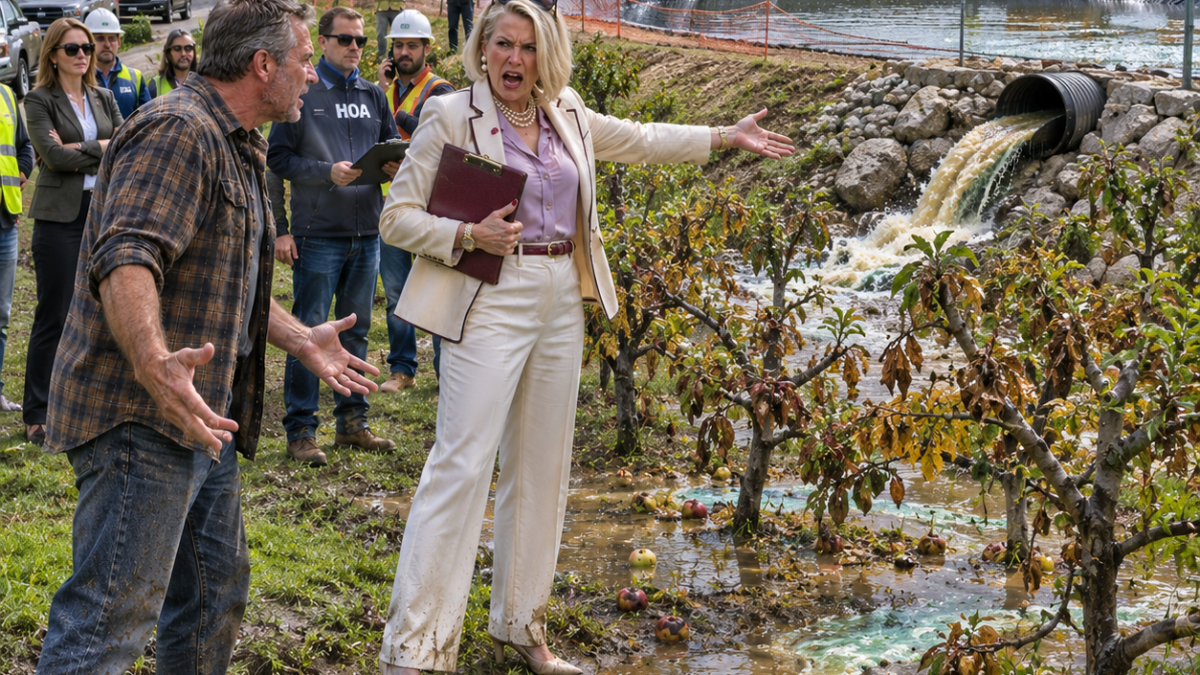
Karen stood above my orchard in a designer raincoat and watched chemically tainted water pour through trees my father had planted with his own hands.
When I demanded that she shut down the HOA drainage pond flooding my land, she looked me straight in the face and said, “Your orchard is in the way of community progress, so deal with it.”
What she didn’t understand was that land remembers everything done to it—and I was about to make sure the truth remembered her too.
My name is Michael Turner, though almost everyone around here calls me Mike.
I’m in my fifties now, gray starting to work its way through my hair, knees a little less forgiving than they used to be, but still strong enough to climb a ladder before sunrise and carry a crate of apples across fifteen acres without complaining too much.
The orchard has been part of my life longer than most people have known me.
My father worked this soil before I did.
He planted some of the oldest apple trees when I was still young enough to think farming meant riding on the tractor and eating fruit before lunch.
I eventually learned differently.
Farming is patience.
It is frost warnings at three in the morning.
It is watching the sky during blossom season.
It is losing sleep over insects no bigger than your thumbnail.
It is knowing which row drains faster after heavy rain and which tree always produces sweeter apples on the western side.
And if you farm organically, it is also discipline.
You don’t get to cut corners.
You don’t get to shrug when chemicals touch the soil.
Certification is built over years and can be destroyed in a single careless afternoon.
That mattered because my orchard was certified organic.
Fifteen acres.
Three decades of soil management.
Thirty years of building trust with customers who drove across the county because they knew exactly what they were buying from me.
My father used to say we weren’t really growing apples.
We were borrowing the land from whoever came after us.
I planned to leave it healthy.
That was the promise.
Then Maplewood Ridge Estates arrived on the hill above me.
The development was new compared with my property.
Luxury homes.
Stone facades.
Perfect lawns.
A clubhouse.
A pool big enough for a small hotel.
And, of course, an HOA.
My orchard wasn’t part of it.
That fact was important.
My deed predated the development by decades.
I paid no dues.
I signed no covenants.
Their architectural rules meant nothing on my side of the property line.
The HOA’s president, however, had a different interpretation.
Her name was Karen Whitmore.
The first time I saw her, she stepped out of a black luxury SUV wearing a bright pink blazer, oversized sunglasses, and the expression of a woman inspecting property she assumed belonged to her.
She didn’t introduce herself.
She looked across my orchard and said, “Interesting.”
I was repairing a fence.
“What is?”
“The agricultural view.”
I waited.
She smiled.
“It’s very rustic.”
“My father would have considered that a compliment.”
“I’m not sure I meant it as one.”
That was Karen.
She could turn four ordinary words into a property dispute.
A week later, I received an HOA notice informing me that my red storage shed caused a “visual inconsistency” with the community’s approved color palette.
I laughed and threw the letter on my kitchen counter.
The shed had been red since Ronald Reagan was president.
Karen followed that with another notice concerning tree height.
Then another about visible agricultural equipment.
Then one suggesting my orchard might negatively affect neighboring property values.
I kept every letter.
Not because I was afraid of them.
Because my father had taught me that when someone keeps telling you who they are, eventually you should believe them.
Then one spring morning, the first excavator arrived.
From the lower orchard, I heard engines grinding above the ridge.
By the time I climbed the hill, construction crews were laying out orange stakes near Karen’s property.
She stood among them pointing at blueprints.
The shape on those plans was unmistakable.
A pond.
“What are you building?” I asked.
Karen barely looked at me.
“A community drainage-retention feature.”
“What does that mean?”
“A beautiful solution to stormwater management.”
“Where does the water go?”
She finally turned.
Her sunglasses reflected my orchard below.
“Downhill.”
My stomach tightened.
Downhill meant me.
“Karen, what’s feeding that pond?”
“Runoff.”
“What kind?”
She sighed.
“Rainwater. Pool overflow. Landscape drainage. Normal community water.”
Pool overflow.
Landscape drainage.
Chemicals.
And directly below it sat fifteen acres of certified organic soil.
I pointed toward my trees.
“If anything treated comes through that system, it can destroy my certification.”
Karen smiled.
Not kindly.
“Mike, you need to understand something.”
“What?”
“The community can’t stop improving because your orchard is inconveniently located.”
I stared at her.
She gave one dismissive little shrug.
“Progress requires compromise.”
“My land isn’t yours to compromise.”
She turned back toward the contractors.
And that was when I knew we had a problem.
Not because Karen was building a pond.
Because she had already decided who would pay the price if that pond failed.
Me.
PART 2
I walked back down the hill feeling something between fear and anger tightening in my chest.
Farmers understand water.
We have to.
Water is life when it arrives where it belongs.
Too little and trees weaken.
Too much and roots suffocate.
Water carrying the wrong thing can destroy soil faster than most people realize.
Karen called her project a drainage-retention feature.
I called it a loaded gun pointed downhill.
The next few weeks confirmed my worst instincts.
Heavy machinery came and went almost every day.
Excavators carved a wide basin into the slope.
Truckloads of gravel arrived.
Crews installed thick black liner.
Concrete was poured around several intake structures.
Neighbors from the HOA wandered past with coffee cups and complimented Karen on her “vision.”
I heard the words every time I worked near the upper rows.
“Eco-friendly.”
“Beautiful.”
“Modern.”
“Great for property values.”
Karen loved giving tours.
She would stand with one hand on her hip and explain how the pond would collect stormwater while becoming a landscaped centerpiece for the neighborhood.
She talked about decorative reeds.
Stone paths.
Benches.
Maybe even low-voltage lighting.
What she rarely mentioned was where the water went after the pond filled.
I watched that part.
One afternoon, I saw workers unloading pipe near the bottom edge of the basin.
I walked up.
A young contractor was kneeling beside a trench.
“Where does that run?”
He looked toward the project manager.
The manager looked toward Karen.
That told me more than the answer.
“Storm overflow,” the manager finally said.
“Where does it discharge?”
He pointed vaguely downhill.
“Natural grade.”
“My orchard is natural grade.”
Karen approached before he could respond.
“Mike.”
“Karie.”
Her expression hardened.
“You’re interfering with contractors.”
“I asked a question.”
“They’re working.”
“So answer it.”
She looked down the slope.
“The system releases excess water according to gravity.”
“That’s a fancy way of saying onto my land.”
“Water has always flowed downhill.”
“Not through a pipe you installed.”
She crossed her arms.
“You’re making this adversarial.”
“You built a drainage pond above my orchard without talking to me.”
“We don’t require your permission to improve HOA property.”
“No. But you need permission to use mine as your discharge field.”
Her jaw tightened.
“Nothing is being discharged onto your property.”
I looked at the pipe.
Then at her.
“Good.”
She seemed relieved for half a second.
I continued.
“Then you won’t mind if I document where it goes.”
The relief disappeared.
“Why are you so determined to create conflict?”
“I’m determined to protect my land.”
Karen laughed softly.
“You farmers get very emotional.”
My father had spent forty years teaching me patience.
Karen could burn through it in forty seconds.
Still, I walked away.
Because I had learned something.
Karen didn’t like the word document.
People who are confident in what they’re doing usually don’t mind records.
People who are hiding something hate them.
So I began keeping records.
Photographs.
Construction dates.
Pipe locations.
Weather.
Copies of every HOA notice.
County permit searches.
Anything publicly available.
The approved plans were harder to interpret than I expected, but one thing stood out.
The drainage design submitted to the county did not clearly show the pipe I had seen being installed toward my orchard.
That worried me.
Then I found something else.
The community pool had recently upgraded its filtration and chemical-management system.
More frequent backwashing.
Higher capacity.
More treated overflow.
The newsletters bragged about improved sanitation.
Great for swimmers.
Not great for organic farmland if somebody decided the cheapest place to send that water was downhill.
I drove to the county planning office.
The woman behind the counter pulled up the approved drawings.
I pointed.
“Where is the discharge line?”
She enlarged the plan.
“Primary overflow is supposed to be contained within the engineered drainage corridor.”
“Where?”
She pointed toward the eastern side of the development.
That route did not lead to my orchard.
“What if they changed it?”
“They’d generally need amended approval depending on the work.”
“Has one been filed?”
She searched.
Then shook her head.
“No amendment that I can see.”
I thanked her.
My concern became suspicion.
Suspicion became dread two mornings later when surveyors appeared along my southern fence.
I found two men in reflective vests looking at a tablet.
“You boys lost?”
The younger man nearly jumped.
The older one straightened.
“We’re verifying coordinates.”
“For who?”
“Maplewood Ridge HOA.”
“You’re standing on my property.”
He looked down.
“I don’t believe we are.”
I pointed toward an old survey pin beside the fence post.
“That says otherwise.”
He checked his tablet.
Then the pin.
Then the tablet again.
Their digital boundary extended several feet into my orchard.
“Who gave you these coordinates?”
“The client.”
“Karen?”
He didn’t answer.
He didn’t need to.
“You have permission to survey HOA land.”
I pointed back toward the ridge.
“You do not have permission to enter mine.”
The men packed up without arguing.
Before leaving, the older surveyor said quietly, “You might want your own boundary survey updated.”
“I already have one.”
That seemed to surprise him.
My father had drilled one habit into me harder than any other.
Know exactly what you own.
That afternoon I pulled the certified survey from my fireproof cabinet.
The property line was exactly where I remembered.
The next day I had bright boundary flags installed.
Karen hated them.
She came down wearing white pants that had no business being near an orchard.
“What are those?”
“Boundary markers.”
“They’re ugly.”
“Good thing my land isn’t in your HOA.”
“They’re visible from our walking path.”
“You don’t have a walking path here.”
“Yet.”
I looked at her.
“Yet?”
She realized she’d said too much.
“Community planning is ongoing.”
“Planning for what?”
Karen smiled tightly.
“Nothing that concerns you.”
She walked away.
But it concerned me now.
I started listening more carefully.
Neighbors talked.
People always do.
Karen had a larger plan for that side of Maplewood Ridge.
The pond was supposed to become the centerpiece of a scenic walking trail.
Benches.
Lighting.
Viewing areas.
Potential expansion along the ridge.
My orchard blocked the easiest route.
Suddenly the strange boundary coordinates made sense.
Karen didn’t necessarily expect to take my land tomorrow.
She was creating pressure.
If drainage problems damaged the orchard badly enough, its value dropped.
If organic certification vanished, my income dropped.
If the land became difficult to farm, maybe the stubborn old orchard owner finally sold.
I couldn’t prove that was the plan.
Not yet.
But I knew enough to stop calling Karen merely annoying.
She was dangerous.
The final construction phase began in early summer.
More pipe arrived.
A secondary line was installed.
They buried it quickly.
I watched from my property.
Karen watched me watching.
Neither of us waved.
Then the weather forecast changed.
Severe thunderstorms.
Three inches of rain possible.
I spent the afternoon checking my own drainage channels.
At dusk the clouds turned black.
By seven, thunder rolled over the ridge.
At seven-thirty, rain came down hard enough to blur the houses above me.
I put on boots and a waterproof coat.
Linda—my sister, who lived in town and checked on me more often than I admitted I appreciated—had called earlier.
“Don’t go climbing around in a thunderstorm.”
“I’m not climbing.”
“What are you doing?”
“Observing.”
“You sound exactly like Dad.”
“That’s not an insult.”
“Mike.”
“I’ll be careful.”
I waited until the worst lightning moved east.
Then I walked toward the southern rows.
At first, everything looked normal.
Rainwater moving between swales.
Leaves shining.
Mud forming near the tractor lane.
Then I heard it.
A roar.
Not rain.
Running water.
I pushed through the trees and saw a stream pouring down from the upper slope.
Not trickling.
Pouring.
A concentrated flow blasted from the direction of the new drainage line.
Water cut through mulch.
It tore shallow trenches into soil.
It spread between my lowest apple rows.
I ran toward it.
The smell hit me before I touched anything.
Sharp.
Clean.
Artificial.
Chlorine.
I crouched.
The runoff was cloudy under my flashlight.
Bits of fertilizer pellets and landscape debris moved through it.
My stomach dropped.
“Son of a…”
Lightning flashed.
For one white second the ridge lit up.
And there she was.
Karen.
Standing beneath the awning of her luxury home.
Watching.
She wasn’t running toward the pond.
She wasn’t calling contractors.
She wasn’t surprised.
She simply watched water from her project pour into my orchard.
I shouted.
“KAREN!”
She didn’t move.
“KAREN! SHUT IT DOWN!”
The wind carried my voice uphill.
She turned and went inside.
That hurt more than I expected.
Not because I needed her help.
Because it told me everything.
The next morning, the orchard smelled wrong.
Farm soil has a smell after rain.
Dark.
Rich.
Alive.
That morning, there was something underneath it.
Chemical.
I walked the lower rows before sunrise.
Water still stood around several trees.
Leaves on young branches were curling.
Some had already begun yellowing at the edges.
I knelt and pushed my fingers into the soil.
Too slick.
Too saturated.
I remember resting my hand against my knee and thinking:
Dad trusted me with this.
That was the first moment fear overwhelmed anger.
An orchard isn’t replaceable like a fence.
Trees take years.
Soil takes longer.
Organic certification is based on trust and process.
If chemical contamination spread widely enough, thirty years of work could become worthless on paper almost overnight.
I went home and collected sterile sample containers.
Water.
Soil.
Locations upstream.
Locations near the runoff.
Control samples from the far end of the orchard.
I labeled everything.
Time.
Date.
GPS location.
Weather.
I photographed the flow path.
Then Karen appeared at the fence.
Designer umbrella.
Designer boots.
Designer indifference.
“Morning, Mike.”
I didn’t answer.
She looked over the wet orchard.
“Quite a storm.”
I screwed the lid onto a sample jar.
“What are you doing?”
“Collecting evidence.”
That got her attention.
“Evidence of what?”
“Your drainage.”
She laughed.
“Rain isn’t my drainage.”
“The pipe is.”
“There was extraordinary rainfall.”
“There was chlorinated water pouring through my trees.”
Karen frowned.
“You don’t know that.”
“I have a nose.”
“Oh, please.”
I stood.
“I’ll also have a laboratory report.”
Her expression flickered.
“Lab?”
“Yes.”
“For rainwater?”
“For whatever your pond sent onto my property.”
Karen stepped closer to the fence.
“Mike, the HOA uses environmentally responsible products.”
“Chlorine is chlorine.”
“It dissipates.”
“Not before it enters soil.”
She gave me that patronizing smile again.
“Maybe organic farming standards are simply unrealistic in a modern residential area.”
I stared at her.
“My farm was here first.”
“And the community is here now.”
There was the real Karen.
No concern.
No apology.
Only hierarchy.
She continued.
“Things change.”
“They do.”
I held up the sample jar.
“That’s why laboratories exist.”
Her smile disappeared.
“You are deliberately creating trouble.”
“No.”
I capped another container.
“I’m measuring it.”
I drove the samples to an environmental laboratory in town.
For two days I barely slept.
Every morning, more signs appeared.
Leaf damage.
Premature fruit drop.
Several young trees looked stressed.
I had spent decades learning the difference between normal seasonal change and something wrong.
This was wrong.
The lab called late Wednesday.
“Mike?”
“Yes.”
“This is Aaron from the environmental lab.”
My stomach tightened.
“What did you find?”
“The samples closest to the southern drainage path show chlorine concentrations between roughly 2.8 and 3.4 parts per million.”
I closed my eyes.
“And the control samples?”
“Much lower. Essentially background for what we tested.”
“So it’s coming from uphill.”
“I can’t legally tell you the source without tracing work, but the pattern is significant.”
“What about soil?”
“There are chemical signatures consistent with treated runoff.”
I sat down.
For several seconds, I couldn’t speak.
Aaron continued carefully.
“If you’re maintaining organic certification, you should contact your certifier immediately.”
That sentence felt like a punch.
“Yeah.”
“I’m sorry.”
“Thanks.”
I hung up.
Then I walked outside.
My father’s oldest tree stood near the center row.
He had planted it decades earlier.
Its trunk was thick and scarred.
One limb had been lost to an ice storm.
Another had been braced after heavy fruiting.
Dad used to stand beneath it every September and pretend to complain that I was picking too early.
I put my hand against the bark.
“I’m sorry.”
The words came out before I realized I was speaking.
“I should’ve stopped this sooner.”
The tree, obviously, said nothing.
But farms have a way of making you talk to things that cannot answer.
“I’m going to fix it.”
That evening I walked up to Karen’s house.
Calling it a house almost felt dishonest.
It was nearly a mansion.
Stone exterior.
Tall windows.
Iron railings.
A wide terrace overlooking the entire hillside.
The pond sat nearby like a decorative jewel.
Karen was on the porch drinking white wine.
She watched me approach.
“Mike.”
“I got the lab results.”
She took a sip.
“And?”
“Your runoff is contaminated with chlorine.”
She didn’t move.
“Enough to damage soil.”
Nothing.
“Enough to threaten my organic certification.”
Karen set down her glass.
“I’m sure there’s another explanation.”
“There isn’t.”
“You don’t know that.”
“I tested the water coming from the drainage route.”
She sighed.
“Mike, your orchard has been around for thirty years. Maybe it’s finally having problems.”
I stared at her.
“You think my entire southern row developed chlorine damage the same night your new outflow pipe activated by coincidence?”
“You’re being emotional.”
“Yes.”
That surprised her.
I took another step.
“I am emotional.”
My voice stayed calm.
“My father planted those trees.”
Karen looked uncomfortable for the first time.
“My livelihood is down there.”
“Mike—”
“My customers trust me.”
“I’m sure—”
“And you sent treated water through it because rerouting your project would have been inconvenient.”
She stiffened.
“You don’t know anything about the design.”
“I know enough.”
“The county approved it.”
“The county approved a different discharge plan.”
Her face changed.
Barely.
But enough.
“You’re wrong.”
“I saw the permit.”
Karen picked up her wine.
“The HOA has attorneys.”
“So do orchards.”
She laughed.
“You hired a lawyer?”
“Not yet.”
“Then don’t threaten me.”
“I’m giving you one chance before I do.”
She stared.
“Redirect the drainage.”
“No.”
“Stop using the pond until the system is inspected.”
“No.”
“Pay for independent testing.”
“No.”
“Then I’ll take legal action.”
Karen smiled.
That cold, thin smile.
“You really think your little orchard can take on an HOA?”
“My little orchard was here before your HOA.”
“We have resources.”
“I have evidence.”
“We have lawyers.”
“I have poisoned soil.”
Karen stepped close enough that I could smell her perfume.
“You don’t understand how these things work.”
“I understand water flows downhill.”
Her eyes narrowed.
“If you interfere with this project, we’ll pursue you for obstruction, harassment, defamation, anything our counsel recommends.”
“Defamation requires false statements.”
“People believe whoever sounds credible.”
That sentence stayed with me.
Not because it scared me.
Because Karen had accidentally explained her entire life.
She believed truth was whatever the person with the most authority could make others accept.
I looked at her porch.
The expensive stone.
The polished railings.
The pond beyond it.
The manicured hillside.
Everything arranged perfectly.
Everything designed to impress.
And below it all, my orchard was absorbing the cost.
“I’ll see you in court.”
Karen smiled.
“Good luck.”
I turned away.
Behind me she called:
“Mike.”
I looked back.
Her expression had gone hard.
“Your orchard is in the way of community progress.”
She lifted her wine glass slightly.
“Deal with it.”
I didn’t answer.
I walked home.
The next morning, six HOA notices were waiting.
Six.
Apparently Karen had spent the evening getting creative.
Non-compliant structure color.
Visual obstruction.
Agricultural equipment visible from common areas.
Unapproved commercial activity.
Potential nuisance odor.
Grass-height violations.
That last one impressed me.
I didn’t have a lawn.
I had an orchard floor.
I filed every letter.
Three days later, a county inspector arrived.
“Mr. Turner?”
“Mike.”
“We received a complaint about unauthorized water retention structures.”
I laughed.
The inspector looked confused.
“Sorry.”
I pointed uphill.
“You’re looking for Karen’s structures.”
“This complaint is against you.”
“I know.”
He spent twenty minutes walking my property.
Then he closed his notebook.
“There’s nothing here.”
“Correct.”
“You’re not building a retention basin.”
“No.”
“Any excavation?”
“Only normal irrigation maintenance.”
He looked toward the HOA ridge.
“Neighbor dispute?”
“Environmental contamination.”
He sighed.
“I’m closing the complaint.”
“Would you mind putting that in writing?”
“Absolutely.”
Karen came down that evening furious.
“Did you tell him I filed a false complaint?”
“No.”
“He called it unfounded.”
“That sounds like something he concluded after finding it unfounded.”
“You’re making me look dishonest.”
“I’m sitting here pruning apples.”
“This is harassment!”
I straightened.
“Karen.”
“What?”
“You sent the inspector.”
Her mouth closed.
“You filed the complaint.”
Silence.
“You are standing on my property yelling.”
She looked down.
Her shoes were inside my boundary flags.
“Step back.”
She did.
“That line matters.”
Karen turned and stormed uphill.
That night I called Daniel Keats.
Daniel was an environmental attorney whose name had come from two different farmers and one conservation consultant.
He arrived the next morning in an old SUV that looked far less expensive than Karen’s and somehow much more intimidating.
He shook my hand.
“Mike?”
“Daniel.”
We sat at my kitchen table.
I had prepared files.
Photographs.
Lab reports.
Permit records.
HOA notices.
Survey.
Timeline.
Daniel stared at the stacks.
“Do you secretly practice law?”
“No.”
“You’ve done half my intake work.”
“My father liked records.”
“Smart man.”
“He also distrusted people who said ‘trust me.’”
“Smarter man.”
Daniel reviewed the lab numbers.
His expression hardened.
“This is serious.”
“I know.”
“You notified the certifier?”
“Yes.”
“What did they say?”
“Temporary review. Affected zones may be suspended depending on remediation.”
Daniel whistled softly.
“Potential losses?”
“Depends how far it spreads.”
“Could be years.”
“Yes.”
He tapped the permit.
“You said the actual pipe doesn’t match this.”
“Correct.”
“We need proof.”
“I can get it.”
“No trespassing.”
“I know.”
“Nothing stupid.”
“I’m a farmer, not an idiot.”
Daniel looked at the six HOA notices.
“I’m still deciding.”
I almost smiled.
Over the next week, I documented everything from my side of the property.
Cameras on my land recorded the drainage path.
Rainfall data.
Water flow.
Damage.
Every affected tree got a number.
Every soil sample had a location.
I began building a visual map.
Daniel obtained public contractor records.
Then something unexpected happened.
Laura Benson, an HOA board member, found me near the upper row.
She looked nervous.
“Mike.”
“Laura.”
“I need to ask you something.”
“Okay.”
“Did you really test the water?”
“Yes.”
“How bad?”
I told her.
She covered her mouth.
“Karen told us you were exaggerating.”
“I’m not.”
“She said the pond was fully compliant.”
“Do you want to see the permit?”
Laura glanced uphill.
“I probably shouldn’t be here.”
“You’re standing on a county-access shoulder.”
She almost smiled.
Then lowered her voice.
“The board never approved chemical discharge.”
“That’s useful.”
“I didn’t say that.”
“You just did.”
Her face tightened.
“Please don’t quote me.”
“I won’t unless you agree.”
She turned to leave.
Then stopped.
“Check the project budget.”
“What?”
“Just check it.”
“Why?”
Laura walked away.
That night Daniel and I started digging.
The financial records exposed the decision.
The original engineering proposal was more expensive.
It included rerouting drainage away from my property.
Proper containment.
Filtration.
A safer discharge corridor.
Then Karen had pushed for revisions.
Cheaper.
Faster.
More visually attractive.
Emails eventually surfaced.
One from Karen read:
THE REROUTE IS EXCESSIVE.
IT DELAYS LANDSCAPING.
PROCEED WITH THE LOWER-COST OPTION.
Another:
WE NEED THE POND COMPLETE BEFORE THE SUMMER PROPERTY TOUR.
The most damaging email came later.
A contractor had warned that the cheaper option increased the risk of downhill discharge during storms.
Karen replied:
THE ORCHARD IS OUTSIDE OUR COMMUNITY.
WE ARE NOT RESPONSIBLE FOR HIS LAND MANAGEMENT.
Daniel put the email on my kitchen table.
Neither of us spoke for a moment.
Finally he said:
“Well.”
I stared at Karen’s words.
“She knew.”
“Yes.”
“She knew the orchard could take the runoff.”
“Yes.”
“And she chose it anyway.”
Daniel nodded.
“This changes the case.”
“From what?”
“Ordinary negligence to potentially willful disregard.”
I leaned back.
My hands were shaking.
I had spent weeks trying to tell myself Karen was careless.
Carelessness I could understand.
People make mistakes.
They rush projects.
They trust bad contractors.
They misunderstand drainage.
But this?
This was a decision.
She had looked at the safer option.
Looked at the cost.
Looked at my orchard.
And chosen my orchard.
Daniel tapped the email.
“Mike.”
I looked up.
“Don’t do anything angry.”
“I’m not angry.”
“Yes, you are.”
I looked toward the window.
The trees outside were moving in the breeze.
“I’m beyond angry.”
“Then let me be angry professionally.”
That made me laugh despite myself.
“Fine.”
“We send a preservation notice.”
“To the HOA?”
“To everybody.”
Contractors.
Board.
Karen.
Insurance carrier.
“And then?”
“We make sure nobody deletes anything.”
The legal notices went out.
Karen responded with fury.
An HOA email accused me of conducting “a coordinated harassment campaign.”
I framed it.
Not literally.
But I considered it.
Then Karen announced the HOA’s annual Community Improvement Tour.
That was her mistake.
She invited real-estate agents.
Design professionals.
Potential buyers.
Regional lifestyle media.
The pond would be the centerpiece.
Daniel called.
“I know that tone.”
“What tone?”
“The one where you’re about to suggest something annoying but legal.”
“Can I put signs on my property?”
“Yes.”
“Can the signs describe documented contamination?”
“If accurate.”
“Can I stand in my orchard?”
“Last I checked.”
“Can people see me from the pond?”
Daniel sighed.
“Mike.”
“I’m asking legal questions.”
“You’re becoming my most educational client.”
The morning of Karen’s showcase, I placed several signs along my upper orchard.
ORGANIC ORCHARD DAMAGED BY HOA DRAINAGE.
ENVIRONMENTAL TESTING IN PROGRESS.
PRIVATE PROPERTY.
I positioned them entirely on my land.
No insults.
No exaggeration.
Just facts.
Around ten, cars began arriving.
Luxury SUVs.
A few sedans.
One van from a design publication.
I could hear Karen talking from uphill.
“Welcome to Maplewood Ridge.”
“This project represents our commitment to sustainable community development.”
I nearly dropped my pruning shears laughing.
Then someone noticed the signs.
Human curiosity did the rest.
“What does that say?”
Karen’s voice changed.
“Oh, ignore that.”
Bad choice.
Never tell adults at a showcase to ignore a contamination warning.
Within minutes, half the group was staring downhill.
I kept working.
Karen tried moving them toward the pond.
A man called out.
“Is that an organic orchard?”
I looked up.
“Yes.”
Karen interrupted.
“Mike is not part of the event.”
The man pointed toward the sign.
“Was it actually contaminated?”
I held up a folder.
“Independent lab results say yes.”
Silence.
Karen came to the railing.
“This is inappropriate.”
I opened the report.
“Chlorine measured between 2.8 and 3.4 parts per million in runoff samples from the affected drainage path.”
A woman with a camera stepped forward.
“Do you have documentation linking the runoff to this pond?”
“Video. GPS flow maps. Soil tests. Permit records.”
Karen laughed too loudly.
“He is in litigation with the HOA.”
Daniel had told me not to argue.
So I simply said:
“Not yet.”
That made Karen look worse.
One architect studied the pond.
Then the hillside.
“Where’s the filtration stage?”
Karen answered quickly.
“The system was professionally designed.”
“By whom?”
“Our contractor.”
“Which engineering firm?”
Karen paused.
The architect frowned.
Another person pointed at the lower berm.
“That outlet looks undersized.”
Karen’s face reddened.
“This isn’t an engineering review.”
The woman with the camera introduced herself as a writer covering sustainable design.
“Would you mind if I photograph the project?”
Karen said:
“Yes.”
Far too fast.
The writer glanced at me.
“Can I photograph your orchard from your property?”
“If you stay where I point.”
Karen snapped.
“No.”
The writer looked confused.
“It’s his property.”
“This is a private community event.”
I called uphill.
“My orchard isn’t part of your community.”
Guests began moving toward the public access edge.
Karen tried stopping them.
That turned curiosity into suspicion.
The architect eventually came close enough to inspect the drainage route from the legal boundary.
He crouched.
Looked at the damaged soil.
Smelled the standing water.
Then looked uphill.
“This isn’t good.”
Karen heard him.
“What does that mean?”
“It means I would want an engineer reviewing this immediately.”
“The system was reviewed.”
He pointed.
“Then somebody needs to explain why discharge is reaching agricultural land.”
Guests began asking questions.
Had the board known?
Did the county approve it?
Was the orchard losing certification?
Why was the HOA calling the pond sustainable?
Karen’s showcase collapsed in less than twenty minutes.
A pair of real-estate agents left early.
The journalist photographed the warning signs.
Someone took pictures of the damaged trees.
Karen walked downhill toward me.
Her face was red.
“You did this intentionally.”
“I placed signs on my property.”
“You humiliated me.”
“I published lab numbers.”
“You sabotaged my event.”
I looked toward the pond.
“No.”
I pointed at the drainage line.
“That sabotaged your event.”
“You are going to regret this.”
“You keep saying that.”
“I mean it.”
“So do the lab results.”
She turned away.
By the next morning, photographs were circulating online.
Not nationally.
Not some ridiculous viral scandal.
But enough locally to matter.
A design publication posted a short item questioning whether the HOA’s “sustainable pond” was properly engineered.
A regional real-estate page shared photographs of the damaged orchard.
Residents started asking questions publicly.
Karen responded the only way she knew how.
She doubled down.
Construction trucks arrived at dawn.
I watched crews haul dirt toward the drainage slope.
A bulldozer appeared.
Then concrete equipment.
I called Daniel.
“What are they doing?”
He sounded instantly concerned.
“Do not interfere.”
“They’re covering the outlet.”
“Photograph from your property.”
“They’re burying evidence.”
“Photograph everything.”
Karen stood on the hillside directing workers.
I walked up to my boundary.
“What are you doing?”
She turned.
“Corrective maintenance.”
“You’re burying the discharge route.”
“We are reinforcing natural drainage.”
“After receiving a preservation notice?”
Her expression flickered.
“This isn’t evidence.”
“The pipe is evidence.”
“You don’t own it.”
“I don’t need to own it.”
Karen pointed downhill.
“Get back on your property.”
“I’m on it.”
She looked at my boots.
I was inches behind the survey flag.
That annoyed her more.
“You think you’re clever.”
“No.”
I held up my phone.
“I think I’m recording.”
She turned toward the contractor.
“Cover every exposed section.”
The contractor hesitated.
“Ma’am, there’s a lot of saturation.”
“Do it.”
“If we add that much fill—”
“I said do it.”
I remember that moment clearly.
A professional warned her.
Again.
Karen ignored him.
Again.
They dumped more soil onto the slope.
Heavy wet fill.
Then rain began.
Not a storm at first.
Just steady rain.
I returned to the orchard.
Twenty minutes later I heard rushing water.
A new stream appeared farther east.
Karen’s attempted reinforcement had changed the flow path.
Water was now cutting toward a section of orchard that had escaped the first contamination.
I ran uphill.
“STOP!”
Workers looked down.
“SHUT THE EQUIPMENT OFF!”
Karen shouted back:
“Stay off HOA property!”
“You’re redirecting water!”
“Mind your orchard!”
“That’s exactly what I’m doing!”
The contractor finally saw it.
“Kill the dozer!”
Engines shut down.
Too late.
Water cut into the fresh fill.
A channel formed.
Then widened.
A section of saturated soil slumped.
The hillside moved.
Not a massive landslide.
But enough.
Mud and fill crashed through a fence section.
Workers ran.
One man barely cleared the slide.
Karen screamed.
For a few seconds nobody moved.
Then the contractor yelled:
“Everybody back!”
Water poured through the broken slope.
This time, even Karen couldn’t pretend it was natural.
She stood near the terrace of her luxury home staring at the mess below.
Mud covered part of her landscaped hillside.
The decorative path was torn up.
Her fence leaned at an angle.
The same water she had treated like somebody else’s problem was now cutting through the manicured property she had spent years displaying as proof of her authority.
I won’t pretend I felt sorry for the landscaping.
But I didn’t celebrate either.
Because the water kept moving.
Toward my trees.
I grabbed a shovel and tried to protect the roots in the nearest row.
A worker came running down.
“Where do you want a temporary berm?”
I pointed.
“Keep it away from the trunks.”
For the next hour, farmers and contractors did what Karen had failed to do from the beginning.
We worked with the land instead of pretending we controlled it.
By dusk, the flow slowed.
I stood in mud nearly to my knees.
Karen remained uphill.
Her beautiful slope looked like a construction disaster.
My orchard looked worse.
Daniel arrived at sunrise.
He walked the damage silently.
Then he looked at the collapsed fill.
“This is catastrophic for them.”
“What about me?”
“Also catastrophic.”
“Great.”
He pointed uphill.
“She altered a disputed drainage system after receiving preservation notice.”
“Yes.”
“Against a contractor’s warning.”
“Yes.”
“Then caused additional discharge.”
“Yes.”
Daniel rubbed his forehead.
“I need more coffee.”
“Is that legal advice?”
“Strongly.”
The HOA board arrived before noon.
Laura.
Weston.
Three other members.
Karen met them in her driveway.
I could hear shouting from below.
Eventually Laura called me.
“Mike.”
I walked to the boundary.
“What?”
“We need to talk.”
Karen spun.
“No, we do not!”
Laura turned on her.
“Karen, enough.”
The entire hill went quiet.
I had never heard anybody on that board speak to Karen that way.
Weston held printed photographs.
“This isn’t the system we approved.”
Karen scoffed.
“Yes, it is.”
“No.”
He pointed at the drainage route.
“The outlet was moved.”
“It was a field adjustment.”
“The liner was changed.”
“Contractor decision.”
“The filtration component is missing.”
“It wasn’t necessary.”
Laura stared at her.
“You told us it was included.”
Karen’s mouth opened.
Nothing came out.
Daniel arrived carrying his briefcase.
Karen looked at him.
“Why is he here?”
“Because you contaminated my land.”
“This is an HOA meeting.”
Daniel smiled.
“I’m not attending the meeting.”
He handed Laura a copy of the lab results.
“I’m delivering notice.”
Weston read the numbers.
His face drained.
Laura looked toward the orchard.
“How bad?”
Daniel answered.
“Potential loss of organic certification in affected acreage. Soil remediation. Crop loss. Possible tree replacement. Engineering correction. Legal costs.”
Karen snapped.
“He’s exaggerating.”
Daniel opened another folder.
“These are your emails.”
Karen froze.
Laura took the pages.
She read the first one.
Then the second.
Then the contractor warning.
Her expression changed from confusion to fury.
“You rejected the safe design?”
Karen stepped closer.
“It was unnecessary.”
“You told us the safe design was already included.”
“I said the system was safe.”
“You told us rerouting would cost forty thousand more because the engineer was padding the bid.”
“He was.”
Weston looked at another email.
“This says he warned about discharge onto Mike’s orchard.”
Karen said nothing.
Laura looked up.
“You knew.”
“No.”
“It’s in writing.”
“I didn’t know it would actually happen.”
“That is not the same thing!”
Karen’s voice rose.
“I was trying to complete the project!”
“For what?”
“For the community!”
I couldn’t stay silent.
“You did it for the tour.”
Karen turned toward me.
“Stay out of this!”
Daniel spoke calmly.
“Mr. Turner is the damaged property owner. Staying out of this stopped being an option weeks ago.”
Karen looked around at the board.
“You’re all going to let him do this?”
Laura shook her head.
“No.”
For one second Karen looked relieved.
Then Laura continued.
“We are going to vote on removing you as president.”
Karen went still.
“You can’t.”
“We can.”
“I built this HOA.”
Weston laughed bitterly.
“You didn’t build it.”
“I saved property values!”
“You exposed us to a six-figure environmental claim.”
Karen grabbed the porch railing.
“You’re panicking.”
“Yes.”
Laura held up the emails.
“Because you lied to us.”
“I made executive decisions.”
“You made decisions without disclosure.”
“For the good of the community!”
“No.”
I said it quietly.
Everyone looked at me.
“You made them so people would praise you.”
Karen’s face twisted.
“You don’t know me.”
“I know what you told the contractor.”
Silence.
“You knew the safe route cost more.”
Her breathing quickened.
“You knew the cheaper design could discharge downhill.”
She shook her head.
“You knew my orchard was below it.”
“Stop.”
“And you chose the cheaper route because you wanted your pond completed before the showcase.”
“STOP!”
Her scream echoed across the hillside.
Nobody moved.
Karen pointed at me.
“You did this!”
“No.”
“You turned everyone against me!”
“No.”
“You destroyed the project!”
I looked at the collapsed slope.
“You did.”
Her shoulders shook.
Daniel stepped forward.
“We’ll be sending a formal complaint seeking damages and remediation.”
Karen stared at him.
“There will be no settlement.”
“Then we file.”
“I’ll fight.”
“Good.”
Daniel closed his briefcase.
“I like trials.”
Karen finally looked afraid.
The emergency HOA meeting happened that afternoon.
Karen was removed.
The vote wasn’t close.
Laura became acting president.
The board notified its insurance carrier.
Outside engineers were hired.
The county opened an inspection.
The state agriculture department became involved because of the contamination.
The HOA’s luxury pond went from “crown jewel” to fenced-off liability zone overnight.
Yellow barriers went up.
Work crews appeared.
Karen’s hillside stopped looking like a resort brochure.
It became a construction site.
For weeks, excavators sat within view of her enormous windows.
Temporary drainage hoses ran past her landscaped terrace.
Mud replaced decorative stone.
Engineers came and went.
County inspectors parked near her driveway.
Insurance adjusters photographed everything.
The luxury home Karen once used like a palace now overlooked the physical evidence of every decision she had made.
That was the nightmare.
Not something I did to her house.
Something the truth did to the illusion she had built around it.
Meanwhile, I dealt with my own nightmare.
Certification officials inspected the orchard.
Several affected areas were placed under remediation review.
Produce from those zones could not be marketed the way it once had been.
Some trees survived.
Others deteriorated.
The worst moment came when one of the older trees my father planted started losing leaves rapidly.
I called an arborist.
He examined the roots.
“Stress is significant.”
“Can we save it?”
“Maybe.”
I hated that word.
Maybe.
Farmers live with maybe.
Maybe rain.
Maybe frost.
Maybe yield.
Maybe recovery.
But this tree was personal.
My father had planted it before I was old enough to remember.
I spent an afternoon pruning damaged growth.
At one point I found myself sitting on an overturned crate beneath its branches.
I thought about Dad.
He had died nine years earlier.
Quietly.
Heart failure.
He had known the orchard would be mine.
The last summer he was healthy enough to work, we walked these same rows.
He had leaned against this tree and said:
“Don’t be afraid to change things.”
I laughed.
“You hate change.”
“I hate stupid change.”
“That sounds more like you.”
He smiled.
Then he touched the bark.
“But protect the soil.”
“I will.”
“The trees come and go.”
“I know.”
“Buildings come and go.”
“I know.”
“People too.”
He looked at me.
“Soil is what remembers.”
Sitting under that tree years later, I finally understood why those words hurt so much.
I had promised him.
And someone else’s vanity had contaminated the thing he trusted me to protect.
I put my head in my hands.
For the first time since the dispute began, I cried.
Not dramatically.
Not loudly.
Just a tired man alone beneath an old apple tree.
Daniel found me there.
He had come to discuss mediation.
He stopped several yards away.
“Bad time?”
“Probably.”
He waited.
I wiped my face.
“Sit.”
He used another crate.
For a minute neither of us spoke.
Then he looked up.
“This one your father’s?”
“Yeah.”
“Is it going to make it?”
“Maybe.”
Daniel nodded.
“That’s a brutal word.”
I looked at him.
“You farm?”
“No.”
“I’ve been divorced.”
That made me laugh harder than it should have.
He opened his folder.
“The HOA wants mediation.”
“Karen?”
“The HOA.”
“What does Karen want?”
“War.”
“Of course.”
“She has very little authority left.”
“Good.”
Daniel handed me a damages summary.
Crop losses.
Soil remediation.
Tree replacement.
Engineering consultation.
Certification losses.
Legal fees.
Future monitoring.
The number at the bottom:
$380,000.
I stared at it.
“That’s a lot of apples.”
“It’s also conservative.”
“I don’t want to bankrupt the neighbors.”
“The HOA has insurance.”
“Will residents be assessed?”
“Potentially some portion, depending on coverage.”
I hated that.
Karen had made the decision.
But communities often pay for leaders they fail to control.
Daniel seemed to read my expression.
“You can demand individual liability against Karen where supported.”
“I don’t care about taking her house.”
“Good.”
He closed the folder.
“Because revenge makes terrible settlement strategy.”
“I want the orchard fixed.”
“Then that’s our priority.”
“And the pond removed.”
“If engineering supports it.”
“It will.”
“And no drainage onto my land.”
“Obviously.”
“And public acknowledgment that I wasn’t the one causing this.”
Daniel smiled.
“That part mattered, huh?”
“More than I wish it did.”
Mediation took place in January.
Cold morning.
Bare branches.
The orchard looked almost peaceful.
I walked the rows before sunrise.
The damaged tree was still standing.
That felt like a good sign.
Daniel picked me up at seven.
Karen was already inside the mediation center when we arrived.
She looked different.
No pink blazer.
No giant sunglasses.
Gray coat.
Hair pulled back.
Dark circles beneath her eyes.
She looked at me once.
Then away.
Laura and the other HOA board members sat together.
Their attorney looked exhausted.
Karen had separate counsel.
That told me plenty.
The mediator was a woman named Margaret Ellis.
She had the calm expression of someone who had watched wealthy adults argue over fences for thirty years.
She laid out the rules.
Daniel presented first.
No speeches.
No insults.
Just evidence.
Photographs before contamination.
Photographs after.
Lab results.
Flow maps.
Video.
County plans.
Contractor drawings.
Emails.
The safe design.
Karen’s rejection.
Her deadline for the property tour.
The warning.
The cheaper construction.
The first storm.
The runoff.
The attempt to alter the slope.
The second failure.
When Daniel finished, the room was silent.
The HOA attorney cleared his throat.
“We acknowledge construction deficiencies occurred.”
Daniel slid one email across the table.
“They were predicted.”
The attorney stopped.
Laura looked at Karen.
Karen stared straight ahead.
Margaret turned toward her.
“Ms. Whitmore, do you wish to respond?”
Karen’s lawyer whispered something.
Karen ignored him.
“I was trying to improve the community.”
Nobody spoke.
“The development needed something distinctive.”
Still silence.
“People complained that the neighborhood looked generic.”
Laura stared at her.
Karen continued.
“The pond would improve values.”
I said quietly:
“At the expense of mine.”
Karen finally looked at me.
“You fought everything.”
“What?”
“Every notice. Every conversation. Every request.”
“Because I wasn’t in your HOA.”
“You mocked me.”
“You sent me grass violations for an orchard.”
Laura closed her eyes.
Karen’s voice rose.
“You never cooperated.”
“With poisoning my land?”
“I didn’t know it would poison anything!”
Daniel slid the contractor warning closer to her.
“You knew there was a risk.”
Karen stared at it.
“That was overly cautious.”
“An engineer warned you.”
“They always warn people.”
“That’s their job.”
Karen looked toward the mediator.
“I was under pressure.”
“From whom?” Margaret asked.
Karen hesitated.
“The community.”
Laura immediately said:
“No.”
Karen turned.
“What?”
“No one pressured you to build that pond.”
“You all approved it.”
“We approved what you presented.”
“You voted.”
“On false information.”
Karen’s face reddened.
“I wanted people to see what I could accomplish.”
There it was.
The first completely honest sentence she had spoken.
Everyone heard it.
Karen looked down.
“I wanted Maplewood Ridge to be known for something.”
Laura whispered:
“At what cost?”
Karen didn’t answer.
Margaret turned to Daniel.
“Settlement demand?”
He handed over the breakdown.
“Three hundred eighty thousand dollars, plus full engineering correction, drainage reconstruction, environmental remediation obligations, monitoring, and specified attorney fees.”
Karen’s lawyer almost choked.
“That is absurd.”
Daniel pointed to the supporting sheets.
“Crop loss estimate.”
Another page.
“Soil remediation.”
Another.
“Certification-related revenue loss.”
Another.
“Engineering.”
Another.
“Tree replacement.”
Another.
“Legal expense.”
The mediator reviewed everything.
“This appears well documented.”
The HOA attorney asked for a private caucus.
They left.
Karen remained with her lawyer.
I sat opposite her.
For several minutes the room was silent.
Then she said:
“You enjoy this.”
Daniel looked at me but didn’t interfere.
I answered.
“No.”
Karen laughed bitterly.
“You expect me to believe that?”
“I enjoyed beating you at first.”
She looked surprised.
“I enjoyed watching people finally tell you no.”
I folded my hands.
“But I don’t enjoy walking through dying trees.”
Her face changed slightly.
“I didn’t mean for that.”
“Intent doesn’t make the leaves green again.”
“I know.”
It was the first time she had said those two words without arrogance.
I studied her.
“Do you?”
She looked toward the window.
“I can see the construction from every room in my house.”
I said nothing.
“Trucks at six in the morning.”
Silence.
“Inspectors.”
Silence.
“Orange fencing.”
I kept waiting.
“My neighbors stare whenever I leave.”
“Karen.”
She looked at me.
“That isn’t what happened to you.”
Her jaw tightened.
“You lost comfort.”
I continued.
“I lost part of my livelihood.”
She looked away.
“You wake up to machinery outside your luxury house.”
My voice stayed calm.
“I woke up wondering whether land my father worked for forty years would ever qualify as organic again.”
Karen said nothing.
“You’re living with embarrassment.”
I leaned forward.
“I’m living with damage.”
Her eyes filled.
“I lost everything.”
“No.”
I shook my head.
“You lost authority.”
“My reputation.”
“Yes.”
“My friends.”
“Maybe.”
“My position.”
“Yes.”
“My project.”
“Yes.”
“People hate me.”
“I can’t control that.”
Her voice broke.
“What do you want from me?”
“The truth would be a start.”
She stared at me.
Then whispered:
“I chose the cheaper design.”
I didn’t react.
“My lawyer told me not to say anything.”
Daniel remained perfectly still.
Karen continued.
“I thought the engineer was exaggerating the risk.”
“Why?”
“Because the safer route crossed common green space.”
“So?”
“It would ruin the walking trail plan.”
I closed my eyes briefly.
“Trees for a walking trail.”
“I didn’t think your orchard would actually be damaged.”
“You decided the risk was acceptable because it wasn’t your land.”
She nodded once.
Barely.
That was as close to an admission as I had expected.
The HOA returned forty minutes later.
Laura sat down.
“We’ll accept the monetary settlement.”
Karen spun toward her.
“What?”
“The board accepts.”
“You cannot.”
“We can.”
“We should fight.”
Their attorney answered.
“We are not likely to improve our position through trial.”
Karen looked at me.
“He’ll tell everyone he won.”
I almost laughed.
“Karen.”
“What?”
“I don’t care what strangers think anymore.”
She looked genuinely confused.
I continued.
“I care whether I can grow apples.”
Margaret moved forward.
The settlement terms were negotiated for another three hours.
By the end:
The HOA agreed to pay $380,000.
A new drainage system would be engineered and installed under county oversight.
The failed pond configuration would be dismantled.
No discharge could enter my property.
Environmental remediation would be funded.
Monitoring would continue.
The HOA would issue a formal written acknowledgment of the drainage failure.
The board would adopt independent review requirements for major infrastructure projects.
Karen would hold no authority over the remediation process.
I signed.
Laura signed for the HOA.
Karen refused.
It didn’t matter.
She no longer controlled the board.
When it was over, Daniel closed his folder.
“Congratulations.”
I looked at him.
“Doesn’t feel like winning.”
“It rarely does when something real was damaged.”
Outside, Karen stood near the curb.
I started toward Daniel’s car.
She called my name.
“Mike.”
I stopped.
Karen walked toward me.
Her gray coat moved in the cold wind.
“You got what you wanted.”
“No.”
“The money.”
“No.”
“The pond.”
“No.”
“My removal.”
“No.”
Her frustration returned.
“Then what?”
I looked toward the direction of home.
“My orchard back.”
She stared at me.
“You can’t undo what happened.”
“I know.”
“Then what was all this for?”
“To stop it happening again.”
Karen seemed confused by that.
Maybe she expected victory to look like humiliation.
Maybe that’s what she would have wanted if our places were reversed.
I opened Daniel’s passenger door.
Then I looked back.
“You thought this was about beating you.”
“It was.”
“At first.”
She waited.
“Then I started caring more about saving what you damaged than watching you lose.”
Karen’s eyes lowered.
“That’s the difference between us.”
I got into the car.
The pond came apart in March.
The same hillside Karen had once decorated for photographs became an industrial work zone.
Excavators removed sections of liner.
Old pipes were exposed.
Engineers mapped proper drainage.
County inspectors watched installation.
A filtration and containment system went in.
The safe discharge corridor was finally built.
Exactly where the original engineers had recommended.
The work was loud.
Messy.
Expensive.
And visible from every major window of Karen’s house.
For months, her luxury property overlooked the consequences of her own shortcut.
She had once looked down from that porch and watched contaminated water enter my orchard.
Now she looked down at excavators tearing apart the monument she had built to herself.
I never went uphill to gloat.
I didn’t need to.
Some battles end when the other person realizes the consequences are permanent.
The settlement money went mostly where it should have gone.
Soil remediation.
Consultants.
Replacement trees.
Drainage work on my side.
Certification monitoring.
Lost revenue.
Legal costs.
I didn’t buy a new truck.
Didn’t renovate the house.
Didn’t take a vacation.
I rebuilt.
We removed contaminated soil from the worst areas.
Added approved organic matter.
Replanted ground cover.
Installed monitoring wells.
Several young apple trees had to come out.
That hurt.
The old tree my father planted survived.
Barely.
By late spring, buds appeared.
I stood beneath it one morning staring upward.
Tiny green points.
New growth.
I touched the trunk.
“You stubborn old thing.”
My father probably would have said the same about me.
Word spread through Maplewood Ridge that I needed help replanting.
I expected maybe two people.
Twenty-three showed up.
George from the neighboring road brought a trailer.
Laura came with work gloves.
A family from the HOA brought compost approved by my certifier.
Teenagers carried saplings.
Older residents brought lunch.
Even several people who had once praised Karen’s pond came down.
One man shook my hand.
“We should’ve asked more questions.”
I looked at the shovel in his other hand.
“You’re here now.”
Laura approached while I was tying a young tree to a support.
She handed me an envelope.
“What’s this?”
“An apology.”
“You could just say it.”
“I tried.”
She smiled nervously.
“I’m better on paper.”
I opened it later.
She apologized for trusting Karen.
For not reviewing the plans carefully.
For ignoring my early warnings because conflict felt uncomfortable.
One sentence stayed with me.
We thought keeping the peace meant letting the loudest person have her way.
I folded the letter.
That was exactly what had happened.
Karen never came to the orchard.
Not then.
Not for months.
I saw her occasionally.
Walking to her car.
Collecting mail.
Standing behind her damaged landscaping while contractors rebuilt the hillside.
No clipboard.
No sunglasses.
No audience.
Then one afternoon in early autumn, I found her standing near the public road overlooking the orchard.
She stayed behind the boundary.
That mattered.
I walked toward her.
“Karen.”
“Mike.”
She looked older.
Not dramatically.
But the constant polish was gone.
She nodded toward the young saplings.
“Those new?”
“Yes.”
“They look small.”
“That’s generally how trees start.”
Her mouth moved like she almost smiled.
Then she looked at the older rows.
“Will the certification come back?”
“Eventually, if testing stays clean.”
“How long?”
“Long enough.”
She nodded.
“I heard the old tree survived.”
I looked at her.
“How did you know about that?”
“Laura.”
Of course.
Karen stared downhill.
“My father liked apple trees.”
That surprised me.
“He had two.”
“Where?”
“Ohio.”
“What kind?”
“I don’t remember.”
We stood quietly.
Then Karen said:
“I hated that sign.”
“What sign?”
“Orchard damaged by HOA drainage.”
I laughed softly.
“I figured.”
“I used to see it from my bedroom.”
“Good.”
She looked at me.
“That was mean.”
“Yes.”
For once, I didn’t apologize.
Karen looked back at the orchard.
“I thought you were trying to destroy me.”
“At first, I wanted you afraid.”
“That worked.”
“I know.”
“You happy about that?”
I thought.
“No.”
She looked surprised.
“Why?”
“Fear doesn’t fix soil.”
Karen wrapped her arms around herself.
“I should have listened.”
“Yes.”
“I should have chosen the original design.”
“Yes.”
“I should have told the board everything.”
“Yes.”
She looked irritated.
“You could make this easier.”
“You had plenty of people making things easy for you.”
That silenced her.
After a moment, she nodded.
“Fair.”
I studied her.
Karen Whitmore saying fair might have been the strangest thing I heard all year.
She looked toward the new trees.
“I’m sorry about your father’s orchard.”
I didn’t answer immediately.
“Thank you.”
“I know that doesn’t fix anything.”
“No.”
“Do you hate me?”
I looked at the woman who had nearly destroyed thirty years of work.
Months earlier, the answer would have been simple.
Now it wasn’t.
“No.”
Karen looked almost disappointed.
“Why not?”
“Hate takes maintenance.”
She blinked.
“I have enough work.”
A small laugh escaped her.
Then she nodded toward my land.
“It looks beautiful.”
“It’s healing.”
“So are you?”
I looked at the old tree.
“Ask me in five years.”
Karen nodded.
Then walked home.
We never became friends.
I wouldn’t insult the story by pretending that happened.
But she stopped acting like the hill belonged to her.
The HOA changed too.
Laura eventually became president.
She instituted engineering review requirements.
Major projects had to include public documentation.
Environmental concerns went to independent professionals.
Residents could access minutes and budgets.
Nobody called those changes revolutionary.
They weren’t.
They were what responsible governance should have looked like from the beginning.
The following spring, my organic certifier returned.
We walked the affected rows.
Sampled soil.
Reviewed remediation records.
Checked buffer zones.
Some acreage still needed monitoring.
But part of the orchard was cleared.
I remember the inspector handing me the report.
“You’re moving in the right direction.”
I read the page twice.
“How long until full restoration?”
“Depends on future tests.”
I nodded.
Maybe again.
But this time maybe sounded like hope.
That autumn, I harvested from the healthy rows.
Not the biggest crop I’d ever had.
Not even close.
But when I bit into the first apple, I had to sit down.
Sweet.
Crisp.
Clean.
I took another.
Then one from the old tree.
I brought it home and placed it on my kitchen table.
My sister stopped by that evening.
She saw the apple.
“Is that from Dad’s tree?”
“Yeah.”
She picked it up carefully.
“Can we eat it?”
“No.”
“Mike.”
“I’m keeping it.”
“It will rot.”
“I know.”
“That is insane.”
“Probably.”
She cut it in half before I could stop her.
I stared at her.
“What?”
“That was symbolic.”
“It was an apple.”
She handed me half.
“Dad would have eaten it.”
She was right.
We stood in the kitchen and ate it.
Neither of us spoke for a while.
Then she started crying.
So did I.
Because sometimes thirty years of work comes down to one apple tasting the way it is supposed to taste.
Two years after Karen built her pond, the hillside looked completely different.
The flashy water feature was gone.
In its place was a properly engineered stormwater system that most people barely noticed.
Which was exactly how drainage should be.
Karen still lived in her luxury house.
But the house was no longer a throne overlooking the community.
It was simply a house.
Her landscaping eventually recovered.
The construction fences disappeared.
The trucks stopped coming.
The orange stakes vanished.
Life moved on.
My orchard recovered more slowly.
Land always does.
That taught me something.
People want justice to happen like lightning.
One dramatic strike.
One verdict.
One payment.
One moment where the bad person loses and everything is restored.
Real life isn’t like that.
Karen lost her presidency in one afternoon.
My soil took years.
Her reputation collapsed in weeks.
My trees grew back inch by inch.
She lost her pond with one vote.
I rebuilt trust with customers season by season.
Consequences can be fast.
Healing almost never is.
One late summer evening, I walked to the top of the orchard.
The sun was setting behind Maplewood Ridge.
New trees stood where damaged ones had once been removed.
Their trunks were still thin.
Their branches still young.
But several carried their first apples.
I thought about my father.
About his hands.
About the way he used to inspect fruit by turning it gently in his palm.
About his promise that soil remembers.
He was right.
The land remembered chlorine.
It remembered flooding.
It remembered careless excavation.
But it also remembered compost.
Rain.
Roots.
Earthworms.
Work.
It remembered recovery.
I placed my hand on the trunk of one young tree.
Someday, long after I was gone, someone else might stand there.
Maybe a child.
Maybe a grandchild.
Maybe somebody who wouldn’t know Karen’s name.
That idea made me smile.
Because Karen had wanted to put her name on a pond.
She wanted recognition.
A project.
A photograph.
A legacy.
And in the end, the thing that lasted wasn’t her pond.
It wasn’t her HOA presidency.
It wasn’t even the scandal.
It was the orchard.
The trees.
The soil.
The work.
A few weeks later, I saw Karen at the grocery store.
We passed in the produce aisle.
She looked at the apples.
Then at me.
“Yours better.”
“Obviously.”
She smiled.
“You never change.”
“I changed plenty.”
“Still arrogant.”
“Only about apples.”
She picked up one from the display.
“Do you sell here again?”
“Starting next month.”
Her eyebrows lifted.
“Organic?”
“Certified rows.”
Karen looked genuinely pleased.
“That’s good.”
“Yeah.”
She started walking away.
Then stopped.
“Mike?”
“What?”
“I am sorry.”
No explanation.
No excuse.
No speech about community improvement.
Just the words.
I nodded.
“I know.”
She walked away.
I stood beside the apples for a moment.
Then I realized something.
For almost two years, I had imagined her apology.
In some versions she cried.
In others she admitted every lie.
Sometimes I told her exactly what I thought of her.
None of those imagined endings felt as satisfying as the real one.
Because by then I didn’t need the apology.
The orchard had survived without it.
So had I.
That night, I walked the rows until after sunset.
The air smelled like dry grass and ripe fruit.
Somewhere above me, sprinklers clicked on in the HOA development.
But the water stayed where it belonged.
No chemical smell.
No muddy stream.
No roar of drainage.
Just ordinary water moving through properly engineered systems.
I stopped beneath my father’s tree.
Its branches were heavy that year.
I rested my palm against the bark.
“Kept my promise.”
The wind moved through the leaves.
That was enough.
Karen thought power meant being president of an HOA.
She thought money meant she could build first and ask questions later.
She thought a luxury home overlooking the valley made her more important than the farmer below it.
She thought my orchard was old-fashioned.
An inconvenience.
A visual obstruction.
Something standing in the way of progress.
She was wrong.
Progress isn’t building something expensive.
Progress isn’t getting your name printed on a project brochure.
Progress isn’t forcing everyone around you to accept your decisions.
Sometimes progress means knowing what not to destroy.
Sometimes it means paying more because the safe solution matters.
Sometimes it means listening to the person downhill before you send water toward his home.
And sometimes it means admitting that land somebody else spent thirty years protecting deserves more respect than your ego.
Karen built a drainage pond because she wanted Maplewood Ridge to remember her.
It did.
Just not for the reason she expected.
People remembered the failed slope.
The investigations.
The environmental reports.
The $380,000 settlement.
The construction equipment surrounding her once-perfect home.
The pond being torn apart while she watched from the same terrace where she had once dismissed my warnings.
I remembered something different.
The first clean apple after remediation.
My sister cutting it in half.
My father’s tree putting out new buds.
Twenty-three neighbors showing up with shovels.
Young saplings taking root in restored soil.
That was my victory.
Not Karen’s humiliation.
Not the settlement.
Not watching her lose power.
The victory was that years later, when rain came down hard on Maplewood Ridge, I could stand under my porch and listen without fear.
The drainage system carried the water safely away.
The orchard absorbed only what nature sent it.
And when the storm ended, I walked between the rows.
The soil beneath my boots was dark.
Crumbly.
Alive.
Exactly the way my father had left it to me.
Exactly the way I intended to leave it for whoever came next.