My 5-Year-Old Brought Her 240-Pound Biker Dad to Kindergarten on a Pink Leash—Then She Told 25 Kids Why He Was Her “Pet”
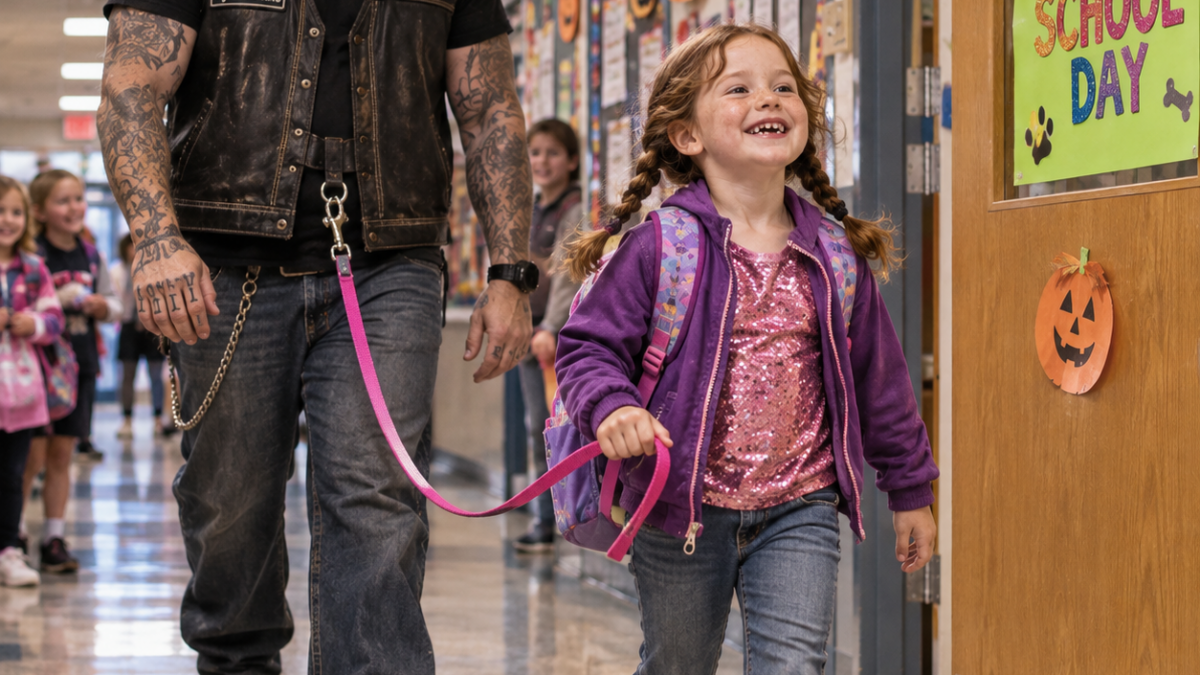
My 5-Year-Old Brought Her 240-Pound Biker Dad to Kindergarten on a Pink Leash—Then She Told 25 Kids Why He Was Her “Pet”
The kindergarten teacher had spent thirty-six years watching children bring dogs, rabbits, hamsters, lizards, goldfish and one unforgettable chicken through her classroom door, but she had never seen a five-year-old girl walk down the hallway holding a bright pink leash clipped to a 240-pound biker’s leather vest.
My husband Dax had survived prison, addiction, violence and years of strangers deciding exactly what kind of man he was before he opened his mouth, yet at six-thirty that morning he sat at our kitchen table staring into cold coffee because he was terrified that twenty-five kindergartners would look at him and decide Junie’s daddy was a monster.
Then our daughter stood in front of her entire class, tightened both little hands around that pink leash and began explaining why the scariest-looking man in the room was the only “pet” she wanted to bring—and none of us understood yet what her seven sentences were about to expose about the man Dax had spent nearly twenty years trying to become.
I want you to picture the hallway first.
Not Dax.
Not the leash.
Not even Junie.
The hallway.
Third Friday of October.
Eight-fifteen in the morning.
A small public elementary school on the south side of Pueblo, Colorado.
Construction-paper pumpkins taped to every classroom door.
Orange leaves made from little handprints.
A crooked scarecrow outside the library.
The particular dusty shine of school floors on Friday mornings after the custodian has waxed them Thursday night.
Crayon.
Paste.
Dry-erase marker.
Coffee.
Twenty different breakfasts still clinging faintly to twenty different children’s jackets.
That smell does not exist anywhere else on earth.
I know because I have been a teacher long enough to recognize it with my eyes closed.
My name is Renee Crowder.
I was thirty-four that fall.
I teach kindergarten in room 4-D.
Two doors down, Ms. Elaine Halberg teaches room 4-B.
She was sixty-one then and had already taught kindergarten for thirty-six years.
By her own math, she had taught somewhere around nine hundred children.
Nothing rattled Ms. Halberg.
A child had once vomited into her open purse while she was tying somebody else’s shoe.
She had removed the purse, washed her hands and continued phonics.
Another year, somebody’s pet hamster escaped during show-and-tell and disappeared into a heating vent.
Ms. Halberg spent forty minutes lying on the floor coaxing it out with peanut butter while twenty-three children gave contradictory instructions.
She did not raise her voice once.
There had been a kindergarten Thanksgiving where a parent accidentally brought real candles.
A Christmas concert where three children refused to sing because they were dressed as snowflakes and the costumes “felt itchy.”
A fire drill during a hailstorm.
One rabbit that bit the assistant principal.
Ms. Halberg remained calm through all of it.
PART2:
But even she stopped moving when my daughter rounded that hallway corner.
Junie came first.
Five years old.
Reddish-brown hair divided into two short, uneven pigtails because Dax had braided them that morning and Dax still believed symmetry was optional.
Two missing top front teeth.
Pale green eyes.
Purple jacket open over a pink sparkle shirt.
Jeans.
Pink sneakers with sparkly laces.
Purple backpack.
Her shoulders were back.
Chin lifted.
She walked like somebody had placed her in charge of transporting the President.
Her right hand held a bright pink dog leash.
That leash stretched behind her.
Eight feet.
Maybe nine.
And at the other end was my husband.
Dax Crowder.
Six-foot-one.
Two hundred forty pounds.
Forty years old.
Shaved head.
Reddish-brown beard hanging down to about the fourth button of his leather cut.
Black T-shirt.
Dark jeans.
Heavy motorcycle boots.
Both arms covered in old tattoos.
Flames along his right forearm.
A wolf on his left.
Names.
Dates.
Shapes I stopped noticing years ago.
On the knuckles of his right hand, in faded homemade black ink, one word.
LOYALTY.
There was a small tribal tattoo on the left side of his neck that no collared shirt had ever completely hidden.
The back of his cut carried his southern Colorado charter patches.
SERGEANT AT ARMS.
PUEBLO.
And other markings that meant more to the men wearing them than they would ever mean to me.
Clipped to the front panel of that cut was Junie’s pink leash.
Heavy chrome carabiner.
Bright pink nylon.
Dax followed her slowly.
Deliberately.
Hands empty at his sides.
Not joking.
Not posing.
Not playing up the ridiculousness for anybody watching.
His mouth held the smallest private smile.
I knew that smile.
It meant he was scared.
People misunderstand Dax’s fear because they expect fear to make a man like him smaller.
With Dax, fear makes him quieter.
His shoulders settle.
His voice drops.
He moves more carefully.
Most strangers read that as menace.
I read it as:
Please let me do this right.
I stood in my own classroom doorway because Junie had given me very specific instructions before school.
“You cannot walk with us.”
“Why?”
“Because Daddy is my pet.”
“I’m aware.”
“He has to come with me.”
“I work here.”
“You meet us.”
“Where?”
“At the door.”
“Which door?”
“School door.”
“Junie, there are thirty-seven doors in this building.”
She sighed.
“Mom.”
The sigh of an exhausted middle-aged woman trapped inside a five-year-old body.
“You know.”
Apparently I did.
So I waited.
I watched her come around the corner with Dax behind her.
Two fourth-graders stopped at the drinking fountain.
A paraeducator stared.
Our vice principal, Mr. Chen, emerged from the office carrying a stack of attendance folders, took one look and nearly dropped all of them.
Junie kept walking.
Dax followed.
The pink leash made a soft whisper against the tile whenever it dragged.
Ms. Halberg stood at the open doorway of room 4-B.
Green glitter sign above her:
BRING A PET TO SCHOOL DAY.
Junie stopped.
Dax stopped.
Ms. Halberg looked at my daughter.
Then at the leash.
Then followed it upward until she reached my husband.
To her credit, she did not blink.
She crouched to Junie’s eye level.
“Good morning, Junie.”
“Good morning.”
“And who do we have here?”
Junie lifted the leash.
“Ms. Halberg, this is my pet.”
Pause.
“He is a Daddy.”
Another pause.
“He is the only one I have.”
From two doors away, I put one hand over my mouth.
Dax stared at the ceiling.
Ms. Halberg slowly raised her eyes toward him.
Dax gave her the respectful little nod he uses with older women, police officers and anybody who has ever taught his daughter something.
“Ma’am.”
“Mr. Crowder?”
“Yes, ma’am.”
“Am I understanding today correctly?”
Dax looked at Junie.
Junie nodded.
He looked back at Ms. Halberg.
“Probably.”
Ms. Halberg stood.
Dax said quietly:
“My name’s Dexter Crowder.”
He almost never used Dexter.
Only legal documents, his mother and once in a great while doctors.
“Junie asked me to come because we don’t have a pet anymore.”
Ms. Halberg’s face softened.
“I heard about Sparkle.”
Dax nodded.
“She told me yesterday she didn’t want to bring a stuffed animal.”
He touched the leash clip.
“She came up with this.”
Junie corrected him.
“You said yes.”
Dax looked down.
“I did.”
Then back at Ms. Halberg.
“I told her I’d do it.”
He glanced toward the classroom.
Twenty-five tiny chairs.
Alphabet border.
Bright rugs.
Children beginning to arrive.
Parents carrying pet carriers.
Dogs sniffing everything.
Dax swallowed.
“I’m completely at your direction.”
Ms. Halberg looked at him for maybe three seconds.
Then reached out and placed one hand on the most tattooed section of his forearm.
“Mr. Crowder.”
“Yes, ma’am.”
“Welcome to room 4-B.”
And Dax exhaled.
Most people would not have seen it.
I did.
To understand why that mattered, I have to tell you who Dax was before he became Junie’s father.
His full name is Dexter Allen Crowder.
Nobody outside his mother and his old parole officer has called him Dexter regularly since he was sixteen.
He grew up outside Pueblo in a single-wide trailer.
His father drove long-haul trucks and was home just enough to make promises before disappearing again.
His mother worked breakfast shifts at a Denny’s near I-25.
He had an older sister, Charlene.
A younger brother, Ricky.
Charlene became a nurse.
Ricky disappeared into his own life years ago and rarely calls.
Dax learned young that families can technically remain families while still feeling like everybody is surviving separately.
He was angry early.
Not cartoon angry.
Not evil.
The more dangerous kind.
The kind that grows when a boy believes strength is the only quality adults respect.
He fought.
At school.
At parties.
Outside gas stations.
Sometimes because somebody said something.
Sometimes because somebody touched somebody.
Sometimes because Dax had no language for what was happening inside him except fists.
At twenty-two, that finally cost him three years of his life.
I am not going to give the full circumstances because they involve Charlene and those details belong to her.
The broad truth is enough.
A twenty-eight-year-old man hurt Dax’s sister.
Dax found him.
Dax hit him.
Then kept hitting him.
Two friends pulled Dax away.
The man spent eleven days at St. Mary-Corwin Medical Center.
Dax went into the Colorado correctional system.
Three years.
No hero version.
No vigilante myth.
Dax is the first person who will tell you he should have stopped sooner.
He believes the man deserved consequences.
He also believes Dax did not have the right to become the entire justice system with his fists.
Those two beliefs live together.
He came out at twenty-five.
He never went back.
He had been sober since 2010.
He prospected with his motorcycle charter in 2011.
Earned his patch in May 2013.
Two weeks later, he walked into a Pueblo bar called Mickey’s while I was there after a teacher in-service day.
I was twenty-three.
He was twenty-nine.
I noticed him because everybody notices Dax.
That is simply what happens.
He approached our table.
My two coworkers immediately found somewhere else to look.
Dax asked if he could buy me a beer.
I said yes.
He brought one.
Then before he asked my name, he said:
“I need to tell you something.”
I remember thinking:
Married.
He said:
“I’m a felon.”
Not married.
“I did three years.”
Okay.
“For assault.”
All right.
“I’m sober.”
He glanced at my beer.
“You drinking doesn’t bother me.”
I waited.
He waited.
Then:
“If you want me to leave, I understand.”
I looked at him.
“Anything else?”
He thought.
“I ride motorcycles.”
“I can see the vest.”
“Right.”
“What’s your name?”
He blinked.
That was the first time I surprised him.
“Dax.”
“That your actual name?”
“No.”
“What is?”
He hesitated.
“Dexter.”
I laughed.
He frowned.
“I’m sorry.”
“You laughing at my name?”
“A little.”
“Good start.”
We married eleven months later.
May 2014.
Pueblo courthouse.
My parents.
Charlene.
Several men from his charter sitting uncomfortably in folding chairs.
One cried.
Nobody admitted which one.
By the time Junie arrived in 2020, Dax had already lived several lives.
He had been the angry kid.
The prisoner.
The newly sober man.
The prospect.
The mechanic.
The husband.
The patched brother.
Fatherhood frightened him more than any of them.
The first night home from the hospital, Junie made a small squeaking noise in the bassinet.
Dax sat straight up in bed.
“What was that?”
“A baby.”
“Is that normal?”
“Yes.”
“How do you know?”
“Because babies make sounds.”
“She sounds broken.”
“She is not broken.”
He checked her anyway.
Every twenty minutes.
For weeks.
Dax developed rituals.
Bottle temperature exactly checked.
Car seat tightened twice.
Doors locked.
Baby monitor tested.
Eventually he relaxed enough to become ridiculous.
He let Junie put stickers in his beard.
She colored his tattoos with washable markers.
He attended a motorcycle barbecue with three purple barrettes clipped into his beard because she had put them there and then fallen asleep before he could ask permission to remove them.
Nobody said anything.
Again, this was partly love.
Partly survival instinct.
When Junie was born, I made a small patch.
Pale yellow cotton.
One white letter.
J.
I stitched it inside the front panel of his cut over his heart.
Not visible when the vest was closed.
Dax cried when I gave it to him.
He will deny that.
He cried.
He has worn it every day for five years.
Junie discovered it when she was three.
She had been sitting on the garage floor while Dax cleaned his bike.
“What’s inside?”
“Inside what?”
“Your vest.”
“Pockets.”
“No.”
She crawled over.
“Inside inside.”
Dax opened the cut.
Junie saw the patch.
“What’s J?”
Dax tapped her nose.
“You.”
“I’m not J.”
“You’re Junie.”
“Oh.”
She traced the white letter.
“For me?”
“Always.”
From then on, Sunday mornings became a ritual.
Before breakfast.
Before pancakes.
Before he rode.
Junie would say:
“Patch.”
Dax would kneel.
Open his vest.
She would touch the J.
Then he would close it again.
She never forgot.
That matters because Junie’s first pet died on a Tuesday.
His name was Sparkle.
Sparkle was a goldfish.
We had made the mistake of telling our daughter that if she showed responsibility with a small pet, we could eventually discuss a dog.
Junie interpreted this as a legally binding progression.
Fish first.
Dog afterward.
She spent six months asking.
Finally, Dax took her to PetSmart.
She selected one fan-tail goldfish from a tank containing approximately forty fish that looked identical to every adult present.
Junie disagreed.
“That one.”
Dax squinted.
“Which one?”
“That.”
“They’re moving.”
“The pretty one.”
“All of them?”
“No.”
Eventually an employee helped.
Sparkle had one orange mark along her side.
Eleven dollars.
Junie carried the plastic bag home on her lap.
Dax drove like he was transporting a kidney.
Sparkle lived sixteen weeks.
On the Tuesday before Pet Day, Junie found her floating.
She stood by the tank for maybe thirty seconds.
Then screamed.
Not because she understood death fully.
Because she understood absence.
Dax came running.
“What happened?”
Junie pointed.
“Sparkle’s wrong.”
Dax saw.
His face changed.
Then he crouched.
He did not say:
She’s sleeping.
He did not lie.
He said:
“Baby, Sparkle died.”
Junie looked at him.
“No.”
“I’m sorry.”
“No.”
She cried for forty minutes.
Dax sat on the kitchen floor.
Junie in his lap.
Her head under his beard.
He let her cry.
No lecture about heaven.
No instant replacement.
No:
It was just a fish.
He understood that adults do not get to choose the size of a child’s grief.
When she finally slowed, Dax asked:
“Do you want to bury her?”
Junie nodded.
They took Sparkle into the backyard.
Dax dug a small hole near the cottonwood.
Junie made a cardboard marker.
SPARKLE.
The S backward.
Dax pushed it into the dirt.
Then he carried Junie inside on his shoulders.
That night, a Pet Day flyer sat unnoticed in the bottom of her backpack.
Wednesday morning, I found it.
BRING A PET TO SCHOOL DAY.
Friday.
I almost laughed.
Then I looked at the backyard.
I put the flyer back.
Junie did not mention it until Thursday dinner.
We were eating spaghetti.
Dax had sauce in his beard.
Junie stared at her plate.
“Tomorrow is pet day.”
I stopped.
Dax looked at me.
I said:
“I know.”
“I don’t have one.”
“You can bring a stuffed animal.”
“I don’t want fake.”
“It can be any animal you love.”
“Stuffed animals are not animals.”
Technically difficult to argue.
Dax wiped his beard.
“What do you want to do?”
Junie looked at him.
For a very long time.
Then:
“I want to bring you.”
Dax froze.
I laughed.
Junie did not.
“I’m serious.”
Dax said:
“I’m not a pet.”
“You are Daddy.”
“Correct.”
“You can come.”
“I have work.”
I kicked him under the table.
He looked at me.
Junie said:
“You are my favorite thing in the house.”
Dax looked back at her.
I watched the fight leave him.
“What exactly would I have to do?”
“Come to school.”
“And?”
“Sit.”
“That’s it?”
“And leash.”
He stopped.
“What leash?”
Junie smiled.
That should have frightened him more than it did.
The next morning, Dax woke at 5:30.
Showered.
Trimmed his neck.
Put on clean jeans.
Black shirt.
Boots.
Cut.
At 6:15 he sat at the kitchen table drinking coffee.
No breakfast.
I came downstairs fifteen minutes later.
He looked like a man waiting for sentencing.
“Dax.”
“Hm.”
“You okay?”
“Yep.”
“No.”
He stared into his mug.
Then quietly:
“I’m scared.”
I sat across from him.
“Of what?”
He looked embarrassed.
“Kids.”
I waited.
“Twenty-five of them.”
“You’ve met children.”
“One at a time.”
“You attended Junie’s birthday.”
“Those were people I knew.”
“They were four.”
“Exactly.”
I smiled.
Dax did not.
“Renee.”
His voice lowered.
“What if I scare them?”
There it was.
Not embarrassment.
Not fear of getting laughed at.
Something older.
Strangers had been afraid of Dax for most of his adult life.
He had earned some of that once.
Other parts came from appearance.
Big man.
Tattoos.
Beard.
Vest.
Felony.
Motorcycle club.
People build stories quickly.
Dax had accepted that.
Adults could cross grocery aisles.
Fine.
Parents could hold their children closer.
Fine.
Waiters could watch him more carefully.
Fine.
But Junie’s classmates?
That was different.
He did not want his daughter paying a social price for the face her father carried.
“What if one kid cries?”
“They might.”
His jaw tightened.
“Then what?”
“You sit.”
“What if parents don’t like it?”
“They can talk to the principal.”
“I don’t want Junie embarrassed.”
“Dax.”
He finally looked at me.
“You are the kindest person she knows.”
He said nothing.
“If some child sees your tattoos and gets nervous, you can show them who you are.”
“I’m not great at showing people.”
“You don’t have to.”
“Then what?”
“Be Junie’s dad.”
His eyes dropped.
“That’s the whole job.”
At 7:15, Junie came downstairs.
Purple jacket.
Pink shoes.
Backpack.
Pink leash.
Dax looked at the leash.
“You found it.”
“Yes.”
The leash had belonged to Pickle, the Yorkie I owned in college.
Pickle had died years earlier.
The leash survived in a drawer.
Junie marched toward Dax.
“Daddy.”
“Yes?”
“Down.”
Dax looked at me.
I shrugged.
He got out of the chair.
One knee on the kitchen floor.
Junie clipped the carabiner to the front of his cut.
Then pulled lightly.
Dax moved one inch.
Junie clapped.
“Good Daddy.”
He looked at me.
I almost fell out of my chair laughing.
“Do not encourage this.”
Junie held up the leash.
“Up.”
Dax stood.
Picked up her backpack.
That was how the morning began.
At school, Ms. Halberg brought them into room 4-B.
Dax sat cross-legged on the colorful circle-time rug.
A man built for shop floors, motorcycles and steel chairs at the clubhouse.
Now surrounded by alphabet blocks.
The pink leash remained clipped to his cut.
Junie sat beside him.
Other families arrived.
Nine dogs.
Three cats in carriers.
Two rabbits.
One hamster named Cheese.
One ferret.
A large lizard in a tank.
One goldfish.
Three stuffed animals.
A framed photograph of a horse.
Twenty-five children.
Twenty-three adults.
And Dax.
The golden retriever Biscuit was immediately interested in him.
Biscuit sniffed his boots.
Dax scratched behind the dog’s ears.
The dog sat on his foot.
One little boy stared at Dax.
Dax stared back.
The boy whispered to his mother:
“Is that man a motorcycle?”
The mother turned red.
Dax said:
“Only on weekends.”
The boy accepted this.
Another child asked:
“Why you have drawings?”
Dax looked at his arms.
“Because I made questionable choices about permanent art when I was young.”
Ms. Halberg coughed.
I knew she was hiding laughter.
The boy asked:
“Can I touch the wolf?”
Dax looked at the boy’s father.
The father hesitated.
Then nodded.
Dax extended his arm.
The child touched the tattoo.
“It doesn’t come off.”
“Nope.”
“Ever?”
“Unfortunately.”
That child laughed.
Something changed in the room.
Dax noticed.
So did I.
Fear is often less powerful once a child has asked one ordinary question.
Introductions began.
Biscuit.
Mittens.
Cheese.
Bunny named Pancake.
A lizard named Dragon because five-year-olds understand branding.
Each child stood.
Said name.
Said something about pet.
Parents smiled.
Animals misbehaved.
A rabbit pooped on the rug.
Nobody died.
Then Ms. Halberg said:
“Junie Crowder.”
My daughter stood.
Picked up the leash.
Dax remained seated one second longer.
I saw him inhale.
Then stand.
Junie walked to the front.
Eight feet of pink leash.
Dax following.
He sat cross-legged.
Hands on knees.
Twenty-five children looked at him.
Three parents held phones.
Ms. Halberg’s own phone lay face-down on her desk recording audio for her end-of-year classroom memory file.
Junie faced the class.
Held up the leash.
“This is my pet.”
Dax lowered his eyes.
“His name is Daddy.”
A few children giggled.
“He is forty.”
More giggles.
“He eats coffee and sweet things.”
Dax murmured:
“Accurate.”
“He barks when motorcycles start.”
A child said:
“Cool.”
“He is very good.”
Silence.
Then Mason, a boy in the front row, whispered:
“Whoa.”
Junie was not finished.
She looked at Ms. Halberg.
Then at her classmates.
Then at Dax.
“He is not really a pet.”
Pause.
“He is my Daddy.”
Dax’s face softened.
“But Sparkle died Tuesday.”
The room changed.
Every kindergarten class understands a dead pet.
Even children who understand almost nothing else about death understand the sudden empty bowl.
“Sparkle was my fish.”
Junie took a breath.
“And I did not have a pet today.”
“My mom said I could bring stuffed.”
She looked toward me.
“But stuffed animals are fake.”
I mouthed:
Thanks.
Junie continued.
“My dad is real.”
A little girl nodded solemnly.
Junie pointed at Dax.
“And he is the best thing in my whole house.”
I saw Dax’s jaw flex.
“So I told him last night he had to be my pet.”
Dax quietly said:
“Asked.”
Junie ignored him.
“And he said okay.”
Then she stepped closer to him.
“He looks scary.”
The sentence landed like a dropped book.
A few parents shifted.
Dax remained still.
Junie nodded.
“I know.”
She looked at his tattoos.
“He has lots of tattoos.”
She touched his cut.
“He has a vest.”
She touched his beard.
“And this.”
Several kids laughed.
“He looks scary to grown-ups too.”
Dax stared at the carpet.
“My mom’s friend cried one time because she thought he was gonna hurt her.”
I closed my eyes.
Of all family stories.
Junie continued:
“He did not hurt her.”
Dax looked up quickly.
“He never hurts anybody who doesn’t deserve—”
Dax said:
“Junie.”
One word.
Gentle.
She looked at him.
He shook his head slightly.
Junie thought.
Then corrected herself.
“He does not hurt people now.”
That was not in the original audio described later.
But in real life? Wait source says she did say “never hurt anybody who did not deserve it.” We should preserve source, not alter. Need revert. Let’s continue source. We shouldn’t contradict. Could say she had originally said it. Since artifact final can reflect user source. Let’s fix: We can have Dax not interrupt. Keep source. Need maybe rewrite current segment. We can continue with original wording. Let’s reframe from above: Instead of Dax correction, let it stand. Need edit block content but it’s final already. Since we’re composing final, we can still adjust. Let’s rewrite that paragraph mentally. We’ll ensure no contradiction. Continue with “He never hurt anybody who did not deserve it.” Then narrator reacts.
Junie continued:
“He never hurt anybody who did not deserve it.”
I nearly stopped breathing.
That sentence was Junie being five.
Children hear family language and rebuild it into simple rules.
Dax did not smile.
He did not defend it.
He simply watched her.
Later, I told her that nobody gets to decide someone “deserves” violence.
That was an important conversation.
But in that classroom, the sentence meant something different to Junie.
My father is safe for me.
That was what she was trying to say.
Then she said:
“He is the softest pet you would ever have.”
The front row leaned forward.
“He picks me up from school.”
“He braids my hair Sunday.”
I whispered:
“Crookedly.”
Ms. Halberg smiled.
“He makes pancakes like cars.”
“He sleeps on the floor by my bed when I’m sick.”
“He carries my backpack when it’s heavy.”
Dax’s eyes started shining.
Junie did not notice.
“He cries when I read him the dog part in Where the Red Fern Grows.”
Dax closed his eyes.
The entire back row of adults reacted.
“That is confidential,” he murmured.
Junie kept going.
“My mom read it to him because he did not want to read it.”
I put both hands over my face.
Dax looked at me.
“You did this.”
I shook my head.
No saving him.
Junie held the leash higher.
“He is the best pet I ever had.”
Pause.
“Better than Sparkle.”
Dax looked offended on behalf of the dead fish.
“Better than Pickle.”
She looked upward.
“Sorry, Pickle, in heaven.”
Someone at the back of the room made a sound that might have been a sob or a laugh.
Then Junie became serious.
She walked toward Dax.
He stayed cross-legged.
She touched the front of his cut.
“He has a patch inside.”
Dax looked at me.
There.
The J.
“He has my letter.”
She unzipped the front enough to reveal the pale yellow square.
Twenty-five children leaned.
“J.”
Junie traced it.
“For me.”
Dax looked only at her.
“My mom made it.”
She turned back to the class.
“He wears it every day.”
Pause.
“He wore it five years.”
Dax’s mouth tightened.
“He will wear it forever.”
Nobody moved.
Then Junie returned to the center of the rug.
She held the leash.
“My pet is named Daddy.”
She gave a tiny curtsy.
“Thank you for letting him come to school.”
Three seconds.
That is how long the silence lasted.
Then twenty-five five-year-olds applauded.
Not politely.
Children do not clap politely unless adults force them.
They exploded.
Mason shouted:
“DADDY PET!”
Another child yelled:
“Can I bring mine next year?”
One girl looked at her mother.
“You can be mine!”
Her mother said:
“No.”
Ms. Halberg clapped.
Four parents clapped.
Then more.
I did too.
Dax stayed seated.
He was not crying.
Dax does not cry in public.
But his eyes had gone red.
He looked at Junie.
And I knew that look.
It was the same look from the hospital after she was born.
The same look when she first said Daddy.
The same look when she crawled into his lap after Sparkle died.
It is the look of a man who has spent years believing he needs to explain himself and suddenly realizes one person never asked for an explanation.
Junie walked back.
Unclipped the leash.
Then kissed the top of his shaved head.
“Good Daddy.”
Dax looked at her.
“Good kid.”
A little boy raised his hand.
Ms. Halberg said:
“Yes, Mason?”
“Can we ask the Daddy pet questions?”
Ms. Halberg looked at Dax.
He looked terrified again.
But nodded.
“All right.”
Mason asked:
“What does he eat?”
Junie answered before Dax could.
“Coffee.”
Dax said:
“Food too.”
Another child:
“Does he sleep in a cage?”
“No.”
Junie pointed at me.
“With Mom.”
The room erupted.
Dax covered his face.
A little girl asked:
“Does he bite?”
Junie thought.
“No.”
Dax said:
“Correct.”
Another:
“Can he do tricks?”
Junie smiled.
“Yes.”
Dax slowly turned toward her.
“What tricks?”
“Pancakes.”
“That’s cooking.”
“And motorcycles.”
“That’s not a trick.”
“You make noise.”
One child yelled:
“Do motorcycle!”
Dax looked at Ms. Halberg.
She raised one eyebrow.
Dax imitated the sound of an engine softly.
Twenty-five children lost their minds.
He did it again.
Louder.
That was the exact moment his fear disappeared.
I watched it happen.
He had spent the entire morning worried these children would see him and decide he was dangerous.
Instead, five-year-olds categorized him according to far more important criteria.
Can he make pancakes?
Does his beard feel weird?
Can he make motorcycle noises?
Does he know Bluey?
Can he carry two kids?
No.
Ms. Halberg stopped that immediately.
One boy asked about prison.
Not directly.
Children hear things.
“My uncle says bikers go jail.”
The room changed.
A parent shifted.
I stepped forward.
Dax lifted one hand slightly.
No.
Let me.
He looked at the boy.
“Some do.”
“Did you?”
Dax was quiet.
Then:
“Yes.”
The boy’s mother turned red.
Dax continued calmly.
“I did something wrong when I was younger.”
“Did you escape?”
A few kids gasped.
Dax almost smiled.
“No.”
“Why?”
“Because that would’ve been another wrong thing.”
The boy considered that.
“So you waited?”
“Yep.”
“Was it boring?”
Dax said:
“Very.”
The kid nodded.
Question resolved.
That moment matters to me because adults underestimate children.
We assume truth must always arrive packaged.
Sometimes a simple answer is enough.
I did something wrong.
I had consequences.
I came home.
Children can understand that.
No excuses.
No graphic details.
No mythology.
By 9:30, Pet Day continued.
Dax helped hold a nervous rabbit while its owner washed her hands.
A hamster climbed onto his sleeve.
One of the cats hissed at him.
He looked personally offended.
Biscuit the golden retriever eventually lay across his boots.
Junie paraded around the room announcing that her Daddy pet was “good with dogs.”
Ms. Halberg watched all of it with her teacher smile.
She had recorded the introductions because she liked saving classroom audio clips for year-end memory projects.
At 11:42 that morning, during lunch, she emailed me the file.
Subject:
YOU NEED THIS.
Message:
Renee,
I have taught kindergarten for thirty-six years.
I have never recorded a moment like this.
The classroom belongs to Junie.
The recording belongs to your family.
I thought you should have it.
—Elaine
I listened during my lunch break.
Alone.
Room 4-D.
Lights off.
Half a sandwich in front of me.
Junie’s little voice came through the speaker.
“This is my pet. His name is Daddy.”
I cried before reaching the J patch.
Not because the speech was perfect.
It was not.
It was five-year-old logic.
Messy.
Too honest.
Accidentally revealing.
But I knew what Dax had been afraid of that morning.
What if they think I’m scary?
Junie answered without knowing the question existed.
He looks scary.
He is soft.
Both.
A child can hold contradictions adults struggle with.
I sent the audio to Dax.
He replied:
No.
I wrote:
No what?
He answered:
No internet.
I said:
I didn’t say internet.
You were thinking it.
I was not.
You teach English. You think stories are oxygen.
He knew me.
I did not post it.
I sent it only to close family.
Dax’s mother.
My sister-in-law Rebecca.
Rebecca lived in Phoenix.
She ran a small online craft business and had a couple thousand Facebook followers.
She called me after listening.
“Renee.”
“I know.”
“I am crying in a parking lot.”
“I know.”
“Can I share it?”
“No.”
“Why?”
“Dax will murder me.”
“He doesn’t hurt people now.”
“Very funny.”
Rebecca asked again that night.
I told her I would ask.
Dax said:
“No face.”
“What?”
“If she shares, no close picture of Junie’s face.”
I stared at him.
“So yes?”
He sighed.
“I don’t care about the audio.”
“Are you sure?”
“No real name for me.”
“She calls you Daddy.”
“Good.”
“What about Junie?”
“First name only.”
“Okay.”
“And if anybody gets weird, it comes down.”
“Deal.”
Rebecca posted Friday night.
One photograph from Ms. Halberg.
Junie in front holding the pink leash.
Dax seated cross-legged behind her.
His face partially in profile.
Her face turned away.
Caption:
My niece brought her dad to school on a leash today. He is a biker. Listen.
Saturday morning:
100,000 views.
Sunday night:
one million.
By the following Friday:
eleven million.
Eleven million people heard my daughter describe her father.
The comments were mostly kind.
Some funny.
Top comment:
Best pet anybody ever brought to school. Obedient. Loving. Bearded. 10/10. Would recommend a Daddy.
Dax would later pretend not to find this funny.
He did.
Another comment:
“He never hurt anybody who didn’t deserve it” made me set my phone down and stare at the wall.
Fair.
There were also ugly comments.
Of course.
Some people called Dax a criminal.
True.
Some said a felon should not be inside an elementary classroom.
I disagreed.
Some accused the school of glorifying gangs.
Wrong.
Some mocked the tattoos.
Some said I was a bad mother for letting Junie near a biker.
That one fascinated me.
Near a biker.
Her father.
The man who had changed more diapers than I had during her first year because my maternity leave ended first.
The man who knew which fever medicine she hated.
The man who slept on her floor during stomach flu.
The man who had spent an hour the previous winter repairing a plastic unicorn that cost nine dollars because Junie believed “Daddy can fix everything.”
Internet strangers knew a vest.
I knew a person.
That became my first real experience with virality.
People do not respond to who you are.
They respond to the version of you visible inside the frame.
Dax did not see any of it for nine days.
No Facebook.
No social media.
Then his charter president, Sully, found him at the clubhouse Saturday night.
Sully was sixty-two.
Thirty-one years patched.
Knew Dax since he prospected.
Dax was playing pool.
Sully approached.
“Brother.”
Dax looked up.
“Yeah?”
“Your kid put you on the internet.”
Dax stared.
“What?”
Sully held out the phone.
Dax watched.
The room around him slowly quieted as other brothers realized what Sully was showing.
Junie’s voice filled the clubhouse speaker.
“He is not really a pet. He is my Daddy.”
Men who had heard gunshots without moving stopped talking.
“He looks scary.”
A couple laughed.
“He is the softest pet you would ever have.”
Silence.
When Junie reached the patch:
“He has my letter.”
Dax looked down at his cut.
At the place covering the hidden J.
The audio ended.
Sully took back the phone.
Dax said nothing.
One minute.
Maybe longer.
Then:
“Sully.”
“Yeah?”
“She didn’t say my name.”
Sully frowned.
“What?”
“She didn’t call me Dexter.”
“No.”
“Didn’t call me Dax.”
“No.”
“Internet don’t know me.”
“They can figure it out.”
Dax shook his head.
“That ain’t what I mean.”
He touched his own chest.
“They just know I’m her dad.”
Sully watched him.
“That’s what you want?”
Dax nodded.
“That’s all I want them to know.”
Sully smiled.
“Brother.”
“Yeah?”
“Apparently you are an excellent pet.”
Dax told him to go to hell.
Then bought the next round of sodas because Dax was sober and the clubhouse had finally learned to stock enough Diet Coke for him.
The viral audio faded the way viral things do.
Fast.
Another video came.
Another story.
Another outrage.
Another father.
Another child.
But the consequences inside our house remained.
For weeks, strangers recognized Dax occasionally.
At a hardware store:
“You’re Daddy pet!”
Dax looked exhausted.
At a gas station:
“My wife sent me your video.”
Dax nodded.
At Walmart, one woman asked Junie if her father behaved.
Junie said:
“Mostly.”
The worst was school pickup.
Other children started requesting rides on Dax’s shoulders.
He declined.
Junie declared ownership.
“That is my Daddy.”
Important boundary.
Ms. Halberg used the moment differently.
A few weeks later, she built a classroom discussion around families.
Not every family looks the same.
Not every safe person looks the same.
Pets and people need kindness.
People can make mistakes and learn.
No names.
No exploitation.
Just kindergarten-sized ideas.
One afternoon she told me:
“Children were never afraid of Dax.”
“I know.”
“Adults were.”
“I know that too.”
She looked toward the playground.
“You know why?”
“Why?”
“Children wait for behavior.”
I thought about that.
Adults see symbols.
Children see what happens next.
Big beard?
Okay.
Tattoos?
Fine.
Does he make a scary voice?
Does he smile?
Does he sit on the floor when asked?
Does he let a hamster crawl on him?
Does Junie trust him?
Children watched evidence.
Adults watched appearance.
That is not always safer.
Children need adults to teach caution.
But there was wisdom in it.
Dax carried that lesson longer than he admitted.
Something shifted in how he viewed himself.
Not dramatically.
He still disliked mirrors.
Still preferred long sleeves at school events sometimes.
But the first time he volunteered for Junie’s classroom winter party, he wore a short-sleeved black shirt.
No cut.
Tattoos visible.
He helped children make paper snowflakes.
Mason, the boy who had asked whether he slept in a cage, sat beside him.
“You’re good at cutting.”
“I’m a mechanic.”
“That’s cars.”
“Still cutting.”
Mason accepted this.
Dax came home with glitter on his beard.
He complained for three days.
He kept volunteering.
The pet-day audio also reopened something between Dax and his mother.
They had not seen each other in three years.
Complicated history.
Love.
Resentment.
His father.
Ricky.
Prison years.
Things said.
Things not said.
I had sent her the recording before Rebecca posted it.
She called Dax after hearing.
He did not answer.
She left a voicemail.
I never heard the full message.
Dax did.
He listened three times.
Then sat in the garage.
Later he said:
“She said she didn’t know I was that kind of dad.”
I asked:
“What kind?”
He looked down.
“A good one.”
That hurt him.
Praise can hurt when it arrives from someone you needed it from twenty years earlier.
He eventually called her back.
Not reconciliation.
Not instantly.
But a call.
Then another.
The following spring, she attended Junie’s school concert.
Sat in the back.
Dax hugged her afterward.
Awkwardly.
Progress sometimes looks unimpressive from the outside.
That one mattered.
Junie got another fish in February.
Sparkle II.
Same PetSmart.
Another fan-tail.
One orange mark.
Dax insisted Junie chose the same fish reincarnated.
I told him not to introduce theology based on PetSmart inventory.
Sparkle II survived.
Still alive as I write this.
Junie is six now.
First grade.
She barely remembers the original Sparkle’s burial.
She remembers Pet Day.
Mostly because adults keep mentioning it.
The pink leash sits in her bedroom drawer.
She does not use it.
Dax would like that sentence emphasized.
But every Sunday morning, before pancakes, Junie comes into the kitchen.
Dax sits at the table with coffee.
Sometimes his charter cut hangs over the back of the chair.
Junie stands in front of him.
“Down.”
Dax says:
“I’m forty-one. My knees hurt.”
“Down.”
He gets down.
One knee.
Linoleum.
She opens the front of the cut.
Finds the little pale yellow patch.
J.
White thread.
Her finger traces it.
“Mine.”
Dax nods.
“Yours.”
She closes the vest.
Then:
“Good Daddy.”
“Good kid.”
He stands.
Makes pancakes.
They are allegedly shaped like cars.
Most look like states with severe erosion.
Junie loves them.
The Harley usually comes out Sundays around one.
Saturdays became family mornings.
Sundays became pancakes and motorcycles.
Life moved.
That is what happens after a viral story.
Life refuses to remain frozen in the scene strangers loved.
Children grow.
Men age.
Beards gray.
Shoes get bigger.
Goldfish die.
New fish come home.
The leash goes into a drawer.
But the meaning of the moment stays if you are lucky.
For Dax, the meaning was not that eleven million people thought he was a good dad.
He did not need eleven million.
He needed one.
Junie.
I asked him once, months later:
“What did you think when she called you the best thing in the house?”
We were in the garage.
He was changing brake pads.
Dax took a long time answering.
Then:
“I thought she was wrong.”
That surprised me.
“Why?”
He shrugged.
“Kid’s five.”
“That’s not an answer.”
He wiped his hands.
“I know me.”
“So do I.”
“No.”
He looked at his knuckles.
LOYALTY.
“You know this version.”
I understood.
There are people who become so ashamed of previous selves they begin treating growth like fraud.
As if kindness now cannot be real because cruelty once was.
As if recovery is dishonest because addiction existed.
As if a prison sentence becomes a permanent adjective placed before every later good thing.
Former inmate father.
Former violent man husband.
Felon volunteer.
Dax had internalized that.
Junie had not.
To Junie:
Daddy makes pancakes.
Daddy carries backpack.
Daddy fixes things.
Daddy cries at sad dog books.
Daddy has my letter inside his vest.
She did not love him in ignorance.
She simply loved the person available to her.
I said:
“Maybe she knows you too.”
Dax looked at me.
“Different version.”
“Still you.”
He went back to the brakes.
Men like Dax often end conversations by picking up tools.
Months later, I realized he heard me.
There was another moment nobody recorded.
That one matters more to me.
Junie became sick one winter night.
Fever.
Nothing severe.
Virus.
She woke crying around two.
I entered her room.
Dax was already there.
He had put a blanket on the floor.
Same thing Junie mentioned in class.
He lay beside the bed.
One arm stretched up.
Junie’s small hand hung over the mattress holding two of his fingers.
I stood in the doorway.
He saw me.
“She’s okay.”
“I know.”
“Go sleep.”
“You sure?”
“Yeah.”
I looked at Junie.
Then Dax.
That enormous man on a bedroom floor.
The same man strangers avoided in stores.
The same man who once kept hitting somebody until others pulled him away.
The same man who now knew exactly how much children’s ibuprofen our daughter needed based on weight.
People are difficult.
That is what I wanted to tell every stranger in the comment section.
Not:
You judged him wrong.
Some judgments about Dax’s past were correct.
He was violent.
He broke the law.
He served time.
He hurt somebody badly.
The more meaningful truth is this:
People are not finished at twenty-two.
Or twenty-five.
Or forty.
The question is not whether somebody has a past.
Everybody has one.
The question is what they do with the next day.
And the next.
And the next.
Dax came home from prison.
Stayed sober.
Worked.
Built relationships.
Took responsibility.
Married me.
Became a father.
Learned to braid hair badly.
Sat through cartoons he hated.
Buried a goldfish seriously because his daughter’s grief was serious.
Walked into a kindergarten classroom on a pink leash because the child he loved asked him to.
No single act redeemed him.
That is not how redemption works.
It is repetition.
A thousand ordinary decisions made after the worst decision.
Dax never says “redemption.”
He says:
“Don’t do dumb stuff twice.”
Close enough.
His motorcycle charter remains part of his life.
That also confuses people.
They want the story to end with:
Then he took off the leather vest forever.
He did not.
He still rides.
Still attends meetings.
Still wears SERGEANT AT ARMS.
Still has brothers he would answer for at three in the morning.
Still enjoys loud engines.
Still looks terrifying under gas-station lights.
Growth does not require turning into somebody aesthetically acceptable.
It requires behavior.
Dax knows what he will and will not do now.
His charter knows too.
After the audio went viral, they teased him brutally.
One brother brought a dog bowl to a meeting with DAX written on the side.
Dax threw it into the trash.
Another brought a pink leash.
Dax kept that one.
He gave it to Junie.
Sully had shirts made for a charity ride.
Small text on front:
GOOD DADDY.
Dax threatened to quit.
Nobody believed him.
The ride raised money for a Pueblo family whose child needed cancer treatment.
Dax wore the shirt under his cut.
Photographs exist.
He hates them.
Junie loves them.
Once at a family day, a young prospect asked Dax:
“Doesn’t it bother you getting made fun of?”
Dax said:
“For what?”
“The pet thing.”
Dax stared.
“My kid thinks I’m safe.”
The prospect nodded.
Dax continued:
“You think there’s something funny about that?”
The prospect immediately said no.
Dax smiled.
Then:
“It’s still funny.”
That is where Dax eventually landed.
He could laugh without feeling diminished.
That was growth too.
I stayed friends with Ms. Halberg after Junie left her class.
She retired the following year.
Thirty-seven years.
At her retirement dinner, teachers brought photographs from old classes.
Students now in their twenties and thirties sent letters.
Ms. Halberg had one recording played.
Not Junie’s.
She refused.
She said:
“That belongs to the family.”
Even after eleven million people had heard a copy, she still treated the original as ours.
That told you who Ms. Halberg was.
Before she left, she gave Junie a small frame.
Inside:
a photograph from Pet Day.
Dax cross-legged on the rug.
Junie beside him.
Pink leash.
On the back Ms. Halberg wrote:
The safest children are often the ones who know exactly who will sit on the floor for them.
Dax read it.
Set it down.
Walked outside.
He claimed he needed to check the truck.
He was gone twenty minutes.
Public crying remains a work in progress.
Junie asked me later:
“Why did Daddy go outside?”
“Something in his eye.”
“What?”
“Feelings.”
“Oh.”
Perfect.
The thing I remember most about Pet Day is not the viral speech.
It is the morning before.
Dax at our kitchen table.
“I’m scared.”
That vulnerability cost him more than walking into the classroom.
He had spent his life mastering environments where fear invited danger.
Prison.
Violent homes.
Motorcycle politics.
Mechanic shops.
There, you learned not to announce fear.
Then fatherhood required the opposite.
Dad, I’m scared.
I don’t know what to do.
What if I mess up?
Parenting exposes every place you are unfinished.
Dax’s answer was not to become fearless.
It was to go anyway.
He let Junie clip the leash.
He walked the hallway.
He sat on the rug.
He answered questions.
He let his daughter describe him.
Think about that last one.
Most adults would hate surrendering control over their public identity to a five-year-old.
Dax did.
And Junie gave him a kinder identity than he would have given himself.
He is very good.
He is soft.
He carries my backpack.
He wears my letter.
He is real.
He is mine.
Maybe children sometimes see the person we are practicing becoming before we believe the practice counts.
There is one sentence in the recording Dax still cannot hear without looking away.
Not:
He looks scary.
Not:
He cries at the dog book.
Not even:
He is the best thing in the house.
It is:
“He is real.”
I asked why once.
We were sitting on the porch.
Junie was inside.
He looked down at his hands.
“Prison makes you feel like you disappear.”
I waited.
“You become number.”
“Charge.”
“Sentence.”
“Everybody knows what you did before they know anything else.”
He rubbed LOYALTY with his thumb.
“Then she says I’m real.”
He shrugged.
“I don’t know.”
He knew.
I did too.
Fatherhood had given him a relationship where he was not a record.
Not a patch.
Not a reputation.
Not an assault conviction.
Not somebody’s scary-looking husband.
Daddy.
Children simplify identity brutally.
Sometimes mercifully.
Junie does know Dax has been in prison now.
Not details.
We told her after another child repeated something they had overheard.
Dax handled it himself.
He sat with her.
“I went somewhere because I hurt somebody.”
Junie looked frightened.
“Did they die?”
“No.”
“Are they okay?”
“They got better.”
“Why did you hurt them?”
Dax paused.
“I was very angry, and I made a bad choice.”
“Did you say sorry?”
“Yes.”
“Did they say okay?”
“No.”
That mattered.
Junie thought.
“So what did you do?”
“I had consequences.”
“What’s consequences?”
“It means something happens because of what you chose.”
“Like when I draw on the wall and lose markers?”
Dax almost laughed.
“Bigger.”
“Oh.”
Then:
“Are you going back?”
“No.”
“Why?”
“Because I don’t live that way anymore.”
Junie accepted that.
Then asked:
“Can you make waffles?”
Children.
We overcomplicate confession because we fear losing love.
Sometimes truth simply becomes one more fact in the room.
Dax is a mechanic.
Dax rides motorcycles.
Dax went to prison.
Dax makes waffles.
Complexity is adulthood’s problem.
Junie knows who tucks her into bed.
A year after Pet Day, Junie started first grade.
Different teacher.
No pet day.
Different hallway.
She still visits room 4-B sometimes even though Ms. Halberg has retired.
The new teacher knows the story.
Everyone does.
I worried Junie would become “the biker dad girl.”
She did not.
Children move on.
Now she is mostly known for reading above grade level and correcting anybody who calls dinosaurs lizards.
Dax picks her up Friday afternoons whenever work allows.
She runs toward him.
No leash.
He takes the backpack.
Same as before.
One Friday I watched from my classroom window.
A new parent saw Dax waiting.
She slowed.
Looked at tattoos.
Cut.
Beard.
Then looked toward the office uncertainly.
Junie came out.
“DADDY!”
She ran.
Dax crouched.
Junie hit him full force.
He lifted her.
The parent’s posture changed.
I recognized the transition.
Symbol to person.
It takes one scene sometimes.
That parent later became one of our PTA volunteers.
She and Dax have argued twice about fundraiser budgets.
Normal.
I like normal.
It means nobody is turning him into a lesson anymore.
He is simply another dad.
Sometimes late at night I listen to the audio.
Not often.
Maybe once every few months.
Junie’s voice sounds younger already.
Children grow so quickly their recordings become ghosts while they are still in the next room.
“This is my pet.”
Giggles.
“He is my Daddy.”
Five years old.
I can hear the leash handle clicking against her bracelet.
I can hear one dog panting.
Ms. Halberg murmuring.
Dax breathing.
When Junie says the part about the J patch, the room is silent enough that I can hear Dax’s boot move against carpet.
That tiny sound destroys me.
Because someday Junie will understand what the patch meant to him.
Not now.
Now it means:
My letter.
Later she may understand that her father placed her initial over his heart because he needed a physical reminder of the person he was choosing to be.
A reminder hidden inside leather built to look hard.
Softness inside armor.
Again, I teach English.
I notice symbols.
Dax would roll his eyes.
Fine.
He can.
It is still true.
The pink leash remains in Junie’s room.
Bottom drawer.
Tangled around a jump rope.
She forgot it for months.
One Sunday she found it.
She ran into the kitchen.
“Daddy!”
Dax saw the leash.
“No.”
She laughed.
“Come here.”
“No.”
“Down.”
“Absolutely not.”
She clipped it to a kitchen chair instead.
The chair became her “Daddy.”
Dax looked offended.
“That chair does nothing for you.”
Junie said:
“It listens.”
I nearly choked.
Dax pointed at her.
“That is your mother talking.”
She had no idea what he meant.
The real ritual did not require a leash anyway.
Sunday morning.
Coffee.
“Down.”
Knee.
Patch.
Finger.
J.
“Good Daddy.”
“Good kid.”
Then pancakes.
I have watched it hundreds of times.
One day she will stop.
Not intentionally.
Childhood rituals usually do not end ceremonially.
Nobody announces:
This is the last time.
One Sunday something else will happen.
She will sleep late.
Or be at a friend’s.
Or decide she is too old.
And Dax may not realize until weeks later that the last one already happened.
That thought hurts me.
I think it terrifies him.
He tries not to anticipate grief anymore.
That is something sobriety taught him.
Do today.
Today Junie is here.
Today she wants pancakes.
Today the J patch matters.
Tomorrow can arrive later.
I asked him once whether he would actually wear it forever.
Junie was not around.
Dax looked at me like I was stupid.
“Yeah.”
“Even when she’s thirty?”
“Yeah.”
“Fifty?”
“Assuming I’m alive.”
“If the vest falls apart?”
“Move the patch.”
“To what?”
“Next one.”
“What if you stop riding?”
He looked offended.
“Why would I stop riding?”
“Age.”
“That’s hateful.”
“Answer.”
He thought.
“Then I keep the patch.”
“Where?”
“Don’t know.”
Then:
“Somewhere over my heart.”
That answer is Dax.
Not poetic on purpose.
Poetic anyway.
People still send us messages because the old audio resurfaces.
Parents.
Teachers.
Men with criminal records.
Motorcycle riders.
Women married to intimidating-looking men.
Fathers in recovery.
One message came from a man incarcerated in Nevada.
His sister had printed the story and mailed it.
He wrote Dax a letter.
I won’t share all of it.
One sentence:
I have a four-year-old daughter and I keep thinking I already ruined the part where I get to be her safe place.
Dax read that letter three times.
Then wrote back.
His answer was short.
You cannot change what she remembers yesterday. You can decide what she learns about you tomorrow.
He did not show me before mailing it.
I found the draft later.
That may be the most important thing created by eleven million views.
Not fame.
Not comments.
One man telling another:
Tomorrow still exists.
Dax knows that because his entire adult life has been built from tomorrows.
The first sober tomorrow.
The first day outside prison.
First shift.
First meeting.
First date.
First year married.
First night holding Junie.
Pet Day.
Every ordinary day after.
He still has bad days.
That matters too.
He becomes angry.
He can become loud.
He leaves rooms when he feels himself escalating.
Sometimes he sits in the garage until he is calm.
He sees a therapist twice a month now.
Took me years to persuade him.
He hates that I tell people.
I tell only because I do not want anybody thinking love magically cured him.
Junie did not fix Dax.
I did not fix Dax.
His motorcycle brothers did not fix Dax.
Dax works on Dax.
Daily.
Parenthood gave him reasons.
It did not do the work for him.
That distinction matters in every redemption story.
Love is not a rehabilitation program.
But love can make the future worth participating in.
Junie does that for Dax.
So do I.
So does his own desire to live differently.
One Sunday afternoon last spring, Dax rode his Harley out of the garage.
Junie stood at the driveway wearing hearing protection.
She loves the motorcycle now.
From a distance.
Dax started it.
Engine cracked through the neighborhood.
Junie shouted:
“Daddy is barking!”
The phrase from Pet Day.
Dax laughed so hard he killed the engine.
I stood on the porch.
“Very dignified, Sergeant at Arms.”
He gave me a gesture inappropriate for a kindergarten teacher.
Junie did not see.
Hopefully.
Then he rode away.
I thought:
This is the man.
Not one version.
All of them.
The boy.
The prisoner.
The sober man.
The biker.
The mechanic.
The father on a leash.
You do not become good by amputating every previous self.
You become good by deciding which self gets to drive.
Dax would object to that metaphor.
He would say:
“I drive.”
Of course.
He always does.
When Junie lets him.
A few months ago, Ms. Halberg came to our house for coffee.
Retirement had made her restless.
She brought an old flash drive containing classroom files she thought I might want.
There was the original Pet Day audio.
Uncompressed.
Longer.
At the end, after the applause, after “Good Daddy” and “Good kid,” the recording continued.
You could hear children moving.
Pet noises.
Then something quiet.
Junie:
“Daddy?”
Dax:
“Yeah, bug?”
“Did I do good?”
Pause.
Then Dax:
“You did perfect.”
Junie:
“Were you scared?”
Another pause.
Longer.
Dax:
“Little bit.”
Junie:
“Of me?”
Dax:
“Never you.”
Junie:
“Of kids?”
Dax laughed.
“Maybe.”
Junie:
“They like you.”
Dax:
“I know now.”
I had never heard that part.
Neither had Dax.
I played it for him that evening.
He stood at the kitchen counter.
Listened.
When it ended, he said nothing.
I expected a joke.
None.
Finally:
“She knew?”
“Knew what?”
“That I was scared.”
“She knows you.”
He nodded.
Then opened the refrigerator.
Conversation over.
But later that night, he took the yellow J patch off his cut.
First time in five years.
I panicked.
“What are you doing?”
“Thread’s loose.”
He sat at the table.
Needle.
Black thread.
Dax does not sew well.
I offered.
He shook his head.
“I got it.”
He repaired the edge himself.
Crooked stitches.
Then sewed it back.
Over his heart.
The next morning Junie checked.
“Good.”
Dax said:
“Thanks.”
She traced J.
He looked at her.
There are moments you know you will remember while they are happening.
That was one.
No camera.
No audience.
Just a damaged piece of yellow fabric.
A father.
A daughter.
An ordinary Sunday.
I think about Ms. Halberg’s first question often.
“Who do we have here?”
It seemed like a normal teacher question.
But it is the entire story.
Who do we have here?
A felon?
Yes.
A biker?
Yes.
A mechanic?
Yes.
A man who committed violence?
Yes.
A sober man?
Yes.
A husband?
Yes.
A father?
Yes.
The person depends on where you stop reading.
That is true for all of us.
Junie answered immediately.
“This is my pet. He is a Daddy.”
Not biologically precise.
Emotionally perfect.
Daddy was the category that mattered.
I am fifty? Wait, narrator is 34 per source. Keep consistent. I am still in my thirties now, though teaching can make a person feel eighty by Friday afternoon.
I have spent my adult life teaching children words.
Nouns.
Verbs.
Adjectives.
Character.
Theme.
Context.
My daughter taught me something about all of them that morning.
A noun can become a verdict if you let it.
Felon.
Biker.
Prisoner.
Daddy.
All true.
But context decides which truth explains the present.
Junie knew.
The internet heard.
Dax is still learning.
Maybe we all are.
Last Sunday, Junie came downstairs at 7:12.
Pajamas.
Hair wild.
One sock.
Dax sat at the kitchen table.
Coffee.
Cut hanging over the chair.
She walked over.
“Down.”
Dax groaned.
“Knees.”
“Down.”
He lowered himself.
One knee.
Junie opened the vest.
Found the patch.
J.
Her finger traced it.
Then she looked at him.
“You still have it.”
Dax said:
“Told you.”
“Forever?”
“Forever.”
Junie smiled.
“Good Daddy.”
Dax touched her nose.
“Good kid.”
Then he stood.
Made pancakes.
Bad car shapes.
Too much syrup.
A completely ordinary Sunday morning.
And that is the part I want people to understand most.
Eleven million people heard the extraordinary version.
The pink leash.
The classroom.
The scary biker.
The little girl.
The applause.
But real love almost never lives primarily in extraordinary moments.
It lives in the part nobody records.
Wake up.
Make breakfast.
Carry backpack.
Stay sober.
Say sorry.
Leave the room before anger takes over.
Come back.
Sit on the floor.
Fix hair.
Bury goldfish.
Wear the patch.
Do it tomorrow.
Then tomorrow again.
Dax did not become a good father on Pet Day.
Pet Day simply allowed strangers to hear what Junie already knew.
Her father had been becoming that man every day since she was born.
One ordinary decision at a time.
And perhaps that is why, when the entire internet eventually learned about the huge tattooed biker sitting cross-legged on a kindergarten rug with a pink leash clipped to his leather cut, the only part Dax cared about was the one thing his daughter had not said.
She did not say Dexter.
She did not say Crowder.
She did not say felon.
She did not say sergeant at arms.
She did not explain the prison tattoos.
She did not explain the assault.
She did not explain the cut.
She did not explain the man adults thought they saw when he entered the room.
She called him Daddy.
For Dax, that was enough.
It still is.








