PART 2: HOA Karen Tried to Steal My $3 Million Private Island—Then She Learned the Owner Was the County Sheriff
The first time Karen Wilson stepped onto my private island, she didn’t ask who owned it—she told me her HOA had already voted on what they planned to do with it.
Three days later, strangers were circling my dock with fake badges, photographing my family, and talking about my home like I was an inconvenience that needed to be removed.
What Karen didn’t understand was that every threat, every forged claim, and every arrogant little mistake was quietly building a case she would eventually wish had never existed.
My name is Theo Marshall.
For most of my adult life, I’ve worn a badge.
I’d spent enough years as county sheriff to know what real danger looked like. Sometimes it came through a door with a gun. Sometimes it came in the middle of the night with headlights off. And sometimes, I learned, it arrived on a polished pontoon boat wearing white linen and a smile that never reached its eyes.
But the story didn’t begin with Karen.
It began with my aunt Eleanor.
Three years earlier, I’d been standing in a lawyer’s office expecting to hear that she’d left me an old rocking chair, maybe some savings, or perhaps the collection of antique fishing lures she’d guarded like crown jewels.
Instead, the attorney pushed a folder across the desk.
“Your aunt left you her lake property.”
I nodded.
I knew about the small house she’d owned near Lake Pinewater.
Then he added, “And the island.”
I stared at him.
“The what?”
He almost smiled.
“The island.”
Inside the folder was a handwritten note from Eleanor.
Theo,
You spend your life taking care of everybody else.
Keep this one place for yourself.
Take care of my island.
Don’t let anyone mess with it.
—Eleanor
At first, I thought she was joking.
Eleanor had always called strange things by dramatic names. Her greenhouse was “the conservatory.” Her rusted fishing boat was “the Eleanor Rose.” A patch of wildflowers behind her house was “the botanical garden.”
But the island was real.
It sat near the center of Lake Pinewater, a quiet lake surrounded by old farms, wooded slopes, and the first signs of suburban development.
Decades earlier, the island had been little more than a raised patch of earth.
Eleanor had spent years reinforcing its shoreline, hauling gravel, planting shrubs and cedar trees, filing permits, and making sure the county recognized it as an independent parcel.
It had its own lot number.
Its own deed.
Its own tax record.
And most important of all, it belonged to no HOA.
I remember standing there for the first time after inheriting it.
The wind moved through the trees. Water tapped quietly against the old dock. Eleanor’s tiny cabin leaned slightly toward the shoreline as if even the building had grown tired with age.
My wife, Megan, walked up beside me.
“You’re smiling,” she said.
“I am?”
“You’ve been smiling for ten minutes.”
Our son Lucas was already throwing rocks into the lake.
Our daughter Emily was inspecting a turtle shell she’d discovered beneath a cedar tree.
For a man whose phone rang at two in the morning because somebody had broken into a gas station, driven a pickup through a fence, or started a fight in a parking lot, that island felt almost unreal.
Quiet.
Private.
Safe.
So I restored it.
Carefully.
Legally.
Every permit was filed.
Every environmental requirement was followed.
I reinforced the shoreline, built a small modern cabin, installed solar power, added rainwater filtration, and replaced Eleanor’s dangerous old dock with something my children could safely jump from during the summer.
Over time, the property became worth close to three million dollars.
But I never cared about that number.
To a developer, it might have been a three-million-dollar parcel.
To me, it was Eleanor’s last gift.
It was where Lucas caught his first fish.
Where Emily learned to swim without holding my hand.
Where Megan and I sat together after my hardest cases and sometimes said absolutely nothing for an hour because nothing needed to be said.
It was the only place in the entire county where people rarely called me Sheriff Marshall.
Out there, I was just Theo.
For nearly three years, nobody bothered us.
Then Pinewater Reserve appeared.
Luxury homes rose along the eastern shoreline almost overnight.
Perfect lawns.
Stone entrances.
Private fitness center.
Community clubhouse.
Artificial waterfalls.
Decorative streetlights.
And, of course, an HOA.
At first, I paid them almost no attention.
Then one Saturday afternoon, while Lucas sat on the dock feeding apple slices to a turtle, I heard the low hum of an electric motor moving across the lake.
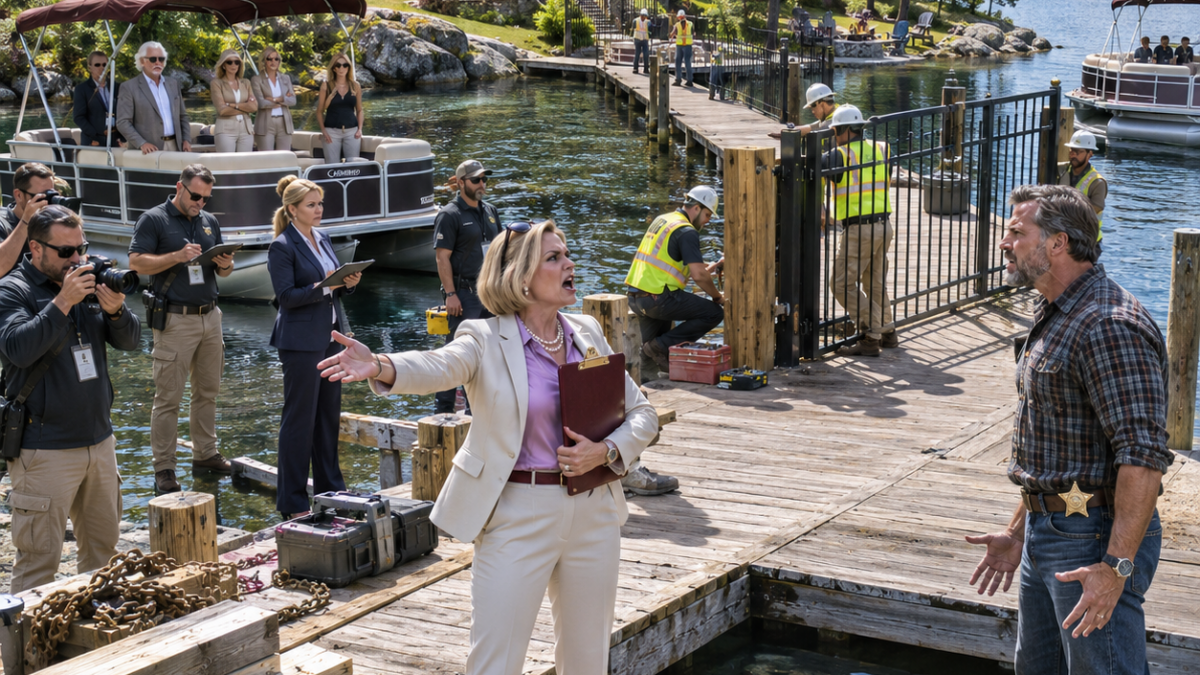
A white pontoon boat was headed directly toward us.
Three people stood aboard.
The woman in front wore a spotless cream blazer despite the summer heat.
Blond bob.
Expensive sunglasses.
Clipboard under one arm.
She stepped onto my dock without asking permission.
“Mr. Marshall?”
“That depends.”
Her smile widened.
“I’m Karen Wilson, president of Pinewater Reserve.”
I waited.
She glanced slowly around my island.
Not admiring it.
Measuring it.
Behind her stood a woman named Jill carrying a leather portfolio and a man in sunglasses I would later learn was one of Pinewater’s legal consultants.
Karen turned toward the cabin.
“Lovely place.”
“Thank you.”
“A shame, really.”
That got my attention.
“A shame?”
She looked back at me.
“That it isn’t available to the community.”
The lake suddenly felt very quiet.
I folded my arms.
“It’s private property.”
Karen gave me the kind of smile people use when they believe you simply haven’t understood how important they are yet.
“Well,” she said, “that may be changing.”
And that was the moment I realized she hadn’t come to introduce herself.
She had come to tell me she intended to take something that belonged to my family.
PART 2
I didn’t answer immediately.
Years in law enforcement had taught me that silence could be useful.
People who were lying hated silence.
They rushed to fill it.
Karen did exactly that.
“Pinewater Reserve recently voted to extend its environmental management authority across the lake.”
I looked at her.
“You voted?”
“Yes.”
“Your HOA?”
“That’s correct.”
“Among yourselves?”
The man behind her shifted his weight.
Karen’s smile tightened.
“It was unanimous.”
I almost laughed.
Almost.
Instead, I picked up the towel I’d left on the dock and slowly dried my hands.
“Congratulations.”
Her eyebrows lifted.
“I’m sorry?”
“You held a vote and everybody agreed with themselves.”
The attorney-looking man stepped forward.
His name was Brad.
“Mr. Marshall, perhaps you don’t understand how community jurisdiction works.”
That time I did laugh.
Not loudly.
Just enough.
Brad frowned.
I looked from him to Karen.
“An HOA can regulate property subject to its covenants. It cannot hold a meeting in a clubhouse, vote on somebody else’s deed, and magically acquire jurisdiction over it.”
Karen’s expression hardened.
“We’re discussing the lake.”
“You’re standing on my island.”
“The island sits within a shared environmental resource.”
“The island has a deed.”
Jill opened her portfolio.
Karen gestured toward it.
“We’ve documented several concerns.”
That sentence interested me.
Jill produced glossy aerial photographs.
Drone photographs.
There were red circles around my solar panels, dock supports, filtration system, and shoreline reinforcement.
She pointed to the first photograph.
“Unregulated construction.”
“Permitted.”
The next.
“Possible shoreline disturbance.”
“Inspected twice.”
Another.
“Nonconforming sanitation installation.”
“County-approved composting system.”
Jill stopped turning pages.
Brad pushed his sunglasses higher.
Karen remained remarkably composed.
“I’m sure you believe everything is in order.”
“I don’t believe it,” I said. “I have the permits.”
She folded her hands.
“Then there should be no reason to resist an inspection.”
“By whom?”
“Our lake compliance team.”
“No.”
Her smile disappeared.
It happened so quickly it almost impressed me.
“No?”
“No.”
“Mr. Marshall—”
“The county environmental department can inspect it. State officials can inspect it. Anybody with actual lawful authority and the proper notice can inspect it.”
I stepped closer.
“But people hired by your HOA do not get to enter my property because you printed a badge and invented a title.”
For the first time, Brad looked uncomfortable.
Karen didn’t.
Her eyes moved past me toward Lucas.
My son was pretending not to listen.
That bothered me more than anything she’d said.
I shifted slightly, blocking her view.
“What do you actually want?”
Karen sighed like I was the unreasonable one.
“We want the lake to fit a unified community vision.”
“There it is.”
“There what is?”
“The real reason you came.”
She tilted her head.
I continued.
“This isn’t about pollution. It isn’t about safety. You don’t like having property in the middle of the lake that you can’t control.”
Karen’s eyes sharpened.
“I think cooperation would be better for everyone.”
“Cooperation requires two people agreeing.”
“This island is becoming a concern.”
“To whom?”
“Our residents.”
“Name one.”
She didn’t.
Instead, she turned toward the boat.
“We’ll be in contact.”
I watched her step aboard.
Then she paused.
Without looking back, she said, “Things change, Mr. Marshall.”
“Yes,” I said.
“Usually when people make mistakes.”
Brad stared at me.
Jill lowered her eyes.
Karen finally turned.
“Is that a threat?”
“No.”
I smiled.
“Just professional experience.”
Their boat moved away.
Lucas came up beside me.
“Dad?”
“Yeah?”
“Is that lady trying to take the island?”
The question hit harder coming from a twelve-year-old.
I looked toward the disappearing pontoon.
“No.”
I placed my hand on his shoulder.
“She’s trying.”
***
The next morning, I went to the county records office.
I deliberately wore my uniform.
Not because I intended to use my authority in a private property dispute.
Quite the opposite.
I wanted everybody who saw me to understand that I intended to handle this correctly.
No shortcuts.
No favors.
No blurred lines.
Drew Lawson was behind the counter when I walked in.
Drew was a former Marine with thick glasses, a bald head, and an almost disturbing affection for zoning law.
He looked up from his computer.
“Sheriff.”
“Drew.”
“You look like somebody put up an illegal fence.”
“Worse.”
He stopped typing.
“Unpermitted septic system?”
“HOA.”
His face changed.
“Oh.”
“Exactly.”
He leaned back.
“What do you need?”
“Everything Pinewater Reserve has filed concerning Lake Pinewater during the past twelve months.”
“That’s broad.”
“Good.”
“Environmental?”
“Yes.”
“Annexation?”
“Yes.”
“Land use?”
“Yes.”
“Development?”
“Yes.”
“Corporate filings?”
“Especially those.”
He whistled.
“Coffee?”
“Please.”
For the next two hours, Drew and I built a paper mountain.
Most of it was ordinary HOA nonsense.
Landscaping applications.
Road easements.
Drainage proposals.
Community dock permits.
Then I found something titled:
**LAKE PINEWATER COMMUNITY-MANAGED RECREATIONAL ECOSYSTEM PETITION**
I read it twice.
“Drew.”
He looked over.
“You seeing what I’m seeing?”
He walked around the desk.
I pointed to a paragraph.
The HOA wanted the county environmental review council to classify the lake as a unified recreational ecosystem managed in cooperation with “principal shoreline stakeholders.”
That language alone wasn’t illegal.
It was bureaucratic.
Vague.
Dangerous.
Another section identified “unregulated private development” as a potential ecological threat.
Attached photographs showed my island.
My dock.
My cabin.
My solar array.
“Those are the same pictures Karen brought yesterday.”
Drew frowned.
“She came here two weeks ago.”
My head snapped up.
“What?”
“Asking about what she called ‘expedited jurisdictional transition.’”
“That isn’t a thing.”
“I told her that.”
“What did she say?”
“She gave me a brochure.”
Despite myself, I laughed.
“That sounds like her.”
Drew continued searching.
Eventually he stopped.
“Well, now.”
“What?”
He turned the monitor toward me.
Several related filings had not been submitted by Pinewater Reserve.
They had been submitted by a company called Coastal Delta Holdings LLC.
“Who are they?”
“Let’s find out.”
Ten minutes later, we were looking at corporate records.
Development company.
Hospitality investments.
Luxury rentals.
Wellness retreats.
Then Drew opened a planning attachment.
Neither of us spoke.
Across the top were the words:
**PINEWATER WELLNESS & LUXURY EXPANSION — PHASE TWO**
The rendering showed the lake after redevelopment.
A community pier.
Floating yoga platforms.
Kayak stations.
Rental cabins.
And at the center of everything—
my island.
Except my cabin was gone.
In its place stood a two-story glass villa surrounded by a wraparound deck.
“Drew.”
“Yeah.”
“Zoom in.”
He did.
Under the rendering was a note:
**Pending jurisdictional resolution and removal of existing unregulated structures.**
Existing unregulated structures.
My home.
My aunt’s cabin site.
My dock.
My family’s property.
They had erased us from their future before they’d even figured out how to steal the land.
I felt anger rise.
Then disappear.
People think anger always feels hot.
Sometimes real anger feels cold.
Precise.
I printed everything.
Before I left, Drew handed me a flash drive.
“Public records, maps, attachments, emails released with the development applications.”
“Thank you.”
He hesitated.
“Theo.”
I looked at him.
“Be careful.”
“I will.”
“No. I mean it.”
His voice had changed.
“These people are spending serious money before they have legal control of the parcel.”
I looked down at the rendering.
“That means they’re confident.”
“Exactly.”
I slipped the flash drive into my pocket.
“Then somebody promised them something.”
***
Cassidy Monroe had been my attorney for almost fifteen years.
She’d represented the sheriff’s office on civil matters, helped me settle land issues after Eleanor died, and once made a county contractor cry during a deposition without raising her voice.
When I dropped the binder on her desk, she stared at it.
“What did you bring me?”
“A headache.”
She opened the first page.
Twenty minutes later, she leaned back.
“Well.”
“That good?”
“No.”
She tapped the villa rendering.
“They’re trying to steal your island.”
“I gathered that.”
“I mean structurally.”
I sat forward.
“Explain.”
“They know they can’t simply take title. So they’re creating regulatory pressure.”
She began counting on her fingers.
“First, redefine the lake as a community-managed ecosystem.”
“Right.”
“Second, characterize your island as an environmental problem.”
“Right.”
“Third, trigger inspections and restrictions.”
“Right.”
“Fourth, make the property expensive or impossible for you to use.”
“And then?”
She looked at the rendering.
“Offer a solution.”
“Sell.”
“Exactly.”
I stared at the wall.
Cassidy closed the binder.
“Here’s what matters.”
I looked back.
“Do not use your office.”
“I know.”
“I’m serious, Theo. Karen will want you to.”
“I said I know.”
“She needs you angry in uniform. She needs a video of Sheriff Marshall threatening the poor HOA president because she cares about the environment.”
I exhaled.
“That makes me want to do it more.”
“I know.”
She smiled.
“That’s why I’m telling you.”
I stood.
“So what do we do?”
“We document.”
“That’s it?”
“No.”
Her smile vanished.
“We document until they bury themselves.”
***
When I returned to the lake that evening, construction equipment sat across from my island.
A crew was building a pier.
It was enormous.
Far larger than anything a small residential community needed.
Survey flags dotted the shoreline.
Generators hummed.
Workers drove pilings into the ground.
A large temporary sign read:
**PINEWATER COMMUNITY PIER
PHASE ONE RESTORATION PROJECT**
Restoration.
That word irritated me.
They weren’t restoring anything.
They were establishing a beachhead.
I lifted my binoculars.
Jill stood beside the foreman.
She pointed toward the island.
Then toward the plans.
Then back at the island.
I took photographs.
Then I called dispatch.
“Hargrove.”
“Sheriff?”
“I need a preliminary incident log.”
“For what?”
“Possible zoning violations at the northeast shoreline of Lake Pinewater.”
“Want a unit?”
“No.”
“Code enforcement?”
“Not yet.”
“Understood.”
“Just timestamp it.”
There was a pause.
“You expecting trouble?”
“I’m expecting paperwork.”
Hargrove laughed.
“That bad?”
“Worse.”
I put the radio down.
Across the water, Jill was still pointing toward my home.
That night, generators lit the opposite shoreline.
For the first time since inheriting Eleanor’s island, I closed the cabin curtains.
***
The following afternoon, I heard another boat.
A narrow white vessel moved slowly around the island.
On the side were the words:
**PINEWATER LAKE WATCH**
Two men wore matching navy polos.
Each carried a clipboard.
I stepped onto the dock.
They completed one circle.
Then another.
Finally they approached.
“Afternoon, sir.”
“Afternoon.”
“We’re conducting a routine compliance inspection.”
“No, you aren’t.”
The driver blinked.
“We have authorization.”
“From whom?”
“Pinewater Reserve.”
“Then inspect Pinewater Reserve.”
The passenger reached toward my dock.
“Sir, we’ve received complaints about unsafe structures.”
“From whom?”
“I’m not at liberty to disclose that.”
“Then you’re not at liberty to step onto my property.”
He lifted a metal badge from his belt.
It looked like something sold with a Halloween costume.
“This grants us access.”
I stared at it.
Then at him.
“No, it doesn’t.”
“Sir—”
“That badge grants you access to nothing.”
“We can report you for obstruction.”
“Obstruction of what?”
He hesitated.
That hesitation told me everything.
I untied the line he’d looped around my dock cleat.
Then I pushed their boat away.
Not violently.
Just firmly.
“You are not law enforcement.”
“We never said we were.”
“You’re wearing badges, carrying radios, and threatening legal consequences.”
The driver’s face reddened.
“You’ll hear from our attorney.”
“I look forward to it.”
They motored away.
My hands were steady.
But inside, something had changed.
Karen had moved from paperwork to impersonated authority.
That afternoon, I installed two additional cameras.
Before dark, I noticed a woman standing on the new pier.
She had her phone pointed directly at me.
I waved.
Not because I was friendly.
Because I wanted her to know I had seen her.
She raised her middle finger.
Then another.
I almost laughed.
Instead, I photographed her photographing me.
Document everything.
Cassidy’s voice echoed in my head.
So I did.
***
The next morning, Drew found the emails.
Dozens of them.
Coastal Delta had been filing plans through different departments and affiliated companies.
Shell corporations.
Consultants.
Environmental contractors.
Private security vendors.
But one email mattered more than the others.
It was from Karen.
**Pending successful jurisdictional resolution of the island encroachment issue, Phase Two construction can begin Q2 next year.**
Island encroachment issue.
I read it again.
Below was a reply from a Coastal Delta executive.
**Please confirm anticipated removal timeline of current occupant.**
I felt my teeth press together.
“Current occupant,” Drew said quietly.
“Not owner.”
“No.”
“Not deed holder.”
“No.”
“Occupant.”
I closed the folder.
Drew looked at me.
“You okay?”
“No.”
It was the truth.
For the first time, the entire thing felt personal in a way even the trespassing hadn’t.
They weren’t disputing a line on a survey.
They had already psychologically erased me.
They were speaking about my family’s home as though we were squatters waiting for eviction.
And somewhere, investors were being shown beautiful renderings of a villa on land Karen did not own.
I took everything to Cassidy.
Her reaction was simpler.
“We have motive.”
“Enough?”
“For a civil injunction? We’re getting close.”
“What about criminal?”
“Not yet.”
She pointed at me.
“And you are not going fishing for one.”
“I know.”
“Say it.”
“I am not going fishing for evidence.”
“Good.”
She leaned back.
“Because people this arrogant usually bring it to you.”
She was right.
I just didn’t expect them to bring it through my front door.
***
Two days later, I crossed the lake shortly after sunrise.
The second my boot touched the dock, I knew something was wrong.
I couldn’t explain it.
There are instincts you develop after years of entering places where bad things have happened.
A door open two inches too far.
A curtain hanging differently.
A bird suddenly going silent.
The cabin door was ajar.
I stopped.
My hand instinctively moved toward my sidearm.
I didn’t draw it.
I approached the wall and listened.
Movement inside.
A drawer opening.
Something hitting the floor.
I pushed the door slowly.
My cabin had been searched.
Cabinet doors were open.
Papers covered the floor.
Cushions had been moved.
Two men stood inside wearing dark blue uniforms.
Neither uniform had a legitimate agency patch.
The older man turned.
“Sir, you need to vacate the structure.”
I almost thought I’d misheard him.
“What?”
“We’re conducting an authorized inspection.”
“Show me your warrant.”
“We don’t require one.”
“Agency?”
He frowned.
“What?”
“What law-enforcement agency are you with?”
“This is an HOA compliance action.”
“You’re wearing handcuffs.”
“For safety.”
“Pepper spray.”
“For safety.”
“A badge.”
He touched it unconsciously.
“For identification.”
I looked toward the younger man.
He was going through a desk drawer containing family photographs.
“Take your hands out of there.”
He smirked.
“We’re documenting.”
I stepped forward.
The older man moved his hand toward his spray.
“Sir, if you become aggressive—”
A voice came from the doorway behind me.
“Theo?”
I recognized it immediately.
Noah Grant.
Friend.
Former Army Ranger.
One of the few people I knew who could turn a casual fishing visit into a military operation.
He looked past me.
His eyes moved across the uniforms.
Then he said quietly, “Those aren’t cops.”
The older man drew the pepper spray.
Everything happened fast.
Noah grabbed his wrist.
The man swung.
Noah ducked and hit him once.
A short, ugly punch.
The man dropped.
The younger intruder ran.
He sprinted past us, raced down the dock, leaped into their boat, nearly fell into the lake, then tore away from the island.
I pulled out my radio.
“Dispatch, Sheriff Marshall.”
“Go ahead.”
“I have an individual detained on my private property for suspected criminal trespass and impersonation of law enforcement. Send Hargrove and another unit.”
Silence.
Then:
“Copy.”
Noah looked down at the unconscious man.
“You think I hit him too hard?”
“He pulled spray.”
“That’s not an answer.”
“He’s breathing.”
“Good.”
Fifteen minutes later, my deputies arrived.
That was when the situation stopped being an HOA dispute.
The man’s employer was Northern Apex Risk Solutions.
A private security company.
The same company operating Pinewater Lake Watch.
And when investigators pulled corporate ownership records, they found a minority owner.
Aaron Wilson.
Karen’s husband.
***
I sat on my dock that night long after the deputies left.
Noah handed me a flask.
I looked at it.
“Tea?”
“Bourbon.”
“I’m working tomorrow.”
“So drink responsibly.”
I took one swallow.
The lake was dark.
Across the water, Pinewater Reserve glowed.
Warm porch lights.
Landscape lighting.
A fountain near the clubhouse.
Everything looked peaceful.
“That’s what bothers me,” I said.
Noah leaned back.
“What?”
“How normal it looks.”
He understood immediately.
“Bad people rarely build haunted castles.”
I smiled.
“That from Ranger school?”
“No. My grandmother.”
We sat quietly.
Eventually he asked, “You scared?”
I considered lying.
“No.”
He looked at me.
I sighed.
“For my kids.”
“That’s different.”
“Somebody went through their pictures today.”
Noah’s expression changed.
“I know.”
“That drawer had Emily’s school photo in it.”
He said nothing.
“Lucas keeps asking whether we’re going to lose the island.”
“You’re not.”
“I know that legally.”
“That’s not what I said.”
I stared across the water.
Noah leaned forward.
“You’re not losing it.”
I nodded.
But I didn’t feel certain anymore.
Not because Karen had a legal case.
She didn’t.
I was worried because people who knew they were losing sometimes stopped caring about legality.
Two mornings later, I discovered exactly how far they were willing to go.
***
The power failed before sunrise.
I stepped outside and opened the inverter housing.
The main conduit had been cut.
Cleanly.
Not weather damage.
Not an animal.
Cut.
My stomach tightened.
I checked the filtration system.
That was when I found the black device under a stack of river stones.
Small.
Professional.
Blinking green.
I didn’t touch it with my bare hands.
Instead, I photographed it in place.
Then bagged it properly.
Nate Patterson ran a cybersecurity and electronic-security company outside town.
He examined the unit beneath a magnifying visor.
“This isn’t retail.”
“I figured.”
“These are leased.”
“To whom?”
“Security contractors mostly.”
He entered the serial number.
Four minutes later, he stopped typing.
“Oh.”
I hated that word.
“What?”
He rotated the monitor.
Registered lessee:
**Northern Apex Risk Solutions.**
I stared at him.
“The fake officers.”
“Yes.”
“Anything else?”
Nate hesitated.
“What?”
“The monitoring account is linked through Wilson Holdings Group.”
I didn’t move.
“Aaron Wilson?”
“Looks like it.”
For several seconds, the only sound in the room was the hum of Nate’s computer fans.
“They weren’t monitoring the island,” I said.
Nate looked at me.
“They were monitoring you.”
That distinction mattered.
A lot.
Someone wanted to know when I arrived.
When I left.
When the property was empty.
When my family was present.
That afternoon, I installed more cameras and reinforced every vulnerable system.
Megan called while I was working.
“Theo.”
“Hey.”
“Lucas told me about the men.”
I closed my eyes.
“I was going to tell you.”
“When?”
“Tonight.”
“Were they armed?”
“Not with firearms.”
“That isn’t what I asked.”
I looked across the water.
“Megan.”
“Were they armed?”
“Pepper spray. Handcuffs.”
She went silent.
I hated that silence more than shouting.
Finally she said, “The kids aren’t going back out there until this is over.”
My first instinct was to argue.
Then I pictured the men digging through Emily’s photograph.
“You’re right.”
Another silence.
“They love that island.”
“I know.”
“So do you.”
I sat down on the cabin step.
“I know.”
“Theo, promise me something.”
“What?”
“Don’t let being sheriff make you think you have to stand there alone.”
That sentence stayed with me.
“I promise.”
It was a promise I would have to learn how to keep.
***
At 3:14 the following morning, my motion sensor screamed.
I woke in the chair on the deck.
Orange light flickered through the trees.
Fire.
I ran.
The walkway leading to the dock was burning.
Flames rolled across the dry wood.
I grabbed an extinguisher.
For ten minutes, the world became smoke, heat, foam, and adrenaline.
By the time the fire died, half the walkway had collapsed.
My arms shook.
My lungs burned.
Then I noticed the cameras.
Destroyed.
One had been smashed.
Another had its wire cut.
Someone had known exactly where they were.
I started photographing the scene.
Near a blackened post, I saw something melted into the ash.
Plastic laminate.
I lifted it with gloves.
Only one corner had survived.
But the logo was visible.
Pinewater Reserve.
I stood in the smoke holding that piece of plastic.
For the first time, I felt something close to hatred.
Not the wild kind.
The dangerous kind.
The kind that tells you to stop being careful.
I thought of Eleanor.
I thought of Lucas asking whether we were going to lose the island.
I thought of Karen’s smile.
Then I heard Megan’s voice in my memory.
Don’t let being sheriff make you think you have to stand there alone.
I put the evidence into a bag.
Called the fire investigator.
Called my deputies.
Called Cassidy.
And I did not call Karen.
That mattered.
Because the thing she needed most was for me to lose control.
I refused to give it to her.
***
Cassidy stared at my soot-covered shirt.
“No one died?”
“No.”
“Good.”
I set the evidence case on her desk.
“Then I’m allowed to be excited.”
I raised an eyebrow.
She held up the HOA fragment.
“Not about the fire, idiot. About this.”
Nate arrived shortly afterward.
He recovered part of a trail-camera image from the damaged memory card.
A hand.
A tool.
A tattoo.
We enlarged it.
Cassidy went still.
“No.”
I recognized it too.
Aaron Wilson had the same tattoo on his forearm.
We found it in photographs from a Coastal Delta corporate retreat.
The image alone wasn’t enough to prove he had set the fire.
But combined with the GPS unit, security company connection, trespass, and development motive?
The picture was becoming ugly.
Cassidy began filing motions.
Emergency injunction.
Preservation of electronic records.
Demand for financial disclosures.
Request for judicial review of the HOA’s environmental petition.
Notification to the prosecutor concerning Northern Apex.
“We don’t need revenge,” she said while typing.
I looked at her.
“I didn’t say we did.”
“You’re thinking it.”
“Maybe.”
She stopped.
“The best revenge is boring.”
“That sounds terrible.”
“Bank records. Discovery orders. Subpoenas.”
She smiled.
“Very boring.”
I finally smiled too.
“And devastating.”
“Exactly.”
***
Karen made her last public mistake the day before the hearing.
She appeared before the town council.
Mia, Cassidy’s paralegal, burst into the office holding a tablet.
“You need to see this.”
Karen stood at a podium on the screen.
Pearls.
Pastel jacket.
Concerned smile.
“If we can resolve the private-island issue,” she said, “we envision repurposing the space into a community wellness retreat.”
Cassidy stopped writing.
Karen continued.
“Meditation cabins, nature therapy, sustainable lodging, and expanded public access.”
I stared at the screen.
She was describing the Coastal Delta investor deck almost word for word.
Mia looked at us.
“She’s presenting the private development plan as an HOA public project.”
Cassidy slowly snapped her pencil in half.
“Tomorrow,” she said, “we end this.”
***
The courtroom was full.
Residents.
Reporters.
County staff.
People who had never cared about zoning in their lives but suddenly considered environmental jurisdiction fascinating.
Karen entered with her attorney.
Aaron sat behind her.
When I walked in, Karen looked directly at me.
Then she smiled.
It was the same smile she’d worn on my dock.
I sat beside Cassidy.
She whispered, “Let them talk.”
“I know.”
“No interruptions.”
“I know.”
“No sheriff face.”
“What’s sheriff face?”
“The face you’re making right now.”
I relaxed my jaw.
The judge entered.
Karen’s attorney went first.
He described Pinewater Reserve as a responsible community trying to protect a fragile ecosystem.
He spoke about water quality.
Shared resources.
Unregulated structures.
Community safety.
He made me sound like a hermit who had constructed an illegal fortress in the middle of a public lake.
I let him.
Then Cassidy stood.
She placed Eleanor’s original parcel record on the projector.
“This deed predates Pinewater Reserve by nearly three decades.”
Next came tax records.
Permits.
Environmental approvals.
Inspection reports.
Water rights.
Shoreline certificates.
Every document Eleanor had saved.
Every document I had added.
The legal fortress she’d built without ever knowing how badly I would need it.
Then Cassidy changed slides.
The Coastal Delta rendering filled the courtroom.
My island.
Their villa.
A murmur moved through the gallery.
The opposing attorney objected.
The judge overruled him.
Cassidy displayed Karen’s email.
**Pending successful jurisdictional resolution…**
Then the reply.
**Please confirm removal timeline of current occupant.**
Karen’s face changed.
Cassidy displayed Northern Apex’s corporate ownership records.
Aaron shifted in his seat.
Next came the GPS tracker lease.
Then the trespass report.
Then the fake badge.
Then the damaged camera image.
Aaron’s tattoo.
Karen’s attorney stood.
“Your Honor, we strongly object to the implication—”
The judge raised his hand.
“Sit down.”
He sat.
Cassidy played the town council recording.
Karen’s own voice filled the courtroom.
“…repurpose that land into a public wellness retreat…”
When the video ended, the judge looked at her.
“Mrs. Wilson.”
Karen straightened.
“Your Honor.”
“Are you acting solely in your capacity as president of Pinewater Reserve?”
“Yes.”
Cassidy said nothing.
The judge continued.
“Do you have any financial relationship with Coastal Delta Holdings?”
Karen’s attorney stood.
“Your Honor—”
“I asked Mrs. Wilson.”
Karen swallowed.
“My husband has business interests.”
“What kind?”
“I’m not involved in all of his business dealings.”
The judge looked at the email.
“You personally sent Coastal Delta a development timeline.”
Silence.
“I was trying to help the community.”
“By removing Mr. Marshall?”
“That isn’t what I meant.”
“You called his property an encroachment.”
“It affects the lake.”
“Do you own the lake?”
“No.”
“Does your HOA own the island?”
“No.”
“Do you have any recorded jurisdiction over his parcel?”
Karen looked at her attorney.
The judge leaned forward.
“Mrs. Wilson?”
“No.”
For months, she had spoken as though authority came from confidence.
That one word destroyed the illusion.
No.
The HOA didn’t own the island.
No.
It didn’t control the parcel.
No.
Karen didn’t have jurisdiction.
The judge issued an emergency order.
All Pinewater Reserve enforcement activity relating to my island stopped immediately.
Construction tied to the disputed development stopped.
The HOA’s discretionary accounts were frozen pending an audit.
Relevant electronic records were ordered preserved.
And the matter was referred to the county prosecutor.
Karen stood motionless.
Outside the courthouse, reporters crowded the steps.
I refused interviews.
Karen didn’t.
“This is a misunderstanding,” she told them.
I watched from inside.
Cassidy stepped beside me.
“She still thinks she can talk her way out.”
“Can she?”
Cassidy smiled.
“Not from bank statements.”
***
The audit lasted three months.
What investigators found went far beyond my island.
HOA dues had been redirected into consulting companies.
Several companies traced back to Wilson Holdings.
Northern Apex had received large payments disguised as community-security services.
Coastal Delta had financed lobbying and planning expenses while Karen promoted the project as an HOA initiative.
One invoice made even Cassidy stare.
Twelve thousand four hundred seventy-eight dollars.
“For what?” I asked.
She slid the document across the table.
“A surveillance balloon.”
I read it.
“You’re joking.”
“No.”
“They put a balloon over my island?”
“Apparently.”
I leaned back.
For three seconds, neither of us spoke.
Then I started laughing.
I couldn’t help it.
After months of fear, fires, threats, lawyers, fake officers, trackers, and sleepless nights, the absurdity finally broke through.
Cassidy began laughing too.
“A twelve-thousand-dollar spy balloon.”
“Paid with HOA dues.”
“That part is less funny.”
“Much less.”
But the financial records also opened doors.
Phone records.
Security logs.
Messages.
Aaron had communicated directly with Northern Apex personnel the nights surveillance devices appeared.
One employee cooperated.
Then another.
The younger fake officer who had escaped my cabin made a deal.
He admitted Northern Apex had been ordered to search the island for “code violations” and anything that could support an emergency condemnation request.
Then the prosecutor found messages about the fire.
No explicit sentence said, Burn Theo Marshall’s dock.
People committing felonies are occasionally smarter than that.
But one message from Aaron to a security supervisor read:
**Make sure he understands the property is becoming more trouble than it’s worth.**
The reply:
**We’ll send a message.**
Less than six hours later, my dock burned.
Karen and Aaron were arrested on a gray Tuesday morning.
I wasn’t there.
I deliberately stayed away.
I didn’t want my badge anywhere near the moment.
Hargrove came to my office afterward.
“They’re booked.”
I looked at the report.
Karen Wilson.
Aaron Wilson.
Fraud.
Unlawful surveillance.
Criminal conspiracy.
False representation of authority.
Conspiracy connected to arson.
Hargrove stood quietly.
“You all right?”
I stared at Karen’s booking photograph.
Without pearls, sunglasses, or the perfect blazer, she looked smaller.
Not defeated.
Human.
For months, I had imagined that moment.
I thought I would feel triumphant.
Instead, I felt tired.
“They could have killed somebody,” I said.
Hargrove nodded.
“Yeah.”
“My kids used that dock.”
“I know.”
“They could’ve been there.”
“I know.”
I closed the file.
“That’s the part I can’t forgive.”
***
The criminal case took months.
During that time, the island slowly became ours again.
The community pier was closed.
Pinewater Lake Watch disappeared.
The strange surveillance stopped.
My children returned.
The first time Lucas stepped onto the rebuilt dock, he stood there for a long moment.
“You sure?”
“About what?”
“That nobody can take it?”
I put down the fishing gear.
“Come here.”
He walked over.
I pointed toward the shoreline.
“You see that cedar tree?”
“Yeah.”
“Aunt Eleanor planted it.”
“Okay.”
“See the cabin?”
“Yeah.”
“She had permits for the original one.”
I pointed toward the dock.
“The county approved that.”
Then toward the ground beneath us.
“And this land has a deed.”
Lucas nodded.
“So?”
“So nobody gets to take something just because they vote that they want it.”
He looked toward Pinewater Reserve.
“Even an HOA?”
“Especially an HOA.”
He smiled.
Then his expression became serious.
“Dad?”
“Yeah?”
“Were you scared?”
I could have lied.
Children notice more than adults think.
“Yes.”
“Really?”
“Really.”
“But you’re sheriff.”
“That doesn’t stop people from being scared.”
“What does?”
“Nothing.”
He frowned.
I put my hand on his shoulder.
“Being brave doesn’t mean you stop being scared. It means you know what matters more than being scared.”
He thought about that.
Then he picked up his fishing rod.
“Like the island?”
I smiled.
“Like your family.”
***
Pinewater Reserve began tearing itself apart.
Residents packed HOA meetings.
People demanded records.
Some homeowners discovered their dues had financed Karen’s legal games without their knowledge.
Others learned money meant for drainage repairs had gone toward Coastal Delta consultants.
One elderly resident named Mrs. Crawford approached me at the grocery store.
She looked embarrassed.
“I owe you an apology.”
“You don’t owe me anything.”
“I voted for Karen.”
“A lot of people did.”
“I believed her.”
“That isn’t a crime.”
She looked at the floor.
“She told us you were damaging the lake.”
“I know.”
“She told us the island was illegally expanded.”
“I know.”
“She said you threatened HOA employees.”
“I know.”
Mrs. Crawford’s eyes filled.
“My husband died two years ago. I moved to Pinewater because they said the HOA would protect property values and keep things peaceful.”
I didn’t know what to say.
She continued.
“I gave them money every month to protect my home. They used it to attack yours.”
That sentence stayed with me.
Because it reminded me of something important.
Karen wasn’t Pinewater Reserve.
Most residents weren’t villains.
They had been manipulated too.
I touched Mrs. Crawford’s shoulder.
“You were lied to.”
“I should have asked questions.”
“Next time you will.”
She nodded.
A week later, she helped organize a homeowner petition demanding dissolution of the board.
That petition eventually collected nearly eighty percent of the community.
Karen had wanted control.
Instead, she taught her entire neighborhood to question authority.
There was something satisfying about that.
***
The trial began the following spring.
Karen looked very different.
No pastel blazer.
No staged confidence.
No crowd of HOA officers following her.
Aaron looked worse.
Several former Northern Apex employees had agreed to testify.
The younger man from my cabin described being told that my property would soon belong to Coastal Delta.
A former accountant explained how HOA money had been routed.
Nate testified about the tracker.
The fire investigator testified about accelerant residue.
Drew explained the development filings.
Then I testified.
The prosecutor asked me about Eleanor.
About the inheritance.
About Karen arriving on the island.
About the photographs.
The fake inspectors.
The GPS device.
The fire.
Finally, he asked:
“Sheriff Marshall, when did you realize the defendants’ conduct had moved beyond a property dispute?”
I looked at the jury.
“When they stopped trying to prove they had authority and started pretending they already had it.”
The prosecutor nodded.
“What do you mean?”
“They used uniforms. Badges. Surveillance. Bureaucratic language. Environmental claims. They wanted me to believe resistance was pointless.”
“Did you believe that?”
“No.”
“Why not?”
I looked briefly toward Karen.
“Because authority isn’t something you get by acting confident.”
I turned back toward the jury.
“It has to come from somewhere lawful.”
The defense attorney stood for cross-examination.
He tried to suggest I had used my position as sheriff to target Karen.
“Isn’t it true,” he asked, “that county employees assisted you in gathering records?”
“They assisted me in accessing public records.”
“Because you were sheriff.”
“No.”
“How can you know?”
“Because anyone can request them.”
He paced.
“You also contacted your dispatch center regarding the pier.”
“Yes.”
“Using your official radio.”
“Yes.”
“Isn’t that an abuse of public resources for personal benefit?”
“No.”
“Why not?”
“Because I reported a possible zoning violation and specifically ordered no enforcement action until jurisdiction was confirmed.”
He paused.
“You created a police record.”
“I created a timestamped observation.”
“Convenient.”
“Accurate.”
He changed direction.
“You carried a firearm while confronting Northern Apex employees.”
“I carry a firearm almost every day.”
“Were they frightened of you?”
“You’d have to ask them.”
“Sheriff Marshall, did you identify yourself as sheriff?”
“No.”
That surprised him.
“Never?”
“Not during the first island confrontation.”
“Why?”
“Because it was a private dispute.”
He looked down at his notes.
It was the wrong question for him to ask.
The jury noticed.
When I left the stand, Cassidy whispered, “He just proved our ethics argument for us.”
“I noticed.”
The jury eventually began deliberating.
Seven hours.
I spent most of them walking.
When we were called back, Megan held my hand.
Karen stood beside Aaron.
The foreperson rose.
“Guilty.”
Fraud.
Guilty.
Conspiracy.
Guilty.
Unlawful surveillance.
Guilty.
False representation.
Guilty.
Criminal conspiracy connected to the arson.
Aaron closed his eyes.
Karen stared straight ahead.
I felt Megan squeeze my hand.
I didn’t celebrate.
I didn’t smile.
I simply breathed.
For the first time in more than a year, I felt like I could.
The judge eventually sentenced them both to twelve years, with no possibility of parole for at least five.
Some people later asked whether I thought twelve years was enough.
I never knew how to answer that.
Prison wouldn’t rebuild the nights my children had lost.
It wouldn’t erase Megan’s fear.
It wouldn’t undo strangers going through my daughter’s photograph.
Punishment rarely makes history disappear.
But consequences matter.
And for the first time since Karen’s pontoon touched my dock, there were consequences she could not vote away.
***
Pinewater Reserve’s HOA collapsed soon afterward.
The court removed the board.
Homeowners voted to replace the association with a far more limited community organization.
The controversial pier was dismantled.
The Lake Watch boat disappeared.
Coastal Delta abandoned the luxury expansion.
Investors fled before the company could finish explaining why the centerpiece of its multimillion-dollar proposal had never belonged to it.
I rebuilt the dock.
Not exactly as Eleanor had built hers.
Better.
Composite decking.
Reinforced steel supports.
Redundant cameras with cellular backup.
Protected battery system.
Fire-resistant storage.
Noah helped.
Mostly.
He spent an unreasonable amount of time complaining about my choice of screws.
“These will rust.”
“They’re stainless.”
“Eventually.”
“Everything eventually rusts.”
“Not my emotional commitment to quality.”
I threw a glove at him.
Lucas and Emily painted the storage shed.
Megan planted flowers around the cabin.
For the first time, repairing the island didn’t feel like preparing for another attack.
It felt like living.
When everything was finished, I installed one final thing.
A cedar sign.
Emily watched while I bolted it to two posts near the dock.
“What does it say?”
I stepped aside.
She read aloud.
“PRIVATE PROPERTY. INDEPENDENT PARCEL. NOT SUBJECT TO HOA VOTE.”
She started laughing.
Megan walked over.
“That’s subtle.”
“I considered something stronger.”
“I’m sure you did.”
Lucas snapped a picture.
Within a week, somebody posted it online.
Then the local paper used the photograph with a headline about the sheriff who saved his island from an HOA corruption scheme.
I hated the headline.
Emily loved it.
“Dad, you’re famous.”
“I was already sheriff.”
“That’s not famous.”
“Good to know.”
One afternoon, a high-school civics class came out with their teacher.
They had been studying property rights and local government.
I agreed to show them the island.
At the end, one student asked the question I’d heard more times than any other.
“Why didn’t you just arrest Karen at the beginning?”
I smiled.
“Because being wrong isn’t always a crime.”
“But she was trying to steal your island.”
“I suspected that.”
“So?”
“So suspicion isn’t proof.”
The student frowned.
I continued.
“And having authority doesn’t mean you get to skip the process because you’re angry.”
Their teacher smiled.
Another student raised her hand.
“So the process protected Karen too?”
“Yes.”
She seemed surprised.
“Even though she was guilty?”
“We didn’t know she was guilty until the evidence proved it.”
The girl nodded slowly.
That moment meant more to me than the newspaper headline.
Because Eleanor’s island had become something I never expected.
A lesson.
Not just for my children.
For me.
***
Late that summer, my family spent an entire weekend there.
No court dates.
No lawyers.
No security alarms.
No reporters.
No Karen.
Saturday evening, Lucas and Emily sat at the end of the dock with fishing poles.
My dog was asleep between them.
Megan leaned against me.
The sky turned orange.
For a while, we watched the water without talking.
Then Emily looked at the sign.
“Dad?”
“Yeah?”
“Does that mean nobody can ever come here?”
“What?”
“The sign.”
I looked at it.
“No.”
“But it says private property.”
“That means people need permission.”
“So people can still visit?”
“Of course.”
She thought for a second.
“Even Pinewater people?”
I smiled.
“Sure.”
“After everything?”
“Most of them didn’t do anything.”
She nodded.
“What if Karen came back?”
Megan looked at me.
Lucas stopped fishing.
Even the question felt strange now.
I considered giving a funny answer.
Instead, I told the truth.
“If Karen came back after serving her sentence and asked peacefully to talk, I’d listen.”
Lucas stared at me.
“Seriously?”
“Seriously.”
“Why?”
“Because protecting a boundary and holding a grudge aren’t the same thing.”
Megan squeezed my arm.
Emily seemed satisfied.
Lucas wasn’t.
“I’d make her stay in the boat.”
I laughed.
“That might be reasonable.”
The sun sank lower.
Eventually, the children went inside.
Megan followed them.
I stayed on the dock.
Alone.
The lake became glass.
I looked toward the cedar trees Eleanor had planted so many years earlier.
And suddenly I missed her terribly.
Not in the sharp way grief first arrives.
In the quieter way it returns years later.
I thought about her note.
Take care of my island.
Don’t let anyone mess with it.
I had always believed Eleanor meant the land.
The deed.
The trees.
The cabin.
The dock.
That night, I understood she had meant something larger.
Peace.
She had spent her life building a little place where the outside world didn’t get to decide everything.
Then she had handed that responsibility to me.
At first, I protected it like a sheriff.
Evidence.
Rules.
Courts.
Law.
But ultimately, I protected it like a nephew.
Like a husband.
Like a father.
Because three million dollars was never the reason I fought.
If Coastal Delta had offered me four million, I would have refused.
Five?
Still no.
Because I knew what the island represented.
Eleanor’s stubborn hands carrying stones.
My children jumping from the dock.
Megan sitting beside me after difficult nights.
A place where I could remove the badge and remember that I was more than my job.
Karen saw acreage.
Developers saw revenue.
Investors saw luxury cabins.
I saw home.
And that was the mistake they never understood.
People will sometimes surrender property when the price becomes high enough.
They will tolerate insults.
They may even walk away from unfairness because fighting is exhausting.
But when someone threatens the place where your family became itself, the calculation changes.
I didn’t defeat Karen because I was stronger.
I didn’t defeat her because I was sheriff.
In some ways, being sheriff made everything harder because I had to be more careful than anyone else.
I won because Eleanor had done her paperwork.
Because Drew kept records.
Because Cassidy understood patience.
Because Nate understood technology.
Because Megan reminded me not to confuse strength with isolation.
Because Noah showed up when I needed him.
Because deputies did their jobs.
Because former employees eventually told the truth.
Because homeowners stopped being afraid to ask questions.
And because Karen made the mistake arrogant people always make.
She believed resistance would disappear if she made resistance painful enough.
She was wrong.
The most dangerous thing about people who abuse authority isn’t always how powerful they are.
It’s how ordinary their methods can look.
A meeting.
A vote.
A form.
A badge.
A consultant.
A letter.
A photograph.
A regulation nobody bothers to question.
That’s how boundaries disappear.
Not always with bulldozers.
Sometimes they disappear one signature at a time.
One assumption at a time.
One frightened person deciding it is easier not to fight.
Karen expected me to become that person.
She expected lawsuits to exhaust me.
Inspections to scare me.
Surveillance to intimidate me.
The fire was supposed to finish what the paperwork couldn’t.
Instead, every step brought her closer to the one place she had spent the entire fight pretending didn’t matter.
The law.
A breeze moved through the trees.
The old dock bell Eleanor had installed years ago gave a soft metallic chime.
I looked toward the cabin.
Light glowed through the windows.
My family was inside.
Safe.
I walked toward them.
Halfway there, I stopped and looked once more across the lake.
Pinewater Reserve was quiet.
The huge community pier was gone.
No Lake Watch vessel moved through the water.
No drones hovered above the trees.
No one stood across the shoreline filming me.
Just houses.
Families.
Porch lights.
Ordinary people beginning again after somebody they trusted had abused that trust.
For months, I had imagined victory as Karen losing.
That wasn’t victory.
This was.
My children laughing inside Eleanor’s cabin.
My wife calling my name because dinner was getting cold.
The smell of cedar and lake water.
The knowledge that tomorrow morning I could drink coffee on the dock without wondering who had crossed the water during the night.
Peace had returned.
Not because someone had given it back.
Because we had defended it without becoming the thing we were fighting.
I touched Eleanor’s old cedar post as I passed.
“I kept it safe,” I whispered.
Then I went inside.
And for the first time since Karen Wilson’s pontoon boat touched my dock, I locked the door because it was bedtime—
not because I was afraid of who might come through it.