HOA Karen Tried to Shut Down My Legal Drone Deliveries and Fine Me $700 a Day — She Thought Her HOA Controlled the Sky
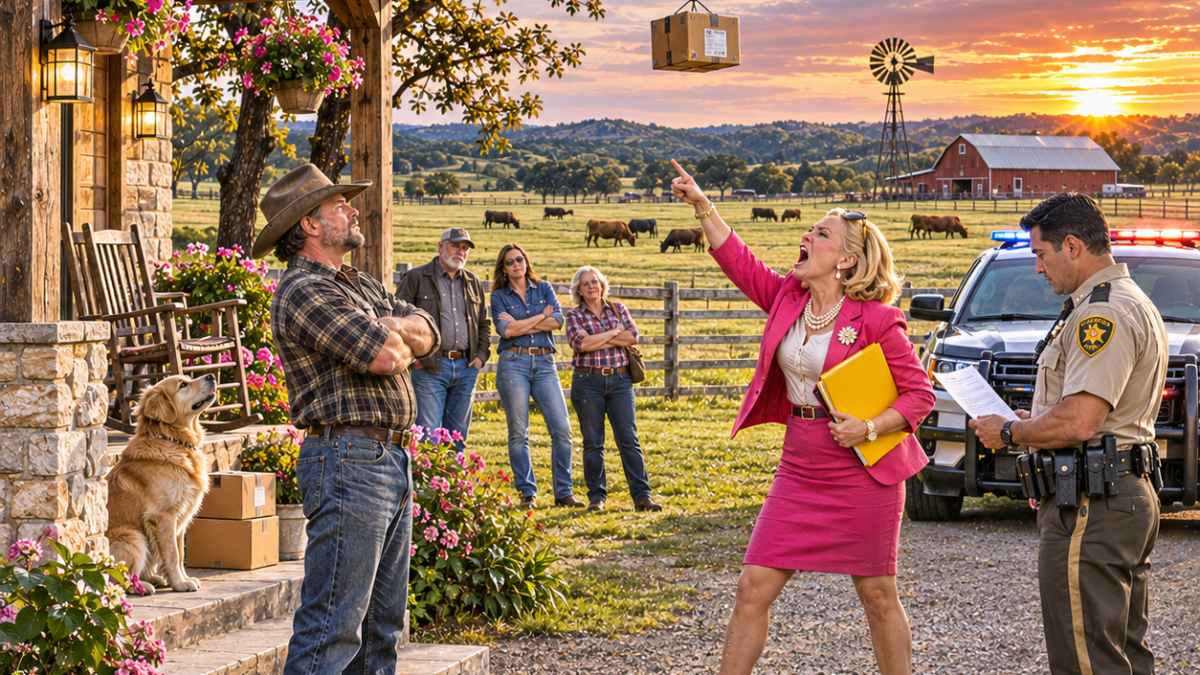
HOA Karen Tried to Shut Down My Legal Drone Deliveries and Fine Me $700 a Day — She Thought Her HOA Controlled the Sky
She tried to regulate a drone flying over land her HOA did not own.
Then she threatened me with $700-a-day fines and police confiscation.
HOA Karen was about to learn that a neighborhood rulebook does not become federal aviation law just because she printed it in bold.
“Your drone delivery is an unauthorized hazard, and I’m calling the police right now to have it shut down.”
Karen Whitmore shouted that from the edge of my driveway while pointing at a delivery drone hovering about forty feet above my porch. The aircraft was sleek, quiet, and steady, four rotors holding it almost motionless while a cable lowered a small package containing a hydraulic sensor I needed for one of the ranch’s irrigation pumps.
The whole delivery would have taken less than two minutes.
Karen turned it into a constitutional convention.
She stood beneath the orange evening sky wearing a bright pink blazer, matching skirt, cream heels, and the expression of a woman who believed aircraft changed ownership when she became angry enough. Her yellow Cedar Ridge Estates folder was tucked beneath one arm. In her other hand she held a violation notice.
“Seven hundred dollars per day,” she announced. “Beginning immediately.”
I looked at the paper.
“Seven hundred?”
“Per day.”
“For what?”
“Unauthorized aerial activity.”
I looked up.
The drone continued lowering my package.
Then I looked back at her.
“My ranch isn’t in your HOA.”
“That argument is getting old.”
“It’s also still true.”
My name is Jack Mercer. I was fifty-four years old, owner of Mercer Ranch, and at the time I worked in federal aviation safety, specializing in unmanned aircraft operations and regional integration. I had spent years reviewing operational risk, airspace coordination, and compliance issues involving drones.
Karen knew none of that.
Apparently she had also never read beyond the first page of any FAA guidance document.
Cedar Ridge Estates sat along the eastern edge of my four-thousand-acre ranch. The subdivision had been built decades after my family acquired the land, and Mercer Ranch had never been annexed into it.
The drone belonged to a commercial delivery operator.
Not me.
The operator used an approved delivery system, and my ranch was an established delivery location. I used the service for small farm components, veterinary supplies, electrical parts, and other items that otherwise required a forty-mile round trip into town.
Karen pointed upward.
“That aircraft entered community airspace.”
“What community airspace?”
“The airspace above Cedar Ridge.”
“It isn’t over Cedar Ridge.”
“It had to pass near Cedar Ridge.”
“So do clouds.”
“This isn’t funny.”
“I’m beginning to disagree.”
Her jaw tightened.
“The board adopted a zero-drone policy last month.”
“Congratulations.”
“It prohibits unmanned aircraft within the community safety zone.”
“Which ends where?”
She pointed vaguely toward the sky.
“Airspace doesn’t have fences.”
“Your authority does.”
That was when a patrol car rolled slowly through my ranch gate.
Karen smiled.
“There. Now we’ll see.”
The package touched down softly on my porch.
The drone began retracting its cable.
Officer Daniel Ruiz stepped from the cruiser.
He looked at me.
Then at Karen.
Then at the aircraft.
“Jack?”
“Evening, Dan.”
Karen marched toward him.
“Officer, I want that drone confiscated immediately.”
Ruiz paused.
“On what basis?”
“It violates HOA aviation rules.”
He looked at me again.
I folded my arms.
Karen lifted her notice triumphantly.
And that was when my phone buzzed with a message from the drone operator’s compliance desk.
I read it once.
Then I smiled.
Karen noticed.
“What?”
I turned the phone face down.
“Nothing yet.”
part 2
Ruiz took Karen’s violation notice and read it slowly.
I knew that look.
Police officers learn very quickly that some paperwork becomes less convincing the longer you stare at it.
At the top was the Cedar Ridge logo.
Underneath, in bold capital letters, Karen had written:
EMERGENCY AERIAL HAZARD ENFORCEMENT ORDER.
I had to admit she understood typography.
Below that was a list of supposed violations.
Unauthorized drone entry.
Excessive rotor noise.
Dangerous package suspension.
Interference with residential enjoyment.
Unlicensed aerial delivery.
Community airspace trespass.
Then came the part I liked most.
“Immediate seizure authorized by HOA Safety Committee.”
Ruiz read that line twice.
“Who’s on the safety committee?” he asked.
Karen straightened.
“I chair it.”
“Who else?”
She hesitated.
“We’re reorganizing.”
I coughed into my fist.
Ruiz gave me a warning look that said he was trying very hard to remain professional.
Then he handed the notice back.
“Ma’am, I’m here because dispatch received a complaint about an unsafe drone operation. I can document what I see and contact the appropriate aviation authority if necessary. I’m not confiscating an aircraft because an HOA notice says I should.”
Karen’s face sharpened.
“You have an obligation to enforce public safety.”
“Correct.”
“Then enforce it.”
“That requires an actual violation.”
She pointed toward the aircraft.
The drone had already finished the delivery.
Its cable was fully retracted.
It climbed smoothly above the ranch and began following its programmed departure route.
“There!” Karen shouted. “It’s fleeing.”
Ruiz looked at me.
“Did she just say the drone is fleeing?”
“Yes.”
“I heard myself say it,” Karen snapped.
“I was hoping I hadn’t.”
She took out her phone.
“I already reported this twice.”
“To us?”
“To the FAA.”
That got my attention.
“Really?”
Karen smiled.
“Yes. I filed a formal complaint about repeated illegal flights.”
I nodded slowly.
That explained the message on my phone.
The commercial operator’s compliance desk had forwarded a notification that an FAA complaint had been associated with my delivery site.
The complaint was being screened.
Normally, that would have meant very little.
Anyone could report a perceived safety issue.
Most complaints were handled professionally and without drama.
Karen, however, had apparently attached my name.
That made things interesting.
Not because I could make the complaint disappear.
I could not.
Nor would I have tried.
Federal ethics rules were not optional simply because the complainant wore pink.
If anything, my position meant I needed to stay farther away from the regulatory review than an ordinary customer would.
I looked at Ruiz.
“Dan, I need to disclose something for your report.”
Karen smiled again.
Finally.
She thought she had me.
I continued.
“I work in FAA aviation safety. UAS operations are part of my portfolio. Because I’m the property owner and recipient, I’ll have no involvement in reviewing any complaint related to this site.”
Karen’s smile disappeared.
Ruiz blinked.
“Wait.”
Karen stared at me.
“You work for the FAA?”
“Yes.”
“In what capacity?”
“Regional aviation safety management.”
Her eyes narrowed.
“You never told me.”
“You never asked.”
“You let me file a complaint?”
“I wasn’t aware you needed my permission.”
Ruiz turned slightly away.
His shoulders moved.
I was almost certain he was laughing.
Karen took one step closer.
“So you’re admitting you’re using your federal position to run illegal drone deliveries.”
“No.”
“Then what are you admitting?”
“That I receive farm supplies from a commercial operator.”
“You supervise them.”
“No.”
“You control the FAA.”
I stared at her.
“Karen, no human being controls the FAA.”
Ruiz lost the fight.
A laugh escaped.
He immediately covered it with a cough.
Karen spun toward him.
“This is not amusing.”
“Sorry.”
“You’re supposed to be neutral.”
“I am.”
“You’re laughing.”
“That’s not legally binding.”
I looked away toward the pasture.
The sun had slipped lower, turning the ranch road copper and gold.
This was exactly why I avoided discussing my job with Karen.
She saw titles as weapons.
If I had told her three months earlier that I worked in aviation safety, she would have spent the next three months claiming either that I personally controlled every aircraft in America or that my refusal to submit to her HOA constituted federal corruption.
Probably both.
Ruiz took my statement.
I explained the basic facts.
The drone was operated by a third-party delivery company.
I did not pilot it.
I did not dispatch it.
I did not control its route.
I had ordered an eligible farm component through a supplier participating in the delivery network.
The commercial operator was responsible for ensuring its aircraft, personnel, route, and operating authority complied with applicable FAA requirements.
My ranch was the delivery location.
Ruiz asked whether I had documentation.
“Yes.”
I pulled up the delivery confirmation and operator information.
Karen interrupted.
“That doesn’t prove it can fly over our neighborhood.”
I looked at her.
“It didn’t deliver to your neighborhood.”
“It crossed community sightlines.”
I waited.
Ruiz waited.
Karen apparently expected that phrase to sound more legal once spoken aloud.
It did not.
“Community sightlines?” Ruiz repeated.
“Yes.”
“Is that in your declaration?”
“It’s in our safety resolution.”
I asked, “Is the sky visible from Cedar Ridge now controlled by the HOA?”
Karen glared at me.
“You’re deliberately trivializing a serious issue.”
“No. I’m trying to determine whether geese need architectural approval.”
Ruiz looked down at his notebook.
Karen pointed at me.
“This is exactly the attitude we’ve been dealing with.”
“Who is we?”
“The community.”
My wife Claire came out of the house carrying two bottles of water.
She handed one to Ruiz.
Then she looked at Karen.
“Still fighting the aircraft?”
Karen drew herself up.
“I am protecting families.”
Claire looked toward the empty sky.
“From the hydraulic sensor?”
Karen ignored her.
Claire handed me the other bottle.
“You want one, Karen?”
“No.”
“Okay.”
Claire went back inside.
That was my wife.
She could make rejection sound like hospitality.
A county sheriff’s deputy arrived ten minutes later because Karen had also called the sheriff’s office.
Deputy Calvin Reeves stepped out.
He looked at Ruiz.
Then at me.
Then at Karen.
“What am I missing?”
Ruiz answered.
“Airspace governance.”
Reeves frowned.
“Do we do that now?”
“Apparently Cedar Ridge does.”
Karen thrust the notice toward him.
“This aircraft violated HOA rules.”
Reeves scanned it.
Then he noticed the line about seizure authority.
“Who exactly were you planning to have seize the drone?”
“The police.”
“While it’s flying?”
“If necessary.”
Reeves handed the paper back.
“I’m going to decline that assignment.”
Karen looked stunned.
I almost felt sorry for her.
Almost.
The officers explained something that should never have required explanation.
Police enforce applicable laws.
They do not become HOA repossession teams because a board president writes “emergency” at the top of a page.
If an aircraft presents an immediate safety hazard, officers can secure the scene, coordinate with aviation authorities, and address violations within their jurisdiction.
But an HOA president cannot simply order police to capture an aircraft.
Karen crossed her arms.
“What about noise?”
Ruiz looked around.
“What noise?”
“The drones are extremely loud.”
At that exact moment, one of my cattle let out a long, aggressive bellow from the pasture.
Reeves looked toward it.
Then back at Karen.
“Do you regulate that?”
She did not appreciate the question.
“We have livestock provisions.”
“On his ranch?”
She said nothing.
I took a drink of water.
The situation would have been funny if Karen’s complaint campaign had not already begun costing me time.
Over the previous six weeks, she had sent four violation notices.
The first demanded $700.
The second claimed the amount had increased to $2,800.
The third claimed $6,300.
The fourth warned that continued drone deliveries could result in “external property lien action.”
That phrase was why I had finally sent everything to Rachel Bennett.
Rachel was my property attorney.
She had already confirmed what we both knew.
Mercer Ranch was not subject to Cedar Ridge’s declaration.
No lien authority existed.
No dues obligation existed.
No HOA aviation policy applied to my property.
Karen’s notices were legally impressive in roughly the same way a child’s pirate map is geographically impressive.
They had graphics.
That was about it.
The next morning, Rachel called me.
“I’ve reviewed the drone letters.”
“How bad?”
“For Karen?”
“Yes.”
“Emotionally or legally?”
“Both.”
I smiled.
“What did you find?”
“She’s cited federal regulations.”
“That should be entertaining.”
“It is.”
Karen had written that my deliveries violated “FAA Rule 107.99.”
There was no Part 107 section with that number matching her claim.
She had also cited a county noise ordinance that applied to prolonged amplified sound during nighttime hours.
The drone deliveries occurred during daylight and lasted minutes.
Then came a supposed “Federal Residential Airspace Protection Act.”
Rachel could not find such a statute.
Neither could I.
We eventually traced the phrase to a neighborhood blog post.
Karen had cited a blog as federal law.
“Please tell me she didn’t put that in an official notice,” I said.
“She put it in bold.”
“Of course she did.”
Rachel sent a formal cease-and-desist to Cedar Ridge.
The letter was almost painfully polite.
It stated that Mercer Ranch was not subject to the association.
It disputed all assessments.
It demanded that the HOA cease representing that it possessed enforcement authority over my property.
It requested preservation of all communications involving the drone complaints, alleged fines, and any attempt to interfere with deliveries.
Then Rachel added one sentence specifically addressing aviation.
Nothing in the letter took a position on whether every future flight would necessarily be lawful.
That determination depended on actual facts and applicable federal rules.
But Cedar Ridge had no authority to invent federal violations or confiscation powers.
That distinction mattered.
I did not want my story becoming:
FAA employee claims all drones are legal because he likes drones.
That would have been idiotic.
Aircraft operations are regulated.
Safety matters.
Airspace matters.
Operating authority matters.
Privacy and nuisance concerns can matter depending on circumstances.
Local governments may have legitimate authority over certain ground activities and land use.
But Karen’s argument was not nuanced.
Her argument was:
I dislike the drone, therefore I control the sky.
That was not a legal doctrine.
The FAA complaint she had filed was routed away from my chain of command because of my involvement.
That was exactly what should have happened.
A compliance specialist from another office, Melissa Grant, handled the initial review.
She contacted the delivery operator directly.
They provided operational records.
Aircraft identification.
Flight logs.
Delivery authorization.
Route information.
Applicable operating authority.
Maintenance status.
Remote identification information where applicable.
Risk controls.
My role in the review was zero.
I actually liked that.
Karen could later accuse me of anything she wanted.
The records would show I stayed out.
Two weeks passed.
Drone deliveries continued.
Karen continued watching them.
At least twice, she stood on Cedar Ridge’s walking path with binoculars.
Claire caught her once.
She came into the kitchen laughing.
“Your girlfriend is back.”
I looked out the window.
Karen stood beyond the eastern fence holding binoculars and her yellow folder.
“She’s documenting.”
Claire poured coffee.
“She looks like she’s hunting a very slow bird.”
“Don’t encourage her.”
“Should I wave?”
“No.”
Claire waved.
Karen lowered the binoculars.
Claire smiled.
Karen raised them again.
I sighed.
“I married a difficult woman.”
Claire kissed my cheek.
“You married well.”
Karen’s campaign escalated at the next HOA meeting.
I learned about it because several Cedar Ridge homeowners had become increasingly uncomfortable with her behavior.
One of them, Tom Alvarez, called me.
“Jack, you should know she’s trying to establish a drone exclusion zone.”
“Over Cedar Ridge?”
“Over Cedar Ridge and a half-mile buffer.”
I laughed.
Tom did not.
“She’s serious.”
“What exactly does the resolution say?”
“I’ll send it.”
The draft arrived ten minutes later.
Karen proposed an “HOA Residential Air Safety Zone” extending horizontally half a mile beyond Cedar Ridge boundaries and vertically to five hundred feet.
I read it twice.
Then I sent it to Rachel.
Rachel called immediately.
“Is this satire?”
“No.”
“She’s claiming jurisdiction five hundred feet up?”
“Yes.”
“And half a mile onto neighboring property?”
“Yes.”
“Does Cedar Ridge own an air force?”
“Not that I know of.”
“That may be the next assessment.”
Karen’s proposed resolution claimed the HOA could impose fines on any “operator, recipient, property owner, tenant, vendor, or facilitating party” associated with drones entering the zone.
The fine was $700 per event.
The resolution also authorized the safety committee to “detain unmanned aircraft equipment upon landing where reasonably accessible.”
That phrase concerned me.
Not because Karen could legally do it.
Because somebody might try.
I called Tom.
“Did the board approve this?”
“Not yet.”
“Make sure they understand that physically interfering with an aircraft is not something they should improvise.”
“I think most of us understand that.”
“Karen?”
“No.”
That answer was predictable.
At the meeting, the resolution failed.
Five board members voted against it.
Karen voted for it.
One abstained.
Apparently she responded by declaring that the board had “lost its courage.”
Then she announced that as president she retained emergency safety powers.
The HOA attorney corrected her.
She argued.
The attorney corrected her again.
She accused him of being “too technical.”
An attorney being technical about legal authority was, in Karen’s view, suspicious.
Three days later, somebody placed a folding lawn chair near the Cedar Ridge walking path facing my ranch.
A handwritten sign taped to it said:
AIR DEFENSE COMMAND.
I had nothing to do with it.
Rachel made me promise not to ask who did.
Karen removed the chair within an hour.
Then came her biggest mistake.
She contacted the drone company directly and demanded that it blacklist my ranch.
The compliance department forwarded the message to me because I was the delivery recipient.
Karen had written:
Cedar Ridge Estates hereby revokes all flight permission within association-controlled community airspace, including adjacent affected property.
The company responded professionally.
They asked whether Cedar Ridge owned the delivery location.
Karen replied:
The property is subject to visual and safety jurisdiction.
They asked whether she had documentation.
She sent her HOA resolution.
The resolution had never passed.
The company noticed.
Their attorney contacted Cedar Ridge’s attorney.
Cedar Ridge’s attorney contacted the board.
The board contacted Karen.
Then the board discovered she had represented a rejected resolution as active policy.
That was when Paul Jenkins, the treasurer, called me.
“Jack.”
“Paul.”
“I need to apologize.”
“For what?”
“For not removing her sooner.”
“That sounds promising.”
He sighed.
“She sent a failed resolution to a commercial aviation company and said it was official.”
“I know.”
“You know?”
“They copied me.”
Paul went silent.
“Oh.”
“Yes.”
“This is going to be a long meeting.”
“Bring snacks.”
It was.
Karen’s emergency board meeting began at seven.
It ended after eleven.
Rachel attended as my counsel.
I stayed home.
At 11:24, she called.
“You awake?”
“Yes.”
“She’s suspended.”
“That fast?”
“Four hours is fast?”
“For an HOA.”
Rachel gave me the highlights.
The board attorney placed Karen’s rejected drone resolution on a projector.
Then he displayed the version she had sent to the delivery company.
They were identical.
He asked why she represented it as binding policy.
Karen said she believed the board’s rejection was “procedurally defective.”
The attorney asked whether any court had ruled that.
No.
Whether the board had reconsidered.
No.
Whether the resolution had been adopted.
No.
Whether she was authorized to tell outside companies that it had been adopted.
No.
Karen responded:
“I’m president. I have inherent authority.”
That sentence apparently caused the HOA attorney to remove his glasses and rub both eyes for several seconds.
Paul asked about the $700-per-day notices sent to me.
The board had never approved those either.
Karen said they were “pilot enforcement notices.”
Someone asked whether “pilot” was a drone joke.
Karen threatened to clear the room.
The attorney reminded her she did not own the room.
That was when the meeting deteriorated.
Eventually, the board voted to suspend her presidential powers pending a formal investigation.
Six to one.
Karen voted against.
Then she claimed the vote violated parliamentary procedure.
Paul asked her to identify the violated rule.
She said, “Common sense.”
Even Rachel laughed while telling me.
The HOA sent me a formal retraction the next morning.
Every drone-related fine was withdrawn.
The board acknowledged Mercer Ranch was outside Cedar Ridge.
It confirmed that the association had no authority to regulate deliveries occurring on my property merely because aircraft could be seen or heard from the subdivision.
It also stated that Cedar Ridge would not attempt to interfere physically with any aircraft.
That sentence should never have been necessary.
But I appreciated it.
The FAA complaint review concluded shortly afterward.
Melissa Grant called me only after the operator had been notified.
“Jack, I’m calling you as the affected property owner, not as an employee.”
“Understood.”
“The complaint did not identify a substantiated violation associated with these deliveries based on the records reviewed.”
“Good.”
“The operator provided the requested documentation.”
“Good.”
“You stayed completely out of the review.”
“That was intentional.”
“I know.”
She paused.
“Apparently the complainant asked whether you could be removed from federal service for refusing to obey HOA aviation rules.”
I closed my eyes.
“She asked that?”
“Yes.”
“What did you tell her?”
“I told her employment matters were outside the scope of the complaint.”
“Thank you.”
“Then she asked whether the FAA could transfer ownership of the drone to the HOA.”
I opened my eyes.
“You’re joking.”
“I am not.”
There are moments in government service when professional neutrality requires enormous personal strength.
Melissa had apparently demonstrated heroic levels of it.
“What did you say?”
“That the complaint process does not distribute aircraft.”
I laughed.
“I’m sorry.”
“I’m not. It improved my week.”
Karen learned about the outcome through the operator’s response and through Cedar Ridge counsel.
She immediately claimed the review had been corrupted because I worked for the FAA.
That accusation was predictable.
It was also why I had documented my recusal so carefully.
Rachel requested copies of the relevant ethics and routing documentation that could properly be disclosed.
The records showed that the complaint had been handled outside my supervisory chain.
I had not reviewed it.
I had not decided it.
I had not communicated with the reviewer about the merits.
Karen’s corruption theory collapsed before it developed enough momentum to become interesting.
She tried another argument.
Noise.
Cedar Ridge hired a private consultant to measure sound near the subdivision boundary during one scheduled delivery.
I did not object.
Data is useful.
The delivery occurred at 3:12 in the afternoon.
The drone approached.
Hovered.
Lowered the package.
Departed.
Total time near the ranch house: several minutes.
The consultant’s report found that the aircraft was audible but did not support Karen’s descriptions of “continuous extreme mechanical noise.”
The loudest event during the measurement period was not the drone.
It was my tractor.
The second loudest was a landscaping crew inside Cedar Ridge.
The third was a motorcycle on the county road.
The drone came in below all three.
Paul later showed me the summary.
I pointed at the motorcycle.
“Can Karen fine him?”
“Don’t give her ideas.”
The board’s internal investigation uncovered even more.
Karen had spent HOA money on a private drone-detection application subscription.
She had purchased binoculars.
She had reimbursed herself for mileage while “monitoring aerial incursions.”
She had also submitted an invoice for a handheld wind meter.
Paul asked why.
Karen said she needed to document “dangerous rotor weather.”
No one knew what that meant.
The invoice was denied.
A homeowner later joked that Karen was one camouflage jacket away from forming her own air-defense battalion.
That joke spread through Cedar Ridge.
Someone changed the clubhouse Wi-Fi network name to NO-FLY-KAREN.
The board made them change it back.
Eventually.
The formal removal meeting took place six weeks after the first police call.
Cedar Ridge’s clubhouse was packed.
Karen arrived wearing navy instead of pink.
She carried two thick binders.
I wondered whether she had finally learned that no amount of paper creates jurisdiction.
Apparently not.
Rachel and I attended because several agenda items involved the disputed fines and communications concerning my property.
The HOA attorney, Martin Cole, began with a simple statement.
“This meeting is not about whether residents may have legitimate concerns about drones. They may. It is about whether the president acted within the authority granted to her.”
That distinction mattered.
Some Cedar Ridge residents genuinely disliked drones.
One woman worried about privacy.
Another worried about noise.
A retired pilot raised reasonable questions about operating safety.
I respected those concerns.
I answered what I could as a property owner and deferred regulatory questions to appropriate channels.
Karen had never done that.
She turned concerns into claims of ownership.
Martin displayed the HOA declaration.
“Does this declaration apply to Mercer Ranch?”
“No,” Paul said.
“Does the association have assessment authority over Mercer Ranch?”
“No.”
“Did the board authorize $700-per-day fines?”
“No.”
“Did the board adopt the half-mile drone exclusion zone?”
“No.”
“Did Ms. Whitmore represent the rejected resolution as active policy?”
Paul nodded.
“Yes.”
Karen interrupted.
“Because the rejection was improper.”
Martin looked at her.
“Was it challenged in court?”
“No.”
“Was it reconsidered?”
“No.”
“Then it was rejected.”
Karen crossed her arms.
“You’re simplifying.”
“That is usually useful when the facts are simple.”
A few people laughed.
Karen glared at them.
Then Martin displayed her email to the drone company.
The room became quiet.
He read the line:
Cedar Ridge Estates hereby revokes all flight permission within association-controlled community airspace, including adjacent affected property.
Then he asked:
“What is association-controlled community airspace?”
Karen stood.
“It’s exactly what it sounds like.”
Martin waited.
She continued.
“An HOA has a duty to protect residents from hazards entering the neighborhood environment.”
“That was not my question.”
“I answered it.”
“No. You described a duty. I asked you to identify the legal authority establishing the airspace you claimed Cedar Ridge controlled.”
Karen opened one binder.
Flipped pages.
Opened the other.
Moved a sticky note.
Closed the first binder.
Someone behind me whispered:
“Houston, we have a problem.”
Rachel looked straight ahead.
I felt her elbow touch mine.
Karen finally said:
“Federal authority doesn’t eliminate local rights.”
Martin nodded.
“That statement can be true in appropriate contexts. Now identify the local right you invoked.”
Silence.
That was the moment Karen lost.
Not when the board voted.
Not when the FAA complaint went nowhere.
Not when the police refused to confiscate the drone.
She lost when everyone in that room finally saw the difference between a legitimate safety concern and invented authority.
Karen had spent years disguising one as the other.
The board removed her as president.
Six votes in favor.
One against.
Hers.
She demanded a recount.
Paul counted again.
Six to one.
Karen accused him of reading the votes with bias.
He held up six fingers.
“I’m reasonably confident.”
The room laughed.
Karen turned bright red.
Then came the humiliation she never expected.
One of the residents stood.
His name was George Evans, a retired airline mechanic in his seventies.
He had never liked the drone deliveries.
He said so openly.
“I still don’t want the damn things buzzing everywhere.”
Karen looked at him hopefully.
Then George continued.
“But I also don’t want an HOA president inventing laws because she thinks nobody will check.”
The room went quiet.
“That,” he said, pointing at Karen, “is more dangerous to a community than Jack’s package delivery.”
I never forgot that.
George and I disagreed about drones.
We never needed to agree.
That was the point.
You can dislike something without pretending you own it.
You can raise concerns without fabricating authority.
You can ask regulators questions without impersonating one.
Karen could never understand that distinction.
After her removal, Denise Harper became interim president.
Her first official email was short.
It stated that Cedar Ridge had no policy regulating aircraft beyond whatever lawful authority the association actually possessed over its own property and residents.
It reminded homeowners not to interfere with aircraft.
It also established a process for residents to report legitimate safety concerns to appropriate authorities without creating duplicate HOA enforcement proceedings.
Then Denise added a sentence that I suspected was aimed entirely at Karen:
“Association letterhead shall not be used to create legal authority that does not otherwise exist.”
I printed that sentence.
Claire framed it.
It still hangs in my ranch office.
The civil side of the dispute was resolved without a long trial.
Rachel demanded that Cedar Ridge formally cancel the fines, correct any internal records suggesting I owed money, reimburse documented legal expenses where appropriate under the settlement, and agree not to represent that Mercer Ranch was subject to its governing documents.
The HOA’s insurer became involved.
So did its counsel.
Karen’s unauthorized actions complicated coverage questions.
Those arguments happened between lawyers.
I stayed out.
Eventually we reached a written settlement.
No admission that every hypothetical drone flight would forever be lawful.
That would have been absurd.
Aircraft operations must comply with whatever rules apply at the time.
The agreement addressed what actually happened.
Cedar Ridge could not fine me as a nonmember under invented HOA rules.
It could not claim ownership of surrounding airspace.
It could not seize aircraft.
It could not interfere with lawful deliveries on my property merely because Karen disliked them.
If residents had legitimate aviation concerns, they could report them through legitimate channels.
That sounded almost boring.
Good law often does.
Karen faced additional consequences inside the association.
The board required her to reimburse several unauthorized expenses.
The binoculars became a point of particular debate.
Karen insisted they were community security equipment.
Paul asked whether the HOA had received them.
No.
They were still at her house.
The board demanded their return.
Karen eventually dropped them off at the clubhouse in a grocery bag.
Someone put a sticky note on them reading:
AIRSPACE DEPARTMENT.
Denise removed it.
After taking a photograph.
Karen’s professional life also suffered.
She worked in commercial property administration.
Once the dispute and board investigation became public, her employer conducted its own review.
I never contacted them.
I did not need to.
Months later, she no longer worked there.
I did not know every reason.
I never claimed I did.
But her reputation for inventing authority around property matters probably did not help.
The strangest consequence was what happened between Karen and her son Dylan.
He had been seventeen during another one of Karen’s enforcement disasters the year before, and by the time of the drone fight he had stopped participating in her HOA campaigns entirely.
One afternoon, I saw him near the Cedar Ridge gate while I was checking fence.
He waved.
I stopped the ATV.
“Everything all right?”
“Yeah.”
He looked embarrassed.
Then he said, “Mom thinks the drones are spying on her.”
“They aren’t.”
“I know.”
“The delivery company doesn’t care about her patio furniture.”
“I told her that.”
“Did it help?”
“No.”
We both laughed.
Then Dylan became serious.
“She keeps saying you’re using your job to humiliate her.”
“I’ve stayed out of the complaint review.”
“I know.”
“How?”
“Dad showed me the board documents.”
He kicked at the gravel.
“I think she just can’t handle being wrong.”
That was probably the most accurate diagnosis anyone ever gave Karen.
Some people fear losing money.
Some fear losing status.
Karen feared losing certainty.
She had built an identity around being the person who knew the rules.
Once people discovered she had been inventing some of them, every disagreement became an attack on who she believed she was.
I felt sorry for her for approximately six seconds.
Then I remembered the $700-per-day fines.
Sympathy has limits too.
Drone deliveries continued.
Not constantly.
Not recklessly.
I used the service when it made practical sense.
Farm operations are full of ridiculous emergencies.
A sensor fails.
A controller burns out.
A livestock medication needs to arrive quickly.
A specialized connector breaks on a Saturday when every supply store is closed.
Driving eighty miles round trip for a part the size of my hand is not efficient.
The drone solved that.
The operator remained responsible for aviation compliance.
I remained responsible for being a customer and maintaining a safe delivery area.
That separation seemed obvious.
Karen had tried to turn it into a war.
After she left office, something funny happened.
Residents stopped complaining as much.
Not because the drones disappeared.
Because the drama did.
Denise sent neighbors the commercial operator’s public safety information.
People understood when deliveries usually occurred.
I moved the designated drop zone farther from the Cedar Ridge boundary even though I was not required to do so.
It reduced perceived noise.
George Evans, the retired mechanic, suggested a slightly different approach path that kept aircraft farther from a row of homes.
I passed the feedback to the delivery provider.
They evaluated it.
Later, routing was adjusted where operationally appropriate.
That was what cooperation looked like.
No screaming.
No fake federal statutes.
No $700 penalties.
No yellow folders.
Just people talking.
George eventually became fascinated by the aircraft.
One afternoon he called me.
“Jack.”
“George.”
“One’s coming in.”
“I know.”
“Mind if I watch from your fence?”
“Come over.”
He stood beside me as the drone approached.
It slowed above the drop zone.
Lowered a package.
Retracted the line.
Departed.
George timed it on his watch.
“Two minutes forty-three seconds.”
“Approximately.”
He scratched his chin.
“Still don’t want fifty of them.”
“Neither do I.”
“But that’s pretty slick.”
“Don’t let Karen hear you say that.”
He laughed.
“She’d fine me.”
“Seven hundred dollars.”
“Per day?”
“Obviously.”
That became our running joke.
Anything inconvenient cost seven hundred dollars per day.
Broken gate?
Seven hundred.
Flat tire?
Seven hundred.
George once dropped a hamburger at a barbecue.
I pointed at it.
“Unauthorized food landing.”
He immediately said, “Seven hundred a day?”
“Plus late fees.”
Denise overheard us.
“You two need hobbies.”
“I have cattle.”
George said, “I have complaints.”
That was community too.
Not forced agreement.
Comfortable disagreement.
Karen never learned that.
Six months after losing the presidency, she listed her house for sale.
The listing emphasized “serene skies and peaceful community living.”
Claire showed it to me.
“Serene skies?”
“That’s what it says.”
“Should we send a drone to the open house?”
I stared at her.
Claire smiled.
“I’m joking.”
“You are a dangerous woman.”
“I learned from you.”
We did nothing.
Karen deserved consequences.
She did not deserve harassment.
That distinction mattered.
Her house sold in the fall.
On moving day, I happened to be near the eastern pasture repairing a gate.
A delivery drone approached my designated zone.
At almost the same moment, Karen’s moving truck pulled away from Cedar Ridge.
The timing was so perfect it felt scripted.
Karen’s SUV stopped near the subdivision entrance.
She saw the drone.
Then she saw me.
For several seconds she sat inside the vehicle.
Finally, she got out.
She walked toward the fence but remained on the public side.
That alone was progress.
“Still doing this?” she asked.
“The deliveries?”
“Yes.”
“Sometimes.”
She looked up at the aircraft.
“It’s obnoxious.”
“You’re allowed to think that.”
She frowned.
That answer seemed to confuse her.
“You don’t care?”
“I care whether it’s operated safely and lawfully. I don’t require everyone to enjoy it.”
She folded her arms.
“The neighborhood hated them.”
“Some did.”
“People complained.”
“Some did.”
“I was trying to protect them.”
“You were trying to control something you didn’t have authority over.”
Her face hardened.
“You always have to be right.”
“No.”
I leaned against the fence.
“I have to know when I have authority and when I don’t. My job taught me that.”
“You embarrassed me with your job.”
“I recused myself.”
“You let everyone know you worked for the FAA.”
“You found out when you called police to confiscate a drone from my porch.”
She looked away.
The drone lowered another package.
We could hear the faint rotor sound above us.
“Do you know what bothered me most?” Karen asked.
I waited.
“You smiled.”
“When?”
“That first day. When I called the police.”
I remembered.
“I knew something you didn’t.”
“That you were FAA.”
“No.”
She looked at me.
“I knew the officers weren’t going to enforce a rule just because you wrote one.”
Karen stared toward the ranch.
“That’s very smug.”
“Probably.”
For once, I did not argue.
She almost smiled.
Almost.
Then she shook her head.
“You could have just stopped the deliveries.”
“You could have just asked questions before threatening me.”
She said nothing.
The package reached the ground.
The cable released.
The drone climbed away.
Karen watched it disappear.
Then she looked back at me.
“Goodbye, Jack.”
“Goodbye, Karen.”
She returned to her SUV.
That was the last time I saw her.
Cedar Ridge became quieter afterward.
Denise won the next regular board election.
Paul stayed treasurer.
George refused every attempt to make him join a committee.
“I’ve survived airline maintenance management,” he said. “I’m not dying in an HOA meeting.”
The board eventually adopted a short drone policy that applied to HOA-owned common property and resident conduct within whatever authority their governing documents actually gave them.
The policy did not claim five hundred vertical feet.
It did not claim a half-mile buffer.
It did not authorize seizure.
It did not reference imaginary federal statutes.
Martin Cole reviewed it before adoption.
Apparently that revolutionary step saved everyone considerable trouble.
Denise mailed me a copy as a joke.
At the top she wrote:
NOTICE: THIS DOES NOT APPLY TO YOU.
I framed that too.
My ranch office became increasingly strange.
On one wall hung family photographs.
On another, cattle records.
Then there was the Karen collection.
The fake drone fine.
The cease-and-desist.
The HOA retraction.
The sentence prohibiting invented legal authority.
The policy with Denise’s note.
Claire called it the Museum of Administrative Overconfidence.
Visitors always asked about the $700 notice.
I told the story.
Most laughed.
A few asked whether HOAs really control drones.
I gave them the same answer every time.
The rules can be complicated.
Federal aviation law governs aircraft operations.
State and local rules may address other legitimate concerns depending on their scope.
HOAs can regulate their own property and members within the authority of their documents and applicable law.
But nobody gets unlimited power merely by calling something a safety rule.
That was the lesson.
Not that drones are above every rule.
Not that federal employees always win.
Not that property owners own an infinite column of sky.
The lesson was much simpler.
Authority needs a source.
Karen never cared about that.
She cared about results.
If she wanted the drone gone, she searched for language that sounded like authority.
If the board rejected her policy, she used it anyway.
If federal law did not say what she wanted, she cited something that sounded federal.
If my ranch lay outside her HOA, she invented “community airspace.”
Every step made sense only if you started with her conclusion.
She should be able to control it.
Therefore she must have authority.
That is how abuse begins.
Not always with evil.
Often with certainty.
Years later, the delivery system became so ordinary that I barely noticed it.
Aircraft improved.
Noise dropped.
Routing changed.
Regulations evolved.
Companies came and went.
Some deliveries still arrived by truck because that made more sense.
Others came by drone.
The ranch did not become a futuristic airport.
It remained what it had always been.
Cattle.
Fences.
Barns.
Dust.
Broken pumps.
Mud.
Sunsets.
And occasionally a small aircraft lowering a box containing a part I had forgotten to order three days earlier.
One evening, Claire and I sat on the porch while another delivery arrived.
The sky had turned deep orange above the western ridge.
The drone hovered beyond the cottonwoods.
Its cable descended.
Claire leaned against me.
“Remember when Karen tried to have the police confiscate one?”
“I try not to.”
“You framed the fine.”
“That’s evidence preservation.”
“That’s nostalgia.”
“It could become relevant.”
“The woman moved away years ago.”
“You never know.”
Claire laughed.
The package reached the porch.
I checked the label.
Replacement solenoid.
Exactly what I needed.
The drone departed.
No confrontation.
No police.
No violation notice.
No screaming.
Just a package arriving.
I watched the aircraft become a small black dot against the sunset.
Then it disappeared.
There was something strangely satisfying about how ordinary it had become.
Karen had predicted disaster.
Crashes.
Chaos.
Noise.
Falling packages.
Community collapse.
What actually happened?
A rancher received farm parts.
That was it.
Her biggest enemy had never been the drone.
It was the possibility that something could happen near her without requiring her permission.
She could not tolerate that.
The ranch had taught me the opposite lesson.
You control what is yours.
You respect what belongs to others.
You maintain your fences.
You know your boundaries.
And when something crosses those boundaries, you check the law before you start pretending you own the sky.
Karen had stood at my driveway in a bright pink blazer and threatened seven hundred dollars a day because a drone delivered a box to my porch.
She believed police would validate her.
They did not.
She believed the FAA would validate her.
It did not.
She believed the board would follow her.
Eventually, it refused.
She believed her title made her authority unlimited.
That was the mistake that cost her the title.
I never needed to defeat Karen by shouting louder.
I did not send people to her house.
I did not use my federal job against her.
I did not interfere with the complaint.
I did not demand that everyone love drones.
I kept records.
I disclosed my conflict.
I stepped away from the regulatory review.
I let the commercial operator provide its documentation.
I let Cedar Ridge’s own declaration expose the limits of its jurisdiction.
I let Karen’s emails expose everything else.
That was enough.
The ranch remained mine.
The delivery site remained mine.
The HOA fine disappeared.
The aircraft kept flying whenever lawful operations called for it.
And Karen’s grand “community airspace” disappeared into the same place as every other power she invented.
Nowhere.
Sometimes, on especially clear evenings, I stand outside the barn and look east toward Cedar Ridge.
The subdivision lights come on one by one.
Beyond them, the sky stretches for miles.
No pink boundary lines.
No HOA flags.
No invisible five-hundred-foot ceiling.
Just open air governed by rules far more complicated—and far more legitimate—than anything Karen ever put inside a yellow folder.
That suits me.
Because the most important thing Karen learned was not who worked for the FAA.
It was that nobody gets to create authority simply because they are angry enough to need it.
Not a rancher.
Not a police officer.
Not a federal employee.
And definitely not an HOA Karen with a printer, a pink blazer, and a seven-hundred-dollar imagination.
THE STORY ENDS HERE
HOA Karen Tried to Shut Down My Legal Drone Deliveries and Fine Me $700 a Day — She Thought Her HOA Controlled the Sky
She tried to regulate a drone flying over land her HOA did not own.
Then she threatened me with $700-a-day fines and police confiscation.
HOA Karen was about to learn that a neighborhood rulebook does not become federal aviation law just because she printed it in bold.
“Your drone delivery is an unauthorized hazard, and I’m calling the police right now to have it shut down.”
Karen Whitmore shouted that from the edge of my driveway while pointing at a delivery drone hovering about forty feet above my porch. The aircraft was sleek, quiet, and steady, four rotors holding it almost motionless while a cable lowered a small package containing a hydraulic sensor I needed for one of the ranch’s irrigation pumps.
The whole delivery would have taken less than two minutes.
Karen turned it into a constitutional convention.
She stood beneath the orange evening sky wearing a bright pink blazer, matching skirt, cream heels, and the expression of a woman who believed aircraft changed ownership when she became angry enough. Her yellow Cedar Ridge Estates folder was tucked beneath one arm. In her other hand she held a violation notice.
“Seven hundred dollars per day,” she announced. “Beginning immediately.”
I looked at the paper.
“Seven hundred?”
“Per day.”
“For what?”
“Unauthorized aerial activity.”
I looked up.
The drone continued lowering my package.
Then I looked back at her.
“My ranch isn’t in your HOA.”
“That argument is getting old.”
“It’s also still true.”
My name is Jack Mercer. I was fifty-four years old, owner of Mercer Ranch, and at the time I worked in federal aviation safety, specializing in unmanned aircraft operations and regional integration. I had spent years reviewing operational risk, airspace coordination, and compliance issues involving drones.
Karen knew none of that.
Apparently she had also never read beyond the first page of any FAA guidance document.
Cedar Ridge Estates sat along the eastern edge of my four-thousand-acre ranch. The subdivision had been built decades after my family acquired the land, and Mercer Ranch had never been annexed into it.
The drone belonged to a commercial delivery operator.
Not me.
The operator used an approved delivery system, and my ranch was an established delivery location. I used the service for small farm components, veterinary supplies, electrical parts, and other items that otherwise required a forty-mile round trip into town.
Karen pointed upward.
“That aircraft entered community airspace.”
“What community airspace?”
“The airspace above Cedar Ridge.”
“It isn’t over Cedar Ridge.”
“It had to pass near Cedar Ridge.”
“So do clouds.”
“This isn’t funny.”
“I’m beginning to disagree.”
Her jaw tightened.
“The board adopted a zero-drone policy last month.”
“Congratulations.”
“It prohibits unmanned aircraft within the community safety zone.”
“Which ends where?”
She pointed vaguely toward the sky.
“Airspace doesn’t have fences.”
“Your authority does.”
That was when a patrol car rolled slowly through my ranch gate.
Karen smiled.
“There. Now we’ll see.”
The package touched down softly on my porch.
The drone began retracting its cable.
Officer Daniel Ruiz stepped from the cruiser.
He looked at me.
Then at Karen.
Then at the aircraft.
“Jack?”
“Evening, Dan.”
Karen marched toward him.
“Officer, I want that drone confiscated immediately.”
Ruiz paused.
“On what basis?”
“It violates HOA aviation rules.”
He looked at me again.
I folded my arms.
Karen lifted her notice triumphantly.
And that was when my phone buzzed with a message from the drone operator’s compliance desk.
I read it once.
Then I smiled.
Karen noticed.
“What?”
I turned the phone face down.
“Nothing yet.”
part 2
Ruiz took Karen’s violation notice and read it slowly.
I knew that look.
Police officers learn very quickly that some paperwork becomes less convincing the longer you stare at it.
At the top was the Cedar Ridge logo.
Underneath, in bold capital letters, Karen had written:
EMERGENCY AERIAL HAZARD ENFORCEMENT ORDER.
I had to admit she understood typography.
Below that was a list of supposed violations.
Unauthorized drone entry.
Excessive rotor noise.
Dangerous package suspension.
Interference with residential enjoyment.
Unlicensed aerial delivery.
Community airspace trespass.
Then came the part I liked most.
“Immediate seizure authorized by HOA Safety Committee.”
Ruiz read that line twice.
“Who’s on the safety committee?” he asked.
Karen straightened.
“I chair it.”
“Who else?”
She hesitated.
“We’re reorganizing.”
I coughed into my fist.
Ruiz gave me a warning look that said he was trying very hard to remain professional.
Then he handed the notice back.
“Ma’am, I’m here because dispatch received a complaint about an unsafe drone operation. I can document what I see and contact the appropriate aviation authority if necessary. I’m not confiscating an aircraft because an HOA notice says I should.”
Karen’s face sharpened.
“You have an obligation to enforce public safety.”
“Correct.”
“Then enforce it.”
“That requires an actual violation.”
She pointed toward the aircraft.
The drone had already finished the delivery.
Its cable was fully retracted.
It climbed smoothly above the ranch and began following its programmed departure route.
“There!” Karen shouted. “It’s fleeing.”
Ruiz looked at me.
“Did she just say the drone is fleeing?”
“Yes.”
“I heard myself say it,” Karen snapped.
“I was hoping I hadn’t.”
She took out her phone.
“I already reported this twice.”
“To us?”
“To the FAA.”
That got my attention.
“Really?”
Karen smiled.
“Yes. I filed a formal complaint about repeated illegal flights.”
I nodded slowly.
That explained the message on my phone.
The commercial operator’s compliance desk had forwarded a notification that an FAA complaint had been associated with my delivery site.
The complaint was being screened.
Normally, that would have meant very little.
Anyone could report a perceived safety issue.
Most complaints were handled professionally and without drama.
Karen, however, had apparently attached my name.
That made things interesting.
Not because I could make the complaint disappear.
I could not.
Nor would I have tried.
Federal ethics rules were not optional simply because the complainant wore pink.
If anything, my position meant I needed to stay farther away from the regulatory review than an ordinary customer would.
I looked at Ruiz.
“Dan, I need to disclose something for your report.”
Karen smiled again.
Finally.
She thought she had me.
I continued.
“I work in FAA aviation safety. UAS operations are part of my portfolio. Because I’m the property owner and recipient, I’ll have no involvement in reviewing any complaint related to this site.”
Karen’s smile disappeared.
Ruiz blinked.
“Wait.”
Karen stared at me.
“You work for the FAA?”
“Yes.”
“In what capacity?”
“Regional aviation safety management.”
Her eyes narrowed.
“You never told me.”
“You never asked.”
“You let me file a complaint?”
“I wasn’t aware you needed my permission.”
Ruiz turned slightly away.
His shoulders moved.
I was almost certain he was laughing.
Karen took one step closer.
“So you’re admitting you’re using your federal position to run illegal drone deliveries.”
“No.”
“Then what are you admitting?”
“That I receive farm supplies from a commercial operator.”
“You supervise them.”
“No.”
“You control the FAA.”
I stared at her.
“Karen, no human being controls the FAA.”
Ruiz lost the fight.
A laugh escaped.
He immediately covered it with a cough.
Karen spun toward him.
“This is not amusing.”
“Sorry.”
“You’re supposed to be neutral.”
“I am.”
“You’re laughing.”
“That’s not legally binding.”
I looked away toward the pasture.
The sun had slipped lower, turning the ranch road copper and gold.
This was exactly why I avoided discussing my job with Karen.
She saw titles as weapons.
If I had told her three months earlier that I worked in aviation safety, she would have spent the next three months claiming either that I personally controlled every aircraft in America or that my refusal to submit to her HOA constituted federal corruption.
Probably both.
Ruiz took my statement.
I explained the basic facts.
The drone was operated by a third-party delivery company.
I did not pilot it.
I did not dispatch it.
I did not control its route.
I had ordered an eligible farm component through a supplier participating in the delivery network.
The commercial operator was responsible for ensuring its aircraft, personnel, route, and operating authority complied with applicable FAA requirements.
My ranch was the delivery location.
Ruiz asked whether I had documentation.
“Yes.”
I pulled up the delivery confirmation and operator information.
Karen interrupted.
“That doesn’t prove it can fly over our neighborhood.”
I looked at her.
“It didn’t deliver to your neighborhood.”
“It crossed community sightlines.”
I waited.
Ruiz waited.
Karen apparently expected that phrase to sound more legal once spoken aloud.
It did not.
“Community sightlines?” Ruiz repeated.
“Yes.”
“Is that in your declaration?”
“It’s in our safety resolution.”
I asked, “Is the sky visible from Cedar Ridge now controlled by the HOA?”
Karen glared at me.
“You’re deliberately trivializing a serious issue.”
“No. I’m trying to determine whether geese need architectural approval.”
Ruiz looked down at his notebook.
Karen pointed at me.
“This is exactly the attitude we’ve been dealing with.”
“Who is we?”
“The community.”
My wife Claire came out of the house carrying two bottles of water.
She handed one to Ruiz.
Then she looked at Karen.
“Still fighting the aircraft?”
Karen drew herself up.
“I am protecting families.”
Claire looked toward the empty sky.
“From the hydraulic sensor?”
Karen ignored her.
Claire handed me the other bottle.
“You want one, Karen?”
“No.”
“Okay.”
Claire went back inside.
That was my wife.
She could make rejection sound like hospitality.
A county sheriff’s deputy arrived ten minutes later because Karen had also called the sheriff’s office.
Deputy Calvin Reeves stepped out.
He looked at Ruiz.
Then at me.
Then at Karen.
“What am I missing?”
Ruiz answered.
“Airspace governance.”
Reeves frowned.
“Do we do that now?”
“Apparently Cedar Ridge does.”
Karen thrust the notice toward him.
“This aircraft violated HOA rules.”
Reeves scanned it.
Then he noticed the line about seizure authority.
“Who exactly were you planning to have seize the drone?”
“The police.”
“While it’s flying?”
“If necessary.”
Reeves handed the paper back.
“I’m going to decline that assignment.”
Karen looked stunned.
I almost felt sorry for her.
Almost.
The officers explained something that should never have required explanation.
Police enforce applicable laws.
They do not become HOA repossession teams because a board president writes “emergency” at the top of a page.
If an aircraft presents an immediate safety hazard, officers can secure the scene, coordinate with aviation authorities, and address violations within their jurisdiction.
But an HOA president cannot simply order police to capture an aircraft.
Karen crossed her arms.
“What about noise?”
Ruiz looked around.
“What noise?”
“The drones are extremely loud.”
At that exact moment, one of my cattle let out a long, aggressive bellow from the pasture.
Reeves looked toward it.
Then back at Karen.
“Do you regulate that?”
She did not appreciate the question.
“We have livestock provisions.”
“On his ranch?”
She said nothing.
I took a drink of water.
The situation would have been funny if Karen’s complaint campaign had not already begun costing me time.
Over the previous six weeks, she had sent four violation notices.
The first demanded $700.
The second claimed the amount had increased to $2,800.
The third claimed $6,300.
The fourth warned that continued drone deliveries could result in “external property lien action.”
That phrase was why I had finally sent everything to Rachel Bennett.
Rachel was my property attorney.
She had already confirmed what we both knew.
Mercer Ranch was not subject to Cedar Ridge’s declaration.
No lien authority existed.
No dues obligation existed.
No HOA aviation policy applied to my property.
Karen’s notices were legally impressive in roughly the same way a child’s pirate map is geographically impressive.
They had graphics.
That was about it.
The next morning, Rachel called me.
“I’ve reviewed the drone letters.”
“How bad?”
“For Karen?”
“Yes.”
“Emotionally or legally?”
“Both.”
I smiled.
“What did you find?”
“She’s cited federal regulations.”
“That should be entertaining.”
“It is.”
Karen had written that my deliveries violated “FAA Rule 107.99.”
There was no Part 107 section with that number matching her claim.
She had also cited a county noise ordinance that applied to prolonged amplified sound during nighttime hours.
The drone deliveries occurred during daylight and lasted minutes.
Then came a supposed “Federal Residential Airspace Protection Act.”
Rachel could not find such a statute.
Neither could I.
We eventually traced the phrase to a neighborhood blog post.
Karen had cited a blog as federal law.
“Please tell me she didn’t put that in an official notice,” I said.
“She put it in bold.”
“Of course she did.”
Rachel sent a formal cease-and-desist to Cedar Ridge.
The letter was almost painfully polite.
It stated that Mercer Ranch was not subject to the association.
It disputed all assessments.
It demanded that the HOA cease representing that it possessed enforcement authority over my property.
It requested preservation of all communications involving the drone complaints, alleged fines, and any attempt to interfere with deliveries.
Then Rachel added one sentence specifically addressing aviation.
Nothing in the letter took a position on whether every future flight would necessarily be lawful.
That determination depended on actual facts and applicable federal rules.
But Cedar Ridge had no authority to invent federal violations or confiscation powers.
That distinction mattered.
I did not want my story becoming:
FAA employee claims all drones are legal because he likes drones.
That would have been idiotic.
Aircraft operations are regulated.
Safety matters.
Airspace matters.
Operating authority matters.
Privacy and nuisance concerns can matter depending on circumstances.
Local governments may have legitimate authority over certain ground activities and land use.
But Karen’s argument was not nuanced.
Her argument was:
I dislike the drone, therefore I control the sky.
That was not a legal doctrine.
The FAA complaint she had filed was routed away from my chain of command because of my involvement.
That was exactly what should have happened.
A compliance specialist from another office, Melissa Grant, handled the initial review.
She contacted the delivery operator directly.
They provided operational records.
Aircraft identification.
Flight logs.
Delivery authorization.
Route information.
Applicable operating authority.
Maintenance status.
Remote identification information where applicable.
Risk controls.
My role in the review was zero.
I actually liked that.
Karen could later accuse me of anything she wanted.
The records would show I stayed out.
Two weeks passed.
Drone deliveries continued.
Karen continued watching them.
At least twice, she stood on Cedar Ridge’s walking path with binoculars.
Claire caught her once.
She came into the kitchen laughing.
“Your girlfriend is back.”
I looked out the window.
Karen stood beyond the eastern fence holding binoculars and her yellow folder.
“She’s documenting.”
Claire poured coffee.
“She looks like she’s hunting a very slow bird.”
“Don’t encourage her.”
“Should I wave?”
“No.”
Claire waved.
Karen lowered the binoculars.
Claire smiled.
Karen raised them again.
I sighed.
“I married a difficult woman.”
Claire kissed my cheek.
“You married well.”
Karen’s campaign escalated at the next HOA meeting.
I learned about it because several Cedar Ridge homeowners had become increasingly uncomfortable with her behavior.
One of them, Tom Alvarez, called me.
“Jack, you should know she’s trying to establish a drone exclusion zone.”
“Over Cedar Ridge?”
“Over Cedar Ridge and a half-mile buffer.”
I laughed.
Tom did not.
“She’s serious.”
“What exactly does the resolution say?”
“I’ll send it.”
The draft arrived ten minutes later.
Karen proposed an “HOA Residential Air Safety Zone” extending horizontally half a mile beyond Cedar Ridge boundaries and vertically to five hundred feet.
I read it twice.
Then I sent it to Rachel.
Rachel called immediately.
“Is this satire?”
“No.”
“She’s claiming jurisdiction five hundred feet up?”
“Yes.”
“And half a mile onto neighboring property?”
“Yes.”
“Does Cedar Ridge own an air force?”
“Not that I know of.”
“That may be the next assessment.”
Karen’s proposed resolution claimed the HOA could impose fines on any “operator, recipient, property owner, tenant, vendor, or facilitating party” associated with drones entering the zone.
The fine was $700 per event.
The resolution also authorized the safety committee to “detain unmanned aircraft equipment upon landing where reasonably accessible.”
That phrase concerned me.
Not because Karen could legally do it.
Because somebody might try.
I called Tom.
“Did the board approve this?”
“Not yet.”
“Make sure they understand that physically interfering with an aircraft is not something they should improvise.”
“I think most of us understand that.”
“Karen?”
“No.”
That answer was predictable.
At the meeting, the resolution failed.
Five board members voted against it.
Karen voted for it.
One abstained.
Apparently she responded by declaring that the board had “lost its courage.”
Then she announced that as president she retained emergency safety powers.
The HOA attorney corrected her.
She argued.
The attorney corrected her again.
She accused him of being “too technical.”
An attorney being technical about legal authority was, in Karen’s view, suspicious.
Three days later, somebody placed a folding lawn chair near the Cedar Ridge walking path facing my ranch.
A handwritten sign taped to it said:
AIR DEFENSE COMMAND.
I had nothing to do with it.
Rachel made me promise not to ask who did.
Karen removed the chair within an hour.
Then came her biggest mistake.
She contacted the drone company directly and demanded that it blacklist my ranch.
The compliance department forwarded the message to me because I was the delivery recipient.
Karen had written:
Cedar Ridge Estates hereby revokes all flight permission within association-controlled community airspace, including adjacent affected property.
The company responded professionally.
They asked whether Cedar Ridge owned the delivery location.
Karen replied:
The property is subject to visual and safety jurisdiction.
They asked whether she had documentation.
She sent her HOA resolution.
The resolution had never passed.
The company noticed.
Their attorney contacted Cedar Ridge’s attorney.
Cedar Ridge’s attorney contacted the board.
The board contacted Karen.
Then the board discovered she had represented a rejected resolution as active policy.
That was when Paul Jenkins, the treasurer, called me.
“Jack.”
“Paul.”
“I need to apologize.”
“For what?”
“For not removing her sooner.”
“That sounds promising.”
He sighed.
“She sent a failed resolution to a commercial aviation company and said it was official.”
“I know.”
“You know?”
“They copied me.”
Paul went silent.
“Oh.”
“Yes.”
“This is going to be a long meeting.”
“Bring snacks.”
It was.
Karen’s emergency board meeting began at seven.
It ended after eleven.
Rachel attended as my counsel.
I stayed home.
At 11:24, she called.
“You awake?”
“Yes.”
“She’s suspended.”
“That fast?”
“Four hours is fast?”
“For an HOA.”
Rachel gave me the highlights.
The board attorney placed Karen’s rejected drone resolution on a projector.
Then he displayed the version she had sent to the delivery company.
They were identical.
He asked why she represented it as binding policy.
Karen said she believed the board’s rejection was “procedurally defective.”
The attorney asked whether any court had ruled that.
No.
Whether the board had reconsidered.
No.
Whether the resolution had been adopted.
No.
Whether she was authorized to tell outside companies that it had been adopted.
No.
Karen responded:
“I’m president. I have inherent authority.”
That sentence apparently caused the HOA attorney to remove his glasses and rub both eyes for several seconds.
Paul asked about the $700-per-day notices sent to me.
The board had never approved those either.
Karen said they were “pilot enforcement notices.”
Someone asked whether “pilot” was a drone joke.
Karen threatened to clear the room.
The attorney reminded her she did not own the room.
That was when the meeting deteriorated.
Eventually, the board voted to suspend her presidential powers pending a formal investigation.
Six to one.
Karen voted against.
Then she claimed the vote violated parliamentary procedure.
Paul asked her to identify the violated rule.
She said, “Common sense.”
Even Rachel laughed while telling me.
The HOA sent me a formal retraction the next morning.
Every drone-related fine was withdrawn.
The board acknowledged Mercer Ranch was outside Cedar Ridge.
It confirmed that the association had no authority to regulate deliveries occurring on my property merely because aircraft could be seen or heard from the subdivision.
It also stated that Cedar Ridge would not attempt to interfere physically with any aircraft.
That sentence should never have been necessary.
But I appreciated it.
The FAA complaint review concluded shortly afterward.
Melissa Grant called me only after the operator had been notified.
“Jack, I’m calling you as the affected property owner, not as an employee.”
“Understood.”
“The complaint did not identify a substantiated violation associated with these deliveries based on the records reviewed.”
“Good.”
“The operator provided the requested documentation.”
“Good.”
“You stayed completely out of the review.”
“That was intentional.”
“I know.”
She paused.
“Apparently the complainant asked whether you could be removed from federal service for refusing to obey HOA aviation rules.”
I closed my eyes.
“She asked that?”
“Yes.”
“What did you tell her?”
“I told her employment matters were outside the scope of the complaint.”
“Thank you.”
“Then she asked whether the FAA could transfer ownership of the drone to the HOA.”
I opened my eyes.
“You’re joking.”
“I am not.”
There are moments in government service when professional neutrality requires enormous personal strength.
Melissa had apparently demonstrated heroic levels of it.
“What did you say?”
“That the complaint process does not distribute aircraft.”
I laughed.
“I’m sorry.”
“I’m not. It improved my week.”
Karen learned about the outcome through the operator’s response and through Cedar Ridge counsel.
She immediately claimed the review had been corrupted because I worked for the FAA.
That accusation was predictable.
It was also why I had documented my recusal so carefully.
Rachel requested copies of the relevant ethics and routing documentation that could properly be disclosed.
The records showed that the complaint had been handled outside my supervisory chain.
I had not reviewed it.
I had not decided it.
I had not communicated with the reviewer about the merits.
Karen’s corruption theory collapsed before it developed enough momentum to become interesting.
She tried another argument.
Noise.
Cedar Ridge hired a private consultant to measure sound near the subdivision boundary during one scheduled delivery.
I did not object.
Data is useful.
The delivery occurred at 3:12 in the afternoon.
The drone approached.
Hovered.
Lowered the package.
Departed.
Total time near the ranch house: several minutes.
The consultant’s report found that the aircraft was audible but did not support Karen’s descriptions of “continuous extreme mechanical noise.”
The loudest event during the measurement period was not the drone.
It was my tractor.
The second loudest was a landscaping crew inside Cedar Ridge.
The third was a motorcycle on the county road.
The drone came in below all three.
Paul later showed me the summary.
I pointed at the motorcycle.
“Can Karen fine him?”
“Don’t give her ideas.”
The board’s internal investigation uncovered even more.
Karen had spent HOA money on a private drone-detection application subscription.
She had purchased binoculars.
She had reimbursed herself for mileage while “monitoring aerial incursions.”
She had also submitted an invoice for a handheld wind meter.
Paul asked why.
Karen said she needed to document “dangerous rotor weather.”
No one knew what that meant.
The invoice was denied.
A homeowner later joked that Karen was one camouflage jacket away from forming her own air-defense battalion.
That joke spread through Cedar Ridge.
Someone changed the clubhouse Wi-Fi network name to NO-FLY-KAREN.
The board made them change it back.
Eventually.
The formal removal meeting took place six weeks after the first police call.
Cedar Ridge’s clubhouse was packed.
Karen arrived wearing navy instead of pink.
She carried two thick binders.
I wondered whether she had finally learned that no amount of paper creates jurisdiction.
Apparently not.
Rachel and I attended because several agenda items involved the disputed fines and communications concerning my property.
The HOA attorney, Martin Cole, began with a simple statement.
“This meeting is not about whether residents may have legitimate concerns about drones. They may. It is about whether the president acted within the authority granted to her.”
That distinction mattered.
Some Cedar Ridge residents genuinely disliked drones.
One woman worried about privacy.
Another worried about noise.
A retired pilot raised reasonable questions about operating safety.
I respected those concerns.
I answered what I could as a property owner and deferred regulatory questions to appropriate channels.
Karen had never done that.
She turned concerns into claims of ownership.
Martin displayed the HOA declaration.
“Does this declaration apply to Mercer Ranch?”
“No,” Paul said.
“Does the association have assessment authority over Mercer Ranch?”
“No.”
“Did the board authorize $700-per-day fines?”
“No.”
“Did the board adopt the half-mile drone exclusion zone?”
“No.”
“Did Ms. Whitmore represent the rejected resolution as active policy?”
Paul nodded.
“Yes.”
Karen interrupted.
“Because the rejection was improper.”
Martin looked at her.
“Was it challenged in court?”
“No.”
“Was it reconsidered?”
“No.”
“Then it was rejected.”
Karen crossed her arms.
“You’re simplifying.”
“That is usually useful when the facts are simple.”
A few people laughed.
Karen glared at them.
Then Martin displayed her email to the drone company.
The room became quiet.
He read the line:
Cedar Ridge Estates hereby revokes all flight permission within association-controlled community airspace, including adjacent affected property.
Then he asked:
“What is association-controlled community airspace?”
Karen stood.
“It’s exactly what it sounds like.”
Martin waited.
She continued.
“An HOA has a duty to protect residents from hazards entering the neighborhood environment.”
“That was not my question.”
“I answered it.”
“No. You described a duty. I asked you to identify the legal authority establishing the airspace you claimed Cedar Ridge controlled.”
Karen opened one binder.
Flipped pages.
Opened the other.
Moved a sticky note.
Closed the first binder.
Someone behind me whispered:
“Houston, we have a problem.”
Rachel looked straight ahead.
I felt her elbow touch mine.
Karen finally said:
“Federal authority doesn’t eliminate local rights.”
Martin nodded.
“That statement can be true in appropriate contexts. Now identify the local right you invoked.”
Silence.
That was the moment Karen lost.
Not when the board voted.
Not when the FAA complaint went nowhere.
Not when the police refused to confiscate the drone.
She lost when everyone in that room finally saw the difference between a legitimate safety concern and invented authority.
Karen had spent years disguising one as the other.
The board removed her as president.
Six votes in favor.
One against.
Hers.
She demanded a recount.
Paul counted again.
Six to one.
Karen accused him of reading the votes with bias.
He held up six fingers.
“I’m reasonably confident.”
The room laughed.
Karen turned bright red.
Then came the humiliation she never expected.
One of the residents stood.
His name was George Evans, a retired airline mechanic in his seventies.
He had never liked the drone deliveries.
He said so openly.
“I still don’t want the damn things buzzing everywhere.”
Karen looked at him hopefully.
Then George continued.
“But I also don’t want an HOA president inventing laws because she thinks nobody will check.”
The room went quiet.
“That,” he said, pointing at Karen, “is more dangerous to a community than Jack’s package delivery.”
I never forgot that.
George and I disagreed about drones.
We never needed to agree.
That was the point.
You can dislike something without pretending you own it.
You can raise concerns without fabricating authority.
You can ask regulators questions without impersonating one.
Karen could never understand that distinction.
After her removal, Denise Harper became interim president.
Her first official email was short.
It stated that Cedar Ridge had no policy regulating aircraft beyond whatever lawful authority the association actually possessed over its own property and residents.
It reminded homeowners not to interfere with aircraft.
It also established a process for residents to report legitimate safety concerns to appropriate authorities without creating duplicate HOA enforcement proceedings.
Then Denise added a sentence that I suspected was aimed entirely at Karen:
“Association letterhead shall not be used to create legal authority that does not otherwise exist.”
I printed that sentence.
Claire framed it.
It still hangs in my ranch office.
The civil side of the dispute was resolved without a long trial.
Rachel demanded that Cedar Ridge formally cancel the fines, correct any internal records suggesting I owed money, reimburse documented legal expenses where appropriate under the settlement, and agree not to represent that Mercer Ranch was subject to its governing documents.
The HOA’s insurer became involved.
So did its counsel.
Karen’s unauthorized actions complicated coverage questions.
Those arguments happened between lawyers.
I stayed out.
Eventually we reached a written settlement.
No admission that every hypothetical drone flight would forever be lawful.
That would have been absurd.
Aircraft operations must comply with whatever rules apply at the time.
The agreement addressed what actually happened.
Cedar Ridge could not fine me as a nonmember under invented HOA rules.
It could not claim ownership of surrounding airspace.
It could not seize aircraft.
It could not interfere with lawful deliveries on my property merely because Karen disliked them.
If residents had legitimate aviation concerns, they could report them through legitimate channels.
That sounded almost boring.
Good law often does.
Karen faced additional consequences inside the association.
The board required her to reimburse several unauthorized expenses.
The binoculars became a point of particular debate.
Karen insisted they were community security equipment.
Paul asked whether the HOA had received them.
No.
They were still at her house.
The board demanded their return.
Karen eventually dropped them off at the clubhouse in a grocery bag.
Someone put a sticky note on them reading:
AIRSPACE DEPARTMENT.
Denise removed it.
After taking a photograph.
Karen’s professional life also suffered.
She worked in commercial property administration.
Once the dispute and board investigation became public, her employer conducted its own review.
I never contacted them.
I did not need to.
Months later, she no longer worked there.
I did not know every reason.
I never claimed I did.
But her reputation for inventing authority around property matters probably did not help.
The strangest consequence was what happened between Karen and her son Dylan.
He had been seventeen during another one of Karen’s enforcement disasters the year before, and by the time of the drone fight he had stopped participating in her HOA campaigns entirely.
One afternoon, I saw him near the Cedar Ridge gate while I was checking fence.
He waved.
I stopped the ATV.
“Everything all right?”
“Yeah.”
He looked embarrassed.
Then he said, “Mom thinks the drones are spying on her.”
“They aren’t.”
“I know.”
“The delivery company doesn’t care about her patio furniture.”
“I told her that.”
“Did it help?”
“No.”
We both laughed.
Then Dylan became serious.
“She keeps saying you’re using your job to humiliate her.”
“I’ve stayed out of the complaint review.”
“I know.”
“How?”
“Dad showed me the board documents.”
He kicked at the gravel.
“I think she just can’t handle being wrong.”
That was probably the most accurate diagnosis anyone ever gave Karen.
Some people fear losing money.
Some fear losing status.
Karen feared losing certainty.
She had built an identity around being the person who knew the rules.
Once people discovered she had been inventing some of them, every disagreement became an attack on who she believed she was.
I felt sorry for her for approximately six seconds.
Then I remembered the $700-per-day fines.
Sympathy has limits too.
Drone deliveries continued.
Not constantly.
Not recklessly.
I used the service when it made practical sense.
Farm operations are full of ridiculous emergencies.
A sensor fails.
A controller burns out.
A livestock medication needs to arrive quickly.
A specialized connector breaks on a Saturday when every supply store is closed.
Driving eighty miles round trip for a part the size of my hand is not efficient.
The drone solved that.
The operator remained responsible for aviation compliance.
I remained responsible for being a customer and maintaining a safe delivery area.
That separation seemed obvious.
Karen had tried to turn it into a war.
After she left office, something funny happened.
Residents stopped complaining as much.
Not because the drones disappeared.
Because the drama did.
Denise sent neighbors the commercial operator’s public safety information.
People understood when deliveries usually occurred.
I moved the designated drop zone farther from the Cedar Ridge boundary even though I was not required to do so.
It reduced perceived noise.
George Evans, the retired mechanic, suggested a slightly different approach path that kept aircraft farther from a row of homes.
I passed the feedback to the delivery provider.
They evaluated it.
Later, routing was adjusted where operationally appropriate.
That was what cooperation looked like.
No screaming.
No fake federal statutes.
No $700 penalties.
No yellow folders.
Just people talking.
George eventually became fascinated by the aircraft.
One afternoon he called me.
“Jack.”
“George.”
“One’s coming in.”
“I know.”
“Mind if I watch from your fence?”
“Come over.”
He stood beside me as the drone approached.
It slowed above the drop zone.
Lowered a package.
Retracted the line.
Departed.
George timed it on his watch.
“Two minutes forty-three seconds.”
“Approximately.”
He scratched his chin.
“Still don’t want fifty of them.”
“Neither do I.”
“But that’s pretty slick.”
“Don’t let Karen hear you say that.”
He laughed.
“She’d fine me.”
“Seven hundred dollars.”
“Per day?”
“Obviously.”
That became our running joke.
Anything inconvenient cost seven hundred dollars per day.
Broken gate?
Seven hundred.
Flat tire?
Seven hundred.
George once dropped a hamburger at a barbecue.
I pointed at it.
“Unauthorized food landing.”
He immediately said, “Seven hundred a day?”
“Plus late fees.”
Denise overheard us.
“You two need hobbies.”
“I have cattle.”
George said, “I have complaints.”
That was community too.
Not forced agreement.
Comfortable disagreement.
Karen never learned that.
Six months after losing the presidency, she listed her house for sale.
The listing emphasized “serene skies and peaceful community living.”
Claire showed it to me.
“Serene skies?”
“That’s what it says.”
“Should we send a drone to the open house?”
I stared at her.
Claire smiled.
“I’m joking.”
“You are a dangerous woman.”
“I learned from you.”
We did nothing.
Karen deserved consequences.
She did not deserve harassment.
That distinction mattered.
Her house sold in the fall.
On moving day, I happened to be near the eastern pasture repairing a gate.
A delivery drone approached my designated zone.
At almost the same moment, Karen’s moving truck pulled away from Cedar Ridge.
The timing was so perfect it felt scripted.
Karen’s SUV stopped near the subdivision entrance.
She saw the drone.
Then she saw me.
For several seconds she sat inside the vehicle.
Finally, she got out.
She walked toward the fence but remained on the public side.
That alone was progress.
“Still doing this?” she asked.
“The deliveries?”
“Yes.”
“Sometimes.”
She looked up at the aircraft.
“It’s obnoxious.”
“You’re allowed to think that.”
She frowned.
That answer seemed to confuse her.
“You don’t care?”
“I care whether it’s operated safely and lawfully. I don’t require everyone to enjoy it.”
She folded her arms.
“The neighborhood hated them.”
“Some did.”
“People complained.”
“Some did.”
“I was trying to protect them.”
“You were trying to control something you didn’t have authority over.”
Her face hardened.
“You always have to be right.”
“No.”
I leaned against the fence.
“I have to know when I have authority and when I don’t. My job taught me that.”
“You embarrassed me with your job.”
“I recused myself.”
“You let everyone know you worked for the FAA.”
“You found out when you called police to confiscate a drone from my porch.”
She looked away.
The drone lowered another package.
We could hear the faint rotor sound above us.
“Do you know what bothered me most?” Karen asked.
I waited.
“You smiled.”
“When?”
“That first day. When I called the police.”
I remembered.
“I knew something you didn’t.”
“That you were FAA.”
“No.”
She looked at me.
“I knew the officers weren’t going to enforce a rule just because you wrote one.”
Karen stared toward the ranch.
“That’s very smug.”
“Probably.”
For once, I did not argue.
She almost smiled.
Almost.
Then she shook her head.
“You could have just stopped the deliveries.”
“You could have just asked questions before threatening me.”
She said nothing.
The package reached the ground.
The cable released.
The drone climbed away.
Karen watched it disappear.
Then she looked back at me.
“Goodbye, Jack.”
“Goodbye, Karen.”
She returned to her SUV.
That was the last time I saw her.
Cedar Ridge became quieter afterward.
Denise won the next regular board election.
Paul stayed treasurer.
George refused every attempt to make him join a committee.
“I’ve survived airline maintenance management,” he said. “I’m not dying in an HOA meeting.”
The board eventually adopted a short drone policy that applied to HOA-owned common property and resident conduct within whatever authority their governing documents actually gave them.
The policy did not claim five hundred vertical feet.
It did not claim a half-mile buffer.
It did not authorize seizure.
It did not reference imaginary federal statutes.
Martin Cole reviewed it before adoption.
Apparently that revolutionary step saved everyone considerable trouble.
Denise mailed me a copy as a joke.
At the top she wrote:
NOTICE: THIS DOES NOT APPLY TO YOU.
I framed that too.
My ranch office became increasingly strange.
On one wall hung family photographs.
On another, cattle records.
Then there was the Karen collection.
The fake drone fine.
The cease-and-desist.
The HOA retraction.
The sentence prohibiting invented legal authority.
The policy with Denise’s note.
Claire called it the Museum of Administrative Overconfidence.
Visitors always asked about the $700 notice.
I told the story.
Most laughed.
A few asked whether HOAs really control drones.
I gave them the same answer every time.
The rules can be complicated.
Federal aviation law governs aircraft operations.
State and local rules may address other legitimate concerns depending on their scope.
HOAs can regulate their own property and members within the authority of their documents and applicable law.
But nobody gets unlimited power merely by calling something a safety rule.
That was the lesson.
Not that drones are above every rule.
Not that federal employees always win.
Not that property owners own an infinite column of sky.
The lesson was much simpler.
Authority needs a source.
Karen never cared about that.
She cared about results.
If she wanted the drone gone, she searched for language that sounded like authority.
If the board rejected her policy, she used it anyway.
If federal law did not say what she wanted, she cited something that sounded federal.
If my ranch lay outside her HOA, she invented “community airspace.”
Every step made sense only if you started with her conclusion.
She should be able to control it.
Therefore she must have authority.
That is how abuse begins.
Not always with evil.
Often with certainty.
Years later, the delivery system became so ordinary that I barely noticed it.
Aircraft improved.
Noise dropped.
Routing changed.
Regulations evolved.
Companies came and went.
Some deliveries still arrived by truck because that made more sense.
Others came by drone.
The ranch did not become a futuristic airport.
It remained what it had always been.
Cattle.
Fences.
Barns.
Dust.
Broken pumps.
Mud.
Sunsets.
And occasionally a small aircraft lowering a box containing a part I had forgotten to order three days earlier.
One evening, Claire and I sat on the porch while another delivery arrived.
The sky had turned deep orange above the western ridge.
The drone hovered beyond the cottonwoods.
Its cable descended.
Claire leaned against me.
“Remember when Karen tried to have the police confiscate one?”
“I try not to.”
“You framed the fine.”
“That’s evidence preservation.”
“That’s nostalgia.”
“It could become relevant.”
“The woman moved away years ago.”
“You never know.”
Claire laughed.
The package reached the porch.
I checked the label.
Replacement solenoid.
Exactly what I needed.
The drone departed.
No confrontation.
No police.
No violation notice.
No screaming.
Just a package arriving.
I watched the aircraft become a small black dot against the sunset.
Then it disappeared.
There was something strangely satisfying about how ordinary it had become.
Karen had predicted disaster.
Crashes.
Chaos.
Noise.
Falling packages.
Community collapse.
What actually happened?
A rancher received farm parts.
That was it.
Her biggest enemy had never been the drone.
It was the possibility that something could happen near her without requiring her permission.
She could not tolerate that.
The ranch had taught me the opposite lesson.
You control what is yours.
You respect what belongs to others.
You maintain your fences.
You know your boundaries.
And when something crosses those boundaries, you check the law before you start pretending you own the sky.
Karen had stood at my driveway in a bright pink blazer and threatened seven hundred dollars a day because a drone delivered a box to my porch.
She believed police would validate her.
They did not.
She believed the FAA would validate her.
It did not.
She believed the board would follow her.
Eventually, it refused.
She believed her title made her authority unlimited.
That was the mistake that cost her the title.
I never needed to defeat Karen by shouting louder.
I did not send people to her house.
I did not use my federal job against her.
I did not interfere with the complaint.
I did not demand that everyone love drones.
I kept records.
I disclosed my conflict.
I stepped away from the regulatory review.
I let the commercial operator provide its documentation.
I let Cedar Ridge’s own declaration expose the limits of its jurisdiction.
I let Karen’s emails expose everything else.
That was enough.
The ranch remained mine.
The delivery site remained mine.
The HOA fine disappeared.
The aircraft kept flying whenever lawful operations called for it.
And Karen’s grand “community airspace” disappeared into the same place as every other power she invented.
Nowhere.
Sometimes, on especially clear evenings, I stand outside the barn and look east toward Cedar Ridge.
The subdivision lights come on one by one.
Beyond them, the sky stretches for miles.
No pink boundary lines.
No HOA flags.
No invisible five-hundred-foot ceiling.
Just open air governed by rules far more complicated—and far more legitimate—than anything Karen ever put inside a yellow folder.
That suits me.
Because the most important thing Karen learned was not who worked for the FAA.
It was that nobody gets to create authority simply because they are angry enough to need it.
Not a rancher.
Not a police officer.
Not a federal employee.
And definitely not an HOA Karen with a printer, a pink blazer, and a seven-hundred-dollar imagination.








