He Stood Over His Dead Sister in the Middle of the Road and Refused to Leave—Eighteen Cars Stopped, but He Wouldn’t Move Until Someone Finally Lifted Her Away.
He Stood Over His Dead Sister in the Road Until His Paws Burned—Then a Grieving Man Drove 90 Miles to Meet Him
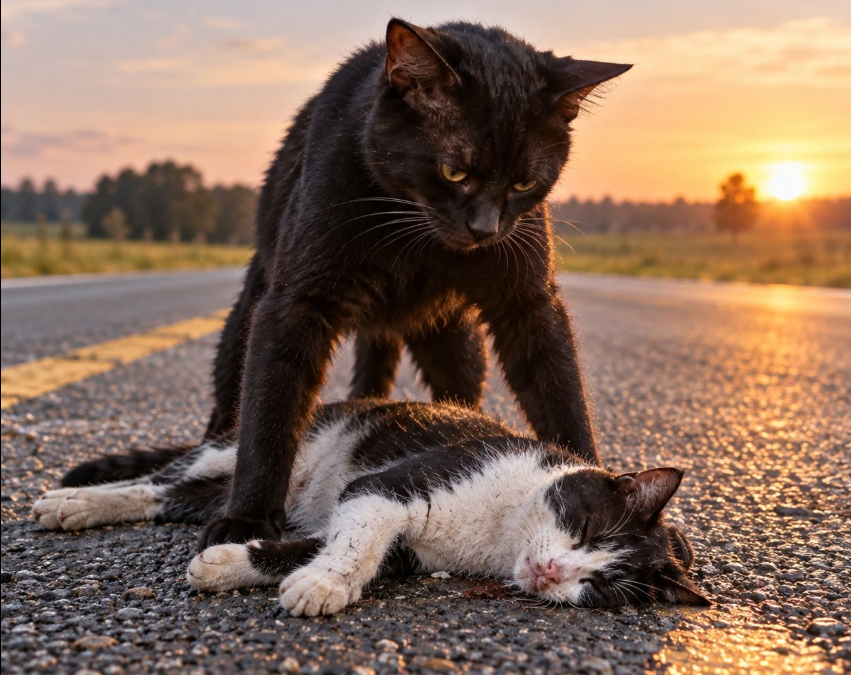
Eighteen cars stopped on a rural road because a starving black cat refused to move away from the body beneath him, even as the summer asphalt burned the pads of all four paws.
When rescuers finally lifted the dead black-and-white cat from the road, the male collapsed in the exact place where she had been standing beneath him, as if his body had been waiting for permission to stop holding itself together.
Eight weeks later, a widower drove ninety miles to meet the cat nobody could comfort—and instead of reaching for him, the man simply sat down beside the window and waited.
The first call came into the sheriff’s office at 6:18 on an August morning.
At first, the dispatcher thought the woman was reporting debris.
That happened often on County Route 14 after storms.
Branches.
Pieces of tires.
Trash.
Dead raccoons.
Once, half a mattress that had somehow landed in the middle of the southbound lane.
Route 14 ran through six miles of farmland before reaching town, a cracked two-lane road bordered by cornfields, soybeans, drainage ditches, and fence posts that leaned at every possible angle.
The dispatcher asked:
“What’s blocking the road, ma’am?”
A pause.
Then:
“A cat.”
The dispatcher waited.
“A cat is blocking the road?”
“No.”
The caller’s voice changed.
“Two cats.”
Another pause.
“One is lying in the road.”
“And the other?”
“Standing over her.”
The dispatcher straightened in her chair.
“Is the standing cat injured?”
“I don’t know.”
“Can you drive around?”
“Yes.”
“Then what’s the emergency?”
The woman’s breath caught.
“He won’t move.”
“Have you tried honking?”
“I did.”
“And?”
“He looked at me.”
“What happened after that?”
PART2:
“He put his face down against the other cat.”
The dispatcher stopped typing for a second.
“Ma’am, are you in danger?”
“No.”
“Is anyone else?”
The woman looked through her windshield.
The black cat remained planted in the center of the lane.
“No.”
Then she corrected herself.
“Yes.”
“Who?”
“The cat.”
The dispatcher waited.
The woman whispered:
“He’s going to get hit if somebody comes around that bend.”
Her name was Hannah Bell.
Thirty-four.
Elementary-school teacher.
Seven months pregnant.
Already late for a doctor’s appointment she had rescheduled twice.
Her husband had told her to take the highway.
Hannah had taken Route 14 because she liked the morning drive.
Less traffic.
Farm fields.
Mist hanging low over the soybeans.
The kind of road where you could breathe before entering town.
That morning, the sun had barely climbed over the horizon.
The air was warm but not yet brutal.
Road dust clung to weeds.
A layer of mist floated across the fields.
Hannah saw a dark shape from far enough away to brake carefully.
At first, she thought it was tire rubber.
Then it moved.
She stopped twenty feet away.
Black cat.
Thin.
Short-haired.
Young adult.
His ribs faintly visible.
Ears flattened.
Front legs spread wide.
Body positioned directly above another cat.
The second animal was smaller.
Black and white.
Female, though Hannah did not know that yet.
One white paw stretched toward the shoulder.
Head on the pavement.
No movement in her ribs.
Hannah honked.
Softly.
Nothing.
Again.
Still nothing.
She rolled down the window.
“Hey.”
The black cat looked toward her.
Yellow-green eyes.
Wide.
Exhausted.
Not aggressive.
He did not hiss.
Did not arch.
Did not run.
He looked at Hannah as if she had interrupted something private.
Then he lowered his head.
Touched his nose against the dead cat’s face.
Hannah put one hand over her mouth.
“Oh.”
That single movement changed the entire scene.
Before that, she saw an animal blocking traffic.
Afterward, she saw grief.
Whether cats understand death the way humans do did not matter.
He understood absence.
He understood something had changed.
And he was not leaving.
Hannah got out.
One hand under her belly.
Heat already rising from the road through her sandals.
She stayed near her car.
“Okay.”
The black cat shifted closer to the body.
“I’m not coming closer.”
He trembled.
Not from cold.
Not dramatically.
A constant muscular shaking.
As if he had held the same position for too long.
Hannah called the sheriff.
Another car stopped.
Then a pickup from the opposite direction.
Then a delivery van.
Within ten minutes, four vehicles lined the road with hazard lights blinking.
A farmer in a seed-company cap stepped out.
“What happened?”
Hannah pointed.
The farmer saw the cats.
Removed his cap.
“Well, I’ll be.”
“Can you move him?”
The man studied the black cat.
Then the small body underneath.
“I can try.”
He approached slowly.
Clicked his tongue.
“Come on, buddy.”
The cat stayed.
The farmer stopped about two feet away.
“Road’s no place for you.”
He extended one boot.
Not kicking.
Just trying to nudge gently.
The black cat moved instantly.
Not away.
Over.
He lowered his chest across the female.
Spread his legs wider.
Made himself into a shield.
Tail tucked.
Ears flat.
No sound.
The farmer withdrew his foot immediately.
“Nope.”
Hannah looked at him.
“What?”
“I’m not touching him.”
More cars arrived.
A nurse heading home from night shift.
A teenager in a dented Honda.
County road worker.
Feed truck.
A father with two children in the back seat.
By the time official help was on the way, eighteen vehicles had stopped.
Some drivers were impatient.
A few honked.
Two shouted from windows.
Several eased around on the gravel shoulder.
But most stayed.
Engines idled.
People stood along the road.
Nobody knew what to do.
A black cat guarding another dead cat should not have stopped an entire farm road.
But for forty minutes, it did.
Something about his refusal made people quieter.
Nobody wanted to be the person who forced him away.
Half a mile down the road, seventy-one-year-old Margaret Ellison noticed the traffic from her kitchen window.
Margaret had lived along Route 14 for forty-six years.
She knew the road by sound.
Grain trucks before harvest.
School bus around seven-thirty.
Commuters.
Fast teenagers after dark.
Silence after storms.
That morning, the road sounded wrong.
Too many engines.
Too many doors shutting.
No sirens.
She wiped her hands on a towel.
Looked out.
From the farmhouse, she could see only a cluster of stopped vehicles and a dark shape in the lane.
People stood differently around accidents.
They moved.
Pointed.
Leaned.
This group barely shifted.
Margaret picked up her phone.
Called Elise Turner.
Elise volunteered with a small rescue called Second Chance Barn Cats.
The rescue was exactly what the name sounded like.
Trap.
Neuter.
Treat.
Foster.
Adopt.
Feed whatever animals the county did not have enough money or space to help.
Elise answered on the third ring.
“Hello?”
“There’s something in the road.”
“What?”
“Cats.”
“Alive?”
“One.”
Margaret hesitated.
“I think.”
“What about the other?”
“I don’t think she is.”
Elise stopped cleaning the litter box in front of her.
“Don’t let anyone chase him.”
“I’m not there.”
“I’m coming.”
Elise grabbed a carrier.
Two thick towels.
Water.
Food.
Gloves.
Then drove toward Route 14 faster than she should have.
She had seen animals grieve before.
People argued about animal grief constantly.
Some insisted animals understood death.
Others said animals only recognized absence.
Elise did not pretend to know exactly what existed inside an animal’s mind.
She only knew what she had witnessed.
Dogs sleeping beside empty collars.
A horse refusing food after a companion was euthanized.
A mother cat searching rooms for kittens taken to foster.
Two bonded tomcats separated for medical care, one screaming until the other was returned.
Attachment did not need human language.
Neither did loss.
Elise arrived at 7:05.
Sun higher.
Heat climbing.
The black cat remained standing.
Same position.
Body lowered.
Legs braced.
Head hanging.
Elise noticed the pavement first.
Too hot.
It was already above eighty degrees, and black asphalt gathered heat fast.
The cat may have stood there since before sunrise.
Maybe several hours.
Bare paw pads against the road.
She parked on the shoulder.
Got out slowly.
Carrier beside her.
Hannah walked over.
“Are you rescue?”
“Yes.”
“He won’t move.”
“I see.”
“He’s been like that since I got here.”
“How long?”
“Almost an hour.”
Elise looked at the black cat.
More closely now.
Thin face.
Dust on whiskers.
No collar.
No tag.
Body too light for his frame.
His paws shifted minutely from side to side.
Pain.
Elise crouched six feet away.
“Hey, baby.”
He looked at her.
“Okay.”
She placed the carrier off to one side.
Door open.
Then spread a towel on the pavement.
No reaching.
No chasing.
That mattered.
Elise spoke softly.
“I need to move her.”
Hannah started crying behind her.
Elise continued.
“I know you don’t want me to.”
The black cat lowered his chest.
Covered more of the female.
“I’m sorry.”
Elise moved forward on her knees.
Slow.
One foot.
Then another.
The cat did not attack.
That made it harder.
No hissing.
No swatting.
No growling.
He was not trying to hurt anyone.
He was trying to stop the world from touching what belonged to him.
Elise stopped two feet away.
Reached toward the female.
The black cat trembled violently.
When Elise’s fingertips touched the female’s shoulder, the male made one sound.
Not a meow.
Not a scream.
A low broken trill.
Small.
Almost conversational.
A sound cats often use for someone familiar.
A greeting.
A connection.
Elise froze.
The black cat lowered his nose.
Touched the female’s face.
The sound did not come again.
Only once.
Elise swallowed.
“I know.”
Her voice broke.
“I know she’s yours.”
She slid the towel underneath the body.
Slowly.
The female was stiff but not completely.
Likely dead for several hours.
Her injuries suggested a vehicle had struck her sometime during the night.
Probably quick.
Elise held onto that possibility.
Quick was the only mercy available.
She wrapped the female carefully.
As soon as Elise lifted her from the asphalt, something happened.
The black cat’s legs collapsed.
He fell exactly where the female had been.
Chest heaving.
Front paws twitching.
Not from impact.
Not from new injury.
Release.
His body had remained upright because she was beneath him.
Once she was gone, there was nothing left holding him up.
Elise moved quickly.
Placed the wrapped female beside her.
Scooped the male with the second towel.
He did not fight.
He turned his head toward the bundle.
“I’ve got her.”
His eyes stayed fixed on it.
“She’s coming too.”
Elise carried both to her SUV.
One living.
One dead.
Both finally off the road.
A deputy arrived three minutes later.
He looked at the traffic.
Then Elise closing the hatch.
“Did I miss everything?”
Elise wiped sweat from her forehead.
“No.”
She glanced toward the line of cars.
“You’re right on time for paperwork.”
The deputy looked at the dark outline left on the pavement.
Removed his hat.
Traffic began moving.
Slowly.
Then normally.
That was what bothered Hannah most.
The world had stopped.
Then suddenly Route 14 became a road again.
Cars accelerated.
People left.
The place where something sacred had happened became ordinary asphalt.
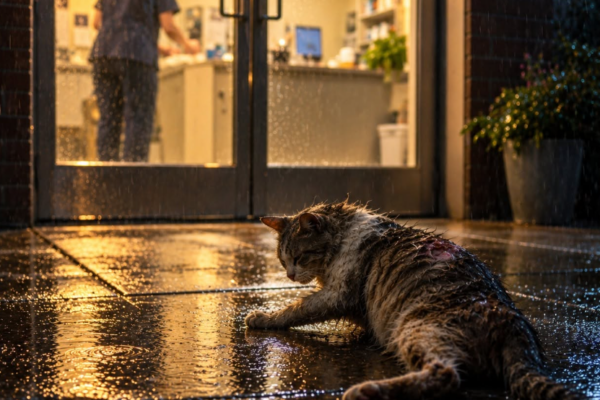
At the rescue, Elise examined the male.
Weight first.
Six and a half pounds.
Far too little for an adult cat his size.
Then paws.
Elise inhaled sharply.
All four pads were burned.
Blistering.
Raw pink tissue.
Tiny pieces of gravel embedded.
Second-degree thermal burns from standing on hot asphalt.
He must have shifted his weight for hours.
One paw hurting.
Then another.
Never stepping away.
Dehydrated.
Elevated body temperature.
Exhausted.
But no major trauma.
The female had no identification.
No microchip.
Neither did the male.
Elise drove both to Dr. Warren.
The veterinarian unwrapped the male’s paws.
“How long was he standing?”
“At least since dawn.”
“On asphalt?”
“Yes.”
Dr. Warren looked toward the second table.
The female remained wrapped.
“Why?”
Elise nodded toward her.
“Because of her.”
When Dr. Warren moved the towel slightly, the male raised his head.
Made a thin searching sound.
The veterinarian looked at him.
Then the female.
“Bonded pair?”
“Maybe more.”
“What do you mean?”
Elise studied them.
Same age.
Similar narrow faces.
Similar ear shape.
Same black markings around the head, though the female had white chest and paws.
“Siblings.”
Dr. Warren leaned closer.
“Could be.”
Nobody could prove it.
No DNA test was going to make the bond more real.
But the possibility fit.
Two littermates surviving together.
Born somewhere under a barn.
Maybe in a ditch.
Maybe an abandoned shed.
Eating together.
Sleeping together.
Sharing body heat through winters.
Crossing roads.
Avoiding dogs.
Avoiding people.
Until one road crossing went wrong.
The female was buried that afternoon beneath a young maple tree behind Elise’s property.
Morning sun reached the spot.
Barn cats liked sitting nearby.
Elise wrapped her in the towel from the road.
Placed a few leaves over her.
She considered giving her a name.
Didn’t.
It felt selfish to name an animal only after death so humans could feel better.
Instead Elise whispered:
“You mattered.”
Then returned to the brother.
His paw pads were treated and loosely wrapped.
He spent the first night inside a large crate.
Soft blankets.
Food.
Water.
Quiet.
He did not eat.
Barely slept.
Chin on his front legs.
Eyes toward the window.
Elise moved the water close enough that he did not have to stand.
He drank.
Next morning, his body had turned toward the back garden.
Toward the maple.
Elise told herself not to create a story.
Cats choose windows.
Light.
Movement.
Warmth.
Still, when she shifted his crate to clean, the cat repositioned himself until he faced the same direction.
Days passed.
His burns healed slowly.
Walking hurt.
Every step cautious.
He placed each paw as if expecting the ground to betray him.
Elise kept him on soft bedding.
Changed bandages.
Gave medication.
Sat nearby without asking for affection.
He tolerated her.
Nothing more.
No purring.
No head rubs.
No playful behavior.
Food had to be placed directly in front of him.
If the bowl sat two feet away, he stared.
Did not walk toward it.
The instinct to seek anything seemed gone.
Other foster cats meant nothing to him.
An orange kitten reached through a pen one afternoon.
The black cat turned his head away.
Never aggressive.
Never difficult.
Just absent.
Elise began writing “Brother” in her medical notes.
Not a name.
A description.
Day 4: Brother ate half can wet food.
Day 8: Brother allowed paw check.
Day 13: Brother watched garden most of afternoon.
Day 21: Brother walked to water bowl by himself.
At night, Elise sat near the crate.
“I don’t know how to help you.”
The cat blinked.
Toward the window.
Not her.
She whispered:
“I’m sorry.”
That became the hardest part.
People thought animal rescue was difficult because of bills.
Mess.
Lack of space.
Aggressive animals.
Bad adopters.
Those things were difficult.
But Elise had learned that the hardest cases were sometimes the quiet ones.
You could clean a wound.
Feed hunger.
Treat infection.
Give antibiotics.
Shelter a body.
But grief did not fit into a syringe.
Eight weeks after Route 14, Elise received a call.
“Second Chance?”
“Yes.”
“My name is Arthur Bennett.”
Older voice.
Careful.
“Margaret Ellison gave me your number.”
Elise paused.
“She said you still have the black cat.”
“I do.”
“I’d like to meet him.”
Elise became cautious immediately.
Stories traveled.
Sad animals attracted people for strange reasons.
Curiosity.
Drama.
A desire to own the animal everyone had talked about.
“He’s not social.”
“That’s all right.”
“He may never become affectionate.”
“That’s all right.”
“He has burns on all four paws. He walks carefully.”
The man was quiet.
Then:
“So do I.”
Elise almost smiled.
“Why him?”
Long silence.
“My wife died in May.”
Elise closed her eyes.
“I’m sorry.”
“Thirty-seven years.”
His voice cracked slightly.
“I sit in the same chair every morning.”
Another pause.
“Look out the same window she used to look through.”
He inhaled.
“I heard about the cat who wouldn’t leave his sister.”
His voice became softer.
“I thought maybe I understood him.”
Arthur drove ninety miles the next morning.
Sixty-four.
Tall.
Slight stoop.
Plaid shirt.
Clean jeans.
Polished work boots.
Wedding ring still on his finger.
He turned it constantly with his thumb.
When Elise opened the rescue door, Arthur removed his cap.
“Ma’am.”
She liked him immediately for that.
Not because politeness guaranteed goodness.
But because he entered without entitlement.
Elise led him to the foster room.
Brother sat by the window.
Same place.
Arthur stopped in the doorway.
Did not say:
Poor thing.
Did not make kissing noises.
Did not approach.
Did not ask to hold him.
He looked.
For nearly a minute.
Then Arthur lowered himself slowly to the floor.
His knees cracked loudly.
He winced.
Settled against the wall several feet away.
Hands on thighs.
Elise said:
“You can talk to him.”
Arthur nodded.
Said nothing.
That was when Elise thought:
He really does understand.
Most people try to fill grief with noise.
Silence makes humans uncomfortable.
Arthur allowed silence.
Five minutes.
Ten.
Brother remained at the window.
Arthur looked through the same glass.
The maple tree moved in the breeze.
Twenty minutes passed.
Then Brother stood.
Elise held her breath.
Careful steps.
One paw.
Another.
He walked toward Arthur in a curve.
Not straight.
As if approaching the possibility of him before approaching the man.
Arthur did not reach.
Brother stopped near his knee.
Sniffed the denim.
Looked up once.
Then lay down beside him.
Not touching.
Not cuddling.
Just beside.
Arthur’s face crumpled.
He looked away.
Brother rested his chin on the floor.
Arthur whispered:
“Hello.”
The cat closed his eyes.
Elise left the room because she needed to cry where neither grieving creature had to feel responsible.
Arthur adopted him that day.
On the form, where it asked for the cat’s name, Arthur wrote:
Ward.
Elise raised an eyebrow.
“Ward?”
“My wife’s maiden name.”
“What was her first name?”
“Ellen.”
“Why not something that directly honors Ellen?”
Arthur looked into the carrier.
“Because he’s not a memorial.”
He touched one finger to the carrier door.
“He’s himself.”
Elise smiled.
“Ward is good.”
Before leaving, Arthur asked:
“Where is she?”
Elise knew immediately.
She pointed toward the maple.
“Under that tree.”
Arthur looked toward it.
“Does he know?”
Elise looked at Ward.
His eyes fixed in the same direction.
“I don’t know.”
Arthur nodded.
“Maybe knowing isn’t always the point.”
The drive to Arthur’s home took two hours because he stopped twice to check Ward.
Ward did not cry.
He sat inside the carrier.
Paws tucked.
Watching the road pass.
Arthur’s home stood outside Bentonville.
Small white house.
Three acres.
Old oaks.
Vegetable garden.
Front porch with two rocking chairs.
Only one chair had been used since May.
Inside, the house was clean.
And dead quiet.
Curtains half closed.
Dishes washed.
Floors swept.
Everything in place.
Ellen’s chair remained slightly angled away from the kitchen table as if she had just gotten up.
Her sweater still hung on a hook near the back door.
Arthur knew he should move things.
He couldn’t.
Grief had become furniture.
He placed Ward’s carrier in the living room.
Opened the door.
“You can come out whenever.”
Ward stayed inside forty-three minutes.
Arthur sat nearby reading a newspaper he did not actually read.
Eventually one black paw appeared.
Then another.
Ward smelled the rug.
Baseboard.
Chair leg.
Air.
Then walked toward the front window.
Jumped awkwardly onto a low bench.
Looked outside.
Arthur stared.
“That was her window.”
Ward’s ears moved.
Arthur sat in Ellen’s chair for the first time since her funeral.
Pain hit immediately.
But Ward was there.
So Arthur stayed.
Days became routine.
Food started near the window.
Ward would not cross the room for it.
Arthur moved the bowl a few inches farther each week.
Ward followed slowly.
Arthur learned rules.
Do not reach quickly.
Do not approach from behind.
Do not pick him up.
Do not block his window.
Do not move food too far.
Do not expect play.
Do not mistake silence for healing.
Ward learned Arthur too.
The kettle at six.
Creaking porch board.
Wedding ring clicking against ceramic coffee mug.
Arthur wandering into a room and forgetting why.
The way he sometimes said Ellen’s name when nobody else was there.
Every morning, Arthur sat beside the window with coffee.
Ward sat on the bench.
They looked east.
Ward could no longer see the maple behind Elise’s rescue.
But he still faced one direction.
Arthur understood.
Because he did too.
His direction was Ellen’s garden.
Tomatoes dead on vines.
Zinnias wild.
Lavender overgrown.
Arthur had avoided it for months.
Every plant reminded him that Ellen had known how to make things grow.
He did not.
After Ward arrived, Arthur opened the back door again.
At first for air.
Then stood on the step.
Then pulled one weed.
Next day, another.
Ward watched through the window.
“You don’t care about tomatoes.”
Ward blinked.
Arthur almost smiled.
“Fair enough.”
By autumn, Arthur was working in the garden again.
Not like Ellen.
Badly.
But he cleared dead vines.
Trimmed lavender.
Planted mums near the steps because Ellen always said fall flowers looked brave.
Ward never went outside.
Arthur did not push.
“The road took enough from you.”
He kept him indoors.
Six months after adoption, Elise called.
“How is he?”
Arthur looked toward the window.
Ward sat in sunlight.
Black fur glowing brown at the edges.
“He still sits by the glass.”
“Eating?”
“Good.”
“Walking?”
“Better.”
“Paws?”
“Sensitive.”
“Does he seem happy?”
Arthur paused.
Ward ate without coaxing now.
Walked more confidently.
Paw pads healed into thick pink skin.
Sometimes slept on the arm of Arthur’s chair.
Once leaned against Arthur’s leg while he washed dishes.
Rarely purred.
When he did, it sounded short and uncertain.
Arthur said:
“He’s here.”
Elise understood.
“That may be enough.”
“He still looks the same direction.”
“Toward what?”
Arthur looked outside.
Morning light across Ellen’s garden.
“I don’t know.”
He rubbed his wedding ring.
“But I understand why.”
After the call, Arthur sat beside Ward.
The cat stayed facing the window.
Arthur reached slowly.
Stopped before touching.
Ward looked at his hand.
Then leaned, almost imperceptibly.
Arthur stroked his shoulder.
Once.
Again.
Ward closed his eyes.
Arthur whispered:
“Some weights don’t leave, do they?”
Ward’s ear twitched.
“No.”
Arthur nodded.
“We just find someone willing to sit beside us while we carry them.”
Winter came early.
Cold rain.
Frost.
Then wet snow.
Ward hated snow.
He watched it through the window with his tail wrapped around his paws.
“It won’t come inside.”
Ward looked unconvinced.
Arthur laughed.
Actually laughed.
The sound surprised him.
First Christmas without Ellen was approaching.
Arthur planned to ignore it.
No tree.
No decorations.
No songs.
Then a package came from Elise.
Inside:
A small ornament shaped like a black cat.
A note.
For Ward’s first safe Christmas.
Arthur sat with the ornament in his palm.
Then went to the closet.
Pulled out the tiny artificial tree Ellen had insisted on keeping even though Arthur said it looked like a decorated bottle brush.
He placed it on the kitchen table.
Not the big tree.
This was enough.
Black-cat ornament in the center.
Then he found one of Ellen’s small silver bells.
Hung it beside the cat.
Ward watched.
“That’s enough.”
It was.
Christmas morning, Ward knocked the silver bell off the tree.
Chased it under the sofa.
Arthur laughed again.
Longer this time.
Spring came.
Ward gained weight.
His coat filled in.
His eyes softened.
But hot surfaces still worried him.
Even indoors.
If sunlight warmed the hardwood floor, Ward sometimes tested it with one paw before walking forward.
Arthur noticed.
Of course he did.
People who grieve notice hesitation.
Arthur placed a woven rug over Ward’s favorite sun patch.
Ward avoided it for three days.
Then claimed it permanently.
In May, on the anniversary of Ellen’s death, Arthur drove to the cemetery.
Ward had not left the house except for veterinary visits.
That morning Arthur opened the carrier.
“You don’t have to come.”
Ward stepped inside voluntarily.
At the cemetery, Arthur kept him safely in the carrier.
Opened the car windows slightly.
Sat beside Ellen’s grave.
“I brought somebody.”
His voice broke immediately.
“He’s not friendly exactly.”
Ward looked through the mesh.
“You’d like him.”
Arthur told Ellen about Route 14.
The sister.
Burned paws.
Elise.
The window.
The garden.
How one quiet black cat had made the house feel slightly less sealed.
Then Arthur cried.
Not quietly.
Not carefully.
For the first time since the funeral, he let grief happen without trying to control it.
Ward made a sound.
Arthur froze.
A trill.
Low.
Broken.
Not a meow.
The same kind of sound Elise had described from the road.
Recognition.
Greeting.
Connection.
Arthur pressed one palm against the carrier.
“Yeah.”
He cried harder.
“I know.”
Elise visited a few weeks later.
She brought flowers for Ellen’s garden.
And a small gray stone.
Arthur looked at it.
“What’s that?”
“From near the maple.”
He stared.
“Not the grave.”
Elise quickly clarified.
“Just close to it.”
Arthur accepted the stone carefully.
Ordinary.
Smooth.
Gray.
He placed it on Ward’s windowsill beside a small pot of lavender.
Ward sniffed once.
Then sat beside it all afternoon.
Neither human said anything.
They did not need to.
Years began passing.
Ward never became the cheerful cat people expected after rescue.
No dramatic personality change.
No running through the house at midnight.
No obsession with feather toys.
No climbing curtains.
He remained cautious.
Watchful.
The world had taught him things.
He remembered.
But he loved.
In his own way.
He slept at the foot of Arthur’s bed.
Followed him room to room.
Sat in the window while Arthur gardened.
Touched Arthur’s fingers with his nose every morning.
Once during a thunderstorm, Ward climbed into Arthur’s lap.
Stayed forty-seven minutes.
Arthur’s leg went numb after ten.
He did not move.
Elise received photographs.
Ward on the windowsill.
Ward beside the silver bell.
Ward watching tomatoes grow.
Ward sleeping with one paw on Arthur’s slipper.
Every August, Arthur drove to Elise’s property.
Wildflowers from the ditch near his house.
He placed them under the maple.
Ward came once.
Arthur brought him in a soft carrier.
Set it near the tree.
Ward stayed inside.
Looked through the mesh.
Silent.
After ten minutes:
One low trill.
Then he turned away.
Arthur never brought him back.
Some doors only need opening once.
Years after Route 14, Hannah Bell ran into Elise at the veterinary clinic.
Hannah had given birth months after the road.
Her daughter was now a toddler running circles around the waiting room.
Hannah was carrying a furious tabby in a carrier.
She recognized Elise.
“You’re the woman from Route 14.”
Elise looked up.
“You were there?”
“I was the first car.”
Hannah’s eyes filled.
“I think about him constantly.”
“He was adopted.”
“I heard.”
She swallowed.
“Is he okay?”
Elise smiled.
“He’s loved.”
Hannah covered her mouth.
“My daughter asks why I cry when I see black cats.”
Elise did not know what to say.
Hannah continued.
“I was pregnant that morning.”
She stared toward the floor.
“I remember watching him stand over her.”
Then:
“I thought, that’s love too.”
Elise nodded.
“Yes.”
“Not human love.”
“No.”
“Not less.”
“No.”
Hannah wiped her eyes.
“I wish I’d done more.”
“You stopped.”
“That doesn’t feel like enough.”
Elise leaned toward her.
“It was the first enough.”
Hannah looked up.
“If you hadn’t stopped, someone else might have hit him.”
Silence.
“You created space around his grief.”
That stayed with Hannah.
Years later, when her daughter learned to drive, Hannah told her the story.
Not as a story about a dead cat.
As a story about stopping.
Noticing.
Being willing to inconvenience yourself because someone else is hurting.
Ward lived with Arthur for six years.
Longer than anyone expected.
His black fur silvered around the muzzle.
Paw pads remained sensitive.
Summer porch boards were tested with Arthur’s hand before Ward went near the screen door.
“Too hot.”
Ward usually agreed.
Arthur aged too.
Hair thinner.
Knees worse.
Garden smaller.
He planted only what he could manage.
But the house was no longer empty.
Ward did not replace Ellen.
Nothing could.
He changed the shape of her absence.
Before Ward, grief filled every room.
Afterward, grief had places to sit.
On the windowsill.
Beside the chair.
At the foot of the bed.
In the garden.
Under the little Christmas tree.
Beside the stone from the maple.
Near the end, Ward stopped jumping onto the window bench.
Arthur built steps.
Three carpeted steps from scrap wood.
Ugly.
Solid.
Ward used them immediately.
Arthur said:
“You’re welcome.”
Ward ignored him.
One evening, Arthur called Elise.
“He’s slowing down.”
She understood immediately.
“I can come tomorrow.”
“No.”
“Not yet?”
“Not yet.”
“Okay.”
Arthur’s voice trembled.
“I just wanted you to know.”
“I know.”
Then:
“I don’t think I can do this again.”
Elise closed her eyes.
“Yes, you can.”
“No.”
“You don’t have to do anything except sit with him.”
Arthur said nothing.
Elise continued.
“Like he sat with her.”
Silence.
“Like he sat with you.”
Ward died in late autumn.
At home.
In the window he had chosen on his first day.
Morning light across the woven rug.
Lavender on the sill.
Arthur sat in Ellen’s chair.
One hand on Ward’s back.
Ward’s breathing had become shallow overnight.
Arthur talked.
Weather.
Garden.
Ellen.
Route 14.
The maple tree.
“You were brave before anyone even knew your name.”
Ward’s ears moved faintly.
Arthur continued.
“You made this house livable again.”
Near the end, Ward lifted his head.
Only slightly.
Touched his nose against Arthur’s fingers.
Then gave one low trill.
Arthur bent over him.
Wept.
They buried Ward beneath an oak in Arthur’s garden.
The grave could be seen from the window.
Elise came.
Hannah came with her daughter.
Margaret Ellison arrived carrying a casserole because she believed every form of grief required food.
Arthur placed the gray stone from beside the maple on Ward’s grave.
Then Ellen’s silver Christmas bell.
Nobody made a speech.
Arthur did not want one.
Ward would not have needed one.
After everyone left, Arthur sat in Ellen’s chair.
Looked toward the empty bench.
For the first time in six years, nothing sat there.
The house felt enormous.
Then Arthur looked through the glass toward the oak.
Ward’s grave rested beneath it.
Something changed in Arthur’s mind.
For years, Ward had looked outward toward something lost.
Now Arthur looked outward toward something he had been given.
Some weights do not disappear.
That remained true.
But they move.
Shift.
Change shape.
At first, grief feels like a stone inside the chest.
Later, maybe it becomes something carried in a pocket.
Still heavy.
Still always there.
But warmed by the hand holding it.
Arthur stayed in the house.
Kept Ellen’s garden.
Every Christmas, he placed the black-cat ornament and silver bell on the little tree.
Every August, he brought wildflowers to the maple behind Elise’s property.
Then returned home.
Placed another bundle beneath the oak.
He never adopted another cat.
People assumed Ward had made it impossible.
They were wrong.
Arthur once explained it to Elise.
“It isn’t that I couldn’t love another.”
“Then why not?”
Arthur looked toward the window.
“Because love isn’t always replacement.”
He smiled faintly.
“Sometimes one chapter ends exactly where it’s supposed to.”
Years after Route 14, people still told the story.
Parents told children.
Rescue volunteers told new foster families.
Hannah told her daughter.
Drivers mentioned it when they saw an animal on the shoulder.
Somebody would ask:
Do animals grieve?
Someone else would tell them about the black cat.
Standing over his sister.
Eighteen cars stopped.
He refused to move.
His paws burned.
The road heated beneath him.
Traffic backed up.
People shouted.
Still he stayed.
Not because he understood death the way humans explain it.
Not because he was trying to become a symbol.
Not because he wanted anyone to rescue him.
He stayed because the body beneath him had once been warmth.
Something familiar curled beside him in winter grass.
A companion through ditches.
Barns.
Hunger.
Fear.
Dark places.
A sister, maybe by blood.
Certainly by life.
Until a road separated them.
People like to believe devotion requires grand gestures.
Sometimes devotion looks much smaller.
Four burned paws on asphalt.
A body shaking with exhaustion.
A refusal to step aside.
Not letting the one you love become only an obstacle everybody wants removed.
That morning, the black cat had no name.
No collar.
No home.
No person.
No medical record.
Only her.
Then she was gone.
And for weeks afterward, he barely seemed interested in staying either.
Until Arthur came.
Arthur did not rescue Ward by making him forget.
He did not teach him to stop looking through windows.
He did not demand affection.
Did not replace the sister.
Ward did not rescue Arthur by replacing Ellen.
He did not erase thirty-seven years of marriage.
Did not stop grief.
Did not make loss fair.
They gave each other something smaller.
Company.
Silence shared.
A chair beside a window.
A morning routine.
A garden.
A reason to get up and move the food bowl a little farther.
A body beside another body when the house felt too empty.
Maybe that is what healing is sometimes.
Not letting go.
Not forgetting.
Not moving on.
Learning that you can carry what remains and still have room beside it for something living.
Ward spent the first part of his story refusing to leave the place where love had ended.
He spent the second part sitting beside a man who had done the same thing in a different way.
And somehow, together, both of them began moving again.
Not quickly.
Not completely.
But enough.
Some weights never disappear.
But sometimes life sends someone who does not ask you to put the weight down.
They do not tell you to stop grieving.
Do not ask why you are still looking toward the same window.
Do not insist that healing means forgetting.
They simply sit beside you.
Quietly.
Long enough that carrying it becomes possible.