The Shelter Split Up Two Bonded Cats to Make Adoption Numbers Look Better—Then Their Dead Owner’s Hidden Letter Exposed Everything
# The Shelter Split Up Two Bonded Cats to Make Adoption Numbers Look Better—Then Their Dead Owner’s Hidden Letter Exposed Everything
Everyone at Harbor Haven could see that Willow and Jasper were not simply two cats sharing a kennel—they were each other’s last safe place after the only person they had ever trusted died.
Then our new adoption coordinator removed the words **BONDED PAIR**, sent them to two different homes, and smiled for the cameras while Jasper stopped drinking and Willow screamed until she lost her voice.
Ten days later, a letter written by their dead owner surfaced at an emergency board meeting, and one sentence on that page made every person in the room understand exactly what we had done to them.
The first time I saw Willow and Jasper together, I thought Willow was sick.
That was the only explanation I could come up with.
She was a small gray cat with pale green eyes and a white patch shaped almost like a teardrop beneath her chin.
She was curled so tightly into Jasper’s side that I could barely tell where she ended and he began.
Jasper was larger.
Black-and-white tuxedo.
Broad chest.
Torn left ear.
Eight years old.
The kind of serious face that made him look like a retired judge who had spent his entire career disappointed in everybody.
They were lying on a faded blue blanket inside the second kennel on the left in Harbor Haven’s quiet room.
Willow’s face was buried against Jasper’s shoulder.
Jasper’s tail lay across her back.
Not beside her.
Across her.
Like an arm.
I stood there holding a laundry basket and stared.
“How long has she been doing that?”
Marlene looked up from the food cart.
Marlene had volunteered at Harbor Haven for almost twelve years.
She was sixty-two.
Short gray hair.
Zero patience for stupidity.
She could bottle-feed six kittens while arguing with a contractor on speakerphone and somehow insult both parties equally.
“She’s not doing anything,” Marlene said.
“She looks terrified.”
“She is.”
Marlene opened a can of food.
“Unless he’s touching her.”
I looked into the kennel again.
Jasper opened one yellow eye.
He studied me.
Not afraid.
Not hostile.
Assessing.
Willow didn’t move.
“They came in together?”
“Owner surrender.”
“What happened?”
“The owner died.”
I hated those cases.
Not because the families were always cruel.
Sometimes nobody could take the animals.
Allergies.
Leases.
Money.
Other pets.
Kids.
Grief of their own.
Humans understand complicated reasons.
Animals do not.
They understand that yesterday there was a familiar house, familiar voice, familiar chair, familiar footsteps.
Then there is a carrier.
A car.
A building that smells like bleach, fear, barking dogs, and strangers.
That is the entire explanation.
“What was the owner’s name?”
“Harold Finch.”
Marlene slid food into the kennel.
“Retired school bus driver. Heart attack. His daughter brought these two in about a month ago.”
I glanced at the intake card.
WILLOW — FEMALE — 7 — GRAY DSH — SHY — BONDED WITH JASPER.
JASPER — MALE — 8 — TUXEDO DSH — FRIENDLY, PROTECTIVE — BONDED WITH WILLOW.
Then in red:
**MUST BE ADOPTED TOGETHER.**
Underlined twice.
Jasper stood.
Willow’s head snapped up immediately.
Her eyes went first to him.
Not me.
Not Marlene.
Not the food.
Jasper stepped toward the bowl.
Willow watched.
He took several bites.
Only then did she move.
She ate beside him.
Shoulder touching shoulder.
I said:
“That’s not subtle.”
Marlene snorted.
“Nope.”
I volunteered at Harbor Haven four days a week then.
I had a full-time job processing insurance claims from home three days a week, but the shelter was the place where I felt most useful.
I had started volunteering after my mother died.
That was the clean version.
The version I gave people.
The actual truth was uglier.
After my mother died, I discovered that loneliness can become embarrassing when you have nowhere to put it.
I was thirty-nine.
Divorced.
No children.
My mother had been the person who called every Sunday night and asked whether I was eating real food or “living on toast like a college freshman.”
Then she was gone.
The phone stopped ringing.
My apartment became too quiet.
So I went to Harbor Haven.
At first, I cleaned cages.
Then I washed bowls.
Then laundry.
Then transport.
Then foster.
People started calling me dependable.
That felt better than lonely.
The shelter gave me somewhere to put love after the person receiving most of it had disappeared.
Maybe that was why Willow and Jasper reached me so quickly.
They had lost someone too.
At least they still had each other.
I had seen bonded cats before.
True bonded pairs behave differently.
Not simply two animals who tolerate one another.
They regulate each other.
Jasper monitored the world for Willow.
If a dog barked in the lobby, he sat up.
If a stranger entered the quiet room, he shifted between Willow and the kennel door.
If someone reached too fast, Willow flattened herself against the blanket and Jasper gave one low sound.
Not quite a growl.
Not a hiss.
Just:
Slow down.
She is scared.
And Willow trusted him completely.
She ate after he ate.
Drank after he drank.
If he left during kennel cleaning, she paced.
Small frantic circles.
Again.
Again.
Again.
When Jasper returned, Willow rushed forward.
Nose to his cheek.
Body trembling until he began grooming her.
Marlene once said:
“He’s her anchor.”
I answered without thinking:
“And she’s his reason.”
Marlene looked at me.
I hadn’t meant to sound dramatic.
But it was true.
Jasper was not young.
He had arthritis in one hip.
His teeth were worn.
The torn ear looked old.
He slept more than Willow.
Moved carefully when he first stood.
But the second she panicked, Jasper changed.
He became alert.
Steady.
Brave.
Some animals survive because somebody else needs them to.
That was Willow and Jasper.
Then Cynthia Vale arrived.
Officially, Cynthia was Harbor Haven’s new adoption coordinator.
A donor-funded expansion grant had required the shelter to “professionalize adoption strategy and public engagement.”
Those were the words.
Harbor Haven had always been small.
Former dentist’s office converted into an animal shelter.
Exam rooms turned into cat rooms.
Old reception space became lobby.
Supply closet turned into kitten nursery.
Hallways covered in photographs of adopted animals.
Dogs in backyards.
Cats in laundry baskets.
Rabbits sitting beside children.
Handwritten Christmas cards.
The place ran on donations, terrible coffee, volunteer guilt, and the belief that every animal deserved better than the worst thing that had happened to it.
Then Cynthia arrived with branded folders.
Cream blazers.
Perfect hair.
She called kennels “placement units.”
She called animals “inventory” when she thought volunteers weren’t listening.
She redesigned adoption cards so every animal had what she called a “marketable identity.”
A large dog named Buddy became:
GOOFY ADVENTURE PARTNER SEEKING ACTIVE FAMILY.
An elderly half-blind cat named Earl became:
DISTINGUISHED GENTLEMAN READY FOR RETIREMENT.
Mittens, who bit three volunteers in one month, became:
INDEPENDENT QUEEN WHO KNOWS WHAT SHE WANTS.
Honestly, that one was accurate.
Cynthia loved success stories.
Puppies.
Kittens.
Small dogs.
Unusual markings.
Dramatic transformations.
Anything that photographed well.
She disliked anything that complicated adoption statistics.
Senior animals.
Medical cases.
Fearful cats.
Black cats.
Bonded pairs.
At our first volunteer meeting with her, Cynthia put up a slide titled:
REDUCING LENGTH OF STAY.
“Bonded pairs,” she said, “can significantly reduce adoption flexibility.”
Marlene muttered beside me:
“Here we go.”
Cynthia continued.
“We sometimes romanticize relationships between animals that may simply be circumstantial.”
I raised my hand.
She looked annoyed before she called on me.
“What about pairs already assessed as bonded?”
“Those can be reviewed.”
“By whom?”
“Staff.”
“Marlene is staff.”
Marlene buried her smile in her coffee.
Cynthia’s expression hardened.
“Experienced volunteers contribute valuable observations. Final placement decisions require a broader strategic view.”
Strategic view.
That phrase bothered me.
I asked:
“If one animal stops eating when separated, does strategy still matter?”
“Temporary stress is normal.”
“And if it isn’t temporary?”
“Then adopters communicate with us.”
The meeting moved on.
Afterward, Marlene and I folded towels in the laundry room.
She said:
“That woman is going to hurt something.”
“Not Willow and Jasper.”
Silence.
I looked at her.
“Marlene.”
“She’s been asking why they’re still in the quiet room.”
“Because Willow panics in the main room.”
“I told her.”
“What did she say?”
“That the quiet room makes them invisible.”
“They aren’t invisible.”
Marlene slammed a towel onto the stack.
“No.”
Then:
“They’re inconvenient.”
Two weeks later, Harbor Haven announced its “Home for the Holidays” event.
It was early November.
Cynthia didn’t care.
She hung red ribbons.
Gold banners.
Invited local media.
Partnered with a pet store.
The board loved it because a strong weekend could help secure the second portion of our expansion grant.
Every adoption card got rewritten.
That Friday afternoon, I walked into the quiet room.
Willow and Jasper’s intake card was gone.
In its place:
WILLOW
Beautiful shy gray girl, 7. Looking for a patient home where she can blossom.
Three kennels away was a second sign:
JASPER
Handsome tuxedo gentleman, 8. Calm, affectionate, independent.
Independent.
I stared at that word.
Marlene came in.
“She removed bonded.”
“I know.”
“Why didn’t you tell me?”
“I was trying not to get arrested.”
I went straight to Cynthia’s office.
She sat behind her desk arranging adoption folders beside a mug that read:
RESCUE IS MY LOVE LANGUAGE.
“We need to talk.”
“Good afternoon, Nora.”
“They’re bonded.”
“They’re under review.”
“No. They’re bonded.”
She continued sorting.
“Their combined adoption prospects are poor.”
“Then they wait.”
“Easy for a volunteer to say.”
That landed exactly where she intended.
I worked for free.
She did not.
“I’m here four days a week.”
“And I’m responsible for outcomes.”
“They aren’t outcomes.”
She finally looked up.
“They’re cats.”
Her voice sharpened.
“Exactly. Cats. Not tragic lovers. Not children. Not symbols.”
“Jasper won’t eat properly without Willow.”
“You don’t know that.”
“Yes, I do.”
“You believe that.”
“No.”
I stepped closer.
“I’ve watched them.”
“Shelter behavior is not always predictive of home behavior.”
That was technically true.
That was what made Cynthia dangerous.
Cruelty rarely announces itself as cruelty.
Sometimes it borrows reasonable sentences.
She told me Willow had received three individual inquiries.
Jasper had two.
Together?
None.
“So you’re splitting them to improve numbers.”
“I’m giving them each a chance at a home.”
“They already have the one thing making this place tolerable.”
“This place isn’t their home.”
Again.
Reasonable sentence.
Wrong conclusion.
I said:
“Please don’t do this.”
For one second, Cynthia looked genuinely angry.
“You volunteers come in, fall in love with stories, and then criticize the people trying to keep shelters open.”
“I’m not criticizing fundraising.”
“You’re undermining professional judgment.”
“I’m asking you not to separate two animals everyone knows are bonded.”
The sound came from the hallway.
Thin.
High.
Willow.
I ran back.
A new volunteer was cleaning their kennel.
Jasper had been placed inside a temporary carrier.
Willow was still in the kennel.
Pressed against the back wall.
Eyes huge.
“Why is he in there?”
The volunteer looked terrified.
“Cynthia said we have to start independent socialization.”
Jasper stood inside the carrier with his nose pressed against the metal door.
Willow cried.
Jasper answered.
Low.
Broken.
I opened the carrier.
“Nora, I don’t think—”
“I’ll take responsibility.”
Jasper came out.
Went straight to Willow.
She rushed underneath his chin.
Pressed her entire body against him.
She shook so hard the blanket moved.
Jasper groomed her forehead.
The new volunteer started crying.
“I didn’t know.”
“I know.”
Behind me:
“That was inappropriate.”
Cynthia.
I stood.
“So was separating them.”
“Go home, Nora.”
I didn’t.
That was probably when Cynthia decided I was a problem.
The adoption event started the next morning.
By ten, Harbor Haven was packed.
Kids wearing paper antlers.
Holiday music.
Dogs barking.
Craft table.
News photographer.
Cynthia moved through the building directing people like a wedding planner.
Every adoption became a “beautiful match.”
I stayed near Willow and Jasper.
So did Marlene.
At eleven-thirty, a couple came in.
Eric and Dana Mercer.
Early fifties.
Gentle.
Their old tuxedo cat had died six months earlier.
They were looking for a calm adult.
They met Jasper.
He liked them.
That was what made everything worse.
Eric scratched beneath his chin.
Jasper leaned into it.
Dana sat on the floor.
Jasper stepped briefly onto her lap.
Then returned to Willow.
Dana smiled.
“He’s wonderful.”
I said:
“He and Willow are bonded.”
Her smile disappeared.
“What?”
“They need to go together.”
Dana looked at Willow.
“But Cynthia said they shared space.”
“She said they weren’t dependent.”
Marlene made a sound behind me.
I repeated:
“They are bonded.”
Eric looked sincerely disappointed.
“She’s beautiful. But our lease only allows one.”
“Then Jasper isn’t the right cat.”
Dana nodded immediately.
“I understand.”
She looked upset.
“I’m sorry. We really didn’t know.”
They left the room.
Twenty minutes later, Cynthia walked in holding paperwork.
My stomach dropped.
“No.”
She ignored me.
Marlene stood in front of the kennel.
“What are you doing?”
“Jasper has an approved adoption.”
“They can’t take Willow.”
“They are adopting Jasper.”
I grabbed the original intake folder.
“His status says bonded.”
Cynthia took the file.
Opened it.
Removed the old card.
“Behavioral status was updated.”
Marlene went pale.
“You can’t rewrite reality.”
Cynthia looked toward the hallway.
People were watching.
News crew nearby.
She changed instantly.
Public smile.
Bright voice.
“Our team makes adoption decisions based on what gives every animal the best chance at a loving home.”
The performance began.
“Jasper has found a wonderful family today.”
If I objected loudly, I became the unstable volunteer destroying someone’s happy adoption.
Marlene didn’t care.
“You take him without Willow and you hurt both animals.”
Cynthia smiled.
“Thank you for your concern.”
Two employees entered.
Good people.
Scared for their jobs.
They transferred Jasper into the Mercers’ carrier.
Willow screamed.
I had never heard a cat make a sound like that.
It ripped through the room.
Not a normal meow.
Not anger.
Shock.
Jasper slammed himself against the carrier door.
Dana started crying.
Eric looked at Cynthia.
“This doesn’t feel right.”
“Transitions can be emotional.”
Willow threw herself toward the kennel bars.
“Stop.”
Cynthia looked at me.
For one second, the smile vanished.
Then Jasper left.
Willow screamed until nothing came out.
By evening, seventeen animals had been adopted.
Cynthia called it the most successful event of the year.
The shelter posted photographs.
One showed Cynthia smiling beside Eric and Dana with Jasper’s carrier.
Caption:
JASPER IS HOME FOR THE HOLIDAYS!
In the background, through the quiet-room window, Willow stood with both front paws against her kennel door.
Looking after him.
I stared at that photograph until I couldn’t see clearly.
Then I drove back.
Marlene was already there.
She sat on the floor.
One hand through the bars.
Willow was pressed against the back wall.
Silent.
Her mouth opened once.
Nothing.
“She won’t eat.”
“It’s been a few hours.”
Marlene looked at me.
“She won’t eat.”
The faded blue blanket looked enormous.
Willow stared toward the door.
I whispered:
“He’ll come back.”
It was wrong of me.
I had no authority to promise that.
But I needed it to be true.
The next morning, Dana called.
Jasper had hidden behind their washing machine all night.
No food.
No litter box.
Cried for hours.
Then stopped making noise completely.
That frightened Dana more.
She asked to return him.
Cynthia told her to wait.
“Adjustment takes time.”
Day two.
Willow ate nothing unless Marlene put food on her fingertip.
Jasper drank only when Eric pushed the bowl near the washing machine and left.
Day three.
Willow lost weight.
Day four.
Jasper began crying whenever he heard a cat on television.
Day five, Dana called again.
This time Cynthia put her on speaker while Marlene and I stood in the office.
Dana was crying.
“This isn’t normal adjustment.”
“I understand your concern.”
“No, I don’t think you do.”
Silence.
“He looks toward the door every time he hears a cat.”
Dana’s voice broke.
“He won’t come near us unless we bring him Willow’s blanket.”
Cynthia kept her voice smooth.
“Adult cats can require several weeks—”
“You told us they weren’t bonded.”
The room changed.
Cynthia’s shoulders stiffened.
“You were provided an updated behavioral profile.”
“You told us directly they did not have to stay together.”
“They were not designated as requiring joint placement at the time.”
Marlene slapped the desk.
“You changed the designation.”
Cynthia muted the phone.
“Enough.”
“No.”
I pointed at the phone.
“She deserves to know.”
“The truth is every placement has risk.”
“He’s grieving.”
“You’re anthropomorphizing.”
“And you’re covering yourself.”
The words came out before I could stop them.
Cynthia stared.
“You’re done here.”
Marlene stepped forward.
“If Nora goes, I go.”
Cynthia laughed.
“You won’t.”
“Try me.”
The office door opened.
Amanda Kline stood there.
Shelter director.
Amanda was kind.
Hardworking.
Conflict-avoidant.
She had kept Harbor Haven alive through budget shortfalls, disease outbreaks, and a roof leak that once dumped water directly onto the dog-food storage.
But Amanda had a flaw.
She confused quiet with functioning.
“What is happening?”
Nobody answered.
Muted phone buzzed.
Amanda pointed.
“Who’s on the call?”
“Dana Mercer.”
“Unmute it.”
Cynthia didn’t move.
Amanda repeated:
“Unmute the phone.”
Marlene did it.
Dana’s voice filled the office.
“Please.”
Everyone froze.
“We love Jasper.”
She cried.
“But not like this.”
Then:
“If he needs Willow, he needs Willow.”
Amanda looked at Cynthia.
“We were told separating them was okay.”
Cynthia looked away.
That was when Amanda finally started asking questions.
Real ones.
She pulled files.
Volunteer logs.
Feeding records.
Veterinary notes.
She called Eric and Dana.
Then she asked something that made my stomach drop.
“Where is Willow now?”
I looked at her.
“What do you mean?”
Amanda went pale.
Cynthia answered.
“She was adopted Monday.”
For several seconds, I didn’t understand.
“Adopted?”
“Yes.”
“To who?”
“A young woman named Brooke.”
“Alone?”
Cynthia folded her arms.
“That was the placement plan.”
Marlene cursed so loudly a dog barked from the hallway.
I sat down.
Cynthia had separated them twice.
Jasper Saturday.
Willow Monday.
The profile Brooke saw said:
SWEET SHY GRAY GIRL SEEKING A QUIET HOME.
Nothing about Jasper.
Nothing about the screaming.
Nothing about Willow barely eating.
Brooke was twenty-six.
Studio apartment.
First cat of her own.
She had grown up with cats and thought Willow’s shyness meant they might understand each other.
Willow spent the first night behind a bookshelf.
No food.
No water Brooke could see.
Second night, Brooke woke around four.
A weak sound near the front door.
Willow.
Pawing beneath it.
Hoarse little cry.
Again.
Again.
Looking for something outside.
Brooke sat on the floor beside her.
“I thought she hated me.”
She told me that later.
“I thought I had done everything wrong.”
“You didn’t.”
“She was looking for Jasper?”
“Yes.”
Brooke started crying.
“Why did they give her to me?”
I didn’t answer.
Because there was no answer that didn’t make everything worse.
The reunion happened Wednesday night.
Ten days after Jasper left Harbor Haven.
It was raining.
Cold.
Brooke brought Willow.
Marlene drove.
I sat in the passenger seat.
Amanda followed in another car.
Willow rode in the back on the old blue blanket.
She looked smaller.
Eyes dull.
Brooke kept her fingers against the carrier door.
“I’m sorry.”
Again.
Again.
Marlene looked in the mirror.
“You brought her back to him.”
“That’s what matters.”
The Mercers lived in a brick duplex.
Dana opened the door before we knocked.
Her eyes were swollen.
Eric stood behind her.
“He’s in the laundry room.”
Willow lifted her head.
Dana heard it too.
“He started crying when your car pulled up.”
From down the hall came a low sound.
Broken.
Jasper.
Willow answered.
One cracked little cry.
Brooke put both hands over her mouth.
We carried the carrier inside.
The house was warm.
Clean.
Everything had been prepared for Jasper.
Soft bed.
Toys.
Food bowl.
Blanket.
He had rejected almost all of it.
The laundry-room door stood open.
Jasper appeared.
I barely recognized him.
His coat looked dull.
Face thinner.
Yellow eyes too large.
He stopped.
Stared at the carrier.
Willow pushed forward.
The carrier slid several inches.
I opened the door.
Willow stepped out.
Slowly at first.
Jasper moved toward her.
One step.
Another.
They met in the middle of the kitchen.
Nothing dramatic happened.
That is one of the things I remember most.
No running leap.
No cinematic moment.
Jasper lowered his head.
Willow pressed her forehead against his.
They stood there.
Completely still.
Breathing.
Then Jasper began licking the top of her head.
Slow.
Careful.
Willow’s whole body softened.
Her legs bent slightly beneath her.
Everyone cried.
Dana.
Brooke.
Amanda.
Marlene.
Me.
Eric turned toward the sink because apparently men think faucets make them invisible.
After several minutes, Jasper walked toward the untouched food.
Willow followed.
He ate one bite.
Then she ate one.
Marlene whispered:
“There.”
Amanda stood behind us.
“I should have stopped this.”
Marlene looked at her.
“Yes.”
No comfort.
Amanda nodded.
She deserved the truth.
Then came the next problem.
Dana wiped her face.
“We cannot legally keep both.”
The room went quiet.
“Our lease says one pet. I already called the landlord.”
Brooke said:
“My apartment only allows one too.”
Willow and Jasper continued eating with their shoulders touching.
I looked at them.
There was no possible way they were returning to Harbor Haven separately.
I also couldn’t bear the idea of another kennel.
Another decision.
Another person saying:
Let’s see how they adjust.
Marlene looked at me.
“No.”
I hadn’t spoken yet.
“I have room.”
“Nora.”
“My apartment allows two.”
“You said you weren’t ready to adopt.”
“I wasn’t.”
“And now?”
I watched Willow stop eating the second Jasper raised his head.
She waited.
He looked at her.
Then continued.
She ate again.
I said:
“Now I know what happens if the person responsible for them doesn’t listen.”
Amanda looked at me.
“You’d take them?”
“Both.”
Dana exhaled.
Brooke cried harder.
Eric said:
“We just want Jasper safe.”
Brooke nodded.
“And Willow needs him.”
Marlene whispered:
“They chose each other years ago.”
Amanda closed her eyes.
“I’ll approve it.”
Marlene said:
“You’ll make sure it cannot be reversed.”
“Yes.”
“And their record says bonded permanently.”
“Yes.”
“No more strategy.”
Amanda looked at the cats.
“No more strategy.”
But Cynthia was not finished.
The next morning, before Amanda issued any public statement, Cynthia posted from Harbor Haven’s social media account.
SOMETIMES ADOPTIONS REQUIRE ADDITIONAL TRANSITION SUPPORT. WE ARE GRATEFUL TO OUR WONDERFUL ADOPTERS AND VOLUNTEERS FOR WORKING TOGETHER TO ENSURE EVERY ANIMAL FINDS THE RIGHT FIT.
It sounded compassionate.
It said nothing.
No separation.
No changed records.
No screaming.
No weight loss.
No lie.
Dana commented:
“We were not told Jasper was bonded. He became physically ill after being separated.”
The comment disappeared.
Brooke commented:
“I was not told Willow had been separated from Jasper or that she was barely eating.”
Deleted.
Then both women were blocked.
That was Cynthia’s mistake.
People tolerate being misled longer than they tolerate being silenced.
Marlene took screenshots.
So did I.
Dana wrote her own post.
Brooke shared it.
Then I did.
Then Marlene.
By evening, volunteers knew.
By morning, local reporters knew.
The same station that filmed Harbor Haven’s successful adoption weekend started asking why two adopters said the shelter had withheld information.
Amanda called an emergency board meeting.
The training room filled.
Board members.
Amanda.
Cynthia.
Marlene.
Me.
Dana.
Eric.
Brooke.
Dr. Sanchez, Harbor Haven’s veterinarian.
Then an elderly man I had never met entered with a cane and a large envelope.
His name was Mr. Bell.
He had been Harold Finch’s neighbor for eighteen years.
Cynthia spoke first.
Of course she did.
Calm.
Prepared.
Cream blazer.
Laptop.
PowerPoint.
“Willow and Jasper’s case has become emotionally charged.”
I almost laughed.
“Unfortunately, misinformation has spread online.”
Slide.
ADOPTION OUTCOMES — HOME FOR THE HOLIDAYS.
17 animals placed.
Higher donor engagement.
Reduced kennel occupancy.
Strong media performance.
She spoke about capacity.
Placement rates.
Stress reduction.
She explained that bonded status can sometimes reflect shelter dependence rather than permanent need.
Then she said:
“The decision was based on professional judgment.”
Dr. Sanchez raised her hand.
“I wasn’t consulted.”
Cynthia stopped.
“What?”
“I’m the veterinarian of record.”
Dr. Sanchez folded her hands.
“Nobody asked me whether separating a documented bonded pair was medically or behaviorally appropriate.”
One board member leaned forward.
“Is veterinary consultation normally required?”
Amanda answered quietly.
“It should have been.”
Cynthia recovered.
“Behavioral observations were considered.”
Marlene slid papers across the table.
“Good.”
She smiled without warmth.
“Read them.”
Kennel logs.
Feeding logs.
Volunteer notes.
Willow eats only after Jasper.
Jasper guards Willow when frightened.
Willow panics during temporary separation.
Pair becomes distressed when split for cleaning.
Must remain together.
Do not separate.
Again.
Again.
Again.
Cynthia looked at the pages.
“Volunteer observations are not clinical determinations.”
Marlene said:
“They’re still facts.”
Dana spoke next.
Softly.
That made it more powerful.
“We trusted you.”
She looked directly at Cynthia.
“We asked whether Jasper needed Willow.”
Cynthia shifted.
“You told us no.”
“I said—”
“You told us they were not bonded.”
Eric spoke.
“Those were your exact words.”
Brooke held up her phone.
“And this is the email you sent me.”
She read:
“Willow previously shared space with another cat but has shown readiness to thrive independently in a quiet home.”
Brooke’s voice broke.
“She spent two nights behind my bookshelf.”
Silence.
“She cried at my front door for him.”
Cynthia didn’t answer.
Then Mr. Bell stood.
He did it slowly.
Cane first.
Then himself.
Brown cardigan.
White hair.
Steady eyes.
“I knew Harold Finch.”
Everyone turned.
“We lived next door eighteen years.”
Mr. Bell looked around the table.
“Those cats were his family after his wife died.”
He lifted the envelope.
“When Harold went into the hospital, he made me promise something.”
Amanda asked:
“What?”
Mr. Bell opened the envelope.
“He wrote a letter.”
I felt my throat close.
“He gave it to his daughter.”
“I watched him.”
“She told me she would give it to whoever took the cats.”
Amanda looked confused.
“What letter?”
Mr. Bell unfolded one sheet of paper.
His hands shook.
Then he read.
“To whoever takes my cats,
Their names are Jasper and Willow.
Jasper is brave when Willow is scared.
Willow gives Jasper a reason to keep moving when his old bones hurt.
They have slept beside each other for six years.
Please do not split them.
They already lost my wife.
If they lose me too, let them at least keep each other.
I do not have much money to offer.
I only have my word that they are good cats and that they love one another.
Please be kinder to them than the world is to old things.
Harold Finch.”
No one moved.
The fluorescent lights hummed.
That was all I heard.
Cynthia finally said:
“I never saw that letter.”
Mr. Bell stared at her.
“Then somebody lost the last thing a dying man asked for.”
Amanda requested the original surrender file.
An employee brought it.
Inside:
Medical records.
Vaccination history.
Owner-surrender paperwork.
Harold’s obituary.
Then one empty plastic sleeve.
OWNER NOTES.
Marlene whispered:
“Oh my God.”
Amanda looked at Cynthia.
“Did you remove anything from this file?”
“No.”
“Did you ever see this letter?”
“No.”
“Did you change the bonded designation?”
Cynthia lifted her chin.
“I updated the behavioral status based on placement needs.”
“That’s not what I asked.”
“I made a professional decision.”
Amanda’s voice hardened.
“You removed the bonded requirement even though every behavioral note said not to separate them.”
Cynthia’s expression finally cracked.
“A decision that got animals adopted.”
There it was.
No branding.
No polished vocabulary.
“What do you think this place needs?” Cynthia snapped. “More sob stories keeping animals in cages? More volunteers deciding every attachment is sacred while we turn away new intakes?”
Marlene stood.
“You want facts?”
Cynthia stared.
“Fact: Willow stopped eating.”
Marlene pointed toward Dana.
“Fact: Jasper stopped drinking.”
Toward Brooke.
“Fact: two adopters were lied to.”
Then Mr. Bell.
“Fact: their dying owner begged us not to split them.”
Her voice shook now.
“And fact: your beautiful adoption numbers almost destroyed both animals.”
Cynthia’s face went cold.
“They’re cats.”
Mr. Bell spoke before anyone else.
“They were all Harold had.”
That silenced the room.
The board voted that night.
Cynthia was terminated.
Not because she made one bad judgment call.
Because she had altered a bonded designation without appropriate review, misrepresented behavioral information to adopters, deleted public complaints, and prioritized placement numbers over documented welfare concerns.
Harbor Haven issued a public apology.
A real one.
No vague language.
Willow and Jasper had been improperly separated.
The shelter accepted responsibility.
New policy:
No bonded status could be removed without veterinary and behavioral review.
No adoption profile could omit documented dependency behavior.
Adopters had to receive complete behavioral histories.
Owner notes would be scanned into digital records immediately so they could not disappear inside a folder.
None of that erased ten days.
But it mattered.
Willow and Jasper came home with me three days later.
I prepared like royalty was arriving.
Two litter boxes.
Two beds they would never use separately.
Low cat tree.
Covered hideaway for Willow.
Arthritis supplements for Jasper.
Food bowls together.
Water fountain Marlene insisted every cat loved.
Jasper thought it was witchcraft.
I opened the carriers in my living room.
Jasper came out first.
Of course.
He inspected everything.
Rug.
Couch.
Hallway.
Window.
Willow stayed inside her carrier.
Watching him.
Jasper returned.
Touched his nose to hers.
Willow stepped out.
They toured the apartment together.
Shoulder to shoulder.
The refrigerator turned on.
Willow jumped.
Jasper leaned against her.
A car passed outside.
He watched until it disappeared.
That night, I put two beds beside my bedroom wall.
At three in the morning, I woke because something was on my feet.
Jasper.
Willow curled into his stomach.
Tail across her back.
Exactly the way I first saw them.
I didn’t move.
For a long time.
I had thought my apartment was quiet before them.
I learned that night there is a difference between quiet and empty.
The next few months were not magically easy.
Willow hid when visitors came.
Jasper growled at delivery drivers through the window.
His arthritis flared during cold weather.
Willow still sometimes refused food until Jasper took the first bite.
If Jasper slept too deeply, Willow touched his face until he opened his eyes.
They carried history.
Safety does not delete history.
It gives history somewhere softer to live.
I learned their habits.
Willow loved warm laundry.
But only after Jasper inspected the basket.
Jasper liked chin scratches but pretended he didn’t.
Willow wanted water away from food.
Jasper stole toast.
Willow chirped in her sleep.
Jasper watched me whenever I cried.
They learned me too.
My footsteps.
Laptop closing.
Cabinet where treats lived.
The fact that visitors eventually left.
The fact that I came home.
Then small changes began.
Willow started entering rooms before Jasper.
Not always.
Sometimes.
Jasper began sleeping with both eyes closed.
Willow occasionally ate first.
The first time that happened, I almost called Marlene.
I put the food down.
Jasper hesitated because his hip bothered him.
Willow walked forward.
Ate.
Three bites.
Then looked back.
Jasper joined.
I stood there holding my breath.
Their bond was changing.
Not weakening.
Healing.
At Harbor Haven, their closeness had contained panic.
If one moved, the other checked.
If one disappeared, the other fell apart.
In my apartment, something different began happening.
Jasper could leave the room.
Willow waited.
Because she was learning:
He comes back.
That may have been the most important lesson either cat learned.
Six months after the board meeting, Harbor Haven held an event in Harold Finch’s memory.
Mr. Bell suggested the name.
Better Together.
Harold had been a school bus driver.
Mr. Bell said:
“He always believed every kid needed somebody decent sitting beside them.”
So Better Together became an adoption day focused on bonded animals, seniors, and difficult-to-place pairs.
Harold’s photograph sat near the entrance.
Old man.
Baseball cap.
Jasper on his lap.
Willow near his knee.
Below it:
**Please be kinder to them than the world is to old things.**
People cried.
Good.
Some truths should make us uncomfortable.
I brought Willow and Jasper in a double stroller Marlene bullied me into buying.
Jasper sat upright like a judge.
Willow leaned against him but didn’t hide.
Children came over.
Adults asked questions.
We explained bonded pairs properly.
Not sentimental nonsense.
Real behavior.
Dependency.
Regulation.
History.
Choice.
A woman came intending to adopt one senior cat.
She saw two twelve-year-old sisters sleeping together in the next room.
“I only came for one.”
Marlene raised an eyebrow.
The woman laughed through tears.
“Apparently I was wrong.”
She applied for both.
By the end of the event, three bonded pairs had serious applications.
Not because we manipulated anyone.
Because we told the truth.
Dana and Eric came.
So did Brooke.
Willow heard Brooke’s voice.
Her ears moved.
Brooke crouched several feet away.
“I was afraid she’d hate me.”
“She won’t.”
“How do you know?”
“I don’t.”
Brooke smiled sadly.
“Fair.”
She put one hand near the stroller.
Willow approached.
Sniffed her fingers.
Then gave one slow blink.
Brooke cried.
“I’m sorry.”
I told her:
“You brought her back.”
She nodded.
“I still hear her crying behind that bookshelf.”
“I know.”
Willow leaned closer.
Not forgiveness exactly.
Animals do not need human words for everything.
But she did not retreat.
Sometimes that is enough.
Amanda spoke near the end of the event.
She stood behind a small podium.
No branding.
No slides.
“I failed Willow and Jasper.”
The room went silent.
“As director, I allowed adoption pressure, public image, and numbers to matter more than the warnings coming from volunteers, adopters, veterinary staff, and the animals themselves.”
She looked at Mr. Bell.
“Harold Finch’s final request should have been honored from the beginning.”
Mr. Bell nodded once.
Amanda continued.
“From now on, bonded means bonded unless a complete professional review proves otherwise.”
Then:
“Convenience will not separate what love has made necessary.”
Marlene leaned toward me.
“Not terrible.”
“For Amanda?”
“For anybody.”
Jasper yawned loudly.
The room laughed.
Even Amanda.
The laughter mattered.
Not because it erased what happened.
Because it happened in a place where the truth was finally allowed to exist without anyone editing it for marketing.
That night, we went home.
Jasper ate first.
Willow followed.
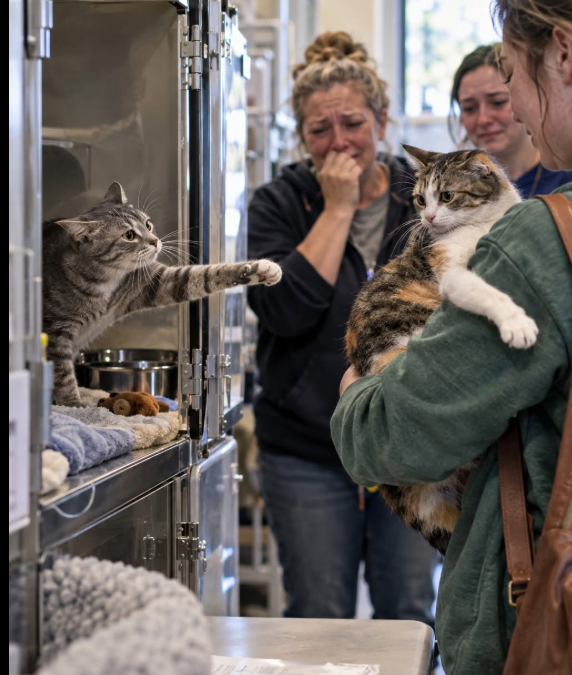
Then both went to their window bench.
Dark street outside.
Their reflections in the glass.
Large tuxedo cat.
Torn ear.
Small gray cat.
White teardrop beneath her chin.
I sat behind them.
“I’m sorry.”
Jasper flicked one ear.
“I know I didn’t separate you.”
Willow leaned against him.
“But people did.”
They kept watching the street.
A car passed.
Headlights slid across the walls.
Months earlier, Willow would have panicked.
Jasper would have sat upright.
That night?
Nothing.
Car gone.
Room quiet.
Safe.
I thought about Harold.
Losing his wife.
Sitting on his porch with Willow and Jasper because they were what remained of his family.
Writing that letter before he went into the hospital.
Knowing he might not come back.
Trying to protect them after death.
I thought about Dana and Eric.
Good people who never should have been made part of the harm.
Brooke.
A woman who believed she had failed a frightened cat when the truth had been hidden from her.
Amanda.
A leader who waited too long to ask hard questions.
Cynthia.
A woman who believed success could be measured without asking what happened after the adoption photo.
Then I thought about how often we call pain inconvenient.
Old people separated from familiar routines.
Children split from siblings.
Animals surrendered after owners die.
People told to adjust when what they are actually doing is grieving.
We ask living things to survive loss after loss.
Then criticize the symptoms.
Willow stood.
She walked away from Jasper.
Toward me.
That was new.
Jasper watched.
Did not follow.
Willow crossed the rug.
Put one paw on my knee.
I touched her head.
Two fingers.
She allowed it.
Then she walked back to Jasper.
Not because she could not exist without him.
Because she wanted to be near him.
There is a difference.
A year passed.
Willow and Jasper remained with me.
They became minor local celebrities.
Their photograph hung at Harbor Haven beneath:
**LISTEN WHEN THEY TELL US WHO THEY LOVE.**
Their case became part of volunteer training.
Amanda shared the bonded-pair policy with other local rescues.
Three adopted versions of it.
Cynthia moved away.
Someone told someone who told Marlene that she worked in real estate.
I didn’t care.
She did not deserve to stay at the center of Willow and Jasper’s story.
The center belonged to them.
Jasper grew slower.
His arthritis worsened.
He took medication hidden in tuna.
Practical man.
Willow became bolder.
Never outgoing.
But she stopped disappearing every time the doorbell rang.
She discovered folded sweaters.
Specifically mine.
She slept on them and looked personally insulted when I needed clothing.
They still ate together.
Still slept touching.
Still looked for each other if one disappeared too long.
But something beautiful had happened.
The desperation faded.
At Harbor Haven, Willow pressed into Jasper because everything else was uncertain.
At home, she pressed into him because she loved him.
Safety turns survival back into love.
That is what I learned from them.
On the anniversary of their reunion, Mr. Bell told me where Harold was buried.
I did something some people might call foolish.
I put Willow and Jasper in their stroller.
Drove to the cemetery.
Harold lay beneath an oak beside his wife.
His headstone read:
BELOVED HUSBAND, NEIGHBOR, AND FRIEND.
HE ALWAYS BROUGHT EVERYONE HOME SAFELY.
Of course it did.
A school bus driver.
I placed a framed photograph of Willow and Jasper beside the stone long enough to take a picture for Mr. Bell.
Then I crouched.
“They’re together.”
I felt ridiculous talking to a headstone.
I did it anyway.
“They’re safe.”
Jasper looked out from the stroller.
Willow leaned against him.
“I’m sorry it took us too long to listen.”
Wind moved through the oak.
For one second, I imagined an old man sitting behind the wheel of a school bus, checking one final time that every child had gotten home.
Then I imagined him finally relaxing.
When we returned to my apartment, Willow jumped out first.
Jasper followed.
That mattered too.
She no longer needed him to inspect every room before she entered.
They ate.
Then went to the window.
Sunset poured across them.
Willow’s gray coat silver.
Jasper’s white chest gold.
Shoulder to shoulder.
No kennel.
No cameras.
No glossy adoption cards.
No one deciding their bond made a spreadsheet inconvenient.
Just home.
Sometimes people think the best gift you can give a shelter animal is an address.
Full bowl.
Soft bed.
Clean litter box.
Those things matter.
But sometimes the most important thing you can give an animal is permission to keep the one thing they already love.
Willow and Jasper taught me that love is not always dramatic enough for people in charge to notice.
Sometimes love is a cat refusing breakfast.
Sometimes it is another crying behind a washing machine.
Sometimes it is one gray body pressed against one tuxedo shoulder saying in the only language available:
I cannot do this world without you yet.
The word yet became important.
Because eventually, Willow could.
She could walk into another room.
Eat first.
Sleep while Jasper drank water.
Stay in bed while he jumped down.
She did not become less bonded.
She became less afraid.
The best moment came almost eighteen months after their reunion.
Sometime after two in the morning, I woke because Jasper jumped off my bed.
Willow lifted her head.
In the first months, she would have followed instantly.
Panic first.
Thinking later.
That night, she stayed.
She watched Jasper walk into the hallway.
Listened.
He drank water.
I could hear the bowl move.
Willow blinked.
Put her head down.
Jasper returned a minute later.
Jumped onto the bed.
Circled once.
Lay beside her.
Willow shifted enough to make room.
His tail fell across her back.
They slept.
I didn’t.
I lay there listening to them breathe.
And something in me settled.
The world had separated them once.
It had failed.
Not because love magically defeated policy.
Not because two cats planned a protest.
Because love leaves evidence.
Empty food bowls.
Weight loss.
Sleepless nights.
Cries behind doors.
Adopters saying:
Something is wrong.
Volunteers refusing to pretend.
A neighbor carrying an old man’s last request inside an envelope.
And two animals recognizing home the second their foreheads touched again.
Some bonds are too deep to fit on an adoption card.
Some relationships become part of how another living being survives.
And sometimes the safest place in the world is not a building.
Not a kennel.
Not a foster room.
Not even a permanent home.
Sometimes safety has a heartbeat.
Sometimes it has whiskers.
A torn ear.
A pale green stare.
A little white mark shaped like a tear.
Sometimes safety is simply waking in the dark, hearing the one you love move away, and knowing with absolute certainty that this time—
they are coming back.