HOA Karen Threatened to Evict Me Over a Bird Feeder on My Own Ranch—She Thought $800-a-Day Fines Made Her My Landlord
HOA Karen Threatened to Evict Me Over a Bird Feeder on My Own Ranch—She Thought $800-a-Day Fines Made Her My Landlord
She threatened to evict me from land my family had owned for generations because birds were eating seed from one of my trees.
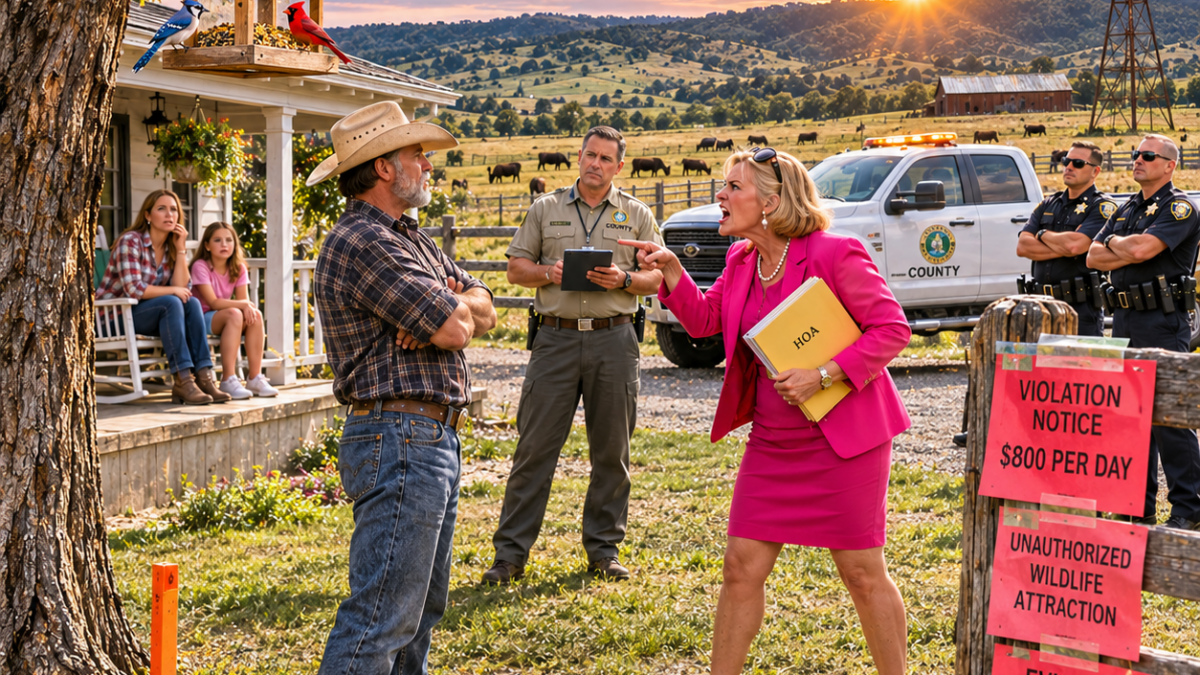
By sunset, HOA Karen had taped $800-a-day violation notices to my fence and called the police over a wooden bird feeder.
What she did not realize was that the little orange survey marker beneath that tree was about to make her entire enforcement campaign look ridiculous.
“Your bird feeder is an unauthorized attraction. Remove it today or we will begin eviction proceedings.”
Victoria Mercer shouted that into her phone while standing outside my backyard fence, pointing at a cedar tree as if she had just discovered an illegal casino operating from its branches.
The object causing the emergency was a wooden bird feeder.
That was it.
No loudspeaker. No livestock pen. No commercial business. No hazardous structure.
A bird feeder.
It hung from a thick cedar limb about twenty feet inside my property line, filled with sunflower seed and millet. Cardinals came in every morning. Finches crowded the smaller perches. My family kept a little notebook near the kitchen window where we wrote down species we recognized.
Victoria apparently considered this a threat to civilization.
She wore her usual bright pink blazer, matching skirt, pearl earrings, and beige heels. Under one arm she carried the yellow HOA folder she used whenever she wanted paperwork to look more powerful than it was.
Three violation notices had already been stapled to a temporary wooden post outside my fence.
The largest read:
UNAUTHORIZED WILDLIFE ATTRACTION.
Daily penalty: $800.
Below that was another warning:
FAILURE TO COMPLY MAY RESULT IN REMOVAL FROM PROPERTY.
I read that line twice.
Then I looked around at the four thousand acres surrounding us.
“You’re evicting me?”
Victoria snapped her folder shut.
“If necessary.”
“From my ranch?”
“From the affected property.”
“The affected property is my ranch.”
“You live adjacent to Green Briar Estates.”
“Yes.”
“That creates community obligations.”
“No, it creates geography.”
Her jaw tightened.
Behind me, my wife, Claire, was sitting on the back porch with our daughter, Emma, watching two cardinals hop around the feeder.
Victoria pointed toward them.
“Those birds are the problem.”
Emma looked at me.
I looked at the birds.
One cardinal continued eating with the calm indifference of an animal unaware it had just violated HOA standards.
Victoria continued.
“We have documented excessive bird traffic, noise, seed debris, and droppings.”
“You documented birds.”
“We documented nuisance activity.”
“You mean flying?”
“Don’t be sarcastic.”
“I’m trying not to be.”
She pulled another sheet from her folder.
“The board voted unanimously that feeders visible from Green Briar common areas are prohibited.”
“My feeder isn’t in Green Briar.”
“It affects Green Briar.”
“My ranch existed before Green Briar.”
“So did mosquitoes. We still control those.”
That was the moment I knew the conversation had nowhere intelligent left to go.
I walked toward the cedar tree and stopped beside the bright orange survey pin driven into the grass beneath it.
Victoria followed me with her eyes.
“That marker means nothing to the HOA.”
I smiled.
“It means quite a lot to the county.”
A vehicle turned onto the ranch road.
White pickup.
County seal on the door.
Victoria straightened her blazer.
She thought help had arrived.
I looked at the feeder, then at the survey pin, then at the folder full of fines she had invented against land she did not control.
For the first time that afternoon, I almost felt sorry for her.
Almost.
part 2
The county pickup stopped beside my equipment shed, and Aaron Schultz stepped out carrying a tablet.
Aaron worked in planning and land-use administration. He was not some all-powerful official who could decide private HOA disputes on the spot, and I knew that. What he could do was verify parcel boundaries, county records, and whether Green Briar had any recorded land-use authority over my ranch.
That was all I needed.
Victoria marched toward him before he had fully closed the truck door.
“Mr. Schultz, thank goodness. We have an escalating wildlife nuisance and a property owner refusing lawful community enforcement.”
Aaron looked at the cedar tree.
Then at the bird feeder.
Then at me.
“Morning, Daniel.”
“Morning.”
Victoria paused.
“You two know each other?”
“He’s filed permits with our office before.”
I nodded toward my machine shed.
“Roof replacement two years ago.”
Aaron looked back at Victoria.
“What exactly is the county issue?”
She handed him her notice.
“This feeder is attracting excessive bird populations directly beside Green Briar Estates.”
Aaron read it.
He looked up.
“This is an HOA violation notice.”
“Yes.”
“I’m asking what county regulation you believe is being violated.”
“The community considers the birds hazardous.”
“That isn’t a county code citation.”
“They create waste.”
“So do cattle.”
Victoria looked toward my pasture.
“Exactly.”
I saw Aaron’s eyes close for approximately one second.
It was the expression of a man reconsidering every professional decision that had brought him to this particular Tuesday morning.
He turned toward me.
“You asked for parcel verification?”
“Yes.”
I handed him my current recorded deed and the professional survey completed the previous year.
The survey showed Green Briar’s western boundary clearly.
My cedar tree sat twenty-three feet inside my ranch.
The feeder hung another several feet inward.
Aaron entered the parcel number into his tablet.
Victoria stood beside him with the confidence of someone waiting for technology to surrender.
It did not.
“This parcel is not part of Green Briar Estates,” Aaron said.
“I know it’s technically outside.”
Technically.
That word again.
I had learned that when Victoria said technically, she was about to explain why facts should be treated as optional.
She opened her folder.
“Green Briar adopted an external nuisance standard six months ago.”
Aaron nodded.
“You can adopt internal association rules.”
“Correct.”
“For property subject to your declaration.”
“Our attorney said nuisance conditions can cross boundaries.”
“They can.”
Victoria smiled triumphantly.
Aaron continued.
“That doesn’t automatically give your HOA enforcement power over property outside the association.”
Her smile disappeared.
“The birds cross into Green Briar.”
“Yes.”
“So the source can be regulated.”
“Not by declaring somebody else’s ranch part of your HOA.”
Her face reddened.
“I never said the ranch was part of the HOA.”
I pointed toward the notice.
“You threatened to evict me.”
Aaron looked down.
He read the sentence.
Then he looked at Victoria.
“Evict him how?”
She hesitated.
“Through legal proceedings.”
“Are you his landlord?”
“No.”
“Mortgage holder?”
“No.”
“Do you own the parcel?”
“Obviously not.”
“Does Green Briar own it?”
“No.”
“Then what exactly do you mean by eviction?”
Victoria folded her arms.
“Removal through court authority.”
“Based on what?”
“Repeated community violations.”
Aaron looked at me.
I looked at Aaron.
Neither of us spoke.
The silence did the work.
A small flock of finches landed on the feeder behind us.
Victoria heard them.
She pointed.
“There! That’s what I’m talking about.”
Aaron turned.
Six tiny birds were eating seed.
One dropped a sunflower shell.
Victoria looked as though she had just caught organized crime on video.
“See?”
Aaron said, “I see finches.”
“Exactly.”
That was when Claire walked out carrying coffee.
She handed me a mug.
Then she looked at Victoria.
“Would anybody like breakfast before the birds overthrow local government?”
Aaron coughed.
I knew that cough.
He was hiding a laugh.
Victoria was not amused.
“This is not funny.”
Claire looked at the feeder.
“Apparently we disagree.”
The bird feeder had never been anything dramatic.
I built it with Emma the previous spring from cedar boards left over from a fence project. She painted a little blue stripe around the roof, and I installed a wide tray because she wanted larger birds to have somewhere to land.
It became part of our morning routine.
Coffee for me.
Tea for Claire.
Cereal for Emma.
Birds outside the window.
I had come home from two deployments years before with a habit of waking early. For a long time, dawn meant checking locks, scanning roads, and listening for sounds nobody else noticed.
The ranch slowly changed that.
Then the birds did too.
There was something reassuring about sitting in a quiet kitchen at sunrise while cardinals argued over sunflower seeds.
Ordinary life has a sound.
Sometimes it is wings against cedar branches.
Victoria saw none of that.
To her, the feeder was simply something she had not approved.
And anything she had not approved seemed to offend her personally.
Her campaign against it had started three weeks earlier.
The first letter arrived in a white envelope bearing Green Briar’s logo.
NOTICE OF EXTERNAL AESTHETIC NONCOMPLIANCE.
I assumed it had been mailed to the wrong address.
The letter claimed my feeder was visible from a Green Briar walking trail and therefore affected “community visual harmony.”
I wrote one sentence back.
My property is not subject to Green Briar Estates covenants.
Three days later, another letter arrived.
This one added wildlife concerns.
Then sanitation concerns.
Then property-value concerns.
By the fourth letter, the feeder had somehow become a “regional pest concentration mechanism.”
I showed that one to Carl Jennings.
Carl owned land north of me and had become Green Briar’s unofficial spectator after they once sent him a warning about his restored pickup.
He read the phrase twice.
“Regional pest concentration mechanism.”
“That’s what it says.”
Carl stared through my kitchen window at a blue jay.
“Dangerous-looking fellow.”
“Very.”
“Probably organized.”
“Highly.”
Carl lowered his voice.
“Have you notified Homeland Security?”
I should have stopped him there.
Instead I laughed.
That encouraged him.
The next day he arrived with a homemade sign.
REGIONAL PEST CONCENTRATION FACILITY.
I refused to hang it.
Claire wanted to.
Emma definitely wanted to.
For three days, the sign remained hidden in the barn.
Then Victoria sent an $800 fine.
I nearly installed the sign myself.
The fines became daily.
Eight hundred dollars.
Then another eight hundred.
Then another.
After one week, Green Briar claimed I owed $5,600.
After two weeks, $11,200.
I replied formally, disputing every assessment and demanding the legal instrument that supposedly gave Green Briar enforcement power over my ranch.
Victoria sent back a board resolution.
Not a deed.
Not an easement.
Not a covenant.
A board resolution.
It declared that wildlife-attracting structures within a “reasonable environmental influence radius” of Green Briar were subject to HOA nuisance enforcement.
The radius was never defined.
Apparently it ended wherever Victoria lost interest.
I forwarded the resolution to Rachel Mendoza.
Rachel had handled my property matters for years.
She called me eleven minutes later.
“I have one question.”
“Go ahead.”
“Are they serious?”
“Yes.”
“About evicting you?”
“Apparently.”
“From land they don’t own?”
“Yes.”
“For birds?”
“Yes.”
Rachel became quiet.
Then she said, “I miss normal boundary disputes.”
We decided not to rush into court immediately.
The threat looked ridiculous, but the letters were escalating. Rachel sent Green Briar a formal demand to withdraw the fines, confirm they claimed no jurisdiction over my ranch, and stop representing that they could evict or remove me.
Green Briar’s management company did not answer.
Victoria did.
Her email said:
The Association will not be intimidated by outdated landowner arguments when public health and community standards are at stake.
Rachel forwarded it to me with one sentence.
“She writes like a small country preparing sanctions.”
Then Victoria called the sheriff’s office.
That was the day she appeared at my fence in pink.
According to Deputy Marcus Hale, who arrived after Aaron, dispatch had been told there was a “hostile landowner refusing a lawful environmental abatement order.”
Marcus stepped out of his patrol SUV and looked at me.
“Hostile?”
“I drank coffee.”
“Recklessly?”
“Black.”
“Serious.”
Victoria approached.
“Deputy, I need documentation that he refused compliance.”
Marcus looked toward Aaron.
“What compliance?”
Aaron answered before she could.
“Private HOA notice against property outside the HOA.”
Marcus nodded.
Then he looked at the feeder.
“That?”
“Yes,” Victoria said.
Marcus stared.
“A bird feeder.”
“An unauthorized wildlife attractant.”
Marcus looked back at me.
“I’m going to need backup.”
Victoria nodded seriously.
“I agree.”
Marcus continued.
“For the terminology.”
I laughed.
Victoria did not.
She showed him the eviction warning.
Marcus read it carefully.
“Ma’am, are you alleging trespass, threats, vandalism, or some other criminal conduct?”
“I’m alleging refusal to obey.”
“That isn’t automatically criminal.”
“He is violating community rules.”
“He says he isn’t in your community.”
“He is adjacent.”
Marcus looked around at the ranch.
Four thousand acres.
Pasture.
Barns.
Cattle.
House.
Windmill.
Then Green Briar rooftops far beyond the fence.
“Adjacent is doing some heavy lifting there.”
Victoria’s anger sharpened.
“Everyone is treating this like a joke.”
I answered quietly.
“You threatened to evict a landowner over a bird feeder.”
“Because you refused every reasonable solution.”
“Your solution was removing something from my property because you dislike birds.”
“We do not dislike birds.”
A cardinal landed almost directly behind her.
She flinched.
Marcus saw it.
So did I.
Nobody said anything.
That made it much funnier.
Aaron finished reviewing the records and gave Victoria the county’s position carefully.
The county was not adjudicating HOA covenants.
But county parcel records showed my land was outside Green Briar.
There was no recorded annexation.
No county order requiring feeder removal.
No condemnation.
No nuisance case.
No governmental eviction proceeding.
If Green Briar believed it had some independent private legal right, its lawyer could present that claim through the proper civil process.
Until then, the county was not backing her demand.
Victoria’s face hardened.
“So you’re refusing to enforce public safety.”
Aaron said, “I’m refusing to invent authority.”
That was the first line the local reporter quoted.
I had not invited media.
Victoria had.
She had contacted a local television station the night before, apparently expecting cameras to capture the county forcing me to remove the feeder.
Instead, the reporter recorded Aaron explaining parcel boundaries while several finches landed behind Victoria.
The segment aired that evening.
The headline was restrained.
PROPERTY DISPUTE OVER BIRD FEEDER RAISES HOA AUTHORITY QUESTIONS.
The footage was not restrained.
At one point Victoria stood in front of my fence explaining that “unmanaged bird concentration can destabilize residential quality.”
Behind her, a single mourning dove walked through the grass.
Slowly.
Calmly.
It looked almost professionally sarcastic.
Carl called me before the segment ended.
“Daniel.”
“No.”
“The dove.”
“I saw it.”
“It deserves representation.”
“Goodbye, Carl.”
“It made her look insane without doing anything.”
“Goodbye.”
“Natural talent.”
I hung up.
Green Briar residents began asking questions that same night.
Not about birds.
About money.
Was the HOA really spending legal and management resources sending $800-a-day fines to a ranch owner outside the subdivision?
Had the board actually authorized eviction threats?
Could similar rules be used against other neighbors?
How much authority did Victoria believe Green Briar possessed?
And, most dangerously for her, who had voted for this?
That last question caused immediate trouble.
Victoria had repeatedly told me, “The board voted.”
The meeting minutes showed something different.
Green Briar’s board had approved a general wildlife-management policy for common areas and member lots.
There was no recorded vote authorizing enforcement against my ranch.
There was no vote approving $800 daily fines against me.
There was certainly no vote authorizing eviction proceedings.
Susan Pike, the board treasurer, discovered that after watching the news.
She called Victoria.
Then she called the HOA attorney.
Then she called Rachel.
By the following afternoon, Rachel had copies of the relevant minutes.
She came to my house.
“This is interesting.”
“That usually means expensive.”
“Not necessarily for you.”
She placed the minutes on the table.
The board had discussed complaints about birds near the western walking trail.
Two homeowners said droppings had increased on benches.
Another complained that seed shells sometimes blew toward the path.
The board approved moving one HOA-owned trash can and installing covered waste containers.
That was it.
Victoria later circulated a separate document labeled EXECUTIVE ENFORCEMENT IMPLEMENTATION.
That document created the $800 fine.
It also claimed repeated violations could justify “property removal proceedings.”
Rachel tapped the sentence.
“She wrote this.”
“How do you know?”
“Metadata from the copy Susan sent.”
I looked at her.
“So the board never authorized it?”
“Not according to these records.”
“What does property removal proceedings mean?”
Rachel smiled without humor.
“I suspect it means Victoria wanted something scary-sounding.”
That was becoming a pattern.
Victoria had discovered that most people do not immediately distinguish between official language and actual authority.
If something arrived on letterhead with a deadline and a dollar amount, many recipients assumed someone must have checked whether it was legal.
She counted on that.
It had worked before.
Eleanor Price, a widow living on two acres outside Green Briar, had paid $1,200 the previous year after receiving a “shared perimeter maintenance assessment.”
She was seventy-three.
She told me she assumed she had no choice.
Carl had refused a similar invoice.
Another neighboring family paid $600 over fence complaints.
When Rachel learned that, the bird feeder stopped being funny.
We started collecting records.
The pattern was simple.
Green Briar had no contractual authority over these outside properties.
Yet Victoria had repeatedly issued invoices or demands using language suggesting formal jurisdiction.
Some recipients paid.
That did not automatically make every payment fraudulent.
Maybe there were facts we did not know.
But there were enough questions for the board to investigate.
Susan pushed for an independent review.
Victoria fought it.
That guaranteed it happened.
The next Green Briar board meeting drew more residents than any meeting in years.
Rachel advised me not to attend.
Carl ignored that advice because it was not addressed to him.
Susan later sent me the recording.
Victoria opened by announcing that “outside agitators” were attacking Green Briar’s environmental stewardship.
A resident raised his hand.
“Is Daniel Cole an outside agitator?”
“Yes.”
“He owns the land next to us.”
“Exactly.”
The resident stared at her.
“That sounds like a neighbor.”
Applause.
Victoria demanded order.
Another homeowner asked about the $800 daily fine.
She said it reflected “the seriousness of noncompliance.”
“Who approved the amount?”
“The board authorized strong enforcement.”
Susan interrupted.
“No, we didn’t.”
The room went silent.
Victoria turned.
“We approved the wildlife policy.”
“For member property and common areas.”
“The authority is implied.”
“According to who?”
“Our legal framework.”
Thomas Avery, Green Briar’s attorney, was sitting at the side of the room.
Susan looked at him.
“Thomas?”
He adjusted his glasses.
“I have not advised the board that its declaration gives it authority to fine nonmember ranch property.”
Victoria’s face changed.
“Not in those exact words.”
Thomas continued.
“I also have not advised that Green Briar can evict Mr. Cole.”
People started laughing.
Victoria looked furious.
“Eviction is shorthand.”
A homeowner called out, “For what?”
She ignored him.
Susan held up the external enforcement notice.
“Did you draft this?”
“As president, I implement board policy.”
“That wasn’t my question.”
“Yes.”
“Did the board approve it?”
“The board empowered me.”
“Did we approve $800 per day?”
Victoria did not answer.
“Did we approve threatening eviction?”
Silence.
Susan looked around the room.
“I think we need to suspend external enforcement immediately.”
The motion passed six to one.
Victoria voted against it.
Carl called me afterward.
“She voted to keep her own policy.”
“Consistency.”
“She gave a speech.”
“Of course.”
“She said birds are eroding institutional authority.”
I stared at my phone.
“She said that?”
“Word for word.”
“Carl.”
“Yeah?”
“Please tell me you didn’t respond.”
Silence.
“Carl?”
“I asked whether cardinals had retained counsel.”
I closed my eyes.
The independent review took three weeks.
It found no recorded authority supporting Green Briar’s fines against neighboring nonmember properties.
Several notices had been issued without formal board approval.
Some charges had been booked as “community impact reimbursements.”
Others were categorized as administrative fees.
The total money collected from outside owners was not enormous.
But it was enough to matter.
More importantly, the practice exposed the association to claims.
Green Briar refunded Eleanor.
They refunded the other family.
Every invoice against me was withdrawn.
The board issued a formal letter confirming that my ranch was not subject to Green Briar’s declaration or enforcement policies.
My bird feeder remained exactly where it had always been.
That should have ended the story.
Victoria refused.
Green Briar’s annual summer picnic was scheduled for the following weekend.
It took place at the subdivision park just across the fence from my western pasture.
I had nothing to do with the event.
I did not sabotage it.
I did not bait birds toward it.
I did not add some magical seed blend designed to unleash an airborne revenge army.
Real life gave me something funnier.
Victoria did it to herself.
The picnic committee had originally planned covered serving stations and trash containers with lids.
Victoria changed the setup.
She wanted the event to look “elegant” for photographs.
She ordered long open buffet tables.
Fruit platters.
Bread baskets.
Pastries.
Cupcakes.
Corn chips.
Barbecue.
And, for reasons nobody could explain later, decorative trays of unshelled sunflower seeds mixed with dried fruit as rustic centerpieces.
When Susan told me that detail afterward, I thought she was joking.
She was not.
The woman who had spent a month calling my bird feeder a wildlife attractant decorated her own outdoor picnic with bird food.
Nature appreciates irony.
The morning of the picnic was bright and warm.
A storm system had passed north of us the previous night, and migrating birds were moving through the area in large numbers.
That was not unusual for the season.
By eleven, blackbirds were gathering along fence lines.
Grackles moved through the park.
A few larger flocks settled in nearby trees.
The picnic began at noon.
I knew none of this because I was repairing a stock-water valve half a mile away.
Then Carl drove across my ranch road at approximately the speed of a man carrying national-security information.
He stopped beside me.
“Come with me.”
“No.”
“You need to see this.”
“What happened?”
He pointed east.
“The wildlife has rejected her appeal.”
I stared at him.
“What?”
“Birds.”
“Carl.”
“Hundreds.”
I climbed into his truck.
Not because I wanted revenge.
Because his face suggested whatever was happening would be worth five minutes.
We stopped on my side of the fence.
The Green Briar picnic had become chaos.
Not dangerous chaos.
Ridiculous chaos.
Birds had discovered the buffet.
A flock of grackles occupied one end of a table.
Two bold birds were pulling pieces from a bread basket.
Another had landed beside a bowl of chips.
Several cardinals and sparrows clustered near the decorative seed trays.
Guests waved napkins.
Children laughed.
Adults tried covering food.
One man protected a plate of ribs with both arms as if defending state secrets.
Then came the geese.
Not thousands.
Not a biblical plague.
Seven Canada geese from Green Briar’s own retention pond.
They walked onto the lawn in formation.
Carl whispered, “Leadership.”
I elbowed him.
The geese did not care about HOA boundaries.
They moved directly toward a table where someone had dropped buns.
Victoria saw them.
She marched across the grass wearing a pink blazer over white pants.
Of course she was wearing pink.
She began waving her arms.
“Shoo!”
The geese stopped.
One looked at her.
Victoria took another step.
The goose hissed.
She stepped backward.
Carl made a noise beside me.
I turned.
He had both hands over his mouth.
“Don’t.”
“I’m not doing anything.”
“You’re shaking.”
“I’m emotional.”
Victoria tried approaching from another direction.
The geese repositioned.
She waved a folded event program.
“Get out!”
Nobody explained to them that she was HOA president.
Or former acting president, depending on the week.
One goose walked around her and took a piece of bread.
The crowd laughed.
That made Victoria angrier.
Which made the scene worse.
She pointed toward the fence.
“This is because of his feeder!”
I was nearly a hundred yards away.
Several people turned.
Carl waved.
I grabbed his arm.
“What are you doing?”
“Neighborly acknowledgment.”
“Stop helping.”
The local reporter from the previous bird-feeder story happened to be covering the picnic because Green Briar had invited the station to showcase “community renewal.”
Her cameraman filmed everything.
The birds.
The geese.
The food tables.
Victoria.
And the sign beside the Green Briar retention pond that read:
PLEASE DO NOT FEED WILDLIFE.
The cameraman zoomed in on it.
Then back to the buffet.
Even I laughed.
A gust of wind caught a stack of paper plates.
They scattered across the lawn.
Victoria chased two.
A grackle landed on the uncovered dessert table.
Someone dropped a tray.
The goose hissed again.
Nobody was injured.
Nothing terrible happened.
The picnic simply dissolved into one of those events that becomes impossible to rescue once everyone realizes the disaster is more entertaining than the program.
Within forty minutes, most food had been moved indoors.
The remaining guests stood around laughing and taking photographs.
The birds eventually lost interest.
The geese returned toward the pond.
Nature completed its hostile takeover without reading a single HOA document.
The evening news segment was devastating.
The reporter did not mock Victoria.
She did not need to.
She explained that Green Briar had recently withdrawn attempts to fine a neighboring rancher over a bird feeder.
Then the footage showed birds eating from Green Briar’s own uncovered picnic buffet.
Then came Victoria insisting that my feeder had created the problem.
The reporter asked an ornithologist from a local nature center for context.
He explained that birds naturally move through the area, especially during seasonal migration, and that exposed outdoor food can attract opportunistic species.
He did not blame my feeder.
He did not blame Green Briar.
He simply described birds behaving like birds.
That was worse for Victoria.
She could fight me.
She could fight Susan.
She could fight lawyers.
She could not cross-examine migration.
The clip went viral locally.
Not nationally.
Not millions of views.
But enough that Green Briar residents were sending each other screenshots by dinner.
The most popular image showed Victoria pointing toward my ranch while three birds stood on the buffet behind her.
Carl printed it.
I told him not to.
He framed it.
I told him definitely not to bring it over.
It is now in my workshop.
The picnic embarrassment alone did not remove Victoria.
That would have been silly.
What ended her presidency was the audit, the unauthorized external fines, the money Green Briar had to refund, the legal costs, and her continued refusal to accept the limits of her authority.
The picnic simply gave everyone a picture they would never forget.
Two days later, the board held another emergency meeting.
Susan presented the independent review.
Thomas Avery explained the legal exposure.
Residents demanded changes.
Victoria defended herself for nearly thirty minutes.
She claimed she had acted to protect health.
Protect property values.
Protect neighborhood aesthetics.
Protect sanitation.
Protect Green Briar’s authority.
Then Eleanor Price stood.
She was the seventy-three-year-old woman who had paid $1,200 after receiving one of Victoria’s outside-property assessments.
Eleanor did not shout.
That made the room quieter.
“You knew I wasn’t in Green Briar.”
Victoria looked uncomfortable.
“I believed neighboring properties shared certain responsibilities.”
“You sent me a bill.”
“For perimeter maintenance.”
“You told me it would become a lien.”
“That was based on the information available.”
Eleanor held up the refund letter.
“Your own lawyer says you had no authority.”
Victoria looked toward Thomas.
He did not rescue her.
Eleanor continued.
“I paid because I was scared.”
That ended the comedy.
Everyone in the room understood what the problem had really been.
Not birds.
Not feeders.
Not property values.
Fear.
Victoria had learned that official-looking notices made people afraid enough to obey.
People like me asked for deeds and authority.
People like Eleanor sometimes wrote checks.
That was why the board finally acted.
The motion to remove Victoria as president passed overwhelmingly.
She remained a homeowner.
But she lost her office.
Her committee roles.
Her enforcement authority.
And, most painful to her, the microphone.
Susan became president.
Her first major policy was only two pages long.
Green Briar would not fine, threaten, demand payment from, or claim covenant authority over nonmember property unless recorded legal documents clearly created that authority.
Any neighbor complaint involving outside property would be handled as what it actually was.
A neighbor complaint.
Not an HOA prosecution.
I told Susan it was the most boring policy I had ever read.
She smiled.
“Thank you.”
“I mean that sincerely.”
“I know.”
Rachel negotiated resolution of my claims without prolonged litigation.
Green Briar formally withdrew every fine.
The association reimbursed my documented legal expenses under the settlement terms.
It acknowledged in writing that I could not be evicted, fined, or otherwise sanctioned under Green Briar’s covenants because my ranch was not subject to them.
They also agreed to stop placing notices on my trees, fence posts, gate, house, equipment, cattle trailers, or “any other object located on the Cole property.”
That last phrase made me laugh.
Apparently my bird feeder required its own peace treaty.
I did not demand money for emotional distress.
I did not want it.
I wanted clarity.
The feeder stayed.
The land stayed.
The boundary stayed.
The rest could become a story.
The following spring, Emma and I repaired the feeder roof.
Weather had warped one cedar board.
She was older by then and insisted on doing most of the work herself.
We stood beneath the tree with a cordless drill while cardinals hopped through nearby branches.
She looked toward Green Briar.
“Can they complain again?”
“They can complain about anything.”
“Can they fine us?”
“No.”
“Can they evict us?”
I smiled.
“No.”
“Because we own it?”
“Because they don’t.”
That was enough for her.
Children often understand property law faster than adults with committees.
We filled the feeder.
Then we sat on the porch.
A chickadee arrived first.
Then finches.
Then a cardinal.
No geese.
Carl was disappointed.
He had developed a strange respect for the goose that hissed at Victoria.
He called it Clarence.
“You can’t name somebody else’s goose.”
“It chose me.”
“It hissed at Victoria.”
“Exactly.”
“That’s not choosing you.”
“Shared values.”
I stopped arguing.
Green Briar changed after Victoria.
Not overnight.
Associations are institutions, not personalities.
But culture matters.
Susan stopped encouraging anonymous violation reporting.
She required board members to disclose conflicts.
Enforcement letters had to identify the actual covenant provision involved.
Residents received meaningful appeal rights.
And, perhaps most radically, the board began using the sentence:
We don’t have authority over that.
Apparently civilization survived.
A homeowner once complained that my cattle were visible from the walking trail.
Susan responded that the cattle were on property outside the association.
End of issue.
Another complained about my barn lights.
Susan called me, not with a demand, but as a neighbor.
“Would you mind checking one floodlight? It may be angled toward two houses.”
I checked.
She was right.
I adjusted it.
No violation notice.
No $800 fine.
No threats.
No television crew.
Just adults solving something.
That experience taught me how much conflict Victoria had manufactured simply because she needed every disagreement to prove her power.
Good leadership reduced friction.
Her leadership created it.
Six months after losing the presidency, Victoria listed her house.
I learned that because Carl sent me the real-estate listing.
“Don’t start.”
“I haven’t said anything.”
“You’re going to.”
“The description says peaceful community.”
“Carl.”
“Should we disclose avian risk?”
I hung up.
Her house sold three months later.
On moving day, I happened to be fixing fence near the county road.
A moving truck sat outside her house.
Victoria carried boxes from the garage.
She saw me across the distance.
I raised one hand.
Not mockingly.
Just acknowledgment.
She did not wave back.
Then a cardinal landed on her mailbox.
I swear that happened.
I did not arrange it.
I did not feed it.
I did not summon it through secret rancher powers.
It landed.
Victoria saw it.
I saw her see it.
For half a second, we both looked at the bird.
Then it flew away.
That was enough.
I turned back to my fence before I started laughing.
A week later, she was gone.
I heard she moved to a newer development outside the county.
Carl suggested mailing her a bird feeder.
Claire threatened to confiscate his truck keys.
We did neither.
Revenge has a useful stopping point.
Once peace returns, continuing the fight just makes you another person refusing to let go.
The little wooden feeder still hangs from the cedar tree.
It has been repaired twice.
Repainted once.
A squirrel chewed one corner.
Emma added a second smaller feeder farther down the yard.
Nobody voted.
Nobody issued a resolution.
We simply hung it.
Sometimes dozens of birds arrive.
Sometimes none.
That unpredictability is part of why I like them.
You cannot govern every living thing into neat little rows.
That was Victoria’s deepest problem.
She treated community life like a photograph she could keep arranging.
Same lawns.
Same colors.
Same fences.
Same acceptable noises.
Same decorations.
Same idea of beauty.
When something moved outside the frame, she tried to regulate it.
A tractor.
A barn.
A pickup.
A bird feeder.
Eventually, birds themselves.
But communities are not photographs.
They are people.
And boundaries exist for a reason.
The HOA had every right to adopt reasonable rules for property actually subject to its declaration.
Its homeowners could debate those rules.
Elect boards.
Remove boards.
Amend covenants where allowed.
That was their business.
My ranch was mine.
That was my business.
Living next door did not merge the two.
The law did not become complicated merely because Victoria wanted a different answer.
One Sunday morning, about a year after she moved, I sat on the porch with Claire.
Emma had gone inside.
The sun had just cleared the eastern ridge.
Cardinals moved around the feeder.
A woodpecker clung to the cedar trunk.
Green Briar’s walking trail was visible beyond the fence.
Two residents passed.
One waved.
I waved back.
No one photographed the feeder.
No one measured bird traffic.
No one counted sunflower shells.
The world remained standing.
Claire handed me coffee.
“Remember when this almost got you evicted?”
“From four thousand acres?”
“That was the theory.”
“I’m still unclear on the mechanics.”
“Maybe they planned to put your ranch on the curb.”
I looked across the pasture.
“Trash pickup would need a bigger truck.”
She laughed.
That quiet morning felt like the real victory.
Not Victoria covered in humiliation at a picnic.
Not the news story.
Not the board vote removing her.
Not the refund letters.
Peace.
The ability to enjoy something ordinary again without thinking about the fight around it.
For months, every time birds gathered, I remembered her pointing at them as though they were evidence.
Eventually, I stopped.
They became birds again.
That matters.
People who abuse authority often leave behind more than financial damage.
They contaminate ordinary things.
Mail becomes threatening because every envelope might contain another demand.
A knock at the door becomes suspicious.
A vehicle near the gate gets your attention.
A hobby becomes something you prepare to defend.
Recovering means taking those ordinary things back.
I took mine back one sunrise at a time.
The county survey marker remains beneath the cedar tree.
Bright orange cap.
Small enough that most people would never notice it.
I notice.
It marks a line on the ground.
But to me it also represents something larger.
Limits.
Victoria believed limits applied to everyone except authority.
The truth is the opposite.
Authority is meaningful because it has limits.
A board can regulate what its documents lawfully allow.
A county can exercise powers given by law.
A court can decide disputes properly brought before it.
A neighbor can complain.
A homeowner can disagree.
But nobody gets unlimited control simply because they believe their purpose is good.
Victoria said she was protecting Green Briar.
Maybe, in her own mind, she believed that.
But good intentions do not transform jurisdiction.
Neither does a vote.
Neither does fear.
Neither does a yellow folder.
Carl came over one evening carrying another homemade sign.
I saw it from fifty feet away.
“No.”
“You haven’t read it.”
“I don’t need to.”
“Just look.”
“No.”
He turned it around.
It said:
AUTHORIZED AVIAN DINING FACILITY.
I stared.
“That’s almost tasteful.”
“Thank you.”
“Still no.”
“What about the barn?”
“No.”
“Inside the barn?”
“No.”
“Behind the barn?”
“Carl.”
He looked offended.
“I support wildlife.”
“You support annoying me.”
“Multiple missions.”
Emma came outside.
She saw the sign.
“I like it.”
Carl smiled.
“Democracy.”
“This is not a democracy,” I said.
He pointed at me.
“Careful. You’re starting to sound like an HOA president.”
That was unfair.
Also effective.
The sign now hangs inside the workshop.
Not outside.
Compromise.
Years have passed since Victoria’s bird-feeder crusade.
Green Briar remains next door.
The ranch remains where it has always been.
The feeder remains in the cedar.
Sometimes I still see Susan.
She retired from the board eventually.
When she did, Green Briar gave her a plaque thanking her for restoring reasonable governance.
Carl wanted the plaque to say:
SHE NEVER TRIED TO EVICT A RANCHER OVER FINCHES.
Susan declined.
I thought it was wise.
The association eventually renovated its walking trail.
They added two educational signs about local bird species.
That made me laugh when I first saw them.
One showed a northern cardinal.
Another explained seasonal migration.
Green Briar, the community whose former president once classified my feeder as an unauthorized wildlife attraction, now encouraged residents to appreciate birds.
History has a sense of humor.
Susan called before the signs went up.
“I wanted you to hear this from me.”
“What?”
“The board approved birdwatching signs.”
I went silent.
“Daniel?”
“I’m processing.”
“You can laugh.”
I did.
“Are feeders allowed?”
“On member lots, subject to normal sanitation rules.”
“Revolutionary.”
“We’re very progressive.”
“Does the board still recognize birds crossing property lines?”
She laughed.
“We have surrendered control of the airspace.”
“Brave.”
That conversation meant more than it should have.
Not because I needed Green Briar to agree with me.
Because institutions can learn.
Victoria treated backing down as weakness.
Susan understood correction as competence.
If a rule is bad, change it.
If authority does not exist, admit it.
If someone was wrongly charged, refund them.
If leadership failed, replace it.
That is how systems recover.
The picnic incident eventually became neighborhood folklore.
Every summer, someone told the story again.
Details grew.
Five geese became twenty.
Twenty birds became five hundred.
By the third year, Carl claimed the sky had gone black.
“That did not happen.”
“You were far away.”
“I was standing next to you.”
“Perspective.”
“There were seven geese.”
“Elite geese.”
“There were maybe a few dozen birds around the tables.”
“Hundreds.”
“Carl.”
“History belongs to survivors.”
“You ate two hamburgers.”
“Survival takes calories.”
I stopped trying.
What mattered was that the real version was already funny enough.
Victoria had spent weeks accusing my feeder of creating an unnatural wildlife problem.
Then she organized an outdoor picnic beside a retention pond, displayed open food, and decorated tables with sunflower seeds.
No sabotage could have improved the irony.
That was why I never needed revenge.
Arrogance often manufactures its own punch line.
All you have to do is resist the temptation to interrupt.
The final legal file sits in my office beside ranch records.
The first page is Victoria’s original notice.
UNAUTHORIZED WILDLIFE ATTRACTION.
The last page is Green Briar’s signed acknowledgment that it has no covenant enforcement authority over my property.
Between those pages are emails, invoices, surveys, minutes, attorney letters, refund agreements, and photographs.
A lot of paper for one bird feeder.
But that is how these disputes grow.
The object is rarely the real issue.
The feeder cost me less than a dinner out.
The principle was priceless.
Could an organization I never joined fine me for something lawful on my own land?
Could it frighten neighbors into paying money without showing authority?
Could one president turn preference into jurisdiction by saying the words confidently enough?
No.
That was worth establishing.
Not through shouting.
Not retaliation.
Not some spectacular revenge stunt.
Through records.
Boundaries.
Questions.
And patience.
Victoria believed patience meant weakness because it was quiet.
She never understood how dangerous quiet people become when they keep copies.
My favorite time of day remains early morning.
Before tractors start.
Before phones ring.
Before traffic appears on the county road.
I sit on the porch with coffee.
The ranch is gray-blue at first.
Then sunlight reaches the eastern fence.
Birds begin moving through the cedar.
Sometimes a cardinal lands on the feeder roof before dropping down to eat.
Sometimes a dozen finches arrive together.
Sometimes one fat squirrel climbs the trunk and spends ten minutes trying to defeat the feeder guard.
Emma named him Harold.
Harold has violated more feeder rules than Victoria ever documented.
He remains unrepentant.
I watch him and think about that afternoon years ago.
Victoria in pink.
Finger pointed.
Yellow folder open.
Eight-hundred-dollar fines.
Threats of eviction.
Police calls.
News cameras.
All because something existed within her sight that she could not control.
She believed my refusal challenged her authority.
The truth was simpler.
Her authority stopped at the fence.
It had always stopped there.
The survey marker did not create that fact.
The county inspector did not create it.
Rachel did not create it.
The board’s later apology did not create it.
They merely confirmed reality.
My land was mine.
Green Briar was theirs.
Birds belonged to neither.
That last part would probably have bothered Victoria most.
There are things no committee owns.
No board can vote cardinals out of the sky.
No yellow folder can issue a violation to a migration route.
No property-value argument can make a cedar tree ask permission before offering a branch.
And no person becomes powerful simply because everybody else is tired of arguing with them.
Victoria learned that eventually.
She threatened to evict me over a bird feeder.
Instead, her own board removed her from the chair she believed made her untouchable.
The fines disappeared.
The threats disappeared.
The notices disappeared.
The fear they created for other neighbors disappeared too.
The feeder stayed.
Sometimes the smallest thing reveals the biggest problem.
For us, it was a wooden box full of sunflower seeds.
Victoria looked at it and saw defiance.
I looked at it and saw home.
Years later, when the sunset turns the pasture gold and the sky fades toward purple, birds still gather in that cedar.
Their wings flash through the light.
Claire still watches from the porch.
Emma still records unusual species when she visits.
And I still sit beneath the same open sky on land my family owned long before Green Briar existed.
No fines.
No eviction papers.
No screaming HOA president.
Just a wooden feeder swinging slightly in the evening breeze.
And every time a cardinal lands on it, I remember the one thing Victoria never managed to put into her rulebook.
Some things were never hers to control.
THE STORY ENDS HERE
HOA Karen Threatened to Evict Me Over a Bird Feeder on My Own Ranch—She Thought $800-a-Day Fines Made Her My Landlord
She threatened to evict me from land my family had owned for generations because birds were eating seed from one of my trees.
By sunset, HOA Karen had taped $800-a-day violation notices to my fence and called the police over a wooden bird feeder.
What she did not realize was that the little orange survey marker beneath that tree was about to make her entire enforcement campaign look ridiculous.
“Your bird feeder is an unauthorized attraction. Remove it today or we will begin eviction proceedings.”
Victoria Mercer shouted that into her phone while standing outside my backyard fence, pointing at a cedar tree as if she had just discovered an illegal casino operating from its branches.
The object causing the emergency was a wooden bird feeder.
That was it.
No loudspeaker. No livestock pen. No commercial business. No hazardous structure.
A bird feeder.
It hung from a thick cedar limb about twenty feet inside my property line, filled with sunflower seed and millet. Cardinals came in every morning. Finches crowded the smaller perches. My family kept a little notebook near the kitchen window where we wrote down species we recognized.
Victoria apparently considered this a threat to civilization.
She wore her usual bright pink blazer, matching skirt, pearl earrings, and beige heels. Under one arm she carried the yellow HOA folder she used whenever she wanted paperwork to look more powerful than it was.
Three violation notices had already been stapled to a temporary wooden post outside my fence.
The largest read:
UNAUTHORIZED WILDLIFE ATTRACTION.
Daily penalty: $800.
Below that was another warning:
FAILURE TO COMPLY MAY RESULT IN REMOVAL FROM PROPERTY.
I read that line twice.
Then I looked around at the four thousand acres surrounding us.
“You’re evicting me?”
Victoria snapped her folder shut.
“If necessary.”
“From my ranch?”
“From the affected property.”
“The affected property is my ranch.”
“You live adjacent to Green Briar Estates.”
“Yes.”
“That creates community obligations.”
“No, it creates geography.”
Her jaw tightened.
Behind me, my wife, Claire, was sitting on the back porch with our daughter, Emma, watching two cardinals hop around the feeder.
Victoria pointed toward them.
“Those birds are the problem.”
Emma looked at me.
I looked at the birds.
One cardinal continued eating with the calm indifference of an animal unaware it had just violated HOA standards.
Victoria continued.
“We have documented excessive bird traffic, noise, seed debris, and droppings.”
“You documented birds.”
“We documented nuisance activity.”
“You mean flying?”
“Don’t be sarcastic.”
“I’m trying not to be.”
She pulled another sheet from her folder.
“The board voted unanimously that feeders visible from Green Briar common areas are prohibited.”
“My feeder isn’t in Green Briar.”
“It affects Green Briar.”
“My ranch existed before Green Briar.”
“So did mosquitoes. We still control those.”
That was the moment I knew the conversation had nowhere intelligent left to go.
I walked toward the cedar tree and stopped beside the bright orange survey pin driven into the grass beneath it.
Victoria followed me with her eyes.
“That marker means nothing to the HOA.”
I smiled.
“It means quite a lot to the county.”
A vehicle turned onto the ranch road.
White pickup.
County seal on the door.
Victoria straightened her blazer.
She thought help had arrived.
I looked at the feeder, then at the survey pin, then at the folder full of fines she had invented against land she did not control.
For the first time that afternoon, I almost felt sorry for her.
Almost.
part 2
The county pickup stopped beside my equipment shed, and Aaron Schultz stepped out carrying a tablet.
Aaron worked in planning and land-use administration. He was not some all-powerful official who could decide private HOA disputes on the spot, and I knew that. What he could do was verify parcel boundaries, county records, and whether Green Briar had any recorded land-use authority over my ranch.
That was all I needed.
Victoria marched toward him before he had fully closed the truck door.
“Mr. Schultz, thank goodness. We have an escalating wildlife nuisance and a property owner refusing lawful community enforcement.”
Aaron looked at the cedar tree.
Then at the bird feeder.
Then at me.
“Morning, Daniel.”
“Morning.”
Victoria paused.
“You two know each other?”
“He’s filed permits with our office before.”
I nodded toward my machine shed.
“Roof replacement two years ago.”
Aaron looked back at Victoria.
“What exactly is the county issue?”
She handed him her notice.
“This feeder is attracting excessive bird populations directly beside Green Briar Estates.”
Aaron read it.
He looked up.
“This is an HOA violation notice.”
“Yes.”
“I’m asking what county regulation you believe is being violated.”
“The community considers the birds hazardous.”
“That isn’t a county code citation.”
“They create waste.”
“So do cattle.”
Victoria looked toward my pasture.
“Exactly.”
I saw Aaron’s eyes close for approximately one second.
It was the expression of a man reconsidering every professional decision that had brought him to this particular Tuesday morning.
He turned toward me.
“You asked for parcel verification?”
“Yes.”
I handed him my current recorded deed and the professional survey completed the previous year.
The survey showed Green Briar’s western boundary clearly.
My cedar tree sat twenty-three feet inside my ranch.
The feeder hung another several feet inward.
Aaron entered the parcel number into his tablet.
Victoria stood beside him with the confidence of someone waiting for technology to surrender.
It did not.
“This parcel is not part of Green Briar Estates,” Aaron said.
“I know it’s technically outside.”
Technically.
That word again.
I had learned that when Victoria said technically, she was about to explain why facts should be treated as optional.
She opened her folder.
“Green Briar adopted an external nuisance standard six months ago.”
Aaron nodded.
“You can adopt internal association rules.”
“Correct.”
“For property subject to your declaration.”
“Our attorney said nuisance conditions can cross boundaries.”
“They can.”
Victoria smiled triumphantly.
Aaron continued.
“That doesn’t automatically give your HOA enforcement power over property outside the association.”
Her smile disappeared.
“The birds cross into Green Briar.”
“Yes.”
“So the source can be regulated.”
“Not by declaring somebody else’s ranch part of your HOA.”
Her face reddened.
“I never said the ranch was part of the HOA.”
I pointed toward the notice.
“You threatened to evict me.”
Aaron looked down.
He read the sentence.
Then he looked at Victoria.
“Evict him how?”
She hesitated.
“Through legal proceedings.”
“Are you his landlord?”
“No.”
“Mortgage holder?”
“No.”
“Do you own the parcel?”
“Obviously not.”
“Does Green Briar own it?”
“No.”
“Then what exactly do you mean by eviction?”
Victoria folded her arms.
“Removal through court authority.”
“Based on what?”
“Repeated community violations.”
Aaron looked at me.
I looked at Aaron.
Neither of us spoke.
The silence did the work.
A small flock of finches landed on the feeder behind us.
Victoria heard them.
She pointed.
“There! That’s what I’m talking about.”
Aaron turned.
Six tiny birds were eating seed.
One dropped a sunflower shell.
Victoria looked as though she had just caught organized crime on video.
“See?”
Aaron said, “I see finches.”
“Exactly.”
That was when Claire walked out carrying coffee.
She handed me a mug.
Then she looked at Victoria.
“Would anybody like breakfast before the birds overthrow local government?”
Aaron coughed.
I knew that cough.
He was hiding a laugh.
Victoria was not amused.
“This is not funny.”
Claire looked at the feeder.
“Apparently we disagree.”
The bird feeder had never been anything dramatic.
I built it with Emma the previous spring from cedar boards left over from a fence project. She painted a little blue stripe around the roof, and I installed a wide tray because she wanted larger birds to have somewhere to land.
It became part of our morning routine.
Coffee for me.
Tea for Claire.
Cereal for Emma.
Birds outside the window.
I had come home from two deployments years before with a habit of waking early. For a long time, dawn meant checking locks, scanning roads, and listening for sounds nobody else noticed.
The ranch slowly changed that.
Then the birds did too.
There was something reassuring about sitting in a quiet kitchen at sunrise while cardinals argued over sunflower seeds.
Ordinary life has a sound.
Sometimes it is wings against cedar branches.
Victoria saw none of that.
To her, the feeder was simply something she had not approved.
And anything she had not approved seemed to offend her personally.
Her campaign against it had started three weeks earlier.
The first letter arrived in a white envelope bearing Green Briar’s logo.
NOTICE OF EXTERNAL AESTHETIC NONCOMPLIANCE.
I assumed it had been mailed to the wrong address.
The letter claimed my feeder was visible from a Green Briar walking trail and therefore affected “community visual harmony.”
I wrote one sentence back.
My property is not subject to Green Briar Estates covenants.
Three days later, another letter arrived.
This one added wildlife concerns.
Then sanitation concerns.
Then property-value concerns.
By the fourth letter, the feeder had somehow become a “regional pest concentration mechanism.”
I showed that one to Carl Jennings.
Carl owned land north of me and had become Green Briar’s unofficial spectator after they once sent him a warning about his restored pickup.
He read the phrase twice.
“Regional pest concentration mechanism.”
“That’s what it says.”
Carl stared through my kitchen window at a blue jay.
“Dangerous-looking fellow.”
“Very.”
“Probably organized.”
“Highly.”
Carl lowered his voice.
“Have you notified Homeland Security?”
I should have stopped him there.
Instead I laughed.
That encouraged him.
The next day he arrived with a homemade sign.
REGIONAL PEST CONCENTRATION FACILITY.
I refused to hang it.
Claire wanted to.
Emma definitely wanted to.
For three days, the sign remained hidden in the barn.
Then Victoria sent an $800 fine.
I nearly installed the sign myself.
The fines became daily.
Eight hundred dollars.
Then another eight hundred.
Then another.
After one week, Green Briar claimed I owed $5,600.
After two weeks, $11,200.
I replied formally, disputing every assessment and demanding the legal instrument that supposedly gave Green Briar enforcement power over my ranch.
Victoria sent back a board resolution.
Not a deed.
Not an easement.
Not a covenant.
A board resolution.
It declared that wildlife-attracting structures within a “reasonable environmental influence radius” of Green Briar were subject to HOA nuisance enforcement.
The radius was never defined.
Apparently it ended wherever Victoria lost interest.
I forwarded the resolution to Rachel Mendoza.
Rachel had handled my property matters for years.
She called me eleven minutes later.
“I have one question.”
“Go ahead.”
“Are they serious?”
“Yes.”
“About evicting you?”
“Apparently.”
“From land they don’t own?”
“Yes.”
“For birds?”
“Yes.”
Rachel became quiet.
Then she said, “I miss normal boundary disputes.”
We decided not to rush into court immediately.
The threat looked ridiculous, but the letters were escalating. Rachel sent Green Briar a formal demand to withdraw the fines, confirm they claimed no jurisdiction over my ranch, and stop representing that they could evict or remove me.
Green Briar’s management company did not answer.
Victoria did.
Her email said:
The Association will not be intimidated by outdated landowner arguments when public health and community standards are at stake.
Rachel forwarded it to me with one sentence.
“She writes like a small country preparing sanctions.”
Then Victoria called the sheriff’s office.
That was the day she appeared at my fence in pink.
According to Deputy Marcus Hale, who arrived after Aaron, dispatch had been told there was a “hostile landowner refusing a lawful environmental abatement order.”
Marcus stepped out of his patrol SUV and looked at me.
“Hostile?”
“I drank coffee.”
“Recklessly?”
“Black.”
“Serious.”
Victoria approached.
“Deputy, I need documentation that he refused compliance.”
Marcus looked toward Aaron.
“What compliance?”
Aaron answered before she could.
“Private HOA notice against property outside the HOA.”
Marcus nodded.
Then he looked at the feeder.
“That?”
“Yes,” Victoria said.
Marcus stared.
“A bird feeder.”
“An unauthorized wildlife attractant.”
Marcus looked back at me.
“I’m going to need backup.”
Victoria nodded seriously.
“I agree.”
Marcus continued.
“For the terminology.”
I laughed.
Victoria did not.
She showed him the eviction warning.
Marcus read it carefully.
“Ma’am, are you alleging trespass, threats, vandalism, or some other criminal conduct?”
“I’m alleging refusal to obey.”
“That isn’t automatically criminal.”
“He is violating community rules.”
“He says he isn’t in your community.”
“He is adjacent.”
Marcus looked around at the ranch.
Four thousand acres.
Pasture.
Barns.
Cattle.
House.
Windmill.
Then Green Briar rooftops far beyond the fence.
“Adjacent is doing some heavy lifting there.”
Victoria’s anger sharpened.
“Everyone is treating this like a joke.”
I answered quietly.
“You threatened to evict a landowner over a bird feeder.”
“Because you refused every reasonable solution.”
“Your solution was removing something from my property because you dislike birds.”
“We do not dislike birds.”
A cardinal landed almost directly behind her.
She flinched.
Marcus saw it.
So did I.
Nobody said anything.
That made it much funnier.
Aaron finished reviewing the records and gave Victoria the county’s position carefully.
The county was not adjudicating HOA covenants.
But county parcel records showed my land was outside Green Briar.
There was no recorded annexation.
No county order requiring feeder removal.
No condemnation.
No nuisance case.
No governmental eviction proceeding.
If Green Briar believed it had some independent private legal right, its lawyer could present that claim through the proper civil process.
Until then, the county was not backing her demand.
Victoria’s face hardened.
“So you’re refusing to enforce public safety.”
Aaron said, “I’m refusing to invent authority.”
That was the first line the local reporter quoted.
I had not invited media.
Victoria had.
She had contacted a local television station the night before, apparently expecting cameras to capture the county forcing me to remove the feeder.
Instead, the reporter recorded Aaron explaining parcel boundaries while several finches landed behind Victoria.
The segment aired that evening.
The headline was restrained.
PROPERTY DISPUTE OVER BIRD FEEDER RAISES HOA AUTHORITY QUESTIONS.
The footage was not restrained.
At one point Victoria stood in front of my fence explaining that “unmanaged bird concentration can destabilize residential quality.”
Behind her, a single mourning dove walked through the grass.
Slowly.
Calmly.
It looked almost professionally sarcastic.
Carl called me before the segment ended.
“Daniel.”
“No.”
“The dove.”
“I saw it.”
“It deserves representation.”
“Goodbye, Carl.”
“It made her look insane without doing anything.”
“Goodbye.”
“Natural talent.”
I hung up.
Green Briar residents began asking questions that same night.
Not about birds.
About money.
Was the HOA really spending legal and management resources sending $800-a-day fines to a ranch owner outside the subdivision?
Had the board actually authorized eviction threats?
Could similar rules be used against other neighbors?
How much authority did Victoria believe Green Briar possessed?
And, most dangerously for her, who had voted for this?
That last question caused immediate trouble.
Victoria had repeatedly told me, “The board voted.”
The meeting minutes showed something different.
Green Briar’s board had approved a general wildlife-management policy for common areas and member lots.
There was no recorded vote authorizing enforcement against my ranch.
There was no vote approving $800 daily fines against me.
There was certainly no vote authorizing eviction proceedings.
Susan Pike, the board treasurer, discovered that after watching the news.
She called Victoria.
Then she called the HOA attorney.
Then she called Rachel.
By the following afternoon, Rachel had copies of the relevant minutes.
She came to my house.
“This is interesting.”
“That usually means expensive.”
“Not necessarily for you.”
She placed the minutes on the table.
The board had discussed complaints about birds near the western walking trail.
Two homeowners said droppings had increased on benches.
Another complained that seed shells sometimes blew toward the path.
The board approved moving one HOA-owned trash can and installing covered waste containers.
That was it.
Victoria later circulated a separate document labeled EXECUTIVE ENFORCEMENT IMPLEMENTATION.
That document created the $800 fine.
It also claimed repeated violations could justify “property removal proceedings.”
Rachel tapped the sentence.
“She wrote this.”
“How do you know?”
“Metadata from the copy Susan sent.”
I looked at her.
“So the board never authorized it?”
“Not according to these records.”
“What does property removal proceedings mean?”
Rachel smiled without humor.
“I suspect it means Victoria wanted something scary-sounding.”
That was becoming a pattern.
Victoria had discovered that most people do not immediately distinguish between official language and actual authority.
If something arrived on letterhead with a deadline and a dollar amount, many recipients assumed someone must have checked whether it was legal.
She counted on that.
It had worked before.
Eleanor Price, a widow living on two acres outside Green Briar, had paid $1,200 the previous year after receiving a “shared perimeter maintenance assessment.”
She was seventy-three.
She told me she assumed she had no choice.
Carl had refused a similar invoice.
Another neighboring family paid $600 over fence complaints.
When Rachel learned that, the bird feeder stopped being funny.
We started collecting records.
The pattern was simple.
Green Briar had no contractual authority over these outside properties.
Yet Victoria had repeatedly issued invoices or demands using language suggesting formal jurisdiction.
Some recipients paid.
That did not automatically make every payment fraudulent.
Maybe there were facts we did not know.
But there were enough questions for the board to investigate.
Susan pushed for an independent review.
Victoria fought it.
That guaranteed it happened.
The next Green Briar board meeting drew more residents than any meeting in years.
Rachel advised me not to attend.
Carl ignored that advice because it was not addressed to him.
Susan later sent me the recording.
Victoria opened by announcing that “outside agitators” were attacking Green Briar’s environmental stewardship.
A resident raised his hand.
“Is Daniel Cole an outside agitator?”
“Yes.”
“He owns the land next to us.”
“Exactly.”
The resident stared at her.
“That sounds like a neighbor.”
Applause.
Victoria demanded order.
Another homeowner asked about the $800 daily fine.
She said it reflected “the seriousness of noncompliance.”
“Who approved the amount?”
“The board authorized strong enforcement.”
Susan interrupted.
“No, we didn’t.”
The room went silent.
Victoria turned.
“We approved the wildlife policy.”
“For member property and common areas.”
“The authority is implied.”
“According to who?”
“Our legal framework.”
Thomas Avery, Green Briar’s attorney, was sitting at the side of the room.
Susan looked at him.
“Thomas?”
He adjusted his glasses.
“I have not advised the board that its declaration gives it authority to fine nonmember ranch property.”
Victoria’s face changed.
“Not in those exact words.”
Thomas continued.
“I also have not advised that Green Briar can evict Mr. Cole.”
People started laughing.
Victoria looked furious.
“Eviction is shorthand.”
A homeowner called out, “For what?”
She ignored him.
Susan held up the external enforcement notice.
“Did you draft this?”
“As president, I implement board policy.”
“That wasn’t my question.”
“Yes.”
“Did the board approve it?”
“The board empowered me.”
“Did we approve $800 per day?”
Victoria did not answer.
“Did we approve threatening eviction?”
Silence.
Susan looked around the room.
“I think we need to suspend external enforcement immediately.”
The motion passed six to one.
Victoria voted against it.
Carl called me afterward.
“She voted to keep her own policy.”
“Consistency.”
“She gave a speech.”
“Of course.”
“She said birds are eroding institutional authority.”
I stared at my phone.
“She said that?”
“Word for word.”
“Carl.”
“Yeah?”
“Please tell me you didn’t respond.”
Silence.
“Carl?”
“I asked whether cardinals had retained counsel.”
I closed my eyes.
The independent review took three weeks.
It found no recorded authority supporting Green Briar’s fines against neighboring nonmember properties.
Several notices had been issued without formal board approval.
Some charges had been booked as “community impact reimbursements.”
Others were categorized as administrative fees.
The total money collected from outside owners was not enormous.
But it was enough to matter.
More importantly, the practice exposed the association to claims.
Green Briar refunded Eleanor.
They refunded the other family.
Every invoice against me was withdrawn.
The board issued a formal letter confirming that my ranch was not subject to Green Briar’s declaration or enforcement policies.
My bird feeder remained exactly where it had always been.
That should have ended the story.
Victoria refused.
Green Briar’s annual summer picnic was scheduled for the following weekend.
It took place at the subdivision park just across the fence from my western pasture.
I had nothing to do with the event.
I did not sabotage it.
I did not bait birds toward it.
I did not add some magical seed blend designed to unleash an airborne revenge army.
Real life gave me something funnier.
Victoria did it to herself.
The picnic committee had originally planned covered serving stations and trash containers with lids.
Victoria changed the setup.
She wanted the event to look “elegant” for photographs.
She ordered long open buffet tables.
Fruit platters.
Bread baskets.
Pastries.
Cupcakes.
Corn chips.
Barbecue.
And, for reasons nobody could explain later, decorative trays of unshelled sunflower seeds mixed with dried fruit as rustic centerpieces.
When Susan told me that detail afterward, I thought she was joking.
She was not.
The woman who had spent a month calling my bird feeder a wildlife attractant decorated her own outdoor picnic with bird food.
Nature appreciates irony.
The morning of the picnic was bright and warm.
A storm system had passed north of us the previous night, and migrating birds were moving through the area in large numbers.
That was not unusual for the season.
By eleven, blackbirds were gathering along fence lines.
Grackles moved through the park.
A few larger flocks settled in nearby trees.
The picnic began at noon.
I knew none of this because I was repairing a stock-water valve half a mile away.
Then Carl drove across my ranch road at approximately the speed of a man carrying national-security information.
He stopped beside me.
“Come with me.”
“No.”
“You need to see this.”
“What happened?”
He pointed east.
“The wildlife has rejected her appeal.”
I stared at him.
“What?”
“Birds.”
“Carl.”
“Hundreds.”
I climbed into his truck.
Not because I wanted revenge.
Because his face suggested whatever was happening would be worth five minutes.
We stopped on my side of the fence.
The Green Briar picnic had become chaos.
Not dangerous chaos.
Ridiculous chaos.
Birds had discovered the buffet.
A flock of grackles occupied one end of a table.
Two bold birds were pulling pieces from a bread basket.
Another had landed beside a bowl of chips.
Several cardinals and sparrows clustered near the decorative seed trays.
Guests waved napkins.
Children laughed.
Adults tried covering food.
One man protected a plate of ribs with both arms as if defending state secrets.
Then came the geese.
Not thousands.
Not a biblical plague.
Seven Canada geese from Green Briar’s own retention pond.
They walked onto the lawn in formation.
Carl whispered, “Leadership.”
I elbowed him.
The geese did not care about HOA boundaries.
They moved directly toward a table where someone had dropped buns.
Victoria saw them.
She marched across the grass wearing a pink blazer over white pants.
Of course she was wearing pink.
She began waving her arms.
“Shoo!”
The geese stopped.
One looked at her.
Victoria took another step.
The goose hissed.
She stepped backward.
Carl made a noise beside me.
I turned.
He had both hands over his mouth.
“Don’t.”
“I’m not doing anything.”
“You’re shaking.”
“I’m emotional.”
Victoria tried approaching from another direction.
The geese repositioned.
She waved a folded event program.
“Get out!”
Nobody explained to them that she was HOA president.
Or former acting president, depending on the week.
One goose walked around her and took a piece of bread.
The crowd laughed.
That made Victoria angrier.
Which made the scene worse.
She pointed toward the fence.
“This is because of his feeder!”
I was nearly a hundred yards away.
Several people turned.
Carl waved.
I grabbed his arm.
“What are you doing?”
“Neighborly acknowledgment.”
“Stop helping.”
The local reporter from the previous bird-feeder story happened to be covering the picnic because Green Briar had invited the station to showcase “community renewal.”
Her cameraman filmed everything.
The birds.
The geese.
The food tables.
Victoria.
And the sign beside the Green Briar retention pond that read:
PLEASE DO NOT FEED WILDLIFE.
The cameraman zoomed in on it.
Then back to the buffet.
Even I laughed.
A gust of wind caught a stack of paper plates.
They scattered across the lawn.
Victoria chased two.
A grackle landed on the uncovered dessert table.
Someone dropped a tray.
The goose hissed again.
Nobody was injured.
Nothing terrible happened.
The picnic simply dissolved into one of those events that becomes impossible to rescue once everyone realizes the disaster is more entertaining than the program.
Within forty minutes, most food had been moved indoors.
The remaining guests stood around laughing and taking photographs.
The birds eventually lost interest.
The geese returned toward the pond.
Nature completed its hostile takeover without reading a single HOA document.
The evening news segment was devastating.
The reporter did not mock Victoria.
She did not need to.
She explained that Green Briar had recently withdrawn attempts to fine a neighboring rancher over a bird feeder.
Then the footage showed birds eating from Green Briar’s own uncovered picnic buffet.
Then came Victoria insisting that my feeder had created the problem.
The reporter asked an ornithologist from a local nature center for context.
He explained that birds naturally move through the area, especially during seasonal migration, and that exposed outdoor food can attract opportunistic species.
He did not blame my feeder.
He did not blame Green Briar.
He simply described birds behaving like birds.
That was worse for Victoria.
She could fight me.
She could fight Susan.
She could fight lawyers.
She could not cross-examine migration.
The clip went viral locally.
Not nationally.
Not millions of views.
But enough that Green Briar residents were sending each other screenshots by dinner.
The most popular image showed Victoria pointing toward my ranch while three birds stood on the buffet behind her.
Carl printed it.
I told him not to.
He framed it.
I told him definitely not to bring it over.
It is now in my workshop.
The picnic embarrassment alone did not remove Victoria.
That would have been silly.
What ended her presidency was the audit, the unauthorized external fines, the money Green Briar had to refund, the legal costs, and her continued refusal to accept the limits of her authority.
The picnic simply gave everyone a picture they would never forget.
Two days later, the board held another emergency meeting.
Susan presented the independent review.
Thomas Avery explained the legal exposure.
Residents demanded changes.
Victoria defended herself for nearly thirty minutes.
She claimed she had acted to protect health.
Protect property values.
Protect neighborhood aesthetics.
Protect sanitation.
Protect Green Briar’s authority.
Then Eleanor Price stood.
She was the seventy-three-year-old woman who had paid $1,200 after receiving one of Victoria’s outside-property assessments.
Eleanor did not shout.
That made the room quieter.
“You knew I wasn’t in Green Briar.”
Victoria looked uncomfortable.
“I believed neighboring properties shared certain responsibilities.”
“You sent me a bill.”
“For perimeter maintenance.”
“You told me it would become a lien.”
“That was based on the information available.”
Eleanor held up the refund letter.
“Your own lawyer says you had no authority.”
Victoria looked toward Thomas.
He did not rescue her.
Eleanor continued.
“I paid because I was scared.”
That ended the comedy.
Everyone in the room understood what the problem had really been.
Not birds.
Not feeders.
Not property values.
Fear.
Victoria had learned that official-looking notices made people afraid enough to obey.
People like me asked for deeds and authority.
People like Eleanor sometimes wrote checks.
That was why the board finally acted.
The motion to remove Victoria as president passed overwhelmingly.
She remained a homeowner.
But she lost her office.
Her committee roles.
Her enforcement authority.
And, most painful to her, the microphone.
Susan became president.
Her first major policy was only two pages long.
Green Briar would not fine, threaten, demand payment from, or claim covenant authority over nonmember property unless recorded legal documents clearly created that authority.
Any neighbor complaint involving outside property would be handled as what it actually was.
A neighbor complaint.
Not an HOA prosecution.
I told Susan it was the most boring policy I had ever read.
She smiled.
“Thank you.”
“I mean that sincerely.”
“I know.”
Rachel negotiated resolution of my claims without prolonged litigation.
Green Briar formally withdrew every fine.
The association reimbursed my documented legal expenses under the settlement terms.
It acknowledged in writing that I could not be evicted, fined, or otherwise sanctioned under Green Briar’s covenants because my ranch was not subject to them.
They also agreed to stop placing notices on my trees, fence posts, gate, house, equipment, cattle trailers, or “any other object located on the Cole property.”
That last phrase made me laugh.
Apparently my bird feeder required its own peace treaty.
I did not demand money for emotional distress.
I did not want it.
I wanted clarity.
The feeder stayed.
The land stayed.
The boundary stayed.
The rest could become a story.
The following spring, Emma and I repaired the feeder roof.
Weather had warped one cedar board.
She was older by then and insisted on doing most of the work herself.
We stood beneath the tree with a cordless drill while cardinals hopped through nearby branches.
She looked toward Green Briar.
“Can they complain again?”
“They can complain about anything.”
“Can they fine us?”
“No.”
“Can they evict us?”
I smiled.
“No.”
“Because we own it?”
“Because they don’t.”
That was enough for her.
Children often understand property law faster than adults with committees.
We filled the feeder.
Then we sat on the porch.
A chickadee arrived first.
Then finches.
Then a cardinal.
No geese.
Carl was disappointed.
He had developed a strange respect for the goose that hissed at Victoria.
He called it Clarence.
“You can’t name somebody else’s goose.”
“It chose me.”
“It hissed at Victoria.”
“Exactly.”
“That’s not choosing you.”
“Shared values.”
I stopped arguing.
Green Briar changed after Victoria.
Not overnight.
Associations are institutions, not personalities.
But culture matters.
Susan stopped encouraging anonymous violation reporting.
She required board members to disclose conflicts.
Enforcement letters had to identify the actual covenant provision involved.
Residents received meaningful appeal rights.
And, perhaps most radically, the board began using the sentence:
We don’t have authority over that.
Apparently civilization survived.
A homeowner once complained that my cattle were visible from the walking trail.
Susan responded that the cattle were on property outside the association.
End of issue.
Another complained about my barn lights.
Susan called me, not with a demand, but as a neighbor.
“Would you mind checking one floodlight? It may be angled toward two houses.”
I checked.
She was right.
I adjusted it.
No violation notice.
No $800 fine.
No threats.
No television crew.
Just adults solving something.
That experience taught me how much conflict Victoria had manufactured simply because she needed every disagreement to prove her power.
Good leadership reduced friction.
Her leadership created it.
Six months after losing the presidency, Victoria listed her house.
I learned that because Carl sent me the real-estate listing.
“Don’t start.”
“I haven’t said anything.”
“You’re going to.”
“The description says peaceful community.”
“Carl.”
“Should we disclose avian risk?”
I hung up.
Her house sold three months later.
On moving day, I happened to be fixing fence near the county road.
A moving truck sat outside her house.
Victoria carried boxes from the garage.
She saw me across the distance.
I raised one hand.
Not mockingly.
Just acknowledgment.
She did not wave back.
Then a cardinal landed on her mailbox.
I swear that happened.
I did not arrange it.
I did not feed it.
I did not summon it through secret rancher powers.
It landed.
Victoria saw it.
I saw her see it.
For half a second, we both looked at the bird.
Then it flew away.
That was enough.
I turned back to my fence before I started laughing.
A week later, she was gone.
I heard she moved to a newer development outside the county.
Carl suggested mailing her a bird feeder.
Claire threatened to confiscate his truck keys.
We did neither.
Revenge has a useful stopping point.
Once peace returns, continuing the fight just makes you another person refusing to let go.
The little wooden feeder still hangs from the cedar tree.
It has been repaired twice.
Repainted once.
A squirrel chewed one corner.
Emma added a second smaller feeder farther down the yard.
Nobody voted.
Nobody issued a resolution.
We simply hung it.
Sometimes dozens of birds arrive.
Sometimes none.
That unpredictability is part of why I like them.
You cannot govern every living thing into neat little rows.
That was Victoria’s deepest problem.
She treated community life like a photograph she could keep arranging.
Same lawns.
Same colors.
Same fences.
Same acceptable noises.
Same decorations.
Same idea of beauty.
When something moved outside the frame, she tried to regulate it.
A tractor.
A barn.
A pickup.
A bird feeder.
Eventually, birds themselves.
But communities are not photographs.
They are people.
And boundaries exist for a reason.
The HOA had every right to adopt reasonable rules for property actually subject to its declaration.
Its homeowners could debate those rules.
Elect boards.
Remove boards.
Amend covenants where allowed.
That was their business.
My ranch was mine.
That was my business.
Living next door did not merge the two.
The law did not become complicated merely because Victoria wanted a different answer.
One Sunday morning, about a year after she moved, I sat on the porch with Claire.
Emma had gone inside.
The sun had just cleared the eastern ridge.
Cardinals moved around the feeder.
A woodpecker clung to the cedar trunk.
Green Briar’s walking trail was visible beyond the fence.
Two residents passed.
One waved.
I waved back.
No one photographed the feeder.
No one measured bird traffic.
No one counted sunflower shells.
The world remained standing.
Claire handed me coffee.
“Remember when this almost got you evicted?”
“From four thousand acres?”
“That was the theory.”
“I’m still unclear on the mechanics.”
“Maybe they planned to put your ranch on the curb.”
I looked across the pasture.
“Trash pickup would need a bigger truck.”
She laughed.
That quiet morning felt like the real victory.
Not Victoria covered in humiliation at a picnic.
Not the news story.
Not the board vote removing her.
Not the refund letters.
Peace.
The ability to enjoy something ordinary again without thinking about the fight around it.
For months, every time birds gathered, I remembered her pointing at them as though they were evidence.
Eventually, I stopped.
They became birds again.
That matters.
People who abuse authority often leave behind more than financial damage.
They contaminate ordinary things.
Mail becomes threatening because every envelope might contain another demand.
A knock at the door becomes suspicious.
A vehicle near the gate gets your attention.
A hobby becomes something you prepare to defend.
Recovering means taking those ordinary things back.
I took mine back one sunrise at a time.
The county survey marker remains beneath the cedar tree.
Bright orange cap.
Small enough that most people would never notice it.
I notice.
It marks a line on the ground.
But to me it also represents something larger.
Limits.
Victoria believed limits applied to everyone except authority.
The truth is the opposite.
Authority is meaningful because it has limits.
A board can regulate what its documents lawfully allow.
A county can exercise powers given by law.
A court can decide disputes properly brought before it.
A neighbor can complain.
A homeowner can disagree.
But nobody gets unlimited control simply because they believe their purpose is good.
Victoria said she was protecting Green Briar.
Maybe, in her own mind, she believed that.
But good intentions do not transform jurisdiction.
Neither does a vote.
Neither does fear.
Neither does a yellow folder.
Carl came over one evening carrying another homemade sign.
I saw it from fifty feet away.
“No.”
“You haven’t read it.”
“I don’t need to.”
“Just look.”
“No.”
He turned it around.
It said:
AUTHORIZED AVIAN DINING FACILITY.
I stared.
“That’s almost tasteful.”
“Thank you.”
“Still no.”
“What about the barn?”
“No.”
“Inside the barn?”
“No.”
“Behind the barn?”
“Carl.”
He looked offended.
“I support wildlife.”
“You support annoying me.”
“Multiple missions.”
Emma came outside.
She saw the sign.
“I like it.”
Carl smiled.
“Democracy.”
“This is not a democracy,” I said.
He pointed at me.
“Careful. You’re starting to sound like an HOA president.”
That was unfair.
Also effective.
The sign now hangs inside the workshop.
Not outside.
Compromise.
Years have passed since Victoria’s bird-feeder crusade.
Green Briar remains next door.
The ranch remains where it has always been.
The feeder remains in the cedar.
Sometimes I still see Susan.
She retired from the board eventually.
When she did, Green Briar gave her a plaque thanking her for restoring reasonable governance.
Carl wanted the plaque to say:
SHE NEVER TRIED TO EVICT A RANCHER OVER FINCHES.
Susan declined.
I thought it was wise.
The association eventually renovated its walking trail.
They added two educational signs about local bird species.
That made me laugh when I first saw them.
One showed a northern cardinal.
Another explained seasonal migration.
Green Briar, the community whose former president once classified my feeder as an unauthorized wildlife attraction, now encouraged residents to appreciate birds.
History has a sense of humor.
Susan called before the signs went up.
“I wanted you to hear this from me.”
“What?”
“The board approved birdwatching signs.”
I went silent.
“Daniel?”
“I’m processing.”
“You can laugh.”
I did.
“Are feeders allowed?”
“On member lots, subject to normal sanitation rules.”
“Revolutionary.”
“We’re very progressive.”
“Does the board still recognize birds crossing property lines?”
She laughed.
“We have surrendered control of the airspace.”
“Brave.”
That conversation meant more than it should have.
Not because I needed Green Briar to agree with me.
Because institutions can learn.
Victoria treated backing down as weakness.
Susan understood correction as competence.
If a rule is bad, change it.
If authority does not exist, admit it.
If someone was wrongly charged, refund them.
If leadership failed, replace it.
That is how systems recover.
The picnic incident eventually became neighborhood folklore.
Every summer, someone told the story again.
Details grew.
Five geese became twenty.
Twenty birds became five hundred.
By the third year, Carl claimed the sky had gone black.
“That did not happen.”
“You were far away.”
“I was standing next to you.”
“Perspective.”
“There were seven geese.”
“Elite geese.”
“There were maybe a few dozen birds around the tables.”
“Hundreds.”
“Carl.”
“History belongs to survivors.”
“You ate two hamburgers.”
“Survival takes calories.”
I stopped trying.
What mattered was that the real version was already funny enough.
Victoria had spent weeks accusing my feeder of creating an unnatural wildlife problem.
Then she organized an outdoor picnic beside a retention pond, displayed open food, and decorated tables with sunflower seeds.
No sabotage could have improved the irony.
That was why I never needed revenge.
Arrogance often manufactures its own punch line.
All you have to do is resist the temptation to interrupt.
The final legal file sits in my office beside ranch records.
The first page is Victoria’s original notice.
UNAUTHORIZED WILDLIFE ATTRACTION.
The last page is Green Briar’s signed acknowledgment that it has no covenant enforcement authority over my property.
Between those pages are emails, invoices, surveys, minutes, attorney letters, refund agreements, and photographs.
A lot of paper for one bird feeder.
But that is how these disputes grow.
The object is rarely the real issue.
The feeder cost me less than a dinner out.
The principle was priceless.
Could an organization I never joined fine me for something lawful on my own land?
Could it frighten neighbors into paying money without showing authority?
Could one president turn preference into jurisdiction by saying the words confidently enough?
No.
That was worth establishing.
Not through shouting.
Not retaliation.
Not some spectacular revenge stunt.
Through records.
Boundaries.
Questions.
And patience.
Victoria believed patience meant weakness because it was quiet.
She never understood how dangerous quiet people become when they keep copies.
My favorite time of day remains early morning.
Before tractors start.
Before phones ring.
Before traffic appears on the county road.
I sit on the porch with coffee.
The ranch is gray-blue at first.
Then sunlight reaches the eastern fence.
Birds begin moving through the cedar.
Sometimes a cardinal lands on the feeder roof before dropping down to eat.
Sometimes a dozen finches arrive together.
Sometimes one fat squirrel climbs the trunk and spends ten minutes trying to defeat the feeder guard.
Emma named him Harold.
Harold has violated more feeder rules than Victoria ever documented.
He remains unrepentant.
I watch him and think about that afternoon years ago.
Victoria in pink.
Finger pointed.
Yellow folder open.
Eight-hundred-dollar fines.
Threats of eviction.
Police calls.
News cameras.
All because something existed within her sight that she could not control.
She believed my refusal challenged her authority.
The truth was simpler.
Her authority stopped at the fence.
It had always stopped there.
The survey marker did not create that fact.
The county inspector did not create it.
Rachel did not create it.
The board’s later apology did not create it.
They merely confirmed reality.
My land was mine.
Green Briar was theirs.
Birds belonged to neither.
That last part would probably have bothered Victoria most.
There are things no committee owns.
No board can vote cardinals out of the sky.
No yellow folder can issue a violation to a migration route.
No property-value argument can make a cedar tree ask permission before offering a branch.
And no person becomes powerful simply because everybody else is tired of arguing with them.
Victoria learned that eventually.
She threatened to evict me over a bird feeder.
Instead, her own board removed her from the chair she believed made her untouchable.
The fines disappeared.
The threats disappeared.
The notices disappeared.
The fear they created for other neighbors disappeared too.
The feeder stayed.
Sometimes the smallest thing reveals the biggest problem.
For us, it was a wooden box full of sunflower seeds.
Victoria looked at it and saw defiance.
I looked at it and saw home.
Years later, when the sunset turns the pasture gold and the sky fades toward purple, birds still gather in that cedar.
Their wings flash through the light.
Claire still watches from the porch.
Emma still records unusual species when she visits.
And I still sit beneath the same open sky on land my family owned long before Green Briar existed.
No fines.
No eviction papers.
No screaming HOA president.
Just a wooden feeder swinging slightly in the evening breeze.
And every time a cardinal lands on it, I remember the one thing Victoria never managed to put into her rulebook.
Some things were never hers to control.








