A Scarred Shelter Cat Waited 214 Days With No One Wanting Him—Then a Dying Kitten Needed the One Thing Only He Could Give
A Scarred Shelter Cat Waited 214 Days With No One Wanting Him—Then a Dying Kitten Needed the One Thing Only He Could Give
For 214 days, families walked past Moss’s kennel because they saw an aging gray tom with a torn ear, a scarred face, and the kind of history nobody wanted to inherit.
Then a tiny kitten named Juniper arrived at the emergency clinic bleeding internally after being struck by a car, and when doctors typed her blood, they discovered the only compatible donor immediately available was the shelter cat almost everyone had ignored.
Weeks later, a volunteer noticed identical shaved rectangles on the sides of their necks and asked one simple question—and the answer would force everyone at Green Hollow Animal Rescue to look at Moss differently.
The first person to notice the matching shaved patches was Rebecca Lawson.
She had not been looking for a mystery.
She had been carrying clean fleece blankets into Room C at Green Hollow Animal Rescue on an ordinary Thursday afternoon in late spring, thinking about laundry, litter boxes, and whether she could finish the evening feeding round before the washing machine completed its cycle.
Room C was quieter than the main adoption wing.
Medical holds.
Older cats.
Shy cats.
Animals recovering from procedures.
Cats who needed a little less noise than the rest of the building could offer.
The shelter itself never truly became silent.
Kennel doors clicked.
Bowls moved.
Machines hummed.
Somewhere a dog barked and another answered.
The air smelled faintly of disinfectant, dry kibble, clean laundry, and the unmistakable warm scent of animals who had been living too long in temporary places.
Rebecca had been volunteering at Green Hollow for almost three years.
Long enough to understand that shelters were made from equal parts hope and heartbreak.
Some mornings, a family arrived fifteen minutes before opening because they had seen a photograph online and already knew which animal they wanted.
Those were good mornings.
Some afternoons, a senior animal watched a fifth family walk past because the kitten beside him was younger.
Those were harder.
Most days contained both.
Rebecca stepped into Room C.
Looked toward kennel twelve.
Stopped.
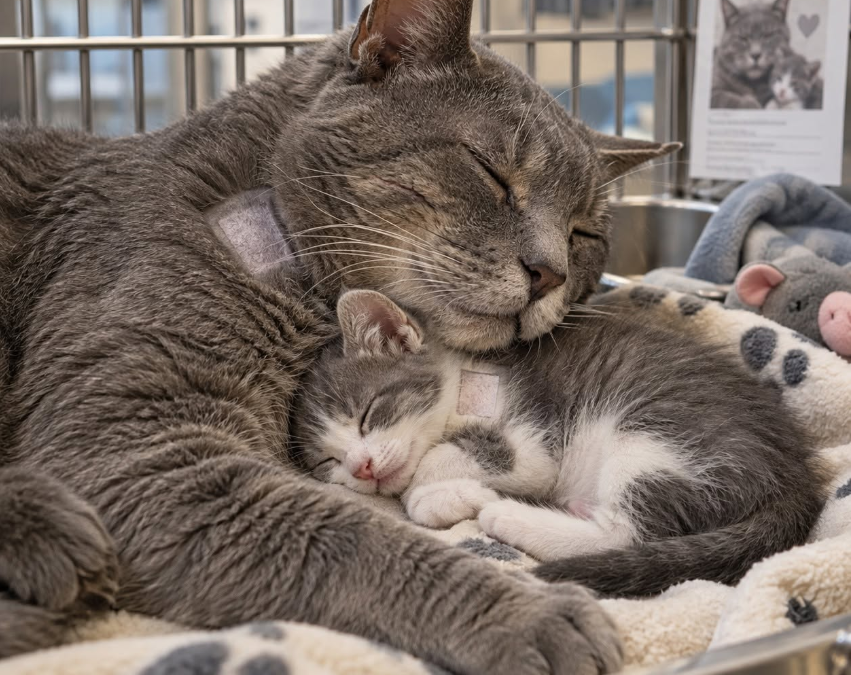
Inside, two cats were asleep together in a patch of sunlight.
One was Moss.
Rebecca knew him mostly by reputation.
Large gray tom.
Around seven years old.
Torn ear.
Scarred muzzle.
Permanent expression suggesting most people had disappointed him before breakfast.
He was broad through the shoulders and thick around the neck in a way that hinted at years spent outdoors defending food, territory, or simply the right to survive another night.
Even after months of regular meals, his coat still looked rougher than the polished cats in the main adoption room.
He was not ugly.
Rebecca hated that word for animals.
But he was not conventionally pretty either.
His face told the truth too quickly.
The kitten sleeping against him looked almost unreal by comparison.
Tiny.
Black fur dusted with silver.
Little white mark under her chin.
Oversized ears.
Narrow body still recovering from something serious enough that the word fragile seemed built into her shape.
She was tucked into the hollow beneath Moss’s neck.
Moss had curved himself around her.
One heavy paw lay partly over her side.
Protective without looking intentional.
Like he had fallen asleep that way and decided moving would require more effort than the kitten was worth.
Then Rebecca saw their necks.
On Moss’s left side, where his thick gray fur was beginning to grow back, was a rectangular shaved patch.
On the kitten’s neck was one almost identical.
Same side.
Same placement.
Almost the same shape.
Rebecca frowned.
Shaved patches were common in shelters.
IV catheters.
Blood draws.
Wound treatment.
Ultrasound preparation.
Matted fur.
Nothing unusual about that.
But these matched too closely.
She moved nearer the kennel.
Moss opened one eye.
Looked at her.
Apparently decided clean blankets were not an emergency.
Closed it again.
The kitten did not stir.
Rebecca took out her phone.
Snapped a photograph.
Then another.
“What happened to you two?”
Neither answered.
By the time she finished evening rounds, she had shown the photograph to three staff members.
Tyler, one of the kennel technicians, stared.
“Huh.”
Denise, a veterinary assistant, leaned closer.
“That is weird.”
Claire, Green Hollow’s adoption coordinator, took the phone and zoomed in.
“Wait. Why are they in the exact same place?”
“That’s what I’m asking.”
Claire looked toward Room C.
“Is Juniper Moss’s foster baby now?”
Rebecca blinked.
“Juniper?”
“The kitten.”
“Oh.”
Then:
“Wait. Moss?”
Claire laughed.
“You seriously don’t know Moss?”
“I know which one he is.”
“Old gray guy. Type B. Ear notch. Hates carriers. Pretends he hates everybody. Secret marshmallow.”
“I didn’t know the marshmallow part.”
Claire gave her a look.
“That’s because nobody stays long enough to find out.”
That sentence should not have hurt.
It did.
Moss had been at Green Hollow for 214 days.
Two hundred and fourteen.
Rebecca knew the number because shelter staff started remembering exact numbers once the stay became long enough to feel personal.
Moss had arrived before Halloween.
Then Thanksgiving passed.
Christmas.
New Year’s.
Valentine’s Day.
Spring.
Kittens entered the shelter after him and left before him.
Families came looking for cats and never asked his name.
Volunteers learned his habits.
Visitors learned nothing.
He had been found near an abandoned grain warehouse on the edge of town.
Residents had reported seeing a large injured gray stray limping between dumpsters.
Animal control expected a feral cat.
The kind that would fight through intake, flatten himself against the back of a trap, and perhaps eventually end up as a working barn cat if anyone would accept him.
Instead, they found Moss.
Dirty.
Bloody.
Dehydrated.
Exhausted.
He had a torn ear.
Old scars across his shoulders and face.
A cracked canine.
A tail full of burrs.
No microchip.
No collar.
No history anyone could verify.
X-rays showed evidence of old injuries that had already healed on their own.
Nobody knew where he’d come from.
Nobody knew whether he had once lived inside a house.
Nobody knew whether anybody had ever called him by another name.
The first week, Moss swatted at anyone who moved too quickly.
He hissed when hands came toward him without warning.
He glared at the entire shelter like he intended to file a formal complaint.
Then regular food began changing him.
Not immediately.
Nothing about Moss changed immediately.
First, he tolerated a person sitting nearby while he ate.
Then he allowed one chin scratch.
Then brushing.
Then a second hand.
He never became silly.
Never threw himself into laps.
Never rolled onto his back demanding affection.
He remained a cat who believed dignity mattered.
But he stopped flinching every time someone reached toward him.
He began leaning, almost imperceptibly, into hands that moved slowly.
Denise called him a gentleman.
Tyler called him a grumpy gentleman.
Both were right.
The problem was that visitors were not looking for grumpy gentlemen.
They wanted kittens.
Young cats.
Cats with bright eyes and soft histories.
Cats who rushed to kennel doors.
Cats with glossy photographs and clean biographies.
Moss sat behind his bars like an old dockworker who had seen too much weather and no longer cared whether strangers approved of him.
People sometimes paused.
“Oh, poor guy.”
Then moved on.
Some asked his age.
Seven, maybe.
They moved on.
Some noticed the torn ear.
Moved on.
Some saw the scars.
Moved on faster.
Very few asked to meet him.
There was one unusual thing about Moss that almost nobody outside the shelter knew.
During intake bloodwork, Green Hollow had typed his blood.
Type B.
Feline blood types matter.
Cats cannot simply receive any available blood in an emergency.
Compatibility matters, and type B is less common than type A in many feline populations.
Green Hollow’s partner hospital, Crestview Veterinary Emergency Clinic, maintained a small list of cats who might be eligible to donate blood in urgent situations.
Healthy enough.
Temperament manageable enough.
Correct type.
When Moss ended up on the list, the staff joked about it.
Tyler had stared at him.
“This guy?”
Denise had scratched under Moss’s chin.
“Yep.”
Moss narrowed his eyes.
“Under all that attitude, he’s rare.”
Moss did not know.
He knew bowls.
Blankets.
Sunlight.
People who sometimes smelled like other cats.
He did not know that one line on his medical chart made him unusual.
For months, the donor list stayed in a file.
Then Juniper came.
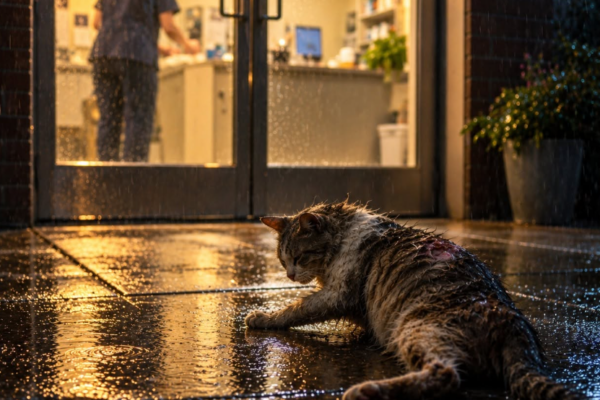
It happened after dark on a rainy Tuesday in April.
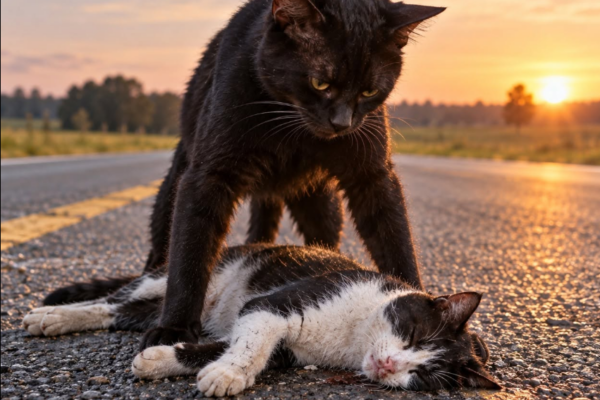
A college student named Naomi Perez was driving home from an evening class along County Road 8 when she saw something move near the shoulder.
At first she thought it was trash.
Rain.
Wind.
Headlights.
Something small tumbling along wet gravel.
Then it moved again.
Naomi hit the brakes so hard the car slid slightly.
She pulled over.
Turned on her hazards.
Ran back.
The kitten was trying to drag herself toward a culvert.
That image stayed with Naomi afterward.
A tiny animal already injured beyond understanding, still trying to find somewhere hidden enough to survive.
She was black with faint silver through her coat.
White beneath the chin.
So small Naomi initially thought she was around eight weeks old.
Later, the veterinarian estimated closer to ten or eleven.
Trauma had made her look younger.
The kitten weighed less than two pounds.
Her breathing was too fast.
There was blood around her mouth and chest.
One back leg trembled violently.
When Naomi tried lifting her, the kitten made a thin, broken sound.
Naomi took off her sweatshirt.
Wrapped the kitten.
Called the emergency number posted on Green Hollow’s door.
Then drove directly to Crestview.
Dr. Sanjay Patel was working that night.
Fifteen years in emergency veterinary medicine had given him a particular kind of calm.
Owners sometimes mistook it for coldness.
It wasn’t.
It was what happened when someone had learned that panic helps nobody.
He examined the kitten.
Ordered imaging.
Bloodwork.
Oxygen.
Warmth.
Then told Naomi the truth.
Internal bleeding.
Severe anemia.
Blunt-force trauma.
Hypothermia.
Possible pelvic injury.
Shock.
“Can you save her?”
Dr. Patel did not answer with comfort.
“We’re going to try.”
Naomi stood near the treatment-room window while technicians moved around the kitten.
Warming pad.
Oxygen.
Monitoring.
Blood sample.
The kitten barely moved.
Then the laboratory result came back.
Her red cell volume was catastrophically low.
She had lost too much blood.
Without a transfusion, Dr. Patel believed she would not survive the night.
They typed her.
B.
Dr. Patel looked at one of the technicians.
“Call Green Hollow.”
“What do you need?”
“The donor cat.”
“Moss?”
“If he’s still cleared.”
At 10:13 that night, Denise’s phone rang.
Shelter employees learn to fear late-night calls.
They usually mean an animal has escaped, deteriorated, been injured, or arrived in worse condition than expected.
Denise answered before she was fully awake.
Dr. Patel did not waste words.
“How fast can you get Moss here?”
She sat up.
“What happened?”
“Kitten. Trauma. Type B. Critical anemia.”
Denise was already reaching for clothes.
Ten minutes later, she unlocked Green Hollow’s back door.
Security lights stretched long shadows down the cat wing.
Animals stirred.
Moss lifted his head when Denise approached carrying a carrier.
He hated carriers.
Not disliked.
Hated.
On normal days, getting Moss into one required treats, planning, strategic towel placement, and occasional negotiation with whatever higher power governed angry cats.
Denise crouched.
“Hey, old man.”
Moss stared at the carrier.
“No. Don’t look at me like that.”
He continued looking.
“It’s for a baby.”
Obviously Moss had no idea what she meant.
Denise kept talking anyway.
“A tiny kitten.”
She opened the carrier.
“I know you hate this.”
Moss complained twice.
Then, perhaps because she moved differently that night, he stepped inside with far less resistance than expected.
During the drive, Denise kept glancing toward him.
Broad gray body.
Torn ear.
Scarred face.
Sitting silently behind bars.
“She’s really sick.”
Moss blinked.
“I don’t know why I’m explaining this.”
Another blink.
“I just think you should know.”
At Crestview, everything moved quickly.
Moss was examined.
Temperature.
Heart.
Bloodwork.
Physical assessment.
He was medically cleared.
The veterinary team sedated him lightly.
Shaved a small rectangular patch from the left side of his neck.
Prepared the jugular draw.
Denise stayed beside him.
Her hand rested over one shoulder.
Moss’s blood flowed into the collection bag.
In another treatment space, Juniper lay almost motionless beneath warming blankets.
Denise would remember that scene for years.
An old cat nobody wanted.
A kitten who might not survive the night.
And between them, a bag of blood.
Life reduced to something red, warm, measurable, and transferable.
The transfusion began.
Nobody celebrated.
Not yet.
The first transfusion saved Juniper.
That was the phrase Dr. Patel used the following morning.
It did not fix her.
Did not guarantee survival.
Did not erase the internal injuries.
It bought time.
Sometimes that is what medicine does.
Time is enough.
Juniper remained hospitalized.
Her temperature improved.
Internal bleeding stabilized.
Her breathing eased.
She began tolerating syringe feeding.
Then a little food on her own.
The injured hind leg turned out to have severe soft-tissue trauma but no fracture requiring surgery.
Her chest and abdomen were badly bruised.
Every movement looked exhausting.
Still, she lived.
Naomi visited every day.
She sat near the kitten.
Talked to her.
“You don’t get to quit.”
Juniper’s eyes barely opened.
“I stopped in the rain for a reason.”
Rebecca eventually named her Juniper.
The kitten had tried to stand one morning.
Her legs shook.
She bent almost completely sideways.
Still stayed up.
“She bends,” Rebecca said.
“But she doesn’t break.”
The name stuck.
For eleven days, Juniper improved.
Slowly.
Enough that people began breathing easier around her.
Then one morning, she crashed.
Her gums turned pale again.
Heart rate climbed.
Follow-up bloodwork showed her red cell count had fallen dangerously.
Complications from her injuries had made her anemic again.
Dr. Patel tried everything appropriate.
Supportive care.
Monitoring.
Treatment.
Still, the numbers continued telling the same story.
She needed blood.
Again.
He called Green Hollow.
Denise answered.
There was only one immediately available compatible donor.
Moss.
She closed her eyes.
“You’re kidding.”
“I wish I were.”
“He donated eleven days ago.”
“I know.”
Silence.
Dr. Patel continued.
“If we don’t do this now, we may lose her.”
Nobody at Green Hollow took the request lightly.
That part mattered.
The story people later told online made Moss sound like a heroic blood machine.
He wasn’t.
He was a living animal.
His safety mattered as much as Juniper’s life.
Karen, Green Hollow’s director, spoke directly with the veterinarian.
“Only if you examine him again.”
“Absolutely.”
“And only if you believe he can tolerate another collection.”
“Yes.”
“We don’t sacrifice him to save her.”
“No one is asking you to.”
Moss returned to Crestview that night.
This time he complained much more loudly about the carrier.
Denise almost laughed.
“Good.”
Moss yowled.
“I’m glad you’re mad.”
He yowled again.
“Angry is healthy.”
At the clinic, he was reexamined.
Bloodwork repeated.
Vitals checked.
Dr. Patel reviewed the results himself.
Moss remained medically cleared.
The team collected the second donation carefully.
The neck was shaved again, almost directly over the first rectangle because the fur had only started growing back.
The second collection went smoothly.
Juniper received the blood.
Then everyone waited.
Hope can become frightening after enough bad news.
You stop wanting to believe too strongly.
Because hope creates something else to lose.
Juniper survived twelve hours.
Then twenty-four.
Then seventy-two.
By the next week, she was eating on her own.
Hissing at thermometers.
Batting at tubing.
Dr. Patel smiled when she swatted at a technician’s hand.
“She’s got opinions.”
The technician looked offended.
“That’s good?”
“Excellent.”
Eventually, Juniper returned to Green Hollow.
Still thin.
Still recovering.
Still under observation.
The foster space was crowded.
She seemed calmer around other cats.
So staff began careful introductions.
Moss surprised everyone.
Juniper climbed into his bed the first night.
Moss looked at her.
Looked at the staff.
Looked back at Juniper.
His entire face appeared to say:
Absolutely not.
Ten seconds later, he licked the top of her head.
That was apparently the agreement.
From then on, Juniper treated Moss as if he had always belonged to her.
She followed him.
Food bowl.
Litter box.
Sleeping shelf.
When unfamiliar people entered, she moved closer to him.
She attacked his tail.
Bit his whiskers.
Climbed over his back.
Once attempted to nurse against his shoulder.
Moss tolerated almost everything with the weary expression of a retired grandfather who had not been consulted before childcare duties began.
He did not lash out.
Sometimes he stood up and moved.
Juniper followed.
Sometimes he stared until she paused.
Then she resumed five seconds later.
At night, she often slept against his chest.
That was how Rebecca found them the afternoon she noticed the matching shaved rectangles.
After asking around, she eventually stopped Karen in the hallway.
“Okay.”
She held up the photograph.
“Why do they have the exact same shaved patch?”
Karen smiled.
“You don’t know?”
“No.”
She looked through the glass.
Juniper was awake, climbing across Moss’s side.
Moss remained horizontal through force of personality.
“Moss donated blood.”
Rebecca stared.
“What?”
“To save her.”
Rebecca looked toward the pair.
Then back.
“Wait.”
Her voice changed.
“The kitten?”
“Yes.”
“The kitten from the emergency case?”
“Yes.”
“He gave blood?”
Karen nodded.
“Twice.”
Rebecca lowered the phone.
“Twice?”
“Her blood type is B. So is his. We had one donor immediately available.”
She pointed toward kennel twelve.
“That old man.”
Rebecca looked at Moss differently.
Not because he had physically changed.
He hadn’t.
Same scar.
Same torn ear.
Same thick gray coat.
Same battered face.
But now she knew something invisible.
Inside that body everyone had passed for 214 days had been exactly what a dying kitten needed.
Rebecca wiped her eyes.
“How did I not know?”
Karen’s expression softened.
“Because we’ve been busy trying to keep both of them alive.”
The photograph went onto the shelter bulletin board.
Two cats sleeping.
Matching shaved patches.
No caption at first.
Anyone who noticed asked:
“What’s the story?”
Staff told them.
Reactions came immediately.
Tears.
Gasps.
Smiles.
Then something very human happened.
People would say:
“That is incredible.”
Then point to Juniper.
“I want her.”
They adored the kitten.
Of course they did.
She was tiny.
Beautiful.
A survivor.
She had the kind of story adoption websites dream about.
Hit by a car.
Nearly died.
Saved by emergency transfusions.
Now recovered enough to play.
Applications began arriving before she was even officially available.
Moss remained Moss.
People praised him.
Then walked past him.
Claire hated watching it.
One afternoon a couple spent twenty minutes holding Juniper.
They listened to the entire transfusion story.
The woman cried.
The man said Moss was “amazing.”
Then as they walked past his kennel, the man glanced once.
“Aw.”
Pause.
“He looks rough.”
They kept going.
Claire muttered:
“There should be a law.”
Rebecca looked over.
“Against what?”
“Bad taste.”
Rebecca laughed.
“Half the county would be incarcerated.”
Still, something began shifting.
Rebecca wrote a simple social post.
Meet Moss and Juniper.
Their matching shaved patches tell a story.
When Juniper was hit by a car and needed emergency blood transfusions—not once, but twice—Moss was the only immediately available compatible donor.
He saved her life.
Now they’re sharing a recovery room while Juniper heals.
She attached the photograph.
The post spread.
First among shelter supporters.
Then local pet groups.
Then farther.
People loved Moss online.
Hero.
Gentleman.
Grizzled medic.
Cranky grandpa with a heart of gold.
Angel.
Rebecca hated the last one.
Moss would have hated it too.
He was not an angel.
He was a cat who once tried biting Tyler because Tyler sneezed during a nail trim.
Still, donations came.
Medical-care funds.
Blankets.
Toys.
A watercolor portrait.
Someone mailed tiny stickers reading BLOOD DONOR.
For a week, Green Hollow received the kind of positive attention shelters rarely get unless the story begins with something terrible.
Juniper kept improving.
Moss kept being admired on screens.
And largely ignored in person.
Then Rachel and Emily Brennan arrived to finalize Juniper’s adoption.
They had been fostering her during the final part of her recovery.
They were exactly the kind of family Green Hollow wanted.
Experienced cat owners.
Quiet home.
Two adult indoor cats.
No small children.
Financially prepared for follow-up care.
They had already reorganized an entire bedroom for a kitten who behaved as though recovery meant discovering new ways to climb curtains.
When Rachel entered, Juniper chirped.
Tail up.
She walked toward her like she already understood.
“There’s our girl.”
Emily handled paperwork at the front desk while Rachel held Juniper.
Then Emily noticed the framed photograph.
Juniper and Moss.
Both asleep.
Both neck patches visible.
“That’s her?”
Claire nodded.
“That is Juniper.”
“And the gray cat?”
“Moss.”
Emily looked around.
“Is he still here?”
Claire smiled.
“Was.”
Emily stopped.
“Was?”
Claire’s smile widened.
“He went home yesterday.”
Rachel looked up.
“What?”
Rebecca, sorting mail nearby, froze.
“What?”
Claire covered her mouth.
“You seriously haven’t heard?”
“He got adopted?”
Claire nodded.
“The Millers came back.”
Rebecca dropped an envelope.
“Charles and Anne?”
“Yes.”
“The retired couple?”
“Yes.”
“They adopted Moss?”
“This morning.”
Rebecca had to sit down.
Nobody made fun of her.
Mostly because Claire was already crying.
The Millers had met Moss a month earlier.
Charles and Anne were both in their seventies.
They lived in a quiet ranch-style house in Pine Ridge.
Sunroom.
Bird feeders.
Soft rugs.
The kind of place older cats dream about without knowing the words.
Both had lost spouses before meeting in a grief-support group.
Friendship came first.
Marriage later.
They understood late beginnings.
They had liked Moss immediately.
He walked into the visitation room.
Sniffed Charles’s shoe.
Inspected Anne.
Then rubbed against Charles’s pant leg.
Anne whispered:
“He’s older.”
Charles stroked Moss’s back.
“So are we.”
She laughed.
“That is exactly what worries me.”
Old animals come with a different kind of fear.
You know goodbye may come sooner.
People who have already lived through loss sometimes hesitate to volunteer for another.
Charles and Anne left saying they needed to think.
Claire had been doing adoptions long enough to know “we’ll think about it” often meant no.
Then Anne saw Moss’s story online again.
Late evening.
She called Charles into the room.
“There he is.”
“The old fellow?”
“The hero.”
Charles read the post.
Slowly.
Then:
“Well.”
Anne looked at him.
“Well what?”
He continued staring at the photograph.
“I think we’ve been told something.”
She understood.
“He has waited 214 days.”
Charles remembered numbers.
Always.
“Two hundred fourteen.”
Anne touched the screen.
“He doesn’t look easy.”
Charles smiled.
“Neither did you.”
She slapped his arm.
Then cried.
The following afternoon, they returned.
Moss did not perform.
He never performed.
He entered the meeting room.
Sniffed Charles again.
Looked at Anne for so long she laughed nervously.
Then jumped onto the bench between them.
Sat down.
Grunted.
Anne looked at Claire.
“Does that count?”
Claire smiled.
“I think you’ve been interviewed.”
Charles nodded solemnly.
“And passed?”
Moss leaned slightly into his hand.
“Apparently.”
They asked practical questions.
Age.
Medical history.
Diet.
Dental care.
Blood donor status.
Whether he liked other cats.
How he handled carriers.
Whether he was a lap cat.
Claire answered honestly.
“He likes routine.”
Moss sat between them.
“He tolerates brushing once he trusts you.”
Anne scratched his cheek.
“He isn’t clingy.”
Moss leaned harder.
Claire pointed.
“He also does that.”
Charles laughed.
“He sounds dignified.”
“Mostly.”
“Mostly?”
“Unless tuna is involved.”
By the time paperwork was signed, Anne had requested update instructions for the shelter.
Charles promised an orthopedic bed appropriate for “a gentleman of experience.”
Several employees stood in the hallway as Moss left.
They pretended not to be emotional.
Nobody succeeded.
Denise crouched near the carrier.
“You behave.”
Moss blinked.
“You have already used up your outlaw years.”
Rebecca touched the carrier door.
“You finally got your turn.”
Then the car left.
Claire cried in the supply closet for four minutes.
The first update arrived three days later.
Subject:
Moss Report.
Four photographs.
First:
Moss in the middle of the sunroom rug looking as if he had personally purchased the house.
Second:
Asleep beside Charles’s slippers.
Third:
On a low window perch staring at a squirrel with enormous hostility.
Fourth:
On Charles’s lap, appearing deeply offended by the decision to climb there.
Anne’s message said Moss had spent forty-eight hours inspecting the home and informing them of his standards.
He liked poached chicken.
Warm laundry.
Birdwatching.
Sleeping wherever someone else intended to sit.
And waking Charles at 5:30 in the morning.
Then:
Please tell Juniper, if that can be done officially, that her old friend is safe.
The email was printed.
Placed on the staff refrigerator.
Juniper’s updates came too.
She gained weight.
Her limp became almost invisible.
She attacked feather toys.
Bothered the family’s calico.
Adored their older black cat.
The hair on her neck grew back.
The matching shaved patch slowly disappeared.
One afternoon, Rachel and Emily brought Juniper back after a veterinary follow-up.
She rode on Rachel’s shoulder like a tiny pirate.
Rebecca kissed the top of her head.
“You are supposed to visit, not move back in.”
Juniper chirped.
Claire came out of the office.
“You need to see something.”
Beside the original photograph of Moss and Juniper, Claire had placed a new picture.
Moss.
Belly-up.
Asleep on Charles’s recliner.
Completely unguarded.
One paw hanging over the side.
Emily laughed.
“He looks like a different cat.”
Claire shook her head.
“I think he finally feels like the same cat in a different life.”
Rachel studied the two photographs.
In one:
Shelter.
Matching shaved patches.
Juniper tucked into Moss.
In the other:
Moss sleeping as if no one in the world could surprise him.
Rachel wiped her eye.
“I keep thinking about how nobody knew what he was carrying.”
Rebecca looked at her.
“The blood?”
“Not only the blood.”
Rachel kept looking at Moss’s photograph.
“Everything.”
Then:
“Whatever made him let that kitten crawl all over him. Whatever made him steady enough to donate twice. Whatever gentleness was inside that face while everybody only saw scars.”
Claire nodded.
“He always mattered.”
Rachel looked at her.
“I know.”
Pause.
“I just mean now everybody else knows.”
That became the heart of Moss’s story.
The transfusions were extraordinary.
They deserved attention.
A dying kitten had needed a rare blood type.
The cat who happened to have it had spent months overlooked.
He gave once.
Then again.
She lived.
That alone was enough for a story.
But underneath it was something quieter.
For 214 days, visitors had looked at Moss and seen what was visible.
Age.
Scars.
Torn ear.
Rough coat.
Medical history.
Uncertainty.
They did not see what was inside.
Not because they were bad people.
Because humans do this constantly.
We mistake what we can see for the whole truth.
Nobody could see type B blood.
Nobody could see the possibility that one night a kitten would need exactly what Moss carried.
Nobody could see the patience hidden behind his caution.
Nobody could see the tenderness that would tolerate Juniper sleeping against him.
Nobody could see the calm he would offer her after survival.
But all of it existed before anybody noticed.
That mattered.
Juniper grew.
Fast.
As survivors sometimes do once the body finally believes the emergency is over.
She remained smaller than average.
Her personality compensated aggressively.
She ran too fast.
Jumped too high.
Played too hard.
Stole beds from larger cats.
Rachel described her as “two pounds of bad decisions wrapped in velvet.”
At Christmas, the Brennans sent Green Hollow a card.
Juniper was tangled in ribbon beneath the Christmas tree.
Inside:
Thank you for saying yes to one tiny life.
She reminds us every day that survival can become joy.
One week later, the Millers sent their card.
Moss sat centered on a red fleece blanket wearing reindeer antlers.
His expression suggested Anne had approximately three seconds left to live.
The antlers apparently remained on for less than that.
Inside, Charles wrote:
Moss has appointed himself household supervisor.
Bird feeders are monitored constantly.
Dinner must occur at exactly 4:47.
He sleeps between us every night.
We are grateful beyond words.
Please tell anyone who thinks older cats cannot change a home that ours says otherwise.
Rebecca kept both cards in her locker.
On difficult days, she reread them.
There were plenty of difficult days.
Shelter work did not become easier because Moss and Juniper survived.
Animals still arrived injured.
Some kittens did not make it.
Some donor searches failed.
Some owners surrendered animals while crying so hard staff members cried with them.
Some people abandoned animals casually.
Others fought desperately to keep animals they loved but could no longer afford to treat.
Some older cats remained in kennels longer than anyone wanted.
Some never found the perfect home.
Hope at a shelter always existed without guarantees.
That was what made it hope.
But Moss and Juniper gave the staff something solid.
A reminder.
Unnoticed did not mean unimportant.
Waiting did not erase worth.
A scarred face did not predict what lived beneath it.
And sometimes the animal everybody had walked past was carrying the exact thing another life would one day need.
Months later, Green Hollow held a fundraiser in the community park.
Dogs wore bandanas.
Volunteers sold cookies shaped like paws.
Children got their faces painted.
A pet store donated raffle baskets.
Adoptable animals rotated through quiet meet-and-greet areas.
Rebecca stood near a display board filled with rescue photographs.
She heard a familiar voice.
“Well.”
Charles Miller.
“There is our celebrity.”
Rebecca turned.
Anne and Charles approached.
Moss rode in a large mesh pet stroller.
Rebecca burst out laughing.
“You bought Moss a stroller?”
Anne smiled.
“He despises harnesses.”
Charles added:
“But enjoys public supervision.”
Moss sat upright.
Broad gray chest forward.
Torn ear visible.
Like a retired admiral reviewing troops he found generally disappointing.
Rebecca crouched.
“Moss.”
He narrowed his eyes.
Allowed one brief scratch beneath the chin.
Then Rachel and Emily arrived.
Juniper came in a secure soft carrier.
They did not trust her loose near so many dogs because Juniper had inherited courage without judgment.
For several minutes, shelter staff gathered around.
Moss.
Juniper.
Together again.
Different homes.
Different routines.
Different futures.
Connected forever by two late-night emergencies and a pair of shaved rectangles nobody would have remembered if Rebecca had not asked.
Rachel opened the top of Juniper’s carrier slightly.
Juniper’s head appeared.
She saw Moss.
Made a soft chirping sound.
Moss leaned forward.
For a moment, everybody held their breath.
There was no movie reunion.
No dramatic rush.
No instant grooming.
They simply looked at each other.
Maybe recognition.
Maybe scent memory.
Maybe nothing more complicated than familiarity.
Juniper extended one paw toward the mesh of Moss’s stroller.
Moss blinked.
Slowly.
Anne covered her mouth.
“Oh.”
Rebecca’s eyes filled.
“Don’t.”
Anne was already crying.
“I can’t help it.”
Charles looked at the display board.
Moss’s intake photograph.
Dirty.
Scarred.
Tired.
Juniper’s emergency photo.
Tiny.
Wrapped in towels.
Then the famous image.
Two cats asleep.
Matching neck patches.
“You know,” Charles said, “people talk about giving a piece of themselves all the time.”
Rachel nodded.
“He did it literally.”
“Twice.”
Charles looked at Moss.
“And never asked for credit.”
Denise, carrying lemonade, joined them.
“No.”
She smiled.
“He prefers rent.”
Everybody laughed.
The fundraiser continued.
Children ran past.
Dogs barked.
People bought raffle tickets.
But throughout the afternoon, Rebecca watched strangers stop in front of the photographs.
Every time, somebody eventually asked:
“Why do both cats have the same shaved spot?”
Rebecca smiled each time.
Then told them.
At the end of the story, they always looked at Moss differently.
That was what stayed with her.
They had been looking at the same cat before.
Nothing about him changed while she spoke.
The ear stayed torn.
Scar stayed visible.
Age remained.
He did not become younger because she told the story.
He did not become prettier.
Only their knowledge changed.
And somehow knowledge changed what they saw.
Years from then, Rebecca knew Green Hollow would still tell the story.
The details might drift.
Stories always do.
Someone might remember rain where there had been none.
Someone might make Juniper smaller.
Someone might say Moss had waited exactly seven months instead of 214 days.
Someone might exaggerate how quickly the transfusion happened.
But the heart would stay.
A gray tom named Moss spent 214 days waiting in a shelter.
People passed.
Then a kitten arrived dying.
Her name was Juniper.
She had been hit by a car.
She needed blood.
Type B.
Moss had type B.
He donated.
She survived.
Then she crashed again.
He donated a second time.
She survived again.
Later, they slept beside each other.
A volunteer noticed their matching shaved necks.
Asked why.
And the question opened everything.
Not merely the medical story.
The deeper one.
That heroes are not always young.
Not always beautiful.
Not always easy.
Sometimes they are old.
Scarred.
Grumpy.
Tired.
Sometimes they have been waiting in the background so long that staff members stop imagining anyone will choose them.
Sometimes they cannot explain themselves.
Cannot list their qualities.
Cannot tell an adopter:
I am gentler than I look.
I have survived more than you know.
I might be exactly what somebody needs one day.
So someone else has to notice.
That is what Rebecca did.
She noticed.
Moss never knew his photograph went viral.
Never knew strangers called him brave.
Never knew people cried over his story.
Never knew he had become a symbol of overlooked animals.
That was probably for the best.
Moss cared about simpler things.
Food arriving on time.
The sunroom.
Warm laundry.
Birds outside the window.
Charles’s slippers.
Anne’s voice.
A soft bed.
The right to sleep in a chair someone else had intended to use.
Juniper knew simpler things too.
Full bowls.
Toys under couches.
Safe people.
Other cats to annoy.
A house where nobody wondered whether she would survive the night.
The shaved patches disappeared beneath new fur.
But what they represented remained.
One life had literally flowed into another.
Then, strangely, the rescue moved backward too.
Juniper’s survival drew attention to Moss.
Moss’s sacrifice gave people a reason to stop at his kennel.
The tiny kitten he saved helped the old cat finally be seen.
Love did not move one direction.
It looped.
Maybe that was the best part.
People like rescue stories with clear heroes.
One animal saves another.
One person saves a dog.
One family adopts a cat.
But real rescue is rarely that simple.
Naomi stopped her car.
Crestview stayed ready.
Dr. Patel knew what the lab result meant.
Green Hollow had typed Moss’s blood months earlier.
Denise answered the phone.
Karen insisted Moss be protected too.
Moss donated.
Juniper fought.
Rebecca asked a question.
The story spread.
Anne and Charles came back.
Every part mattered.
No single person owned the happy ending.
That was the truth shelters understand better than almost anyone.
Saving one life is often a chain of ordinary people refusing to be the person who says:
Someone else will handle it.
Moss spent 214 days waiting.
That number never stopped mattering.
Two hundred fourteen mornings.
Two hundred fourteen evening feedings.
Two hundred fourteen days of visitors walking past.
But the waiting did not mean he had nothing to offer.
It only meant nobody had yet learned how to see him.
And maybe that is what Rebecca remembered most.
Not that Moss became extraordinary when he donated blood.
He had always been extraordinary in ways nobody bothered to measure.
The blood test merely revealed one of them.
His value had never depended on Juniper needing him.
If Juniper had never arrived, Moss still would have deserved Charles and Anne’s sunroom.
Still deserved warm laundry.
Still deserved chicken.
Still deserved to be wanted.
The transfusions did not make him worthy.
They made people pay attention.
There is a difference.
And Juniper did not owe Moss a life of symbolic gratitude either.
She did what kittens do.
Grew.
Played.
Stole beds.
Attacked ribbon.
Annoyed older cats.
Turned survival into ordinary joy.
That was enough.
Nobody needed either animal to spend the rest of life reenacting the night they almost lost everything.
The miracle was that eventually, neither had to.
Moss stopped being the old shelter cat.
He became the cat whose dinner was late if Anne was thirty seconds past 4:47.
Juniper stopped being the dying roadside kitten.
She became the household menace who knocked toys beneath the sofa.
That is the ending rescue animals deserve.
Not eternal gratitude.
Ordinary life.
Safety becoming boring.
Love becoming routine.
A full bowl that no longer feels miraculous because it appears every day.
A hand reaching down that does not frighten.
A bed nobody takes away.
Moss knew that in the end.
The feel of Charles’s palm along his back.
Anne saying goodnight.
Sun warming his fur.
Birds beyond the glass.
No kennel door.
No stranger walking past.
No 214th day.
Just home.
Juniper knew it too.
She slept wherever she wanted.
Played until tired.
Ate until full.
Grew into the life doctors were not sure she would ever have.
And every once in a while, someone at Green Hollow still stopped in front of that old photograph.
Two cats.
One large.
One tiny.
Matching shaved patches on their necks.
They would point.
“Why do they have the same mark?”
Someone would smile.
Then tell them.
And by the time the story ended, the person asking would understand what the shelter staff had taken far too long to learn.
Sometimes the life nobody notices is carrying something extraordinary.
Sometimes the one who looks roughest is the gentlest in the room.
Sometimes a creature can wait 214 days while people search for something better, only for the world to discover that what it needed had been sitting there all along.
And sometimes a tiny shaved rectangle is enough to make someone stop, look twice, and finally ask the right question.