HOA Karen Emptied My Private Home Gym and Threatened Eviction—She Had No Idea Who Her Own Board Members Were Paying Every Week
HOA Karen Emptied My Private Home Gym and Threatened Eviction—She Had No Idea Who Her Own Board Members Were Paying Every Week
HOA Karen marched onto my ranch, ordered workers to empty my private gym, and billed me $900 a day for refusing to remove an “eyesore” from property her association didn’t control.
She was so certain her board vote gave her authority that she never bothered to ask who owned the garage—or why several people on that same board already knew me very well.
I let her contractors load the first bench because sometimes the fastest way to defeat a bully is to let them finish creating the evidence.
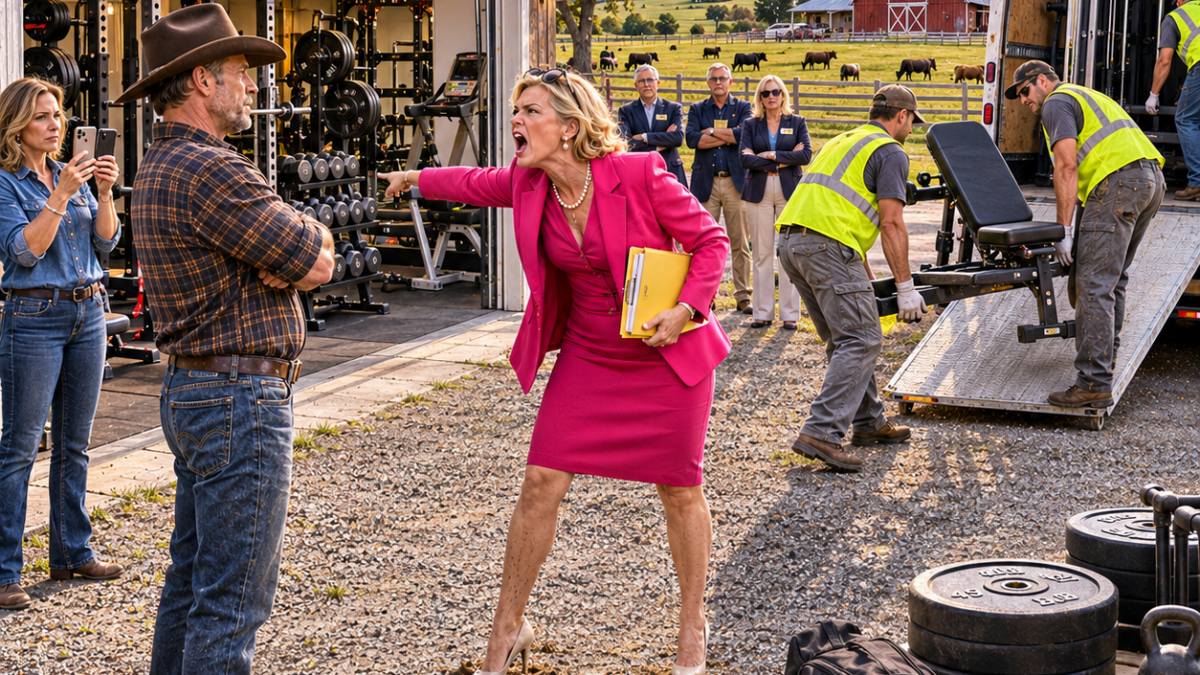
“Your home gym is an unauthorized eyesore, Jack. Remove everything immediately or the HOA will begin eviction proceedings.”
Victoria Vale shouted it from inside my garage while two hired movers carried my adjustable bench toward a box truck parked beside the barn.
Metal plates clanged against one another.
A pair of forty-five-pound dumbbells rolled across the rubber flooring before one worker caught them with his boot.
Behind them, the November sunset burned orange over four thousand acres of pasture my family had owned for generations.
Victoria looked ridiculous against it.
Bright pink blazer.
Matching skirt.
Cream heels.
Yellow HOA folder tucked under one arm.
She pointed toward my power rack like it was hazardous waste.
“This entire setup violates our new visual-harmony standards. Unapproved commercial exercise equipment is prohibited when visible from community roads.”
I glanced toward the nearest Willow Crest road.
It was almost half a mile away.
“You’d need binoculars.”
“That is irrelevant.”
“My garage is forty yards inside my property.”
“It affects the neighborhood aesthetic.”
“You crossed two gates to get here.”
“They were open.”
“It’s a ranch.”
She slapped another notice onto the garage frame.
**$900 DAILY NONCOMPLIANCE PENALTY.**
I read the line beneath it.
**Failure to comply may result in removal action, recovery of costs, and occupancy enforcement.**
“Occupancy enforcement?”
“Eviction.”
I looked at her.
“From my house?”
“If necessary.”
Claire, my wife, stood near the porch holding her phone at chest level.
She had been recording for eight minutes.
Victoria didn’t seem to care.
In fact, she liked an audience.
She turned toward the workers.
“Take the cable machine next.”
The older mover hesitated.
“Ma’am, that thing is bolted down.”
“Then unbolt it.”
I stepped forward.
“Don’t.”
The man stopped immediately.
Victoria snapped, “Continue.”
He looked between us.
I didn’t raise my voice.
“This is my building. I am telling you not to remove anything permanently attached.”
Victoria rolled her eyes.
“Jack, we went through this already. The board voted.”
I walked to my pickup and removed a worn leather case from behind the seat.
Inside was a certified copy of my family’s 1921 land grant and the most recent boundary survey.
Victoria saw the papers and laughed.
“Oh, not the antique deed again.”
“It says where your authority ends.”
“Modern community standards supersede obsolete paperwork.”
“That’s an interesting legal theory.”
She tapped her folder.
“The HOA attorney reviewed our aesthetic policy.”
“Did the attorney review this property?”
“The board did.”
“That wasn’t my question.”
One of the movers slowly lowered my bench back onto the truck ramp.
Victoria noticed.
“Why did you stop?”
He pointed toward me.
“He says this isn’t HOA property.”
“It’s within the community impact zone.”
I looked at him.
“There is no community impact zone on my deed.”
Victoria sighed.
“You’re deliberately obstructing lawful enforcement.”
Then she turned to the workers.
“Load the bench.”
I looked at Claire.
She gave me the smallest nod.
Still recording.
So I stepped aside.
The bench went into the truck.
Victoria smiled.
And when she signed the contractor’s removal authorization under the words **PROPERTY CONTROL VERIFIED BY HOA**, I knew she had just turned an absurd argument into something my attorney could use.
**part 2**
I let the workers stand there for another thirty seconds before I asked them one simple question.
“Who told you the HOA controls this garage?”
The older mover looked uncomfortable.
His name patch said **Miguel**.
He glanced toward Victoria.
“She booked the job.”
“That wasn’t what I asked.”
Victoria stepped between us.
“They do not need to answer questions from a noncompliant resident.”
I almost smiled.
“Resident of what?”
“The greater Willow Crest community.”
“Is my ranch inside Willow Crest?”
“It is adjacent.”
“So no.”
She opened her yellow folder again.
“You’re trying to confuse a straightforward enforcement action.”
Miguel looked toward the truck.
Then back toward me.
“Sir, our work order lists this building as association-controlled property.”
Claire moved slightly closer with the phone.
Victoria heard him and snapped, “The form required a category.”
Miguel frowned.
“It required an owner.”
“And I provided the responsible entity.”
I looked at her.
“You listed the HOA as owner?”
“I listed the association as enforcement authority.”
“That’s not what he said.”
Miguel nodded toward his clipboard.
“It says Willow Crest Homeowners Association under property owner.”
Victoria’s expression changed.
Barely.
But I saw it.
The confidence remained.
The certainty didn’t.
“Administrative shorthand,” she said.
Miguel stared at her.
“Ma’am, ownership isn’t shorthand.”
I liked him immediately.
He set the clipboard on the truck’s bumper.
“I need to call my supervisor.”
Victoria stepped in front of him.
“You are under contract.”
“For a legal removal.”
“It is legal.”
“The actual property owner says it isn’t.”
“He is subject to the HOA.”
I unfolded the recent survey and held it where Miguel could see.
The orange boundary line was clear.
So was the label.
**MERCER RANCH — PARCEL 07-184-A — 4,012.6 ACRES.**
Willow Crest sat on the eastern side.
Outside the line.
My garage sat well inside it.
Miguel stared at the survey.
“Is this current?”
“Eight months old.”
“Licensed survey?”
“Stamp’s at the bottom.”
Victoria waved dismissively.
“The survey does not account for community aesthetic jurisdiction.”
Miguel looked at her.
“I move furniture.”
She blinked.
“What?”
“I do not adjudicate aesthetic jurisdiction.”
Claire made a sound behind me.
I looked back.
She had turned away because she was laughing.
Victoria’s face reddened.
“This is not amusing.”
Miguel picked up his phone.
“We’re pausing the job.”
“You will not.”
“We are.”
“I already paid your deposit.”
“You can discuss that with the office.”
Victoria pointed at the bench in the truck.
“At least finish what you started.”
Miguel looked at me.
“Do you want that returned?”
“Yes.”
He nodded toward his partner.
“Put it back.”
Victoria stepped forward.
“No.”
Nobody moved.
She looked from one worker to the other.
“I am the president of Willow Crest.”
Miguel nodded.
“And he owns the building.”
That sentence ended the removal.
The bench came back out.
The dumbbells were carried inside.
The resistance machine stayed where it was.
Unfortunately, several pieces had already been dragged across concrete, and one storage rack had been tipped hard enough to bend a mounting plate.
Nothing catastrophic.
But enough.
Enough for photographs.
Enough for invoices.
Enough for documentation.
Victoria watched the workers reverse their work with a look of personal betrayal.
Then she turned toward me.
“You have created additional charges.”
“How?”
“You obstructed contracted enforcement.”
“You hired movers to take my equipment.”
“Because you ignored the notice.”
“What notice?”
She pulled out a sheet dated three days earlier.
I looked at it.
“Where was this delivered?”
“Your garage.”
“No.”
“Front gate.”
“No.”
“Then perhaps your staff removed it.”
“I don’t have staff at this gate.”
She flipped through papers.
“Certified mail.”
“Tracking number?”
Her fingers stopped.
“I don’t carry postal records.”
“Of course not.”
She slapped the paper against my chest.
I didn’t take it.
It dropped onto the ground.
Wind caught it and sent it sliding across the gravel.
For a second, everybody watched Victoria chase her own violation notice.
Her heels sank into a patch of soft soil.
She nearly lost one.
Claire finally lowered the phone because she was laughing too hard to keep it steady.
Victoria snatched the paper from the grass.
“You think this is funny?”
“I think you drove onto private ranchland in heels to seize a squat rack.”
“It is not a squat rack.”
I looked at her.
“You’ve been calling it an eyesore for twenty minutes. You don’t even know what it is?”
“It is industrial-looking exercise equipment.”
“That’s a squat rack.”
“I don’t care what it’s called.”
“That part is obvious.”
She jammed the notice back into the folder.
Then she walked toward the truck.
Miguel stepped aside.
“You’re going to regret making this difficult,” she said.
I folded the survey.
“Victoria.”
She stopped.
“If you send anybody back onto this ranch to remove property without permission, I’m treating it as trespass.”
She turned.
“If you continue operating an unauthorized commercial gym, we will escalate.”
“Commercial?”
“You train people here.”
“Sometimes.”
“For money.”
“Yes.”
“So you admit it.”
“I admit I’m a trainer.”
Her smile returned.
“There. That changes everything.”
“It changes nothing about your property line.”
“You’re running a business visible from the neighborhood.”
“The county approved my accessory-use permit years ago.”
Her smile faltered.
“You have a permit?”
“Would you like the number?”
She stared at me.
I could almost see her searching for a new argument.
Then she found one.
“County approval does not eliminate HOA approval.”
“When the property isn’t in your HOA, it does.”
She pointed at me.
“This is not over.”
“No.”
I looked toward the camera in Claire’s hand.
“It really isn’t.”
Victoria left.
The movers left.
The dust settled.
And for the first time that evening, I looked closely at the garage.
My gym had taken fifteen years to build.
Not because I was obsessed with equipment.
Because of what it represented.
I had started training seriously after a back injury in my thirties. A ranch doesn’t stop demanding work because your body hurts. Gates still need lifting. Feed still needs moving. Calves still need pulling. Fences still need repairing.
Physical therapy got me walking without pain.
Strength training got me working again.
Over time, I studied more.
Mobility.
Programming.
Injury prevention.
Nutrition.
I earned certifications.
At first I trained ranch hands.
Then firefighters.
Then a few business owners from town.
Eventually people started paying.
I turned one side of the old equipment garage into a proper training space.
Rubber flooring.
Power racks.
Cable stations.
Adjustable benches.
Rowers.
Sled track.
Storage.
Everything clean.
Everything insured.
Everything permitted.
I called it **Mercer Performance**.
Most clients never cared who owned the ranch.
They came through a separate west entrance, trained for an hour, and left.
Several Willow Crest residents had become clients.
So had people I later learned sat on the HOA board.
That part was going to matter.
But not yet.
That night, I called Melissa Grant.
She had been our family attorney long enough to answer with:
“What did the HOA do now?”
I hadn’t even said hello.
“How did you know?”
“Claire texted me a picture of a woman in a pink suit standing beside your dumbbell rack.”
I looked toward my wife.
She was sitting at the kitchen island.
“You texted Melissa?”
Claire shrugged.
“I knew where this was going.”
Melissa continued.
“Tell me everything.”
I did.
She interrupted only twice.
First when I mentioned the $900 daily fine.
“Did she identify the covenant provision?”
“No.”
“Good.”
“Why good?”
“Because I enjoy easy questions.”
The second interruption came when I told her the mover’s work order listed Willow Crest as the property owner.
Melissa went quiet.
“Do you have a photo?”
“Claire filmed Miguel reading it.”
“Excellent.”
“What are we looking at?”
“First we separate the stupid from the serious.”
“That sounds useful.”
“The stupid is the HOA calling exercise equipment aesthetically offensive from half a mile away.”
“Agreed.”
“The serious is representing to a third-party contractor that they had control over property they apparently do not control, entering your land, beginning removal, and potentially damaging equipment.”
“Conversion?”
“Possibly attempted conversion depending on what they intended and what actually occurred. Trespass. Property damage. Interference with business. We don’t need to over-label it yet.”
“She threatened eviction.”
Melissa laughed.
“From four thousand acres you own?”
“That was the pitch.”
“Please tell me Claire recorded it.”
“Every word.”
“Good. Tomorrow morning, nobody touches anything until we photograph it.”
“I already took pictures.”
“Take more.”
“Of what?”
“Everything.”
That was why Melissa was good.
People think legal fights are won by the most dramatic fact.
Usually they’re won by boring facts that nobody can dispute.
Time.
Date.
Photograph.
Invoice.
Survey.
Permit.
Email.
Signature.
The next morning, I photographed every piece of equipment that had been moved.
A scrape along the bench frame.
A bent plate-tree bracket.
A torn rubber corner where the movers had dragged something heavy.
A gouge in the garage threshold.
Then I pulled the security footage.
Victoria arriving at 4:11 p.m.
The box truck at 4:17.
Victoria walking through the open garage at 4:19.
The first bench leaving at 4:31.
My arrival at 4:36.
The signed contractor sheet at 4:43.
The workers reversing course at 4:54.
No ambiguity.
Melissa sent a cease-and-desist letter before lunch.
It went to Victoria.
The HOA board.
The property management company.
The association attorney.
The association’s insurer.
And the county planning office.
Her letter was calm enough to be terrifying.
It explained that Mercer Ranch was not subject to the Willow Crest declaration.
The garage was outside all recorded HOA jurisdiction.
My training operation held county approval for limited appointment-based fitness instruction.
The association had no authority to impose aesthetic fines, remove equipment, direct contractors onto my land, or threaten eviction.
All documents were to be preserved.
All further contact regarding enforcement was to go through counsel.
The HOA had forty-eight hours to withdraw the fines and identify the authority it claimed.
Victoria answered in twenty-six minutes.
Not the board.
Not their attorney.
Victoria.
Her email began:
**Your client’s aggressive resistance does not invalidate lawful community oversight.**
Melissa forwarded it to me.
Underneath she wrote:
**She has chosen adventure.**
I called her.
“What does that mean?”
“It means do not respond.”
Victoria’s email was three pages.
She argued that my garage created “visual-commercial spillover.”
She claimed that clients driving through Willow Crest-adjacent roads increased community traffic.
They didn’t.
My west entrance connected directly to County Route 14.
She claimed the weights created “industrial visual pollution.”
They were inside a garage.
She claimed my business benefited from Willow Crest property values.
I still don’t know how.
Then came the sentence Melissa cared about most.
**Because the Mercer property functions as part of the greater Willow Crest visual environment, the board retains corrective authority notwithstanding technical deed boundaries.**
Melissa read it aloud.
“Technical deed boundaries.”
I nodded.
“That’s my favorite part.”
“No, Jack. Your favorite part is about to become the county’s favorite part.”
She requested an emergency parcel review.
Two days later, County Planning Inspector Daniel Reeves drove out.
Victoria knew he was coming.
I’m still not sure how.
Maybe the planning office contacted the HOA.
Maybe the board told her.
Either way, when Daniel arrived, Victoria was already there.
And she had brought a news crew.
That was pure Victoria.
If she was going to be proven right, she wanted witnesses.
She stood outside my garage wearing the pink blazer again, speaking into a reporter’s microphone.
“The Willow Crest board has taken responsible action to protect residents from unregulated commercial activity and visually inappropriate installations near our community.”
The reporter pointed toward the garage.
“The equipment is indoors.”
Victoria smiled.
“Visibility is not limited to permanent exposure. Garage doors open.”
I was standing twenty yards away when Daniel stepped out of the county truck.
He looked at the camera.
Then at Victoria.
Then at me.
“Mr. Mercer?”
“That’s me.”
He shook my hand.
“I’ve reviewed the initial records.”
Victoria moved toward us.
“Excellent. Then you understand the community-impact issue.”
Daniel glanced at her.
“I understand there is a jurisdiction dispute.”
“There is no dispute.”
He looked toward me.
I shrugged.
“She says that a lot.”
Daniel opened his tablet.
“Let’s start with the parcel.”
He walked toward the survey marker near the driveway.
Bright orange cap.
Survey number.
Date.
Professional seal.
Then to the next marker.
And the next.
He compared them to the GIS record and the recorded plat.
Victoria followed so closely she almost stepped on his boots.
“The HOA boundary runs along the eastern subdivision line,” Daniel said.
“Yes.”
“The Mercer garage is approximately seventeen hundred feet outside that boundary.”
Victoria frowned.
“Straight-line distance is misleading.”
Daniel looked at her.
“In what way?”
“The visual relationship is broader.”
“Property jurisdiction isn’t measured by visual relationship.”
“Our rules address visible impacts.”
“On property subject to those rules.”
Victoria opened her folder.
“The board expanded the policy last month.”
Daniel turned.
“Can your board amend county parcel ownership?”
“No, but—”
“Can it add land to its declaration without the owner’s legal participation?”
“The board has community-welfare authority.”
“That wasn’t my question.”
The reporter’s cameraman shifted closer.
Victoria noticed.
Her tone became more polished.
“We’re asking the county to recognize a modern approach to neighborhood integration.”
Daniel nodded.
“I’m asking whether Mr. Mercer’s parcel was ever annexed into Willow Crest.”
She didn’t answer.
He looked at the tablet.
“It wasn’t.”
He swiped.
“No supplemental declaration.”
Another swipe.
“No covenant attachment.”
Another.
“No recorded easement granting enforcement rights.”
He looked at me.
“Is this the 1921 grant?”
I handed him the certified copy.
“Yes.”
He examined it.
Then the later deeds.
Then the survey.
“The chain appears consistent.”
Victoria stepped forward.
“Old documents don’t address the current commercial use.”
Daniel looked toward the garage.
“Mr. Mercer provided permit number?”
I gave it to him.
He entered it.
A moment later, the permit appeared.
**HOME OCCUPATION / APPOINTMENT-BASED FITNESS INSTRUCTION.**
No exterior signage.
Limited client volume.
No amplified outdoor activity.
Off-street parking required.
All conditions satisfied.
Daniel looked up.
“This use is permitted by the county.”
Victoria stared at the screen.
“When was that issued?”
“Four years ago.”
“Before our new standard.”
Daniel almost smiled.
“Your new standard does not apply here.”
She folded her arms.
“The gym harms our aesthetics.”
Daniel looked toward the nearest Willow Crest homes.
Then at the garage.
“Can you see the equipment from the subdivision?”
“Yes.”
“From where?”
“The ridge road.”
“Show me.”
That was a mistake.
Victoria led us toward the eastern edge of the ranch.
The news crew followed.
So did Claire.
We stopped at the fence.
Across it, Willow Crest’s Ridge View Drive curved along the subdivision boundary.
Victoria pointed.
“From the road, when the garage door is open, residents can see the equipment.”
Daniel looked.
The garage was a distant rectangle.
“You can identify dumbbells from here?”
“Yes.”
He squinted.
“I can barely identify the garage.”
The reporter turned away.
I knew why.
She was smiling.
Victoria pointed harder.
“The black structures inside are clearly industrial.”
Daniel looked at me.
“Do you run a welding operation?”
“No.”
“Manufacturing?”
“No.”
“Outdoor commercial events?”
“No.”
“Signage?”
“No.”
“Noise complaints?”
“None I know of.”
Daniel looked toward Victoria.
“What exactly is the county violation you believe exists?”
She hesitated.
“This is primarily an HOA matter.”
He nodded.
“Then the county’s relevant role is determining whether your association has land-use authority over this parcel.”
“Correct.”
“It does not.”
Silence.
Victoria’s folder lowered half an inch.
Daniel continued.
“The entire ranch parcel remains private property outside Willow Crest. The garage is not subject to the HOA declaration based on the records I reviewed. The county has not issued the association any removal authority. Your board cannot authorize physical removal of Mr. Mercer’s equipment from his building.”
Victoria stared at him.
“But the board voted.”
Daniel’s voice stayed polite.
“A board vote cannot create jurisdiction over property outside the governing documents.”
“The gym is visible.”
“Visibility does not transfer ownership.”
“The community has standards.”
“Within the community.”
Her expression tightened.
“What about safety?”
“What safety violation?”
“The weights are heavy.”
I turned my head.
Claire put both hands over her mouth.
Daniel blinked.
“Yes, ma’am. That is generally a feature of weights.”
The cameraman coughed loudly.
Victoria’s face went bright red.
“I mean unsecured exercise equipment creates risks.”
“On his private property?”
“Yes.”
“To whom?”
“Clients.”
Daniel looked at my permit again.
“Workplace and business safety are separate issues. I see no county order authorizing your HOA to seize equipment.”
“I never said seize.”
I looked at her.
“You hired movers.”
“For corrective removal.”
“Where were they taking it?”
She hesitated.
“Temporary storage.”
“Where?”
“An HOA contractor facility.”
“So you were taking it.”
“It would have been returned after compliance.”
“Compliance with rules that don’t apply.”
Daniel raised one hand.
“I think we have enough.”
He wrote the formal county determination that afternoon.
No HOA jurisdiction.
No annexation.
No removal authority.
No applicable HOA fine.
The county permit remained valid.
He also issued a written stop-work notice concerning any further contractor activity initiated on my parcel without lawful authorization.
The reporter asked Victoria for comment.
She stared at the paperwork.
Then at Daniel.
Then at the camera.
“This is an outdated system that prioritizes individual property claims over community well-being.”
The reporter asked, “Are you saying private ownership is outdated?”
Victoria realized what she had just said.
“No. That is not what I meant.”
“What did you mean?”
“The county needs more flexible tools.”
Daniel stepped away.
He wanted no part of that interview.
I understood.
Then the reporter asked me.
“What do you want to happen now?”
I looked toward my garage.
“My equipment returned exactly where it was. The damage repaired. The fines withdrawn. And nobody from the HOA entering my ranch again without permission.”
“You want Ms. Vale prosecuted?”
“No.”
Victoria looked surprised.
I continued.
“I want this corrected.”
That answer mattered later.
Because I was angry.
I was furious.
But there was a difference between wanting somebody humiliated and wanting somebody stopped.
Victoria was already doing a fine job of humiliating herself.
I didn’t need to help.
The county order hit Willow Crest like a storm.
Residents had seen the evening news.
The segment opened with Victoria declaring the HOA had authority over “visible commercial impacts.”
Then it cut to Daniel saying:
“The association has no jurisdiction over this parcel.”
Then came:
“Yes, ma’am. That is generally a feature of weights.”
Ben Carter called me immediately after the broadcast.
Ben lived in Willow Crest and had been my friend for twenty years.
He was also one of my training clients.
Not a board member.
Just an enthusiastic spectator whenever Victoria created trouble.
He was laughing too hard to speak.
“What?”
He gasped.
“Jack.”
“What?”
“The weights are heavy.”
“Go away.”
“Breaking news.”
“Ben.”
“Authorities confirm dumbbells contain weight.”
I hung up.
He called again.
I declined.
Then he texted:
**COMMUNITY SAFETY ALERT: GRAVITY DISCOVERED AT MERCER RANCH.**
I hated that I laughed.
The following morning, Melissa received an email from Willow Crest’s attorney, Martin Cho.
Unlike Victoria, Martin understood why the situation was serious.
He requested a temporary standstill.
No further HOA enforcement.
No additional fines.
No contractor entry.
They wanted forty-eight hours to review the record.
Melissa agreed, provided all evidence was preserved.
Then she asked for the board minutes.
That’s when the story changed.
The board had never voted to remove my gym equipment.
They had voted to investigate whether commercial-looking structures visible from Willow Crest could be addressed through existing nuisance procedures.
That was it.
No removal.
No $900 daily fine.
No eviction threat.
No authorization to send contractors.
Victoria had taken a preliminary discussion and turned it into an enforcement campaign.
Martin called Melissa.
She put him on speaker while I sat across from her.
“I want to be precise,” he said. “The association did adopt amended visual guidelines last month.”
“Applicable to HOA property,” Melissa said.
“Yes.”
“And Mr. Mercer’s ranch?”
“No.”
“Did the board vote to apply them to him?”
“No.”
“Did the board vote to remove his equipment?”
“No.”
“Authorize contractors?”
“No.”
“Authorize a $900 daily assessment?”
“No.”
“Authorize eviction language?”
There was a pause.
“No.”
Melissa looked at me.
I leaned back.
Martin continued.
“I advised Ms. Vale two months ago that the association has no enforcement jurisdiction over neighboring nonmember parcels.”
I stared at the speaker.
Melissa’s voice became even calmer.
“Do you have that advice in writing?”
“Yes.”
“Preserve it.”
“Already done.”
When the call ended, I sat there for a while.
“So she knew.”
Melissa nodded.
“Apparently.”
“And did it anyway.”
“That appears to be the problem.”
I should have felt triumphant.
Instead I felt something heavier.
Until that point, I had allowed myself to imagine Victoria was simply ignorant.
Ignorance can be corrected.
Arrogance is harder.
But knowingly crossing a line after being told where it was?
That was different.
She hadn’t misunderstood her authority.
She had decided authority was whatever nobody stopped her from doing.
That realization bothered me more than the damaged equipment.
The board scheduled an emergency meeting for Thursday.
Melissa wanted me there.
“I don’t enjoy HOA meetings.”
“You don’t belong to the HOA.”
“That makes them worse.”
“You need to hear what they say.”
Claire came too.
So did Ben.
The Willow Crest clubhouse was packed.
Residents stood along the walls.
Some had seen the news.
Others had heard about the county order.
Most wanted to know why association money had been spent hiring movers to clear equipment from property the association didn’t control.
Victoria sat at the front table.
No pink blazer this time.
Ivory.
The yellow folder remained.
Beside her sat Robert Mills, vice president.
Janet Holloway, treasurer.
Kevin Dorsey, property manager.
Two other directors.
And Martin Cho.
The meeting opened badly for Victoria.
Janet began with the invoice.
“Three thousand two hundred dollars paid as a contractor deposit for removal and storage.”
Murmurs filled the room.
Victoria leaned toward her microphone.
“The expense was necessary for enforcement.”
Janet looked at her.
“What enforcement?”
“The garage violation.”
“Where is the board authorization?”
“It falls under presidential emergency authority.”
Martin Cho spoke.
“There is no general presidential emergency authority for this situation.”
Victoria turned toward him.
“You advised expedited action could be appropriate in safety matters.”
“Inside the association.”
“The gym posed a safety issue.”
Martin looked at the audience.
Then back at her.
“Because the weights were heavy?”
The room exploded.
Victoria’s face hardened.
“That comment was taken out of context.”
Ben whispered behind me, “Maybe the weights got heavier.”
Claire elbowed him.
Janet continued.
“Why was Willow Crest listed as property owner on the contractor order?”
Victoria shuffled papers.
“That was administrative formatting.”
Robert spoke.
“Did you complete the work order?”
“Yes.”
“Did you list the HOA as owner?”
“I listed the controlling entity.”
“The form says owner.”
“The contractor’s terminology was imprecise.”
Robert stared at her.
“No. You put the association’s name in a box labeled property owner.”
She leaned back.
“We were acting under community-impact authority.”
Martin closed his eyes.
That expression told me he had heard the phrase too many times already.
Robert opened a binder.
“I want to discuss the October board meeting.”
Victoria looked annoyed.
“What about it?”
“The minutes say we voted to ask counsel whether neighboring commercial operations could be addressed if they caused documented nuisances.”
“Yes.”
“They do not say we voted to fine Jack.”
“The intent was clear.”
“No.”
“They do not say we authorized equipment removal.”
“We delegated enforcement.”
“No.”
“They do not say we authorized eviction threats.”
“That language came from a standard compliance template.”
Kevin, the property manager, leaned toward his microphone.
“No, it did not.”
Victoria turned toward him.
“Excuse me?”
“Our standard template does not use the word eviction.”
She stared.
Kevin opened his laptop.
“The notice was created from your account.”
The room went quiet.
Robert looked at Victoria.
“You wrote it?”
“I modified it.”
“To threaten eviction from land outside the HOA?”
“It was meant to communicate seriousness.”
Janet shook her head.
“You threatened something we cannot legally do because you wanted to sound serious?”
Victoria’s voice sharpened.
“You are reducing a complex governance issue to semantics.”
Martin finally answered.
“Words matter when they threaten legal consequences.”
Applause.
Not loud.
But enough.
Victoria looked toward the crowd.
“You’re all reacting emotionally because local media sensationalized a routine enforcement matter.”
A man in the second row stood.
“My dues paid for movers to take somebody else’s gym.”
Victoria pointed at him.
“You’re out of order.”
Robert said, “He’s recognized.”
She turned.
“I’m chairing.”
Robert met her eyes.
“You were.”
That changed the room.
He made a motion to appoint himself temporary chair for the remainder of the meeting because the agenda involved allegations concerning the president’s conduct.
Martin confirmed the bylaws allowed the board to do it.
Four hands went up.
Victoria voted no.
The motion passed.
She sat rigidly.
Robert turned to me.
“Mr. Mercer, would you like to address the board?”
I stood.
I hadn’t prepared a speech.
I didn’t need one.
“I’ve lived next to Willow Crest since before half these houses were built. I’ve never asked your association for anything. I don’t use your pool. I don’t use your clubhouse. My driveway doesn’t connect to your private streets. My ranch isn’t under your declaration.”
I looked at Victoria.
“Two days ago, your president entered my garage with contractors and began removing equipment I own.”
Then back at the board.
“I’m not asking you to like my gym.”
A few people laughed.
“I’m asking you to understand that your authority stops before my gate.”
I sat down.
Robert nodded.
“Thank you.”
Victoria leaned toward her microphone.
“What Mr. Mercer is omitting is that he operates a commercial training facility attracting clients from Willow Crest.”
There it was.
The line I knew was coming.
Robert looked at me.
“Is that true?”
“Yes.”
Victoria smiled.
“Thank you.”
I continued.
“County permitted. Appointment only. Separate access. No HOA streets.”
Her smile weakened.
Then Janet asked, “How many Willow Crest clients?”
I looked around the room.
That was when the twist finally arrived.
“Several.”
“Residents?”
“Residents and board members.”
Every head at the front table turned.
Victoria looked confused.
Robert looked more confused.
Janet stared at me.
Then slowly, recognition crossed her face.
“Wait.”
I stood again.
This time I removed my flannel overshirt.
Underneath, I was wearing the black polo I used for training.
Small white logo on the chest.
**MERCER PERFORMANCE.**
Janet’s mouth fell open.
Robert whispered, “No way.”
Another director, Tom Gallagher, sat back in his chair.
“You’re Coach Jack?”
I smiled.
“Apparently.”
The room went dead quiet.
Then Ben started laughing.
Not normal laughter.
The kind where a man bends forward and loses the ability to breathe.
Victoria looked from Robert to Janet to Tom.
“What is happening?”
Janet stared at my shirt.
“I’ve been training with Jack for eight months.”
Robert raised a hand slowly.
“Ten.”
Tom rubbed his forehead.
“Almost a year.”
Victoria looked at them.
“You train at that garage?”
Robert answered.
“Yes.”
She stared.
“And you never told me?”
“You never asked where my trainer worked.”
Janet looked at Victoria.
“You called the equipment an unauthorized eyesore.”
Victoria flushed.
“That is irrelevant.”
Janet shook her head.
“No. I’ve used that exact bench.”
Ben made a noise behind me.
Robert looked toward the ceiling like he was begging for strength.
Tom said, “You ordered them to remove the cable machine?”
“Yes.”
“That’s the new one?”
I nodded.
Tom looked genuinely offended.
“I like that machine.”
The room erupted.
Victoria slammed her palm onto the table.
“This is not funny.”
Robert wiped his mouth.
“I’m trying very hard.”
“You knew this facility existed.”
“I knew Jack operated Mercer Performance.”
“You knew where?”
“I knew it was on a ranch.”
“His ranch?”
Robert looked at me.
“I honestly assumed he leased that section.”
I nodded.
“That’s fair.”
Janet added, “I came through the west entrance. I never realized the house and training building were part of the same parcel.”
Victoria looked triumphant for half a second.
“Exactly. Even board members did not know the use was occurring there.”
Janet stared at her.
“We didn’t know because it caused no problem.”
That ended the triumph.
Robert nodded.
“No traffic issue.”
Tom added, “No noise.”
Janet said, “No parking spillover.”
Robert looked toward Victoria.
“And apparently no visibility issue, because I lived here nine years before realizing the gym was inside that garage.”
Applause broke out again.
Victoria looked cornered.
She did what cornered people often do.
She attacked harder.
“The fact that directors have undisclosed financial relationships with Mr. Mercer raises a conflict-of-interest issue.”
Robert blinked.
“I pay him to make me do squats.”
“That is a financial relationship.”
“I pay the grocery store too.”
“Don’t be flippant.”
Janet leaned forward.
“Victoria, I paid Jack for private fitness coaching. I had no idea there was an HOA dispute until this week.”
Tom raised a hand.
“Same.”
Robert nodded.
“Same.”
Martin Cho spoke.
“There is no inherent conflict merely because directors separately purchased ordinary services from a neighboring business. They should disclose it now that the matter is before them and, if necessary, recuse depending on the vote.”
Victoria seized on that.
“Exactly.”
Robert looked at Martin.
“Do we have to recuse from votes regarding Victoria’s procedural conduct?”
Martin thought about it.
“Not necessarily. Your personal training relationship with Mr. Mercer does not appear relevant to whether the president exceeded board authorization.”
Victoria sank slightly in her chair.
Ben whispered, “She found a technicality and the technicality escaped.”
Claire whispered back, “Please stop.”
The meeting continued for three hours.
The board reviewed emails.
The contractor order.
My cease-and-desist.
The county determination.
The permit.
The altered notice.
The invoice.
Then Martin read the email he had sent Victoria two months earlier.
It said, in plain English, that Willow Crest had no enforcement authority over nonmember neighboring parcels.
Nobody applauded this time.
The mood had shifted.
This wasn’t funny anymore.
Victoria had known.
Robert asked her directly.
“You received this?”
“Yes.”
“Read it?”
“Yes.”
“Then why did you send contractors onto Jack’s ranch?”
She looked at him.
“Because circumstances changed.”
“What circumstances?”
“The gym became a growing community concern.”
“Who complained?”
Silence.
Janet asked, “Do we have complaints?”
Kevin searched the management database.
“One.”
Victoria immediately said, “There.”
Kevin continued.
“Submitted anonymously.”
Robert asked, “When?”
“Two days before the removal.”
“Any earlier complaints?”
“No.”
“Can we identify the sender?”
Kevin hesitated.
“The portal login is tied to an administrator account.”
Everyone looked at Victoria.
Her face went still.
Robert asked quietly, “Which administrator?”
Kevin swallowed.
“President account.”
The room became silent enough to hear the HVAC fan.
Victoria’s voice dropped.
“I documented a resident concern verbally reported to me.”
“By who?”
“I’m not obligated to expose a resident to retaliation.”
“Then who authorized you to file it under your own account?”
“I was memorializing the complaint.”
Janet leaned back.
“Was there a resident?”
Victoria’s jaw tightened.
“I will not violate confidentiality.”
That answer told everybody enough.
The investigation became formal that night.
Robert made a motion suspending Victoria’s enforcement authority.
Four to one.
Janet made a motion requiring all outside enforcement expenses to receive board approval.
Five to zero.
Tom made a motion immediately withdrawing every notice and fine against my property.
Five to zero.
Then Robert made one more.
“Direct counsel to negotiate restitution with Mr. Mercer for documented damage, business interruption, and reasonable legal costs arising from the unauthorized contractor action.”
Victoria objected.
“We are rewarding noncompliance.”
Robert turned toward her.
“There was no valid compliance obligation.”
The motion passed.
That should have been enough.
Emotionally, it wasn’t.
When I got home, I walked into the garage alone.
The lights hummed overhead.
Everything was back roughly where it belonged.
But not exactly.
The adjustable bench had a new scratch.
The plate rack leaned slightly because of the bent bracket.
One rubber mat was torn.
Little things.
Replaceable things.
Still, I stood there longer than I expected.
Claire eventually came in.
“You okay?”
“Yeah.”
She leaned against the doorway.
“You don’t look okay.”
I looked around.
“My dad helped me pour this floor.”
She waited.
“He thought the gym idea was ridiculous.”
She smiled.
“I remember.”
“He said nobody would drive thirty minutes to pay me to make them hurt.”
“Technically, he was right about the hurting.”
I laughed.
Then my eyes settled on the first steel rack I bought.
“It took years to build this.”
“I know.”
“And she looked at it for thirty seconds and decided she had the right to dismantle it.”
Claire nodded.
“That’s what hurts.”
“Yeah.”
It wasn’t about dumbbells.
That was the thing people outside the story might not understand.
The garage represented the period of my life when I had rebuilt myself.
After the back injury.
After months when I couldn’t lift feed sacks without pain.
After I wondered whether I would have to sell cattle because my body couldn’t keep up.
Strength training gave me part of my independence back.
Then it became something I could give other people.
A firefighter recovering from shoulder surgery.
A widower who needed structure after losing his wife.
A sixty-two-year-old board vice president who wanted to pick up his granddaughter without worrying about his knees.
A seventy-year-old woman who wanted enough balance to hike with her family.
To Victoria, all of that was visual pollution.
Maybe she couldn’t have known.
But she never asked.
That was the pattern.
She never asked what something meant before deciding what it was allowed to be.
The following week, Melissa and Martin negotiated a resolution.
The HOA reimbursed every damaged item.
They covered the contractor-related restoration.
They paid documented lost training revenue from sessions I had canceled while the garage was inspected and reset.
They reimbursed a reasonable portion of my attorney fees.
They formally acknowledged my property remained outside association jurisdiction.
They agreed no officer, director, employee, or contractor would enter Mercer Ranch for enforcement purposes without permission or lawful authority.
I did not demand punitive money.
Melissa asked whether I was sure.
“Yes.”
“You have leverage.”
“I want correction.”
“She knowingly ignored counsel.”
“I know.”
“You could pursue broader claims.”
“I know.”
“So why not?”
I looked through her office window.
“Because the people paying the HOA’s bills aren’t the people who walked into my garage.”
She nodded slowly.
“That’s reasonable.”
“I want Victoria stopped. I don’t want two hundred families getting a special assessment because I’m angry.”
“That distinction matters.”
“It does to me.”
We settled.
The county kept its determination on record.
The fines disappeared.
The notices were withdrawn.
My equipment stayed.
My permit stayed.
And the board investigation into Victoria widened.
They reviewed twelve months of enforcement records.
What they found wasn’t a criminal conspiracy.
It was something more ordinary.
Victoria had repeatedly stretched authority.
She sent notices before board review.
She upgraded warnings into formal violations on her own.
She used phrases like “board mandated” when the board had merely discussed something.
She threatened remedies the bylaws did not provide.
Most homeowners had complied because fighting was exhausting.
A trash bin left visible too long.
A wreath three days past the seasonal deadline.
A pickup parked overnight in a driveway instead of a garage.
A garden bench six inches outside an approved footprint.
A basketball hoop with the “wrong visual profile.”
No single incident looked enormous.
Together, they revealed a pattern.
Victoria believed rules were useful mainly because rules made people obey.
The board called a second meeting.
This time I wasn’t required to attend.
I went anyway.
So did half the neighborhood.
Victoria had lost the pink blazer.
She wore dark blue.
The yellow folder remained.
But she no longer held it upright.
It sat flat on the table.
Robert opened the meeting.
“The governance review is complete.”
The report found that Victoria had exceeded delegated authority in multiple enforcement actions, misrepresented board decisions, incurred unauthorized expenses, and failed to follow counsel’s written jurisdiction guidance.
She interrupted.
“This report is political.”
Robert shook his head.
“It’s documentary.”
“You’re framing ordinary presidential discretion as misconduct.”
Janet answered.
“Presidential discretion does not include inventing board votes.”
“I never invented a vote.”
“You told Jack the board voted to remove his gym.”
“We voted on visual standards.”
“That is not the same thing.”
“The outcome was implied.”
Tom leaned forward.
“Then why have minutes?”
Victoria stared at him.
“What?”
“If the president can decide what every vote ‘implies,’ why do we record motions?”
She had no answer.
The board voted to remove her as president.
Four to one.
The room was silent.
No cheering.
No dramatic applause.
For all her faults, this was a neighborhood organization, not a sporting event.
Victoria sat rigidly as Robert read the result.
Then she stood.
“You’re making a terrible mistake.”
Nobody replied.
“I built this association into what it is.”
Janet said quietly, “That’s part of the concern.”
Victoria looked toward me.
I wasn’t smiling.
That seemed to anger her more.
“You wanted this.”
“No.”
“You humiliated me.”
“You did that yourself.”
“You brought attorneys.”
“After you brought movers.”
“You brought the county.”
“After you threatened eviction.”
“You brought the news.”
I shook my head.
“You invited them.”
Her face tightened.
She had forgotten that part.
Or wanted to.
“You could have cooperated.”
I looked at her.
“You keep using that word.”
“What word?”
“Cooperate.”
“And?”
“Cooperation requires two people having a choice.”
She stared at me.
“You never wanted cooperation. You wanted compliance.”
Nobody said anything.
Then Ben, sitting behind me, whispered:
“That’ll do it.”
I almost laughed.
Victoria resigned from the board three days later.
Her letter claimed that the association had “abandoned strong governance in favor of populist appeasement.”
Ben printed it.
Of course.
He framed the paragraph.
Of course.
Then he hung it in my gym.
That part I objected to.
“I’m taking this down.”
“It’s motivational.”
“It’s eight hundred words.”
“Read it between sets.”
“I’d rather do burpees.”
“That bad?”
“Yes.”
He left it anyway.
I moved it into the storage room.
A month passed.
Mercer Performance returned to normal.
Robert came Tuesdays and Fridays.
Janet trained Mondays.
Tom usually came Wednesday mornings.
They had all offered to stop because of the conflict.
I told them not to.
“You hired me before any of this.”
Robert looked uncomfortable.
“Still feels weird.”
“Then squat.”
“What?”
“Bar’s loaded.”
“That’s your solution?”
“It’s been working for ten months.”
He groaned and stepped under the bar.
That was the beauty of training.
Politics disappeared under a loaded barbell.
The weight did not care whether somebody was president, rancher, attorney, accountant, mechanic, or retiree.
Gravity was very democratic.
Robert finished his set and sat on the bench.
“I owe you an apology.”
“You personally?”
“As a board member.”
“You didn’t authorize it.”
“We let her operate without enough oversight.”
“That’s different.”
“Not different enough.”
I handed him water.
“You fixed it.”
“After your garage got emptied.”
“Partially emptied.”
“Because you stopped it.”
“Because Miguel stopped it.”
Robert laughed.
“I heard about him.”
“He may be the smartest person in the story.”
“I’d agree.”
A week later, Miguel returned.
Not as a mover.
As a client.
He walked into the garage wearing gym clothes and looked around.
“I’ve never trained before.”
“You carried a weight bench for a living.”
“That doesn’t count.”
“It counts more than you think.”
He grinned.
“I figured I owe this place something.”
“You don’t owe me anything.”
“I stopped the job late.”
“You stopped it.”
He nodded.
“So what do I do?”
I pointed toward a rower.
“Warm up.”
He trained with me for six months.
Never complained.
Except about lunges.
Everybody complains about lunges.
The funniest part came at the Willow Crest annual meeting.
Robert had become president.
One of his first actions was to simplify the enforcement manual.
Not weaken it.
Simplify it.
A rule had to be tied to actual governing authority.
Every violation notice required the applicable covenant or bylaw section.
Anything involving a boundary required parcel verification.
Any contractor entry required written proof of lawful access.
Any threat involving liens, towing, legal action, or removal had to be reviewed by management or counsel.
Then Robert added a training example to the board orientation packet.
He showed it to me.
**Example: Association rules do not apply to adjacent nonmember property merely because the property is visible from the community.**
I looked at him.
“Subtle.”
“We thought so.”
“Any pictures of my squat rack?”
“Legal said no.”
“Cowards.”
He laughed.
Then came the truly ridiculous part.
Willow Crest created a voluntary fitness club.
Residents had been asking for one after learning how many people trained with me.
The clubhouse gym consisted of two treadmills, a faded stationary bike, and dumbbells that stopped at twenty-five pounds.
Robert approached me about consulting on an upgrade.
“Let me understand this,” I said.
“Yes.”
“A year ago, the HOA called my gym an eyesore.”
“Victoria called it an eyesore.”
“The president.”
“Former president.”
“And now you want me to design yours.”
He nodded.
“How much?”
“Your normal consulting rate.”
“You’re going to pay me?”
“Yes.”
“Using HOA funds?”
“Approved unanimously.”
I stared at him.
He smiled.
“Life is strange.”
I agreed to help.
Not because I needed the job.
Because it was funny.
We built a simple, sensible clubhouse training room.
Two adjustable benches.
Dumbbells.
Cable station.
Resistance bands.
Storage.
Nothing excessive.
When the equipment arrived, Ben stood beside me watching workers carry it inside.
He folded his arms.
“Visual pollution.”
“Go away.”
“Industrial hazard.”
“Ben.”
“The weights are heavy.”
I turned.
He was already running.
The new gym became popular.
Residents who had never exercised started using it.
Janet organized beginner strength classes.
Robert started a senior mobility group.
The association even invited me to give a workshop on safe resistance training.
I agreed on one condition.
“What?”
I looked at Robert.
“No pink blazers.”
He laughed for a full minute.
Months later, I saw Victoria for the first time since her resignation.
I was at the feed store.
She stood in the parking lot beside her SUV.
No folder.
No blazer.
Just jeans and a sweater.
She noticed me.
For a second I considered pretending I hadn’t seen her.
Then she walked over.
“Jack.”
“Victoria.”
“I heard they built a gym.”
I smiled.
“News travels.”
“You designed it.”
“Consulted.”
She shook her head.
“That is unbelievable.”
“It is a little funny.”
“You enjoy this.”
“Yes.”
At least I wasn’t going to lie.
Her mouth almost curved.
Then she looked away.
“I’m selling my house.”
“I heard.”
“Of course you did.”
“Ben exists.”
“That man is a menace.”
“We finally agree.”
She laughed once.
Then grew serious.
“I owe you an apology.”
I waited.
She folded her arms.
“I shouldn’t have sent the movers.”
“No.”
“I thought if I acted decisively, everyone else would fall in line.”
“That was the problem.”
“I know that now.”
I didn’t expect those words.
“You do?”
She nodded.
“I spent months thinking the board betrayed me.”
“And?”
“Then I read the investigation report again.”
“That sounds painful.”
“It was.”
She looked toward the store.
“I kept telling myself I was protecting standards.”
“You liked enforcing them.”
“Yes.”
That honesty surprised me.
She continued.
“It felt like if people followed the rules, everything stayed orderly.”
“Order can be useful.”
“I took it too far.”
“Way too far.”
She gave me a look.
“You could let me finish.”
“Sorry.”
“No, you’re not.”
“No.”
She almost smiled again.
Then she said something I remembered.
“I never understood why you didn’t just close the garage door.”
“What?”
“If the equipment was out of sight, there would have been no argument.”
I stared at her.
“Victoria.”
“I know, I know. Not my property.”
“Exactly.”
“I’m saying that was how I thought.”
“And now?”
“Now I understand that not liking something is not the same as having authority over it.”
That was enough.
Not forgiveness in some dramatic movie sense.
Just enough.
She had finally learned the sentence everybody around her had been trying to teach.
I nodded.
“Good.”
She looked relieved.
Then she pointed at my truck.
“You still train those board members?”
“Three of them.”
“Robert too?”
“Twice a week.”
She smiled.
“I always wondered why he suddenly started standing up straighter.”
“That’s not governance.”
“Apparently.”
She moved to leave.
Then turned.
“For what it’s worth, that cable machine is ugly.”
I laughed.
“There she is.”
She smiled properly this time.
Then walked away.
Victoria sold her house that winter.
The listing described Willow Crest as offering “beautiful community amenities, including an updated fitness center.”
Ben sent me the screenshot before breakfast.
Under the listing he wrote:
**AUTHORIZED EYESORE.**
I blocked him for twenty minutes.
Then unblocked him because he was supposed to bring fence staples.
Years passed.
The gym changed.
Equipment wore out.
I replaced benches.
Upgraded flooring.
Added a second rack.
Sold the old cable machine—the one Victoria hated—and bought a better one.
Tom complained that the new machine felt harder.
I told him gravity had been updated.
Janet laughed.
Robert did not.
He was using it.
Claire still called the garage my sanctuary.
She was right.
On difficult days, I would walk in before sunrise and train alone.
No board.
No politics.
No property lines.
Just steel, breath, and work.
The rhythm had carried me through injury.
Through my father’s death.
Through drought years.
Through long winters.
Through the slow realization that getting older didn’t mean surrendering strength.
That history was invisible to Victoria when she arrived.
But that was precisely why private property matters.
People don’t need to justify every personal choice to somebody standing outside the fence.
If I wasn’t harming anybody, violating a lawful restriction, or creating a real nuisance, I did not owe a committee an explanation for why a barbell mattered to me.
The law protected the boundary.
But the boundary protected something larger.
Autonomy.
The right to decide what your own space is for.
One summer evening, Robert finished a training session and walked outside with me.
The sunset looked almost exactly like the evening Victoria brought the movers.
Orange through the dust.
Purple beyond the ridge.
Cattle moving slowly toward water.
Robert looked at the garage.
“Hard to believe we nearly paid people to empty this.”
“You didn’t.”
“The association did.”
“Victoria did.”
“She was president.”
I nodded.
“Fair.”
He stood quietly.
Then said, “You know what scares me?”
“What?”
“If the mover hadn’t asked questions, they might have taken everything.”
“Maybe.”
“And then we would’ve spent months fighting over where it went.”
“Probably.”
“All because someone saw official letterhead and assumed authority.”
“That happens.”
He looked at me.
“How do you stop it?”
“Ask for the source.”
“Of authority?”
“Every time.”
I pointed toward his HOA folder.
“You say I owe a fine? Show the covenant.”
“You say you control land? Show the deed.”
“You say the board approved something? Show the minutes.”
“You say a contractor can enter? Show the access right.”
“Paper isn’t power because it has a logo.”
Robert nodded.
“That should be in board training.”
“Use it.”
“We might.”
He left.
A month later, he sent me a draft policy.
At the top was a sentence:
**All enforcement authority must be traceable to a governing document, recorded property interest, statute, or valid owner consent.**
I smiled.
That was the lesson.
Not “HOAs are evil.”
They aren’t.
Some are badly managed.
Some are reasonable.
Most are somewhere in the middle.
The problem begins when an organization forgets that authority is limited.
Victoria’s yellow folder had made her feel powerful because people usually complied.
But compliance is not proof.
Sometimes people comply because fighting costs more than surrender.
That can teach the wrong person the wrong lesson.
Victoria kept pushing until she found someone who had the time, records, and patience to say:
Show me.
That one phrase changed everything.
Show me the boundary.
Show me the covenant.
Show me the vote.
Show me the ownership.
Show me the authority.
She couldn’t.
So she substituted confidence.
That worked right up until it didn’t.
The most satisfying ending came years later at a Willow Crest charity fitness event.
The HOA invited Mercer Performance to run a strength challenge to raise money for the volunteer fire department.
I brought equipment.
Robert volunteered.
Janet organized registration.
Tom complained about the warm-up.
Ben showed up wearing a bright pink blazer he had bought online.
I saw him from across the parking lot.
“No.”
He spread his arms.
“What?”
“Take it off.”
“It’s community-approved.”
“You look insane.”
“I’m honoring history.”
“You’re embarrassing everyone.”
“Visual harmony.”
I walked toward him.
He ran behind Robert.
The entire parking lot was laughing.
Eventually he removed the blazer.
Underneath, his T-shirt read:
**WARNING: WEIGHTS MAY BE HEAVY.**
I nearly sent him home.
Claire stopped me.
The event raised more than eight thousand dollars.
At the end of the afternoon, people helped load the equipment back into my truck.
Nobody assumed it belonged to them because it was visible.
Nobody formed an emergency committee.
Nobody issued a fine.
Nobody threatened eviction.
Progress.
Driving home that evening, I passed the old subdivision entrance.
Victoria’s house had new owners.
A family with two kids.
A basketball hoop stood in the driveway.
The garage door was open.
Inside I could see a treadmill.
Some dumbbells.
A bench.
I laughed so hard I had to slow the truck.
Claire looked at me.
“What?”
“Nothing.”
“What?”
I pointed.
She saw the gym.
Then started laughing too.
“Should we call the HOA?”
“No.”
“Visual pollution.”
“Stop.”
“Industrial equipment.”
“Claire.”
“The weights look heavy.”
I shook my head.
“I married the wrong woman.”
“No refunds.”
We drove on.
The ranch gate appeared ahead.
I turned in.
The garage lights came on automatically as we approached.
Through the open door, the equipment looked exactly like what it was.
Not an eyesore.
Not community property.
Not a violation.
Not a threat.
Just tools.
Steel.
Rubber.
Cable.
Things that had meaning because of what people did with them.
The first time Victoria stood there, she saw something she disliked and immediately searched for a rule that could make it disappear.
By the end, everybody else had learned the opposite lesson.
Before enforcing a rule, find out whether it applies.
Before taking property, find out who owns it.
Before threatening someone, make sure you actually have the power you claim.
And before calling a private gym worthless, maybe check whether half your board is paying the owner to train there every Tuesday.
Victoria lost her presidency because she never learned where authority ended until she crossed the wrong boundary.
I didn’t have to scream.
I didn’t have to threaten her.
I didn’t have to tear up her notices or block the truck.
I needed a deed.
A survey.
A permit.
A camera.
And enough patience to let her sign her own name to the mistake.
That was the part people always remembered wrong.
They thought I beat her because I had better connections.
I didn’t.
They thought I beat her because I knew the county inspector.
I didn’t.
They thought the board protected me because I trained them.
They couldn’t.
By the time they learned the gym was mine, the documents had already settled the legal question.
The trainer reveal was just the humiliation at the end.
The law did the real work.
Recorded ownership.
Limited HOA jurisdiction.
County permitting.
Evidence of unauthorized entry.
Proof of what was moved.
Proof of who ordered it.
That was justice.
The laughter afterward was simply a bonus.
Now, whenever a new client asks why there’s an old yellow violation notice framed beside the garage entrance, I tell them the short version.
“A woman once tried to evict me from my own ranch because she didn’t like my dumbbells.”
They usually laugh.
Then they ask whether that really happened.
I point toward the faded signature at the bottom.
Victoria Vale.
HOA President.
And beneath it, in Ben’s handwriting, somebody added:
**AUTHORITY NOT INCLUDED.**
I should remove that.
I never do.
Some reminders are worth keeping.
Every morning, the garage door rises.
Sunlight spills across the rubber floor.
The racks stay where they belong.
The benches stay where they belong.
My clients walk in, train, complain about lunges, and leave stronger than they arrived.
Outside, four thousand acres stretch toward the horizon.
No HOA owns them.
No board vote controls them.
No pink blazer changes them.
And whenever I hear metal plates clank across the room, I remember the afternoon Victoria tried to carry my life out one bench at a time.
She thought power meant giving orders loudly enough that nobody questioned them.
She learned something better.
Real authority does not need to pretend.
It can be traced.
It can be proven.
And when it stops at the property line, no amount of shouting can make it cross.








