A Badly Injured Stray Dragged Himself Into Our Vet Clinic Before Closing—Then the Cat Nobody Wanted Became the One Every Frightened Animal Needed
A Badly Injured Stray Dragged Himself Into Our Vet Clinic Before Closing—Then the Cat Nobody Wanted Became the One Every Frightened Animal Needed
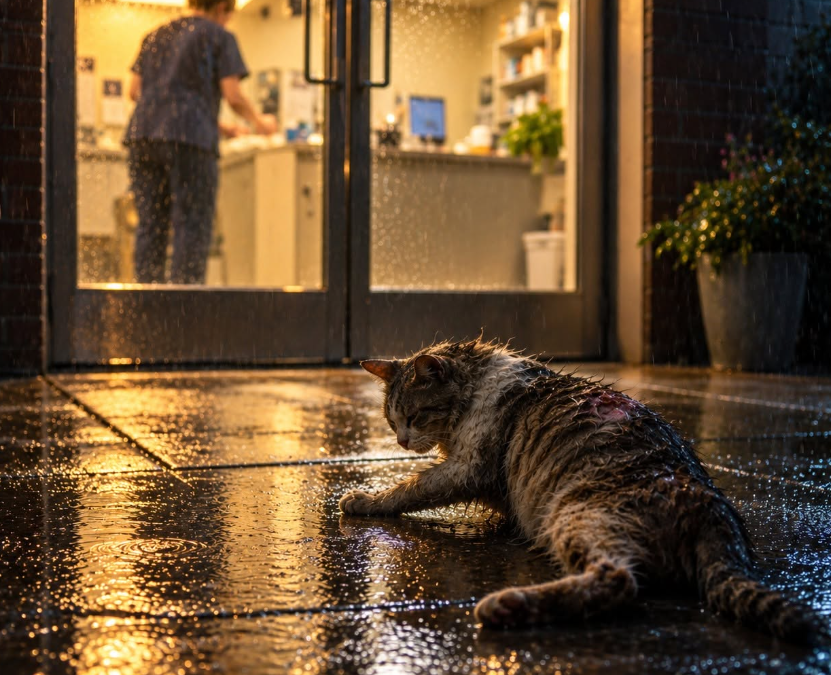
At 6:47 on a freezing March evening, an injured orange stray dragged himself through the rain to our veterinary clinic, collapsed on the mat, and looked at me with one swollen eye like he had come there because he had nowhere else left to die.
Weeks later, after people called his scars ugly and passed over him for adoption, that same limping cat began doing something none of us could explain—terrified animals who fought every human in the room became quieter whenever he sat beside them.
Then one wealthy client demanded we remove him because he looked “damaged” and “bad for business,” and what happened after Patch disappeared from our clinic forced an entire town to decide whether broken things matter only after they become useful.
The first time I saw Patch, I thought he was already dying.
It was a Thursday evening in March, cold enough that the rain looked almost metallic beneath the streetlights.
Maple Ridge had one of those storms that seemed determined to make everything miserable.
The sidewalks were shining black.
Cars hissed through standing water.
Branches scraped against roofs.
Even the neon pharmacy sign across the street looked tired.
Inside Riverside Animal Clinic, we were ten minutes past our last appointment.
I had already wiped down the front counter twice.
The floors smelled like disinfectant and wet dog.
Someone had left half a cup of coffee beside the printer, where it had been sitting long enough to develop the personality of motor oil.
I wanted to go home.
There was nothing waiting for me there except a one-bedroom apartment above an insurance office that had gone out of business three years earlier.
A refrigerator that hummed too loudly.
Laundry.
A frozen dinner.
A couch I had bought after my divorce because Aaron took the good one.
Still, home meant nobody would ask me another question.
Nobody would hand me a shaking carrier.
Nobody would cry while I explained bloodwork.
Nobody would ask whether loving an animal meant we should somehow be able to perform surgery for free.
I had been a veterinary technician for eleven years.
Long enough to know the public had a very strange idea of what veterinary work looked like.
People imagined puppies.
Kittens.
Tiny bandages.
Funny cone photographs.
PART2
They did not imagine holding an old Labrador while his owner kissed his forehead goodbye.
They did not imagine explaining kidney failure to an elderly woman who kept apologizing because she only had eighty-seven dollars in her checking account.
They did not imagine bite wounds.
Blood.
Urine.
Fear.
Three missed lunches.
A ringing phone while somebody cried in Exam Room Four.
They definitely did not imagine going into the supply closet afterward, leaning against a shelf of surgical gloves, and giving yourself exactly forty-five seconds to fall apart because another appointment was waiting.
By closing time that Thursday, I was exhausted.
Not dramatically exhausted.
Just worn thin.
I was wiping the counter when I heard something scrape against the front door.
I ignored it.
Wind.
Branch.
Trash blown across the sidewalk.
Then again.
Scrape.
Pause.
Scrape.
I stopped.
The sound came from low against the glass.
I looked up.
Rain streamed down the door so heavily that all I could see at first was the reflection of the lobby lights.
Then something moved near the bottom.
Orange.
Or brown.
Or red.
I walked around the counter.
Slowly.
The towel was still in my hand.
When I reached the glass, I forgot how tired I was.
A cat was pressed against the door.
He looked orange beneath everything covering him.
Mud.
Rain.
Blood.
One ear was torn nearly halfway down.
One eye was swollen almost shut.
A pale line ran diagonally across his nose.
His left front paw hung strangely beneath him.
His ribs showed.
His breathing came in quick, shallow pulls.
He wasn’t meowing.
That frightened me more than anything else.
A cat in that kind of pain usually gives you something.
A scream.
A growl.
A hiss.
A warning.
This one only looked at me.
Not pleading.
Not trusting.
Not fighting.
He looked as though fear itself required more energy than he had left.
“Oh, sweetheart.”
I unlocked the door.
The moment it opened, he tried to step inside.
His injured paw folded beneath him.
He fell across the mat.
“Lena!”
Dr. Lena Ortiz had her coat on and her keys in one hand.
She was halfway down the hallway.
She turned.
Saw the cat.
“Treatment room.”
No questions.
No hesitation.
That was Lena.
I scooped him up.
He weighed almost nothing.
Not literally.
But he was far too light for his frame, and the sensation of bones beneath wet fur made anger rise through me before sadness had time to arrive.
Someone had seen this animal deteriorate.
Maybe many people.
Someone had left the bite wound on his shoulder untreated.
Someone had walked past his torn ear.
Someone had watched him become thin enough that I could feel his spine through two layers of wet fur.
Maybe nobody had ever claimed him.
Maybe he belonged to the street.
I didn’t know.
All I knew was that he had somehow chosen our lighted door.
And now he was ours to save if we could.
We worked for almost two hours.
Warm towels.
Fluids.
Temperature.
Pain control.
Wound cleaning.
Flea treatment.
X-rays.
Bloodwork.
No microchip.
No collar.
No recent surgical marks.
No phone number attached to him.
No one officially responsible.
His shoulder carried an infected bite.
His front leg was badly sprained but not shattered.
One tooth was cracked.
His ear would heal crooked.
There were older scars beneath the fresh injuries.
His gums were pale.
He was several pounds underweight.
His breathing stayed shallow.
Lena stood beside the table after reviewing the first results.
“I don’t like his odds.”
I looked down at him.
His good eye was open.
Watching us.
“Don’t say that.”
“Mara.”
“He can hear you.”
“He’s a cat.”
“He’s listening.”
Lena almost smiled.
Almost.
Then she adjusted the IV.
“We’ll keep him warm. Recheck bloodwork in the morning. Antibiotics. Pain control. If his breathing changes, call me immediately.”
“You’re going home?”
“You should too.”
I looked at the cat.
“No.”
“Mara.”
“I’ll stay until he’s stable.”
“You’ve been here since six-thirty.”
“So?”
“So it is now after nine.”
“He came here.”
That was my entire argument.
Lena knew me well enough not to waste time.
She sighed.
“Call if anything changes.”
After she left, the clinic became a different place.
The phones stopped.
The fluorescent lights in the lobby went dark.
The boarding dogs settled.
Somewhere in the back, a beagle snored with the determination of heavy machinery.
The cat lay beneath a warming blanket.
His IV line was taped to one leg.
Every few minutes I checked his chest.
Still moving.
Good.
I brought a chair beside the kennel.
Then eventually abandoned the chair and sat on the floor.
“You don’t have a name.”
His ear moved.
“That’s inconvenient.”
Nothing.
I started talking.
Not because I believed conversation was medical treatment.
Because silence had become uncomfortable.
I told him the clinic coffee tasted like somebody rinsed an engine part through it.
I told him our printer had an instinct for grief and only jammed when somebody was crying.
I told him about Bruce, a golden retriever who had eaten seven socks in eighteen months.
I told him about a Chihuahua named Peanut who had bitten me, Miguel, Lena, and one visiting priest during the clinic’s Christmas blessing.
The cat’s good eye remained half open.
“I’m Mara, by the way.”
He didn’t seem impressed.
“Mara Ellis.”
Still nothing.
“I live alone.”
His ear twitched.
“Don’t judge me.”
Around midnight, I brought him a little food.
He sniffed.
Took a few cautious bites.
Stopped.
That was enough.
At two in the morning, I folded my arms beside his kennel and rested my head against them.
“If you stay,” I whispered, “I’ll stay too.”
It was a ridiculous promise.
I knew that.
He was a stray.
I was exhausted.
I couldn’t adopt every broken animal that came through our door.
But at two in the morning, promises do not have to survive daylight to feel true.
When I woke, Lena was standing over me holding two coffees.
The orange cat was still breathing.
Barely.
But breathing.
She looked at him.
Then me.
“Well.”
“What?”
“He’s stubborn.”
“Good.”
“Stubborn helps.”
I named him Patch that morning.
People assumed it was because his coat looked uneven.
It wasn’t.
Not exactly.
He looked like life had torn him apart in different places and somebody had put him back together with whatever scraps remained.
Patch.
It fit.
He improved slowly.
And badly.
Patch had no interest in becoming an inspirational recovery story.
He hated his medicine.
He hated wound care.
He hated the thermometer with such personal hostility that I became convinced he remembered the brand.
He disliked being restrained.
He disliked having his paws touched.
He disliked anyone pretending he should be grateful.
But he lived.
That mattered.
His leg healed enough for weight-bearing, though he kept a permanent limp.
His shoulder infection cleared.
The torn ear closed badly and beautifully.
The scar across his nose turned pale.
The swollen eye recovered, though one side of his face always looked softer afterward.
He gained weight.
His fur cleaned up.
He began grooming himself again.
Then came the part I assumed would be easy.
Finding him a home.
Everybody says they love survivors.
Until the survivor doesn’t look the way they imagined.
I brushed Patch.
Took photographs near the front window where morning light made even our ugliest furniture look sentimental.
I positioned him so the injured paw did not appear too obvious.
Then felt guilty and took another photograph showing it honestly.
I wrote a post.
Patch is a quiet, gentle adult cat looking for a patient home. He survived life on the street and has healed beautifully. He has a permanent limp, a crooked ear, and enough personality for several healthier cats. He loves warm blankets, calm rooms, and chicken.
I added photographs.
Then the heart emojis.
Because apparently no animal can be adopted online without heart emojis.
The post did well.
Hundreds of likes.
Dozens of comments.
Poor baby.
What a survivor.
Look at that sweet face.
Someone please adopt him.
He deserves everything.
Everybody loved him.
In theory.
Nobody applied.
One woman asked his age.
I guessed six to eight.
She stopped responding.
A man asked whether the limp would mean “expensive vet bills later.”
I answered honestly.
He said he would think about it.
He didn’t.
A woman with three toddlers wanted to know whether Patch enjoyed being carried.
I said I wouldn’t place him in a home where young children were likely to grab him without understanding his boundaries.
She replied:
“We probably want a kitten anyway.”
Someone wrote:
Do you have any prettier orange cats?
I stared at that message longer than I should have.
After three weeks, I stopped checking adoption inquiries every ten minutes.
After six, I stopped pretending it didn’t hurt.
After ten, nobody mentioned adoption anymore.
Patch simply became ours.
Not officially.
No board meeting.
No paperwork.
No declaration.
He transitioned from:
“The stray we’re trying to place.”
To:
“Patch.”
As if that explained everything.
He slept on folded towels behind reception.
Sat in the front window every morning.
Limped down hallways as though he personally supervised staff.
He discovered which drawer contained treats.
He learned that Miguel, one of our assistants, could be emotionally manipulated in under six seconds.
Miguel denied this.
While feeding him chicken.
Patch stared at people with the particular expression cats use when they believe your existence has failed to meet professional standards.
He did not become cuddly.
That’s important.
People like stories where injured animals become endlessly affectionate.
Patch was affectionate when Patch wanted to be.
He hated being picked up unless he had already decided gravity was inconvenient.
He stole chairs.
Knocked pens off counters.
Once sat on a stack of invoices for twenty minutes and refused to move.
During a staff meeting, he walked across a printed financial report and vomited directly over a section labeled GROWTH OPPORTUNITIES.
Lena called it “peer review.”
He wasn’t magical.
He was better.
He was real.
Then Pearl came in.
Pearl was a small gray cat whose fear arrived before she did.
Her carrier shook.
Not because somebody was carrying it badly.
Because Pearl was throwing herself from side to side inside.
Her owner, a young woman named Hannah, looked close to tears.
“She wasn’t like this at home.”
“You don’t need to apologize.”
“I swear she’s sweet.”
“I believe you.”
The carrier door rattled.
Pearl’s pupils were huge.
Her breath came quickly.
She growled when I approached.
Backed herself violently against the plastic when Lena entered.
We lowered the lights.
Sat farther away.
Waited.
Opened the carrier and gave her space.
No improvement.
She panicked harder.
Hannah started crying.
“I shouldn’t have brought her.”
“You did the right thing.”
“She hates me now.”
“She is scared.”
“I don’t know what to do.”
“We’ll figure it out.”
Then Patch appeared in the doorway.
Nobody called him.
He simply limped in.
Stopped near the wall.
Looked toward Pearl.
Then sat.
That was all.
He didn’t approach her carrier.
Didn’t touch it.
Didn’t vocalize.
Didn’t stare.
He sat.
Pearl stopped throwing herself against the door.
Not immediately calm.
Not suddenly transformed.
But still.
The room went quiet enough that I could hear the wall clock.
Patch blinked.
Slowly.
Pearl moved toward the side of the carrier closest to him.
Hannah looked at me.
I looked at Lena.
Nobody said anything.
We were afraid the moment might break.
After several minutes, Pearl’s breathing slowed.
We completed the exam.
She still growled.
Still swatted once.
Still hated every second.
But the panic had dropped enough for us to work safely.
Patch lay on the floor.
Hannah wiped her face afterward.
“What did he do?”
I looked at Patch.
He yawned.
“I think he just understood.”
We told ourselves it was coincidence.
Then it happened again.
A black kitten from a hoarding house.
Patch sat outside the carrier.
The shaking slowed.
A fourteen-year-old Siamese who screamed so loudly in reception that a Labrador tried to hide behind its owner.
Patch sat nearby.
The Siamese eventually stopped screaming.
A semi-feral barn cat shredded two towels and almost Miguel.
Patch entered.
Settled near the wall.
The cat crouched instead of attacking.
Again.
And again.
Patch did not cure fear.
I need to say that.
He was not some supernatural therapy cat.
He did not erase trauma.
Some animals still hissed.
Some still needed medication.
Some still required sedation.
Some did not respond to him at all.
But often, when Patch entered, the fear lowered by one degree.
Sometimes one degree is everything.
Enough for a frightened cat to remain still.
Enough to hear a heartbeat.
Enough to give medicine.
Enough for a human owner to breathe.
Clients noticed.
“Is Patch here?”
“My cat did better with him last time.”
“Can he sit nearby?”
We made rules.
Patch stayed at a distance.
We watched the other animal carefully.
Nobody forced contact.
He never entered if his presence increased stress.
Usually he seemed to know before we did.
Sometimes he would stop at the doorway and leave.
Other times, he walked in and settled.
Mr. Harold Nolan became one of his biggest admirers.
Harold was in his seventies and owned a nineteen-year-old orange cat named Buddy.
Every other Friday, Harold brought Patch a small plastic container of plain cooked chicken.
He claimed it was leftover.
The pieces were always cut into perfect cubes.
Nobody believed him.
A teenage client named Ava drew a picture of Patch.
Crooked ear.
Scarred nose.
Bent paw.
Across the top she wrote:
HE LOOKS LIKE HE FOUGHT LIFE AND WON.
I taped it inside a cabinet behind reception.
On hard days, I opened the cabinet just to look.
There were many hard days.
Veterinary medicine does something strange to the heart.
You enter because you love animals.
Then you discover how often love collides with money.
A client loves a dog with everything they have.
The dog needs surgery.
They cannot afford surgery.
You explain payment options.
They ask what happens if they do nothing.
You answer.
They cry.
You go to the next appointment.
Another person screams at you because an estimate is too high.
“If you actually cared about animals, you would do it for free.”
You smile because professionalism requires smiling.
Meanwhile, your student loans still exist.
Your rent still exists.
The clinic has electricity bills.
Medication costs money.
Staff need salaries.
Love does not make any of those disappear.
Somewhere in the middle of that exhaustion was Patch.
Quiet.
Scarred.
Limping.
Sitting beside fear.
People began calling him our comfort cat.
I hated the phrase.
Not because it was wrong.
Because it reduced him again.
First he had been:
The ugly stray.
Then:
The poor survivor.
Now:
The helpful cat.
Why did he need a function?
Why did we always require broken things to become inspiring before we decided they belonged?
Nobody wanted Patch when his only achievement was surviving.
Once his scars became useful, people adored him.
That bothered me more every week.
Patch did not know.
He continued being Patch.
The trouble arrived in a white carrier trimmed with gold.
Madison Crowe walked into Riverside Animal Clinic on a Saturday morning.
Everybody in Maple Ridge knew Madison.
She owned a boutique on Sycamore Street selling candles named things like Rebirth and Intention for forty dollars each.
Her husband developed luxury riverfront apartments.
She drove a white SUV that never seemed to encounter dirt.
Her hair looked engineered.
Inside the expensive carrier was a Persian cat named Duchess.
Duchess looked as though she had never encountered weather.
Madison entered.
Saw Patch sitting in the window.
Stopped.
“What is that?”
Not who.
What.
I felt irritation immediately.
“That is Patch.”
“Why is he loose?”
“He lives here.”
“In the clinic?”
“Yes.”
She stared.
“He looks sick.”
“He isn’t.”
“Injured.”
“He was injured.”
Her face tightened.
“That can’t be sanitary.”
“He is vaccinated, tested, parasite-controlled, medically monitored, and probably cleaner than our staff refrigerator.”
Miguel made a choking noise behind reception.
Madison did not laugh.
Duchess began growling.
Patch opened one eye.
That was his entire contribution.
Duchess hissed.
“Can you remove him?”
“He isn’t near her.”
“She is clearly upset.”
“Many cats become stressed in unfamiliar environments.”
“I am asking you to remove the stray.”
The lobby became quiet.
Patch stood.
Stretched.
Then limped behind reception as though the conversation bored him.
The appointment was terrible anyway.
Duchess growled through everything.
Madison complained about the wait.
Complained about the price of bloodwork.
Complained about the disinfectant smell.
Complained because Lena would not diagnose a skin condition based on Madison’s certainty that it “just felt autoimmune.”
By noon, the online review appeared.
One star.
She described Patch as a “maimed stray” wandering through medical areas.
Called our clinic unsanitary.
Unprofessional.
Said paying clients should not have their pets exposed to traumatized street animals.
By evening, two neighborhood groups were discussing it.
Some defended us.
Patch helped my cat.
That “maimed stray” behaves better than half this town.
He’s vaccinated.
Relax.
Others joined Madison.
I wouldn’t want that ugly cat near my pet either.
Stop glorifying damaged animals.
A clinic is a business.
Clients shouldn’t have to look at trauma.
That sentence stayed with me.
Shouldn’t have to look at trauma.
I read the comments Sunday night while Patch slept on my couch.
I had brought him home because the clinic was closed.
Rain tapped the apartment window.
My dinner went cold in the microwave.
Patch lay curled in his fish-print fleece blanket, one paw over his nose.
He had no idea people online were debating whether his face was appropriate for public viewing.
Monday morning, Denise Whitaker called me into her office.
Denise was our practice manager.
She was not cruel.
I wish she had been.
Cruelty would have made everything simpler.
Denise cared.
She also had two children in college.
A mother with dementia.
A blood pressure problem.
And spreadsheets for problems the rest of us preferred not to admit existed.
She closed the office door.
“Patch can’t roam the clinic anymore.”
I stared.
“What?”
“We’ve received four complaints.”
“Madison and three people who have never been clients?”
“One contacted the county sanitation office.”
“Patch is cleaner than the clinic microwave.”
“This isn’t funny.”
“No. It’s ridiculous.”
“It’s liability.”
There it was.
Liability.
The word businesses use when compassion becomes inconvenient.
“He helps.”
“I know.”
“Then why are we treating him like the problem?”
“Because helping isn’t the same thing as policy.”
Neither of us liked the sentence.
She continued.
“We’ve allowed him to move freely without formal protocols. He isn’t a certified therapy animal. We have to think about exposure, consent, behavior, documentation.”
“He has never hurt anybody.”
“That is not the same as saying risk doesn’t exist.”
I hated that she was partially right.
It would have been easier if she had been completely wrong.
“So what?”
“For now, Patch needs to be removed from the clinic.”
For now.
I hated those words.
“Where?”
“Someone can foster him.”
She looked at me.
I laughed without humor.
“You mean me.”
“I didn’t say that.”
“You didn’t have to.”
Denise looked away.
That hurt.
Because we both knew I would take him.
The divorced woman.
Quiet apartment.
No children.
Already staying late.
Of course Mara absorbs the difficult thing.
“I’ll take him.”
“Mara—”
“No. Don’t make it gentle. I’ll take him because someone has to.”
That afternoon I packed Patch’s life into a cardboard box.
Fish-print blanket.
Stainless bowl.
Treats.
Stuffed mouse he ignored but slept beside.
Ava’s drawing.
Patch watched from the towel basket.
That was what broke me.
He didn’t look frightened.
He looked experienced.
Like being moved was simply another kind of weather.
Miguel hugged me in the supply room.
“This is wrong.”
Lena stood near the back door, arms crossed.
“We’ll fix it.”
“Will we?”
She had no answer.
Patch walked into the carrier without resisting.
Rain had started again by the time I carried him outside.
Same kind of rain as the first night.
Cold.
Thin.
Relentless.
I buckled the carrier into my passenger seat.
At my apartment, I opened it.
Patch walked out.
Inspected the room.
Limped onto the couch.
Turned around twice.
Lay down.
Then looked at me as though I were the one behaving strangely.
And standing there, I realized something I had avoided admitting.
I had spent months believing Patch needed us.
Maybe I needed him too.
The clinic changed immediately.
Not because Patch possessed magic.
Because absence has a shape.
Tuesday, a terrified tabby panicked so badly we had to postpone the exam.
Wednesday, a senior cat bit Miguel during a blood draw.
He went into the break room afterward and sat alone with his hand wrapped.
Thursday, Pearl returned.
Hannah looked around the lobby.
“Where’s Patch?”
“He’s staying with me.”
“Oh.”
That small word hurt.
“She did so much better when he was here.”
“I know.”
“I thought maybe…”
She looked at Pearl’s carrier.
“Never mind.”
I wanted to say:
We removed him because one rich woman decided his scars were offensive.
Instead I said:
“We’re figuring some things out.”
We were not.
That evening, I got home exhausted.
Patch met me at the door with one rough little meow.
Then limped toward the kitchen.
Apparently emotional collapse did not excuse late dinner.
I fed him.
Took off my shoes.
Stood over the sink eating crackers because cooking required a kind of optimism I did not possess.
Then I started crying.
Not delicate crying.
Ugly crying.
Angry crying.
I cried because the clinic felt empty.
Because people could be casually cruel.
Because Patch had been unwanted, then celebrated, then discarded again the second his existence complicated business.
And because that pattern felt familiar.
Aaron had loved me when I was useful.
I kept the calendar.
Paid bills.
Remembered birthdays.
Bought groceries.
Smoothed arguments.
Kept our life orderly.
Then one day he told me:
“You’re a good person, Mara. I just don’t feel alive with you.”
Alive.
As if loyalty were furniture.
As if stability were a defect.
As if years of quietly holding a life together mattered only until something shinier arrived.
That night I wondered how many of us live one inconvenience away from being moved aside.
Patch jumped from the couch.
Limped into the kitchen.
Then sat on my foot.
That was all.
No dramatic purring.
No climbing into my arms.
No healing my divorce.
He sat against me.
Stayed.
My breathing slowed.
I looked down.
“Oh.”
Patch blinked.
“You do this to people too.”
The next afternoon, Harold Nolan came in carrying Buddy wrapped in a faded blue towel.
Buddy was nineteen.
Kidneys failing.
Very tired.
Harold’s hands shook as he held him.
“I’m sorry, Bud.”
He kept whispering it.
Not to us.
To Buddy.
We brought them into the comfort room.
Soft lamp.
Tissues.
A door that closed quietly.
Lena examined Buddy.
There were options.
There are almost always options until suddenly there aren’t.
Fluids.
Hospitalization.
More bloodwork.
Maybe a little more time.
Maybe not good time.
Harold listened.
Then looked at Buddy.
“He’s tired.”
Lena nodded.
“Yes.”
Harold closed his eyes.
“He was my wife’s cat.”
Nobody had asked.
Grief introduces the dead without permission.
“Marjorie found him outside the library. Brought him home inside her coat. I told her we weren’t keeping a cat.”
He smiled weakly.
“Buddy slept on my pillow that night.”
Then he looked around.
“Where’s that beat-up orange cat?”
My throat tightened.
“Patch?”
“Yeah.”
“He’s staying at my apartment right now.”
“Oh.”
That word again.
“I saw a video of him with a scared cat.”
Harold looked embarrassed.
“I thought maybe…”
He glanced at Buddy.
“Silly.”
“No.”
“What?”
“Not silly.”
He looked down.
“I thought maybe Patch could sit nearby.”
I had no answer that didn’t make me furious.
We left Harold alone with Buddy for a few minutes.
From the hallway, I could hear him.
“Your mama’s waiting, Bud.”
Pause.
“She’ll be mad if I let you hurt too long.”
Then:
“You stayed longer than either of us deserved.”
Another pause.
“I hope somebody sits with me when it’s my turn.”
I went into the supply closet and shut the door.
Patch should have been there.
Not because he was magic.
Because sometimes fear does not need fixing.
Sometimes it needs company.
Buddy died peacefully that afternoon.
Harold folded the empty blue towel afterward.
Then looked toward Patch’s usual window.
“Funny world.”
“What?”
“We spend our whole lives avoiding anything scarred.”
He swallowed.
“Then one day, the scarred face is the only one that looks honest.”
That night, I wrote the post.
I did not ask permission.
Nobody explicitly told me I couldn’t.
Which is not the same as permission.
Everybody knows that.
Patch slept beside me on the fish blanket.
I took a photograph.
Not a flattering one.
A true one.
Crooked ear.
Scar across his nose.
One eye softer.
Bad paw tucked beneath him.
He looked old.
Tired.
Real.
Then I wrote.
I wrote about the rainy night.
The mat.
The weeks nobody wanted him.
The frightened animals.
I wrote that Patch did not cure them.
He simply sat nearby.
I wrote that people ignored him when he was merely injured and unwanted.
Then celebrated him once he became useful.
Then removed him again when his appearance became inconvenient.
And I wrote the sentence that scared me most.
Maybe we don’t really love broken things.
Maybe we love what broken things can do for us.
We love survivors when their survival inspires us.
We love scars once scars become a story.
We love wounded people when they become gentle, productive, educational, beautiful, profitable, reassuring.
Patch had been worthy before all of that.
Wet.
Bleeding.
Collapsed.
Ugly, if someone insisted on using the word.
He did not become valuable when he began calming other cats.
He had value before we knew what he could give.
Then I wrote:
Maybe this is about a cat.
Maybe it isn’t.
I stared at the screen.
Then posted it.
By morning, everything exploded.
Thousands of shares.
Local rescue groups reposted it.
News pages picked it up.
Comments flooded in.
Some beautiful.
Some cruel.
You are absolutely right.
This made me adopt a senior cat today.
As a disabled veteran, this hit me hard.
Stop guilt-tripping people into adopting damaged pets.
Businesses need rules.
That cat is more professional than the people fighting in these comments.
One person wrote:
This isn’t about cats and everybody knows it.
I kept rereading that.
Denise called at 7:02.
“Mara.”
“Yes.”
“Did you post about Patch?”
“Yes.”
“You didn’t use the clinic’s name.”
“No.”
“You didn’t need to.”
“No.”
She sighed.
“I wish you’d talked to me.”
“I wish you’d let him stay.”
Silence.
Then:
“I deserved that.”
I sat up.
Denise did not apologize casually.
She wrestled every apology to the ground first.
“Corporate is asking questions.”
“Of course.”
“Clients are calling.”
“Good.”
“Some say they’re leaving if Patch doesn’t come back.”
I looked at Patch.
He sat beside the phone staring at me with complete disinterest.
“Interesting.”
“Don’t enjoy this.”
“I’m not enjoying it.”
“You sound pleased.”
“I sound furious.”
“That too.”
By noon, the clinic parking lot was full.
Not protesters.
People.
Harold came without Buddy.
Same brown jacket.
Container of chicken.
Hannah brought a letter.
A father came with a little girl carrying a jar of coins.
She wanted to donate to “the ugly cat who helps scared cats.”
Another woman arrived with a three-legged tabby she had just adopted.
“Patch made me stop waiting for a perfect cat.”
Madison Crowe drove past once.
She didn’t stop.
Probably her wisest decision of the month.
At 1:30, Denise gathered the staff.
Treatment room.
Nobody sat.
She looked tired.
“I made the wrong call.”
Silence.
“I was trying to reduce risk.”
She swallowed.
“And I let fear erase what Patch actually means here.”
Miguel looked stunned.
It may have been the first time he’d seen a manager admit fault before retirement.
Denise continued.
“But if he returns, we do this correctly.”
She had a list.
Of course she had a list.
Owner consent.
No unsupervised access.
Defined areas.
Updated veterinary records.
Cleaning procedures.
A designated resting space.
Clients could refuse interaction.
Animal behavior monitored.
Lena nodded.
“Reasonable.”
I still wasn’t satisfied.
“Why now?”
Denise looked at me.
“Because people want him back?”
“Partly.”
I laughed once.
At least she was honest.
“And partly because Harold emailed me this morning.”
I stopped.
“He said Buddy’s last visit was kind.”
Denise’s voice softened.
“But the room felt like it was missing someone who understood.”
Nobody moved.
“He said he didn’t blame us. He only hoped we wouldn’t let fear remove tenderness from the building.”
Denise’s eyes shone.
She hated it.
“I don’t want to manage a place where tenderness is bad optics.”
That was when I began forgiving her.
Not completely.
Forgiveness does not work that way.
Enough.
Patch returned the next morning at 8:03.
Someone suggested giving him a title.
Clinic Comfort Ambassador.
I threatened to quit and steal the coffee maker.
No vest.
No badge.
No ridiculous title.
Patch walked through the back door.
Ignored Lena.
Ignored Miguel whispering, “My king.”
Limped straight to the front window.
Jumped up with some effort.
Turned twice.
Sat facing the parking lot.
Like nothing had happened.
The clinic softened.
Not cheering.
Not applause.
Just a collective exhale.
Something structural had returned.
His first patient back was a skinny tabby found behind an apartment dumpster.
The woman carrying him was named Kayla.
Messy hair.
Bleach-stained sweatshirt.
Exhausted eyes.
“My husband moved out the same week I found him.”
She laughed awkwardly.
“I don’t know if I’m saving him or he’s saving me.”
The tabby slammed himself against the carrier.
Patch lifted his head from the window.
Kayla noticed.
“Is that him?”
“Yes.”
“The famous ugly cat?”
I bristled.
She saw my face.
“I mean that lovingly.”
She looked at Patch.
“He looks like he’s survived some things and isn’t pretending otherwise.”
Then she started crying.
Patch climbed down.
Limped over.
Sat beside the carrier.
The tabby stopped hitting the back wall.
Kayla covered her mouth.
Nobody spoke.
There it was.
The entire truth.
Patch wasn’t magical.
Suffering had not made him holy.
Pain had not been given to him so he could later become useful.
He simply knew something about fear.
Maybe frightened animals recognized that.
Maybe his body language was unusually nonthreatening.
Maybe his calm presence changed our behavior, which changed theirs.
Lena later explained all kinds of plausible mechanisms.
None of them reduced the beauty.
The scarred recognize something in the scarred.
The tired sometimes trust the tired.
And occasionally being beside someone who isn’t trying to fix you makes the room easier to survive.
Patch stayed.
The clinic changed around him.
Slowly.
Forms.
Policies.
Training.
Consent.
Fear-reduction strategies.
Lena eventually presented at a veterinary conference about reducing stress in feline patients.
She included research.
Medication options.
Environmental control.
Handling.
Carrier management.
Then eventually one photograph of Patch.
Not as evidence of magic.
As an example of what happened when we learned to observe rather than force.
Madison transferred Duchess to another clinic.
Nobody objected.
Harold continued bringing chicken every other Friday.
“I don’t have a cat anymore,” I reminded him once.
“I noticed.”
“Why are you bringing chicken?”
“Leftovers.”
The pieces were still perfect cubes.
He fed Patch by hand.
The little girl with the coin jar came back six months later.
Ava.
She had adopted an older black cat from the shelter.
Cloudy eye.
Bent tail.
“Why him?” I asked.
She looked offended by the question.
“Because nobody else was picking him.”
Then:
“And he looks honest.”
Patch blinked from the counter.
I took that as approval.
Years passed.
Not dramatically.
One day at a time.
Patch grew older.
At first gradually.
Then suddenly.
His face whitened.
His limp worsened.
He stopped jumping directly into the window.
Miguel bought little carpeted stairs and claimed they were “for accessibility research.”
Nobody believed him.
Patch used them.
He slept more.
Still visited frightened animals.
Slower now.
Clients greeted him differently.
“Hey, old man.”
“You still working?”
“Good to see you.”
He tolerated fame with the weary dignity of someone who had never requested an audience.
My own life changed too.
Not into anything cinematic.
Aaron did not return.
I did not marry a handsome widower who loved rescue cats.
I simply stopped eating over the sink every night.
Sometimes I sat at the table.
Harold and I started drinking coffee on Fridays after his visits.
At first, not dates.
We talked about Marjorie.
Buddy.
My divorce.
Patch.
Then other things.
Eventually the distinction between coffee and a date became less important than the fact that we kept meeting.
We did not save each other.
That is too much responsibility to put on another human being.
We kept each other company.
Sometimes that is enough.
Patch had been with us nearly six years when the storm came.
Autumn.
Heavy rain.
Wind.
Clinic lights flickering.
I was wiping the front counter at closing.
Almost exactly like the first night.
Then:
Scrape.
My entire body froze.
Scrape.
Pause.
Scrape.
For one impossible second, I expected time to fold in half.
I imagined young Patch outside again.
Wet.
Bleeding.
Waiting.
Instead, there was a cardboard box.
I opened the door.
Three kittens.
Maybe four weeks old.
Cold.
Crying.
A note taped to the side.
CAN’T KEEP THEM. SORRY.
I stood in the rain staring at the word.
Sorry.
People use it when they want to leave the consequences of their decision in somebody else’s hands.
We brought the kittens inside.
Two screamed.
One barely moved.
Small gray female.
White chin.
Pale gums.
Limp body.
Lena stayed.
Of course.
Glucose.
Warmth.
Food.
Fluids.
Monitoring.
The gray kitten was the weakest.
Patch appeared in the doorway.
Old now.
Bones stiffer.
He watched.
“Not tonight.”
He ignored me.
“Patch, go rest.”
He limped into the treatment room.
Lowered himself beside the gray kitten’s towel.
Not touching.
Just nearby.
The kitten turned her face toward him.
Patch blinked slowly.
Her shivering eased.
“Lena.”
She looked over.
Then at Patch.
Her face changed.
We both saw it.
He looked tired.
Not ordinary tired.
His breathing was shallow.
His body held that fragile stillness every veterinary professional learns to fear.
“Patch?”
He did not look at me.
He watched the kitten.
We worked all night.
Two stabilized quickly.
The gray one fought.
Patch stayed.
At 5:12, she lifted her head.
Made the smallest sound.
A tiny squeak.
Patch closed his eyes.
I reached for him.
His body leaned against my hand.
Warm.
Still warm.
But leaving.
“No.”
Lena knelt beside me.
“Mara.”
“No.”
She did not argue.
Some truths are cruel enough without saying them immediately.
I lifted Patch.
He weighed more than he had the first night.
Yet somehow felt lighter.
The gray kitten cried again.
Alive.
Because the world can be unfair and generous at exactly the same time.
I carried Patch to the front window.
His window.
The rain had stopped.
Morning light had just begun turning the street silver.
No phones.
No clients.
No estimates.
No one asking what compassion cost.
I sat on the floor beneath the window with Patch against my chest.
His injured paw rested across my wrist.
The same paw that had collapsed beneath him the night he arrived.
“You did so good.”
My voice broke.
Patch’s crooked ear moved.
“You stubborn, ugly, beautiful old man.”
Lena sat beside me.
Miguel stood in the hallway crying openly.
Denise had come early because storms made her worry about roof leaks.
She walked in.
Saw us.
Covered her mouth.
Patch opened his good eye.
Looked at me.
No fear.
No exhaustion like the first night.
Something else.
Readiness.
I thought about Pearl.
Buddy.
Kayla’s tabby.
Ava’s black shelter cat.
The kittens behind us.
All those terrified animals who had found one calmer breath because Patch sat nearby.
Then I remembered the part I never wanted forgotten.
He had mattered before any of that.
I pressed my forehead against his.
“You were worthy before this.”
His eye remained open.
“Before the clinic.”
My voice shook.
“Before people loved you.”
Patch began to purr.
Barely.
An uneven, faint vibration.
“Before anybody needed you.”
The purr continued.
“You were worthy on the mat.”
One more breath.
Then another.
Then Patch stopped.
No dramatic sound.
No final cry.
Stillness.
The kind that changes the size of a room.
I held him.
Nobody told me it was time.
Nobody checked the schedule.
Nobody asked about the appointments coming at eight.
That was the clinic’s final gift to him.
Time.
By eight, clients arrived.
Denise met them outside.
Told them we were closed that morning because of an emergency.
Some understood immediately.
Word traveled.
Harold arrived around nine carrying his usual container of chicken.
He saw my face through the glass.
Stopped.
He knew.
Patch lay wrapped in the fish-print blanket.
Harold sat beside me.
No words for several minutes.
Then:
“Funny world.”
I nodded.
He looked at Patch.
“Spent all those years calling him broken.”
His voice cracked.
“Turns out he was holding this place together.”
We buried Patch beneath the maple tree beside the clinic.
Near a bench where clients often sat after receiving bad news.
There were practical objections.
Property.
Future ownership.
Policy.
Denise handled them.
Firmly.
I loved her for that.
The memorial was supposed to be small.
Staff.
Harold.
Hannah.
Maybe Ava.
Half the town came.
Rain fell softly.
Umbrellas filled the walkway.
Children brought drawings.
Clients brought flowers.
Ava brought her old black cat in a carrier because she said:
“He needs to say thank you.”
Kayla arrived with the dumpster tabby, now glossy, fat, and extremely unimpressed by public mourning.
The gray kitten survived.
We named her Matilda.
Two months later, Lena adopted her.
Lena called it temporary for approximately sixteen minutes.
At Patch’s memorial, I tried to speak.
Nothing came out.
So Lena read the words I had written.
Patch arrived broken, but broken was never the truth of him.
It was only the condition in which we first saw him.
He was not valuable because he calmed frightened animals.
He did not earn love by becoming useful.
He did not earn shelter by becoming inspiring.
He had a place from the beginning.
We were simply late to recognize it.
He taught us that gentleness does not always look gentle.
That scars are not warnings.
That sometimes fear becomes smaller because somebody chooses to stay beside it.
And that the lives people overlook may be quietly holding other lives together.
If you loved Patch, honor him by noticing someone before they become impressive.
Before the transformation.
Before the inspirational ending.
Before the scar becomes beautiful.
Make room before usefulness.
Be kind before proof.
Open the door.
When Lena finished, nobody applauded.
Thank God.
We stood in the rain.
Quiet.
For once, silence did not feel empty.
A week later, a small stone appeared beneath the maple tree.
PATCH
HE HELPED THE SCARED ONES.
HE WAS ALWAYS WORTHY.
The clinic changed afterward.
Not perfectly.
Nothing does.
Clients still complained.
Bills remained painful.
Staff still burned out.
The printer still developed mechanical problems whenever someone cried.
But Patch left something behind.
Denise created the Patch Fund.
It helped cover care for injured strays and supported treatment for fearful animals whose families needed extra assistance.
Donations arrived.
Five dollars.
Twenty.
Five hundred.
Once, an envelope appeared containing seventeen quarters and a child’s note.
FOR CATS WHO LOOK HONEST.
We framed it.
Patch’s front window remained empty.
No cat replaced him.
That mattered to me.
Matilda visited occasionally after Lena adopted her.
She sometimes sat near the window for a minute.
Then wandered away.
Nobody asked her to become Patch.
Love becomes cruel when it demands replacements.
Every March, on the anniversary of the night Patch arrived, we leave the lobby light on one hour after closing.
6:47 to 7:47.
Some years, nothing happens.
Rain.
Glass.
Light.
Memory.
Once, a stray cat appeared near the door.
We brought him inside.
Another year, somebody left an injured rabbit in a box.
We helped.
Most years, nothing comes.
That’s okay.
The light stays on anyway.
I still work at Riverside.
I’m older now.
My knees complain when I get onto the floor with frightened animals.
My hands ache when winter comes.
Miguel eventually became terrifyingly competent and somehow now trains new employees.
Denise retired.
She sends money to the Patch Fund every Christmas.
Lena’s hair has gray in it.
She calls it “clinic glitter.”
Harold and I still have Friday coffee.
Sometimes we talk about Buddy.
Sometimes Patch.
Sometimes nothing important.
Ordinary companionship turned out to be one of the best things either of us found.
Every now and then, a new client notices Patch’s framed photograph near the window.
Fish blanket.
Scar.
Bent ear.
Bad paw tucked underneath.
One good eye looking directly at the camera like he had survived the worst the world offered and remained unconvinced about humanity.
They ask:
“Who was that?”
I tell them.
Not the short version.
Patch deserves more than the short version.
I tell them about the rainy night.
The scrape.
The mat.
The wounds.
The weeks nobody wanted him.
Pearl.
The strange way fear changed around him.
Madison.
The complaint.
The cardboard box.
My apartment.
Harold asking for Patch when Buddy died.
The post.
The return.
The years in the window.
The kittens.
His last morning.
Some people cry.
Others become uncomfortable.
Good.
Some stories should make us uncomfortable.
Comfort has never been the same thing as truth.
Then I tell them what took me years to understand.
The world is very quick to ask damaged things what they can provide.
Can your pain inspire us?
Can your scars teach us something?
Can your survival become a video?
Can you comfort other people?
Can you work?
Can you smile?
Can you turn suffering into a purpose beautiful enough that the rest of us no longer feel guilty looking at it?
Patch did those things without trying.
But he never should have needed to.
He was worthy before he helped.
Before people shared photographs.
Before clients requested him.
Before strangers called him special.
Before he became a story.
He was worthy when he was wet.
Bleeding.
Underweight.
Inconvenient.
Unattractive to people who wanted kittens with perfect ears.
Collapsed outside a locked glass door.
That is the part I need people to remember.
Not only because of cats.
Because of us.
The tired.
The scarred.
The people eating crackers over kitchen sinks because cooking feels impossible.
The people crying in parking lots and wiping their faces before work.
The people who become useful because simply needing something feels too dangerous.
The people sitting outside some bright, warm place wondering whether anyone inside will unlock the door unless they first prove they deserve it.
Patch never asked to symbolize any of that.
He was a cat.
A stubborn, scarred, inconvenient orange cat.
He simply lived long enough for us to understand what we had done.
We ignored him while he needed something.
Loved him when he gave something.
Rejected him when loving him became complicated.
Then finally learned to value him without requiring anything in return.
Years later, when the rain comes down hard against Riverside’s windows, I still sometimes hear it.
Scrape.
Pause.
Scrape.
I look toward the glass.
For one impossible second, I expect him.
Small.
Wet.
Broken.
Waiting.
Then I remember.
Patch is not outside anymore.
He is in the fund.
In the protocols.
In the way we lower lights for frightened cats.
In the clients who adopted senior animals.
In Ava’s cloudy-eyed black cat.
In Matilda.
In Miguel, who now tells every new employee that patience is a clinical skill.
In Denise, who finally learned that tenderness is not bad business.
In Harold.
In me.
Especially in me.
Because that first night, when I unlocked the glass door, I thought I was saving Patch.
I carried him to the treatment room.
Kept him warm.
Stayed beside him.
Named him.
I believed I had opened something for him.
A door.
A chance.
A life.
It took years to understand the opposite was also true.
Patch dragged his damaged body through cold rain.
Found one building with a light still burning.
Scraped against the glass.
Collapsed on our mat.
And somehow opened something in all of us.
We were simply slower to notice.
Maybe that is what happens with broken things.
They arrive carrying visible damage, and we stand safely on the other side deciding whether the damage makes them worth less.
Sometimes we call them ugly.
Sometimes inconvenient.
Sometimes expensive.
Sometimes difficult.
Sometimes we wait until they become inspirational enough to forgive the scars.
Patch knew better.
He never needed language for it.
Nobody has to become useful to deserve love.
Nobody has to become beautiful to deserve shelter.
Nobody has to transform pain into purpose before someone opens the door.
The broken ones were always worth saving.
The rest of us were just standing on the warm side of the glass, taking too long to unlock it.