𝗙𝗨𝗟𝗟 𝗦𝗧𝗢𝗥𝗬 The Water Bill Vivien Sent Me Proved Her HOA Had Been Living Off My Ranch for Years
𝗙𝗨𝗟𝗟 𝗦𝗧𝗢𝗥𝗬
Vivien gave a small satisfied nod.
I rested one hand on the warm steel pipe.
“But before you start sending bills, you might want to be real sure which direction the water is going.”
After Vivien left, I stood beside the pump house until the dust from her SUV settled back onto the county road.
The blue booster pump kept humming behind the corrugated steel wall.
I opened the door.
Warm air rolled out, carrying the smell of grease, rust, and sunbaked electrical insulation. The pump sat on the same concrete pad my father had poured thirty-two years earlier. Its paint was chipped around the bolts, and the discharge pipe disappeared through the south wall toward Silver Mesa.
I could still see Walter Turner kneeling there in an old denim shirt, tapping a pressure gauge with one dirty fingernail.
I was sixteen the first time he made me rebuild a check valve.
Back then, there was no HOA. Silver Mesa was forty acres of survey stakes and bulldozer tracks. The original developer had come to my father because the subdivision’s municipal connection could handle household demand but struggled with storage recovery during the hottest months.
Dad’s well had capacity to spare.
They paid part of the electricity, helped install the booster line, and Dad allowed a limited volume downhill.
He called it helping the neighbors.
There had been paperwork somewhere, but Dad trusted handshakes more than filing cabinets. Years passed. Developers changed. Houses multiplied. The HOA took over. Dad died.
I inherited four hundred twenty acres, a stack of repair manuals, and the habit of keeping that blue pump alive.
Nobody from Silver Mesa had asked me about it in years.
Every month, I paid the ranch electric bill. Every summer, I replaced seals, cleaned screens, checked wiring, and listened for the smallest change in that old pump’s hum.
I never stopped to calculate how much water crossed that southern line.
The ranch had always had enough.
That afternoon, I pulled open the old steel cabinet beside the pump. Inside were faded breaker labels written in Dad’s block handwriting.
WELL.
BOOSTER.
SOUTH LINE.
I ran my thumb across South Line and felt dust gather against my skin.
The $5,000 assessment sat folded in my shirt pocket.
I took it out and laid it on the workbench.
Then I started tracing pipe.
The ranch irrigation main left the well header heading west toward my pasture. The booster branch turned south. Separate valves. Separate pipes. Same well.
I crouched beside the junction and put my hand against each line.
The irrigation pipe was cool and still.
The south line vibrated steadily.
Water was moving while every sprinkler on my ranch was shut down.
I walked outside and followed the buried route until it vanished beneath the fence line. Beyond it, the ground dropped toward Silver Mesa. Late sunlight flashed off windows below. Somewhere down there, sprinklers were throwing water over manicured lawns.
I heard my father’s voice as clearly as if he were standing behind me.
Keep the pump clean, Caleb. People downstream count on pressure whether they know your name or not.
I had spent years treating that sentence like another maintenance instruction.
Check oil.
Grease bearings.
Keep neighbors supplied.
Now Vivien wanted accountability for every gallon.
Fine.
I pulled out my phone and called Mason Briggs, a plumber I used on irrigation jobs.
“You still have those commercial flow meters?”
“Two-inch or four-inch?” he asked.
“Both. I need two separate runs measured.”
“Problem?”
I looked downhill again.
“Not yet.”
Mason could be there Monday morning.
After I hung up, I checked the booster temperature with the back of my fingers.
Warm.
Normal.
Still running.
I could have thrown the breaker right then. One switch, and Vivien would have learned something before dinner.
But there were families down there who had nothing to do with that $5,000 bill. Children brushing teeth. Elderly people filling glasses. Residents who had bought homes believing water would come when they turned a handle.
So I left the switch alone.
Instead, I picked up Vivien’s assessment, folded it carefully along the same crease, and put it back in my pocket.
She had asked for accountability.
On Monday morning, she was going to get it.
Monday came hot and windless.
By 7:30, Mason Briggs had his white service truck parked beside the pump house and two magnetic flow meters laid across my workbench. He wiped sweat from his forehead, looked at the south line, then at me.
“You sure you want to know?”
“That’s why you’re here.”
We installed one meter on the ranch irrigation main and another on the line feeding downhill.
I opened my pasture valve first. Water surged through the pipe with a deep metallic shudder, then settled into a steady pulse. Mason watched the display, nodded, and logged the number.
I shut it again.
The ranch reading dropped to zero.
The south line kept climbing.
“That one never stops,” Mason said.
“I noticed.”
We left both meters logging while I worked cattle along the west pasture.
By noon, the heat had turned the fence wire too hot to hold. Dust stuck to the sweat along my neck, and every few minutes, I found myself looking toward the pump house.
At 2:15, a red SUV came through my gate without calling.
Vivien Cross stepped out in her red pantsuit, somehow still sharp despite the heat, followed by a man in khakis carrying a tablet.
She stopped when she saw Mason’s equipment.
“What is this?”
“Accountability,” I said.
Her eyes moved from the meters to the south pipe.
“You are not authorized to alter infrastructure serving Silver Mesa.”
Mason slowly lowered his wrench.
I leaned against the workbench.
“This infrastructure is inside my pump house, on my land, connected to my well, and powered through my meter.”
Vivien pointed toward the equipment.
“Silver Mesa has relied on this system for decades.”
“That sounds important.”
“It is.”
“Then somebody probably should have known who owned it before sending him a $5,000 water bill.”
Mason looked down to hide a smile.
Vivien did not.
Her jaw tightened.
The man beside her tapped something on his tablet and whispered that they should leave.
She ignored him.
That was the moment I understood this was not a misunderstanding she intended to correct. She needed me to submit. If she withdrew the charge in front of her own property manager, she lost authority.
So she doubled down.
“Payment is due Friday,” she said. “After that, penalties begin.”
I walked to the meter and turned its display toward her.
“Then Friday works for me too.”
For the first time, her expression shifted just slightly.
“What happens Friday?”
“I stop donating.”
She stared at me.
“Donating what?”
I did not answer.
I did not need to.
Her eyes followed the four-inch pipe through the south wall.
The pump hummed between us.
She finally heard it differently.
Vivien left ten minutes later, faster than she had arrived.
I kept the water running.
That mattered.
I was not going to punish hundreds of homeowners because one board president wanted a fight. But I changed my strategy that afternoon. I called the electric cooperative and separated the booster pump’s consumption from the ranch load. Then Mason helped me calculate the cost of maintaining the line, electricity, pump wear, filters, and the volume leaving my property.
The numbers were not dramatic individually.
Together, they were impossible to ignore.
Tuesday morning, Silver Mesa’s property manager called me.
His name was Thomas Hale, and his voice was careful in the way people sound when they have discovered a problem but do not know who is listening.
“Mr. Turner, we understand there may be a private supply component involved.”
“There is.”
“The board would like time to review it.”
“You have until Friday.”
“Are you threatening to shut off residential water?”
“No. I’m giving notice that I’m ending an undocumented private subsidy. What Silver Mesa does after that is Silver Mesa’s responsibility.”
There was a long silence.
“How much water are we talking about?”
I looked through the pump house door at the south meter spinning steadily beneath the Texas sun.
“That,” I said, “is the question your board should have asked before deciding I owed you $5,000.”
By Thursday evening, Vivien had not withdrawn the assessment.
Instead, an envelope arrived by certified mail warning me against interfering with what she now called a community water asset.
I read that phrase twice.
Community water asset.
Then I walked into the pump house and pinned the letter beside Dad’s faded South Line label.
Friday was no longer about proving where the water came from.
Vivien had just claimed my system as hers.
Now I had to decide how much I was willing to risk to make her prove it.
Friday morning arrived under a pale white sky with heat already rising off the caliche road.
I was tightening a loose hinge on the pump house door when three Silver Mesa utility trucks rolled through my gate. Vivien stepped from the first one in that same red pantsuit, followed by two maintenance workers and a private security officer.
One worker carried a bolt cutter.
I set my wrench on the bench.
“Nobody touches that equipment.”
Vivien stopped ten feet from me.
“You were formally notified that this is a community asset.”
“You called it that in a letter. That does not make it true.”
She pointed toward the south line.
“Our residents depend on that water.”
“Exactly. That is why I have not shut it off.”
The security officer glanced between us, already looking uncomfortable.
Vivien ordered the workers forward.
Neither moved.
I reached beside the door and switched off only the booster circuit I had separated two days earlier.
The main well pump kept running. Water continued toward Silver Mesa, but without the private booster maintaining their preferred pressure.
The low mechanical growl inside the building softened.
Vivien’s expression changed.
“What did you do?”
“Stopped paying to boost your pressure.”
Her phone rang before she could answer.
Then Thomas Hale’s phone rang.
Within minutes, calls were coming from the subdivision. Sprinklers at the highest homes were losing reach. Decorative fountains were weakening. Residents still had household water, but the wasteful pressure Silver Mesa had treated as permanent was gone.
Vivien stepped closer.
“Turn it back on.”
“Withdraw the assessment and reimburse the power cost your system has been pushing onto my meter.”
“You are extorting the association.”
“No,” I said. “I am refusing to subsidize it.”
She told the maintenance crew to restore the booster themselves.
That was her mistake.
Mason had helped me install a lockout on the ranch-owned electrical panel, and that panel sat entirely inside my deeded utility structure.
The workers looked at the lockout.
Then they looked at me.
“We’re not cutting his lock,” one said.
Vivien’s face went hard.
“Then I will get someone who will.”
She left before noon.
For about two hours, I thought I had won.
At 1:30, Thomas Hale emailed me a temporary suspension of the $5,000 assessment while the board reviewed the water arrangement.
I read it twice, then leaned back against the workbench.
False peace has a particular feel to it.
Too clean.
Too easy.
At 4:16, I heard diesel engines outside.
A contractor I did not recognize had parked beside the south fence with a small excavator and a trenching machine. Vivien stood near the gate, one hand raised as she directed them toward the buried line.
“What are you doing?” I called.
She turned without surprise.
“Silver Mesa is protecting its water access.”
“By digging on my ranch?”
“By securing the community connection before you interfere with it again.”
I walked toward the contractor and pointed at the fence line.
“Your equipment crosses private property if you go another foot.”
The operator killed the engine.
Vivien immediately started arguing with him, but he shook his head. He wanted a survey before digging.
She did not have one.
That stopped the machine.
But it did not stop her.
As the contractor backed toward the county road, I noticed orange paint already sprayed along the ground outside my fence.
It ran east instead of north toward the subdivision.
I followed it nearly three hundred yards until it reached an old concrete valve box half-buried beneath mesquite.
I knew that box.
My father had shown it to me when I was nineteen and told me never to open it unless the south line failed.
I cleared dirt from the lid with my boot.
The steel underneath was stamped with a date from twenty-eight years earlier.
Vivien had accidentally pointed me toward the one part of the system I had forgotten existed.
I lifted the heavy lid and looked down at two valves.
Not one.
Two.
One fed Silver Mesa’s original residential distribution connection.
The other disappeared east beneath land the HOA had purchased five years ago for its clubhouse expansion.
The second valve was open.
I stood there listening to water moving through the darkness below my boots.
The $5,000 bill suddenly felt smaller.
Whatever Silver Mesa had been taking from my ranch, it was not only watering homes.
The next morning, I brought Mason back to the old valve box before the heat settled over the ranch.
He crouched beside it, brushed away twenty years of dirt, and traced both pipes with his fingertips.
“Don’t touch either valve yet,” he said.
“Why?”
“If that second line feeds what I think it feeds, closing it blind could damage equipment downstream.”
That was the difference between being angry and being useful.
I wanted answers, but I was not going to create a failure just to prove a point.
Mason connected a portable ultrasonic meter to the eastbound pipe. The reading stabilized high enough to make him whistle.
“That’s not a drinking fountain.”
We followed the buried route without digging, using his locator along the county shoulder until the signal bent toward Silver Mesa’s newer property.
From the crest of a low hill, I could see where it ended.
Beyond the clubhouse stood a landscaped recreation complex I had barely noticed before. A swimming pool. Ornamental ponds. Irrigated lawns. Rows of young live oaks glowing green against miles of dry August grass.
My water had been keeping all of it alive.
I did not need another mystery.
I needed leverage that would not hurt homeowners.
So I changed tactics again.
Instead of touching the supply valves, I left them open and isolated the cost. Mason helped me install temporary monitoring on the east branch while I kept the booster off. By sunset, the numbers gave me something more valuable than outrage.
A daily operating burden I could measure.
The next day, Vivien arrived with Thomas Hale and an attorney.
I met them outside the pump house. The air smelled like hot cedar and machine oil.
“The board has withdrawn your assessment,” the attorney said.
Vivien kept her arms folded.
“Temporarily,” she added.
“Then we’re halfway done,” I said.
I handed the attorney a single-page summary of the metered flow and electrical load.
I did not bury him in paperwork.
I pointed toward the south wall.
“Silver Mesa has been drawing ranch water through two branches while my family paid to pump it. I will keep residential service flowing while we resolve this, but the recreation branch stops receiving subsidized pressure Monday morning.”
Vivien laughed once.
“You do not control our facilities.”
“I control my booster.”
“And when the landscaping dies?”
“Then your board explains why luxury landscaping depended on a private ranch pump you claimed I was stealing from.”
Her smile disappeared.
The attorney asked for forty-eight hours.
I gave him twenty-four.
That evening, Silver Mesa sent residents an email blaming me for an impending water emergency.
By eight, trucks were lining the county road.
Homeowners stood outside my gate, demanding to know why I was shutting off their water.
Vivien had found the pressure point she wanted.
People.
I opened the gate and walked out alone.
“Your household water is still running,” I said. “Check your faucets.”
Phones came out.
Calls went back to spouses.
One man nodded slowly.
Another woman said her kitchen pressure was normal.
The anger changed direction without me raising my voice.
Then a homeowner named Daniel Reed stepped forward.
“My dues went up last year because the HOA said the recreation complex had a new municipal irrigation contract.”
Vivien, standing beside her SUV, went completely still.
Daniel looked at her.
“We have been paying for irrigation already.”
That landed harder than anything I could have said.
I looked toward the green clubhouse lawns in the distance, then back at the pipe disappearing beneath my fence.
Silver Mesa had not merely been using my water.
Somebody had apparently been charging residents as though they were buying that same water somewhere else.
Vivien had spent all week trying to make me defend myself.
Now, for the first time, she had to explain where their money was going.
Daniel’s question broke the crowd open.
People stopped looking at me and turned toward Vivien.
She held her ground beside the red SUV, but I saw her thumb press hard against the edge of her phone.
“The irrigation contract covers infrastructure and reserve capacity,” she said.
Daniel shook his head.
“That is not what the budget says.”
Another homeowner stepped forward.
“Mine says purchased irrigation water.”
Vivien’s attorney moved close and spoke quietly to her.
She waved him off.
That told me more than the argument did.
I walked back through my gate and left them there.
If Vivien wanted a public fight, I was not going to give her one. I had finally learned what worked against her.
Every time she pushed harder, she created another obligation.
She had to explain.
By Monday morning, the recreation complex had become the center of the dispute.
I kept the residential branch untouched and left the booster off. Household service remained steady, but the ornamental ponds dropped several inches, and the clubhouse sprinklers barely cleared the curbs. Brown patches began appearing along the outer lawn.
Vivien called twice.
I let both calls go to voicemail.
At eleven, Daniel Reed arrived at the ranch with three other homeowners. He carried copies of their annual HOA budgets.
But what mattered was not the paper itself.
It was what they had already decided to do.
“We’re demanding a special board meeting,” Daniel said. “Not about your $5,000. About our money.”
That changed the battlefield.
Until then, Vivien could frame me as one stubborn rancher fighting a homeowners association.
Now her own members were asking why they had paid for water that appeared to be coming through my pump house.
I gave them the meter readings and nothing more.
“Verify everything yourselves,” I told them. “Do not take my word for it.”
That afternoon, Vivien made her next move.
A plumbing contractor arrived at the recreation complex and began preparing a temporary connection to a commercial water-hauling tank.
By sunset, tanker trucks were feeding the irrigation system.
The fountains rose again. Sprinklers swept across the grass. From the hill above my pasture, Silver Mesa looked normal.
For a few hours, it looked like she had beaten me.
Then the consequence arrived.
Commercial hauling was expensive.
Three tankers came Tuesday.
Five came Wednesday.
The HOA’s own residents watched them rumble through the entrance every few hours, diesel engines echoing between stucco houses.
Vivien had replaced water she had been receiving through my ranch with water everyone could now see being purchased by the truckload.
She had turned an invisible subsidy into a visible expense.
Thursday evening, the special meeting was held in the clubhouse.
I stayed outside until Daniel came through the doors and waved me in.
The room smelled of coffee, air conditioning, and damp carpet. More than a hundred residents filled the chairs and lined the walls. Vivien sat at the front table. The confidence was still there, but the control was not.
Daniel asked one question.
“If the HOA had a legitimate irrigation supplier, why are we suddenly paying tankers because Mr. Turner stopped boosting his private line?”
Vivien said, “The ranch connection was merely supplemental.”
Then Thomas Hale, seated two chairs away, lowered his eyes.
“That is not accurate.”
The room went silent.
Vivien turned toward him.
He swallowed.
“The ranch line has been the primary irrigation source since before I took this job.”
She stared at him as if she could force the words back into his mouth.
She could not.
The attorney leaned toward the microphone and recommended suspending all nonessential irrigation until ownership and billing were resolved. Residents immediately demanded the tanker deliveries stop.
The vote passed overwhelmingly.
Vivien lost control of the recreation water in the same room where she had built her authority.
But she still had one move left.
As people filed out, she walked past me and stopped close enough that only I could hear her.
“You think this is over because they got emotional?”
I looked through the clubhouse windows at the dark sprinklers outside.
“No.”
I put my hat back on.
“I think it is over when somebody explains why they were charged for water my pump was supplying.”
Her face stayed still.
But her eyes did not.
For the first time, Vivien looked afraid of the question instead of angry at the man asking it.
The morning after the special meeting, Silver Mesa was quieter than I had ever seen it.
No tanker engines. No sprinklers clicking across the clubhouse lawn. The ornamental pond had gone still enough to reflect the white sky.
I was checking the south line meter when Daniel called.
“Vivien scheduled an emergency board session for tonight,” he said. “Closed session.”
“About what?”
“She says the association needs to acquire your water infrastructure for community protection.”
I looked at Dad’s faded South Line label above the pipe.
She had lost the argument over the $5,000 assessment.
Then she had lost the irrigation fight.
So she was changing the question again.
If she could not control my pump, she wanted the HOA to claim it.
By noon, Mason and I were standing beside the old valve box with a licensed surveyor named Clare Holloway. Clare traced the ranch boundary, checked the utility corridor, then walked the line twice before speaking.
“The HOA has an easement across part of the south edge,” she said. “But an easement is not ownership of your well, pump house, electrical service, or booster.”
“What about the east branch?”
She studied her field tablet.
“That branch leaves the original easement after roughly two hundred feet.”
That mattered.
Silver Mesa’s newer recreation facilities were not simply benefiting from an old residential connection.
The HOA had extended beyond the original corridor when it expanded the clubhouse property.
I did not need Clare to win the fight for me.
I needed to know where I could safely stand.
That evening, more residents showed up than the clubhouse could hold.
Vivien tried to move the board into closed session, but three directors refused. One of them, an older man named Harold Pike, pushed his chair back from the table.
“I am not voting to seize anything until members understand what we have been paying for.”
Applause rolled through the room.
Vivien struck the table with her palm.
“This is not a town hall.”
“No,” Daniel said from the second row. “It is our association.”
I stayed near the back wall.
Vivien finally looked directly at me.
“Mr. Turner has deliberately reduced service to this community to force a financial settlement.”
I shook my head.
“Residential water never stopped.”
“You disabled equipment supporting our system.”
“My equipment.”
She turned to the board.
“Which is precisely why we need emergency control.”
That was when Harold opened a folder.
“Before we discuss control, I want the property manager to explain this.”
He held up a payment ledger.
The room tightened.
Thomas Hale cleared his throat.
“Those are irrigation reserve transfers.”
“To whom?” Harold asked.
Vivien cut in.
“This is outside the agenda.”
“To whom?” Harold repeated.
Thomas looked toward Vivien.
Then he answered.
“A consulting company called Mesa Resource Management.”
Daniel leaned forward.
“Who owns it?”
Nobody spoke.
Vivien reached for her bag.
Harold said the name before she could stand.
“Vivien Cross.”
The silence felt physical.
She did not deny it.
Instead, she said, “The company provided legitimate water management services.”
That explained why Vivien had fought so hard to control a water system she had never bothered to understand.
But by then, the company was not the part I cared about most.
The important fact was simpler.
Silver Mesa had spent years treating my family’s water like an association asset, charging around it, budgeting around it, and never once asking who had been keeping it moving downhill.
I stepped forward only when Harold asked me what I wanted.
“First, my $5,000 assessment is canceled permanently. Second, nobody enters my pump house or modifies my lines without written permission. Third, Silver Mesa installs its own lawful irrigation supply.”
Vivien laughed under her breath.
“And your money?”
“We will calculate what the HOA actually owes after the meters finish logging.”
I looked at the residents.
“I am not asking you to pay twice for the same water.”
That landed.
Vivien stood abruptly.
“This meeting is finished.”
Harold remained seated.
“For you, maybe.”
Two other directors nodded.
By a four-to-one vote, they removed Vivien’s emergency authority pending a financial review and prohibited her from directing contractors or accessing association funds without a second signature.
She walked out without looking at me.
It felt like victory.
It was not.
When I reached the ranch forty minutes later, the pump house alarm was flashing red.
I ran inside and smelled hot insulation.
The booster panel was dead.
Someone had tried to energize the disconnected circuit from the downstream side, backfeeding equipment that was never designed for it.
Mason answered on the second ring.
“Kill the main disconnect,” he said.
I did.
The pump house fell silent.
The damaged controls shared the main service feeding both the well and the booster. Until an electrician isolated the fault, I could not safely run either circuit.
For the first time since this started, water to Silver Mesa stopped completely.
Not because I wanted it to.
Because somebody had pushed the system one step too far.
The silence lasted three seconds before my phone started ringing.
Daniel was first.
“Water is down across Silver Mesa.”
“I know. Tell everyone not to touch their valves. I’m working on it.”
I called Mason, grabbed two flashlights, and opened the pump house doors to let the heat escape.
The smell of scorched insulation hung inside like burnt plastic.
I kept the main disconnect open and waited.
Twenty minutes later, Mason’s truck came bouncing down the ranch road, headlights cutting through the dust. He inspected the booster panel without touching the damaged conductors.
“Good call killing everything,” he said. “We need an electrician before this gets energized again.”
“How fast?”
“Depends what burned.”
I looked toward the dark subdivision beyond my fence.
This was no longer about lawns or fountains. Homes had lost the ranch-fed supply because the electrical fault made the pumping system unsafe to operate.
I called Daniel again.
“Tell the board to activate whatever emergency water plan they have. Bottled water, tankers for household use, whatever their provider requires. Do not wait on me.”
By sunrise, Silver Mesa’s entrance was crowded with utility vehicles.
This time, the tankers were not feeding ornamental ponds.
They were supporting residents while a licensed electrician worked beside Mason inside my pump house. I stayed with them, handing over tools, opening panels, tracing circuits.
Around nine, the electrician found where the downstream backfeed had entered the booster controls.
A temporary cable had been connected on the Silver Mesa side of the system and energized toward my equipment.
“Whoever did this bypassed your isolation,” he said.
“Can you tell who?”
“I can tell where it came from.”
That was enough.
I did not need a dramatic confession.
The physical consequence was sitting in front of us.
Blackened terminals.
A ruined contactor.
A pump system that could not safely run until repaired.
At 10:30, Harold arrived with Daniel and two board members.
Vivien came five minutes later.
She stepped from her SUV and headed toward the pump house.
Harold blocked the doorway.
“You do not have authority to enter.”
“Move.”
“No.”
Her eyes found me over his shoulder.
“Restore the water.”
I pointed toward the damaged panel.
“As soon as the electrician says it is safe.”
“You caused this by disabling the booster.”
The electrician looked up from his meter.
“No, ma’am. The isolated circuit was backfed from downstream.”
Vivien stopped talking.
Harold turned toward her.
“Did you authorize anyone to reconnect it?”
“Absolutely not.”
Then Mason walked outside holding a weatherproof contractor tag he had found attached to the temporary cable near the downstream service cabinet. The company name matched the contractor Vivien had brought to my ranch days earlier.
Harold’s face changed.
“Did you hire them?”
Vivien looked at the tag, then at the residents gathering near the fence.
“I instructed them to protect association infrastructure.”
“After we removed your authority.”
“The work order was issued before the vote.”
That answer saved us hours of arguing and destroyed her position in one sentence.
Harold took out his phone and called the HOA attorney.
Vivien started toward her SUV.
Daniel said, “Where are you going?”
She did not answer.
By early afternoon, the damaged components had been replaced.
I paid the electrician myself because waiting for the HOA would have kept families without water longer. When Mason gave me the nod, I closed the main disconnect.
The pump kicked once.
Then settled into its familiar low hum.
Pressure climbed.
Daniel’s phone buzzed with messages from residents confirming their faucets were running again.
I left the recreation booster isolated.
Household supply returned.
The lawn stayed dry.
That evening, the board met under emergency rules with counsel present.
Vivien was removed as president and barred from authorizing vendors or accessing HOA accounts while the board pursued recovery of unauthorized expenses.
The $5,000 assessment against me was canceled permanently.
The contractor’s repair costs were assigned to Silver Mesa pending reimbursement from the responsible parties, and the board ordered an independent review of payments to Vivien’s company.
I drove home after dark, exhausted, my shirt smelling of dust and electrical smoke.
At the pump house, I stopped beneath Dad’s faded South Line label and listened to water moving through the pipe again.
Vivien had tried to make my well belong to her by using it, billing around it, and finally forcing control over it.
Instead, every move she made had narrowed her options until the system itself showed exactly where her authority ended.
Three weeks later, I stood beside the old valve box while a crew from Silver Mesa installed a separate metered irrigation connection on their side of the property line.
The August heat had finally broken. A north breeze moved through the mesquite, carrying the smell of damp soil from a storm the night before.
Nobody from the HOA crossed my fence without asking.
That small change meant more to me than any apology could have.
The board had approved a written transition agreement. Household service from my ranch line would continue temporarily while Silver Mesa completed its independent supply, but every gallon leaving my property was now metered. Every electrical cost was reimbursed. The recreation branch was disconnected from my system for good.
The final numbers from Mason’s meters showed years of pumping had cost my family far more than the $5,000 Vivien tried to charge me.
The HOA negotiated reimbursement for the documented period we could reasonably calculate, including the emergency electrical repair I had paid for myself.
I accepted it because I wanted the system separated, not another year of fighting over old estimates.
Vivien’s ending came through the choices she had made herself.
The review confirmed that her company had received association payments for water management work while the recreation complex depended primarily on water pumped from my ranch.
She resigned before the next regular meeting, and the board pursued repayment of unsupported charges and the damage tied to the contractor work.
I did not follow every argument after that.
I did not need to.
Vivien had wanted control of my water badly enough to make everyone finally measure what that control had been costing them.
The following month, Daniel invited me to walk through the recreation complex after the new irrigation meter went live.
The ornamental ponds were smaller now. Half the decorative grass had been replaced with native plants. Sprinklers ran on shorter schedules. Silver Mesa looked less extravagant, but for the first time, it was paying for what it used.
Daniel stopped beside one of the young live oaks.
“You know what’s funny?” he said.
“What?”
“Water bills went down after we started actually paying for the water.”
I laughed.
“Funny how that works.”
Back at the ranch, I removed Vivien’s certified letter from the pump house wall.
Dad’s faded South Line label stayed exactly where it was.
I cleaned the dust from the old metal plate and tightened one loose screw beneath it. Then I walked outside and opened the ranch irrigation valve.
Water moved through my pasture lines with that familiar low vibration under my boots. A row of sprinklers rose across the field and threw silver arcs over the dry grass.
For weeks, every sound from that pump house had felt like part of a fight.
Now it sounded like work again.
I thought about the first $5,000 notice.
Vivien standing at my gate, telling me I owed Silver Mesa money for watering my own ranch.
She had been so certain the water belonged to whoever controlled the bill.
In the end, that bill did exactly one useful thing.
It made me measure what I had spent years taking for granted.
I watched the sprinklers turn slowly beneath the afternoon light, then looked south toward the subdivision.
Their new line ran independently now.
Mine stayed on my land.
Two systems.
Two meters.
Two responsibilities.
The way it should have been from the beginning.
I shut the pump house door, heard the latch catch behind me, and walked back toward the pasture while my own water kept falling on my own grass.
𝗧𝗛𝗘 𝗘𝗡𝗗
The Water Bill Vivien Sent Me Proved Her HOA Had Been Living Off My Ranch for Years
Vivien Cross stepped into my irrigation spray like she owned the water before she even knew where it came from.
She handed me a $5,000 bill for watering my own ranch and called it unauthorized consumption.
By the time we finished measuring every gallon, her entire neighborhood learned who had really been paying to keep Silver Mesa green.
The first thing Vivien Cross did was step directly into the spray.
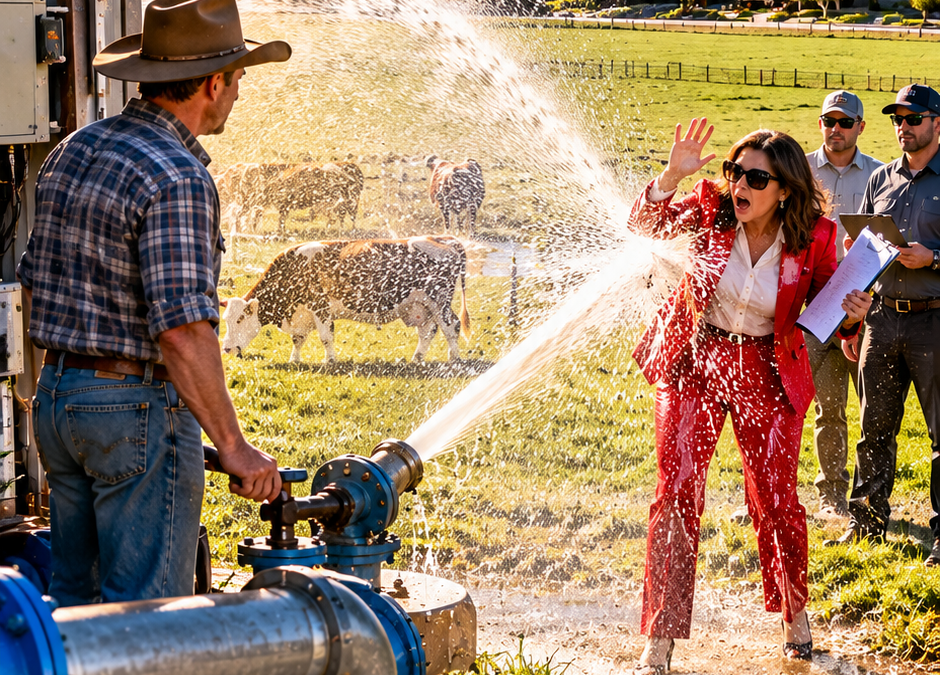
One second, she was standing beside my south pasture in a red pantsuit that probably cost more than my oldest saddle. The next, a forty-foot arc from the irrigation gun swept across her polished shoes, hit the cuffs of her pants, and scattered the three HOA people standing behind her like quail flushed out of brush.
I reached for the valve and killed the pressure.
The sprinkler coughed twice, then stopped.
Water dripped from the alfalfa in the hard morning light. The ground smelled dark and clean beneath the dust. Behind me, the pump house carried its usual low mechanical hum.
Vivien stared at her shoes.
Then she stared at me.
“Caleb Turner,” she said.
“Depends who’s asking.”
I wiped my palm on my faded jeans and walked over.
The temperature was already pushing eighty-five, and the day had not even settled into its worst heat yet. August on my ranch did not arrive politely. It came up from the ground, rolled off the metal roofs, and pressed against your chest until even the cattle moved slower.
Vivien did not belong in that heat.
Not dressed like that. Not standing in my pasture with a white envelope held at chest height like she expected me to come take it from her hand.
“Silver Mesa Homeowners Association has assessed your property,” she said.
“For what?”
“Unauthorized water consumption.”
For a second, I thought I had misunderstood her.
Then she pushed the envelope closer.
“Five thousand dollars.”
I looked at the envelope.
Then I looked past her toward Silver Mesa Estates, a mile downhill beyond the cottonwoods, where tile roofs shimmered through the heat and ornamental trees stayed impossibly green no matter how dry the county got.
“Unauthorized water consumption,” I repeated.
“You have been irrigating through a line connected to our utility corridor.”
She pointed toward the buried pipe crossing the edge of my property.
“That makes this community water.”
One of the men behind her shifted his clipboard against his hip.
I knew him.
Dale Mercer. HOA maintenance. He had been around long enough to know better, but he would not meet my eyes.
“Vivien,” I said, “this ranch was pumping water before Silver Mesa had its first foundation poured.”
“That does not exempt you from current rules.”
She pushed the envelope closer.
I took it.
Five thousand dollars was printed near the middle in heavy black type.
Payment due in fifteen days.
I folded the paper once and slid it into my shirt pocket.
Vivien’s expression changed slightly.
I think she had expected shouting.
Maybe she had even hoped for it. People like Vivien Cross handled anger well because anger made other people look unreasonable. She knew how to stand still, let someone raise his voice, then turn to the nearest witness with a practiced look of disappointment.
So I did not shout.
“Anything else?” I asked.
“Yes. Effective Monday, all agricultural usage connected to the HOA distribution corridor must be independently metered. Until then, your irrigation privileges are under review.”
That word made me turn.
Privileges.
Behind the pump house, my center pivot line stretched across land my grandfather had fenced. A Hereford cow stood ankle-deep in damp grass, chewing like none of us mattered. My father had watered that pasture. His father had watered it before him. The pump house had stood in that same place for thirty-two years, humming through summers when the creek ran low and the municipal tanks in town dropped to brown rings.
I walked to the steel pressure gauge beside the main valve.
The needle rested where it always did.
Vivien followed several steps behind.
“Mr. Turner, I’m not finished.”
I put two fingers against the pipe.
The ranch irrigation was off now, but the steel still carried a faint vibration. The old blue booster pump inside the shed was running.
It did that often.
My father had maintained that pump until his hands got too stiff to hold a wrench. After he died, I kept doing what he had done. Grease the bearings. Check the pressure. Replace seals. Clean screens. Listen for bearing noise. Keep it moving.
I had never given much thought to where every gallon went once the pipe disappeared downhill.
I straightened and looked at Vivien.
“You want separate meters?”
“We want accountability for every gallon.”
“Every gallon.”
Dale finally looked at me.
His face had gone still.
Maybe he heard something in my voice that Vivien did not.
I glanced once more at the humming pump house, then back at the woman charging me five thousand dollars to water my own ranch.
“All right,” I said. “We’ll measure it.”
Vivien gave a small satisfied nod.
I rested one hand on the warm steel pipe.
“But before you start sending bills, you might want to be real sure which direction the water is going.”
After Vivien left, I stood beside the pump house until the dust from her SUV settled back onto the county road.
The blue booster pump kept humming behind the corrugated steel wall.
I opened the door.
Warm air rolled out, carrying the smell of grease, rust, and sunbaked electrical insulation. The pump sat on the same concrete pad my father had poured thirty-two years earlier. Its paint was chipped around the bolts, and the discharge pipe disappeared through the south wall toward Silver Mesa.
I could still see Walter Turner kneeling there in an old denim shirt, tapping a pressure gauge with one dirty fingernail.
I was sixteen the first time he made me rebuild a check valve.
Back then, there was no HOA. Silver Mesa was forty acres of survey stakes and bulldozer tracks. The original developer had come to my father because the subdivision’s municipal connection could handle household demand but struggled with storage recovery during the hottest months.
Dad’s well had capacity to spare.
They paid part of the electricity, helped install the booster line, and Dad allowed a limited volume downhill.
He called it helping the neighbors.
There had been paperwork somewhere, but Dad trusted handshakes more than filing cabinets. Years passed. Developers changed. Houses multiplied. The HOA took over. Dad died.
I inherited four hundred twenty acres, a stack of repair manuals, and the habit of keeping that blue pump alive.
Nobody from Silver Mesa had asked me about it in years.
Every month, I paid the ranch electric bill. Every summer, I replaced seals, cleaned screens, checked wiring, and listened for the smallest change in that old pump’s hum.
I never stopped to calculate how much water crossed that southern line.
The ranch had always had enough.
That afternoon, I pulled open the old steel cabinet beside the pump. Inside were faded breaker labels written in Dad’s block handwriting.
WELL.
BOOSTER.
SOUTH LINE.
I ran my thumb across South Line and felt dust gather against my skin.
The $5,000 assessment sat folded in my shirt pocket.
I took it out and laid it on the workbench.
Then I started tracing pipe.
The ranch irrigation main left the well header heading west toward my pasture. The booster branch turned south. Separate valves. Separate pipes. Same well.
I crouched beside the junction and put my hand against each line.
The irrigation pipe was cool and still.
The south line vibrated steadily.
Water was moving while every sprinkler on my ranch was shut down.
I walked outside and followed the buried route until it vanished beneath the fence line. Beyond it, the ground dropped toward Silver Mesa. Late sunlight flashed off windows below. Somewhere down there, sprinklers were throwing water over manicured lawns.
I heard my father’s voice as clearly as if he were standing behind me.
Keep the pump clean, Caleb. People downstream count on pressure whether they know your name or not.
I had spent years treating that sentence like another maintenance instruction.
Check oil.
Grease bearings.
Keep neighbors supplied.
Now Vivien wanted accountability for every gallon.
Fine.
I pulled out my phone and called Mason Briggs, a plumber I used on irrigation jobs.
“You still have those commercial flow meters?”
“Two-inch or four-inch?” he asked.
“Both. I need two separate runs measured.”
“Problem?”
I looked downhill again.
“Not yet.”
Mason could be there Monday morning.
After I hung up, I checked the booster temperature with the back of my fingers.
Warm.
Normal.
Still running.
I could have thrown the breaker right then. One switch, and Vivien would have learned something before dinner.
But there were families down there who had nothing to do with that $5,000 bill. Children brushing teeth. Elderly people filling glasses. Residents who had bought homes believing water would come when they turned a handle.
So I left the switch alone.
Instead, I picked up Vivien’s assessment, folded it carefully along the same crease, and put it back in my pocket.
She had asked for accountability.
On Monday morning, she was going to get it.
Monday came hot and windless.
By 7:30, Mason Briggs had his white service truck parked beside the pump house and two magnetic flow meters laid across my workbench. He wiped sweat from his forehead, looked at the south line, then at me.
“You sure you want to know?”
“That’s why you’re here.”
We installed one meter on the ranch irrigation main and another on the line feeding downhill.
I opened my pasture valve first. Water surged through the pipe with a deep metallic shudder, then settled into a steady pulse. Mason watched the display, nodded, and logged the number.
I shut it again.
The ranch reading dropped to zero.
The south line kept climbing.
“That one never stops,” Mason said.
“I noticed.”
We left both meters logging while I worked cattle along the west pasture.
By noon, the heat had turned the fence wire too hot to hold. Dust stuck to the sweat along my neck, and every few minutes, I found myself looking toward the pump house.
At 2:15, a red SUV came through my gate without calling.
Vivien Cross stepped out in her red pantsuit, somehow still sharp despite the heat, followed by a man in khakis carrying a tablet.
She stopped when she saw Mason’s equipment.
“What is this?”
“Accountability,” I said.
Her eyes moved from the meters to the south pipe.
“You are not authorized to alter infrastructure serving Silver Mesa.”
Mason slowly lowered his wrench.
I leaned against the workbench.
“This infrastructure is inside my pump house, on my land, connected to my well, and powered through my meter.”
Vivien pointed toward the equipment.
“Silver Mesa has relied on this system for decades.”
“That sounds important.”
“It is.”
“Then somebody probably should have known who owned it before sending him a $5,000 water bill.”
Mason looked down to hide a smile.
Vivien did not.
Her jaw tightened.
The man beside her tapped something on his tablet and whispered that they should leave.
She ignored him.
That was the moment I understood this was not a misunderstanding she intended to correct. She needed me to submit. If she withdrew the charge in front of her own property manager, she lost authority.
So she doubled down.
“Payment is due Friday,” she said. “After that, penalties begin.”
I walked to the meter and turned its display toward her.
“Then Friday works for me too.”
For the first time, her expression shifted just slightly.
“What happens Friday?”
“I stop donating.”
She stared at me.
“Donating what?”
I did not answer.
I did not need to.
Her eyes followed the four-inch pipe through the south wall.
The pump hummed between us.
She finally heard it differently.
Vivien left ten minutes later, faster than she had arrived.
I kept the water running.
That mattered.
I was not going to punish hundreds of homeowners because one board president wanted a fight. But I changed my strategy that afternoon. I called the electric cooperative and separated the booster pump’s consumption from the ranch load. Then Mason helped me calculate the cost of maintaining the line, electricity, pump wear, filters, and the volume leaving my property.
The numbers were not dramatic individually.
Together, they were impossible to ignore.
Tuesday morning, Silver Mesa’s property manager called me.
His name was Thomas Hale, and his voice was careful in the way people sound when they have discovered a problem but do not know who is listening.
“Mr. Turner, we understand there may be a private supply component involved.”
“There is.”
“The board would like time to review it.”
“You have until Friday.”
“Are you threatening to shut off residential water?”
“No. I’m giving notice that I’m ending an undocumented private subsidy. What Silver Mesa does after that is Silver Mesa’s responsibility.”
There was a long silence.
“How much water are we talking about?”
I looked through the pump house door at the south meter spinning steadily beneath the Texas sun.
“That,” I said, “is the question your board should have asked before deciding I owed you $5,000.”
By Thursday evening, Vivien had not withdrawn the assessment.
Instead, an envelope arrived by certified mail warning me against interfering with what she now called a community water asset.
I read that phrase twice.
Community water asset.
Then I walked into the pump house and pinned the letter beside Dad’s faded South Line label.
Friday was no longer about proving where the water came from.
Vivien had just claimed my system as hers.
Now I had to decide how much I was willing to risk to make her prove it.
Friday morning arrived under a pale white sky with heat already rising off the caliche road.
I was tightening a loose hinge on the pump house door when three Silver Mesa utility trucks rolled through my gate. Vivien stepped from the first one in that same red pantsuit, followed by two maintenance workers and a private security officer.
One worker carried a bolt cutter.
I set my wrench on the bench.
“Nobody touches that equipment.”
Vivien stopped ten feet from me.
“You were formally notified that this is a community asset.”
“You called it that in a letter. That does not make it true.”
She pointed toward the south line.
“Our residents depend on that water.”
“Exactly. That is why I have not shut it off.”
The security officer glanced between us, already looking uncomfortable.
Vivien ordered the workers forward.
Neither moved.
I reached beside the door and switched off only the booster circuit I had separated two days earlier.
The main well pump kept running. Water continued toward Silver Mesa, but without the private booster maintaining their preferred pressure.
The low mechanical growl inside the building softened.
Vivien’s expression changed.
“What did you do?”
“Stopped paying to boost your pressure.”
Her phone rang before she could answer.
Then Thomas Hale’s phone rang.
Within minutes, calls were coming from the subdivision. Sprinklers at the highest homes were losing reach. Decorative fountains were weakening. Residents still had household water, but the wasteful pressure Silver Mesa had treated as permanent was gone.
Vivien stepped closer.
“Turn it back on.”
“Withdraw the assessment and reimburse the power cost your system has been pushing onto my meter.”
“You are extorting the association.”
“No,” I said. “I am refusing to subsidize it.”
She told the maintenance crew to restore the booster themselves.
That was her mistake.
Mason had helped me install a lockout on the ranch-owned electrical panel, and that panel sat entirely inside my deeded utility structure.
The workers looked at the lockout.
Then they looked at me.
“We’re not cutting his lock,” one said.
Vivien’s face went hard.
“Then I will get someone who will.”
She left before noon.
For about two hours, I thought I had won.
At 1:30, Thomas Hale emailed me a temporary suspension of the $5,000 assessment while the board reviewed the water arrangement.
I read it twice, then leaned back against the workbench.
False peace has a particular feel to it.
Too clean.
Too easy.
At 4:16, I heard diesel engines outside.
A contractor I did not recognize had parked beside the south fence with a small excavator and a trenching machine. Vivien stood near the gate, one hand raised as she directed them toward the buried line.
“What are you doing?” I called.
She turned without surprise.
“Silver Mesa is protecting its water access.”
“By digging on my ranch?”
“By securing the community connection before you interfere with it again.”
I walked toward the contractor and pointed at the fence line.
“Your equipment crosses private property if you go another foot.”
The operator killed the engine.
Vivien immediately started arguing with him, but he shook his head. He wanted a survey before digging.
She did not have one.
That stopped the machine.
But it did not stop her.
As the contractor backed toward the county road, I noticed orange paint already sprayed along the ground outside my fence.
It ran east instead of north toward the subdivision.
I followed it nearly three hundred yards until it reached an old concrete valve box half-buried beneath mesquite.
I knew that box.
My father had shown it to me when I was nineteen and told me never to open it unless the south line failed.
I cleared dirt from the lid with my boot.
The steel underneath was stamped with a date from twenty-eight years earlier.
Vivien had accidentally pointed me toward the one part of the system I had forgotten existed.
I lifted the heavy lid and looked down at two valves.
Not one.
Two.
One fed Silver Mesa’s original residential distribution connection.
The other disappeared east beneath land the HOA had purchased five years ago for its clubhouse expansion.
The second valve was open.
I stood there listening to water moving through the darkness below my boots.
The $5,000 bill suddenly felt smaller.
Whatever Silver Mesa had been taking from my ranch, it was not only watering homes.
The next morning, I brought Mason back to the old valve box before the heat settled over the ranch.
He crouched beside it, brushed away twenty years of dirt, and traced both pipes with his fingertips.
“Don’t touch either valve yet,” he said.
“Why?”
“If that second line feeds what I think it feeds, closing it blind could damage equipment downstream.”
That was the difference between being angry and being useful.
I wanted answers, but I was not going to create a failure just to prove a point.
Mason connected a portable ultrasonic meter to the eastbound pipe. The reading stabilized high enough to make him whistle.
“That’s not a drinking fountain.”
We followed the buried route without digging, using his locator along the county shoulder until the signal bent toward Silver Mesa’s newer property.
From the crest of a low hill, I could see where it ended.
Beyond the clubhouse stood a landscaped recreation complex I had barely noticed before. A swimming pool. Ornamental ponds. Irrigated lawns. Rows of young live oaks glowing green against miles of dry August grass.
My water had been keeping all of it alive.
I did not need another mystery.
I needed leverage that would not hurt homeowners.
So I changed tactics again.
Instead of touching the supply valves, I left them open and isolated the cost. Mason helped me install temporary monitoring on the east branch while I kept the booster off. By sunset, the numbers gave me something more valuable than outrage.
A daily operating burden I could measure.
The next day, Vivien arrived with Thomas Hale and an attorney.
I met them outside the pump house. The air smelled like hot cedar and machine oil.
“The board has withdrawn your assessment,” the attorney said.
Vivien kept her arms folded.
“Temporarily,” she added.
“Then we’re halfway done,” I said.
I handed the attorney a single-page summary of the metered flow and electrical load.
I did not bury him in paperwork.
I pointed toward the south wall.
“Silver Mesa has been drawing ranch water through two branches while my family paid to pump it. I will keep residential service flowing while we resolve this, but the recreation branch stops receiving subsidized pressure Monday morning.”
Vivien laughed once.
“You do not control our facilities.”
“I control my booster.”
“And when the landscaping dies?”
“Then your board explains why luxury landscaping depended on a private ranch pump you claimed I was stealing from.”
Her smile disappeared.
The attorney asked for forty-eight hours.
I gave him twenty-four.
That evening, Silver Mesa sent residents an email blaming me for an impending water emergency.
By eight, trucks were lining the county road.
Homeowners stood outside my gate, demanding to know why I was shutting off their water.
Vivien had found the pressure point she wanted.
People.
I opened the gate and walked out alone.
“Your household water is still running,” I said. “Check your faucets.”
Phones came out.
Calls went back to spouses.
One man nodded slowly.
Another woman said her kitchen pressure was normal.
The anger changed direction without me raising my voice.
Then a homeowner named Daniel Reed stepped forward.
“My dues went up last year because the HOA said the recreation complex had a new municipal irrigation contract.”
Vivien, standing beside her SUV, went completely still.
Daniel looked at her.
“We have been paying for irrigation already.”
That landed harder than anything I could have said.
I looked toward the green clubhouse lawns in the distance, then back at the pipe disappearing beneath my fence.
Silver Mesa had not merely been using my water.
Somebody had apparently been charging residents as though they were buying that same water somewhere else.
Vivien had spent all week trying to make me defend myself.
Now, for the first time, she had to explain where their money was going.
Daniel’s question broke the crowd open.
People stopped looking at me and turned toward Vivien.
She held her ground beside the red SUV, but I saw her thumb press hard against the edge of her phone.
“The irrigation contract covers infrastructure and reserve capacity,” she said.
Daniel shook his head.
“That is not what the budget says.”
Another homeowner stepped forward.
“Mine says purchased irrigation water.”
Vivien’s attorney moved close and spoke quietly to her.
She waved him off.
That told me more than the argument did.
I walked back through my gate and left them there.
If Vivien wanted a public fight, I was not going to give her one. I had finally learned what worked against her.
Every time she pushed harder, she created another obligation.
She had to explain.
By Monday morning, the recreation complex had become the center of the dispute.
I kept the residential branch untouched and left the booster off. Household service remained steady, but the ornamental ponds dropped several inches, and the clubhouse sprinklers barely cleared the curbs. Brown patches began appearing along the outer lawn.
Vivien called twice.
I let both calls go to voicemail.
At eleven, Daniel Reed arrived at the ranch with three other homeowners. He carried copies of their annual HOA budgets.
But what mattered was not the paper itself.
It was what they had already decided to do.
“We’re demanding a special board meeting,” Daniel said. “Not about your $5,000. About our money.”
That changed the battlefield.
Until then, Vivien could frame me as one stubborn rancher fighting a homeowners association.
Now her own members were asking why they had paid for water that appeared to be coming through my pump house.
I gave them the meter readings and nothing more.
“Verify everything yourselves,” I told them. “Do not take my word for it.”
That afternoon, Vivien made her next move.
A plumbing contractor arrived at the recreation complex and began preparing a temporary connection to a commercial water-hauling tank.
By sunset, tanker trucks were feeding the irrigation system.
The fountains rose again. Sprinklers swept across the grass. From the hill above my pasture, Silver Mesa looked normal.
For a few hours, it looked like she had beaten me.
Then the consequence arrived.
Commercial hauling was expensive.
Three tankers came Tuesday.
Five came Wednesday.
The HOA’s own residents watched them rumble through the entrance every few hours, diesel engines echoing between stucco houses.
Vivien had replaced water she had been receiving through my ranch with water everyone could now see being purchased by the truckload.
She had turned an invisible subsidy into a visible expense.
Thursday evening, the special meeting was held in the clubhouse.
I stayed outside until Daniel came through the doors and waved me in.
The room smelled of coffee, air conditioning, and damp carpet. More than a hundred residents filled the chairs and lined the walls. Vivien sat at the front table. The confidence was still there, but the control was not.
Daniel asked one question.
“If the HOA had a legitimate irrigation supplier, why are we suddenly paying tankers because Mr. Turner stopped boosting his private line?”
Vivien said, “The ranch connection was merely supplemental.”
Then Thomas Hale, seated two chairs away, lowered his eyes.
“That is not accurate.”
The room went silent.
Vivien turned toward him.
He swallowed.
“The ranch line has been the primary irrigation source since before I took this job.”
She stared at him as if she could force the words back into his mouth.
She could not.
The attorney leaned toward the microphone and recommended suspending all nonessential irrigation until ownership and billing were resolved. Residents immediately demanded the tanker deliveries stop.
The vote passed overwhelmingly.
Vivien lost control of the recreation water in the same room where she had built her authority.
But she still had one move left.
As people filed out, she walked past me and stopped close enough that only I could hear her.
“You think this is over because they got emotional?”
I looked through the clubhouse windows at the dark sprinklers outside.
“No.”
I put my hat back on.
“I think it is over when somebody explains why they were charged for water my pump was supplying.”
Her face stayed still.
But her eyes did not.
For the first time, Vivien looked afraid of the question instead of angry at the man asking it.
The morning after the special meeting, Silver Mesa was quieter than I had ever seen it.
No tanker engines. No sprinklers clicking across the clubhouse lawn. The ornamental pond had gone still enough to reflect the white sky.
I was checking the south line meter when Daniel called.
“Vivien scheduled an emergency board session for tonight,” he said. “Closed session.”
“About what?”
“She says the association needs to acquire your water infrastructure for community protection.”
I looked at Dad’s faded South Line label above the pipe.
She had lost the argument over the $5,000 assessment.
Then she had lost the irrigation fight.
So she was changing the question again.
If she could not control my pump, she wanted the HOA to claim it.
By noon, Mason and I were standing beside the old valve box with a licensed surveyor named Clare Holloway. Clare traced the ranch boundary, checked the utility corridor, then walked the line twice before speaking.
“The HOA has an easement across part of the south edge,” she said. “But an easement is not ownership of your well, pump house, electrical service, or booster.”
“What about the east branch?”
She studied her field tablet.
“That branch leaves the original easement after roughly two hundred feet.”
That mattered.
Silver Mesa’s newer recreation facilities were not simply benefiting from an old residential connection.
The HOA had extended beyond the original corridor when it expanded the clubhouse property.
I did not need Clare to win the fight for me.
I needed to know where I could safely stand.
That evening, more residents showed up than the clubhouse could hold.
Vivien tried to move the board into closed session, but three directors refused. One of them, an older man named Harold Pike, pushed his chair back from the table.
“I am not voting to seize anything until members understand what we have been paying for.”
Applause rolled through the room.
Vivien struck the table with her palm.
“This is not a town hall.”
“No,” Daniel said from the second row. “It is our association.”
I stayed near the back wall.
Vivien finally looked directly at me.
“Mr. Turner has deliberately reduced service to this community to force a financial settlement.”
I shook my head.
“Residential water never stopped.”
“You disabled equipment supporting our system.”
“My equipment.”
She turned to the board.
“Which is precisely why we need emergency control.”
That was when Harold opened a folder.
“Before we discuss control, I want the property manager to explain this.”
He held up a payment ledger.
The room tightened.
Thomas Hale cleared his throat.
“Those are irrigation reserve transfers.”
“To whom?” Harold asked.
Vivien cut in.
“This is outside the agenda.”
“To whom?” Harold repeated.
Thomas looked toward Vivien.
Then he answered.
“A consulting company called Mesa Resource Management.”
Daniel leaned forward.
“Who owns it?”
Nobody spoke.
Vivien reached for her bag.
Harold said the name before she could stand.
“Vivien Cross.”
The silence felt physical.
She did not deny it.
Instead, she said, “The company provided legitimate water management services.”
That explained why Vivien had fought so hard to control a water system she had never bothered to understand.
But by then, the company was not the part I cared about most.
The important fact was simpler.
Silver Mesa had spent years treating my family’s water like an association asset, charging around it, budgeting around it, and never once asking who had been keeping it moving downhill.
I stepped forward only when Harold asked me what I wanted.
“First, my $5,000 assessment is canceled permanently. Second, nobody enters my pump house or modifies my lines without written permission. Third, Silver Mesa installs its own lawful irrigation supply.”
Vivien laughed under her breath.
“And your money?”
“We will calculate what the HOA actually owes after the meters finish logging.”
I looked at the residents.
“I am not asking you to pay twice for the same water.”
That landed.
Vivien stood abruptly.
“This meeting is finished.”
Harold remained seated.
“For you, maybe.”
Two other directors nodded.
By a four-to-one vote, they removed Vivien’s emergency authority pending a financial review and prohibited her from directing contractors or accessing association funds without a second signature.
She walked out without looking at me.
It felt like victory.
It was not.
When I reached the ranch forty minutes later, the pump house alarm was flashing red.
I ran inside and smelled hot insulation.
The booster panel was dead.
Someone had tried to energize the disconnected circuit from the downstream side, backfeeding equipment that was never designed for it.
Mason answered on the second ring.
“Kill the main disconnect,” he said.
I did.
The pump house fell silent.
The damaged controls shared the main service feeding both the well and the booster. Until an electrician isolated the fault, I could not safely run either circuit.
For the first time since this started, water to Silver Mesa stopped completely.
Not because I wanted it to.
Because somebody had pushed the system one step too far.
The silence lasted three seconds before my phone started ringing.
Daniel was first.
“Water is down across Silver Mesa.”
“I know. Tell everyone not to touch their valves. I’m working on it.”
I called Mason, grabbed two flashlights, and opened the pump house doors to let the heat escape.
The smell of scorched insulation hung inside like burnt plastic.
I kept the main disconnect open and waited.
Twenty minutes later, Mason’s truck came bouncing down the ranch road, headlights cutting through the dust. He inspected the booster panel without touching the damaged conductors.
“Good call killing everything,” he said. “We need an electrician before this gets energized again.”
“How fast?”
“Depends what burned.”
I looked toward the dark subdivision beyond my fence.
This was no longer about lawns or fountains. Homes had lost the ranch-fed supply because the electrical fault made the pumping system unsafe to operate.
I called Daniel again.
“Tell the board to activate whatever emergency water plan they have. Bottled water, tankers for household use, whatever their provider requires. Do not wait on me.”
By sunrise, Silver Mesa’s entrance was crowded with utility vehicles.
This time, the tankers were not feeding ornamental ponds.
They were supporting residents while a licensed electrician worked beside Mason inside my pump house. I stayed with them, handing over tools, opening panels, tracing circuits.
Around nine, the electrician found where the downstream backfeed had entered the booster controls.
A temporary cable had been connected on the Silver Mesa side of the system and energized toward my equipment.
“Whoever did this bypassed your isolation,” he said.
“Can you tell who?”
“I can tell where it came from.”
That was enough.
I did not need a dramatic confession.
The physical consequence was sitting in front of us.
Blackened terminals.
A ruined contactor.
A pump system that could not safely run until repaired.
At 10:30, Harold arrived with Daniel and two board members.
Vivien came five minutes later.
She stepped from her SUV and headed toward the pump house.
Harold blocked the doorway.
“You do not have authority to enter.”
“Move.”
“No.”
Her eyes found me over his shoulder.
“Restore the water.”
I pointed toward the damaged panel.
“As soon as the electrician says it is safe.”
“You caused this by disabling the booster.”
The electrician looked up from his meter.
“No, ma’am. The isolated circuit was backfed from downstream.”
Vivien stopped talking.
Harold turned toward her.
“Did you authorize anyone to reconnect it?”
“Absolutely not.”
Then Mason walked outside holding a weatherproof contractor tag he had found attached to the temporary cable near the downstream service cabinet. The company name matched the contractor Vivien had brought to my ranch days earlier.
Harold’s face changed.
“Did you hire them?”
Vivien looked at the tag, then at the residents gathering near the fence.
“I instructed them to protect association infrastructure.”
“After we removed your authority.”
“The work order was issued before the vote.”
That answer saved us hours of arguing and destroyed her position in one sentence.
Harold took out his phone and called the HOA attorney.
Vivien started toward her SUV.
Daniel said, “Where are you going?”
She did not answer.
By early afternoon, the damaged components had been replaced.
I paid the electrician myself because waiting for the HOA would have kept families without water longer. When Mason gave me the nod, I closed the main disconnect.
The pump kicked once.
Then settled into its familiar low hum.
Pressure climbed.
Daniel’s phone buzzed with messages from residents confirming their faucets were running again.
I left the recreation booster isolated.
Household supply returned.
The lawn stayed dry.
That evening, the board met under emergency rules with counsel present.
Vivien was removed as president and barred from authorizing vendors or accessing HOA accounts while the board pursued recovery of unauthorized expenses.
The $5,000 assessment against me was canceled permanently.
The contractor’s repair costs were assigned to Silver Mesa pending reimbursement from the responsible parties, and the board ordered an independent review of payments to Vivien’s company.
I drove home after dark, exhausted, my shirt smelling of dust and electrical smoke.
At the pump house, I stopped beneath Dad’s faded South Line label and listened to water moving through the pipe again.
Vivien had tried to make my well belong to her by using it, billing around it, and finally forcing control over it.
Instead, every move she made had narrowed her options until the system itself showed exactly where her authority ended.
Three weeks later, I stood beside the old valve box while a crew from Silver Mesa installed a separate metered irrigation connection on their side of the property line.
The August heat had finally broken. A north breeze moved through the mesquite, carrying the smell of damp soil from a storm the night before.
Nobody from the HOA crossed my fence without asking.
That small change meant more to me than any apology could have.
The board had approved a written transition agreement. Household service from my ranch line would continue temporarily while Silver Mesa completed its independent supply, but every gallon leaving my property was now metered. Every electrical cost was reimbursed. The recreation branch was disconnected from my system for good.
The final numbers from Mason’s meters showed years of pumping had cost my family far more than the $5,000 Vivien tried to charge me.
The HOA negotiated reimbursement for the documented period we could reasonably calculate, including the emergency electrical repair I had paid for myself.
I accepted it because I wanted the system separated, not another year of fighting over old estimates.
Vivien’s ending came through the choices she had made herself.
The review confirmed that her company had received association payments for water management work while the recreation complex depended primarily on water pumped from my ranch.
She resigned before the next regular meeting, and the board pursued repayment of unsupported charges and the damage tied to the contractor work.
I did not follow every argument after that.
I did not need to.
Vivien had wanted control of my water badly enough to make everyone finally measure what that control had been costing them.
The following month, Daniel invited me to walk through the recreation complex after the new irrigation meter went live.
The ornamental ponds were smaller now. Half the decorative grass had been replaced with native plants. Sprinklers ran on shorter schedules. Silver Mesa looked less extravagant, but for the first time, it was paying for what it used.
Daniel stopped beside one of the young live oaks.
“You know what’s funny?” he said.
“What?”
“Water bills went down after we started actually paying for the water.”
I laughed.
“Funny how that works.”
Back at the ranch, I removed Vivien’s certified letter from the pump house wall.
Dad’s faded South Line label stayed exactly where it was.
I cleaned the dust from the old metal plate and tightened one loose screw beneath it. Then I walked outside and opened the ranch irrigation valve.
Water moved through my pasture lines with that familiar low vibration under my boots. A row of sprinklers rose across the field and threw silver arcs over the dry grass.
For weeks, every sound from that pump house had felt like part of a fight.
Now it sounded like work again.
I thought about the first $5,000 notice.
Vivien standing at my gate, telling me I owed Silver Mesa money for watering my own ranch.
She had been so certain the water belonged to whoever controlled the bill.
In the end, that bill did exactly one useful thing.
It made me measure what I had spent years taking for granted.
I watched the sprinklers turn slowly beneath the afternoon light, then looked south toward the subdivision.
Their new line ran independently now.
Mine stayed on my land.
Two systems.
Two meters.
Two responsibilities.
The way it should have been from the beginning.
I shut the pump house door, heard the latch catch behind me, and walked back toward the pasture while my own water kept falling on my own grass.