𝗙𝗨𝗟𝗟 𝗦𝗧𝗢𝗥𝗬 The Wall Vivian Tore Down Was the Only Warning Standing Between Her HOA and the Floodwater
𝗙𝗨𝗟𝗟 𝗦𝗧𝗢𝗥𝗬
The crew packed up twenty minutes later. I stayed until the dump truck disappeared, then began pulling salvageable stones away from the tire tracks by hand.
By sunset, my palms were raw and half the wall was still missing.
I stood in the opening and looked from the subdivision to the county road.
For the first time in eighty years, nothing stood between them.
And I still did not understand why that bothered me more than the stones they had taken.
The next morning, I was resetting a limestone corner on the Haskins barn when my phone buzzed against the tailgate.
I had mortar on my gloves and ignored it until the second call. By then, the September air was already warming, carrying the smell of cut hay through the open barn doors.
The message was from my neighbor, Melissa Crane.
Three words.
They’re using it.
I finished seating the stone before I drove home.
That was the kind of work I had done for twenty-six years. Old things deserve care even when newer trouble is waiting. My own place sat on forty-three acres outside town, with a weathered workshop behind the house and Brier Glenn pressing against the eastern pasture where cornfields had stood when I was a kid.
The old wall ran along the lower edge.
My grandfather Henry repaired it every spring. He never made it prettier. He replaced what winter moved and left everything else alone. When I was nineteen, I once suggested mortaring the loose sections.
He looked at me like I had offered to paint the trees.
“It moves because it needs to,” he said.
I remembered that when I reached the lower field and saw a white HOA maintenance cart rolling through the opening Vivian’s crew had made.
Its tires bumped across the dirt, passed between the surviving ends of the wall, and continued toward County Route 18.
Nothing happened.
No wheel sank.
No ground cracked.
The driver waved at me.
I did not wave back.
That afternoon, another car crossed.
The following morning, a landscaping pickup used the same route. I stood beside my workshop with a tape measure hanging from my belt and watched it disappear toward the subdivision.
Vivian arrived around noon.
She stepped from a black SUV, her red pantsuit sharp against the dusty field, and looked at the tire tracks as if they were numbers proving an equation.
“Three days,” she said.
“It has been less than forty-eight hours.”
“And your road works perfectly.”
“It is not a road.”
She pointed at the opening.
“It connects two roads. Vehicles can cross it. I am not sure what else you would call it.”
I crouched beside one of the old wagon ruts.
It came down from the barn, shallow under the grass, then curved west twenty feet before reaching the wall. I had followed that bend thousands of times without noticing it.
“My family never drove through here.”
“Your family also built a stone wall where one wasn’t needed.”
I stood.
“You still don’t know that.”
“Neither do you.”
That landed because she was right.
I knew how to read bad masonry. I knew frost damage, settlement, drainage pressure, failed footings. But I could not tell her why Henry had guarded this particular strip like crossing it would insult the dead.
That evening, I walked the wall with his old masonry hammer.
The remaining stones were ordinary local limestone, dry-stacked without mortar. I lifted one loose capstone and found the same pale powder underneath that I had noticed after the demolition. I brushed it away with my thumb, set the stone back, and kept walking.
Near the opening, I found an old depression hidden beneath the grass.
It crossed the new tire tracks at an angle and disappeared toward the woods.
I dropped a fist-sized stone onto the bare dirt.
The sound was wrong.
Not dramatic.
Just flatter at first, then a faint hollow note underneath.
I dropped it again.
Same sound.
Headlights swept across the field behind me. Another HOA car rolled through the opening, tires crunching over fresh gravel someone had already spread without asking me.
I stepped aside and watched it pass safely.
The driver disappeared toward the county road.
The ground stayed still.
Maybe Vivian was right.
Maybe Henry had inherited a useless rule and handed it to me. Maybe I was protecting a pile of old stones because they belonged to my memory, not because they served any purpose.
But when I looked down, those old wagon ruts still curved away before reaching the stones.
Eighty years of wheels had come that far and chosen not to cross.
Now, because one woman had removed thirty feet of rock, everyone had started taking the shortcut.
By the end of that week, the shortcut had become routine.
I heard tires before breakfast. I watched landscaping pickups cross while I loaded stone into my work truck. I came home Friday to find a delivery van bouncing through the opening as if the lane had existed for years.
Every successful trip made my objection look smaller.
Vivian understood that.
Saturday morning, she brought half a dozen residents down to the boundary while a maintenance crew spread another thin layer of gravel across the dirt. She wore the same red pantsuit, spotless despite the dust, and walked beside the lane with one hand extended toward it.
“This takes service traffic away from our main entrance,” she told them. “It is safer, faster, and already working.”
Melissa Crane stood near the back with her arms folded.
I stayed on my side of the surviving wall and watched a landscaping truck come through. Its suspension rocked once over the shallow depression I had found, then leveled out.
Vivian looked directly at me.
“Another successful crossing.”
“That is not the same as knowing what you are driving over.”
“And what exactly are we driving over, Grant?”
I had no answer I could prove.
The hollow note from a dropped stone was not an engineering report. My grandfather’s rule was not one either.
Vivian waited long enough for everyone to notice my silence.
“That is what I thought.”
She turned back to the residents.
By Monday, trash service was using the shortcut.
Tuesday brought two delivery vans. The wheel tracks deepened until the grass between them stood like a narrow green ridge.
I walked those tracks after work, boots pressing into dry soil warmed by the afternoon sun. Where the lane crossed the old depression, the dirt felt softer under my heel.
I crouched and pushed my fingers into it.
No cavity opened.
No dramatic crack appeared.
Just compacted soil over something I could not read.
I hated uncertainty more than I hated Vivian.
Stone usually told you what was wrong. A bulging wall carried weight badly. White staining meant water had traveled somewhere. A foundation crack had direction.
This ground gave me nothing except a bad sound and a dead man’s rule.
Wednesday afternoon, Vivian returned with two board members and orange marking flags.
She planted one beside the lane, then another farther toward the county road.
“What are those for?” I asked.
“Surveying the permanent access.”
“Permanent?”
“The board is considering formalizing the corridor.”
I stepped between her and the next flag.
“No.”
Her chin lifted.
“You have watched vehicles use this route all week.”
“Light vehicles. Without incident.”
“Without incident is not the same thing as safe.”
A small smile touched one corner of her mouth.
“Interesting. That is exactly what you told me I could not say about your wall.”
She had me there.
I looked past her toward the opening. The remaining stone ends stood twenty-five feet apart now, useless as a barrier. Beyond them, the fresh tracks made the route look established.
That was the part I had not understood when the excavator arrived.
Vivian had not needed to prove the wall was dangerous forever. She only needed to remove enough of it for people to start behaving as if the road was real.
Once tires made tracks, the tracks became an argument.
“You don’t have permission to build a road across my land,” I said.
“Then show me where the historical access ends.”
“It ends at the wall.”
“A wall you cannot explain.”
She pulled the last orange flag from her hand and pressed it into the soil.
I watched the metal shaft sink farther than I expected before resistance caught it.
Vivian did not notice.
She was already walking back toward Brier Glenn.
I waited until everyone left, then pulled the flag out.
The bottom six inches were dusted with the same pale white powder I had found beneath the stones.
I rubbed it between my fingers and looked toward the old wagon ruts.
They curved west.
The new tracks went straight.
For the first time, I stopped thinking about how to rebuild the wall.
I started thinking about how to stop the weight.
The concrete barriers arrived before sunrise on Thursday.
I unloaded them from my flatbed one at a time with the skid steer, setting three across the section of lane that crossed ground I knew was inside my property line. Each block weighed close to two thousand pounds. I left a gap wide enough for a maintenance cart, then chained a small reflector post between the last barrier and the surviving end of the wall.
By seven, my shirt was damp between my shoulder blades, and limestone dust had turned the toes of my boots gray.
Vivian showed up twenty minutes later.
Her SUV stopped hard on Brier Glenn’s side. She stepped out, stared at the barriers, then walked toward me with her jaw set.
“Move them.”
I shut off the skid steer.
The sudden silence made the cicadas sound twice as loud.
“Carts can still pass.”
“Service trucks need access.”
“They have access. County Route 18 to my ridge road.”
“That is almost a mile longer.”
“I’ll maintain it.”
She looked at the barriers again.
“So now you are deliberately interfering with an HOA safety route.”
“I am keeping heavy vehicles off this strip until somebody can tell me what is under it.”
“Based on what?”
I rubbed the pale dust from an old wall stone between my thumb and forefinger.
I could have told her about the hollow sound, the wagon ruts, my grandfather standing there in work boots, and the way the flag sank too deep. I knew exactly how it would sound.
“Based on the fact that I don’t know.”
Vivian gave a short laugh.
“That is your argument?”
“It is enough for me not to gamble with somebody else’s truck.”
Her eyes narrowed.
“You don’t get to stop progress because your grandfather had superstitions.”
That one hit harder than I expected.
I stepped away before my temper could answer for me.
By noon, I had graded the first quarter mile of the ridge road myself. The old surface was washboarded and choked with weeds. I dragged it smooth, hauled two loads of crushed stone from Miller’s quarry, and canceled a chimney job I had already postponed once.
Friday cost me another job.
Saturday cost me a hydraulic hose when the skid steer caught a buried stump.
But service trucks started using the ridge.
They complained about the extra twelve minutes.
Nobody got blocked for three days.
The lower strip stayed quiet.
Then Monday morning, I heard a diesel engine and the rhythmic thump of a compactor.
I drove down and found a crew spreading gravel beyond my barriers from the Brier Glenn side. Orange stakes marked a lane twenty feet wide. Vivian stood beside a board member while a small roller pressed the fresh stone flat.
“What are you doing?” I called.
“Improving the portion of the corridor the board recognizes as shared access.”
“I gave you another road.”
“You gave us an inconvenient detour.”
The roller passed over the shallow depression.
For half a second, I saw the gravel shiver behind its rear drum.
Then it settled smooth.
I walked closer and pointed at the machine.
“Keep that off my side.”
Vivian folded her arms.
“Your barriers already make that clear.”
I looked at the new lane. It was clean, level, professional. Exactly the kind of surface people trusted without asking what held it up.
“No heavy trucks,” I said. “Not through that opening.”
“You still cannot tell me why.”
“No,” I said, looking directly at her. “But until I can, I am done pretending that means there is nothing wrong.”
Vivian turned toward the crew.
“Finish the section.”
The roller moved again.
I did not try to stop it.
Instead, I climbed into my truck and drove back toward the ridge.
If Vivian wanted to fight over the wall, she could have it without me.
The wall was already half gone.
What mattered now was keeping weight somewhere else.
That afternoon, I ordered another forty tons of crushed stone for the ridge road and put it on my own account. I did not know what I was protecting yet. I only knew I was finally protecting the right thing.
The rain came Tuesday night.
Hard enough to wake me at 2:17.
Water hammered the metal roof over my bedroom, and thunder rolled across the ridge. By daylight, the storm had moved east, leaving the fields dark and shining.
I pulled on my boots and drove straight to the lower pasture.
The ridge road had held. Water ran clean through the shallow ditches I had cut along both shoulders, exactly where I wanted it.
Then I reached the old wall.
The new gravel lane looked different.
A section near the depression had sagged, maybe two inches. Barely enough to notice unless you knew yesterday’s grade.
Fine white material had washed into a narrow line along the downhill edge.
I crouched and touched it.
Chalky. Cold. The same powder from beneath the stones.
Melissa walked over from her property, carrying coffee in a steel mug.
“That wasn’t there yesterday.”
“No.”
I followed the white trail toward the woods.
Twenty yards in, it disappeared beneath blackberry vines and a fallen cedar. Melissa and I pulled the branches aside and found a shallow stone-lined channel running downhill.
Not a pipe.
Not a ditch either.
The sides were carefully fitted limestone, old enough that roots had grown between the joints.
Melissa stared at it.
“Your grandfather built this?”
“Too old.”
I cleared leaves from another three feet and felt my stomach tighten.
The channel pointed directly toward the wall.
By nine, Vivian was there with the paving contractor. She saw the sag and dismissed it before I finished explaining.
“Storm settlement.”
“Maybe.”
“Then why are we discussing it?”
“Because your roller compacted the surface over something designed to move water.”
She glanced toward the stone channel.
“You don’t know that.”
“Not yet.”
The contractor, a broad man named Eddie Sloan, stepped off the gravel and studied the depression. He drove a steel probe down near the edge.
It sank almost eighteen inches before scraping stone.
His expression changed.
Vivian noticed.
“Problem?”
Eddie pulled the probe free. Mud coated the lower half.
“I want to know what is under this before putting loaded dump trucks across it.”
Vivian’s face tightened.
“We are not building an interstate.”
“Weight does not care what you call the road.”
She looked at me, then at the barriers farther west.
“Fine. Light traffic only until we inspect it.”
It felt like a win.
Small, but real.
For the first time, she had backed away from heavier vehicles.
I spent the afternoon clearing the stone channel by hand. It widened as it approached the old wall, then vanished beneath the demolished section.
At sunset, I found something else.
Three flat limestone slabs set side by side below grade. Their edges had been polished smooth by decades of water.
The wall had not merely crossed the drainage path.
It had been built into it.
Wednesday stayed dry.
Thursday stayed dry.
By Friday morning, the sag had stopped growing.
Vivian sent an email allowing the temporary weight restriction, and I almost believed we had bought enough time.
Then at 4:40 that afternoon, I heard air brakes from the direction of Brier Glenn.
I ran outside.
A tandem dump truck loaded with gravel was waiting at the opening. Vivian stood beside it, one hand raised toward the driver.
“You agreed to light traffic!” I shouted.
She turned.
“The restriction was temporary.”
“Nothing changed underground.”
“The surface stabilized.”
Eddie Sloan was not there.
This was another contractor.
The driver leaned from his window.
“Ma’am, you want me through or not?”
Vivian pointed straight down the new lane.
“Go.”
The truck eased forward.
Its front axle crossed the depression.
Then the rear wheels reached it.
I heard a dull crack beneath the engine noise.
Not stone breaking above ground.
Something deeper.
The truck stopped.
One rear tire had dropped several inches into the gravel.
Water, brown and sudden, began seeping around the tread.
Vivian’s hand slowly lowered.
I walked toward the truck, watching muddy water spread across the lane where eighty years of wagon tracks had always turned away.
The wall had never been keeping people out.
It had been keeping weight off something the town once understood.
The driver killed the engine and climbed down without waiting for Vivian.
Muddy water continued bubbling through the gravel around the sunken rear tire, carrying pale limestone grit in thin ribbons toward the downhill grass.
I walked to the edge of the depression and held up one hand.
“Nobody moves that truck.”
Vivian came toward me fast.
“It stuck six inches, Grant. We pull it out and repair the base.”
“If the base is what failed—”
The driver looked beneath his truck, then shook his head.
“I’m not moving until somebody checks that ground.”
That ended Vivian’s argument with him.
She pulled out her phone and walked away.
I called Eddie Sloan.
He arrived forty minutes later with two men, a compact excavator, and a pump. I paid for the emergency call myself.
We unloaded the truck first, transferring gravel into smaller equipment from firm ground. Only after the weight was gone did a recovery truck ease it backward.
The tire came free with a wet sucking sound.
Beneath it was a dark opening about three feet across.
Eddie crouched beside me.
“Do not put your weight on that edge.”
We scraped gravel away from the opening with hand tools.
Six inches down, the packed roadbed gave way to fitted limestone. The stones formed a shallow arch over a narrow underground channel. One section had cracked under the truck. Water moved beneath it fast enough to make the broken pieces tremble.
Melissa stood behind the barrier with three neighbors.
Vivian remained near her SUV, arms folded tight across her red jacket.
“So it’s an old drain,” she said.
Eddie looked up.
“It is more than a ditch.”
He pointed downhill.
“See the grade? This carries runoff under the terrace.”
I followed the line with my eyes toward Brier Glenn.
The subdivision sat lower than my field, with its first row of homes beyond a broad grassy basin.
Something clicked into place.
“Where does it discharge?” Eddie asked.
We traced the channel downhill until brush swallowed it near the property corner. There, under honeysuckle and eighty years of soil, we found another stone opening. Water spilled through it into a wide swale aimed away from the homes.
Melissa stared back toward the demolished wall.
“So why put a wall over the top?”
I looked at the surviving stones, then at the curved wagon ruts.
“To make sure nobody drove across the weak section.”
The wall had not been the drainage structure.
It had been the guardrail.
That was the first real twist.
And it changed my strategy immediately.
I stopped trying to prove the wall deserved to survive because it was old. I needed the drainage system working before the next storm.
The weather report gave us less than forty-eight hours.
Eddie agreed to help stabilize the broken arch if I covered materials.
I called my customers and canceled the rest of my week.
Then Vivian stepped between us and the excavator.
“You are not rebuilding anything inside the access corridor.”
“I am repairing the channel your truck broke.”
“The board has not authorized excavation.”
I stared at her.
“Your board authorized a loaded dump truck over an unknown void after your own contractor warned you.”
Her face hardened.
“And now we know what is there.”
“Exactly.”
She looked toward the houses, then back at me.
“You will wait until the board reviews it.”
Thunder rolled somewhere west, low and distant.
Eddie checked the sky.
I smelled rain before I felt the first cool gust across the field.
Vivian was still fighting over who controlled the ground.
I was looking downhill at thirty-two homes sitting below a drainage system we had just learned could no longer carry what was coming.
The first drops hit the dust like dark coins.
Eddie looked at me, then at the broken arch.
“If that forecast is right, this needs to be open tonight.”
Vivian stepped closer.
“Nobody touches it until the board approves the work.”
I pulled out my phone, not to call a lawyer, but to check the radar.
A red band stretched across the county, moving east.
“How long does your board need?”
“Emergency meeting tomorrow morning.”
Eddie gave a dry laugh.
“Storm gets here before midnight.”
Vivian pointed toward his excavator.
“Move that machine off the corridor.”
For a second, I almost did what I had done all week.
Argue about ownership.
Then I looked downhill at Brier Glenn and changed the question.
“Eddie, can we route the water around the broken section without rebuilding it?”
He studied the slope.
“Temporary diversion. Maybe. We cut from the upper swale to your west pasture and keep heavy equipment away from the arch.”
“Do it.”
Vivian’s head snapped toward me.
“You cannot redirect runoff toward the subdivision.”
“I’m redirecting it away from the subdivision.”
The west pasture belonged entirely to me and fell toward an empty hay field before reaching a county drainage ditch.
It would ruin several acres if the rain came hard enough.
I knew that before I gave Eddie the order.
By six, the excavator was working fifty yards uphill, nowhere near Vivian’s claimed corridor. I ran the skid steer behind it, shaping a shallow emergency channel through my own pasture. Wet dirt packed beneath the tires. The air smelled like clay and cut grass.
Melissa and two neighbors dragged branches away from the old stone outlet while Eddie’s crew cleared debris by hand.
Vivian stood under an umbrella near her SUV, making calls.
At 7:30, she came back with two private security vehicles.
The guards did not threaten anyone.
They simply parked across the easiest equipment approach from Brier Glenn.
“You have made your point,” I told her.
“No,” she said. “I am protecting the association from unauthorized work.”
“If you block the work and those homes flood, that association will have bigger problems than my pasture.”
“If you cut a drainage channel and flood somebody else’s property, the liability lands on us.”
“Not from my land, it doesn’t. Eddie is routing it west across my pasture into the county ditch.”
She looked toward the excavator.
“You do not have an approved drainage plan.”
“I have a storm coming and thirty-two houses downhill.”
I pointed toward the security vehicles.
“So keep them out of my pasture.”
Rain began falling steadily.
Water collected in the old channel above the broken arch, rising against the collapsed stones. Our diversion was almost finished, but not connected.
Eddie shouted over the excavator.
“Twenty minutes!”
We had ten.
The first surge came down from the ridge as a brown sheet, filling the stone-lined channel faster than I expected. It struck the damaged arch and backed up. Water spread across the gravel lane, then started sliding downhill toward the subdivision.
Vivian finally stopped talking.
One of the security guards turned and stared at the homes below.
“That’s going toward us.”
“Yes,” I said.
Melissa pointed uphill.
“Grant!”
Eddie had broken through the final strip of earth.
The temporary channel opened with a rush.
Water swung west, pouring into my pasture in a widening muddy ribbon. It flattened grass, swallowed two fence posts, and tore across the corner of the hay field.
I watched months of work disappear under brown water.
But the flow across the HOA lane began dropping.
Vivian stood beside me, rain running from her ponytail onto the shoulders of her red jacket.
“You did this without authorization.”
I looked at the water cutting through my land.
“I paid for it too.”
By midnight, the diversion was carrying most of the runoff safely west.
Brier Glenn stayed dry.
For about six hours, I thought that was the victory.
At dawn, the rain weakened.
I walked the damaged pasture with Eddie, exhausted enough that my hands shook when I lifted my coffee. Near the old stone outlet, Melissa called my name.
She was kneeling beside a section of earth the storm had washed clean.
Set into the bank was a rectangular limestone marker.
Not decorative.
Not part of the wall.
Eighty years of dirt had hidden most of its face, but the carved county seal was still visible. Beneath it were two words and a date.
FLOOD EASEMENT
1946
Eddie looked from the marker to the broken wall, then downhill toward Brier Glenn.
Vivian had spent a week insisting the old stones were blocking progress.
The storm had just uncovered proof that the town had once placed them there to protect the very land her HOA now controlled.
By eight that morning, the storm had thinned to a cold mist, and the limestone marker sat exposed in the washed bank like something the ground had finally decided to return.
I cleaned mud from the carved seal with my thumb while Melissa photographed its position from several angles.
I did not celebrate.
A stone marker could explain the past, but it could not repair the broken channel or the pasture I had sacrificed overnight.
Eddie stood over the opening with his hands on his hips.
“If the easement still follows this drainage line, nobody should have been compacting a road across it.”
“Still a big if,” I said.
I called the county public works office and gave them the marker date, location, and what had happened during the storm.
Then I did the harder thing.
I left the wall alone.
No rebuilding.
No dramatic showdown.
Eddie and I spent the morning strengthening the temporary diversion because another band of rain was forecast that evening.
Around ten, Vivian arrived with three board members.
Her red pantsuit had been replaced by another one just as sharp. She walked straight past the muddy tire tracks toward the marker.
“This proves nothing about the wall,” she said.
“I didn’t say it did.”
That stopped her for half a beat.
“Then remove your barriers and let us restore the lane.”
“No heavy traffic until the drainage is stabilized.”
“You do not have authority over association access.”
“You keep calling it association access.”
I pointed toward the curved wagon ruts still visible beyond the surviving wall.
“But every old route turns away from this spot.”
Vivian looked toward the board members.
“We are not debating folklore again.”
“Neither am I.”
A county pickup arrived twenty minutes later.
The man who stepped out introduced himself as Daniel Ruiz from Public Works.
He did not arrive like a rescuer. He did not order anyone around. He walked the ground.
He measured the exposed channel, checked the outlet, photographed the marker, and asked Eddie where the truck had broken through. Then he stood downhill and studied the slope toward Brier Glenn.
“Who authorized the roadbed over this section?”
Vivian answered immediately.
“The association improved an existing access corridor.”
Ruiz looked at the fresh gravel, then at the eighty-year-old marker.
“Existing where?”
Nobody answered.
He requested the subdivision drainage plan.
Vivian said the management office had it.
One board member, a gray-haired man named Peter Walsh, shifted uncomfortably.
“Actually,” he said, “there was something in the closing packet when the developer transferred control.”
Vivian turned toward him.
“Peter.”
He ignored her.
“A drainage reservation. I remember because the map looked strange.”
That was the moment the balance changed.
Not because we had found one magic document, but because Vivian’s own board stopped moving as a single body behind her.
Peter drove home and returned with a rolled site plan.
Ruiz spread it across the hood of his truck.
A dashed corridor followed the stone channel through my property and widened below it into the grassy basin inside Brier Glenn. The old wall sat directly across a marked no-load crossing zone.
Vivian stared at the map without speaking.
Ruiz tapped the dashed line.
“The drainage easement remained active when the subdivision was approved. The basin below is part of the same system.”
Melissa looked at Vivian.
“So the wall was protecting it.”
Ruiz shook his head slightly.
“The wall itself is not the legal protection. But its placement kept vehicles off the vulnerable crossing. Somebody understood that.”
Eighty years suddenly made sense.
Vivian’s mistake had not been removing an antique wall.
It had been converting its opening into a road after repeated warnings and then sending a loaded truck across the exact place the wall had prevented vehicles from crossing.
Peter stepped away from her.
“You told us the route was cleared.”
“It was,” Vivian said. “Based on the records available to me.”
“You had this map.”
“The board had this map.”
Peter’s face hardened.
“You are the board president.”
The remaining members went quiet.
Ruiz ordered no celebration and made no speech. He simply placed temporary county barricades at both approaches to the damaged crossing and said the drainage had to remain unobstructed pending emergency repair.
Vivian watched him close the shortcut she had spent two weeks creating.
I looked past her toward my ruined pasture.
Brown water still moved through the channel I had cut to save the homes below.
The victory did not feel clean.
It had cost me jobs, equipment repairs, forty tons of gravel, and several acres of grass. But for the first time since the excavator bit into that wall, Vivian was not deciding what happened next.
The ground was.
Three weeks later, I stood beside the same opening while a county-approved crew lifted the last broken stones from the drainage arch.
Morning light flashed off wet limestone, and the air smelled of fresh soil and diesel. This time, every machine stayed on timber mats outside the no-load zone. Eddie rebuilt the damaged section by hand with two masons, matching the old stonework instead of burying it under gravel.
The permanent solution was not mine alone.
The county restored the drainage crossing, and Brier Glenn’s board voted to abandon the shortcut entirely. My ridge road became the designated service route under a maintenance agreement that paid me for upkeep instead of pretending my land belonged to everyone.
I accepted because the alternative was proving a point while making thirty-two families drive through another preventable mess.
Vivian fought until the last vote.
She called the old restriction obsolete. She argued that the truck collapse had been an unforeseeable maintenance failure. Then Peter placed the contractor’s written warning beside the board minutes showing that Vivian had personally authorized heavy traffic after the temporary restriction.
The room went quiet.
She had not been wrong because she failed to know an eighty-year-old secret.
She had been wrong because once uncertainty appeared, she kept choosing authority over caution.
The board removed her as president that night.
Two weeks later, the association’s insurer denied coverage for the unauthorized road work, leaving the HOA to pursue Vivian under its own indemnification rules for costs tied to actions taken outside approved authority.
After the board’s counsel reviewed the authorization records, Vivian agreed to reimburse the association for the emergency grading contract she had approved without a recorded board vote.
It was not some dramatic courtroom ending.
It was signatures, invoices, and the loss of power she had treated like personal property.
The harder bill belonged to me.
My west pasture looked like someone had dragged a brown river through it. I lost most of that season’s hay, and the canceled masonry jobs did not magically come back.
On the first Saturday in October, Melissa found me resetting the wall.
I had cleaned every stone the HOA crew knocked down and stacked them by size. Some were cracked. Others still carried pale marks where they had rested against neighboring stones for decades.
“You’re putting it exactly where it was?” she asked.
“Almost.”
I set another limestone block into the bed, leaving a little more room over the channel.
“Eddie’s idea.”
She smiled.
“Your grandfather would complain.”
“My grandfather complained about free coffee.”
By noon, six Brier Glenn residents had wandered over.
Nobody brought speeches.
Peter carried stone. A teenager from the first house downhill hauled buckets of gravel. One woman, whose basement would have taken the first runoff, brought sandwiches and left them on my tailgate.
We worked until the wall stood waist high again, following the old curve across the vulnerable crossing.
Not decorative.
Not mysterious anymore.
Useful.
Near sunset, a black SUV slowed on the county road.
Vivian was behind the wheel.
She looked toward us through the open window.
For one second, our eyes met.
I did not wave.
Neither did she.
Then she drove on.
I placed the final capstone where the old wall met the grass and stepped back.
The wagon ruts still curved west, just as they had before any of us were born. Beyond the wall, the repaired stone channel carried a thin ribbon of clear water downhill toward the basin.
I finally understood why the town had kept that wall for eighty years.
It was not because people back then were sentimental about stone.
They knew something simple that we had nearly forgotten.
When the land tells you where not to put weight, you listen.
Vivian had torn down the warning because she thought removing an obstacle gave her control.
In the end, every decision she made after that only proved why the obstacle had been there.
I brushed limestone dust from my hands, climbed into my truck, and drove home by the long road.
𝗧𝗛𝗘 𝗘𝗡𝗗
The Wall Vivian Tore Down Was the Only Warning Standing Between Her HOA and the Floodwater
The first stone hit the dump truck hard enough to pull me out of my workshop.
By the time I reached the lower field, Vivian Mercer had already turned my family’s eighty-year-old wall into a shortcut for her HOA.
What she thought was an obstacle was actually the only warning still standing over a secret buried in the ground.
My name is Grant Mercer, and I have spent most of my life working with stone.
Old chimneys. Barn foundations. Field walls. Cellar steps. Farmhouse corners leaning just enough to scare the owner but not enough to fall if you knew where to brace them. I restore the kind of things most people do not notice until they crack, sink, bulge, or disappear.
Stone teaches you patience because it never lies quickly.
A bad wall tells its story one joint at a time. A bulge means pressure. White staining means water traveled somewhere it should not have. A loose capstone means frost got underneath and lifted what gravity had spent years settling. Mortar fails for reasons. Foundations shift for reasons. Even a collapsed chimney leaves a trail if you know how to look.
That is why the sound brought me outside.
I was in my workshop that September morning, running a board through the table saw, when a sharp metallic bang cut through the whine of the blade. At first, I thought something had fallen from the rack near the door. Then another bang came, heavier than the first, followed by the hydraulic growl of equipment.
I shut off the saw.
The blade spun down while I stood there with sawdust on my forearms, listening.
Then I heard stone sliding against steel.
I was out the door before the saw stopped moving.
Sunlight hit hard across the lower field. September had dried the grass to a dull yellow except where shade held moisture near the fence line. Beyond the workshop, past the old cart path and the edge of the pasture, an excavator bucket was hooked beneath the wall my family had kept standing for eighty years.
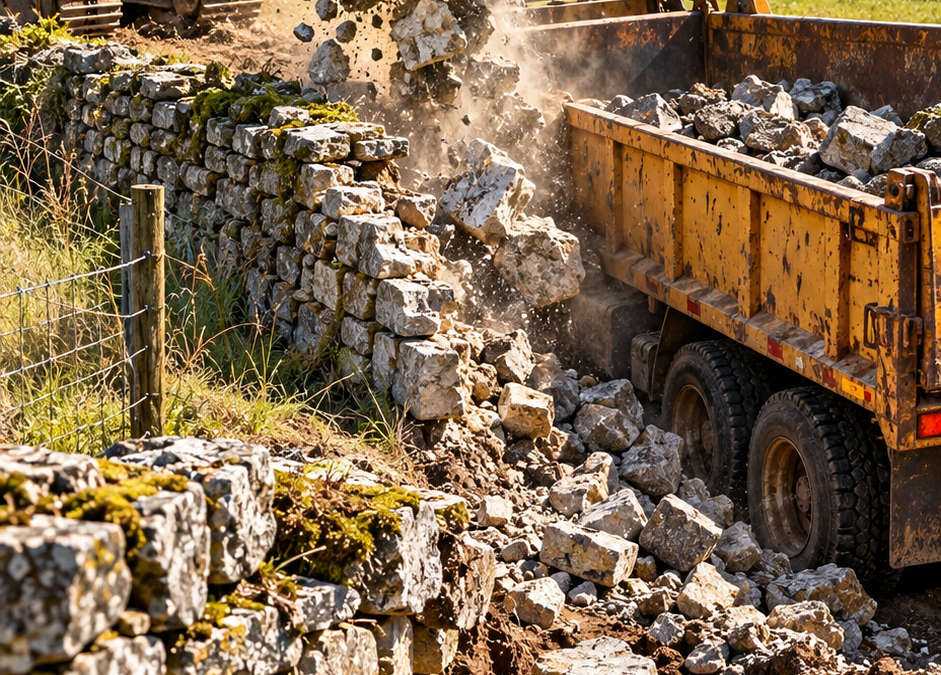
Gray fieldstone rolled into a yellow dump bed in clouds of pale dust.
For a second, I could not make sense of what I was seeing.
That wall had always been there.
Not tall. Not grand. Not even particularly straight. It ran along the lower edge of my property, never more than four feet high, dry-stacked from local limestone my grandfather had reset every spring. It was the kind of wall people drove past without noticing. Some stones leaned. Some had shifted. Grass grew through sections. Moss took the north face in wet years.
But it had stood through my grandfather’s life, my father’s, and most of mine.
Now an excavator was ripping it open like junk.
“Shut it down!” I yelled.
The operator looked toward the access lane instead of at me.
That was when I saw Vivian Mercer.
No relation, thank God.
She stood beside the machine in a bright red pantsuit, brown hair pulled into a high ponytail, one hand raised toward the operator like she was conducting traffic. Behind her, four residents from Brier Glenn watched from the subdivision side of my fence.
Vivian lowered her hand.
The excavator stopped.
“Grant,” she called, “you need to stay clear of the equipment.”
I walked straight toward the broken wall.
“The equipment is on my land.”
A section almost thirty feet long was already gone.
I could see the darker impressions where stones had rested against each other for decades. One surviving end leaned slightly toward the pasture, exactly the way it had when my grandfather Henry showed me how to reset frost-heaved stones when I was sixteen.
Vivian pointed toward that leaning section.
“That is precisely the problem. Loose stone. Unstable sections. Children living within walking distance.”
“The board classified it as unsafe.”
“Your board does not own this ground.”
Her expression barely changed.
“We are creating emergency and service access between Brier Glenn and the county road. This wall obstructs it.”
I looked past her.
With the section removed, I could suddenly see a straight path from the subdivision pavement across my lower field toward County Route 18.
It looked convenient.
Too convenient.
“Who gave you permission?”
“The contractor was given the board’s emergency access authorization.”
“From whom?”
“The HOA board.”
“The HOA board has no authority here.”
“We have been advised this corridor historically served shared access.”
“Advised by who?”
She exhaled through her nose.
“I am not debating property records beside an excavator.”
“Then get the excavator off my property.”
One of the Brier Glenn residents shifted backward.
Vivian glanced at him, then returned her eyes to me.
“The remaining unstable section will eventually have to be addressed.”
“Not today.”
For several seconds, the only sound was the diesel engine idling.
Then Vivian gave the operator a short downward motion with her hand.
He killed the engine.
I climbed onto the torn edge of the wall.
Something white coated the underside of one stone, fine as chalk. I rubbed it between my fingers. Behind the wall, the ground dipped so gently most people would never notice. Old wagon ruts came down from my barn, curved west, and stopped before the stones.
They had always stopped there.
My grandfather had made sure of that.
I could hear his voice from thirty years earlier, irritated because I had tried to drive his old Ford tractor across the lower pasture.
“Wheels stay west of the stones, Grant.”
I had been sixteen then, full of impatience and convinced every old rule had been invented by someone who liked being obeyed. I thought it was just another thing my grandfather said because he had inherited it from somebody even older.
Vivian stepped closer, but stayed on the cleared lane.
“You are protecting a crumbling pile of rocks.”
I looked at the stones scattered beneath the excavator bucket.
“My grandfather wouldn’t even let tractors cross here.”
She followed my gaze toward the open strip.
“Then your grandfather wasted a perfectly good road.”
She turned and walked back toward Brier Glenn.
The crew packed up twenty minutes later. I stayed until the dump truck disappeared, then began pulling salvageable stones away from the tire tracks by hand.
By sunset, my palms were raw and half the wall was still missing.
I stood in the opening and looked from the subdivision to the county road.
For the first time in eighty years, nothing stood between them.
And I still did not understand why that bothered me more than the stones they had taken.
The next morning, I was resetting a limestone corner on the Haskins barn when my phone buzzed against the tailgate.
I had mortar on my gloves and ignored it until the second call. By then, the September air was already warming, carrying the smell of cut hay through the open barn doors.
The message was from my neighbor, Melissa Crane.
Three words.
They’re using it.
I finished seating the stone before I drove home.
That was the kind of work I had done for twenty-six years. Old things deserve care even when newer trouble is waiting. My own place sat on forty-three acres outside town, with a weathered workshop behind the house and Brier Glenn pressing against the eastern pasture where cornfields had stood when I was a kid.
The old wall ran along the lower edge.
My grandfather Henry repaired it every spring. He never made it prettier. He replaced what winter moved and left everything else alone. When I was nineteen, I once suggested mortaring the loose sections.
He looked at me like I had offered to paint the trees.
“It moves because it needs to,” he said.
I remembered that when I reached the lower field and saw a white HOA maintenance cart rolling through the opening Vivian’s crew had made.
Its tires bumped across the dirt, passed between the surviving ends of the wall, and continued toward County Route 18.
Nothing happened.
No wheel sank.
No ground cracked.
The driver waved at me.
I did not wave back.
That afternoon, another car crossed.
The following morning, a landscaping pickup used the same route. I stood beside my workshop with a tape measure hanging from my belt and watched it disappear toward the subdivision.
Vivian arrived around noon.
She stepped from a black SUV, her red pantsuit sharp against the dusty field, and looked at the tire tracks as if they were numbers proving an equation.
“Three days,” she said.
“It has been less than forty-eight hours.”
“And your road works perfectly.”
“It is not a road.”
She pointed at the opening.
“It connects two roads. Vehicles can cross it. I am not sure what else you would call it.”
I crouched beside one of the old wagon ruts.
It came down from the barn, shallow under the grass, then curved west twenty feet before reaching the wall. I had followed that bend thousands of times without noticing it.
“My family never drove through here.”
“Your family also built a stone wall where one wasn’t needed.”
I stood.
“You still don’t know that.”
“Neither do you.”
That landed because she was right.
I knew how to read bad masonry. I knew frost damage, settlement, drainage pressure, failed footings. But I could not tell her why Henry had guarded this particular strip like crossing it would insult the dead.
That evening, I walked the wall with his old masonry hammer.
The remaining stones were ordinary local limestone, dry-stacked without mortar. I lifted one loose capstone and found the same pale powder underneath that I had noticed after the demolition. I brushed it away with my thumb, set the stone back, and kept walking.
Near the opening, I found an old depression hidden beneath the grass.
It crossed the new tire tracks at an angle and disappeared toward the woods.
I dropped a fist-sized stone onto the bare dirt.
The sound was wrong.
Not dramatic.
Just flatter at first, then a faint hollow note underneath.
I dropped it again.
Same sound.
Headlights swept across the field behind me. Another HOA car rolled through the opening, tires crunching over fresh gravel someone had already spread without asking me.
I stepped aside and watched it pass safely.
The driver disappeared toward the county road.
The ground stayed still.
Maybe Vivian was right.
Maybe Henry had inherited a useless rule and handed it to me. Maybe I was protecting a pile of old stones because they belonged to my memory, not because they served any purpose.
But when I looked down, those old wagon ruts still curved away before reaching the stones.
Eighty years of wheels had come that far and chosen not to cross.
Now, because one woman had removed thirty feet of rock, everyone had started taking the shortcut.
By the end of that week, the shortcut had become routine.
I heard tires before breakfast. I watched landscaping pickups cross while I loaded stone into my work truck. I came home Friday to find a delivery van bouncing through the opening as if the lane had existed for years.
Every successful trip made my objection look smaller.
Vivian understood that.
Saturday morning, she brought half a dozen residents down to the boundary while a maintenance crew spread another thin layer of gravel across the dirt. She wore the same red pantsuit, spotless despite the dust, and walked beside the lane with one hand extended toward it.
“This takes service traffic away from our main entrance,” she told them. “It is safer, faster, and already working.”
Melissa Crane stood near the back with her arms folded.
I stayed on my side of the surviving wall and watched a landscaping truck come through. Its suspension rocked once over the shallow depression I had found, then leveled out.
Vivian looked directly at me.
“Another successful crossing.”
“That is not the same as knowing what you are driving over.”
“And what exactly are we driving over, Grant?”
I had no answer I could prove.
The hollow note from a dropped stone was not an engineering report. My grandfather’s rule was not one either.
Vivian waited long enough for everyone to notice my silence.
“That is what I thought.”
She turned back to the residents.
By Monday, trash service was using the shortcut.
Tuesday brought two delivery vans. The wheel tracks deepened until the grass between them stood like a narrow green ridge.
I walked those tracks after work, boots pressing into dry soil warmed by the afternoon sun. Where the lane crossed the old depression, the dirt felt softer under my heel.
I crouched and pushed my fingers into it.
No cavity opened.
No dramatic crack appeared.
Just compacted soil over something I could not read.
I hated uncertainty more than I hated Vivian.
Stone usually told you what was wrong. A bulging wall carried weight badly. White staining meant water had traveled somewhere. A foundation crack had direction.
This ground gave me nothing except a bad sound and a dead man’s rule.
Wednesday afternoon, Vivian returned with two board members and orange marking flags.
She planted one beside the lane, then another farther toward the county road.
“What are those for?” I asked.
“Surveying the permanent access.”
“Permanent?”
“The board is considering formalizing the corridor.”
I stepped between her and the next flag.
“No.”
Her chin lifted.
“You have watched vehicles use this route all week.”
“Light vehicles. Without incident.”
“Without incident is not the same thing as safe.”
A small smile touched one corner of her mouth.
“Interesting. That is exactly what you told me I could not say about your wall.”
She had me there.
I looked past her toward the opening. The remaining stone ends stood twenty-five feet apart now, useless as a barrier. Beyond them, the fresh tracks made the route look established.
That was the part I had not understood when the excavator arrived.
Vivian had not needed to prove the wall was dangerous forever. She only needed to remove enough of it for people to start behaving as if the road was real.
Once tires made tracks, the tracks became an argument.
“You don’t have permission to build a road across my land,” I said.
“Then show me where the historical access ends.”
“It ends at the wall.”
“A wall you cannot explain.”
She pulled the last orange flag from her hand and pressed it into the soil.
I watched the metal shaft sink farther than I expected before resistance caught it.
Vivian did not notice.
She was already walking back toward Brier Glenn.
I waited until everyone left, then pulled the flag out.
The bottom six inches were dusted with the same pale white powder I had found beneath the stones.
I rubbed it between my fingers and looked toward the old wagon ruts.
They curved west.
The new tracks went straight.
For the first time, I stopped thinking about how to rebuild the wall.
I started thinking about how to stop the weight.
The concrete barriers arrived before sunrise on Thursday.
I unloaded them from my flatbed one at a time with the skid steer, setting three across the section of lane that crossed ground I knew was inside my property line. Each block weighed close to two thousand pounds. I left a gap wide enough for a maintenance cart, then chained a small reflector post between the last barrier and the surviving end of the wall.
By seven, my shirt was damp between my shoulder blades, and limestone dust had turned the toes of my boots gray.
Vivian showed up twenty minutes later.
Her SUV stopped hard on Brier Glenn’s side. She stepped out, stared at the barriers, then walked toward me with her jaw set.
“Move them.”
I shut off the skid steer.
The sudden silence made the cicadas sound twice as loud.
“Carts can still pass.”
“Service trucks need access.”
“They have access. County Route 18 to my ridge road.”
“That is almost a mile longer.”
“I’ll maintain it.”
She looked at the barriers again.
“So now you are deliberately interfering with an HOA safety route.”
“I am keeping heavy vehicles off this strip until somebody can tell me what is under it.”
“Based on what?”
I rubbed the pale dust from an old wall stone between my thumb and forefinger.
I could have told her about the hollow sound, the wagon ruts, my grandfather standing there in work boots, and the way the flag sank too deep. I knew exactly how it would sound.
“Based on the fact that I don’t know.”
Vivian gave a short laugh.
“That is your argument?”
“It is enough for me not to gamble with somebody else’s truck.”
Her eyes narrowed.
“You don’t get to stop progress because your grandfather had superstitions.”
That one hit harder than I expected.
I stepped away before my temper could answer for me.
By noon, I had graded the first quarter mile of the ridge road myself. The old surface was washboarded and choked with weeds. I dragged it smooth, hauled two loads of crushed stone from Miller’s quarry, and canceled a chimney job I had already postponed once.
Friday cost me another job.
Saturday cost me a hydraulic hose when the skid steer caught a buried stump.
But service trucks started using the ridge.
They complained about the extra twelve minutes.
Nobody got blocked for three days.
The lower strip stayed quiet.
Then Monday morning, I heard a diesel engine and the rhythmic thump of a compactor.
I drove down and found a crew spreading gravel beyond my barriers from the Brier Glenn side. Orange stakes marked a lane twenty feet wide. Vivian stood beside a board member while a small roller pressed the fresh stone flat.
“What are you doing?” I called.
“Improving the portion of the corridor the board recognizes as shared access.”
“I gave you another road.”
“You gave us an inconvenient detour.”
The roller passed over the shallow depression.
For half a second, I saw the gravel shiver behind its rear drum.
Then it settled smooth.
I walked closer and pointed at the machine.
“Keep that off my side.”
Vivian folded her arms.
“Your barriers already make that clear.”
I looked at the new lane. It was clean, level, professional. Exactly the kind of surface people trusted without asking what held it up.
“No heavy trucks,” I said. “Not through that opening.”
“You still cannot tell me why.”
“No,” I said, looking directly at her. “But until I can, I am done pretending that means there is nothing wrong.”
Vivian turned toward the crew.
“Finish the section.”
The roller moved again.
I did not try to stop it.
Instead, I climbed into my truck and drove back toward the ridge.
If Vivian wanted to fight over the wall, she could have it without me.
The wall was already half gone.
What mattered now was keeping weight somewhere else.
That afternoon, I ordered another forty tons of crushed stone for the ridge road and put it on my own account. I did not know what I was protecting yet. I only knew I was finally protecting the right thing.
The rain came Tuesday night.
Hard enough to wake me at 2:17.
Water hammered the metal roof over my bedroom, and thunder rolled across the ridge. By daylight, the storm had moved east, leaving the fields dark and shining.
I pulled on my boots and drove straight to the lower pasture.
The ridge road had held. Water ran clean through the shallow ditches I had cut along both shoulders, exactly where I wanted it.
Then I reached the old wall.
The new gravel lane looked different.
A section near the depression had sagged, maybe two inches. Barely enough to notice unless you knew yesterday’s grade.
Fine white material had washed into a narrow line along the downhill edge.
I crouched and touched it.
Chalky. Cold. The same powder from beneath the stones.
Melissa walked over from her property, carrying coffee in a steel mug.
“That wasn’t there yesterday.”
“No.”
I followed the white trail toward the woods.
Twenty yards in, it disappeared beneath blackberry vines and a fallen cedar. Melissa and I pulled the branches aside and found a shallow stone-lined channel running downhill.
Not a pipe.
Not a ditch either.
The sides were carefully fitted limestone, old enough that roots had grown between the joints.
Melissa stared at it.
“Your grandfather built this?”
“Too old.”
I cleared leaves from another three feet and felt my stomach tighten.
The channel pointed directly toward the wall.
By nine, Vivian was there with the paving contractor. She saw the sag and dismissed it before I finished explaining.
“Storm settlement.”
“Maybe.”
“Then why are we discussing it?”
“Because your roller compacted the surface over something designed to move water.”
She glanced toward the stone channel.
“You don’t know that.”
“Not yet.”
The contractor, a broad man named Eddie Sloan, stepped off the gravel and studied the depression. He drove a steel probe down near the edge.
It sank almost eighteen inches before scraping stone.
His expression changed.
Vivian noticed.
“Problem?”
Eddie pulled the probe free. Mud coated the lower half.
“I want to know what is under this before putting loaded dump trucks across it.”
Vivian’s face tightened.
“We are not building an interstate.”
“Weight does not care what you call the road.”
She looked at me, then at the barriers farther west.
“Fine. Light traffic only until we inspect it.”
It felt like a win.
Small, but real.
For the first time, she had backed away from heavier vehicles.
I spent the afternoon clearing the stone channel by hand. It widened as it approached the old wall, then vanished beneath the demolished section.
At sunset, I found something else.
Three flat limestone slabs set side by side below grade. Their edges had been polished smooth by decades of water.
The wall had not merely crossed the drainage path.
It had been built into it.
Wednesday stayed dry.
Thursday stayed dry.
By Friday morning, the sag had stopped growing.
Vivian sent an email allowing the temporary weight restriction, and I almost believed we had bought enough time.
Then at 4:40 that afternoon, I heard air brakes from the direction of Brier Glenn.
I ran outside.
A tandem dump truck loaded with gravel was waiting at the opening. Vivian stood beside it, one hand raised toward the driver.
“You agreed to light traffic!” I shouted.
She turned.
“The restriction was temporary.”
“Nothing changed underground.”
“The surface stabilized.”
Eddie Sloan was not there.
This was another contractor.
The driver leaned from his window.
“Ma’am, you want me through or not?”
Vivian pointed straight down the new lane.
“Go.”
The truck eased forward.
Its front axle crossed the depression.
Then the rear wheels reached it.
I heard a dull crack beneath the engine noise.
Not stone breaking above ground.
Something deeper.
The truck stopped.
One rear tire had dropped several inches into the gravel.
Water, brown and sudden, began seeping around the tread.
Vivian’s hand slowly lowered.
I walked toward the truck, watching muddy water spread across the lane where eighty years of wagon tracks had always turned away.
The wall had never been keeping people out.
It had been keeping weight off something the town once understood.
The driver killed the engine and climbed down without waiting for Vivian.
Muddy water continued bubbling through the gravel around the sunken rear tire, carrying pale limestone grit in thin ribbons toward the downhill grass.
I walked to the edge of the depression and held up one hand.
“Nobody moves that truck.”
Vivian came toward me fast.
“It stuck six inches, Grant. We pull it out and repair the base.”
“If the base is what failed—”
The driver looked beneath his truck, then shook his head.
“I’m not moving until somebody checks that ground.”
That ended Vivian’s argument with him.
She pulled out her phone and walked away.
I called Eddie Sloan.
He arrived forty minutes later with two men, a compact excavator, and a pump. I paid for the emergency call myself.
We unloaded the truck first, transferring gravel into smaller equipment from firm ground. Only after the weight was gone did a recovery truck ease it backward.
The tire came free with a wet sucking sound.
Beneath it was a dark opening about three feet across.
Eddie crouched beside me.
“Do not put your weight on that edge.”
We scraped gravel away from the opening with hand tools.
Six inches down, the packed roadbed gave way to fitted limestone. The stones formed a shallow arch over a narrow underground channel. One section had cracked under the truck. Water moved beneath it fast enough to make the broken pieces tremble.
Melissa stood behind the barrier with three neighbors.
Vivian remained near her SUV, arms folded tight across her red jacket.
“So it’s an old drain,” she said.
Eddie looked up.
“It is more than a ditch.”
He pointed downhill.
“See the grade? This carries runoff under the terrace.”
I followed the line with my eyes toward Brier Glenn.
The subdivision sat lower than my field, with its first row of homes beyond a broad grassy basin.
Something clicked into place.
“Where does it discharge?” Eddie asked.
We traced the channel downhill until brush swallowed it near the property corner. There, under honeysuckle and eighty years of soil, we found another stone opening. Water spilled through it into a wide swale aimed away from the homes.
Melissa stared back toward the demolished wall.
“So why put a wall over the top?”
I looked at the surviving stones, then at the curved wagon ruts.
“To make sure nobody drove across the weak section.”
The wall had not been the drainage structure.
It had been the guardrail.
That was the first real twist.
And it changed my strategy immediately.
I stopped trying to prove the wall deserved to survive because it was old. I needed the drainage system working before the next storm.
The weather report gave us less than forty-eight hours.
Eddie agreed to help stabilize the broken arch if I covered materials.
I called my customers and canceled the rest of my week.
Then Vivian stepped between us and the excavator.
“You are not rebuilding anything inside the access corridor.”
“I am repairing the channel your truck broke.”
“The board has not authorized excavation.”
I stared at her.
“Your board authorized a loaded dump truck over an unknown void after your own contractor warned you.”
Her face hardened.
“And now we know what is there.”
“Exactly.”
She looked toward the houses, then back at me.
“You will wait until the board reviews it.”
Thunder rolled somewhere west, low and distant.
Eddie checked the sky.
I smelled rain before I felt the first cool gust across the field.
Vivian was still fighting over who controlled the ground.
I was looking downhill at thirty-two homes sitting below a drainage system we had just learned could no longer carry what was coming.
The first drops hit the dust like dark coins.
Eddie looked at me, then at the broken arch.
“If that forecast is right, this needs to be open tonight.”
Vivian stepped closer.
“Nobody touches it until the board approves the work.”
I pulled out my phone, not to call a lawyer, but to check the radar.
A red band stretched across the county, moving east.
“How long does your board need?”
“Emergency meeting tomorrow morning.”
Eddie gave a dry laugh.
“Storm gets here before midnight.”
Vivian pointed toward his excavator.
“Move that machine off the corridor.”
For a second, I almost did what I had done all week.
Argue about ownership.
Then I looked downhill at Brier Glenn and changed the question.
“Eddie, can we route the water around the broken section without rebuilding it?”
He studied the slope.
“Temporary diversion. Maybe. We cut from the upper swale to your west pasture and keep heavy equipment away from the arch.”
“Do it.”
Vivian’s head snapped toward me.
“You cannot redirect runoff toward the subdivision.”
“I’m redirecting it away from the subdivision.”
The west pasture belonged entirely to me and fell toward an empty hay field before reaching a county drainage ditch.
It would ruin several acres if the rain came hard enough.
I knew that before I gave Eddie the order.
By six, the excavator was working fifty yards uphill, nowhere near Vivian’s claimed corridor. I ran the skid steer behind it, shaping a shallow emergency channel through my own pasture. Wet dirt packed beneath the tires. The air smelled like clay and cut grass.
Melissa and two neighbors dragged branches away from the old stone outlet while Eddie’s crew cleared debris by hand.
Vivian stood under an umbrella near her SUV, making calls.
At 7:30, she came back with two private security vehicles.
The guards did not threaten anyone.
They simply parked across the easiest equipment approach from Brier Glenn.
“You have made your point,” I told her.
“No,” she said. “I am protecting the association from unauthorized work.”
“If you block the work and those homes flood, that association will have bigger problems than my pasture.”
“If you cut a drainage channel and flood somebody else’s property, the liability lands on us.”
“Not from my land, it doesn’t. Eddie is routing it west across my pasture into the county ditch.”
She looked toward the excavator.
“You do not have an approved drainage plan.”
“I have a storm coming and thirty-two houses downhill.”
I pointed toward the security vehicles.
“So keep them out of my pasture.”
Rain began falling steadily.
Water collected in the old channel above the broken arch, rising against the collapsed stones. Our diversion was almost finished, but not connected.
Eddie shouted over the excavator.
“Twenty minutes!”
We had ten.
The first surge came down from the ridge as a brown sheet, filling the stone-lined channel faster than I expected. It struck the damaged arch and backed up. Water spread across the gravel lane, then started sliding downhill toward the subdivision.
Vivian finally stopped talking.
One of the security guards turned and stared at the homes below.
“That’s going toward us.”
“Yes,” I said.
Melissa pointed uphill.
“Grant!”
Eddie had broken through the final strip of earth.
The temporary channel opened with a rush.
Water swung west, pouring into my pasture in a widening muddy ribbon. It flattened grass, swallowed two fence posts, and tore across the corner of the hay field.
I watched months of work disappear under brown water.
But the flow across the HOA lane began dropping.
Vivian stood beside me, rain running from her ponytail onto the shoulders of her red jacket.
“You did this without authorization.”
I looked at the water cutting through my land.
“I paid for it too.”
By midnight, the diversion was carrying most of the runoff safely west.
Brier Glenn stayed dry.
For about six hours, I thought that was the victory.
At dawn, the rain weakened.
I walked the damaged pasture with Eddie, exhausted enough that my hands shook when I lifted my coffee. Near the old stone outlet, Melissa called my name.
She was kneeling beside a section of earth the storm had washed clean.
Set into the bank was a rectangular limestone marker.
Not decorative.
Not part of the wall.
Eighty years of dirt had hidden most of its face, but the carved county seal was still visible. Beneath it were two words and a date.
FLOOD EASEMENT
1946
Eddie looked from the marker to the broken wall, then downhill toward Brier Glenn.
Vivian had spent a week insisting the old stones were blocking progress.
The storm had just uncovered proof that the town had once placed them there to protect the very land her HOA now controlled.
By eight that morning, the storm had thinned to a cold mist, and the limestone marker sat exposed in the washed bank like something the ground had finally decided to return.
I cleaned mud from the carved seal with my thumb while Melissa photographed its position from several angles.
I did not celebrate.
A stone marker could explain the past, but it could not repair the broken channel or the pasture I had sacrificed overnight.
Eddie stood over the opening with his hands on his hips.
“If the easement still follows this drainage line, nobody should have been compacting a road across it.”
“Still a big if,” I said.
I called the county public works office and gave them the marker date, location, and what had happened during the storm.
Then I did the harder thing.
I left the wall alone.
No rebuilding.
No dramatic showdown.
Eddie and I spent the morning strengthening the temporary diversion because another band of rain was forecast that evening.
Around ten, Vivian arrived with three board members.
Her red pantsuit had been replaced by another one just as sharp. She walked straight past the muddy tire tracks toward the marker.
“This proves nothing about the wall,” she said.
“I didn’t say it did.”
That stopped her for half a beat.
“Then remove your barriers and let us restore the lane.”
“No heavy traffic until the drainage is stabilized.”
“You do not have authority over association access.”
“You keep calling it association access.”
I pointed toward the curved wagon ruts still visible beyond the surviving wall.
“But every old route turns away from this spot.”
Vivian looked toward the board members.
“We are not debating folklore again.”
“Neither am I.”
A county pickup arrived twenty minutes later.
The man who stepped out introduced himself as Daniel Ruiz from Public Works.
He did not arrive like a rescuer. He did not order anyone around. He walked the ground.
He measured the exposed channel, checked the outlet, photographed the marker, and asked Eddie where the truck had broken through. Then he stood downhill and studied the slope toward Brier Glenn.
“Who authorized the roadbed over this section?”
Vivian answered immediately.
“The association improved an existing access corridor.”
Ruiz looked at the fresh gravel, then at the eighty-year-old marker.
“Existing where?”
Nobody answered.
He requested the subdivision drainage plan.
Vivian said the management office had it.
One board member, a gray-haired man named Peter Walsh, shifted uncomfortably.
“Actually,” he said, “there was something in the closing packet when the developer transferred control.”
Vivian turned toward him.
“Peter.”
He ignored her.
“A drainage reservation. I remember because the map looked strange.”
That was the moment the balance changed.
Not because we had found one magic document, but because Vivian’s own board stopped moving as a single body behind her.
Peter drove home and returned with a rolled site plan.
Ruiz spread it across the hood of his truck.
A dashed corridor followed the stone channel through my property and widened below it into the grassy basin inside Brier Glenn. The old wall sat directly across a marked no-load crossing zone.
Vivian stared at the map without speaking.
Ruiz tapped the dashed line.
“The drainage easement remained active when the subdivision was approved. The basin below is part of the same system.”
Melissa looked at Vivian.
“So the wall was protecting it.”
Ruiz shook his head slightly.
“The wall itself is not the legal protection. But its placement kept vehicles off the vulnerable crossing. Somebody understood that.”
Eighty years suddenly made sense.
Vivian’s mistake had not been removing an antique wall.
It had been converting its opening into a road after repeated warnings and then sending a loaded truck across the exact place the wall had prevented vehicles from crossing.
Peter stepped away from her.
“You told us the route was cleared.”
“It was,” Vivian said. “Based on the records available to me.”
“You had this map.”
“The board had this map.”
Peter’s face hardened.
“You are the board president.”
The remaining members went quiet.
Ruiz ordered no celebration and made no speech. He simply placed temporary county barricades at both approaches to the damaged crossing and said the drainage had to remain unobstructed pending emergency repair.
Vivian watched him close the shortcut she had spent two weeks creating.
I looked past her toward my ruined pasture.
Brown water still moved through the channel I had cut to save the homes below.
The victory did not feel clean.
It had cost me jobs, equipment repairs, forty tons of gravel, and several acres of grass. But for the first time since the excavator bit into that wall, Vivian was not deciding what happened next.
The ground was.
Three weeks later, I stood beside the same opening while a county-approved crew lifted the last broken stones from the drainage arch.
Morning light flashed off wet limestone, and the air smelled of fresh soil and diesel. This time, every machine stayed on timber mats outside the no-load zone. Eddie rebuilt the damaged section by hand with two masons, matching the old stonework instead of burying it under gravel.
The permanent solution was not mine alone.
The county restored the drainage crossing, and Brier Glenn’s board voted to abandon the shortcut entirely. My ridge road became the designated service route under a maintenance agreement that paid me for upkeep instead of pretending my land belonged to everyone.
I accepted because the alternative was proving a point while making thirty-two families drive through another preventable mess.
Vivian fought until the last vote.
She called the old restriction obsolete. She argued that the truck collapse had been an unforeseeable maintenance failure. Then Peter placed the contractor’s written warning beside the board minutes showing that Vivian had personally authorized heavy traffic after the temporary restriction.
The room went quiet.
She had not been wrong because she failed to know an eighty-year-old secret.
She had been wrong because once uncertainty appeared, she kept choosing authority over caution.
The board removed her as president that night.
Two weeks later, the association’s insurer denied coverage for the unauthorized road work, leaving the HOA to pursue Vivian under its own indemnification rules for costs tied to actions taken outside approved authority.
After the board’s counsel reviewed the authorization records, Vivian agreed to reimburse the association for the emergency grading contract she had approved without a recorded board vote.
It was not some dramatic courtroom ending.
It was signatures, invoices, and the loss of power she had treated like personal property.
The harder bill belonged to me.
My west pasture looked like someone had dragged a brown river through it. I lost most of that season’s hay, and the canceled masonry jobs did not magically come back.
On the first Saturday in October, Melissa found me resetting the wall.
I had cleaned every stone the HOA crew knocked down and stacked them by size. Some were cracked. Others still carried pale marks where they had rested against neighboring stones for decades.
“You’re putting it exactly where it was?” she asked.
“Almost.”
I set another limestone block into the bed, leaving a little more room over the channel.
“Eddie’s idea.”
She smiled.
“Your grandfather would complain.”
“My grandfather complained about free coffee.”
By noon, six Brier Glenn residents had wandered over.
Nobody brought speeches.
Peter carried stone. A teenager from the first house downhill hauled buckets of gravel. One woman, whose basement would have taken the first runoff, brought sandwiches and left them on my tailgate.
We worked until the wall stood waist high again, following the old curve across the vulnerable crossing.
Not decorative.
Not mysterious anymore.
Useful.
Near sunset, a black SUV slowed on the county road.
Vivian was behind the wheel.
She looked toward us through the open window.
For one second, our eyes met.
I did not wave.
Neither did she.
Then she drove on.
I placed the final capstone where the old wall met the grass and stepped back.
The wagon ruts still curved west, just as they had before any of us were born. Beyond the wall, the repaired stone channel carried a thin ribbon of clear water downhill toward the basin.
I finally understood why the town had kept that wall for eighty years.
It was not because people back then were sentimental about stone.
They knew something simple that we had nearly forgotten.
When the land tells you where not to put weight, you listen.
Vivian had torn down the warning because she thought removing an obstacle gave her control.
In the end, every decision she made after that only proved why the obstacle had been there.
I brushed limestone dust from my hands, climbed into my truck, and drove home by the long road.