𝗙𝗨𝗟𝗟 𝗦𝗧𝗢𝗥𝗬 The Snow Had Almost Buried the Cry I Was Never Supposed to Hear
𝗙𝗨𝗟𝗟 𝗦𝗧𝗢𝗥𝗬
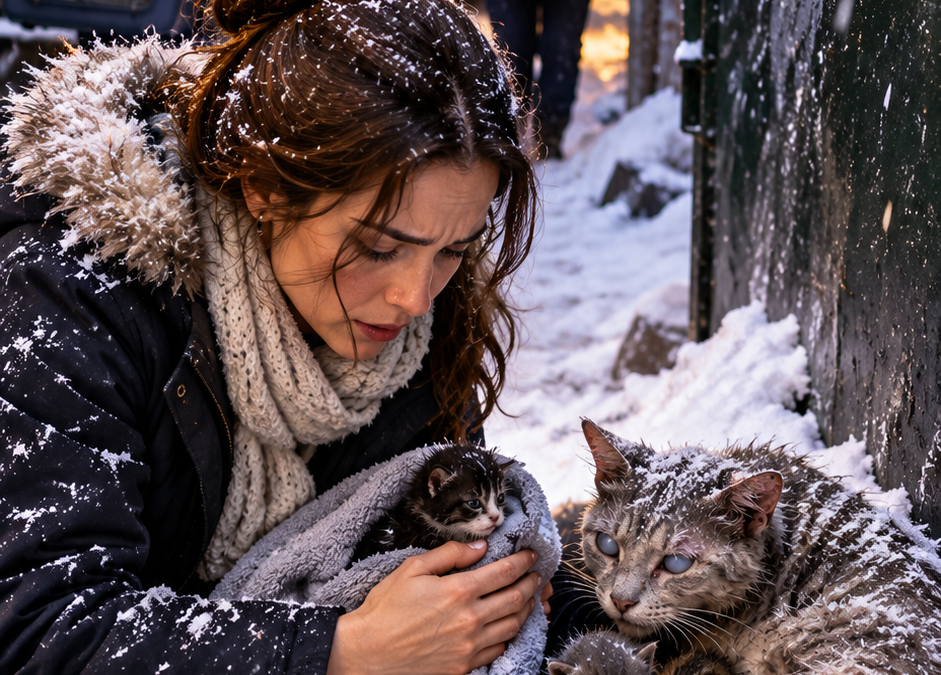
I took the second kitten next. The mother hissed again, but this time she did not strike. She lifted her head, trembling, and turned toward the sound of her baby.
“I’ve got them,” I whispered. “I’ve got them.”
The third kitten was tucked under her chest, and that one fought me with everything it had left. Tiny, furious, squeaking with outrage.
For one absurd second, I laughed.
“Your baby has opinions,” I told her.
Then the clinic van pulled up at the mouth of the alley.
Jenny jumped out first with towels and a carrier. Dr. Patel followed with a medical bag, her face already set in the focused expression she wore when worry had no time to show.
“Oh my God,” Jenny whispered.
Dr. Patel crouched beside me. “How long has she been out here?”
“I don’t know.”
“Keep the kittens inside your coat.”
Jenny unfolded a towel. “Easy, mama.”
The cat tried to stand.
Her back legs failed.
She collapsed into the snow.
That was when I saw how thin she truly was. Under the matted fur, she was bones, skin, and stubborn love.
Jenny wrapped her carefully. The cat fought for only two seconds before her head dropped.
“She’s hypothermic,” Dr. Patel said. “We need to move now.”
I rode in the back of the van with the kittens pressed to my chest while Jenny held the carrier steady. The mother cat lifted her head once when one of the kittens cried.
I leaned closer.
“They’re here,” I told her. “They’re with me.”
Her ears moved toward my voice.
At the clinic, everything became motion.
Warm towels.
Oxygen.
Heated pads.
Tiny syringes of formula.
An IV line taped to the mother cat’s leg.
Under the bright exam lights, she looked even worse. Her eyes were milky and infected. Her gums were pale. Fleas moved through the mats around her neck. A wound near her shoulder had scabbed over badly beneath dirty fur.
“How bad?” I asked.
Dr. Patel did not answer immediately.
That was how I knew.
“Severe hypothermia,” she said. “Malnutrition. Dehydration. Respiratory infection. Likely permanent damage to her eyes. The kittens are cold but responsive.”
Cold but responsive.
It sounded clinical.
It meant alive.
The mother cat lifted her head when the tabby kitten cried. Her body was too weak to move, but she tried anyway.
Dr. Patel placed a gentle hand on her side.
“Not yet,” she said. “Let us help them.”
I stood at the edge of the room, soaked and shaking, blood drying across my knuckles. My scarf lay in a wet heap on the floor. Mrs. Langley’s medicine was still in my pocket.
Jenny touched my elbow.
“Mara, you’re bleeding.”
“She thought I was taking them.”
“She was protecting them.”
“I know.”
That made it worse.
Near midnight, the black kitten faded.
One moment he was moving faintly beneath the towel.
The next, he went still.
Jenny called for Dr. Patel, and suddenly everyone was working again. Warming him. Rubbing him. A drop of sugar water on his gums. Oxygen near his face.
The mother cat heard the commotion.
She tried to rise inside the cage.
Her legs failed.
Then she made a sound I will never forget.
Not a meow.
Not a cry.
Something deeper.
A broken, desperate call from a mother too weak to reach her child.
I opened the small cage door.
Dr. Patel did not stop me.
The cat turned her blind face toward me.
I slid my hand inside.
This time, she did not strike.
She pressed her forehead against my fingers.
The same cat who had clawed me in the alley now leaned into my hand because the world had become too large for her to fight alone.
“Stay,” I whispered. “Please stay.”
Behind me, Jenny said, “Come on, little guy.”
Seconds passed.
Then the black kitten jerked.
A tiny gasp.
Another.
Jenny exhaled. “There he is.”
I covered my mouth.
The mother cat made that sound again, softer this time.
I kept my hand against her head until she slept.
By morning, all four were alive.
Barely.
But alive.
We named the mother Willow.
Not because she was graceful. She was ragged, scarred, filthy, and half-starved.
But every time someone touched her kittens, she lifted her head.
Bent, but not broken.
A willow in winter.
For the next week, Willow fought for every breath. Her infection slowly responded to medication. The kittens gained weight by grams, tiny victories recorded on a clipboard like miracles in ink.
The black kitten remained the weakest. The gray one complained about everything. The little tabby rooted blindly for milk and kicked his siblings in the face.
Willow remained blind.
Dr. Patel confirmed it on the fourth day.
“Some of the damage is old,” she said.
“How does a blind cat survive outside?”
Dr. Patel looked through the glass at Willow curled around her babies.
“By being lucky. By being careful. By finding shelter. By having people ignore her until luck runs out.”
That sentence stayed with me.
People ignore suffering when it learns to be quiet.
On the seventh day, Willow was finally strong enough to be reunited with her kittens without glass, without warming trays, without human hands constantly separating and checking them.
Jenny brought the tabby first.
Willow lifted her head before the kitten reached her.
She knew.
Her nose twitched. Her ears angled forward. When Jenny set the kitten near her paws, Willow froze for one second, then began grooming him with slow, careful strokes.
The gray kitten came next, yelling like she had been personally offended by the entire medical profession.
Willow pulled her close.
Then came the black kitten.
The one who had almost died.
He wobbled toward his mother’s chest and pressed his tiny face into her fur.
Willow lowered her head over him.
Not heavily.
Just enough to cover.
Just enough to say, mine.
I turned away because I did not want anyone to see me cry.
Jenny saw anyway.
“They know her,” she said.
“Of course they do.”
“No,” she whispered. “I mean they know she fought for them.”
I signed the foster papers that afternoon.
Technically, Willow and the kittens belonged to the rescue network until adoption. Practically, everyone knew they were coming home with me the moment it was safe.
Two weeks later, my spare room became a nursery.
I lined the floor with washable blankets, placed food and water where Willow could find them, and removed anything she might bump into. Blind cats build maps through sound, scent, texture, and memory.
When I opened the carrier, Willow did not move.
The kittens cried from the smaller carrier beside her.
Only then did she step out.
One paw.
Then another.
She bumped the water bowl, froze, sniffed it, and continued. She found the bed. The litter box. The blanket pile.
Then she found her kittens.
Only then did she lie down.
That was when I understood.
She was not afraid of the room.
She was afraid of losing them.
The weeks that followed were made of small miracles.
The tabby became Orbit because Mrs. Langley said he moved like a tiny planet. The gray kitten became Pebble because she looked like a dust bunny with opinions. The black kitten became Midnight because every survivor deserves a dramatic name.
Willow remained Willow.
She learned my voice.
Then my footsteps.
Then the sound of the food container opening.
Trust did not come to her like sunlight. It came slowly, like thawing ground.
A little less flinching.
A little more sleep.
A little longer before she pulled away.
The first time she purred, I thought the heater was broken.
It happened late one night while I sat on the floor reading. The kittens were sleeping in a pile. Willow lay near my knee, not touching me.
Then I felt it.
A faint, rough vibration.
I stopped turning the page.
She kept her head on her paws, cloudy eyes half-closed, body still.
The purr lasted maybe ten seconds.
Then it stopped.
But ten seconds was enough.
Trust had entered the room.
By spring, the kittens were healthy, wild, and ready for homes.
Orbit went to a family with two children who loved space. Pebble went to a retired teacher who said she liked opinionated women and saw no reason her cat should be different.
Midnight went to Mrs. Langley.
“I’m too old for a kitten,” she told me.
“You are.”
“And I’m taking him anyway.”
“He’ll destroy your curtains.”
“I never liked them.”
When Midnight left, Willow searched the room for him that night. She checked the bed, the carrier, the blanket pile, and the corner where he liked to wrestle the stuffed lamb.
Then she sat in the middle of the room and made a soft, questioning sound.
I sat on the floor.
“I know,” I whispered. “He’s safe.”
She turned toward my voice and walked slowly to me.
One careful step.
Then another.
Then she pressed her forehead against my knee.
I put my hand on her back.
This time, she did not flinch.
That was the night I stopped pretending I was only fostering her.
The next morning, the rescue coordinator called.
“We still don’t have an application for Willow.”
“Yes, you do,” I said.
There was silence.
Then laughter.
“I knew it.”
I filled out the adoption papers that afternoon.
When I signed my name, I thought about the alley. The snow. The weak hiss. The tiny kitten going still under the clinic lights. The way Willow had pressed her blind face into my hand when the world became too much to fight alone.
Some animals enter your life because you rescue them.
Others enter because they find the exact frozen place inside you and lie down there until it warms.
One year later, I walked past the old bakery again.
Snow was falling lightly, nothing like that storm. The new owner had placed flower boxes beneath the windows, and the alley had been cleaned. Covered bins stood near the back wall. Salt had been spread across the pavement.
There was no gray shape against the brick.
No tiny cry.
No blind mother trying to disappear beneath snow.
Still, I stopped.
For a second, I heard it again.
The sound I was never supposed to hear.
I thought about how close I had come to walking away.
One louder truck.
One stronger gust of wind.
One moment of convincing myself it was nothing.
How thin the line was between found and forgotten.
When I got home, Willow was waiting near the door.
Not because she could see me.
Because she knew my key.
My boots on the mat.
The rustle of the bakery bag in my hand.
She lifted her scarred head, cloudy eyes turned toward my voice.
“Hi, girl,” I said.
She crossed the hallway carefully and pressed her face into my shin.
I sat on the floor, and she climbed into my lap with the slow certainty of someone who had learned warmth could be trusted.
Her fur was soft now. The wound on her shoulder had healed into a small ridge. Her eyes would never clear, but they no longer looked empty to me.
They looked like hers.
I scratched behind her torn ear.
“You did it,” I whispered.
She purred.
Rough.
Uneven.
Perfect.
Outside, snow began to fall again.
Inside, the house was warm.
And every small life that had nearly vanished against that brick wall was safe somewhere.
Orbit under glow-in-the-dark planets.
Pebble on a retired teacher’s lap.
Midnight in Mrs. Langley’s laundry basket, ruining towels.
And Willow here with me, blind and scarred and alive.
The cry I almost missed had become a whole new life.
Not only for them.
For me too.








