They Adopted One Cat and Left Her Bonded Sister Behind—11 Days Later She Ran Straight Back to Cage #9
# They Adopted One Cat and Left Her Bonded Sister Behind—11 Days Later She Ran Straight Back to Cage #9
Eleven had been gone from our shelter for eleven days when her new family carried her back through the front door because she had stopped eating, stopped exploring, and spent nearly every hour staring at the entrance as if she were waiting for someone who never came.
The moment I set her down, she twisted out of my arms, sprinted past every kennel in the cat corridor, and stopped at cage #9, where Ghost—thin, exhausted, and barely responsive—slowly lifted her head.
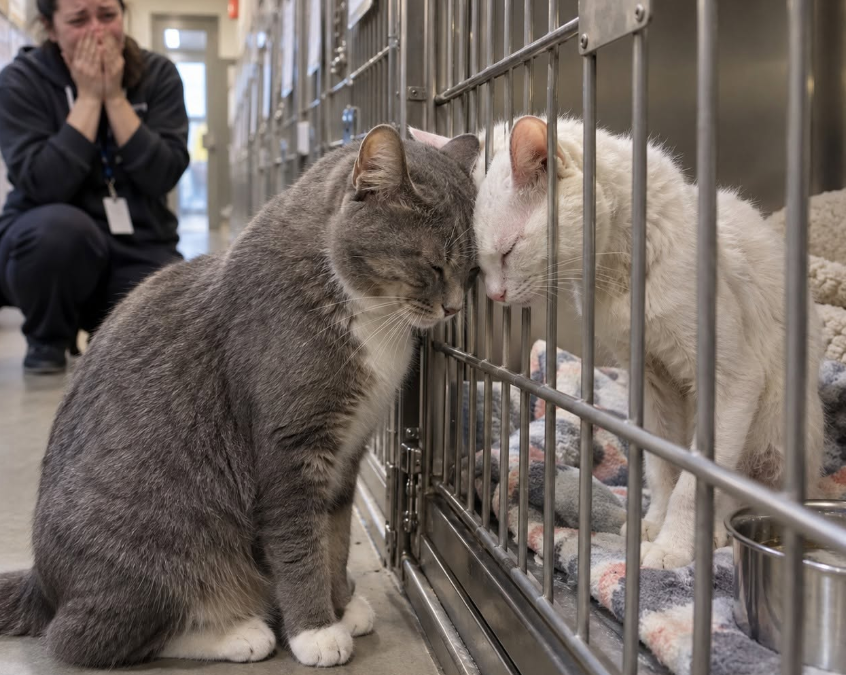
Then the two cats pressed their foreheads together through the metal bars and stayed that way for twenty silent minutes, and every person watching finally understood that we had not given Eleven a home—we had torn one home in half.
My name is Rachel Monroe.
I had worked with shelter cats for twelve years before Eleven and Ghost taught me that experience can make you confident without necessarily making you right.
We used the phrase all the time.
Bonded pair.
Two words.
Printed on kennel cards.
Typed into adoption profiles.
Written in medical notes.
Passed from staff member to staff member like a warning label.
To most visitors, bonded meant something softer.
They like each other.
They sleep together.
Maybe they groom each other.
Maybe they look cute curled in the same bed.
Preferable.
Sweet.
Not essential.
People would stand outside a kennel and say:
“I really like the gray one.”
And we would answer:
“They need to be adopted together.”
Then came the questions.
“Do they really?”
“Couldn’t they adjust?”
“Cats are independent, right?”
“What if my landlord only allows one?”
“Wouldn’t one home still be better than both staying here?”
I understood those questions.
Two cats meant more food.
More litter.
More veterinary bills.
Two carriers.
More deposits.
More space.
People had leases.
Budgets.
Other animals.
Children.
Life.
Not everybody who could responsibly adopt one cat could responsibly adopt two.
That did not make them selfish.
The problem was that we sometimes allowed those practical realities to blur the animal reality sitting right in front of us.
Eleven and Ghost arrived on a brutally hot July afternoon.
Animal control officer Mark Vasquez brought them in.
He walked through the intake door carrying one carrier and said:
“You’re going to want the big cage.”
I looked inside.
For a second, I thought there was only one cat.
Two bodies were pressed so tightly together that they overlapped.
Gray female slightly on top.
White female underneath.
Neither moved away when the carrier shifted.
“How’d you find them?”
“Property owner was clearing a collapsed shed.”
Mark wiped sweat from his forehead.
“Lifted a sheet of roofing and thought he found one dead cat.”
My stomach tightened.
“Then?”
“One head came up.”
He paused.
“Then the second.”
That image never left me.
July heat.
Rotten wood.
Rusty roofing.
Two cats surviving beneath debris, pressed so closely together that someone thought they were one animal.
They were both about four years old.
No collars.
No chips.
No owner located.
Minor dehydration.
Fleas.
Small cuts.
Otherwise healthier than they had any right to be.
We had no idea where they came from.
No idea whether they were sisters.
Mother and daughter.
Unrelated cats who found each other.
Whatever they were biologically, they had survived together.
Our intake protocol required separate examinations.
So we placed them in adjoining cages.
That lasted fifty-three minutes.
I know because I looked at the clock later.
The gray cat flattened herself against the divider.
Not hiding.
Not pacing.
Just pressing every possible inch of her body against the metal wall separating her from the white cat.
The white cat did the opposite.
She paced.
Front.
Back.
Front.
Back.
Then she began vocalizing.
I have heard cats make almost every sound imaginable.
Pain.
Fear.
Anger.
Heat.
Demand.
Confusion.
Loneliness.
This sound was different.
Low.
Drawn out.
Repeated.
Not a scream.
Not quite a howl.
Calling.
That was the only word that fit.
The gray cat stopped eating.
The white cat never started.
We pushed their food bowls closer to the divider.
Nothing.
I crouched beside the white one.
“Your friend’s right there.”
She barely looked at me.
Pressed her face toward the metal instead.
Another long call.
Dr. Patel finished their examinations.
Nothing contagious.
Nothing requiring isolation.
I pointed toward the untouched food.
“Can we put them together?”
He looked at both cats.
“Yes.”
We opened the connecting panel between the two large cages.
The white cat moved first.
Straight through.
The gray cat stood.
They touched noses.
Then the gray one began grooming the white one’s face immediately.
Forehead.
Ear.
Cheek.
Slow strokes.
The white cat closed her eyes.
Lay down.
Put her head across the gray cat’s back.
Less than ten minutes later, both were eating from the same plate.
Dr. Patel watched.
“Well.”
I looked at him.
“Subtle enough?”
“Extremely.”
They were officially marked:
BONDED PAIR.
MUST BE ADOPTED TOGETHER.
Two days later, volunteers named them.
The gray cat became Eleven because someone had been watching Stranger Things during lunch.
The white cat became Ghost, which started an argument because Ghost was not technically a Stranger Things name.
Nobody cared enough to change it.
The names stuck.
Eleven had a soft gray coat, white paws, white chest, amber-green eyes.
Slightly bolder.
She was usually the first to approach humans.
Ghost was almost entirely white.
Pale green eyes.
Longer legs.
Quieter around people.
But if Eleven disappeared from sight, Ghost became the louder one.
They did everything together.
Eat.
Sleep.
Groom.
Explore.
Even use the litter box within minutes of each other.
If visitors approached quietly, Eleven usually came forward first.
Ghost watched.
If Eleven stayed relaxed, Ghost approached.
If Eleven retreated, Ghost disappeared beside her.
At night, they slept so tangled together that volunteers occasionally had to count tails.
Their adoption profile started:
ELEVEN & GHOST — BONDED PAIR.
MUST GO HOME TOGETHER.
For five weeks, nobody adopted them.
People loved them.
That was the frustrating part.
A college student adored Ghost.
Landlord permitted one animal.
A retired couple fell in love with Eleven.
Already owned two cats.
Couldn’t add two more.
A family with two children spent nearly half an hour on the floor with both.
Kids loved them.
The father eventually asked:
“What happens if they get separated?”
I said:
“They become very distressed.”
“Would they die?”
“No.”
The word came out automatically.
And I hated it afterward.
Because people hear:
They won’t die.
And translate it into:
They’ll be fine.
So I added:
“We’ve seen both stop eating during short separations.”
He nodded.
Then:
“We really only wanted one.”
They adopted a kitten three cages down.
I watched Eleven groom Ghost after they left and had to remind myself not to resent the kitten.
Shelter work does that to you.
You begin feeling angry at happy endings because the animal you wanted chosen wasn’t.
Then you remember every animal needed one.
There was no villain in that.
Five weeks passed.
Then came August 19.
A family walked in specifically seeking an adult cat.
Diane Harper.
Her husband, Paul.
Their nine-year-old daughter, Sophie.
Quiet family.
No other pets.
Rental townhouse thirty minutes away.
Sophie sat cross-legged on the meet-and-greet-room floor.
Eleven came out first.
Rubbed against her ankle.
Sophie smiled but didn’t grab.
Good sign.
Ghost stayed behind a chair.
Ten minutes later, she came out too.
Sophie whispered:
“They’re sisters?”
“We don’t know.”
“They act like sisters.”
“Yes.”
They stayed almost an hour.
The kind of meeting that makes shelter staff start imagining adoption paperwork before anybody asks.
Then Diane said:
“We can only take one.”
My stomach dropped.
“Our landlord approved one cat.”
I explained everything.
Carefully.
Not a sales pitch.
Not guilt.
Facts.
Separated at intake.
Stopped eating.
Calling.
Immediate improvement when reunited.
Sleeping together.
Grooming.
Ghost becoming distressed when Eleven disappeared.
Diane listened.
Paul asked questions.
Sophie looked increasingly unhappy.
“Can we ask our landlord?”
“We already did,” Diane said.
“One animal.”
Sophie pointed toward Eleven.
“If we have to choose…”
I stopped her gently.
“I don’t recommend choosing.”
Diane looked at me.
“But they’ve already been here five weeks.”
“Yes.”
“They need homes.”
“Yes.”
“If we take one, isn’t that better than both staying in a shelter?”
There it was.
The question that shelter workers wrestle with constantly.
Perfect versus possible.
Long-term kennel stress versus separation stress.
An actual family versus waiting for a hypothetical family willing to take both.
We discussed it.
I wish I could say we refused immediately.
We didn’t.
Another staff member argued that Eleven seemed slightly more independent.
Ghost displayed more obvious separation calling.
Maybe Eleven could adapt.
That reasoning bothered me.
But I understood it.
Dr. Patel was called.
He said:
“If you split them, tell the adopter clearly this may fail.”
Diane understood.
She seemed kind.
Responsible.
Willing to return Eleven if severe distress developed.
We documented everything.
I still felt wrong.
When I signed the adoption paperwork, my pen paused above the line.
Sophie noticed.
“You don’t want us to take her.”
Children notice hesitation adults politely ignore.
“I want Eleven to have a good home.”
“We’ll love her.”
“I believe you.”
That was true.
Then I looked through the glass toward Ghost.
“She may miss Ghost more than we expect.”
Sophie went to cage #9.
Put two fingers through the safe opening.
“I’m sorry.”
Ghost sniffed them.
Eleven went into the carrier.
At the shelter entrance, she began vocalizing.
Soft.
Searching.
From down the hall, Ghost answered.
One long call.
Eleven froze inside the carrier.
Diane looked at me.
“That’s Ghost?”
“Yes.”
Sophie started crying.
Paul shifted uncomfortably.
“We can still stop.”
Every part of me wanted to say:
Yes.
Stop.
Instead, because I had already helped approve the placement, I said:
“Take her home and monitor closely.”
That sentence followed me for eleven days.
The moment Eleven disappeared through the shelter’s front door, Ghost walked to the bars of cage #9.
Sat.
Faced the hallway.
Dinner arrived.
Untouched.
I told myself:
Adjustment.
Morning.
Still untouched.
Wet food.
Nothing.
Tuna water.
Nothing.
Warm chicken.
Nothing.
Ghost did not hide.
That made it worse.
A frightened cat often hides.
Ghost waited.
Every sound from the hallway made her head lift.
Footsteps.
Carrier door.
Voices.
Then her head lowered again.
Day two.
Minimal water.
No meaningful food.
Dr. Patel started supportive care.
Fluids.
Appetite stimulant.
Exam.
No physical explanation.
I asked:
“What do you think?”
“Stress.”
“Separation?”
“Most likely.”
I called Diane.
“How’s Eleven?”
Silence.
My stomach tightened.
“Not good.”
“What’s happening?”
“She won’t eat.”
I closed my eyes.
“How long?”
“Since yesterday.”
“Nothing?”
“Maybe a few licks.”
“Where is she?”
Another pause.
“Beside the front door.”
“What do you mean?”
“She sits there.”
“All day?”
“Almost.”
Diane sounded exhausted.
“She doesn’t explore. Doesn’t play. Sophie bought toys. We got a heated bed. Different food. She just sits facing the door.”
I looked down the hallway toward Ghost.
Same posture.
Different building.
Same wait.
“Bring her back.”
Diane hesitated.
“We have a vet appointment tomorrow.”
“Good.”
“If she’s medically okay—”
“Bring her back.”
Her voice dropped.
“You think this is Ghost.”
“Yes.”
I stopped trying to protect everyone’s feelings.
“I think they’re doing the same thing.”
That night Ghost ate two teaspoons after medication.
We celebrated like she had finished an entire steak.
Then she returned to the bars.
Day three.
Same.
Day four.
Ghost’s coat lost some shine.
She stopped grooming normally.
White fur clumped near her shoulders.
Her weight dropped.
We weighed her every morning.
At Diane’s house, Eleven was losing weight too.
Diane sent photographs.
Morning:
Eleven beside beige front door.
Evening:
Same spot.
Night:
Same.
One picture showed a new plush bed placed beside her.
Unused.
Another showed expensive prescription food.
Untouched.
Sophie sat beside her sometimes.
Eleven allowed petting.
But kept looking toward the door.
Diane texted me:
She’s not afraid of us. She just seems like she’s waiting for permission to leave.
I read that sentence three times.
Day five.
After closing, I sat outside Ghost’s kennel.
“You know she isn’t coming down that hall tonight.”
Ghost stared past me.
“You have to eat.”
Nothing.
I put two fingers close to the bars.
Ghost came forward.
Not for me.
Closer to the exit.
For twelve years, I had warned volunteers about anthropomorphism.
Don’t assign motives too confidently.
Don’t assume a cat is “angry” when she may be frightened.
Don’t assume an animal is “jealous” because behavior changed.
Use observation.
Use evidence.
Now every part of me wanted to reduce all those clinical words into one sentence.
She misses her.
Maybe the proper terms were attachment disruption.
Loss of social buffering.
Stress response.
Loss of familiar scent.
Those words might have been precise.
They were not more true.
Ghost missed Eleven.
Day six.
Diane’s veterinarian found no physical reason for Eleven’s food refusal.
Anti-nausea medication.
Appetite stimulant.
Still no meaningful improvement.
Day seven.
I called.
“Please bring her back.”
Diane sounded like she had been crying.
“Sophie thinks we failed her.”
“You didn’t.”
“We wanted to give her a home.”
“I know.”
“We did everything.”
“I know.”
Then the question I still remember.
“Why doesn’t she want us?”
I sat outside Ghost’s cage.
“This isn’t about not wanting you.”
“How do you know?”
“Because relationships don’t become less important just because someone else offers love.”
Silence.
“We don’t automatically become the most important people in an animal’s life because we sign adoption papers.”
Diane breathed out.
“Our landlord still won’t allow two.”
“I understand.”
“If we bring Eleven back, Sophie will be devastated.”
“I know.”
“I need another day.”
I wanted to push.
Didn’t.
The family was not careless.
They had veterinary oversight.
They were trying.
That mattered.
Day eight.
Ghost accepted syringe-assisted nutrition.
Day nine.
Eleven had lost more than a pound.
Dangerous for a cat.
Her veterinarian became concerned about prolonged anorexia and risk of hepatic lipidosis.
Day ten.
Diane called.
“We’re coming tomorrow.”
I closed my eyes.
“Okay.”
“She ate one bite tonight.”
“That’s something.”
“Then went back to the door.”
“I’ll be here.”
Sophie came onto the phone.
“Rachel?”
“Hi, honey.”
“Is Ghost mad?”
“No.”
“Does she hate us?”
“No.”
“Does Eleven?”
“No.”
“Then why can’t Eleven be happy here?”
I took a long time before answering.
“Sometimes a new safe place doesn’t erase who made you feel safe before.”
Sophie stayed quiet.
Then:
“Eleven wants Ghost.”
“I think so.”
“Does Ghost want Eleven?”
I looked toward cage #9.
“Yes.”
The next morning was day eleven.
I arrived early.
Ghost looked awful.
Not actively dying.
But depleted.
Thin.
Eyes half closed.
She had received fluids.
Medication.
Nutrition.
Her body was being supported.
Her spirit seemed to be waiting somewhere down the hallway.
At 10:12, the shelter door opened.
Diane walked in carrying a soft-sided carrier.
Sophie held one handle.
Paul followed.
Diane looked ashamed.
That bothered me.
“You don’t need to apologize.”
“She looks terrible.”
“Eleven?”
Diane nodded.
Then movement inside the carrier.
I opened the top.
Gray head.
White paws.
Eleven.
Thinner.
But alert.
The second she smelled the shelter, she stood.
Instantly.
Nose moving.
Head turned.
Toward the cat room.
Diane whispered:
“She knows.”
I lifted Eleven out.
My plan was to carry her.
She twisted.
Not aggressively.
Urgently.
“Okay.”
I lowered her to the floor.
She ran.
Not walked.
Not hesitated.
Ran.
Past cage three.
Five.
Seven.
Stopped at nine.
Ghost was lying inside.
For half a second, neither moved.
Eleven stepped to the bars.
Lowered her head.
Pressed her forehead against the metal.
Ghost opened her eyes.
Slowly.
Lifted her head.
Stood with visible effort.
One step.
Another.
Reached the bars.
Pressed her forehead against Eleven’s.
Metal between them.
Fur touching through the gaps.
Then both closed their eyes.
Nobody spoke.
Diane cried first.
Sophie immediately after.
I was already crying.
Luis, one of our kennel technicians, stopped at the end of the hallway holding a laundry basket.
He lowered it silently.
Dr. Patel came around the corner.
Stopped too.
One minute.
Five.
Ten.
Still touching.
Eleven’s breathing slowed.
Ghost’s body softened.
Eventually Eleven sat.
Ghost sat inside.
Forehead to forehead.
Twenty minutes.
We know because Luis looked at the clock when it started.
Ghost finally moved first.
She turned.
Walked toward the food bowl.
Sniffed.
Then ate.
Three bites.
More.
I covered my mouth.
Eleven stayed at the bars.
Ghost ate more voluntarily than she had in eleven days.
Diane whispered:
“Oh my God.”
Sophie looked at her mother.
“We have to take Ghost.”
Diane closed her eyes.
“Our landlord—”
“We have to.”
Paul had said almost nothing.
Now he walked outside.
“I’ll call him.”
I opened cage #9.
Eleven went inside.
No hesitation.
Ghost stopped eating long enough to groom Eleven.
Forehead.
Ear.
Cheek.
Exactly like that first intake reunion.
Eleven closed her eyes.
Then the two cats lowered their heads to the same food bowl.
That was when the guilt hit me fully.
I had approved this.
Not recklessly.
Not alone.
Not without discussion.
But I had helped.
Because five weeks felt long.
Because a good family wanted one.
Because Eleven seemed slightly more independent.
Because I thought maybe love and comfort in a new house could compensate.
Because I told myself:
They may adjust.
Eleven and Ghost paid for that gamble.
Eleven lost weight.
Ghost lost weight.
Both stopped eating.
Both spent days facing doors.
I promised myself that morning I would never again describe a truly bonded pair with weak language.
“They prefer to stay together.”
No.
Preference is choosing tuna instead of chicken.
This was attachment.
Regulation.
Safety.
Their bodies functioned differently together.
Paul returned twenty minutes later.
“Landlord says no.”
Sophie’s face collapsed.
Then Paul added:
“So we’re moving.”
Diane stared.
“What?”
“Our lease is up in six weeks.”
“You cannot move because of cats.”
“Two cats.”
“Paul.”
“We’ve talked about moving anyway.”
Diane looked at him like he had grown another head.
“What do we do for six weeks?”
Paul held up his phone.
“My sister has a duplex.”
Vacant downstairs unit.
Pets allowed.
“We can stay there temporarily.”
Sophie screamed.
No actual words.
Just pure nine-year-old joy.
Then hugged her father.
Diane cried.
“This is insane.”
Paul looked through the kennel bars.
Eleven and Ghost were pressed together.
“Yeah.”
He smiled.
“I think separating them was more insane.”
We did not let them leave that day.
Both needed medical stabilization.
Eleven had lost dangerous weight.
Ghost had too.
Dr. Patel wanted monitored feeding.
Diane understood.
The family returned every day.
Recovery happened faster than any of us expected.
Eleven ate that afternoon.
Ghost kept eating.
Both groomed again.
They slept tangled together.
Day two:
Normal litter-box use.
Day three:
Ghost played with a feather wand.
First time since Eleven left.
Day four:
Eleven climbed onto Sophie’s lap.
Ghost climbed partly onto Eleven.
Sophie sat frozen beneath both.
“I’m trapped.”
“Yes.”
“Can someone bring me water?”
“No.”
She looked offended.
“Why?”
“Bonded cat rules.”
She giggled.
Then something unexpected happened with the landlord.
Paul sent him the reunion photograph.
One volunteer had taken it from a respectful distance.
Gray forehead.
White forehead.
Bars between them.
Eyes closed.
He also sent veterinary letters explaining the weight loss and medical consequences of separation.
The landlord called.
He wasn’t emotional about it.
Asked practical questions.
Additional deposit?
Yes.
Vaccinations?
Yes.
Litter management?
Responsible.
Potential damage?
Standard pet agreement.
Then he approved a second cat.
Paul told us:
“I think the photo did what I couldn’t.”
Diane said:
“He’ll never admit it.”
I answered:
“Let him keep his dignity.”
The family returned the next day.
This time for both.
I changed the records.
ELEVEN — ADOPTED.
GHOST — ADOPTED.
SAME HOUSEHOLD.
SAME DATE.
We used one large carrier.
The second both cats were inside, Ghost curled around Eleven.
Sophie crouched in front.
“You’re both coming.”
Ghost blinked.
Eleven rubbed against Sophie’s fingers.
Diane hugged me.
“I’m sorry we separated them.”
“So am I.”
She pulled back.
“You warned us.”
“Not enough.”
“You couldn’t know.”
Maybe.
But I could learn.
That mattered.
The first update came that evening.
Photo:
Two cats under the dining table.
Pressed together.
Message:
They ate dinner. Both bowls.
Next morning:
Slept all night.
Later:
Ghost followed Eleven into the bathroom and yelled because the door closed for four seconds.
I replied:
Sounds normal.
A week later came another picture.
Sophie on the couch.
Eleven on her stomach.
Ghost across her legs.
Caption:
I have lost access to my child.
A month later, both cats had regained weight.
Coats bright.
Eyes clear.
Diane brought them back for follow-up.
The moment Eleven was lifted from the carrier, Ghost became agitated.
So we repositioned them where they could see each other during the exam.
Ghost’s heart rate settled.
Dr. Patel looked at me.
“Lesson learned?”
“Yes.”
Over the next year, the family sent photos regularly.
Sleeping?
Together.
Eating?
Side by side.
Watching birds?
Shoulder to shoulder.
Sophie doing homework?
Both lying directly on whatever paper she needed.
If Eleven walked into another room, Ghost followed.
Usually within seconds.
Diane timed it once.
Seven seconds.
Then texted:
Separation anxiety or extremely committed supervision?
I answered:
Yes.
My favorite photograph came during winter.
Snow outside.
Eleven and Ghost squeezed into a basket clearly designed for one cat.
Gray and white fur overlapping.
Sophie wrote beneath it:
One cat with two bodies.
Apparently that was also how she described them at school.
Her teacher emailed Diane because she thought it was adorable.
I cried.
Shelter workers cry over strange things.
We printed the reunion photograph.
Hung it near the cat adoption area.
At first I wrote:
THIS IS WHAT BONDED MEANS.
Management thought it sounded too confrontational.
They were probably right.
Final plaque:
**This is what a bonded pair can look like.
This is why some animals must be adopted together.
Sometimes home is not a place. Sometimes home is the one waiting beside you.**
People stopped.
Asked questions.
That became useful.
Instead of saying:
“These two need to go together.”
We explained why.
Eating patterns.
Sleeping behavior.
Separation response.
Attachment.
Reunion behavior.
We also became more careful about not overusing the bonded label.
Not every two cats who cuddle need permanent placement together.
Some enjoy company but adapt separately.
Some kennel together because space is limited.
Some are friendly.
Others are dependent.
We began documenting:
Who eats first?
Does one stop eating when the other leaves?
Does one vocalize?
Hide?
Search?
What happens during vet visits?
How do they respond at reunion?
The word bonded stopped being marketing.
It became evidence.
Eleven and Ghost changed that.
They changed me too.
For twelve years, I had believed I understood cat attachment.
Cats have a reputation for independence.
People love saying:
“They’re not needy like dogs.”
I hated that word afterward.
Need is not automatically weakness.
Cats form profound social attachments.
Humans.
Other cats.
Dogs.
Places.
Routines.
The expression may be quieter.
That does not make it shallow.
Eleven and Ghost did not destroy furniture when separated.
They did not attack anybody.
They stopped.
Stopped eating.
Stopped exploring.
Stopped grooming properly.
Stopped engaging.
Their distress looked like stillness.
Humans are bad at noticing stillness.
We notice noise.
Aggression.
Destruction.
We notice a cat clawing curtains.
We may miss the one sitting beside a door for eleven days.
Diane later told me more about Eleven’s first night.
She explored maybe three feet from the carrier.
Then sat beside the front door.
Sophie brought toys.
Nothing.
Food.
Nothing.
Bed.
Nothing.
At midnight, Diane woke.
Eleven still there.
Three in the morning.
Still there.
Seven.
Still there.
Every time somebody opened the door, Eleven stood.
Looked outside.
Not trying to bolt.
Searching.
Then sat again.
For eleven days.
Warm house.
Kind family.
Soft beds.
Affection.
Everything shelters say animals need.
And still Eleven waited.
Because the most important part of her known world had remained behind in cage #9.
Ghost did the same from the opposite side.
One cat in a home.
One cat in a shelter.
Both facing exits.
Both waiting for the same thing.
Each other.
I sometimes wondered what would have happened if we had waited longer.
Would Eleven eventually adjust?
Maybe.
Would Ghost?
Maybe.
Animals survive loss.
Humans do too.
But survival was never the right question.
We had the ability to restore the relationship.
Why force them to learn how to live without it?
That changed how I thought about adoption.
We often say:
Any good home is better than a cage.
Usually, yes.
But home is more than walls.
Food.
Furniture.
Temperature.
Home contains relationships.
Smells.
Routine.
Social safety.
You can improve ninety percent of an animal’s environment while accidentally removing the ten percent that matters most.
Placement has to consider both.
Our policies changed.
Bonded animals received a prominent marker.
No separation without review.
When housing restrictions were the barrier, staff offered to speak directly with landlords.
Sometimes it worked.
Sometimes it didn’t.
We created a small fund to help with additional pet deposits for bonded pairs.
An anonymous donor sent money after hearing Eleven and Ghost’s story.
Memo line:
KEEP THEM TOGETHER.
I taped a copy above my desk.
Six months later, two twelve-year-old black cats arrived after their owner died.
Brothers.
One diabetic.
Nobody wanted two senior black cats.
The old version of our shelter might eventually have considered separating them.
We didn’t.
They waited seven weeks.
Then a widow adopted both.
The fund paid her extra pet deposit.
She sent a photograph of them sleeping together in her recliner.
I printed it.
Put it beside Eleven and Ghost.
That is how impact works sometimes.
One visible mistake changes the next decision.
We failed Eleven and Ghost.
I can say that now without qualification.
We did not abuse them.
We did not act maliciously.
We discussed.
Documented.
Warned.
Had reasons.
Still failed.
Good intentions do not erase outcomes.
The important thing was what happened after.
We admitted it.
Changed.
Helped the family repair the situation.
Learned.
Animal welfare workers are under pressure to appear certain.
Animals cannot explain themselves with sentences.
People expect professionals to know what everything means.
We don’t.
Not always.
Good shelter work requires humility.
Observe.
Make a decision.
Watch what happens.
Adjust.
The cats provided the data.
We finally listened.
By the second year after adoption, Sophie had become our unofficial bonded-pair spokesperson.
Her school held a shelter supply drive.
Sophie made posters.
One used the reunion photograph.
Under it, in huge marker:
DON’T BREAK UP BEST FRIENDS.
Scientifically imperfect.
Emotionally effective.
They collected food.
Blankets.
Litter.
More than six hundred dollars.
When Sophie delivered everything, she asked:
“Can I see cage nine?”
I froze for a second.
Ghost had not lived there in years.
A young tabby occupied it now.
He rubbed against the bars.
Sophie stared.
“That was Ghost’s?”
“Yes.”
“It looks smaller than I remember.”
“Most things do.”
She turned toward the framed photograph.
Forehead to forehead.
“I remember that day.”
“You were there.”
“I remember how quiet everybody got.”
So did I.
Shelters are almost never silent.
Dogs.
Doors.
Phones.
Laundry carts.
People talking.
That morning, the whole cat corridor stopped.
Nobody wanted to interrupt what was happening.
Two cats breathing together through metal.
Twenty minutes.
It felt private.
And somehow instructional.
Like they were showing us something that should have been obvious from the start.
Sophie asked:
“Did they think they’d never see each other again?”
“I don’t know.”
“What do you think?”
“I think they knew the other one was gone.”
“Do cats know eleven days?”
“Probably not as a number.”
“But they know time?”
“They know routine.”
“Absence?”
“Yes.”
She stared at the picture.
“Ghost looks like she’s saying, ‘You came back.’”
I looked too.
Maybe.
Or maybe that was human language for something simpler.
Familiar scent.
Familiar body.
Safe.
Again.
Years passed.
The family kept both cats.
If one needed veterinary care, they often brought both.
At first, staff joked.
Then we noticed something.
The patient cat’s heart rate often stayed lower when the other was visible.
Not magic.
Social buffering.
Familiar presence reducing stress.
Ghost hated nail trims.
Eleven sat nearby.
Ghost complained the entire time.
Afterward, she immediately went to Eleven for grooming.
Eleven tolerated vaccines better when Ghost stayed within sight.
We adjusted our procedures.
Medicine works better when you remember the patient exists inside relationships.
One summer, Diane called.
Her first words:
“Everything’s fine.”
That is an excellent way to start a shelter alumni call.
“Then why are you calling?”
“I’m watching them sleep.”
I waited.
“They’re in the same position as when animal control found them.”
Pressed together.
“So close you can barely tell where one ends.”
Diane went quiet.
Then said something I never forgot.
“I used to think adopting Eleven meant we were rescuing her.”
“And?”
“She was already somebody’s home.”
I wrote that down afterward.
She was already somebody’s home.
Humans forget that when adopting rescue animals.
We meet them halfway through their lives and behave as if their real story begins with us.
It doesn’t.
They had history before our application.
Relationships.
Fear.
Preferences.
Loss.
Sometimes love.
Eleven and Ghost survived underneath a collapsed shed together before anybody knew their names.
We never learned how long.
Never learned where they came from.
Maybe sisters.
Maybe not.
By the time they reached us, separation changed whether they ate.
That was the fact that mattered.
Years later, I was training a new volunteer.
First week.
Young woman.
She saw the reunion photo.
“Is this staged?”
“No.”
“Why are they touching through the bars?”
I told her.
The shed.
Five weeks.
Adoption.
Ghost waiting.
Eleven waiting.
Weight loss.
Return.
The run down the hallway.
Twenty minutes.
She looked horrified.
“Why did you separate them if you knew they were bonded?”
Direct.
No professional politeness.
I could have defended us.
Housing limits.
Length of stay.
Adoption pressure.
A kind family.
Professional judgment.
Instead:
“We made the wrong call.”
She looked surprised.
“Shelters get it wrong?”
“Yes.”
“Veterinarians too?”
“Yes.”
“Behaviorists?”
“Yes.”
“Then how do you know what to do?”
“You pay attention.”
“To what?”
“The animal in front of you.”
“And if they prove you wrong?”
“You change.”
That was another thing Eleven and Ghost left us.
Permission to change.
Pride ruins good decisions.
You can be experienced and wrong.
Compassionate and wrong.
Careful and wrong.
What matters afterward is whether you defend yourself or correct the course.
Eleven did not care that the paperwork was signed.
Ghost did not care that the family had bought a heated bed.
Their answer was physical.
No.
Not like this.
Together.
That was the requirement.
Eventually, we listened.
I keep several shelter photographs at home.
Animals who made it.
Animals who didn’t.
Fosters.
Old dogs.
Litters of kittens.
Eleven and Ghost are there.
Not the polished adoption photo.
The reunion.
Bars.
Foreheads.
Eyes closed.
Someone once asked:
“Why keep the sad one?”
Because the happy pictures show an outcome.
That photograph shows recognition.
Not theirs.
Ours.
We finally recognized what they had been telling us from the beginning.
Separated during intake:
Stop eating.
Reunited:
Eat.
Five weeks together:
Stable.
Separated:
Both stop eating.
Reunited:
Eat.
Sometimes humans need the same lesson repeated an embarrassing number of times before we call it evidence.
Eleven and Ghost were patient teachers.
One year, Sophie came back with a school essay.
Title:
ONE CAT WITH TWO BODIES.
She read me the final paragraph.
She wrote that people thought home was a building.
But for Eleven, home had stayed behind metal bars.
For Ghost, home had left in a carrier.
And when home came back, neither cat cared who was standing around crying.
They only touched foreheads.
I told Sophie:
“That’s better than our plaque.”
She said:
“I know.”
Teenagers.
At home, Ghost eventually became the more confident cat.
That surprised me.
At the shelter, Ghost had seemed more dependent.
More vocal.
At home, once secure, she became curious.
Opened cabinets.
Stole socks.
Learned to push bedroom doors open.
Eleven stayed calmer.
Preferred windows.
Loved Sophie’s bed.
Every evening Eleven groomed Ghost’s face.
Same ritual.
Forehead.
Ear.
Cheek.
Sometimes Ghost lost patience and groomed her back.
Their bond was not frozen in trauma.
That mattered.
I did not want their story reduced to:
Two fragile cats who couldn’t function alone.
They were resilient.
Playful.
Adaptable.
They simply had one relationship that was nonnegotiable.
That is not weakness.
Humans understand that when we stop pretending independence is the only measure of health.
We need people too.
Sometimes one particular person.
Lose a spouse.
Sibling.
Parent.
Best friend.
You remain technically alive.
Eventually you eat.
Work.
Function.
But the absence changes your body.
Your sleep.
Appetite.
Attention.
Why would we assume animals are immune to attachment simply because they cannot explain it?
I think about the eleven days often.
Not because sadness is the important part.
Because eleven days was long enough for us to see the cost.
Short enough to repair it.
Many separations never get repaired.
An owner dies.
Companion animal dies.
Pets are surrendered.
Bonded animals are split because nobody documented what they meant to one another.
Life forces loss sometimes.
We cannot prevent everything.
But when separation is optional, knowledge creates responsibility.
Once you know, you cannot pretend you don’t.
The reunion photograph remains in our shelter training materials.
The training caption is less emotional now:
**Bonded does not mean “cute together.”
It means separation causes measurable distress.
Observe the relationship, not only the individual animals.**
Less poetic.
More useful.
Another copy hangs in the lobby.
That one still says:
**Sometimes home is the one waiting beside you.**
Both are true.
Science and story can share a wall.
Visitors still stop.
Sometimes they say:
“I can’t adopt two.”
And we say:
“That’s okay.”
Then we introduce them to a cat who thrives alone.
No guilt.
No pressure.
The goal is not forcing someone into a placement they cannot sustain.
A single cat deserves a family who wants one.
A bonded pair deserves a family able to take two.
The right home matters more than the fastest exit.
Eleven and Ghost taught us that too.
The last update Diane sent me on their adoption anniversary was a photograph.
No caption.
Two cats asleep inside one wicker basket.
A basket designed for one medium-sized cat.
Gray body.
White body.
Heads crossed.
Paws overlapping.
I replied:
Do they own any other beds?
Diane answered:
Seven.
Then:
They use this one.
Of course.
A few minutes later another message arrived.
Sophie says they spent eleven days with too much space between them and now they’re making up for it.
Scientifically?
Probably nonsense.
Emotionally?
I liked it.
People usually focus on the reunion when they hear the story.
Eleven running.
Ghost lifting her head.
Foreheads meeting.
Twenty minutes.
Everybody crying.
The landlord changing his mind.
The family taking both.
That is the cinematic part.
I think the most important moment happened earlier.
Day eleven.
A family who had done everything expected of responsible adopters admitted love alone was not enough to make the placement right.
They could have kept trying.
Could have told themselves:
She needs discipline.
More time.
Different food.
Different toys.
Could have worried that returning a shelter animal made them bad people.
People fear that judgment.
Instead, Diane brought Eleven back.
That decision changed both cats’ lives.
Return is not always failure.
Sometimes return is information.
Sometimes the kindest sentence an adopter can say is:
“This is not working for the animal.”
Diane later admitted she had been ashamed walking through our doors.
“I thought you’d judge us.”
“I didn’t.”
“You looked upset.”
“I was.”
“See?”
“At myself.”
She went quiet.
Then laughed.
“I wish you’d told me that.”
“I was busy watching Eleven sprint down the hall.”
Fair.
That is why I never tell the story as:
A family separated two cats and then fixed their mistake.
Too simple.
We all participated.
Shelter.
Adopter.
Landlord.
Circumstances.
Then we all adapted.
That version is less satisfying.
Also more honest.
The photograph gets shared now and then.
Two foreheads.
Metal bars.
Eyes closed.
People comment:
“Animals know love.”
Maybe.
“Never separate bonded pets.”
When the bond is truly established, yes.
“They’re soulmates.”
That is human language.
I don’t mind it.
But if you ask me what I actually witnessed, I’ll keep it simpler.
Eleven left.
Ghost stopped eating.
Eleven entered a safe home.
Stopped eating.
Ghost watched the shelter hallway.
Eleven watched the townhouse door.
Eleven returned.
Ran directly to Ghost.
They touched.
Both ate.
That happened.
No interpretation needed.
Sometimes facts are emotional enough.
I spent years thinking shelter work was about getting animals out.
Find adopter.
Sign paperwork.
Open cage.
Success.
Eleven and Ghost made that definition feel embarrassingly incomplete.
A successful adoption is not an animal leaving the shelter.
It is an animal arriving somewhere it can live well.
Eleven left once.
That was not success.
The second time?
Ghost left beside her.
That was.
I remember watching the final carrier disappear through Harbor Haven’s front doors.
Eleven facing forward.
Ghost pressed against her side.
Sophie holding the carrier with both hands.
Diane turned once and waved.
Then the door closed.
The hallway became empty.
Cage #9 stood open.
Clean blanket.
Empty bowl.
No cat.
For the first time, Ghost was gone and I did not feel panic.
Because Eleven was gone too.
Together.
That was the difference.
That evening, during closing rounds, I walked past cage #9.
Stopped.
Touched the bars where their foreheads had rested.
Luis passed with a laundry basket.
“You crying again?”
“No.”
“You are.”
“Shelter dust.”
“We have air filters.”
“Go away.”
He laughed.
I stayed there another minute.
Empty kennels are supposed to be the best sight in rescue.
That one finally was.
Years have passed.
I’ve seen many bonded pairs since.
Some obvious.
Some subtle.
I ask different questions now.
Who eats first?
Who sleeps touching whom?
What happens if one goes to the vet?
Does the other search?
Vocalize?
Hide?
Stop eating?
What does reunion look like?
I no longer assume every pair needs permanent placement together simply because they cuddle.
Evidence matters.
Observation matters.
Respect matters.
But when I am uncertain, I remember two doors.
Ghost at cage #9.
Eleven at the entrance of a townhouse.
Two cats facing different exits.
Waiting for the same thing.
Each other.
And whenever someone asks me what bonded really means, I don’t start with a dictionary definition.
I show them the photograph.
Gray forehead.
White forehead.
Steel bars in between.
Eyes closed.
Then I tell them:
One of those cats had a family.
The other had a shelter full of people who cared about her.
Neither one was home.
Not until they were together again.
That was what bonded meant for Eleven and Ghost.
Not that they enjoyed sleeping in the same basket.
Not that adoption photos looked sweeter with two cats.
It meant Eleven could be offered food, warmth, toys, affection, and a loving child and still spend eleven days staring at a door because Ghost was not behind it.
It meant Ghost could remain in the shelter she already knew, surrounded by familiar staff, and still stop eating because Eleven had disappeared.
And it meant that when those eleven days ended, nobody had to coax them.
No treats.
No calling.
No instructions.
Eleven smelled the hallway.
Ran.
Ghost lifted her head.
Their foreheads met through steel.
And for twenty minutes, neither cat needed anything else.
Their world had returned.
That is the sentence I think about most.
Not:
They were reunited.
Something bigger.
Their world returned.
You could see the exact instant the waiting ended.
Tension leaving two bodies.
Breathing slowing.
Eyes closing.
Relief without language.
People sometimes say animals cannot tell us what they need.
That is not completely true.
They tell us constantly.
They just don’t use words.
They use appetite.
Posture.
Sleep.
Movement.
Silence.
The doorway they stare at.
The wall they press against.
The body they search for when it disappears.
Our job is not to make animals communicate more like humans.
It is to become better at listening to the language they already use.
Eleven and Ghost had been speaking clearly from the very first hour.
It simply took us eleven days to finally understand.
Today they sleep together in a home where nobody asks whether one would be easier than two.
They eat side by side.
Groom each other every evening.
Follow each other from room to room.
And Sophie still tells people the same thing she said when she was a little girl.
“We have two cats.”
Then she smiles.
“But really, it’s one cat with two bodies.”
I used to think that was just something sweet a child had invented.
After watching Eleven run back to cage #9, I’m not sure she was wrong.