I Went to Adopt One Shelter Cat—Then His Terrified Brother Wrapped Both Paws Around Him and Wouldn’t Let Me Take Him Away
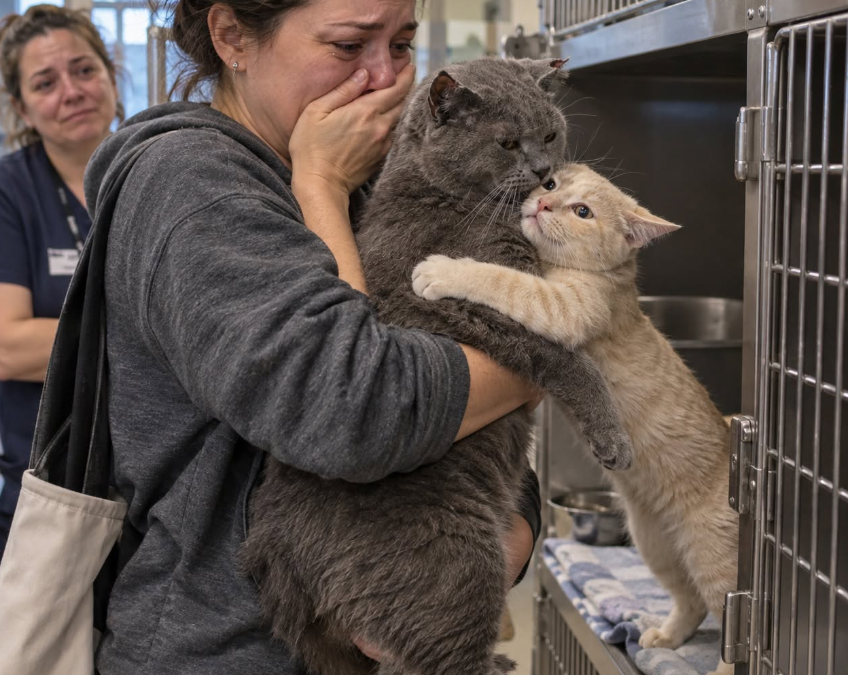
I Went to Adopt One Shelter Cat—Then His Terrified Brother Wrapped Both Paws Around Him and Wouldn’t Let Me Take Him Away
I walked into the shelter with one carrier, one tight budget, and one rule I was absolutely certain I could not afford to break: I was taking home one cat.
Then I lifted a scarred gray tom named Weston from his cage, and his terrified cream-colored brother lunged forward, wrapped both paws around him, and held on like being separated was the one thing he would not survive.
By the time I left with both brothers, I still had the same one-bedroom apartment, the same reduced paycheck, and the same stack of bills waiting on my kitchen counter—but I had no idea those two unwanted cats were about to expose how much of my own life I had cut away in the name of being “practical.”
I went to the shelter to adopt one cat.
That was the whole plan.
One cat.
One carrier.
One litter box.
One set of vaccinations.
One extra mouth.
One small living thing waiting near the door when I came home from work.
Nothing dramatic.
Nothing reckless.
I had already had enough recklessness in my life.
Eight months earlier, my marriage ended.
Not explosively.
There was no affair discovered through text messages.
No police.
No screaming match that ended with shattered dishes.
Honestly, I think a dramatic ending would have been easier.
Dramatic endings give you something to point at.
This happened because two people spent years becoming strangers politely.
My wife, Claire, and I had been married eleven years.
There was no single morning when I woke up and knew we were finished.
Instead, there were hundreds of evenings when we sat on opposite ends of the couch looking at different screens.
Meals where the conversation never made it past:
“How was work?”
“Fine.”
“You?”
“Fine.”
A kiss at the door that gradually became a habit instead of affection.
Then even the habit disappeared.
The final conversation happened on a Tuesday in our kitchen.
Claire stood beside the refrigerator.
I stood beside the sink.
Neither of us was angry.
That was the saddest part.
She said:
“I don’t think we’re living together anymore.”
I looked around.
We were clearly standing in the same kitchen.
She understood my confusion.
“I mean really living together.”
I didn’t argue.
Because I knew.
Three months later, we signed papers.
Claire kept the house because she could refinance it.
I took what I could fit into a rented truck.
A dresser.
A couch she hated.
Two lamps.
Half the dishes.
Books.
Clothes.
A coffee maker.
And the quiet.
I moved into a one-bedroom apartment above a dentist’s office that had been converted into residential units years earlier.
The place had thin walls.
Tired beige carpet.
Cabinet doors that did not quite align.
A bathroom fan that sounded like a helicopter preparing for evacuation.
If my upstairs neighbor flushed her toilet at two in the morning, I knew.
If the couple next door watched sitcom reruns, I heard the laugh track.
If somebody coughed in the hallway, it sounded like they were coughing inside my bedroom.
Yet somehow, despite being surrounded by evidence of other people, the apartment was the loneliest place I had ever lived.
After the divorce, I became careful.
That is the word I used.
Careful.
With money.
With groceries.
With gas.
With what I told people.
With how often I accepted invitations.
With how many times I looked at the empty side of the bed.
I stopped buying coffee on the way to work.
Stopped ordering takeout.
Started shopping at the grocery store late Wednesday because that was when they marked down bread.
I kept the thermostat two degrees lower than I liked.
I learned which soups tasted acceptable three nights in a row.
I canceled subscriptions.
I told myself all of this was maturity.
Discipline.
Rebuilding.
That last word was the lie.
I wasn’t rebuilding.
I was reducing.
Shrinking everything until there was less that could hurt.
Smaller grocery bill.
Smaller apartment.
Smaller expectations.
Smaller life.
A woman I worked with named Theresa noticed first.
She was fifty-three, had four grandchildren, and possessed the unsettling ability to identify emotional problems before I had admitted them to myself.
One afternoon she watched me eat crackers at my desk for lunch.
“You need a cat.”
I looked up.
“What?”
“A cat.”
“No.”
“You don’t even know my argument.”
“I don’t need to.”
She sat on the corner of my desk.
“You go home every night and disappear.”
“I go home.”
“Same thing.”
“I like being alone.”
“No, you tolerate being alone.”
“I had a marriage. I’m trying something different.”
She ignored that.
“Get a cat.”
“I don’t want the responsibility.”
“That’s exactly why you should.”
I stared at her.
“That makes no sense.”
“It gives your day rhythm.”
She counted on her fingers.
“Feed something in the morning. Clean something besides your own dishes. Have something waiting when you come through the door. Something alive enough to make home feel like a place instead of where you store yourself overnight.”
I laughed.
“That is aggressively specific.”
“I’ve been watching you.”
“Creepy.”
“You’re welcome.”
The idea stayed.
Not because Theresa convinced me.
Because I began noticing the silence differently.
I would unlock the apartment door after work.
Nothing.
Turn on a light.
Nothing.
Drop my keys.
The sound seemed too loud.
There is a kind of loneliness that feels emotional.
There is another kind that becomes architectural.
Rooms start feeling oversized.
Doorways pointless.
A couch too long.
A kitchen table absurd for one person.
I started looking at shelter websites.
Just looking.
Then reading profiles.
Adult cats.
Senior cats.
Calm cats.
Cats who did not require a giant house or constant stimulation.
I created rules.
Responsible rules.
One cat.
Older, ideally.
Calm.
No major medical issues I couldn’t afford.
One cat meant manageable.
One food bowl.
One litter box.
One annual exam.
One vaccine schedule.
One body that could fit beside me on a couch without becoming a financial emergency.
I repeated that to myself the morning I drove to the shelter.
One cat.
The carrier sat on the passenger seat.
Singular.
Proof.
The shelter was a low beige building near a tire shop and a row of storage units.
The parking lot needed resurfacing.
A hand-painted sign by the front entrance said:
ADOPT. FOSTER. VOLUNTEER.
Inside smelled like detergent, damp blankets, animal fur, and the particular nervousness shelters carry no matter how clean they are.
A tired woman at reception smiled.
“What are you looking for?”
“One calm cat.”
“Kitten?”
“No.”
That seemed to please her.
“Age?”
“Adult. Older is fine.”
“Personality?”
“Low-key.”
She looked at me for half a second longer than necessary.
“Apartment?”
“Yes.”
“Other pets?”
“No.”
“Kids?”
“No.”
Then:
“Let’s see who feels right.”
That sentence bothered me.
I wanted data.
Age.
Temperament.
Medical history.
What I could afford.
I did not want something to “feel right.”
Feeling right was how people bought houses above budget.
Feeling right was how my marriage began.
I had become suspicious of feelings.
Still, I followed.
We passed rows of kennels.
Some cats came immediately to the doors.
Paws through bars.
Meows.
Head rubs.
Others hid.
Two kittens climbed over each other like popcorn with claws.
An enormous white cat slept through my existence entirely.
Cards were clipped to cages.
LOVES LAPS.
NEEDS QUIET HOME.
GOOD WITH CHILDREN.
SPECIAL DIET.
SENIOR SWEETHEART.
SHY AT FIRST.
I read them like applications.
Then I saw Weston and Louie.
They shared one large enclosure.
At first, I thought there was only one cat.
Gray.
Broad-faced.
Torn left ear.
Scarred shoulder.
The expression of someone who had fought in three wars and found all of them disappointing.
Then the cream-colored cat moved.
He had been curled so tightly against the gray one that his body almost disappeared beneath him.
Smaller.
Narrow.
Large anxious eyes.
His head remained tucked beneath his brother’s chin.
“That’s Weston and Louie,” the woman said.
“Brothers?”
“Same litter.”
“How old?”
“About five.”
They looked older.
Or maybe they simply looked tired.
“What happened to Weston’s ear?”
“We don’t know exactly.”
She pointed at the card.
“They came in after their owner went into long-term care. A relative had them temporarily, but it didn’t work out.”
“Medical?”
“Nothing major. Weston has some dental issues we want monitored. Louie is physically healthy.”
“Behavior?”
“Weston acts tough.”
That made sense.
“Louie is anxious.”
Also obvious.
Then she said:
“They settle each other.”
That was the warning.
I should have understood.
Instead, I looked at Weston.
He lifted his head.
Stared at me.
Judged my shoes.
Judged my posture.
Probably judged my divorce.
“Which one is friendlier?”
The woman smiled.
“Depends what you mean by friendly.”
“That’s not reassuring.”
“Weston is confident enough to tell you what he doesn’t like.”
“And Louie?”
“He startles.”
“At what?”
“Everything.”
“Great.”
I looked again.
Weston watched me.
Louie watched Weston.
One cat monitoring the stranger.
The other monitoring his brother.
My rule remained intact.
One cat.
I opened the cage.
Weston did not retreat.
That surprised me.
He stayed seated.
I extended a hand.
He smelled my fingers.
Then allowed one scratch under the chin.
His fur was rough in spots.
Softer near his neck.
I touched the scarred area on his shoulder carefully.
No reaction.
He didn’t purr.
Didn’t push into me dramatically.
Didn’t perform.
Then, after several seconds, he leaned his face into my fingers.
Barely.
A tiny surrender.
As if needing affection offended him personally but not enough to reject it.
That got me.
“I think maybe this one.”
The woman nodded.
“I can get your carrier.”
I reached under Weston.
One arm beneath his chest.
Another supporting his back legs.
Lifted.
That was when Louie moved.
Not backward.
Not away.
Toward him.
Fast.
He stood on his hind legs and reached both front paws upward.
Then wrapped them around Weston’s body.
I froze.
Louie held on.
His paws locked around his brother’s ribs.
His whole thin cream-colored body stretched upward.
Not attacking.
Not clawing.
Not panicking wildly.
Clinging.
Desperate.
Weston twisted in my arms.
For one second I thought he might scratch me.
Instead, he pressed his face into Louie’s neck.
The room changed.
I know that sounds ridiculous.
It was still a shelter.
Still fluorescent lights.
Still cages.
Still barking from the dog wing.
But suddenly I was not watching two cats.
I was watching every ending I had spent eight months reducing into practical language.
A moving truck.
Boxes.
Two sets of keys on a kitchen counter.
Claire saying:
“This is probably for the best.”
My sister saying:
“At least it’s clean.”
Friends saying:
“You’ll adjust.”
Everyone loves that word.
Adjust.
Humans use it when we want to describe pain without letting it interrupt the plan.
They’ll adjust.
You’ll adjust.
Cats adjust.
Kids adjust.
Parents adjust.
Everything adjusts if you wait long enough.
Maybe.
Louie did not look like he wanted to adjust.
He looked like he wanted his brother.
That was all.
I lowered Weston back into the kennel.
Louie still did not release him immediately.
Even with Weston’s paws safely back on the blanket, Louie kept one paw pressed against his side.
Proof.
Still here.
The shelter employee watched me.
“You okay?”
“Yeah.”
I wasn’t.
I laughed because I was embarrassed by my own reaction.
Then wiped my eyes.
One cat.
I had repeated it all morning.
One cat was smart.
One cat was responsible.
One cat was what I could afford.
I looked at Weston.
Then Louie.
“Nobody’s going home alone.”
The woman didn’t react immediately.
Maybe shelter workers learn not to celebrate until paperwork is signed.
“You sure?”
“No.”
She smiled.
“That is usually how the good decisions start.”
“That’s terrible advice.”
“Probably.”
I brought home two cats.
One carrier.
Both inside.
The ride was thirty minutes.
Weston complained twice.
Deep, offended yowls.
Louie did not make a sound.
He pressed himself against his brother the entire trip.
One paw touching Weston’s shoulder.
Every time the car turned, Louie adjusted so the contact remained.
When I carried them upstairs, my apartment looked exactly as it had that morning.
Faded couch.
Ugly carpet.
Bills near the coffee machine.
Cheap blinds.
Half a loaf of bread.
One mug in the sink.
Nothing changed.
And everything had.
The first night, Weston took possession of the far end of my couch.
I did not give it to him.
He assumed authority.
Louie hid behind the armchair.
I put food down.
Water.
Litter boxes.
Two, because the shelter employee had insisted.
“They need one each plus one ideally.”
“I live in six hundred square feet.”
“Then start with two and pray.”
I started with two.
Around ten, Louie came out.
Slowly.
Low to the floor.
Weston watched.
Louie crossed the room.
Curled against him.
Weston groomed the top of his head exactly twice.
Then stopped, apparently unwilling to become sentimental.
At midnight, I woke.
Something warm touched my legs.
Louie.
He had climbed onto the bed.
Curled near my knees.
Weston sat in the hallway staring toward the front door.
Security.
I lay in darkness listening.
Breathing.
Paws shifting.
A faint purr.
The ordinary sounds of not being alone.
I had forgotten how loud life was.
The first morning, Weston woke me by standing on my ribs.
I opened my eyes.
Gray face six inches away.
Expression deeply disappointed.
Louie was tucked against my hip.
For one second, I forgot the last eight months.
Then remembered.
I wasn’t alone anymore.
Not exactly.
They followed me to the kitchen.
I placed two bowls down.
Weston sniffed his.
Louie sniffed his.
Neither ate.
They stared at me.
“What’s wrong?”
Weston blinked.
Louie glanced at Weston.
Then Weston walked to Louie’s bowl.
Ate one bite.
Stepped away.
Only then did Louie eat.
I stared.
“You’re kidding.”
Weston went to his own bowl.
They ate side by side.
That was my first lesson.
I had not adopted two independent cats who happened to share DNA.
I had adopted a system.
Weston entered rooms first.
Louie followed.
If I opened a closet, Weston investigated.
Louie watched from behind him.
If a truck banged outside, Louie flinched.
Weston turned toward the window.
If I moved furniture, Louie waited until Weston inspected the change.
At night, they slept together.
During the day, they separated sometimes—but never for long.
If Weston disappeared into the bedroom, Louie eventually checked.
If Louie slept by the window, Weston passed through regularly.
It was like watching one heartbeat repeatedly confirm the other still existed.
There were practical consequences.
Two cats eat more than one.
I know.
Shocking.
The first bag of food disappeared so quickly I accused them of running a black-market operation.
Litter vanished.
Flea medication doubled.
There was fur on my clothes.
Fur in my bed.
Fur inside one coffee mug that had been in a closed cabinet.
I still don’t understand that.
At two in the morning, the apartment occasionally sounded like minor construction.
I bought a scratching post.
Weston ignored it.
Scratched the cheap rug.
I bought a second scratching post.
Louie loved the cardboard box it came in.
Love is expensive in ways loneliness isn’t.
Loneliness costs things too.
But quietly.
You don’t see it on receipts.
Love produces invoices.
Cat food.
Litter.
Vaccines.
Dental care.
Treats you swore you wouldn’t buy.
The second scratching post because apparently the first scratching post has offended someone.
I began changing my spending.
No Friday bakery muffin.
No takeout.
Cheaper coffee.
Cancel another streaming subscription.
Fine.
I had survived worse.
Theresa called after a week.
“How’s the cat?”
“Cats.”
Silence.
“Plural?”
“Yes.”
“I recommended one cat.”
“Your instructions lacked precision.”
“You adopted two?”
“Yes.”
“Why?”
I told her.
There was a pause.
Then:
“Are you okay for that?”
Normal question.
Kind question.
Still irritated me.
“I’m fine.”
“I didn’t mean—”
“I know.”
And I did know.
She cared.
But after we hung up, the question stayed.
Because people spend money numbing themselves constantly.
Bars.
Shopping.
Gambling.
Food delivery.
Phones.
Cars.
Subscriptions.
Stuff.
Nobody looks at the receipt and says:
“Are you sure you can afford the thing keeping you from feeling your own life?”
But bring home two unwanted animals and suddenly everybody becomes a financial planner.
Friends asked:
“Two is a lot, isn’t it?”
My sister:
“That is a commitment.”
A coworker:
“Couldn’t the shelter separate them?”
The phrase repeated.
They’ll adjust.
Maybe.
The brothers made that theory difficult to believe.
Two weeks after adoption, the shelter called.
Same woman who had helped me.
“How are my boys?”
My boys.
That nearly got me.
“Good.”
“Still attached?”
“Like somebody stitched them together.”
She laughed.
Then got quiet.
“I’m glad you took both.”
Something in her voice changed.
“Why?”
“We had interest in Weston before.”
“Really?”
“He’s older, but people liked him. Calm. Solid.”
“And Louie?”
Pause.
“Too nervous.”
I looked across the living room.
Louie slept with one paw resting against Weston’s tail.
“Someone wanted Weston alone?”
“Yes.”
“What did you say?”
“That they were bonded.”
“And?”
“She said cats don’t care about siblings that much.”
I said nothing.
The shelter worker continued.
“We tried separating them once for cleaning.”
My stomach tightened.
“Louie panicked. He bloodied his nose trying to get through the temporary divider.”
I closed my eyes.
“And Weston?”
“Stopped eating that afternoon.”
I could picture it perfectly.
Louie throwing his body at whatever separated them.
Weston refusing food because the one thing more important than food was missing.
“Why would anyone split them?”
I knew the answer before she said it.
“One is easier.”
Of course.
One is easier.
One bowl.
One bill.
One body.
One schedule.
One grief someday.
Half the attachment because the other half will probably adapt if we repeat the word enough.
That sentence lodged inside me.
One is easier.
So is avoiding difficult conversations.
So is ending friendships when someone becomes complicated.
So is telling grief to move on because everyone else is uncomfortable.
So is calling dependence unhealthy whenever another person’s need begins costing us something.
One is easier.
Then my work hours got cut.
Not dramatically.
Four hours one week.
Six the next.
Business slowed.
Management didn’t make speeches.
Schedules simply changed.
I sat in my car during lunch staring at the new shift list.
The air was hot.
I left the engine off to save gas.
I counted.
Rent.
Utilities.
Phone.
Food.
Gas.
Cat food.
Litter.
The veterinary appointment I had not yet scheduled.
Suddenly the floor beneath my life moved.
I went home.
Didn’t remove my shoes.
Sat directly on the floor.
Louie came over.
Sniffed my jeans.
Climbed into my lap.
Weston stayed near the couch watching me.
“I may have made a stupid decision.”
Weston blinked.
Louie settled.
I laughed.
Not because it was funny.
Because if I didn’t laugh, the next sound would have been something worse.
I scheduled the vet appointment.
Responsible people do not avoid medical care because it frightens their spreadsheet.
That was what I told myself.
The clinic smelled like disinfectant and wet dog.
Weston sat in his carrier looking insulted.
Louie flattened against the back of his.
Then Weston reached one paw through the carrier bars.
Touched Louie’s paw.
A second.
Maybe less.
Louie’s body loosened slightly.
The veterinarian examined Weston first.
Then Louie.
She was calm.
Steady.
The kind of person who did not waste warmth performing warmth.
Finally, she looked at her notes.
“Weston needs dental work.”
My stomach tightened.
“How soon?”
“Not emergency today, but sooner rather than later.”
“One bad tooth?”
“At least one. Possibly others once he’s under and we can evaluate properly.”
I nodded.
“And Louie?”
“Physically good.”
She looked toward him.
“Anxiety is significant.”
“That sounds right.”
“Any recent separation?”
I laughed.
“Just the loss of their home, owner, shelter stay, adoption, and moving here.”
She smiled.
“Fair.”
Then:
“With bonded cats, one can act as the other’s anchor after instability. Keeping them together may help him regulate.”
If they stay together.
The words landed heavily.
The estimate landed heavier.
At home, I spread it across the kitchen table.
Weston jumped up.
Sat directly on the paper.
“Helpful.”
Louie watched from the chair.
I made columns.
Urgent.
Can wait.
Cannot wait.
Cut this.
Delay that.
Move money here.
There is something bleak about converting a life into arithmetic while the life itself is purring on the estimate.
My sister called a few days later.
I told her.
Reduced hours.
Dental.
Budget.
She listened.
Then quietly:
“You could return one.”
Not cruel.
That is important.
She loved me.
She was practical.
Some people bring emotional warmth.
My sister brings batteries, full tanks of gas, and reminder texts before storms.
“I’m not saying because you don’t care,” she added.
“I know.”
“Sometimes caring means knowing what you can carry.”
What you can carry.
I looked toward the couch.
Weston groomed one paw.
Louie pressed against his side.
“I think we say that too easily.”
She sighed.
“What?”
“I think people use ‘what you can carry’ when they mean ‘what remains convenient.’”
“That isn’t fair.”
“Maybe.”
“I’m worried about you.”
“I know.”
“You just got divorced. Your hours got cut. You’re counting groceries.”
“I know.”
“And you have two cats because one hugged the other.”
“When you say it like that, I sound insane.”
“I’m not saying that.”
I took a breath.
“Maybe I am.”
Silence.
Then:
“But I think sometimes we call it maturity when really we’re cutting living things away until the numbers stop frightening us.”
My sister exhaled.
“That’s dramatic for cats.”
“Is it?”
Long pause.
Then:
“Maybe not.”
That helped.
Not agreement.
Not money.
Just the possibility that tenderness did not automatically equal irresponsibility.
A week later, Weston stopped eating properly.
He sniffed breakfast.
Walked away.
Returned.
Took a little.
Stopped.
Louie noticed before I accepted it.
He followed Weston.
Touched his face.
Watched him.
Second morning, same thing.
I called the vet.
Dental moved up.
The hard part was Weston staying overnight.
Two extractions.
Monitoring.
Recovery.
I handed the carrier to the technician.
The moment she walked through the treatment-room door with Weston, Louie screamed.
I had never heard his full voice.
At home, he chirped.
Soft meows.
Tiny worried sounds.
This was different.
A raw broken cry.
Every person in the lobby looked up.
The technician paused.
“We’ll take good care of him.”
“I know.”
That wasn’t the problem.
The problem sat inside the second carrier.
Louie cried all the way home.
At the apartment, he shot out.
Couch.
Bedroom.
Window.
Kitchen.
Hall.
Back to the couch.
Checking every place where Weston usually existed.
Again.
Again.
He returned to me.
Cried.
I sat on the floor.
“I know.”
And I did.
That frightened me.
I knew what it was to live in a room after one body had vanished.
To walk toward a doorway expecting a shape.
To hear a familiar household sound and feel absence before memory catches up.
I knew exactly why Louie searched.
That night he wouldn’t eat until I took the bowl into the bedroom and sat beside him.
Even then, every few bites:
Head up.
Listen.
Nothing.
At midnight, he crawled behind my knees.
Pressed himself there.
I was not Weston.
I was simply the only warm thing available.
The clinic called after eight the next morning.
Weston was fine.
Two teeth removed.
Groggy.
Angry.
Fine.
I nearly cried.
At pickup, the technician explained medication.
Soft food.
Appetite.
Quiet.
Then Louie made one short sound from his carrier.
Weston lifted his head immediately.
He turned toward the noise.
Tried standing.
Louie pressed his nose into the carrier bars.
The technician stopped mid-sentence.
Smiled.
“Well.”
She looked at me.
“There’s your recovery plan.”
At home, Louie stayed beside Weston.
Not crowding.
Not climbing over him.
Just near.
If Weston moved, Louie followed.
If Weston drank, Louie waited.
When Weston slept, Louie settled within reach.
And Weston allowed it.
That mattered.
Proud creatures do not accept witness easily.
Pain reveals what we actually need.
By the end of the week, Weston ate normally.
His glare had returned.
Louie relaxed.
The apartment breathed again.
I didn’t.
Something about that day separated had broken open every argument I’d been making with myself.
They’ll adjust.
Maybe.
But why are we always so eager to prove it?
Why is separation considered neutral while attachment has to defend itself?
Why is needing someone automatically treated like the immature position?
I started noticing how often people say:
“They’ll be fine.”
Children after divorce.
Older parents moved away from spouses.
Friends left behind.
Animals separated.
Sometimes “they’ll be fine” is optimism.
Sometimes it means:
I need them to be fine so I can stop thinking about what this decision costs.
I took a photograph of Weston recovering.
He looked like a boxer after twelve rounds.
Louie pressed against him.
I posted it online.
I don’t know why.
Maybe because I wanted one place where the story could exist outside my own head.
Caption:
I went to the shelter for one cat.
I came home with two because the smaller one wrapped both paws around his brother when I tried to take him.
Today Weston had dental surgery and Louie spent the whole day searching the apartment for him.
Some bonds aren’t optional just because they complicate the budget.
That was all.
By bedtime, hundreds of shares.
Morning:
Thousands.
Messages.
People sent photographs of bonded dogs.
Cats.
Parrots.
Siblings.
Spouses.
A widow wrote that after her husband died, her sister moved into the spare bedroom because she had stopped eating properly alone.
A man told me his brother came to live with him after divorce and everyone called it failure.
“It saved him,” he wrote.
An elderly man said he adopted both of his late sister’s cats because:
“I knew enough about loss not to make it worse for them.”
That sentence stayed.
Knew enough about loss not to make it worse.
There were other comments.
Of course.
You should not adopt animals you can’t afford.
Cats adapt.
People anthropomorphize animals.
This is irresponsible.
Feelings over facts.
Some people care more about animals than humans.
I read too many.
My eyes hurt.
I put the phone down.
Weston slept.
Louie curled beside him.
I became angry.
Not because disagreement offended me.
Because tenderness seemed to make some people furious.
There is something in our culture that worships independence until independence becomes isolation.
A man can work sixty hours.
Eat standing up.
Ignore every relationship.
Spend hundreds numbing himself.
And people call him disciplined.
But say:
“These animals love each other. I didn’t want to separate them.”
Suddenly everyone wants audited bank statements.
One comment stayed with me.
A woman wrote:
“This country teaches us to afford things before we deserve them, including comfort.”
I reread that.
Again.
Afford things before we deserve them.
Love as a premium feature.
Care available once your budget looks clean enough.
Healing delayed until your life becomes financially photogenic.
I hated how much sense it made.
My sister came over the following weekend.
She brought soup.
She always brought food in containers with good lids because she believed bad containers were one of society’s hidden failures.
Weston distrusted her.
Louie hid.
We ate.
Halfway through lunch, a garbage truck slammed something outside.
Louie startled.
Slid on the floor.
Before I moved, Weston stood beside him.
Not touching much.
Just there.
Louie leaned against his shoulder.
My sister watched.
“Oh.”
That was all.
Oh.
Understanding in theory is one thing.
Understanding in the body is another.
At the door later, she hugged me.
“I still worry about the money.”
“I know.”
“But I was wrong.”
“About?”
“Talking about them like groceries.”
That nearly broke me.
Most people do not apologize when practicality fails them.
They rebrand it.
She didn’t.
Months passed.
The apartment became theirs.
Weston took the window chair.
Louie discovered morning sunlight.
Their toys migrated beneath furniture.
Two bowls lived beside mine in the drying rack.
A blanket covered the chair because Weston preferred that texture.
The apartment looked inhabited.
Not staged.
Not temporary.
Inhabited.
Before them, I had lived like someone emotionally prepared to move out at any moment.
The cats were not cautious that way.
By day four, they were all in.
Mine.
Yours.
Home.
That was it.
One Friday, I sat on the kitchen floor crying.
No catastrophe.
Just accumulation.
Unexpected bill.
Still-reduced schedule.
Fatigue.
The particular humiliation of being an adult and discovering you are one appliance failure away from a financial personality change.
I cried quietly.
Because adults learn to cry as if apologizing for taking up audible space.
Weston appeared.
Sat a foot away.
Louie came closer.
Put one paw on my leg.
No advice.
No:
“Look on the bright side.”
No:
“Everything happens for a reason.”
No:
“Have you tried journaling?”
No demand that I transform pain into a growth opportunity.
Company.
That was all.
And suddenly I understood what people are starving for.
Company without optimization.
Somebody staying while the room is bad.
Weston and Louie did that for each other every day.
They taught me to receive it.
The viral post kept circulating.
Every few days, a message.
Widows.
Students.
Divorced people.
Rescue workers.
People caring for elderly parents.
People who had been told they were too dependent.
Someone wrote:
“People mock us for needing each other and then wonder why everyone is lonely.”
Another:
“We keep calling detachment maturity because attachment comes with obligations.”
Then I wrote a second post.
Probably should not have.
I said:
Maybe adopting two cats was not the most efficient choice for a man in a small apartment with reduced hours.
But we are drowning in efficient choices.
Maybe that is part of the problem.
I wrote:
We keep telling lonely people to downsize their needs.
Manage expectations.
Simplify.
Detach.
Wait until life becomes tidy before accepting love.
Then the sentence that made everybody angry:
“I think we have confused ‘practical’ with ‘merciless’ so often that some people can no longer tell the difference.”
That one traveled farther.
People loved it.
People hated it.
People called me irresponsible.
Sentimental.
Manipulative.
A man wrote:
“People like you are why shelters get returns.”
Someone replied:
“People like you are why the vulnerable are expected to survive cleanly.”
The vulnerable expected to survive cleanly.
That was the argument.
Be broke, but quietly.
Grieve, but efficiently.
Need people, but not enough to inconvenience anyone.
Love, but only after every emergency fund is funded and every variable controlled.
I am not saying people should take animals they cannot care for.
I paid Weston’s dental.
I fed them.
Took them to the vet.
Changed my budget.
Responsibility matters.
But responsibility is not the same thing as building a life where nothing living is allowed to complicate you.
That winter was cold.
The windows leaked air.
I shoved towels against the frames.
Kept the thermostat lower than ideal.
Weston slept near the vent.
Louie stayed near my blanket while I paid bills.
Money remained tight.
I will not romanticize it.
Some months required careful planning.
Some required more careful planning than anyone should need simply to keep food in the kitchen and lights on.
I stood in grocery aisles.
Put things back.
Swapped brands.
Delayed purchases.
But not once did I look at Weston and Louie sleeping nose to nose and think:
I wish I had split you.
Not once.
Easier and better are not synonyms.
Sometimes they overlap.
Sometimes they do not even live in the same neighborhood.
Near Christmas, my upstairs neighbor knocked.
Her name was Mrs. Russo.
Sixties.
Peppermint perfume.
Always wore slippers in the hallway.
She held a small paper bag.
“I had extra ornaments.”
“I don’t have a tree.”
She looked at the bag.
“They’re felt snowflakes.”
Then:
“Cats can destroy them.”
“Perfect.”
Louie loved the tissue paper.
Weston loved the bag.
Mrs. Russo stood in my doorway watching.
Then:
“My niece sent me your story.”
I nearly died.
“Sorry.”
“Why are you apologizing?”
“I don’t know.”
She looked around.
Bowls.
Toys.
Blanket.
Cats.
Then me.
“You look less ghostly than when you moved in.”
There are prettier compliments.
Few truer.
Less ghostly.
Before them, I had been haunting my own future.
Work.
Home.
Soup.
Sleep.
Repeat.
The cats demanded present tense.
Feed me now.
Open this now.
Sit down now.
Notice me now.
Animals ruin detachment.
Bless them.
There is no way to live with them without participating.
And once I started participating in their lives, mine became harder to ignore.
Louie eventually started greeting me at the door.
Not always.
Only when brave.
A tiny chirp.
Weston usually stood farther back pretending enthusiasm was beneath him.
One icy evening, the power went out.
Everything clicked off.
Heat.
Television.
Refrigerator.
The apartment dropped into sudden silence.
Louie panicked.
Ran under the bed.
Weston followed.
I got a flashlight.
Sat on the floor.
Waited.
After several minutes, Weston emerged halfway.
Sat near me.
Then turned toward the darkness beneath the bed.
Louie’s eyes reflected the flashlight.
“It’s okay.”
He didn’t believe me.
Weston lowered himself.
Half beneath the bed.
Half outside.
A bridge.
Louie moved forward.
Reached Weston’s shoulder.
Paused.
Then came out.
That image stayed with me long after electricity returned.
Love had done something similar for me.
It had not dragged me into a bright new life.
No dramatic transformation.
It simply lay down between fear and the room.
Made a bridge small enough to cross.
Sometimes that is enough to build an entire future.
A few weeks later, I returned to the shelter.
Food donation.
Old blankets.
Nothing heroic.
What I could spare.
The employee recognized me.
“How are my famous boys?”
“Unionized.”
She laughed.
I told her about the posts.
The arguments.
The comments.
She shook her head.
“People really hate hearing animals have emotional lives.”
“Why?”
“Because then convenience isn’t neutral.”
Convenience isn’t neutral.
That stayed with me.
Convenience usually favors the person with the power to choose.
The one paying.
The one leaving.
The one deciding.
The one who gets to say:
“It’ll be easier this way.”
Someone smaller absorbs the cost.
By spring, the apartment had routines.
Weston outside my bedroom door at 6:30.
Louie near the kitchen mat pretending he had not been waiting.
Window patrol.
Night patrol.
Both cats stopping whenever I sneezed.
Weston inspecting delivery boxes.
Louie stealing socks from the laundry pile.
I was not suddenly rich.
Not healed in a cinematic way.
Some mornings divorce still hurt.
Some bills still frightened me.
Some nights loneliness still found a way through.
But I was no longer hollow.
There were witnesses in my life.
Small.
Furry.
Demanding.
Deeply opinionated about wet food.
Witnesses.
That matters more than people admit.
We live in a culture obsessed with wellness while treating dependence like a moral defect.
“Reach out.”
But do not reach too far.
“Ask for help.”
But preferably not when help costs time.
“Be vulnerable.”
But keep it inspirational.
“Lean on your people.”
But recover quickly enough that your needs don’t disrupt their calendar.
We praise resilience when sometimes what we mean is:
Can you suffer without inconveniencing me?
Weston and Louie never asked that of each other.
If Louie was afraid, Weston showed up.
If Weston was hurting, Louie stayed.
When one disappeared for a dental appointment, the other cried until strangers turned around.
They never apologized.
Never called their attachment unhealthy.
Never pretended needing each other made them weak.
They needed each other.
Clearly.
Honestly.
Maybe that is why their story spread.
Not because people are overly sentimental about cats.
Because people recognized the argument beneath it.
How much connection are you allowed before somebody calls it impractical?
How much love can you keep if your life isn’t polished?
How many warm things are you allowed before somebody asks for receipts?
My answer now?
More than I used to believe.
Months after the adoption, I folded laundry on the couch.
Weston sat at one end.
Louie slept inside a basket of socks.
Sunset turned the apartment gold.
Ordinary evening.
The kind that once would have hurt because there was nobody to mention it to.
I looked at them.
Remembered the shelter.
The torn ear.
Cream-colored body.
Both paws wrapped around Weston.
Then that one paw staying pressed to him even after I put him back.
At first, I thought the gesture meant:
Don’t take him.
Now I think it meant more.
This matters.
This stays.
Do not call losing this reasonable simply because it is easier for you.
I think most of us have one paw on something like that.
A person.
A sibling.
A child.
A parent.
A dog.
A cat.
A routine.
A friendship.
Some small living thing keeping darkness from taking over the whole room.
And there is always a voice telling us:
Let go.
Simplify.
Be realistic.
Sometimes we have to.
Life is not a fairy tale.
Love does not always win.
Money matters.
Health matters.
Capacity matters.
There are choices nobody wants to make.
I will never insult people facing impossible decisions by pretending affection pays every bill.
But I no longer believe separation is automatically the mature choice simply because it is cheaper, tidier, or easier to explain.
Sometimes responsibility is protecting the bond.
Sometimes the wiser decision is the one that looks inconvenient on paper.
I went to adopt one cat.
I came home with two.
Extra food.
Extra litter.
Extra fur.
Extra vet bills.
Extra mess.
Extra warmth.
I came home with Weston, who looks at the world as if it has disappointed him personally.
And Louie, who still trusts that disappointing world more when his brother stands nearby.
People can argue forever about whether I made the practical choice.
That’s fine.
The apartment is still small.
The carpet still looks tired.
The walls are still thin enough that I know when the upstairs toilet flushes.
But at night, there are other sounds now.
Paws moving across the blanket.
Louie’s sleepy chirp.
Weston jumping from the chair with a heavy thump.
One brother shifting closer to the other.
My own breathing.
My own heartbeat.
No longer the loneliest sound in the room.
I thought I rescued two cats because they refused to be separated.
That’s the easy version.
The harder truth is that they taught me something I had forgotten during the divorce.
Some attachments are not obstacles to building a stable life.
Sometimes they are the structure that makes a life stable enough to keep building.
And if that sounds too emotional for people who prefer everything clean, efficient, and easy, I can only say this:
We already tried building a world around what was easiest.
Look how lonely it became.








