PART 2: HOA Karen Tried to Tow My Boat for Being “Too Big”—Then I Proved I Owned the Lake and Kicked Her Entire Club Off It
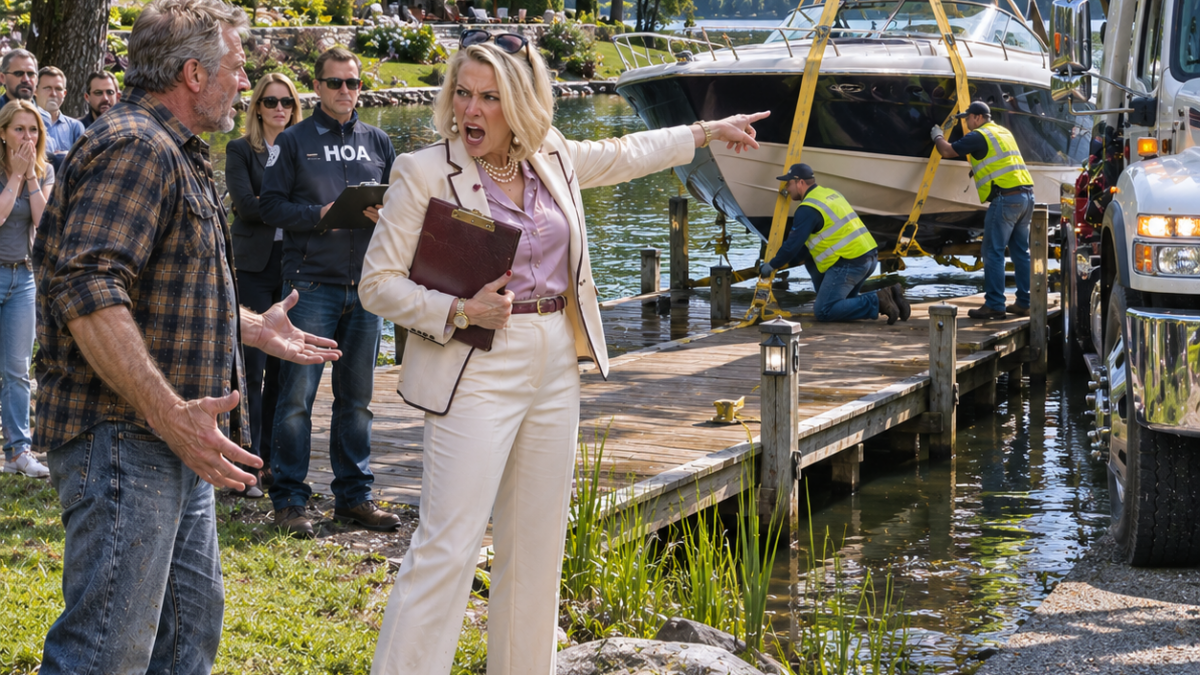
The morning Sophie Ward tried to tow my boat, she marched onto my dock with a clipboard, a tow truck, and enough confidence to make you think she owned every drop of water beneath her heels.
She called my boat “too big,” slapped an HOA violation sticker on the hull, and ordered a terrified tow driver to remove it while half the neighborhood watched from shore.
What Sophie didn’t know was that the lake she was trying to control had been in my family for generations—and before the summer was over, she was going to learn exactly where her authority ended.
My name is Carl Sanders.
I’m sixty-one years old, and I’ve spent most of my life beside the same stretch of water my grandfather taught me to respect before I was old enough to understand deeds, property lines, or the strange things adults will do when they get a little power.
Lake Sanders wasn’t always called that.
For most of my childhood, folks simply called it “the lake.”
My grandfather Earl called it home.
He owned the land around the northern and western shoreline, including the old cabin, the boathouse, the private dock, and several parcels that had been in our family since the early 1930s.
But Earl never behaved like a man guarding a treasure.
If a kid wanted to fish, he let him fish.
If somebody’s canoe flipped, Grandpa was the first one in the water.
If a neighbor needed to use the boat ramp, he said yes.
His rules were simple.
Respect the water.
Pick up your trash.
Don’t act like an idiot.
That was about it.
I grew up the same way.
For decades, I let the neighborhood use the lake freely.
Families brought picnic baskets.
Teenagers learned how to paddle.
Old men sat on my dock arguing about bass.
Nobody paid an access fee.
Nobody signed a waiver.
We knew each other.
We trusted each other.
Then the neighborhood changed.
About twenty-five years earlier, homeowners on the east side had formed a small association to handle snow removal, landscaping, and common road maintenance.
Nothing unusual.
But over time, that association became an HOA.
Then the HOA became something else.
Rules multiplied.
Mailbox colors.
Fence heights.
Approved porch furniture.
Holiday-decoration schedules.
One family received a warning because their children left a soccer goal on the lawn.
Another homeowner got fined for keeping a garbage bin visible after six in the evening.
Most people complained quietly and paid because arguing felt exhausting.
Then Sophie Ward moved in.
She bought one of the larger homes on the eastern ridge—a polished stone-and-glass place with a view over nearly the entire lake.
Sophie was the kind of woman who treated confidence like legal documentation.
She wore designer sunglasses even on cloudy mornings.
She carried a clipboard everywhere.
And when she became HOA president, she started speaking about “community standards” as though Congress had personally appointed her to enforce them.
At first, I ignored her.
My property wasn’t part of the HOA.
Never had been.
The deed was older than every house in Sophie’s subdivision.
Their jurisdiction ended long before my shoreline began.
Sophie either didn’t know that or didn’t care.
The first letter she sent called me “Dear Occupant.”
I laughed so hard I nearly dropped it in the lake.
The second complained that my boathouse didn’t match the subdivision’s architectural palette.
The third was about my boat.
According to Sophie, my thirty-two-foot cabin cruiser was “excessive in scale” and created a “visual obstruction inconsistent with neighborhood shoreline standards.”
I read that sentence twice.
Then I carried the letter inside and filed it.
That surprised my brother Tom.
Tom was county sheriff.
He’d known me long enough to recognize when I stopped laughing.
“You filing HOA letters now?”
“Yep.”
“Why?”
“Because fools get dangerous when they start putting nonsense in writing.”
He nodded slowly.
“You expecting trouble?”
I looked across the lake toward Sophie’s house.
“I’m expecting paperwork.”
Tom grinned.
“Same thing, usually.”
Over the next few months, Sophie’s letters became more aggressive.
She claimed the HOA had “shared shoreline authority.”
She demanded access to my dock for inspection.
She suggested I sign a “cooperative lake-management agreement.”
I sent back one response.
A copy of the legal description from my deed.
Under it, I wrote:
**Your jurisdiction ends where my property begins.**
After that, things went quiet.
For three weeks.
Then, on a beautiful Saturday morning, I heard a diesel engine coming down my private access road.
I stepped onto my porch holding a blue coffee mug.
A tow truck appeared between the cedars.
Behind it came Sophie Ward.
Pink blazer.
Dark sunglasses.
Clipboard.
Two HOA board members walked behind her like nervous palace guards.
She marched onto my dock and pointed at my boat.
“That one.”
The tow driver looked at her.
“You sure?”
“Absolutely.”
Then she turned and saw me.
Her smile was pure satisfaction.
“Good morning, Mr. Sanders.”
I took a sip of coffee.
“Sophie.”
She pointed at my boat.
“That vessel is too large for community shoreline standards.”
I looked at the lake.
Then at her.
“Community what?”
“It obstructs access and violates HOA size restrictions.”
I almost laughed.
But something about the tow chain hanging from that truck made me stop.
Sophie wasn’t sending letters anymore.
She had come to take something.
That was when I decided the conversation was over.
And the reckoning could begin.
PART 2
The tow driver’s name was Mark Hill.
I knew him.
Everybody around the lake knew Mark.
He ran the only heavy towing service within thirty miles, and he was a decent guy with the permanent expression of someone who spent his life being asked to move vehicles other people had parked stupidly.
That morning, he looked miserable.
“Carl,” he said, “I told her I needed proof this was authorized.”
Sophie spun toward him.
“You have proof.”
She raised her clipboard.
Mark looked at it.
“That’s an HOA form.”
“Yes.”
“Not a court order.”
Her mouth tightened.
“You were contracted to perform a tow.”
“I was contracted to remove an illegally stored vessel.”
“My boat is tied to my dock.”
Sophie pointed at me.
“Because you refuse to cooperate.”
I stepped down from the porch.
Neighbors were already gathering.
Jim Foster from the yellow ranch house stood near the gravel path holding a fishing pole.
Linda Myers leaned over her second-story deck.
Nancy Greene appeared carrying a tray of muffins, because Nancy somehow responded to every neighborhood crisis like it was a church social.
Sophie saw the audience and became more theatrical.
“Mr. Sanders, the board has repeatedly notified you that this boat exceeds allowable dimensions for community waterfront use.”
I looked down at the deck boards.
“My dock.”
She ignored me.
“It blocks the scenic view.”
“My water.”
“You are being deliberately difficult.”
“My boat.”
She snapped her clipboard shut.
“This lake is a community amenity.”
“No.”
Her face hardened.
“Yes.”
“No, Sophie.”
Her two board members shifted uncomfortably.
One of them, Carl Jenkins—not to be confused with me—looked toward the tow truck.
The other, Deborah Ross, pretended to study the shoreline.
Sophie pointed dramatically.
“Mark, proceed.”
He didn’t move.
“Mark.”
He scratched his head.
“Mrs. Ward, there’s nowhere for me to legally hook that boat from the road without crossing his property.”
“You have authorization.”
“From who?”
“The HOA.”
Mark looked at me.
I looked at him.
He sighed.
“That’s what I thought.”
Sophie’s cheeks turned red.
She stormed to the boat.
Before I realized what she was doing, she pulled a bright orange violation sticker from her folder and slapped it against my hull.
The sticker immediately peeled loose from the polished surface.
It fluttered downward.
Then stuck to the side of Sophie’s shoe.
Jim burst out laughing.
Sophie looked down.
Someone behind me snorted.
Then everybody started laughing.
Sophie tore the sticker off her shoe.
“This is not funny.”
Jim wiped his eyes.
“Depends who you ask.”
Sophie turned on him.
“You are interfering with an official enforcement action.”
Jim held up both hands.
“I’m holding a fishing pole.”
“That’s enough.”
Her voice rose.
“I am ordering the immediate removal of this vessel.”
That was when a cruiser appeared on the access road.
My brother Tom stepped out.
He wore his sheriff’s hat low and moved slowly toward the dock.
He looked at the tow truck.
Then Sophie.
Then me.
Finally, he asked:
“What did you do?”
I put a hand against my chest.
“Why assume it was me?”
“Experience.”
Sophie marched toward him.
“Sheriff Sanders, thank God.”
Tom raised an eyebrow.
“That’s new.”
“I need you to supervise a lawful HOA enforcement.”
“Against who?”
She pointed at me.
“Your brother.”
Tom looked at the boat.
“What’d Carl do?”
“He refuses to remove an oversized vessel.”
Tom scratched his chin.
“From where?”
“This shoreline.”
“Whose shoreline?”
“The community’s.”
Tom looked toward me.
“Carl?”
“Mine.”
Tom turned back.
“Mrs. Ward, you got paperwork showing otherwise?”
She held out the HOA violation form.
Tom read it.
Then handed it back.
“I mean paperwork.”
“This is paperwork.”
“I mean a deed, court order, easement, municipal order, something carrying legal authority over this parcel.”
Sophie blinked.
“The HOA bylaws give us authority.”
“Over HOA property.”
“This falls within the shared scenic corridor.”
Tom paused.
“The what?”
“Our scenic corridor.”
Behind him, Jim whispered loudly:
“She made that up yesterday.”
Sophie spun around.
“I heard that.”
“Good.”
Tom raised a hand.
“Everybody relax.”
He looked at Sophie.
“This dock sits on private property.”
She shook her head.
“The water is shared.”
“Recreational access has been allowed.”
“Exactly.”
“Allowed.”
Tom emphasized the word.
“That’s different from ownership.”
Sophie’s mouth tightened.
“You’re protecting him because he’s your brother.”
“No.”
Tom’s voice became serious.
“I’m warning you because you’re standing on private property attempting to remove personal property without documentation.”
Mark immediately dropped the tow chain.
“Thank you.”
Sophie stared at him.
“Pick that up.”
“No, ma’am.”
“I hired you.”
“And I’m declining the tow.”
“You can’t do that.”
“I absolutely can.”
Tom stepped toward Sophie.
“You need to leave the dock.”
Her eyes widened.
“You’re ejecting an HOA president?”
“I’m asking a person without permission to leave private property.”
“This is outrageous.”
“No.”
Tom pointed toward the path.
“This is simple.”
Sophie stood frozen.
Neighbors were recording now.
Phones everywhere.
I didn’t like that part.
Conflict gets stupid fast when people perform for cameras.
So I spoke before Sophie could.
“Everyone calm down.”
She glared.
I continued.
“Sophie, take your board members and leave.”
“This is not finished.”
“You’re right.”
She seemed surprised.
I looked at the tow truck.
Then the violation sticker still stuck halfway to her shoe.
Then at the lake.
“It’s just starting.”
She stormed away.
Her heels struck the boards like gunshots.
The two board members followed.
Mark walked back toward his truck.
As he passed me, he muttered:
“Next time she calls, I’m blocking her number.”
“Smart.”
Tom stayed.
When the crowd drifted away, he sat on the porch.
I poured him coffee.
He looked at me.
“You enjoyed that.”
“A little.”
“Don’t.”
“I said a little.”
“She’ll come back.”
“I know.”
“She’ll bring lawyers.”
“I know.”
Tom leaned back.
“You’re too calm.”
“That worries you?”
“With you? Yes.”
I looked toward the lake.
“Remember Grandpa’s deed?”
“Of course.”
“There’s more in it than shoreline.”
Tom studied me.
“What are you thinking?”
“Nothing yet.”
“Carl.”
“I’m drinking coffee.”
“That isn’t an answer.”
“It’s the only one you’re getting.”
The truth was, the tow attempt changed something inside me.
For years, I had treated Sophie’s HOA like a mosquito.
Annoying.
Persistent.
Mostly harmless.
That morning, she had crossed onto my property with machinery and attempted to take a boat worth more than some houses in town.
People who cross a boundary once often apologize.
People who cross it twice are testing whether the boundary exists.
I went inside.
My grandfather’s roll-top desk stood near the back window.
The bottom drawer stuck unless you lifted it slightly.
Inside was the deed.
Old paper.
County seals.
Surveys.
Legal descriptions.
Notes from attorneys long dead.
My grandfather had kept everything.
When I was fourteen, Earl had once walked me to North Cove.
He showed me a granite marker near the trees.
“See that?”
“A rock?”
“A boundary.”
I laughed.
“Looks like a rock.”
“It’ll still be here when people forget what it means.”
Then he handed me an envelope.
“You won’t need this until you do.”
I had opened it years later.
Inside were copies of deeds, survey notes, and a letter.
One sentence stayed with me:
**Some people confuse permission with ownership. Never punish them for the confusion. Just correct it before they hurt something.**
That afternoon, I reread it.
Sophie had enjoyed access to the lake because my family had always allowed neighbors to use it.
She had interpreted generosity as weakness.
That was partly my fault.
Not because I had done anything wrong.
But because I had never forced the newer residents to understand the arrangement.
I called Grace Holloway.
Grace was an attorney in town.
She had represented our family on land matters for almost fifteen years.
She answered:
“If this is about Sophie Ward, I already heard.”
“How?”
“Small town.”
“Fair.”
“I also saw the video.”
I closed my eyes.
“Of course you did.”
“The sticker was my favorite part.”
“Grace.”
“Fine. Lawyer voice.”
She cleared her throat dramatically.
“How can I assist you, Mr. Sanders?”
“I want everything checked.”
“Everything?”
“Deed. Shoreline. Recreational access. HOA boundary. Marina easements.”
A pause.
“Marina too?”
“Especially the marina.”
“Why?”
“I got a call last week from First County Bank.”
Now she became serious.
“About?”
“The marina loan.”
Silence.
Then:
“Oh.”
“Exactly.”
The marina sat on a narrow piece of shoreline near the east side of the lake.
Years earlier, a private operator had built slips, a small store, and a boat ramp there.
The HOA increasingly treated the marina like its own facility.
But ownership was complicated.
The land beneath portions of the improvements was tied to old lease and riparian agreements.
My grandfather had negotiated some of those rights.
The bank held debt secured against the marina improvements and leasehold interests.
Recently, the note had started going bad.
The banker knew my family’s history.
He had quietly asked whether I might be interested in purchasing the note.
At the time, I had said maybe.
After Sophie brought a tow truck onto my dock, maybe became yes.
Grace came over the next day.
We spread documents across my dining table.
She read for nearly two hours.
Then she leaned back.
“You know what Earl did?”
“What?”
“He was paranoid.”
I smiled.
“That’s genetic.”
“No. Professionally paranoid.”
She tapped one document.
“Right of first refusal here.”
Another.
“Riparian reservation here.”
Another.
“And the marina’s leasehold interest sits inside a structure that gives your chain of title more leverage than Sophie understands.”
“How much leverage?”
Grace smiled.
“Enough that I’m suddenly enjoying my afternoon.”
We contacted the bank.
Negotiations began quietly.
No social media.
No threats.
No HOA letters.
Just lawyers.
Numbers.
Title work.
Debt instruments.
While Sophie performed, I prepared.
A week after the first tow attempt, she came back.
Same tow truck.
Same two board members.
Same pink blazer.
This time there were more spectators.
Mark stopped his truck before reaching my dock.
He got out and raised both hands.
“Carl, I want the record to show I advised against this.”
Sophie snapped:
“You are here to work.”
“I’m here because your office prepaid the call.”
“Then do your job.”
He looked at me.
“Sorry.”
“Not your fault.”
Sophie marched down the dock.
“Mr. Sanders.”
“Sophie.”
“I trust you are ready to cooperate.”
“I’m always cooperative with lawful requests.”
Her eyes narrowed.
“The board voted unanimously to remove your vessel.”
“What board?”
“The HOA board.”
“Which I don’t belong to.”
She opened a binder.
“Article Nine grants the association authority over all property affecting shared visual corridors.”
I stared.
“Say that again.”
“Shared visual corridors.”
Jim, standing nearby, whispered:
“That sounds contagious.”
Laughter.
Sophie ignored it.
I held out my hand.
“Show me.”
“What?”
“The article.”
She opened the binder.
Flipped pages.
Then more.
Deborah leaned over her shoulder.
Carl Jenkins whispered something.
Sophie flipped faster.
Finally, she snapped the binder shut.
“It’s there.”
“Where?”
“In the bylaws.”
“Then show me.”
“I do not need to prove the HOA’s authority to you.”
“That’s convenient.”
Her face reddened.
She turned.
“Mark, proceed.”
He didn’t.
“Mark.”
He shook his head.
“No.”
Sophie looked like she had been slapped.
“You are breaching contract.”
“I’m avoiding trespass.”
That was when Tom’s cruiser arrived again.
He stepped out.
Looked at everybody.
Then sighed.
“Did we not do this already?”
Sophie pointed at me.
“He continues to defy community regulations.”
Tom walked onto the dock.
“What changed since last weekend?”
“The board issued a final order.”
“Court order?”
“HOA order.”
“Same answer.”
Sophie’s voice rose.
“This man is obstructing community access.”
Tom looked around.
Families were fishing.
Two kayaks passed.
A teenager waved from a canoe.
“Looks pretty accessible.”
“My boat blocks the view.”
Tom looked at it.
Then at the lake.
“Move your head six feet.”
Jim laughed so hard he nearly dropped his cooler.
Sophie tried another violation sticker.
This one slid down the hull and landed on her high heel.
The crowd exploded.
Even Tom turned away to hide a smile.
Sophie tore the sticker off.
“This neighborhood has become completely disrespectful.”
Tom’s humor disappeared.
“Sophie.”
She froze.
“This is your final warning from me.”
“For what?”
“Trespass.”
Her eyes widened.
“This is community property.”
“No.”
Tom pointed toward the shore.
“Carl has allowed use.”
“I don’t accept that interpretation.”
“You don’t need to.”
His voice became hard.
“If you return to this private dock attempting to remove property without a lawful order, you can be cited.”
Sophie looked at me.
“This is corruption.”
I said nothing.
She pointed at Tom.
“You’re abusing your office to protect family.”
Tom nodded slowly.
“Then file a complaint.”
“I will.”
“Good.”
That answer stunned her.
Bullies expect fear.
They don’t know what to do with procedure.
Sophie stormed away.
When she reached the gravel path, she turned.
“This isn’t over!”
Tom looked at me.
“She says that a lot.”
“I’m starting to think she means it.”
That evening, I printed everything.
County boundary maps.
My deed.
Survey.
HOA filings.
Letters.
Videos.
Statements from witnesses.
Then Grace called.
“We have a path on the marina note.”
“How clean?”
“Clean enough if we move carefully.”
“Do it.”
“You understand what this means?”
“Yes.”
“No, Carl.”
Her tone sharpened.
“You’re not buying the marina itself outright. You’re acquiring debt and certain secured interests. It gives you control and leverage, but don’t start acting like Sophie.”
That made me laugh.
“Fair.”
“I mean it.”
“I know.”
“Title and remedies have to follow the documents.”
“Measure twice.”
“Cut once.”
“That’s why I hired you.”
“Good.”
We closed the purchase through an LLC.
Blue Cedar Holdings.
I chose the name because my grandfather’s favorite tree stood beside the cabin.
Nobody in the neighborhood knew.
Not even Tom.
I wanted it that way.
Sophie was still fighting the wrong battle.
She thought this was about the size of my boat.
It had become about jurisdiction.
And debt.
And the danger of pretending borrowed access is ownership.
Then Sophie escalated again.
One Saturday, she arrived with an attorney.
At least, that was how she introduced him.
Robert Klein looked like he had slept badly for a month.
Navy suit.
Cheap briefcase.
Tie too tight.
Sophie walked beside him with a cameraman following.
That told me everything.
This was theater.
“Mr. Sanders,” Robert said.
“Counselor.”
“We represent Lake View Homeowners Association.”
“I’m sorry.”
He blinked.
“What?”
“Nothing.”
Sophie glared.
Robert opened his folder.
“Under Article Nine of the association charter, the HOA retains authority over property affecting communal access and aesthetics.”
I folded my arms.
“My property?”
“Any property affecting community use.”
“Outside HOA boundaries?”
He hesitated.
“Under certain circumstances.”
“Which?”
Sophie jumped in.
“All circumstances involving the lake.”
I looked at her.
“Are you claiming the HOA owns the lake?”
She lifted her chin.
“We have legal jurisdiction over it.”
I repeated:
“Legal jurisdiction over the entire lake?”
“Yes.”
“Say it clearly.”
Robert shifted.
“Sophie…”
She ignored him.
“The Lake View HOA has full jurisdiction over community waters and all docks visible from association property.”
I smiled.
“Perfect.”
Robert frowned.
“Why perfect?”
“Because everybody heard it.”
Neighbors were recording again.
Robert looked toward the phones.
His face changed.
Sophie kept talking.
“We have used this lake for decades.”
“Yes.”
“That establishes community rights.”
“No.”
“It does.”
“Permission isn’t ownership.”
“Stop repeating that.”
“I’ll stop when you understand it.”
Then a county marine-safety vehicle arrived.
Not some dramatic federal invasion.
Just officials who had been contacted about the attempted vessel seizure and dock dispute.
The lead officer stepped onto the shore.
“Who’s ordering a vessel removed?”
Sophie raised her hand.
“The HOA.”
“Documentation?”
Robert offered the binder.
The officer looked through it.
Then looked at Robert.
“These are association bylaws.”
“Yes.”
“Where’s the court authorization?”
Robert swallowed.
“We believe the HOA’s charter provides—”
“I’m not asking what you believe.”
The officer returned the binder.
“Do you have a county order, title document, seizure authorization, or court directive?”
“No.”
Sophie stepped forward.
“This lake serves our subdivision.”
“So?”
“It’s part of our community.”
“That is not the same as ownership.”
I nearly applauded.
Instead, I sipped coffee.
The officer looked at my deed copies.
Then the survey.
Then the parcel map.
“Your dock sits within your parcel.”
“Yes.”
“Your vessel is lawfully registered?”
“Yes.”
“Any navigation hazard?”
“No.”
He looked toward the open water.
“Doesn’t appear to be.”
Sophie interrupted.
“It destroys the view.”
The officer stared at her.
“So does my truck from certain angles.”
Someone laughed.
Sophie turned purple.
“This is outrageous.”
The officer handed me my papers.
“Nothing here supports an HOA-directed tow.”
Robert closed his briefcase.
Sophie glared at him.
“Do something.”
He whispered:
“I am.”
“Then do it.”
“I’m advising you.”
“To what?”
“Stop talking.”
The crowd lost it.
Sophie stormed away.
She slipped slightly on the wet boards but caught herself.
Somebody recorded that too.
By evening, the video was everywhere locally.
I didn’t enjoy that part as much as everyone thought.
At first, yes.
Watching a bully lose control is satisfying.
But public humiliation has a way of turning conflict into spectacle.
And spectacle makes people careless.
Tom called.
“You’re on Channel 8.”
“I know.”
“Sophie claims she was ambushed.”
“By land records?”
“Apparently.”
“I hate television.”
“Then stop being interesting.”
“Working on it.”
Sophie did not.
She posted long statements online accusing me of misinformation.
She claimed the HOA had hired “appropriate legal counsel.”
She accused Tom of corruption.
She claimed the lake had always been communal property.
That last statement mattered.
Grace called.
“Save everything.”
“I am.”
“Screenshots.”
“Done.”
“Videos.”
“Done.”
“Don’t respond emotionally.”
“I haven’t.”
“Good.”
Then she added:
“The marina closing is complete.”
I sat up.
“Everything?”
“Blue Cedar Holdings now owns the note and associated secured interests we discussed.”
I looked toward the marina lights across the water.
“So now?”
“Now we follow the documents.”
“Can the HOA hold events there?”
“Depends on the underlying lease and current defaults. But they have considerably less control than Sophie believes.”
I smiled.
Grace sighed.
“I heard that smile.”
“You can hear a smile?”
“Yours? Yes.”
“Grace.”
“Carl.”
“I’m going to be reasonable.”
“That sentence has historically preceded trouble.”
The next week, glossy flyers appeared around Lake View.
**EMERGENCY COMMUNITY MEETING**
**TAKE BACK THE LAKE**
Hosted by Sophie Ward.
Location:
The marina.
I called Grace.
She answered with:
“No.”
“I haven’t asked yet.”
“You were going to.”
“Can she hold the meeting there?”
“She can try.”
“That isn’t legal advice.”
“You sound disappointed.”
“What if Blue Cedar schedules another permitted event?”
Silence.
Then Grace said:
“What event?”
“A community barbecue.”
“Carl.”
“Free food.”
“Carl.”
“Music.”
“Do not create a riot.”
“I’m creating ribs.”
“Those are not mutually exclusive.”
I arranged a lake celebration.
Open to neighbors.
Families.
Friends.
Nobody needed HOA membership.
Saturday arrived bright and warm.
By eleven, the marina smelled like smoked ribs, sweet corn, burgers, and charcoal.
A local country trio played beneath a canopy.
Children ran along the grass.
Kayaks drifted offshore.
Tom stood near the grill in uniform because he was technically working traffic and crowd safety.
He held a paper plate.
“Professional.”
“Sheriffs eat.”
“Apparently.”
At noon, Sophie arrived.
Two SUVs.
Board members.
A local news van.
And a banner:
**RECLAIM OUR COMMUNITY WATERS**
She stepped out wearing the pink blazer.
Of course.
She carried a megaphone.
I looked at Tom.
He looked at me.
“You did this.”
“I lit charcoal.”
Sophie climbed onto the marina deck.
“Residents of Lake View!”
The band kept playing.
She shouted louder.
“For too long our community has suffered from one individual’s refusal to respect collective standards!”
Somebody yelled:
“Play louder!”
The band did.
Sophie’s eye twitched.
“TURN THAT OFF!”
Tom waved a rib bone.
“Licensed event!”
“You’re interfering with HOA business.”
“No ma’am.”
He took a bite.
“I’m eating lunch.”
The Channel 8 cameraman didn’t know where to point.
Sophie eventually produced a document.
“This letter confirms our legal jurisdiction over adjoining shoreline property.”
She held it overhead.
I walked closer.
“Can I see it?”
“No.”
“Then why are you waving it at cameras?”
The crowd laughed.
She thrust it toward me.
I read the first paragraph.
Then the second.
Something looked wrong immediately.
The formatting was inconsistent.
The seal looked copied.
At the bottom, tiny text remained from the source template.
**SAMPLE – NOT FOR LEGAL USE**
I turned the page around.
Someone gasped.
Then laughter rolled across the marina.
Sophie grabbed for the sheet.
“Give me that!”
Tom stepped between us.
“Easy.”
Sophie looked at Robert Klein.
He wasn’t there.
Interesting.
“Who prepared this?”
She didn’t answer.
Tom inspected it.
“Sophie, you need to be very careful about presenting documents as official if they aren’t.”
“It is official.”
“Who signed it?”
“Our counsel.”
“Which counsel?”
Silence.
Behind us came a metallic clunk.
Sophie turned.
Mark Hill’s tow truck was beside her SUV.
Her black SUV was parked half across the active boat ramp.
Mark had already warned the driver twice over the loudspeaker.
Now a chain was attached.
Sophie screamed.
“WHAT ARE YOU DOING?”
Mark grinned.
“Removing a vehicle blocking the ramp.”
“You can’t tow me!”
He pointed toward the posted ramp rules.
“Actually, this one’s real.”
She looked at me.
“You ordered this.”
“I authorized enforcement of the marina’s parking rules.”
Her face changed.
“What?”
I took the Blue Cedar documents from Grace, who had quietly arrived twenty minutes earlier.
Sophie stared.
I held them out.
“Blue Cedar Holdings.”
“What is that?”
“My company.”
“So?”
“It purchased the marina note and secured interests.”
Her eyes narrowed.
“No.”
“Yes.”
“You can’t.”
“Already did.”
“This marina belongs to the HOA.”
Grace stepped forward.
“No, Mrs. Ward.”
Sophie looked at her.
“And you are?”
“Grace Holloway. Counsel for Mr. Sanders and Blue Cedar Holdings.”
Sophie’s confidence cracked.
Grace continued.
“The HOA does not own this property. Its rights arise from limited agreements and arrangements that do not provide the authority you have publicly claimed.”
Sophie grabbed the paperwork.
Tom blocked her hand.
“Don’t.”
She stepped back.
Mark’s tow truck began moving.
Sophie’s SUV rolled away from the ramp.
A large HOA banner tied to the roof flapped violently.
Someone yelled:
“TOW THE QUEEN!”
I turned.
“Don’t.”
The crowd quieted.
That surprised them.
I looked around.
“This isn’t a mob.”
Then at Sophie.
“She parked illegally. The vehicle is being moved. That’s it.”
Sophie looked almost disappointed that I wouldn’t humiliate her more.
She recovered quickly.
“This is theft.”
“It’s a tow.”
“You planned this.”
“You parked across a ramp.”
“You bought the marina to attack me!”
“No.”
I looked toward the water.
“I bought an investment nobody else wanted.”
Grace whispered:
“Better.”
Sophie heard.
Her face turned red.
“You think this makes you king of the lake?”
“No.”
“I think you do.”
“No.”
I held up the deed.
“My grandfather taught me something about owning things.”
“What?”
“You don’t get to confuse ownership with permission.”
Her mouth opened.
I continued.
“I let people use this lake because I wanted them here.”
“You can’t revoke community access.”
“Maybe not every historical right. That’s what lawyers are for.”
Grace nodded approvingly.
“But I can stop pretending your HOA owns something it never owned.”
Sophie’s megaphone slipped from her hand.
It rolled across the dock.
Dropped into the water.
The crowd burst out laughing.
Even I smiled.
Sophie left without it.
By Monday, the video had spread everywhere locally.
But the story wasn’t just about a megaphone or tow truck anymore.
People started asking real questions.
Who owned the lake?
What authority did the HOA actually have?
Why had residents been paying lake-related assessments?
What rights came from deeded easements?
What was merely tradition?
Several longtime homeowners contacted Grace.
Some had documents.
Some had old letters.
Some had nothing more than assumptions.
That was when I realized Sophie had created a larger mess than either of us understood.
For decades, the lake had functioned because nobody needed to define every right.
My family allowed broad access.
People behaved.
The marina operated.
Everybody got along.
Then Sophie arrived and tried turning goodwill into enforceable HOA authority.
Once that happened, every old agreement needed examination.
Grace spent weeks untangling it.
Not everything favored me.
That mattered.
Some homeowners had legitimate easement rights.
Some parcels had recorded access.
Certain marina agreements couldn’t simply be canceled because I felt like it.
I respected that.
My goal wasn’t to lock everybody out.
It was to separate lawful rights from Sophie’s fantasy.
Then the lawsuit arrived.
**Lake View Homeowners Association v. Carl Sanders.**
Claims:
Unlawful possession.
Interference with community waters.
Obstruction of association rights.
Harassment.
I sat at my desk reading it.
Tom arrived.
He looked at the cover page.
Then me.
“Harassment?”
“Apparently.”
“You barely talk.”
“I know.”
“You going to settle?”
“No.”
“Good.”
I raised an eyebrow.
“Sheriff offering legal advice?”
“Brother offering common sense.”
Grace was less amused.
She read the complaint twice.
Then said:
“This is bad.”
I looked at her.
“For me?”
“For whoever drafted it.”
“Why?”
“They’re making ownership allegations they don’t appear able to support.”
“Can we end it fast?”
“Maybe.”
“Will we?”
“No.”
“Why?”
“Because Sophie needs the record to be complete.”
I stared.
“That sounded personal.”
“It sounded efficient.”
“Grace.”
“She irritates me.”
“There it is.”
The courthouse filled on hearing day.
More people came than I expected.
Families Sophie had fined.
Fishermen.
Marina customers.
People from the HOA.
Reporters.
Tom sat in the back in civilian clothes because he wanted no accusations that he was using his office.
Judge William Whitaker presided.
I knew the name.
Grandpa had taken his family fishing decades ago.
Grace had warned me about that.
“Do not mention it unless the judge does.”
“I wasn’t planning to.”
“Good.”
Sophie arrived in a charcoal suit.
Her new attorney looked competent enough to worry me.
That was probably good.
Cases should turn on evidence, not bad lawyering.
The judge entered.
Everyone rose.
The HOA presented first.
Their argument was straightforward.
Residents had used the lake for generations.
The HOA had managed aspects of shoreline access.
The lake functioned as a community feature.
My recent restrictions and marina actions, they claimed, interfered with established community expectations.
Then came their weakness.
Ownership.
The judge asked:
“Do you contend the HOA owns the lake?”
Sophie’s lawyer hesitated.
“We contend the association possesses enforceable rights regarding use and management.”
“That wasn’t my question.”
He glanced at Sophie.
She whispered.
He looked uncomfortable.
Finally:
“The association believes the lake functions as a common amenity.”
Judge Whitaker leaned forward.
“Ownership?”
Silence.
Sophie stood.
Her lawyer tried to stop her.
“Yes.”
The courtroom shifted.
Sophie continued.
“The lake belongs to this community.”
Judge Whitaker looked at her.
“Please sit.”
“But—”
“Your counsel is speaking.”
She sat.
Grace leaned toward me.
“Thank you, Sophie.”
The HOA produced bylaws.
Internal maps.
Old newsletters.
Meeting minutes.
Nothing conveyed title.
Some documents supported resident access rights.
Grace acknowledged those.
She did not pretend they didn’t exist.
Then the judge asked for our evidence.
Grace stood.
“Your Honor, this case is easier if we separate three things the plaintiff keeps blending together.”
She held up one finger.
“Ownership.”
Second.
“Recorded access rights.”
Third.
“Informal permission and customary use.”
The judge nodded.
Grace introduced certified deeds.
County plats.
Tax records.
Survey documents.
Chain of title.
Riparian descriptions.
Then she introduced each easement.
Some residents had limited access rights.
Others didn’t.
The HOA itself had no blanket ownership.
The marina had separate arrangements.
Blue Cedar’s note and interests were documented.
Grace didn’t exaggerate.
That made her devastating.
“Mr. Sanders does not ask this court to erase lawful easements.”
She looked toward the HOA table.
“He asks the court to stop the association from transforming those limited rights into ownership it never possessed.”
Judge Whitaker reviewed the original deed.
His expression changed slightly.
“I remember Earl Sanders.”
Sophie whispered something angrily.
The judge continued:
“He took my father and me fishing when I was a child.”
Her attorney immediately stood.
“Your Honor, we may need to address impartiality.”
Whitaker nodded.
“Fair concern.”
Everyone went quiet.
“I have no financial or personal interest in this property. My childhood acquaintance with Mr. Sanders’ grandfather does not alter the recorded instruments before this court. If counsel wishes to make a formal motion, I will hear it.”
The attorney looked through his documents.
Then sat.
“No motion, Your Honor.”
Good lawyer.
Sophie looked furious.
Grace continued.
She showed the HOA boundary map.
Their recorded subdivision boundary ended well before my private dock.
Then the videos.
Sophie ordering a tow.
Sophie claiming jurisdiction over all visible lake property.
Sophie attempting enforcement on my parcel.
Tom’s written incident reports.
Mark Hill’s statement.
The marine-safety officer’s report.
Then the HOA’s own letters.
Each one expanded the claimed authority.
Each one made Sophie look worse.
Finally, the judge asked Sophie’s attorney:
“What recorded instrument gives your association authority to tow a vessel from Mr. Sanders’ private dock?”
He looked down.
“We do not have a specific recorded instrument authorizing that act.”
The room went silent.
The judge nodded.
“What recorded instrument conveys ownership of the lake to the HOA?”
“None conveying title, Your Honor.”
“Then why are we here?”
The attorney exhaled.
“Because there are longstanding access expectations and community-use arguments.”
Judge Whitaker looked toward Grace.
“Does your client dispute lawful recorded access?”
“No.”
“Customary recreational use?”
“Not categorically.”
“Then what does he dispute?”
“HOA control.”
That sentence settled over the courtroom.
The case had finally become simple.
Not neighbors versus lake owner.
Not rich man versus association.
Not private access versus community.
Control.
The HOA wanted authority it didn’t legally possess.
Judge Whitaker dismissed the HOA’s ownership-based claims.
He preserved legitimate recorded easement rights.
He affirmed my title.
He rejected the association’s claimed power over my private dock and vessel.
And because the tow attempts and repeated interference had crossed documented boundaries, he granted injunctive relief restricting the HOA from attempting further enforcement against my lake property without lawful authority.
Then he addressed legal costs and damages related to the property interference.
Sophie looked stunned.
Not angry at first.
Just confused.
As though the law had failed by refusing to become what she wanted.
Then anger arrived.
She stood.
“This is ridiculous.”
Her lawyer grabbed her arm.
“Sophie.”
“No.”
Judge Whitaker looked over his glasses.
“Mrs. Ward.”
“The sheriff is his brother.”
Tom was sitting in the back.
“The judge knew his grandfather.”
“Mrs. Ward.”
“The entire town has decided I’m the villain.”
The judge’s voice hardened.
“This court decided nothing based on popularity.”
Sophie pointed toward the evidence table.
“He hoarded documents for decades.”
I almost laughed.
Judge Whitaker didn’t.
“That is generally what one does with deeds.”
A few people chuckled.
Sophie’s lawyer whispered:
“Please sit.”
She didn’t.
“You are rewarding him for excluding a community!”
Grace stood.
“My client has not excluded lawful access holders.”
The judge nodded.
“Correct.”
Sophie looked around.
“The lake belongs to everyone!”
Judge Whitaker replied:
“No.”
One word.
Calm.
Final.
“Certain people possess lawful access. That does not make the HOA owner.”
Sophie’s shoulders dropped.
The judge continued.
“Your association may regulate matters within its legitimate authority. It may not invent jurisdiction over land and water merely because residents can see it.”
The gavel fell.
Case dismissed with prejudice on the unsupported ownership claims.
The HOA was ordered to stop asserting enforcement authority over my dock, vessel, and private shoreline.
Legal fees related to the improper property interference were addressed in my favor.
Outside the courthouse, reporters gathered.
One asked:
“Mr. Sanders, are you going to close the lake?”
“No.”
That surprised them.
“Then what changes?”
I looked at the camera.
“The HOA is done pretending it owns something it doesn’t.”
“What about residents?”
“People with legal access keep their legal access.”
“And everyone else?”
I paused.
“My family allowed neighbors here for generations.”
I looked toward the crowd.
“I don’t plan to punish decent people because one person forgot the difference between welcome and entitlement.”
That became the quote the newspaper used.
Tom appeared beside me.
“Grandpa would’ve liked that.”
“I hope so.”
“He would’ve used fewer words.”
“Definitely.”
Then Grace stepped outside.
She handed me a folder.
“We have one more decision.”
“What?”
“The HOA has scheduled another lake event.”
I stared.
“When?”
“Tomorrow.”
“Where?”
“At the marina.”
“After today?”
“Apparently.”
Tom laughed.
“She’s committed.”
Grace looked at him.
“That’s one word.”
The next morning began almost unbelievably peaceful.
Mist floated above the water.
I stood on my porch drinking coffee.
The judgment lay inside on the desk.
My grandfather’s photograph stood beside it.
He was waist-deep in the lake holding a fishing rod.
I looked at him.
“Well.”
The photograph, predictably, offered no legal advice.
By nine, Tom arrived with two deputies.
Not because we were “evicting” residents.
Because the order had to be enforced against unauthorized HOA activity on my private property and the marina interests now controlled through Blue Cedar.
Grace had coordinated everything.
We were careful.
No theatrics.
No mob.
No destruction.
The HOA had placed signs at the marina.
**MEMBERS ONLY**
**HOA CONTROLLED WATER ACCESS**
**NO LAUNCHING WITHOUT ASSOCIATION APPROVAL**
Those signs were coming down.
That was enough for me.
Neighbors gathered anyway.
Some brought coffee.
Others brought chairs.
Nancy brought cookies.
Of course.
At ten fifteen, Sophie arrived.
Pink blazer.
Folder.
Four remaining board members.
She stopped when she saw the deputies.
“What is this?”
Tom stepped forward.
“Court order.”
“I know about the order.”
“Then this should be easy.”
“The HOA still has rights.”
“Certain homeowners do.”
He held up the document.
“The association does not have the enforcement authority you’ve been claiming.”
Sophie looked at me.
“You planned this.”
“Yes.”
Finally, I admitted it.
Her eyes narrowed.
“You wanted to humiliate me.”
“No.”
“Liar.”
I walked toward her.
“I wanted the signs down.”
She looked around.
Workers had already begun removing them.
One sign said:
**HOA LAKE MANAGEMENT AREA**
The screws came loose.
The sign dropped.
Sophie flinched.
“You can’t erase twenty-five years.”
“I’m not.”
“What do you call this?”
“Correcting the record.”
She turned toward the board.
“Do something.”
Nobody moved.
“Sophie,” one member said quietly, “we need to stop.”
She stared at him.
“Stop?”
“The legal fees.”
“This isn’t about money.”
“For residents it is.”
“You’re betraying me.”
“No.”
He shook his head.
“We’re tired.”
That hurt her more than anything I could have said.
Tired.
That was what happened to people around Sophie.
They became tired.
Of conflict.
Rules.
Threats.
Meetings.
Fighting.
Eventually they stopped asking whether she was right.
They simply obeyed because resistance cost too much energy.
Now they were tired of obeying too.
Sophie stepped onto the marina dock.
Tom blocked her.
“Not today.”
“You’re threatening to arrest me?”
“I’m asking you to comply.”
“This is my lake.”
I spoke quietly.
“No.”
She turned toward me.
“It never was.”
Her face shook.
“I built this community.”
“No.”
“I made people care about standards.”
“You made people afraid of letters.”
“I protected property values.”
“You tried to tow my boat.”
“Because it was too big!”
Someone laughed.
Sophie spun around.
“Stop laughing!”
Nobody stopped.
Then I raised my hand.
The crowd settled.
I looked at Sophie.
“My boat was never the problem.”
“Yes, it was.”
“No.”
“You hated that I had something you couldn’t regulate.”
She stared at me.
“That was the problem.”
The words landed.
Sophie looked toward the lake.
For a moment, something in her expression changed.
Maybe she understood.
Maybe not.
Tom handed her a copy of the court order.
“Mrs. Ward, you need to leave the restricted private area.”
Her voice dropped.
“You wouldn’t arrest me.”
“I don’t want to.”
“But?”
“But I will if you force me.”
The two deputies stepped closer.
Sophie looked at them.
Then at the board.
Nobody defended her.
Finally, she walked away.
No screaming.
No grand exit.
Just footsteps.
Pink blazer disappearing through the trees.
The rest of the board remained.
One woman approached me.
“Carl.”
“Yes?”
“What happens to the lake?”
“Same thing that happened before Sophie.”
She looked confused.
“People fish.”
Another homeowner asked:
“Kids can still swim?”
“Yes.”
“Boat ramp?”
“Subject to the actual marina rules. Not invented HOA ones.”
Someone laughed.
“What about HOA stickers?”
“Anyone puts one on my boat, they’re buying the wax.”
That got a cheer.
But I raised my hand again.
“I mean this.”
The crowd quieted.
“This isn’t freedom from responsibility.”
I pointed toward the water.
“Respect the lake.”
Then the shore.
“Respect people’s property.”
Then the marina.
“Respect actual rules.”
I paused.
“We’re not replacing Sophie’s nonsense with chaos.”
Jim shouted:
“Can I still fish from your dock?”
“If you stop using my bait.”
“No deal.”
Laughter rolled over the water.
That afternoon became a celebration.
Not because I planned one.
Because people stayed.
Someone brought a grill.
Then music.
Families arrived.
Boats moved slowly across the lake.
Children jumped from the swimming platform.
For the first time in years, I heard no one mention bylaws.
Near sunset, I found Tom sitting at the edge of the dock.
I handed him a beer.
He took it.
“You kicked the HOA off the lake.”
“Not exactly.”
“Ruining my story.”
“I kicked their imaginary authority off the lake.”
“Doesn’t fit on a T-shirt.”
“Good.”
He looked across the water.
“You going to rename it?”
“Rename what?”
“The lake.”
I laughed.
“Grandpa would’ve hated that.”
“People already call it Lake Sanders.”
“People call you Sheriff Tom. Doesn’t mean you changed your birth certificate.”
He smiled.
Then became serious.
“You okay?”
I knew what he meant.
Winning does strange things.
For months, conflict had given every day a purpose.
Documents.
Calls.
Lawyers.
Hearings.
Evidence.
Then suddenly—
nothing.
Peace can feel empty if you’ve forgotten what it sounds like.
“I think so.”
Tom looked toward Grandpa’s old boathouse.
“He’d be proud.”
“You think?”
“He hated bullies.”
“He also hated lawyers.”
“Grace isn’t here.”
From behind us, Grace said:
“I am now.”
We turned.
She carried three plates of food.
Tom grimaced.
“Counselor.”
“Sheriff.”
She handed me a plate.
“I heard the lawyer insult.”
“Historical observation.”
“My invoice just increased.”
Tom looked at me.
“She scares me.”
“She should.”
We ate in silence.
Night fell.
Lights appeared along the shore.
Not uniform.
Not HOA approved.
One house had warm yellow lanterns.
Another had blue string lights.
Someone hung a ridiculous glowing flamingo near a dock.
It was ugly.
I loved it.
The lake looked alive.
A few weeks later, the HOA held an election.
Sophie lost the presidency.
Badly.
She wasn’t removed by me.
That mattered.
Her own residents voted her out.
Carl Jenkins resigned.
Deborah stopped attending meetings.
A quieter board took over.
Their first announcement was only one page.
No threats.
No bold red warnings.
They promised to review fines, clarify authority, and stop enforcement outside recorded HOA boundaries.
Grace showed it to me.
“What do you think?”
“Too many commas.”
She smiled.
“Earl would have liked you.”
“He did.”
“No. I mean now.”
I looked toward Grandpa’s photograph.
“Maybe.”
The marina issue took longer.
Debt doesn’t disappear because someone loses an HOA election.
Blue Cedar worked with the operators.
We restructured portions of the agreement.
Fixed maintenance issues.
Published clear access rules.
No politics.
No fake lake authority.
No “visual corridor enforcement.”
The boat ramp stayed open.
Fees, where legitimate, were transparent.
People complained less when rules actually made sense.
Funny how that works.
Then winter came.
Cold mornings.
Gray water.
The first thin ice formed near North Cove.
One morning, I walked to the granite boundary marker Grandpa had shown me when I was fourteen.
It was still there.
Same rock.
Same line.
I sat on a fallen log.
For years, I had thought Grandpa’s lesson was about property.
Know your boundaries.
Keep your deed.
Protect what you own.
I understood now that wasn’t the whole lesson.
Boundaries aren’t only about keeping people out.
They also tell you how far your own power should go.
Sophie never understood that.
She believed every problem could be solved by expanding authority.
New rule.
New fine.
New committee.
New jurisdiction.
Eventually she expanded so far that she stepped onto something that wasn’t hers.
I had almost made the opposite mistake.
Once I proved I owned the lake, it would have been easy to become Sophie in reverse.
My water.
My rules.
My revenge.
No neighbors.
No access.
No mercy.
For a few angry days, I considered it.
That was the truth.
Then I remembered Earl.
People had fished here for decades because my grandfather wanted them here.
Children had learned to swim here.
Families had scattered ashes here.
Teenagers had fallen in love sitting at the end of these docks.
Ownership mattered.
But stewardship mattered more.
So the next spring, I put up one sign.
Not an HOA sign.
Hand-carved cedar.
It read:
**LAKE SANDERS**
**WELCOME, NEIGHBORS**
**RESPECT THE WATER**
**RESPECT EACH OTHER**
That was the whole rulebook.
Tom came by while I was installing it.
“No font guidelines?”
“No.”
“No approved color palette?”
“No.”
“No paragraph on boat size?”
I looked toward my cabin cruiser.
“Especially no.”
He laughed.
Then Sophie came walking down the road.
I hadn’t seen her in months.
No pink blazer.
No clipboard.
She wore jeans and a gray jacket.
Tom looked at me.
“I can stay.”
“No.”
“You sure?”
“Yes.”
He walked toward his cruiser.
When he passed Sophie, he tipped his hat.
“Morning.”
She nodded.
Then stopped near the sign.
I kept tightening the final bolt.
“Lake Sanders.”
Her voice held no sarcasm.
“Apparently.”
“You wanted that?”
“No.”
She looked surprised.
“Then why?”
“People started calling it that.”
She looked toward the water.
“I heard the county maps are being updated.”
“Some records are being clarified.”
She nodded slowly.
For a while, neither of us spoke.
Then she said:
“I sold the house.”
I looked at her.
“When?”
“Closing next month.”
“Where are you going?”
“My daughter lives in Raleigh.”
“That’ll be a change.”
“Yes.”
Her hands were in her jacket pockets.
Without the sunglasses and clipboard, she seemed smaller.
Not weak.
Just human.
“I hated you.”
She said it calmly.
I nodded.
“I know.”
“I thought you were stubborn.”
“I am.”
“I thought you enjoyed humiliating me.”
I considered the answer.
“At first.”
She looked at me.
“You admit that?”
“Yes.”
I rested the wrench on the signpost.
“When you tried to take my boat, I enjoyed watching you fail.”
Sophie looked down.
“Then why didn’t you close the lake?”
“Because the neighbors weren’t the problem.”
“I was.”
“Yes.”
The bluntness surprised her.
She nodded once.
“Fair.”
I almost laughed.
Sophie Ward saying fair was new.
She looked toward the dock.
“Your grandfather really owned all of this?”
“Most of the relevant shoreline and lake title interests, yes.”
“And he let everyone use it?”
“Yep.”
“Why?”
“Because he wasn’t afraid generosity would make him less important.”
She flinched.
I regretted that sentence immediately.
Not because it was false.
Because it was sharper than necessary.
“Sophie.”
“No.”
She held up a hand.
“You’re right.”
I said nothing.
She continued.
“I thought if people followed my rules, it meant they respected me.”
Her voice was quiet.
“But they were afraid of conflict.”
“Yes.”
“I didn’t know the difference.”
“I think you did eventually.”
She looked at the sign.
“Maybe too late.”
“Not necessarily.”
She smiled faintly.
“You always talk like your grandfather.”
“Tom says that too.”
“Annoying.”
“Also what Tom says.”
A small laugh escaped her.
It was the first time I had ever heard Sophie laugh without someone else being the target.
She stepped toward the road.
Then stopped.
“Carl.”
“Yes?”
“I’m sorry about the boat.”
I waited.
“And the dock.”
Another pause.
“And pretending the HOA owned the lake.”
“That one was ambitious.”
She smiled despite herself.
“I know.”
I nodded.
“Thank you.”
She walked away.
I never saw her again.
The new HOA board lasted.
Mostly because they were boring.
That is a compliment.
Meetings became shorter.
Fines dropped.
People stopped treating every disagreement like constitutional litigation.
The neighborhood looked less uniform.
One house painted its front door dark green.
Another put up purple porch chairs.
Nancy hung a Christmas wreath two weeks early.
Civilization survived.
The lake changed too.
Not physically.
But people treated it differently.
They knew now that access wasn’t something to take for granted.
Parents taught children to clean up.
Fishermen helped repair docks.
The marina started a volunteer shoreline-cleanup day.
Teenagers complained about being forced to participate.
Which meant it was working.
The old canoe kid from years before grew into a college student.
One summer, he came by the bait shop.
“You remember me?”
“Depends.”
“I asked if the HOA could make rules for water.”
I laughed.
“You were fifteen.”
“Fourteen.”
“You were annoying.”
“I still am.”
“What are you studying?”
“Environmental law.”
I stared at him.
“Oh no.”
He laughed.
“You did this.”
“I apologize to the country.”
He bought a lure.
Before leaving, he pointed toward Grandpa’s framed deed.
“That the famous document?”
“One of them.”
“Can I see it?”
I opened the drawer.
He studied the old paper.
Then said:
“All that chaos because nobody bothered reading this?”
“Pretty much.”
He shook his head.
“That’s insane.”
“No.”
I closed the drawer.
“That’s human.”
Years passed.
The story became local folklore.
People exaggerated it.
In one version, I supposedly bought the entire HOA.
I didn’t.
Another claimed Tom personally arrested six board members.
He arrested none.
One version involved the Coast Guard arriving by helicopter.
Absolutely not.
My favorite claimed Sophie’s SUV was towed into the lake.
Mark was deeply offended by that one.
But the core stayed true.
An HOA president tried to tow a boat from a dock she didn’t control.
The owner proved his title.
The HOA overreached.
The court stopped it.
And after all the legal noise, the lake remained open to the people who respected it.
That last part mattered most.
One summer evening, nearly three years after the lawsuit, I sat on the dock with Tom.
We were older.
Not dramatically.
But enough.
His hair had gone almost completely gray.
Mine wasn’t far behind.
He cast a line.
“You ever regret it?”
“What?”
“Not shutting everyone out.”
“No.”
“Never?”
I looked toward the opposite shore.
Children were swimming.
A family grilled near the public access area.
Two old men argued about fishing spots.
The marina lights came on.
“No.”
Tom nodded.
“Grandpa would’ve done the same.”
“Yeah.”
We sat quietly.
After a while he asked:
“Still have Sophie’s violation sticker?”
I smiled.
“Maybe.”
“You kept it?”
“Evidence.”
“The case is over.”
“Historical evidence.”
“Carl.”
I laughed.
It was in the desk drawer.
Beside the deed.
Orange.
Wrinkled.
One corner still had dirt from Sophie’s shoe.
I kept it not as a trophy.
At least, that’s what I told myself.
I kept it because it reminded me how ridiculous power looks once you stop being afraid of it.
Sophie had arrived on my dock believing a clipboard gave her authority.
She had brought a tow truck because she assumed nobody would challenge her.
She saw years of shared access and decided it meant ownership.
She mistook my patience for surrender.
She was wrong.
But I had been wrong about something too.
For a while, I believed winning meant taking everything back.
The marina.
The dock.
The water.
The access.
I imagined a locked gate.
A private shoreline.
A giant sign telling the HOA exactly where to go.
That would have felt satisfying.
For about a week.
Then I would have become another person using property to control people.
My grandfather would have hated that.
Real victory wasn’t kicking every neighbor off my lake.
It was kicking the HOA’s false authority off it.
There was a difference.
A big one.
Late that night, after Tom left, I walked back to the cabin.
Grandpa’s photograph hung near the desk.
I opened the drawer.
The deed was still there.
Old.
Creased.
Smelling faintly of paper and cedar.
I unfolded the letter Earl had given me decades ago.
The handwriting was shaky now with age.
Not the paper.
My eyes.
I reread the sentence:
**Some people confuse permission with ownership. Never punish them for the confusion. Just correct it before they hurt something.**
I sat down.
For months, I had thought that line was about Sophie.
Maybe it was.
But maybe it was also about me.
Ownership can become its own kind of arrogance if you let it.
The lake had survived Earl.
It would survive me.
Someday somebody else would hold that deed.
Somebody else would sit on the porch.
Somebody else would decide whether children could fish from the dock.
My responsibility wasn’t to rule the lake.
It was to leave it whole.
The next morning, I woke before sunrise.
Mist lay over the water.
I poured coffee into the same chipped blue mug.
Then walked down to the dock.
A father and his little boy were already there.
The father looked embarrassed.
“Morning, Carl.”
“Morning.”
“Hope we’re not too early.”
I looked at the boy.
He couldn’t have been more than seven.
Tiny fishing rod.
Red life jacket.
Serious expression.
“You catching anything?”
The boy shook his head.
“Fish are sleeping.”
“Smart fish.”
The father smiled.
“We can leave if—”
“No.”
I sat beside them.
The boy looked at my boat.
“That yours?”
“Yep.”
“It’s huge.”
I laughed.
“Careful.”
“What?”
“Somebody once tried to have it towed for saying that.”
The father laughed.
The boy didn’t understand.
Good.
Children shouldn’t have to understand HOA wars.
He cast badly.
The hook landed about ten feet from the dock.
“Perfect.”
He looked at me suspiciously.
“Really?”
“No.”
I showed him how to hold the rod.
We tried again.
Better.
Then the bobber dipped.
The boy gasped.
“Fish!”
He pulled too hard.
The little bluegill flew from the water and landed on the dock between us.
The kid screamed with joy.
His father laughed.
I helped remove the hook.
We let the fish go.
The boy watched it disappear beneath the surface.
“Why’d we put it back?”
“So somebody else gets a turn.”
He thought about that.
Then nodded.
And there it was.
The entire lesson.
Ownership.
Access.
Stewardship.
Generosity.
Not complicated.
Adults just make it complicated when ego gets involved.
The sun rose over the trees.
Golden light spread across the water.
I could see the new HOA neighborhood on the far ridge.
Different colored doors.
Different porch furniture.
One ridiculous flamingo.
And nobody marching around with a clipboard.
Good.
I finished my coffee.
The boy cast again.
The lake stayed quiet.
No tow trucks.
No violation stickers.
No megaphones.
No cameras.
Just water.
Years earlier, Sophie Ward had tried to tow my boat because it was “too big.”
She thought the solution was control.
I answered with paperwork.
She tried to claim the dock.
I showed the deed.
She claimed the lake.
I showed the title.
She tried to use the marina as her stage.
I bought the debt she never bothered understanding.
She sued.
She lost.
And when the court finally made the boundary clear, I removed the HOA’s authority from my lake.
Not the neighbors.
Not the children.
Not the old fishermen.
Just the authority that never belonged there in the first place.
That was the ending Sophie never understood.
She believed winning meant somebody else had to lose everything.
My grandfather taught me better.
The lake was never valuable because I could keep people away.
It was valuable because I had the right to decide when to welcome them.
And every morning I saw families on the shore, every afternoon I heard kids laughing from kayaks, every evening I watched fishermen drift home under a red sunset, I knew I had made the right choice.
Sophie had tried to turn the lake into one more HOA-controlled amenity.
I turned it back into what it had always been.
Water.
Memory.
Family.
A place where people could breathe without wondering whether somebody was measuring their boat.
I looked toward the old granite boundary marker across North Cove.
Grandpa had been right.
People forget.
Paper fades.
Boards change.
Presidents come and go.
But boundaries matter.
So does generosity.
The trick is knowing the difference.
I took one final sip of coffee and watched another circle spread across the lake where a fish had broken the surface.
Then it disappeared.
The water became still again.
Peace returned the same way it always does.
Quietly.
And this time, nobody from the HOA was coming to tow it away.








