I Went to Donate My Late Mother’s Blankets—Then a 14-Year-Old Shelter Cat Reached Through the Cage and Refused to Let Go
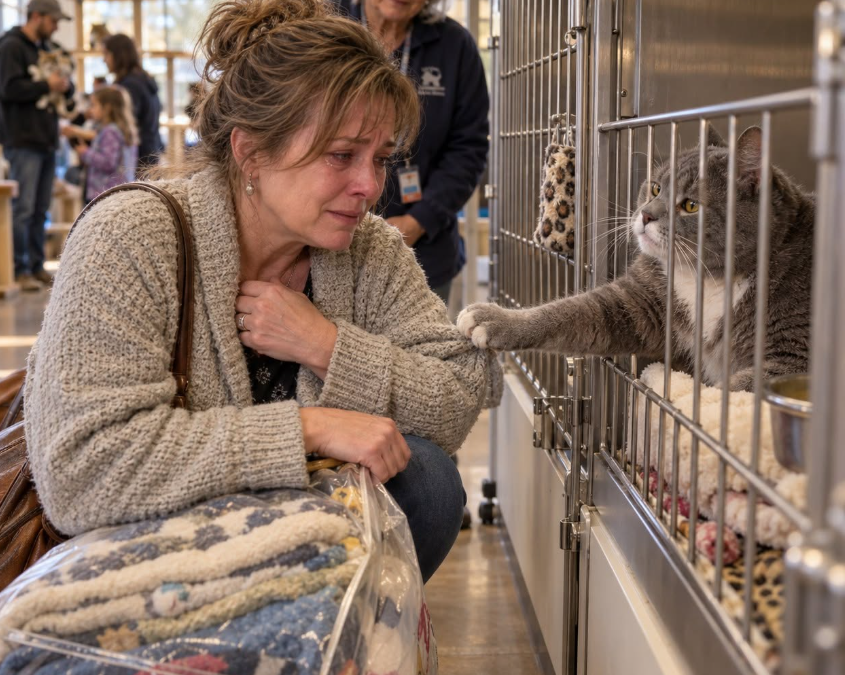
I Went to Donate My Late Mother’s Blankets—Then a 14-Year-Old Shelter Cat Reached Through the Cage and Refused to Let Go
I promised myself I would not look into a single cage because I had already buried my mother three months earlier, and I knew my heart could not survive another goodbye.
Then one old gray paw slipped through the bars, hooked gently into the sleeve of my sweater, and held me there like a fourteen-year-old cat had been waiting all morning for the one person afraid enough to keep walking.
I thought adopting Oggy would teach me how to survive one more loss, but I had no idea his final eleven months would lead me to a sixteen-year-old cat abandoned twice, a letter from an old woman who still loved her, and a question I would spend years trying to answer.
I only went to the shelter to donate my mother’s blankets.
That was the plan.
Walk in.
Drop them off.
Walk out.
No cages.
No names.
No sad eyes.
No accidentally learning that some animal had been waiting nine months for a person who never came.
I made that rule in the parking lot before I got out of my car.
I actually said it aloud.
“You are not adopting anything today.”
The words sounded ridiculous in the empty car.
Still, I repeated them.
“You are donating blankets.”
That was all.
On the back seat sat a black trash bag full of fleece throws my mother had kept folded in the bottom drawer of her linen cabinet.
They smelled faintly like lavender detergent.
Her detergent.
The smell had survived her better than I had.
My mother had died three months earlier.
People say grief comes in waves.
That sounds almost beautiful.
Mine felt more like discovering traps in rooms I already knew.
I could be fine making coffee, then notice the mug she always used when she visited.
Gone.
I could open the garage and see the cardboard boxes containing the remains of eighty-one years.
Gone.
I could hear a woman laughing in a grocery store and turn because for half a second the sound belonged to my mother.
Gone.
Three months was long enough for everybody around me to start returning to ordinary life.
Not long enough for mine to feel ordinary.
The first few weeks after the funeral, people called every day.
Then every other day.
Then on Sundays.
Then:
“Thinking of you.”
A text.
A heart emoji.
A promise to get lunch sometime.
Nobody was being cruel.
Life was simply moving.
Mine had not received the message.
My mother’s belongings were still stacked in my garage.
Every box contained some tiny object with the power to stop me.
A grocery list.
Lip balm.
A cardigan.
A church bulletin folded around a coupon that had expired two years earlier.
Her handwriting on a recipe card.
Her reading glasses in the exact case she always misplaced.
I could not keep everything.
I could not throw anything away.
So I moved the boxes from one side of the garage to the other and called that progress.
Then I found the blankets.
They had belonged to Marcy, my mother’s old calico cat.
Marcy had died years before Mom did.
Round.
Bossy.
The absolute ruler of my mother’s living room.
Mom had kept Marcy’s blankets because she believed soft things should never be wasted.
That was exactly how she said it.
“Soft things should never be wasted.”
I remember standing in the garage pressing one of those blankets against my chest.
It felt stupid.
It also felt like being held.
I couldn’t throw them away.
But keeping them in a box felt worse.
So I called the county shelter.
The woman who answered told me they always needed blankets, especially for senior cats.
That phrase nearly made me hang up.
Senior cats.
No.
I wasn’t going there to meet anybody.
I was going there to leave something useful behind.
The shelter sat at the edge of town in a low brick building with a faded blue sign and a wind chime near the entrance.
It looked older than some of the animals inside.
The lobby smelled faintly of bleach, laundry detergent, and dry cat food.
A woman behind the desk looked up.
Silver hair.
Pulled back.
Maybe sixty.
Warm face.
Her name tag said JADE.
“I called about the blankets.”
“Oh, yes.”
She came around the desk.
“These are wonderful.”
I handed over the bag.
“They belonged to my mother.”
The words came out before I intended them to.
Jade did not give me the exaggerated sympathetic expression people sometimes make when grief enters a casual conversation.
She simply said:
“I’m sorry.”
“Thank you.”
“And these will help.”
That mattered.
Not:
They’ll go to a good place.
Not:
Your mother would be proud.
She didn’t pretend to know my mother.
She just told me the blankets would be used.
That was enough.
Behind her, I could see through a glass door into the main cat room.
A family stood near the front.
Mother.
Father.
Two children.
They were watching two kittens tumble over each other like tiny drunk acrobats.
One child laughed.
I understood why kittens went first.
Kittens felt like beginnings.
Like possibility.
Like a long story whose ending was too far away to imagine.
I turned toward the exit.
Jade said:
“You’re welcome to walk through.”
I shook my head much too quickly.
“I’m not adopting.”
A tiny smile touched her mouth.
“I didn’t say you were.”
I should have left.
I still don’t know why I didn’t.
Maybe because grief makes you careless.
Maybe because the blankets had already taken me farther than I intended to go.
Maybe because some part of me wanted to be around living things that needed something simple.
Food.
Warmth.
A clean bed.
No one asking me whether I had started “moving forward.”
I followed the hallway.
The kittens were first.
Of course.
Bright eyes.
Tiny paws.
People crouched around them taking pictures.
Then young adult cats.
A black cat sleeping in a cardboard box.
A tabby attacking a toy mouse like the mouse owed him money.
A calico with one eye staring at everyone with deep suspicion.
I smiled despite myself.
Then the hallway grew quieter.
Fewer visitors.
Larger handwritten cards.
SPECIAL DIET.
SHY.
NEEDS QUIET HOME.
SENIOR.
I slowed down.
That was my mistake.
Or maybe the opposite.
The cage was near the back.
Old gray cat.
Large frame gone soft with age.
Silver fur around his muzzle.
Cloudy green eyes.
His card said:
OGGY.
14 YEARS OLD.
CALM.
AFFECTIONATE.
SENIOR HOME PREFERRED.
WAITING 5 MONTHS.
Five months.
I looked away.
Immediately.
Absolutely not.
Jade had followed but stayed a few feet behind.
“He’s been here a while,” she said.
I tried to sound uninterested.
“He looks sweet.”
“He is.”
Oggy lifted his head.
Slowly.
He looked at me.
There was nothing dramatic in his expression.
No desperate meow.
No throwing himself against the cage.
He just watched.
I stepped closer.
“Hi.”
Then one gray paw came through the bars.
It reached toward the sleeve of my sweater.
Hooked lightly into the fabric.
And stopped.
I stared down.
Oggy did not pull hard.
He simply held on.
Like:
You can leave if you really want to.
But I’d rather you didn’t.
My throat closed.
I gave a nervous laugh.
“Well.”
His paw stayed.
“Hello to you too.”
Jade said softly:
“He doesn’t usually do that.”
I looked over my shoulder.
“Do shelter employees get trained to say that?”
She laughed.
“No.”
“Because that was suspiciously well timed.”
“I promise.”
Oggy blinked.
Still holding my sleeve.
I crouched.
He moved closer.
His paw remained through the bars.
“How long do cats his age usually live?”
Jade took her time answering.
I appreciated that.
People rush to comfort grief.
Sometimes because they love you.
Sometimes because your fear makes them uncomfortable.
They say:
He could have years.
You never know.
Don’t think like that.
Jade said:
“No one can honestly promise you.”
There it was.
Exactly the reason I could not take him home.
I had just buried my mother.
Just begun learning what a house sounded like after somebody disappeared from it.
I could not bring home an old cat, learn his habits, memorize his footsteps, begin listening for him—and then lose him too.
“I’m not strong enough for that.”
Jade looked at Oggy.
Then at me.
“Maybe he doesn’t need someone strong.”
I waited.
“Maybe he just needs someone who stays.”
That sentence hit something I had been protecting.
I stood.
Oggy’s paw slipped from my sleeve.
I left.
I drove home proud of myself for almost ten minutes.
I had made the sensible choice.
Responsible.
Adult.
I was grieving.
You should not make emotional decisions while grieving.
I repeated that at every traffic light.
That evening I heated soup.
Sat alone at my kitchen table.
The refrigerator hummed.
Clock ticked.
Rain touched the window.
I ate three spoonfuls.
No mother calling to ask whether I had eaten.
No Marcy.
No Oggy.
No one needing me to open a can of food or refill a bowl.
Nothing.
The problem with an empty house is that silence gives your thoughts excellent acoustics.
All I could see was one gray paw.
All I could hear was:
Maybe he just needs someone who stays.
The following morning, I went back.
Jade was cleaning a cage when she saw me.
She didn’t look surprised.
That irritated me slightly.
“I still don’t know if I can do this.”
“No one does.”
“What if he dies next month?”
She opened his cage.
“Then he won’t spend next month here.”
That was the end of the argument.
I took Oggy home that afternoon.
He did not explode from the carrier like a cat in a heartwarming commercial.
He stayed inside for several minutes.
Then emerged slowly.
Sniffed the rug.
Couch.
Dining table.
Kitchen.
Hallway.
He moved like an old man inspecting a hotel room he had already decided to complain about.
Then he saw one of my mother’s blankets.
I had kept one.
I still don’t know whether I deliberately placed it beside the armchair because I hoped he would choose it.
Probably.
Oggy climbed onto it.
Turned twice.
Lay down.
As if he had been sleeping there for years.
The first weeks were uneventful.
Beautifully uneventful.
He ate slowly.
Drank noisily.
Slept more than I knew cats could sleep.
Every morning, he followed me into the kitchen.
I made coffee.
He sat near my feet.
Every evening, he appeared in the hallway around seven-fifteen.
Not seven.
Not seven-thirty.
Seven-fifteen.
He sat there like a supervisor checking whether I had completed the day properly.
At night, he climbed onto the couch and placed one heavy paw on my leg.
That was his preferred form of affection.
One paw.
No drama.
No desperate need to be held.
Just contact.
I began speaking aloud again.
“You hungry, old man?”
Rusty purr.
“Your bowl is full.”
Stare.
“You saw me fill it.”
Stare.
“Oh, you want the chicken.”
Purr.
“You’re manipulative.”
Purr louder.
I learned his rules.
Water bowl filled all the way to the top.
Salmon unacceptable.
Plain chicken excellent.
Tuna tolerated.
Countertops beneath him.
Furniture scratching beneath him.
Closed bedroom door offensive.
Sun patch mandatory.
I realized something about old animals.
They often have no interest in making life complicated.
Warm place.
Food.
Soft blanket.
Familiar voice.
Body nearby.
Oggy did not need adventure.
He needed safety.
And I needed something similar.
My house changed.
Not louder exactly.
Fuller.
There is a difference.
Grief still came.
I would find my mother’s handwriting in a drawer.
Hear one of her songs in a store.
Reach for my phone to call her before remembering.
But Oggy would be there.
He did not fix anything.
That wasn’t his job.
He simply remained.
Some days that was medicine.
Eleven months after I adopted him, Oggy stopped finishing his food.
The first night, I pretended not to notice.
“He’s being picky.”
The chicken was too dry.
The bowl wrong.
Old cats have opinions.
The next morning, he ate almost nothing.
Then he walked to my mother’s blanket.
Lay down.
Looked at me.
I knew.
Fear hit so fast that I could barely breathe.
This was the exact thing I had tried to avoid.
I sat on the floor beside him.
“I knew this would happen.”
He lifted his head.
“I knew it would hurt.”
Oggy pressed his forehead weakly into my palm.
And somehow, in that moment, the entire equation changed.
I had not adopted him because I believed I could escape heartbreak.
I had adopted him because he deserved not to face his last chapter alone.
Eleven months.
People call that short.
It is short.
It is also long enough for hundreds of breakfasts.
Hundreds of evenings.
A thousand little conversations.
A favorite sleeping place.
A person who knows exactly how you like chicken torn into pieces.
A name said with affection every day.
Oggy died on my mother’s blanket.
I was beside him.
I held him.
I told him he was good.
I told him I was sorry.
I told him thank you.
It broke my heart.
Of course it did.
But I had been wrong about something.
Heartbreak did not destroy the love that came before it.
The love changed the heartbreak.
That difference was everything.
A few weeks after Oggy died, I returned to the shelter.
Jade looked at the bag in my hands.
Oggy’s unused food.
Medication.
Small bed.
She said gently:
“Dropping off his things?”
I shook my head.
“No.”
She waited.
I looked toward the quiet hallway.
“I want to know which senior cat has been waiting the longest.”
Jade’s expression changed.
Slowly.
Not happy.
Not sad.
Something more careful.
“Are you sure you want to know?”
My hands started shaking.
I almost laughed.
“I just buried my mother and held a fourteen-year-old cat while he died.”
I took a breath.
“No. I’m not sure.”
Then:
“Show me anyway.”
We walked past the kittens.
Past the easy yeses.
Past young cats rolling against cage doors.
Past cats performing charm like professional salespeople.
At the far end, Jade stopped.
Small brown tabby.
White chest.
One front toe bent sideways.
Curled on an old towel.
She didn’t get up.
Didn’t meow.
Didn’t reach.
Her card read:
MABEL.
16 YEARS OLD.
QUIET.
SHY.
NEEDS PATIENCE.
Then beneath it:
RETURNED TWICE.
I felt something drop inside me.
“Twice?”
“First family said she was too withdrawn.”
“And the second?”
“Said she hid too much.”
“How long has she been here?”
Jade hesitated.
“Nine months.”
Nine months.
At sixteen.
Nine months watching people choose kittens.
Watching children point.
Watching carriers leave.
Watching strangers say:
She’s beautiful, but—
I crouched.
“Hi, Mabel.”
No response.
Not even fear.
She simply looked tired.
Oggy had stopped me with one paw.
Mabel looked like she had stopped expecting anyone to stop.
That hurt worse.
“What happened to her owner?”
“Her person went into residential care.”
“Family couldn’t take Mabel?”
“No.”
I looked at her card again.
Returned twice.
Sixteen.
Nine months.
“Is she unfriendly?”
“No.”
“Then?”
“She’s slow.”
“How slow?”
Jade looked at Mabel.
“Maybe very.”
I almost said:
So am I.
Instead:
“Does she like blankets?”
That made Jade smile.
“She loves blankets.”
I brought Mabel home that afternoon.
The drive was silent.
No crying.
No scratching carrier.
Nothing.
“You okay back there?”
Nothing.
“Me neither.”
At home, I opened the carrier.
Mabel stayed inside.
Ten minutes.
Twenty.
An hour.
I sat several feet away with a book.
Read the same paragraph six times.
Jade had warned me:
“Don’t rush her.”
Then she said something I remembered later.
“Being chosen can be frightening when you stopped believing anyone would choose you.”
Finally, one brown paw appeared.
Then another.
Mabel stepped out.
Slowly.
Sniffed the rug.
Couch.
Chair.
Then the corner of my mother’s old blanket.
She climbed onto it.
Turned once.
Lay down stiffly.
Not relaxed.
But there.
Maybe.
That was enough.
First night, she slept under a table.
Second, under the couch.
Third, behind the armchair.
For two weeks, I got nothing from her.
No purr.
No ankle rub.
No lap.
No affection.
Only evidence.
Empty food bowl after I went to bed.
Used litter box.
Warm dent in the blanket.
I started understanding why people had returned her.
And I hated myself for understanding.
Not because Mabel was difficult.
Because love that gives no visible return can make humans feel foolish.
We want proof.
Instant chemistry.
The cute photograph.
The animal rushing into our arms.
The story people understand in fifteen seconds.
Mabel wasn’t that story.
Mabel was a locked door.
The question wasn’t whether I could open it.
The question was whether I could wait outside without kicking it down.
On the fifteenth night, I woke because something touched my foot.
Mabel stood beside the bed.
Her eyes reflected hallway light.
“Hi.”
She jumped down.
Gone.
The next night, she returned.
Then again.
By the end of the week, she slept on the far corner of my bed.
Maximum distance while technically joining me.
That was Mabel’s first gift.
Distance with hope inside it.
Then one morning, I found a folded piece of paper beneath the small cushion that had come home in her carrier.
Worn edges.
Blue ink.
I should not have opened it.
I did.
Five lines.
Please tell Mabel I did not stop loving her.
Please tell her I looked for another way.
Please tell her she was my best girl.
Please let her have something soft.
Please do not let her think I left because I wanted to.
I sat on the floor.
For a long time.
Mabel was on my mother’s blanket, washing one paw.
I looked at her.
Suddenly, the cat in my living room became part of someone else’s grief too.
I drove back to Harbor Haven that afternoon.
Jade saw my face.
“Is Mabel okay?”
“Yes.”
I put the note on the desk.
“I found this.”
Jade closed her eyes.
“I wondered where that went.”
“You knew?”
“I knew her owner wrote something. I thought it was in the intake file.”
“Who wrote it?”
“Ruth.”
“Her owner?”
“For sixteen years.”
“Is she dead?”
“No.”
The answer surprised me.
“She’s at Cedar Glen Residence.”
Care home.
“Does she know Mabel was adopted?”
Jade hesitated.
That pause tightened my chest.
“What?”
“Her daughter asked us not to contact the family about Mabel.”
“Why?”
“Because hearing that Mabel was still here was devastating Ruth.”
I stared.
“So she doesn’t get to know Mabel found a home?”
“I didn’t say that.”
“That’s what it means.”
“Her daughter is trying to protect her.”
“From good news?”
“From another loss.”
That silenced me.
Because I understood that more than I wanted to.
One more glimpse of something you cannot have back can be its own kind of cruelty.
Still:
“It feels wrong.”
“It might be.”
Jade did not rescue me with certainty.
I hated her for that for approximately ten seconds.
Then she said:
“Ask yourself who you’re trying to comfort.”
“What?”
“Ruth?”
She pointed toward the note.
“Mabel?”
Then:
“Or you?”
That question followed me home.
Who did I want to save?
Ruth?
Mabel?
Or the woman inside me who still wished somebody could knock on my door and give me one more piece of my mother?
I put the note in my desk.
Did nothing.
Three days.
On the fourth, Mabel climbed onto the couch.
Beside me.
Not across the room.
Beside.
She stared at my lap.
Considered.
Stepped onto my thigh.
Circled three times.
Settled.
Her body was incredibly light.
I put one hand near her back.
Not touching.
After a minute, she leaned into it.
I cried without making noise.
“I’ve got you.”
Mabel closed her eyes.
That was when I understood she wasn’t Oggy’s replacement.
She was not another version of his story.
Mabel brought her own history through my door.
And unlike Oggy’s, part of hers was still alive.
Jade eventually asked permission to post a simple photograph on the shelter’s community page.
Nothing about Ruth.
Nothing private.
Just Mabel asleep on my mother’s blanket.
Caption:
Mabel, our longest-waiting senior girl, is finally home.
Comments flooded in.
Bless you.
Senior pets are special.
I could never do this. I’d be too heartbroken.
What a beautiful ending.
People love endings when they don’t have to sit through the middle.
Then one comment appeared.
That looks like my mother’s cat.
Second:
Is this Mabel from Cedar Glen?
My hands went cold.
Jade called.
“Mabel’s former owner’s daughter saw it.”
“What did she say?”
“She wants the post removed.”
“Why?”
“She’s afraid someone her mother knows will show Ruth.”
My first reaction was anger.
Protective anger.
Self-righteous anger.
“So Ruth is never allowed to know?”
“Please.”
Jade sounded tired.
“Don’t make this simple.”
I looked at Mabel sleeping in sunlight.
Then Jade said:
“Her daughter’s name is Nora. She’s willing to talk to you.”
I said yes.
Nora called that evening.
She sounded younger than I expected.
Maybe forties.
Exhausted.
First words:
“Thank you for taking Mabel.”
That made disliking her difficult.
“You’re welcome.”
Long pause.
“My mother loved that cat more than anything.”
“I know.”
“No.”
Her voice cracked.
“I don’t think you do.”
I sat.
Mabel entered the kitchen and settled beside my chair.
Nora told me about Ruth.
Her father had died six years earlier.
After that, Ruth and Mabel became a two-member household.
Coffee every morning.
Mabel on the windowsill.
Game shows every night.
Mabel on Ruth’s lap.
As Ruth’s health declined, she remembered Mabel’s feeding schedule better than some of her own appointments.
When the time came for assisted living, Nora searched.
Facilities allowing cats.
Private rooms.
Exceptions.
Pet visitation.
Friends.
Relatives.
Neighbors.
Church members.
Everyone had a reason they couldn’t take Mabel.
Nora had two children.
Full-time job.
Husband frequently traveling.
An old dog that did not tolerate cats.
“I tried.”
She repeated it several times.
Not defensively.
Like someone who needed one person to believe her.
“I tried.”
When she surrendered Mabel, Ruth did not speak to her for eight days.
Every visit:
Where’s Mabel?
At first Nora told the truth.
Shelter.
Still waiting.
Then Ruth cried after every update.
The facility called Nora because her mother became impossible to comfort.
So Nora stopped mentioning Mabel.
“I told myself it was kinder.”
She paused.
“Maybe I’m horrible.”
“No.”
I answered immediately.
And meant it.
“It makes you human.”
Nora started crying.
“Please don’t post more photos.”
I looked down.
“I don’t want to choose between my mother’s peace and the truth.”
That was the real conflict.
Not:
Good daughter versus bad daughter.
Not:
Pet lover versus cruel family.
A daughter trying to protect a mother.
An old woman missing a cat.
A cat adapting after losing her human.
Love pulling in three directions.
“I’ll ask Jade to take it down.”
Nora exhaled.
“Thank you.”
The post disappeared.
I thought that would be the end.
Then Ruth found out anyway.
Someone at Cedar Glen had seen the photograph.
Grief slips around rules.
A letter arrived at the shelter.
Addressed:
To the person who has Mabel.
Jade called me.
I drove over.
The handwriting shook but remained readable.
Dear person who has Mabel,
I am Ruth.
I was Mabel’s first home.
I am glad she has a second one.
I hope she has a window.
She likes birds, but she pretends she does not care.
She likes warm blankets.
She does not like loud voices.
She will forgive you slowly, then all at once.
If she sits on your lap, please know you have been chosen by a very fine lady.
I did not give her away because I stopped loving her.
I gave her away because my life became smaller than my love.
I stopped.
Read that sentence again.
My life became smaller than my love.
Sometimes one sentence explains an entire tragedy.
Ruth continued.
I will not ask to have her back.
But if it would not hurt her too much, I would like to see her once.
Just once.
I pressed the paper against my chest.
“What does Nora say?”
Jade hesitated.
“No.”
My heart dropped.
“She thinks it’ll break Ruth again.”
“And Ruth?”
“She says she’s already broken in that place.”
No villain.
Again.
Just people trying to protect each other with inadequate tools.
Nora called that night.
Scared.
“Please don’t do this.”
“I haven’t agreed.”
“You’re thinking about it.”
She was right.
“Ruth asked for one visit.”
“And then what?”
I had no answer.
“Do you know what it’s like when your mother forgets why she’s crying but her body still remembers?”
No.
“Do you know what it’s like to become the person everyone judges because you made the decision nobody else was willing to make?”
No.
I knew death.
Empty houses.
Last breaths.
I did not know the exact grief of becoming gatekeeper to my mother’s pain.
Nora continued.
“People love to say pets are family.”
She exhaled.
“I agree.”
“But so are my children.”
“My husband.”
“My mother.”
“I couldn’t keep every promise at once.”
That sentence changed me too.
Love can be larger than capacity.
When capacity runs out, somebody always thinks you failed.
“I’m not trying to hurt you.”
“I know.”
“I’m not trying to hurt Ruth.”
“I know.”
Then Nora said:
“Good intentions can still hurt.”
I had learned that from grief already.
I sat beside Mabel afterward and told her everything because apparently I had become the kind of person who discussed family ethics with a sixteen-year-old cat.
Mabel yawned.
Put one paw on my wrist.
Old cats are excellent at refusing to solve human problems.
The following morning, Jade suggested a compromise.
Neutral visit.
At the shelter.
Quiet room.
Twenty minutes.
No promises.
No discussion of Mabel returning to Ruth.
Carrier stays open only if Mabel chooses.
If Mabel hides, stop.
If Ruth becomes overwhelmed, stop.
Boundaries.
Nora said no.
Then no again.
Third time, she cried.
“I don’t want to be the bad person in my mother’s last years.”
“You’re not.”
“I feel like I am.”
“I don’t think bad people worry this much about hurting everyone.”
A week later, she agreed.
One visit.
I barely slept the night before.
Mabel slept perfectly.
Of course.
In the morning, I brushed her.
Three strokes before she gave me a look.
Enough.
I put my mother’s smallest fleece blanket inside the carrier.
Mabel entered voluntarily.
At the shelter, Jade prepared a quiet room.
Two chairs.
Rug.
Lamp.
No cages.
Nora arrived first.
Cardigan buttoned incorrectly at the bottom.
Tired eyes.
She saw the carrier.
Covered her mouth.
“Oh.”
One tiny word.
So much guilt inside it.
Mabel watched.
Nora did not reach.
That made me respect her.
Then Ruth entered.
Tiny.
White hair pinned loosely.
Walker with tennis balls on the feet.
An aide stayed near the doorway.
Ruth’s eyes found the carrier.
She stopped.
For one awful moment, I thought Nora had been right.
Ruth’s face collapsed inward.
Not dramatic.
Not loud.
Like paper losing structure.
Nora moved.
“Mom—”
Ruth raised one hand.
“Wait.”
Mabel stood inside the carrier.
Ears forward.
Ruth lowered herself into the chair.
I opened the carrier door.
I expected Mabel to remain inside.
Part of me hoped she would.
It would make everything easier.
She stepped out.
Slow.
One paw.
Another.
Looked around.
Then Ruth said:
“Hello, my best girl.”
Mabel froze.
Her entire body changed.
Not younger.
Not suddenly strong.
Awake.
As if something familiar had reached twenty feet across time.
She walked to Ruth.
Slowly.
Ruth held out one hand.
Mabel pressed her forehead into Ruth’s fingers.
Every person in the room broke.
Quietly.
Nora turned toward the wall.
Jade wiped her cheek.
I held the empty carrier handle like it was keeping me upright.
Ruth cried.
But she smiled.
“You look good.”
She touched Mabel’s face.
“You got a little round.”
Mabel leaned against her shoe.
Ruth laughed.
A bright sound.
“I know.”
Then:
“I know, sweetheart.”
Nora made a sound.
Ruth looked up.
“Oh, honey.”
Nora shook her head.
“I’m sorry.”
Ruth held out her other hand.
Nora went to her knees.
“I’m sorry, Mom.”
“I know.”
“I tried.”
“I know that too.”
Nora cried like somebody who had been carrying guilt long after the person she thought she hurt had stopped blaming her.
Ruth stroked her daughter’s hair with one hand.
Mabel with the other.
“My two stubborn girls.”
I looked away.
Some moments feel wrong to stare at.
Ruth spent twenty minutes talking to Mabel.
Birds outside her Cedar Glen window.
Terrible oatmeal.
Their old chair.
How glad she was Mabel had blankets.
Then she looked at me.
“Does she sleep with you?”
“Sometimes.”
Ruth smiled.
“That means she trusts you.”
I swallowed.
“I’m trying to be good to her.”
“You are.”
Two words.
I hadn’t realized I needed permission from Mabel’s first person to love her until Ruth gave it.
Then time ran out.
Everybody knew.
The room shifted.
Ruth looked down at Mabel.
“I don’t know how to say goodbye twice.”
That was the price.
The thing Nora had feared.
The thing I wanted love to magically solve.
Ruth looked at me.
For one second, I thought she might ask me to leave Mabel.
If she had, I honestly don’t know what I would have done.
She didn’t.
She reached into her cardigan pocket.
Pulled out a faded blue square of cloth.
Frayed edge.
“This is from my old housecoat.”
She smiled.
“Mabel used to sleep on it when I folded laundry.”
She gave it to me.
“Will you put it with her blankets?”
I nodded.
No voice available.
Ruth bent as far as she could.
Kissed Mabel’s head.
“You go home now.”
Her lips trembled.
“Be loved all the way.”
Mabel eventually walked into her carrier after I placed the blue fabric inside.
Not because she had forgotten Ruth.
Not because leaving was easy.
Because maybe love had become larger than one address.
On the drive home, I had to pull over.
I cried in a grocery-store parking lot.
Mabel sat in the carrier with Ruth’s cloth tucked under her chin.
That night, she slept on my chest.
Head under my chin.
Purr vibrating against my ribs.
I thought about all the people sitting at tables making impossible decisions.
Aging parents.
Small homes.
Pets.
Jobs.
Money.
Children.
Care facilities.
Time.
Love.
We tell people:
Do the right thing.
As if the right thing is always obvious.
Sometimes every available choice hurts somebody.
Sometimes the best you can do is choose the hurt you can soften.
The visits continued.
Once a month.
Only when Ruth felt well enough.
Only when Mabel seemed comfortable.
Same quiet room.
At first, Nora stood near the door.
Then sat.
Eventually she started bringing towels from Ruth’s room because Mabel liked the smell.
Ruth stopped asking whether Mabel could stay.
Nora stopped apologizing every visit.
Mabel stopped hiding in the carrier afterward.
We built a rhythm.
Not perfect.
Kind.
Kind became enough.
One afternoon, Nora walked me to my car.
“I judged you.”
I laughed.
“I judged you.”
“I know.”
No offense.
Just truth.
“I thought you were one of those people who thinks love fixes logistics.”
“That definitely sounds like something I would have believed.”
She smiled.
“I thought you’d make me the villain.”
I looked through the window at Mabel.
“I think I needed a villain.”
“Why?”
“Grief is easier when it has a face.”
Nora looked down.
“I needed one too.”
“Who?”
“The residence.”
She shrugged.
“My cousins.”
“Myself.”
“Depends on the day.”
Two women who loved the same cat from opposite sides of the same wound.
“Thank you for not keeping her from Mom.”
“Thank you for letting me bring her.”
“I almost didn’t.”
“I know.”
“I still don’t know whether it was the right decision.”
I thought about that.
Then:
“Maybe some choices never become right.”
Nora looked at me.
“Maybe they just become merciful.”
She nodded.
Then hugged me.
Awkward.
Unexpected.
Needed.
Mabel lived with me another year and three months.
That sounds short.
I had stopped measuring love that way.
She became braver.
Slowly.
She claimed the windowsill.
Yelled at birds she had no realistic intention of catching.
Declared the green chair private property.
Stole plain chicken from my plate once and appeared offended when I objected.
She slept on my mother’s fleece.
Ruth’s blue cloth.
Sometimes both.
Two histories under one old cat.
I kept Ruth’s first letter in my desk.
My life became smaller than my love.
I read that line on hard days.
It made me gentler toward people.
Not instantly.
But slowly.
Like Mabel.
Then Jade called one morning.
Her voice gave away the news before she spoke.
“Ruth passed last night.”
I sat on the edge of my bed.
Mabel lay curled on the blue fabric.
“Oh.”
Nothing else came.
“Nora wanted you to know.”
Mabel opened one eye.
Closed it.
People argue about whether animals know death.
I have no proof.
I only know Mabel stayed near me that day.
And I stayed near her.
A week later, Nora came to my house.
She carried a paper bag.
Inside:
A photograph of Ruth as a young woman holding a tiny tabby kitten.
Mabel.
A cream blanket from Ruth’s room.
And another letter.
Addressed to me.
Ruth had written it after the second visit.
My dear friend,
I hope you do not mind me calling you that.
Anyone who loves the same cat is not a stranger.
Thank you for giving Mabel a home when I could not.
Thank you for letting me say goodbye without making it the end of her joy.
Please do not let anyone tell you old love is wasted love.
Old love is the strongest kind.
It knows the ending is near and chooses tenderness anyway.
If your heart lets you, keep choosing the ones at the end of the hallway.
They are not done being someone’s whole world.
I read it twice.
Then gave it to Nora.
She hadn’t seen it.
By the time she finished, she was crying.
“She forgave me.”
I touched her arm.
“I think she forgave you long before you asked.”
Nora covered her face.
Mabel walked over.
For most of their relationship, she had politely ignored Nora.
That day, Mabel pressed her head into Nora’s ankle.
Nora laughed through tears.
“Well.”
She crouched.
“It’s about time.”
That winter, Jade asked me to attend a shelter meeting.
I assumed they needed volunteers.
Food.
Blankets.
Fundraising.
The issue was senior cats.
Not in dramatic language.
Nobody said:
We don’t want old cats.
They said:
Space.
Adoption flow.
Length of stay.
Community demand.
One board member said:
“We need to focus limited resources on animals with the highest placement potential.”
Nobody booed.
Because this wasn’t a movie.
Also because some of what he said was practically true.
Every long-term cage affected intake capacity.
Most adopters wanted pets they could reasonably expect to have for years.
Kittens moved.
Young adults moved.
Senior cats waited.
Truth can be cruel when delivered without tenderness.
Another person said:
“We shouldn’t shame families for preferring young, healthy animals.”
I agreed.
I raised my hand.
“I don’t think anyone should be shamed for adopting kittens.”
Heads turned.
“Kittens need homes.”
“Younger cats need homes.”
“Choosing a beginning doesn’t mean you love less.”
Jade watched me.
“But I think we make a mistake when we measure a life only by how easy it is to place.”
Silence.
“Mabel was returned twice because she hid.”
“Oggy waited because he was fourteen.”
“Neither needed some extraordinary saint.”
“They needed patience.”
I thought about Ruth.
“An old cat sitting in a cage may be carrying sixteen years of somebody’s mornings.”
The room grew quieter.
“Somebody’s routine.”
“Somebody’s last normal day.”
“Somebody’s grief.”
Then a voice behind me said:
“I surrendered Mabel.”
Nora.
I hadn’t known she was there.
Every head turned.
She looked terrified.
Still stood.
“My mother entered care.”
“I couldn’t keep Mabel.”
“I tried.”
Her voice shook.
“Maybe I failed.”
She swallowed.
“Or maybe I didn’t.”
“But it felt exactly like failing.”
No one interrupted.
“I signed the surrender papers believing Mabel would be adopted because she was sweet.”
“She wasn’t.”
“Every month she stayed here, I felt like I had abandoned my mother and her cat at the same time.”
Nora looked at the board.
“I understand limited space.”
“I had to make a limited-space decision in my own life.”
Then:
“But please don’t make the oldest animals disappear because they’re harder to market.”
Harder to market.
That phrase landed hard.
The meeting did not transform the shelter overnight.
Real life rarely changes after one speech.
But people started suggesting things.
Senior foster list.
Quiet meet-and-greet rooms.
Better photographs.
Honest bios.
No costumes.
No desperate guilt language.
Jade proposed:
The Last Page Program.
Someone objected.
“It sounds like they’re dying.”
Jade said:
“The point is that last pages still matter.”
The name stayed.
It worked slowly.
Real kindness usually does.
A retired man adopted a twelve-year-old cat named Pickle because, in his words, both of them “liked naps and distrusted company.”
A nurse fostered a deaf senior cat who screamed like a malfunctioning alarm.
A widower sat with a fifteen-year-old black cat for two hours without touching him.
Then adopted him.
Not everyone chose seniors.
Good.
No guilt.
That became Jade’s rule.
“No guilt.”
“Only invitations.”
People met the older cats.
If they fell in love, wonderful.
If they adopted a kitten instead, also wonderful.
Love should be an invitation.
Not a trap.
Mabel became the unofficial queen of the program without knowing or caring.
We didn’t put her all over social media.
Nora and I agreed.
But Jade framed one photograph for the senior hallway.
Mabel asleep on my mother’s blanket.
Ruth’s blue cloth under her chin.
Under it:
OLD LOVE IS NOT WASTED LOVE.
Some people stopped.
Some cried.
Some kept walking.
Some came back.
Enough.
The following spring, Mabel slowed down.
Subtle.
No dramatic collapse.
She stopped jumping onto the windowsill and waited for me to lift her.
Slept deeper.
Ate less some mornings.
Looked at me longer.
I knew that look now.
Oggy had taught me.
It didn’t mean panic.
It meant:
Pay attention.
So I did.
I paid attention to the click of her crooked toe across the kitchen floor.
The weight of her sleeping against my leg.
The way sunlight turned her whiskers white.
Her irritated little meow if dinner was late.
The things grief would someday make me desperate to remember.
One evening, I carried her to the window.
A bird landed on the fence.
Mabel lifted her head.
Tail moved once.
“Terrifying.”
I kissed the top of her head.
“That bird has no idea how lucky it is.”
Mabel blinked.
I wrapped Ruth’s cream blanket around her.
Held her until the bird flew away.
Two days later, Nora came over.
She brought soup nobody wanted.
Mabel lay between us on the couch.
Nora stroked her with one finger.
“You gave her a good ending.”
I looked down.
“No.”
Nora frowned.
“We gave her a good middle after a hard turn.”
She smiled sadly.
“My mother would like that.”
We sat there.
Two women.
One old cat.
Three blankets from three different lives.
My mother’s fleece.
Ruth’s blue housecoat.
Ruth’s cream blanket from Cedar Glen.
I used to think a home was walls.
Keys.
Furniture.
Mail with your name.
Mabel taught me otherwise.
A home can hold people who never met.
My mother never met Oggy.
Oggy never met Mabel.
Ruth never met my mother.
And somehow all of them existed together in my living room.
Each person leaving something soft for whoever came next.
Mabel died on a Sunday morning.
Quiet.
Not empty.
There is a difference.
She was on my lap.
Wrapped in Ruth’s cream blanket.
One corner of my mother’s fleece under her chin.
Nora was there.
Jade too.
I had called Jade because I could not imagine that last page without the woman who had first told me senior animals didn’t need heroes.
Mabel’s breathing slowed.
I told her Ruth loved her.
I told her Oggy would have liked her but probably would have pretended otherwise.
I called her my very fine lady.
Nora whispered:
“Tell Mom we tried.”
Mabel’s crooked paw rested on my wrist.
Then she was still.
It hurt.
Of course.
Love is not a transaction where enough kindness purchases freedom from grief.
Love is why grief has weight.
But I didn’t feel cheated.
I felt trusted.
Trusted with Oggy’s last eleven months.
Trusted with Mabel.
Trusted with Ruth’s goodbye.
Trusted with the lesson that a short chapter can alter the entire book.
A month later, I returned to Harbor Haven.
The senior hallway was still quiet.
Probably always would be.
But now each cage had a fresh blanket.
Handwritten cards.
SHY AT FIRST.
LOVES CHIN SCRATCHS.
LIKES QUIET HOMES.
NEEDS TIME.
STILL HAS SO MUCH LOVE TO GIVE.
Jade saw me.
Smiled.
Not brightly.
Not sadly.
Knowingly.
“You don’t have to do this again.”
“I know.”
“I mean it.”
“I know.”
She stood beside me.
Last cage on the right:
Thin black cat.
Cloudy eyes.
White chest patch shaped almost like a crooked heart.
Card:
ARTHUR.
15 YEARS OLD.
WAITING 7 MONTHS.
LIKES QUIET VOICES.
I crouched.
Arthur didn’t move.
Didn’t reach.
Didn’t perform heartbreak.
He sat in the back.
Old.
Still.
Uncertain.
A mother with two children passed behind me.
One child said:
“That cat looks boring.”
The mother shushed him.
I almost smiled.
Once, I might have understood.
Once, I thought the quiet animals had less story.
Now I knew quiet could contain an entire lifetime.
“Hi, Arthur.”
His ears moved.
Just slightly.
“I hear you like quiet voices.”
Jade stood behind me.
“His owner died.”
Of course.
There it was again.
The familiar door.
The choice.
The knowledge that love would eventually hurt.
I thought about my mother’s blankets.
Oggy’s gray paw.
Mabel hiding behind the chair.
Ruth’s letters.
Nora carrying guilt that never belonged entirely to her.
Every last page that somehow became somebody else’s beginning.
Arthur blinked.
Slow.
Not a sign.
Not destiny.
Not proof.
Just a blink.
I looked at Jade.
“How long can I sit with him?”
She smiled.
“As long as he needs.”
So I sat on the shelter floor.
Arthur stayed in the back.
People came and went.
Kittens played in the front room.
Children laughed.
Doors opened.
Doors closed.
And I stayed.
Five minutes.
Ten.
Twenty.
I talked occasionally.
Nothing important.
Weather.
Traffic.
My mother.
Oggy.
Mabel.
I told him I had become embarrassingly experienced at loving cats who had no interest in impressing me.
Arthur did not respond.
“That’s fine.”
I leaned against the wall.
“I’m not in a hurry.”
That was the truth.
I had spent years thinking love required courage.
It doesn’t always.
Sometimes courage is too dramatic a word.
Sometimes love only requires time.
Not leaving because nothing happened quickly.
Not demanding proof.
Not making another living creature responsible for making you feel chosen.
An hour passed.
Arthur remained in the back of the cage.
Jade walked by once.
Didn’t interrupt.
A couple adopted a kitten.
Applause in the lobby.
Carrier left.
Another family entered.
Life.
Arthur watched.
Eventually, I put one finger through the bars.
Not reaching toward him.
Just there.
Offering.
For a long time, he stared at my hand.
I thought about Oggy.
The old paw catching my sleeve.
How easy that had made the decision.
I thought about Mabel.
Two weeks of giving me nothing except emptied bowls.
Arthur owed me neither kind of story.
Maybe he would come forward.
Maybe he wouldn’t.
Maybe I would sit here another hour and leave alone.
That did not make the hour wasted.
Then Arthur stood.
Slowly.
His back legs looked stiff.
He walked three steps.
Stopped.
I kept my hand still.
One more step.
Then another.
He reached the bars.
Sniffed my finger.
I didn’t move.
Arthur lowered his old head.
And rested it against my hand.
No dramatic purr.
No paw gripping my sleeve.
No miracle.
Just weight.
Trusting me with a few ounces of his tired head.
My eyes filled.
“Okay.”
I whispered it mostly to myself.
“Okay.”
Jade had been right from the very beginning.
Maybe they don’t need somebody strong.
Maybe they need someone who stays.
I used to believe adopting an old animal meant volunteering for heartbreak.
Now I think it means refusing to let heartbreak have the final word.
Some people say:
I could never do that.
I understand.
Some say:
It’s too sad.
I understand.
Some say:
I want more years.
I understand that too.
There is nothing wrong with wanting beginnings.
Kittens deserve homes.
Young animals deserve homes.
Families deserve choices that fit the lives they actually have.
But I have held old love in my lap.
I have watched it forgive slowly.
Then all at once.
I have seen a forgotten cage become a home.
A goodbye become mercy.
A woman whose life became smaller than her love find a way to keep loving anyway.
I have watched two strangers stop blaming each other because one old cat made both of us understand that nobody had failed as simply as we wanted to believe.
And I have learned that being late to someone’s story does not mean the remaining pages are less important.
Oggy had eleven months.
Mabel had a year and three.
I did not know how long Arthur would have.
That used to terrify me.
Now I understood the question differently.
Not:
How much time do I get?
But:
What can the time become?
A warm blanket.
A full bowl.
A quiet voice.
Morning sunlight.
A name spoken gently.
Someone waiting when you wake.
Someone beside you when you sleep.
Someone there at the end.
People think senior animals need extraordinary adopters.
They don’t.
Not always.
Sometimes they need ordinary people willing to accept that love does not become worthless because the calendar is shorter.
Ruth wrote:
Old love is not wasted love.
She was right.
Old love may be the purest kind I know.
It sees the ending.
Doesn’t pretend otherwise.
And chooses tenderness anyway.
Arthur leaned harder against my finger.
I smiled through tears.
“Take your time.”
He closed his cloudy eyes.
Outside the senior hallway, another family laughed.
A cage door opened.
A cage door closed.
Life kept moving.
I stayed where I was.
Because I had finally learned that a heart breaking again was not the worst thing that could happen to me.
A heart breaking open still has room.
A heart kept closed does not.
And somewhere between my mother’s blankets, Oggy’s gray paw, Mabel’s crooked toe, Ruth’s blue scrap of cloth, Nora’s impossible decision, and Arthur’s tired head resting against my hand, I stopped asking whether loving something old was worth the pain of losing it.
I already knew.
The pain was never proof that I had made a mistake.
It was proof that someone had been here.
Someone had mattered.
Someone had been loved all the way.
So I sat beside Arthur as long as he needed.
And when he finally lifted his head and took one slow step closer to the cage door, I did not ask him for another sign.
I simply stayed.








