A 10-Year-Old Shelter Cat Had Five Minutes Left—Then He Wrapped One Paw Around the Veterinarian’s Finger and Wouldn’t Let Go
# A 10-Year-Old Shelter Cat Had Five Minutes Left—Then He Wrapped One Paw Around the Veterinarian’s Finger and Wouldn’t Let Go
**At 3:55 on a Friday afternoon, I opened a cage to euthanize a ten-year-old black cat who had spent 120 days waiting for someone to choose him.**
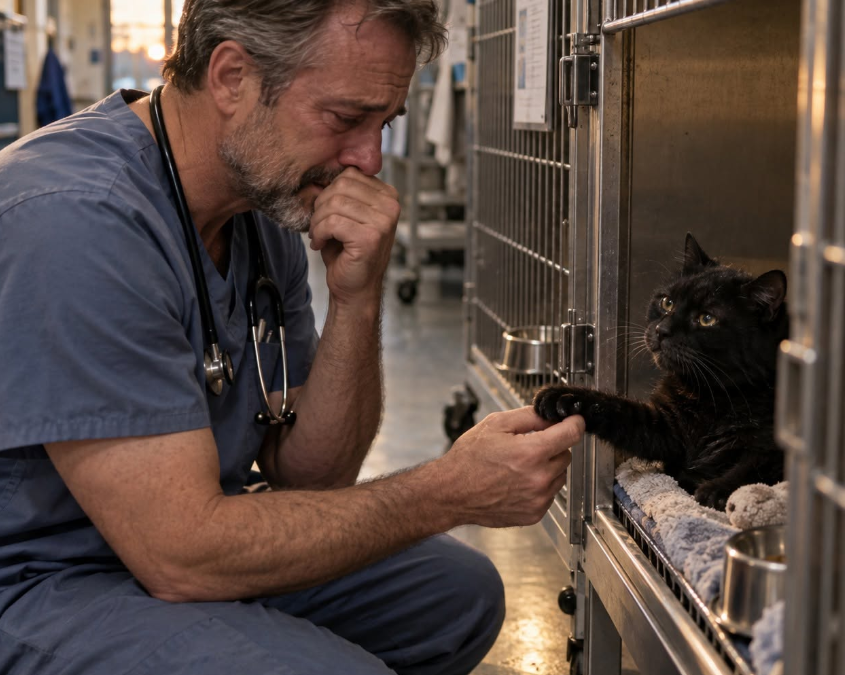
**Before I could lift him out, he slipped one paw through the bars, wrapped it around my finger, and stared at me while the clock above the treatment-room door moved closer to four.**
**Five minutes later, I had broken a rule, changed the cat’s name, and started a fight inside our shelter that would force all of us to confront a truth we had been avoiding for years.**
My name is Dr. Mateo Ramos.
For eight years, I was the veterinarian people called when nobody else wanted to be in the room.
That is not an official title.
My diploma says Doctor of Veterinary Medicine.
My name appears on vaccination records, surgery reports, rabies certificates, cruelty investigations, bite quarantines, spay and neuter forms, treatment plans, and thousands of medical records belonging to animals whose lives crossed mine for anywhere from twenty minutes to fifteen years.
But inside the shelter, away from the bright adoption lobby and the photographs of happy families holding new pets, I had another job.
I was often the person who stayed when hope ran out.
People like to imagine shelter medicine as puppies going home in red bandanas.
Kittens tucked beneath children’s chins.
Senior dogs meeting widows who say things like:
“We’re both old. We’ll understand each other.”
Those things happen.
I have seen them.
I have cried over them.
I have stood in our parking lot while families drove away with an animal they had just adopted and felt something inside me repair itself for a moment.
But shelters have other rooms too.
Rooms the public rarely sees.
Stainless steel.
Locked cabinets.
Dim lights.
Rooms where good people become very quiet because if anybody speaks too loudly, the grief may become impossible to contain.
When people found out what I did for a living, they often asked:
“How can you do that?”
They meant euthanasia.
I never had a satisfying answer.
The honest answer was:
Badly.
I did it badly every time.
My hands stayed steady because the animal deserved steady hands.
My voice stayed soft.
I used the gentlest technique possible.
When suffering truly had no humane path forward, I believed in giving peace.
I had seen cancer hollow out dogs until breathing hurt.
I had watched old cats whose kidneys had failed stop eating, stop drinking, stop recognizing comfort.
I had seen cruelty cases where keeping an animal alive would have been for us, not for them.
Mercy exists.
I believe that.
But mercy and convenience are not the same thing.
Space is not disease.
Time is not pain.
Being overlooked is not a medical diagnosis.
And by the time I met Friday, I was no longer certain our shelter always remembered the difference.
I once told my wife Elena that the day euthanasia stopped hurting would be the day I quit.
She sat across from me at our kitchen table, both hands around a coffee cup.
“Promise?”
“I promise.”
At the time, I meant it.
Then the years accumulated.
Not enough money.
Too many animals.
Kitten season.
Parvo outbreaks.
People abandoning pets after losing apartments.
People surrendering dogs because they had babies.
People crying while surrendering animals because they had cancer and nowhere else to turn.
People lying.
People genuinely desperate.
Cruelty cases.
Hoarding cases.
Emergency intakes.
Foster homes full.
Rescue partners full.
Every cage occupied.
Every temporary crate occupied.
Every office temporarily becoming an animal room.
Pain did not stop hurting.
That wasn’t the problem.
The problem was that I learned how to function around it.
I learned to finish a euthanasia, write the record, clean the table, remove my gloves, and walk directly into an exam room where somebody was waiting for a vaccine appointment.
I learned to tell a family:
“He passed peacefully.”
Then wash my hands.
Then answer a phone call.
Then eat lunch if there was time.
Most days there wasn’t.
Pain remained.
But I started building walls around it.
I told myself those walls made me professional.
Maybe they did.
Maybe they also made me numb.
I was no longer sure.
That frightened me.
Then there was animal number 418.
He arrived at the shelter on a rainy Monday in March.
Ten years old.
Black domestic shorthair.
Neutered male.
Twelve pounds.
Small patch of white beneath his chin.
Amber eyes.
Healthy bloodwork.
Clear lungs.
Mild early arthritis.
No aggression.
Good with children.
Indoor-only cat.
Affectionate.
That word was written twice in the surrender form.
Affectionate.
His family said they were moving and could not take him.
They filled everything out quickly.
Reason for surrender:
Relocation.
Medical concerns:
None.
Behavioral concerns:
None.
They left.
They did not say goodbye.
I did not witness that part.
I learned it later from the intake notes.
But I had witnessed enough surrender appointments to imagine it.
A carrier placed on a counter.
The animal looking through plastic slits or metal bars.
One human filling out paperwork while another avoids looking at the animal.
The staff member trying not to judge because sometimes people truly have no option.
Sometimes they do.
Sometimes they do not.
The animal cannot tell the difference.
Cats do not understand leases.
Job transfers.
Divorce.
A new boyfriend who hates pets.
A landlord changing rules.
A baby on the way.
A relative developing allergies.
A family deciding that ten years is enough inconvenience.
They understand one thing.
Door opens.
People leave.
Door closes.
The shelter named number 418 “Midnight” for his public profile.
Black cat.
Obvious choice.
Nobody used it much.
On his kennel card, MIDNIGHT appeared above his intake number.
His adoption photograph was terrible.
Not intentionally.
Black cats are difficult to photograph in shelter lighting.
Their features disappear.
Eyes remain.
Midnight looked like two amber circles floating inside a dark hole.
It did him no favors.
At thirty days, staff said:
“He’ll go.”
He was sweet.
Healthy.
Quiet.
At sixty days:
“I can’t believe he’s still here.”
At ninety days, people stopped saying much.
That’s one of the cruelest changes in long shelter stays.
At first, everybody fights for you.
New photos.
Social media post.
Extra enrichment.
Volunteers point you out to visitors.
“You should meet Midnight.”
Then days become months.
The animal remains.
The staff still cares.
That is exactly why it becomes difficult to talk about.
Hope repeated without results begins to hurt.
Eventually, people learn not to press the wound every time they walk past the cage.
Midnight became part of Cat Room B.
Third cage on the left.
I passed him almost daily.
Sometimes he slept.
Sometimes he reached one paw through the bars.
Sometimes he pressed his forehead against them when someone stopped.
He wasn’t demanding.
No loud meowing.
No dramatic attempts to catch attention.
If you put a finger near the cage, he rubbed his cheek against it.
I examined him twice.
Once at intake.
Once when a mild respiratory infection moved through the room.
Both times he was gentle.
Nervous.
But gentle.
He leaned against my stethoscope while I listened to his heart.
I remember that clearly now.
At the time, it was one more detail in a day overflowing with details.
That bothers me.
The first time Midnight’s name appeared on a long-stay review list, he had been there 106 days.
Tuesday morning.
Staff meeting.
Bad coffee.
Too many spreadsheets.
Marlene Shaw, our shelter director, sat at the end of the table.
Marlene wasn’t cruel.
That matters.
People prefer stories with villains because villains simplify blame.
Marlene had once refinanced her own house to keep the shelter from closing.
She knew long-term animals by name.
She had personally fostered litters at two in the morning.
She carried antacids in her pocket.
She cried in supply closets.
But she was also responsible for keeping the building operating.
Buildings have walls.
Walls create limits.
“We are twenty-eight animals over comfortable capacity,” she said.
Nobody needed reminding.
Cats were already in temporary pop-up crates.
Isolation was full from a hoarding case.
Kitten season had started early.
Three foster families had stopped taking animals because they needed a break.
Donations were down.
County contracts required us to accept strays whether space existed or not.
“Cat Room B,” Marlene continued. “We need to review long stays.”
I already saw the highlighted row.
“Midnight?”
She looked at the paper.
“One hundred six days.”
“He’s healthy.”
“I know.”
“Any behavior issue?”
“No.”
“Then no.”
Marlene sighed.
“Mateo.”
“No.”
Ashley, one of the younger technicians, twisted a pen between her fingers.
“We can repost him.”
“We reposted him three weeks ago,” Marlene said.
“New pictures.”
“Did those last month.”
“Foster?”
“Every cat foster is full.”
I tapped the paper.
“He is healthy.”
No one answered.
“And affectionate.”
Still nothing.
“We do not euthanize a healthy affectionate cat because he has been here too long.”
Marlene looked exhausted.
“Then tell me where I put the four cats animal control is bringing this afternoon.”
That silenced everybody.
I hated her for asking.
I hated myself because I had no answer.
“We can put temporary crates in the hall.”
“For how long?”
“As long as necessary.”
She looked at me sadly.
“That is what we always say.”
The decision was postponed.
At 110 days, postponed again.
At 114, again.
At 118, his name returned.
By then, four cats had arrived from a burned apartment building.
Two had burns.
One was pregnant.
One belonged to an owner nobody could locate.
The shelter had become a puzzle with no empty squares.
Cats in offices.
Cats in the break room.
Cats in temporary kennels.
Noise.
Stress.
Staff exhaustion.
On Thursday at 6:40 P.M., Marlene came into my office while I was completing medical records.
She closed the door.
I knew.
“No.”
She sat.
“Mateo.”
“No.”
“Midnight is on tomorrow’s list.”
“He is healthy.”
“I know.”
“He is adoptable.”
“He has been available for 119 days.”
“That isn’t pathology.”
“I know.”
“Then don’t ask me to treat it like pathology.”
Her eyes filled.
“I am not asking because I don’t care.”
“Then don’t.”
“We have no cages.”
“Find one.”
“Where?”
I opened my mouth.
Nothing came out.
That was the part I hated most.
I could not foster him.
Not realistically.
Our house already contained three children.
Lucia, twelve.
Gabriel, nine.
Sofia, six.
A twelve-year-old Golden Retriever named Benji.
Two bottle kittens temporarily living in our laundry room.
Elena had the patience of a saint, but even saints have square footage.
I could not create adopters.
Could not build an expansion overnight.
Could not undo the surrender.
Could not force visitors to choose a ten-year-old black cat over six-week-old kittens waving tiny paws through the cages like professional salespeople.
Marlene slid the file across the desk.
“Tomorrow.”
I looked at it.
“When?”
“Last appointment.”
“What time?”
“Four.”
I stared at her.
“End of the day?”
She nodded.
“I’m sorry.”
After she left, I stayed at my desk.
Number 418.
Midnight.
Ten years.
Affectionate.
Healthy.
120 days.
Scheduled 4:00 P.M.
I went to Cat Room B before I left.
Most lights were off.
Midnight sat at the front of the cage.
When he saw me, he stood.
Pressed his forehead against the bars.
I offered a finger.
He rubbed his cheek along it.
“I’m sorry.”
He purred.
The sound made me angry.
Not with him.
With everything.
With the family who left.
With the visitors who passed.
With kitten season.
With budgets.
With walls.
With myself.
I went home.
Elena was folding laundry at the kitchen table.
She looked at me once.
“Bad list?”
I nodded.
“Dog?”
“Cat.”
“Medical?”
“No.”
She stopped folding.
“Behavior?”
“No.”
“Space?”
I said nothing.
Her eyes closed.
“Oh, Mateo.”
Sofia ran into the kitchen wearing mismatched pajamas and holding a stuffed unicorn upside down.
“Daddy, Benji stole my sock.”
Benji lay on the living-room rug wagging his tail.
No shame.
I picked Sofia up.
“Did you tell him socks aren’t food?”
“Yes.”
“What did he say?”
“Nothing.”
“That sounds like him.”
She laughed.
For twenty minutes, I became only Dad.
Retrieved sock.
Checked Gabriel’s math.
Listened to Lucia explain why her friend group might be collapsing because someone posted a photograph without permission.
Tucked Sofia in.
Then tucked her in again because apparently my first attempt lacked structural integrity.
Later, Elena found me sitting on the laundry room floor beside the bottle kittens.
“You’re thinking about bringing him home.”
“No.”
She sat beside me.
“Liar.”
I almost smiled.
“I’m thinking about how I can’t.”
“That is different.”
We sat.
“What is he like?”
“Black.”
“I assumed.”
“Older.”
“How old?”
“Ten.”
“Friendly?”
“Yes.”
“Name?”
“Midnight. Or 418, depending on which paper you’re reading.”
Elena frowned.
“Number 418?”
“Intake number.”
“No animal should die with a number as the last thing anybody calls him.”
I looked at her.
She immediately pointed at me.
“That was not permission.”
“I didn’t say anything.”
“You said it with your eyebrows.”
“We have Benji.”
“Yes.”
“Two bottle kittens.”
“Yes.”
“Three children.”
“I remember giving birth to them.”
“We already have chaos.”
“Yes.”
“And Friday is—”
I stopped.
Elena tilted her head.
“What?”
“Nothing.”
“You said Friday.”
“I meant tomorrow.”
But the word had landed differently.
Friday.
The day he was scheduled to die.
The day everyone wanted to finish the week.
The day a living creature had become the final task on a schedule.
Elena watched me.
“We cannot save every animal.”
“I know.”
“You say that.”
“I know.”
“But you treat every euthanasia like proof that you failed.”
I looked away.
“If you bring home every animal because you feel guilty, you will destroy yourself.”
“I know.”
“And probably me.”
“I know.”
“And the children will start living in animal crates.”
I smiled.
“Probably.”
She took my hand.
“But if one animal reaches something in you that isn’t guilt…”
I looked at her.
“Pay attention.”
I slept badly.
Friday began horribly.
A puppy with parvovirus crashed before eight.
A German Shepherd arrived with a chain embedded in his neck.
A woman screamed at reception because we would not accept her neighbor’s cat without documentation.
Two neonatal kittens died before noon.
The washing machine flooded.
Someone used the last clean surgical towel and did not restock.
At 1:30, Marlene passed me in the hall.
“You okay?”
“No.”
She nodded.
“Me neither.”
That was shelter medicine.
At 3:40, the building began settling.
Volunteers finished walks.
Cages were cleaned.
Phones slowed.
The lobby emptied.
Rain tapped against the windows.
Midnight was last on my schedule.
End of day.
End of week.
End of list.
At 3:50, I prepared the treatment room.
I will not describe the process in detail.
Euthanasia done correctly is gentle.
Sometimes it is the kindest thing medicine can offer.
I believe that completely.
But that afternoon did not feel like mercy.
At 3:55, I entered Cat Room B.
Ashley was cleaning the sink.
She saw me.
Then looked at cage 418.
“Want help?”
“No.”
My voice sounded unfamiliar.
I walked to the cage.
Midnight sat on the fleece blanket.
“Hey.”
He blinked.
I opened the door.
Reached inside.
One hand toward his chest.
The other ready to support his back legs.
Before I touched him, Midnight moved.
Not backward.
Toward me.
He raised one front paw.
Slipped it through the bars beside the open door.
Then curled it around my index finger.
I stopped breathing.
His claws were extended slightly.
Enough to hold.
Not enough to hurt.
He did not scratch.
Did not swat.
Did not panic.
He simply held my finger.
Then looked at me.
Amber eyes.
Directly.
I had handled thousands of cats.
Angry cats.
Terrified cats.
Feral cats.
Sick cats.
Dying cats.
Cats who bit.
Cats who screamed.
Cats who climbed walls.
Cats who hid beneath towels.
Cats who froze.
Cats who became limp with fear.
No cat had ever held my hand.
Ashley stopped moving.
Rain hit the high window.
The clock continued moving toward four.
I stayed there.
Bent in front of cage 418.
One finger held by a cat who had spent 120 days being described as affectionate without anybody choosing him.
His expression did not accuse me.
That might have been easier.
He just looked.
And held on.
Five minutes.
That was what remained on the schedule.
Five minutes before the last procedure.
Five minutes between cage and treatment room.
Five minutes between being alive and being a body we would wrap afterward.
I thought about every time procedure had allowed me to survive a terrible day.
Every intake number.
Every census sheet.
Every list.
Every moment when calling something policy made it easier not to feel its full meaning.
Then Elena’s voice came back.
If one animal reaches something in you that isn’t guilt, pay attention.
“Damn it.”
Ashley laughed and sobbed at the same time.
I tried to gently remove my finger.
Midnight tightened his paw.
Not much.
Just:
Not yet.
I closed my eyes.
Then I closed the cage.
His paw remained around my finger through the bars.
“Ashley.”
“Yes?”
“Tell Marlene I need ten minutes.”
“Okay.”
“Don’t let anybody touch the treatment tray.”
“Okay.”
I stayed another few seconds.
Then slowly pulled my finger away.
Midnight released it.
I walked to my office.
Closed the door.
Called Elena.
Third ring.
“Hi.”
“I’m bringing one home.”
Silence.
Then:
“Which one?”
“The one who grabbed me.”
“What does that mean?”
“I don’t know.”
“Mateo.”
“I know.”
She exhaled.
“I am not saying no.”
I closed my eyes.
“I am asking you the question again.”
“What question?”
“Guilt or something else?”
I looked at my finger.
One tiny crescent mark where a claw had pressed.
“Something else.”
Her voice softened.
“Then bring him home.”
I covered my eyes.
“Thank you.”
“Don’t thank me until Benji sees him.”
I laughed.
It came out broken.
“Elena?”
“Yeah?”
“His name is Friday.”
Pause.
“Of course it is.”
Marlene stood outside my office.
Ashley must have found her.
“You’re taking him?”
“Yes.”
“Foster?”
“No.”
“Adoption?”
“Yes.”
“You sure?”
“No.”
For the first time all day, Marlene smiled.
“That is honest.”
“I’m sure of one thing.”
“What?”
“He is not dying today.”
Her smile disappeared.
Something softer replaced it.
“I can live with that.”
I signed the paperwork.
Formal.
Ridiculous.
Sacred.
Animal ID:
418.
Current name:
Midnight.
New name:
Friday.
Adopter:
Mateo Ramos.
At 4:18 P.M., Friday left the shelter.
Carrier strapped into my passenger seat.
Rain slowing.
I sat behind the steering wheel for a full minute.
Friday watched through the carrier mesh.
“You have no idea what you just did.”
He blinked.
Maybe he did.
At home, chaos.
Benji shuffled toward the door, tail waving.
Bottle kittens cried from the laundry room.
Sofia shouted:
“DADDY BROUGHT A CAT!”
Gabriel appeared.
“Is he sick?”
Lucia:
“Are we fostering?”
Elena stood in the kitchen doorway.
“Adopting.”
All three children stopped.
“Really?” Lucia asked.
I nodded.
“His name is Friday.”
Sofia gasped.
“Like today?”
“Yes.”
“Was he born today?”
“No.”
“Did something happen today?”
I looked at Friday’s carrier.
“Yes.”
“What?”
“He held my hand.”
Sofia nodded solemnly.
That was enough explanation.
We set Friday up in the laundry room.
Quiet.
Warm.
Litter box.
Water.
Food.
Bed.
Carrier left open.
We moved the bottle kittens into our bedroom.
Elena watched me reorganizing the room with the expression of a woman mentally revising household disaster procedures.
Friday did not leave the carrier while anyone watched.
Once we gave him privacy, he disappeared behind the dryer.
For two days, that was home.
We rarely saw him.
Food disappeared.
Litter box used.
Water level dropped.
Occasional black tail if someone entered too quickly.
Sofia was disappointed.
“Does he hate us?”
“No.”
“Is he scared?”
“Yes.”
“Of me?”
“Of everything changing.”
“But it changed good.”
“He doesn’t know that yet.”
She thought.
“So we wait?”
“Yes.”
Waiting is difficult.
Especially when you believe love should produce immediate visible results.
We waited.
Third day.
Dinner.
Spaghetti.
Benji beneath Gabriel’s chair waiting for gravity to deliver meatballs.
Garlic bread.
Kids arguing.
Friday appeared in the laundry room doorway.
Nobody moved.
Even Sofia became silent.
Friday stepped into the kitchen.
Slowly.
Tail low.
Not tucked.
Stopped near the refrigerator.
Sat.
We kept eating with the unnatural concentration of people pretending nothing historic was occurring.
Benji raised his head.
Friday stared.
Benji, usually incapable of understanding feline boundaries, seemed to recognize a serious situation.
He lowered his head.
Friday stayed through dinner.
Then went behind the dryer.
Day four:
Couch.
Day five:
Lucia’s bed.
At 6:20 in the morning, Lucia appeared in our bedroom crying.
Elena sat up immediately.
“What happened?”
“He picked me.”
“What?”
“He’s sleeping on my legs.”
“Okay.”
“I need to pee.”
Elena covered her mouth.
“I don’t want to ruin it.”
I walked to Lucia’s room.
Friday lay curled against her knees.
Completely relaxed.
One paw rested on her ankle.
The same paw.
I knew before I even looked closely.
Monday, I returned to the shelter.
Cat Room B.
Cage 418 had another cat.
Young gray tabby.
Respiratory infection.
Large frightened eyes.
Different number.
Same cage.
That was harder than I expected.
The machine had continued.
Friday leaving did not create peace.
It created space.
And space was immediately filled.
One life out.
Another in.
Rescue does not pause to honor breakthroughs.
Ashley found me standing there.
“She’s sweet.”
I nodded.
“What’s her name?”
“426.”
I looked at her.
“What?”
“Intake number.”
“No.”
She frowned.
“We aren’t doing that.”
“Doing what?”
“Numbers as names.”
“They’re intake numbers.”
“Medical records, fine.”
I pointed at the cage.
“But not here.”
Ashley watched me.
“Every animal gets a name before the public sees them.”
“Okay.”
“Long-stay cats get new photos every two weeks.”
“That will take volunteers.”
“Then we recruit volunteers.”
“Okay.”
“And every euthanasia decision involving a healthy animal for space gets another review.”
She glanced toward Marlene’s office.
“That will be a fight.”
“I know.”
Friday had ruined something in me.
Or repaired it.
I could no longer accept certain things quietly just because they were difficult to change.
The arguments lasted weeks.
Not because staff wanted nameless animals to die.
Again:
Systems rarely survive because everybody inside them is cruel.
They survive because limitations become routine.
Names create record confusion.
Photography takes time.
Long-stay promotions don’t guarantee adoption.
Foster networks are exhausted.
Space remains finite.
Budgets remain real.
Every objection contained truth.
That is why changing systems is difficult.
They’re built from realities hardened into habits.
But I kept seeing the paw.
3:55.
One black paw around one finger.
So we changed what we could.
Every animal received a public name within twenty-four hours.
A volunteer photography team formed.
Long-stay profiles were rewritten by people who actually spent time with the animals instead of copying intake notes.
We created a “Last Look” foster plea before any healthy animal could appear on a space-based euthanasia list.
Partner rescues were contacted earlier.
Not the morning of.
Not the night before.
Earlier.
Senior cat adoption fees began getting sponsored by donors.
None of this solved capacity.
None of it eliminated euthanasia.
None of it created infinite cages.
But it bought time.
Sometimes time is the most expensive medicine in shelter work.
Six months passed.
Friday became part of our home in the way cats often do.
Slowly.
Then completely.
He hated closed doors.
Preferred sleeping with Lucia.
Preferred Elena’s lap during movies.
Liked Gabriel because Gabriel read aloud quietly and did not grab.
Avoided Sofia unless she approached with the solemnity of someone entering a temple.
Loved Benji.
For reasons nobody understood.
Benji adored him back.
Every evening after dinner, Friday climbed into my lap.
Not Elena’s.
Not the children’s.
Mine.
Turn.
Turn.
Settle.
Then knead my shirt with one paw.
Always the same paw.
The first time, I turned my face away.
Elena noticed.
She always noticed.
“You okay?”
“Yes.”
Friday pressed into my chest.
Elena sat beside me.
“You know he didn’t only ask you to save him.”
I looked over.
“He gave you a way back.”
I said nothing.
Because she was right.
For years, I had been losing something.
Not compassion.
I still cared.
Maybe too much.
What I had lost was the belief that compassion could interrupt anything.
I had begun thinking my job was only to witness loss kindly.
Make the bad ending gentle.
Friday reminded me that sometimes kindness has to interrupt the process itself.
Sometimes kindness closes the cage door.
Calls home.
Starts an argument.
Six months after adoption, Ashley came into my office holding her phone.
“Can I ask you something?”
“That sounds dangerous.”
“It is.”
She sat.
“I have a picture.”
“Of?”
“That day.”
I knew.
“The cage?”
She nodded.
“Marlene had asked me to photograph a broken latch in the room.”
She looked guilty.
“I had my phone out. Then Friday grabbed your finger.”
My throat tightened.
“I took one picture.”
“Show me.”
She turned the screen.
Slightly blurry.
My back toward the camera.
Cage door open.
Friday’s paw extending through the bars.
Wrapped around my finger.
His amber eyes visible inside the shadow.
I stared.
The moment looked different from outside.
Smaller.
No dramatic lighting.
No heroic framing.
Just one exhausted veterinarian bending toward one overlooked cat.
“I want to post it.”
I looked up.
“Why?”
“Not to make you a hero.”
“Good.”
“I want people to understand what five minutes can mean.”
She handed me a draft.
The cat in this photograph was scheduled to be euthanized at 4:00 P.M. At 3:55, he reached through the bars and held our veterinarian’s finger. The veterinarian stopped the procedure and took him home. Five minutes became the difference between everything and nothing.
I read it three times.
“Change one thing.”
“What?”
“Use his name.”
“Friday?”
“Yes.”
“He has a name.”
Ashley smiled.
“I hoped you’d say that.”
The post went up.
By morning:
Thousands of shares.
By noon:
Local television calls.
By evening:
Shelter phone ringing nonstop.
People asked about Friday.
But more importantly, they asked about other animals.
“Do you have any senior black cats?”
“Which cat has been there longest?”
“Who is on the Last Look list?”
Gray tabby 426 had been named Mabel.
A retired school librarian adopted her.
She said:
“I saw Friday holding the vet’s hand and realized I’ve been waiting for a sign to adopt an older cat.”
A twelve-year-old tuxedo named George went home with a college professor.
A diabetic cat named Peaches found a foster.
That foster failed spectacularly.
Adopted her three weeks later.
Donations came for senior-cat care.
Not enough to change everything.
Enough to create days.
Maybe weeks.
Time.
The post also created anger.
People demanded to know why a healthy cat had been scheduled for euthanasia.
Some called us murderers.
Some called me a saint.
Both reactions made me uncomfortable.
Staff members received threats.
People condemned Marlene without knowing she had spent Thursday night crying over the list.
So Marlene and I recorded a video.
No dramatic music.
No sentimental montage.
Just two exhausted people sitting in the shelter lobby.
We explained capacity.
Funding.
County intake obligations.
Space-based euthanasia.
Foster shortages.
The role of spay and neuter programs.
Why individual blame does not solve systemic problems.
We admitted where we had failed.
Then Marlene looked directly into the camera.
“Please do not wait until an animal has five minutes left to decide that their life matters.”
That sentence spread farther than the original photograph.
At home, Friday remained unimpressed by fame.
A television reporter interviewed me remotely.
Friday walked across the keyboard.
Knocked over a pen.
Bit the corner of a certificate the mayor sent.
Companies shipped expensive orthopedic cat beds.
Friday slept in the cardboard shipping box.
He was still Friday.
Two years have passed.
I still work at the shelter.
I still perform euthanasia.
When true mercy requires it.
When pain cannot be controlled.
When quality of life is gone.
I still hurt.
Good.
I want to.
But I no longer measure professionalism by how much pain I can quietly swallow.
I measure it differently.
Did I look again?
Did I ask another question?
Did we call another rescue?
Did we give the animal a name?
Did we try before the final hour?
Did I allow contact to matter?
Friday is twelve now.
Arthritis worse.
Joint supplements hidden in food he pretends not to enjoy.
Black coat thinning slightly over his shoulders.
White patch beneath his chin more obvious.
Amber eyes exactly the same.
Benji is older too.
He moves slowly.
Friday sleeps beside him.
Lucia is fourteen.
Friday still prefers her bed.
Gabriel reads harder books now.
Friday listens.
Sofia no longer needs instructions about approaching gently.
She learned.
Every night, when the children are upstairs and Benji has settled near the couch, Friday comes to me.
One turn.
Second turn.
Down.
Paw against my chest.
Press.
Release.
Press.
Release.
Sometimes I place one finger under it.
Friday curls his paw around me.
Not as tightly as before.
He doesn’t need to.
He is not asking:
Not yet.
He is home.
But I remember.
A Friday afternoon.
Rain.
A cage.
418.
Affectionate.
120 days.
A clock.
3:55.
Five minutes.
A paw.
People tell the story now like Friday knew what was happening.
I don’t think he did.
He didn’t understand schedules.
Euthanasia lists.
Capacity.
Policies.
Budgets.
He didn’t know the difference between 3:55 and 4:00.
He knew a human hand was near him.
So he reached.
Maybe he would have done it any other day.
Maybe he had done it before and we were too busy to notice.
That possibility bothers me most.
How many times had Friday reached through the bars during those 120 days?
How many fingers had he touched?
How many people had smiled and moved on?
How many signs only become signs because the timing finally makes us pay attention?
Friday did not change in those five minutes.
I did.
That distinction matters.
He had always been affectionate.
It was written on his file.
He had always been gentle.
We knew.
He had always deserved a home.
Nothing about 3:55 created his worth.
The paw did not suddenly make him special.
It made me stop behaving like his existing worth was somehow outweighed by the calendar.
That truth became uncomfortable once I saw it.
Shelters survive through triage.
We make decisions.
Medical urgency.
Behavior.
Capacity.
Resources.
We cannot pretend those decisions don’t exist.
But we can also become so accustomed to categorizing lives that the categories begin replacing the animals.
Senior.
Black.
Long stay.
Medical.
Behavior.
Owner surrender.
Space risk.
Those labels may be operationally useful.
They are not identity.
Friday was not “senior black cat, 120 days.”
He was a cat who liked Lucia’s knees.
Who loved Benji.
Who hated closed doors.
Who preferred cardboard to expensive beds.
Who had a white dot under his chin.
Who kneaded my shirt every night.
The shelter file didn’t know any of that.
It couldn’t.
That is why names matter.
That is why stories matter.
Not because every animal needs to become viral.
Actually, I hope most never do.
Viral rescue stories are often built on a terrible premise:
Something almost had to go irreversibly wrong before enough people looked.
I wish Friday had been adopted on day twelve.
No photograph.
No five-minute countdown.
No television.
No policy fight.
Just:
Family walks in.
Meets ten-year-old black cat.
Falls in love.
Goes home.
That would have been the better story.
But it wasn’t the one we got.
So we used the one we got.
The Last Look system grew.
Local volunteers created transportation chains.
A photographer donated monthly sessions for long-stay animals.
A retired marketing professor volunteered to rewrite profiles.
Senior animals got sponsored adoption fees.
We developed earlier capacity alerts instead of waiting for crisis.
The changes were bureaucratic.
Unromantic.
Spreadsheets.
Emails.
Forms.
Calls.
But real change often looks boring.
The dramatic part is the paw.
The useful part is the process afterward.
One year after Friday came home, Marlene pulled me aside.
“We had twenty-three fewer space-only euthanasia decisions this year.”
I looked at her.
“Twenty-three?”
She nodded.
“That doesn’t mean zero.”
“I know.”
“We still lost animals.”
“I know.”
“But twenty-three.”
I sat down.
Twenty-three.
Twenty-three animals whose stories did not end on a Friday table.
Maybe some went home.
Some to foster.
Some transferred.
Some simply got enough additional time for a family to walk through the door.
I went home and told Elena.
She hugged me.
Friday was asleep in a cardboard box.
I looked at him.
“You hear that?”
He opened one eye.
“Twenty-three.”
He closed it.
No interest.
Good.
Heroes should not be required to understand statistics.
People continued sending messages.
A man adopted a thirteen-year-old cat after seeing Friday.
A woman who had always avoided black cats brought home two.
One family wrote that their daughter had asked why older animals waited longer.
That conversation led them to adopt an eleven-year-old beagle.
Not every message was sentimental.
One person wrote:
I worked at a municipal shelter for nine years. Your story made me cry because I’ve been Mateo and I’ve been Marlene. Thank you for not pretending there are easy villains.
I printed that one.
Marlene kept it in her desk.
Because that mattered too.
We needed compassion for the humans inside broken systems.
Not excuses.
Compassion.
Staff members leave shelter medicine because the moral injury becomes unbearable.
You enter wanting to save.
Then find yourself making choices inside scarcity.
People outside see one decision.
You live inside thousands.
Friday’s story did not teach me that every euthanasia is wrong.
That would be dishonest.
It taught me that numbness deserves scrutiny.
Routine deserves scrutiny.
Any time a healthy animal’s life becomes a box on a form, somebody should pause.
Not because pausing creates miracles.
Because living creatures deserve the discomfort of being considered fully.
Friday deserved that at day thirty.
Sixty.
Ninety.
118.
Not only 3:55 on day 120.
I think about his original family sometimes.
People ask whether I’m angry.
I don’t know.
I wish they had kept him.
I wish they had found another home themselves.
I wish they had said goodbye.
But I don’t know their complete story.
Maybe the move was real.
Maybe there were circumstances the intake form couldn’t contain.
Maybe they thought a shelter was the safest option.
Maybe they assumed a friendly black cat would be adopted quickly.
Maybe they failed him.
Possibly all of those things are true at once.
Friday does not care anymore.
He has Elena.
Lucia.
Gabriel.
Sofia.
Benji.
Me.
Our laundry piles.
Our noisy dinners.
Our couch.
Our cardboard boxes.
Our life.
That is another lesson animals teach if you let them.
They often move forward before we do.
I can spend hours assigning blame to March.
Friday wants dinner tonight.
One winter evening, about eighteen months after adoption, Benji had trouble standing.
His arthritis had worsened.
He tried getting up from the rug.
Back legs slipped.
Before I could reach him, Friday walked over.
Sat beside his face.
Benji tried again.
Failed.
Friday stayed.
No licking.
No dramatic comfort.
He simply sat.
I thought of every animal I’d watched die with a human hand nearby.
Every creature who had needed company more than explanation.
Benji finally stood.
Friday walked away.
Elena saw me staring.
“What?”
“Nothing.”
“Mateo.”
I smiled.
“He still does it.”
“Does what?”
“Stays.”
That was Friday.
He stayed.
Perhaps because he’d spent 120 days waiting for somebody else to.
When Sofia was sick with the flu, Friday slept outside her bedroom.
When Lucia cried after her first serious heartbreak, he climbed into her lap despite usually preferring knees.
When I came home after one particularly difficult shelter day, he followed me into the kitchen.
I sat on the floor.
He sat on my foot.
I laughed because I suddenly remembered Patch-like behaviors? No. Need stay source. Let’s continue carefully.
The point is not that cats possess supernatural emotional insight.
I am a veterinarian.
I believe in behavior, scent, routine, body language, association.
But companionship does not become less meaningful because biology can explain parts of it.
Friday had learned us.
We had learned him.
That is enough.
Two years after that afternoon, I can still walk into Cat Room B and feel the memory physically.
Third cage on the left has housed dozens of cats since.
Mabel.
Oscar.
June.
Fig.
Tango.
Lucille.
Each one had a name.
Each one got new photographs.
Not every one got adopted quickly.
But nobody on the floor called them numbers.
Sometimes I touch the edge of cage 418’s old location.
Nobody else notices.
I don’t need them to.
The shelter has changed.
Not solved.
Changed.
Still crowded during kitten season.
Still underfunded.
Still too many calls from people surrendering pets.
Still hard decisions.
Still bad days.
But the language changed.
Instead of:
“Which ones are longest stay?”
We ask:
“Which ones haven’t had enough exposure?”
Instead of:
“No foster.”
We ask:
“Have we made the emergency plea?”
Instead of:
“Nothing else we can do.”
Someone asks:
“What have we actually tried?”
Sometimes the answer remains painful.
But asking matters.
Friday taught us that.
Or more accurately:
Friday forced me to remember something I already believed before exhaustion buried it.
A living being is not paperwork.
One of the reporters once asked me:
“Did Friday save your life?”
I hated the question.
Not because it was completely wrong.
Because it made the story too dramatic.
I was not dying.
I wasn’t suicidal.
I wasn’t disappearing.
I was going to work.
Raising children.
Married to a woman I loved.
Eating dinner.
Paying bills.
Living.
But some part of me had narrowed.
The part that believed resistance could matter.
The part that wanted to ask:
Why?
Instead of:
What is the procedure?
Friday did not save my life.
He returned a part of it.
That is different.
Elena said it best.
“He gave you a way back.”
A way back to being the veterinarian who once promised that pain should continue to hurt.
A way back to discomfort.
A way back to questioning.
A way back to seeing animals before systems.
The day euthanasia stops hurting may still be the day I quit.
But now I understand something else.
Pain alone is not enough.
You can hurt and still become passive.
Compassion is not the feeling.
Compassion is what the feeling makes you willing to interrupt.
Friday interrupted me.
At 3:55.
Sometimes I imagine what would have happened if he had stayed at the back of the cage.
I hate doing that.
But I do.
I would have lifted him.
Carried him out.
Spoken gently.
Finished the procedure.
Held him.
Written the record.
Probably cried in my office.
Gone home.
Elena would have known.
We would have talked.
Then Saturday morning Sofia would ask for pancakes.
Life would continue.
The cage would fill.
And Friday would become one more animal I remembered when somebody asked:
“What is the hardest part of your job?”
That alternate life exists only in my imagination.
Thank God.
Instead, he reached.
That’s all.
A paw.
No speech.
No miracle.
He simply made contact.
Then I responded.
That is the whole story underneath everything else.
One creature reached.
One person stopped.
People prefer heroic versions.
The vet defied the system.
Saved the cat.
Changed the shelter.
But I had walked past Friday for months.
Remember that.
I examined him.
Knew he was gentle.
Saw him reach toward people.
And still, it took five minutes before four for me to truly stop.
That humility matters.
Heroes are often late.
We become useful only after realizing how long we failed to notice.
The shelter now has Friday’s photograph hanging near the staff room.
Not the viral photo.
A newer one.
Friday asleep on Lucia’s bed.
Black body stretched across a pink quilt.
White chin visible.
One paw over her ankle.
Underneath is a small line:
DON’T WAIT FOR FIVE MINUTES.
Marlene chose it.
New staff ask about him.
Ashley tells the story.
Sometimes I do.
Usually I let somebody else.
Because Friday’s story belongs to more than me now.
It belongs to every staff member who looked at a long-stay animal differently afterward.
Every foster who answered a Last Look plea.
Every adopter who chose age over novelty.
Every volunteer who learned photography because black cats deserved better pictures.
Every donor who bought a week.
Every rescue that took one more transfer.
None of those people needed a paw around their finger.
They only needed enough time to see.
Last month, we had another Friday.
Not the day.
The situation.
Eleven-year-old calico.
Owner died.
No family.
Severe shelter stress.
Seventy-eight days.
Not eating well.
The old system might have called her behavior deteriorating and started a hard conversation late.
Instead, her name was Rosie.
Her foster plea went out at day sixty.
No response.
Again at sixty-five.
New photos.
No response.
At seventy.
A volunteer made a video showing Rosie sitting quietly beside someone reading.
At seventy-two, a hospice nurse saw the post.
She fostered.
At seventy-nine, she adopted.
No five-minute countdown.
No viral drama.
No reporter.
That is success.
I told Elena that night.
“Rosie?”
“Adopted.”
“The calico?”
“Yes.”
She smiled.
“Because of Friday?”
I thought.
“No.”
She raised an eyebrow.
“Because we learned before Rosie needed to become Friday.”
That was better.
I do not want another cat to repeat his exact story.
That would mean we hadn’t learned enough.
Friday is twelve now.
Some mornings, he is stiff.
He hesitates before jumping.
We added steps to Lucia’s bed.
He pretends they are unnecessary.
Uses them when nobody appears to be watching.
His bloodwork remains good.
The small white mark beneath his chin has widened as gray hairs appear around his muzzle.
He has become more vocal with age.
Dinner must occur on time.
Doors should remain open.
Benji should not receive treats first.
Cardboard boxes belong to Friday under ancient property law.
Sofia, now eight, claims he understands English.
I tell her cats understand patterns more than vocabulary.
She says:
“That’s exactly what someone would say if they were hiding that cats understand English.”
I have stopped debating her.
Friday remains uninterested in being inspirational.
One night, I was answering emails about a shelter funding proposal.
He stepped onto the keyboard.
Deleted half a paragraph.
Then sat on the laptop.
“Friday.”
He looked at me.
“People think you changed policy.”
No response.
“You could respect the work.”
He began washing his shoulder.
“Unbelievable.”
Elena walked past.
“You’re arguing with a cat.”
“He started it.”
Friday continued grooming.
There is a strange freedom in loving an animal who has no idea what he symbolizes to you.
Friday never asks me to be better.
Never reminds me about 3:55.
Never holds me accountable for policy changes.
He wants dinner.
Warmth.
Routine.
Touch when requested.
Space when not.
Maybe that’s why he changed us.
He required nothing grand.
We were the ones who made everything complicated.
Sometimes visitors at the shelter still ask:
“Is Friday here?”
“No.”
“He lives with you?”
“Yes.”
“Can we meet him?”
“No.”
I say it kindly.
Friday retired from public life before he ever knew he had one.
He doesn’t owe strangers access because his photograph touched them.
People laugh.
But I mean it.
Animals do not become public property because their stories inspire us.
Friday gets to be a cat.
That may be the best ending I can give him.
Not mascot.
Not miracle.
Not symbol.
Cat.
Home.
One Sunday afternoon, I found him sleeping between Benji’s front paws.
Benji had grown thin.
Golden face white.
Friday pressed against his chest.
I stood in the doorway.
Elena came behind me.
Neither of us spoke.
Because we both knew Benji’s time was getting shorter.
I was afraid.
Not as a veterinarian.
As his person.
There is a difference.
Professionally, I knew the signs.
Difficulty rising.
Muscle loss.
Pain.
Appetite changes.
Quality of life.
Personally, I wanted every sign to be temporary.
One month later, we made the decision.
At home.
Elena.
Children.
Me.
Friday nearby.
I will not turn Benji’s death into a lesson.
He deserved more than that.
He died loved.
Friday remained in the room.
Afterward, he walked to the empty rug.
Sniffed.
Sat.
For three days, he slept there.
The children asked if he missed Benji.
I said I believed he noticed his absence.
Anything more would be pretending certainty I did not have.
But each night, Friday eventually came to my lap.
Same paw.
Same pressure.
And grief became something we carried together without explaining.
That was when I finally understood why I had reacted so strongly to his paw at the shelter.
It was not a request in any literal sense.
I know that.
But touch interrupts abstraction.
Number 418 was abstract.
Long-stay list was abstract.
Capacity was abstract.
3:55 schedule was abstract.
A paw around your finger is not.
Contact collapses distance.
Suddenly there is no category.
There is only:
You.
Me.
Here.
Now.
That is what I had been losing.
Not kindness.
Proximity.
I had learned to protect myself by turning individual lives into professional categories.
Friday crossed the category line with one paw.
Two years later, I still need that reminder.
Not every case can come home.
Not every animal can stay.
Not every life can be extended without harm.
But every animal can be seen as an individual before the decision is made.
That is the minimum.
Name.
Story.
Body.
Behavior.
Fear.
Preferences.
Context.
One life.
Not a number.
Friday’s original surrender file remains in our archive.
I pulled it once after the story became public.
I don’t know why.
Maybe I wanted to see whether something had been missed.
I read the family’s notes again.
Good with kids.
Affectionate.
Indoor only.
No medical concerns.
Relocation.
I stared at the handwriting.
Then closed the file.
There was no hidden explanation.
No clue.
Just the record of a life changing because humans changed circumstances.
Sometimes that’s all there is.
I used to think the greatest tragedies in shelters were obvious cruelty.
Starvation.
Injury.
Abuse.
They are tragedies.
But there is another kind.
Ordinary invisibility.
The animal who is not sick enough.
Not young enough.
Not unusual enough.
Not photogenic enough.
Not damaged enough for a rescue story.
Not dramatic enough to make people stop.
Friday almost died because nothing remarkable had happened to him.
He was healthy.
Gentle.
Old.
Black.
Left behind.
That was it.
No viral backstory.
No highway rescue.
No fire.
No missing limb.
No abuse case.
Just a cat whose family left and whose new family didn’t arrive quickly enough.
That may be why his story spread later.
People recognized something uncomfortable.
The world does not always overlook the unworthy.
It often overlooks the quiet.
I think about that beyond shelter walls now.
The quiet student.
Quiet coworker.
Quiet elderly neighbor.
The person who functions so well nobody asks if they’re okay.
The ones who do not make enough noise to become emergencies.
Maybe that is why Friday’s story affected people.
Not because he grabbed a finger.
Because so many people know what it feels like to wait quietly for somebody to notice before the clock runs out.
I have received letters from strangers saying that.
One from a nurse.
One from a veteran.
One from a widow.
One from a teenager who wrote:
I know I’m not a cat, but I felt like 418 for a while.
I sat with that letter for a long time.
We cannot turn every animal story into a human metaphor.
Animals deserve stories about themselves.
But sometimes recognition travels across species anyway.
Friday did not know.
He does not need to.
At night, he sleeps.
That is enough.
At the shelter, Marlene eventually stepped down as director.
Not because of the Friday controversy.
She had been there seventeen years.
She was tired.
At her retirement gathering, Ashley gave her a framed copy of the viral photograph.
Marlene laughed.
Then cried.
“Worst Friday of my life.”
I stood beside her.
“Best?”
She looked at me.
“Both.”
Then:
“I still think about the list.”
“So do I.”
“I wonder who else we missed.”
I didn’t answer.
There was no kind answer.
Probably some.
That is part of living after systems improve.
Better does not erase before.
Marlene wiped her face.
“I used to think leadership meant being able to make impossible decisions.”
“What do you think now?”
“Maybe it means refusing to let impossible become normal.”
I remembered that.
Denise, our new director, kept the Last Look system.
Expanded it.
Regional shelters joined.
Not because Friday created a movement.
I dislike language like that.
Movements make everything sound clean.
What happened was messier.
People changed procedures because enough staff were tired of pretending existing procedures were inevitable.
Friday became a story they could point to.
Stories give abstract problems faces.
His face happened to be black with amber eyes.
His paw happened to hold mine.
Last week, Sofia asked me:
“What happens when Friday dies?”
Children attack the questions adults avoid.
We were sitting at breakfast.
Friday was under the table.
I nearly choked on coffee.
Elena watched.
Your turn, her face said.
I put down the mug.
“He’s old.”
“I know.”
“Someday his body will stop working.”
“Will you make him die like at the shelter?”
Elena inhaled sharply.
I stayed calm.
“If he’s suffering and medicine can’t help him enough, we may help him die peacefully.”
Sofia looked under the table.
Friday was licking one paw.
“Will he be scared?”
“I don’t know.”
“Will you hold him?”
“Yes.”
“With your finger?”
My throat tightened.
“If he wants.”
She nodded.
“Okay.”
Then ate cereal.
After breakfast, I sat alone for a while.
Because someday Friday’s story will end.
The thought is unbearable.
And ordinary.
Every adoption contains that contract.
Bring them home.
Love them.
Eventually lose them.
We do it anyway.
Maybe that’s the strangest form of hope humans practice.
Friday had five minutes on paper.
Instead, he got years.
Breakfasts.
Beds.
Children.
Benji.
Sunlight.
Cardboard boxes.
Arthritis supplements.
Christmas trees.
Vet checks.
Annoying reporters.
None of those years were guaranteed when his paw reached out.
That is what time does when you give it back.
It becomes ordinary.
And ordinary is the miracle.
People still focus on 3:55.
I understand.
It is dramatic.
Five minutes.
Clock.
Hand.
Paw.
Decision.
But my favorite part happened after.
The third day in our house.
Friday appearing in the kitchen doorway.
Everyone staying still.
A cat deciding to step forward.
Or Lucia crying because she needed the bathroom but Friday had chosen her bed.
Or Benji learning not to rush him.
Or Friday sleeping in cardboard while expensive beds sat unused.
Those moments justify everything.
Not because he had to prove saving him was worthwhile.
He didn’t.
But because life after rescue should become larger than the rescue itself.
Friday is not the cat who almost died.
He is Friday.
That sounds simple.
It took us months to understand.
At the shelter, we now train new staff differently.
During orientation, I tell them:
“You will learn animal IDs.”
They expect a technical lecture.
“You need them for records.”
I pause.
“But when you’re on the floor, learn names.”
Someone always asks why.
I say:
“Because paperwork needs numbers. Compassion doesn’t.”
Then we move on.
I don’t always tell the Friday story.
Eventually they hear it.
Usually from Ashley.
She tells it with more drama than necessary.
Claims the clock showed exactly 3:55:17.
It did not.
Claims rain thundered dramatically.
It was ordinary rain.
Claims I looked at Friday and said:
“Not today.”
I did not.
I said:
“Damn it.”
Ashley insists that ruins the inspirational tone.
I tell her accuracy matters.
She says:
“Fine. Hero says damn it. More relatable.”
Friday would approve.
Two years after adoption, his original viral post still occasionally resurfaces.
People comment:
I remember this cat.
Is he still alive?
Yes.
Still alive.
Still black.
Still old.
Still demanding dinner.
One woman recently wrote:
I adopted my senior cat because of Friday. She died last month. I only had her eighteen months, but they were hers.
That phrase.
They were hers.
I reread it.
Maybe that’s what all of this is about.
Time does not need to be long to belong to someone.
Friday had 120 shelter days.
Then almost no more.
We gave him back the next day.
Then another.
Then another.
Now years.
They are his.
When his body eventually fails, nobody can take them away.
Sometimes shelter medicine becomes obsessed with outcomes.
Adopted.
Transferred.
Euthanized.
Returned.
Reclaimed.
Died in care.
Those are necessary labels.
But lives happen between outcomes.
Friday’s life is not a statistic saying adoption after 120 days.
It is Lucia’s quilt.
Benji’s rug.
Elena’s movie nights.
Sofia’s whispering.
My lap.
That is what a saved life becomes.
Not proof.
Life.
I have stopped calling that afternoon a miracle.
Miracle lets us off too easily.
Miracles require no accountability.
What happened was a decision.
A late decision.
An emotional decision.
Maybe an irrational one.
But still a decision.
I closed the cage.
Called my wife.
Signed a paper.
Then we changed procedures.
Those are human actions.
Which means they can be repeated before the final five minutes.
That is the part worth remembering.
Not:
Wait for a sign.
Not:
Every animal will reach through the bars.
Not:
Follow your heart and ignore reality.
Reality matters.
Budgets matter.
Capacity matters.
Staff safety matters.
Animal welfare matters.
But systems are choices too.
And choices can be reviewed.
Improved.
Challenged.
Friday did not eliminate impossible decisions.
He made us less willing to accept them too early.
That is enough.
Tonight, Friday is asleep beside me while I write medical notes from home.
His body is curled against my thigh.
Black fur.
Gray beginning around the face.
White patch beneath chin.
One paw resting on my wrist.
I move my hand.
His toes tighten.
Not enough to stop me.
Enough that I notice.
There it is.
The same feeling.
Light pressure.
Connection.
I look at the clock.
No countdown.
No treatment tray.
No cage.
No intake number.
Only home.
Sometimes I put my finger beneath his paw.
He closes it.
Then falls back asleep.
He is not asking to be saved.
He does not know that was ever the story.
He is simply holding what is near him.
Maybe that is all he did at 3:55 too.
Maybe the meaning belonged entirely to me.
That does not make it less real.
It makes it more important.
Because the truth is not that Friday somehow understood he had five minutes left.
The truth is that I did.
I knew.
And for the first time in too long, I let that knowledge fully reach me.
Five minutes.
That was enough.
Enough to close a cage.
Enough to call home.
Enough to write a new name.
Enough to create years.
The shelter still has back rooms.
Still has hard days.
Still has lists.
I still stand in rooms nobody wants to enter.
I still perform mercy when mercy is needed.
I still go home smelling like disinfectant and sadness sometimes.
But I no longer believe strength means letting every painful decision pass through me without resistance.
Sometimes strength means steady hands.
Sometimes it means accepting loss.
Sometimes it means saying:
There is nothing more medicine can do.
And sometimes, at 3:55 on a Friday afternoon, strength means admitting there might still be something else we can do.
Closing the cage.
Walking away from the tray.
Making one more call.
Giving a living thing another day.
Friday taught me that without knowing it.
Or maybe he did not teach me anything.
Maybe he simply reached.
And I finally stopped long enough to be reached.