𝗙𝗨𝗟𝗟 𝗦𝗧𝗢𝗥𝗬 The Passes Vanessa Sold at My Gate Were Printed Before Anyone Asked Who Owned the Ramp
𝗙𝗨𝗟𝗟 𝗦𝗧𝗢𝗥𝗬
She glanced toward the vehicles.
“You are creating confusion.”
I almost laughed.
“I came home to a fee table at my gate, and I’m creating confusion?”
For a moment, I thought she might argue.
Instead, she looked toward the residents and raised her voice into a calm, polished announcement.
“We are pausing launches temporarily while we verify spacing at the ramp.”
Spacing.
Not ownership.
Not permission.
Spacing.
That was Vanessa’s gift. She could turn any problem into a procedural adjustment before anyone understood what had actually happened.
I did not try to win the argument there.
Too many people were around. Too many trailers were moving. Too many children were near the water. My first priority was documenting what had already happened and stopping anything dangerous from getting worse.
I photographed the tire ruts. I photographed a scraped section near the edge of the ramp where a trailer wheel had dropped off the gravel. I photographed the gate latch hanging open. Then I took a closer picture of one laminated pass lying on the table.
The pass had the HOA logo at the top. Below that was the lake access program name, the ramp designation, and the authorization code.
I had never seen that code before.
I had never seen the program name before.
I had never approved the pass.
But the card had been printed, laminated, distributed, and accepted as proof that residents were allowed to enter my property.
That meant the problem had started long before that Saturday morning.
Someone had designed the program. Someone had created the fee schedule. Someone had selected my ramp. Someone had authorized the passes. Someone had decided residents could be charged to use property I had never offered to the HOA.
I took one final photograph of the pass and zoomed in on the bottom corner.
Next to the authorization code was a short program number.
That number was the first clue that the crowd at my shoreline was not the beginning of the story.
It was only the first time I had seen what the HOA had already put into motion.
The next morning, I started with the simplest question I could think of.
Who actually owned the ground under that ramp?
I had never needed to prove it before.
The ramp had been there when I bought the house, and everything about its history pointed in the same direction. I paid to maintain it. I repaired cracked concrete near the waterline two summers earlier. After heavy rain washed gravel out of the access lane, I paid to have that replaced too.
But assumptions were no longer enough.
I spread my closing documents across the dining table while the lake sat bright and calm beyond the back windows. Somewhere across the water, a boat engine climbed in pitch, leveled off, and faded toward the far shoreline. The sound made the paperwork in front of me feel less abstract.
People had been launching boats thirty yards from where I was sitting.
I worked through the deed, purchase survey, and county tax map together instead of treating them as separate answers.
All three pointed to the same physical reality.
The access lane ran inside my parcel. The shoreline remained inside my parcel. The ramp itself was not shown as HOA common property.
Then I opened the governing documents.
The association had real authority around the lake. It could regulate shoreline construction, review docks, establish boating rules, impose wake restrictions, and enforce certain environmental standards. None of that surprised me. I had known those rules when I bought the house.
What I could not find was language allowing the board to convert a privately owned launch into a community facility.
I searched specifically for recreational access, boat launching, private shoreline entry, and fee-based use.
Nothing gave me a clear answer in the HOA’s favor.
A faded contractor invoice lying in another folder made the distinction feel even sharper. Several years earlier, a marine contractor had repaired the lower edge of the ramp and stabilized part of the shoreline. The invoice carried my name, my address, and a description of work performed at a private residential boat ramp.
I remembered writing the check.
Now I was staring at an HOA portal describing the same location as part of a neighborhood lake access program.
Outside, another engine crossed the water.
For a moment, I could almost hear the previous weekend again.
Trailer tires on gravel. Hitch chains clattering. Strangers moving through my gate, as if someone had erased the difference between common property and private ground.
I logged into the resident portal.
The current announcement described the program as a safer, more orderly way to handle peak weekend access. It emphasized congestion, scheduling, and fairness. A simple route map showed vehicles leaving the neighborhood road and following a path toward the water.
The route ended at my gate.
My house was not identified.
Neither was private ownership of the ramp.
On the map, the access lane looked no different from a road leading to the clubhouse.
The schedule showed Saturday mornings, Sunday mornings, and holiday periods. The program had already been operating for several weeks.
That explained something I had been trying not to overstate.
The residents were not trespassing because they had independently decided my property looked convenient.
They had been sent there.
I saved the announcement and started reading older board summaries.
The reason for the program emerged gradually.
Residents had complained about congestion at the existing community launch. Maintenance reports mentioned erosion, poor trailer maneuvering space, and temporary restrictions after heavy rain. The HOA had clearly been looking for additional capacity.
Then a meeting summary from six weeks earlier referred to a temporary lake access expansion plan. It said additional launch capacity had been identified and implementation approved pending administrative coordination.
At the bottom was a program number.
It matched the number printed on the laminated pass I had photographed beside my gate.
That was my first hard connection between what had happened on my property and an official board decision.
I searched the number again.
Most results were routine notices, but an archived planning memo listed three launch locations: the existing community ramp, a secondary shoreline staging area, and an approved supplemental launch point.
That third location had no address.
No parcel number.
No homeowner name.
Only the program number.
I leaned back from the screen.
The omission bothered me more than a mislabeled map would have.
If the board believed the ramp was common property, identifying it should have been easy. If they knew it was private, then somewhere there should have been a record explaining how they obtained the right to use it.
By late afternoon, sunlight had shifted across the table, and the old repair invoice was partly covered by the shadow of my laptop.
On paper, I had paid to maintain a private ramp.
On the HOA portal, residents were being directed to it as though it belonged to the community.
Between those two versions of the same place, one document had to be missing.
I needed to find the paper that supposedly bridged that gap.
The planning memo gave me a program number.
The passes gave me an authorization code.
The next question was whether either of them connected to money.
The resident portal had a payment section for assessments, clubhouse reservations, guest parking, pool access, and seasonal activities. Buried under recreational services was a category labeled temporary launch access.
The fee amounts matched the sign that had been sitting beside my gate.
I began building a spreadsheet, but this time I kept it simple enough that I could see the pattern instead of drowning in entries.
Dates went in one column.
Pass type in another.
Fee amount.
Program number.
Location code.
Saturday access.
Sunday access.
Guest launch.
Weekend access.
The transactions accumulated faster than I expected.
Through the open window, I could hear someone running a small outboard motor farther down the lake. Every time the sound crossed the water, I found myself looking toward the access lane.
The program on my screen was not theoretical anymore.
Every entry represented a truck, a trailer, and someone passing through my gate.
Archived announcements expanded the timeline. The HOA had offered access on two weekends before the one when I discovered the crowd, then again during a holiday period.
A receipt attached to an old resident reimbursement question gave me the next clean link.
It carried the HOA name, the lake access program, a payment amount, and the same program number.
This was not somebody collecting informal cash at a folding table.
The association had built a payment system around it.
I checked the HOA’s monthly financial statements and found a revenue category labeled recreation access fees. The amount was modest at first, then increased during the exact period when the supplemental launch program became active.
I added the totals to the spreadsheet.
The individual transactions I could see did not account for every dollar, but I did not need them to. The dates lined up closely enough to establish a pattern.
Then my phone vibrated.
A neighbor had sent me a photograph of one of the laminated passes he had purchased two weeks earlier.
He was not trying to help me build a case.
He genuinely believed the arrangement had been approved.
His message thanked me for opening the ramp to the neighborhood and said the new location was much easier than the community launch.
I read it twice.
That message landed harder than anything in the financial report.
He was not being rude.
He was grateful.
Someone had sold him access to my property so convincingly that he thought I had volunteered it.
I called him back, careful not to turn the situation into an accusation against residents who had every reason to trust an official HOA pass.
He explained that he had paid through the association system, received the pass, and followed the route instructions exactly as posted. Nothing about the process had suggested the ramp was private or that homeowner permission was unresolved.
After the call, I enlarged the photograph.
The pass carried the association logo, weekend date, QR code, program number, and a separate launch point identifier.
That last code mattered.
The planning memo listed only one supplemental launch location. When I compared the identifier on the pass with the internal location reference, they matched.
The payment was not merely buying participation in some broad lake program.
It was buying access to my specific ramp.
I added a location code column to the spreadsheet and worked backward through every transaction I could verify. By mid-afternoon, the structure was unmistakable.
The HOA had turned a physical access point on my property into something measurable and sellable.
A resident chose a date, paid a fee, received a pass, and arrived at a designated location.
The system made the arrangement look legitimate because every part of it was organized.
What it did not show was permission.
The financial statements provided another clue. Beneath recreational revenue was a subcategory labeled lake operations recovery.
I checked my own records before drawing any conclusion. The contractor bills for concrete repair, gravel replacement, shoreline stabilization, and gate hardware had all been mine. There was no HOA reimbursement in my bank records and no corresponding contribution in the files I kept for the ramp.
So I returned to the association records.
A budget attachment tied supplemental launch access fees to seasonal lake-related expenses. That explained the accounting destination at a high level.
What caught my attention was the ledger reference beside the entry.
It was different from both the program number and the launch-point code.
I searched for it.
The resident portal returned nothing.
The board archive returned nothing.
A downloadable transaction summary finally produced one match.
In the note field was a short phrase.
Temporary access authorization.
I stopped scrolling.
Until then, I had been following what the HOA did. The passes showed use. The spreadsheet showed fees. The location code tied those fees directly to my ramp.
Now there was finally a reference to the document that was supposed to explain why the association believed it could do any of it.
I had never seen that authorization.
I had certainly never signed one.
For the first time, I had something specific enough to demand.
The phrase temporary access authorization sounded official enough to matter.
It also sounded vague enough to hide almost anything.
I searched the resident portal first.
Nothing.
Then the board packet archive.
Nothing there either.
The only references I could find were indirect. One appeared in the finance summary. Another appeared beside the access program code. A third was buried inside a maintenance discussion from two months earlier.
That maintenance discussion turned out to be the better lead.
The HOA’s official community launch had been having problems for almost a year.
The turning area was narrow. The gravel approach washed out after storms. Several residents had complained about trailers backing into traffic while waiting for the ramp to clear. There were also photographs attached to one of the maintenance reports. The pictures showed erosion near the shoreline, standing water along the approach lane, and temporary barriers placed where part of the gravel shoulder had collapsed.
The board had considered repairs.
One estimate proposed rebuilding the approach and stabilizing the shoreline. Another included drainage work. A third involved widening the trailer turning area.
None of the options were cheap.
The project also could not be completed immediately. Permitting, contractor scheduling, and lake-level conditions all affected the timing.
That was when my ramp entered the picture.
I found the first reference in an operations note. It described the need for supplemental launch capacity during the repair period.
The note did not identify my property by name.
It referred instead to an existing paved residential launch with favorable trailer access.
That description could only have meant mine.
My ramp was not technically paved asphalt. It was reinforced concrete with a gravel approach. But compared with the association launch, it was wide, straight, and easy to use. A pickup could back a trailer almost directly from the access lane to the water. There was enough room to turn. The slope was gradual. The shoreline was stable.
From an operations standpoint, it made sense.
From an ownership standpoint, the documents were still silent.
I kept reading.
The next board packet included a lake management summary recommending temporary redistribution of launch traffic. One paragraph referred to existing shoreline access rights inside the development.
That phrase caught my attention.
Existing shoreline access rights.
I searched the declaration for the same wording. The exact phrase was not there, but there was an older amendment attached to the governing documents. It had been recorded years before I bought the property.
The amendment dealt with community lake access, emergency shoreline maintenance, and association rights to enter certain areas for environmental work.
It was dense, the kind of document that looked powerful if someone read only one paragraph.
One section allowed the HOA to enter portions of privately owned shoreline when necessary to perform approved maintenance related to erosion control, drainage, or lake health. Another section allowed temporary access for emergency work affecting common lake infrastructure.
That was real authority, but it was narrow.
The language dealt with maintenance, environmental protection, emergency access.
It did not describe recreational boat launching.
It did not create a public access corridor.
It did not mention selling launch privileges.
Still, I could see how someone determined to move quickly might stretch the language.
A board member could read shoreline access and focus on those two words. A manager could see temporary access and connect it to a temporary program. Once those phrases were separated from the rest of the document, the distinction became easier to ignore.
That seemed to be what had happened.
The next clue came from an internal planning worksheet included in an older board packet.
The worksheet compared three options.
Repair the community launch immediately.
Limit lake access until repairs could be completed.
Use supplemental private access temporarily.
The first option cost the most.
The second risked resident complaints.
The third was marked as operationally preferable.
Beside it was a handwritten note.
Existing access language may support temporary use.
That was the first indication of the reasoning behind the program.
Not ownership.
Not a signed agreement.
An interpretation.
I saved the worksheet and added it to my timeline.
Then I checked the date.
It had been created eleven days before the first access passes were sold.
That was important.
The board had not stumbled into the program after residents began using my ramp. They had considered the options in advance. They had looked at cost. They had looked at convenience. Then they selected the route that kept lake access open without waiting for the community launch to be repaired.
A later maintenance report made the financial pressure even clearer.
The launch repair had been pushed into the next budget cycle. The HOA had several other expenses that year—pool equipment, landscaping repairs, a drainage project near the clubhouse. The board was trying to avoid a special assessment.
That did not mean anyone was stealing money.
It meant they had an incentive to find a cheaper temporary solution.
My ramp became that solution.
The fee program made it even more attractive. Residents could continue launching boats. The HOA avoided an immediate repair project. The access fees helped offset lake-related operating expenses.
From the board’s perspective, the arrangement probably looked efficient.
From mine, it looked like they had solved a community problem by assigning the cost and risk to one homeowner.
I searched for any evidence that the board had tried to contact me before implementation.
No email.
No letter.
No certified notice.
No portal message.
No draft agreement.
No request for permission.
Nothing.
That absence mattered.
If the temporary access authorization was supposed to represent my consent, there should have been some record of me giving it.
There was not.
Then I found another board packet.
This one had a legal review checklist attached to it. Most of the items were marked complete.
Lake rules reviewed.
Insurance requirements reviewed.
Traffic management plan reviewed.
Resident fee schedule approved.
One item was different.
Property access basis.
Beside it was a notation directing staff to rely on the recorded shoreline amendment pending final confirmation.
I read that phrase twice.
Pending final confirmation.
The program had already moved forward. Passes had already been printed. Fees had already been collected. Residents had already been directed through my gate.
And the document they were using to justify access was apparently still waiting for final confirmation.
That changed the question again.
I was no longer trying to understand why the HOA wanted my ramp. I understood that now. The community launch needed repairs. My ramp was easier. The board wanted to avoid service disruption and additional expense. The fees helped support lake operations.
The real question was whether convenience had turned an uncertain interpretation into a decision.
At the bottom of the checklist was one more reference.
Temporary access authorization attached.
But there was no attachment.
I searched the packet again.
Nothing.
I checked the page numbers.
One page was missing between the checklist and the next exhibit.
That missing page was now the most important document in the entire file because whatever the HOA believed gave them the right to send paying residents across my property, that page was supposed to explain it.
The missing attachment changed the way I looked at the program.
Until then, most of what I had found could still be explained as a board moving too quickly toward a convenient solution.
Then the next weekend showed me what convenience looked like when two tons of truck and trailer were involved.
I heard the tires before I saw the vehicle.
A pickup backing toward the water had turned too sharply near the lower section of the access lane. One trailer wheel slipped off the gravel shoulder and dropped into the grass. The driver accelerated. The tire spun. Wet soil sprayed backward, and the rut deepened almost instantly.
The trailer shifted sideways far enough for the metal frame to scrape the concrete edge of the ramp.
By the time I reached the shoreline, several residents were trying to guide the truck back onto the lane.
The driver climbed out, saw me recording the damage, and reacted with irritation rather than embarrassment.
“I paid twenty-five dollars for this access,” he said. “This approach should be in better condition if the HOA is charging people to launch here.”
That sentence clarified the entire problem in a way another board document could not.
He believed he was a customer.
He had paid the association for a service. From his perspective, poor conditions were somebody else’s failure to deliver what he had purchased.
From mine, he was standing beside a rut torn into grass I owned on a lane I maintained after paying money to an organization that had never asked whether I wanted to operate a public launch.
I did not argue with him.
The pass had given him every reason to think he belonged there.
I photographed the trailer position, the torn grass, the fresh concrete scrape, and the open gate. Then I stepped back while the group worked the wheel onto the gravel.
Nobody was hurt.
That was fortunate.
It was also what made the incident useful as a warning rather than a disaster.
A trailer could roll. A truck could slide toward the water. A child could cross behind a reversing vehicle. Someone could fall on wet concrete.
My ramp had been designed for private use by people I knew were coming.
It had no marked queuing area, traffic arrows, pedestrian separation, or staff supervising vehicle movement.
The HOA had increased the traffic without changing the property to match the new risk.
That evening, I contacted my insurance agent.
I explained the program, the fees, the lack of any agreement I had signed, and the trailer incident. The response was cautious but immediate. The insurer wanted the program materials, access terms, photographs, waiver language, incident documentation, and whatever agreement supposedly authorized the HOA to operate there.
I went back to the portal.
The participant waiver protected the association against certain vehicle and personal property claims and required residents to follow HOA lake rules. It never identified me as the property owner. There was no section describing the HOA’s relationship with the owner of the launch point and no explanation of who carried responsibility for the physical site.
Then I found the incident report created after the trailer scrape.
The location field used the supplemental launch code. The damage description matched what I had photographed. A separate field identified the operator of the facility.
It listed the HOA.
That was more significant than the damage itself.
The association was not merely directing residents toward an available shoreline.
Its own paperwork described the HOA as operating the site.
My insurer responded by asking who controlled entry during program hours, who collected fees, who maintained the surface, and whether any written license, easement, or operating agreement existed.
The answers created an uncomfortable split.
The HOA issued passes and collected the money.
I maintained the property.
And I had never signed the documents normally expected to connect those two facts.
The insurer opened a formal review.
A launch safety checklist added another problem. Trailer spacing, water depth, surface condition, and signage had all been marked complete before opening weekend.
Insurance coordination had not.
Beside that item was a note directing management to confirm it before expanded use.
I could find no later version showing that confirmation had happened.
An earlier maintenance email was even clearer. It described the supplemental ramp as privately maintained and warned that surface damage responsibility should be clarified if traffic increased.
Someone had anticipated the exact condition now visible beside the lake.
The HOA had been warned that higher traffic could damage a privately maintained site.
The warning did not stop the program.
That was when the missing temporary access authorization stopped being an administrative curiosity.
If it established permission, the insurer needed it.
If it assigned maintenance responsibility, I needed it.
If it defined the HOA as operator, it should explain what obligations came with that role.
I prepared a formal records request covering the complete program file, the temporary access authorization, board approval, insurance review, payment records, and communications concerning the supplemental launch point.
The trailer rut remained visible outside while I sent it.
For the first time, the paperwork and the physical damage were telling exactly the same story.
Something had been put into operation before the people running it had answered who owned the risk.
The formal records request changed the tone of the dispute.
I was no longer working from public announcements and resident summaries. I was asking for the documents created while the program was being designed.
The first production contained familiar material.
The later files did not.
An internal management email described the supplemental launch as privately maintained and asked whether written homeowner consent would be required for regular recreational use.
The question had been raised before the first pass was sold.
Another email asked whether the HOA’s insurer had approved the location. Insurance review was still being coordinated.
Vanessa’s messages appeared throughout the thread. She was focused on congestion at the community launch, complaints from residents, and the approaching busy season.
Her priority was keeping the lake program functioning.
The pressure was obvious.
So was the unresolved consent question.
One message asked whether written confirmation from the property owner had been obtained.
No confirmation was attached.
I placed the emails into the timeline by date.
Then the records production finally included the document I had been looking for.
Temporary access authorization.
Two pages.
Vanessa had signed it as HOA president. The first page authorized limited weekend use of the supplemental launch point. The second cited the recorded shoreline amendment, the board’s lake management authority, and its responsibility to maintain reasonable access during disruptions.
What the document did not contain was just as important.
My signature was not on it.
It was not an agreement with me.
It did not create an easement.
It did not transfer control of the ramp.
It was the HOA authorizing its own program.
I sent the file to Laura Bennett, the property attorney I had contacted after the insurance review began.
Her analysis was measured, which I appreciated more than outrage. She explained that the governing documents appeared to give the association legitimate power over lake rules and certain narrow shoreline access situations, but nothing in the material clearly established a general recreational right to operate a private homeowner’s ramp as a fee-based facility.
The distinction mattered.
The HOA had authority around the lake.
That did not automatically answer what it could do with my parcel.
My insurer requested clarification from the association about operational control and damage responsibility.
Soon afterward, the upcoming supplemental launch dates disappeared from the portal.
The program was placed under administrative review.
That Saturday, my gate stayed closed.
Then I opened the payment processor records.
Unlike the monthly summaries, these showed the program at transaction level: payment timestamp, fee type, pass category, program code, location identifier, and processor reference.
I compared them with my spreadsheet.
For the first time, every major number lined up.
Several hundred dollars had been collected through the code tied specifically to my ramp. The money entered the HOA operating account and was allocated to a lake operations cost center covering items such as erosion work, temporary barriers, signage, and seasonal maintenance.
There was no payment to Vanessa.
No diversion into a personal account.
No evidence of private enrichment.
That settled that question.
The dispute was about authority and process, not embezzlement.
The processor history also resolved something more important.
Passes continued to be sold after management had already asked whether homeowner consent existed.
I lined the events up by date.
The consent inquiry came first.
Additional payments followed.
The internal authorization followed.
Insurance coordination remained incomplete.
Then came the trailer incident.
Viewed separately, each document left room for explanation.
Placed in sequence, they showed the program advancing while the questions that mattered most remained open.
Laura reached essentially the same conclusion.
The strongest evidence was not a dramatic phrase hidden in one email. It was the chronology showing that consent, insurance, and damage responsibility were still unresolved while the association continued operating a paid access program.
By the end of the week, the supplemental launch had been suspended.
My insurer had opened a property damage file, and the association agreed to preserve the program records.
The argument over whether something had gone wrong was narrowing.
What remained was practical.
The grass had been damaged.
The concrete had been scraped.
Residents had paid for access.
The collected money had already entered HOA operations.
Now the board had to decide who would restore the property, what would happen to those fees, and whether the same people who pushed the program forward would still control the next one.
Once the program was suspended, the shoreline went still.
That silence was strange at first.
For weeks, I had heard the sound of other people’s weekends through my windows—engines warming, trailers clanking, voices carrying across the water. After the suspension, the lake went back to the way it had been before the passes.
Not empty.
Shared.
But not through my gate.
The adjuster came out on a gray Tuesday morning. He spent nearly forty minutes walking the access lane, measuring the tire ruts, photographing the chipped concrete shoulder, and comparing the damage with my older contractor invoices and photographs.
He was not dramatic.
That helped.
The repairs were ordinary, which was exactly what I wanted.
A marine contractor patched the concrete edge, regraded and compacted the gravel approach, replaced the loosened gate hardware, and restored the damaged shoulder. The insurance issues were handled through documentation and adjustments between the parties rather than a courtroom.
The fees took a little longer.
The payment records gave the board a precise total for transactions tied to the supplemental launch-point code. Residents who had paid for access to my ramp received account credits or reimbursements, and the related accounting entries were reversed from the lake operations cost center.
Then the HOA finally funded the problem it had been trying to work around.
The community launch overhaul moved forward.
By late August, the association-owned site had a wider trailer turning area, stabilized drainage, reinforced gravel, reflective barriers, and clear directional signage. Vehicles that had once been routed past my house now turned toward a facility designed and insured for that traffic.
More importantly, it sat entirely on common property.
The board changed its approval process at the same time.
Any future program involving private land required a parcel verification sheet, written owner consent, completed insurance review, and legal approval before implementation. Fee-based access also had to identify exactly what property the association had authority to provide.
Vanessa remained on the board, but her authority narrowed.
She no longer handled private property access programs through a direct operational approval. Those decisions now moved through management, legal review, and a board committee before anything reached implementation.
There was no public spectacle attached to that change.
No dramatic resignation.
No courtroom speech.
No security escort.
That would have made a cleaner story, maybe, but real consequences often arrive as revised forms, missing authority, new signatures required, and a person who used to act alone suddenly needing three other people to approve what once took one email.
At the annual meeting, Vanessa still arrived in the same vivid red blazer with the same structured black folder. What had changed was the packet in front of her.
Each access proposal now carried a parcel number, ownership verification, consent status, and insurance sign-off.
The controls that had been missing were now printed into the process.
My own property recovered more slowly.
New grass filled the deepest tire tracks, first in patches, then across the entire shoulder. The fresh concrete at the edge of the ramp gradually lost its bright color. By early fall, the repaired section blended into the older surface unless someone knew where to look.
I installed a heavier latch and a brass padlock on the gate.
A small private property sign went onto the post beside it.
Nothing confrontational.
Nothing oversized.
Just a clear marker at the point where the HOA program had once treated an assumption like permission.
The neighborhood moved on quickly after the association launch reopened.
Boat trailers followed the new directional signs toward the common facility. The supplemental map vanished from the resident portal. The old passes expired, and weekend traffic stopped coming down my lane.
One October morning, I walked to the shoreline before sunrise.
The lake was almost flat. Mist sat just above the surface, and the only sound near the ramp was water touching the concrete at the bottom edge.
I stood there for a while, looking at the place where the trailers had lined up, where Vanessa’s folding table had stood, where the fee sign had turned my gate into a transaction point.
It would have been easy to stay angry at the residents.
But most of them had only followed instructions. They had paid through the official system. They had received official passes. They had trusted the logo, the QR code, the map, and the woman at the table with the clipboard.
That was the dangerous part.
Organization can make a wrong thing look lawful.
A printed pass can make private property look open.
A fee schedule can make trespass feel like a reservation.
Vanessa had not pocketed the money. She had not sneaked around in the dark. She had done something almost more revealing. She had placed everything inside the machinery of the HOA and trusted the process to make the permission appear after the fact.
But permission does not work that way.
Not for a gate.
Not for a ramp.
Not for land.
The lake was shared.
The rules around it were shared.
The responsibility to maintain common facilities was shared.
But the ramp behind my house had never stopped being mine just because the association found it convenient.
I checked the brass padlock once, slipped the key into my pocket, and walked back toward the house.
Behind me, the gate stayed closed.
The water stayed quiet.
And for the first time in weeks, nobody arrived with a pass.
𝗧𝗛𝗘 𝗘𝗡𝗗
The Passes Vanessa Sold at My Gate Were Printed Before Anyone Asked Who Owned the Ramp
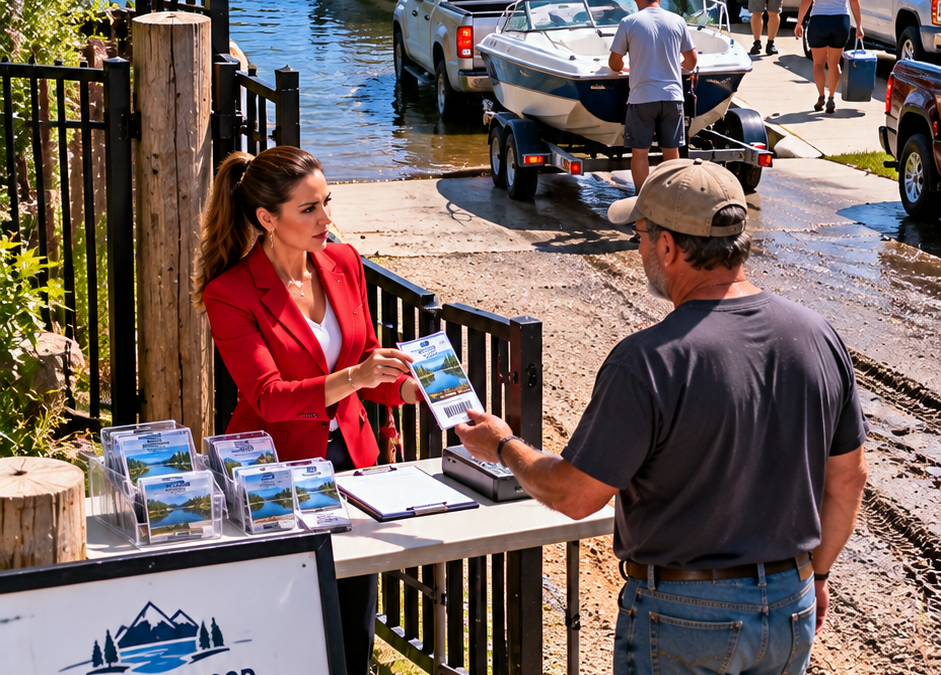
The first thing I noticed was not the boat in the water, but the folding table beside my open gate.
Vanessa Cole stood behind it with laminated passes, a clipboard, and a fee schedule for land she had never asked to use.
By the time I found the program number printed on those passes, I understood the HOA had not made a mistake—they had built a system around my property.
By the time the HOA stopped sending residents to my boat ramp, tire ruts had torn through the shoreline grass, my gate had been left open repeatedly, and the association had already collected hundreds of dollars in access fees.
They called it a neighborhood lake program.
I called it selling tickets to my land.
At first, I did not even know the program existed.
That was the part that bothered me most later. Not the ruts. Not the scraped concrete. Not even the strangers backing trailers toward the water like they had every right to be there. What stayed with me was how organized it all looked before I had heard a single word about it.
Three weekends before everything started unraveling, I came home late Saturday morning and knew something was wrong before I reached the house.
Too many vehicles were near the lake.
My place sat on the inside bend of Cedar Lake, where the neighborhood road curved past my front gate before dropping toward the community clubhouse on the far side. The house itself was set back from the road, with a short gravel access lane behind it that curved down to the water. At the end of that lane was my boat ramp—concrete, narrow, sloped just enough to launch my fishing boat without drama if you knew where the gravel shoulder ended.
I used it for myself.
Sometimes, I let close friends use it.
The rule was simple.
Ask first.
That Saturday, nobody had asked.
Two pickup trucks with boat trailers were parked along the edge of my property. Another SUV sat half on the grass near the gate. I heard engines idling near the shoreline and the hollow metallic clatter of trailer hitches being adjusted.
My stomach tightened before I even saw the ramp.
One boat was already in the water. Another trailer was backing down toward the concrete. A family stood near the shoreline carrying coolers and life jackets while two teenagers waited beside an inflatable tube. At the entrance to the access lane, my gate stood wide open.
Beside it, a folding table had been set up.
And behind that table stood Vanessa Cole.
Vanessa was the HOA president, early forties, sharply organized, and impossible to miss in the vivid red blazer she wore whenever she handled association business. She had the kind of posture that made every clipboard look like a legal instrument.
A stack of laminated passes sat beside her hand.
A small printed sign faced the road.
I stopped my truck before turning into the driveway and took out my phone.
The sign carried the HOA logo.
Below it was a heading.
NEIGHBORHOOD LAKE ACCESS PROGRAM
Under that was a fee schedule.
Weekend launch access.
Resident rate.
Guest rate.
I photographed the sign first.
Then the table.
Then the line of vehicles.
I kept the camera moving toward the ramp. The shoreline grass beside the gravel lane had been pressed down by repeated tires. Fresh ruts crossed one section where a trailer had swung too wide. The gate latch hung open even though I normally kept it closed when I was not using the ramp.
What bothered me most was not just that people were there.
It was how official everything looked.
This was not a handful of residents who had misunderstood where the community launch was. People were arriving with passes. Someone was checking them. Fees had apparently been collected. Vehicles were being directed toward the water. The whole thing had rules.
I walked closer to the table.
Each laminated pass carried a small authorization code beneath the HOA logo. Some were marked for single-day access. Others appeared to cover the entire weekend.
Then I saw the line that made the back of my neck go cold.
Approved launch point: South Residential Ramp.
That was their name for it.
Mine was simpler.
My ramp.
Vanessa noticed me almost immediately.
Her expression tightened, but she did not look surprised.
That detail stayed with me.
Nothing about her posture suggested that the HOA had accidentally wandered onto the wrong property. She did not look like a person who had just realized she was standing beside a private gate with a stack of paid passes. She looked like someone supervising a scheduled event.
“Good morning,” I said.
Her eyes flicked toward my phone.
“Is there a problem?”
“That depends,” I said. “Why are there strangers using my boat ramp?”
A man waiting near the table turned his head. The family with the coolers stopped talking. Somewhere behind me, a trailer hitch clanged against a ball mount.
Vanessa smiled.
Not warmly.
Professionally.
“This is part of the temporary lake access program.”
“I don’t have a temporary lake access program.”
“The association approved supplemental access during peak weekend periods.”
“Approved where?”
She glanced toward the ramp as another truck started backing down.
“Could we discuss this later? We have residents trying to launch.”
“No. We can discuss it now.”
Her smile thinned.
“This is not the best time.”
“It seems like exactly the time.”
A man beside the table lifted one of the laminated passes.
“I already paid for this,” he said, not angrily, but with the frustration of someone who had done what he was told and now found himself in the middle of a fight he did not understand.
I looked at him.
“I’m not blaming you.”
Then I looked back at Vanessa.
“I’m asking who sold it to him.”
Her jaw tightened.
“The association collected standard access fees.”
“For my property?”
“For lake access.”
“My ramp is not lake access. It is a private ramp on private land.”
A woman near the shoreline shifted uncomfortably.
Vanessa lowered her voice.
“The HOA has shoreline authority.”
“For rules and maintenance. Not for selling launch passes through my gate.”
“We can clarify the documents.”
“Then clarify them before another trailer uses that ramp.”
She glanced toward the vehicles.
“You are creating confusion.”
I almost laughed.
“I came home to a fee table at my gate, and I’m creating confusion?”
For a moment, I thought she might argue.
Instead, she looked toward the residents and raised her voice into a calm, polished announcement.
“We are pausing launches temporarily while we verify spacing at the ramp.”
Spacing.
Not ownership.
Not permission.
Spacing.
That was Vanessa’s gift. She could turn any problem into a procedural adjustment before anyone understood what had actually happened.
I did not try to win the argument there.
Too many people were around. Too many trailers were moving. Too many children were near the water. My first priority was documenting what had already happened and stopping anything dangerous from getting worse.
I photographed the tire ruts. I photographed a scraped section near the edge of the ramp where a trailer wheel had dropped off the gravel. I photographed the gate latch hanging open. Then I took a closer picture of one laminated pass lying on the table.
The pass had the HOA logo at the top. Below that was the lake access program name, the ramp designation, and the authorization code.
I had never seen that code before.
I had never seen the program name before.
I had never approved the pass.
But the card had been printed, laminated, distributed, and accepted as proof that residents were allowed to enter my property.
That meant the problem had started long before that Saturday morning.
Someone had designed the program. Someone had created the fee schedule. Someone had selected my ramp. Someone had authorized the passes. Someone had decided residents could be charged to use property I had never offered to the HOA.
I took one final photograph of the pass and zoomed in on the bottom corner.
Next to the authorization code was a short program number.
That number was the first clue that the crowd at my shoreline was not the beginning of the story.
It was only the first time I had seen what the HOA had already put into motion.
The next morning, I started with the simplest question I could think of.
Who actually owned the ground under that ramp?
I had never needed to prove it before.
The ramp had been there when I bought the house, and everything about its history pointed in the same direction. I paid to maintain it. I repaired cracked concrete near the waterline two summers earlier. After heavy rain washed gravel out of the access lane, I paid to have that replaced too.
But assumptions were no longer enough.
I spread my closing documents across the dining table while the lake sat bright and calm beyond the back windows. Somewhere across the water, a boat engine climbed in pitch, leveled off, and faded toward the far shoreline. The sound made the paperwork in front of me feel less abstract.
People had been launching boats thirty yards from where I was sitting.
I worked through the deed, purchase survey, and county tax map together instead of treating them as separate answers.
All three pointed to the same physical reality.
The access lane ran inside my parcel. The shoreline remained inside my parcel. The ramp itself was not shown as HOA common property.
Then I opened the governing documents.
The association had real authority around the lake. It could regulate shoreline construction, review docks, establish boating rules, impose wake restrictions, and enforce certain environmental standards. None of that surprised me. I had known those rules when I bought the house.
What I could not find was language allowing the board to convert a privately owned launch into a community facility.
I searched specifically for recreational access, boat launching, private shoreline entry, and fee-based use.
Nothing gave me a clear answer in the HOA’s favor.
A faded contractor invoice lying in another folder made the distinction feel even sharper. Several years earlier, a marine contractor had repaired the lower edge of the ramp and stabilized part of the shoreline. The invoice carried my name, my address, and a description of work performed at a private residential boat ramp.
I remembered writing the check.
Now I was staring at an HOA portal describing the same location as part of a neighborhood lake access program.
Outside, another engine crossed the water.
For a moment, I could almost hear the previous weekend again.
Trailer tires on gravel. Hitch chains clattering. Strangers moving through my gate, as if someone had erased the difference between common property and private ground.
I logged into the resident portal.
The current announcement described the program as a safer, more orderly way to handle peak weekend access. It emphasized congestion, scheduling, and fairness. A simple route map showed vehicles leaving the neighborhood road and following a path toward the water.
The route ended at my gate.
My house was not identified.
Neither was private ownership of the ramp.
On the map, the access lane looked no different from a road leading to the clubhouse.
The schedule showed Saturday mornings, Sunday mornings, and holiday periods. The program had already been operating for several weeks.
That explained something I had been trying not to overstate.
The residents were not trespassing because they had independently decided my property looked convenient.
They had been sent there.
I saved the announcement and started reading older board summaries.
The reason for the program emerged gradually.
Residents had complained about congestion at the existing community launch. Maintenance reports mentioned erosion, poor trailer maneuvering space, and temporary restrictions after heavy rain. The HOA had clearly been looking for additional capacity.
Then a meeting summary from six weeks earlier referred to a temporary lake access expansion plan. It said additional launch capacity had been identified and implementation approved pending administrative coordination.
At the bottom was a program number.
It matched the number printed on the laminated pass I had photographed beside my gate.
That was my first hard connection between what had happened on my property and an official board decision.
I searched the number again.
Most results were routine notices, but an archived planning memo listed three launch locations: the existing community ramp, a secondary shoreline staging area, and an approved supplemental launch point.
That third location had no address.
No parcel number.
No homeowner name.
Only the program number.
I leaned back from the screen.
The omission bothered me more than a mislabeled map would have.
If the board believed the ramp was common property, identifying it should have been easy. If they knew it was private, then somewhere there should have been a record explaining how they obtained the right to use it.
By late afternoon, sunlight had shifted across the table, and the old repair invoice was partly covered by the shadow of my laptop.
On paper, I had paid to maintain a private ramp.
On the HOA portal, residents were being directed to it as though it belonged to the community.
Between those two versions of the same place, one document had to be missing.
I needed to find the paper that supposedly bridged that gap.
The planning memo gave me a program number.
The passes gave me an authorization code.
The next question was whether either of them connected to money.
The resident portal had a payment section for assessments, clubhouse reservations, guest parking, pool access, and seasonal activities. Buried under recreational services was a category labeled temporary launch access.
The fee amounts matched the sign that had been sitting beside my gate.
I began building a spreadsheet, but this time I kept it simple enough that I could see the pattern instead of drowning in entries.
Dates went in one column.
Pass type in another.
Fee amount.
Program number.
Location code.
Saturday access.
Sunday access.
Guest launch.
Weekend access.
The transactions accumulated faster than I expected.
Through the open window, I could hear someone running a small outboard motor farther down the lake. Every time the sound crossed the water, I found myself looking toward the access lane.
The program on my screen was not theoretical anymore.
Every entry represented a truck, a trailer, and someone passing through my gate.
Archived announcements expanded the timeline. The HOA had offered access on two weekends before the one when I discovered the crowd, then again during a holiday period.
A receipt attached to an old resident reimbursement question gave me the next clean link.
It carried the HOA name, the lake access program, a payment amount, and the same program number.
This was not somebody collecting informal cash at a folding table.
The association had built a payment system around it.
I checked the HOA’s monthly financial statements and found a revenue category labeled recreation access fees. The amount was modest at first, then increased during the exact period when the supplemental launch program became active.
I added the totals to the spreadsheet.
The individual transactions I could see did not account for every dollar, but I did not need them to. The dates lined up closely enough to establish a pattern.
Then my phone vibrated.
A neighbor had sent me a photograph of one of the laminated passes he had purchased two weeks earlier.
He was not trying to help me build a case.
He genuinely believed the arrangement had been approved.
His message thanked me for opening the ramp to the neighborhood and said the new location was much easier than the community launch.
I read it twice.
That message landed harder than anything in the financial report.
He was not being rude.
He was grateful.
Someone had sold him access to my property so convincingly that he thought I had volunteered it.
I called him back, careful not to turn the situation into an accusation against residents who had every reason to trust an official HOA pass.
He explained that he had paid through the association system, received the pass, and followed the route instructions exactly as posted. Nothing about the process had suggested the ramp was private or that homeowner permission was unresolved.
After the call, I enlarged the photograph.
The pass carried the association logo, weekend date, QR code, program number, and a separate launch point identifier.
That last code mattered.
The planning memo listed only one supplemental launch location. When I compared the identifier on the pass with the internal location reference, they matched.
The payment was not merely buying participation in some broad lake program.
It was buying access to my specific ramp.
I added a location code column to the spreadsheet and worked backward through every transaction I could verify. By mid-afternoon, the structure was unmistakable.
The HOA had turned a physical access point on my property into something measurable and sellable.
A resident chose a date, paid a fee, received a pass, and arrived at a designated location.
The system made the arrangement look legitimate because every part of it was organized.
What it did not show was permission.
The financial statements provided another clue. Beneath recreational revenue was a subcategory labeled lake operations recovery.
I checked my own records before drawing any conclusion. The contractor bills for concrete repair, gravel replacement, shoreline stabilization, and gate hardware had all been mine. There was no HOA reimbursement in my bank records and no corresponding contribution in the files I kept for the ramp.
So I returned to the association records.
A budget attachment tied supplemental launch access fees to seasonal lake-related expenses. That explained the accounting destination at a high level.
What caught my attention was the ledger reference beside the entry.
It was different from both the program number and the launch-point code.
I searched for it.
The resident portal returned nothing.
The board archive returned nothing.
A downloadable transaction summary finally produced one match.
In the note field was a short phrase.
Temporary access authorization.
I stopped scrolling.
Until then, I had been following what the HOA did. The passes showed use. The spreadsheet showed fees. The location code tied those fees directly to my ramp.
Now there was finally a reference to the document that was supposed to explain why the association believed it could do any of it.
I had never seen that authorization.
I had certainly never signed one.
For the first time, I had something specific enough to demand.
The phrase temporary access authorization sounded official enough to matter.
It also sounded vague enough to hide almost anything.
I searched the resident portal first.
Nothing.
Then the board packet archive.
Nothing there either.
The only references I could find were indirect. One appeared in the finance summary. Another appeared beside the access program code. A third was buried inside a maintenance discussion from two months earlier.
That maintenance discussion turned out to be the better lead.
The HOA’s official community launch had been having problems for almost a year.
The turning area was narrow. The gravel approach washed out after storms. Several residents had complained about trailers backing into traffic while waiting for the ramp to clear. There were also photographs attached to one of the maintenance reports. The pictures showed erosion near the shoreline, standing water along the approach lane, and temporary barriers placed where part of the gravel shoulder had collapsed.
The board had considered repairs.
One estimate proposed rebuilding the approach and stabilizing the shoreline. Another included drainage work. A third involved widening the trailer turning area.
None of the options were cheap.
The project also could not be completed immediately. Permitting, contractor scheduling, and lake-level conditions all affected the timing.
That was when my ramp entered the picture.
I found the first reference in an operations note. It described the need for supplemental launch capacity during the repair period.
The note did not identify my property by name.
It referred instead to an existing paved residential launch with favorable trailer access.
That description could only have meant mine.
My ramp was not technically paved asphalt. It was reinforced concrete with a gravel approach. But compared with the association launch, it was wide, straight, and easy to use. A pickup could back a trailer almost directly from the access lane to the water. There was enough room to turn. The slope was gradual. The shoreline was stable.
From an operations standpoint, it made sense.
From an ownership standpoint, the documents were still silent.
I kept reading.
The next board packet included a lake management summary recommending temporary redistribution of launch traffic. One paragraph referred to existing shoreline access rights inside the development.
That phrase caught my attention.
Existing shoreline access rights.
I searched the declaration for the same wording. The exact phrase was not there, but there was an older amendment attached to the governing documents. It had been recorded years before I bought the property.
The amendment dealt with community lake access, emergency shoreline maintenance, and association rights to enter certain areas for environmental work.
It was dense, the kind of document that looked powerful if someone read only one paragraph.
One section allowed the HOA to enter portions of privately owned shoreline when necessary to perform approved maintenance related to erosion control, drainage, or lake health. Another section allowed temporary access for emergency work affecting common lake infrastructure.
That was real authority, but it was narrow.
The language dealt with maintenance, environmental protection, emergency access.
It did not describe recreational boat launching.
It did not create a public access corridor.
It did not mention selling launch privileges.
Still, I could see how someone determined to move quickly might stretch the language.
A board member could read shoreline access and focus on those two words. A manager could see temporary access and connect it to a temporary program. Once those phrases were separated from the rest of the document, the distinction became easier to ignore.
That seemed to be what had happened.
The next clue came from an internal planning worksheet included in an older board packet.
The worksheet compared three options.
Repair the community launch immediately.
Limit lake access until repairs could be completed.
Use supplemental private access temporarily.
The first option cost the most.
The second risked resident complaints.
The third was marked as operationally preferable.
Beside it was a handwritten note.
Existing access language may support temporary use.
That was the first indication of the reasoning behind the program.
Not ownership.
Not a signed agreement.
An interpretation.
I saved the worksheet and added it to my timeline.
Then I checked the date.
It had been created eleven days before the first access passes were sold.
That was important.
The board had not stumbled into the program after residents began using my ramp. They had considered the options in advance. They had looked at cost. They had looked at convenience. Then they selected the route that kept lake access open without waiting for the community launch to be repaired.
A later maintenance report made the financial pressure even clearer.
The launch repair had been pushed into the next budget cycle. The HOA had several other expenses that year—pool equipment, landscaping repairs, a drainage project near the clubhouse. The board was trying to avoid a special assessment.
That did not mean anyone was stealing money.
It meant they had an incentive to find a cheaper temporary solution.
My ramp became that solution.
The fee program made it even more attractive. Residents could continue launching boats. The HOA avoided an immediate repair project. The access fees helped offset lake-related operating expenses.
From the board’s perspective, the arrangement probably looked efficient.
From mine, it looked like they had solved a community problem by assigning the cost and risk to one homeowner.
I searched for any evidence that the board had tried to contact me before implementation.
No email.
No letter.
No certified notice.
No portal message.
No draft agreement.
No request for permission.
Nothing.
That absence mattered.
If the temporary access authorization was supposed to represent my consent, there should have been some record of me giving it.
There was not.
Then I found another board packet.
This one had a legal review checklist attached to it. Most of the items were marked complete.
Lake rules reviewed.
Insurance requirements reviewed.
Traffic management plan reviewed.
Resident fee schedule approved.
One item was different.
Property access basis.
Beside it was a notation directing staff to rely on the recorded shoreline amendment pending final confirmation.
I read that phrase twice.
Pending final confirmation.
The program had already moved forward. Passes had already been printed. Fees had already been collected. Residents had already been directed through my gate.
And the document they were using to justify access was apparently still waiting for final confirmation.
That changed the question again.
I was no longer trying to understand why the HOA wanted my ramp. I understood that now. The community launch needed repairs. My ramp was easier. The board wanted to avoid service disruption and additional expense. The fees helped support lake operations.
The real question was whether convenience had turned an uncertain interpretation into a decision.
At the bottom of the checklist was one more reference.
Temporary access authorization attached.
But there was no attachment.
I searched the packet again.
Nothing.
I checked the page numbers.
One page was missing between the checklist and the next exhibit.
That missing page was now the most important document in the entire file because whatever the HOA believed gave them the right to send paying residents across my property, that page was supposed to explain it.
The missing attachment changed the way I looked at the program.
Until then, most of what I had found could still be explained as a board moving too quickly toward a convenient solution.
Then the next weekend showed me what convenience looked like when two tons of truck and trailer were involved.
I heard the tires before I saw the vehicle.
A pickup backing toward the water had turned too sharply near the lower section of the access lane. One trailer wheel slipped off the gravel shoulder and dropped into the grass. The driver accelerated. The tire spun. Wet soil sprayed backward, and the rut deepened almost instantly.
The trailer shifted sideways far enough for the metal frame to scrape the concrete edge of the ramp.
By the time I reached the shoreline, several residents were trying to guide the truck back onto the lane.
The driver climbed out, saw me recording the damage, and reacted with irritation rather than embarrassment.
“I paid twenty-five dollars for this access,” he said. “This approach should be in better condition if the HOA is charging people to launch here.”
That sentence clarified the entire problem in a way another board document could not.
He believed he was a customer.
He had paid the association for a service. From his perspective, poor conditions were somebody else’s failure to deliver what he had purchased.
From mine, he was standing beside a rut torn into grass I owned on a lane I maintained after paying money to an organization that had never asked whether I wanted to operate a public launch.
I did not argue with him.
The pass had given him every reason to think he belonged there.
I photographed the trailer position, the torn grass, the fresh concrete scrape, and the open gate. Then I stepped back while the group worked the wheel onto the gravel.
Nobody was hurt.
That was fortunate.
It was also what made the incident useful as a warning rather than a disaster.
A trailer could roll. A truck could slide toward the water. A child could cross behind a reversing vehicle. Someone could fall on wet concrete.
My ramp had been designed for private use by people I knew were coming.
It had no marked queuing area, traffic arrows, pedestrian separation, or staff supervising vehicle movement.
The HOA had increased the traffic without changing the property to match the new risk.
That evening, I contacted my insurance agent.
I explained the program, the fees, the lack of any agreement I had signed, and the trailer incident. The response was cautious but immediate. The insurer wanted the program materials, access terms, photographs, waiver language, incident documentation, and whatever agreement supposedly authorized the HOA to operate there.
I went back to the portal.
The participant waiver protected the association against certain vehicle and personal property claims and required residents to follow HOA lake rules. It never identified me as the property owner. There was no section describing the HOA’s relationship with the owner of the launch point and no explanation of who carried responsibility for the physical site.
Then I found the incident report created after the trailer scrape.
The location field used the supplemental launch code. The damage description matched what I had photographed. A separate field identified the operator of the facility.
It listed the HOA.
That was more significant than the damage itself.
The association was not merely directing residents toward an available shoreline.
Its own paperwork described the HOA as operating the site.
My insurer responded by asking who controlled entry during program hours, who collected fees, who maintained the surface, and whether any written license, easement, or operating agreement existed.
The answers created an uncomfortable split.
The HOA issued passes and collected the money.
I maintained the property.
And I had never signed the documents normally expected to connect those two facts.
The insurer opened a formal review.
A launch safety checklist added another problem. Trailer spacing, water depth, surface condition, and signage had all been marked complete before opening weekend.
Insurance coordination had not.
Beside that item was a note directing management to confirm it before expanded use.
I could find no later version showing that confirmation had happened.
An earlier maintenance email was even clearer. It described the supplemental ramp as privately maintained and warned that surface damage responsibility should be clarified if traffic increased.
Someone had anticipated the exact condition now visible beside the lake.
The HOA had been warned that higher traffic could damage a privately maintained site.
The warning did not stop the program.
That was when the missing temporary access authorization stopped being an administrative curiosity.
If it established permission, the insurer needed it.
If it assigned maintenance responsibility, I needed it.
If it defined the HOA as operator, it should explain what obligations came with that role.
I prepared a formal records request covering the complete program file, the temporary access authorization, board approval, insurance review, payment records, and communications concerning the supplemental launch point.
The trailer rut remained visible outside while I sent it.
For the first time, the paperwork and the physical damage were telling exactly the same story.
Something had been put into operation before the people running it had answered who owned the risk.
The formal records request changed the tone of the dispute.
I was no longer working from public announcements and resident summaries. I was asking for the documents created while the program was being designed.
The first production contained familiar material.
The later files did not.
An internal management email described the supplemental launch as privately maintained and asked whether written homeowner consent would be required for regular recreational use.
The question had been raised before the first pass was sold.
Another email asked whether the HOA’s insurer had approved the location. Insurance review was still being coordinated.
Vanessa’s messages appeared throughout the thread. She was focused on congestion at the community launch, complaints from residents, and the approaching busy season.
Her priority was keeping the lake program functioning.
The pressure was obvious.
So was the unresolved consent question.
One message asked whether written confirmation from the property owner had been obtained.
No confirmation was attached.
I placed the emails into the timeline by date.
Then the records production finally included the document I had been looking for.
Temporary access authorization.
Two pages.
Vanessa had signed it as HOA president. The first page authorized limited weekend use of the supplemental launch point. The second cited the recorded shoreline amendment, the board’s lake management authority, and its responsibility to maintain reasonable access during disruptions.
What the document did not contain was just as important.
My signature was not on it.
It was not an agreement with me.
It did not create an easement.
It did not transfer control of the ramp.
It was the HOA authorizing its own program.
I sent the file to Laura Bennett, the property attorney I had contacted after the insurance review began.
Her analysis was measured, which I appreciated more than outrage. She explained that the governing documents appeared to give the association legitimate power over lake rules and certain narrow shoreline access situations, but nothing in the material clearly established a general recreational right to operate a private homeowner’s ramp as a fee-based facility.
The distinction mattered.
The HOA had authority around the lake.
That did not automatically answer what it could do with my parcel.
My insurer requested clarification from the association about operational control and damage responsibility.
Soon afterward, the upcoming supplemental launch dates disappeared from the portal.
The program was placed under administrative review.
That Saturday, my gate stayed closed.
Then I opened the payment processor records.
Unlike the monthly summaries, these showed the program at transaction level: payment timestamp, fee type, pass category, program code, location identifier, and processor reference.
I compared them with my spreadsheet.
For the first time, every major number lined up.
Several hundred dollars had been collected through the code tied specifically to my ramp. The money entered the HOA operating account and was allocated to a lake operations cost center covering items such as erosion work, temporary barriers, signage, and seasonal maintenance.
There was no payment to Vanessa.
No diversion into a personal account.
No evidence of private enrichment.
That settled that question.
The dispute was about authority and process, not embezzlement.
The processor history also resolved something more important.
Passes continued to be sold after management had already asked whether homeowner consent existed.
I lined the events up by date.
The consent inquiry came first.
Additional payments followed.
The internal authorization followed.
Insurance coordination remained incomplete.
Then came the trailer incident.
Viewed separately, each document left room for explanation.
Placed in sequence, they showed the program advancing while the questions that mattered most remained open.
Laura reached essentially the same conclusion.
The strongest evidence was not a dramatic phrase hidden in one email. It was the chronology showing that consent, insurance, and damage responsibility were still unresolved while the association continued operating a paid access program.
By the end of the week, the supplemental launch had been suspended.
My insurer had opened a property damage file, and the association agreed to preserve the program records.
The argument over whether something had gone wrong was narrowing.
What remained was practical.
The grass had been damaged.
The concrete had been scraped.
Residents had paid for access.
The collected money had already entered HOA operations.
Now the board had to decide who would restore the property, what would happen to those fees, and whether the same people who pushed the program forward would still control the next one.
Once the program was suspended, the shoreline went still.
That silence was strange at first.
For weeks, I had heard the sound of other people’s weekends through my windows—engines warming, trailers clanking, voices carrying across the water. After the suspension, the lake went back to the way it had been before the passes.
Not empty.
Shared.
But not through my gate.
The adjuster came out on a gray Tuesday morning. He spent nearly forty minutes walking the access lane, measuring the tire ruts, photographing the chipped concrete shoulder, and comparing the damage with my older contractor invoices and photographs.
He was not dramatic.
That helped.
The repairs were ordinary, which was exactly what I wanted.
A marine contractor patched the concrete edge, regraded and compacted the gravel approach, replaced the loosened gate hardware, and restored the damaged shoulder. The insurance issues were handled through documentation and adjustments between the parties rather than a courtroom.
The fees took a little longer.
The payment records gave the board a precise total for transactions tied to the supplemental launch-point code. Residents who had paid for access to my ramp received account credits or reimbursements, and the related accounting entries were reversed from the lake operations cost center.
Then the HOA finally funded the problem it had been trying to work around.
The community launch overhaul moved forward.
By late August, the association-owned site had a wider trailer turning area, stabilized drainage, reinforced gravel, reflective barriers, and clear directional signage. Vehicles that had once been routed past my house now turned toward a facility designed and insured for that traffic.
More importantly, it sat entirely on common property.
The board changed its approval process at the same time.
Any future program involving private land required a parcel verification sheet, written owner consent, completed insurance review, and legal approval before implementation. Fee-based access also had to identify exactly what property the association had authority to provide.
Vanessa remained on the board, but her authority narrowed.
She no longer handled private property access programs through a direct operational approval. Those decisions now moved through management, legal review, and a board committee before anything reached implementation.
There was no public spectacle attached to that change.
No dramatic resignation.
No courtroom speech.
No security escort.
That would have made a cleaner story, maybe, but real consequences often arrive as revised forms, missing authority, new signatures required, and a person who used to act alone suddenly needing three other people to approve what once took one email.
At the annual meeting, Vanessa still arrived in the same vivid red blazer with the same structured black folder. What had changed was the packet in front of her.
Each access proposal now carried a parcel number, ownership verification, consent status, and insurance sign-off.
The controls that had been missing were now printed into the process.
My own property recovered more slowly.
New grass filled the deepest tire tracks, first in patches, then across the entire shoulder. The fresh concrete at the edge of the ramp gradually lost its bright color. By early fall, the repaired section blended into the older surface unless someone knew where to look.
I installed a heavier latch and a brass padlock on the gate.
A small private property sign went onto the post beside it.
Nothing confrontational.
Nothing oversized.
Just a clear marker at the point where the HOA program had once treated an assumption like permission.
The neighborhood moved on quickly after the association launch reopened.
Boat trailers followed the new directional signs toward the common facility. The supplemental map vanished from the resident portal. The old passes expired, and weekend traffic stopped coming down my lane.
One October morning, I walked to the shoreline before sunrise.
The lake was almost flat. Mist sat just above the surface, and the only sound near the ramp was water touching the concrete at the bottom edge.
I stood there for a while, looking at the place where the trailers had lined up, where Vanessa’s folding table had stood, where the fee sign had turned my gate into a transaction point.
It would have been easy to stay angry at the residents.
But most of them had only followed instructions. They had paid through the official system. They had received official passes. They had trusted the logo, the QR code, the map, and the woman at the table with the clipboard.
That was the dangerous part.
Organization can make a wrong thing look lawful.
A printed pass can make private property look open.
A fee schedule can make trespass feel like a reservation.
Vanessa had not pocketed the money. She had not sneaked around in the dark. She had done something almost more revealing. She had placed everything inside the machinery of the HOA and trusted the process to make the permission appear after the fact.
But permission does not work that way.
Not for a gate.
Not for a ramp.
Not for land.
The lake was shared.
The rules around it were shared.
The responsibility to maintain common facilities was shared.
But the ramp behind my house had never stopped being mine just because the association found it convenient.
I checked the brass padlock once, slipped the key into my pocket, and walked back toward the house.
Behind me, the gate stayed closed.
The water stayed quiet.
And for the first time in weeks, nobody arrived with a pass.