𝗙𝗨𝗟𝗟 𝗦𝗧𝗢𝗥𝗬 The Morning They Blasted My Mountain, the Lake Answered Before Any Court Could
𝗙𝗨𝗟𝗟 𝗦𝗧𝗢𝗥𝗬
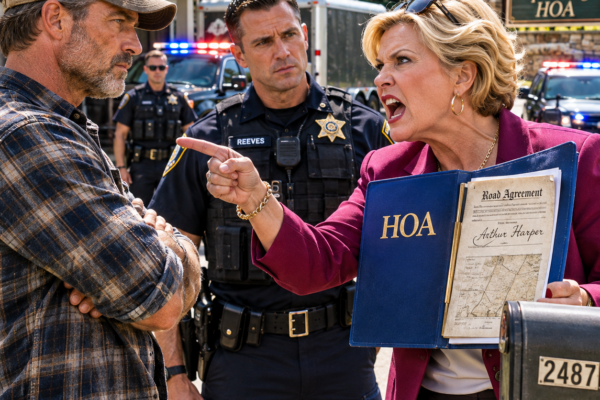
“You are standing in the way of progress.”
“No. I am standing on my own land.”
She stared at me through the gate.
“We’ll be back,” she said.
“I’ll be ready.”
They left in a line of polished vehicles, rolling down my drive like a funeral procession for bad assumptions.
The next morning, survey crews appeared on my land.
Not at the gate.
On my land.
They had come in from the lower service trail, where the old logging road crossed near the drainage ditch. Three trucks. Survey equipment. Stacks of stakes. Men in reflective vests. One of them was already setting a tripod when I arrived.
I parked my truck across the trail and got out.
“Pack it up.”
The lead surveyor turned. “We’re contracted to mark the access corridor.”
“By who?”
“Ridge Crest Estates HOA.”
“You are trespassing.”
He looked genuinely uneasy. “We were told access had been authorized.”
“You were told wrong.”
One of the workers held a roll of flagging tape, frozen halfway between the truck and the tree line.
I called the sheriff.
While we waited, I photographed every truck, plate, worker, stake bundle, and marked point. I did not yell. I did not touch their equipment. I did not give Linda the confrontation she probably wanted. I documented.
Sheriff Daniel Brooks arrived twenty-five minutes later.
He was a calm man, which was exactly what the morning needed. He stepped out of his SUV, looked at the survey trucks, looked at me, then looked at Linda Carter’s vehicle coming up the trail behind him.
Of course she had arrived.
She stepped out before the dust settled.
“Sheriff,” she called, “thank you for coming. We have a dispute involving an approved HOA access project.”
Brooks looked at her. “Who authorized entry onto this land?”
“The board approved the project.”
“That is not what I asked.”
Linda hesitated.
I handed Brooks my deed.
He unfolded it on the hood of his SUV and compared it with the survey crew’s work order. Then I gave him the county property map and the most recent recorded survey. He studied everything without speaking for several minutes.
Linda tried to fill the silence.
“The community has invested considerable planning resources into this expansion.”
Brooks did not look up.
“Planning does not create ownership.”
That stopped her for a moment.
Finally, Brooks turned to the survey crew.
“Do you have written permission from Mr. Mercer to be on this property?”
The lead surveyor shook his head.
“We were told the HOA had authority.”
Brooks looked at Linda.
“Do you have a recorded easement, deed, court order, or written access agreement?”
Linda’s mouth tightened.
“Our attorney is reviewing historical rights.”
“So no.”
Her face flushed.
Brooks folded my deed carefully and handed it back to me.
“Until someone produces legal authority, this crew needs to leave Mr. Mercer’s property.”
The surveyor did not argue. His men began packing up immediately.
Linda stood there watching them, her jaw locked.
I thought that would slow her down.
It did not.
That was the mistake I made.
I assumed the sheriff’s warning, the deed, the survey, and the removal of her crew would force the HOA into legal channels.
But Linda had a timetable.
And money behind her.
And, as I later learned, private emails full of people telling one another that delay would kill the development.
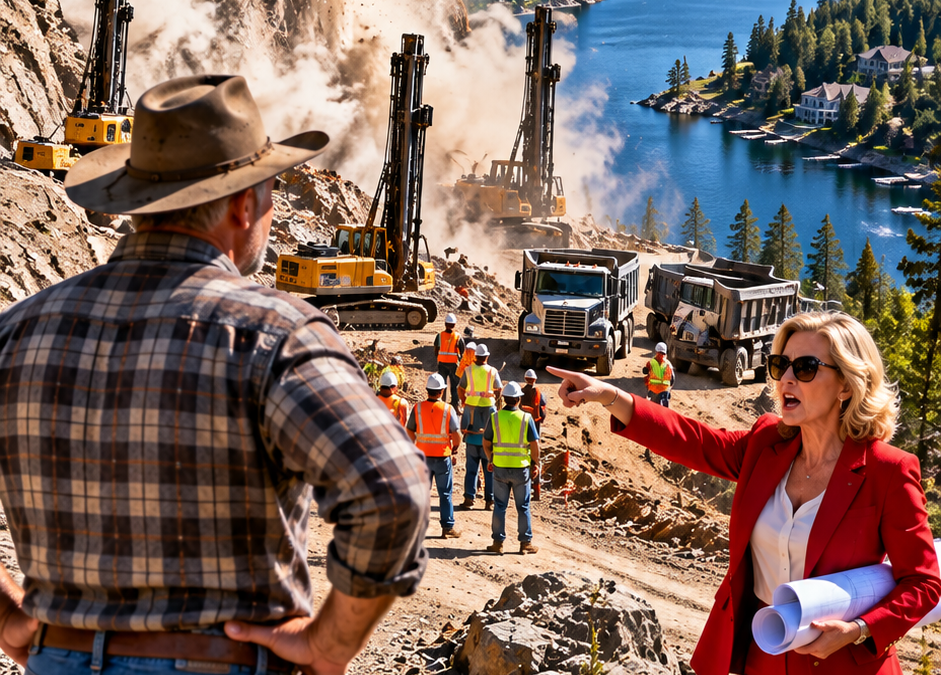
Two days later, explosive equipment arrived at the mountain.
I saw the trucks at sunrise.
At first, through the trees, I thought it was construction machinery returning. Then I saw the blasting mats, drilling rig, warning placards, and a subcontractor logo I recognized from quarry work outside the county. My stomach turned cold.
They were not surveying anymore.
They were preparing to cut.
I drove down fast enough that gravel sprayed behind me.
Linda was already there, standing near the lower ridge with Warren Pike and two men in hard hats. One of them was reviewing a drilling pattern on a tablet. Another crew had started staging equipment along the rock face.
I got out and walked straight toward her.
“Stop this now.”
Linda turned.
She did not even pretend surprise.
“Good morning, Mr. Mercer.”
“You brought blasting equipment onto my land.”
“The HOA has secured operational clearance for the access road.”
“From who?”
She smiled.
“Appropriate parties.”
“No, Linda. From who?”
Warren would not look at me.
That told me enough.
I pointed toward the blasting crew.
“Every person here is trespassing. Every piece of equipment is unauthorized. You are creating an immediate hazard above the lake.”
One of the blasting supervisors approached, frowning. “We were told the site was cleared.”
“It isn’t.”
Linda cut in. “The landowner has been obstructive. Counsel believes the association may proceed under the expansion plan.”
“Counsel believes?” I said. “That is what you are risking a mountain on?”
Her smile sharpened.
“The development has been delayed long enough.”
That was when I finally saw the full picture.
This was never about a road.
The road was only the first cut. The real prize was the shoreline below—the protected western bank of Blackwater Lake, the one part of the lakefront still untouched by mansions, docks, clubhouses, and private slips. My mountain was the barrier between Ridge Crest and millions of dollars in luxury waterfront lots.
They needed the road.
They needed the slope opened.
They needed me either intimidated, exhausted, or forced into court after the damage was already done.
I stepped closer to Linda.
“You know this slope is unstable.”
Her expression flickered.
Only once.
But I saw it.
“My family has engineering reports going back thirty years,” I said. “You blast this ridge and you risk a slide into the lake.”
“That sounds exaggerated.”
“You have been warned.”
She looked toward the crew.
“Proceed.”
I called the sheriff again. Then my lawyer. Then the county emergency office. Then I began recording.
The first blast was prepared just after sunrise.
I stood at the boundary with my truck parked behind me and my phone in my hand, helpless in the physical sense but not silent. I had warned them. I had documented them. I had called every authority available. But the crew moved with the terrifying efficiency of men following a contract. Drill points had been set. Mats positioned. Workers cleared back.
The mountain felt unnaturally still.
Even the birds had gone quiet.
Linda stood beside her SUV with her arms folded, watching me more than the ridge. Her face carried that same controlled confidence, but I could see strain beneath it now. She wanted the first blast done before anyone with real authority arrived.
The warning horn sounded.
My chest tightened.
The blast hit like the sky cracking open.
The ridge jumped.
A violent boom rolled through the valley, slammed against the lake, and came back in pieces. Dust burst outward from the rock face. Trees shook. Loose stones clattered down the slope. A brown-gray scar opened across the lower mountain where the charge had bitten into it.
For several seconds, no one spoke.
Then Linda smiled.
A few HOA men near her clapped.
Something inside me went dark.
They thought the mountain had surrendered.
But I was looking higher.
Above the blasted section, a long seam had opened beneath a band of fractured rock. Dust was breathing out of it in thin streams. Small stones began ticking downslope like scattered marbles.
I knew that sound.
My father had shown me old slide scars where the mountain whispered before it roared.
I turned toward the blasting supervisor.
“Stop the second charge.”
He was already looking at the slope, frowning.
Linda snapped, “The sequence has been engineered.”
I shouted now. “Stop the second charge!”
The supervisor lifted his radio.
Before he could speak, another horn sounded from the staging area.
My blood went cold.
The second blast detonated.
This one was deeper.
The sound did not just echo. It punched through the ground beneath my boots. The lower ridge blew outward, and for one impossible second the mountain seemed to hold itself together through sheer memory.
Then the slope failed.
It began as a shudder.
A section of trees tilted.
Then the entire face above the cut loosened.
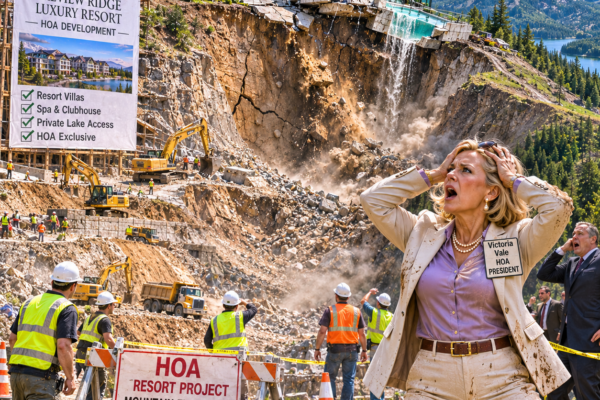
Rock, soil, root systems, shattered timber, and debris tore free in a massive sliding wall. The sound was beyond anything I had ever heard from land—deeper than thunder, heavier than machinery, alive with breaking stone and ripping wood.
People started screaming.
The slide slammed into Blackwater Lake with the force of a collapsing building.
The impact threw water upward in a white wall.
Not a splash.
A wall.
The lake surged back from the impact, rising and folding into itself. For one suspended moment, the water seemed confused by the violence done to it.
Then it moved.
A wave formed across the lake and began racing toward Ridge Crest.
I had warned them about this exact thing.
My father’s engineering files had warned about it.
Old county notes had warned about it.
The mountain had warned them with every fracture and seep line they ignored.
Now the lake was answering.
The wave grew as it crossed open water, gathering debris—tree trunks, dock boards, rocks, broken branches, shattered sections of slope. It moved faster than any person could run. Faster than panic could organize itself into action.
Linda’s face changed completely.
The smile vanished.
Authority vanished.
All that remained was terror.
“Oh my God,” someone whispered.
The first row of Ridge Crest mansions sat along the lower eastern shore, built too close to water because views mattered more than caution. They had private docks, boat lifts, glass walls, pool terraces, and manicured lawns rolling down toward the lake.
The wave hit them like judgment.
It slammed into the docks first, ripping boats from their moorings. One boat flipped against a retaining wall. Another tore loose and crashed sideways into a pool deck. Water blasted over lawns, shattered outdoor furniture, swallowed fire pits, and surged against the lower floors of million-dollar homes. Windows burst inward. Stone terraces disappeared beneath brown water. A swimming pool vanished under mud and lake debris in seconds.
Car alarms began screaming across the shoreline.
People ran from patios and docks.
Someone shouted for children.
Someone else yelled that an elderly man was trapped near a lower guesthouse.
My phone rang while the wave was still moving through the neighborhood.
Linda.
I stared at her name on the screen for one second, then answered.
Her voice was ragged.
“Elias, you have to help us.”
I looked across the lake at the destruction spreading through Ridge Crest.
“I told you not to blast my mountain.”
“Please,” she said. “We need the safe routes. The lower road is flooding.”
That was the first useful thing she had said all week.
I swallowed my anger because people were in danger now, and the residents were not the ones who had ordered the blast.
“Get everyone away from the shoreline,” I said. “Do not send vehicles down Lakefront Drive. Use the upper service road behind the clubhouse. The western maintenance trail is blocked by the slide. Tell emergency crews the old ridge road is the safest high route, but they need four-wheel drive.”
She was sobbing now.
“Elias—”
“Move them uphill, Linda.”
Then I hung up and called Sheriff Brooks again.
This time, the whole county responded.
Within thirty minutes, sirens filled the valley.
Sheriff vehicles came first. Then fire trucks. Then rescue units. Then state emergency management. A helicopter circled over the lake, its blades chopping the air above the dust cloud still rising from the slide scar. Boats launched from the public emergency ramp on the south side. Crews moved along the flooded shoreline, pulling residents from damaged homes and stranded decks.
I led two rescue teams through the upper ridge road because I was the only one who knew where it remained passable after heavy rain. My anger had to wait. The mountain could wait. The lawsuit could wait.
People needed out.
One woman was carried from a flooded guesthouse wrapped in a blanket, shaking so badly her teeth clicked. A teenager stood on a roof terrace crying while firefighters reached him by ladder. A man in a suit kept repeating, “The water came through the glass,” as if saying it enough times would make it less true. Children sat in the back of ambulances, wet and terrified, while their parents stared at the lake like it had betrayed them.
But the lake had not betrayed anyone.
People had betrayed the mountain above it.
By sunset, federal investigators had arrived.
So had state environmental officials, county engineers, insurance adjusters, and enough lawyers to make the shoreline look like a courtroom scattered across mud.
Linda did not come near me again that day.
Neither did Warren Pike.
The blasting crew supervisor gave a statement before dark. I saw him pointing toward the ridge, then toward Linda’s group, then toward the work orders. His face looked gray.
Sheriff Brooks found me near the upper road as the last evacuation vehicle passed.
“You all right?” he asked.
“No.”
He nodded once. “Fair answer.”
“I warned them.”
“I know.”
“I called you.”
“I know.”
“I told them the slope was unstable.”
Brooks looked toward the scar in the mountain, where dust still drifted from broken rock.
“Then make sure every document proving that is ready.”
“It is.”
“Good,” he said. “Because this is going to get ugly.”
He was right.
By the next morning, Linda’s story had changed.
The HOA claimed the slide was a natural event triggered by preexisting instability. They claimed the blast had been conducted under professional supervision. They claimed the flooding was an unforeseeable accident. They claimed the association had acted in good faith based on planning documents.
They did not claim ownership so loudly anymore.
That part had gone quiet.
My attorney, Rebecca Shaw, arrived at my house before noon with two associates and the expression of a woman who had already sharpened every blade in her office.
Rebecca had represented my father years earlier when a timber company tried to push a logging road across the northern ridge. She knew the property. She knew the old reports. She knew exactly what had been sitting in my files waiting for a day I had prayed would never come.
We spread everything across the dining room table.
The deed.
The recorded survey.
The county boundary map.
The engineering report from 1991 warning that blasting near the lower ridge could destabilize the slope above Blackwater Lake.
The environmental assessment from 2004 noting old slide zones.
The letter my father had sent to the county opposing shoreline development.
My own prior notice to the HOA.
Photographs of the survey crews.
Video of Linda saying the HOA had authority.
Video of me warning the blasting supervisor to stop.
Footage of the first blast, the crack opening, and my warning before the second.
Rebecca watched the video twice.
After the second viewing, she sat very still.
Then she said, “They are in serious trouble.”
“I want them off my land forever.”
“That will be the easy part.”
“What is the hard part?”
She looked toward the window, where the mountain rose beyond the trees.
“Making them pay enough to understand what they destroyed.”
The investigation expanded quickly.
State officials mapped the blast site. Federal investigators reviewed contractor permits, communications, environmental risks, and whether anyone had knowingly proceeded despite warnings. County engineers studied the slide path and wave impact. Insurance companies began fighting one another almost immediately.
Then came the emails.
I did not see them at first.
I only knew something had changed when Rebecca called me late one evening and said, “You need to come to my office tomorrow.”
Her voice was controlled, but there was electricity beneath it.
The next morning, she handed me printed pages.
Private HOA emails.
Months of them.
Linda, Warren Pike, two board members, the development consultant, and the blasting contractor’s planning contact.
They had discussed the instability.
Not vaguely.
Specifically.
One email referenced the 1991 slope warning by name.
Another said, Mercer will use the old engineering reports to delay the project if we give him time.
Another, from Warren Pike, said, Once initial road work begins, the practical leverage shifts. Courts are unlikely to reverse completed infrastructure.
Linda had written one line that I read over and over until the words burned into me.
The risk is manageable, and the shoreline value justifies moving aggressively.
The shoreline value.
That was what my mountain, my father’s warnings, and the safety of everyone below had meant to her.
Value.
Rebecca watched me read it.
I set the paper down because my hands had started shaking.
“She knew.”
“Yes,” Rebecca said.
“They all knew.”
“Yes.”
“They blasted anyway.”
Rebecca’s voice was quiet.
“Yes.”
The lawsuit we filed was massive.
Trespass.
Property damage.
Unauthorized blasting.
Negligence.
Nuisance.
Environmental harm.
Violation of recorded property rights.
Damage to water resources.
Restoration costs.
Punitive claims based on evidence they had known the risk and proceeded for financial gain.
Ridge Crest filed responses denying almost everything. Their lawyers tried to spread blame across contractors, engineers, historical instability, rainfall, natural slope movement, and even my refusal to cooperate with their “planned access solution.” They suggested I had contributed to the disaster by not allowing a safer road design.
Rebecca dismantled that argument in one sentence.
“My client refused to let them trespass. That did not give them permission to trespass dangerously.”
The court proceedings lasted longer than I wanted and less time than Ridge Crest hoped.
Evidence has a way of shortening lies.
The deed was clear.
The survey was clear.
The sheriff’s earlier report was clear.
The video was clear.
The engineering warnings were clear.
The emails were devastating.
Linda appeared in court wearing a dark suit and no smile. I watched her sit behind her attorneys, hands folded, eyes fixed forward. She looked smaller without the gate, the folder, the board members, and the mountain behind her to threaten.
At one point, Rebecca displayed the email about shoreline value on a screen.
Linda did not look at it.
I did.
I wanted to remember exactly what greed looked like when stripped of decoration.
The court ruled that the HOA had illegally entered my property and authorized destructive work without ownership, easement, or lawful permission. The ruling found that they had ignored documented boundary records and proceeded despite known slope warnings. They were ordered to pay substantial damages, fund stabilization and restoration work, cover environmental remediation, and permanently cease any development activity on my mountain.
The luxury shoreline expansion died in that courtroom.
No private road.
No waterfront village.
No exclusive boat slips.
No million-dollar lots carved out of my family’s ridge.
Linda resigned before the final order was entered.
The official HOA notice said she was stepping down to focus on “personal matters.” That phrase traveled around the county like smoke. Everyone knew what it meant. The people who had once admired her ambition now had flooded lower floors, ruined docks, lawsuits, insurance claims, and a development dream that had collapsed into the lake.
Some residents blamed her.
Some blamed the board.
Some blamed the contractors.
A few blamed me, at least for a while, because anger often looks for the nearest person still standing.
But most eventually saw the documents.
They learned I had warned the HOA.
They learned my family had protected that slope for decades.
They learned the board had known about the danger and pushed forward anyway.
One older resident named Mrs. Donnelly came to my gate months later. Her lake house had been damaged badly, though she had survived unharmed. She stood on the other side of the gate holding an envelope in both hands.
“I owe you an apology,” she said.
I opened the gate but did not invite her far in.
“For what?”
“For believing them.”
I said nothing.
She looked toward the mountain, where stabilization crews were working along the scar.
“They told us you were blocking progress out of spite.”
“I know.”
“They said the road was safe.”
“I know.”
Her eyes filled with tears.
“My grandson was in our lower bedroom when the wave hit. He got out because my son carried him upstairs fast enough.”
I felt the anger inside me lose its shape for a moment.
“I’m glad he got out.”
She nodded, wiping her face.
“I am too. And I’m sorry.”
She handed me the envelope. Inside was a photocopy of one of the HOA newsletters announcing the expansion. Across the top, in her handwriting, she had written: We should have asked harder questions.
I kept it.
Not because I needed more proof.
Because it reminded me that not everyone below the ridge had chosen the lie. Some had simply trusted the wrong people.
Restoring the mountain took years.
No court order could put rock back exactly where it had been. No settlement could reattach old trees or erase the scar completely. Engineers stabilized the slope with anchors, drainage control, retaining measures, and careful replanting. Environmental crews removed debris from the lake, restored damaged shoreline sections, and monitored water quality. The work was slow, expensive, and painful to watch.
But the mountain began to heal.
Not quickly.
Mountains do not heal on human schedules.
The first spring after the ruling, grass appeared along part of the disturbed slope. Then small shrubs. Then erosion-control plantings took hold. Pines were planted in staggered rows, not to pretend nothing had happened, but to give the land a chance to knit itself back together.
I walked there often.
At first, it hurt too much. Every broken section looked like failure. Every exposed rock face felt like accusation. I would stand near the edge of the slide zone and hear the blast again in my memory, feel the ground move beneath my boots, see the wave rising across the lake.
But slowly, the silence returned.
Birds came back first.
Then deer tracks.
Then the wind began to sound less like emptiness and more like the old mountain breathing.
One evening, nearly three years after the blast, I climbed to the upper meadow just before sunset. From there, I could see the lake, the repaired slope, the remaining Ridge Crest homes, and the protected shoreline that Linda had wanted to sell in pieces.
The lake was calm.
The kind of calm that looks innocent unless you know what it can do when struck hard enough.
I sat on a flat stone my father used to call the thinking rock. He had taken me there after my first serious fight as a teenager, after my mother’s funeral, and after the day he signed the property fully into the family trust. He believed a man made better decisions when he had to look at land larger than his own mood.
I wished he could have been there.
I wished I could tell him I had kept the mountain.
Not perfectly.
Not without damage.
Not without grief.
But I had kept it.
The HOA never received another inch.
The development corridor was permanently barred. The court order was recorded. Conservation restrictions were added later with my approval, ensuring no future board, developer, or smiling president with legal papers could try the same thing again.
My family’s mountain was protected more strongly after the disaster than it had been before.
That did not make the disaster worth it.
Nothing could.
But it gave the damage an answer.
People often say land is valuable because it can be developed. They calculate roads, lots, lake frontage, views, docks, clubhouses, tax revenue, and resale numbers. They put money into spreadsheets and call the total potential.
My family saw value differently.
The value was in the ridge that held the lake in place.
The old trees gripping the slope.
The trails that taught children where water moved after rain.
The quiet shoreline where herons fed at dawn.
The mountain standing untouched because generations before me had refused to turn every beautiful thing into a sales opportunity.
Linda Carter saw my mountain as an obstacle.
My father saw it as a trust.
That was the difference.
She brought board approvals, contractors, blasting plans, private emails, and ambition sharpened by money.
I brought a deed, a survey, engineering warnings, and the stubborn memory of every lesson my father had given me on those trails.
In the end, the court confirmed what the land had already known.
The HOA did not own the mountain.
They had no right to cut it.
They had no right to blast it.
They had no right to gamble with the safety of the lake, the homes below, or the legacy my family had protected for generations.
They tried to destroy my mountain for profit.
Instead, they destroyed their own dream.
Today, when I stand at the upper meadow and look down toward Blackwater Lake, I still see the scar if the light hits the ridge a certain way. I may always see it. Some wounds become part of the record. Some damage cannot be hidden, and maybe it should not be.
The scar reminds me what greed sounds like when it becomes machinery.
It reminds me what happens when people treat warnings as obstacles.
It reminds me why my father kept every document and why I will never apologize for defending a boundary.
But the mountain is still there.
The lake is still there.
The protected shoreline remains quiet.
And at sunset, when the water turns dark beneath the ridge and the wind moves through the pines, I can almost hear my father’s voice again.
Land talks.
This time, everyone heard it.
𝗧𝗛𝗘 𝗘𝗡𝗗
The Morning They Blasted My Mountain, the Lake Answered Before Any Court Could
The first time I saw the blasting crew at the base of my mountain, I felt something inside me go completely still. The HOA president smiled like she had already won, like paper and money could move stone older than all of us. She did not understand that mountains remember every insult, and water never forgets where gravity wants to go.
My name is Elias Mercer, and I inherited the mountain the same way my father had inherited it from his father—not as a trophy, not as an investment, but as a responsibility.
The property sat high above Blackwater Lake, a deep private body of water folded between two ridges in the western part of the county. From the upper meadow, you could see the lake shining through the pine trees like a piece of dark glass. In summer, mist lifted off it before sunrise. In winter, the surface turned steel gray beneath the clouds. At night, the water reflected the stars so clearly that my mother used to say the sky had a second home down there.
My family had protected that mountain for generations.
Not because we hated progress. Not because we wanted to keep everyone out of everything. We protected it because the land was fragile in ways outsiders never bothered to understand. The slope above the lake looked solid from a distance, but my grandfather knew better. My father knew better. I knew better. Beneath the trees and rock outcrops were old slide zones, fractured seams, hidden drainage channels, and unstable layers that could shift if disturbed too aggressively.
The mountain was beautiful.
It was also dangerous if treated carelessly.
My father spent half his life explaining that to surveyors, county planners, timber buyers, developers, and anyone else who looked at the ridge and saw only profit. When I was a boy, I followed him along the trails while he pointed out cracks in the exposed rock, places where old slides had carried trees downslope, and sections of earth that stayed wet even after weeks without rain.
“Land talks,” he told me once. “Most people don’t listen until it starts shouting.”
I was twelve then. I thought he was being poetic.
Years later, I learned he was being precise.
By the time the HOA came for the mountain, my father was already gone. My mother too. The house at the lower bend was mine now. The deed was in my name. The old maps, engineering assessments, boundary surveys, environmental reports, and handwritten family notes sat in my office in labeled files. I had kept everything because my father had taught me that memory was not enough when money started arguing.
The neighborhood below the lake was called Ridge Crest Estates.
It had not existed when I was a child. Back then, the land below the eastern shore was a mixture of pasture, scrub oak, and old hunting cabins. Then a developer bought it, cut in roads, installed utilities, and built the kind of luxury homes that looked less like houses and more like declarations. Tall glass windows. Stone terraces. Boat docks. Infinity pools. Private drives. Three-car garages. Landscaped slopes pretending to be natural.
I did not care what people built on land they actually owned.
But Ridge Crest had always wanted more.
The subdivision sat along one part of the lake, but the best undeveloped shoreline remained protected by my mountain. The western side was steeper, quieter, and more dramatic. Any developer with enough greed could stand at the lower road, look up at my ridge, and imagine a private road carved through the mountain, leading down to exclusive waterfront lots.
That fantasy had circulated for years.
My father had shut it down twice.
I had shut it down once.
Then Linda Carter became HOA president.
Linda did not look like someone who would order a mountain blasted. That was part of the problem. She looked polished, careful, and expensive. She wore tailored jackets even to outdoor meetings and spoke in the soft, controlled voice of someone used to making ugly decisions sound like committee business. She never yelled. She smiled instead. She had learned that if she said “community improvement” calmly enough, people stopped asking who would pay the real cost.
The first time she came to my gate, she brought three board members and a stack of papers thick enough to impress anyone who did not know how little paper meant without ownership.
I saw them from the porch before they reached the call box.
Four cars in a row.
Too formal for a neighborly visit.
Too confident for people coming to ask permission.
I walked down the gravel drive and stopped on my side of the gate. The morning was cool, and the mountain rose behind me in layers of pine, stone, and shadow.
Linda stepped forward with a folder in both hands.
“Mr. Mercer,” she said. “Thank you for meeting us.”
“I didn’t.”
Her smile held.
“We need to discuss the new Ridge Crest access road.”
“There is no Ridge Crest access road on my property.”
“That is what we’re here to clarify.”
One of the board members, a man named Warren Pike, unrolled a site plan against the hood of his SUV. The plan showed a proposed road cutting across the lower section of my mountain, curving around the ridge, and descending toward the western shoreline of Blackwater Lake. Beyond that were outlines for luxury lots, dock access, parking areas, and a future “shoreline village.”
I looked at it for maybe five seconds before I understood what they intended.
They did not want access.
They wanted my mountain opened like a wound.
“No,” I said.
Linda blinked once. “You haven’t heard the proposal.”
“I saw enough.”
“This road has been approved by the HOA board.”
I laughed.
I could not help it. It came out sharp and humorless.
“You approved a road across land you don’t own?”
Her smile thinned.
“The association has reviewed historical access claims, developer intent, and community expansion rights.”
“You don’t have expansion rights on my mountain.”
Warren Pike cleared his throat. “There may be some ambiguity regarding ownership along the lower ridge.”
“There is no ambiguity.”
Linda opened her folder and slid several pages through the bars of the gate.
“The HOA’s position is that this section is no longer exclusively under your control.”
I did not touch the papers.
“What did you just say?”
She raised her chin.
“You don’t own the mountain anymore.”
For a second, the world went very quiet.
The wind moved through the pines behind me. Somewhere high above us, a hawk called once and vanished into the blue. I remember that clearly because I needed something real to focus on before my anger spoke for me.
I reached inside my jacket and pulled out the folded deed copy I had started carrying after the last developer tried to blur the boundary.
Then I placed it against the gate in front of her.
“Read.”
Linda looked annoyed, but she read.
The legal description ran along the upper ridge, down the western slope, around the lakefront boundary, and back through the old survey markers near the county road. It included the disputed access corridor. It included the rock face. It included the slope they wanted to cut. It included the protected shoreline below.
My mountain.
My lakefront.
My deed.
Linda’s smile disappeared slowly.
Warren leaned closer, read over her shoulder, and went pale around the mouth.
I said, “Now show me the recorded document that transferred any part of this land to Ridge Crest.”
Linda closed the folder.
“We’ll have counsel review it.”
“You should have done that before coming here.”
Her eyes hardened.
“This project is important to hundreds of families.”
“My deed is important to me.”
“You are standing in the way of progress.”
“No. I am standing on my own land.”
She stared at me through the gate.
“We’ll be back,” she said.
“I’ll be ready.”
They left in a line of polished vehicles, rolling down my drive like a funeral procession for bad assumptions.
The next morning, survey crews appeared on my land.
Not at the gate.
On my land.
They had come in from the lower service trail, where the old logging road crossed near the drainage ditch. Three trucks. Survey equipment. Stacks of stakes. Men in reflective vests. One of them was already setting a tripod when I arrived.
I parked my truck across the trail and got out.
“Pack it up.”
The lead surveyor turned. “We’re contracted to mark the access corridor.”
“By who?”
“Ridge Crest Estates HOA.”
“You are trespassing.”
He looked genuinely uneasy. “We were told access had been authorized.”
“You were told wrong.”
One of the workers held a roll of flagging tape, frozen halfway between the truck and the tree line.
I called the sheriff.
While we waited, I photographed every truck, plate, worker, stake bundle, and marked point. I did not yell. I did not touch their equipment. I did not give Linda the confrontation she probably wanted. I documented.
Sheriff Daniel Brooks arrived twenty-five minutes later.
He was a calm man, which was exactly what the morning needed. He stepped out of his SUV, looked at the survey trucks, looked at me, then looked at Linda Carter’s vehicle coming up the trail behind him.
Of course she had arrived.
She stepped out before the dust settled.
“Sheriff,” she called, “thank you for coming. We have a dispute involving an approved HOA access project.”
Brooks looked at her. “Who authorized entry onto this land?”
“The board approved the project.”
“That is not what I asked.”
Linda hesitated.
I handed Brooks my deed.
He unfolded it on the hood of his SUV and compared it with the survey crew’s work order. Then I gave him the county property map and the most recent recorded survey. He studied everything without speaking for several minutes.
Linda tried to fill the silence.
“The community has invested considerable planning resources into this expansion.”
Brooks did not look up.
“Planning does not create ownership.”
That stopped her for a moment.
Finally, Brooks turned to the survey crew.
“Do you have written permission from Mr. Mercer to be on this property?”
The lead surveyor shook his head.
“We were told the HOA had authority.”
Brooks looked at Linda.
“Do you have a recorded easement, deed, court order, or written access agreement?”
Linda’s mouth tightened.
“Our attorney is reviewing historical rights.”
“So no.”
Her face flushed.
Brooks folded my deed carefully and handed it back to me.
“Until someone produces legal authority, this crew needs to leave Mr. Mercer’s property.”
The surveyor did not argue. His men began packing up immediately.
Linda stood there watching them, her jaw locked.
I thought that would slow her down.
It did not.
That was the mistake I made.
I assumed the sheriff’s warning, the deed, the survey, and the removal of her crew would force the HOA into legal channels.
But Linda had a timetable.
And money behind her.
And, as I later learned, private emails full of people telling one another that delay would kill the development.
Two days later, explosive equipment arrived at the mountain.
I saw the trucks at sunrise.
At first, through the trees, I thought it was construction machinery returning. Then I saw the blasting mats, drilling rig, warning placards, and a subcontractor logo I recognized from quarry work outside the county. My stomach turned cold.
They were not surveying anymore.
They were preparing to cut.
I drove down fast enough that gravel sprayed behind me.
Linda was already there, standing near the lower ridge with Warren Pike and two men in hard hats. One of them was reviewing a drilling pattern on a tablet. Another crew had started staging equipment along the rock face.
I got out and walked straight toward her.
“Stop this now.”
Linda turned.
She did not even pretend surprise.
“Good morning, Mr. Mercer.”
“You brought blasting equipment onto my land.”
“The HOA has secured operational clearance for the access road.”
“From who?”
She smiled.
“Appropriate parties.”
“No, Linda. From who?”
Warren would not look at me.
That told me enough.
I pointed toward the blasting crew.
“Every person here is trespassing. Every piece of equipment is unauthorized. You are creating an immediate hazard above the lake.”
One of the blasting supervisors approached, frowning. “We were told the site was cleared.”
“It isn’t.”
Linda cut in. “The landowner has been obstructive. Counsel believes the association may proceed under the expansion plan.”
“Counsel believes?” I said. “That is what you are risking a mountain on?”
Her smile sharpened.
“The development has been delayed long enough.”
That was when I finally saw the full picture.
This was never about a road.
The road was only the first cut. The real prize was the shoreline below—the protected western bank of Blackwater Lake, the one part of the lakefront still untouched by mansions, docks, clubhouses, and private slips. My mountain was the barrier between Ridge Crest and millions of dollars in luxury waterfront lots.
They needed the road.
They needed the slope opened.
They needed me either intimidated, exhausted, or forced into court after the damage was already done.
I stepped closer to Linda.
“You know this slope is unstable.”
Her expression flickered.
Only once.
But I saw it.
“My family has engineering reports going back thirty years,” I said. “You blast this ridge and you risk a slide into the lake.”
“That sounds exaggerated.”
“You have been warned.”
She looked toward the crew.
“Proceed.”
I called the sheriff again. Then my lawyer. Then the county emergency office. Then I began recording.
The first blast was prepared just after sunrise.
I stood at the boundary with my truck parked behind me and my phone in my hand, helpless in the physical sense but not silent. I had warned them. I had documented them. I had called every authority available. But the crew moved with the terrifying efficiency of men following a contract. Drill points had been set. Mats positioned. Workers cleared back.
The mountain felt unnaturally still.
Even the birds had gone quiet.
Linda stood beside her SUV with her arms folded, watching me more than the ridge. Her face carried that same controlled confidence, but I could see strain beneath it now. She wanted the first blast done before anyone with real authority arrived.
The warning horn sounded.
My chest tightened.
The blast hit like the sky cracking open.
The ridge jumped.
A violent boom rolled through the valley, slammed against the lake, and came back in pieces. Dust burst outward from the rock face. Trees shook. Loose stones clattered down the slope. A brown-gray scar opened across the lower mountain where the charge had bitten into it.
For several seconds, no one spoke.
Then Linda smiled.
A few HOA men near her clapped.
Something inside me went dark.
They thought the mountain had surrendered.
But I was looking higher.
Above the blasted section, a long seam had opened beneath a band of fractured rock. Dust was breathing out of it in thin streams. Small stones began ticking downslope like scattered marbles.
I knew that sound.
My father had shown me old slide scars where the mountain whispered before it roared.
I turned toward the blasting supervisor.
“Stop the second charge.”
He was already looking at the slope, frowning.
Linda snapped, “The sequence has been engineered.”
I shouted now. “Stop the second charge!”
The supervisor lifted his radio.
Before he could speak, another horn sounded from the staging area.
My blood went cold.
The second blast detonated.
This one was deeper.
The sound did not just echo. It punched through the ground beneath my boots. The lower ridge blew outward, and for one impossible second the mountain seemed to hold itself together through sheer memory.
Then the slope failed.
It began as a shudder.
A section of trees tilted.
Then the entire face above the cut loosened.
Rock, soil, root systems, shattered timber, and debris tore free in a massive sliding wall. The sound was beyond anything I had ever heard from land—deeper than thunder, heavier than machinery, alive with breaking stone and ripping wood.
People started screaming.
The slide slammed into Blackwater Lake with the force of a collapsing building.
The impact threw water upward in a white wall.
Not a splash.
A wall.
The lake surged back from the impact, rising and folding into itself. For one suspended moment, the water seemed confused by the violence done to it.
Then it moved.
A wave formed across the lake and began racing toward Ridge Crest.
I had warned them about this exact thing.
My father’s engineering files had warned about it.
Old county notes had warned about it.
The mountain had warned them with every fracture and seep line they ignored.
Now the lake was answering.
The wave grew as it crossed open water, gathering debris—tree trunks, dock boards, rocks, broken branches, shattered sections of slope. It moved faster than any person could run. Faster than panic could organize itself into action.
Linda’s face changed completely.
The smile vanished.
Authority vanished.
All that remained was terror.
“Oh my God,” someone whispered.
The first row of Ridge Crest mansions sat along the lower eastern shore, built too close to water because views mattered more than caution. They had private docks, boat lifts, glass walls, pool terraces, and manicured lawns rolling down toward the lake.
The wave hit them like judgment.
It slammed into the docks first, ripping boats from their moorings. One boat flipped against a retaining wall. Another tore loose and crashed sideways into a pool deck. Water blasted over lawns, shattered outdoor furniture, swallowed fire pits, and surged against the lower floors of million-dollar homes. Windows burst inward. Stone terraces disappeared beneath brown water. A swimming pool vanished under mud and lake debris in seconds.
Car alarms began screaming across the shoreline.
People ran from patios and docks.
Someone shouted for children.
Someone else yelled that an elderly man was trapped near a lower guesthouse.
My phone rang while the wave was still moving through the neighborhood.
Linda.
I stared at her name on the screen for one second, then answered.
Her voice was ragged.
“Elias, you have to help us.”
I looked across the lake at the destruction spreading through Ridge Crest.
“I told you not to blast my mountain.”
“Please,” she said. “We need the safe routes. The lower road is flooding.”
That was the first useful thing she had said all week.
I swallowed my anger because people were in danger now, and the residents were not the ones who had ordered the blast.
“Get everyone away from the shoreline,” I said. “Do not send vehicles down Lakefront Drive. Use the upper service road behind the clubhouse. The western maintenance trail is blocked by the slide. Tell emergency crews the old ridge road is the safest high route, but they need four-wheel drive.”
She was sobbing now.
“Elias—”
“Move them uphill, Linda.”
Then I hung up and called Sheriff Brooks again.
This time, the whole county responded.
Within thirty minutes, sirens filled the valley.
Sheriff vehicles came first. Then fire trucks. Then rescue units. Then state emergency management. A helicopter circled over the lake, its blades chopping the air above the dust cloud still rising from the slide scar. Boats launched from the public emergency ramp on the south side. Crews moved along the flooded shoreline, pulling residents from damaged homes and stranded decks.
I led two rescue teams through the upper ridge road because I was the only one who knew where it remained passable after heavy rain. My anger had to wait. The mountain could wait. The lawsuit could wait.
People needed out.
One woman was carried from a flooded guesthouse wrapped in a blanket, shaking so badly her teeth clicked. A teenager stood on a roof terrace crying while firefighters reached him by ladder. A man in a suit kept repeating, “The water came through the glass,” as if saying it enough times would make it less true. Children sat in the back of ambulances, wet and terrified, while their parents stared at the lake like it had betrayed them.
But the lake had not betrayed anyone.
People had betrayed the mountain above it.
By sunset, federal investigators had arrived.
So had state environmental officials, county engineers, insurance adjusters, and enough lawyers to make the shoreline look like a courtroom scattered across mud.
Linda did not come near me again that day.
Neither did Warren Pike.
The blasting crew supervisor gave a statement before dark. I saw him pointing toward the ridge, then toward Linda’s group, then toward the work orders. His face looked gray.
Sheriff Brooks found me near the upper road as the last evacuation vehicle passed.
“You all right?” he asked.
“No.”
He nodded once. “Fair answer.”
“I warned them.”
“I know.”
“I called you.”
“I know.”
“I told them the slope was unstable.”
Brooks looked toward the scar in the mountain, where dust still drifted from broken rock.
“Then make sure every document proving that is ready.”
“It is.”
“Good,” he said. “Because this is going to get ugly.”
He was right.
By the next morning, Linda’s story had changed.
The HOA claimed the slide was a natural event triggered by preexisting instability. They claimed the blast had been conducted under professional supervision. They claimed the flooding was an unforeseeable accident. They claimed the association had acted in good faith based on planning documents.
They did not claim ownership so loudly anymore.
That part had gone quiet.
My attorney, Rebecca Shaw, arrived at my house before noon with two associates and the expression of a woman who had already sharpened every blade in her office.
Rebecca had represented my father years earlier when a timber company tried to push a logging road across the northern ridge. She knew the property. She knew the old reports. She knew exactly what had been sitting in my files waiting for a day I had prayed would never come.
We spread everything across the dining room table.
The deed.
The recorded survey.
The county boundary map.
The engineering report from 1991 warning that blasting near the lower ridge could destabilize the slope above Blackwater Lake.
The environmental assessment from 2004 noting old slide zones.
The letter my father had sent to the county opposing shoreline development.
My own prior notice to the HOA.
Photographs of the survey crews.
Video of Linda saying the HOA had authority.
Video of me warning the blasting supervisor to stop.
Footage of the first blast, the crack opening, and my warning before the second.
Rebecca watched the video twice.
After the second viewing, she sat very still.
Then she said, “They are in serious trouble.”
“I want them off my land forever.”
“That will be the easy part.”
“What is the hard part?”
She looked toward the window, where the mountain rose beyond the trees.
“Making them pay enough to understand what they destroyed.”
The investigation expanded quickly.
State officials mapped the blast site. Federal investigators reviewed contractor permits, communications, environmental risks, and whether anyone had knowingly proceeded despite warnings. County engineers studied the slide path and wave impact. Insurance companies began fighting one another almost immediately.
Then came the emails.
I did not see them at first.
I only knew something had changed when Rebecca called me late one evening and said, “You need to come to my office tomorrow.”
Her voice was controlled, but there was electricity beneath it.
The next morning, she handed me printed pages.
Private HOA emails.
Months of them.
Linda, Warren Pike, two board members, the development consultant, and the blasting contractor’s planning contact.
They had discussed the instability.
Not vaguely.
Specifically.
One email referenced the 1991 slope warning by name.
Another said, Mercer will use the old engineering reports to delay the project if we give him time.
Another, from Warren Pike, said, Once initial road work begins, the practical leverage shifts. Courts are unlikely to reverse completed infrastructure.
Linda had written one line that I read over and over until the words burned into me.
The risk is manageable, and the shoreline value justifies moving aggressively.
The shoreline value.
That was what my mountain, my father’s warnings, and the safety of everyone below had meant to her.
Value.
Rebecca watched me read it.
I set the paper down because my hands had started shaking.
“She knew.”
“Yes,” Rebecca said.
“They all knew.”
“Yes.”
“They blasted anyway.”
Rebecca’s voice was quiet.
“Yes.”
The lawsuit we filed was massive.
Trespass.
Property damage.
Unauthorized blasting.
Negligence.
Nuisance.
Environmental harm.
Violation of recorded property rights.
Damage to water resources.
Restoration costs.
Punitive claims based on evidence they had known the risk and proceeded for financial gain.
Ridge Crest filed responses denying almost everything. Their lawyers tried to spread blame across contractors, engineers, historical instability, rainfall, natural slope movement, and even my refusal to cooperate with their “planned access solution.” They suggested I had contributed to the disaster by not allowing a safer road design.
Rebecca dismantled that argument in one sentence.
“My client refused to let them trespass. That did not give them permission to trespass dangerously.”
The court proceedings lasted longer than I wanted and less time than Ridge Crest hoped.
Evidence has a way of shortening lies.
The deed was clear.
The survey was clear.
The sheriff’s earlier report was clear.
The video was clear.
The engineering warnings were clear.
The emails were devastating.
Linda appeared in court wearing a dark suit and no smile. I watched her sit behind her attorneys, hands folded, eyes fixed forward. She looked smaller without the gate, the folder, the board members, and the mountain behind her to threaten.
At one point, Rebecca displayed the email about shoreline value on a screen.
Linda did not look at it.
I did.
I wanted to remember exactly what greed looked like when stripped of decoration.
The court ruled that the HOA had illegally entered my property and authorized destructive work without ownership, easement, or lawful permission. The ruling found that they had ignored documented boundary records and proceeded despite known slope warnings. They were ordered to pay substantial damages, fund stabilization and restoration work, cover environmental remediation, and permanently cease any development activity on my mountain.
The luxury shoreline expansion died in that courtroom.
No private road.
No waterfront village.
No exclusive boat slips.
No million-dollar lots carved out of my family’s ridge.
Linda resigned before the final order was entered.
The official HOA notice said she was stepping down to focus on “personal matters.” That phrase traveled around the county like smoke. Everyone knew what it meant. The people who had once admired her ambition now had flooded lower floors, ruined docks, lawsuits, insurance claims, and a development dream that had collapsed into the lake.
Some residents blamed her.
Some blamed the board.
Some blamed the contractors.
A few blamed me, at least for a while, because anger often looks for the nearest person still standing.
But most eventually saw the documents.
They learned I had warned the HOA.
They learned my family had protected that slope for decades.
They learned the board had known about the danger and pushed forward anyway.
One older resident named Mrs. Donnelly came to my gate months later. Her lake house had been damaged badly, though she had survived unharmed. She stood on the other side of the gate holding an envelope in both hands.
“I owe you an apology,” she said.
I opened the gate but did not invite her far in.
“For what?”
“For believing them.”
I said nothing.
She looked toward the mountain, where stabilization crews were working along the scar.
“They told us you were blocking progress out of spite.”
“I know.”
“They said the road was safe.”
“I know.”
Her eyes filled with tears.
“My grandson was in our lower bedroom when the wave hit. He got out because my son carried him upstairs fast enough.”
I felt the anger inside me lose its shape for a moment.
“I’m glad he got out.”
She nodded, wiping her face.
“I am too. And I’m sorry.”
She handed me the envelope. Inside was a photocopy of one of the HOA newsletters announcing the expansion. Across the top, in her handwriting, she had written: We should have asked harder questions.
I kept it.
Not because I needed more proof.
Because it reminded me that not everyone below the ridge had chosen the lie. Some had simply trusted the wrong people.
Restoring the mountain took years.
No court order could put rock back exactly where it had been. No settlement could reattach old trees or erase the scar completely. Engineers stabilized the slope with anchors, drainage control, retaining measures, and careful replanting. Environmental crews removed debris from the lake, restored damaged shoreline sections, and monitored water quality. The work was slow, expensive, and painful to watch.
But the mountain began to heal.
Not quickly.
Mountains do not heal on human schedules.
The first spring after the ruling, grass appeared along part of the disturbed slope. Then small shrubs. Then erosion-control plantings took hold. Pines were planted in staggered rows, not to pretend nothing had happened, but to give the land a chance to knit itself back together.
I walked there often.
At first, it hurt too much. Every broken section looked like failure. Every exposed rock face felt like accusation. I would stand near the edge of the slide zone and hear the blast again in my memory, feel the ground move beneath my boots, see the wave rising across the lake.
But slowly, the silence returned.
Birds came back first.
Then deer tracks.
Then the wind began to sound less like emptiness and more like the old mountain breathing.
One evening, nearly three years after the blast, I climbed to the upper meadow just before sunset. From there, I could see the lake, the repaired slope, the remaining Ridge Crest homes, and the protected shoreline that Linda had wanted to sell in pieces.
The lake was calm.
The kind of calm that looks innocent unless you know what it can do when struck hard enough.
I sat on a flat stone my father used to call the thinking rock. He had taken me there after my first serious fight as a teenager, after my mother’s funeral, and after the day he signed the property fully into the family trust. He believed a man made better decisions when he had to look at land larger than his own mood.
I wished he could have been there.
I wished I could tell him I had kept the mountain.
Not perfectly.
Not without damage.
Not without grief.
But I had kept it.
The HOA never received another inch.
The development corridor was permanently barred. The court order was recorded. Conservation restrictions were added later with my approval, ensuring no future board, developer, or smiling president with legal papers could try the same thing again.
My family’s mountain was protected more strongly after the disaster than it had been before.
That did not make the disaster worth it.
Nothing could.
But it gave the damage an answer.
People often say land is valuable because it can be developed. They calculate roads, lots, lake frontage, views, docks, clubhouses, tax revenue, and resale numbers. They put money into spreadsheets and call the total potential.
My family saw value differently.
The value was in the ridge that held the lake in place.
The old trees gripping the slope.
The trails that taught children where water moved after rain.
The quiet shoreline where herons fed at dawn.
The mountain standing untouched because generations before me had refused to turn every beautiful thing into a sales opportunity.
Linda Carter saw my mountain as an obstacle.
My father saw it as a trust.
That was the difference.
She brought board approvals, contractors, blasting plans, private emails, and ambition sharpened by money.
I brought a deed, a survey, engineering warnings, and the stubborn memory of every lesson my father had given me on those trails.
In the end, the court confirmed what the land had already known.
The HOA did not own the mountain.
They had no right to cut it.
They had no right to blast it.
They had no right to gamble with the safety of the lake, the homes below, or the legacy my family had protected for generations.
They tried to destroy my mountain for profit.
Instead, they destroyed their own dream.
Today, when I stand at the upper meadow and look down toward Blackwater Lake, I still see the scar if the light hits the ridge a certain way. I may always see it. Some wounds become part of the record. Some damage cannot be hidden, and maybe it should not be.
The scar reminds me what greed sounds like when it becomes machinery.
It reminds me what happens when people treat warnings as obstacles.
It reminds me why my father kept every document and why I will never apologize for defending a boundary.
But the mountain is still there.
The lake is still there.
The protected shoreline remains quiet.
And at sunset, when the water turns dark beneath the ridge and the wind moves through the pines, I can almost hear my father’s voice again.
Land talks.
This time, everyone heard it.