HOA Karen Called 911 on Me SIX TIMES Because I Wouldn’t Join—Then Police Found the Road She Really Wanted
HOA Karen Called 911 on Me SIX TIMES Because I Wouldn’t Join—Then Police Found the Road She Really Wanted
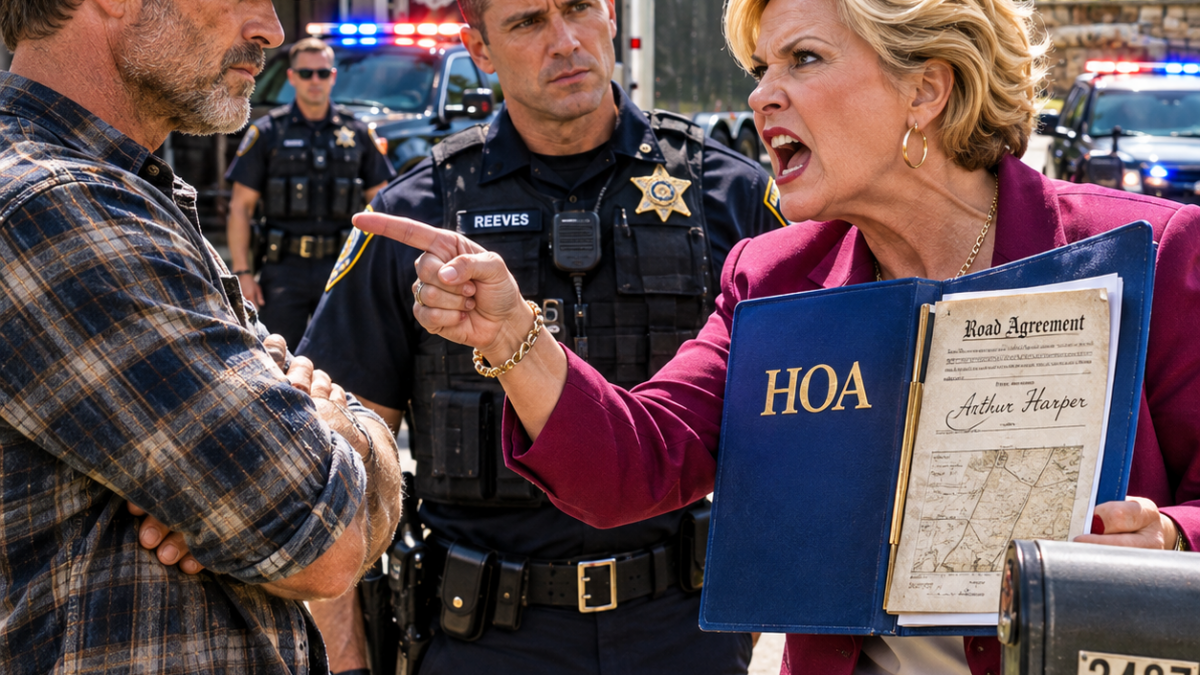
**“OFFICER, HE’S BLOCKING OUR EMERGENCY ACCESS AGAIN—MAKE HIM MOVE THAT TRAILER!” HOA president Brenda Whitmore shouted as the sixth police response in three weeks pulled into my driveway.**
**The problem was I had never joined Maple Ridge HOA, my five acres had been in my family since 1979, and every previous “emergency” Brenda reported—from my dog to my fire pit—had turned out to be perfectly legal activity on my own property.**
**Then she opened a blue folder, showed the officer an old road agreement supposedly signed by my grandfather, and I finally understood why she had become so desperate to force me into her HOA.**
The fourth police cruiser stopped in front of my house just as I was carrying a box of tools into the garage.
Red and blue light washed across the brick walls.
Two officers stepped out.
Across the road, Brenda Whitmore stood beside her mailbox holding her phone.
And smiling.
Not nervously.
Not apologetically.
Satisfied.
Like everything was going exactly the way she wanted.
Officer Daniel Reeves recognized me immediately.
He had already been to my property more than once.
“Mr. Harper?”
“That’s me.”
“We received a report about a possible emergency-access obstruction.”
I looked at my work trailer.
It sat beside my gravel driveway.
Fully inside my property.
Not blocking the county road.
Not blocking anyone’s house.
Not blocking anything except perhaps Brenda’s imagination.
“There is no emergency-access road here.”
Brenda crossed the street before Reeves could answer.
“There is supposed to be.”
He turned.
“What does that mean?”
She pointed toward the western edge of my property.
“That land is part of Maple Ridge’s secondary emergency-access plan. Mr. Harper has repeatedly refused to cooperate.”
I laughed once.
“I’m not even in Maple Ridge.”
Reeves looked at her.
“Is he a member of your HOA?”
Brenda hesitated.
“Not yet.”
The officer stared at her.
“Not yet?”
“He’s supposed to join.”
PART2:
That was when the whole thing became absurd enough that I almost smiled.
Nobody was supposed to join a voluntary HOA because its president decided they should.
But Brenda looked completely serious.
She opened the thick blue folder she had brought with her.
“We’re correcting an old boundary problem.”
My stomach tightened.
She pulled out several pages.
At the bottom was my grandfather’s name.
Arthur Harper.
Beside it was a signature.
According to the document, Grandpa had agreed years earlier that the western corner of his property could eventually be placed under community control and used for future road access.
The signature looked close enough to real that I stopped laughing.
Brenda pointed toward my trailer.
“You see? He keeps obstructing land that was already promised for community use.”
I stared at the page.
Then at her.
“I’ve never seen that document.”
She smiled.
“You should have joined when I gave you the chance.”
That sentence stayed with me.
Because it made the supposed property agreement sound less like a historical discovery and more like leverage.
My name is Daniel Harper.
The house had belonged to my grandfather before it belonged to me.
Grandpa bought five acres outside a small Virginia town in 1979.
Back then, the road was mostly farmland, woods, and older houses separated by fields.
He built a simple brick house.
Planted two apple trees.
Added a detached garage.
Then a workshop where he fixed lawn equipment for neighbors.
Nothing fancy.
But solid.
When Grandpa died, Mom inherited everything.
She rented the place while I worked construction in Richmond.
Years later, when she moved to Florida, she offered to sell it to me below market value.
I was thirty-four.
Tired of apartment living.
And I had started a small landscaping business.
I needed room.
Tools.
Mowers.
Work trucks.
Utility trailer.
The Harper place was perfect.
By then, everything around it had changed.
The old farm east of us had become Maple Ridge.
More than one hundred homes.
Clubhouse.
Pool.
Sidewalks.
Matching mailboxes.
Stone entrance pillars.
Flower beds.
And rules.
Paint colors.
Fence styles.
Sheds.
Parking.
Commercial vehicles.
Trash cans.
My property looked nothing like it.
Older fence.
Gravel driveway.
Two work trucks.
Trailer.
Wooden shed.
Firewood beside the workshop.
Sometimes a mower parked in the side yard.
Nothing dangerous.
Nothing illegal.
And none of it mattered because my property was not inside Maple Ridge.
Most residents understood that.
James Miller lived closest.
Good guy.
He occasionally borrowed tools.
I helped repair his riding mower.
His wife Susan brought banana bread after I fixed their gate.
Their twelve-year-old son Luke loved watching me work on engines.
That was exactly the kind of relationship I wanted.
Different properties.
Different rules.
Still neighbors.
The trouble started about two months after I moved in.
I came home one evening and found a white envelope taped to my front door.
MAPLE RIDGE HOMEOWNERS ASSOCIATION.
COMMUNITY COMPLIANCE NOTICE.
Four violations.
Work trailer visible from road.
Garage door open too long.
Shed wrong color.
Trash cans visible from driveway.
I read it twice.
Then called the number.
A woman named Linda answered.
I gave her the address.
Pause.
Typing.
Then:
“Oh.”
That was reassuring.
She confirmed my parcel was not inside Maple Ridge.
Said the notice had been entered by HOA president Brenda Whitmore.
Linda promised to remove it.
I assumed that was the end.
Two days later, Brenda arrived at my house.
Late fifties.
Short blonde hair.
Perfectly organized folder.
Friendly smile that stopped being friendly the moment you disagreed.
She said there had been confusion.
“There really isn’t,” I told her. “I’m not in your HOA.”
“Technically, your parcel sits outside the recorded boundary.”
Technically.
I noticed the word immediately.
She explained that my property shared the same road corridor and affected neighborhood appearance.
Maple Ridge hoped I would voluntarily join.
Voluntarily.
That word mattered too.
“No.”
Not rude.
Not angry.
Just no.
I explained that my landscaping business operated from home.
Trailers.
Tools.
Trucks.
Outdoor equipment.
Joining an HOA that restricted those things made no sense.
“The board could probably make exceptions.”
“Why would I join something that needs exceptions before I’m even a member?”
She didn’t like that question.
Then she listed the benefits.
Pool.
Clubhouse.
Community events.
Security.
Landscaping standards.
I told her I already had more yard than I wanted to maintain and did not need a pool.
Her smile tightened.
Before leaving, she handed me an annexation packet.
VOLUNTARY ANNEXATION INTO MAPLE RIDGE HOA.
I set it on my kitchen counter.
Forgot about it.
A week later, another compliance notice arrived.
Commercial vehicle violation.
I called Brenda directly.
She said it was only informational.
“Then why does it threaten future fines?”
“If you join Maple Ridge, you need to understand the standards.”
“I’m not joining.”
Long silence.
Then:
“You may want to reconsider.”
“Why?”
“Properties outside community standards can create conflict with neighbors.”
A threat wrapped in polite language.
I ignored it.
For several weeks, life stayed normal.
Work.
Home.
Equipment maintenance.
James helped replace part of my fence.
Luke carried boards that were probably too heavy for him.
Susan brought lemonade and warned both of us about back injuries.
That was neighborhood life.
No forms.
No dues.
No emergency meetings.
Just people helping each other.
Then the first 911 call happened.
Tuesday evening.
I was in the garage repairing a leaf blower.
Police lights appeared.
An officer walked up.
Possible burglary.
Caller had reported a suspicious man carrying tools into a detached garage after dark.
The suspicious man was me.
At my own house.
I showed my driver’s license.
Property information.
The officer apologized.
The next morning James mentioned Brenda had been standing near the road when police arrived.
Strange.
But I did not accuse her.
Maybe she honestly misunderstood.
Three days later, another police car.
Illegal commercial operation.
Unknown vehicles coming and going.
One employee had stopped by to pick up a mower.
That was it.
The officer explained business-zoning complaints normally went through the county, not 911.
Nothing happened.
He left.
That evening Brenda called.
“Are you getting tired of police coming to your property?”
I became very still.
“Why are you asking?”
“Residents are concerned.”
“Did you call them?”
She avoided the question.
Then:
“If you joined the HOA, I could help reduce these misunderstandings.”
I almost laughed.
“So I should join because people keep calling police?”
“That isn’t what I said.”
“That is exactly what you said.”
I hung up.
The third call came Sunday morning.
I had a small pile of storm branches inside a legal fire pit.
Water nearby.
Calm weather.
County rules allowed it.
Two firefighters and a deputy arrived because somebody reported an uncontrolled fire threatening neighboring homes.
There was barely enough flame to cook a hot dog.
The deputy looked embarrassed.
He asked whether I knew who might be making the calls.
“I have an idea. I don’t have proof.”
That afternoon, I installed cameras.
Doorbell.
Garage.
Road.
Not for revenge.
For records.
If somebody kept creating emergencies where none existed, I wanted evidence showing what had actually happened.
Several quiet days followed.
Then Brenda returned.
Another annexation packet.
Reduced first-year dues.
“No.”
She offered to waive penalties for my work trailer.
“You cannot fine my trailer.”
Her smile disappeared.
“You don’t understand how much easier this would be if your property were inside Maple Ridge.”
“Easier for who?”
No answer.
That night, I finally read the annexation packet.
Most of it was predictable.
Dues.
Voting.
Rules.
Maintenance.
Then I reached the final map.
My five acres sat along Maple Ridge’s western edge.
Behind my back field, a narrow corridor connected toward another county road.
Across my western corner:
PROPOSED SECONDARY ACCESS.
I stared.
There was no road there.
Grass.
Trees.
Fence.
Part of my equipment-storage area.
I called James.
He went quiet.
Maple Ridge had been debating a second entrance.
The main entrance backed up badly during morning traffic.
Some residents wanted another exit on the west side.
“Where?”
“Probably near your land.”
That changed everything.
Maybe Brenda never cared about my trailer.
Maybe she cared about the ground under it.
The next morning, I drove to county records.
My deed was clear.
Five acres.
Outside Maple Ridge.
No HOA covenant.
No membership agreement.
No recorded road easement.
Then the clerk found a planning request.
Maple Ridge had applied six months earlier for an emergency access road on the west side.
The proposed route crossed my property.
Approved?
No.
The county requested proof of land ownership or written permission from affected owners.
Maple Ridge did not have it.
File inactive.
I knew exactly why.
I had never said yes.
When I returned home, Brenda was waiting.
“Where were you?”
“None of your business.”
Then:
“Why did Maple Ridge file a road plan across my property?”
For the first time, she looked genuinely surprised.
Only for a second.
Then the smile returned.
“It’s just an idea.”
“Does the HOA need my land?”
“Engineers are reviewing options.”
“If I join Maple Ridge, does the HOA get more control over that land?”
“You’re imagining connections.”
“Great. Then stop asking me to join.”
She left.
That evening:
Fourth 911 call.
Report:
I had threatened a woman in my driveway.
Two officers arrived.
I showed them security video.
Brenda beside my truck.
Us talking.
Her walking away calmly.
No shouting.
No threat.
One officer watched twice.
“Has this woman called us on you before?”
“I believe so.”
He wrote something down.
That was when the pattern became official.
Over the next twelve days:
Aggressive dog.
My dog had been inside a fenced yard.
Suspicious work truck.
Legally parked.
Illegal digging near utilities.
I was planting two trees.
Every time:
Police came.
Every time:
Nothing.
Every time:
Brenda was somewhere nearby.
Then came the sixth call.
The one Officer Reeves responded to.
Work trailer blocking emergency access.
No approved road.
No easement.
No emergency.
Brenda walked over holding the blue folder.
Reeves asked why she kept using emergency services for a property dispute.
She said:
“He refuses to cooperate with community rules.”
“Is he in your HOA?”
“Not yet.”
Then she showed Grandpa’s supposed agreement.
The signature looked real.
My stomach dropped.
I had never seen it.
Reeves read it carefully.
Then looked at me.
“You know anything about this?”
“No.”
Brenda smiled.
“You should have joined.”
Reeves did something important.
He did not decide the property dispute.
He said this was clearly not a 911 emergency.
Lawyers and county records would handle it.
Then he warned Brenda not to use emergency services to pressure someone in a land disagreement.
Her face turned red.
Before leaving, she said:
“Once the county sees the original agreement, that road is going through.”
I called Mom.
Asked whether Grandpa had ever discussed giving developers road access.
Long silence.
Then:
“There was an argument.”
“What argument?”
“Some people wanted a route across the western edge. Your grandfather refused.”
“Are you sure?”
“Yes.”
I told her about the signed document.
Mom went quiet again.
Then:
“Your grandfather kept everything.”
“Where?”
“The workshop.”
I grabbed a flashlight.
Grandpa’s old workshop held boxes I had barely touched.
Receipts.
Tax papers.
Equipment manuals.
Photos.
Behind a metal cabinet:
Dusty brown file box.
LAND — WEST SIDE.
Inside were developer letters.
Survey maps.
County notices.
Yellow envelope.
First page:
Offer for future road access.
Grandpa’s handwriting across the bottom:
NO ACCESS.
NOT NOW.
NOT EVER.
My hands began shaking.
Then I found the second document.
Same form Brenda had shown Reeves.
Same title.
Same property description.
But Grandpa’s copy had no signature.
Across the top:
REJECTED.
Stapled behind it was a letter from Grandpa’s attorney warning the developer never to present the unsigned agreement as approved.
I stared at it.
If Grandpa rejected the deal, how did Brenda have a signed copy?
My phone buzzed.
Motion alert.
Road camera.
White SUV beside the far fence.
Two men in reflective vests.
Survey equipment.
Brenda behind them.
One drove an orange stake into my field.
I ran outside carrying Grandpa’s file.
Brenda told the surveyor:
“The owner won’t cooperate, but we have the agreement.”
The surveyor unfolded a map.
MAPLE RIDGE WEST EMERGENCY ACCESS.
Red line straight across my western corner.
And suddenly the six 911 calls looked different.
Brenda was not merely harassing me.
She was creating history.
Trailer blocking access.
Trees near utilities.
Truck safety concern.
Commercial traffic.
Fire.
Dog.
Repeated emergency responses attached to the same address.
If somebody later saw only the incident list, my property could look like a chronic public-safety problem.
I shouted:
“Stop!”
The surveyor lowered his equipment immediately.
He introduced himself as Mark Collins.
He had been hired to locate the proposed emergency corridor.
“Who gave you permission to enter?”
He looked at Brenda.
She mentioned the old agreement.
I handed Mark Grandpa’s rejected copy and the attorney letter.
He read them.
Then asked Brenda:
“Is your signed agreement recorded?”
“The HOA attorney is handling that.”
“Do you have legal authorization for us to enter today?”
“The road is part of emergency planning.”
“That wasn’t my question.”
Mark turned toward his assistant.
“Pull the stakes.”
Brenda became furious.
“The HOA is paying you to finish.”
Mark shrugged.
“You’re paying me to survey, not trespass.”
I respected him immediately.
A contractor realizing something is wrong and stopping can prevent a bad situation from becoming much worse.
I called Officer Reeves through the non-emergency number.
He arrived.
Compared both agreements.
Same document.
One rejected.
One carrying Grandpa’s signature.
He asked Brenda for the original.
She had only a copy.
Where was the original?
She refused to discuss legal storage in front of me.
Reeves asked about court authorization.
None.
Recorded easement.
None.
County order.
None.
Mark packed up.
Then Reeves opened his notebook and reviewed the earlier calls.
Suspicious tools.
Commercial vehicles.
Controlled fire.
Dog.
Tree planting.
Trailer.
“Ms. Whitmore, none of these resulted in arrest, citation, or emergency action.”
Brenda insisted the concerns were reasonable.
Reeves told her future misuse of 911 could become a problem of its own.
For the first time, Brenda looked worried.
Not angry.
Worried.
I hired Rebecca Lawson the next morning.
Land and real-estate attorney.
I brought everything.
Deed.
Maps.
Annexation papers.
Compliance notices.
Police records.
Grandpa’s rejected agreement.
Rebecca read silently for almost an hour.
Then:
“We separate facts from suspicion.”
Fact:
I was not in Maple Ridge.
Fact:
My deed contained no HOA covenant.
Fact:
No recorded easement existed.
Fact:
Grandpa’s file contained an unsigned agreement marked rejected.
Fact:
Brenda possessed a signed version that still had to be authenticated.
Everything else required proof.
Rebecca requested every Maple Ridge record related to my property.
Western access.
Annexation.
Brenda’s communications.
She also requested the original signed agreement.
Then full county planning records.
Several quiet days followed.
No police.
No surveyors.
No notices.
I spent Saturday repairing a mower with James and Luke.
Susan brought sandwiches.
We tried not to make the entire afternoon about Brenda.
Then Susan said:
“Brenda told residents the western route was almost secured.”
“When?”
“About a month ago.”
Before several of the 911 calls.
Before survey stakes.
Before she showed me Grandpa’s supposed signed agreement.
“What did ‘almost secured’ mean?”
Susan did not know.
Only one administrative obstacle remained.
I had a feeling that obstacle was me.
Then county planning sent Rebecca the complete route analysis.
Three options.
Route A:
Across my five acres.
Estimated cost:
About $180,000.
Route B:
Entirely inside Maple Ridge.
Remove landscaped hill.
Retaining wall.
More than $620,000.
Route C:
Different county connection.
Land purchase.
Nearly $500,000 plus acquisition costs.
There was the motive.
Route A was not the only route.
It was the cheapest route.
My property represented hundreds of thousands of dollars in savings.
Then Rebecca found language buried on page nineteen of the annexation agreement.
Newly annexed properties agreed to support community access improvements already included in Maple Ridge’s master plan.
Would joining automatically transfer my land?
No.
But it gave Maple Ridge a much stronger argument that I had accepted infrastructure obligations.
That explained Brenda’s obsession with membership.
First she needed me inside the system.
Then she could use the system against me.
Rebecca found emails between Brenda and a traffic consultant.
Two months before she first asked me to join:
WESTERN LANDOWNER EXPECTED TO JOIN MAPLE RIDGE SOON.
Another:
HOA ENFORCEMENT CONCERNS MAY ENCOURAGE FINAL COOPERATION.
The consultant asked whether my property was legally subject to HOA rules.
Brenda answered:
NOT CURRENTLY, BUT WE ARE WORKING ON VOLUNTARY INCLUSION.
Not currently.
She knew.
From the beginning.
Yet she sent compliance notices anyway.
Then Maple Ridge produced the digital copy of Grandpa’s signed agreement.
No original.
Metadata showed the file had been uploaded only seven months earlier.
The same period when western-access planning restarted.
Upload account:
Brenda Whitmore.
Rebecca still would not call it forgery.
She hired Dr. Helen Morris, a forensic document examiner.
We gathered Grandpa’s known signatures.
Tax documents.
Bank papers.
Equipment contracts.
Cards.
Nearly thirty samples.
While Dr. Morris worked, I obtained the full 911 records.
All six calls traced back either to Brenda directly or Maple Ridge’s office number.
The language mattered.
Garage call:
UNKNOWN MALE ENTERING STRUCTURE.
Brenda already knew me.
Commercial call:
UNFAMILIAR TRUCKS CREATING SAFETY CONCERN.
She knew they were my landscaping vehicles.
Fire call:
FLAMES POSSIBLY SPREADING TOWARD RESIDENTIAL LOTS.
Not true.
Rebecca stopped the recording.
“This is no longer just irritating.”
She reminded me that every unnecessary emergency response could divert officers or firefighters from somebody who actually needed help.
That changed how I felt.
I had considered Brenda’s calls harassment.
Now I understood the larger danger.
Then one afternoon, Brenda appeared outside my gate again.
Two men in county-style reflective jackets.
White utility truck.
MAPLE RIDGE SAFETY CONSULTING.
They remained outside.
Photographed my trailer.
Driveway.
Fence.
Work vehicles.
Brenda pointed at my camera.
Smiled.
That evening:
FINAL OPPORTUNITY FOR VOLUNTARY ANNEXATION.
Join within ten days.
Prior compliance concerns waived.
Three years of reduced dues.
And Maple Ridge would “work cooperatively” with me regarding future transportation needs.
Same message.
Join and everything becomes cooperation.
Refuse and everything becomes an emergency.
Then Dr. Morris called.
Grandpa’s signature on Brenda’s agreement showed exact microscopic similarities to a genuine signature from an old tax authorization.
Not normal similarities.
Exact.
Same tiny gap.
Same curve.
Same proportions.
Likely reproduced from the genuine document.
Problem:
Need the original to make the strongest conclusion.
Nobody could find it.
Then Brenda called an emergency HOA meeting.
WESTERN ACCESS SAFETY CRISIS.
I went with Rebecca.
Packed clubhouse.
Brenda displayed maps.
My property marked as preferred emergency route.
Photos of my trailer.
Truck.
Fence.
Trees.
Then a slide:
SIX POLICE/FIRE RESPONSES AT WESTERN PROPERTY.
Residents whispered.
One woman asked:
“Why are police always over there?”
Exactly the conclusion Brenda wanted.
Then Officer Reeves stood in the back.
He was attending as a guest.
Not officially representing the department.
He raised his hand.
“Since these calls are being used to describe Mr. Harper’s property as unsafe, people should know none of the six resulted in charges, citations, arrests, or any finding that he created an emergency.”
The room shifted.
Then:
“And if I remember correctly, Ms. Whitmore personally made several of those calls.”
Questions exploded.
Brenda called every report good faith.
Then the rear doors opened.
An elderly man entered carrying a brown briefcase.
Rebecca whispered:
“Charles Bennett.”
“Who?”
“The attorney who represented the developer when your grandfather rejected the road agreement.”
Charles walked to the front.
“I hear Maple Ridge is relying on an agreement signed by Arthur Harper.”
Brenda said HOA counsel was handling it.
Charles opened his file.
He removed the same agreement.
Across the first page:
VOID.
OWNER REFUSED.
Then another document.
Grandpa’s genuine tax authorization.
The exact source Dr. Morris suspected.
Charles said:
“Arthur Harper never signed the access agreement.”
The room became chaos.
Then every phone buzzed.
MAPLE RIDGE EMERGENCY ALERT.
WEST GATE EMERGENCY ACCESS ACTIVATION IN PROGRESS.
There was no west gate.
Not yet.
My security camera triggered.
Two large trucks outside my western fence.
Workers unloading metal barriers.
Hydraulic cutter.
Small bulldozer.
Then the cutter closed around my fence.
Metal snapped.
The entire clubhouse watched.
Rebecca grabbed her bag.
“We’re leaving.”
Officer Reeves followed.
Charles followed.
Brenda shouted:
“Nobody interfere with emergency safety work!”
Rebecca turned.
“Show me the court order.”
Silence.
“County authorization?”
Silence.
“Recorded easement?”
Nothing.
By the time we reached my property, twelve feet of fence had been removed.
Metal plates covered the roadside ditch.
Bulldozer unloaded.
Crew supervisor:
Paul Warner.
He had been told the West Emergency Route needed immediate activation under a disaster plan.
“What disaster?”
He looked confused.
No fire.
No flood.
No blocked entrance.
No medical emergency.
Only an emergency work order.
Signed electronically:
Brenda Whitmore.
Reason:
IMMEDIATE SAFETY ACCESS REQUIRED DUE TO REPEATED OBSTRUCTION OF APPROVED EMERGENCY CORRIDOR.
The “obstructions” were my trailer and fence sitting on my property.
Charles showed Paul Grandpa’s original file.
Paul’s face changed.
Then he ordered his crew to stop.
Brenda arrived.
Told him to continue.
Officer Reeves asked:
“What emergency?”
“The risk of the main entrance becoming blocked.”
“Is it blocked?”
“No.”
“Fire?”
“No.”
“Flood?”
“No.”
“Ambulance delay?”
“No.”
“Then what emergency?”
She said the risk itself justified action.
James stepped forward.
“The board never voted to cut Daniel’s fence.”
Other residents agreed.
Most had no idea construction had been scheduled.
The emergency alert was the first they heard about it.
I said nothing.
Let the documents speak.
Grandpa’s file.
Broken fence.
Work order.
No easement.
No court order.
No emergency.
Sometimes silence is stronger when the facts are already loud.
The crew left.
Paul promised to repair the damage if the order proved unauthorized.
Brenda approached me after everyone began leaving.
“You have no idea what you’re doing.”
“You keep saying that.”
“Route A is the only realistic solution.”
“It isn’t.”
“It’s the only affordable one.”
There it was.
Affordable.
Not necessary.
Affordable.
Then:
“Just join the HOA. We can solve this.”
Six 911 calls.
Fake-looking agreement.
Survey crew.
Cut fence.
Still:
Join.
“No.”
Same answer.
Next morning, the board suspended Brenda’s authority.
No contracts.
No emergency alerts.
No contractor instructions.
No acting alone for the HOA.
Then Rebecca found Maple Ridge Safety Consulting’s contract.
Signed by Brenda.
Company owner:
Gregory Whitmore.
Her brother.
The contract exceeded what Brenda could authorize alone.
The HOA board had never properly approved it.
Dr. Morris completed the forensic report.
Grandpa’s signature had been copied from the tax authorization.
Not naturally signed on the road agreement.
Grandpa said no.
Someone took his real signature and changed it to yes.
Then Charles produced his archive-request records.
Only one request for Grandpa’s old development file in the previous five years.
Eleven months earlier.
Maple Ridge HOA.
Authorized contact:
Brenda Whitmore.
That did not prove she personally created the fake.
But it placed her directly beside both source documents.
Then Rebecca finished the 911 timeline.
Call one:
Three days after my second annexation refusal.
Call two:
Day after Brenda emailed about using enforcement pressure to encourage cooperation.
Fire call:
After county asked for proof of access rights.
Dog complaint:
After I challenged the route map.
Utility complaint:
After I visited county records.
Trailer call:
Same day surveyors were scheduled.
Repeated phrase:
POSSIBLE EMERGENCY ACCESS OBSTRUCTION.
Used before an emergency corridor legally existed.
The sheriff’s office began reviewing whether Brenda had misused emergency services.
For the first time, police were no longer investigating me.
They were investigating the calls.
Maple Ridge scheduled a formal meeting to decide Brenda’s future.
Thomas Reynolds chaired it.
He began with:
“Mr. Harper’s property is not and has never been a Maple Ridge HOA parcel.”
Some residents gasped.
Apparently a few still believed I was simply an HOA member refusing rules.
Thomas repeated it.
All compliance notices withdrawn.
Western access suspended.
No entry onto my land without permission or actual legal authority.
Then treasurer Denise Walker stood.
Maple Ridge Safety Consulting had received nearly $38,000 over three months.
Traffic studies.
Property photographs.
Emergency planning.
Survey coordination.
Owner:
Gregory Whitmore.
The room erupted.
Brenda insisted his company was qualified.
Board members demanded to know why the relationship had not been disclosed.
Then Charles explained Grandpa’s rejected agreement.
Dr. Morris’s copied-signature conclusion.
Rebecca asked Brenda:
“Did you request Arthur Harper’s archived file eleven months ago?”
“Yes.”
“Did that file contain both the rejected agreement and the tax authorization?”
“I don’t remember.”
Charles did.
It contained both.
Thomas announced a vote to remove Brenda.
Before the vote happened, two sheriff’s deputies entered.
Reeves with them.
He needed to speak with Brenda privately regarding the 911 investigation.
Her face went pale.
Then my phone rang.
James.
“Daniel, somebody’s at your property.”
“What?”
“Excavator.”
I opened my camera app.
Yellow excavator inside my western field.
Someone had removed the temporary boards covering the broken fence.
A man with rolled plans stood beside the machine.
Bucket digging directly along Route A.
Then the operator lifted another scoop.
Something dark appeared beneath the soil.
Pipe.
The operator stopped.
James shouted through my phone:
“I smell gas.”
For the first time since Brenda started calling 911, there was an actual emergency.
Officer Reeves radioed immediately.
Fire department.
Gas utility.
Police.
Residents near the western side evacuated away from the nearest houses.
Nobody was hurt.
That was all I cared about.
The gas company shut down the damaged line before ignition.
No fire.
No injured workers.
No damaged homes.
Then investigators asked the obvious question.
Who sent the excavator?
Western Access Solutions.
Project manager:
Eric Dalton.
He had received authorization that morning.
Signed:
Gregory Whitmore.
Owner of Maple Ridge Safety Consulting.
Brenda’s brother.
Same company paid by the HOA.
Same company photographing my property.
Same company connected to the pressure campaign.
Nobody told Eric the landowner had refused access.
Nobody told him the agreement was disputed.
Nobody told him the board had suspended the western-road project.
Gregory described the work as an approved emergency-access improvement.
Emergency again.
The word had been used so often it had almost lost meaning.
Until that morning.
That morning gas was escaping from a damaged line.
That was an emergency.
And the difference was obvious.
Maple Ridge emailed all residents.
The digging had not been approved.
Gregory was not a board member.
Western Access had no authority to enter my property.
Route project frozen.
Then something almost funny happened.
The board announced they were choosing Route B.
The expensive route.
Entirely inside Maple Ridge.
More than $620,000.
Retaining wall.
Major grading.
No part of my five acres.
The solution had existed from the beginning.
It was simply more expensive.
They had spent weeks harassing me because my land offered them a discount.
Luke asked his father:
“If Route B works, why didn’t they just build that?”
James laughed.
“They didn’t want to pay for it.”
Luke shrugged.
“Then they should.”
A twelve-year-old solved the entire dispute in six words.
Then investigators searched records connected to Maple Ridge Safety Consulting.
Gregory’s computers contained:
Grandpa’s original rejected agreement.
Grandpa’s genuine tax authorization.
And a working digital file showing the rejected agreement with Grandpa’s signature inserted onto it.
No mystery anymore.
The signed version had been created recently.
Then:
WEST ACCESS STRATEGY.
Traffic maps.
Annexation forms.
Property photographs.
Pressure points.
COMMERCIAL VEHICLES.
EXTERIOR STORAGE.
FIRE COMPLAINTS.
ANIMAL CONCERNS.
EMERGENCY OBSTRUCTION.
Every category matched Brenda’s 911 campaign.
Another line:
REPEATED PUBLIC SAFETY DOCUMENTATION MAY SUPPORT ACCESS NECESSITY.
There it was.
The calls were not random complaints.
They were useful paperwork.
Create reports.
Show police responses.
Make the property look dangerous.
Use that record at HOA meetings.
Pressure the owner.
Get the road.
The sheriff referred Brenda’s calls for possible misuse of emergency services and false reporting.
Gregory faced a much larger investigation involving the false document and unauthorized work.
I asked Rebecca what would happen.
“Let investigators handle it.”
Best advice she gave me.
I wanted accountability.
But I did not want revenge to become another HOA controlling my life.
The board held one final western-access meeting.
No photos of my trailer.
No police-call slideshow.
No dramatic safety claims.
Thomas apologized publicly.
Then said what should have been obvious from day one.
“Daniel Harper is not an HOA member.”
Never had been.
Grandpa never joined.
My property was not subject to HOA rules.
No authority over:
Truck.
Trailer.
Shed.
Fire pit.
Dog.
Trees.
Garage.
Route A was permanently removed.
Route B would be built inside Maple Ridge.
Residents would probably face higher assessments.
Nobody liked that.
But nobody argued that I should surrender land to save them money.
That was progress.
Then Margaret Ellis, one of Maple Ridge’s older residents, stood.
“We became so focused on convenience and property values that we stopped asking whether our neighbor was being treated fairly.”
I thought Grandpa would have liked her.
The HOA adopted new controls.
No president authorizing large contracts alone.
No family-owned vendor without disclosure.
No enforcement against outside parcels without legal review.
No emergency alerts for ordinary property disputes.
Months passed.
My business recovered.
Fence repaired.
Gas-line trench disappeared under new grass.
Trailer stayed exactly where I wanted.
Dog continued threatening squirrels and nobody else.
Police cars stopped appearing.
Eventually Brenda and Gregory faced legal consequences.
Gregory was charged in connection with the false access document and unauthorized property work.
Brenda faced charges tied to misuse of emergency reporting and the pressure campaign.
Their cases moved slowly.
I did not attend every hearing.
Rebecca handled anything affecting my property.
I gave statements when requested.
Then went home.
Maple Ridge eventually elected Nancy Powell as its new HOA president.
Her first visit made me laugh.
She stopped outside my gate.
Called me.
Waited.
I walked down.
“I wanted to introduce myself.”
“Okay.”
“I’d like a better relationship with neighbors outside Maple Ridge.”
“So would I.”
Then she smiled.
“Just so we’re clear, I am not asking you to join.”
I laughed harder than I had in months.
“Good start.”
Route B took almost a year.
Big retaining wall.
Expensive.
Not beautiful.
But it worked.
Maple Ridge got its second exit.
My land remained untouched.
One afternoon Officer Reeves stopped by.
Off duty.
No flashing lights.
He returned a flash drive containing copies of video I had provided.
“Nice being at this address without a 911 call.”
“Very.”
Then he became serious.
Repeated false or exaggerated emergency calls were not just annoying.
Dispatchers and officers had to treat calls as real until proven otherwise.
Every unnecessary response used resources somebody else might need.
I never forgot that.
Because the day the excavator struck the gas line, I was grateful those sirens came.
That was what 911 was for.
Not forcing somebody into an HOA.
Not pressuring a landowner.
Not building a paper trail.
Not making a neighbor look dangerous.
A year after all of it started, James came over with two beers.
We sat on my porch looking toward the western field.
Grass had grown back.
Fence repaired.
No stakes.
No road.
Apple trees still standing.
“Hard to believe this started because she wanted you in the HOA.”
I laughed.
Technically, yes.
But Brenda wanted more than dues.
Membership would have made the road fight easier.
When I refused, she sent compliance notices.
When those failed, she used emergency complaints.
Then police calls.
Then Grandpa’s fake agreement.
Surveyors.
Fence cutting.
Excavator.
Gas line.
All because I kept saying one word.
No.
James asked:
“If Nancy offered, would you ever join now?”
I looked around.
Work truck beside garage.
Trailer near workshop.
Old brown shed.
Trash cans visible from one angle if somebody tried really hard.
“No.”
He laughed.
So did I.
There was nothing inherently wrong with Maple Ridge for people who wanted it.
Some loved the pool.
The clubhouse.
The rules.
Planned events.
That was their choice.
I wanted something different.
That was mine.
Grandpa understood that long before I did.
Across the original road proposal, he had written:
NO ACCESS.
NOT NOW.
NOT EVER.
Three short lines.
He protected the land by saying no.
I protected it by keeping his records.
By checking county documents.
By staying calm.
By using cameras.
By letting investigators investigate.
And by refusing to let constant pressure turn somebody else’s convenience into my obligation.
Brenda called 911 on me again and again.
She told police my property was dangerous.
She told residents my trailer blocked emergency access.
She used six emergency responses to make one independent property look like a neighborhood safety crisis.
She wanted me in her HOA so badly that my refusal became part of a road strategy.
In the end, I never joined.
The fake agreement collapsed.
The calls stopped.
Route A disappeared.
Maple Ridge built Route B on land it actually controlled.
And the five acres Grandpa bought in 1979 remained exactly what he intended them to be.
Home.








