PART 2: HOA President Blew Open Our Mountain for a Luxury Resort — Then the Ground Started Moving Beneath Her Glass Mansion
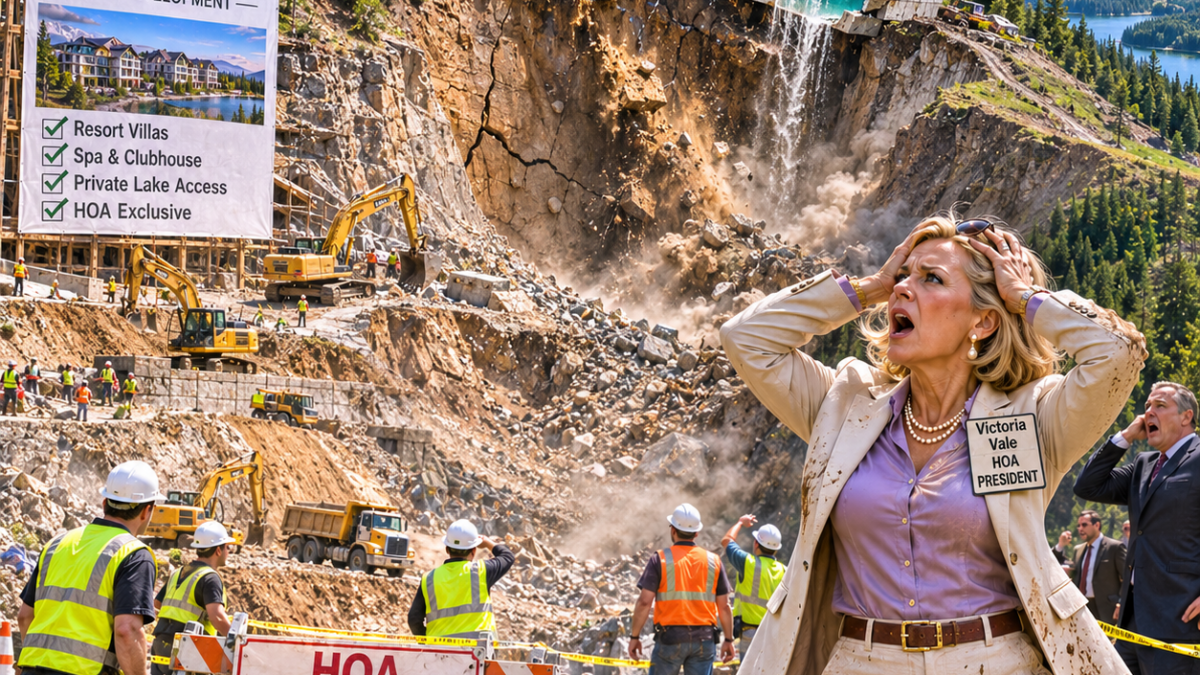
At 3:41 in the morning, a sound like thunder trapped inside stone ripped me out of bed, and by the time I reached my back porch with a flashlight, the upper face of Silver Crown Mountain was already moving—trees tipping, boulders rolling, mud folding over itself as it came down toward the half-built resort and the glass mansion Sophia Williams had planted beneath a slope I had spent months warning her was unstable. I had been called paranoid, bitter, obsolete, and even “emotionally unstable” for saying the blasting and grading were changing the mountain faster than their engineers admitted, but standing there in the rain while the ridge broke open, I understood that the argument was no longer about an HOA president humiliating a retired geotechnical engineer at meetings. What frightened me most in those first seconds was not what the slide had already reached, but the fact that I knew exactly which part of the mountain was likely to move next—and there were families sleeping below it.
My name is Michael Brown. I was sixty-four then, retired, widowed, and living in the house my wife Ellen and I had chosen because Silver Crown Mountain rose behind it like a wall between us and the noise of the rest of the world.
After Ellen died, that mountain became part of how I survived her. I walked its lower trails when the house felt too empty and sat on my porch while fog caught in the junipers.
For years, our little neighborhood barely needed an association. We shared a mailbox cluster, handled trash pickup, and mostly left one another alone.
Then Sophia Williams arrived.
Within a year she had turned our HOA into something that felt less like neighborhood management and more like private government.
Sophia loved the word luxury.
Luxury landscaping. Luxury standards. Luxury views.
Then, at a packed meeting one Thursday night, she clicked a remote and put a rendering of a glass-walled resort on the clubhouse screen.
“Silver Crown Mountain Resort,” she announced. “This will transform our community.”
People applauded.
The images were beautiful—an aerial tram, infinity pool, glass villas, and a conference center cut into the mountainside.
I stared at the slope behind the renderings and felt my stomach tighten.
“Have you done a post-cut slope stability analysis?” I asked.
Sophia’s smile stayed in place.
“We’ve consulted professionals.”
“What kind?”
“Our architect and development team.”
“An architect isn’t a geotechnical engineer.”
The room went quiet.
I stood.
“That slope is decomposed granite, fractured shale, and old slide material. There was a documented failure on the north face in 1978. If you blast and over-steepen it without proper stabilization, you’re increasing the chance of a landslide.”
Sophia tilted her head.
“Mr. Brown, you’re retired, correct?”
A small laugh came from one corner.
“Yes.”
“Then perhaps we should allow the active professionals to do their jobs.”
I went home angry, pulled old county maps, and found the 1978 slide scar exactly where I remembered it. Then I called Samuel Klein, an old colleague still practicing, and sent him photographs of the proposed cut.
His reply came the next morning.
Michael, if they remove support from that face and load the bench below it, they need a serious geotechnical review. That slope has history.
I printed the message.
Sophia ignored it.
A week later, the first blast shook my windows.
Dust rolled across the mountain in a gray cloud. When it cleared, a raw wound cut across the slope where juniper and pine had stood the day before.
I drove to the county office with maps, photographs, and a formal objection. The clerk stamped my packet and said it would be reviewed.
Construction continued the next morning.
Then came the first light rain.
Only about an inch.
By sunrise, six inches of mud had pushed against my back fence.
I measured it, photographed it, and logged it.
At the next HOA meeting, I carried the photographs to the front.
Sophia didn’t even look at them.
“This board has already addressed your concerns.”
“No. You dismissed them.”
Her expression hardened.
“Your unsolicited reports are creating panic and threatening a project that benefits everyone.”
Then Tom Delaney, a neighbor with two young children, stood up.
“Michael,” he said quietly, “can you look at something at my house after this?”
Sophia’s face changed.
“What kind of something?” I asked.
Tom swallowed.
“A crack in my basement wall.”
The room went silent.
And when he showed me the photograph on his phone, I knew the mountain had already begun answering the question Sophia refused to hear.
PART 2
The crack ran diagonally from the lower corner of Tom’s basement window toward the concrete floor.
Hairline at the top.
Wider near the bottom.
Not dramatic enough to make anyone run into the street.
Exactly the kind of thing that frightened me more.
“Was this here before construction?” I asked.
Tom shook his head.
“I don’t think so.”
“Don’t think or know?”
“My wife painted the basement last Christmas. She would’ve noticed.”
Sophia pushed back from the table.
“Homes settle.”
I looked at her.
“Of course they do.”
“Then stop frightening people.”
“I’m not saying the mountain caused this.”
Tom frowned.
“You’re not?”
“Not from one photograph.”
Sophia smiled as though I had surrendered.
I continued.
“But I’m saying you photograph it, measure it, date it, and watch whether it changes.”
Her smile vanished.
Tom nodded.
“I can do that.”
“Put a piece of tape across it and mark the date. Better yet, get a structural engineer.”
Sophia slapped her palm lightly against the podium.
“This is exactly what I mean.”
I turned.
“What?”
“You cannot attend every meeting and diagnose people’s homes.”
“I specifically said I wasn’t diagnosing it.”
“You are creating fear.”
“No.”
I held up the photograph.
“The crack already exists. Pretending it doesn’t isn’t reassurance.”
One of Sophia’s allies, Cynthia Parker, leaned toward her microphone.
“Michael, we appreciate your background, but the project has permits.”
That sentence became a refrain.
Permits.
As if paper could reinforce soil.
I gathered my photographs.
“I hope I’m wrong.”
Sophia laughed softly.
“You’re not behaving like a man who hopes he’s wrong.”
That hurt because there was enough truth inside it to sting.
I had spent my career being paid to find problems before they became disasters.
You learn to trust your instincts.
Sometimes too much.
Ellen used to accuse me of inspecting restaurant ceilings for structural defects during dinner.
“You’re supposed to be looking at me,” she would say.
“I am.”
“No, you’re looking at that beam.”
“The beam concerns me.”
“Michael.”
Then she would smile.
I missed that smile every day.
Maybe Sophia was right about one thing.
I wanted proof.
Not of disaster.
Of danger.
Because danger could still be stopped.
After the meeting, Tom followed me outside.
“You really think my house is moving?”
“I don’t know.”
“You looked worried.”
“I’m worried about the whole slope.”
“That’s not reassuring.”
“I don’t want to reassure you with something I can’t prove.”
He leaned against his truck.
“My kids sleep downstairs sometimes.”
“Move them upstairs until you get the crack looked at.”
His face changed.
“That serious?”
“I’m being cautious.”
“Michael.”
I looked at him.
“Yes.”
He nodded slowly.
“I’ll move them.”
The next morning I drove to the county archive.
I had not been inside that building since before Ellen died.
Same smell.
Paper, dust, weak coffee.
A clerk named Brenda helped me pull historical geologic reports.
The 1978 slide was there.
Not rumor.
Not memory.
A documented slope failure after sustained rain.
It had taken out part of an orchard and blocked a county road.
No fatalities.
Lucky.
There were aerial photographs showing the scar.
The proposed resort cut overlapped the southern edge of the old disturbed zone.
I sat at a microfilm reader staring at the image until my eyes hurt.
Then I found something worse.
A 1986 county planning memorandum recommending limited excavation along that face because of “weathered rock, colluvial deposits, and prior instability.”
I printed it.
Then another.
And another.
By noon, my table looked like a paper landslide.
I called Samuel Klein.
“You busy?”
“Always.”
“I found the 1978 maps.”
“How close?”
“Too close.”
I sent photographs.
He called back twenty minutes later.
“Michael.”
“Yeah.”
“You were right to be concerned.”
“I hate when people tell me that.”
“They need a current geotechnical assessment.”
“They claim they have one.”
“Have you seen it?”
“No.”
“Request it.”
“From the HOA?”
“From whichever agency approved grading.”
That became my next battle.
County planning told me portions were public.
Some engineering documents were under review.
The developer’s counsel objected to releasing proprietary material.
Sophia told the neighborhood everything had been cleared.
Nobody would show me the report.
So I looked at what I could see.
The mountain.
I began walking the lower ridge every evening.
Not onto the construction site.
Public trail.
My property.
Neighbor property with permission.
I photographed drainage.
Marked reference points.
Measured the distance between fixed objects and small cracks where I could do so lawfully.
Nothing dramatic.
Millimeters.
Then more.
The first retaining structure developed a hairline crack.
I photographed it from the public road.
Two days later, the crack had lengthened.
Then rain came.
Not a storm.
A gentle spring rain.
The kind Californians celebrate after a dry stretch.
By morning, red-brown mud had pushed against my fence.
Six inches.
I stood there in rubber boots staring at it.
“Ellen,” I said aloud, “I really need to be wrong.”
The mountain offered no opinion.
At noon, Sophia’s newsletter arrived.
CERTAIN RESIDENTS CONTINUE TO SPREAD SPECULATIVE CLAIMS ABOUT SILVER CROWN MOUNTAIN RESORT.
It never named me.
It did not need to.
The message continued:
While we respect former professional experience, residents should rely on currently licensed experts retained for the project rather than unsupported personal interpretations.
Former professional experience.
She had found a polite way to call me obsolete.
Tom called.
“You see it?”
“Yes.”
“She means you.”
“I know.”
“You want me to say something?”
“No.”
“Why not?”
“Because arguing about insults is how she wins.”
“What are you going to do?”
“Get more evidence.”
That afternoon Samuel sent me a signed letter.
Short.
Careful.
Professional.
He had not performed a full site investigation and said so explicitly.
But based on photographs, historical records, and visible post-blast conditions, he believed further geotechnical evaluation was warranted before continued loading of the slope.
I submitted it to county planning.
Then environmental review.
Then building safety.
Three offices.
Three case numbers.
Weeks passed.
Bulldozers did not.
The resort became real by inches.
Access roads.
Concrete footings.
Retaining walls.
Steel.
Sophia’s own residence—or “mountain villa,” as she called it—rose on a bench below the largest cut.
Glass.
Steel.
Stone.
A monument to confidence.
One afternoon I saw her giving a local television crew a tour.
She stood in front of the excavation wearing a cream suit and holding champagne.
“Silver Crown is entering a new era.”
Behind her, I could see an exposed fracture line in the slope.
I stood at the edge of the public viewing area with a folder under my arm.
When the reporter finished, I approached.
“Sophia.”
She saw the folder.
“No.”
“You haven’t even heard me.”
“I’ve heard you for three months.”
“The slope moved after the last rain.”
“According to you.”
“I have measurements.”
“According to you.”
“Samuel Klein put his concerns in writing.”
Her smile tightened.
“He hasn’t visited the property.”
“He’s reviewed—”
“So he’s guessing.”
“No.”
“He’s guessing from your photographs.”
A cameraman turned slightly toward us.
Sophia noticed.
Then her public smile returned.
“Michael, if you have concerns, use the proper channels.”
“I have.”
“Excellent.”
“They haven’t stopped construction.”
“That should tell you something.”
“It tells me bureaucracy is slow.”
“It tells me qualified agencies disagree with you.”
I looked behind her.
At the raw slope.
At water staining the cut.
At a retaining wall carrying more load every week.
“Sophia, slow this down.”
Her expression softened for half a second.
Almost human.
Then hardened again.
“We have investors.”
That was the first honest answer she gave me.
“Investors can wait.”
“No.”
“Families down slope can’t move a mountain.”
“Stop dramatizing everything.”
“Get another independent review.”
“We’ve spent enough on studies.”
I stared at her.
There it was.
Money.
Schedule.
Commitments.
A project that had become too expensive to question.
“You’re afraid of what another report will say.”
Her eyes flashed.
“Leave.”
“This is a public road.”
“Then stand on the public road and be miserable.”
I left.
Not because she ordered me.
Because I was angry enough to say something useless.
That night, I sat in Ellen’s chair.
I almost never did that.
It still held the faint dent her body had made over twenty-one years.
Ridiculous, I know.
Furniture doesn’t remember people.
We do.
I put Samuel’s letter on the coffee table.
“You’d tell me to stop obsessing.”
The room remained quiet.
“No.”
I smiled.
“You’d tell me to keep going but eat dinner first.”
I made eggs.
The next morning Tom called.
“Come over.”
“What happened?”
“Just come.”
His basement crack had widened.
Not dramatically.
Enough.
He had dated the tape.
The tape had torn.
His wife, Maria, stood holding their youngest daughter.
“I want the kids out of here.”
Tom looked exhausted.
“Michael?”
I crouched near the wall.
“I’m not a structural engineer.”
“You’re an engineer.”
“Different specialty.”
“Is the house safe?”
“I can’t certify that.”
Maria said:
“That isn’t what I asked.”
I looked at her.
“If these were my kids, I’d have them sleep somewhere else until the house is inspected.”
She nodded immediately.
Tom closed his eyes.
“Okay.”
That afternoon Rosa Thompson called.
Kitchen tile had cracked.
Then Greg Alvarez.
A backyard patio had separated from one corner of his house.
Could be construction vibration.
Could be settlement.
Could be unrelated.
That was the maddening part.
Early warning signs live in ambiguity.
Sophia used that ambiguity like armor.
At the next meeting, I stood with three folders.
She stood behind the podium.
“I move that Mr. Brown be limited to three minutes.”
Cynthia seconded.
Approved.
Three minutes.
I laughed.
Sophia frowned.
“What?”
“You spent forty-five minutes showing us infinity pools.”
“Your time has started.”
I opened the first folder.
“Tom Delaney’s basement crack has widened.”
Tom stood.
“That’s true.”
Second.
“Rosa Thompson has new interior tile damage.”
Rosa raised her hand.
Third.
“Surface displacement along the lower slope increased after rainfall.”
Sophia tapped her pen.
“You have one minute.”
I held up Samuel’s letter.
“A licensed geotechnical consultant recommends additional review.”
“We have consultants.”
“Then release their reports.”
Her eyes narrowed.
“They’re proprietary.”
“This is a safety issue.”
“Our legal counsel disagrees.”
Tom stood.
“Why can’t we see the safety report?”
Murmurs.
Sophia looked at him.
“Because construction documents contain protected information.”
“Then show us the conclusions.”
“They’ve been summarized.”
“By you.”
That changed the room.
Sophia saw it.
She said:
“Tom, I understand you’re anxious because of your house.”
“Don’t do that.”
“Do what?”
“Make me sound emotional because I’m asking a question.”
People shifted.
Rosa stood.
“My kitchen cracked.”
Sophia sighed.
“Houses settle.”
Rosa’s voice sharpened.
“My house is fourteen years old.”
“Rosa—”
“You told us this project was safe.”
“It is.”
“Then show us.”
The room broke into overlapping voices.
Sophia banged the gavel.
“This meeting is out of order.”
I watched her.
For the first time, she looked less like a president and more like a woman standing between a crowd and a door she desperately wanted kept shut.
She ended the meeting.
The next morning, my truck window was broken.
A fist-sized rock sat on the passenger seat.
No note.
No witness.
I called the sheriff.
Deputy Aaron Bell photographed it.
“Enemies?”
“One obvious one.”
“Did you see who did it?”
“No.”
“Camera?”
“Wrong angle.”
He bagged the rock.
“Don’t accuse anyone publicly.”
“I wasn’t planning to.”
“You looked like you were.”
“I have an expressive face.”
Later that day, an HOA violation notice appeared on my front door.
Unauthorized distribution of materials.
Two hundred fifty dollar fine.
I laughed.
Actually laughed.
Then I took a photograph and sent it to Ricky Hampton.
Ricky had been a construction-liability attorney for nearly thirty years.
Old friend.
Mean poker player.
He called within an hour.
“They fined you for sharing safety information?”
“Apparently.”
“Do you want me to have fun?”
“Not yet.”
He sounded disappointed.
“Why?”
“Because if this collapses, I want every warning preserved.”
“Michael.”
“I know how that sounds.”
“It sounds like you’re preparing for a disaster.”
“I am.”
“And what are you doing to prevent one?”
“Everything I can.”
“Then let me start writing.”
Ricky sent the HOA and developer a formal preservation notice.
No threats.
No theatrics.
Preserve engineering reports.
Construction records.
Blasting logs.
Slope-monitoring data.
Board communications.
Consultant memos.
Permit correspondence.
Sophia responded through counsel with a cease-and-desist accusing me of defamation.
Ricky read it over the phone.
Then laughed.
“Sloppy.”
“Why?”
“They call your statements false without identifying which statements.”
“What do we do?”
“Nothing reckless.”
“That’s becoming everybody’s favorite advice.”
“Because you sound like a man waiting for gravity to become your witness.”
He was right.
I hated that too.
The forecast changed the following week.
Atmospheric river.
Potentially heavy multi-day rain.
My stomach tightened before the first cloud arrived.
I cleaned drainage around my house.
Moved photographs upstairs.
Put Ellen’s albums in waterproof bins.
Checked neighbors.
Tom had taken his family to Maria’s sister’s place temporarily.
Rosa refused to leave.
I stood in her kitchen.
“You have somewhere to go?”
“My sister.”
“Go.”
She looked toward her new cabinets.
“I just finished this room.”
“Cabinets are replaceable.”
Her eyes filled.
“I know.”
“Then go.”
She left that afternoon.
I did too.
For six hours.
Then I came back.
Ricky was furious.
“Why are you there?”
“My house.”
“Michael.”
“I’m not on the construction slope.”
“Evacuate if officials tell you.”
“I will.”
“Promise.”
“I promise.”
Rain began at dusk.
Steady.
By midnight, harder.
Water ran down the blasted cuts in dark ribbons.
At 1:42 a.m., one trail camera caught a boulder releasing from the upper scar.
At 2:17, a sheet of mud moved twenty yards and stopped near the resort service road.
I uploaded the video.
Called county emergency dispatch.
Reported active slope movement.
At 2:41, they told me responders were monitoring.
At 3:03, my camera showed one retaining wall leaning farther than it had that afternoon.
I called again.
Then I called Sophia.
No answer.
Again.
No answer.
I called Vince, the contractor.
He answered angry.
“Brown?”
“The upper slope is moving.”
“Do you know what time it is?”
“Three-ten.”
“Then go back to bed.”
“Vince, I have video of a twenty-yard debris movement.”
Silence.
“Send it.”
I did.
He called back.
“That could be runoff.”
“It isn’t.”
“You can’t know from video.”
“I can know enough to tell you to get people out.”
“No crews are working.”
“What about Sophia?”
“What about her?”
“Is she at the mansion?”
“I don’t know.”
I called her again.
Finally she answered.
“What?”
Her voice was thick with sleep.
“Sophia, where are you?”
“What is wrong with you?”
“Are you at the mountain house?”
Silence.
“Yes.”
“Leave.”
“What?”
“Leave now.”
“Michael—”
“The slope moved.”
“I’m not doing this.”
“I have video.”
“I’m hanging up.”
“Don’t.”
“You have terrorized this community for months.”
“The upper cut is failing.”
“You don’t know that.”
“I know enough.”
Rain hammered my roof.
I heard a low vibration beneath it.
My whole body went cold.
“Sophia.”
She went quiet.
“You hear that?”
Another rumble.
Not thunder.
Deeper.
She whispered:
“What is that?”
“Get out.”
The line went dead.
I grabbed my boots.
Then the mountain screamed.
3:41 a.m.
The sound did not come from one place.
It came from everywhere.
Rock grinding against rock.
Trees snapping.
Earth moving with a force too large for the human mind to measure in the moment.
I reached the porch.
My flashlight beam looked ridiculous against it.
The upper slope released.
At first, slow.
Then faster.
A dark mass folded downhill.
Trees tilted and disappeared.
Boulders rolled through mud like stones in a river.
The service road vanished.
The lower retaining wall buckled.
Then Sophia’s half-built mansion moved.
The glass frame flexed.
Steel twisted.
One side dropped.
For half a second, the entire structure seemed to hang crooked against the floodlights.
Then the slope took it.
The mansion folded into mud and vanished behind debris.
I couldn’t breathe.
“Sophia.”
I called her.
No answer.
Again.
Nothing.
I called 911.
“Possible major landslide at Silver Crown construction site. Residence impacted. Potential occupants.”
The dispatcher kept me talking.
Location.
Access.
Number of homes below.
Known workers.
Known occupants.
I gave everything.
Then another smaller section of slope moved.
“Tell responders the north service road is gone.”
“Sir, are you in a safe location?”
“For now.”
“Do not approach the slide.”
“I won’t.”
Lights appeared in the valley.
Neighbors screamed.
Power went out.
Darkness swallowed the mountain.
For several minutes, the only light came from emergency vehicles and lightning far behind the ridge.
I stood under the porch roof shaking.
Not from cold.
From the possibility that Sophia was under thirty feet of earth because I had not convinced her.
That thought was irrational.
I knew that.
Still came.
At dawn, rescue teams established a perimeter.
Fire trucks.
Sheriff units.
County emergency management.
Urban search and rescue.
Helicopters when the weather allowed.
I went to the staging area with my waterproof binder.
A firefighter stopped me.
“Sir, residents stay behind the barrier.”
“I have slope records.”
“What kind?”
“I’m a retired geotechnical engineer. I documented movement leading up to the slide.”
That got me passed to someone else.
Then someone else.
Finally a county engineer named Marisol Vega took the binder.
She flipped through photographs.
Stopped.
“Dates?”
“On every page.”
“These displacement measurements yours?”
“Yes.”
“Independent review?”
“Samuel Klein reviewed earlier conditions.”
“Contact?”
“Inside front cover.”
She looked at me.
“Where’s the biggest remaining concern?”
I pointed toward the northern shoulder.
“That section.”
“Why?”
“Water is still entering the cut, and part of the old slide mass may not have released.”
She nodded once.
No argument.
No condescension.
Then shouted for another engineer.
For the first time in months, someone listened before asking whether I was still licensed.
Around seven, word came from the triage area.
Sophia was alive.
She had gotten out before the main collapse.
Her SUV had made it partway down the access road before mud blocked it.
A rescue crew found her walking downhill in the rain.
I closed my eyes.
Relief hit so hard I had to sit down.
I did not like Sophia.
I had imagined her losing power.
Losing the project.
Being forced to admit she was wrong.
I had never wanted her buried.
When I saw her later, she was wrapped in a silver emergency blanket.
Hair plastered to her face.
Mud covering the white raincoat she had worn like armor.
She saw me.
For several seconds, neither of us moved.
Then she stood.
A medic tried to stop her.
She came toward me.
“You.”
Her voice was raw.
I didn’t answer.
“You called me.”
“Yes.”
“You knew.”
“I knew the slope was moving.”
“You knew this would happen.”
“No.”
“You said—”
“I said it could happen.”
She looked toward the mountain.
Her mansion was gone.
Not damaged.
Gone.
She turned back.
“This is your fault.”
I stared.
“What?”
“You caused panic. You interfered with construction. You—”
“Sophia.”
“You wanted this.”
“No.”
“You wanted me humiliated.”
“I wanted you to stop blasting and grading an unstable slope.”
Her face crumpled for half a second.
Then rebuilt itself.
“The weather caused this.”
“Rain triggered it.”
“Exactly.”
“Trigger isn’t the same as cause.”
“You don’t know that.”
“No.”
I looked at the rescue crews.
“That’s why investigators exist.”
She stepped closer.
“You stay away from me.”
“I’m happy to.”
She returned to the triage tent.
Tom came up behind me.
His children were wrapped in blankets.
“Michael.”
I turned.
He hugged me.
I did not expect that.
His voice broke.
“You were right.”
I pushed him back gently.
“Don’t.”
“We should’ve listened.”
“Tom.”
“My kids were sleeping at Maria’s sister’s because of you.”
That stopped me.
“You told me to get them out.”
“I told you to get the house inspected.”
“You told me what you’d do.”
His eyes filled.
“They weren’t there.”
I looked toward the mountain.
Then at his children.
“Good.”
That was all I could say.
By midmorning, reporters arrived.
Of course they did.
The footage was spectacular in the worst possible way.
A luxury development swallowed by a landslide.
An HOA president rescued from the slope.
Neighbors evacuated.
Blasting controversy.
They smelled a story before the mud dried.
A reporter caught Sophia first.
Wrapped in a blanket, she read from a damp page.
“We are working closely with officials to understand the unexpected geological instability caused by unprecedented weather conditions.”
Unexpected.
That word nearly broke something in me.
Then she continued.
“Our community has been subjected to misinformation and fear in recent months, and we ask everyone to avoid speculation while experts determine the truth.”
Tom looked at me.
“She’s blaming you.”
“Not yet.”
“She’s about to.”
She did.
By afternoon, an HOA email went out.
Certain individuals have amplified panic and interfered with the community’s ability to respond calmly to this unforeseen natural event.
No name.
Everybody knew.
Ricky called.
“Say nothing.”
“She’s blaming me.”
“I know.”
“I have six months of warnings.”
“I know.”
“I want to—”
“Michael.”
I stopped.
“Say nothing.”
I hated him.
Then did exactly what he said.
Instead, I drove my duplicate binder to county planning.
Dean Rollins met me in the lobby.
We had worked together years earlier.
He looked twenty years older than he had last month.
“Michael.”
“Dean.”
“I saw the slide.”
“I brought everything.”
He took the binder.
“Construction is suspended.”
“Not enough.”
“It’s what I can tell you now.”
“The remaining slope is still moving.”
“We have state geologists coming.”
“Good.”
He flipped through Samuel’s memo.
“You submitted this before?”
“Three times.”
Dean looked up.
“To this office?”
“Yes.”
His expression changed.
“Case numbers?”
I gave them.
He wrote them down.
“Michael.”
“What?”
“If those submissions were in the file and permits continued without review—”
“I know.”
He rubbed both hands over his face.
“Would you testify?”
“Anywhere.”
The state arrived two days later.
Geologists.
Civil engineers.
Hydrologists.
Emergency management.
They installed monitoring instruments.
Closed portions of the neighborhood.
Red-tagged several homes temporarily.
Tom’s was one.
Rosa’s was another.
Insurance companies descended.
So did attorneys.
The mountain became more crowded after disaster than it had ever been before development.
I stood behind a barricade watching strangers map scars I already knew.
A young state geologist named Priya Natarajan—not related to anyone else in this story—asked me to walk her through my photographs.
We spent three hours.
At one point she stopped at an image taken six weeks before the slide.
“This drainage channel wasn’t in the original grading plan.”
“I never saw the final plan.”
She compared another photograph.
“Water’s concentrating here.”
“Yes.”
“Was this after blasting?”
“Yes.”
She looked up the slope.
“That’s a problem.”
My stomach turned.
Not because I liked hearing it.
Because I had heard myself saying the same thing for months.
She asked:
“Why didn’t construction stop?”
I looked at her.
“You tell me.”
The investigation widened.
County permits.
Consultant reports.
Contractor decisions.
HOA communications.
Investor pressure.
Blasting records.
Change orders.
Drainage revisions.
Ricky told me not to assume criminal conduct.
“Negligence is enough to ruin lives,” he said.
“Don’t turn every bad decision into a conspiracy.”
He was right.
The truth was ugly enough.
Sophia responded with control.
First the newsletter.
Then an attorney letter accusing me of defamation.
Then a civil counterclaim.
I almost admired the speed.
Her lawyers claimed my public warnings had damaged investor confidence, interfered with construction, harmed property values, and contributed to panic after the slide.
One paragraph suggested my repeated activity near the slope could have affected site conditions.
I stared at the document.
“They’re saying I destabilized the mountain?”
Dana Merryweather sat across from me.
Ricky had referred the litigation to her because the case had grown beyond a neighborhood dispute.
Dana specialized in construction liability and speech-related claims.
She wore reading glasses on a chain and had the emotional warmth of a scalpel.
“They’re implying several theories.”
“Can warnings move mountains?”
“No.”
“Good.”
“But don’t joke.”
“Everybody says that.”
“Because you joke when frightened.”
“I’m not frightened.”
She stared.
I sighed.
“Fine.”
Dana tapped the counterclaim.
“This part matters.”
She pointed to allegations based on my reports to government agencies, public meetings, and statements to neighbors.
“California has protections for speech connected to public issues and official proceedings.”
“Anti-SLAPP.”
She looked surprised.
“I’m retired, not dead.”
“Good.”
“We move to strike the claims that target protected activity.”
“Does that end everything?”
“No.”
“Of course not.”
“Real litigation is not television.”
“I’ve noticed.”
At the same time, the neighborhood turned.
Not all at once.
Rosa hosted the first meeting at my house because the clubhouse sat inside an evacuation zone.
Thirty people packed my porch and living room.
Ellen would have hated the shoes.
I almost smiled thinking about it.
Tom stood near the fireplace.
Rosa held a folder of insurance letters.
Greg had photographs of his slumped patio.
Mrs. Alvarez had foundation damage.
Everyone wanted answers.
Some wanted blood.
That worried me.
Rosa said:
“Sophia lied.”
“Maybe.”
She stared.
“Michael.”
“She dismissed warnings. We can prove that. Don’t say more than we can prove.”
“She told us everything was safe.”
“We can prove that too.”
Tom said:
“Then we remove her.”
Murmurs.
I held up one hand.
“You do whatever your bylaws allow.”
“Our bylaws?”
“Yes.”
“She ignored everything.”
“That doesn’t give you permission to.”
The room quieted.
I heard Ellen in that sentence.
Rules only matter when they are inconvenient.
Rosa opened the HOA documents.
Recall procedure.
Petition threshold.
Notice requirements.
Vote.
“Fine,” she said.
“We do it properly.”
Good.
Forty signatures by morning.
Then sixty.
Sophia launched her defense.
Emails.
Statements.
Social media.
She described the landslide as an unforeseeable climate event.
Called the recall opportunistic.
Said critics were exploiting tragedy.
She never mentioned my first warning.
Never mentioned Samuel.
Never mentioned Tom’s crack.
Never mentioned the mud after one inch of rain.
Then someone leaked an internal board email.
I did not leak it.
Dana made me repeat that five times.
Sophia had written two months before the slide:
Michael Brown’s continued geological commentary is creating unnecessary concern among residents and investors. We should limit distribution of his materials through official channels.
Another:
Do not circulate Klein memo until counsel determines whether it has standing.
Standing.
As if gravity waited for standing.
Tom read the email on my porch.
“They hid it.”
“Maybe they delayed circulation.”
“Michael.”
“I’m trying not to say more than the document says.”
“You warned them.”
“I know.”
“And they buried it.”
I looked at him.
“Use that word carefully.”
He understood.
The anti-SLAPP hearing came before the full liability case.
Dana prepared me for weeks.
Not because I had to give some grand speech.
Because lawsuits distort memory.
You begin remembering arguments instead of events.
She forced me back to dates.
Documents.
Exact words.
At the courthouse, Sophia sat behind two attorneys.
No white blazer.
Navy suit.
Hair pulled back.
She looked exhausted.
I felt nothing like triumph.
Judge Ballinger took the bench.
Dana argued first.
She laid out my reports to county agencies.
HOA meetings.
Independent expert memo.
Historical maps.
My public statements after the disaster.
“These were warnings concerning public safety and government permitting,” she said. “The plaintiff now seeks damages because Mr. Brown spoke before the landslide, and because after the landslide his warnings proved inconvenient.”
Sophia’s attorney stood.
“Your Honor, Mr. Brown did more than speak. He created an atmosphere of panic that delayed project operations, frightened residents, and damaged economic relationships.”
Judge Ballinger looked over her glasses.
“Did Mr. Brown create the landslide?”
“No, Your Honor.”
“Then explain the causal theory carefully.”
The attorney did.
Investor panic.
Construction disruption.
Residents interfering.
Public pressure.
Dana stood again.
“Mr. Brown submitted concerns before the slope failed. Punishing him for those concerns after the failure is precisely why these protections exist.”
The judge reviewed documents.
Samuel’s memo.
My county submissions.
HOA newsletter.
Sophia’s internal email about limiting my reports.
Silence stretched.
Then Judge Ballinger ruled.
The claims targeting my protected warnings and official complaints were struck.
Sophia’s side was ordered to cover fees associated with that portion.
Not the end of every dispute.
Not a declaration that I was right about every engineering issue.
But her attempt to make me pay for speaking had failed.
Outside, reporters surrounded Dana.
She handled them.
I tried to escape.
Failed.
A microphone appeared.
“Mr. Brown, do you feel vindicated?”
I looked toward the mountain visible beyond the courthouse parking structure.
“No.”
The reporter seemed disappointed.
“You predicted the landslide.”
“I warned about risk.”
“Isn’t that vindication?”
“No.”
“Why?”
“Because vindication would mean I got something I wanted.”
I looked at him.
“I wanted construction to stop before anyone lost a house.”
That clip spread.
So did another phrase.
“I didn’t predict it. I documented it.”
I said that during a later interview after a reporter repeatedly asked whether I had “foreseen” the exact collapse.
I hated being turned into some prophet.
There was nothing mystical about saturated soil and bad slope decisions.
Then the State Geological Task Force issued its preliminary report.
Dana called.
“Sit down.”
“I hate that phrase.”
“Sit.”
I did.
She emailed the PDF.
The language was careful.
Technical.
Devastating.
The report identified blasting, excavation geometry, inadequate drainage control, and continued loading of an already vulnerable slope as major contributing factors to instability.
It cited historical slide conditions.
It referenced warnings submitted before the failure.
Mine.
Samuel’s.
Other concerns I hadn’t even known existed.
One consultant had apparently recommended additional drainage review months earlier.
A contractor memo noted unexpected seepage.
A field inspector had photographed cracking.
Pieces.
Separate offices.
Separate people.
No one had assembled them.
Sophia had not invented the danger alone.
That mattered.
The failure was larger than one HOA president.
Developers.
Consultants.
Contractors.
Oversight gaps.
Schedule pressure.
A system where every person saw one piece and assumed somebody else held the whole picture.
Sophia’s wrongdoing was not that she single-handedly moved the mountain.
It was that she made questioning the project socially and politically costly.
She turned doubt into disloyalty.
That allowed warnings to become easier to ignore.
The report triggered the recall.
Eighty-seven percent voted to remove her.
The result arrived by certified notice.
Sophia Williams removed as HOA president effective immediately.
Tom brought me the tally.
“You did it.”
“No.”
“What?”
“I didn’t vote.”
“You started this.”
“The mountain started it.”
He frowned.
“That sounds annoyingly wise.”
“I’m practicing.”
Cynthia resigned three days later.
Two other board members stepped down.
Rosa Thompson became interim president.
Tom joined the board.
Their first act was not to sue anyone.
It was to fund temporary housing support for displaced residents.
That told me the community had learned something.
Their second act was to request an independent audit of every resort-related HOA decision.
Their third was to ask me to serve as volunteer geological adviser.
I said no.
Rosa stared at me.
“No?”
“I’m tired.”
“Michael.”
“I spent months being told nobody wanted my advice.”
“We want it now.”
“That doesn’t restore my energy.”
Tom said:
“My kids call your house the safe house.”
I looked at him.
“That’s manipulative.”
“Yes.”
Rosa smiled.
“Effective?”
I sighed.
“Temporary.”
That became permanent for almost a year.
We did not rebuild the resort.
The county halted development on the northern face.
The task force recommended permanent restrictions in the most unstable areas.
The remaining investors withdrew.
Insurance litigation continued.
Civil cases multiplied.
I stayed out of most of them except as a witness.
Restoration began.
Native grasses.
Erosion-control matting.
Drainage repair.
Monitoring.
Revegetation.
Not because plants magically stabilize a mountain.
Because recovery happens in layers.
Engineering.
Ecology.
Time.
One Saturday, college geology students came to map drainage.
I walked with them.
One young man asked:
“Did you hate watching the resort get built?”
“Yes.”
“Did part of you feel satisfied when it failed?”
I stopped.
“That’s a dangerous question.”
“Sorry.”
“No.”
I looked toward the slide scar.
“It’s a good one.”
I thought about Sophia’s mansion disappearing.
The rush of horror.
The later headlines.
Her removal.
“Part of me wanted to be proven right before the slide.”
“That makes sense.”
“No.”
I shook my head.
“It makes me human.”
We kept walking.
“The morning after, I would’ve given anything to be wrong.”
That student wrote something in his field book.
I laughed.
“Don’t quote me.”
He smiled.
“Too late.”
Months passed.
Silver Crown changed color.
Raw brown became muted green.
Not healed.
Covered.
There is a difference.
The slide scar remained visible.
It probably will longer than I live.
Tom rebuilt parts of his foundation.
Rosa’s insurance battle took nearly a year.
Several homeowners joined settlement negotiations with parties involved in the development.
Not everyone recovered financially.
That mattered too.
Justice did not magically restore property values.
Some people sold.
Some stayed.
One elderly couple left because every heavy rain gave them panic attacks.
I understood.
Rain changed for me too.
Before, I loved it.
Now, the first hard drops against the windows made me check the slope monitors.
At night I sometimes woke thinking I heard the roar.
Then sat in darkness until I remembered the mountain was being watched by people who listened now.
Dana once told me:
“You know you’re allowed to stop checking every sensor.”
“I’m the adviser.”
“You’re also retired.”
“I hate that word.”
“So did Sophia when she used it against you.”
That made me stop.
Ellen would have liked Dana.
“Take a week away,” she said.
“Where?”
“Anywhere without a mountain.”
I went to my daughter’s house in Oregon.
First trip since Ellen died.
My daughter, Claire, opened the door and hugged me for so long I became uncomfortable.
“You’re thinner.”
“You sound like your mother.”
“Good.”
She put me in the guest room.
No maps.
No slope monitors.
No HOA emails.
The first night I slept nine hours.
At breakfast Claire asked:
“Why didn’t you tell me how scared you were?”
“I wasn’t.”
She gave me Ellen’s look.
I corrected myself.
“I was busy.”
“That isn’t an answer.”
I stared into coffee.
“I thought if I stopped watching, something would happen.”
“Dad.”
“It did happen.”
“And you still couldn’t stop it.”
That landed harder than I wanted.
She reached across the table.
“You warned them.”
“I could’ve done more.”
“Like what?”
“I don’t know.”
“Exactly.”
My eyes filled.
I looked away.
Claire squeezed my hand.
“Mom used to say you thought responsibility meant controlling outcomes.”
I laughed through the ache.
“She said too much.”
“She was right.”
“She usually was.”
I stayed ten days.
When I returned, the mountain was still there.
That sounds obvious.
It didn’t feel obvious.
The restoration group had installed a bench at the lower trailhead.
One afternoon, I found Sophia sitting on it.
I almost turned around.
She looked nothing like the woman from the resort renderings.
Faded green jacket.
Hiking boots.
No makeup I could see.
Hair tied back.
A canvas backpack beside her.
She saw me.
“Michael.”
I stopped.
“What are you doing here?”
“I asked Rosa.”
That surprised me.
“She said I could visit the public trail.”
I looked toward the restoration site.
“Why?”
Sophia stared at the mountain.
“I wanted to see it.”
“You saw it every day.”
“No.”
She swallowed.
“I saw a project.”
That answer kept me from leaving.
I sat on the other end of the bench.
Far enough apart that nobody could mistake us for friends.
For a while, neither spoke.
Workers moved below the scar.
Students placed erosion markers.
Wind moved through new grass.
Finally Sophia said:
“I sold the last property.”
“I heard.”
“Of course you did.”
“Small community.”
She nodded.
“I moved to Colorado.”
I almost laughed.
“Another mountain?”
“Smaller apartment.”
“That seems safer.”
A faint smile.
“I volunteer at an environmental education center.”
I turned.
“You?”
“I know.”
“With children?”
“Mostly.”
“Do they know?”
“About Silver Crown?”
“Yes.”
She looked down.
“Some.”
“Which parts?”
“The parts I can say without feeling sick.”
That was not the answer I expected.
She reached into her pocket.
Pulled out a small dark stone.
Smooth.
Teardrop-shaped.
“I found this after the slide.”
She placed it on the bench between us.
“I kept it.”
“Why?”
“I hated it.”
“That makes no sense.”
“I know.”
She rubbed her palms together.
“I wanted something to blame.”
I stared at the stone.
“The mountain?”
“At first.”
She laughed bitterly.
“Then you.”
I said nothing.
“I hated you more than the mountain.”
“I noticed.”
“You embarrassed me at every meeting.”
“I disagreed with you.”
“It felt like humiliation.”
“That wasn’t my job to fix.”
“I know.”
That was new.
She continued.
“When the resort started, I thought if I made it successful, everyone would remember me.”
“For what?”
“Building something.”
Her voice cracked.
“I spent twenty years being someone’s wife, then someone’s mother, then someone who organized committees.”
I looked at her.
This was the first time I heard anything behind Sophia’s hunger for authority.
“My husband left before I moved to Silver Crown.”
I had not known.
“My daughter barely spoke to me. I came here and people listened.”
“So you built bigger.”
“Yes.”
“Why the resort?”
“Because a mailbox committee wasn’t enough.”
That was brutally honest.
“I wanted people to need me.”
She looked up at the scar.
“And every time you questioned the project, I heard you saying I was stupid.”
“I was saying the slope was dangerous.”
“I know that now.”
“You knew some of it then.”
She flinched.
“Yes.”
There it was.
The admission I had wanted for years.
It felt smaller than I imagined.
“How much?”
She looked at the stone.
“I knew your report worried the board.”
“Samuel’s?”
“Yes.”
“You told them not to circulate it.”
“I asked counsel to review it.”
“Why?”
“Because investors were nervous.”
I felt old anger return.
“Sophia.”
“I know.”
“You were warned.”
“I know.”
“Tom’s house was cracking.”
“I told myself houses crack.”
“The mud.”
“I told myself drainage could be fixed.”
“The retaining wall.”
“I told myself Vince had it handled.”
“The storm?”
Her eyes filled.
“I told myself you had been wrong every day before, so you would be wrong one more day.”
I stared at her.
“I wasn’t wrong every day before.”
“I know.”
“You mean the mountain hadn’t failed yet.”
“Yes.”
That was the psychology of disaster.
Every warning not followed by immediate catastrophe becomes evidence, to some people, that the warning was false.
Until the day it isn’t.
Sophia wiped one eye.
“I got out because you called.”
I looked away.
“I almost didn’t answer.”
“I know.”
“How?”
“I saw the missed calls later.”
Rain had been hammering windows.
Her phone on the counter.
My name appearing.
Again.
Again.
She had answered only to tell me to stop.
Then the mountain groaned.
“I heard fear in your voice,” she said.
“I was afraid.”
“Not for yourself.”
“No.”
She looked at me.
“I spent months telling everyone you wanted me destroyed.”
I said nothing.
“You called anyway.”
“What was I supposed to do?”
She laughed once.
“That’s what finally broke me.”
“Not losing the mansion?”
“No.”
“Not the recall?”
“No.”
“The lawsuit?”
“No.”
She looked toward the mountain.
“You tried to save me after I spent months trying to ruin you.”
My throat tightened.
“I wasn’t trying to save Sophia Williams, HOA president.”
“Who then?”
“A person in danger.”
She cried quietly.
No dramatic sobbing.
Just tears.
For the first time since I met her, Sophia Williams did not appear to care who saw weakness.
After a while, she said:
“I’m sorry.”
I had imagined those words for months.
I thought they would feel like a verdict.
They didn’t.
They felt like rain finally falling after a long dry season.
Needed.
Not magical.
“I’m not the only person you owe that to.”
“I know.”
“Tom.”
“I wrote him.”
“Rosa.”
“Her too.”
“Samuel.”
“I don’t know him.”
“Then maybe start with the people who lost homes.”
She nodded.
“I am.”
I looked at the stone between us.
“What is that supposed to be?”
“A reminder.”
“Of what?”
“That I don’t control everything.”
I almost smiled.
“That is a lot of meaning for a rock.”
She laughed through tears.
“I thought you’d say that.”
She stood.
“Can I leave it?”
“Why?”
“I don’t want to carry it anymore.”
I did not pick it up.
“Leave it.”
She started down the trail.
Then stopped.
“Michael?”
“Yes?”
“I wanted to hate you forever.”
“I know.”
“But you were trying to stop me from killing somebody.”
My chest tightened.
“Don’t make me a saint.”
“I’m not.”
“Good.”
“You were rude.”
I laughed.
“Now I believe you.”
She smiled faintly.
Then walked away.
I never saw her again.
The stone stayed on the bench.
At first, nobody knew what it meant.
Eventually the restoration committee built a small overlook there.
They did not put Sophia’s name on anything.
They did not put mine either.
I insisted.
Instead, the plaque read:
SILVER CROWN RESTORATION OVERLOOK
IN MEMORY OF THE LAND LOST, THE HOMES DAMAGED, AND THE WARNINGS THAT MUST BE HEARD BEFORE DISASTER.
That was enough.
The first Mountain Renewal Day happened the following spring.
Children planted native shrubs.
College students showed residents how the drainage monitoring worked.
Volunteers built benches from storm-felled wood.
Rosa organized food.
Tom burned hamburgers.
He claimed they were smoky.
His children had grown almost a foot since the slide.
One of them, Daniel, tugged my jacket.
“Mr. Brown?”
“What?”
“Are you the guy who saved the mountain?”
Every adult within earshot became quiet.
Children have a talent for asking questions adults would rather avoid.
I crouched.
“No.”
He looked disappointed.
“But my dad said—”
“Your dad exaggerates.”
Tom shouted:
“I heard that.”
Daniel frowned.
“Then who saved it?”
I looked up at Silver Crown.
Grass covered parts of the scar now.
Wildflowers.
Juniper seedlings.
Still a long exposed band where Sophia’s mansion had once stood.
“The mountain saved itself.”
Daniel looked confused.
I added:
“I just refused to look away.”
That satisfied him.
He ran off.
Tom came over.
“You always have to sound like a fortune cookie?”
“I panicked.”
He laughed.
Then we stood together looking up.
“Would Maria and I still be here if you hadn’t warned us?”
“I don’t know.”
“I do.”
“Tom.”
“My kids weren’t in that basement.”
I looked at him.
He had told me this before.
It still hit every time.
“I’m glad.”
He nodded.
“So am I.”
Later that afternoon, Claire arrived from Oregon.
She walked beside me to the overlook.
Saw Sophia’s stone.
“What’s that?”
“Long story.”
“Everything with you is a long story.”
I told her.
Not all at once.
Enough.
She sat.
“You forgave her?”
“No.”
Claire looked surprised.
“I thought that was where the story was going.”
“Forgiveness isn’t a requirement for closure.”
“Mom would disagree.”
“Your mother disagreed recreationally.”
Claire smiled.
“So what did you do?”
“I believed her apology.”
“That’s different?”
“To me.”
We sat quietly.
The mountain rose above us.
Birds had returned.
Not all.
Enough.
A hawk circled the ridge.
Ellen loved hawks.
Claire saw it too.
“Mom would’ve liked this.”
“The mountain being scarred?”
“The people trying to fix it.”
I nodded.
“She would.”
Years later, heavy rain still wakes me.
I check alerts.
Less often now.
The slope-monitoring system belongs to the county, not to me.
Young engineers maintain it.
I know some of them by name.
Most treat me politely as the old man who won’t stop asking about drainage.
I’ve become exactly the person Sophia accused me of being.
Retired.
Opinionated.
Persistent.
The difference is I no longer need anyone to call me relevant.
The mountain took care of that.
Silver Crown never returned to what it was before the blasting.
It couldn’t.
Restoration is not reversal.
Some scars remain.
That matters.
People like happy endings that erase damage.
Real life rarely gives those.
Rosa eventually repaired her home.
Tom reinforced his foundation and stayed.
Several families moved.
Insurance settlements took years.
The resort investors lost millions.
Vince’s company faced its own civil claims and licensing review.
County procedures changed.
Large hillside projects in the area now faced stricter independent geotechnical review requirements.
The HOA rewrote almost everything Sophia had centralized.
Term limits.
Independent financial oversight.
Mandatory disclosure of development conflicts.
No board president could unilaterally restrict homeowner safety materials again.
Meetings became boring.
I considered that progress.
Rosa remained president for one term.
Then voluntarily stepped down.
“That’s how you know I’m better than Sophia,” she told me.
“You quit?”
“I know when to leave.”
Tom became treasurer.
Terrible choice.
He hated math.
Patricia from down the road took over after six months.
The community changed too.
Not into some perfect family.
People still argued.
Fence colors.
Parking.
Dogs.
A ridiculous three-month battle over holiday lights.
But disagreement stopped being treason.
That mattered more than harmony.
Every year on Mountain Renewal Day, someone asks me to speak.
Every year I say no.
Every year Rosa ignores me and prints my name on the program.
My speech gets shorter.
The first year, twenty minutes.
Second year, twelve.
By the fifth year, I stood at the overlook with maybe a hundred people below.
Children who had not even been born when the slide happened were running around the benches.
I looked up at the mountain.
Then down at the crowd.
“I used to think listening to the land meant knowing geology.”
People waited.
“I was wrong.”
Rosa smiled because she knew I hated speeches.
“It means knowing you can be wrong.”
I pointed toward the scar.
“Every disaster starts somewhere before the disaster. A crack. A leak. A report. A person everyone finds annoying.”
People laughed.
I continued.
“The dangerous moment is when protecting a plan becomes more important than understanding the warning.”
Then I stopped.
Rosa whispered:
“That’s it?”
“That’s it.”
“You owe us eighteen minutes.”
“No.”
I walked off.
Later, a young geotechnical student found me.
“Mr. Brown?”
“Michael.”
“I’m writing my thesis on communication failures in slope-risk management.”
“Terrible way to spend your youth.”
She laughed.
“Can I ask you something?”
“Sure.”
“What was the first sign everyone missed?”
I thought she meant mud.
Cracking.
Seepage.
Then I understood.
“The first sign wasn’t geological.”
She waited.
“It was social.”
“What do you mean?”
“The moment people became afraid to ask questions.”
She wrote that down.
I continued.
“Sophia didn’t cause every engineering failure. That would be too simple.”
“But she created a culture where doubt looked like betrayal.”
“And once that happens?”
“People hide uncertainty.”
“Experts soften language.”
“Neighbors stay quiet.”
“Officials assume somebody else checked.”
I looked toward the scar.
“Then small failures get room to become large ones.”
The student nodded.
“Do you think it would have happened without the HOA?”
“I don’t know.”
That answer disappointed her.
Good.
Engineers should distrust clean answers.
She asked:
“Do you think Sophia changed?”
“I hope so.”
“You don’t know?”
“No.”
“You never contacted her?”
“No.”
“Why?”
“Her apology wasn’t the beginning of a relationship.”
It was an ending.
That evening I walked home alone.
My house still sat where Ellen and I had chosen it decades earlier.
Porch older.
Paint newer.
Her chair still there.
I had finally started sitting in it sometimes.
Not because I was replacing her.
Because empty chairs should eventually become chairs again.
I poured coffee and watched the last sunlight touch Silver Crown.
For years after the slide, I looked at the scar first.
That evening, I noticed the green around it.
Native grasses.
Young trees.
Drainage channels shaped to carry water safely.
A hawk landing on a snag.
Healing does not erase evidence.
It grows around it.
Claire called.
“Dad.”
“Hi.”
“You eat?”
“Yes.”
“Real food?”
“Define real.”
“Not eggs.”
I looked at the plate beside me.
Eggs.
“Soup.”
“You’re lying.”
“Runs in the family.”
She laughed.
Then:
“Storm coming tomorrow.”
“I know.”
“You checking sensors?”
“No.”
Silence.
“Really?”
“County has people.”
“I’m proud of you.”
“Don’t make it weird.”
“Too late.”
We talked about her kids.
Her job.
Normal things.
When we hung up, the first clouds had gathered over the ridge.
Years earlier, I would have gone inside.
Opened maps.
Checked rainfall models.
Walked the fence with a flashlight.
Instead, I stayed on the porch.
Wind moved through the junipers.
A few drops fell.
One hit my hand.
Then another.
Silver Crown darkened under rain.
I listened.
Not for disaster.
Just rain.
The mountain had taught me fear.
Sophia had taught me anger.
Ellen, long before either of them, had tried to teach me something harder.
You can care without controlling.
You can warn without owning the outcome.
You can be right and still grieve what being right cost.
Thunder rolled far away.
I looked toward the restoration overlook.
I could not see Sophia’s little stone from my porch.
But I knew it was there.
A dark teardrop sitting on weathered wood.
No plaque.
No name.
Just weight.
Rain fell harder.
The mountain held.
I stood eventually and took my coffee inside.
Before closing the door, I looked back one last time.
Silver Crown was scarred.
Alive.
Unfinished.
So was I.
And for the first time since the night the mountain came down, I did not feel the need to stand watch.
[END OF STORY]








