A Biker Stormed Into an Elementary School and Carried a Trembling Boy Out—Then 43 Motorcycles Were Waiting Outside the Next Morning
A Biker Stormed Into an Elementary School and Carried a Trembling Boy Out—Then 43 Motorcycles Were Waiting Outside the Next Morning
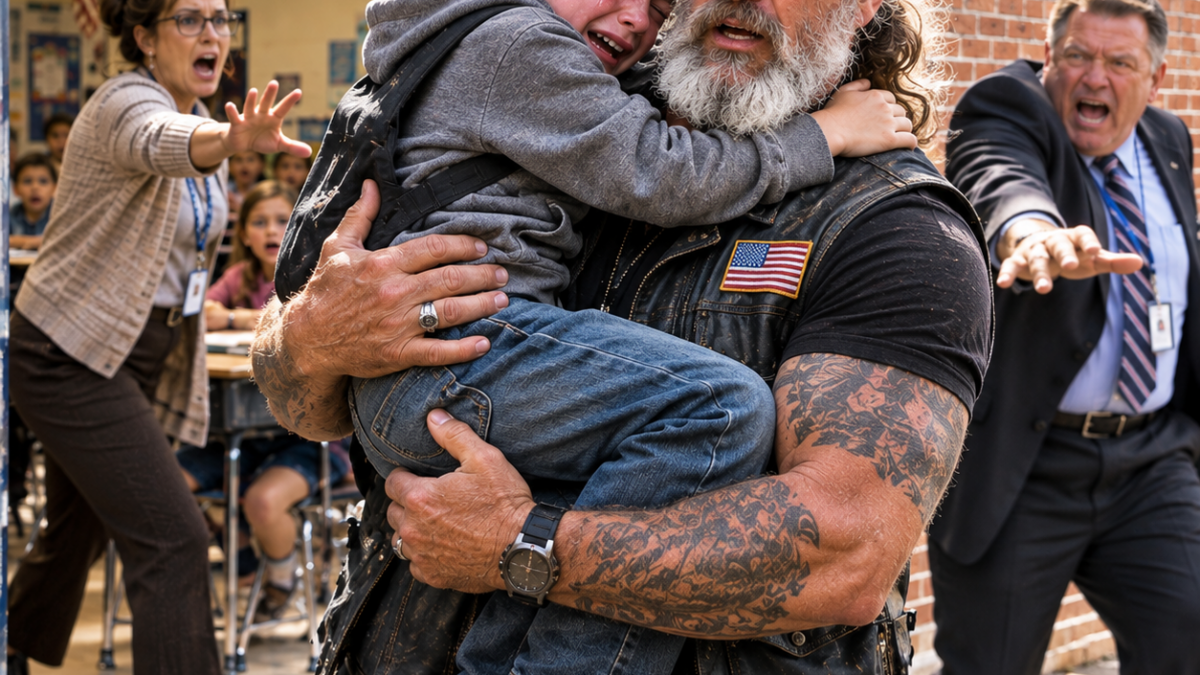
**At 1:47 on a Thursday afternoon, I kicked open the door to Room 207, crossed an elementary-school classroom in muddy motorcycle boots, and carried a shaking nine-year-old boy out while his teacher screamed that she was calling the police.**
**The boy was my grandson Caleb, and twenty minutes earlier he had sent me the first message in his life that truly scared me: “Papa please come.”**
**Then, outside the school, he grabbed both sides of my jacket and whispered why he was terrified to go back inside—and the name he gave me belonged to the man already running down the hallway toward us.**
I was sixty-four years old, two hundred forty pounds, and had enough gray in my beard to know better than to kick open a school door.
I did it anyway.
That part matters.
People later turned that afternoon into one of those stories where an old biker somehow knows exactly what to do.
I did not.
I was scared.
Angry.
Confused.
And moving much faster than a sixty-four-year-old man with two artificial screws in his left knee had any business moving.
The text arrived at 1:27.
I was in my garage changing oil on my Harley.
Three words.
Papa please come.
No period.
No explanation.
Nothing else.
Caleb was nine.
He had a phone mostly because his mother worked long hours and wanted him to be able to reach family in an emergency.
He used it to send me photographs of weird bugs, ask whether I had pancake mix, and occasionally text things like:
CAN DOGS EAT PICKLES???
He had never sent me:
Papa please come.
I called immediately.
No answer.
Again.
Nothing.
I texted.
I’M COMING. WHERE ARE YOU?
No reply.
I called the school.
Office voicemail.
Called his teacher’s classroom number.
Voicemail again.
Then I called my daughter Renee.
She answered on the third ring sounding breathless.
“Dad, I’m at work. What’s wrong?”
PART2:
“Did Caleb call you?”
“No.”
“He texted me.”
“What did he say?”
“Papa please come.”
Silence.
Renee worked almost two hours away at a medical-supply warehouse.
She could not reach Lincoln Elementary quickly.
Caleb’s father had disappeared from his life when he was four.
The only other emergency contact nearby was me.
“I’m going over there.”
“Dad, find out what happened first.”
“I will.”
“Do not get yourself arrested.”
“I’ll do my best.”
“That is not reassuring.”
I hung up.
Put on my jacket.
Helmet.
Gloves.
Then stopped.
Looked at the message again.
Papa please come.
I had spent a lot of my younger years around men who thought fear was weakness.
It isn’t.
Fear is information.
And something in those three words told me my grandson had run out of every option he thought he had except me.
I left.
Twenty minutes later, my Harley rolled into Lincoln Elementary so loud that three parents near the pickup lane turned to look.
I parked crooked.
Did not care.
The secretary behind the front desk stood up when I came through the doors.
“Sir, you need to sign in.”
“I’m here for Caleb Castellanos.”
“Relationship?”
“Grandfather.”
“Do you have identification?”
“Yes.”
“Please wait while I—”
“Where is Room 207?”
“Sir, you cannot just—”
“Where?”
Her hand moved toward the phone.
“Second floor, but you need to wait.”
I did not.
That was wrong.
I know that.
Schools have security rules for a reason.
A large unknown man in motorcycle leathers should not be able to walk into an elementary classroom.
But in that moment, procedure had lost the argument inside my head.
I took the stairs two at a time.
Someone called after me.
I reached 207.
Closed door.
Small window.
I looked through.
Caleb sat in the last row.
Head down.
Both hands under his desk.
I knew something was wrong before I opened the door.
Children move.
Fidget.
Whisper.
Look around.
Caleb sat absolutely still.
I shoved the door open.
The teacher screamed.
Several kids did too.
Someone dropped a juice box.
It hit the floor and sprayed orange liquid across a backpack.
The teacher stepped toward me.
“Sir! You cannot be in here!”
“Caleb.”
His head snapped up.
His face was white.
Eyes red.
He stood so fast his chair tipped backward.
Then he ran to me.
No hesitation.
He grabbed my arm hard enough that his fingernails pressed through my sleeve.
“Papa.”
That was all.
I looked at the teacher.
“I’m taking him.”
“You absolutely are not.”
“I’m his emergency contact.”
“You need to go through the office.”
“Then tell the office where we’re going.”
I lifted him.
Nine-year-old boy.
Old enough that he usually complained if I tried carrying him.
That day he wrapped both arms around my neck.
The teacher followed us into the hallway.
“I’m calling the police!”
“Okay.”
I kept walking.
Then a man came around the corner.
Principal Hargrove.
I knew who he was.
Mid-fifties.
Heavyset.
Neatly combed hair.
Always wore pale dress shirts and dark ties.
He had shaken my hand at a school Christmas program once.
He moved quickly toward us.
“What is happening?”
Caleb’s entire body tightened.
Not subtly.
His arms locked around my neck.
I felt it.
The principal reached for me.
“Put that child down.”
“No.”
“You cannot remove a student like this.”
“I’m taking my grandson home.”
“You need authorization.”
“His mother is on the phone with me.”
“She needs to contact the office.”
Then he grabbed my arm.
I reacted.
Too fast.
I turned and shoved him away.
Not punched.
Not struck.
Shoved.
Hard.
He hit the hallway wall and slid partway down.
Several teachers gasped.
Somebody shouted.
I kept going.
Caleb buried his face against my shoulder.
By the time we reached the parking lot, my heart was pounding.
His knees buckled when I put him down.
I caught him.
“Caleb.”
He grabbed my jacket.
“Please don’t make me go back.”
“I’m not.”
“You promise?”
“I promise.”
Sirens sounded somewhere in the distance.
I crouched in front of him.
“What happened?”
He looked toward the school.
Then at the asphalt.
“Papa, he said if I ever told anybody, he’d hurt Mama.”
Everything inside me went quiet.
“Who?”
Caleb whispered:
“Mr. Hargrove.”
For a second, my body decided what it wanted to do before my brain caught up.
I looked toward the school doors.
My right hand moved toward my belt.
Not because there was a weapon there.
There wasn’t.
Old habit.
Movement before action.
Then Caleb grabbed the front of my shirt with both hands.
“Papa, don’t leave me here.”
That saved me.
Not saved Hargrove.
Saved me.
Because anger wanted me to go back inside.
Caleb needed me to stay.
I pulled off my leather jacket and wrapped it around him.
It hung nearly to his ankles.
He looked like a child wearing a costume.
Three teachers stood near the entrance.
One held a phone, recording.
I could hear the sirens getting louder.
Caleb looked at me.
“They’re gonna come for you.”
“Let them.”
I put my helmet on him.
Too big.
Strapped it as tight as I could.
Then I called Renee.
“I’m taking him home.”
“What happened?”
“I don’t know everything yet.”
“Is he okay?”
“No.”
Silence.
“Dad.”
“He is safe.”
That was the important part.
“I’m twenty-two miles away. Meet us there.”
Then I rode home slowly.
Far slower than usual.
Caleb sat behind me.
Both arms around my stomach.
His hands locked together.
Every few miles, I touched one of them just to remind him I was still there.
He never loosened his grip.
At home, I made the one meal I can produce reliably without setting off a smoke detector.
Peanut butter sandwich.
No crust.
Glass of milk.
He ate three bites.
Kept looking at the front door.
I locked it.
Then the back door.
Then I closed the blinds.
Not because I thought the principal was actually coming.
Because Caleb needed to see me take his fear seriously.
I sat across from him.
“Buddy.”
He looked at me.
“You don’t have to tell me everything right now.”
His lower lip trembled.
“I do.”
“No. You tell me what you can.”
I put my hands flat on the table.
“I’m listening.”
He started with October.
Shoes.
His sneakers had bright red soles.
Apparently not considered proper enough for a school event.
Hargrove pulled him from class.
Made him sit alone in the office through lunch.
November.
Talking in the hallway.
He had to write:
I WILL BE SILENT.
One hundred times.
By December, the office visits happened weekly.
Then more often.
Some were for small things.
Forgetting a worksheet.
Laughing in line.
Not tying a shoe quickly enough.
Caleb said Hargrove started calling him “difficult.”
Then “ungrateful.”
Then telling him his mother worked too much because Caleb made her life harder.
I could feel anger building behind my ribs.
I kept my face still.
Children watch adults while telling hard things.
If the adult looks horrified, they sometimes stop.
If the adult looks furious, they sometimes think they caused the fury.
So I held the table.
Listened.
By January, according to Caleb, the punishment became physical.
A wooden ruler.
Flat side.
Hands.
Sometimes legs.
Once the bottom of his foot where nobody would notice.
I felt my fingers curl.
Forced them open.
“Did anybody see?”
He shook his head.
“Did you tell anyone?”
“No.”
“Why?”
“Hargrove said Mama was tired.”
I waited.
“He said if I made trouble, she’d break.”
My throat closed.
Caleb continued.
“He said if school decided I was bad, they could send me somewhere else.”
“Where?”
“A home.”
“With strangers?”
He nodded.
“He said Mama wouldn’t be able to stop them.”
That was the kind of lie designed for a child.
Not legal enough for adults.
Terrifying enough for nine-year-olds.
I asked:
“Why today?”
That was when he started crying.
Not loud.
Just tears.
“He said I had to stay after school.”
“For what?”
“Extra tutoring.”
“Did your mom know?”
“She got an email.”
“What did it say?”
“That I needed help with reading.”
Caleb was one of the strongest readers in his class.
I knew because he corrected me whenever I mispronounced dinosaur names.
“He said it’d just be me and him.”
My body went cold.
“Door locked?”
Caleb nodded.
“And he said if I didn’t come, or if I told Mama what happens in his office, he’d come to our house.”
I had to look away.
Just for a second.
Then back.
“What did he say he’d do?”
Caleb whispered:
“Hurt her.”
I reached across the table.
He put his hand in mine.
Tiny.
Warm.
Nails bitten short.
There was a faded mark near the base of his thumb.
I turned his hand carefully.
“Did he do this?”
Caleb nodded.
I wanted to destroy something.
Instead, I squeezed gently.
“Listen to me.”
His eyes met mine.
“You are not going back there.”
“Never?”
“Not while I’m alive.”
“Papa—”
“And that text?”
He waited.
“That was one of the bravest things I’ve ever seen anybody do.”
He shook his head.
“I was scared.”
“Brave doesn’t mean you aren’t scared.”
I had spent enough time around bikers, veterans, cops, welders, truckers, and hardheaded old men to know that.
“Brave means scared and you still do the thing that might save you.”
His face crumpled.
Then he came around the table and buried himself against my chest.
I held him.
He cried.
I let him.
Renee arrived at 5:40.
She came through my front door without knocking.
“Where is he?”
Caleb ran to her.
She dropped to her knees.
For nearly an hour, she held him on my couch the way she used to when he was four.
Her face changed as I told her what he had told me.
Fear.
Confusion.
Denial.
Then something harder.
My daughter is five-foot-three.
One hundred twenty pounds soaking wet.
Works two jobs.
Hasn’t had a real vacation in eleven years.
She had held that boy’s world together since her husband walked out.
I had watched her survive bills, fevers, broken appliances, school meetings, overtime, car repairs, and the thousand invisible things single parents carry.
I had rarely seen her angry.
That evening, I learned what her anger looked like.
“Dad.”
Her voice was perfectly steady.
“What do we do?”
“Police.”
She nodded.
“Tonight.”
“Yes.”
“Hospital?”
“Medical documentation.”
She looked at Caleb.
He was asleep against her shoulder.
Then:
“After that?”
“I make some calls.”
She knew what I meant.
She did not tell me not to.
We went to the sheriff’s office first.
Sergeant Elena Alvarez met us in a private interview room.
Maybe forty.
Dark hair pulled back.
Soft voice without sounding fake.
She gave Caleb juice.
Let him sit on Renee’s lap.
She never rushed him.
Never asked:
Are you sure?
Never asked:
Why didn’t you tell sooner?
She asked:
“What happened next?”
“What did he say?”
“Where were you sitting?”
“Who else was nearby?”
Questions children can answer.
Afterward, a pediatric nurse documented the visible marks.
Eleven total.
Some old.
Some fading.
One across his lower back consistent with the edge of something narrow and straight.
I stood in the hallway while Renee stayed with him.
Alvarez came out.
“Mr. Castellanos?”
“Yeah.”
“I believe your grandson.”
I swallowed.
“Okay.”
“But I need to be straight with you.”
I could tell I wasn’t going to like the rest.
“Hargrove has been principal at Lincoln nineteen years.”
“So?”
“He’s well connected.”
That phrase always means trouble.
“He sits on advisory boards connected to two other county schools. His brother-in-law is a state senator.”
I stared at her.
“And?”
“And there have been complaints.”
My stomach tightened.
“What complaints?”
“Two that I know of involving discipline concerns. Neither resulted in charges.”
“Why?”
“I can’t discuss details yet.”
“Were they children?”
“Yes.”
I closed my eyes.
Alvarez continued.
“I am opening an investigation tonight.”
“Will he be at school tomorrow?”
“I don’t know.”
“Monday?”
“I don’t know.”
“That isn’t good enough.”
“I know.”
She lowered her voice.
“But this has to be done correctly.”
Then she looked directly at me.
“Whatever you’re thinking about doing—don’t.”
“I haven’t said anything.”
“You don’t have to.”
I almost smiled.
“Is it the beard?”
“It’s the hallway incident.”
Fair.
“I shoved him.”
“We’ll deal with that separately.”
“He grabbed me.”
“I’ve reviewed the school video. I know.”
That surprised me.
She continued:
“If you threaten him, confront him, send people to his house, or give him any reason to claim intimidation, you make this harder for Caleb.”
That sentence mattered.
Not:
You might get arrested.
Not:
Think about yourself.
You make this harder for Caleb.
“I hear you.”
“Do you?”
“Yes.”
At home, Caleb slept in the spare room with Renee.
When I checked at midnight, his hand was wrapped around her forearm.
Like if he let go, something might happen.
I went into the garage.
Sat on my workbench.
At 1:03 A.M., I called Rooster.
His real name is Michael Daniels.
Nobody has called him Michael since 1984.
Old road captain.
Sixty-eight.
Arthritis.
Bad left shoulder.
Still rides a Road King that weighs almost as much as a refrigerator.
Second ring.
“Talk to me, Cas.”
I told him everything.
He did not interrupt.
At the end, there was a long silence.
Then:
“How many?”
“All of them.”
“Done.”
That was the entire conversation.
I called Big Lou.
Dawson.
Preacher.
Mills.
Every answer was the same.
“What time?”
By 6:30, my driveway sounded like thunder.
Not forty-three bikes yet.
Maybe twenty.
Then more arrived.
Coffee in paper cups.
Old men climbing off motorcycles with stiff knees.
Average age probably close to sixty.
Some had grandchildren.
Some had children who went to Lincoln years earlier.
One man, Pete, had three daughters.
He asked me:
“What are we doing?”
“Sitting.”
“That all?”
“That all.”
“No signs?”
“No.”
“No yelling?”
“No.”
“No blocking entrances?”
“No.”
“No following Hargrove?”
“Absolutely not.”
Rooster looked around.
“You hear him?”
Everyone did.
“We are not there to scare kids.”
That was important.
Motorcycles already looked intimidating.
Forty-three bikers outside an elementary school could easily become the wrong kind of story.
So we made rules.
Stay on public sidewalk or legal parking area.
Do not block buses.
Do not surround anyone.
Do not touch anyone.
Do not shout at staff.
Do not photograph children.
If reporters show up, protect Caleb’s identity.
If police ask us to move, we move.
We were not there to be vigilantes.
We were there to make sure frightened families knew somebody was paying attention.
Renee came outside.
She looked at the bikes.
Then at me.
“Forty-three?”
“Eventually.”
“You called everybody.”
“Yes.”
She hugged Rooster.
He whispered something that made her cry.
Then she looked at me.
“Dad.”
“What?”
“Do this right.”
“I will.”
At 7:30, forty-three motorcycles lined the public frontage near Lincoln Elementary.
We did not rev engines.
Didn’t block traffic.
Didn’t carry signs.
Just sat.
Leather vests.
Coffee.
Quiet.
Parents slowed.
Some rolled up windows.
One woman turned around and left.
I understood.
If I were bringing a six-year-old to school and saw forty-three bikers outside, I might reconsider too.
Then a young father pulled in.
Minivan.
Little girl in the back.
He parked.
Walked toward me.
“What’s going on?”
I had promised Alvarez not to identify Caleb.
So I didn’t.
“A child made a report yesterday that the principal has been hurting students. Police opened an investigation.”
His face changed.
“Which child?”
“Can’t say.”
“Why are you here?”
“To make sure kids know they can walk through that door without being alone.”
He looked at the school.
Then at us.
“Are you threatening the principal?”
“No.”
“You gonna cause trouble?”
“No.”
He nodded.
Then went back to his minivan.
He walked his daughter inside holding her hand.
When he came out, he stopped beside my bike.
Didn’t leave.
By eight, three parents were standing with us.
Then seven.
Then twelve.
Word spread.
Not social media at first.
Parent texts.
Group chats.
Somebody had heard police were investigating.
Someone else said their child had been afraid of the principal.
A mother approached me crying.
“My son came home last year with bruises.”
I felt my jaw tighten.
“What happened?”
“He said he fell.”
She covered her mouth.
“I believed him.”
“You had the information you had.”
“What if—”
“Talk to the police.”
Not me.
That was important.
“Sergeant Alvarez. Sheriff’s office. Tell her everything.”
By nine, twenty-six parents had joined.
Not all angry.
Some confused.
Some defensive of Hargrove.
One woman told a reporter:
“He has been principal nineteen years. My children loved him.”
That could also be true.
People are complicated.
Institutions are complicated.
A person can be kind to one child and cruel to another.
By 9:30, three local TV stations had arrived.
We refused to give Caleb’s name.
Rooster stood between a cameraman and parents bringing children into school.
“No kids on camera unless the parents agree.”
The cameraman listened.
At 10:02, the superintendent’s car came into the parking lot fast enough to bounce over the curb.
Dr. Stephen Mallory.
Gray suit.
Expensive shoes.
He went directly inside.
At 10:18, two sheriff vehicles arrived.
Alvarez was in one.
She saw me.
Walked over.
“I told you not to do anything stupid.”
“We’re sitting.”
She looked at forty-three motorcycles.
“This is your version of nothing?”
“Pretty much.”
“Any threats?”
“No.”
“Anyone enter the school?”
“No.”
“Anyone contact Hargrove?”
“No.”
She almost smiled.
“Keep it that way.”
Then she went inside.
At 10:31, another detective arrived.
At 10:39, a woman with a state child-protection badge entered.
At 10:45, the front doors opened.
Hargrove came out.
Hands behind his back.
Cuffed.
He looked smaller than I remembered.
That happens when power disappears.
Yesterday he had filled an entire hallway.
Now he looked like a tired middle-aged man in a pale shirt.
He saw me.
For one second our eyes met.
I did nothing.
No smile.
No gesture.
No victory.
Then he looked away.
Parents around me reacted.
Some cried.
Some swore.
One man started moving forward.
Rooster caught his arm.
“Don’t.”
The man stopped.
Police put Hargrove in the vehicle.
The cruiser left.
Nobody cheered.
I’m proud of that.
Because this was not a football game.
A man being arrested did not heal children.
It meant an investigation had become serious enough for law enforcement to act.
That was all.
But it opened a door.
Before noon, two other boys came forward.
That afternoon, three more.
Then a girl named Emily Carter.
She had graduated sixth grade the previous year.
Twelve years old.
Her mother brought a notebook.
Emily had kept records.
Dates.
Times.
Office visits.
Punishments.
Things Hargrove said.
She wrote because nobody believed her the first time she tried telling them.
Her parents stood in the sheriff’s lobby crying.
Her father said:
“I told her she was exaggerating.”
I watched the man break in front of me.
That is another kind of wound.
The moment a parent realizes the child told the truth and the parent chose the adult.
I didn’t judge him.
I could see he was going to judge himself for a long time.
More parents came forward.
Not every complaint involved physical punishment.
Some described intimidation.
Humiliation.
Isolation.
Threats involving grades.
Threats involving school transfers.
Patterns.
That word became important.
Pattern.
Vice Principal Donnelly had apparently documented some incidents as “disciplinary concerns.”
She told investigators she believed Hargrove was strict but effective.
Then emails emerged.
Staff had raised questions.
A counselor had asked why certain children were repeatedly removed from class.
A teacher had reported seeing a child crying after leaving the office.
The pieces had existed.
Nobody had assembled them.
Or maybe some people had chosen not to.
The district placed Donnelly on administrative leave.
She was later dismissed.
Dr. Mallory, the superintendent, announced an independent review.
He retired the following month.
His lawyer said the retirement had been planned.
Maybe.
Parents drew their own conclusions.
Hargrove’s brother-in-law, State Senator Hargrove—different first name, same family—released a statement saying he had never interfered in any school investigation.
I did not know whether that was true.
Neither did most parents.
Rumors ran faster than facts.
Alvarez warned us not to help rumors grow.
So we didn’t.
The bikers stopped coming after the second day.
That mattered too.
We had made the point.
Staying forever would have turned support into spectacle.
Rooster said:
“The kid needs peace now, Cas.”
He was right.
Renee withdrew Caleb immediately.
The district offered another elementary school.
She refused.
Instead, she enrolled him in a smaller public school across town.
The principal had taught third grade for twenty years before becoming an administrator.
On the first morning, Renee stood in her office.
“If anybody ever lays a hand on my son, I’ll know within twenty-four hours.”
The principal nodded.
“I would expect you to.”
Then she crouched in front of Caleb.
“Your mom can visit anytime. Your grandfather can visit too.”
Caleb looked at me.
I said:
“Only if I sign in this time.”
The principal smiled.
“I would appreciate that.”
I deserved that.
The case against Hargrove took months.
Long months.
People online wanted everything resolved in a week.
Real cases don’t work like that.
Interviews.
Records.
Medical evaluations.
School files.
Attorneys.
Motions.
More interviews.
Caleb had to repeat parts of his story.
We tried to minimize how many times.
Alvarez was careful about that.
Eventually Hargrove accepted a plea agreement.
Nine years.
Additional restrictions afterward.
Registration requirements.
No work around children.
Some people called nine years too little.
Some called it justice.
I did not know what word to use.
There is no number that gives a child back the night before fear entered his life.
Nine years was something.
Not everything.
Something.
Caleb began counseling.
Weekly at first.
He hated it.
First three sessions he barely spoke.
The counselor, Dr. Melissa Grant, never forced him.
They played cards.
Built things with blocks.
Talked about motorcycles.
On week four, he told her about Room 207.
By month three, he started sleeping through some nights.
Not all.
He kept a lamp on.
Renee bought him a night-light shaped like the moon.
He called it stupid.
Still used it.
He stopped flinching when adults raised their voices.
Mostly.
School improved.
He made a friend named Marcus who loved sharks.
One afternoon Caleb came to my house holding a book about great white sharks.
“He says they aren’t really hunting people.”
“Marcus?”
“Sharks.”
“Good to know.”
He rolled his eyes.
That eye roll was one of the best things I had seen in months.
Normal child irritation.
Beautiful.
For a while, Caleb would not get near Lincoln Elementary.
If we drove past it, he looked at the floor.
So we changed routes.
Dr. Grant told us not to turn avoidance into a permanent rule.
“When he’s ready, let him decide.”
Months later, Caleb asked me to drive past.
“Slow?”
“Whatever you want.”
We went by on the Harley.
The school looked ordinary.
That bothered me.
Buildings where terrible things happen do not look different afterward.
Same brick.
Same flag.
Same playground.
New principal.
New policies.
New cameras in administrative hallways.
Doors required visibility windows.
No child could be isolated behind a locked administrative door without documentation.
Complaints involving physical discipline automatically went outside the principal’s chain of command.
Parents demanded those changes.
They should have existed before.
But children in the future would have them.
That mattered.
The forty-three bikers became a story of their own.
Local news loved the image.
Rows of motorcycles.
Gray beards.
Leather.
Old men drinking coffee outside an elementary school.
Some headlines made it sound like we had forced police to arrest Hargrove.
We had not.
Alvarez made that clear publicly.
Police had already opened the investigation.
Evidence drove the arrest.
Our presence made people pay attention.
More importantly, it made some parents feel safe enough to speak.
That distinction mattered to me.
We were not heroes.
Caleb was.
Emily was.
The other children were.
They had something taken from them and still found words.
A year later, Rooster had patches made.
Not club patches.
Small ones.
Black background.
White letters.
THREE WORDS.
Underneath:
PLEASE COME.
We wore them on charity rides.
No child’s name.
No school.
No sensational story.
Just those words.
The first ride raised money for a local child-advocacy center.
Then another club joined.
Then another.
People started calling us about fundraisers.
School-supply drives.
Counseling funds.
Emergency housing for families.
The thing grew.
Not into some vigilante group.
I made that rule clear.
We did not investigate allegations.
We did not confront accused people.
We did not show up at houses.
We did not threaten.
We supported children and families through legitimate organizations.
Sometimes that meant money.
Sometimes rides.
Sometimes sitting in court hallways.
Sometimes fixing a broken porch for a mother who had spent all her money on legal expenses.
Sometimes simply answering the phone.
Because that was the part that stayed with me.
Caleb sent a message.
Somebody answered.
What about the children whose messages went unanswered?
Or the ones who had never learned they were allowed to send one?
Saturday rides became our ritual.
Caleb sat behind me.
Helmet.
Jeans.
Small leather jacket Renee bought after making me promise I would never take him above the speed limit.
Eight miles to a diner outside town.
Pancakes.
Orange juice.
Usually chocolate-chip pancakes even though he insisted they were “for little kids.”
One Saturday, maybe eight months after everything, we sat in our usual booth.
Caleb was cutting pancakes into tiny squares.
He looked up.
“Papa?”
“Yeah?”
“How did you know?”
“Know what?”
“To come that day.”
I stopped eating.
“Because you asked me.”
“What if I hadn’t sent the text?”
That question sat between us.
I could have lied.
Said I would have known anyway.
Grandparents know everything.
Some magic instinct.
But that would have stolen something from him.
The truth was his action mattered.
So I set down my fork.
“Then maybe I would have come another day.”
He waited.
“Maybe somebody else would have noticed.”
He looked at his plate.
“Maybe not.”
“Maybe not.”
His eyes lifted.
“But eventually, son, I would’ve come.”
“How?”
“I don’t know.”
He looked unconvinced.
I reached across the table.
“But you didn’t wait for eventually.”
His hand stopped.
“You sent the message.”
“Because I was scared.”
“I know.”
“I almost deleted it.”
My chest hurt.
“Why didn’t you?”
He shrugged.
Then:
“I thought you’d believe me.”
There are sentences that change a man’s life.
That was one.
Not:
I knew you’d fight him.
Not:
I knew you’d scare him.
Not:
I knew you’d bring bikers.
I thought you’d believe me.
All that leather.
All those motorcycles.
All that noise.
And what Caleb had needed from me was belief.
I squeezed his hand.
“I always will.”
Then I corrected myself.
Because blind belief is not the lesson either.
“I’ll always listen.”
He nodded.
Went back to his pancakes.
I looked through the diner window at my motorcycle.
Years earlier, I thought strength meant being the loudest man in a room.
Then I thought it meant not being afraid.
Age taught me differently.
Strength was sitting at a kitchen table when every part of you wanted to break something and telling a frightened boy:
Take your time.
Strength was Renee walking into a police station knowing she might hear things that would haunt her forever.
Strength was Alvarez spending two hours listening instead of rushing.
Strength was Emily keeping a journal when adults dismissed her.
Strength was parents admitting they had been wrong.
Strength was forty-three bikers sitting quietly when everybody expected them to roar.
Strength was allowing evidence to do what rage could not.
And strength was Caleb sending three words.
Papa please come.
I still think about Room 207.
The tipped chair.
Juice box on the floor.
His white face.
The way he reached for me.
I regret how I entered that school.
I regret shoving Hargrove.
Those actions could have made things worse.
I was lucky they did not.
But I will never regret answering that text.
If a child asks you to come, go.
Maybe it is nothing.
Maybe it is embarrassment.
Maybe somebody said something cruel.
Maybe they failed a test and think their world is ending.
Or maybe they have been carrying something too heavy for a nine-year-old body.
Go.
Listen before deciding what happened.
Believe that fear deserves attention even before you understand its cause.
Then protect them the right way.
That is the part I learned after the anger burned out.
You do not protect children by becoming more dangerous than the person who frightened them.
You protect them by becoming dependable.
By staying.
By listening.
By documenting.
By making calls.
By showing up again tomorrow.
Caleb is eleven now.
Taller.
Funnier.
Still hates tomatoes.
Still sleeps with a light on some nights.
Counseling is monthly.
Sometimes he goes two months when things are good.
Then something triggers a bad week and he goes sooner.
We stopped treating that like failure.
Healing is not a straight road.
The school district changed too.
New superintendent.
New complaint system.
A parent advisory panel.
Outside review for allegations involving administrators.
Nothing can guarantee another child is never hurt.
But “we didn’t know” became a harder excuse to use.
Renee still works too much.
I still tell her that.
She still tells me to mind my business.
We argue.
Then she brings Caleb over and eats everything in my refrigerator.
Normal family problems.
Wonderful normal family problems.
Rooster’s left knee finally got replaced.
He complained that the hospital coffee violated several international laws.
Big Lou sold his motorcycle and immediately bought another because apparently retirement from motorcycles lasted nine days.
The group still meets at the diner.
Sometimes Caleb sits with the bikers instead of me.
They treat him like one of them.
Which mostly means they insult his pancake choices and slip him money when I’m not looking.
A few weeks ago, we did another charity ride.
More than two hundred motorcycles.
Not for Caleb specifically.
For the child-advocacy center.
Families lined part of the route.
One woman held a sign:
THANK YOU FOR ANSWERING.
That almost got me.
At the end, Dr. Grant spoke briefly.
She said something I wish every adult could hear.
Children often test the water before telling the whole truth.
They say:
I don’t like him.
I don’t want to go.
My stomach hurts.
Can you pick me up?
Can I sleep in your room?
Please come.
Adults sometimes wait for the dramatic sentence.
The perfect accusation.
The full explanation.
Children may not have it yet.
Sometimes the first job is simply to notice the change.
That night, after everyone left, Caleb and I sat in my garage.
He was helping me clean the Harley.
Mostly spraying too much cleaner.
He pointed at the small patch on my vest.
THREE WORDS.
“That’s because of me?”
“Yes.”
He studied it.
“Do people know?”
“Some.”
“You tell them my story?”
“Only what you say I can.”
He nodded.
Then after a moment:
“You can tell them I sent the text.”
“You sure?”
“Yeah.”
He kept polishing chrome.
“Maybe some other kid will send one.”
I turned away for a second.
Pretended I needed another rag.
When I looked back, he was still working.
Eleven years old.
Alive.
Healing.
Annoyed because I had apparently bought the wrong brand of motorcycle polish.
That was enough.
The story people tell is that a biker stormed into a school and dragged a trembling boy out of class.
That’s true.
People tell the next part too.
Forty-three motorcycles.
Principal in handcuffs.
Parents coming forward.
That’s true too.
But those are not the parts I think about when the garage gets quiet.
I think about a phone vibrating beside an oil pan.
I think about three words on a screen.
I think about how easily I could have assumed it wasn’t urgent.
How easily an adult can decide a child is being dramatic.
How easily fear can hide behind ordinary school days.
And I think about the question Caleb asked over pancakes.
How did you know to come?
I didn’t know.
He told me.
That’s the whole point.
A child asked.
An adult answered.
And sometimes, before the motorcycles, before the police, before the cameras and courtrooms and headlines, that is where saving someone begins.
With answering.