Nine Bikers Were Painting My Dead Mother’s House Pink at 4 A.M.—Then One Handed Me the List She Left Behind
Nine Bikers Were Painting My Dead Mother’s House Pink at 4 A.M.—Then One Handed Me the List She Left Behind
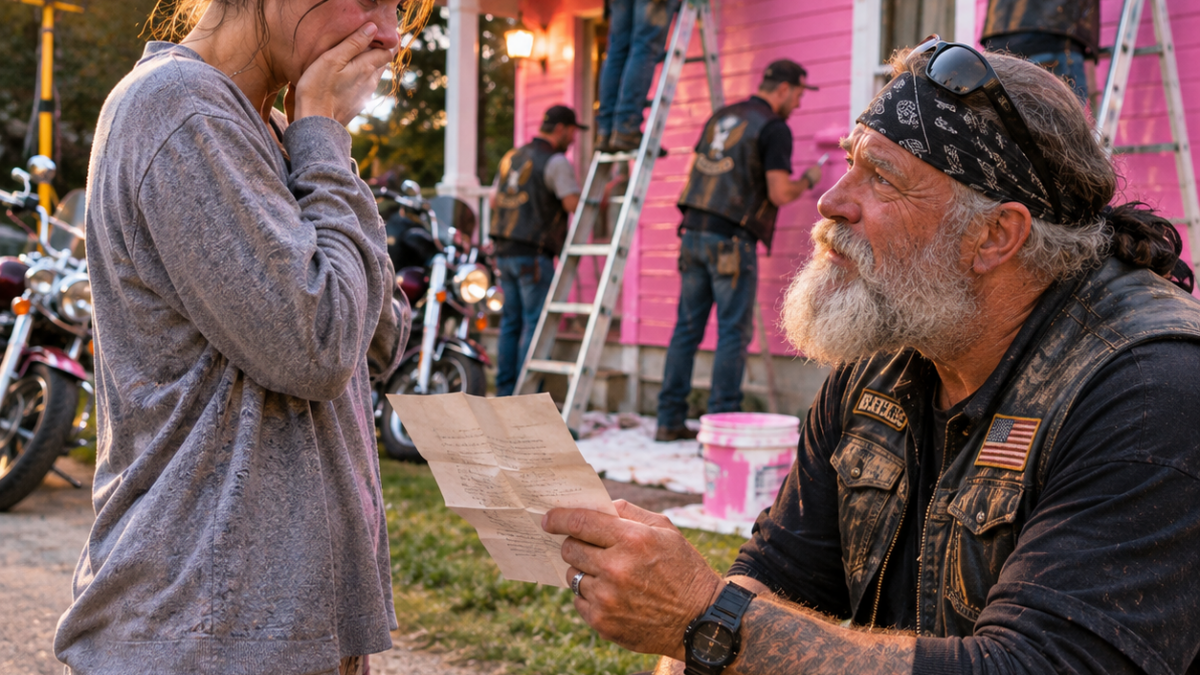
**At four in the morning, three days after my mother died, I woke to nine motorcycles outside her house and a group of leather-vested strangers painting the siding the brightest pink I had ever seen.**
**I almost called 911 until a gray-bearded biker climbed down from his ladder, looked at me like he had known me for years, and said, “Claire, your mama talked about you every single Monday.”**
**Then he handed me a folded sheet covered in my mother’s shaky handwriting—a list of twenty-three things she wanted done after her death—and I realized there was an entire life she had built without me knowing anything about it.**
My mother died on a Tuesday.
Pancreatic cancer.
She was sixty-seven.
Those were the facts I had been repeating because facts were easier than feelings.
Tuesday.
Pancreatic cancer.
Sixty-seven.
The nurse from hospice called me in Seattle at 6:14 that morning and spoke in the carefully softened voice people use when they are about to divide your life into before and after.
“Claire, I’m sorry. Your mother passed peacefully about twenty minutes ago.”
I remember staring through the windows of my apartment at rain sliding down the glass.
My coffee was still warm in my hand.
There was traffic sixteen floors below me.
A bus stopped.
Someone ran across the intersection carrying an umbrella.
The entire city continued moving.
My mother had just died.
And nothing outside my window had changed.
I said thank you.
That was all I could manage.
Then I sat down on the kitchen floor.
Not because grief knocked me over.
Not exactly.
It was more complicated than that.
My mother and I had not been close for years.
Three years, technically, since I had last been home.
Longer if you counted the years before that when every phone call felt cautious and every visit ended with one of us finding an excuse to leave the room.
There had been no great final fight.
No dramatic declaration that we were finished with each other.
Our distance had formed gradually.
PART2:
Years of silence layered over old resentment.
My father.
My leaving.
Her staying.
Everything we did not know how to discuss.
I had moved to Seattle twelve years earlier and built an entire adult life two thousand miles away.
Restaurant management.
A small apartment.
Friends who knew me without knowing where I came from.
A city where nobody had ever watched my father slam a cabinet door hard enough to make my mother flinch.
Nobody knew how quietly she used to move around him.
Nobody knew how young I had been the first time I decided I would leave that house and never come back.
My father, Ray, had been dead for eleven years.
Yet somehow I had continued punishing my mother for surviving him in a way I did not understand.
The funeral was Friday.
I flew in Wednesday morning.
One suitcase.
Black dress.
Laptop.
A folder containing every document I thought I might need to settle an estate.
My plan was simple.
Funeral.
Lawyer.
Clean house.
Call realtor.
List by Friday if possible.
Back to Seattle Sunday night.
Efficient.
Contained.
I told myself my mother would have appreciated that.
She had always liked lists.
Bills paid early.
Spices alphabetized.
Birthday cards mailed exactly seven days before the birthday.
Even when I was a child, she kept a notebook in the kitchen drawer labeled THINGS THAT MUST NOT BE FORGOTTEN.
I used to tease her about it.
Years later, I understood she had spent so much of her marriage trying not to make mistakes that organization had become a kind of armor.
The house looked smaller when I pulled into the driveway.
That surprised me.
As a child, it had felt enormous.
Two stories.
White siding.
Blue shutters.
Deep front porch.
Oak tree in the yard.
Now it looked tired.
The paint was peeling in strips.
One gutter hung loose near the back corner.
The porch railing leaned badly.
Weeds had grown through cracks beside the steps.
A section of roof over the garage was patched with something that looked temporary enough to have been there for years.
I stood on the sidewalk with my suitcase and felt anger before grief.
She had been sick for more than a year.
Where had everybody been?
The hospice nurse told me Mom had insisted on staying home as long as possible.
She had neighbors who checked in.
Church people.
A home-health aide during the last months.
But the house looked like someone had been abandoned.
Like she had been abandoned.
And I had not been there.
That thought hurt enough that I immediately turned it into blame.
She could have called me.
I had told her to call if things got bad.
Hadn’t I?
Maybe.
Probably.
I was not sure anymore.
When you spend years avoiding a relationship, memory becomes convenient.
You remember the invitations you made.
You forget how cold your voice sounded when you made them.
Inside, the house smelled exactly like childhood.
Furniture polish.
Old books.
Cinnamon.
A little lavender.
And beneath it all, that strange stillness that comes after someone dies in a place that still contains everything they touched.
Her reading glasses sat beside the couch.
One slipper was under the coffee table.
A half-finished crossword rested beside her chair.
Her coat still hung by the back door.
I walked through the kitchen and found a note taped to the refrigerator in her handwriting.
CLAIRE — THE FREEZER IS FULL. EAT SOMETHING REAL.
I stared at it for a long time.
Then laughed once.
It came out sounding almost like a sob.
She had known I was coming.
Not when.
But eventually.
That first day passed in paperwork.
Funeral home.
Pastor.
Attorney.
Insurance.
Utility accounts.
I kept moving because moving felt useful.
At eight that night, I found three boxes in the dining room labeled DONATE.
Another labeled CHURCH.
Another labeled MONDAY.
I assumed Monday meant trash pickup.
I dragged it closer.
Inside were stacks of paper plates, plastic containers, folded napkins, and about twenty mismatched coffee mugs.
I did not think much about it.
By midnight, I had made piles everywhere.
Keep.
Sell.
Donate.
Trash.
The brutal categories people use to reduce a human life into manageable decisions.
I fell asleep on the couch sometime after one.
The scraping woke me at four.
At first, I thought it came from inside the house.
Mouse.
Branch.
Something settling.
Then it happened again.
Scrape.
Scrape.
Scrape.
Metal against wood.
I sat up.
The living room was dark except for streetlight coming through the curtains.
Then I saw light moving outside.
I froze.
Another sound.
Footsteps on the porch roof.
I went to the window.
And saw motorcycles.
At least nine.
Lined along the street.
Chrome reflecting portable work lights.
Men moving around the house.
One on a ladder.
Another carrying a bucket.
Someone standing on the porch scraping paint.
For several seconds, my brain could not understand what I was seeing.
Then I saw the wall.
Pink.
Not pale pink.
Not tasteful blush.
Pink.
Bright.
Cheerful.
Almost ridiculous.
A section of my dead mother’s house was glowing pink at four o’clock in the morning.
My first thought was vandalism.
My second thought was drugs.
My third was that I should call 911 before one of these men noticed me.
I reached for my phone.
Then a huge gray-bearded man standing near the porch looked directly through the window.
He saw me.
I stopped breathing.
He raised one hand.
Not waving.
Just acknowledging me.
Then he dipped his roller into a tray and went back to painting.
That was somehow more alarming.
I threw on the old cardigan lying over Mom’s chair, opened the front door, and stepped onto the porch barefoot.
Cold wood under my feet.
My pajama pants were covered in tiny coffee cups.
Not exactly how I imagined confronting nine bikers at four in the morning.
“What are you doing?”
Every man stopped.
The gray-bearded one climbed down slowly.
He was enormous.
Probably six-three.
Broad shoulders.
Gray hair tied back.
Leather vest over a black sweatshirt.
His beard reached halfway down his chest.
Then he looked at me.
And I saw the saddest eyes I had ever seen on a man that large.
“You must be Claire.”
My stomach dropped.
“How do you know my name?”
“Your mama talked about you every single day.”
He corrected himself.
“Every Monday, anyway. Rest of the week too, probably.”
I stared at him.
“Who are you?”
“Walter Brennan. Everybody calls me Walt.”
He gestured around the yard.
“These idiots are Danny, Eddie, Mack, Joseph, Leon, Rick, Big Sam, and Tommy.”
A man on the ladder said:
“I prefer Thomas.”
Walt looked up.
“You’ve been Tommy since 1998.”
“Still hate it.”
Nobody laughed very hard.
Their grief was visible now that I knew to look for it.
“What are you doing to my mother’s house?”
Walt reached into his vest.
Pulled out a folded piece of paper.
Held it toward me.
“She gave me this eight months ago.”
I did not take it immediately.
“What is it?”
“Orders.”
Someone behind him muttered:
“Definitely orders.”
Walt almost smiled.
“She made us promise we wouldn’t show you until you got here.”
I took the paper.
My mother’s handwriting covered both sides.
Shaky.
Uneven.
But unmistakably hers.
At the top:
WHEN I’M GONE — MONDAY CREW.
Below it:
Twenty-three numbered items.
Number one:
PAINT THE HOUSE PINK.
Then, in parentheses:
I always wanted it pink but Ray said it was trashy. Ray’s dead now and so am I. Paint it pink.
I read it twice.
Then a third time.
A laugh escaped me.
An actual laugh.
Sharp and surprised.
Walt smiled slightly.
“She was very clear about the color.”
“Apparently.”
“Bright pink.”
“I can see that.”
“She rejected four samples.”
“You showed a dying woman paint samples?”
“She made us.”
One man called from the ladder:
“Took two Mondays.”
Another said:
“She said the first one looked like an old lady’s bathroom.”
Someone else added:
“The second looked like Pepto-Bismol.”
That got a real laugh from several of them.
I looked at the house again.
The pink was outrageous.
My father would have hated it.
That realization made something inside me loosen.
“Why are you doing this at four in the morning?”
Walt scratched his beard.
“Because your mama made us promise we’d start before sunrise after you came home.”
“Why?”
“She said you’d try to sell the house before we could stop you.”
I stared at him.
He looked embarrassed.
“Her words, not mine.”
I looked down at the list.
“Who are you people?”
Walt’s expression softened.
“The Monday crew.”
“That doesn’t answer anything.”
“No, ma’am.”
He looked toward the folding chairs near the driveway.
“Want some coffee?”
I should have said no.
Instead, ten minutes later I was sitting outside my mother’s house in pajamas, wrapped in an old blanket while nine bikers painted the siding pink under work lights.
Walt handed me coffee in a mug that said WORLD’S OKAYEST GRANDPA.
“It was hers?”
“No. Mine.”
I looked at him.
“Why do you have your own coffee mug here?”
He leaned back.
“Long story.”
“I have time.”
That was how I learned my mother’s secret life.
Eleven years earlier, Walt’s motorcycle broke down on the county road about a mile from the house.
August.
Almost a hundred degrees.
He walked toward the nearest place looking for water.
He was wearing full leather.
Vest covered in patches.
Bandana.
Boots.
Long beard even then.
He told me later he knew what people usually saw when someone like him walked toward their porch.
Trouble.
My mother was sitting outside shelling peas.
She looked up.
Saw him.
And said:
“You look hot.”
Walt stopped halfway up the walkway.
“Yes, ma’am.”
“You want lemonade?”
“That depends. Are you planning to poison me?”
My mother apparently stared at him.
Then:
“If I wanted you dead, I wouldn’t waste good lemons.”
That sounded so unlike the mother I remembered that I assumed Walt was exaggerating.
He swore he wasn’t.
She brought lemonade.
Then lunch.
Meatloaf.
Green beans.
Mashed potatoes.
He ate on the porch while waiting for a friend to bring tools.
When his friend could not come until the next day, Mom drove Walt to the auto-parts store in her station wagon.
The idea of my tiny five-foot-four mother driving this enormous biker around town made me laugh again.
“She made me hold leftover meatloaf on my lap,” Walt said.
“Why?”
“Said I looked underfed.”
“You’re six-three and probably two-fifty.”
“Two-seventy back then.”
“Underfed?”
“Your mama had standards.”
He returned the next morning.
Fixed his motorcycle.
Then noticed two porch steps were rotten.
He replaced them.
Mom said:
“You don’t have to do that.”
Walt replied:
“You didn’t have to feed me.”
The next Monday, he came back.
Brought a friend.
Mom fed both.
They repaired a gutter.
The Monday after that, four bikers arrived.
Mom made pot roast.
They raked leaves.
Patched the garage roof.
Within two months, Monday lunch had become permanent.
Every Monday at noon.
Soup in winter.
Sandwiches in summer.
Pot roast.
Fried chicken.
Chili.
Meatloaf.
Always dessert.
Usually pie.
After lunch, they found something to fix.
Leaky faucet.
Loose railing.
Broken outlet.
Roof shingles.
Fences.
Deck boards.
Gutters.
Paint.
One of them rebuilt the entire back deck.
“She never asked us to do anything,” Walt said.
“Never?”
“Not once.”
“Then how did you know what needed fixing?”
“We have eyes.”
The red-bearded biker on the ladder yelled:
“Some of us!”
Walt ignored him.
“Rain, snow, heat—we came every Monday.”
“For eleven years?”
“Eleven years.”
“And she fed all of you?”
“Until she couldn’t.”
His voice changed.
The work around us continued more quietly.
“When she got sick, she tried hiding it.”
That sounded like her.
“She lost weight. Got tired. Still cooked.”
He looked toward the kitchen window.
“One Monday she dropped a pan. Eddie found her sitting on the floor because she couldn’t get back up.”
I looked toward the tall red-bearded man.
He was scraping paint near the second-floor window.
“That Eddie?”
“Yes.”
Walt continued.
“After that, we brought lunch.”
“She let you?”
“Not happily.”
I smiled.
“I believe that.”
“We’d cook. She’d sit at the table and tell us we were doing it wrong.”
“Also believable.”
“When she got too sick to sit there, we’d carry lunch upstairs.”
The coffee suddenly tasted bitter.
“She told me nobody was helping her.”
Walt looked at me.
“She told you that?”
“Not exactly.”
That was the problem.
Mom had never said:
I am alone.
I had simply assumed.
Because I wasn’t there.
Because nobody had called me with stories of bikers replacing gutters and carrying soup upstairs.
Because grief likes to turn absence into accusation.
Walt seemed to understand.
“She wasn’t alone.”
I nodded.
Tears came unexpectedly.
I looked down at the list.
Number two:
FIX PORCH RAILING. Walt knows which boards are bad. Don’t let Danny say they’re fine. Danny thinks duct tape is carpentry.
From the side yard:
“I heard that!”
Number three:
Plant the rosebushes in the garage. They have been waiting two years because my knees betrayed me. Fence line. Morning sun.
Number four:
Donate Ray’s clothes to the shelter on Fifth Street.
Then:
Except the green jacket. Throw that ugly thing away. I hated it while he was alive and I refuse to let a homeless man suffer because I was too polite.
I covered my mouth.
Walt grinned.
“She really hated that jacket.”
“I remember it.”
Green corduroy.
My father wore it to church.
Birthdays.
Christmas.
Everything.
Mom once told him it made him look distinguished.
Apparently she had been lying for thirty years.
Number five:
Give Walt ALL my pie recipes.
Underlined twice.
Then:
He has been asking for six years. The crust secret is frozen butter and one tablespoon vodka. Alcohol cooks out. Calm down, Walt.
Walt leaned toward the paper.
“I knew there was a secret.”
“You’ve never seen this?”
“Not the whole thing.”
“You had it eight months.”
“She sealed copies.”
“Then how did you know to paint?”
“She gave us separate instructions.”
“Of course she did.”
Number six:
Return library books. Three years overdue. Apologize to Mrs. Patterson. Don’t let her waive the fine. I deserve consequences.
Number seven:
Leak under kitchen sink is pipe behind wall. ONLY EDDIE TOUCHES IT.
Eddie called from his ladder:
“She’s right.”
Number eight:
Blue quilt goes to Maria, Eddie’s wife. Quilts are for using, not keeping in closets.
Eddie stopped scraping.
For several seconds, he did not move.
Then wiped his face with his sleeve and returned to work.
The list continued.
Build bench under oak tree.
Donate record collection to music shop downtown.
“Someone should dance to them.”
Christmas decorations to church.
Rebuild vegetable garden.
Fix doorbell after four years of pretending it didn’t bother her.
Repair mailbox.
Give pressure canner to Nancy next door.
Donate mystery novels to county jail library.
Take good dishes out of cabinet and actually use them before giving them away.
And:
Please throw away every plastic container without a matching lid. I couldn’t do it. Maybe death will finally give me courage.
By sunrise, half the house was pink.
By seven, someone had arrived with breakfast biscuits.
By eight, I had forgotten I was supposed to be sorting my mother’s things for sale.
I spent the morning following bikers around the property while they completed tasks my mother had assigned from beyond the grave.
Danny rebuilt the porch railing.
He kept trying to save boards Walt said were rotten.
Walt pointed to item two.
“Official instructions.”
Danny muttered:
“She knew I’d argue.”
In the garage, we found six rosebushes wrapped in burlap.
Receipts were dated almost two years earlier.
Mom had bought them after my father died.
Then her knees worsened.
Then cancer.
She never planted them.
Walt showed me where she wanted them.
Along the fence.
Morning sun.
We dug holes.
My hands blistered.
Nobody commented.
Around ten, Eddie opened the kitchen wall beneath the sink.
He found the leak exactly where Mom said.
“How did she know?”
Eddie looked at me.
“Your mama knew everything wrong with this house.”
“Why didn’t she tell you?”
“Pride.”
That answer hurt because I knew exactly how pride could disguise loneliness.
By noon, the house was completely pink.
Ridiculous.
Bold.
Joyful.
A row of beige and white homes surrounded it.
Mom’s house looked like it had suddenly decided it was finished apologizing.
The men packed brushes.
Folded tarps.
Loaded ladders.
Something inside me panicked.
They were leaving.
I looked at the kitchen clock.
11:54.
Then I understood.
“Wait.”
Walt turned.
“Let me make lunch.”
Everyone stopped.
I wiped paint from my hand onto my jeans.
“It’s Monday.”
Walt’s face changed.
His first real smile.
“Yes, ma’am.”
“It is.”
Mom had stocked the kitchen.
Of course she had.
Freezer labeled.
Chicken.
Vegetables.
Bread.
Containers with dates.
Spices lined neatly.
Rice.
Beans.
Canned tomatoes.
Enough food for weeks.
She had prepared the kitchen knowing she was dying.
That realization almost broke me again.
Instead, I cooked.
Rice and beans.
Frozen chicken.
Cornbread from a boxed mix because Mom’s recipe intimidated me.
Nine bikers squeezed around the kitchen table.
I sat in her usual chair.
Walt stopped me.
“That’s hers.”
I started to stand.
Then he shook his head.
“No. Stay.”
So I did.
And for the next two hours, I met my mother.
Not the mother I remembered.
The woman she became after I left.
Danny told me she bullied him into wearing a helmet after he crashed on wet pavement.
“I told her I was fifty-one years old.”
“What did she say?”
“She said apparently fifty-one wasn’t old enough to have sense.”
Eddie said my mother stayed on the phone with his wife, Maria, for three hours while he had heart surgery.
“She didn’t even know Maria that well then.”
Walt corrected him.
“Your mama knew everybody after ten minutes.”
Mack said she mailed birthday cards to his grandchildren.
Five-dollar bill in each.
Inside:
BUY SOMETHING YOUR PARENTS WOULDN’T.
Joseph said Mom attended his daughter’s high-school graduation because her own grandmother had died the month before.
Jack—no, not that Jack, another biker named Jack who everyone called Big Sam for reasons nobody explained—said she once stood in the driveway holding a broom while yelling at three raccoons.
“She didn’t hit them.”
“What did she do?”
“Told them they had poor manners.”
That sounded impossible.
And somehow exactly right.
Walt leaned back.
“After Ray died, she changed.”
I looked at him.
“How?”
He considered.
“Bloomed.”
That word.
Like a flower.
Like something had been waiting underground.
“She laughed louder.”
I said nothing.
“She started saying what she thought.”
No surprise there.
“She painted the kitchen yellow.”
I looked around.
I had assumed it always had been.
“She cut her hair.”
I remembered seeing a photo.
I had thought it looked strange.
“She joined the library reading program.”
I hadn’t known.
“She started listening to music in the mornings.”
“She hated loud music.”
Walt smiled.
“Apparently Ray hated loud music.”
That hit me.
The mother I remembered had been careful.
Quiet.
Always watching my father’s mood.
Checking whether dinner was right.
Whether bills were paid.
Whether the house was too loud.
Whether I was talking back.
Whether my father’s silence meant anger was coming.
After he died, she became somebody else.
Or maybe she became herself.
I excused myself.
Made it to the bathroom.
Locked the door.
Then sat on the edge of the tub and cried so hard my ribs hurt.
Not because she was dead.
Not only that.
Because she had lived.
And I had missed it.
I had spent years holding onto the woman who had failed to protect me from my father.
I had frozen her in the worst years of our lives.
I never considered she might have changed after I left.
I never gave her the opportunity.
Part of me had needed her to remain the mother I was angry with.
Because if she changed, then maybe I had lost something I could have had.
That hurt worse than anger.
A knock came.
Not loud.
Walt.
“You okay?”
“No.”
“Fair.”
He did not tell me to stop crying.
Did not say my mother would not want me sad.
Did not offer any of the useless things people say because silence makes them uncomfortable.
He simply sat outside the bathroom door.
I could see the edge of one black boot.
After a while, I said:
“I thought she chose him over me.”
Walt answered quietly.
“Maybe sometimes she did.”
That surprised me.
Most people would have defended the dead.
Made Mom perfect.
Walt did not.
“She was scared a long time.”
“I was a kid.”
“I know.”
“She should have protected me.”
“Yes.”
I cried harder.
Then:
“I left.”
“You had to.”
“She stayed.”
“She thought she had to.”
I opened the door.
Walt was sitting on the hallway floor, knees pulled up awkwardly because the man was too large for that position.
“She talked about you all the time,” he said.
“Why didn’t she call?”
“She did.”
I looked away.
Because I knew.
She called.
Monthly.
Sometimes more.
I let most go to voicemail.
If I answered, I kept things short.
Work.
Busy.
Call later.
Later became years.
“She knew I didn’t want to talk.”
“Yes.”
“Was she angry?”
“No.”
“That almost makes it worse.”
“She was sad.”
I closed my eyes.
Walt continued.
“But she understood more than you think.”
At the time, I did not know what he meant.
I would nine days later.
The Monday crew came back Tuesday.
Apparently death lists had no respect for weekly schedules.
We planted rosebushes.
Eddie fixed the pipe.
Danny built the bench under the oak tree.
It was cedar.
Wide enough for two.
Mom had specified:
Do not build one of those tiny decorative benches nobody can actually sit on.
Wednesday, we took Dad’s clothes to the shelter.
Walt made sure I personally threw away the green jacket.
We stood beside the dumpster.
He saluted it.
“Farewell, ugly bastard.”
I laughed until I cried.
We delivered Christmas decorations to church.
Pastor Helen hugged me and told me Mom had run the church pantry every second Wednesday for four years.
Another thing I did not know.
Thursday, I took three overdue library books downtown.
Mrs. Patterson was still head librarian.
She saw Mom’s name on the account.
Her face softened.
“Oh, Evelyn.”
The fine was $47.60.
She tried waiving it.
I shook my head.
“She specifically said not to.”
Mrs. Patterson laughed.
“That sounds like her.”
Then she asked whether I wanted to see the children’s room.
Every Saturday morning for five years, Mom read stories there.
There was a little chair in the corner with a brass plaque:
MISS EVELYN’S CHAIR.
I had to sit down.
“How did I not know any of this?”
Mrs. Patterson squeezed my hand.
“Sometimes people become very large in places their family never sees.”
That sentence stayed with me.
At the music shop, the owner nearly cried when I brought Mom’s records.
Motown.
Old country.
Ella Fitzgerald.
Fleetwood Mac.
Aretha Franklin.
Music my father rarely allowed in the house.
“She came in every month,” the owner said.
“Your mother?”
“Always looking for something new.”
Mom.
New music.
At sixty-five.
I had spent years imagining her frozen in 2001.
Meanwhile she had been living.
Friday morning, I climbed into the attic.
That was where everything changed again.
I was looking for Christmas boxes.
Instead, I found twelve shoeboxes.
Each labeled by year.
Starting with the year I moved to Seattle.
My name written on every lid.
CLAIRE 2014.
CLAIRE 2015.
CLAIRE 2016.
My hands started shaking before I opened the first.
Printed Facebook posts.
Photos I had shared online.
Restaurant reviews mentioning me.
A local business article about my promotion.
An old menu from the restaurant where I became assistant manager.
Birthday cards.
Not mailed.
Letters.
Not finished.
Notes in margins.
SO PROUD OF HER.
SHE LOOKS TIRED HERE. HOPE SHE IS SLEEPING.
SHE CUT HER HAIR. BEAUTIFUL.
THIS RESTAURANT LOOKS TOO EXPENSIVE FOR THE PORTIONS.
That one made me laugh through tears.
Another clipping showed me accepting an industry award.
Mom had circled my face.
MY GIRL.
I sat on the attic floor.
The room spun.
Walt found me about twenty minutes later.
He climbed the stairs slowly and sat on an old trunk.
“She kept all this?”
“You knew?”
“Some.”
I held up one of the unsent cards.
“She called me every month.”
“Yes.”
“I always said I was busy.”
Walt looked toward the boxes.
“She knew that wasn’t true.”
I covered my face.
“She said you’d come home when you were ready.”
“I wasn’t ready until she was gone.”
Walt waited.
Then:
“You’re here now.”
“That doesn’t fix it.”
“No.”
That was one thing I liked about Walt.
He never lied to make pain smaller.
“It doesn’t fix it,” he repeated. “But it counts.”
We finished twenty-two items in nine days.
Everything except number twenty-three.
I knew it was for me.
That was why I avoided it.
There was always something else to do.
Fence.
Donation.
Library.
Records.
Garden.
Bench.
I rebuilt the vegetable garden with Noah and several neighborhood children.
Apparently Mom knew exactly which kids stole tomatoes.
Item fourteen said:
Fix garden fence but leave the loose board on the southeast corner. The Martinez boys think I don’t know they steal tomatoes. Let them keep thinking that.
Mrs. Martinez cried when I showed her.
“They loved your mother.”
“I think she loved them too.”
“She did.”
Everywhere I went, someone had a piece of her.
The church.
Library.
Music shop.
Neighbors.
Monday crew.
Children.
People I had never met.
My mother had somehow built herself into an entire community while I was busy insisting she was alone.
On the ninth evening, the list had one unchecked number.
Twenty-three.
I carried the paper outside.
Sat on the new cedar bench beneath the oak tree.
Rosebushes along the fence.
Pink house behind me.
I had spent nine days avoiding one paragraph.
Finally, I read it.
This one is for Claire.
When she comes home.
Top shelf of my closet, behind the blue hatbox, there is a wooden box with a brass latch your grandfather made.
I stopped.
Started again.
I’m sorry I wasn’t strong enough to leave your father sooner.
My breathing changed.
But after he was gone, I lived.
These bikers became my family.
I wasn’t alone.
Don’t carry guilt for leaving.
You had to save yourself, and I had to stay until I could save myself.
I could barely see the page anymore.
The box has my mother’s ring and my grandmother’s.
I loved you every day you were gone.
I never stopped.
Come home when you’re ready.
The door’s unlocked.
Mom.
I bent forward.
Paper against my knees.
Then I cried in a way I had not cried since childhood.
Not quietly.
Not politely.
No hand over my mouth.
No trying to stop.
Everything came out.
My father.
My mother.
The things she failed to do.
The things I had never forgiven.
All the phone calls I ignored.
The years.
The shoeboxes.
The pie recipes.
The pink house.
The life I did not know.
Walt found me.
Of course he did.
He sat beside me without asking.
We stayed quiet a long time.
Finally I said:
“She wanted me to know she wasn’t alone.”
Walt nodded.
“She wasn’t.”
“Because of you.”
He shook his head.
“Because of her.”
“What?”
“She made the lemonade.”
I looked at him.
“She opened the door. We just showed up.”
That was probably the truest thing anyone said to me that week.
My mother had not simply been rescued by a group of bikers.
She had created the relationship.
One glass of lemonade.
One plate of meatloaf.
One invitation.
Then another.
Then eleven years.
I went inside.
Her bedroom still smelled faintly of lavender powder.
Blue hatbox on the closet shelf.
Behind it:
A wooden box.
Small.
Dark wood.
Brass latch.
My grandfather had made it.
Inside were two gold rings.
One belonged to Mom’s mother.
One to her grandmother.
Both worn thin.
Four generations of women if you counted my hand holding them.
A folded note underneath:
WE SURVIVED MORE THAN WE SHOULD HAVE HAD TO. TRY TO MAKE THE NEXT GENERATION SURVIVE LESS.
I pressed the rings into my palm.
Then tried them.
One fit my right hand.
The other fit my left.
I stood in front of Mom’s mirror.
For the first time since arriving, I did not see the daughter who left.
I saw a woman standing inside another woman’s unfinished life.
That night, I looked at the flight confirmation on my phone.
Seattle.
Sunday.
My apartment.
Job.
Everything familiar.
Everything I had built after escaping.
There was nothing wrong with Seattle.
I loved that city.
It had given me anonymity when I needed it.
Space.
A career.
Friends.
Distance.
But distance had once saved me.
That did not mean I needed it forever.
The next morning, Walt found me making coffee.
“What do you like to eat?”
He frowned.
“Anything.”
“No. Monday.”
His expression changed.
“What about Monday?”
“What do you like to eat?”
“Your mama usually made pot roast.”
“I don’t know how.”
“I do.”
I stared at him.
“My mother taught a biker how to make pot roast?”
He looked offended.
“Your mother taught me a lot of things.”
Then:
“I can also make pie now.”
“I heard your crust was terrible.”
“That was before vodka.”
I laughed.
A real laugh.
Then I started crying again.
Walt handed me a dish towel.
“Your family cries a lot in kitchens.”
Six months have passed.
I did not go back to Seattle that Sunday.
Not permanently.
I flew back two weeks later.
Gave notice at work.
Sold most of my furniture.
Put my apartment on the market.
Friends thought grief had made me impulsive.
Maybe it had.
But the decision did not feel impulsive.
It felt like something I had been approaching for years without knowing it.
I moved into the pink house.
People stare.
Of course they do.
It sits between beige, pale gray, and white houses like a flamingo crashed a homeowners meeting.
I love it.
Every time I turn onto the street, I see it and think:
Mom finally got her color.
The Monday crew still arrives at noon.
They pretend there are things to fix.
There usually aren’t.
So they invent them.
Walt tightened the same porch screw three Mondays in a row.
I finally told him:
“If that screw gets any tighter, the porch will collapse.”
He admitted he mostly came for lunch.
Maria sometimes comes with Eddie.
In winter, she brings the blue quilt.
Not folded carefully inside some cabinet.
Used.
Exactly as Mom wanted.
The rosebushes bloomed.
One died.
Walt blamed Danny.
Danny blamed soil.
I replaced it.
The vegetable garden is ridiculous.
Tomatoes.
Beans.
Peppers.
Cucumbers.
The Martinez boys still use the loose board.
They think I don’t know.
I make sure ripe tomatoes are closest to that corner.
Mrs. Patterson at the library tried returning my mother’s $47.60 as a donation receipt.
I refused.
Mom said consequences.
We obey Mom.
The music shop puts one of her records on the turntable every first Monday of the month.
Sometimes I go.
Sometimes strangers dance.
Mom would have liked that.
The front doorbell finally works.
Nobody uses it.
The Monday crew walks in.
So does Susan from next door.
The church ladies knock once and enter.
Walt usually shouts:
“Anybody decent?”
I always answer:
“No.”
He comes in anyway.
Her spices remain organized exactly the way she left them.
I have changed almost everything else in the kitchen.
New faucet.
New refrigerator.
Different curtains.
But I cannot move those spices.
Sometimes I reach for paprika and see her handwriting.
PAPRIKA — MAY 2024.
And for half a second, she feels one room away.
I kept the shoeboxes.
Every one.
I finally read every unfinished letter.
Some made me angry.
Some made me laugh.
Some made me wish I could call her and demand an explanation.
That may be the strangest thing about grief.
Love does not erase what happened.
Death does not magically transform a difficult parent into a perfect one.
My mother failed me in ways that mattered.
She stayed too long.
She was afraid when I needed her brave.
I spent years believing that acknowledging her failures required me to ignore everything else about her.
It did not.
She could have failed me.
And loved me.
She could have been frightened.
And later fearless.
She could have stayed.
And still understood why I left.
People are cruelly complicated that way.
I wish I had learned that before she died.
But I learned it.
That has to count for something.
The table is still set for ten every Monday.
Nine members of the crew.
Me.
Sometimes more chairs appear.
Nobody asks permission.
We just squeeze closer.
Walt makes pie now.
Almost as good as Mom’s.
He refuses to admit mine is better.
Mine isn’t.
But someday.
The oak bench has become my favorite place.
I wear the older gold ring most days.
Mom’s ring stays in the wooden box unless it’s a special occasion.
Sometimes I sit under that tree after everyone leaves.
The pink siding glows in late-afternoon sun.
Motorcycles disappear one by one down the street.
The house becomes quiet.
And I think about the first morning I saw them.
Nine strangers.
Four in the morning.
Ladders.
Paint.
Motorcycles.
I almost called 911.
If Walt had not looked through that window when he did, I probably would have.
Instead, he handed me my mother’s list.
Twenty-three things.
I thought it was a list of chores.
It wasn’t.
It was a map.
Every item led me somewhere she had been after I stopped looking.
The library.
Church.
Music shop.
Garden.
Monday table.
Walt.
Eddie.
Maria.
Children.
Friends.
And finally back to me.
My mother got all twenty-three things.
The house is pink.
Railings fixed.
Roses planted.
Ray’s awful jacket is gone.
Walt has the pie recipes.
Library books returned.
Leak repaired.
Blue quilt used.
Bench beneath oak.
Records making strangers dance.
Vegetable garden feeding children who pretend to steal.
And the rings are with me.
She wasn’t here to see any of it.
At least not in the way I desperately wish she were.
But every Monday at noon, motorcycles start arriving.
The kitchen fills.
Somebody complains the coffee is weak.
Danny tells the same story he told last week.
Eddie opens the refrigerator without asking.
Walt stands at the stove pretending he invented pot roast.
And someone always refers to her the same way.
“Your mama would’ve said…”
“Your mama used to…”
“Your mama hated…”
“Your mama loved…”
Your mama.
Not Evelyn.
Not Mrs. Carter.
Not the woman who used to live here.
Your mama.
For years I thought going home meant returning to the person I had been before I escaped.
I was wrong.
Sometimes going home means discovering the people you left kept living after you were gone.
Sometimes they changed.
Sometimes you changed.
Sometimes the door stays unlocked longer than either of you deserved.
And sometimes, if you are very lucky and very late, you still get to walk through it.
Every Monday, just before noon, I open that door.
I set ten plates on the table.
Then I wait for the motorcycles.








