PART 2: HOA President Kept Turning My Private Pool Into Her Family’s Free Resort — So I Prepared for Their Next Visit
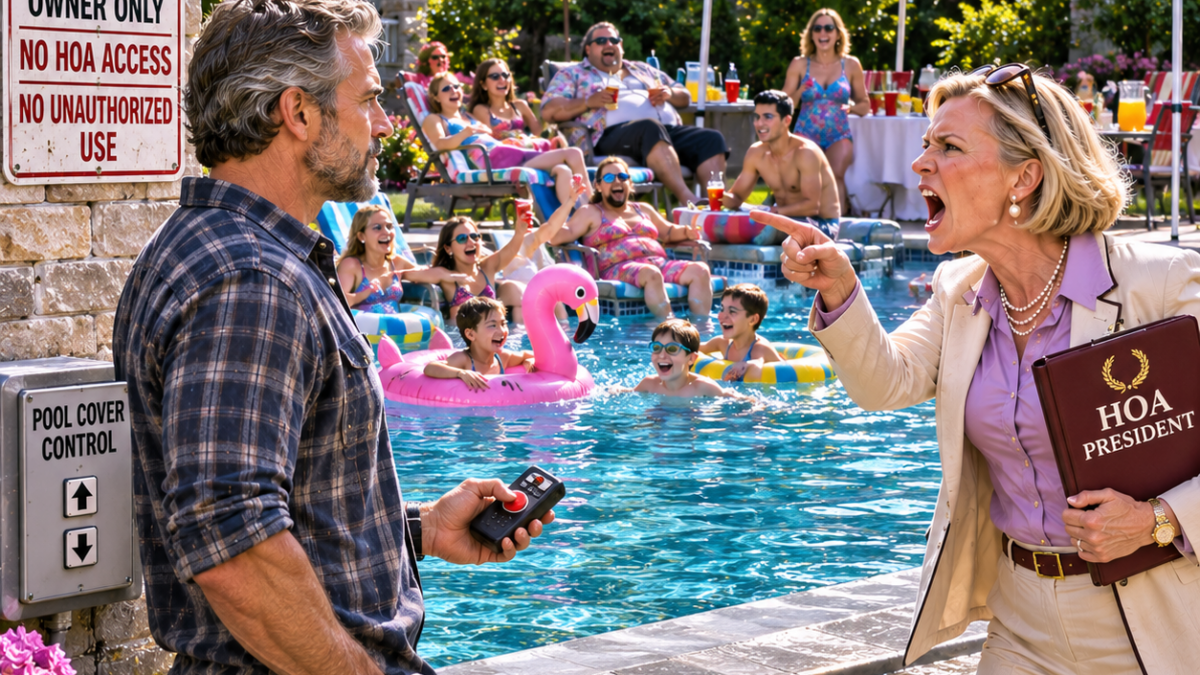
The first time I found HOA president Victoria Whitmore’s children swimming in my private backyard pool, I assumed somebody had made an embarrassing mistake; by the sixth time, her husband was drinking my beer beside the deep end, strangers were using my grill, and Victoria was telling neighbors that my fenced backyard was practically a “community amenity.” Then she started fining me for the noise, trash, and “excessive pool activity” created by the very people she kept inviting onto my property, while every polite request I made for her family to stay out was twisted into proof that I was selfish, antisocial, and hostile to the neighborhood. By the time Victoria announced another gathering at my pool without asking me, I had stopped wondering how to make her respect the word no and started wondering how much evidence I would need before the entire neighborhood finally understood what she had been doing.
My name is Anthony Lewis, and when I bought my house in Maplewood Heights, the pool was half the reason I signed the papers.
I had spent twenty-five years working long hours in operations management. Deadlines, conference calls, delayed flights, emergency meetings—I had lived by other people’s schedules for most of my adult life.
My retirement dream was embarrassingly simple.
A quiet backyard.
A grill.
A cold drink.
A pool no one could schedule but me.
For the first few months, that was exactly what I had.
Then one Sunday morning, I walked outside carrying coffee and found two teenagers in the water.
They were laughing, throwing a beach ball between them.
I stopped so suddenly coffee spilled over my hand.
“Can I help you?”
The girl smiled.
“Morning, Mr. Lewis. Mom said we could swim here.”
“Your mom?”
Victoria appeared near the side gate wearing oversized sunglasses and carrying the clipboard she seemed physically incapable of putting down.
“Oh, Anthony. I’m sorry. The kids must have misunderstood.”
I looked at the locked gate.
Then at her.
“How did they get in?”
Her smile flickered.
“We’re neighbors.”
“That doesn’t answer the question.”
She waved dismissively.
“They thought the pool was available because you’re part of the HOA.”
“My pool is attached to my house.”
“Of course. I’ll explain it.”
I should have insisted they leave immediately.
Instead, I made the mistake polite people make when they don’t yet realize politeness is being interpreted as permission.
I let it go.
Three days later, they were back.
This time there were four teenagers.
The following Saturday, Victoria’s husband Doug was sitting in one of my patio chairs drinking a beer while his son floated on my inflatable lounger.
“Great setup, Tony,” Doug said.
“Anthony.”
“Right.”
He raised the beer.
“HOA should give you a medal.”
“Maybe the HOA should give you a pool.”
He laughed as though I had made a joke.
I started locking the gate differently.
Someone kept getting through.
I texted Victoria.
Please stop allowing your family onto my property without permission.
Her reply came two minutes later.
Anthony, we’re neighbors. Don’t make this weird.
Then the first HOA violation arrived.
EXCESSIVE NOISE AND VISUAL DISRUPTION FROM POOL AREA.
Signed:
Victoria Whitmore, President.
I stared at it for a full minute.
Most of the noise she was citing had happened while her children were in my pool.
When I confronted her, she smiled.
“Nothing personal. Rules are rules.”
“What about trespassing?”
“Oh, don’t be dramatic.”
That was when I installed cameras.
Not one.
Four.
Gate.
Pool deck.
Rear fence.
Patio.
I documented every unauthorized visit.
Wet towels.
Food wrappers.
Open gate.
Doug drinking beside the pool.
Victoria herself walking into my yard without knocking.
Then came the Saturday that changed things.
I returned from an overnight business trip and found two SUVs blocking part of my driveway.
Music was shaking the back windows.
I went through the gate.
There were nearly twenty people around my pool.
Children cannonballing.
Adults drinking.
Doug grilling hamburgers on my grill.
Victoria was stretched out on my chaise lounge with a margarita.
She lifted one hand.
“Anthony! You’re home.”
I stared at her.
“You invited twenty people into my backyard?”
“Don’t exaggerate.”
I counted.
“Nineteen.”
She rolled her eyes.
“We’re having a small community afternoon.”
“On my property.”
“You weren’t using it.”
That sentence did something to me.
I didn’t yell.
Didn’t threaten anyone.
I turned around, went inside, opened the camera archive, and started saving every file.
Then I noticed something on the HOA community page.
A new announcement.
MAPLEWOOD HEIGHTS POOL SAFETY SOCIAL — SATURDAY.
Hosted by President Victoria Whitmore.
Location wasn’t listed.
It didn’t have to be.
My phone buzzed.
A message from my neighbor Mrs. Jenkins.
Anthony, is Victoria really holding another party at your house?
I looked through the window at Victoria laughing beside my pool.
Then at the growing folder of videos on my laptop.
And for the first time, I realized the next gathering could give me something every argument had failed to produce.
Witnesses.
PART 2
I didn’t answer Mrs. Jenkins immediately.
I sat in front of the monitor while the party outside continued.
Twenty people.
Three families I recognized.
Several I didn’t.
Victoria’s daughter had brought two friends.
Doug had commandeered my grill.
Someone had dragged one of my indoor throw pillows outside.
A little boy had spilled orange soda across the concrete.
And every few minutes, somebody would glance toward the house as if expecting me to come out and complain.
I understood why.
Victoria had trained them to see me as the problem.
Not the homeowner whose yard they had entered without permission.
The difficult neighbor.
The man who refused to “share.”
I typed Mrs. Jenkins back.
No. I did not authorize this.
Three dots appeared.
Then:
Oh my God.
A second message followed.
She told us you finally agreed.
That mattered.
I took a screenshot.
Then another neighbor texted.
Same thing.
Victoria said today’s gathering was approved by you.
Another screenshot.
I opened a new folder on my computer.
PARTY — UNAUTHORIZED.
The strange thing was, once I stopped thinking of the chaos outside as something I had to personally defeat, my anger cooled.
Evidence has that effect.
It turns emotion into chronology.
2:07 p.m. — first unauthorized guest enters gate.
2:14 — Doug begins using grill.
2:18 — Victoria arrives.
2:31 — six additional guests.
3:02 — child enters house through patio door before being redirected by another guest.
3:11 — alcoholic drinks placed beside pool while minors are swimming.
3:40 — Victoria tells Mrs. Parker on video, “Anthony doesn’t care. He just likes complaining.”
I replayed that line twice.
Then I heard the patio door open.
Victoria walked halfway into my kitchen.
“Anthony?”
I stood.
She stopped when she saw me.
“Why are you in my house?”
“I was looking for garbage bags.”
“Get out.”
She blinked.
“Excuse me?”
“Out.”
Her expression hardened.
“Don’t speak to me like that.”
“You just walked into my house without permission.”
“Your back door was open.”
“Because you’re hosting a party outside it.”
“We’re your neighbors.”
“You keep saying that like it changes ownership.”
Her mouth tightened.
“You’re determined to make everything unpleasant.”
I stepped toward the door and held it open.
“No. I’m determined to make one thing clear. This is the last gathering you hold here.”
She gave a short laugh.
“Anthony, everybody is already here.”
“Today.”
“What?”
“Finish today. Clean everything. Then never do it again.”
She stared at me.
That was my second mistake.
The first had been letting the original trespass go.
The second was letting this one finish.
At the time, I told myself it was strategic.
More footage.
More witnesses.
No confrontation with children present.
All true.
But another part of me wanted Victoria comfortable.
I wanted her convinced I had surrendered.
That part wasn’t strategic.
It was pride.
She walked back outside smiling.
By sunset, everyone had left.
They did not clean.
Of course they didn’t.
Hamburger wrappers.
Beer cans.
Soggy napkins.
A broken plastic cup in the flower bed.
Chips in the skimmer.
A towel I didn’t own.
Sticky footprints from the deck to my kitchen.
I spent nearly two hours cleaning.
Around ten, I sat at the edge of the pool with my feet in the water.
The backyard was quiet again.
I should have felt relief.
Instead, I felt violated.
That word seems dramatic until you’ve had strangers repeatedly enter the one place you built for privacy.
A house has public-facing spaces.
Your driveway.
Your porch.
Maybe your front yard.
A fenced backyard is different.
People understand that instinctively.
They knock.
They ask.
They don’t walk through a gate and start grilling hamburgers.
Unless someone convinces them they have the right.
Victoria had done exactly that.
Monday morning brought another HOA notice.
This one accused me of:
EXCESSIVE POOL ACTIVITY CREATING VISUAL AND AUDITORY DISHARMONY.
I laughed.
Not because it was funny.
Because there are moments when reality becomes so absurd your body doesn’t know what else to do.
I called an attorney.
His name was David Chen.
He specialized in real estate and association disputes.
I gave him the governing documents, my deed, the notices, screenshots, and camera clips.
He read quietly for nearly forty minutes.
Then he looked at me.
“Your pool isn’t a common element.”
“I know.”
“No easement?”
“No.”
“No association maintenance responsibility?”
“No.”
“No shared-access language in the declaration?”
“No.”
“Then why does she think she can use it?”
“Because she’s HOA president.”
“That isn’t a legal doctrine.”
“Tell her.”
“I will.”
He pulled the first violation closer.
“This one is interesting.”
“The noise complaint?”
“Yes. What date?”
I told him.
“Was her family present?”
I opened the video.
He watched.
Doug raised a beer toward the camera.
David smiled.
“Useful.”
“I thought so.”
“You’ve been saving everything?”
“Everything.”
“Good.”
He held up a finger.
“But no games.”
I frowned.
“What games?”
“You have the expression.”
“What expression?”
“The one clients get when they’ve decided lawyers are too slow and revenge will be faster.”
I leaned back.
“That’s oddly specific.”
“Experience.”
He slid the papers together.
“Anthony, you are winning right now.”
“Doesn’t feel like it.”
“That’s because you’re thinking emotionally.”
“And she isn’t?”
“Clearly she is.”
He tapped the folder.
“Which is why you don’t join her.”
He drafted a cease-and-desist letter.
Private property.
No implied permission.
No HOA right of access.
All prior permission, if any could be claimed, explicitly revoked.
No member of the Whitmore household or any person invited by them was permitted to enter my backyard or use the pool without direct written permission from me.
Future unauthorized entry would be documented and may be reported as trespass.
The association was also directed to withdraw any fines based on activity caused by unauthorized guests.
Clear.
Boring.
Professional.
I loved it.
Victoria responded by posting a new HOA newsletter.
COMMUNITY COOPERATION AND SHARED AMENITY SPIRIT.
No names.
No address.
But everyone knew.
The letter complained that certain residents were “undermining neighborly culture by excessively asserting technical property boundaries.”
Technical property boundaries.
I printed it.
David called after reading it.
“She has a gift.”
“For what?”
“Making herself look worse in writing.”
The board scheduled a hearing on my violations.
I attended.
That was the first time I realized Victoria’s control over Maplewood Heights wasn’t as absolute as it appeared.
She sat in the center behind a folding table.
Doug wasn’t there.
Four other board members were.
Rachel Moore, the treasurer.
Harold Jenkins, no relation to Mrs. Jenkins.
Lisa Grant.
And Peter Kim.
Victoria opened.
“We’re here regarding repeated complaints arising from the Lewis property.”
I raised my hand.
She frowned.
“This isn’t a courtroom, Anthony.”
“No. In a courtroom, you’d have to establish jurisdiction.”
Peter covered a smile.
Victoria noticed.
“Mr. Lewis has created an unnecessarily hostile environment regarding reasonable community use.”
Rachel interrupted.
“Victoria, is his pool actually community use?”
Silence.
Victoria looked at her.
“We’ve discussed this.”
“Informally.”
“It’s inside the neighborhood.”
“So is my kitchen.”
A few residents laughed.
Victoria’s eyes flashed.
“Rachel.”
“I’m asking.”
Victoria turned toward me.
“Anthony has historically allowed neighbors to use the pool.”
“No.”
“You did.”
“I failed to call police the first few times your children trespassed.”
Gasps.
Victoria snapped:
“They did not trespass.”
I opened my folder.
“Would you like to see the videos?”
Her jaw tightened.
David had told me to bring copies, not speeches.
I handed each board member a timeline.
Dates.
Video stills.
Texts.
The HOA notices.
Then the cease-and-desist letter.
Rachel read for several minutes.
“Victoria, you were there on these dates?”
“They were social visits.”
“Did Anthony invite you?”
Silence.
“Victoria?”
“We understood there was standing permission.”
I spoke.
“There wasn’t.”
She glared.
Harold looked at the noise notice.
“This fine is dated July twelfth.”
“Yes.”
He looked at my timeline.
“Your husband was apparently at the pool that day.”
Victoria shifted.
“That’s irrelevant.”
“How?”
“The violation concerns Anthony’s property.”
Harold looked genuinely confused.
“So your family makes noise at his pool, and we fine him?”
“It isn’t that simple.”
It looked exactly that simple.
The board voted three to two to suspend my fines pending review.
Victoria voted against.
Lisa backed her.
For the first time, I saw Victoria lose a vote.
She gathered her papers too quickly.
Her pen fell.
She bent to pick it up.
When she sat again, the color had risen into her cheeks.
Afterward, she followed me into the hallway.
“You enjoyed that.”
“What?”
“Embarrassing me.”
“I showed documents.”
“You came prepared to make me look incompetent.”
“You issued the notices.”
Her voice dropped.
“You don’t know what you’re starting.”
I almost answered angrily.
Instead I remembered David.
No games.
“Then stop entering my property.”
I walked away.
The next week was quiet.
Suspiciously quiet.
No Whitmore children.
No Doug.
No music.
I started enjoying my backyard again.
I had breakfast beside the pool on Thursday.
Grilled steak Friday.
Saturday morning, I floated on my back for nearly half an hour without hearing anyone say “community spirit.”
I thought maybe the board vote had finally done what I couldn’t.
Then I saw the flyer.
MAPLEWOOD HEIGHTS SUMMER POOL SAFETY SOCIAL
HOSTED BY HOA PRESIDENT VICTORIA WHITMORE
Saturday, noon.
No location.
Again.
I photographed it.
Then Mrs. Jenkins called.
“Anthony?”
“Yes?”
“Please tell me you know about Saturday.”
“What did Victoria say?”
“That you’re participating.”
“No.”
A long silence.
“Oh, honey.”
That was Mrs. Jenkins.
Seventy-three.
Retired elementary school teacher.
Called grown men honey when they were in trouble.
“She says it’s a reconciliation event.”
I closed my eyes.
“How many people?”
“She said families welcome.”
“Of course.”
“Do you want me to tell people?”
I thought.
“No.”
“Anthony.”
“I’ll handle it.”
“Legally?”
“I have a lawyer.”
“That wasn’t my question.”
I smiled despite myself.
“Yes. Legally.”
I called David.
He was less amused.
“Send her written notice now.”
“She already has one.”
“Send another referencing the event.”
We did.
Email.
Certified letter.
Board copied.
No response.
Friday afternoon, Doug walked over.
He stopped outside the fence this time.
Progress.
“You got a minute?”
“What?”
He looked exhausted.
“Vic’s planning something tomorrow.”
“I know.”
“I told her not to.”
“Thank you.”
“She says the board approved it.”
“Did they?”
Doug looked away.
There was my answer.
“Why are you telling me?”
He rubbed the back of his neck.
“Because this is getting stupid.”
“It passed stupid about six weeks ago.”
“I know.”
“Does Victoria?”
He gave a tired laugh.
“Not when she thinks she’s right.”
“Doug, I need you to hear me clearly. Nobody from your family has permission to enter this yard tomorrow.”
He nodded.
“I understand.”
“Tell her.”
“I have.”
“And?”
“She told me I’m weak.”
That was the first moment I saw Doug as something other than an entitled man with my beer in his hand.
He looked defeated.
Not innocent.
He had participated.
He had laughed.
He had ignored my boundaries because it was convenient.
But now the machinery he had helped build was running over him too.
“Then don’t come tomorrow.”
“I won’t.”
He left.
That night I barely slept.
I kept imagining another party.
Another mess.
Another round of reports.
I hated how much space Victoria occupied in my head.
Around two in the morning, I went downstairs.
The pool light was on.
Blue water.
Empty deck.
Quiet.
I stood there for a long time.
Then I made a choice I would later regret.
Not because it destroyed anyone’s life.
It didn’t.
But because it wasn’t who I wanted to be.
Months earlier, during one of my more childish late-night searches, I had bought a novelty prank product advertised as non-toxic and temporary.
A powder meant to create harmless irritation.
I had never used it.
David’s voice practically spoke in my head.
No games.
I should have thrown it away.
Instead, Saturday morning, angry and tired and convinced I needed to teach Victoria a lesson, I added a small amount to the pool.
I won’t describe how.
I won’t pretend it was smart.
At the time, I told myself it was harmless.
Temporary.
Unpleasant enough to send trespassers running.
That reasoning sounds a lot worse when I say it now.
Because it was worse.
I was deliberately setting up a physical consequence for people I knew might enter the water.
Even trespassers.
Even people who had no right to be there.
They were still people.
I understood that more clearly later than I did at six that morning.
By eleven-thirty, cars began arriving.
I watched from inside.
Victoria entered first.
Not through the gate.
She used a copied key.
That mattered.
My camera had a clean view.
Click.
Gate opens.
Victoria steps through.
Six guests followed.
Then nine.
Then more.
Some were people who had been told I approved the gathering.
That distinction hit me immediately.
I had been thinking of “Victoria’s party” as one group.
But the cameras showed people smiling.
Carrying towels.
Parents putting sunscreen on children.
They didn’t all know they were trespassing.
Some honestly believed they had permission.
My stomach tightened.
I reached for my phone.
I should have stopped it then.
I could have called police before anyone entered the water.
Instead, I hesitated.
Pride again.
I wanted Victoria caught.
At noon, she stood beside my pool and announced:
“Welcome, everybody!”
Children jumped in.
Adults followed.
Music started.
I watched.
Five minutes.
Ten.
Then one woman climbed out scratching her arm.
Another rubbed her shoulders.
A teenager said:
“Something feels weird.”
My satisfaction vanished.
That fast.
A little girl started crying.
I was outside before Victoria even saw me.
“Everybody out of the pool.”
She turned.
Her hair was wet.
“What did you do?”
“Everybody out.”
A man lifted his son onto the deck.
People began rinsing off with the outdoor shower.
Victoria scratched her neck.
Then froze.
Her eyes locked onto mine.
“You did something.”
I didn’t answer.
“Anthony.”
I looked at the children.
My stomach dropped.
This wasn’t funny.
It had never been funny.
Victoria shouted:
“You poisoned us!”
Someone called 911.
Maybe Victoria.
Maybe one of the parents.
I went inside and retrieved the product packaging.
That was the point where I had a choice.
Lie.
Or tell the truth.
The original version of me—the one who had spent weeks imagining the perfect humiliation—wanted to hide it.
Claim normal chlorine.
Make Victoria look hysterical.
I couldn’t.
When the first patrol officer arrived, Victoria was already shouting.
“He did this deliberately!”
Officer Mark Ramirez held up his hand.
“Everyone calm down.”
Another officer began separating people and asking whether anyone needed medical care.
Two parents drove children to urgent care out of caution.
No one appeared seriously ill.
Still, I felt sick.
Ramirez approached me.
“Mr. Lewis?”
“Yes.”
“Your property?”
“Yes.”
“Did you put something in the pool?”
I looked at Victoria.
Then at the camera above the patio door.
Then back at him.
“Yes.”
Victoria screamed:
“I knew it!”
Ramirez kept his eyes on me.
“What?”
I handed him the package.
“A novelty prank powder. The manufacturer labels it non-toxic and temporary.”
His expression hardened.
“You intentionally put it in before people entered?”
“Yes.”
“Did you know they were coming?”
“I knew Victoria planned another unauthorized event.”
He stared at me.
“That doesn’t make this okay.”
“I know.”
Victoria laughed harshly.
“Oh, now he knows!”
Ramirez turned.
“Mrs. Whitmore, stop.”
“He poisoned children!”
“We are determining what happened.”
“I want him arrested.”
Ramirez looked at the gate.
“Did you have permission to enter?”
Victoria hesitated.
“This is an HOA matter.”
“That wasn’t the question.”
She pointed toward me.
“Don’t turn this around.”
“I’m asking everyone questions.”
The second officer came over.
“Gate camera shows her using a key.”
Ramirez looked at me.
“Did you give her that?”
“No.”
“Anyone in her family?”
“No.”
Victoria shouted:
“The HOA has emergency access rights.”
I said:
“No, it doesn’t.”
Ramirez rubbed his forehead.
“Everybody stop talking.”
That afternoon did not become the clean revenge fantasy I had imagined.
It became a mess.
Exactly what revenge usually becomes when you think emotion can substitute for judgment.
Emergency medical personnel evaluated several guests.
Most symptoms were mild and faded quickly after rinsing.
Two people went to urgent care.
No lasting injury was reported.
The pool was closed until it could be drained, cleaned, and professionally tested.
Police documented the trespass.
They documented the copied key.
They documented Victoria’s prior notices.
And they documented what I had done.
I gave them the packaging.
I gave them my security footage.
I gave them everything.
Victoria stood near the driveway wrapped in a towel.
Her face was red.
Not just from irritation.
Rage.
“You’re finished.”
I looked at her.
“Maybe.”
She seemed surprised.
“You admit it?”
“I already did.”
“You tried to hurt us.”
“I made a stupid decision.”
“You’re a criminal.”
“Maybe I crossed a legal line. The authorities can decide that.”
She stared.
That wasn’t the response she wanted.
She wanted me defensive.
Smug.
Cruel.
Instead, I was ashamed.
And weirdly, that made her angrier.
“You think saying sorry fixes this?”
“No.”
Officer Ramirez approached.
“Mrs. Whitmore, we need to discuss the entry onto the property.”
She turned.
“This is ridiculous.”
He held up a still image from the gate footage.
“You used a key.”
“So?”
“Where did you get it?”
Her face changed.
Doug had not come.
Her children had.
One of them looked away.
Ramirez asked again.
“Where did the key come from?”
Victoria folded her arms.
“The HOA maintains access to properties for emergencies.”
I laughed once before I could stop myself.
Ramirez glanced at me.
I stopped.
He looked back at her.
“Do you have documentation giving the association authority to keep a key to Mr. Lewis’s backyard?”
She didn’t answer.
“Mrs. Whitmore?”
“It was necessary for safety.”
“Who copied it?”
Silence.
Her son finally said:
“Mom had me take Dad’s copy.”
Victoria spun around.
“Evan.”
He looked miserable.
“You told me Anthony said it was fine.”
The entire patio went quiet.
Victoria’s face drained.
I stared at Doug’s son.
“Doug had a copy?”
Evan nodded.
I remembered.
Months earlier, before all this started, Doug had fed my cat while I was away for a weekend.
I had given him a temporary gate key.
He had promised to return it.
I never asked.
Because back then we were neighbors.
Normal neighbors.
Officer Ramirez wrote something down.
Victoria turned on her son.
“Go home.”
“He’s a witness,” Ramirez said.
“You cannot question my child.”
“He’s eighteen.”
Victoria closed her eyes.
For the first time that day, she looked less angry than trapped.
The officers didn’t arrest either of us at the scene.
That was another difference between fantasy and reality.
Facts needed reviewing.
Intent mattered.
Medical reports mattered.
Property rights mattered.
The prosecutor would decide whether my prank crossed into a criminal offense.
The trespass complaints would also be reviewed.
I spent the rest of Saturday draining my pool.
Not because I had to do it personally.
Because I couldn’t stand looking at the water.
David arrived around six.
He saw the emptying pool.
Then me.
Then the package on the table.
“I told you no games.”
“I know.”
“You used it?”
“Yes.”
He closed his eyes.
“Anyone seriously hurt?”
“No.”
“Thank God.”
“I know.”
He sat.
For a while, neither of us spoke.
Then:
“You’re going to tell me everything.”
“I already told police.”
“Good.”
“I didn’t lie.”
“Very good.”
“I feel like an idiot.”
“You were an idiot.”
“Thank you.”
“You pay me for clarity.”
I looked toward the pool.
“Can they charge me?”
“Yes.”
“For what?”
“Potentially several things depending on local law, what the substance was, what you knew, and actual harm.”
I nodded.
“And Victoria?”
“Separate issue. Her trespass does not legally cancel your conduct.”
“I understand.”
“Do you?”
“Yes.”
David softened slightly.
“Good. Because the worst thing you can do now is turn this into some moral argument where you were entitled to retaliate because she entered your property.”
“I wasn’t.”
“Correct.”
I leaned forward.
“But she can’t keep doing this.”
“No.”
“That matters too.”
“Absolutely.”
He opened his laptop.
“We deal with both.”
That became the strategy.
Accountability without surrender.
I accepted responsibility for my mistake.
And I stopped allowing Victoria’s conduct to hide behind it.
Over the next week, the story split Maplewood in half.
People who supported Victoria said I had booby-trapped my pool.
People who supported me said trespassers had no business being there.
Both sides simplified it.
I hated both versions.
The truth was uncomfortable.
Victoria had repeatedly violated my property rights.
I had retaliated stupidly.
Two wrongs did not merge into one right.
Mrs. Jenkins came over Wednesday.
I expected disappointment.
She brought banana bread.
“I heard.”
“I figured.”
She sat at my kitchen table.
“Were children there?”
“Yes.”
Her face tightened.
“I didn’t think about that enough.”
“No.”
“You’re angry.”
“Yes.”
“I understand.”
She sighed.
“Still doesn’t make what Victoria did okay.”
“I know.”
“And what she did doesn’t make yours okay.”
“I know.”
She studied me.
“Good.”
That was Mrs. Jenkins.
No speech.
No applause.
Just accuracy.
Then she slid her phone toward me.
“Look.”
A screenshot from the HOA group.
Victoria had written:
Due to Mr. Lewis’s intentional chemical attack on residents, the HOA is immediately exercising emergency authority over his property to protect the community.
I read it twice.
“What emergency authority?”
“Exactly.”
Another post:
His pool must remain closed pending HOA inspection.
Another:
The board will consider permanent control measures.
I almost laughed.
“She’s still trying.”
Mrs. Jenkins nodded.
“She thinks your mistake saved her.”
That sentence mattered.
Because Victoria had been losing control.
The board had suspended my fines.
Residents were questioning her.
My cease-and-desist letter existed.
The camera footage existed.
But now I had given her something powerful.
A way to recast herself as the victim.
David said the same thing.
“You handed her a lifeline.”
“I know.”
“So stop helping.”
“What do we do?”
“Facts.”
He requested a formal HOA hearing.
Not against me.
Against Victoria.
Abuse of association authority.
Unauthorized entry.
Misuse of resident access credentials.
False representation of private property as common property.
Retaliatory enforcement.
We submitted the full history.
Every message.
Every notice.
Every video.
Including the pool incident.
Nothing hidden.
At the hearing, Victoria entered like she had already won.
Her lawyer sat beside her.
That was new.
So was mine.
Rachel Moore chaired the meeting because the complaint concerned the president.
Victoria didn’t like that.
“This is procedurally improper.”
Rachel said:
“Association counsel advised you cannot chair a hearing concerning your own conduct.”
Victoria looked at the HOA attorney.
He nodded.
She sat.
Rachel turned toward me.
“Anthony, before we begin, there’s an obvious issue.”
“The powder.”
“Yes.”
I nodded.
“I did it.”
Murmurs.
Victoria leaned toward her attorney.
I continued.
“It was a bad decision. I disclosed it to police. I’m dealing with the consequences separately. I’m not asking this board to excuse it.”
Victoria’s expression changed.
She had expected denial.
I continued.
“But my bad decision happened after months of unauthorized entries. It did not create those entries.”
David laid out the timeline.
First trespass.
Second.
Doug.
Twenty-person party.
Violation notice.
Camera installation.
Board hearing.
Cease-and-desist.
Pool event announcement.
Certified notice forbidding access.
Saturday entry using copied key.
Rachel asked:
“Victoria, did you receive the cease-and-desist before the event?”
Her lawyer whispered.
Victoria answered:
“Yes.”
“Did you understand that Anthony had revoked permission?”
“I disputed his interpretation.”
“Interpretation of permission?”
“The HOA has authority.”
“Show us.”
Victoria pushed a binder forward.
David opened it.
Declaration.
Bylaws.
Rules.
No pool access right.
No emergency key authority.
No private-amenity sharing clause.
No association easement through my fenced backyard.
David closed it.
“Nothing here authorizes entry.”
Victoria’s lawyer said:
“The association has broad health-and-safety powers.”
David replied:
“Health-and-safety powers don’t create an easement.”
The HOA attorney shifted uncomfortably.
Rachel asked:
“Did the board vote to host the event?”
Victoria said:
“Yes.”
Harold frowned.
“When?”
She looked at him.
“The social committee approved it.”
“That’s not the board.”
“The committee operates under board authority.”
“Did we vote?”
Silence.
Peter Kim spoke.
“I didn’t.”
Lisa, who had supported Victoria before, looked down.
“Neither did I.”
Rachel asked:
“Who approved it?”
Victoria’s voice tightened.
“I did.”
There it was.
Not the board.
Not the community.
Victoria.
Rachel looked at the video still showing Victoria using the copied key.
“Where did this key come from?”
“It had been provided to the Whitmore household.”
“For what purpose?”
I answered.
“Years earlier, Doug fed my cat while I traveled.”
Rachel looked at Victoria.
“Was it returned?”
“I don’t know.”
“Did you ask Anthony before using it?”
“No.”
“Did you tell attendees they had his permission?”
Victoria hesitated.
Mrs. Jenkins stood from the audience.
“She told me he approved it.”
Another resident:
“Me too.”
Another:
“She called it a reconciliation party.”
Victoria’s lawyer leaned close to her.
She ignored him.
“I was trying to defuse a hostile situation.”
Rachel stared.
“By entering the property after receiving a letter forbidding entry?”
Victoria slammed her hand on the table.
“He had been creating hostility for months!”
The room went silent.
Her lawyer touched her arm.
“Victoria.”
She pulled away.
“He refused everything. Every reasonable request. Every attempt at community cooperation.”
David said:
“His pool is not required to cooperate.”
A laugh moved through the room.
Victoria pointed at me.
“And then he put chemicals in the water!”
I nodded.
“Yes.”
Her finger stayed raised.
I continued.
“And I have never said that was justified.”
The finger slowly lowered.
That was the moment the room changed.
I didn’t defeat her by proving I was perfect.
I wasn’t.
I defeated her argument by refusing to let my mistake erase hers.
Rachel called a recess.
Twenty minutes later, the board returned.
Victoria was suspended from enforcement authority pending an independent review.
Not removed.
Not yet.
That came later.
The criminal side took several weeks.
Laboratory analysis confirmed the novelty product was low-level and not associated with serious toxicity at the exposure involved.
Medical records showed temporary skin irritation in several swimmers and no lasting injury.
That did not make my decision good.
But it mattered legally.
The prosecutor offered a misdemeanor resolution tied to reckless conduct, restitution for documented medical costs, and a diversion program because I had no criminal record, had immediately disclosed what I had done, and no one suffered serious injury.
I accepted.
No heroic courtroom victory.
No pretending trespass gave me immunity.
I paid the medical bills.
Completed a community safety course.
And learned a sentence I wish I had understood earlier:
You do not get to engineer punishment for someone entering your property.
You call the police.
You document.
You sue.
You secure the gate.
You do not become creative.
Meanwhile, the trespass case against Victoria moved separately.
The copied key.
The written notice.
Her own messages.
The witnesses.
All of it mattered.
Police also reviewed the prior entries.
Most were too old or too informal for serious criminal consequences, especially because I had sometimes allowed the visits to continue instead of clearly demanding immediate departure.
But the final event was different.
Permission had been explicitly revoked.
She knew.
She entered anyway.
The prosecutor eventually resolved that through a misdemeanor trespass plea and an order prohibiting her from entering my property.
That alone should have ended things.
It didn’t.
Victoria retaliated through the HOA.
Even while suspended from enforcement decisions, she flooded the board with complaints against me.
Commercial activity.
Unapproved cameras.
Improper fence height.
Pool equipment screening.
Patio lighting.
Mailbox paint.
One notice accused my inflatable flamingo of violating “aesthetic consistency.”
I framed that one.
David did not approve.
“You’re encouraging yourself.”
“I need hobbies.”
“You have a pool.”
“Temporarily empty.”
I had drained and cleaned it completely after the incident.
When I refilled it, I installed a new gate lock.
Then electronic access.
Then a camera directly over the latch.
No copied keys.
Doug came over while the installer was finishing.
He stayed outside.
“Looks serious.”
“It is.”
He nodded.
“I’m sorry.”
“For what part?”
He looked down.
“All of it.”
“That’s broad.”
“I should’ve returned the key.”
“Yes.”
“I should’ve stopped letting the kids come.”
“Yes.”
“I should’ve told Vic she was wrong.”
“Yes.”
He gave a tired laugh.
“You aren’t making this easy.”
“You want me to?”
“No.”
We stood quietly.
Then he said:
“She thinks she can still get the board back.”
“Probably.”
“She thinks everyone will forget once your case becomes public.”
“My case is public.”
“She says it’ll make people hate you.”
“Some do.”
Doug looked surprised.
“You’re okay with that?”
“No.”
I leaned against the fence.
“But I’m learning something. Being right about Victoria doesn’t require me to be right about everything.”
He nodded slowly.
“I wish she understood that.”
“So do I.”
The independent HOA review started with enforcement practices.
Then widened.
Not because of me.
Because Rachel found invoices.
The first questionable payment was small.
$1,850.
“Community consulting.”
Vendor:
Whitmore Residential Services.
Doug’s company.
Rachel asked him about it.
He looked stunned.
“I don’t have a company called that.”
That was a problem.
Corporate records showed the company had been registered two years earlier.
Organizer:
Victoria Whitmore.
Mailing address:
A private mailbox.
Doug’s name appeared in the title but not the registration.
He called me that evening.
“Anthony.”
“Yeah?”
“Can I ask you something?”
“Depends.”
“Did you know Vic had a company using my name?”
“No.”
“She billed the HOA.”
“I heard.”
“She told the board it was mine.”
I sat down.
“Doug, you need a lawyer.”
“I don’t want a lawyer.”
“You need one.”
“I didn’t do anything.”
“Then protect yourself.”
Silence.
“I think she’s been hiding money.”
That was where the pool story became something larger.
Rachel pushed for a forensic audit.
Victoria fought it.
Hard.
“This is retaliation driven by Anthony Lewis.”
Rachel said:
“Anthony didn’t discover the invoices.”
“He poisoned residents!”
“And was held accountable.”
“Why is everyone defending him?”
“We aren’t.”
That answer mattered.
Rachel continued:
“We are reviewing association money.”
Victoria’s face changed.
Not dramatically.
Just enough.
Peter Kim noticed.
So did I.
The audit went back four years.
Beautification projects.
Consulting fees.
Event budgets.
Landscaping.
Resident outreach.
Emergency maintenance.
Several expenses were legitimate.
Some were sloppy.
Then auditors found payments to three vendors with personal connections to Victoria.
Whitmore Residential Services.
VJW Consulting.
Maple Civic Events.
Some services had been performed.
Some invoices were inflated.
Others lacked evidence of work.
One landscaping charge corresponded to materials delivered not to HOA property, but to Victoria’s home.
A patio project had partially been billed under “community hospitality improvements.”
Travel costs from a weekend resort appeared as “board leadership retreat.”
Rachel called an emergency meeting.
Victoria arrived with counsel.
I almost didn’t go.
David told me to.
“You don’t have to speak.”
“Then why?”
“Because your evidence started the review.”
“That sounds like speaking.”
“Sit in the back.”
I did.
The clubhouse was packed.
Rachel opened with a summary.
Approximately $94,000 in transactions required additional explanation.
That did not mean $94,000 was stolen.
The auditor said that clearly.
Victoria’s supporters ignored the distinction.
Her critics ignored it in the other direction.
People like simple numbers.
Reality gave them categories.
Documented but poorly approved.
Related-party without disclosure.
Personal benefit.
Unsupported.
Potential fraud.
The board referred the most serious items to law enforcement and association counsel.
Victoria stood.
“This is a witch hunt.”
Rachel sighed.
“No one has reached a final criminal conclusion.”
“You’ve humiliated me publicly.”
“The records belong to the members.”
“You had no right to release them.”
“The bylaws require financial disclosure.”
Victoria pointed toward the back.
Toward me.
“This started because that man couldn’t share a swimming pool.”
Every head turned.
I wanted to disappear.
Rachel looked at me.
“You don’t need to respond.”
I should have stayed seated.
I didn’t.
“I’ll respond.”
David’s head slowly turned.
I walked forward.
Victoria looked almost pleased.
She thought I was taking the bait.
Maybe I was.
“Victoria’s right about one thing.”
The room went still.
“This started with my pool.”
She smiled.
I continued.
“She entered it without permission.”
The smile faded.
“I responded badly.”
Whispers.
“I put something in the water to teach her a lesson.”
Some people already knew.
Others didn’t.
“I shouldn’t have done that.”
I looked around.
“I was held responsible.”
Then at Victoria.
“So if you think my mistake means your financial records shouldn’t be examined, I disagree.”
No anger.
No joke.
No revenge line.
Just that.
I sat down.
David whispered:
“That was almost responsible.”
“Almost?”
“You still stood up.”
The board voted to remove Victoria as president pending final findings.
Not unanimous.
But decisive.
She remained seated after the vote.
Doug wasn’t beside her.
Her children weren’t there.
Her usual group had scattered across the room.
When she finally stood, she looked at Rachel.
“After everything I’ve done for this neighborhood.”
Rachel answered softly.
“That’s what we’re trying to understand.”
Victoria walked out.
No applause.
I was glad.
The financial investigation took months.
The final amount investigators believed involved intentional misappropriation was lower than the dramatic rumors.
About $87,000 in payments and benefits became the core of the case after legitimate or insufficiently provable expenses were removed.
Forgery allegations arose from several authorization forms.
Doug cooperated.
So did two former vendors.
The county charged Victoria with theft-related and fraud-related offenses.
Her real-estate brokerage suspended her pending resolution.
Not because an HOA dispute had ruined her career.
Because the financial case affected her professional licensing obligations.
That distinction mattered.
The criminal case ended in a plea.
Restitution.
Probation.
A suspended custodial sentence with conditions.
Financial monitoring.
Community service.
And professional consequences through the licensing process.
She did not go to prison for twenty years.
No judge delivered a speech about karma.
Real life is less theatrical.
The consequence that hurt Victoria most came from somewhere else.
Doug filed for divorce.
He told me months later.
Not immediately.
Not because of one pool party.
“People keep saying I left because she got arrested.”
We were standing near my driveway.
“That isn’t why?”
“No.”
“Why?”
He looked toward their house.
“I realized I had spent years telling myself her behavior wasn’t my responsibility.”
He shoved his hands into his pockets.
“It wasn’t.”
I waited.
“But my silence was.”
That was more honest than anything I’d ever heard from him.
He continued.
“She used my name on a company without telling me.”
“I know.”
“She lied to the kids.”
“I know.”
“She told everyone I supported things I didn’t even know about.”
“You did support some.”
He winced.
“I know.”
“You used my pool.”
“I know.”
I smiled faintly.
“Just making sure.”
He laughed.
Then became serious.
“I kept saying she was the hurricane.”
“And?”
“I kept standing in the wind.”
He moved out two weeks later.
The HOA held elections.
Rachel became president.
Her first act was to send me a formal letter.
Every unsupported fine issued during Victoria’s campaign against my property was voided.
Fees refunded.
Records corrected.
Then Rachel came to my house personally.
She stopped at the locked gate.
Didn’t touch it.
“Anthony?”
I opened it.
That simple act—the waiting—meant more than the letter.
She handed me a folder.
“We’ve rewritten the enforcement policy.”
“Am I supposed to be excited?”
“No.”
“Good.”
“You should read it.”
“I’ll have David read it.”
She laughed.
“Fair.”
The changes were substantial.
No unilateral presidential fines.
Written evidence.
Board review above set amounts.
Conflict disclosure.
Appeal rights.
No entry onto private property without consent, emergency necessity, or lawful authority.
Transparent budgets.
Annual independent review.
Term limits.
That last one made me smile.
“Victoria would’ve hated this.”
Rachel said:
“That’s partly why everyone likes it.”
Then she looked toward the pool.
“Are you using it again?”
“Yes.”
“Anyone else?”
“By invitation.”
She nodded.
“Good.”
I almost joked that HOA presidents paid double.
I didn’t.
Growth.
A few weeks later, Mrs. Jenkins suggested something I didn’t expect.
“You should host a barbecue.”
I stared.
“At the pool?”
“Yes.”
“Have you learned nothing?”
She smiled.
“With people you invite.”
That distinction changed everything.
I chose twelve neighbors.
Not the whole HOA.
People who had helped.
People who had apologized.
People I actually wanted around.
Mrs. Jenkins.
Rachel.
Mr. Kim.
A young single mother named Sarah and her two children.
Doug wasn’t ready for social events.
That was fine.
I grilled burgers.
Kids swam.
Someone played music quietly.
People cleaned their own plates.
Nobody walked into my house.
Nobody opened a cabinet.
Nobody acted entitled.
At one point, Sarah’s eight-year-old daughter stood beside the water wearing goggles.
“Mr. Lewis?”
“Yes?”
“Can I jump in?”
The question hit me harder than it should have.
Three words.
Can I?
I smiled.
“Absolutely.”
She cannonballed.
Water splashed my shirt.
Everyone laughed.
And suddenly I understood what had actually been stolen from me during the previous year.
Not chlorine.
Not patio furniture.
Not money.
Choice.
The ability to say yes.
When people keep taking without asking, you eventually become so focused on saying no that you forget how good yes can feel when it’s yours to give.
That night, after everyone left, I cleaned almost nothing.
They had done it themselves.
One towel remained on a chair.
Mrs. Jenkins’s.
I folded it.
Put it aside.
Sat beside the pool.
Quiet.
Mine.
But not lonely.
A month later, I received a letter forwarded through Victoria’s attorney.
David called first.
“You don’t have to open it.”
“Legal?”
“No.”
“Threat?”
“Doesn’t appear to be.”
I opened it.
Anthony,
I have spent a long time blaming you for what happened to me.
I blamed you for the board removing me.
I blamed you for the investigation.
I blamed you for Doug leaving.
I even blamed you for my children refusing to defend me.
Therapy has been unpleasant because my therapist keeps asking what you actually caused.
I don’t like the answer.
You did not make me use your pool.
You did not make me lie about permission.
You did not make me issue fines.
You did not make me move HOA money.
You did something wrong in retaliation, and I used that mistake as proof that everything I had done before it was justified.
It wasn’t.
I don’t know when I started believing being president meant I deserved obedience.
Maybe people let me get away with too much for too long.
Maybe I needed everyone to think I was competent because I was terrified they would discover I wasn’t.
Those are explanations.
Not excuses.
I am sorry for entering your property.
I am sorry for teaching my children that other people’s boundaries only mattered when convenient.
I am sorry for what I did to Maplewood.
You do not owe me forgiveness.
Victoria
I folded the letter.
No sudden absolution.
No tears.
I wasn’t ready to call her a friend.
I would never trust her with a key again.
But I believed that letter more than any apology she had offered while still trying to win.
I put it in the same folder as my own diversion paperwork.
That felt right.
Two people.
Two sets of consequences.
Her mistakes larger.
Mine still mine.
The story could have ended there.
For a while, I thought it had.
Then Victoria’s house went into foreclosure.
That information didn’t come from some detective showing up and magically handing me a deed.
I saw the public notice months later.
Doug’s name had been removed during divorce proceedings.
Victoria had fallen behind on the mortgage while dealing with restitution, legal expenses, and lost income.
The property was eventually offered through a bank-managed sale after the foreclosure process.
I had no reason to buy it.
So naturally, I thought about buying it for two straight weeks.
David stared at me when I mentioned it.
“No.”
“Why?”
“Because this sounds like revenge.”
“Investment.”
“Revenge with depreciation schedules.”
“The house is across the street.”
“Exactly.”
“Property values are solid.”
“Anthony.”
I smiled.
“Okay. Maybe twenty percent revenge.”
“That’s twenty percent too much.”
I didn’t bid at first.
The house sat.
Price dropped.
I walked past it every morning.
Grass growing.
Roses dying.
Paint peeling from the railing Victoria used to photograph other people’s lawns from.
Then Rachel told me the HOA was worried an investor would turn it into a poorly managed rental.
That didn’t obligate me.
But it made the property practical.
I ran the numbers.
Renovation.
Taxes.
Insurance.
Projected guest use.
Possible future resale.
The financial case worked.
Eventually I made an offer through the bank.
Not hidden.
Not automatic.
Not some magical transfer.
A normal offer.
The bank accepted.
The irony hit me when I signed.
The woman who had spent months treating my pool like community property had lost her house, and I now legally owned it because I had bought it through an ordinary sale.
I felt almost guilty about how satisfying that was.
David called.
“Congratulations.”
“You sound disappointed.”
“I was hoping you’d develop maturity.”
“I did.”
“Clearly.”
“What should I do with it?”
“Rent it.”
“No.”
“Sell it.”
“No.”
“Then why did you buy it?”
I looked through the window at the empty house.
“I don’t know yet.”
The first time I entered after closing, it felt strange.
No furniture.
No floral perfume.
No clipboard.
The dining room wall still showed pale rectangles where HOA awards had once hung.
In the kitchen, a hook remained where Victoria apparently kept her keys.
I stood there longer than necessary.
Then walked into the backyard.
From that angle, I could see my pool.
Perfectly.
The top of the fence.
Patio umbrellas.
Blue water.
That was when I understood why she had become so fixated.
Her kitchen and upstairs windows looked directly onto the pool.
Every gathering.
Every quiet evening.
Every time I sat alone beside the water.
She had been able to see it.
Maybe that had made entitlement easier.
Something visible starts feeling accessible.
Something beautiful starts feeling wasted when you’re not included.
Not logical.
Human.
Still wrong.
But human.
I sat on her back steps.
For months, I had imagined victory as Victoria losing.
Her position.
Her reputation.
Her control.
Sitting in her empty yard, none of that felt particularly good.
It felt quiet.
Sad, almost.
I thought about the pool incident.
My stupid powder.
Children rinsing their arms.
Police lights.
The shame on my face when Ramirez asked whether I had done it intentionally.
I had wanted to teach Victoria about boundaries and temporarily crossed one myself.
That memory would always be attached to the victory.
Maybe that was healthy.
Perfect revenge stories are dangerous because they teach us that being wronged turns whatever we do next into justice.
It doesn’t.
I decided the house needed a different purpose.
Not a trophy.
Not a shrine to winning.
I renovated it.
Neutral paint.
New flooring.
Fixed the neglected roses.
Repaired the porch.
Then I turned it into a guest house.
My sister stayed there when she visited from Arizona.
Old coworkers stayed during fishing weekends.
Rachel’s parents used it for three nights when her house flooded after a pipe burst.
Mrs. Jenkins’s daughter stayed during Thanksgiving.
I named it Blue Haven.
She hated the name.
“Sounds like a retirement village.”
“You are literally retired.”
“Still hate it.”
I kept it.
The fence between the two properties stayed.
That mattered.
I could have removed it.
Connected the yards.
Created one big estate.
Instead, I repaired it.
New boards.
New gate.
Because boundaries aren’t ugly.
A good boundary can be what lets two good things exist beside each other.
The following summer, Maplewood held its first neighborhood cookout under Rachel’s board.
At the community park.
Not my pool.
I attended.
So did Officer Ramirez.
He recognized me near the grill.
“Pool guy.”
I winced.
“Please don’t call me that.”
He smiled.
“How’s everything?”
“Quiet.”
“Good.”
“I owe you something.”
“What?”
“Thanks.”
“For?”
“Not treating me like I was innocent just because people were trespassing.”
He studied me.
“Most people don’t thank cops for that.”
“I’m trying something new.”
“Accountability?”
“Apparently.”
He laughed.
Then lowered his voice.
“You know what impressed me that day?”
“What?”
“You told the truth.”
“I had cameras.”
“You could’ve lied before we saw them.”
Fair.
He nodded toward Rachel and the board.
“Looks better around here.”
“It is.”
“Pool?”
“Private.”
“Good.”
We shook hands.
That evening, Mrs. Jenkins followed me home carrying leftover pie.
At my gate she stopped.
“Permission to enter?”
I laughed.
“You’re never letting that joke die.”
“Never.”
I opened the gate.
She sat beside the pool.
I brought coffee.
For a while we watched the lights ripple across the water.
Then she said:
“Do you forgive her?”
I knew exactly who.
“I don’t know.”
“That’s not an answer.”
“It is.”
She waited.
I tried again.
“I don’t want anything bad to happen to her.”
“That’s something.”
“I don’t want her back.”
“Also something.”
“I believe she understands more now.”
“And?”
I looked at the water.
“I think forgiveness might just mean I’m not waiting for another apology.”
Mrs. Jenkins nodded.
“That sounds expensive.”
“What?”
“All that therapy language.”
I laughed.
“You’re impossible.”
“I’m seventy-four. I’ve earned it.”
A year after Victoria left Maplewood, Rachel called me.
“We received something addressed to the board.”
“About me?”
“Sort of.”
“What?”
“A restitution completion notice.”
Victoria had finished the financial restitution required under her case.
Not every association loss had been recovered through her personally—insurance and settlements covered parts—but her court obligations were complete.
Rachel sounded surprised.
“I thought you’d want to know.”
“Why?”
“Because everything started with you.”
“No.”
“What?”
“It started before me.”
I thought about the invoices.
The fines.
Residents who had stayed silent.
“My pool just made it visible.”
Rachel was quiet.
“That’s probably true.”
That mattered too.
I hadn’t saved Maplewood.
People like Mrs. Jenkins had spoken.
Rachel had challenged finances.
Harold had voted against Victoria.
Doug had cooperated.
Auditors had investigated.
Police had handled reports.
Lawyers had enforced boundaries.
The neighborhood had changed because enough people finally stopped treating one person’s certainty as authority.
That was more realistic than one man defeating an HOA tyrant with a prank.
And more satisfying.
That summer, I hosted another backyard gathering.
Small.
Invited.
Children swimming.
Adults eating burgers.
No one paid.
I had experimented briefly with allowing paid photo shoots and small rentals after Victoria left, as the original conflict had made me determined to prove I could use my property within the rules.
David hated that too.
“Why are you turning your sanctuary into a business?”
“To annoy Victoria.”
“She moved.”
“Good point.”
So I stopped.
That was another funny thing about revenge.
Sometimes you build a new habit around a person who isn’t even present anymore.
The rentals had been legal under the HOA’s limited private-event rules, but they weren’t what I wanted.
I had bought the house for peace.
So I took it back.
Not from Victoria.
From my own need to keep proving she hadn’t won.
One evening after everyone left, a little boy had forgotten his goggles.
I found them beside the ladder.
Blue.
Cheap.
I held them in my hand and remembered the first two Whitmore teenagers splashing around years earlier.
Back then, I thought the problem was people in the water.
It wasn’t.
The problem was permission.
The kids at my party had been invited.
They had asked.
Their parents had thanked me.
They helped clean.
Same pool.
Same noise.
Completely different feeling.
Choice changes everything.
The last time I heard directly from Victoria was almost two years after the first trespass.
A Christmas card arrived through David’s office.
No long letter.
No explanation.
Just a photograph of mountains somewhere in Arizona and a handwritten sentence.
I hope your backyard is peaceful.
Victoria
I smiled.
Then placed it in a drawer.
Not displayed.
Not destroyed.
Just stored.
That felt appropriate.
Doug eventually sold his interest in what remained of their old shared property issues and moved closer to his son.
Evan apologized once.
He came by while visiting Maplewood.
Stayed outside the gate.
“Mr. Lewis?”
“Anthony is fine.”
“I wanted to say something.”
I waited.
“I knew Mom wasn’t supposed to use that key.”
“Okay.”
“She told me it didn’t matter because she was president.”
“I figured.”
“I should’ve said something.”
“You were eighteen.”
“I wasn’t eight.”
Fair.
“I’m sorry.”
“Thank you.”
He glanced toward the pool.
“Can I ask something weird?”
“Sure.”
“Did you really put powder in it?”
I groaned.
“Yes.”
He laughed nervously.
“Mom still talks about that.”
“I regret it.”
His smile faded.
“Seriously?”
“Seriously.”
“Why?”
“Because being angry doesn’t give you permission to risk hurting somebody.”
He nodded.
“Mom says she deserved it.”
“No.”
He looked surprised.
“She deserved consequences.”
I pointed toward the gate.
“Police report. Trespass charge. Losing the board position. Financial investigation. Those were consequences.”
Then toward the pool.
“What I did was retaliation.”
He thought about that.
“There’s a difference.”
“Big one.”
He nodded.
“I wish Mom had understood differences earlier.”
“So do I.”
He left.
I watched him walk away and realized I was glad we had talked.
Not because I needed absolution from Victoria’s son.
Because stories change depending on where you stop telling them.
If I ended mine at the moment Victoria was humiliated beside the pool, I would sound clever.
If I ended it at her removal, I would sound victorious.
If I ended it at the financial case, she would sound monstrous.
But years later, the full story looked different.
Victoria was controlling.
Dishonest.
Entitled.
She abused authority and stole money.
She also eventually admitted it.
I was patient longer than I should have been.
Then I retaliated in a way I should not have.
I admitted it.
Paid for it.
Learned from it.
Doug enabled her.
Then finally stopped.
The board failed.
Then rebuilt.
Neighbors stayed silent.
Then spoke.
Nobody was perfectly good.
Nobody needed to be.
The backyard stayed mine.
That was enough.
One Saturday morning, I woke early.
Coffee.
Robe.
Same combination as the first time I found Victoria’s children in the pool.
I opened the patio door.
Blue water.
Still surface.
Sunlight starting to touch the fence.
No towels.
No strangers.
No clipboard.
I sat beside the shallow end.
For twenty minutes, nothing happened.
Then Mrs. Jenkins called from the gate.
“Anthony?”
“Yes?”
“I’m returning your casserole dish.”
“Gate’s unlocked.”
She didn’t enter.
“Permission?”
I smiled.
“Yes, Mrs. Jenkins. You may enter.”
She came through carrying the dish.
“You’ve trained me well.”
“You’re mocking me.”
“Also yes.”
She set it on the table.
Then looked at the water.
“Beautiful morning.”
“It is.”
“You swimming?”
“Maybe.”
She pointed at me.
“No powder?”
“Please leave.”
Her laugh echoed across the yard.
I laughed too.
Real laughter.
Not revenge.
Not humiliation.
Just a joke between neighbors.
She headed toward the gate.
Before leaving, she turned.
“You know what I like most about your pool now?”
“What?”
“You share it more.”
I shook my head.
“I knew you’d say that.”
She smiled.
“Difference is, now we ask.”
Then she closed the gate behind herself.
The latch clicked.
I sat there listening to the pool filter hum.
Years earlier, that sound had been buried beneath music, strangers, arguments, police radios, and Victoria telling me community mattered more than consent.
Now it was the loudest thing in the yard.
I finished my coffee.
Set the mug down.
And stepped into the water.
No witnesses.
No cameras I needed to check.
No lesson to teach.
No battle left to win.
Just my pool, on my property, under a quiet morning sky.
Exactly the life I had wanted before any of this began.
[END OF STORY]








