PART 2: HOA President Kept Stealing My Packages — Then She Reached for One Beside My Beehive
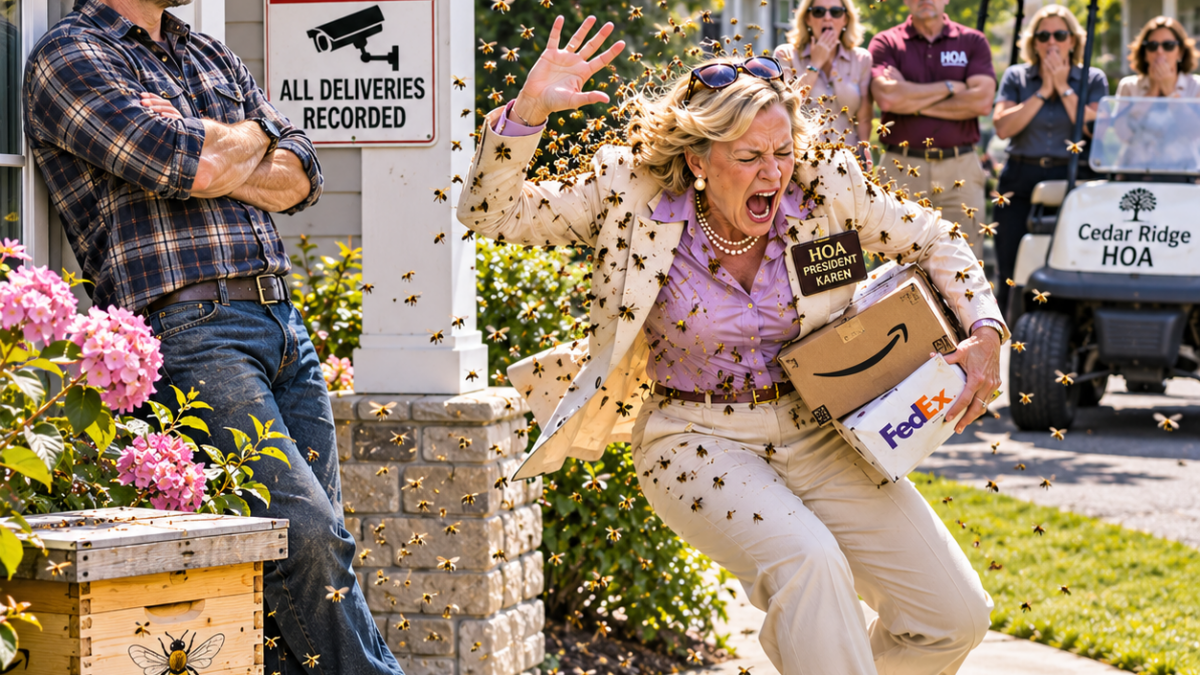
The first time one of my packages disappeared, I blamed a porch pirate; by the seventh, I had security footage of HOA president Karen Whitfield strolling onto my property in her pink blazer, lifting a box with my name and address printed across the label, and carrying it home as casually as if she’d just collected her own newspaper. When I confronted her, she didn’t apologize—she claimed she was “protecting community deliveries,” threatened to fine me for harassment, and somehow convinced half the HOA board that my missing packages were really a safety issue caused by me refusing to cooperate with her new rules. What Karen didn’t know was that I had stopped trying to argue with her days earlier, because once I realized she would keep taking whatever she wanted as long as nobody could prove it, I decided the next package on my porch would tell the truth for me.
My name is Michael Turner.
I retired from emergency medical services after twenty years of answering calls on other people’s worst days, and by the time I bought my house in Maplewood Grove, I wanted a life where nothing screamed.
No sirens.
No radios.
No hospital corridors.
Just Diane, my wife, a quiet two-story house, and the honeybees I kept behind the back fence.
Beekeeping started because my doctor told me retirement wasn’t supposed to mean sitting indoors waiting for my blood pressure to rise.
The bees were perfect.
They were predictable.
Work came first.
Drama came never.
Diane loved the honey and hated my white protective suit.
“You look like a marshmallow astronaut,” she’d tell me.
“I look professional.”
“You look inflatable.”
That was marriage.
For five years, Maplewood Grove was exactly what we’d hoped for.
Then Karen Whitfield moved into the old Parsons house at the corner.
Within a week, she had joined the HOA board.
Within a month, she was president.
Within six weeks, she had printed a new “community standards guide” nobody remembered voting on.
Karen loved rules, especially rules that happened to give Karen more authority.
Our first disagreement was over my hives.
She walked straight up my driveway while I was checking a frame.
“Excuse me.”
I looked through my veil.
“Yes?”
“Are those bees?”
I glanced at the thousands of bees.
“No, ma’am. Very organized raisins.”
She didn’t laugh.
“You cannot keep dangerous insects this close to neighboring homes.”
“They’re registered hives.”
“They can sting children.”
“There aren’t any children on this street.”
“That isn’t the point.”
“What is the point?”
She tightened her grip on the clipboard.
“I’ll be raising this at the HOA meeting.”
“Great. I’ll bring honey.”
She walked away looking offended by both me and agriculture.
I thought that would be the worst of it.
Then my packages started disappearing.
The first was a box of replacement hive frames.
The second was coffee filters.
The third contained a thermostat sensor.
Nothing valuable enough to trigger panic.
Just irritating.
Our mail carrier, Tony, swore he’d left them behind the fern on my porch.
Then Diane noticed something.
“Why is the camera unplugged?”
I checked.
The power cord had been pulled cleanly from the outlet.
No storm.
No damage.
Someone had done it deliberately.
The next evening I asked my neighbor Paul whether he’d noticed anybody around the porch.
He stopped watering his lawn.
Looked toward Karen’s house.
Then back at me.
“You didn’t hear this from me.”
“That sentence always means I’m about to hear something.”
“I saw Karen pick up one of your boxes.”
I stared.
“When?”
“Last week.”
“And you didn’t say anything?”
“She told me she was taking it for safekeeping.”
“Safekeeping where?”
“Her house.”
I almost laughed.
The next morning I went to the HOA office.
Pam, the longtime secretary, looked genuinely confused when I asked whether the association had a rule allowing officers to collect unattended packages.
“No.”
“Nothing about delivery security?”
“No.”
“Nothing about HOA presidents taking boxes off private porches?”
She slowly lowered her coffee.
“Michael, what did Karen do?”
I smiled.
“That’s what I’m going to find out.”
That afternoon, I installed a second camera Karen couldn’t unplug from the porch.
Then I ordered one inexpensive box of hive supplies.
Tony delivered it at 1:04.
At 1:11, Karen appeared.
She looked left.
Then right.
Bent down.
Picked up my package.
And walked away.
I watched the recording three times.
Then I printed a still image and placed it inside a folder.
Across the front I wrote:
**EXHIBIT A.**
Diane saw it.
“Oh no.”
“What?”
“That’s your plotting handwriting.”
“I have plotting handwriting?”
“You absolutely have plotting handwriting.”
I looked back at the frozen image of Karen holding my property.
For the first time since the packages began disappearing, I wasn’t angry.
I finally knew exactly what she was doing.
Now I only needed to find out how far she’d go when she thought nobody could stop her.
PART 2
I didn’t confront Karen immediately.
That surprised Diane.
“You have video.”
“I know.”
“You have a witness.”
“I know.”
“You have the shipping confirmation.”
“I know.”
She folded her arms.
“So?”
I closed the folder.
“So I want my package back.”
Diane stared at me for several seconds.
“You are enjoying this.”
“No.”
“You’re lying.”
“A little.”
She shook her head and went back to making dinner.
I sent Karen a text.
**Hi Karen. I noticed you picked up one of my deliveries this afternoon. Could you please bring it back?**
Her response came almost instantly.
**Michael, I secured an unattended package due to recent safety concerns. You may retrieve it from me at the next HOA meeting.**
I read it twice.
Then handed the phone to Diane.
She started laughing.
“She kidnapped your smoker parts.”
“Apparently.”
“Does she want ransom?”
“Maybe dues.”
I saved the screenshot.
Then I replied:
**Please return the package to my porch. I did not authorize you to remove it.**
Karen:
**Your hostility is unnecessary. I am acting in the interest of the community.**
I didn’t answer again.
The next HOA meeting was Thursday.
Maplewood Grove meetings were usually eighteen people arguing about mulch.
That night there were thirty-two.
Karen stood at the front of the clubhouse wearing a pale pink blazer, pearl earrings, and the expression of a woman about to announce new federal law.
“Before we begin,” she said, “I’d like to remind residents that unattended deliveries create opportunities for theft and suspicious activity.”
I almost admired the nerve.
She continued.
“Board officers may take reasonable steps to secure community safety.”
I raised my hand.
Her mouth tightened.
“Yes, Mr. Turner?”
“Where in the bylaws does it say HOA officers can remove packages from private property?”
The room changed.
Not dramatically.
Just enough.
People looked up.
Karen smiled.
“This isn’t about any individual incident.”
“I didn’t say it was.”
She paused.
I continued.
“I’m asking which rule authorizes it.”
“We have broad safety authority.”
“Can you cite it?”
“This isn’t a courtroom.”
“No. In court you’d have to answer.”
Paul coughed to hide a laugh.
Karen’s face reddened.
“Mr. Turner, if you have a complaint, submit it in writing.”
“I already documented it.”
Her eyes sharpened.
“What exactly are you implying?”
“Nothing.”
I opened my folder.
“I have video of you removing a package from my porch.”
Silence.
Her smile vanished.
“That recording may be illegal.”
“It isn’t.”
“You were recording me without consent.”
“You were standing on my front porch.”
“That’s irrelevant.”
Greg Sanders, the HOA vice president, shifted uncomfortably.
“Karen, did you take Michael’s package?”
She looked at him as if he’d betrayed the crown.
“I secured it.”
“Did he ask you to?”
“No.”
“Did you return it?”
“I intended to.”
I leaned back.
“It’s been three days.”
Someone in the back whispered:
“That’s not securing.”
Karen heard.
Her voice sharpened.
“This is precisely why residents need guidance. People exaggerate simple safety measures into attacks on their personal freedom.”
I said:
“Taking someone else’s package isn’t guidance.”
“Enough.”
She struck the table with the wooden gavel she’d bought for herself.
I had never seen an HOA president own a gavel before Karen.
“I will not allow this meeting to become a forum for personal harassment.”
I held up the still image.
“Then stop stealing my mail.”
The room erupted.
Not cheering.
Talking.
Questions.
Greg rubbed both hands over his face.
Pam, sitting near the side wall taking minutes, looked at Karen with visible disappointment.
Karen slammed the gavel again.
“This discussion is over.”
I smiled.
“Fine.”
Then I added:
“Please return the package.”
She glared at me.
“After the meeting.”
She didn’t.
I waited outside for twenty minutes.
Karen left through another door.
My package stayed gone.
That was when the situation stopped being ridiculous.
It became deliberate.
The following morning, I filed a non-emergency report with the sheriff’s office and contacted the carrier about repeated delivery interference.
I didn’t demand arrests.
I didn’t claim federal conspiracies.
I provided the footage.
The tracking information.
Karen’s text.
Paul’s statement.
The deputy who took the report, Luis Mendoza, looked at the video.
“That’s clear.”
“Pretty much.”
“You know where the package is?”
“Presumably her house.”
“You go over there?”
“No.”
“Good.”
He typed.
“Keep documenting. Don’t trespass to recover anything yourself.”
“Understood.”
“You’ve worked emergency services?”
“Paramedic.”
He smiled.
“Then you already know people turn simple problems into big ones when adrenaline gets involved.”
“I’ve seen it.”
“Don’t become one of them.”
That sentence mattered later.
Two days passed.
Then another package disappeared.
This one contained a small replacement part for my bee smoker.
The hidden camera caught Karen again.
Same routine.
Same look around.
Same unhurried walk home.
No hesitation.
I sent the footage to Deputy Mendoza.
Then I made a decision.
Not with bees.
Not yet.
With a box.
I took an old shipping carton and placed a small GPS tracker inside.
I added a handwritten note:
**THIS PACKAGE IS BEING TRACKED. PLEASE RETURN IT TO 302 MAPLEWOOD.**
Then I sealed it.
No explosives.
No chemicals.
No mechanism.
Nothing that could hurt anyone.
Just a tracker and a message.
I placed it on my porch the next morning.
Tony knew what I was doing.
“You sure about this?”
“Legal package on my property.”
“Fair.”
He scanned it for the camera as if making an official delivery.
Then drove away.
At 10:14, Karen appeared.
Pink blazer.
White dog.
Clipboard.
She paused.
Read the label.
Looked toward my window.
Then picked up the box.
The GPS dot moved across the street.
Stopped.
Her garage.
I waited.
Diane stood behind me.
“Please don’t go over there angry.”
“I’m not angry.”
“You’re smiling.”
“Different thing.”
“Michael.”
“I’ll stay outside.”
I walked across the street.
Karen was trimming roses.
“Morning.”
She looked up.
“Michael.”
“Nice day.”
“Yes.”
“Nice day to return my package.”
Her shears stopped.
“What package?”
“The one currently broadcasting from your garage.”
For the first time, I watched genuine fear cross her face.
It disappeared quickly.
“I don’t know what you’re talking about.”
I held up my phone.
The tracker showed the location.
“Interesting.”
Her lips pressed together.
“I was going to bring it back.”
“You always say that.”
“You’ve been spying on me.”
“No.”
“You put a tracking device in a package knowing I might collect it.”
I nodded.
“That’s almost an admission.”
Her eyes widened.
“Do not twist my words.”
The garage door was raised about two feet.
Inside, behind her SUV, I could see boxes.
Several.
One had the blue-and-yellow tape from a supplier I used for hive equipment.
Another was from the coffee company Diane ordered from.
She followed my gaze.
Then stepped between me and the garage.
“You cannot enter my property.”
“I wasn’t planning to.”
“Good.”
“But those are mine.”
“No.”
“That one has my name printed on the side.”
“I’m safeguarding items.”
“For months?”
“You have a theft problem.”
“I have a Karen problem.”
Her face went red.
“Get off my property.”
I stepped back onto the sidewalk.
“Gladly.”
I held up my phone.
“I’m calling the sheriff.”
Her expression changed again.
“You wouldn’t.”
I smiled.
“That’s becoming your favorite mistake.”
Deputy Mendoza arrived twenty-five minutes later.
I stayed across the street.
Karen came outside already holding documents.
She had prepared.
That told me something.
Mendoza spoke to her privately first.
Then to me.
Then Karen opened the garage.
I watched from the sidewalk.
One box.
Two.
Four.
Six.
Most still sealed.
My name on every one.
Diane came outside and stood beside me.
“Wow.”
“Yep.”
“She kept them.”
“Yep.”
“Why?”
“I don’t know.”
Karen’s voice rose across the street.
“I told you, I was protecting deliveries.”
Mendoza replied:
“Ma’am, some of these are weeks old.”
“I was waiting for him to cooperate.”
“With what?”
“The HOA safety process.”
Deputy Mendoza looked at the boxes again.
Then at her.
“You don’t get to hold somebody’s property until they cooperate with you.”
Karen’s chin lifted.
“That’s your opinion.”
“No, ma’am.”
He handed me the packages one by one after documenting them.
No dramatic handcuffs.
No patrol car.
Not then.
The incident went to the county prosecutor for review.
Karen acted as if she had won because she wasn’t arrested on the spot.
By evening, an emergency HOA meeting had been called.
Not about package theft.
About me.
The notice said:
**RESIDENT PRIVACY AND SURVEILLANCE CONCERNS.**
Diane read it over dinner.
“She steals your boxes, and you’re the privacy concern?”
“Apparently.”
“You can’t invent this.”
“Karen can.”
The clubhouse was packed.
Karen stood at the podium.
Greg beside her.
Three other board members looked as if they’d been drafted into military service.
“Mr. Turner has engaged in disturbing surveillance behavior,” Karen began, “including tracking devices and unauthorized recording of residents.”
I raised my hand.
She ignored me.
Paul stood.
“Karen.”
She frowned.
“Yes?”
“You had his boxes in your garage.”
“This meeting isn’t about that.”
“Seems connected.”
Someone else laughed.
Karen snapped:
“Those packages were secured due to reports of porch theft.”
I called from my seat:
“By you.”
That got louder laughter.
Karen pointed at me.
“You see? Hostility.”
Greg leaned into his microphone.
“Karen, I think we need to address the packages.”
Her head turned slowly.
“Greg.”
“We can’t ignore them.”
“I explained that.”
“Six boxes.”
“They were unattended.”
“For weeks.”
She stared at him.
Greg looked terrified.
But he kept going.
“Michael has footage.”
“I know what he has.”
“And the sheriff recovered the packages from your garage.”
“I returned them voluntarily.”
A voice from the back:
“After the deputy showed up.”
The room erupted again.
Karen slammed the gavel.
“Order.”
Nobody quieted immediately.
I sat there watching something important happen.
Not victory.
Doubt.
For months, Karen’s authority had depended on people assuming she knew the rules better than they did.
The moment residents started checking facts, that authority weakened.
Greg finally said:
“The board cannot endorse removal of private deliveries.”
Karen snapped:
“Then the board needs a new policy.”
“Maybe.”
Her face relaxed slightly.
Then Greg continued.
“But until a policy is lawfully adopted, nobody should touch someone else’s packages.”
She looked at him like he’d slapped her.
The meeting ended without punishment for me.
More importantly, Karen lost control of the room.
Diane was waiting when I got home.
“How bad?”
“Greg developed a spine.”
“Temporary?”
“We’ll see.”
“And Karen?”
“Angry.”
“That’s not new.”
“No.”
“She going to stop?”
I looked toward the street.
Karen’s house lights were on.
“I doubt it.”
Three mornings later, an HOA violation notice appeared on my door.
**UNAPPROVED AGRICULTURAL ACTIVITY.**
My bees.
I laughed so loudly Diane came downstairs.
“What?”
I handed her the paper.
She read it.
“Oh, she has completely lost it.”
The notice demanded removal of all “stinging insect colonies” within seventy-two hours.
I had kept bees legally for years.
County registration.
Agricultural designation.
Inspection records.
Health certifications.
I called the county agricultural extension office.
The inspector, Tom Kellerman, knew me.
“Your HOA wants what?”
“To remove the hives.”
“Why?”
“Because their president steals packages.”
There was a pause.
“I feel like I missed several chapters.”
“You did.”
Tom came out anyway.
He inspected.
Healthy colonies.
Proper water source.
Fence setback compliant.
No uncontrolled swarming.
No disease.
No nuisance condition.
He signed the report.
**NO VIOLATION FOUND.**
I emailed it to the entire board.
Karen responded in nine minutes.
**COUNTY REGISTRATION DOES NOT SUPERSEDE COMMUNITY SAFETY.**
Tom called me after I forwarded it.
“She serious?”
“Very.”
“Your HOA can regulate some property use depending on covenants, but they can’t invent facts. Your hives aren’t an emergency.”
“Can I quote you?”
“Please don’t drag me into HOA Facebook.”
Fair.
The board scheduled another meeting.
This time more than fifty residents came.
Karen held up a stock photograph of a hornet.
Not a honeybee.
A hornet.
“This is the danger we are discussing.”
I raised my hand.
Greg recognized me before Karen could stop him.
“That’s not my bee.”
People laughed.
Karen glared.
“These images are illustrative.”
“They’re a different species.”
“The distinction is irrelevant to public safety.”
“It’s extremely relevant if you’re accusing my honeybees of behaving like hornets.”
Paul raised his hand.
“Do hornets make Michael’s honey?”
More laughter.
Karen’s face tightened.
“Could we please take this seriously?”
I opened my folder.
County registration.
Inspector report.
Hive map.
Insurance coverage.
Beekeeping association membership.
“I’m taking it seriously.”
I handed Greg the documents.
He read them.
Then passed them down.
Peter Shaw, another board member, spoke.
“Everything appears compliant.”
Karen said:
“Our own rules can be stricter.”
Greg asked:
“Where is the rule?”
She flipped through her binder.
“General nuisance authority.”
Peter looked at me.
“Any documented stings involving neighbors before Karen?”
“No.”
“Complaints?”
“No.”
“Swarm incidents?”
“No.”
Karen’s voice sharpened.
“I was stung.”
I looked at her.
“When?”
She hesitated.
Everyone noticed.
“When I walked near his porch.”
My eyebrows rose.
That was new.
“What were you doing near my porch?”
“Inspecting.”
“Did you enter the property?”
“I remained within community-access boundaries.”
“There aren’t community-access boundaries on my porch.”
She ignored me.
Her claim eventually turned into a formal complaint that my bees had attacked her.
That was when I reviewed older footage.
I found it.
Tuesday morning.
Karen walking up the driveway.
One of my smaller hive boxes had been temporarily positioned near the side garden while I repaired its stand.
Not beside a package.
Not a trap.
Just part of ordinary maintenance on my property.
Karen approached the porch.
Paused near the bees.
Reached toward a delivery box.
One bee landed on her sleeve.
She swatted.
Then another circled her.
Karen panicked.
Dropped the box.
Waved both arms.
Backed away.
One sting.
Maybe two.
Then she ran.
No swarm.
No engineered attack.
No bees unleashed like weapons.
Just someone trespassing near a registered hive and reacting badly when a bee investigated her.
At the HOA meeting, I played the footage.
The room was silent for about three seconds.
Then someone snorted.
Paul.
After that, laughter spread.
Karen stood.
“This isn’t funny.”
Greg pressed his lips together.
“I’m trying not to.”
“You see what he does? He humiliates me.”
I paused the video.
“No, Karen.”
I pointed at the screen.
“That’s what happened.”
“You placed that hive there deliberately.”
“No.”
“You knew I walked that route.”
“On my porch?”
She went quiet.
I continued.
“You keep saying I’m setting traps when the only thing you have to do to avoid every single one of these problems is stay off my property.”
That landed.
Hard.
The board voted down the bee-removal order.
Four to one.
Karen was the one.
She stormed out.
As she passed me, she whispered:
“You’re going to regret this.”
I didn’t answer.
Deputy Mendoza’s earlier advice stayed in my head.
Don’t become part of the problem.
For the next week, I concentrated on the bees.
Spring flow was strong.
The colonies were producing well.
Diane and I bottled honey in the kitchen.
For the first time in weeks, life felt normal.
Then Tony stopped at the mailbox.
“Got something weird.”
“What?”
“Somebody called the post office asking us to suspend deliveries to your address because of dangerous insects.”
I stared.
“Seriously?”
“Supervisor checked. No official restriction.”
“Let me guess who called.”
Tony smiled.
“I can’t confirm.”
“Pink blazer?”
He laughed.
“Have a good one, Mike.”
Karen also contacted animal control.
Then the county health department.
Then the agricultural office again.
Each inquiry produced the same answer.
Legal hives.
No documented hazard.
No violation.
The more she tried, the more paper I accumulated.
And the more the other board members saw a pattern.
Rachel Miller, the HOA treasurer, came over one evening.
She stopped at the sidewalk.
“Can I come up?”
I almost smiled at the question.
“Yes.”
She walked onto the porch.
“I’m reviewing enforcement expenses.”
“Okay.”
“We spent over three thousand dollars this month.”
“On what?”
“Legal consultations. Special mailings. Safety reviews.”
“For my bees?”
“Mostly.”
I stared.
“Why?”
“Karen authorized them.”
“Board vote?”
Rachel looked uncomfortable.
“No.”
“Can she?”
“Under five hundred dollars per expense.”
“How many expenses?”
“Seven.”
There it was.
Not theft.
Not yet.
But manipulation.
Breaking a large action into smaller approvals to avoid board review.
Rachel continued.
“I need copies of everything she sent you.”
“You’ll get them.”
“And package footage.”
“Yes.”
She nodded.
“I should’ve challenged her earlier.”
“Why didn’t you?”
“Because she always sounded certain.”
That may have been the most honest explanation of Karen’s power anyone ever gave me.
Certainty.
People confuse it with competence.
The board announced a governance review.
Karen responded by distributing flyers.
**DANGER IN MAPLEWOOD GROVE — AGGRESSIVE BEE COLONIES THREATEN PETS AND CHILDREN.**
The photograph was a yellow jacket.
Not even a bee.
Paul taped his flyer to a cardboard box and drew a smiley face on it.
Within days, three houses displayed little wooden bee decorations in solidarity.
One neighbor put up a sign:
**POLLINATORS WELCOME. CLIPBOARDS BY APPOINTMENT.**
Diane laughed so hard she photographed it.
Karen did not find it funny.
At the next open forum, she brought one of my honey jars.
I sold small batches at the farmers market and donated part of the proceeds to a school garden program.
Karen held the jar like evidence.
“This product represents an unregulated commercial activity originating inside our residential neighborhood.”
I stood.
“That’s from the county farmers market.”
“You produced it here.”
“Yes.”
“You sell it.”
“Yes.”
“Therefore you’re operating a business.”
Peter looked at the bylaws.
“Home-produced agricultural goods are exempt under our current rules.”
Karen stared at him.
“Since when?”
“2008.”
“Who wrote that?”
Greg raised one hand.
“My predecessor.”
Someone laughed.
Karen slammed the jar down.
“This board has become a joke.”
Greg looked at her.
“No, Karen.”
The room quieted.
He continued.
“This board has become tired.”
Her face changed.
“We’ve spent weeks discussing one man’s legal bees because you won’t let this go.”
“I was attacked.”
“You walked onto his porch.”
“He tracks residents.”
“He tracked his own package.”
“He records people.”
“He records his property.”
“He is deliberately undermining my authority.”
Greg leaned back.
“Maybe authority isn’t the issue.”
That sentence broke something.
Karen stood abruptly.
“If the HOA won’t protect this community, I will.”
She grabbed her binder and left.
I looked at Greg.
“What did she mean?”
He rubbed his forehead.
“I don’t know.”
Diane did.
That night she said:
“That woman is going to touch your hives.”
I looked toward the dark backyard.
“Probably.”
“Can you move them?”
“Why should I?”
“Because I’d rather be right and bored than right and dealing with an ambulance.”
She had a point.
The next morning I called Tom from the agricultural office.
He recommended extra security, not relocation.
“Moving established colonies isn’t nothing,” he said.
“I know.”
“Cameras?”
“Already.”
“Lighting?”
“Yes.”
“Fence?”
“Yes.”
“Then document.”
I added a second camera near the hives.
Motion light.
Locked rear gate.
No tricks.
No bait.
No plan to make anyone get stung.
Just protection.
Three nights later, at 1:13 a.m., Diane shook my shoulder.
“Michael.”
I woke.
“What?”
“Your phone.”
Motion alert.
Rear fence.
I opened the camera.
A figure stood near the side gate.
Dark sweatshirt.
Gloves.
Flashlight.
My pulse jumped.
Karen.
She worked at the latch.
The gate opened.
Diane whispered:
“Call the sheriff.”
I did.
“Possible trespass in progress at 302 Maplewood Grove. Individual is approaching registered beehives.”
“Do you recognize the individual?”
“Yes. Karen Whitfield.”
“Is she armed?”
I zoomed.
“She has some kind of garden sprayer or pesticide container.”
“Stay inside.”
“I will.”
That last sentence saved the entire night from becoming something worse.
I wanted to go outside.
Of course I did.
Those colonies were mine.
I’d raised queens from some of those lines.
I knew which box held the gentlest colony.
Which one had struggled through winter.
Which hive Diane called “the drama queens” because they propolized everything.
But going outside would have created confrontation.
So I stayed behind the glass.
Karen moved toward the first hive.
She set down the flashlight.
Unscrewed the top of the container.
Then tried lifting the hive cover.
Wrong move.
Honeybees don’t hunt people.
They don’t organize revenge.
But they defend their colony when physically disturbed.
The camera showed bees beginning to emerge.
Karen jerked backward.
Swatted.
That made things worse.
She knocked the lid sideways.
More bees came out.
She screamed.
Dropped the sprayer.
Turned.
Then tripped over the edge of the hive stand.
The flashlight rolled across the grass.
“She’s disturbed the hive,” I told dispatch.
“Stay inside.”
“She’s running.”
Karen sprinted toward the gate, arms covering her face.
Several bees followed.
Not thousands.
Not some supernatural black cloud.
Enough.
She made it through the gate.
Then kept running toward her house.
Diane stood beside me.
“Oh my God.”
“She’s okay.”
“How do you know?”
“She’s running very fast.”
The sheriff’s cruiser arrived within minutes.
So did an ambulance after Karen’s husband called.
I put on my bee suit before going outside.
Not for drama.
Because the hive had been disturbed.
I closed it carefully.
Checked the frames.
No catastrophic damage.
Some crushed bees.
That bothered me more than I expected.
Deputy Mendoza walked into the backyard once the colony had settled.
He looked at the sprayer.
Then at me.
“This hers?”
“Yes.”
“What is it?”
“I haven’t touched it.”
“Good.”
A second deputy photographed it.
Label:
INSECTICIDE.
Karen had come onto my property at one in the morning carrying insecticide toward registered hives after the board refused to order them removed.
That was no longer a funny HOA dispute.
Mendoza looked at the camera.
“You have footage?”
“Every second.”
He nodded.
“Save originals.”
“Already backed up.”
“Of course they are.”
He almost smiled.
Then became serious.
“Anyone else involved?”
“Not that I saw.”
“Don’t post it.”
“I won’t.”
That mattered.
Neighbors had heard screaming.
Several doorbell cameras had captured Karen running.
By morning, clips were circulating privately anyway.
I refused to share mine publicly.
The county needed clean evidence.
Karen received treatment for multiple stings.
No anaphylaxis.
No permanent injury.
She was released the same morning.
The bees weren’t so lucky.
The pesticide container had leaked when she dropped it.
Tom from agriculture came out immediately.
We isolated the affected area.
One colony had exposure.
Several hundred bees died over the next two days.
Watching them pile near the entrance made me angrier than Karen stealing every package combined.
Diane found me sitting beside the hive.
“You okay?”
“No.”
“They’re insects, Mike.”
“I know.”
“You can still be upset.”
I looked at the dead workers near the landing board.
“They didn’t do anything.”
“No.”
“She came here to kill them.”
“Yes.”
I clenched my jaw.
Diane sat beside me.
“Then let the law handle her.”
I looked at her.
She pointed at me.
“No clever plan.”
“I don’t have one.”
“Good.”
“I already have better.”
“What?”
“Evidence.”
That was the moment the story changed for me.
Until then, part of me had enjoyed humiliating Karen.
The stolen-package tracker.
The meeting laughs.
The jokes.
I told myself I was teaching her a lesson.
But Karen hadn’t learned anything.
Humiliation had only made her more reckless.
Consequences needed to be real.
Not entertaining.
The sheriff’s office submitted charges for criminal trespass, property damage, and pesticide-related violations depending on county review.
The agricultural department issued its own report.
The HOA called an emergency meeting.
Karen was still technically president.
Rachel chaired because Karen was the subject.
The clubhouse was packed beyond capacity.
Diane sat beside me.
Paul behind us.
Tony the mail carrier wasn’t there—his employer wanted no part of HOA politics—but he’d provided written statements about delivery complaints.
Rachel opened.
“This meeting concerns alleged conduct by President Karen Whitfield involving resident property, association authority, and board finances.”
Karen sat at the front with an attorney.
No pink blazer.
Navy suit.
No clipboard.
Her hands stayed clasped.
Rachel continued.
“We will not debate criminal guilt. That belongs to the courts.”
Good.
“But we must determine whether Mrs. Whitfield violated board duties.”
Karen’s attorney spoke first.
“My client maintains that her actions were motivated by legitimate safety concerns.”
I almost laughed.
Diane touched my arm.
Don’t.
I didn’t.
Rachel asked:
“At one-thirteen in the morning?”
The attorney continued.
“She believed the hives represented an immediate hazard.”
Peter asked:
“Why bring pesticide?”
Silence.
The attorney looked at Karen.
Karen leaned toward the microphone.
“Because the county refused to act.”
That was the wrong answer.
You could feel it.
Rachel’s face changed.
“You decided to act yourself?”
“I decided to protect the community.”
“After the board voted there was no violation?”
“The board was wrong.”
Greg closed his eyes.
Karen continued.
“The bees attacked me before.”
“While you were taking Michael’s package.”
“I was inspecting.”
“On his porch.”
“He is twisting everything.”
Rachel turned toward me.
“Michael, please show the recording.”
I connected my laptop.
The footage began.
Timestamp.
1:13:07 a.m.
Karen entering through my side gate.
1:14.
Approaching the hives.
1:15.
Setting down pesticide.
1:16.
Trying to lift the hive cover.
Then the bees emerging.
Karen running.
I stopped the video before the most humiliating part.
No screaming replay.
No slow motion.
No joke.
Rachel asked:
“Was the gate locked?”
“Yes.”
“How did she enter?”
I zoomed the earlier section.
Karen used a small tool at the latch.
Not sophisticated.
Just enough to force the simple mechanism.
Rachel looked toward Karen.
Her attorney whispered.
Karen said:
“The gate was defective.”
Paul laughed from behind me.
Rachel gave him a look.
He stopped.
Then Rachel held up another folder.
“This is the agricultural report.”
Registered hives.
Legal placement.
No public nuisance.
Pesticide contamination after intrusion.
Bee mortality.
She turned to Karen.
“What authority were you exercising?”
Karen’s voice sharpened.
“HOA emergency powers.”
“Show me the provision.”
Her attorney opened a binder.
They had one.
A general clause allowing the association to respond to immediate threats affecting common property or common safety.
Rachel read it.
Then looked at the attorney.
“Does that authorize an officer to enter private property at one in the morning after the board rejected enforcement?”
He answered carefully.
“The clause is broad.”
“That wasn’t my question.”
Silence.
The HOA’s own counsel stood from the side of the room.
He was not Karen’s lawyer.
Important difference.
“The association does not interpret that clause as authorizing what occurred.”
Karen turned.
“You told me we had emergency authority.”
“I told the board it had emergency authority under appropriate circumstances.”
“This was appropriate.”
“No.”
Her face went white.
Then came the financial review.
Rachel had found more.
Karen had approved thousands of dollars in small invoices without board votes.
Legal consultations targeting my hives.
Mailings.
A “community security assessment.”
Private photography.
One consultant had apparently driven past my property twice and charged $480.
The board hadn’t approved a campaign against me.
Karen had manufactured one administratively.
That alone might have removed her.
Then Greg spoke.
“I need to disclose something.”
Karen looked at him.
He swallowed.
“She asked me to sign the bee petition.”
Everyone knew that.
“But she also asked me to approve reimbursement for the pesticide.”
The room became completely silent.
Rachel stared.
“What?”
Greg held up an email.
“She sent this yesterday.”
Karen’s attorney grabbed her arm.
Too late.
Greg read:
**Please code last night’s pest-control expense under emergency landscaping. Receipt attached.**
A sound moved through the room.
Not laughter.
Shock.
Karen had tried to make the HOA reimburse the insecticide she carried onto my property during an alleged trespass.
Rachel asked:
“Is that receipt authentic?”
Greg handed it over.
“Yes.”
Karen snapped:
“It was purchased for community protection.”
Her lawyer whispered urgently.
Karen ignored him.
“I’ve spent months trying to protect this neighborhood while all of you sit around doing nothing.”
Rachel’s voice became very quiet.
“You stole his packages.”
“I secured them.”
“You entered his property.”
“For safety.”
“You attempted to destroy registered hives.”
“They are dangerous.”
“You tried to bill residents for the pesticide.”
“Because it was HOA business.”
“No.”
Rachel pushed the receipt back.
“It was your business.”
That was the strongest moment of the entire meeting.
No speech.
No cheering.
Just one word.
Your.
Karen had spent months turning personal obsession into association policy.
Rachel finally separated them.
Peter moved for immediate removal of Karen Whitfield as HOA president.
Greg seconded.
The vote was five to zero.
Karen wasn’t permitted to vote on her own removal.
She sat still.
Rachel announced:
“Effective immediately, Karen Whitfield is removed from the presidency and suspended from all committee authority pending legal review.”
Someone clapped.
Then more people.
Rachel raised her hand.
“Please.”
The applause stopped.
I’m glad she stopped it.
Karen didn’t need a mob.
She needed consequences.
She stood.
Her attorney gathered papers.
Before leaving, Karen looked at me.
“You’re happy.”
I thought about it.
“No.”
She almost laughed.
“Liar.”
“I wanted my packages back.”
“You wanted me destroyed.”
“At one point?”
I nodded.
“Maybe.”
She stared.
I continued.
“But you didn’t need my help.”
Her face tightened.
Then she left.
The prosecutor’s office eventually combined the strongest evidence into a case involving repeated theft-related conduct, trespass, property damage, and misuse of pesticide.
Not every missing package became a separate dramatic felony.
Some were low-value items.
Some had been recovered unopened.
Some conduct fit better into broader charges.
Karen had no serious criminal history.
She entered a negotiated resolution.
Restitution.
Probation.
Community service.
No-contact restrictions concerning my property.
And compliance with county regulations.
The agricultural violations carried separate fines.
The HOA pursued reimbursement for unauthorized expenses.
That was enough.
I didn’t demand prison.
When Deputy Mendoza asked whether I wanted the maximum possible punishment, I surprised myself.
“I want her to stay off my property.”
He nodded.
“That can be arranged.”
“And pay for the hive damage.”
“Document everything.”
Already done.
One colony never fully recovered.
That hurt.
The queen stopped laying consistently after the pesticide exposure.
I tried requeening.
The workers dwindled.
By fall, I combined the survivors with another colony.
I remember standing beside the empty box after moving the last frames.
Diane came out.
“That was the one she damaged?”
“Yes.”
“Sorry.”
I nodded.
It seemed ridiculous to grieve a hive.
Then again, grief doesn’t care whether strangers understand it.
I had watched that colony grow from a small spring split.
I knew its temperament.
Its honey pattern.
Its queen.
It had been alive because thousands of tiny lives coordinated every day.
Then one person decided her anger mattered more.
I cleaned the box and stored it in the shed.
Didn’t throw it away.
Karen disappeared from neighborhood life for several weeks.
No walks.
No clipboard.
No flyers.
Her husband, Robert, still lived with her then.
He came over one afternoon.
Stopped at the sidewalk.
“Michael?”
“Yes?”
“Can I talk?”
“From there.”
He nodded.
Fair.
He looked tired.
“I didn’t know about the packages.”
“Okay.”
“I knew she was picking them up sometimes.”
“That’s different from not knowing.”
He winced.
“You’re right.”
“I know.”
He looked toward the backyard.
“How bad were the bees?”
“One colony is probably gone.”
“I’m sorry.”
“Thank you.”
He shoved his hands into his pockets.
“She hasn’t been herself.”
I almost said:
She seemed pretty consistently herself to me.
I didn’t.
“What does that mean?”
Robert looked toward their house.
“My business failed last year.”
I hadn’t known.
“She took over finances.”
“Okay.”
“Then my mother got sick.”
He paused.
“Everything at home became chaos. The HOA became the one place Karen felt like she was in control.”
“That explains behavior.”
“I know.”
“It doesn’t excuse it.”
“I know.”
There it was.
A phrase I’d heard from too many people after too much damage.
He continued.
“She isn’t sleeping.”
“She needs help.”
“I’ve been trying.”
“Then keep trying.”
He nodded.
“I’m selling the house.”
That surprised me.
“Both of you?”
“I don’t know.”
He looked embarrassed.
“We’re separating.”
I felt no satisfaction.
None.
“I’m sorry.”
He looked at me.
“Really?”
“Yes.”
He laughed softly.
“Karen said you’d celebrate.”
“Karen thinks everything is a contest.”
Robert nodded.
“That’s part of the problem.”
He left.
The HOA held elections.
Rachel became president.
Her first meeting lasted forty-three minutes.
No gavel.
No slideshow.
No emergency declaration.
At the end, Paul stood.
“Can we officially prohibit stealing packages?”
Rachel stared at him.
“We don’t need an HOA rule against theft.”
Paul smiled.
“Progress.”
Everyone laughed.
Rachel introduced reforms.
No unilateral spending above a small threshold.
No new enforcement policy without board vote.
No entering resident property without permission or legal authority.
Clear complaint process.
Financial disclosures.
Term limits.
And something I appreciated more than I expected:
Board officers were prohibited from personally investigating neighbors.
Complaints went through management.
Not presidents with clipboards.
Pam remained secretary.
She called it the “Karen Clause.”
Rachel refused to write that in official minutes.
I supported her decision.
Tony kept delivering packages.
For the first month, I still watched every notification.
1:03.
Delivered.
1:05.
Camera.
1:20.
Camera again.
Nothing happened.
Packages remained exactly where they belonged.
It took longer than I expected to stop checking.
That’s the part people don’t talk about when they tell funny stories about neighborhood bullies.
Even after the person stops, your body remembers the pattern.
A car slows down.
You look.
Footsteps outside.
You check.
A motion alert.
Heart rate rises.
Diane noticed.
“You’re watching the camera again.”
“Habit.”
“No.”
“What?”
“Fear.”
I looked at her.
She was right.
“I’m not afraid of Karen.”
“Maybe not Karen.”
“What then?”
“That someone can just decide your boundaries don’t matter.”
That was exactly it.
My packages had been cheap.
The damage to the hive could be repaired.
But for months, Karen had made my home feel permeable.
Like property wasn’t ownership unless she agreed.
That took longer to fix.
So I changed something.
Not the camera.
Me.
I stopped checking live video unless an alert happened at night.
I left inexpensive packages outside until dinner.
I didn’t rush to retrieve them.
Nothing disappeared.
The world did not collapse.
One Sunday morning, Diane carried a small honey jar onto the porch.
“What’s this?”
“Breakfast.”
“I know what honey is.”
“Congratulations.”
She spread it on toast.
Then looked toward the hives.
“You going to replace the lost colony?”
“Maybe spring.”
“You should.”
“Why?”
“Because she doesn’t get to decide how many bees live here.”
I smiled.
“That’s almost vindictive.”
“I learned from you.”
Spring came.
I ordered a new queen from a reputable breeder.
Built a fresh colony.
Placed it on the restored stand.
No sign.
No symbolism.
Just bees.
But when the first workers began orienting in front of the entrance, I felt something settle in me.
Life returning to an empty box.
The new colony grew quickly.
By June, they were thriving.
Rachel asked if I’d give a short beekeeping demonstration at the community garden.
I almost said no.
Then she added:
“For kids.”
“There aren’t kids on our street.”
“New family moved into the Whitfield house.”
I looked at her.
“They sold?”
“Last week.”
I hadn’t noticed.
Karen and Robert’s house had been listed quietly.
Robert moved first.
Karen left later.
No moving-day spectacle.
No crowd.
No one standing outside enjoying her departure.
Good.
A young couple bought the house.
Emily and Jason.
One daughter.
Eight years old.
Lily.
The first time Lily saw me working bees, she stood outside the fence for ten minutes.
Then shouted:
“Are they dangerous?”
I smiled beneath the veil.
“Only if you do something foolish.”
Diane called from the porch:
“Don’t give him opportunities, Lily.”
The girl laughed.
At the garden demonstration, I showed children an empty hive frame.
Protective veil.
Smoker.
Honeycomb.
I explained pollination.
Worker bees.
Queens.
Drones.
How colonies communicate.
Lily raised her hand.
“Do bees know who owns them?”
“No.”
“Then why do they stay?”
“Because the hive is home.”
She thought.
“Do they attack strangers?”
“Not normally.”
“What do they do?”
“They defend themselves if they think the colony is in danger.”
She nodded seriously.
“So don’t mess with their house.”
“Exactly.”
The sentence was so simple I almost laughed.
Don’t mess with their house.
Karen had needed months, lawyers, deputies, board votes, and several bee stings to encounter a concept an eight-year-old understood immediately.
After the demonstration, Rachel approached.
“You know you’re famous now.”
“No.”
“Neighborhood beekeeper.”
“That’s not fame.”
“Paul started calling your honey Hive Justice.”
I groaned.
“He printed labels.”
“Please tell me you’re joking.”
She showed me her phone.
There it was.
A drawing of a bee holding a tiny gavel.
**HIVE JUSTICE — MAPLEWOOD GROVE**
I stared.
“Absolutely not.”
“It gets worse.”
“How?”
“He ordered shirts.”
I closed my eyes.
Diane bought two.
Eventually I gave in and donated a batch of honey to the school garden fundraiser under the ridiculous name.
It sold out.
The money funded raised beds and pollinator plants.
Months passed.
Then an envelope arrived.
No return address I recognized.
Inside:
Michael,
I don’t expect you to forgive me.
For a long time, I told myself I took your packages because someone had to protect the neighborhood.
That’s what I said publicly.
The truth is uglier.
The first time, I was angry about the bees and wanted to know what you were ordering.
Then I realized taking the boxes made you react.
That made me feel powerful.
Every time you challenged me, I felt like I was losing control, and every time I used the HOA against you, I convinced myself I was restoring order.
By the end, I wasn’t protecting anything.
I was punishing you for not obeying me.
The night I went after your hives, I believed destroying them would prove I had been right.
I was wrong.
I am sorry for the packages.
I am sorry for the colony I damaged.
I am sorry for turning the HOA into something personal.
Robert left because he got tired of living inside my anger.
I don’t blame him anymore.
I’m getting help.
You do not need to respond.
Karen
I read it twice.
Then handed it to Diane.
She read silently.
“What do you think?”
“I don’t know.”
“Believe her?”
“Maybe.”
“Forgive her?”
I looked toward the hives.
“I don’t know.”
Diane folded the letter.
“You don’t have to decide today.”
That was one reason I’d stayed married to her so long.
She rarely forced meaning before it was ready.
I put the letter in the drawer with the old package-theft folder.
Not displayed.
Not destroyed.
A record.
That felt appropriate.
A year after Karen’s removal, Maplewood Grove voted on whether to continue the HOA in its existing form.
People were tired.
But Rachel made an argument I agreed with.
“Bad leadership doesn’t mean every shared responsibility disappears.”
Road landscaping.
Common-area insurance.
Pool maintenance.
Entrance lighting.
Those things still existed.
So the HOA survived.
Smaller.
Transparent.
Boring.
Exactly how an HOA should be.
Paul was disappointed.
“I voted for Honey Owners Association.”
“You were the only vote.”
“Democracy failed.”
“You’ll recover.”
Greg never ran for office again.
He came to my house one afternoon carrying an envelope.
“What’s this?”
“Reimbursement.”
“For?”
“The board approved payment for the damaged hive equipment Karen tried to bill us to destroy.”
I opened it.
Not a huge amount.
Enough to cover equipment and part of the lost colony.
“I wasn’t expecting this.”
“We should’ve stopped her sooner.”
“You did eventually.”
“Eventually isn’t always good enough.”
No argument from me.
He looked toward the bees.
“They still hate me?”
“They don’t know who you are.”
“That’s comforting.”
He left.
I used the reimbursement to buy bee suits for the school garden program.
Not because I wanted a perfect ending.
Because it made sense.
The final time I heard anything about Karen directly came through Rachel.
“She sent the board a repayment check.”
“For what?”
“Unauthorized association expenses.”
“All of it?”
“Most.”
“That part of probation?”
“Some was. This is extra.”
I nodded.
“Good.”
Rachel studied me.
“You seem disappointed.”
“No.”
“Happy?”
“No.”
“What are you?”
I thought.
“Done.”
That was the word.
Not victorious.
Done.
Two years after the first package disappeared, Tony delivered a box while I was sitting on the porch.
He set it behind the fern.
“Signature not required.”
“Thanks.”
He didn’t leave immediately.
“Remember when I used to wonder where these went?”
“Hard to forget.”
He looked across the street.
Lily was drawing with chalk on the Whitfields’ old driveway.
“Better neighborhood.”
“Much.”
Tony pointed toward the package.
“You gonna leave that sitting there?”
I looked at it.
“Probably.”
“Living dangerously.”
“Trying.”
He laughed and drove away.
I left it for three hours.
No one touched it.
At five, Lily appeared at the edge of the driveway.
“Mr. Mike?”
“Yes?”
“Your package is still outside.”
“I know.”
“What if someone steals it?”
I smiled.
“Then I have cameras.”
She nodded.
“What is it?”
“Bee frames.”
“Can I see?”
“Ask your mom.”
Ten minutes later, she returned with Emily.
We opened the box on the porch.
Lily held one wooden frame carefully.
“That’s it?”
“That’s it.”
“Why would anyone steal this?”
I laughed harder than I had in months.
“Excellent question.”
Emily looked confused.
“Inside joke?”
“Very old one.”
We carried the frames to the backyard.
Lily watched from a safe distance while I prepared the hive.
She asked questions constantly.
Why bees dance.
Why smoke calms them.
Why queens are larger.
Why workers are female.
Why honey doesn’t spoil quickly.
Finally:
“Why do you like them so much?”
I paused.
Years earlier I would have answered:
Because they’re peaceful.
Now I knew that wasn’t quite right.
Bees aren’t peaceful in the sentimental sense.
They work.
They defend.
They adapt.
They communicate.
They survive.
“I like that they know what belongs inside the hive,” I said.
Lily frowned.
“What does that mean?”
“They take care of home.”
She smiled.
“So do you.”
That caught me off guard.
I looked away.
“Go tell your mother you’re becoming too observant.”
Emily laughed.
That evening, Diane and I sat on the porch.
The package box was folded beside the recycling bin.
No tracker.
No camera printout.
No police report.
Just cardboard.
“Good day?” she asked.
“Yeah.”
“She likes the bees.”
“Lily?”
“No, Karen.”
I stared at her.
She burst out laughing.
“You should’ve seen your face.”
“Cruel.”
“You deserved that.”
We watched the sunset.
The hives settled.
Workers returned in small streams, heavy with pollen.
Their sound deepened as evening cooled.
Diane rested her head against my shoulder.
“You know what I think is funny?”
“I’m afraid to ask.”
“You moved here because you wanted nobody bothering you.”
“Yes.”
“And now you teach neighborhood children about bees.”
“Yes.”
“You donate honey.”
“Against my better judgment.”
“You go to HOA meetings voluntarily.”
“Rarely.”
“You know everyone’s name.”
I sighed.
“Where is this going?”
“Maybe peace wasn’t what you thought.”
I looked toward the street.
Paul walking his dog.
Rachel watering flowers.
Lily’s chalk drawings.
Tony’s delivery truck disappearing around the corner.
Maybe she was right.
When I retired, I thought peace meant isolation.
A quiet house.
Private backyard.
Nobody needing anything.
Then Karen arrived and taught me, accidentally, how fragile that kind of peace was.
A fence doesn’t create respect.
A camera doesn’t create trust.
Rules don’t create community.
People do.
The same people who had once stayed silent started speaking.
Greg challenged Karen.
Rachel checked the accounts.
Paul testified about the packages.
Pam refused to invent a rule.
Deputy Mendoza treated a ridiculous neighbor dispute seriously before it became worse.
Diane kept reminding me not to become as obsessed as the person I was fighting.
Even Karen, eventually, did the hardest thing she’d avoided from the beginning.
Admit she was wrong.
I never responded to her letter.
Not because I wanted to punish her.
Because sometimes an apology doesn’t require an answer.
Sometimes its job is simply to stop demanding that the injured person carry the liar’s version of events.
The next spring, I harvested honey from the colony that had replaced the damaged hive.
The first frame was heavy.
Golden.
Perfectly capped.
I carried it inside.
Diane looked up.
“New colony?”
“Yep.”
She tasted a small spoonful.
“Well?”
I asked.
She pretended to think.
“Needs something.”
“What?”
“A ridiculous label.”
“No.”
“Hive Justice.”
“Absolutely not.”
She smiled.
I made twelve jars.
Every label said:
**MAPLEWOOD HONEY**
Nothing else.
I gave one to Rachel.
One to Greg.
One to Paul.
One to Pam.
One to Deputy Mendoza at the station.
Tony got two.
The school garden received the rest.
I kept one.
Not as a trophy.
Just honey.
That summer, the HOA organized a community picnic.
Rachel asked whether I would bring a table about pollinators.
“Only if Paul is forbidden from making signs.”
“No promises.”
He made one.
**ASK MIKE ABOUT BEES. DO NOT ASK KAREN FOR PACKAGE SECURITY.**
Rachel made him take it down.
Eventually.
At the picnic, Lily helped me demonstrate hive equipment.
No live colony.
Just frames and photos.
A boy asked:
“Do bees get revenge?”
“No.”
“Never?”
“No.”
“What if someone hurts them?”
“They defend the hive if there’s immediate danger.”
“What about later?”
“They don’t sit around planning payback.”
He looked disappointed.
“So they’re nicer than people?”
A few adults laughed.
I thought about Karen.
About myself.
About the tracker package.
The satisfaction I had felt embarrassing her.
The nights I watched the camera expecting another confrontation.
“Sometimes,” I said.
The boy nodded like that confirmed everything.
After the picnic, I went home alone ahead of Diane.
A package sat on the porch.
I didn’t know it was coming.
Small brown box.
My name.
Correct address.
For one strange second, two years disappeared.
My shoulders tightened.
I looked toward Karen’s old house.
New flowers.
Lily’s bike.
No pink blazer.
No clipboard.
I laughed at myself.
Then picked up the box.
Inside was a small brass plaque.
Diane had ordered it.
She came through the gate a few minutes later.
“You opened it?”
“Yes.”
“Without checking camera footage?”
“Very brave.”
The plaque read:
**RESPECT THE HIVE.**
I looked at her.
“Really?”
“You needed a sign.”
“For what?”
“Your bee shed.”
I shook my head.
“Too dramatic.”
“You love dramatic.”
“I hate dramatic.”
“You kept an evidence folder labeled Exhibit A.”
“Professional.”
“Paramedics don’t make exhibits.”
“Retired ones do.”
We mounted the plaque on the shed.
Not the front gate.
Not where strangers would read it as a warning.
Just beside the hives.
For us.
Years later, when people asked about the story, they usually wanted the funny version.
The HOA woman stealing packages.
The GPS tracker.
The bees chasing her.
The midnight pesticide disaster.
They wanted me to say I planned everything.
That I used the bees to teach Karen a lesson.
I didn’t.
The truth was better.
I used cameras.
Documents.
A tracker.
Police reports.
County registration.
Board procedure.
Patience.
Karen handled the bees herself when she crossed a boundary she had been warned about repeatedly.
Nature wasn’t my weapon.
It was simply something she couldn’t bully.
And that distinction mattered.
One evening, long after the neighborhood had stopped talking about her, I sat beside the hives with a glass of iced tea.
The sun was dropping.
Diane was inside.
A delivery box remained on the porch where Tony had left it an hour earlier.
I could see it from my chair.
For once, I wasn’t watching it.
A bee landed on my hand.
I stayed still.
It walked across my knuckle.
Then lifted away.
Behind me, thousands of workers moved in and out of the hive entrance.
No shouting.
No gavel.
No violation notice.
No one claiming authority over something that wasn’t theirs.
Just work.
Home.
Boundaries.
The simple order I had been trying to protect from the beginning.
When it got dark, I went inside.
The package was still on the porch.
I left it there until morning.
[END OF STORY]








