PART 2: HOA President Built 50 Houses on My Stolen Land — Then I Opened the Dam She Pretended Didn’t Matter
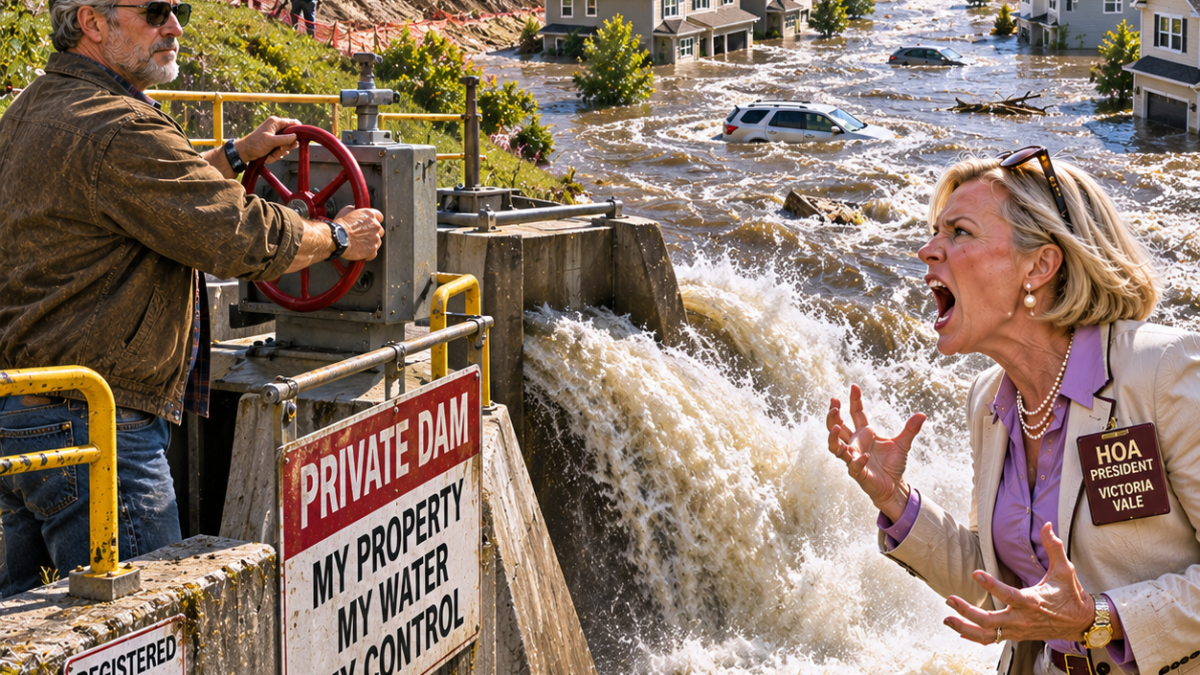
I came home from a six-month engineering assignment overseas and found fifty houses standing on land my grandfather had left me, complete with paved streets, mailboxes, families unloading furniture, and a polished stone entrance sign announcing **MEADOWBROOK HEIGHTS — PHASE II** as though two hundred acres of my family history had somehow become an HOA expansion while I was gone. The woman behind it was Deborah Whitmore, the HOA president who had spent three years trying to buy the lower half of my property for pennies on the dollar, and when I stormed into her sales office demanding to know how she had built an entire neighborhood on land I had never sold, she calmly slid a recorded deed across the desk and told me the county considered her the legal owner. What frightened me most wasn’t the forged paperwork or even the fifty homes—it was realizing that Deborah had placed those families directly below the old flood-control dam my grandfather had built in the 1960s, in a valley he had warned me since childhood should never be developed.
My name is David Brennan.
I was fifty-two and nearing the end of a thirty-year career as a civil engineer when this happened.
The property had been in my family since 1947.
My grandfather bought it after coming home from World War II, back when the valley was mostly forest, rock, wild grass, and a spring-fed creek winding through the low ground.
He spent twenty years shaping the place carefully rather than trying to conquer it.
The most important thing he ever built was the dam.
It wasn’t enormous, but it mattered.
It held a reservoir above the lower valley, provided irrigation water, softened seasonal flooding, and kept the creek from turning violent during heavy storms.
Grandpa taught me every inch of it.
“Water remembers where it used to go,” he told me when I was twelve. “People forget.”
At the time, I thought it was another one of his old-man sayings.
Decades later, I understood exactly what he meant.
Deborah Whitmore entered my life three years before I left for Germany.
She ran Meadowbrook Heights, a suburban development roughly two miles from my property.
Her first offer for one hundred acres was sixty thousand dollars.
The land was worth millions.
I actually thought she’d misplaced a zero.
She hadn’t.
“Mr. Brennan,” she said, “this is an opportunity to become part of something larger.”
“My land isn’t for sale.”
Her smile disappeared.
“You’ll regret being difficult.”
After that came inspections.
Complaints.
Letters.
Zoning allegations.
Environmental complaints.
Every one of them eventually collapsed.
But each cost me time and attorney fees.
My lawyer, Mitchell Barnes, told me not to panic.
“You’ve got clean title,” he said. “She can’t just take land because she wants it.”
I believed him.
Then a German engineering firm offered me a six-month consulting contract on a water-management project.
The timing wasn’t ideal, but the work was exactly what I loved.
Mitchell promised to watch the property.
For three months, he emailed me weekly.
Nothing unusual.
No filings.
No construction.
No problems.
Then his messages stopped.
Two weeks.
No reply.
His secretary kept saying he was unavailable.
My neighbor Frank’s number suddenly stopped working.
Even the county clerk refused to discuss recent property filings by phone.
Something felt wrong enough that I abandoned the final portion of the contract and flew home.
When I landed in Denver, seventeen voicemails appeared on my phone.
Three came from a lawyer I had never heard of.
The first message said I was being sued for trespassing.
Trespassing.
On my own property.
I drove north from the airport with both hands locked around the steering wheel.
Two hours later, I reached my access road.
Then I hit the brakes.
The forest was gone.
In its place stood houses.
Not five.
Not ten.
Fifty.
Some finished.
Some still under construction.
Children rode bicycles along fresh sidewalks.
Moving trucks sat beside new garages.
A mail carrier was filling curbside boxes.
And where my grandfather’s lower pasture had once opened toward the creek, a stone monument now read:
**MEADOWBROOK HEIGHTS — PHASE II**
I drove through in a state I can only describe as numb.
At the center of the development stood a sales office.
I went inside.
A young woman looked up brightly.
“Are you here for a tour?”
“Who owns this land?”
Her smile disappeared.
“Whitmore Property Group.”
“Where is Deborah Whitmore?”
“She’s in a meeting.”
I walked past her and opened the only closed office door.
Deborah sat behind a desk covered in architectural plans.
She looked up.
No surprise.
No fear.
Just satisfaction.
“Mr. Brennan,” she said.
Then she reached into a folder.
“Welcome home.”
She slid a document toward me.
I looked down at the signature line.
And saw my own name written in handwriting that wasn’t mine.
PART 2
For several seconds, I couldn’t speak.
I had spent my career reading technical drawings, contracts, inspection records, easements, construction specifications, and government filings.
Documents were familiar territory.
That paper looked real enough to fool someone who wasn’t looking for a lie.
County recording stamp.
Parcel identification numbers.
Legal description.
Notary block.
Transfer date.
My name.
Deborah’s company.
Everything arranged exactly where it belonged.
Except the signature.
I touched it with one finger.
“This isn’t mine.”
Deborah leaned back.
“It’s recorded.”
“You forged my signature.”
“I didn’t forge anything.”
“I have signed thousands of documents in my life. That’s not my signature.”
She gave me a cold little smile.
“Then perhaps you should speak with your attorney.”
“I will.”
“The county accepted it.”
“That doesn’t make it real.”
“It makes it legally effective until someone proves otherwise.”
That sentence told me she had rehearsed this.
I picked up the deed.
She held out her hand.
“That stays here.”
I looked at her.
“It’s a copy.”
“Yes.”
“So I’ll keep it.”
Her smile disappeared.
“You’re standing on private property.”
I nearly laughed.
“My property.”
“Not according to the county.”
“You built fifty houses in six months.”
“Closer to eight.”
I stared at her.
She had started before I even left the country.
That realization hit harder than the deed.
This hadn’t been some opportunistic land grab after my plane took off.
She had been preparing it while still sending me nuisance complaints.
While smiling at zoning hearings.
While making offers.
While pretending the only dispute was price.
“You planned this.”
She folded her hands.
“I planned a housing development.”
“On land you didn’t own.”
“On land my company legally acquired.”
“Stop saying legally.”
Her face hardened.
“Mr. Brennan, I suggest you leave before I call the sheriff.”
“Call him.”
“I will.”
“Good.”
She reached for the phone.
Then something in her expression made me stop.
Not fear.
Confidence.
Too much confidence.
I thought about Frank’s warning.
Half the county officials in her pocket.
I thought about the clerk refusing to talk.
Mitchell disappearing.
The lawsuit accusing me of trespassing.
I slowly put the deed copy into my jacket.
“This isn’t over.”
Deborah smiled.
“Yes, David.”
It was the first time she used my first name.
“It is.”
I drove straight to Mitchell Barnes’s office.
His secretary saw me and stood so fast her chair rolled backward.
“Mr. Brennan.”
“Where is Mitchell?”
“He’s unavailable.”
“Get him.”
“Sir—”
“Now.”
A door opened.
Mitchell stood there.
He looked twenty years older than when I had left.
Tie loose.
Eyes red.
Shirt wrinkled.
“David.”
I walked past him into his office.
He shut the door.
I threw the deed on his desk.
“What happened?”
He stared at it.
That was enough.
“You knew.”
“David—”
“You knew.”
He lowered himself into his chair.
“I didn’t know they would move that fast.”
My hands went cold.
“You knew.”
“I knew they filed something.”
“When?”
“November.”
“Before I left?”
He didn’t answer.
“Mitchell.”
“Shortly before.”
I backed away from the desk.
“You told me nothing was happening.”
“I was trying to manage it.”
“Fifty houses, Mitchell.”
His face collapsed.
“They threatened me.”
“With what?”
He stared at his hands.
“An old trust-account issue.”
“What issue?”
“Twenty-one years ago, I moved client funds between accounts before a closing. The money was restored. Nobody lost anything.”
“Was it legal?”
He closed his eyes.
“No.”
I sat down because suddenly my knees didn’t feel reliable.
“You let them steal my property because they had dirt on you.”
“I tried to slow them.”
“You sent me weekly emails saying everything was fine.”
“I was scared.”
“So was I.”
“I know.”
“No, you don’t.”
My voice broke.
“That land is the only thing my grandfather left me.”
He looked up.
“I know.”
“You promised to protect it.”
“I know.”
I stood.
“Stop saying that.”
He flinched.
I had never shouted at him before.
Fifteen years.
He had helped me through my grandfather’s estate.
Handled my mother’s medical directives.
Reviewed my retirement papers.
I had trusted him with almost everything that mattered.
“What else did they do?”
Mitchell pulled a folder from his drawer.
His hands shook.
“County clerk accepted the transfer.”
“Obviously.”
“Notary is legitimate.”
“She witnessed a forged signature?”
“According to the document.”
“Building permits?”
“I objected.”
“What happened?”
“Planning approved them.”
“Environmental review?”
“Waived under an amended development determination.”
“By who?”
“County administrator.”
“Survey?”
“Submitted.”
“Real survey?”
Mitchell didn’t answer quickly enough.
I felt sick.
“Show me.”
The elevation survey attached to the development plan contained measurements I knew were impossible.
The lower valley was a natural floodplain.
I had surveyed portions of it personally.
Grandpa had taught me its contours before I could drive.
The Whitmore report claimed building pads several feet higher than reality.
“They falsified elevations.”
Mitchell whispered:
“I think so.”
“You think?”
“I never visited after construction started.”
“Why?”
“Security stopped me.”
“On my land.”
He looked away.
I gathered the files.
“Who can I trust?”
He gave a humorless laugh.
“Not me.”
That answer hurt more than anything else he had said.
I left.
By midnight, I had called Rebecca Soto.
Rebecca practiced property and civil-rights litigation in Denver.
No connection to Jefferson County.
No reason to care about Deborah Whitmore.
I drove to her office the next morning with three boxes.
She spent almost four hours going through them.
Finally, she leaned back.
“The deed is almost certainly fraudulent.”
“Almost?”
“I’m a lawyer. We say almost until a handwriting expert says definitely.”
“The elevations are fake.”
“That needs an engineer.”
“I am an engineer.”
“Then we need another engineer.”
I nodded.
She continued.
“The permits are troubling.”
“Can we stop construction?”
“Possibly.”
“Possibly isn’t good enough.”
“David, fifty homes exist.”
“On stolen land.”
“I understand.”
“Families are moving in.”
“I understand that too.”
I stood and walked toward the window.
“So we get an injunction.”
“We try.”
“Try?”
She waited until I turned around.
“You need to hear something you aren’t going to like.”
“Go ahead.”
“The families who purchased these homes may be innocent parties.”
“They are.”
“Which means every legal remedy becomes more complicated.”
“They bought stolen property.”
“Without knowing.”
“That doesn’t make Deborah the owner.”
“No.”
“So?”
“So courts don’t erase fifty mortgages with a pen in one afternoon.”
I rubbed both hands over my face.
“What do I do?”
“First, we preserve evidence.”
“Then?”
“Title challenge.”
“Then?”
“Emergency review of the development approvals.”
“Then?”
“Potential federal claims if corruption can be documented.”
“And while we do that?”
She looked at me.
“We try to stop additional sales.”
That was the first plan that sounded remotely useful.
We filed.
Fast.
Title fraud.
Forgery.
Emergency injunction.
Notice to purchasers.
Request to freeze unsold property transfers.
Three weeks later, the county judge dismissed the emergency application on procedural grounds and required a longer evidentiary process.
Rebecca walked out of court furious.
“This is not normal.”
“You think he’s compromised?”
“I think we don’t accuse judges without proof.”
“Campaign donations are public.”
She stopped walking.
“You checked?”
“Last night.”
Whitmore Property Group and related entities had contributed heavily to the judge’s previous election campaign.
Legal donations.
Publicly reported.
Not proof of bribery.
But enough to make my stomach turn.
Rebecca filed a recusal motion.
Denied.
We appealed.
Weeks passed.
More families moved in.
I contacted state agencies.
Complaints were acknowledged.
Nothing immediate happened.
I contacted news organizations.
No response.
Then the threatening men found me.
I was leaving a hardware store when two men approached near my truck.
One wore a navy golf shirt.
The other had a shaved head.
“David Brennan?”
I stopped.
“Who wants to know?”
“Mrs. Whitmore would like this situation to calm down.”
“Then tell her to return my land.”
The shaved-head man smiled.
“You’re making this more complicated than necessary.”
“That seems to be a popular phrase.”
“Drop the lawsuit.”
“No.”
“You’ve already lost.”
“No.”
He stepped closer.
“People have accidents when they’re under stress.”
My pulse increased.
I kept my hands visible.
“You threatening me?”
“I’m telling you to take care of yourself.”
They walked away.
That night, all four tires on my truck were slashed.
Across my front door, someone had painted:
DROP IT.
I photographed everything.
Called Rebecca.
Called the state police rather than the county sheriff.
Then I called a man named Marcus Webb.
Frank had once mentioned him.
Former sheriff’s deputy.
Private investigator.
Fired after challenging local corruption.
We met at a diner two counties away.
He read the police report.
Then the deed.
Then Deborah’s company records.
“You finally got her attention.”
“She had mine first.”
He looked at me.
“You want me to prove she stole your land?”
“I want everything.”
“Everything is expensive.”
“I don’t care.”
He smiled faintly.
“People who say that usually care by invoice three.”
“I have retirement savings.”
“You may need them.”
“Find out what she did.”
Marcus spent three weeks digging.
He didn’t break into offices.
Didn’t hack computers.
He pulled public filings.
Corporate registrations.
Property records.
Campaign disclosures.
Insurance records legally available to investigators.
He talked to former contractors.
Subcontractors.
Neighbors.
People Deborah had sued.
People Deborah had fired.
Then he called me at nine one night.
“Come to my office.”
“What did you find?”
“Enough that I don’t want to say it by phone.”
I arrived forty minutes later.
Documents covered his conference table.
Maps.
Insurance schedules.
Permit applications.
Email printouts supplied by a former Whitmore employee.
Marcus pointed to a flood map.
“You know this better than I do.”
I leaned over.
Special flood hazard zone.
The entire Phase II development sat inside it.
Not close.
Inside.
“This is old data.”
“Still valid?”
“Yes.”
He handed me the development map.
The flood designation had been removed.
“How?”
“Updated survey.”
I compared elevations.
Impossible.
“The numbers are fabricated.”
“You’re sure?”
“I’ll stake my license on it.”
Marcus pushed another stack toward me.
“Look at the insurance.”
Fifty homes.
Flood coverage.
Unusually high insured values.
Policies bound unusually early in the sales process.
Several coordinated through the same broker.
Douglas Kramer.
Sentinel Insurance Group.
“Why so high?”
“That’s what bothered me.”
I read correspondence obtained from a former Whitmore finance employee.
The language was careful.
Not a cartoon villain confession.
But the pattern was obvious.
Discussions of “catastrophic-event valuation.”
“Maximum recoverable exposure.”
“Asset replacement differential.”
One email from Deborah asked:
Are all Phase II units fully covered before final occupancy?
Douglas replied:
Yes. Flood riders are in place.
Another:
Ensure ownership entities remain protected if regional event occurs before resale stabilization.
I looked at Marcus.
“They expected flooding.”
“I think they knew the risk was much higher than buyers were told.”
“Fraud?”
“Possibly insurance fraud. Definitely disclosure questions.”
“Families know?”
“No.”
I sat down.
The room felt suddenly too small.
These weren’t empty investment units.
People lived there.
Families.
Children.
Retirees.
People who had bought houses believing inspectors and county permits meant something.
Marcus pointed at another file.
“There’s more.”
A former construction superintendent had reported groundwater discoloration during excavation.
The report was marked:
SITE CONDITION — HOLD.
A second document two days later:
CONDITION RESOLVED — CONTINUE.
“Resolved how?”
“No remediation record.”
“That isn’t possible.”
“Maybe it wasn’t resolved.”
My stomach tightened.
“What did they find?”
“Unknown contamination.”
“How unknown?”
“Smell, soil discoloration, oily seepage.”
I stood.
“They built anyway.”
“Yes.”
I walked toward the window.
“Jesus.”
Marcus said:
“David, this isn’t just your land anymore.”
“I know.”
“Whatever you do next affects fifty families.”
“I know.”
He waited.
Then:
“Do you?”
I turned.
“Yes.”
That night, I drove to the dam.
Moonlight reflected across the reservoir.
Grandpa’s old maintenance shed still stood near the upstream bank.
Inside, tools hung exactly where he had left them.
I found his logbooks.
Rainfall.
Reservoir levels.
Valve inspections.
Storm events.
Decades of handwriting.
One note from 1986 caught my attention.
LOWER VALLEY MUST REMAIN OPEN FLOODWAY.
Another from 1997:
DEVELOPMENT DOWNSTREAM WOULD CREATE UNACCEPTABLE RISK.
I sat on the workbench.
Grandpa had known.
Not Deborah.
Not the fraud.
The water.
The land.
For decades, the dam had reduced ordinary flooding enough that people forgot the valley was naturally supposed to carry water during extreme storms.
I drove home and called Rebecca.
“We need state dam safety.”
“What happened?”
“The development is inside the emergency release path.”
“Explain.”
“The reservoir protects the valley under normal conditions, but if we get a major storm and the dam approaches its operational limit, water has to be released.”
“Would that flood Phase II?”
“Yes.”
“How badly?”
“I don’t know yet.”
“Don’t touch anything.”
“I wasn’t planning to.”
“David.”
“I said I wasn’t.”
“Get an independent engineer.”
We hired one.
Dr. Elaine Porter.
Hydrologist.
Thirty-two years in flood modeling.
No Jefferson County connection.
She reviewed the dam.
Reservoir.
Weather records.
Flood maps.
Development elevations.
Then she called me into the temporary site office.
“Who approved those houses?”
“That is a long story.”
“They shouldn’t be there.”
“I know.”
“No, David.”
She pointed at the map.
“They really should not be there.”
“How bad?”
“In a major storm, even with the dam functioning correctly, the lower valley remains vulnerable.”
“What if the reservoir reaches emergency release level?”
She looked at me.
“Then the operator follows the dam’s safety plan.”
“And Phase II?”
“Floods.”
I looked away.
“How deep?”
“Depends on rainfall, soil saturation, release rate, downstream obstruction.”
“Worst case?”
“Several feet in low areas.”
“People?”
“If warned and evacuated early, manageable.”
“And if they aren’t?”
She did not answer.
She didn’t need to.
We contacted the state dam-safety office.
That was the first government agency that reacted immediately.
Two engineers arrived within forty-eight hours.
One walked the crest of the dam with me.
The other studied Phase II.
“Was downstream development disclosed to the dam program?”
“No.”
“It should have been.”
“Would approval have changed?”
“Probably.”
“What happens now?”
“We update the emergency action plan.”
Finally.
Something real.
We mapped evacuation routes.
Notification procedures.
Reservoir thresholds.
Downstream warnings.
No secret operation.
No revenge plan.
A safety plan.
Rebecca also contacted Sarah Chen, an investigative reporter in Denver.
Sarah had spent years reporting on land-use corruption.
She met us at Rebecca’s office.
At first she looked skeptical.
Then she read the forged deed.
Then the elevation reports.
Then the insurance correspondence.
Then the contamination report.
Her skepticism disappeared.
“This is enormous.”
“Yes.”
“Why hasn’t the state acted?”
“Fragments are in different agencies.”
“And local officials?”
“Compromised or incompetent.”
“Which?”
Rebecca said:
“We can prove conflicts. Let’s not overstate bribery yet.”
Sarah nodded.
She understood.
“What do you want from me?”
“Verify everything independently,” I said.
“And publish?”
“When you’re ready.”
Sarah looked at me.
“You’re not asking me to hold it?”
“No.”
That was another change.
The source version of this story—the one people later repeated—made it sound like I planned some secret theatrical moment where nature would expose everything at exactly the right time.
I didn’t.
By then, I wanted the truth out before the weather ever mattered.
Sarah started calling.
County.
Developers.
Insurers.
Former workers.
Residents.
Deborah learned quickly.
She called me.
Unknown number.
“David.”
“What?”
“You’ve been talking to reporters.”
“Yes.”
“You sent investigators.”
“State dam safety.”
“You’re trying to panic homeowners.”
“I’m trying to keep them alive.”
Her voice went cold.
“You always were dramatic.”
“Your houses are in a floodplain.”
“According to outdated maps.”
“According to current maps.”
“My engineers disagree.”
“Your engineers invented elevation.”
Silence.
Then:
“You need to stop.”
“No.”
“If you continue defaming my company, I will sue you personally.”
“Get in line.”
“You think you can destroy everything I’ve built?”
I gripped the phone.
“You built it on land you stole.”
“No court has ruled that.”
“Yet.”
She lowered her voice.
“You’re going to lose, David.”
“Maybe.”
“You’ll lose your money.”
“Maybe.”
“Your reputation.”
“Maybe.”
“Then what is this worth to you?”
I looked through my window toward the hills.
“My grandfather’s land.”
I paused.
“And fifty families who deserve to know what you sold them.”
She hung up.
Sarah’s first article ran three days later.
Not the full scandal.
A narrower story.
QUESTIONS RAISED OVER FLOOD DISCLOSURES AT MEADOWBROOK HEIGHTS PHASE II.
It cited independent flood maps.
Buyer interviews.
The questionable elevation discrepancies.
Deborah denied wrongdoing.
County officials promised review.
For the first time, residents started calling me.
The first was Patricia Morales.
Single mother.
Two children.
House 14.
“Mr. Brennan?”
“Yes.”
“Is my house on your land?”
My throat tightened.
“Yes.”
Silence.
Then:
“Did I buy a stolen house?”
“You bought a house from people who represented they had legal title.”
“That isn’t what I asked.”
“No.”
I closed my eyes.
“You didn’t steal anything.”
“Are we going to lose our home?”
“I don’t know.”
“My daughter starts middle school next week.”
“I know.”
“No, you don’t.”
She started crying.
“I’m sorry.”
I wanted to tell her everything would be fine.
I couldn’t.
“Patricia, have you received any flood-risk documents?”
“Insurance paperwork.”
“Do you have a second floor?”
“Yes.”
“Keep important documents together. Medications. Emergency bags.”
“You think we’re going to flood?”
“I think you should be prepared.”
“Why didn’t anyone tell us?”
That question stayed with me.
Why hadn’t anyone?
Because everybody in the chain had benefited from silence.
Seller.
Developer.
Officials.
Insurance interests.
And for too long, even I had treated this primarily as stolen land.
The residents changed that.
It wasn’t just my inheritance anymore.
It was their mortgages.
Their children.
Their lives.
State dam safety issued formal downstream-risk notices.
That forced county emergency management to act.
Deborah called the notices “alarmist.”
At an HOA meeting, she told homeowners:
“The dam has protected this valley for sixty years.”
Patricia stood.
“Does that mean we’re in the flood path?”
Deborah smiled.
“No one is in danger.”
“That’s not what I asked.”
Residents had started learning.
Good.
Frank called me that night.
I hadn’t spoken to him in months.
He had lost his farm after Deborah’s harassment campaign drove him into debt.
He now lived forty miles away.
“I saw the news.”
“I’m sorry I couldn’t reach you.”
“She got my number shut off after I moved.”
“How?”
“Long story.”
“You okay?”
“No.”
Neither of us laughed.
Then:
“You’re fighting her?”
“Yes.”
“Good.”
“Frank, families live down there.”
“I know.”
“Whatever happens, they come first.”
He was quiet.
Then:
“Your granddad would say the same thing.”
Weather changed the following week.
A large storm system developed over the Front Range.
Forecast totals climbed.
State engineers called.
“Reservoir is already high.”
“How high?”
“Higher than we’d prefer.”
Rain from earlier storms had saturated the watershed.
Emergency management activated the updated plan.
Phase II residents received evacuation warnings before the storm arrived.
Not anonymous letters.
Official alerts.
Deborah told people the warnings were politically motivated.
Some believed her.
Most didn’t.
Patricia called me.
“We’re leaving.”
“Good.”
“Should we take everything?”
“Take what matters.”
“Will the house survive?”
I looked at the model.
“I can’t promise that.”
She went quiet.
Then:
“I hate you for saying that.”
“I know.”
“But thank you for saying it.”
The first heavy rain arrived Thursday evening.
By Friday morning, reservoir inflow had doubled.
By noon, the state engineer in charge called me.
“David, be ready.”
I knew what that meant.
The dam had an emergency operating protocol.
If the reservoir exceeded a specific safety threshold, controlled release was required to prevent uncontrolled overtopping or structural failure.
A controlled release could flood the valley.
A dam failure could kill people.
There was no revenge in that equation.
Only bad choices.
And one worse choice.
At four-thirty, emergency management ordered full evacuation of the lowest Phase II streets.
Fire crews knocked on doors.
Sheriff’s deputies blocked access.
School buses assisted residents without transportation.
Animal-control teams moved pets.
Deborah arrived furious.
She tried to enter the development.
A deputy stopped her.
“These are my homeowners.”
“They’re evacuating.”
“This is unnecessary.”
“The order is active.”
She called someone.
Then someone else.
Nobody overruled it.
For the first time, her phone calls didn’t matter.
At six-ten, the reservoir crossed the warning threshold.
Rain hammered the roof of the dam control building.
Elaine stood beside me.
State engineer Paul Mercer was on radio with emergency management.
I looked at the gauge.
My grandfather’s handwriting appeared in my mind.
Water remembers where it used to go.
Paul looked at me.
“We’re approaching mandatory release.”
My stomach tightened.
“If we do this—”
“I know.”
“Those houses—”
“I know.”
“Is everyone out?”
He checked radio traffic.
“Primary evacuation complete. Crews are checking.”
I stood there listening to rain.
I had imagined this moment differently when I was angry.
In those early nights after discovering the houses, some ugly part of me had fantasized about watching Deborah’s empire wash away.
Now all I could think about was Patricia’s daughter.
The blue backpack she had mentioned.
Families carrying photo albums.
Old people leaving homes they believed were safe.
This wasn’t revenge anymore.
It was disaster management.
And I hated it.
At seven-oh-two, the state issued the order.
Controlled emergency release.
Paul looked at me.
“As owner and qualified operator, you can execute.”
My hands shook.
“I don’t want to.”
“No one does.”
“What if the model is wrong?”
“Then we adapt.”
“What if the release damages houses?”
“It will.”
The words hit me.
He continued.
“What if we don’t release and the dam overtops?”
I looked at the reservoir.
That answer was worse.
I nodded.
The actual procedure was controlled, staged, and monitored by engineers and emergency personnel.
No dramatic spinning wheel in the dark.
No secret sabotage.
No attempt to make the flood look natural.
We logged every action.
Time.
Reservoir level.
Downstream gauge.
Flow.
Emergency communications.
At seven-fourteen, I authorized the first release step.
Water moved into the lower creek.
At first, nothing looked extraordinary.
Rain already filled drainage channels.
The creek rose.
Then kept rising.
Emergency crews reported water entering the lowest street.
Patricia’s house was on that street.
My chest tightened.
“Occupancy?”
“Clear.”
“Confirmed?”
“Confirmed.”
We increased the release according to the safety plan.
By nine, water covered lawns.
By ten, it reached some front steps.
By eleven, lower floors of several homes had taken water.
News helicopters arrived.
From the dam, I could see flashing lights along the ridge.
Deborah stood behind the barricade.
Even from a distance, I recognized her posture.
Hands moving.
Pointing.
Demanding.
But there was nothing she could demand away.
Gravity did not care who chaired the HOA.
The flood continued through the night.
Not a wall of water.
Not some cinematic wave.
A relentless rise.
Slow enough to evacuate.
Strong enough to ruin everything left behind.
Furniture.
Drywall.
Cars.
Flooring.
Memories.
Every report that came over the radio felt like a weight.
No fatalities.
No missing residents.
Minor injuries during evacuation.
No one trapped.
Those were the numbers that mattered.
At 1:18 a.m., something unexpected happened.
A house on the eastern edge shifted.
Foundation movement.
Fire crews reported ground erosion.
Then an environmental officer radioed:
“Possible contaminated discharge.”
Paul looked at me.
“What?”
The report repeated.
Dark liquid.
Unusual odor.
Sheen on floodwater.
Hazmat requested.
My mind jumped immediately to the construction report Marcus had found.
Oily seepage.
Unresolved condition.
I called him.
“Marcus.”
“I’m watching the news.”
“The contamination report was real.”
Silence.
Then:
“David.”
“I know.”
By dawn, state environmental crews had established a perimeter.
Samples went to laboratories.
Residents were prohibited from returning.
Deborah called a press conference.
She blamed the dam.
Blamed me.
Blamed the storm.
Blamed “politically motivated misinformation.”
Then Sarah Chen published her second story.
This one changed everything.
She had obtained historical industrial records connecting portions of the valley to a manufacturing company once controlled by Deborah’s late husband, Richard Whitmore.
Decades earlier, contractors associated with the company had been investigated for improper waste disposal.
No one had ever connected those records to my land.
Not until now.
The flood had exposed buried drums and contaminated soil beneath part of Phase II.
The state called federal environmental authorities.
The insurance investigation accelerated.
So did the title investigation.
The forged deed suddenly mattered to agencies that had ignored it when it was “just” a property dispute.
Federal investigators arrived.
Not because I had triggered some magic revenge plan.
Because the evidence had converged.
Land fraud.
False development documents.
Insurance irregularities.
Possible corruption.
Environmental concealment.
Threats.
Forged records.
The story was too large for one county to bury.
Marcus called me three days after the flood.
“You should turn on the news.”
I did.
Federal agents were carrying boxes out of Whitmore Property Group headquarters.
Douglas Kramer had been placed under arrest pending federal charges related to insurance fraud and conspiracy.
The county clerk’s office was being searched under warrant.
Two officials were placed on administrative leave.
Deborah appeared on camera outside her home.
For once, no clipboard.
No prepared smile.
A reporter shouted:
“Mrs. Whitmore, did you know Phase II was built inside a designated flood zone?”
“No comment.”
“Did you forge David Brennan’s deed?”
“No comment.”
“Did you know about the contamination?”
Her face changed.
Just slightly.
Sarah noticed it too.
That clip ran all evening.
Deborah was arrested two days later.
The list of allegations was long.
Fraud.
Forgery.
Bribery-related offenses.
Conspiracy.
Insurance fraud.
Financial crimes.
Environmental violations.
Not every accusation would survive.
Rebecca reminded me of that constantly.
“Charges aren’t convictions.”
“I know.”
“News isn’t evidence.”
“I know.”
“Do not talk like the case is finished.”
“I know.”
She looked at me.
“You’re irritating when you say that.”
“I had a lawyer train me.”
“Which lawyer?”
“Current one.”
“Good answer.”
My own actions were reviewed too.
That mattered.
The dam release had damaged dozens of houses.
Investigators examined every log.
Every threshold.
Every emergency warning.
Every communication with state engineers.
Every evacuation order.
I sat for hours of interviews.
“Did you want the development flooded?”
The federal investigator asked.
I answered truthfully.
“When I first discovered what happened, part of me wanted Deborah to lose everything.”
“Did that influence your decision to release water?”
“No.”
“Why should we believe that?”
I slid the operating log across the table.
“Because I didn’t make the decision alone.”
State dam-safety engineers confirmed the reservoir had reached conditions requiring controlled release under the emergency plan.
Hydrologists testified that withholding release would have increased the risk of overtopping and uncontrolled failure.
The investigation cleared the operation as a documented emergency response.
That finding saved me legally.
It did not erase how complicated I felt about the outcome.
Fifty families lost their homes.
Yes, Deborah had put them there.
Yes, the land would eventually have flooded.
Yes, contamination was underneath them.
Yes, everyone survived because evacuation happened first.
Still, when Patricia called me from a hotel room, she cried.
“My daughter’s room is gone.”
I closed my eyes.
“I’m sorry.”
“She had drawings on the wall.”
“I know.”
“No, you don’t.”
She had said that once before.
This time I didn’t argue.
“You’re right.”
Her voice softened.
“I know you didn’t create this.”
I said nothing.
“I saw the state report.”
“Okay.”
“They said the dam would’ve been in danger.”
“Yes.”
“So you had to release.”
“Yes.”
She took a shaky breath.
“I still hate that you were the one standing there.”
“I understand.”
“I don’t hate you.”
“Okay.”
“I just don’t know what to feel.”
“Neither do I.”
That was the most honest conversation I had after the flood.
The Phase II residents filed claims against Whitmore Property Group, insurers, contractors, and the county.
Rebecca helped coordinate lawyers representing them.
Not because they suddenly became part of my revenge.
Because they were victims too.
Some settlements came from insurance.
Some from corporate liquidation.
Some from government liability.
Amounts differed by mortgage, damage, contamination exposure, and coverage.
Nobody got a magical check that erased everything.
But most families eventually received enough to relocate without being financially destroyed.
Patricia bought a smaller house fifteen miles away.
On high ground.
She called me after closing.
“You know the first thing I asked?”
“What?”
“Flood map.”
I laughed.
“So something good came from me?”
“Don’t get carried away.”
The forged transfer of my land was voided after federal handwriting experts, notary evidence, payment records, and internal Whitmore documents established the sale had never happened.
My title was restored.
No one disputed it after that.
But standing in the ruined valley, I felt no joy.
Mud covered the streets.
Hazmat fencing surrounded contaminated areas.
The shells of houses waited for demolition.
The forest Grandpa had loved was already gone.
Technically, I had won the land back.
Emotionally, it felt like inheriting a wound.
I told Rebecca:
“I don’t want houses there again.”
“Then don’t build.”
“I mean ever.”
“That requires more than a promise.”
We created a conservation easement.
Eventually, I transferred the lower valley into a conservation trust with permanent restrictions against residential development.
Environmental cleanup came first.
Federal and state agencies removed contaminated soil.
Treated groundwater.
Excavated buried waste.
Demolished unsafe structures.
It took years.
Not months.
That was another thing the dramatic news reports got wrong.
Nature does not heal on a television schedule.
Neither do people.
The criminal case against Deborah took almost a year to reach trial.
By then, prosecutors had separated rumor from provable fact.
Some local officials had accepted improper payments.
Others had simply been negligent.
Some permits contained knowingly false information.
Others had been signed by people who claimed they relied on fraudulent reports.
Douglas Kramer reached a cooperation agreement.
Mitchell Barnes surrendered his law license and testified about the coercion and the false filings he had failed to expose.
That was difficult to watch.
He sat on the witness stand with his shoulders rounded.
The prosecutor asked:
“Did Mr. Brennan authorize the transfer?”
“No.”
“Did you know that?”
“Yes.”
“Did you tell him while he was overseas?”
“No.”
“Why?”
Mitchell looked toward me.
“Cowardice.”
The courtroom went silent.
Not blackmail.
Not fear.
Not Deborah.
Cowardice.
He could have blamed everything else.
Instead, he owned the part that was his.
I never trusted him again.
But I respected that answer.
The prosecution’s strongest evidence against Deborah came from her own records.
Emails.
Payments.
Draft deeds.
Messages with the notary.
Instructions concerning elevation certificates.
Insurance correspondence.
One email to Douglas Kramer read:
Phase II must close before revised flood mapping becomes a sales issue.
Another:
Do not circulate the original Brennan title materials.
And another to a county contact:
We need the elevation challenge closed before state review.
No confession.
No movie-villain speech.
Just enough.
Piece by piece.
The contamination evidence was more complicated.
Prosecutors proved Deborah had received a historical environmental memo referencing potential buried industrial waste before construction.
Her defense argued she believed the issue had been resolved decades earlier.
The government showed she had ordered additional soil testing canceled after preliminary results threatened the development schedule.
That destroyed the defense.
Sarah sat behind me during closing arguments.
She whispered:
“That’s the whole case.”
“What?”
“She always had one more chance to stop.”
I knew exactly what she meant.
Deborah could have stopped after I rejected her offer.
After the harassment.
After the forged deed.
After the first bad soil report.
After the flood map.
After the insurance questions.
After residents asked.
Every stage gave her an exit.
Pride and money closed each one.
The jury convicted her on the major fraud, forgery, conspiracy, bribery-related, and financial counts, along with environmental offenses supported by the evidence.
Not every charge.
Enough.
At sentencing, the judge imposed a lengthy federal prison term and substantial restitution.
Not because she was an HOA president.
Not because she had annoyed me.
Because fifty families had been sold homes through fraud on land obtained through forgery, inside a concealed flood hazard, above contamination she had reason to investigate and chose not to.
When they led her away, she looked at me.
I expected anger.
There wasn’t any.
Only exhaustion.
Nine months later, I received a letter.
Federal correctional institution.
Deborah Whitmore.
I almost threw it away.
Instead, I put it in a drawer.
Three days later, I opened it.
David,
I know you have no reason to speak to me.
I am not asking you to change anything about my case.
There are things about the land you still don’t know.
If you are willing, I would like to tell you in person.
D.W.
I called Rebecca.
“Don’t go.”
“Why?”
“Because you’ve spent three years trying to get her out of your life.”
“What if it’s about contamination?”
“Tell investigators.”
“She specifically said the land.”
Rebecca sighed.
“You’re going anyway.”
“Probably.”
“Then do not promise her anything.”
“I won’t.”
The prison was six hours away.
Deborah looked different when she entered the visiting room.
Gray hair pulled back.
No makeup.
No jewelry.
No tailored suit.
She sat across from me.
“Thank you.”
“Why am I here?”
She folded her hands.
“My husband.”
“Richard.”
“Yes.”
“He knew about the waste.”
She nodded.
“How?”
“He created some of it.”
My jaw tightened.
She continued.
“His manufacturing company dumped solvents and metal waste illegally in several rural sites during the eighties and early nineties.”
“On my grandfather’s land?”
“Yes.”
“How?”
“Contractors.”
“Did Grandpa know?”
“No.”
“Why our property?”
“Richard wanted it.”
I stared at her.
“What?”
“He approached your grandfather years before I ever did.”
I remembered nothing about it.
Grandpa had never mentioned Richard Whitmore.
“He offered to buy the valley,” Deborah said. “Your grandfather refused.”
“So he poisoned it?”
Her eyes lowered.
“He approved dumping through a contractor. I don’t know whether revenge was the only reason. Disposal costs were part of it.”
I leaned back.
For a moment, I couldn’t breathe properly.
Grandpa had spent decades protecting water that flowed across land someone had secretly contaminated.
“He never knew.”
“No.”
“And you knew?”
“Not while Richard was alive.”
“When did you find out?”
“After he died.”
“How long before you came to me?”
“About two years.”
I stared at her.
“So when you offered me sixty thousand dollars—”
“I knew.”
“Jesus Christ.”
“I knew the land had contamination risk.”
“And you wanted to buy it cheap.”
“Yes.”
“You built houses on it.”
“Yes.”
“Why?”
Her eyes filled.
“Because I thought if I controlled the property, I could bury the past.”
I laughed once.
It sounded ugly in the quiet room.
“You buried people on top of it.”
“I know.”
“You knew there might be poison under those houses.”
“I told myself the old reports were exaggerated.”
“You canceled testing.”
“I know.”
“You forged my deed.”
“I know.”
“You threatened me.”
“I know.”
“Stop saying that.”
She flinched.
The words came out exactly as they had with Mitchell.
Another person telling me they knew after years of choosing not to care.
Deborah looked down.
“Richard left me a life built on fraud.”
“And you continued it.”
“Yes.”
“Why?”
“At first?”
She took a breath.
“Fear.”
“Then?”
“Money.”
“Then?”
“Pride.”
That answer was quieter.
More believable.
“I thought if I admitted what Richard had done, everything would disappear. The company. The houses. My reputation.”
“So you became him.”
“Yes.”
No defense.
That made it harder to hate her in the clean way I wanted.
She reached into a folder a guard had approved.
A sheet of paper.
Two parcel references.
“These are other sites.”
I didn’t touch it.
“What sites?”
“Places Richard used.”
“Contaminated?”
“I believe so.”
“Does the government know?”
“Not these.”
“Why tell me?”
“Because I don’t trust myself to decide what deserves protecting anymore.”
I took the paper.
“You need to tell federal investigators.”
“I will.”
“Then why give it to me?”
“Because you’ll make sure someone actually checks.”
I stared at her.
“That sounds almost like trust.”
“No.”
She gave a faint, exhausted smile.
“It sounds like consequence.”
I gave the information to federal environmental investigators that afternoon.
Both sites were later tested.
Both required remediation.
Neither had homes built over it.
That was the first good thing Deborah had done that I knew about.
It did not erase anything.
It still mattered.
Years passed.
The lower valley changed slowly.
Demolition crews left.
Excavation ended.
Clean soil replaced contaminated layers.
Groundwater monitoring wells remained.
Native grasses returned.
Wildflowers came after that.
Then deer.
Then foxes.
One spring morning, I saw two beavers working near the creek.
I laughed so hard I had to sit down.
Grandpa had spent years maintaining a dam.
The beavers apparently had opinions.
The conservation trust built a small educational center on high ground.
Not a museum about revenge.
A place about water.
Floodplains.
Land-use history.
Environmental contamination.
Property records.
Public corruption.
The importance of independent review.
One exhibit included two elevation maps.
The real one.
The forged one.
No dramatic labels.
Just:
WHAT HAPPENS WHEN DATA IS MADE TO SERVE A DECISION INSTEAD OF INFORM IT?
School groups came.
Engineering students came.
So did families who had once lived in Phase II.
Patricia visited with her children three years after the flood.
Her daughter, Elena, was sixteen by then.
She stood overlooking the grassland.
“Our house was there?”
Patricia pointed.
“About where those cottonwoods are.”
Elena looked at me.
“Do you feel bad?”
Children ask the clean questions adults spend years avoiding.
“Yes.”
“For opening the dam?”
I looked toward the reservoir.
“For every house that was lost.”
“But you had to?”
“The reservoir had to be released.”
“That isn’t what I asked.”
She was her mother’s daughter.
I smiled sadly.
“Yes. I still feel bad.”
“Even if nobody died?”
“Yes.”
“Even if the houses were dangerous?”
“Yes.”
“Why?”
“Because necessary doesn’t mean painless.”
She considered that.
Then nodded.
“Okay.”
Patricia touched my shoulder after Elena walked away.
“She doesn’t blame you.”
“I know.”
“Do you blame yourself?”
“Less.”
“That sounds healthy.”
“Expensive therapy.”
She laughed.
Mrs. Jenkins would have liked her.
A few months later, while repairing old masonry near the dam’s maintenance shed, I found a rusted metal box wedged behind a loose stone.
Inside were maintenance notes.
Old photographs.
And one sealed envelope.
My name.
Grandpa’s handwriting.
I sat on the dam before opening it.
David,
If you found this, then you’re still poking around places I told you were dangerous.
Some things don’t change.
I laughed before I reached the second paragraph.
He wrote about the valley.
The dam.
Water.
Stewardship.
Nothing supernatural.
No prediction that I would one day confront Deborah.
No instructions to destroy houses.
Instead:
The dam is not a weapon.
Never use it as one.
If the reservoir must be released, you follow the numbers, the weather, and the safety plan—not your anger.
I stopped reading.
My eyes blurred.
Grandpa continued:
People will someday forget why the lower valley floods because the dam will make them comfortable. Comfort makes people careless.
If they build where water needs to go, the water will eventually remind them.
Your job is not to punish anyone.
Your job is to respect what is real.
Land.
Water.
Gravity.
Truth.
Those things do not care how important a person thinks they are.
Protect people first.
Protect the land second.
Protect your pride last.
I read that sentence four times.
Protect your pride last.
If only I had found the letter earlier.
Maybe I would have avoided some of the anger.
Maybe not.
At the bottom:
You were always better at calculations than patience.
Work on that.
Love,
Grandpa.
I cried.
Not the neat movie kind.
Ugly, shoulders-shaking grief.
For him.
For the valley.
For Mitchell.
For Patricia’s house.
For fifty families.
Even, in some complicated way, for Deborah.
Because Grandpa had been right.
The real danger was never one bad woman.
It was people choosing what they wanted to believe because reality was inconvenient.
Deborah wanted the land.
So the title became an inconvenience.
The county wanted development revenue.
So the flood maps became an inconvenience.
The builders wanted schedules.
So the contamination became an inconvenience.
The insurer wanted premiums and opportunity.
So risk became a number to manipulate.
Mitchell wanted his career protected.
So telling me the truth became an inconvenience.
And when I first came home, I wanted revenge so badly that innocent families briefly became an inconvenience in my own mind.
That scared me more than I liked admitting.
Years later, the dam still stands.
So does my cabin.
The upper forest remains in the family.
The lower valley belongs to the conservation trust now.
It cannot become another subdivision.
Patricia sends Christmas cards.
Frank eventually moved back closer to town after receiving compensation from a separate harassment claim against Whitmore’s company.
Marcus retired from private investigation after the federal cases ended.
He bought a fishing boat.
Calls it *Probable Cause*.
Rebecca still complains that I create too much paperwork.
Sarah Chen won a state journalism award for the Meadowbrook investigation.
She mailed me the article afterward with one sentence written across the top:
You were right about the land.
I wrote back:
Grandpa was.
Mitchell died several years later.
Before he did, he sent me an apology.
I never answered.
I didn’t know what to say.
Forgiveness and trust are different things.
I could let go of wanting him punished without pretending the betrayal hadn’t happened.
Deborah remains in federal custody.
We never became friends.
I visited only once.
She later cooperated with environmental investigators regarding Richard’s old dumping network, which helped locate additional records and cleanup sites.
Whether she did it from remorse, guilt, or hope of reducing her sentence wasn’t my problem to decide.
Good actions don’t require pure motives to be useful.
The old Phase II entrance monument was removed during remediation.
I asked the conservation trust to save one stone.
Not the whole thing.
Just the piece that had once carried the words:
MEADOWBROOK HEIGHTS — PHASE II.
It’s now displayed inside the visitor center.
Beside it is a photograph of the restored valley.
The plaque underneath says:
THIS LAND WAS ONCE TREATED AS IF PAPERWORK COULD OVERRIDE GEOGRAPHY.
IT COULDN’T.
I didn’t write that.
Elaine did.
Much better than anything I would’ve come up with.
On the fifth anniversary of the flood, I walked to the dam before sunrise.
No reporters.
No residents.
No lawyers.
Just me.
The reservoir was calm.
Below, the valley held mist between the grasses.
A hawk moved over the creek.
Farther downstream, beavers had built another dam.
I leaned on the railing.
For years, people told the story as if I had opened a valve and destroyed Deborah Whitmore’s empire.
That version was dramatic.
It was also wrong.
Deborah destroyed her own empire the moment she decided another person’s signature could be manufactured, a floodplain could be redefined, contaminated soil could be ignored, and fifty families could be treated as pieces in a financial scheme.
The storm didn’t create her crimes.
The dam didn’t create them.
The water only made them impossible to hide.
I took Grandpa’s letter from my jacket.
The paper had been folded so many times the creases were soft.
Protect people first.
Protect the land second.
Protect your pride last.
I looked down at the valley.
“I’m working on the last one,” I said.
The creek kept moving.
No applause.
No dramatic answer.
Just water following the path it had always known.
And for the first time since I returned from Germany and found fifty houses standing where my grandfather’s land used to be, that was enough.
[END OF STORY]








