PART 2: HOA Karen Kept Blocking My Logging Gate With Her Tesla — Then an 80,000-Pound Truck Showed Up at Dawn
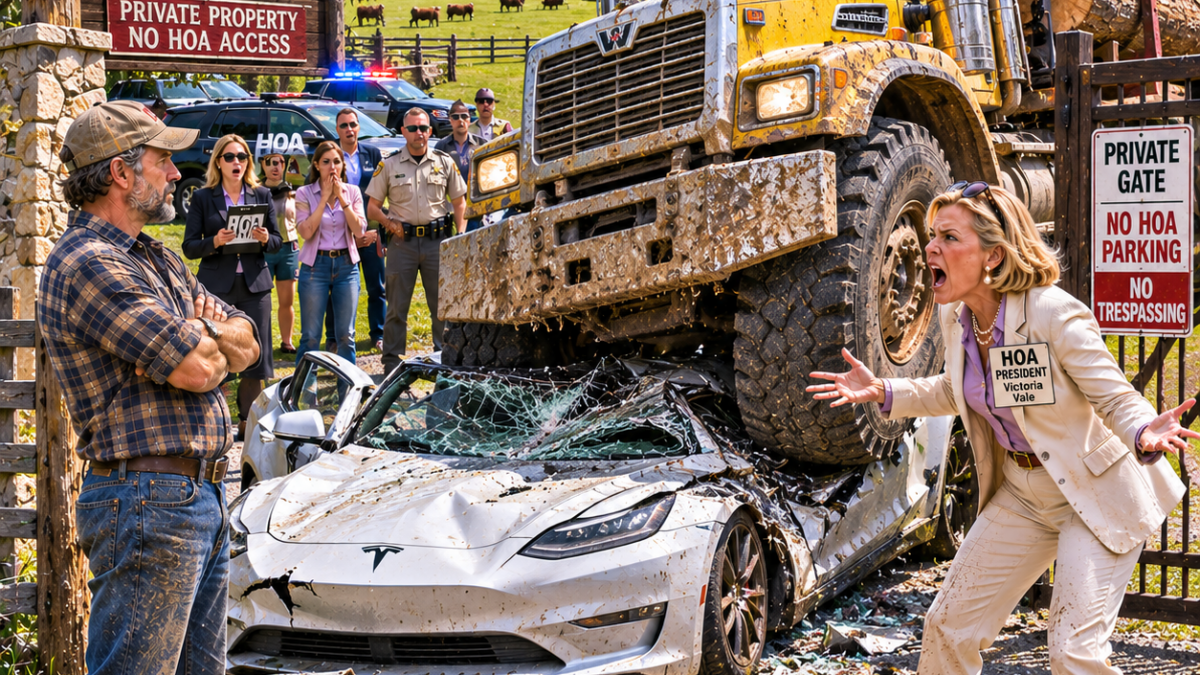
The first time Karen Patterson parked her white Tesla across the only gate to my logging property, I thought she was careless; by the fiftieth time, after fake HOA fines, spray-painted signs, a fraudulent lien, lost deliveries, and one afternoon when my eighty-year-old mother sat exhausted in a car because Karen refused to move, I finally understood that the gate was never the real issue—control was. When I warned Karen in writing that an eighty-thousand-pound logging truck had a legitimate commercial haul scheduled through my private access road at six o’clock Monday morning, she signed for the certified letter, ignored three reflective NO PARKING notices, and still left her Tesla dead center in front of the gate as if daring me to prove that my property actually belonged to me. What she did not know was that for months I had been building something far heavier than anger—a paper trail so complete that when the truck finally came around the bend before sunrise, every person watching would have to decide whether they believed her title, her social-media story, or the evidence.
My name is Marcus Turner. I was forty-seven then, and I had spent twelve quiet years living on fifteen wooded acres just outside Whispering Pines, running a small logging company from a yard behind an iron gate.
The road was mine.
Not shared.
Not leased.
Not maintained by the HOA.
Mine by deed, survey, taxes, maintenance records, and twelve years of gravel bills.
Three metal signs said PRIVATE ROAD — NO PARKING — UNAUTHORIZED VEHICLES WILL BE TOWED.
Nobody had ever argued with them until Karen moved into the largest house near the cul-de-sac.
The first time I met her, she barely introduced herself. The second time, I found her Tesla Model X blocking my gate while she walked toward the clubhouse with a yoga mat.
I honked twice.
Nothing.
I got out.
“Ma’am, is this your car?”
She turned, oversized sunglasses covering half her face.
“Yes. I’ll just be a minute.”
“You’re blocking my driveway.”
She glanced at the gate.
“This is community access.”
“No, ma’am. It’s private.”
Her smile changed.
“The HOA maintains this stretch.”
“I maintain it.”
“Well, I’m vice president.”
I pointed at the sign.
“And I’m the guy who owns the road.”
She left the Tesla there for another hour.
The next morning, I found an HOA violation notice under my gate latch demanding two hundred fifty dollars for “restricting shared roadway access.”
I laughed.
Then she parked there again.
And again.
When I complained to the board, they emailed back that Karen’s use of the road fell within “reasonable community activity.”
So I began taking photographs.
Dates.
Times.
License plate.
Distance from the gate.
Lost work.
Karen noticed.
Instead of stopping, she got bolder.
One sign was spray-painted with HOA ACCESS ONLY.
A delivery truck carrying thousands of dollars in lumber sat idle because her Tesla blocked the gate.
When I told her she had cost me money, she looked straight at me and said, “Maybe you should plan better.”
That was when I called my attorney, Tom.
“Document everything,” he told me. “And don’t touch the car.”
Then the title company called.
Someone had filed an HOA lien against my property for nine hundred dollars in supposed unpaid road-maintenance dues.
The lien carried Karen Patterson’s signature.
Tom went quiet when I sent it.
“Marcus, your land isn’t even in the HOA.”
“I know.”
“This just became bigger than parking.”
We filed a formal challenge and sent a cease-and-desist.
Karen answered by accusing my licensed logging business of violating HOA commercial-use rules.
Rules that still did not apply to me.
Then came the day my mother visited.
She was eighty, walked with a folding walker, and had been looking forward to spending the weekend at my place.
Karen’s Tesla sat inches from the gate latch.
I called.
Voicemail.
I called the HOA.
Nothing useful.
A deputy came, documented the blockage, and explained that the ownership dispute and towing issue would have to be handled carefully.
My mother waited.
And waited.
When she finally reached my house hours later, her face was pale with exhaustion.
She touched my arm and said, “Don’t do anything stupid over me.”
That sentence stayed with me all night.
At midnight, I called Tom.
“I’m done asking.”
He answered quietly.
“Good. Then stop asking and start proving.”
The next morning, he slid a county parcel map across his desk, tapped one section with his pen, and said, “Marcus, look at what Karen filed with the HOA board three months before she ever parked at your gate.”
I leaned closer.
And for the first time, I realized her Tesla had never been the beginning of this fight.
PART 2
The document was a photocopy of a preliminary access proposal from nearly twenty years earlier.
Not an easement.
Not a deed.
Not a right-of-way.
A proposal.
Someone developing Whispering Pines had once wanted a secondary emergency route through the lower edge of the parcel that eventually became mine.
The proposal had been rejected.
The county stamp at the bottom was impossible to misunderstand.
ACCESS NOT GRANTED.
PRIVATE PARCEL EXCLUDED FROM FINAL DEVELOPMENT PLAN.
I looked at Tom.
“Where did you get this?”
“County archives.”
“No. I mean what did Karen file?”
He slid another page beside it.
That version looked almost identical.
Almost.
The lower portion containing the rejection had been cut off.
Across the top, someone had written:
HISTORIC COMMUNITY ACCESS — TURNER ROAD.
I felt my jaw tighten.
“That isn’t the original.”
“No.”
“Who made this?”
“I don’t know yet.”
“Karen filed it?”
“With the board.”
“When?”
“Three months before she first parked there.”
I leaned back.
Suddenly the months rearranged themselves in my head.
The parking.
The fake violations.
The constant phrase shared access.
The HOA letters.
The lien.
Karen had not stumbled into a disagreement and then become stubborn.
She had started with a claim.
Then behaved as if repetition could make the claim true.
“Tom.”
“Yeah?”
“Why would she care this much about a dead access proposal?”
“That’s what we find out next.”
He pulled a second folder from his desk.
“Whispering Pines is trying to expand.”
I stared at him.
“What?”
“There’s a parcel west of the subdivision under option to a developer.”
“My side.”
“Your side.”
“There’s no road connecting it.”
“Not unless they go through you.”
I looked again at the map.
The rejected access line ran directly through my gate and down my private road.
Tom tapped the paper.
“If Whispering Pines can represent this as an existing community access corridor, that western parcel becomes a lot more attractive.”
“Karen knows this?”
“I don’t have proof.”
“She filed the map.”
“That proves she filed the map.”
I hated lawyers for sentences like that.
They were usually right.
“Who owns the development company?”
“We’re checking.”
“Her?”
“No indication.”
“Her husband?”
“Doug works corporate tax.”
“That doesn’t answer my question.”
“No.”
I stood and walked to the window.
For months, Karen had treated me like an obstacle.
Maybe I literally was one.
Not to the HOA.
To a future deal.
I turned.
“Does the board know the map was rejected?”
“I doubt most of them have seen the original.”
“So Karen gave them a cropped copy.”
“We need to be careful with language.”
“She gave them a version missing the rejection.”
“That we can say.”
I laughed without humor.
“You really know how to ruin a good accusation.”
“It’s why I went to law school.”
“What now?”
“We challenge the lien formally.”
“We already did.”
“We also demand the HOA produce the legal basis for every claim they’ve made against your property.”
“And the road?”
“You keep operating your business.”
“While Karen blocks me?”
“For now.”
I stared at him.
He raised one finger.
“And you keep documenting.”
I hated that phrase almost as much as Karen hated the word private.
But I did it.
Every parking incident went into a spreadsheet.
Every photograph had a timestamp.
Every missed delivery had an invoice.
Every time one of my drivers sat waiting because Karen’s Tesla blocked access, I recorded payroll, fuel, and client delay.
Within three weeks, the numbers had become ugly.
One client had threatened to move future orders elsewhere.
Another charged back part of a delayed delivery.
My men were irritated.
Pete Reynolds, my senior driver, finally cornered me by the equipment shed.
“Boss.”
“Yeah?”
“How long are we letting this happen?”
“We’re not letting it happen.”
“Feels like it.”
“I’m handling it.”
Pete looked toward the gate.
“You know what I could do with the Kenworth.”
“Yes.”
“Just saying.”
“No.”
“One little—”
“No.”
He grinned.
“I didn’t finish.”
“I know how your brain works.”
He became serious.
“She’s costing you money.”
“I know.”
“She’s costing us hours.”
“I know.”
“Then why are we waiting?”
Because my mother had looked at me with tired eyes and said:
Don’t do anything stupid over me.
Because Tom had warned me that anger would give Karen exactly what she needed.
Because the most dangerous thing in a property dispute is being right and acting wrong.
I told Pete:
“Because when this ends, I want one version of the facts.”
“What version?”
“The true one.”
He nodded.
“Fair enough.”
Karen did not appreciate patience.
She interpreted it as weakness.
A week later, I came home to find three cars parked across my gate.
Karen’s Tesla in the center.
Two SUVs beside it.
Folding chairs on the gravel.
A portable speaker.
Six women drinking iced coffee.
A printed sign:
COMMUNITY ACCESS AWARENESS DAY.
I stopped my pickup fifty feet away.
For several seconds, I honestly thought I had driven into a parody of my own life.
Karen stood.
She raised her phone.
“Marcus is here.”
Three other phones came up.
I stepped out.
“What is this?”
Karen smiled.
“A peaceful community gathering.”
“On my property.”
“We’re on the disputed access corridor.”
“There is no disputed corridor.”
“Our records say otherwise.”
“The county records say access was rejected.”
Her smile faltered.
Just slightly.
“You don’t know what you’re talking about.”
“I have the original.”
One of the women lowered her phone.
Karen recovered.
“Then let the courts decide.”
“Fine. Until then, move the cars.”
“No.”
“Karen.”
She moved closer.
“You’ve spent months intimidating women over parking.”
I stared.
“Is that what you’re posting now?”
“You have anger issues.”
“Move the cars.”
“You operate dangerous diesel equipment beside a residential community.”
“On land zoned for my business.”
“You threaten people with towing.”
“Because they block a private gate.”
Karen turned her phone toward herself.
“You see what we deal with?”
I almost took the bait.
Almost.
Instead I pulled out my phone and photographed every vehicle.
Every license plate.
The gathering.
The distance from the gate.
Then I called the sheriff’s non-emergency line.
Karen laughed.
“Again?”
“Yes.”
“They’ve already told you this is civil.”
“Then we’ll make another record.”
The laughter disappeared.
That bothered her more than yelling would have.
Deputy Eric Lawson arrived forty minutes later.
He had already been out twice.
He stepped from his cruiser and looked at the chairs.
Then at me.
Then at Karen.
“I’m afraid to ask.”
Karen walked toward him.
“Officer, we are peacefully exercising documented community access.”
Lawson sighed.
“Mrs. Patterson, is that your Tesla?”
“Yes.”
“Is Mr. Turner asking you to move it?”
“He doesn’t own the access corridor.”
Lawson looked at me.
“I do.”
Karen produced her cropped map.
Lawson studied it.
Then I handed him the original county version.
He compared them.
“Why is this part missing from yours?”
Karen crossed her arms.
“Different copy.”
“The missing part says access not granted.”
“That’s his interpretation.”
Lawson looked at the printed words again.
Then at Karen.
“It’s pretty direct.”
She flushed.
“This is a civil title matter.”
“Yes.”
Lawson handed the document back.
“And because it’s a civil title matter, I’m not standing here declaring ownership beyond what records show.”
He pointed toward my signs.
“But Mr. Turner has made clear he does not consent to your vehicles blocking his gate.”
Karen smiled tightly.
“Are you ordering us to leave?”
“I’m strongly advising you to stop creating a situation that keeps generating reports.”
“That’s not an order.”
Lawson looked tired.
“No.”
Karen returned to her chair.
The message was clear.
She had found the gap.
Police were not going to turn a disputed access fight into a roadside trial.
So she used the uncertainty as a shield.
Tom was furious when I told him.
“Good.”
I blinked.
“What part of that was good?”
“She handed a deputy the cropped map.”
“So?”
“So now it’s in a report.”
I sat down.
“Tom.”
“Yes?”
“Do lawyers enjoy misery?”
“Only documented misery.”
The board finally responded to our formal demand.
Their attorney, Lisa Harper, sent a three-page letter.
She was more careful than Karen.
No claim that they definitely owned my road.
Instead:
The association maintains that historic and equitable access rights may exist.
May exist.
That phrase told Tom everything.
“They’ve backed away.”
“Doesn’t feel like it.”
“They went from ‘this is our road’ to ‘rights may exist.’”
“Karen’s still parking there.”
“That part we fix next.”
He had filed for declaratory relief regarding the road and an injunction against unauthorized obstruction of my gate.
Court dates moved slowly.
Meanwhile, Karen kept posting.
One video showed her standing in front of my gate.
“Behind me is a road one private commercial operator is attempting to monopolize despite decades of community use.”
Decades.
Whispering Pines had only existed for eighteen years.
Before that, the land was timber and pasture.
Tom saved the video.
“Another exhibit.”
I laughed.
“You really do love her.”
“She makes my work easy.”
Then the title company called again.
The supposed nine-hundred-dollar HOA lien had been rejected after review because the association lacked authority over my parcel.
Good.
But Tom noticed something else.
Karen had used an internal HOA form containing my parcel number.
That number was not in their normal ownership database.
Somebody had researched it.
Somebody had deliberately entered my land into their system.
Tom subpoenaed association records through the civil process once litigation allowed it.
That was when the first real fracture inside the HOA appeared.
A board member named Lisa Moreno called me.
Not attorney Lisa.
Different Lisa.
Whispering Pines homeowner.
Board secretary.
She sounded nervous.
“Mr. Turner?”
“Marcus.”
“I probably shouldn’t be calling you.”
“Then call Tom.”
“I don’t want this formal yet.”
Everything in me tightened.
“What is it?”
She lowered her voice.
“Karen told us the road was already owned by Whispering Pines.”
“When?”
“Before she became vice president.”
I stopped.
“She wasn’t vice president when she started this?”
“No.”
“She ran partly on getting the western access reopened.”
That was new.
“Why?”
“She said it would improve emergency access and future property values.”
“Future property values.”
“Yes.”
“Did she mention development?”
Silence.
“Lisa?”
“There were discussions.”
“About the parcel west of me?”
“Yes.”
I sat down.
“Who?”
“Karen. Doug. Henry Walters, the board president. A developer named Northstar Ridge.”
There it was.
Not proof of corruption.
Proof the road mattered.
“Did anyone tell you the county rejected the old access?”
“No.”
“What did Karen show you?”
“The map.”
“Full map?”
“I don’t know.”
“Did it say access not granted?”
“No.”
I closed my eyes.
“Lisa, you need your own lawyer.”
“Why?”
“Because you’re describing board decisions involved in active litigation.”
“I didn’t do anything.”
“Then protect yourself.”
She started crying.
Not dramatically.
Quietly.
“I voted for those letters to you.”
I said nothing.
“She said you were trying to steal HOA land.”
I looked toward my gate.
“I’ve paid taxes on it for twelve years.”
“I know that now.”
“You should call Tom.”
“I’m scared.”
“Of Karen?”
“Of what this does to all of us.”
That was the first time I understood something I had missed.
Not everyone supporting Karen believed her.
Some people were simply afraid of admitting they had been wrong after helping her.
I gave Lisa Tom’s number.
Then I went outside and split firewood until my shoulders hurt.
The next morning, Karen’s Tesla was back.
Centered across the gate.
I did not call her.
I photographed it.
Logged it.
Called Lawson.
Logged that too.
Weeks passed.
Then the court granted temporary relief.
Not everything Tom wanted.
Enough.
The order recognized my parcel records, prohibited the HOA and its agents from representing that my road was established HOA property without legal basis, and required vehicles not to obstruct my commercial gate pending final resolution.
I read the order twice.
Then drove to Karen’s house.
I did not knock.
A process server did.
He handed it to her.
I watched from the public road.
She opened the envelope.
Read the first page.
Looked up.
Saw me.
Walked toward the curb.
“You think this scares me?”
“No.”
“This isn’t a final ruling.”
“I know.”
“We’re appealing.”
“Talk to Tom.”
“You’re enjoying this.”
“No.”
“Liar.”
I thought of my mother sitting in the car.
“Maybe a little.”
Her eyes narrowed.
“You’re going to regret making this personal.”
“You made it personal when you filed a lien against my home.”
“I filed an HOA claim.”
“On land outside your HOA.”
“We’ll see.”
Then she smiled.
“You think one judge controls what happens here?”
That sentence stayed with me.
Because Monday morning she parked in front of the gate again.
After the order.
Dead center.
White Tesla.
I stood staring at it.
Tom answered on the first ring.
“She did what?”
“Parked across the gate.”
“After service?”
“Yes.”
“Photograph.”
“Already did.”
“Call Lawson.”
“Doing it.”
“And Marcus?”
“What?”
“Do not touch the car.”
My jaw tightened.
“I know.”
Lawson arrived.
Read the order.
Photographed the Tesla.
Called his supervisor.
Karen eventually walked out of the clubhouse carrying coffee.
She saw the cruiser.
Then me.
Then the papers in Lawson’s hand.
“What now?”
Lawson said:
“Mrs. Patterson, this order specifically addresses obstruction of Mr. Turner’s access.”
“My attorney is challenging it.”
“Until a court changes it, it exists.”
“I’m not obstructing anything.”
I pointed at the gate.
“Open it.”
She glared.
“I’m parked temporarily.”
Lawson said:
“Move the vehicle.”
She crossed her arms.
“No.”
Something changed inside me then.
Not rage.
Certainty.
Karen had spent months proving that every boundary was negotiable if she disliked it.
Now even a court order was just another opinion.
Lawson made another call.
This time a tow truck came.
Karen filmed everything.
“You are stealing my vehicle!”
The driver ignored her.
Lawson said:
“Your vehicle is being removed from a location covered by the court order.”
“This is retaliation.”
“Talk to your attorney.”
“You’re all conspiring with him.”
Her Tesla went onto the flatbed.
For the first time in months, my gate was clear.
I expected relief.
What I felt was sadness.
Because it had taken a judge, a deputy, a tow operator, two lawyers, and months of records to accomplish something Karen could have done herself in thirty seconds.
Move the car.
She retrieved it from impound that afternoon.
And the next day she parked ten feet farther away.
Technically clear of the gate.
I almost admired the precision.
Then her friends began parking there.
Not blocking.
Watching.
Filming.
Trying to provoke me.
I ignored them.
The civil case moved toward discovery.
That was when Karen made her biggest mistake.
She filed an affidavit claiming the HOA had maintained my road for more than ten years.
Tom called.
“Marcus, pull every maintenance receipt you have.”
I laughed.
“All of them?”
“All.”
I had twelve years of gravel invoices.
Drainage work.
Grading.
Culvert repairs.
Snow clearing.
Brush cutting.
Every bill in my company name.
The HOA produced none.
Then Lisa Moreno’s board records arrived.
One set of minutes included:
Western access currently remains private Turner parcel. VP Patterson recommends continued efforts to establish HOA rights.
Tom stared at the sentence.
“Continued efforts to establish.”
I nodded.
“Meaning they knew they didn’t already have them.”
“Exactly.”
Another email was even worse.
Karen to Doug:
If Marcus keeps allowing intermittent community parking without formal objection, we may be able to characterize the area as historically shared.
I had formally objected almost every time.
She knew.
Tom leaned back.
“There’s your motive.”
“To park?”
“To normalize use.”
I felt sick.
All the petty humiliations had a strategy underneath.
Not sophisticated.
Not necessarily legally effective.
But intentional.
She wanted photographs.
Patterns.
People using the space.
Records showing the HOA acted as though the road belonged to them.
“She was manufacturing history.”
Tom nodded.
“Trying.”
“And my mother sat in a car for hours because of that.”
His face softened.
“Yeah.”
That was the moment I stopped wanting revenge.
I wanted a final judgment.
Nothing more.
Nothing less.
The logging delivery that became famous happened two months later.
By then, the temporary court order was in place.
The HOA had formally acknowledged pending litigation.
Karen had been personally served.
My road ownership records had been entered into the case.
And I had a legitimate timber contract requiring an early Monday departure.
Not a stunt.
Not a setup.
A real job.
Forty thousand pounds of Douglas fir on a Kenworth and trailer.
A mill waiting.
A schedule.
Pete driving.
The Friday before, Tom insisted on notice.
Again.
Certified letter to Karen.
Notice to HOA counsel.
Notice to board.
Written notice posted at the gate.
COMMERCIAL LOGGING TRAFFIC
MONDAY 6:00 A.M.
KEEP GATE AND ACCESS CLEAR
I left Karen one voicemail.
“Karen, this is Marcus. Logging traffic is scheduled Monday at six. Do not block the gate. There is a court order. I don’t want anyone hurt and I don’t want any property damaged. Please keep the access clear.”
No anger.
No clever line.
Just that.
Sunday night, I barely slept.
At 4:52 Monday morning, I made coffee.
Checked the camera.
The Tesla was there.
White.
Polished.
Parked directly across the gate.
I stared at the screen.
Then laughed once.
Not because it was funny.
Because disbelief has nowhere else to go sometimes.
I called Tom.
He answered groggy.
“She’s there.”
Silence.
Then:
“Call law enforcement.”
“I know.”
“Do not let the truck approach until they arrive.”
“I know.”
“Marcus.”
“I know.”
Deputy Lawson arrived at 5:46.
He got out.
Saw the Tesla.
Actually stopped walking.
“No.”
“Yes.”
“She knows about today?”
“Certified notice.”
“Court order?”
“Still active.”
“Called her?”
“Twice.”
Lawson rubbed both eyes.
“I’m going to retire at thirty-seven.”
At 5:53, Pete’s Kenworth appeared at the county turn.
The headlights came through the pines like two pale moons.
The truck stopped well short.
Engine idling.
Loaded trailer behind it.
Massive.
Legitimate.
Waiting.
Karen came jogging from the direction of the clubhouse at 5:58.
Phone already recording.
Of course.
“What is this?”
Lawson said:
“Mrs. Patterson, move your vehicle.”
She looked at the truck.
Then at me.
“You scheduled this to intimidate me.”
I held up the manifest.
“Mill delivery.”
“At six in the morning?”
“That’s logging.”
“You knew my car was here.”
“I warned you not to put it here.”
She pointed her camera at me.
“Say that again.”
“I warned you Friday.”
“You threatened my Tesla with a logging truck.”
“No.”
I looked directly at her phone.
“I told you commercial traffic was scheduled and asked you to keep the road clear.”
Lawson said:
“Mrs. Patterson, stop filming me and move the car.”
She turned on him.
“I am documenting harassment.”
“Document while moving.”
“I have rights.”
“So does he.”
She laughed.
“You don’t understand what this man has done to our community.”
Lawson’s face went blank.
“I understand I have an eighty-thousand-pound commercial combination stopped on a public approach because your vehicle is blocking a private access under an active court order.”
That shut everybody up.
Pete’s diesel rumbled behind us.
Not threatening.
Just present.
Karen looked at the truck.
For the first time, I saw uncertainty.
Then pride returned.
“If he needs through, he can go around.”
I stared.
“Around where?”
She pointed vaguely toward the shoulder.
“That truck can fit.”
Pete climbed down from the cab.
“Ma’am.”
Karen turned.
Pete pointed toward the ditch.
“That shoulder won’t hold my trailer.”
“You’re a professional driver.”
“Yes.”
“That’s your problem.”
Pete looked at me.
I raised one hand.
Don’t.
Lawson stepped between them.
“Mrs. Patterson, move the Tesla now.”
“No.”
Lawson called his supervisor.
Then a tow company.
Karen called her lawyer.
Her lawyer apparently gave better advice than Karen liked.
I watched her expression change while listening.
“No.”
Pause.
“But—”
Pause.
“This is my car.”
Long pause.
Then she hung up.
I asked:
“What did he say?”
“None of your business.”
Lawson asked:
“Did he tell you to move it?”
She glared.
The tow truck arrived at 6:21.
By then three Whispering Pines residents stood across the cul-de-sac watching.
Then six.
Phones everywhere.
Karen planted herself beside the Tesla.
“You are not touching it.”
The tow operator stopped.
Lawson said:
“Mrs. Patterson, step away.”
“This is illegal.”
“You have been directed to move it yourself.”
“I refuse.”
“Then step away.”
She turned toward me.
“You planned this whole spectacle.”
I looked at the idling Kenworth.
Pete losing time.
My mill delivery late.
Lawson missing patrol calls.
Tow operator standing by.
Neighbors filming.
“No, Karen.”
I was tired enough that my voice came out almost gentle.
“You did.”
She froze.
The tow operator loaded the Tesla.
No crushing.
No collision.
No logging truck touching it.
And somehow that made the moment more powerful.
Because Karen had spent months insisting only force could make her move.
In the end, nobody needed force.
A court order.
A deputy.
A flatbed.
Paper.
The Tesla rose onto the tow truck while the Kenworth sat waiting behind it.
One teenager across the road whispered:
“Dude.”
Karen heard.
She spun.
“Stop filming!”
Naturally, everyone filmed more.
The Tesla was secured.
Tow truck pulled away.
Lawson walked to me.
“Road’s clear.”
I looked at Pete.
“Let’s work.”
He climbed back into the Kenworth.
The engine rose.
Air brakes released.
Slowly, carefully, the loaded logging truck came forward.
Karen stood on the shoulder.
For the first time, she saw what she had been obstructing.
The Kenworth was enormous next to her.
Not a weapon.
A livelihood.
My livelihood.
My employees’ livelihood.
Contracts.
Fuel.
Insurance.
Years of work.
It rolled through the open gate without touching anything.
Pete gave one short horn.
Not at Karen.
At me.
I raised my hand.
The truck disappeared up the road.
Karen stood in silence.
Then she looked at me.
“You’re going to pay for this.”
“For what?”
“My tow.”
“No.”
“My legal fees.”
“No.”
“My humiliation.”
I almost smiled.
“That one isn’t billable.”
She walked away.
By noon, the video was online.
Not the truth.
The internet version.
HOA KAREN’S TESLA NEARLY CRUSHED BY LOGGING TRUCK.
Then:
LOGGER BRINGS 80,000-POUND TRUCK TO DESTROY HOA TESLA.
Then:
PRIVATE ROAD SHOWDOWN.
Somebody edited the Kenworth approaching with dramatic music.
Another froze the frame so it looked inches from the Tesla even though it had stopped far back.
I hated it.
Karen loved it at first.
She posted:
THIS IS WHAT HARASSMENT LOOKS LIKE.
She showed herself beside the Tesla.
The truck behind it.
Deputy present.
She omitted the court order.
Certified notice.
Tow instruction.
Private road.
Tom called.
“Do not respond.”
“I wasn’t going to.”
“You sound like you were.”
“I hate misinformation.”
“I know.”
“She’s making it look like I tried to run over her car.”
“The full video exists.”
“So?”
“So let people lie first.”
“That is terrible advice.”
“No.”
Tom sounded almost cheerful.
“It’s litigation advice.”
The full security footage came out during a local news inquiry.
The reporter, Maya Chen, called me.
“Mr. Turner, did you intend to use the logging truck to damage Mrs. Patterson’s vehicle?”
“No.”
“Did it touch the Tesla?”
“No.”
“Did you tell your driver to continue if the vehicle remained?”
“No.”
“Why was the truck there?”
“Contracted delivery.”
“Can you prove that?”
“Yes.”
I sent the manifest.
The invoice.
Mill appointment.
Driver logs.
Then the certified letter.
Court order.
Security footage showing the truck stopping well back.
Karen being ordered repeatedly to move.
The tow truck.
The Kenworth passing only after the Tesla was gone.
Maya called again.
“This is different from the viral clip.”
“Yes.”
“Why didn’t you post this?”
“I’m not interested in internet court.”
The evening story aired.
The headline changed.
PRIVATE ROAD DISPUTE: DOCUMENTS CONTRADICT VIRAL “TESLA CRUSH” CLAIM.
Karen declined an interview.
That was the first time I felt the tide turn.
Not because strangers sided with me.
Because facts finally became easier to see than the performance.
Then Lisa Moreno sent Tom the financial records.
Everything got worse.
The HOA had paid legal expenses related to Karen’s road campaign.
Not inherently improper if the board had authorized them.
But some had been coded as “community access preservation” before the board formally voted on litigation.
Karen had approved several expenditures as vice president.
Henry Walters, the president, had signed off.
Then there were administrative fees collected from homeowners.
Some had been deposited late.
Some refunded without clear documentation.
A yoga instructor had been paid from an “HOA wellness outreach” account while Karen’s private classes appeared on the same invoice.
Tom looked at me.
“Do not call this embezzlement.”
“I wasn’t going to.”
“You were thinking it.”
“I was thinking creative accounting.”
“Also don’t say that.”
“Can I say weird?”
“Yes.”
“It’s weird.”
The HOA hired an independent accountant.
Henry resigned as president within a week.
Not because he admitted wrongdoing.
Because, according to his letter, he had failed to maintain appropriate oversight.
That sounded accurate.
Karen called an emergency board meeting.
I did not attend.
Tom advised against it.
Lisa told me later what happened.
Karen entered expecting support.
Instead she faced homeowners who had spent the previous month reading documents.
Mrs. Patel from Lot Twelve stood first.
“You fined us six hundred dollars over a fence you said violated emergency access.”
Karen answered:
“It did.”
“The county approved it.”
“County approval doesn’t eliminate covenant review.”
Mrs. Patel held up an email.
“You approved the same fence style for Cynthia.”
Karen’s face tightened.
“Different location.”
Then Mr. Hall stood.
“You charged me two hundred dollars for unauthorized commercial parking because my plumbing van was in my driveway overnight.”
“That is in the rules.”
“You parked your Tesla on a commercial road fifty times.”
Murmurs.
Karen banged the gavel.
Lisa said:
“You’re not chair.”
Karen looked at her.
“What?”
“Henry resigned.”
“I’m acting president.”
“No.”
The bylaws required a board vote.
Karen had simply assumed the title moved to her.
That detail almost made me laugh.
Lisa continued.
“We’re electing an interim chair first.”
Karen stood.
“This is ridiculous.”
Someone in the back said:
“So was parking in front of his gate.”
Laughter.
Karen flushed.
The board elected Lisa interim chair.
Then she presented the original county access map.
Full page.
ACCESS NOT GRANTED.
PRIVATE PARCEL EXCLUDED.
Lisa placed Karen’s cropped version beside it.
“Karen, where did this copy come from?”
Karen said:
“The development archive.”
“Who removed the bottom?”
“I didn’t.”
“Who gave it to you?”
“I don’t remember.”
“Did you know the original existed?”
Silence.
Lisa asked again.
“Did you know?”
Karen’s hands tightened around her phone.
“I knew there were multiple historical documents.”
“That’s not an answer.”
Tom later told me that line was becoming contagious.
Karen said:
“I believed the association had rights.”
Lisa replied:
“You told us it definitely did.”
“I was relying on counsel.”
“Which counsel?”
Silence.
The HOA attorney, Lisa Harper, stood from the back.
“Not our firm.”
Room went still.
That was the first real collapse.
Not shouting.
Silence.
Karen had spent months using legal language as armor.
Now the association’s actual attorney had separated herself from Karen’s claim in one sentence.
Lisa Moreno continued.
“Did you file a lien against Marcus Turner’s parcel?”
“Yes.”
“Under what authority?”
“Unpaid shared-road maintenance.”
“The HOA has never maintained his road.”
“We intended to.”
Someone laughed.
Karen snapped:
“This isn’t funny.”
No.
It wasn’t.
The vote to suspend her from office pending investigation passed overwhelmingly.
She left before the meeting ended.
The next morning, her Tesla did not appear at my gate.
For the first time in months, I drove out at seven and saw nothing.
I stopped anyway.
Habit.
Looked left.
Right.
Empty gravel.
I sat there longer than I needed to.
Then drove to work.
Three days later, Mom called.
“I heard something happened.”
“You heard from who?”
“Everyone.”
“Mom.”
“Did you crush a woman’s electric car with a timber truck?”
“No.”
“I told your sister that sounded unlike you.”
“Thank you.”
“She said it sounded exactly like you.”
“That feels less supportive.”
Mom laughed.
Then became quiet.
“Is it over?”
“I think so.”
“You think?”
“The road’s clear.”
“What about the woman?”
“Suspended from the HOA.”
“And the lien?”
“Gone.”
“Good.”
Pause.
“Marcus?”
“Yeah?”
“You didn’t do anything stupid over me, did you?”
I looked toward the gate.
“No.”
“Promise?”
“Promise.”
That mattered more than the court order.
More than the viral video.
More than Karen losing her title.
I wanted to be able to say that to my mother without lying.
The final road case came up two months later.
Not a jury trial.
A civil hearing.
Tom had binders.
Karen had new counsel.
The HOA, now under Lisa Moreno’s interim leadership, had changed position entirely.
Their attorney submitted a statement saying the association no longer claimed ownership of my road and would abide by the county parcel record unless a court ruled otherwise.
That left Karen personally arguing that historic shared use existed.
Her lawyer did his best.
Old map.
Community patterns.
Emergency access theory.
Tom answered with:
Recorded deed.
County rejection.
Maintenance records.
Photographs.
HOA minutes admitting they were trying to “establish” access.
Karen’s email about creating a pattern of shared use.
The judge read that email twice.
Then looked toward Karen.
“Mrs. Patterson, what did you mean by ‘if Turner continues allowing intermittent parking, we may characterize the area as historically shared’?”
Karen leaned toward her attorney.
He whispered something.
She answered:
“I was discussing a potential legal position.”
“Were you a lawyer?”
“No.”
“Was the association’s counsel advising that position?”
Her attorney said:
“Objection to relevance.”
The judge looked at him.
“Overruled.”
Karen’s voice lowered.
“No.”
“So you were attempting to create evidence of use?”
“I was documenting community activity.”
“On land you knew Mr. Turner claimed as private.”
“Yes.”
“And after he objected repeatedly?”
Silence.
“Yes.”
The judge closed the folder.
That was the moment.
Not a logging truck.
Not a tow.
Not a screaming match.
One word.
Yes.
The final order confirmed my exclusive control of the road subject only to genuine public emergency authority and existing utility rights unrelated to the HOA.
Whispering Pines had no recreational access.
No parking right.
No maintenance claim.
No power to fine me.
No power to lien my parcel for HOA dues.
The court also made the temporary obstruction restrictions permanent.
Tom squeezed my shoulder.
“We’re done.”
I looked at Karen.
She sat very still.
Not crying.
Not angry.
Just staring at the table.
Part of me wanted to say something.
A perfect line.
Something about signs.
Tesla.
Consequences.
I didn’t.
I walked out.
The financial investigation inside Whispering Pines continued.
It found sloppy governance.
Selective enforcement.
Improperly authorized expenses.
Some questionable reimbursements.
Not the enormous criminal conspiracy neighborhood gossip invented.
Karen had not secretly stolen millions.
Reality was smaller.
And somehow sadder.
She had blurred HOA money with her personal campaign because she had convinced herself they were the same cause.
The board required repayment of certain expenses.
Several homeowners received refunds for improperly assessed administrative fees.
The yoga expenses became the joke everyone remembered, though the underlying accounting problem was broader.
Karen resigned before the removal vote became permanent.
Doug moved out not long afterward.
I never knew whether the road fight caused their separation or simply arrived when the marriage was already breaking.
I refused to turn somebody else’s divorce into part of my victory.
Karen put the house up for sale.
Tom told me.
I said:
“Okay.”
“You don’t sound happy.”
“I’m tired.”
“You won.”
“I got my road back.”
“That’s winning.”
Maybe.
The HOA sent me a formal letter.
Not an email.
Paper.
Signed by Lisa Moreno and the new president, Henry Caldwell—not the old Henry Walters.
It read:
Whispering Pines Homeowners Association acknowledges that Turner Road is private property outside the association’s jurisdiction. The association regrets prior communications suggesting otherwise and recognizes Mr. Turner’s exclusive right to control ordinary access to his parcel.
I read that paragraph three times.
Then framed it.
Mom visited the following Thanksgiving.
I was nervous all morning.
Ridiculous.
Gate was clear.
Road was clear.
No Tesla.
No chairs.
No HOA protest.
Still, every time an engine sounded from the cul-de-sac, I looked up.
Then Mom’s little sedan appeared.
I opened the gate.
She drove through.
Parked near the house.
I brought her walker around.
She stood slowly.
Looked back toward the road.
“Well.”
“What?”
“The queen moved her carriage.”
I laughed.
“Mom.”
“What? I’m eighty. I can say things.”
She took my arm.
We walked toward the house.
Halfway there she stopped.
“You look tired.”
“I’m fine.”
“No.”
Mothers hear lies differently.
“I’m better.”
“That’s not the same.”
We sat on the porch.
She looked toward the pines.
“Your father would’ve been proud.”
I smiled.
“Dad would’ve driven the truck through the gate.”
“He would’ve wanted to.”
“Exactly.”
“He also would’ve listened to Tom.”
“That seems optimistic.”
She laughed.
Then squeezed my hand.
“You stayed yourself.”
I looked at her.
“What does that mean?”
“She kept trying to turn you into the angry man she told everyone you were.”
My chest tightened.
Mom continued.
“You didn’t let her.”
That was the first time I understood what the real fight had been.
Karen’s story required me to become dangerous.
Unreasonable.
Vindictive.
The more I yelled, the stronger her version became.
The more I threatened, the easier it became to forget that she was the one blocking my property.
Tom had not just been protecting my case when he kept telling me to stay calm.
He had been protecting my identity.
The following spring, a young couple bought Karen’s house.
Eli and Joanna Brooks.
They drove an old Tacoma.
First week there, Eli walked over carrying a six-pack.
Stopped outside the gate.
Called.
“Mr. Turner?”
“Marcus.”
“Marcus, I’m the new guy from the Patterson house.”
“Condolences.”
He laughed.
“I heard.”
“Everybody did.”
He looked at the PRIVATE ROAD sign.
“Am I okay to walk in?”
That question alone earned him points.
“Yeah.”
He came up.
Handed me a beer.
“I figured I should meet the man who supposedly flattened a Tesla with a logging truck.”
“I did not flatten a Tesla.”
“So I’ve been told.”
“By who?”
“My wife.”
“She’s smarter than you.”
“Usually.”
We sat near the shop.
I told him the shorter version.
Private road.
Parking.
Court.
Tow.
Logging truck.
Viral exaggeration.
He shook his head.
“So the truck never touched it?”
“No.”
“That’s less exciting.”
“Much safer.”
He smiled.
“I prefer boring neighbors.”
“Same.”
Eli became exactly that.
Boring.
Wonderful.
He waved.
Asked permission before trimming branches near my boundary.
Called when a storm dropped one of my trees partly toward his fence.
I sold him firewood.
Normal life returned so quietly I almost missed it.
That was the strange thing.
Conflict arrives loudly.
Peace sneaks back.
One morning I drove through the gate and realized I had not checked the camera before leaving.
Months earlier, that would have been impossible.
Every day had started with:
Is she there?
Now I had forgotten.
I stopped the pickup.
Looked back.
Gate.
Sign.
Empty shoulder.
Nothing.
I smiled.
Then kept driving.
Pete never let me forget the story.
At company barbecues, a new employee would eventually ask:
“Is that the Kenworth?”
Pete would say:
“The very one.”
I would shout from across the yard:
“It did not hit the Tesla.”
Pete would respond:
“Details.”
“They matter.”
“Ruining the legend, boss.”
“Good.”
Once, a twenty-two-year-old new driver said:
“If somebody blocked me like that, I’d just push the car.”
Everybody laughed except me.
I looked at him.
“No.”
He stopped smiling.
“What?”
“You stop.”
“Call me.”
“Call law enforcement if needed.”
“Call a tow.”
“You do not use an eighty-thousand-pound truck to teach lessons.”
He glanced toward Pete.
Pete nodded.
“He’s serious.”
I continued.
“Commercial equipment is for work. The second you use it because you’re angry, you’re risking somebody’s life and your own future.”
The kid nodded.
“Yes, sir.”
That became part of our safety talk.
Not Karen.
Not revenge.
Judgment.
The viral video lasted longer than Karen’s reputation.
Every few months someone sent it to me.
Different title.
Same footage.
Sometimes edited to make the truck look closer.
Sometimes a thumbnail showed a crushed Tesla that never existed.
I stopped correcting strangers.
But when local reporters called on anniversaries, I always said the same thing.
“The truck didn’t win that dispute.”
“What did?”
“The documents.”
That sounded boring.
Good.
Truth often does.
Lisa Moreno eventually invited me to an HOA meeting.
I almost refused.
Then she said:
“We want to formally adopt a neighboring-property policy.”
“That sounds like something you can do without me.”
“Probably.”
“Then why invite me?”
“Because half the board still thinks a property line is just a suggestion until somebody gets angry.”
I went.
The clubhouse looked exactly like every HOA clubhouse I had ever imagined.
Beige.
Coffee.
Stacking chairs.
A framed landscape nobody had ever looked at intentionally.
Lisa introduced me.
“This is Marcus Turner, our neighbor.”
Not enemy.
Not logging operator.
Neighbor.
I appreciated that.
The new policy was simple.
The association could not assert control over outside property without documented legal authority.
No officer could file liens or violations against non-member parcels.
Any claimed easement required attorney review and recorded evidence.
Board members with personal financial interests in adjacent development had to disclose them.
That last part caught me.
“Personal interests?”
Lisa glanced at me.
“Northstar Ridge.”
I waited.
“Doug had done tax consulting for one of its investors.”
There it was.
Not ownership.
Not secret partnership.
A connection.
“Did Karen know?”
“We assume so.”
“Can you prove she acted because of it?”
“No.”
I nodded.
“Then don’t.”
Lisa smiled.
“You sound like Tom.”
“I’ve suffered.”
The policy passed.
Afterward, Mrs. Patel approached.
“I owe you an apology.”
“You don’t.”
“I believed Karen.”
“A lot of people did.”
“She said your logging trucks were destroying our road.”
“They don’t use your road.”
“I know.”
She looked embarrassed.
“I didn’t check.”
“That’s human.”
“She made everything sound urgent.”
“That was her talent.”
Mrs. Patel nodded.
“My husband says the neighborhood is calmer now.”
“Good.”
“We still fight about holiday lights.”
“Excellent.”
She laughed.
That was what healthy community looked like to me by then.
Not agreement.
Proportion.
Christmas lights should not feel like constitutional crises.
A mailbox should not destroy friendships.
A private gate should not require a lawsuit.
Years later, I found the original fake violation notice while cleaning my office.
Two hundred fifty dollars.
Restricting shared roadway access.
Karen’s signature.
I held it beside the framed HOA apology.
The two pieces of paper told the whole story.
One invented authority.
The other acknowledged its limits.
I almost threw the old notice away.
Instead I put it behind the framed apology.
Not visible.
Just there.
History belongs in the back.
One October afternoon, Mom visited again.
Eighty-three now.
Slower.
Still mean about my shirts.
Eli and Joanna waved from their yard as we came through the gate.
Mom noticed.
“Nice people?”
“Very.”
“No electric car?”
“Joanna has one.”
Mom stared.
“You let her?”
I laughed so hard I had to stop walking.
“Mom.”
“What?”
“It was never about electric cars.”
“I know.”
She smiled.
“I wanted to hear you say it.”
We sat on the porch.
Pines moved in the wind.
A logging truck came down the private road.
Empty trailer this time.
Pete driving.
He stopped before the house.
Rolled down his window.
“Morning, Mrs. Turner.”
Mom waved.
“Are you the one who crushed the Tesla?”
Pete looked at me.
I pointed one finger.
“Don’t.”
He grinned.
“No, ma’am.”
Mom sighed dramatically.
“Story gets worse every year.”
Pete drove on.
I looked at her.
“You’re part of the problem.”
“I’m eighty-three. I’m allowed.”
Maybe she was.
That winter, I received a letter with no return address.
I recognized the handwriting before opening it.
Karen.
For several minutes I left it on the counter.
Then opened it.
Marcus,
I don’t expect you to respond.
I’ve had a lot of time to think about Whispering Pines and about the road.
I spent years believing that if I could make people accept my version of things, that version became reality.
I told myself I was protecting the community.
Some of what I did came from fear that property values would fall and that the expansion plan would collapse.
Some came from pride.
More than I wanted to admit came from the fact that you kept saying no.
I had become accustomed to people eventually giving in.
You did not.
I hated you for that.
I convinced myself your refusal was hostility.
It wasn’t.
It was ownership.
I’m sorry about your mother.
That line stopped me.
I read it twice.
She continued:
I knew she was waiting that day.
One of the women at the clubhouse told me.
I told myself moving the car would let you win.
There is no excuse for that.
I am sorry.
I folded the letter.
Walked outside.
Sat on the porch.
That was the first thing Karen ever said that truly hurt me.
Not because it was cruel.
Because she admitted she knew.
Mom had been sitting in discomfort.
Karen knew.
And she left the Tesla anyway because moving it meant losing.
I almost tore the letter.
Didn’t.
The final paragraph read:
The last year has been difficult.
Doug and I separated.
I moved away.
I am not on an HOA board.
That may be for the best.
I’m learning the difference between being respected and being obeyed.
I confused them for a long time.
You don’t owe me forgiveness.
I only wanted to stop pretending I did nothing wrong.
Karen.
I called Tom.
“Got a letter.”
“From?”
“Karen.”
“What does she want?”
“Nothing.”
“That’s suspicious.”
“I think it’s an apology.”
Silence.
Then:
“How do you feel?”
“I don’t know.”
“You going to respond?”
“I don’t know.”
“You don’t have to.”
“I know.”
I sat with it for a week.
Then wrote four lines.
Karen,
I received your letter.
Thank you for acknowledging what happened, especially the day my mother visited.
I hope wherever you are now, life is quieter for you.
Marcus.
No forgiveness speech.
No invitation.
No victory lap.
I mailed it.
That was enough.
When Mom died two years later, peacefully, after a short illness, I found myself thinking about that blocked gate day more than I expected.
Not because it was the worst day we had.
It wasn’t.
We had decades of better memories.
Fishing.
Christmas.
Dad’s funeral.
Her teaching me to cook after my divorce.
Her calling every Sunday whether I answered or not.
Still, that image stayed.
Her sitting beside the folded walker.
Tired.
Trying to protect me from my own anger.
Don’t do anything stupid over me.
At the funeral reception, Pete came up.
“You okay?”
“No.”
He nodded.
“Yeah.”
We stood quietly.
Then he said:
“She was the reason you didn’t lose it with Karen, wasn’t she?”
I looked at him.
“Partly.”
“She’d like how it ended.”
“I hope so.”
“She’d still say your shirt doesn’t match.”
I looked down.
Blue plaid.
Black jacket.
“Probably.”
That made me laugh when I didn’t think I could.
Months later, I replaced the gate.
Not because Karen damaged it.
Age.
Rust.
Years of logging traffic.
Eli helped me hang the new one.
We worked all morning.
When finished, he asked:
“You putting the old warning sign back?”
PRIVATE ROAD — NO PARKING — TRESPASSERS WILL BE TOWED.
I looked at it.
Faded.
Spray-paint scars still visible beneath old solvent marks.
“No.”
“What instead?”
I had a new sign made.
PRIVATE ROAD
PLEASE KEEP GATE CLEAR
WORKING LOGGING ACCESS
Eli read it.
“Less aggressive.”
“I’m getting old.”
“You’re fifty-something.”
“Ancient.”
He smiled.
“What happened to respect it or regret it?”
“Never actually liked that.”
“Too dramatic?”
“Sounds like something Karen would put on a sign.”
That made both of us laugh.
The gate swung smoothly.
Closed.
Latched.
Simple.
That evening I sat on the porch with a beer.
The pines moved.
Diesel rumbled faintly from the yard.
Somewhere in Whispering Pines, kids were yelling during a basketball game.
Normal neighborhood noise.
Nothing to fight.
I thought about how the story had changed every time someone retold it.
Eventually I became the logger who crushed an entitled woman’s Tesla under an eighty-thousand-pound truck.
It made a satisfying story.
Wrong, though.
The Tesla survived.
Karen survived.
I survived without becoming the person she said I was.
That mattered more.
The logging truck played its part.
It arrived.
It waited.
It made the absurdity visible.
An enormous machine built to move timber stopped because one person had decided her Tesla mattered more than everyone else’s rights.
But the truck never needed to touch her car.
The court order already had more weight.
The documents had more momentum.
The truth had better traction.
Maybe that sounds less exciting.
I’m okay with that.
Real justice is often less cinematic than revenge.
It takes longer.
Costs more.
Requires patience when patience feels insulting.
It asks you to keep copies when you’d rather throw punches.
To call lawyers when you’d rather yell.
To stand behind a gate and let somebody call you weak because you know what they don’t.
The record is growing.
One Saturday morning, years after Karen left, I drove toward the gate and found Joanna Brooks’s electric SUV stopped nearby.
Not blocking.
Twenty feet off the access lane.
She was standing beside it with a flat tire.
I pulled over.
“You okay?”
She laughed.
“Apparently I offended a nail.”
“You have a spare?”
“Electric car.”
“That answer means no?”
“Basically.”
I called Pete.
He brought our service truck.
We helped her.
While we waited, Joanna looked toward my gate.
“Do you ever get nervous seeing a white electric car here?”
I laughed.
“No.”
“Really?”
“Cars don’t bother me.”
“People?”
“Some.”
She smiled.
Then asked:
“Was Karen really as bad as everyone says?”
I thought about the apology letter.
About the day Mom waited.
About the fake lien.
About the board meeting.
About Karen admitting that she had confused respect with obedience.
“Yes.”
Then:
“But people are usually more complicated than the story told about them.”
Joanna nodded.
“That’s annoyingly mature.”
“I’ve been practicing.”
Pete arrived.
He looked at the electric SUV.
Then at me.
“Boss.”
“Don’t.”
He grinned.
We fixed the problem.
Joanna drove home.
No drama.
No viral video.
Best morning I’d had in years.
That night, I walked down to the gate.
I still did that sometimes.
Not because I expected trouble.
Because twelve years of living behind a gate had taught me that checking the latch was part of ending the day.
The new metal felt cool under my hand.
Beyond it, Whispering Pines sat under warm porch lights.
The road between us was empty.
My side.
Their side.
No hostility in that.
Just clarity.
I remembered the first day Karen told me:
“You shouldn’t hoard public access.”
I had spent months defending myself after that.
Trying to prove that privacy wasn’t selfishness.
That ownership wasn’t aggression.
That saying no wasn’t hostility.
Eventually I learned I did not need to prove those things to everyone.
A boundary is not an insult.
It is information.
This is mine.
That is yours.
Ask before crossing.
Accept the answer.
Simple enough that children understand it.
Complicated enough that adults spend fortunes pretending they don’t.
I closed the gate.
The latch dropped into place.
Behind me, the logging yard had gone quiet.
Tomorrow Pete would haul another load before sunrise.
The Kenworth would roll down the gravel carrying timber, not revenge.
Exactly what it was built for.
I looked once toward Whispering Pines.
Then toward the house where Mom’s old folding walker still sat in the hall closet because I had never found the courage to throw it away.
Her voice came back as clearly as that afternoon.
Don’t do anything stupid over me.
I smiled.
“I didn’t, Mom.”
Then I turned off the gate light.
And walked home.
[END OF STORY]








