100 Bikers Surrounded a Courthouse After a Judge Sent a Burned 7-Year-Old Back Home—Then They Made Her One Promise
100 Bikers Surrounded a Courthouse After a Judge Sent a Burned 7-Year-Old Back Home—Then They Made Her One Promise
The judge looked at the cigarette burns on a seven-year-old girl’s arms, listened to lawyers argue over paperwork, and ordered her returned to the same house she had been removed from four months earlier.
I was sitting in the back row in my leather vest when Lily heard the ruling, and I watched something disappear from her face before she ever shed a tear.
By sunrise the next morning, one hundred motorcycles were parked outside that courthouse—but what those men did next had nothing to do with revenge.
My name is Jack Turner.
I’ve been riding motorcycles longer than I’ve been married, and I’ve been married thirty-two years.
That sentence usually tells people most of what they want to know about me.
Gray beard.
Bad knees.
Old Harley.
Leather vest that has been through rain, funerals, heat waves, charity rides, hospital parking lots, and more gas stations than I could possibly count.
People see the vest first.
Sometimes they decide what kind of man I am before I open my mouth.
I stopped caring about that years ago.
Our club is called Iron Haven.
We are not vigilantes.
We do not break down doors.
We do not hunt people.
We do not intimidate witnesses.
Most of us have jobs, mortgages, grandchildren, high blood pressure, and wives who remind us that leather does not count as formal clothing no matter how expensive the boots are.
What we do have is a child advocacy program.
It started after one of our members, Danny Ruiz, learned that his granddaughter was terrified to attend a family-court hearing involving the man who had hurt her mother.
Danny asked six of us to ride with her.
Not into the courtroom.
Just there.
We waited outside.
When she got out of the car and saw six motorcycles lined up beside the courthouse steps, she smiled.
That was all.
But Danny never forgot it.
Neither did we.
A frightened child had walked into a building where adults were going to make decisions about her life, and for one morning she knew somebody had shown up specifically for her.
The program grew from there.
Schools called.
Foster parents called.
Social workers who knew us personally started asking whether a couple of trained, background-checked volunteers could sit outside hearings so kids did not feel alone.
We created rules.
No threats.
No weapons at advocacy events.
No contact with accused parents unless professionals specifically requested something.
No posting children’s identities.
No following families.
No acting like police.
We were support.
Nothing more.
Sometimes that meant sitting outside a courtroom.
Sometimes it meant escorting a foster family to a hearing because the child was afraid.
Sometimes it meant appearing at a school concert where a kid had nobody else in the audience.
That was how I met Lily.
I won’t give her last name.
PART2:
I won’t say which elementary school she attended.
And I’ve changed a few identifying details because she is older now and deserves to own her story instead of having strangers own it for her.
She was seven when I first saw her.
Small girl.
Brown hair.
Big eyes.
Yellow backpack.
And a way of looking at doors that bothered me immediately.
Children who feel safe usually walk into rooms without thinking about the exit.
Lily noticed every exit.
She had been removed from her father’s home four months earlier after a teacher named Mrs. Elena Guerrero noticed circular burns on her forearms.
Not one.
Several.
There were bruises along her ribs.
A badly healed fracture in her left wrist.
Medical records showed nobody had taken her for treatment when the wrist was originally injured.
I learned only what the professionals were allowed to share.
Enough to know why she had been removed.
Her father denied hurting her.
He said she was clumsy.
He said she played roughly.
He said the burns came from accidents.
I had spent enough years around people to know that everybody accused of something deserves due process.
I believed that then.
I believe it now.
The problem was Lily’s body had already been telling a story.
For four months, she lived with a foster mother named Karen Bell.
Karen was fifty-one.
Widowed.
Former elementary-school librarian.
The kind of woman who kept snacks in every drawer because she had spent half her life around hungry children.
The first month, Lily barely spoke.
She slept with the bedroom light on.
She hid food inside pillowcases.
If Karen moved too quickly, Lily flinched.
If a man raised his voice on television, Lily left the room.
Then slowly, she changed.
She started eating at the kitchen table.
Started drawing.
Started sleeping with the hallway light instead of every lamp in the house.
She joined an after-school reading group.
She let Karen brush her hair.
And one evening, without planning it, Lily called her “Mama.”
Karen told me that later.
She cried when she said it.
“I didn’t correct her.”
“Why would you?”
“Because I wasn’t her mother.”
I remember saying:
“You were the person making her feel safe.”
Karen looked down.
“That’s all I wanted to be.”
The custody hearing was supposed to decide whether Lily remained in temporary placement while the child-protection case continued.
Our club had been asked to provide two support riders.
Danny came.
I came.
We sat at the back.
Her father came with an attorney named Robert Stanton.
Stanton was good.
I don’t mean evil-good.
I mean professionally good.
Organized.
Prepared.
Precise.
He challenged the way protective services had entered the home.
He challenged the timing of photographs.
He challenged who had been present during certain interviews.
He argued that key evidence had been collected without proper adherence to procedure.
He brought neighbors.
A coworker.
A pastor from a church the father had attended occasionally.
They described him as hard-working.
Devoted.
Overwhelmed after his wife left.
A single father going through difficult circumstances.
None of those statements erased Lily’s injuries.
But family court does not operate on anger.
Judge William Harker had spent thirty years on the bench.
Sixty-three years old.
Gray hair.
Heavy glasses.
His reputation was conservative about procedure.
He listened for nearly three hours.
I kept looking toward Lily.
She was not inside for every argument.
A child advocate stayed with her.
At the end, Harker returned.
He explained that there were serious procedural deficiencies in the removal and in how some of the evidence had been gathered.
He did not say the injuries were imaginary.
He did not say her father was innocent.
That distinction matters.
He said the court could not rely on certain evidence in its current form.
Then he ordered Lily returned to her father pending further proceedings.
Immediately.
I felt Danny’s hand grab my forearm.
Not because he was afraid I would attack anyone.
Because he knew exactly what I was feeling.
Lily was sitting on a bench outside when Karen had to tell her.
Yellow dress.
White shoes.
Hair tied with a ribbon.
Karen knelt in front of her.
I couldn’t hear the first words.
Then I saw Lily’s face.
People imagine abused children screaming when they are frightened.
Some do.
Lily didn’t.
She went completely still.
Her shoulders dropped.
Her mouth closed.
Her eyes stopped moving.
Like somebody had turned off the child who had slowly begun coming back to life.
Karen started crying.
Lily did not.
That frightened me more.
The caseworker approached.
Lily looked at Karen.
“Am I in trouble?”
Karen shook her head.
“No, baby.”
“Did I do something bad?”
“No.”
“Then why do I have to go?”
Karen had no answer that a seven-year-old could understand.
How do you explain evidentiary procedure to a child with cigarette scars?
How do you explain that a system designed to protect her had rules because those rules protect everybody, but today those same rules were sending her someplace she feared?
I walked outside before I said something I would regret.
I stood beside my motorcycle.
Called Danny even though he was twenty yards away.
He answered.
“What?”
“We have a problem.”
“I noticed.”
“Get everyone.”
There was a pause.
“How many?”
“Everyone who will come legally and peacefully.”
Danny understood immediately.
“Tomorrow?”
“Six a.m.”
“Courthouse?”
“Yes.”
He asked one question.
“Threats?”
“No.”
“Blocking traffic?”
“No.”
“Getting in anybody’s face?”
“No.”
“Good.”
Then:
“I’ll make calls.”
That night, six clubs were contacted.
Not criminal clubs.
Riding clubs.
Veterans.
Charity riders.
A firefighters’ motorcycle group.
Two independent riding associations.
We told every president exactly what happened.
We also told them the rules.
No weapons.
No touching anybody.
No blocking entrances.
No following the judge.
No yelling threats.
No confronting Lily’s father.
We were going to stand.
That was it.
At 4:30 the next morning, I heard motorcycles before I saw them.
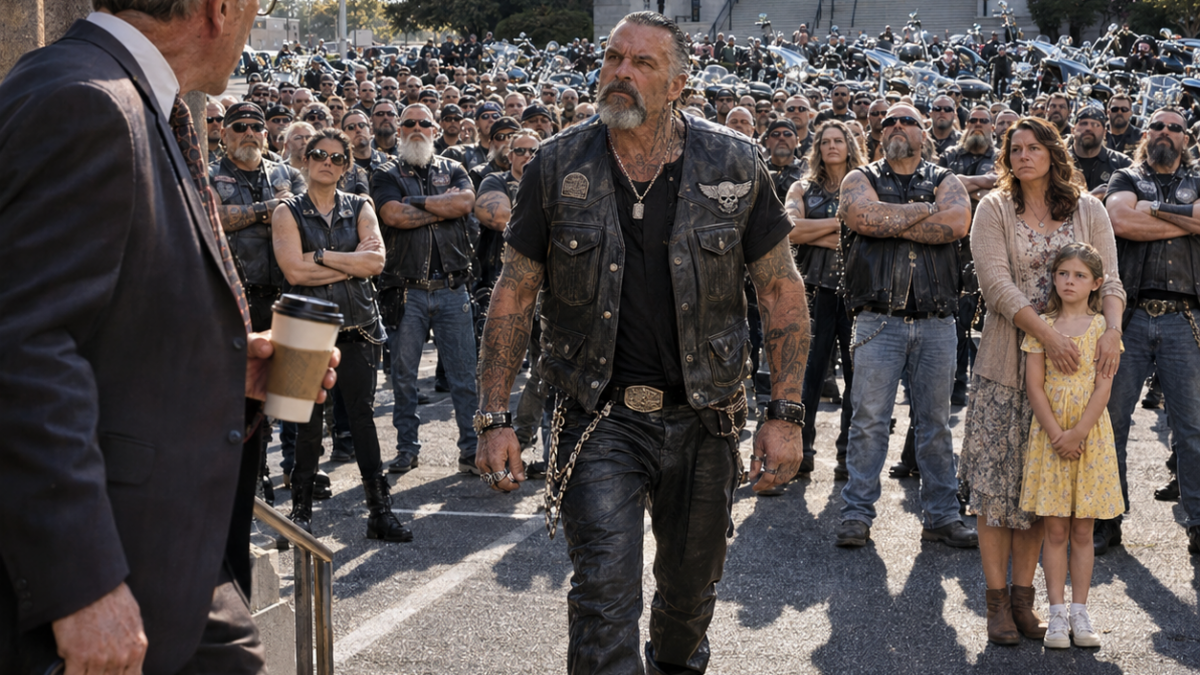
By 5:45, there were a hundred.
Some men had ridden three hours.
One was seventy-two.
One had come straight from an overnight factory shift.
Another had oxygen equipment in his saddlebag because he had lung disease and refused to stay home.
I told him:
“You realize this is ridiculous.”
He said:
“So is sending a burned seven-year-old back before somebody fixes the case.”
Fair point.
We lined motorcycles along the far edge of the courthouse parking lot.
We stayed off the fire lane.
Stayed off handicapped spaces.
Stayed away from doors.
Then we stood.
No chanting.
No revving engines.
No signs threatening anybody.
Just men.
Leather.
Boots.
Folded arms.
Silence.
At 7:10, the first news van arrived.
Somebody had called them.
Not me.
Probably Danny.
He still denies it.
By eight, cameras were across the street.
Court employees walked through the line.
We stepped aside.
A clerk whispered:
“Thank you.”
One security officer warned us:
“No disruption.”
Danny nodded.
“Understood.”
At 8:15, Judge Harker exited a side door.
Coffee.
Briefcase.
He stopped.
A hundred bikers can create a strange kind of silence.
Harker looked at us.
Then toward the cameras.
Then toward his car.
He started walking.
Danny stepped forward one pace.
No closer.
“Judge Harker.”
The judge stopped.
“Can I help you?”
Danny said:
“You sent a seven-year-old girl back to the man accused of burning her.”
Harker’s expression hardened.
“That case was decided based on the law and evidence properly before the court. I will not discuss a pending matter with you.”
“We’re not asking you to.”
Harker waited.
Danny continued.
“We want you to know Lily has people now.”
The judge looked at him.
“Excuse me?”
“People who will notice if she stops coming to school. People who will ask questions if she shows up hurt. People who will support her foster mother. People who will help her lawyer. We’re not going away.”
Harker’s face reddened.
“Are you threatening me?”
Danny shook his head.
“No, sir.”
Then he said the sentence the cameras replayed for days.
“We’re promising her.”
Harker stared.
A reporter moved closer.
Danny did not.
“This is inappropriate,” the judge said.
Danny answered:
“Sending a frightened child home because the adults handling her case made procedural mistakes feels pretty inappropriate too.”
Harker’s jaw tightened.
I expected him to argue.
He didn’t.
He walked to his car.
We remained.
Until noon.
Reporters asked questions.
We answered carefully.
We did not accuse Judge Harker of taking money.
We did not call him corrupt.
We did not claim he loved abusers.
We said what happened.
A child with documented injuries had been removed.
Errors in the process caused evidence problems.
The court returned her.
We believed that outcome placed her at risk.
We wanted the case repaired immediately.
By that evening, every local station had footage.
By morning, national pages were sharing clips.
People were furious.
Some wanted Harker removed.
Some blamed protective services.
Some blamed the father.
Some blamed “the system.”
Anger was everywhere.
Anger did nothing for Lily.
That afternoon I called Diane Marsh.
Family-law attorney.
Twenty years representing children and foster families.
She reviewed everything pro bono.
When she finished, she said something I hated.
“Harker’s ruling is legally defensible.”
I stared at her.
“How?”
“Because protective services made mistakes.”
“She was burned.”
“I know.”
“Her wrist was broken.”
“I know.”
“So fix it.”
Diane leaned forward.
“You think I don’t want to?”
I stopped.
She softened.
“The court excluded or discounted evidence because of how it was obtained and documented. We can appeal parts of that. But the fastest route to emergency protection is new evidence.”
“What kind?”
“Current risk. New injuries. A disclosure. Police documentation. A mandated reporter observing something new.”
I felt sick.
“So we wait for him to hurt her again?”
Diane was silent.
“That’s what you’re saying.”
“I’m saying the law needs something current that can support a new emergency petition without relying on the defective removal.”
I stood and walked toward her window.
“That’s insane.”
“It feels insane.”
“She has to get hurt again before the system believes the first injuries?”
Diane rubbed her eyes.
“This is why procedure matters from the beginning. If agencies take shortcuts because they’re convinced they’re right, the child sometimes pays for it later.”
I hated that she was right.
We made a plan.
Not surveillance.
Not harassment.
No motorcycles outside Lily’s house.
That could terrify her and create legal problems.
We used people already legitimately in her life.
Mrs. Guerrero watched her at school.
As a teacher, she was already a mandated reporter.
Neighbors next door, Carl and Evelyn Warner, agreed to call police if they heard anything alarming.
Karen stayed in touch with Diane.
Our club created a phone chain.
If professionals needed transportation, support, meals, court attendance, we were available.
But nobody was to confront Lily’s father.
Danny emphasized that at every meeting.
“If you think helping Lily means scaring the man, stay home.”
That kept everybody focused.
Day three, Mrs. Guerrero called me.
“She’s different.”
“How?”
“Quiet again.”
My stomach tightened.
“She won’t eat lunch. Won’t join reading group. And she’s wearing long sleeves.”
It was warm outside.
“What kind of long sleeves?”
“Thick sweatshirt.”
“Can you see marks?”
“No. She won’t let me close.”
“Did she say anything?”
“Nothing.”
I called Diane.
Behavior documented.
Not enough.
Day eight.
Another call.
Lily’s class had done a family portrait assignment.
Most children drew houses.
Pets.
Parents.
Lily drew herself inside a closet.
Dark scribbles around her.
Door.
Latch on the outside.
Mrs. Guerrero photographed the drawing according to school policy and documented the context.
“Is that enough?” I asked Diane.
“It helps.”
“Helps?”
“It establishes pattern.”
“What does enough look like?”
Diane sounded tired.
“Something I wish we never had to find.”
Day eleven.
Midnight.
Warners called Danny.
Yelling through the wall.
A man shouting.
Child crying.
Danny told them:
“Call 911 first.”
Then called us.
Six riders headed toward that neighborhood.
Not to the house.
A public parking lot two blocks away.
Police arrived first.
Knocked.
Lily’s father answered.
Calm.
Polite.
Invited them in.
Lily was in bed.
No visible injuries.
Father said she had a nightmare.
Officers documented it.
Nothing more they could legally do at that moment.
I sat on my motorcycle afterward staring toward a distant upstairs window.
A night-light glowed behind the curtain.
For the first time in years, I understood how helplessness can become physically painful.
My chest hurt.
Not metaphorically.
I wanted to fix something with my hands.
Motorcycles make sense.
Engine stops?
Check fuel.
Check spark.
Check compression.
Loose chain?
Tighten it.
Broken wire?
Replace it.
A terrified child inside a house where every legal line has to be respected?
Nothing is simple.
Day fourteen.
7:30 in the morning.
Mrs. Guerrero called.
Crying.
“She’s here.”
“What happened?”
“Come to school.”
I was there in fifteen minutes.
Mrs. Guerrero met me outside.
Her hands were shaking.
“It got hot during morning work. Lily took off her sweatshirt.”
I already knew.
“What did you see?”
“Burns.”
I closed my eyes.
“New?”
“Yes.”
“Where?”
“Upper arm. Three.”
Circular.
Uniform.
Fresh enough that the teacher believed they were only days old.
She had immediately followed mandated-reporting procedure.
She also documented them in a way the school’s child-safety officer approved.
Then she gently asked Lily what happened.
Lily said she spilled soup.
Mrs. Guerrero knew what accidental splash burns looked like.
These were not that.
I called Diane.
Her voice changed the second I said:
“New burns.”
“Photographs?”
“Yes.”
“Mandated reporter?”
“Yes.”
“School documentation?”
“Yes.”
“Call protective services. I’m filing.”
“You think we have enough?”
“We have new injuries, prior medical history, behavioral changes, the closet drawing, neighbor calls, and a mandated reporter. Yes.”
Then she said:
“And I’m filing in the next available district under the emergency provision. This is new evidence.”
Judge Patricia Reeves signed the emergency removal order at 2:15 that afternoon.
By three, a social worker and two police officers were at Lily’s father’s home.
Danny and I parked across the street on a public road.
Engines off.
Helmets hanging.
Hands nowhere near anything.
Just watching.
The door opened.
Social worker came out first.
Then Lily.
Long sleeves.
Plastic grocery bag carrying clothes.
She looked smaller than I remembered.
She saw our bikes.
Saw Danny.
Saw me.
She did not smile.
She walked toward Danny’s motorcycle.
The social worker stayed beside her.
Lily placed one hand on the gas tank.
Then asked:
“Are you taking me to Mama?”
Karen.
She meant Karen.
The social worker knelt.
“That’s exactly where we’re going.”
Danny turned away for a second.
I knew why.
He was crying.
The social worker drove Lily.
Danny rode behind.
I rode behind Danny.
We kept distance.
No show.
No parade.
No loud engines.
Just two motorcycles following a car carrying a seven-year-old girl toward the only house where she had learned to sleep without every light on.
Karen was already outside.
She had received the call twenty minutes earlier.
When the social worker opened the passenger-side rear door, Lily stepped out.
She looked at Karen.
Karen knelt.
Opened both arms.
Lily ran.
I have never seen a child move that fast.
She hit Karen so hard they both nearly fell backward.
“Mama.”
That one word broke every adult watching.
Karen held her.
Did not speak.
Couldn’t.
Danny and I sat in the street crying like fools.
I was not embarrassed.
Lily’s father was arrested the following week after investigators assembled the new evidence.
The fresh injuries mattered.
So did prior medical documentation.
School records.
Neighbor statements.
The pattern.
He was charged with aggravated child abuse.
Initially pleaded not guilty.
Later changed his plea to guilty after his attorney reviewed the evidence.
He received seven years.
When Danny told me the sentence, my first thought was:
Not enough.
Then Diane said:
“Seven years is seven years Lily doesn’t have to be afraid of him coming into her bedroom.”
That reframed it.
I stopped thinking about punishment.
Started thinking about time.
Seven birthdays.
Seven Christmas mornings.
Seven first days of school.
Seven years of falling asleep without listening for footsteps.
That mattered.
The public attention around the case did not disappear.
Judge Harker’s ruling came under judicial review.
Not because a hundred bikers demanded punishment.
Media coverage caused other families to examine old cases.
Some contacted reporters.
Some filed complaints.
Several raised concerns about how procedural technicalities had been handled in cases involving child safety.
Harker was not removed from the judiciary.
He was reassigned away from family court.
Civil matters.
Contract disputes.
Property cases.
Some people wanted more.
Some thought even the reassignment was unfair because the original agency had made genuine procedural mistakes.
Diane said something important.
“Harker didn’t create the bad evidence collection.”
“No.”
“He applied law to what was in front of him.”
“Yes.”
“But judges also have discretion in complicated child-safety matters, and public institutions have to be willing to review outcomes when patterns appear.”
That was enough for me.
The story was never about destroying a judge.
It was about protecting Lily.
The courthouse demonstration later came up during a state legislative hearing about child-protection procedures.
Diane testified.
Not us.
She explained how procedural errors could endanger children by weakening otherwise serious cases.
Better training.
Better documentation.
Faster emergency review.
Clearer standards.
Afterward she called.
“You helped change something.”
“We stood in a parking lot.”
“You made people pay attention.”
Maybe.
But I never wanted Lily to become a symbol.
Symbols belong to everybody.
Lily belonged to herself.
For months after she returned to Karen, she still struggled.
Safety is not a switch.
You do not remove a child from danger and instantly restore what danger took.
She had nightmares.
She hid food again for a while.
If someone knocked loudly, she froze.
Karen found her sleeping inside the bedroom closet one night.
Door open.
Blanket on the floor.
Karen did not drag her out.
She sat outside the closet.
Stayed there.
Eventually Lily crawled into her lap.
Therapy helped.
School helped.
Routine helped.
And, weirdly, motorcycles helped.
Our club did not overwhelm her.
We never sent one hundred men to her house.
Usually two or three.
Birthday?
Maybe six.
School fundraiser?
Four.
Softball game?
We occasionally failed at moderation.
The first softball game we attended, fifteen motorcycles pulled into the parking lot.
Karen called Danny.
“What did you do?”
“Support.”
“She’s seven.”
“We’re very supportive.”
Lily stepped onto the field, looked toward the bleachers, and saw fifteen tattooed men sitting together holding juice boxes because the concession stand did not sell coffee.
She put both hands on her hips.
Then smiled.
That smile was different from the one I remembered in foster care.
Not cautious.
Not borrowed.
It belonged completely to her.
One day she walked up to Eddie.
Eddie is six foot four.
Gray beard almost to his chest.
Lily stared at it.
“You need to fix that.”
Eddie blinked.
“My beard?”
“It’s ridiculous.”
I nearly fell out of my chair laughing.
Eddie looked offended.
“What’s wrong with it?”
“It looks like a squirrel.”
Danny said:
“She’s not wrong.”
Eddie spent the next week threatening to leave the club.
He did not trim the beard.
Lily became louder.
Bossier.
Funniest child I knew.
All signs of healing that people who have never seen a terrified child might underestimate.
For months, she continued wearing long sleeves.
Even in heat.
The scars embarrassed her.
Karen never pushed.
Mrs. Guerrero never pushed.
Therapist never pushed.
Then one spring school field day happened.
Relay race.
Hot afternoon.
Mrs. Guerrero sent me a photograph later with Karen’s permission.
Lily running.
Tank top.
Arms pumping.
Hair flying.
Scars visible.
Huge grin.
I stared at the picture for a long time.
Then printed it.
I keep it inside my vest.
Left side.
Over my heart.
Karen’s adoption petition moved through court carefully.
No shortcuts.
No mistakes.
No rushing because everybody thought the ending was obvious.
Diane insisted every form be correct.
Every notice proper.
Every signature witnessed.
Every required review complete.
She said:
“We are not giving anybody an opening to hurt Lily with paperwork again.”
A year after the courthouse ruling, adoption was finalized.
Small courtroom.
Different judge.
Karen cried before proceedings even started.
Lily wore a blue dress.
Danny and I waited outside because Karen wanted the legal moment intimate.
Family.
Caseworker.
Attorney.
Teacher.
When the doors opened, Lily came running into the hallway.
She held a paper above her head.
“I’M A BELL!”
Her new last name.
Then she ran directly into Danny.
He lifted her.
She yelled:
“You’re squishing me!”
“Sorry.”
“Put me down.”
He did.
She turned to me.
“Did you bring the bikes?”
“Maybe.”
“How many?”
I looked toward the window.
The courthouse parking lot held thirty-seven motorcycles.
I had told everyone to keep it small.
Bikers are terrible at counting.
When Lily came outside, thirty-seven engines started.
Not revving wildly.
Just starting together.
A low rolling sound.
She covered her ears and laughed.
Then raised both arms like she was conducting an orchestra.
Nobody rode until her car left.
Then we followed.
Again.
Not because Karen needed protection.
Because Lily liked the sound.
That night we had a barbecue at Karen’s house.
Someone brought a cake.
Someone else brought balloons.
Eddie brought a helmet.
An actual child-size motorcycle helmet.
Karen looked at him.
“No.”
“I didn’t say motorcycle.”
“No.”
“Maybe scooter.”
“No.”
“Bicycle?”
“Ask Jack to drive you home.”
Lily laughed.
Then she asked Danny something.
“Why did all of you come to court?”
He looked at me.
I shrugged.
His answer to give.
Danny sat beside her on the porch.
“Because Jack called.”
“Why did Jack call?”
Danny sighed.
“Because he gets dramatic.”
I threw a napkin at him.
Lily giggled.
Then Danny became serious.
“Because you looked like you thought nobody was coming.”
Her smile faded slightly.
He continued.
“We wanted you to know somebody was.”
Lily looked down at her shoes.
“Were you mad at the judge?”
“Yes.”
“Did you want to hurt him?”
Danny answered immediately.
“No.”
“Why not?”
“Because hurting somebody doesn’t make a bad decision disappear.”
She thought about that.
“We wanted people to pay attention,” he said. “Then lawyers and teachers and social workers had to do the real work.”
Lily looked toward Karen.
“Mama did work too.”
“A lot.”
Then Lily asked:
“Did you save me?”
Danny’s face changed.
“No.”
She looked confused.
“Mrs. Guerrero helped.”
He counted on his fingers.
“Karen helped. Diane helped. Your social worker helped. Police helped. The Warners helped. The firefighters at the school event later helped when you fell off the monkey bars because apparently you have no survival instincts.”
Lily rolled her eyes.
“And you helped yourself.”
“How?”
“You kept going to school.”
She was quiet.
“You kept drawing. You kept talking when you could. And when your teacher gave you a safe chance, your body told the truth.”
I watched her absorb that.
Children who survive abuse sometimes grow up believing adults rescued them like objects.
Danny wanted her to understand she had agency too.
We had shown up.
But Lily had survived.
Those are different things.
Months later, Judge Harker retired.
Not immediately.
Not dramatically.
No one chased him from town.
I saw him once after reassignment.
Grocery store.
Bread aisle.
He recognized me.
I recognized him.
For a moment, neither spoke.
Then he said:
“How is the girl?”
“Good.”
He nodded.
“I heard about the adoption.”
“Yes.”
He looked tired.
Older than I remembered.
Then:
“I’ve thought about that case often.”
I did not know what he expected me to say.
So I said:
“So have I.”
He looked at me.
“You believed I didn’t care what happened to her.”
“At the time, yes.”
“And now?”
I considered lying.
“No. I think you cared about applying the rules correctly.”
He nodded slowly.
“But?”
“But Lily still went home.”
His eyes lowered.
“Yes.”
There was no satisfying argument after that.
He told me the protective-services failures had disturbed him too.
He believed courts cannot simply ignore procedural rights because an allegation is emotionally powerful.
I agreed.
Then I said:
“But children cannot absorb the cost every time adults mishandle procedure.”
He answered:
“No.”
We stood between cereal and bread talking about the limits of systems.
No cameras.
No leather wall.
No speeches.
Before leaving, Harker said:
“I hope she never remembers my name.”
I understood what he meant.
For years, I had imagined him only as the judge who sent Lily back.
That afternoon I saw an older man carrying groceries who had made a ruling within an imperfect system.
I still believed the outcome had been dangerous.
But people are usually more complicated than the worst decision we know about them.
That lesson mattered too.
Our advocacy program changed after Lily.
We added legal training.
Not to become lawyers.
To understand what not to do.
We partnered more closely with certified child advocates.
We stopped using phrases like “we protect kids” because it sounded too much like we could replace professionals.
We couldn’t.
We became:
We show up.
That was our job.
Show up at court.
Show up at school.
Show up at birthdays.
Show up when foster parents need someone to repair a broken porch railing and cannot afford a contractor.
Show up when a teenager aging out of care needs furniture.
Show up when a kid wants six bikers in the audience for a spelling bee.
Do the thing you are actually qualified to do.
Let other people do theirs.
A few years after Lily’s adoption, one of our younger members asked Danny:
“Would you call a hundred bikers again?”
Danny thought.
“Depends.”
“On what?”
“If a hundred were useful.”
That was the right answer.
Sometimes support needs a crowd.
Sometimes it needs one person quietly sitting outside a bedroom door.
The morning outside the courthouse needed a crowd.
Lily needed to know the ruling did not erase her.
The public needed to understand what procedural mistakes could cost.
But the weeks afterward required something quieter.
Teachers documenting.
Neighbors listening.
Lawyer filing.
Social workers acting.
Police serving orders.
Foster mother waiting with open arms.
Healing is usually less cinematic than outrage.
It also matters more.
Lily is older now.
Old enough to understand most of what happened.
Karen gave her the choice about whether she wanted to know details.
Lily chose gradually.
Not all at once.
The scars remain.
Some are faint.
A few still visible.
She does not hide them anymore.
One day she asked me if I hated her father.
I answered carefully.
“No.”
She looked surprised.
“You should.”
“Maybe.”
“He hurt me.”
“I know.”
“Then why don’t you hate him?”
I leaned back.
“Because hatred takes up a lot of room.”
She waited.
“I can believe what he did was terrible. I can be glad he couldn’t hurt you anymore. I can believe consequences were necessary. None of that requires me to build my life around hating him.”
Lily looked away.
“Sometimes I hate him.”
“You’re allowed to feel whatever you feel.”
“Karen says that.”
“Karen is smarter than me.”
“Obviously.”
There was the bossiness again.
Good.
Then she asked:
“Did the bikers really surround the courthouse?”
“We stood in the parking lot.”
“Mom says a hundred.”
“Approximately.”
“Danny says exactly one hundred and three.”
“Danny lies for dramatic effect.”
She smiled.
Then:
“Were you scared?”
That question surprised me.
“Of what?”
“That you couldn’t help.”
I thought about the night outside her father’s house.
The night-light behind the window.
The helplessness.
“Yes.”
“What did you do?”
“Stayed.”
She nodded.
Maybe she understood that better than anything else.
People often ask what the story is about.
Some think it is about bikers scaring a judge.
It isn’t.
We did not scare Judge Harker into reversing anything.
He never reversed the order.
The emergency removal came because new evidence was gathered properly and another judge had legal grounds to act.
Some people think it is about a broken justice system.
Partly.
Protective services made serious mistakes.
Court procedure mattered.
A judge had to apply law to imperfect evidence.
Then professionals corrected the case.
Systems can fail without every person inside them being evil.
Some think it is about angry men in leather making enough noise to force justice.
That version sounds good online.
It is not the version I carry.
The version I carry is Lily sitting outside the courtroom in a yellow dress.
No crying.
No screaming.
Just shutting down.
I remember that face.
Then I remember another face.
A year later.
Tank top.
Relay race.
Arms uncovered.
Scars visible.
Running so hard her hair flew behind her.
Grinning.
That is the distance between the two photographs.
That is the story.
Not motorcycles.
Not judges.
Not television cameras.
Safety.
What happens to a child when she loses it.
And what can happen when enough adults decide restoring it matters.
Danny still says we did not save Lily.
He is right.
No single person did.
Mrs. Guerrero noticed.
Karen loved.
Diane fought.
The Warners listened.
Social workers acted.
Police responded.
Doctors documented.
A judge signed a new order.
A prosecutor built a case.
A foster mother opened her arms.
A child survived.
And one hundred bikers?
We showed up.
That was all we had ever promised.
I still carry the photograph from field day inside my vest.
Sometimes I take it out before an advocacy ride.
Look at Lily running.
The scars are visible if you know where to look.
I don’t look at them anymore.
I look at her face.
No fear.
No checking exits.
No long sleeves.
No frozen expression.
Just a kid running toward a finish line.
And every time I see that photograph, I think back to six o’clock on a cold morning outside Dayton County Courthouse.
A hundred motorcycles.
Men standing quietly.
Judge Harker asking whether we were threatening him.
Danny shaking his head.
“No, sir.”
Then the promise.
Not to the judge.
To Lily.
You have people now.
We’re watching.
We’re staying.
We’re not going away.
And for once in her life, every adult who made that promise kept it.