𝗙𝗨𝗟𝗟 𝗦𝗧𝗢𝗥𝗬 The Morning Monica Blackwell Tried to Tear Down a Barn Before I Understood What It Was Really Holding Up
𝗙𝗨𝗟𝗟 𝗦𝗧𝗢𝗥𝗬
He looked at her.
“Maybe it’s time, Junie.”
Monica heard that and relaxed just a little.
Her shoulders lowered.
She had what she came for.
Surrender.
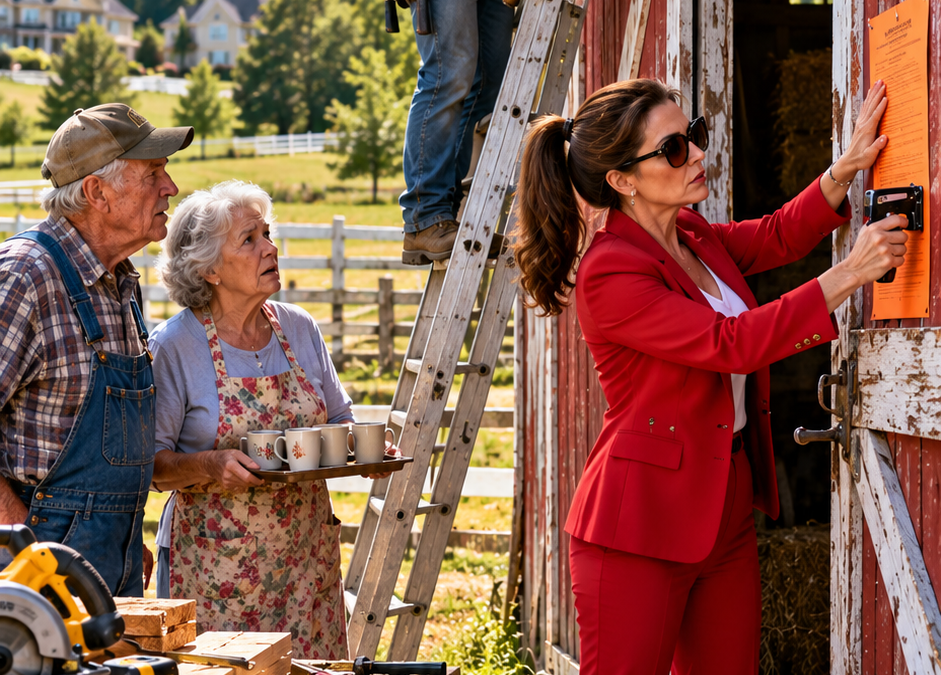
She handed Walter another copy of the notice, turned toward a silver SUV parked beside the gravel drive, then stopped when she saw me pick up my hammer.
“Mr. Bennett.”
I looked at her.
“I was serious. You are to stop all repair activity.”
I slid the hammer into my belt.
“So was I.”
She drove away five minutes later, tires whispering over gravel.
I waited until the SUV disappeared beyond the maples before touching the orange notice. One staple had punched through the edge of the red door where old paint had curled away like a dry leaf. Beneath it, I could see three older coats: red, darker red, then bare pine.
June stood beside me.
“I painted those doors in 1981,” she said.
Walter muttered, “Still hate the color.”
June almost smiled.
Almost.
I stepped inside.
The temperature dropped ten degrees. Dust floated through shafts of sunlight from the roof boards. The place smelled like old timber, machine oil, leather, and hay that had not been stored there in years.
This was not a museum.
It was a working man’s memory with a roof over it.
A scarred workbench ran along the north wall. Rusted horseshoes hung from nails. Near the center aisle, pencil marks climbed one support post beside handwritten dates and names.
Danny, age six.
Rebecca, eight.
Danny, eleven.
Then grandchildren.
I ran my thumb near one faded line without touching it.
“Kids and grandkids,” June said behind me.
Walter walked past us toward a heavy beam above the old stalls. One side was blackened, almost charcoal dark.
“Electrical fire,” he said. “1992. Thought we’d lose the whole thing.”
He slapped the beam once.
Solid sound.
“Dad helped me put this frame up in ’79. That beam survived the fire. Outlived him by thirty years.”
Then Walter pulled an old silver pocket watch from his overalls and clicked it open.
“I used this when we built it. Dad charged me by the hour for his help.”
June snorted.
“He never took the money.”
Walter closed the watch.
The click echoed through the barn.
“Dean, call the excavator fellow you use. Tell him I want this down before the thirty days are up. No point letting them do it and sending us the bill.”
The papers did not say a judge had ordered anything.
They said the association could pursue removal and charge the cost back if Walter and June did not comply.
Walter had read that as inevitable.
So had I, for a moment.
Then I looked at his hand still wrapped around that watch.
“No.”
His eyes lifted.
“What?”
“I’m not calling anybody.”
I walked to the west wall and pressed my palm against the post I had been working on. Rough oak. Dry. Still carrying load. The sill below it was ugly, but ugly was not dead.
“Roof needs work,” I said. “West sill has rot. Two posts need sisters. Door header needs attention.”
“Dean—”
“But this thing isn’t finished.”
June said nothing.
Walter exhaled through his nose.
“You heard her. Thirty days.”
“I did.”
I pulled my tape measure from my belt and stretched it across the damaged sill.
“Then give me thirty days.”
Walter stared at me like I had suggested moving the barn with a pickup truck.
“You’ve got paying jobs.”
“I’ll work around them.”
“Materials cost money.”
“I know what lumber costs.”
“And if they stop you?”
I looked through the open doors toward the road where Monica’s SUV had vanished. Then I looked back at the orange paper flapping against June’s red paint.
That was my first mistake.
I still thought this was a construction problem.
Rotten wood.
Bad roof.
Thirty days.
Things I understood.
I did not understand Monica yet.
I tore the notice free carefully enough not to take any more paint with it, folded it once, and placed it on Walter’s workbench.
Then I climbed the ladder again.
June picked up the coffee.
Walter remained beneath me, pocket watch in his palm.
“Dean,” he called. “You sure about this?”
I seated the cedar board under the eave, lined its edge with the old timber, and drove the first nail home.
The hammer strike rolled through the barn like a rifle crack.
“Start the clock.”
By sunrise the next morning, I had the whole repair mapped in carpenter’s pencil across a sheet of plywood balanced on Walter’s workbench.
West sill first.
Sister the two posts.
Patch the roof over the center bay.
Rebuild the door header last.
Twenty-nine days left.
Tight, but possible.
At least that was what I believed while June’s coffee mixed with the smell of fresh-cut cedar and my circular saw screamed through the quiet morning.
Walter sat on an upside-down feed bucket, sorting old square nails into a coffee can. His right knee had been replaced twice, so every time he stood, he planted both hands on his thighs and pushed himself upright like an old hydraulic jack.
I told him to stay seated.
He ignored me.
“I built this place,” he said. “I can hand you nails.”
Around ten, June brought sandwiches and stopped beside the center post. She touched one of the pencil marks with one finger.
“Rebecca did that one herself,” she said.
The line was crooked and labeled eleven years old.
“She stood on her toes,” Walter said.
“Cheater,” June said.
Then she laughed.
It was the first time I had heard either of them laugh since Monica stapled that notice to the door.
That sound changed the job for me.
I was not straightening lumber anymore.
I was trying to keep a place where people still remembered who had stood where.
For the first four days, progress came fast.
My helper, Cody, and I lifted the west wall barely three-quarters of an inch, cut out the worst section of rotten sill, and slid treated timber beneath the old oak posts. Every evening, I swept the floor before leaving. Every morning, Walter’s pocket watch appeared beside my thermos.
He would click it open whenever I started and close it when I quit.
“Keeping track?” I asked.
“Making sure you’re not getting lazy.”
On day five, the lumber truck never arrived.
I called the yard at noon.
“Driver got turned around at the subdivision entrance,” the dispatcher said. “Some association lady told him commercial deliveries weren’t authorized on that road.”
I looked toward the highway.
Monica’s HOA controlled the paved subdivision lane that provided the easiest approach to the Callahan property. There was another way in, but it was an old farm track from the county road, narrow and rough enough to shake fillings loose.
“Send him around the north side.”
“That truck’s twenty-six feet long.”
“I know.”
Forty minutes later, I was cutting back branches with a pole saw while Walter guided the truck through ruts deep enough to swallow its rear tires.
We got the lumber in.
Lost half a day.
I considered it an inconvenience.
That was mistake number two.
Two mornings later, the dumpster company called before breakfast. Their driver had been told the container could not remain where I had placed it because part of the access area fell under HOA traffic restrictions.
I moved it myself with my equipment.
Then Cody showed me a message he had received warning contractors that work associated with the barn might be subject to enforcement action.
“I’ve got a wife who sees words like enforcement action and starts calculating bail money,” he said.
“Nobody’s getting arrested.”
“I know that. She doesn’t.”
He stayed that day.
But I saw the hesitation.
Monica did not need to shut down my saw. She just needed to make every board take twice as long to install.
So I adjusted.
Smaller loads.
Earlier mornings.
More work by hand.
I treated each obstacle like a bad measurement: correct it and keep moving.
By the end of the first week, the west wall stood straighter than it had in fifteen years.
I should have been worried.
Instead, I was proud.
Friday afternoon, my phone rang while I was fitting blocking between joists. A paying customer wanted to know why I was not at his kitchen remodel.
I looked at the barn.
Then at the clock.
I had completely lost track of the day.
“I’ll be there Monday,” I told him.
When I hung up, June was standing behind me holding an envelope.
“What’s that?”
“For materials.”
“No, June.”
“Dean.”
“Buy Walter a better coffee maker.”
I pushed the envelope back.
She did not move.
Her eyes dropped toward the bed of my truck where receipts were wedged beneath my clipboard. Cedar, fasteners, treated lumber, fuel, equipment rental. She saw enough.
“This isn’t supposed to become your problem.”
I folded the receipts over and shoved them into the glove box.
“It’s a barn, June. I know how to fix barns.”
That evening, Monica’s silver SUV rolled slowly past the property.
She did not stop.
She did not need to.
I watched it disappear through the trees while my saw blade spun down with that thin metallic whine a blade makes before going silent.
Behind me, Walter clicked his pocket watch shut.
“Twenty-two days left.”
I still believed I could beat Monica by working harder.
From the way her brake lights glowed red at the end of the road before she drove away, I think she already knew exactly how to beat me.
By Monday morning, the barn was costing me money I had not agreed to spend.
I knew it before I opened my banking app.
You can hear lost money on a job site.
It sounds like a saw sitting silent while you wait for material that should already be there.
My second lumber delivery had been canceled completely.
The yard manager called at 7:12 while I was standing beside the west wall with a chalk line in my hand.
“Dean, I can’t keep sending trucks into that mess. Driver spent ninety minutes getting turned around Friday. I’ve got other customers.”
“Use the north farm track.”
“My insurance guy saw the pictures.”
“No.”
The line went quiet.
I stared at the stack beside me.
Six boards left.
I needed twenty-four.
“I’ll pick it up myself.”
“That’s your call.”
So I drove twelve miles back to my own workshop and started dismantling a storage shed I had built behind it eight years earlier.
Nothing fancy. Twelve by six. Metal roof. Treated frame. Dry enough to keep tools and leftover stock out of the weather.
I pulled the siding first.
Then the rafters.
By noon, my trailer was loaded with lumber that had belonged to me that morning.
When I returned, Walter was standing at the gate.
He watched me back the trailer toward the barn.
“Where’d that come from?”
“Had it lying around.”
He ran his palm across one of the boards.
Screw holes.
Old stain.
He knew.
“You tore something apart.”
“Something less important.”
His jaw tightened.
Before he could answer, Cody’s pickup rolled in behind me. He climbed out without his tool belt.
That told me everything.
“My wife won,” he said.
“Can’t blame her.”
“I can finish today.”
“Go home, Cody.”
He looked toward the barn.
“You sure?”
“Yeah.”
We shook hands.
He drove away three minutes later.
The dust from his tires hung over the gravel long after the truck disappeared.
I worked alone that afternoon.
Every board suddenly weighed more.
By Wednesday, I was four days behind on the kitchen remodel I had promised to start. The homeowner stopped being patient. He called while I was under the barn drilling through an old oak sill. Dirt pressed into my shoulder blades, wood chips sticking to the sweat on my neck.
“Dean, I hired you because people said you showed up when you said you would.”
The drill stopped in my hands.
Above me, Walter shifted his boots across the floorboards.
“I know.”
“I’ve got cabinets sitting in my dining room and no kitchen.”
“Give me two more days.”
Silence.
Then, “I already gave it to somebody else.”
The call ended.
I stayed under the barn for a while, staring at the dark underside of the floor.
That remodel would have covered my mortgage, payroll, and shop expenses for most of the month.
I crawled out, wiped dirt from my shirt, and went back to drilling.
June found the canceled contract that evening. I had printed the revised schedule and left it folded on my truck seat. She did not mention it until I came inside the barn for water.
The paper was lying on Walter’s workbench beside his pocket watch.
“You lost that job because of us,” she said.
“Because I missed the start date.”
“Because you were here.”
I twisted the cap off the bottle. The plastic crackled in my hand.
“Same thing.”
“No,” Walter said.
He was sitting on the feed bucket again, but this time the coffee can of nails sat untouched between his boots.
“It isn’t.”
I drank half the bottle without answering.
Walter stood slowly.
Both hands on his thighs.
Push.
Straighten.
Breathe.
“Pack your tools.”
“Not happening.”
“That wasn’t a request.”
I almost laughed.
Walter did not.
He walked to my trailer and touched one of the boards from my shed.
“My father and I built this barn because we needed it. We didn’t build it so forty-five years later, some stubborn fool could start tearing his own life apart to keep it standing.”
“I’ve got twenty days.”
“You’ve got bills.”
“So do you.”
His eyes hardened.
“This is my memory, Dean. Not your debt.”
That landed harder than anything Monica had said.
June turned away and started gathering empty coffee mugs. Even though there were only two, I could hear ceramic touching ceramic in her shaking hands.
I picked up my tool belt.
Walter nodded once, thinking he had gotten through to me.
Then I buckled it around my waist.
“I gave you thirty days.”
“And I’m telling you to stop.”
“Then we’ve both gotten real comfortable giving orders lately.”
June made a small sound that might have been a laugh.
Walter stared at me for a long second, then shook his head and walked toward the house.
That night, I did not drive home.
I parked my truck beside the barn, reclined the seat, and used my rolled-up jacket for a pillow. Around two in the morning, cold worked through the glass and woke me. Moonlight came through the windshield. The barn stood thirty feet away, patched siding pale against old boards.
My shed lumber was already disappearing into it.
My paying job was gone.
Cody was gone.
The easy deliveries were gone.
And I was still measuring success in feet of repaired wall.
At 5:46, the farmhouse porch light came on.
A few minutes later, Walter crossed the yard carrying two coffees. He opened my passenger door without knocking and set one in the cup holder. Then he placed his silver pocket watch on the dashboard.
Click.
“Nineteen days,” he said.
He shut the door and walked toward the barn.
I watched the second hand move beneath scratched glass.
For the first time since I had started, thirty days did not feel like a deadline.
It felt like a price tag.
Rain found the barn before sunrise on day eighteen.
Not a storm.
Just a steady October rain that drummed against the patched roof and slipped through every section I had not reached yet.
I stood beneath the center bay with a flashlight in one hand and a coffee in the other, watching water strike the floor in six different places.
Plink.
Plink.
Plink.
Each drop landed in an old galvanized bucket Walter had arranged beneath the leaks.
I looked at my plywood repair plan on the workbench.
West wall.
Roof.
Header.
Siding.
Doors.
I had been crossing things off for twelve days, and the list still looked hungry.
Walter came through the side entrance carrying another bucket.
“Found one over the old calf stall. Make that seven.”
He set it down and wiped rain from his glasses.
“You sleep in that truck again?”
“Maybe.”
“June says you did.”
“Then why ask?”
He gave me the look I deserved and walked away.
I climbed into the loft to inspect the roof. The old boards were damp and cold beneath my palms. Through a gap near the ridge, I could see the gray sky moving above us.
I had been thinking like a contractor from the first hammer strike.
Repair the defects.
Finish the envelope.
Make the structure whole.
But Monica did not need me to fail at carpentry.
She only needed the barn to remain what she called it: deteriorated, unused, disposable.
I climbed back down.
“Walter, what did you actually use this place for?”
He glanced around.
“Everything. That narrows it down.”
He pointed toward the north wall.
“Workbench was Dad’s. I repaired equipment there. Calving stall was over there. Jun kept feed records at that little desk until the mice ate the drawer.”
“Loft?”
“Hay. Mostly kids hid up there when they were supposed to be working.”
June entered carrying towels over her head.
“We could hear them whispering through the floorboards.”
Walter looked at her.
“You could. I pretended I couldn’t.”
She lowered the towels and smiled.
Then I looked at my repair plan again.
I picked it up, folded it twice, and put it under my toolbox.
“We’re changing the job.”
Walter frowned.
“I’m done trying to make the whole barn pretty.”
“Wasn’t aware pretty was an option.”
I pointed toward the center and north bay.
“I make this section dry, safe, usable. Roof first. Then the workbench. One set of doors. Basic lights. Forget the south siding for now. Forget the loft.”
June studied me.
“Usable for what?”
“For whatever you used it for before everybody decided it was useless.”
That afternoon, I moved the remaining lumber under the north bay and started cutting.
I stripped only the roof boards that had to come off. I reused sound material instead of replacing anything just because it looked old. Walter helped me rebuild the workbench vise, working the rusted screw loose with penetrating oil and a pipe wrench.
The first time it turned, he grinned like somebody had handed him back ten years.
June disappeared into the farmhouse and returned with a cardboard box. She pulled out an old brass bell, green around the edges.
“This hung beside the door.”
“Then hang it.”
She did.
The bell gave one dull clang.
Not pretty.
Not polished.
But it worked.
Two days later, I ran a simple lighting circuit through the center bay. Nothing fancy. Four LED fixtures, protected wiring, switches where Walter could reach them without climbing over anything.
At dusk, I flipped the breaker.
White light flooded the old workbench.
Walter stood beneath it without speaking.
Then he walked to a shelf, picked up a block plane, and clamped a piece of pine in the vise.
Shhk.
Thin curls rolled onto the bench.
The smell of fresh pine mixed with old hay and machine oil.
June leaned against the red door with her arms folded.
I watched Walter make three more passes.
That sound did something my new cedar never had.
The barn was not waiting to be saved anymore.
It was being used.
The next morning, June carried boxes back from the farmhouse. Old tack. Hand tools. A coffee tin filled with bolts. Family photographs sealed in plastic sleeves. She stopped at the center post and wiped dust from the pencil marks with the edge of her sleeve.
Walter brought in a broken kitchen chair and set it on the workbench.
“Jun’s been after me to fix this since Easter.”
“Last Easter?” I asked.
“I’m not answering that.”
He sat down and started pulling the loose joints apart.
I checked my watch.
Fifteen days left.
For once, I did not feel behind.
Around noon, tires crunched slowly on wet gravel.
Monica’s silver SUV stopped outside the open doors.
She stepped out in that same red pantsuit, careful not to place her heels in the mud. Her eyes went first to me, then past me.
Walter was at the bench under the new lights, fitting a chair rung.
June stood on a small step stool, hanging the brass bell properly beside the door.
Monica did not say anything for several seconds.
She had expected construction.
What she saw was occupation.
Her gaze moved from the lights to the tools, the boxes, the chair clamped to Walter’s workbench.
Then Walter picked up the plane again.
Shhk.
A thin curl of pine dropped beside his hand.
Monica’s eyes followed it to the floor. She looked at me once, turned around, and walked back to her SUV without giving a single order.
That worried me more than if she had screamed.
I watched her reverse down the drive while Walter kept working behind me.
I had finally stopped racing Monica’s clock.
Judging by how fast she drove away, Monica had just realized it too.
She came back the next morning at 9:17, and this time she did not stay by her SUV.
I heard her heels before I saw her. Hard little clicks against the concrete apron outside the barn, completely out of rhythm with my impact driver. I was fastening blocking above the center bay. Walter was at the workbench sanding the chair he had repaired. June stood near the red doors, cleaning the brass bell with an old dish towel.
Monica walked straight through the opening, stopped beneath my ladder, and looked up.
“Turn that off.”
I released the trigger. The driver wound down. Walter’s sandpaper stopped too.
“Good morning, Monica,” June said.
Monica ignored her.
“Mr. Bennett, you were instructed to cease repair activity.”
“I remember.”
“Then why are you still working?”
I climbed down.
“Because Walter and June asked me to.”
“The association has already issued its determination.”
“And this is still their barn.”
Her mouth tightened. She pointed toward the lights, the workbench, the stacked boxes.
“Moving belongings into a non-compliant structure does not change its status.”
Walter set the sandpaper down.
“They’re not belongings. They’re my tools.”
Monica turned to him.
“Mr. Callahan, this would be easier if you stopped encouraging him.”
Walter looked at me, then at the chair beneath his hands.
“Funny. Two weeks ago, I was telling him the same thing.”
Monica did not smile.
She stepped closer to me. Expensive perfume cut through the smell of pine dust.
“I am telling you directly. Stop repairing this barn.”
I held her stare.
Then I reached past her, picked up the impact driver, and climbed back onto the ladder.
The motor barked once as the next screw seated into wood.
Monica stood beneath me for maybe five seconds.
Then she walked out.
By noon, orange survey flags appeared along the gravel edge beside the barn. The following morning, red paint marked a line across the dirt near the west side. A contractor’s pickup arrived with two men who unloaded temporary barriers and stacked them twenty feet from the wall.
They did not touch the barn.
They did not need to.
The message sat there in steel and fluorescent plastic.
Monica was not waiting for day thirty anymore.
She was preparing for it.
That changed how I worked.
I started moving tools twice a day so nothing sat near the marked zone. Deliveries had to be carried farther. Half my attention stayed on the repair, the other half on what was happening outside.
I began rushing.
That was the dangerous part.
The west side still needed temporary support while I tied the repaired center bay into the older frame. Walter stood beside me one afternoon as I set a steel jack post beneath a beam.
“You’re opening too much at once,” he said.
“I need access to the sill.”
“Then finish one section before you open the next.”
“If I do that, I lose a day.”
“A day is cheaper than a wall.”
Walter said it without looking at me.
I knew he was right.
I also knew I had twelve days left, a stack of unpaid invoices at the shop, and half a barn still open to the weather.
“I’ll brace it before I leave.”
He studied me for a second, then went back to sorting the old hardware we had pulled from the west bay.
By late afternoon, the temporary braces were in place and the wall was holding.
Not finished.
Holding.
There was a difference.
Normally, I respected that difference.
That week, I was learning how easy it was to pretend the difference did not matter when a clock was running.
Monica came by before sunset. She did not argue about the work or mention the deadline. She stood near the drive in that red suit, watching my crew load tools, and her eyes settled for a moment on the west side of the barn.
“You leaving it like that?”
“For tonight.”
“Safe?”
I looked at the braces.
“Safe if nobody interferes with the site.”
She gave me a small nod, the kind that could mean anything, then walked back toward her SUV.
I watched her leave, locked the remaining tools in the trailer, and told myself I had bought the wall one more night.
The machine showed up at 7:08 the next morning.
I heard the diesel before I saw it: a low mechanical growl coming through the trees while I was tightening the last bolts on the west sill. Walter was sweeping beneath the workbench. June had just set a thermos beside my toolbox.
Then a compact track loader rolled up the gravel approach behind the contractor’s pickup. Wet mud packed into its tracks.
Monica’s silver SUV followed.
I put my wrench down.
“Walter, stay inside the center bay.”
He looked through the open doors.
“They’re early.”
“Yeah.”
Monica stepped out wearing the red pantsuit under a black coat. The contractor from the day before climbed from his truck and walked toward me.
“We’re setting the access area.”
“Not along that wall.”
I pointed at the west side.
“I told you yesterday that frame is still carrying temporary support.”
“We’re not touching your structure.”
“You don’t have to touch it. The ground beside the barn is soft from two days of rain. I can feel vibration through my boots when that loader idles thirty feet away. Keep that machine back until I tie the upper frame in.”
Monica came around the contractor.
“No more delays, Mr. Bennett.”
“This isn’t a delay. It’s a safety issue.”
“You’ve called everything a safety issue since we arrived.”
“No. I called that wall a safety issue.”
I pointed to the diagonal brace Walter had warned me about.
“Give me three hours.”
“Yesterday, you said one day.”
“And I worked until ten last night.”
“Yet it is still unfinished.”
I looked at the exposed frame.
She was not wrong.
That was the worst part.
I had pushed too much work into one section because I was trying to save time.
Now the barn depended on temporary support I should have replaced before dark.
The contractor looked at the wall, then at me.
“We can work farther out.”
“Not with the ground this soft.”
Monica folded her arms.
“Proceed with the layout.”
The loader moved.
Its tracks chewed into wet soil, slow and heavy. I felt the first tremor through the concrete apron.
“Stop.”
The operator stopped.
Monica raised one hand.
“Continue.”
The machine turned. One track held while the other crawled, grinding mud sideways.
The barn made a sound I had heard once before on an old dairy restoration in Kansas.
Not a crack.
A groan.
Deep, slow, taking load where it did not want it.
I turned toward the west wall.
The diagonal brace had shifted maybe half an inch.
“Shut it down.”
The contractor yelled toward the operator. The engine dropped to idle.
I ran inside.
Walter was already moving toward me.
“Out,” I said.
“Dean, the jack—”
“Forget the jack.”
Another groan rolled through the frame. Dust sifted from the rafters.
Walter looked up.
I grabbed his arm and guided him toward the center doors. His bad knee slowed him.
Behind us, something snapped with the dry sound of a baseball bat breaking.
“Keep moving.”
June was outside now, one hand over her mouth.
I got Walter across the apron and turned back.
The west wall leaned for one second.
Everything held perfectly still.
Then the temporary brace kicked sideways.
The upper frame dropped several inches.
Roof boards folded inward.
A section of siding tore loose, and half the west bay came down in a rolling crash of timber, roofing, dust, and old hay.
My compressor disappeared beneath it.
So did two saws, a nailer, ladders, and most of the cedar I had installed the first week.
Then it stopped.
The silence afterward was worse.
Rainwater dripped from the broken roof. Somewhere under the debris, my compressor released air in a long hiss.
Nobody moved.
Monica stood beside her SUV, pale now, her arms no longer folded. The contractor stared at the wreckage.
“I told you that wall was temporary,” I said.
My voice came out quieter than I expected.
He nodded once.
“I heard you.”
Monica stepped forward.
“The equipment never contacted the structure.”
I looked at her.
“I know.”
That shut down whatever argument she was preparing because I was not going to give myself the comfort of blaming all of it on her.
She pushed.
I rushed.
She ignored the risk.
I left the wall vulnerable.
Both things were true, and the barn did not care which one made me feel better.
There would be time later to sort out photographs, invoices, and who owed what. Right then, I had two old people standing beside a broken barn and a mistake with my fingerprints on it too.
Walter walked past me toward the debris.
“Don’t.”
He stopped anyway.
The repaired west wall was gone.
My new cedar lay split beneath blackened old rafters.
The red door had been knocked flat and half buried.
Walter stared at it for a long time.
Then he turned toward me.
“Enough, son.”
“I can shore the center.”
“No, Dean. Look at it.”
I did.
Eleven days remained.
The restoration plan that had looked difficult yesterday was impossible now.
June came beside her husband and took his hand.
“Dean,” she said. “Go home.”
I looked from her to Walter.
Neither of them was angry.
I almost wished they were.
Walter reached into his pocket, took out the silver watch, and closed his fist around it without opening the cover.
“You gave us more than we asked for.”
He looked at my crushed tools.
“Don’t give us anything else.”
Behind him, the old charred beam from the 1992 fire still hung over the surviving center bay, black on one side and solid on the other.
Everything around it looked broken.
I took off my tool belt and laid it on the tailgate.
For the first time in nineteen days, I left the Callahan barn before dark.
I drove straight to my shop and sat there with the engine off until the cab went cold.
Through the windshield, I could see what was left of my storage shed behind the building. Four corner posts, half a roof, open sky where a wall used to be. I had stripped it to feed Walter’s barn, and now half that lumber was buried under the west bay.
My phone showed three missed calls.
One from a supplier.
Two from customers.
I turned it face down on the passenger seat.
For nineteen days, I had an answer every morning.
Cut this.
Lift that.
Replace the rotten piece.
Work faster.
That night, I had nothing.
I went inside, washed barn dust from my hands, and found a splinter buried deep beside my thumb. I worked it out with tweezers, wrapped the spot in electrical tape, and finally went home.
I slept six hours.
At 5:30 the next morning, I reached into the truck console for a pencil, and my fingers hit cold metal.
Walter’s pocket watch.
It must have fallen there when he brought me coffee.
I clicked it open.
The second hand moved cleanly beneath the scratched glass.
Eleven days.
For three weeks, I had treated that watch like an accusation. Every click meant another hour gone. Another board I had not replaced. Another piece of the barn Monica was getting closer to taking.
I had answered every lost hour by trying to save more.
More wall.
More roof.
More footprint.
Somewhere along the way, I had started measuring the job by how much structure I could keep instead of what Walter and June actually needed to keep.
I looked through the windshield at the remains of my own storage shed behind the shop.
Half a roof.
Four posts.
Open sky.
Then I thought about Walter’s workbench under the new lights, June’s red door, the pencil marks on the center post, and the blackened beam that had already survived one fire.
None of those things required me to put the west bay back where it had been.
I closed the watch.
For the first time, eleven days did not feel too short.
It felt specific.
I did not need enough time to rebuild the barn we had lost.
I needed enough time to decide what could still carry the life inside it.
By 6:15, my truck was loaded.
No fresh cedar.
No compressor.
No finish tools.
Chainsaw. Bottle jacks. Come-alongs. Ratchet straps. Sledge. Framing hammer. Every ugly tool you use when the job has stopped caring how pretty your plan was.
Walter was standing beside the debris when I arrived. June stood behind him in a brown cardigan, arms folded against the cold.
Neither looked surprised to see me.
Walter looked into my truck bed.
“I told you to go home.”
“I did.”
“Then you forgot how staying home works.”
I handed him the pocket watch.
“We can’t save the barn.”
His face changed.
Just slightly.
“I know,” I said. “Not all of it.”
He looked past me toward the wreckage.
“That’s different.”
I walked him inside the surviving center bay.
“We stop rebuilding the footprint. South side can wait. West bay is gone. Loft comes down where it isn’t supported. We keep the center and north sections. Dry roof. Safe frame. One door. Workbench.”
June looked at the fallen red door beneath the debris.
“That door.”
“If there’s enough left, there’s enough.”
Walter rubbed his jaw and studied the old beams.
“You tell me which ones matter.”
That was the moment the job stopped being mine.
We spent the morning pulling apart the collapse instead of rebuilding it.
I cut twisted boards free while Walter marked salvage with a carpenter’s pencil. One slash meant keep. Two meant firewood. June carried hardware into coffee cans and lined them along the workbench.
Around noon, I uncovered the red door.
One lower corner had split and two boards were crushed, but the upper half was intact.
June crouched beside it and brushed sawdust from the faded paint.
“Told you,” she said.
I cut away the broken section.
We would make it smaller.
By afternoon, Walter stood beneath the blackened beam from the old 1992 fire. I tapped it with my hammer, checked the ends, then looked at him.
“I can replace this one.”
“Why?”
“It’s ugly.”
“So am I.”
I laughed before I could stop myself.
Walter put his palm against the charred surface.
“That one already survived once.”
“Then it stays.”
We built around it.
The next four days were the hardest work I had done in years.
Not because the framing was complicated.
Because every decision meant giving something up.
I cut away sections I had spent hours trying to preserve. We lowered part of the loft. I shortened the barn’s usable footprint. I stopped hiding scars behind new lumber.
Walter worked beside me until his knee swelled, then sat at the bench and sorted hardware. June brought coffee, swept debris, labeled boxes, and painted the repaired edge of the red door with leftover paint she found in the farmhouse basement.
The color did not match perfectly.
She did not care.
On day six, we raised the shortened door together. Its old hinges groaned, then settled. June pulled it closed. The brass bell beside it gave one dull clang.
Walter looked at me.
“Sounds terrible.”
“Sounds like a barn.”
He smiled.
Seven days remained.
Monica’s barriers were still outside.
Her orange demolition notice was still folded beneath my toolbox.
My tools were fewer.
My bank account was lighter.
The building was smaller.
But for the first time, nothing inside that barn was temporary.
Walter opened his pocket watch.
Click.
I looked at the surviving center bay, the red door, the pencil marks we had protected on the old post, and the charred beam above us.
Monica had spent three weeks waiting for me to run out of time.
She had not understood what happened when I stopped trying to save everything.
On the thirtieth morning, frost silvered the grass around the Callahan barn.
My breath showed in the work lights, and every steel tool I touched felt cold enough to sting. I had one board left. Not decorative trim. Not siding. A ten-foot piece of southern yellow pine that would lock the shortened west frame into the surviving center bay and take the last temporary load off my jack.
Walter was already inside under the four white lights. He had a pine board clamped to his father’s workbench and was pushing the old block plane across it.
Shhk.
Shhk.
Shhk.
June stood beside the pencil-marked post, unpacking coffee cups from a cardboard box. She had brought the barn back one object at a time until it smelled less like construction and more like itself again.
Coffee.
Machine oil.
Pine.
Old leather.
I lifted the final board onto my shoulder.
“This is it.”
Walter pulled out the pocket watch.
“Want the time?”
“Not yet.”
Tires rolled over gravel.
I did not have to look.
Monica’s silver SUV stopped beside the orange barriers, followed by the contractor’s pickup and the same compact track loader that had been there when the west bay came down.
Its diesel engine idled in the cold.
Monica stepped out in her red pantsuit beneath a charcoal coat.
She looked at the barn for a long moment.
It was smaller now.
Rougher.
The repaired red door did not quite match its original lower edge. Fresh lumber sat beside blackened oak. One side still showed scars from the collapse.
But the roof was closed.
The lights were on.
Walter was working.
June was pouring coffee.
Monica walked toward me.
“Mr. Bennett.”
I set the pine board across two sawhorses.
“Morning.”
“The thirty-day period has expired.”
“Not according to Walter.”
Walter clicked the watch open.
“Still got some morning left.”
Monica’s eyes narrowed.
“This is not a joke.”
“Nobody’s laughing,” I said.
She looked past me into the barn.
“You were ordered to stop repairing this structure.”
I picked up my tape measure.
“I remember.”
“Then stop.”
I hooked the tape on the board.
“Ninety-four and three-eighths.”
Marked it.
Monica stepped closer.
“I said stop.”
My saw started.
The blade cut through the pine with a hard, clean scream, throwing yellow dust across my jeans. When it stopped, the silence felt sharp.
I carried the board inside.
The contractor approached the doors but did not cross the threshold. His eyes went immediately to Walter, then June, then the repaired framing.
“They’re using it?” he asked.
Monica turned on him.
“That is irrelevant.”
He looked toward the west side where the collapse had happened.
“Not to me.”
“Your crew was contracted for removal preparation.”
“Preparation, yes.”
He pointed toward Walter’s bench.
“That’s an occupied work area now.”
“It is a barn with people inside it.”
“Then they can step outside.”
Walter stopped planing.
He did not raise his voice.
“No.”
One word.
That was all.
June poured a third cup of coffee and said it beside him.
“No.”
Monica looked at me.
“You created this situation deliberately.”
I lifted one end of the final board into position.
“I repaired what they asked me to repair.”
“After being explicitly told not to by you.”
The contractor walked back toward his truck.
Monica followed him two steps.
“Where are you going?”
“I’m not putting equipment beside that structure with those people working inside.”
“They can be removed from the area.”
“Not by me.”
He looked toward the west wall, then back at Monica.
“Last time your equipment worked beside that frame, part of it came down. I’m not putting my crew, my machine, or my insurance on the other end of that argument.”
Monica’s face tightened.
“You were contracted to prepare this structure for removal.”
“I was contracted to operate equipment. I was not contracted to drag two property owners out of their own barn.”
He turned toward his truck.
“You want them removed? You handle that first.”
The loader operator looked from Monica to Walter.
Then he shut down his engine.
The sudden quiet spread across the yard.
Monica stood between the silent machine and the open red door.
For almost a month, every order she gave had moved something. A truck. A supplier. A worker. A barrier. Me.
Now she pointed toward the barn, and nobody moved.
I climbed my ladder.
Walter steadied the bottom without being asked.
I drove the first structural screw through the pine.
Then the second.
Monica came to the doorway.
“Bennett.”
Third screw.
“If you finish that, you are knowingly defying the association.”
Fourth.
I looked down at Walter.
“Time.”
He opened the pocket watch.
The scratched silver case caught the work light.
“Plenty.”
I drove the fifth screw.
The board pulled tight against the old frame.
I removed the temporary jack slowly. The beam settled maybe an eighth of an inch and stopped.
Solid.
I climbed down and put my palm against the post.
No movement.
Behind me, Walter picked up his plane again.
Shhk.
June rang the brass bell once.
Monica stood outside the red door, staring at the contractor’s truck as it backed away from the barn.
She could keep issuing orders.
She could keep pointing.
But to get what she wanted now, she needed somebody willing to carry those orders through while Walter and June stood inside the place she had spent thirty days calling disposable.
Nobody was.
Monica lowered her hand.
She walked back across the frosted grass, opened her SUV, and stopped before getting in.
For a second, I thought she might turn around.
She did not.
The silver SUV rolled down the gravel drive.
The orange barriers stayed behind.
Walter came beside me and held out the pocket watch.
“Now you want the time.”
I looked through the open red doors at June, the workbench, the pencil marks, and that blackened beam still carrying weight above us.
Then I took the watch from his hand.
Behind us, Monica’s SUV disappeared around the bend.
I never asked what time it was.
Three weeks later, I drove past the Callahan place on my way home from a paying job.
I had paying jobs again, though not the kitchen remodel I had lost. That one stayed gone. So did my compressor, two saws, a framing nailer, and most of the money I had put into lumber. Behind my shop, the storage shed was still missing half its walls. I had covered what remained with a blue tarp that snapped in the wind every night.
Saving the barn had not put any of that back.
I turned into Walter’s driveway anyway.
The orange barriers were gone.
No equipment waited beside the barn.
No notice hung on the door.
Just late afternoon sun across faded red paint.
June had finished painting the repaired lower section, but the color was a shade too bright. You could see exactly where forty-five-year-old red stopped and new red began.
“Don’t say it,” she called when I climbed out of my truck.
She was standing on a step stool with a paintbrush.
“Wasn’t going to.”
“You were looking at it.”
“I’m a carpenter. Looking is free.”
She pointed the brush at me.
“So is keeping your opinion to yourself.”
From inside came that familiar scrape.
Shhk.
Shhk.
Shhk.
I walked through the red doors.
Walter was at the workbench planing the edge of a walnut board. The repaired chair from before the collapse sat beside him, finished now. Above the bench, the charred beam still crossed the center bay. I had offered twice to box it in with clean lumber.
Walter had refused twice.
In daylight, the old fire damage looked even darker against the new framing.
“Still ugly,” I said.
Walter kept planing.
“Still standing.”
On the center post, the pencil marks were untouched.
Danny at six.
Rebecca at eight.
Grandchildren below and above them.
June had cleaned the dust away but had not traced over a single line. Even the faintest marks remained faint.
That felt right.
Walter set the plane down and reached into his shirt pocket.
“Got something for you.”
“If that’s a check, put it back.”
“It’s not.”
He held out the silver pocket watch.
I recognized the scratch across the cover before it reached my hand.
“No.”
It was not a question.
“Your dad gave you this.”
“My dad used it while we built this place.”
Walter folded my fingers around the case.
I tried to hand it back.
He closed both hands around mine and pushed once.
Not hard.
He did not need to.
“Take the watch, Dean.”
So I did.
The metal was warm from his pocket.
I clicked it open.
The second hand moved steadily around the face.
Same as it had on my dashboard the morning after the collapse.
Same as it had while Monica’s thirty days disappeared one hour at a time.
June came inside carrying the brass bell she had removed to touch up the door. She hung it on its hook and gave the rope a short pull.
Clang.
Still sounded terrible.
Walter looked at me.
“Don’t.”
“Wasn’t going to say anything.”
“Your face did.”
June laughed.
I leaned against the workbench and looked around.
The barn was smaller than when I first walked into it. The west bay would never come back the way it had been. Some roof lines ended where they had not before. New pine met old oak in plain view. There were scars we had not hidden because hiding them would have meant pretending those thirty days never happened.
Monica never came back while I was there.
After a while, I stopped looking toward the gravel drive when tires passed beyond the trees.
There was nothing left out there I needed to watch for.
The barn had become ordinary again.
After thirty days of fighting over whether it deserved to exist, ordinary felt like enough.
Outside, the sun dropped behind the cottonwoods and turned the open doorway gold. June closed one half of the red door against the evening cold. Walter clamped another board to the bench.
I slipped his watch into the pocket of my navy shirt.
Then I heard the plane move again.
Shhk.
Thirty days earlier, Walter had stood in the same barn and asked me to call an excavator.
Now wood curls gathered around his boots while June’s awful brass bell hung beside the door and the blackened beam from 1992 carried weight overhead.
I stayed there until the light outside went blue.
No speeches.
No celebration.
Just coffee cooling on the bench and the smell of fresh-cut walnut in an old barn somebody had decided was supposed to disappear.
Before I left, I ran my hand once across the center post, careful not to touch the pencil marks.
Then I stepped outside and pulled the red door closed.
The latch caught with a solid wooden knock.
Not the sound of something being saved.
The sound of something still being used.