𝗙𝗨𝗟𝗟 𝗦𝗧𝗢𝗥𝗬 The Morning Marissa Vale Chained My Headgate Before She Learned Who Controlled the Water
𝗙𝗨𝗟𝗟 𝗦𝗧𝗢𝗥𝗬
I looked once more at the locked turnout.
The real problem was no longer whether Marissa believed the HOA had authority.
The problem was finding out whether anyone outside the HOA believed it too.
Back at the shop, I pulled my irrigation folder from the cabinet.
I keep paper longer than most people think is necessary. Faded seasonal schedules. District-stamped delivery notices. Carbon-copy account statements. Maintenance letters. Handwritten notes from years when drought or repairs changed the rotation.
My father had kept those files before me. His handwriting still appeared on some of the old notes, slanted and compact, with dates circled twice when water was short. He had believed that memory was too soft for anything involving land, money, or water.
“Write it down,” he used to say. “Water arguments always come back thirsty.”
I had laughed at that when I was younger.
I was not laughing now.
The current notice listed turnout 14C. It matched the metal tag on the headgate. The date matched too. My delivery window began at 5:45 that morning and ran six hours.
What I did not have was any notice saying my delivery had been canceled, moved, or subordinated to the HOA.
Outside, I pushed two fingers into the soil near the first headland. The surface was powdery. There was still moisture deeper down, but not much. The field was not dying in front of me. The problem was quieter than that.
Heat would keep pulling moisture upward. Once the root zone fell too far behind, irrigation would stop being about maintaining yield and start becoming recovery.
That was why I did not cut the lock.
I did not force the gate.
The district had an operating system, and I wanted its answer before I did anything Marissa could later describe as interference.
I called the canal office and gave the woman in operations my account number, turnout number, and the time I had found the chain.
She put me on hold.
When she came back, her tone had changed.
“I don’t see a closure order on that turnout.”
“Is my delivery still scheduled?”
“Your account is active. I need field operations to verify the current delivery status.”
“There’s a private padlock on the mechanism.”
“Who installed it?”
“The HOA landscaping contractor, according to their president.”
A pause.
“Don’t remove it yet.”
“That was my plan.”
“I’m dispatching someone to the lateral.”
“How soon?”
“He’s already working in your area.”
The difference between losing six tons and losing nothing might now depend on how quickly someone with actual authority reached that gate.
Twenty minutes later, a white Canal District pickup appeared on the county road.
The truck slowed beside the flowing lateral and the chained turnout. Then the driver stepped out.
He was in his early sixties, wearing a faded green work shirt. His neck and forearms were dark from years in the sun. He carried a clipboard, a folding rule, and a metal tag reader. His face had the patient expression of someone who had spent most of his working life fixing other people’s water problems.
“You Grant Calder?”
“That’s me.”
“Tom Reyes. Field operations.”
He shook my hand, then looked past me toward the headgate.
“That the lock?”
“Yes.”
He walked over without touching it.
For almost a minute, he said nothing. He checked the turnout number stamped into the steel frame, wrote it down, looked at the chain, then crouched beside the operating mechanism.
“District put this on?”
“No.”
“Who says they did?”
“Nobody. HOA president says their landscaping contractor installed it under board authority.”
Tom looked across the road toward the subdivision entrance. The sprinklers were still running.
“Board authority over what?”
“That’s what I’m trying to find out.”
He stood and took several photos with a district-issued phone.
One of the landscaping workers had stopped near the monument and was watching us now.
Marissa appeared a few minutes later. She had removed the black portfolio from her car and carried it against her side as she crossed toward the canal.
Tom introduced himself.
“I’m with canal operations. I need to document the turnout condition.”
Marissa nodded once.
“Good. Then you can confirm that the HOA is protecting system pressure.”
Tom looked at her.
“I can confirm what I see.”
“The landscaping is under establishment watering,” she said. “We cannot have pressure fluctuations this week.”
“Did the district issue a control order for this gate?”
“The board authorized temporary priority.”
“I’m asking about the district.”
She opened the portfolio.
“The canal crosses association property. We have maintenance obligations around the lateral.”
Tom did not take the paper she held out.
“That may be true. It doesn’t answer my question.”
Her expression tightened.
“The HOA has managed that section for years.”
“Managed the vegetation and access,” Tom said. “That’s different from operating a delivery turnout.”
I stayed out of it.
That was not easy.
But I had learned early that when someone with actual authority starts asking the right questions, the smartest thing you can do is stop filling the air.
Tom moved several yards upstream and checked a small gauge mounted beside the lateral. Then he walked downstream toward the HOA branch, watching the flow. When he returned, he wrote another number on his clipboard.
“Flow looks stable.”
Marissa gestured toward the sprinklers.
“Exactly.”
“That doesn’t tell me why this gate is locked.”
She shifted her weight.
“We were advised that opening both delivery points during peak landscaping use would compromise pressure.”
“Advised by who?”
“Our contractor.”
Tom looked toward the white landscaping pickup.
“Name?”
“Evergreen Grounds.”
He wrote that down.
Then he looked at me.
“When did you first find the gate locked?”
“A little after six.”
“Was your delivery already open?”
“My window had started.”
“Did you touch the chain?”
“No.”
“Good.”
Marissa gave a short laugh.
“So now we’re treating this like a crime scene.”
Tom kept writing.
“We’re treating it like a district facility that somebody altered.”
That ended the humor.
One of the landscapers finally walked over. He introduced himself as Luis, the crew supervisor.
Tom asked the same question.
“Did your crew install the chain and lock?”
Luis looked at Marissa before answering.
“We put it on yesterday afternoon.”
“On whose instruction?”
“Ms. Vale.”
“What were you told?”
“That the HOA needed the turnout secured during establishment watering.”
“Did anyone from the canal district give you that instruction?”
“No.”
“Did you call us before locking the mechanism?”
“No.”
Luis looked increasingly uncomfortable.
“We thought it was HOA controlled.”
Tom turned toward Marissa.
She did not look away.
“The lateral is on HOA property before it reaches his parcel,” she said.
Tom pointed at the turnout.
“That mechanism serves his account.”
“That’s your interpretation.”
“That’s the number stamped on the frame.”
He tapped his clipboard.
“I’m not making a legal determination. I’m documenting which account the structure is assigned to.”
That was the first time all morning somebody had separated the physical fact from the argument around it.
Tom made another call from beside his truck. I could hear only pieces.
“Calder turnout.”
A pause.
“Private lock.”
Another pause.
“No, I don’t have a district closure order in the field system.”
He listened longer.
“Keep the delivery open upstream for now.”
Then he nodded.
“Understood.”
When he hung up, I asked, “Can you remove it?”
“Not yet.”
Marissa looked almost relieved.
Tom continued, “I need operations to verify the active delivery sequence before I alter anything. If I cut a private lock and there’s a separate authorization I haven’t seen, I create another problem.”
“That’s reasonable,” I said.
Marissa folded her arms.
“So the gate stays closed.”
“For now,” Tom said.
She turned toward me.
“There you go.”
Tom looked at her.
“That is not a ruling in your favor.”
Her smile disappeared.
He walked back to the turnout and attached a small district inspection tag to the chain. It contained the date, time, turnout number, and his initials.
“Don’t remove the tag,” he said.
“To either of us?” Marissa asked.
“To anyone.”
The sprinklers kept moving in their slow arcs. Every few seconds, sunlight caught the spray and turned it white.
I looked toward my field.
The upper rows still showed decent color from a distance, but the soil surface between them had begun to pale.
Tom followed my gaze.
“How long since your last irrigation?”
“Eleven days.”
“What stage are you at?”
“Recovery before the next cutting.”
He nodded.
“That’s not ideal.”
“No.”
“How much time do you have left in the current window?”
“About five hours.”
He checked his watch.
“I’ll push operations.”
Marissa stepped forward.
“Our landscaping contract has a watering requirement too.”
Tom faced her.
“I’m not saying it doesn’t.”
“If the subdivision loses new sod because this gate gets opened, the district needs to understand the liability.”
“I’m not discussing liability.”
“You should be.”
“I’m discussing delivery control.”
That distinction irritated her more than an argument would have. She wanted him to weigh whose grass mattered more. He kept bringing the conversation back to who controlled the system.
Luis and his crew returned to the sprinkler heads.
Marissa stayed near her car making calls.
Tom spent another twenty minutes inspecting the branch structure, noting the HOA delivery point farther downstream and comparing tags on both turnouts.
At one point, he asked me to walk with him.
“Yours is 14C,” he said.
I nodded.
“HOA branch is 14E, right?”
“Separate accounts, as far as I know.”
He wrote something down.
“Okay.”
“What does that tell you?”
“That I need the schedule from operations before I tell you anything more.”
He did not overstate it.
I appreciated that.
Around 8:30, the district office called me. The same woman from operations was on the line.
“Mr. Calder, field operations has documented the private lock. We are reviewing today’s delivery sequence and the HOA account notes.”
“Can you tell me if my turn is still active?”
“Your account remains active, but I don’t want to give you an incomplete answer until scheduling confirms the sequence.”
“Any closure order?”
“None is showing in our system.”
That was not the final answer I wanted.
It was still important.
I wrote down the time of the call.
After we hung up, Tom asked what she had said.
I told him.
He nodded.
“That matches what I’m seeing.”
Marissa was close enough to hear.
“No closure order does not mean Grant has unrestricted use.”
Tom looked at her.
“No one said unrestricted.”
“You’re acting like the board had no basis to intervene.”
“I’m acting like I haven’t found a district instruction authorizing the lock.”
That was as far as he would go.
By ten, the temperature had climbed. The sprinklers on the HOA side finally shut off. The water in the lateral kept moving.
My turnout remained closed.
I walked the edge of the hayfield with Caleb. He knelt between two rows and dug into the soil with his fingers.
“Dry deeper than yesterday.”
“I know.”
“If we miss today, we’ll get through it.”
“That’s not what I asked.”
I looked across the field.
Some sections would recover if I got water within a day. Others might never fill out the way I had planned. The loss would not be dramatic enough for anyone to see from the road.
It would show later in bale count and weight.
That was the problem with water disputes.
The damage often arrived quietly.
When I returned to the gate, Tom was finishing his field report. He handed me a business card.
“I’m submitting this as an unauthorized physical restriction pending operations review.”
“What happens next?”
“Scheduling pulls the delivery records. Compliance may get involved if the HOA is claiming some independent operating right.”
Marissa heard that.
“We are not claiming an independent water right.”
Tom turned toward her.
“What are you claiming?”
She hesitated.
“That the association has authority to manage shared infrastructure crossing its property.”
“Then put that in writing.”
Her face went still.
“Why?”
“Because operations is going to ask exactly what authority you relied on when you ordered this gate locked.”
She closed the portfolio.
“I’ll have management send it.”
Tom nodded.
“That’ll help.”
He drove away shortly after.
The chain stayed in place.
So did the inspection tag.
I had lost most of the morning, and my field still had not received a gallon from that turnout, but the dispute had changed.
At sunrise, Marissa had controlled the gate because she had the key.
By noon, the district had documented the lock, identified the turnout, recorded the HOA branch separately, and found no closure order in its field system.
That was not a ruling.
It was something better than an argument.
It was a record.
Now Marissa had to explain where her authority came from.
The district called me just after 1:30.
This time it was not the front desk. A scheduling supervisor named Elena Park introduced herself and said Tom Reyes had already uploaded his field report.
“We’ve pulled today’s delivery sequence,” she said. “I want to walk through what is actually in the system before anyone touches that gate.”
I went back to the shop and opened my irrigation folder on the desk.
“Go ahead.”
“Your turnout is 14C.”
“Yes.”
“Your delivery window began at 5:45 this morning and runs through 11:45.”
I checked my notes.
“That’s what I was expecting.”
“The HOA’s account is 14E. Their scheduled delivery begins at noon.”
I stopped writing.
“After mine?”
“According to the current schedule, yes.”
“What about the landscaping priority they keep talking about?”
“That is what I’m reviewing now.”
She asked me not to treat the schedule as a legal conclusion and said operations still needed to compare the HOA account notes, maintenance history, and any special instructions attached to the lateral.
That was fine with me.
The timing itself was enough to change the shape of the dispute.
Marissa had not locked my turnout because two legitimate delivery windows overlapped.
At least according to the district’s own schedule, hers had not started yet.
Elena emailed me a copy of the day sheet. It was not dramatic. A table with account numbers, turnout numbers, start times, end times, estimated flow, and operator notes.
My row came first.
The HOA row appeared below it.
I printed the sheet and laid it beside the old notice from my folder.
The times matched.
At 2:15, another email arrived. This one came from the district’s records coordinator and included the service notes attached to both accounts.
The HOA had contacted the district five days earlier. The request was straightforward. Their landscape contractor wanted an earlier morning window for two weeks while new sod and ornamental trees established.
A short internal note showed that scheduling had reviewed the request.
The response was equally straightforward.
Request not approved. Existing delivery order remains in effect.
I read it twice.
Then I checked the date.
Three days before Marissa had the lock installed.
The file did not say she personally received that response. It showed only that the HOA account had been notified through the contact information on record.
I wrote that distinction down.
I was not interested in claiming she knew something unless the records eventually supported it.
What I could say was simpler.
The HOA had asked for a different watering sequence.
The district had declined to change it.
The existing sequence remained in place.
And the lock appeared afterward.
That afternoon, the HOA management company finally answered a records request I had sent earlier. The packet included board minutes, landscaping correspondence, and a vendor work note from Evergreen Grounds.
The board minutes were less aggressive than Marissa had sounded at the gate. They approved an enhanced establishment watering plan for the new entrance landscaping and authorized Marissa to coordinate with contractors and utility providers as needed.
Nothing in the minutes said the board had changed a district delivery schedule.
Nothing said the HOA could lock a neighboring turnout.
The phrase Marissa had used—temporary irrigation priority—appeared nowhere in the resolution itself.
The landscaping correspondence was more useful.
Evergreen Grounds had warned the HOA that the sod was showing heat stress and that irregular morning pressure was reducing sprinkler coverage near the monument. Their project manager suggested asking the Canal District for an earlier delivery window during the establishment period.
A later email from Marissa said, Please proceed with the morning watering plan. I’ll handle the access issue.
That sentence caught my attention, but it still did not explain what “access issue” meant.
The answer was in a work note dated the following afternoon.
Secure upstream turnout during HOA establishment watering. Lock and chain provided by customer contact. Customer contact: Marissa Vale.
I sat back.
The contractor had not improvised. The chain was not a field decision made by a crew trying to protect pressure. It had been supplied as an instruction tied to Marissa.
I called Elena.
“I have the landscaping work note.”
“What does it say?”
I read the relevant line.
There was a pause.
“Send that to me.”
“I will.”
“Do you have the board resolution too?”
“Yes.”
“Send the full packet. Don’t highlight only the pieces you think matter.”
That was good advice.
I scanned everything and sent it in one file.
Around three, Marissa called.
“I understand you’re collecting HOA records now.”
“I requested them.”
“You’re treating a temporary operations measure like theft.”
“I’m trying to find the authority behind the lock.”
“You already know the authority. The board approved establishment watering.”
“The board approved watering. That isn’t the same as changing the district sequence.”
“You’re splitting words.”
“No,” I said. “I’m reading the schedule.”
Her tone sharpened.
“You have a field. We have hundreds of homeowners who paid for landscaping that is at risk.”
“That doesn’t make my account your backup supply.”
“No one is using your account.”
“Then why was my turnout chained shut?”
She did not answer immediately.
“We were told simultaneous use would reduce pressure.”
“By Evergreen?”
“Yes.”
“And did the district approve your earlier window?”
“That is still under review.”
I had the district note in front of me.
I did not quote it.
“Then we can wait for their answer.”
She exhaled hard.
“This could have been handled cooperatively.”
“You put a lock on the gate before talking to me.”
“We took a temporary step to protect common property.”
“On a turnout assigned to my account. That’s the district’s terminology. It’s stamped into the steel.”
She ended the call a few seconds later.
At 3:30, Elena contacted me again. She had received the HOA packet.
“We’re building a chronology,” she said.
“Can you tell me what you have so far?”
“I can tell you what the records show, not what compliance will conclude.”
“That’s all I’m asking.”
She read the sequence slowly.
The HOA requested an earlier delivery period.
Scheduling declined the request.
The existing delivery order remained active.
The landscaping contractor later received instructions to secure the upstream turnout during HOA watering.
The contractor identified Marissa as the customer contact.
Tom then documented the private lock during my active delivery window.
I wrote each step in my notebook.
“Does your system show any authorization after the denied request?”
“Not in scheduling. Not in maintenance. No closure order in field operations. Tom’s report is the only entry I see today.”
“What happens now?”
“Operations is escalating the issue to compliance because the HOA is asserting authority based on the canal crossing its property.”
That was the first time somebody inside the district had framed the dispute in the same terms Marissa had been using.
Not whose grass needed water more.
Not whether my hayfield was more important than the entrance landscaping.
Whether property access around the canal gave the HOA authority to interfere with delivery control.
Elena sent one more document before the office closed.
It was a lateral service diagram.
The drawing showed the main branch entering the subdivision side of the corridor, continuing past a maintenance strip, then serving my turnout at 14C before reaching the HOA delivery structure at 14E farther downstream.
The diagram explained the physical sequence without answering the rights question.
I could see why Marissa kept pointing to the canal crossing HOA ground. Part of the infrastructure physically passed through land managed by the association.
But the same diagram showed separate numbered delivery structures tied to separate accounts.
That was a fact.
What rights came with the corridor was still a question for the district to interpret.
Before dinner, I drove back to the headgate.
The chain was still there. Tom’s inspection tag moved slightly in the breeze. The lateral had dropped to a lower flow now that the HOA’s scheduled period was nearing its end.
Caleb joined me at the fence.
“Any answer?”
“We have the schedule.”
“And your turn was first.”
“Yes.”
He looked at the lock.
“So why is that still on there?”
“Because the schedule tells us whose water was supposed to move when. It doesn’t tell us yet what authority they think they had to lock the structure.”
He nodded toward the field.
“We’re going to need that makeup water.”
“I know.”
The first visible stress was starting to show in patches nearest the upper end. Nothing catastrophic. Just enough that I could no longer pretend timing was theoretical.
At 6:10, the district sent a final message for the day.
Compliance review opened: Turnout 14C / HOA access claim.
That line told me exactly where the dispute was headed next.
The records had answered the scheduling question.
They had also traced the lock back to Marissa’s instruction.
What they had not answered was whether the HOA’s access rights around the canal gave her any power to control my delivery structure.
For the first time all day, I had the right question in front of me.
Now I needed the district to answer it.
Daniel Cho called the next morning while I was standing beside turnout 14C.
The chain was still there. Tom’s inspection tag moved slightly in the breeze, and sunlight had already reached the upper field behind me.
Elena joined the call first.
“Grant, Daniel handles service compliance and lateral-use questions. He’s reviewed the field report, scheduling records, HOA documents, and the corridor instruments we have on file.”
Daniel came on.
“I want to separate three things before we talk about conclusions.”
I rested my notebook on the fence post.
“Go ahead.”
“First, access to the canal corridor for maintenance and inspection.”
I wrote: access.
“Second, the right of an account holder to receive scheduled water through an assigned delivery structure.”
Under it, I wrote: delivery.
“Third, authority to operate, restrict, or reallocate another account’s turnout control.”
Daniel let the words sit for a second.
“They are related to the same physical system. They are not automatically the same legal or operational right.”
I looked at the lateral.
The canal crossed land associated with the subdivision before reaching my turnout. That physical fact had been the center of Marissa’s argument from the first morning.
Daniel continued.
“The district easement allows inspection, repair, vegetation management, and access along the corridor. The association also has responsibilities to keep portions of that corridor accessible.”
“So Marissa is right about having responsibilities there.”
“About certain responsibilities, yes.”
“And the lock?”
“Nothing we’ve reviewed so far says those responsibilities transfer control of a separate account’s delivery structure.”
I walked several yards toward the edge of the field while he spoke.
Caleb had dug another soil check that morning. The darker layer we had found the day before was retreating deeper below the surface. Every hour did not destroy the crop, but every warm hour was using moisture the plants could not replace while 14C stayed closed.
“Can an HOA ever shut one?” I asked.
“There are situations where someone may need to respond to an immediate hazard. Broken structure, flooding, a threat to public safety. But emergency action is temporary, documented, and reported to the district.”
“There wasn’t a failure here.”
“Tom documented normal flow and no emergency condition.”
I looked across the road. The HOA entrance landscaping still looked bright and green from the extra establishment watering it had received. My field looked fine from that distance too.
That was what made the argument dangerous.
The damage was developing below the level anyone driving past would notice.
Daniel opened another record.
“The operating rules assign delivery adjustments to district personnel or to the account holder when a turnout has been released for that account’s scheduled use.”
“My turn had already started.”
“Scheduling confirms that.”
“So what is compliance waiting for?”
“We are giving the HOA an opportunity to identify a separate written authority that is not already in our records.”
“What kind?”
“An operating agreement. A service amendment. A specific emergency provision. Something that actually addresses control of 14C, not just the corridor easement.”
“Correct.”
My phone showed an incoming call from Marissa before Daniel and I had finished.
I let it ring out.
Ten minutes later, she called again. Daniel had already ended the compliance call, so I answered.
“The HOA’s attorney reviewed the canal easement,” she said.
“I figured.”
“The association has maintenance responsibilities over that corridor.”
“Daniel agrees.”
That stopped her for half a beat.
“Then you understand why we acted.”
“No. I understand why you can maintain the corridor.”
“We had a pressure problem threatening common landscaping.”
“Where does the easement say you can lock 14C?”
“You’re reducing a real infrastructure issue to one sentence.”
“I’m reducing it to the sentence that would authorize the lock.”
Her voice hardened.
“The system was designed before this community existed at its current size. Agricultural delivery practices cannot ignore hundreds of homes forever.”
“That sounds like a reason to ask the district for a different schedule.”
“We did.”
“And until they change it, you expect the HOA to watch thousands of dollars in landscaping fail?”
I looked back at my own field. Forty-two acres. An expected cutting. Six tons at risk under even a modest loss scenario.
“You made that decision using somebody else’s delivery window.”
“We made a temporary management decision.”
“Then show the district the authority for it.”
She ended the call.
By noon, the temperature had climbed enough that the soil surface near the headland had gone from dusty to almost chalky.
Caleb came over with a shovel. He cut a narrow slice several inches down and broke it apart in his hands.
“There’s still moisture below.”
“For now.”
He nodded toward the chain.
“How long are they going to argue about vocabulary?”
“That vocabulary decides who gets to touch the gate.”
The answer came faster than I expected.
Daniel emailed the HOA management company a formal information request and copied me. The district asked for any written authority allowing the association to secure, immobilize, or otherwise control turnout 14C during an active delivery assigned to another account.
The management company sent back the board resolution.
Daniel responded that a board vote could authorize the HOA’s own landscaping plan, but did not establish district authority over the turnout.
The HOA attorney then supplied the corridor easement.
Daniel already had it.
His reply asked for the specific clause granting operational control over 14C.
Nothing arrived for more than an hour.
Marissa texted me instead.
You’re forcing the HOA to defend a reasonable safety and maintenance decision as if we stole your water.
A second message followed.
If your field had needed emergency water, the district could have opened it.
I forwarded both to Daniel.
He called while I was still beside the canal.
“Was there an emergency condition on your property that morning?”
“No.”
“Did the HOA report a canal emergency?”
“Not that I know of.”
“We have no such report.”
He paused.
“They appear to be shifting from scheduled-use authority to emergency justification. We need them to state clearly what they’re relying on.”
Later that afternoon, HOA counsel did exactly that.
The association was not claiming ownership of my water allocation. It was not claiming a permanent right to operate 14C. Counsel described the lock as a temporary infrastructure management measure intended to stabilize pressure and protect the shared corridor.
Daniel’s response was shorter than the explanation.
Please identify the district rule, written authorization, or emergency provision permitting a private association to immobilize turnout 14C during another account holder’s active scheduled delivery.
I read that sentence standing beside the same gate Marissa had ordered chained against me.
Nothing looked dramatic.
Water moved through the lateral.
Wind moved through the hay.
The lock stayed closed.
But the dispute had finally been stripped down to something that could not be solved by repeating community maintenance or safety.
Either the HOA had authority to control that turnout or it did not.
By sunset, it had produced plenty of reasons for wanting the gate closed.
It still had not produced permission to close it.
Daniel called just after eight the next morning.
“We completed the compliance review.”
I was already outside. The driest rows were no longer hiding their stress.
“What did they produce?”
“No separate operating authority. None of the documents they submitted gives the HOA control of 14C during your delivery.”
“What happens now?”
“We issued a corrective notice.”
A white district pickup turned onto the shoulder before he finished.
Tom was driving.
Another field employee sat beside him, and a long-handled bolt cutter rested in the truck bed.
Marissa arrived minutes later in a red blazer, a folder tucked beneath one arm. Two residents walking dogs slowed near the subdivision monument. A man outside the first house shut off his hose and watched from his driveway.
Nobody came over.
Tom handed Marissa the notice.
“This is premature,” she said.
“Compliance cleared the action.”
“The HOA still disputes your interpretation of the corridor rights.”
“You can preserve that objection with compliance. My instruction is to restore the turnout.”
Marissa looked at the bolt cutter.
“You’re destroying HOA property.”
“We’re removing a private restriction from a district-controlled delivery structure.”
The second employee photographed the turnout, inspection tag, lock, and chain. Tom set the cutter jaws around one link.
For the first time, Marissa stopped talking.
He leaned into the handles.
The chain tightened.
Then the steel flattened inside the jaws and broke with a sharp metallic crack. One end struck the turnout frame. The other dropped into the dirt.
The sound carried across the road.
Marissa’s expression changed only slightly. Her jaw set and she gripped the folder with both hands while Tom lifted the broken chain away.
Whatever the watching residents thought, none of them stepped forward to defend the lock.
Tom placed the cut chain and padlock in an evidence bag with the inspection tag rather than handing them back on the spot. The second employee noted the time and corrective notice number.
That small bit of procedure mattered.
The lock had begun as something Marissa could describe as a temporary field decision. Now it was part of a district compliance record, photographed, numbered, and removed under written authority.
Tom worked the turnout by hand, opened it far enough to confirm the mechanism moved freely, then closed it again.
“Your makeup delivery is tonight,” he told me.
“How long?”
“Six hours. Same estimated flow as the missed turn.”
Marissa stepped forward.
“You’re adding an unscheduled delivery into an active rotation.”
“We’re correcting a missed district delivery.”
“That affects downstream users.”
“They’ve been notified.”
“So everyone else gets adjusted because Grant refused to cooperate.”
Tom looked directly at her.
“The schedule change is ours to manage.”
The corrective notice also required written district approval before the HOA or its contractors could secure, modify, restrict, or operate a district delivery structure, except during a documented emergency.
Marissa read that paragraph twice.
“This adds bureaucracy to routine maintenance.”
“It doesn’t prevent maintenance,” Tom said. “It prevents maintenance from becoming control of somebody else’s turnout.”
The HOA board met that afternoon.
Marissa remained president, but the board removed utility-related field decisions from her individual authority. Future contractor instructions involving canal structures, outside utility equipment, or shared infrastructure would require management review and written confirmation from the relevant service provider.
Routine landscaping remained hers to coordinate.
14C did not.
At 7:10 that evening, Tom returned.
Caleb and I had the gated pipe ready. Tom recorded the start time and opened the turnout. Water pushed through with a low rush, entered the pipe, and moved toward the upper rows.
The first outlet spilled across dry soil, darkening it almost immediately.
“About time,” Caleb said.
I watched the water spread.
The lock was gone.
The delivery was back.
But two days of lost moisture had already left shorter plants in parts of the field.
The next question was no longer who controlled the gate.
It was what those two days had actually caused.
The makeup delivery helped. It did not erase the missed turn, but it stopped the field from sliding any further. Over the next week, Caleb and I watched the upper rows recover enough to show where the real damage had settled.
On cutting day, we finally had numbers.
I compared bale count, average weight, and yield from the stressed acreage with the neighboring section that had received normal water.
The loss was real.
It was not catastrophic.
I sent the records to the HOA management company with my labor notes and the district file. Evergreen later credited the HOA for the lock installation after management disputed whether that work had been properly cleared. The association’s insurer reimbursed my documented crop loss after reviewing the district record.
There was no giant settlement.
There was no dramatic check.
The numbers followed the records.
That was enough.
The more important change happened at the canal.
The HOA stopped trying to manage its pressure by controlling my turnout. Evergreen adjusted the subdivision watering plan to use the window assigned to account 14E, and a balancing valve was added downstream on the HOA side so its crew could manage pressure without touching 14C.
The district reviewed the work before it went into service.
Marissa remained HOA president, but the special meeting resolution stayed in effect. Instructions involving canal structures or outside utility equipment now required written review before a contractor acted.
No more field shortcuts.
At the next board meeting, the HOA also adopted a contractor checklist requiring the service provider’s written approval number before any job touched canal hardware. I never needed to attend that meeting. The management company sent me the adopted procedure because 14C was specifically referenced in the corrective file.
That was the part I cared about.
A payment could cover one bad cutting.
A procedure could prevent the same shortcut from reaching the field again.
Caleb and I reseeded two thin patches near the upper end and adjusted the next irrigation interval to help the stand recover. By the second cutting, those sections were still lighter than the rest, but they were producing again.
I saw Marissa once about three weeks later near the subdivision monument while a crew adjusted sprinkler heads. She looked toward my truck. I looked toward the canal.
Neither of us stopped.
A month after the dispute, my next scheduled delivery opened at 5:45 in the morning.
I was at 14C before sunrise.
The inspection tag was gone.
So was the chain.
I moved the steel handle, and the first rush of water entered the gated pipe.
Caleb was already in the field checking the lower berm. Water reached the first rows, spread evenly, and worked toward the center section.
Across the road, the HOA sprinklers were off.
Their turn would come later.
That quiet difference was the whole result.
My field no longer depended on whether an HOA officer believed her board vote reached farther than it did. The district schedule controlled the delivery, and the new procedure controlled any future changes.
By midmorning, the upper field was darkening as water moved through the rows. The stressed section would never fully recover that earlier cutting. The next one had a fair chance.
The schedule was back where it belonged.
So was control of the gate.
Marissa Vale had arrived at my headgate with a shiny lock, a board resolution, and the confidence of someone who believed proximity meant authority. She had pointed to the canal corridor, the subdivision landscaping, the homeowners, the sod, the contractor, and the pressure problem. She had named every reason she wanted control.
But wanting control is not the same as having it.
A lateral can cross HOA-managed ground without making every turnout HOA property.
A board can approve landscaping without rewriting a district delivery schedule.
A contractor can install a lock without creating the authority to use it.
And a hayfield can look fine from the road while losing money one dry hour at a time.
That morning, Marissa had a key.
I had a schedule.
The key held for two days.
The schedule held longer.
𝗧𝗛𝗘 𝗘𝗡𝗗
The Morning Marissa Vale Chained My Headgate Before She Learned Who Controlled the Water
Marissa Vale had one hand on a brand-new padlock when I told her to take it off my chain. Across the road, HOA sprinklers were sweeping water over fresh sod while my hayfield waited dry behind me. She thought a board vote could move water the way it moved meeting minutes, but canal gates do not answer to confidence.
My name is Grant Calder, and on my place, water determines almost everything.
Rain helps. A good storm can take pressure off a week. A cool spring can stretch moisture longer than expected. But you cannot build a hay operation around hope, clouds, or somebody else’s promise that the weather might cooperate.
You build it around water turns.
Our irrigation comes through the Canal District. The main canal feeds laterals, and those laterals deliver water to individual account holders during assigned windows. Mine comes through turnout 14C, a steel headgate beside the road that has been part of my working life long enough that I know the sound it makes when the handle first breaks loose after winter.
That gate is not pretty. It is not decorative. It does not sit under a stone monument or beside manicured shrubs. It is a steel frame, a tagged turnout, a control handle, bolts, grease, mud, and responsibility.
When my turn opens, I use it.
When my turn ends, the flow moves on.
That was how the system had worked for years.
The subdivision came later.
Its entrance landscaping, common lawns, and ornamental trees drew water from the same larger system through a different account and a delivery point farther downstream. Their turnout was 14E. Mine was 14C. Same lateral corridor, different structures, different accounts, different windows.
That distinction mattered.
Marissa Vale did not think it mattered enough.
The morning it started, I reached the canal a little after sunrise expecting to open my delivery and send water toward the upper hayfield. Forty-two acres were waiting. The stand had gone eleven days since its last irrigation. We were working toward the next cutting, and if I kept the schedule tight, I expected roughly one point four tons per acre.
That kind of number may not sound dramatic to someone who lives in meeting rooms and argues over landscape budgets, but in hay, small losses get expensive quietly. A ten percent yield loss on that field meant nearly six tons of hay, maybe fifteen hundred dollars at replacement price before labor, hauling, and later feed adjustments.
Not bankruptcy.
Not ruin.
But not something an HOA board had any right to volunteer on my behalf.
My ranch hand, Caleb, had checked the gated pipe before sunrise. The tractor was near the lower field. Everything was ready except the water.
Then I saw the chain.
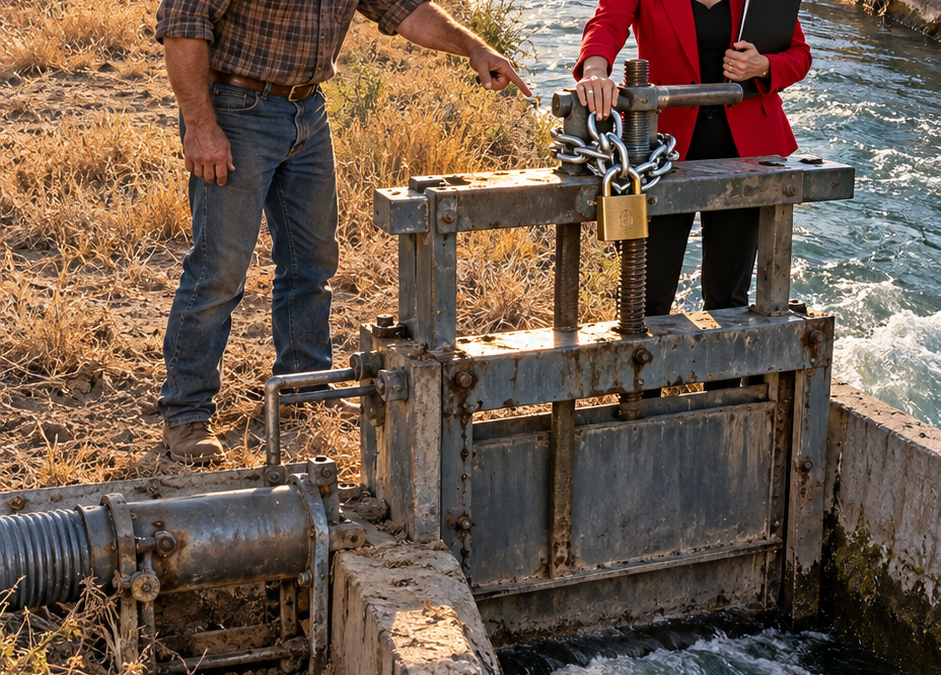
Marissa Vale stood beside my irrigation headgate in a bright red blazer, one hand resting on a brand-new brass padlock.
Across the ditch, sprinklers were already sweeping over the subdivision lawns.
I stopped ten feet from her.
“Take your hand off that chain,” I said.
She looked at me as if I had interrupted something official.
“The board authorized this.”
“Authorized what?”
“Temporary irrigation priority.”
“My hayfield can’t wait.”
“Then you should have planned better.”
I looked at the locked gate, then at her.
“Who told you my delivery turn belonged to the HOA?”
Her expression hardened.
“This lateral serves the entire community. We’re protecting water pressure while the new landscaping establishes.”
The canal moved steadily behind her, carrying enough water to make the argument feel almost absurd. My turnout sat closed. Across the road, the HOA entrance was getting soaked. Sprinklers swung in slow arcs over fresh sod, ornamental trees, and flower beds arranged around the subdivision monument.
I stepped closer to the steel gate assembly without touching the chain.
The padlock was new enough that the brass still shone. A short length of galvanized chain had been wrapped through the operating handle and around the frame. It was not district hardware. At least, it was not anything I had ever seen the district use.
“Who installed that?”
“The landscaping contractor.”
“On whose order?”
“Mine.”
She said it without hesitation.
A white landscaping pickup was parked near the subdivision monument. Two workers were adjusting sprinkler heads along a strip of sod, pretending not to watch us.
I checked my watch.
My delivery window had started seventeen minutes earlier.
The field behind me had been waiting since before sunrise.
“You locked this before my turn opened.”
“We redirected the flow before there was a conflict.”
“There is a conflict only because you’re refusing to cooperate.”
That nearly made me laugh.
Instead, I looked down the lateral. Water was moving cleanly toward the branch serving the subdivision. No leak. No emergency repair. No district crew. Nothing suggested a mechanical problem.
Marissa reached into a black portfolio and pulled out a sheet of paper.
“The HOA approved temporary irrigation priority for common landscaping.”
She held it just far enough away that I could see a board letterhead without reading the details.
“That’s an HOA resolution.”
“Yes.”
“This gate isn’t operated by your board.”
Her jaw tightened.
“The canal crosses HOA property before it reaches your turnout. We have responsibilities too.”
That was different from saying the water belonged to them.
I took out my phone and recorded the gate, the chain, the padlock, the flowing lateral, and the sprinklers running across the entrance landscaping.
Marissa watched me.
“What exactly do you think that proves?”
“Nothing yet.”
I put the phone away.
“That’s why I’m calling the canal office.”
For the first time, she stopped talking.
Only for a second.
Then she folded her arms.
“Go ahead.”
I looked once more at the locked turnout.
The real problem was no longer whether Marissa believed the HOA had authority.
The problem was finding out whether anyone outside the HOA believed it too.
Back at the shop, I pulled my irrigation folder from the cabinet.
I keep paper longer than most people think is necessary. Faded seasonal schedules. District-stamped delivery notices. Carbon-copy account statements. Maintenance letters. Handwritten notes from years when drought or repairs changed the rotation.
My father had kept those files before me. His handwriting still appeared on some of the old notes, slanted and compact, with dates circled twice when water was short. He had believed that memory was too soft for anything involving land, money, or water.
“Write it down,” he used to say. “Water arguments always come back thirsty.”
I had laughed at that when I was younger.
I was not laughing now.
The current notice listed turnout 14C. It matched the metal tag on the headgate. The date matched too. My delivery window began at 5:45 that morning and ran six hours.
What I did not have was any notice saying my delivery had been canceled, moved, or subordinated to the HOA.
Outside, I pushed two fingers into the soil near the first headland. The surface was powdery. There was still moisture deeper down, but not much. The field was not dying in front of me. The problem was quieter than that.
Heat would keep pulling moisture upward. Once the root zone fell too far behind, irrigation would stop being about maintaining yield and start becoming recovery.
That was why I did not cut the lock.
I did not force the gate.
The district had an operating system, and I wanted its answer before I did anything Marissa could later describe as interference.
I called the canal office and gave the woman in operations my account number, turnout number, and the time I had found the chain.
She put me on hold.
When she came back, her tone had changed.
“I don’t see a closure order on that turnout.”
“Is my delivery still scheduled?”
“Your account is active. I need field operations to verify the current delivery status.”
“There’s a private padlock on the mechanism.”
“Who installed it?”
“The HOA landscaping contractor, according to their president.”
A pause.
“Don’t remove it yet.”
“That was my plan.”
“I’m dispatching someone to the lateral.”
“How soon?”
“He’s already working in your area.”
The difference between losing six tons and losing nothing might now depend on how quickly someone with actual authority reached that gate.
Twenty minutes later, a white Canal District pickup appeared on the county road.
The truck slowed beside the flowing lateral and the chained turnout. Then the driver stepped out.
He was in his early sixties, wearing a faded green work shirt. His neck and forearms were dark from years in the sun. He carried a clipboard, a folding rule, and a metal tag reader. His face had the patient expression of someone who had spent most of his working life fixing other people’s water problems.
“You Grant Calder?”
“That’s me.”
“Tom Reyes. Field operations.”
He shook my hand, then looked past me toward the headgate.
“That the lock?”
“Yes.”
He walked over without touching it.
For almost a minute, he said nothing. He checked the turnout number stamped into the steel frame, wrote it down, looked at the chain, then crouched beside the operating mechanism.
“District put this on?”
“No.”
“Who says they did?”
“Nobody. HOA president says their landscaping contractor installed it under board authority.”
Tom looked across the road toward the subdivision entrance. The sprinklers were still running.
“Board authority over what?”
“That’s what I’m trying to find out.”
He stood and took several photos with a district-issued phone.
One of the landscaping workers had stopped near the monument and was watching us now.
Marissa appeared a few minutes later. She had removed the black portfolio from her car and carried it against her side as she crossed toward the canal.
Tom introduced himself.
“I’m with canal operations. I need to document the turnout condition.”
Marissa nodded once.
“Good. Then you can confirm that the HOA is protecting system pressure.”
Tom looked at her.
“I can confirm what I see.”
“The landscaping is under establishment watering,” she said. “We cannot have pressure fluctuations this week.”
“Did the district issue a control order for this gate?”
“The board authorized temporary priority.”
“I’m asking about the district.”
She opened the portfolio.
“The canal crosses association property. We have maintenance obligations around the lateral.”
Tom did not take the paper she held out.
“That may be true. It doesn’t answer my question.”
Her expression tightened.
“The HOA has managed that section for years.”
“Managed the vegetation and access,” Tom said. “That’s different from operating a delivery turnout.”
I stayed out of it.
That was not easy.
But I had learned early that when someone with actual authority starts asking the right questions, the smartest thing you can do is stop filling the air.
Tom moved several yards upstream and checked a small gauge mounted beside the lateral. Then he walked downstream toward the HOA branch, watching the flow. When he returned, he wrote another number on his clipboard.
“Flow looks stable.”
Marissa gestured toward the sprinklers.
“Exactly.”
“That doesn’t tell me why this gate is locked.”
She shifted her weight.
“We were advised that opening both delivery points during peak landscaping use would compromise pressure.”
“Advised by who?”
“Our contractor.”
Tom looked toward the white landscaping pickup.
“Name?”
“Evergreen Grounds.”
He wrote that down.
Then he looked at me.
“When did you first find the gate locked?”
“A little after six.”
“Was your delivery already open?”
“My window had started.”
“Did you touch the chain?”
“No.”
“Good.”
Marissa gave a short laugh.
“So now we’re treating this like a crime scene.”
Tom kept writing.
“We’re treating it like a district facility that somebody altered.”
That ended the humor.
One of the landscapers finally walked over. He introduced himself as Luis, the crew supervisor.
Tom asked the same question.
“Did your crew install the chain and lock?”
Luis looked at Marissa before answering.
“We put it on yesterday afternoon.”
“On whose instruction?”
“Ms. Vale.”
“What were you told?”
“That the HOA needed the turnout secured during establishment watering.”
“Did anyone from the canal district give you that instruction?”
“No.”
“Did you call us before locking the mechanism?”
“No.”
Luis looked increasingly uncomfortable.
“We thought it was HOA controlled.”
Tom turned toward Marissa.
She did not look away.
“The lateral is on HOA property before it reaches his parcel,” she said.
Tom pointed at the turnout.
“That mechanism serves his account.”
“That’s your interpretation.”
“That’s the number stamped on the frame.”
He tapped his clipboard.
“I’m not making a legal determination. I’m documenting which account the structure is assigned to.”
That was the first time all morning somebody had separated the physical fact from the argument around it.
Tom made another call from beside his truck. I could hear only pieces.
“Calder turnout.”
A pause.
“Private lock.”
Another pause.
“No, I don’t have a district closure order in the field system.”
He listened longer.
“Keep the delivery open upstream for now.”
Then he nodded.
“Understood.”
When he hung up, I asked, “Can you remove it?”
“Not yet.”
Marissa looked almost relieved.
Tom continued, “I need operations to verify the active delivery sequence before I alter anything. If I cut a private lock and there’s a separate authorization I haven’t seen, I create another problem.”
“That’s reasonable,” I said.
Marissa folded her arms.
“So the gate stays closed.”
“For now,” Tom said.
She turned toward me.
“There you go.”
Tom looked at her.
“That is not a ruling in your favor.”
Her smile disappeared.
He walked back to the turnout and attached a small district inspection tag to the chain. It contained the date, time, turnout number, and his initials.
“Don’t remove the tag,” he said.
“To either of us?” Marissa asked.
“To anyone.”
The sprinklers kept moving in their slow arcs. Every few seconds, sunlight caught the spray and turned it white.
I looked toward my field.
The upper rows still showed decent color from a distance, but the soil surface between them had begun to pale.
Tom followed my gaze.
“How long since your last irrigation?”
“Eleven days.”
“What stage are you at?”
“Recovery before the next cutting.”
He nodded.
“That’s not ideal.”
“No.”
“How much time do you have left in the current window?”
“About five hours.”
He checked his watch.
“I’ll push operations.”
Marissa stepped forward.
“Our landscaping contract has a watering requirement too.”
Tom faced her.
“I’m not saying it doesn’t.”
“If the subdivision loses new sod because this gate gets opened, the district needs to understand the liability.”
“I’m not discussing liability.”
“You should be.”
“I’m discussing delivery control.”
That distinction irritated her more than an argument would have. She wanted him to weigh whose grass mattered more. He kept bringing the conversation back to who controlled the system.
Luis and his crew returned to the sprinkler heads.
Marissa stayed near her car making calls.
Tom spent another twenty minutes inspecting the branch structure, noting the HOA delivery point farther downstream and comparing tags on both turnouts.
At one point, he asked me to walk with him.
“Yours is 14C,” he said.
I nodded.
“HOA branch is 14E, right?”
“Separate accounts, as far as I know.”
He wrote something down.
“Okay.”
“What does that tell you?”
“That I need the schedule from operations before I tell you anything more.”
He did not overstate it.
I appreciated that.
Around 8:30, the district office called me. The same woman from operations was on the line.
“Mr. Calder, field operations has documented the private lock. We are reviewing today’s delivery sequence and the HOA account notes.”
“Can you tell me if my turn is still active?”
“Your account remains active, but I don’t want to give you an incomplete answer until scheduling confirms the sequence.”
“Any closure order?”
“None is showing in our system.”
That was not the final answer I wanted.
It was still important.
I wrote down the time of the call.
After we hung up, Tom asked what she had said.
I told him.
He nodded.
“That matches what I’m seeing.”
Marissa was close enough to hear.
“No closure order does not mean Grant has unrestricted use.”
Tom looked at her.
“No one said unrestricted.”
“You’re acting like the board had no basis to intervene.”
“I’m acting like I haven’t found a district instruction authorizing the lock.”
That was as far as he would go.
By ten, the temperature had climbed. The sprinklers on the HOA side finally shut off. The water in the lateral kept moving.
My turnout remained closed.
I walked the edge of the hayfield with Caleb. He knelt between two rows and dug into the soil with his fingers.
“Dry deeper than yesterday.”
“I know.”
“If we miss today, we’ll get through it.”
“That’s not what I asked.”
I looked across the field.
Some sections would recover if I got water within a day. Others might never fill out the way I had planned. The loss would not be dramatic enough for anyone to see from the road.
It would show later in bale count and weight.
That was the problem with water disputes.
The damage often arrived quietly.
When I returned to the gate, Tom was finishing his field report. He handed me a business card.
“I’m submitting this as an unauthorized physical restriction pending operations review.”
“What happens next?”
“Scheduling pulls the delivery records. Compliance may get involved if the HOA is claiming some independent operating right.”
Marissa heard that.
“We are not claiming an independent water right.”
Tom turned toward her.
“What are you claiming?”
She hesitated.
“That the association has authority to manage shared infrastructure crossing its property.”
“Then put that in writing.”
Her face went still.
“Why?”
“Because operations is going to ask exactly what authority you relied on when you ordered this gate locked.”
She closed the portfolio.
“I’ll have management send it.”
Tom nodded.
“That’ll help.”
He drove away shortly after.
The chain stayed in place.
So did the inspection tag.
I had lost most of the morning, and my field still had not received a gallon from that turnout, but the dispute had changed.
At sunrise, Marissa had controlled the gate because she had the key.
By noon, the district had documented the lock, identified the turnout, recorded the HOA branch separately, and found no closure order in its field system.
That was not a ruling.
It was something better than an argument.
It was a record.
Now Marissa had to explain where her authority came from.
The district called me just after 1:30.
This time it was not the front desk. A scheduling supervisor named Elena Park introduced herself and said Tom Reyes had already uploaded his field report.
“We’ve pulled today’s delivery sequence,” she said. “I want to walk through what is actually in the system before anyone touches that gate.”
I went back to the shop and opened my irrigation folder on the desk.
“Go ahead.”
“Your turnout is 14C.”
“Yes.”
“Your delivery window began at 5:45 this morning and runs through 11:45.”
I checked my notes.
“That’s what I was expecting.”
“The HOA’s account is 14E. Their scheduled delivery begins at noon.”
I stopped writing.
“After mine?”
“According to the current schedule, yes.”
“What about the landscaping priority they keep talking about?”
“That is what I’m reviewing now.”
She asked me not to treat the schedule as a legal conclusion and said operations still needed to compare the HOA account notes, maintenance history, and any special instructions attached to the lateral.
That was fine with me.
The timing itself was enough to change the shape of the dispute.
Marissa had not locked my turnout because two legitimate delivery windows overlapped.
At least according to the district’s own schedule, hers had not started yet.
Elena emailed me a copy of the day sheet. It was not dramatic. A table with account numbers, turnout numbers, start times, end times, estimated flow, and operator notes.
My row came first.
The HOA row appeared below it.
I printed the sheet and laid it beside the old notice from my folder.
The times matched.
At 2:15, another email arrived. This one came from the district’s records coordinator and included the service notes attached to both accounts.
The HOA had contacted the district five days earlier. The request was straightforward. Their landscape contractor wanted an earlier morning window for two weeks while new sod and ornamental trees established.
A short internal note showed that scheduling had reviewed the request.
The response was equally straightforward.
Request not approved. Existing delivery order remains in effect.
I read it twice.
Then I checked the date.
Three days before Marissa had the lock installed.
The file did not say she personally received that response. It showed only that the HOA account had been notified through the contact information on record.
I wrote that distinction down.
I was not interested in claiming she knew something unless the records eventually supported it.
What I could say was simpler.
The HOA had asked for a different watering sequence.
The district had declined to change it.
The existing sequence remained in place.
And the lock appeared afterward.
That afternoon, the HOA management company finally answered a records request I had sent earlier. The packet included board minutes, landscaping correspondence, and a vendor work note from Evergreen Grounds.
The board minutes were less aggressive than Marissa had sounded at the gate. They approved an enhanced establishment watering plan for the new entrance landscaping and authorized Marissa to coordinate with contractors and utility providers as needed.
Nothing in the minutes said the board had changed a district delivery schedule.
Nothing said the HOA could lock a neighboring turnout.
The phrase Marissa had used—temporary irrigation priority—appeared nowhere in the resolution itself.
The landscaping correspondence was more useful.
Evergreen Grounds had warned the HOA that the sod was showing heat stress and that irregular morning pressure was reducing sprinkler coverage near the monument. Their project manager suggested asking the Canal District for an earlier delivery window during the establishment period.
A later email from Marissa said, Please proceed with the morning watering plan. I’ll handle the access issue.
That sentence caught my attention, but it still did not explain what “access issue” meant.
The answer was in a work note dated the following afternoon.
Secure upstream turnout during HOA establishment watering. Lock and chain provided by customer contact. Customer contact: Marissa Vale.
I sat back.
The contractor had not improvised. The chain was not a field decision made by a crew trying to protect pressure. It had been supplied as an instruction tied to Marissa.
I called Elena.
“I have the landscaping work note.”
“What does it say?”
I read the relevant line.
There was a pause.
“Send that to me.”
“I will.”
“Do you have the board resolution too?”
“Yes.”
“Send the full packet. Don’t highlight only the pieces you think matter.”
That was good advice.
I scanned everything and sent it in one file.
Around three, Marissa called.
“I understand you’re collecting HOA records now.”
“I requested them.”
“You’re treating a temporary operations measure like theft.”
“I’m trying to find the authority behind the lock.”
“You already know the authority. The board approved establishment watering.”
“The board approved watering. That isn’t the same as changing the district sequence.”
“You’re splitting words.”
“No,” I said. “I’m reading the schedule.”
Her tone sharpened.
“You have a field. We have hundreds of homeowners who paid for landscaping that is at risk.”
“That doesn’t make my account your backup supply.”
“No one is using your account.”
“Then why was my turnout chained shut?”
She did not answer immediately.
“We were told simultaneous use would reduce pressure.”
“By Evergreen?”
“Yes.”
“And did the district approve your earlier window?”
“That is still under review.”
I had the district note in front of me.
I did not quote it.
“Then we can wait for their answer.”
She exhaled hard.
“This could have been handled cooperatively.”
“You put a lock on the gate before talking to me.”
“We took a temporary step to protect common property.”
“On a turnout assigned to my account. That’s the district’s terminology. It’s stamped into the steel.”
She ended the call a few seconds later.
At 3:30, Elena contacted me again. She had received the HOA packet.
“We’re building a chronology,” she said.
“Can you tell me what you have so far?”
“I can tell you what the records show, not what compliance will conclude.”
“That’s all I’m asking.”
She read the sequence slowly.
The HOA requested an earlier delivery period.
Scheduling declined the request.
The existing delivery order remained active.
The landscaping contractor later received instructions to secure the upstream turnout during HOA watering.
The contractor identified Marissa as the customer contact.
Tom then documented the private lock during my active delivery window.
I wrote each step in my notebook.
“Does your system show any authorization after the denied request?”
“Not in scheduling. Not in maintenance. No closure order in field operations. Tom’s report is the only entry I see today.”
“What happens now?”
“Operations is escalating the issue to compliance because the HOA is asserting authority based on the canal crossing its property.”
That was the first time somebody inside the district had framed the dispute in the same terms Marissa had been using.
Not whose grass needed water more.
Not whether my hayfield was more important than the entrance landscaping.
Whether property access around the canal gave the HOA authority to interfere with delivery control.
Elena sent one more document before the office closed.
It was a lateral service diagram.
The drawing showed the main branch entering the subdivision side of the corridor, continuing past a maintenance strip, then serving my turnout at 14C before reaching the HOA delivery structure at 14E farther downstream.
The diagram explained the physical sequence without answering the rights question.
I could see why Marissa kept pointing to the canal crossing HOA ground. Part of the infrastructure physically passed through land managed by the association.
But the same diagram showed separate numbered delivery structures tied to separate accounts.
That was a fact.
What rights came with the corridor was still a question for the district to interpret.
Before dinner, I drove back to the headgate.
The chain was still there. Tom’s inspection tag moved slightly in the breeze. The lateral had dropped to a lower flow now that the HOA’s scheduled period was nearing its end.
Caleb joined me at the fence.
“Any answer?”
“We have the schedule.”
“And your turn was first.”
“Yes.”
He looked at the lock.
“So why is that still on there?”
“Because the schedule tells us whose water was supposed to move when. It doesn’t tell us yet what authority they think they had to lock the structure.”
He nodded toward the field.
“We’re going to need that makeup water.”
“I know.”
The first visible stress was starting to show in patches nearest the upper end. Nothing catastrophic. Just enough that I could no longer pretend timing was theoretical.
At 6:10, the district sent a final message for the day.
Compliance review opened: Turnout 14C / HOA access claim.
That line told me exactly where the dispute was headed next.
The records had answered the scheduling question.
They had also traced the lock back to Marissa’s instruction.
What they had not answered was whether the HOA’s access rights around the canal gave her any power to control my delivery structure.
For the first time all day, I had the right question in front of me.
Now I needed the district to answer it.
Daniel Cho called the next morning while I was standing beside turnout 14C.
The chain was still there. Tom’s inspection tag moved slightly in the breeze, and sunlight had already reached the upper field behind me.
Elena joined the call first.
“Grant, Daniel handles service compliance and lateral-use questions. He’s reviewed the field report, scheduling records, HOA documents, and the corridor instruments we have on file.”
Daniel came on.
“I want to separate three things before we talk about conclusions.”
I rested my notebook on the fence post.
“Go ahead.”
“First, access to the canal corridor for maintenance and inspection.”
I wrote: access.
“Second, the right of an account holder to receive scheduled water through an assigned delivery structure.”
Under it, I wrote: delivery.
“Third, authority to operate, restrict, or reallocate another account’s turnout control.”
Daniel let the words sit for a second.
“They are related to the same physical system. They are not automatically the same legal or operational right.”
I looked at the lateral.
The canal crossed land associated with the subdivision before reaching my turnout. That physical fact had been the center of Marissa’s argument from the first morning.
Daniel continued.
“The district easement allows inspection, repair, vegetation management, and access along the corridor. The association also has responsibilities to keep portions of that corridor accessible.”
“So Marissa is right about having responsibilities there.”
“About certain responsibilities, yes.”
“And the lock?”
“Nothing we’ve reviewed so far says those responsibilities transfer control of a separate account’s delivery structure.”
I walked several yards toward the edge of the field while he spoke.
Caleb had dug another soil check that morning. The darker layer we had found the day before was retreating deeper below the surface. Every hour did not destroy the crop, but every warm hour was using moisture the plants could not replace while 14C stayed closed.
“Can an HOA ever shut one?” I asked.
“There are situations where someone may need to respond to an immediate hazard. Broken structure, flooding, a threat to public safety. But emergency action is temporary, documented, and reported to the district.”
“There wasn’t a failure here.”
“Tom documented normal flow and no emergency condition.”
I looked across the road. The HOA entrance landscaping still looked bright and green from the extra establishment watering it had received. My field looked fine from that distance too.
That was what made the argument dangerous.
The damage was developing below the level anyone driving past would notice.
Daniel opened another record.
“The operating rules assign delivery adjustments to district personnel or to the account holder when a turnout has been released for that account’s scheduled use.”
“My turn had already started.”
“Scheduling confirms that.”
“So what is compliance waiting for?”
“We are giving the HOA an opportunity to identify a separate written authority that is not already in our records.”
“What kind?”
“An operating agreement. A service amendment. A specific emergency provision. Something that actually addresses control of 14C, not just the corridor easement.”
“Correct.”
My phone showed an incoming call from Marissa before Daniel and I had finished.
I let it ring out.
Ten minutes later, she called again. Daniel had already ended the compliance call, so I answered.
“The HOA’s attorney reviewed the canal easement,” she said.
“I figured.”
“The association has maintenance responsibilities over that corridor.”
“Daniel agrees.”
That stopped her for half a beat.
“Then you understand why we acted.”
“No. I understand why you can maintain the corridor.”
“We had a pressure problem threatening common landscaping.”
“Where does the easement say you can lock 14C?”
“You’re reducing a real infrastructure issue to one sentence.”
“I’m reducing it to the sentence that would authorize the lock.”
Her voice hardened.
“The system was designed before this community existed at its current size. Agricultural delivery practices cannot ignore hundreds of homes forever.”
“That sounds like a reason to ask the district for a different schedule.”
“We did.”
“And until they change it, you expect the HOA to watch thousands of dollars in landscaping fail?”
I looked back at my own field. Forty-two acres. An expected cutting. Six tons at risk under even a modest loss scenario.
“You made that decision using somebody else’s delivery window.”
“We made a temporary management decision.”
“Then show the district the authority for it.”
She ended the call.
By noon, the temperature had climbed enough that the soil surface near the headland had gone from dusty to almost chalky.
Caleb came over with a shovel. He cut a narrow slice several inches down and broke it apart in his hands.
“There’s still moisture below.”
“For now.”
He nodded toward the chain.
“How long are they going to argue about vocabulary?”
“That vocabulary decides who gets to touch the gate.”
The answer came faster than I expected.
Daniel emailed the HOA management company a formal information request and copied me. The district asked for any written authority allowing the association to secure, immobilize, or otherwise control turnout 14C during an active delivery assigned to another account.
The management company sent back the board resolution.
Daniel responded that a board vote could authorize the HOA’s own landscaping plan, but did not establish district authority over the turnout.
The HOA attorney then supplied the corridor easement.
Daniel already had it.
His reply asked for the specific clause granting operational control over 14C.
Nothing arrived for more than an hour.
Marissa texted me instead.
You’re forcing the HOA to defend a reasonable safety and maintenance decision as if we stole your water.
A second message followed.
If your field had needed emergency water, the district could have opened it.
I forwarded both to Daniel.
He called while I was still beside the canal.
“Was there an emergency condition on your property that morning?”
“No.”
“Did the HOA report a canal emergency?”
“Not that I know of.”
“We have no such report.”
He paused.
“They appear to be shifting from scheduled-use authority to emergency justification. We need them to state clearly what they’re relying on.”
Later that afternoon, HOA counsel did exactly that.
The association was not claiming ownership of my water allocation. It was not claiming a permanent right to operate 14C. Counsel described the lock as a temporary infrastructure management measure intended to stabilize pressure and protect the shared corridor.
Daniel’s response was shorter than the explanation.
Please identify the district rule, written authorization, or emergency provision permitting a private association to immobilize turnout 14C during another account holder’s active scheduled delivery.
I read that sentence standing beside the same gate Marissa had ordered chained against me.
Nothing looked dramatic.
Water moved through the lateral.
Wind moved through the hay.
The lock stayed closed.
But the dispute had finally been stripped down to something that could not be solved by repeating community maintenance or safety.
Either the HOA had authority to control that turnout or it did not.
By sunset, it had produced plenty of reasons for wanting the gate closed.
It still had not produced permission to close it.
Daniel called just after eight the next morning.
“We completed the compliance review.”
I was already outside. The driest rows were no longer hiding their stress.
“What did they produce?”
“No separate operating authority. None of the documents they submitted gives the HOA control of 14C during your delivery.”
“What happens now?”
“We issued a corrective notice.”
A white district pickup turned onto the shoulder before he finished.
Tom was driving.
Another field employee sat beside him, and a long-handled bolt cutter rested in the truck bed.
Marissa arrived minutes later in a red blazer, a folder tucked beneath one arm. Two residents walking dogs slowed near the subdivision monument. A man outside the first house shut off his hose and watched from his driveway.
Nobody came over.
Tom handed Marissa the notice.
“This is premature,” she said.
“Compliance cleared the action.”
“The HOA still disputes your interpretation of the corridor rights.”
“You can preserve that objection with compliance. My instruction is to restore the turnout.”
Marissa looked at the bolt cutter.
“You’re destroying HOA property.”
“We’re removing a private restriction from a district-controlled delivery structure.”
The second employee photographed the turnout, inspection tag, lock, and chain. Tom set the cutter jaws around one link.
For the first time, Marissa stopped talking.
He leaned into the handles.
The chain tightened.
Then the steel flattened inside the jaws and broke with a sharp metallic crack. One end struck the turnout frame. The other dropped into the dirt.
The sound carried across the road.
Marissa’s expression changed only slightly. Her jaw set and she gripped the folder with both hands while Tom lifted the broken chain away.
Whatever the watching residents thought, none of them stepped forward to defend the lock.
Tom placed the cut chain and padlock in an evidence bag with the inspection tag rather than handing them back on the spot. The second employee noted the time and corrective notice number.
That small bit of procedure mattered.
The lock had begun as something Marissa could describe as a temporary field decision. Now it was part of a district compliance record, photographed, numbered, and removed under written authority.
Tom worked the turnout by hand, opened it far enough to confirm the mechanism moved freely, then closed it again.
“Your makeup delivery is tonight,” he told me.
“How long?”
“Six hours. Same estimated flow as the missed turn.”
Marissa stepped forward.
“You’re adding an unscheduled delivery into an active rotation.”
“We’re correcting a missed district delivery.”
“That affects downstream users.”
“They’ve been notified.”
“So everyone else gets adjusted because Grant refused to cooperate.”
Tom looked directly at her.
“The schedule change is ours to manage.”
The corrective notice also required written district approval before the HOA or its contractors could secure, modify, restrict, or operate a district delivery structure, except during a documented emergency.
Marissa read that paragraph twice.
“This adds bureaucracy to routine maintenance.”
“It doesn’t prevent maintenance,” Tom said. “It prevents maintenance from becoming control of somebody else’s turnout.”
The HOA board met that afternoon.
Marissa remained president, but the board removed utility-related field decisions from her individual authority. Future contractor instructions involving canal structures, outside utility equipment, or shared infrastructure would require management review and written confirmation from the relevant service provider.
Routine landscaping remained hers to coordinate.
14C did not.
At 7:10 that evening, Tom returned.
Caleb and I had the gated pipe ready. Tom recorded the start time and opened the turnout. Water pushed through with a low rush, entered the pipe, and moved toward the upper rows.
The first outlet spilled across dry soil, darkening it almost immediately.
“About time,” Caleb said.
I watched the water spread.
The lock was gone.
The delivery was back.
But two days of lost moisture had already left shorter plants in parts of the field.
The next question was no longer who controlled the gate.
It was what those two days had actually caused.
The makeup delivery helped. It did not erase the missed turn, but it stopped the field from sliding any further. Over the next week, Caleb and I watched the upper rows recover enough to show where the real damage had settled.
On cutting day, we finally had numbers.
I compared bale count, average weight, and yield from the stressed acreage with the neighboring section that had received normal water.
The loss was real.
It was not catastrophic.
I sent the records to the HOA management company with my labor notes and the district file. Evergreen later credited the HOA for the lock installation after management disputed whether that work had been properly cleared. The association’s insurer reimbursed my documented crop loss after reviewing the district record.
There was no giant settlement.
There was no dramatic check.
The numbers followed the records.
That was enough.
The more important change happened at the canal.
The HOA stopped trying to manage its pressure by controlling my turnout. Evergreen adjusted the subdivision watering plan to use the window assigned to account 14E, and a balancing valve was added downstream on the HOA side so its crew could manage pressure without touching 14C.
The district reviewed the work before it went into service.
Marissa remained HOA president, but the special meeting resolution stayed in effect. Instructions involving canal structures or outside utility equipment now required written review before a contractor acted.
No more field shortcuts.
At the next board meeting, the HOA also adopted a contractor checklist requiring the service provider’s written approval number before any job touched canal hardware. I never needed to attend that meeting. The management company sent me the adopted procedure because 14C was specifically referenced in the corrective file.
That was the part I cared about.
A payment could cover one bad cutting.
A procedure could prevent the same shortcut from reaching the field again.
Caleb and I reseeded two thin patches near the upper end and adjusted the next irrigation interval to help the stand recover. By the second cutting, those sections were still lighter than the rest, but they were producing again.
I saw Marissa once about three weeks later near the subdivision monument while a crew adjusted sprinkler heads. She looked toward my truck. I looked toward the canal.
Neither of us stopped.
A month after the dispute, my next scheduled delivery opened at 5:45 in the morning.
I was at 14C before sunrise.
The inspection tag was gone.
So was the chain.
I moved the steel handle, and the first rush of water entered the gated pipe.
Caleb was already in the field checking the lower berm. Water reached the first rows, spread evenly, and worked toward the center section.
Across the road, the HOA sprinklers were off.
Their turn would come later.
That quiet difference was the whole result.
My field no longer depended on whether an HOA officer believed her board vote reached farther than it did. The district schedule controlled the delivery, and the new procedure controlled any future changes.
By midmorning, the upper field was darkening as water moved through the rows. The stressed section would never fully recover that earlier cutting. The next one had a fair chance.
The schedule was back where it belonged.
So was control of the gate.
Marissa Vale had arrived at my headgate with a shiny lock, a board resolution, and the confidence of someone who believed proximity meant authority. She had pointed to the canal corridor, the subdivision landscaping, the homeowners, the sod, the contractor, and the pressure problem. She had named every reason she wanted control.
But wanting control is not the same as having it.
A lateral can cross HOA-managed ground without making every turnout HOA property.
A board can approve landscaping without rewriting a district delivery schedule.
A contractor can install a lock without creating the authority to use it.
And a hayfield can look fine from the road while losing money one dry hour at a time.
That morning, Marissa had a key.
I had a schedule.
The key held for two days.
The schedule held longer.