𝗙𝗨𝗟𝗟 𝗦𝗧𝗢𝗥𝗬 The Insurance Adjuster Was Already Photographing My Barn Before I Learned the HOA Had Filed the Claim
𝗙𝗨𝗟𝗟 𝗦𝗧𝗢𝗥𝗬
Lauren immediately objected.
“This claim has already been opened.”
Owen nodded. “That doesn’t mean I determined title.”
That was the second sign he was not there to fight her battle.
I took out my phone and photographed his business card, the claim number on his tablet, and the page showing my ranch address. Then I photographed the measuring wheel, his truck, and the areas he had already inspected.
Owen did not object.
Lauren did.
“You are making this unnecessarily adversarial.”
“No,” I said. “I’m making a record.”
For the first time, her jaw tightened.
I asked Owen to stop the inspection until the insurer verified who actually owned the property.
He agreed.
Lauren did not.
She stood beside her SUV in that cobalt-blue blazer while Owen packed his equipment back into his truck. Before leaving, he handed me his card.
“Send me your deed and your policy declarations,” he said. “I’ll note the file.”
I looked at the barn again.
A few minutes earlier, the problem had been a stranger taking photographs on my ranch.
Now I knew the real problem.
An insurance company had a claim file with my address on it.
And somehow, the HOA next door believed it had the right to file it.
I went straight from the barn to the ranch office.
Not because I doubted who owned the property.
Because I wanted every answer on paper before anyone else came back through my gate.
The deed was easy to find. I kept the original closing documents in a steel file cabinet beneath the desk, along with tax records, equipment titles, and insurance paperwork. Fourteen years earlier, I had bought the entire 104-acre ranch from a family that had run cattle there for two generations.
The deed included the barn.
The equipment shed.
The fencing.
The access road.
There was nothing complicated about it.
Cedar Hollow was not listed as an owner. The HOA was not named as a beneficiary. No part of the ranch was identified as common property.
Then I pulled my farm policy.
That made the situation even stranger.
My insurer had the cattle barn listed as a scheduled structure. The equipment shed was there too. So were fencing allowances and storm-related coverage provisions. I had renewed that policy every year. I had paid the premiums.
After the hailstorm, I had already called my agent about several damaged roof panels, though I had not decided whether the repairs were significant enough to file a claim.
Now another insurance company had sent an adjuster to inspect the same buildings under somebody else’s claim.
I photographed the deed pages and policy declarations and emailed them to Owen Park.
He called less than twenty minutes later.
“I got the documents.”
“Good.”
“I’m putting the inspection on hold.”
“That should have happened before you came onto the ranch.”
“I understand why you’re upset.”
His tone was calm, not defensive.
“I was given an assignment with a loss location, a list of structures, and permission from the insured’s representative to inspect.”
“The insured being Cedar Hollow.”
“Yes.”
“And nobody checked who actually owned the buildings.”
“That isn’t normally something I determine before an inspection.”
I leaned back in my chair.
Owen explained that adjusters are often sent out with a claim number, policy information, an address, and a scope. Their job is to document reported damage, roof condition, fence damage, debris, dimensions, and repair estimates. They are not title examiners.
“If the assignment says inspect Building A at a certain location,” he said, “I usually inspect Building A.”
“That seems like a problem when Building A belongs to someone else.”
“It can be.”
At least he did not pretend otherwise.
I asked him what exactly he had been told to inspect.
He opened the file while we were on the phone.
Cattle barn roof.
Equipment shed.
A section of north fencing.
Storm debris near the access road.
Temporary weather protection if needed.
Every item was mine.
I wrote them down.
“Was my name anywhere in the assignment?”
“Not that I saw.”
“Was there any document showing the HOA owned these structures?”
“I wasn’t sent one.”
That answer mattered.
Owen had not arrived with a deed.
He had arrived with an insurance assignment.
Those were two very different things.
I asked him to send me whatever portion of the inspection request he was allowed to release. He said he would need authorization from Harborline Mutual. That was fair.
Before we ended the call, he added one thing.
“I’ve added your ownership documents to the file.”
“What happens now?”
“The carrier will review them. Until then, I’m not returning to the property without direct confirmation that the access issue has been resolved.”
For the first time that day, I felt like one piece of the problem had moved into the right place.
Owen was not the person I needed to fight.
He had been following an assignment.
The larger question was why that assignment existed.
I called my own insurance agent next. Her name was Teresa Blake, and she had handled my farm coverage for six years.
I told her Cedar Hollow had filed a claim that included my barn and fencing.
She was quiet for several seconds.
“Your barn?”
“Yes.”
“Under their master policy?”
“That’s what the adjuster said.”
She asked me to send everything I had.
Ten minutes later, she called back.
“Our records still show you as the insured owner of those structures.”
“I know.”
“I don’t see Cedar Hollow anywhere in your file.”
“I know that too.”
Then she asked the question I had been waiting for someone else to ask.
“Why would their carrier have your building scheduled at all?”
That was exactly the problem.
Two insurance systems now appeared to recognize the same physical structures for completely different policyholders.
One of those systems was mine.
I knew how those buildings had gotten there. I had insured them because I owned them.
The other system belonged to Cedar Hollow, and somebody had put my barn into it long before Owen ever drove through my gate.
That afternoon, I printed one page from my farm policy and placed it beside the photograph of the HOA claim screen.
Same ranch.
Same structures.
Two different insured parties.
Whatever Cedar Hollow believed it had been insuring, the mistake had started before the storm.
The storm had only exposed it.
The claim summary arrived two days later.
Not from Lauren.
From Harborline Mutual.
Owen had requested permission to release the portion of the file that identified the reported loss. Once the carrier received my deed and farm policy declarations, they sent a redacted copy to me and to the attorney I had just hired.
Her name was Clare Bennett. She practiced real estate and insurance law out of a small office in the county seat, and she had the useful habit of reading documents before deciding what they meant.
I forwarded her everything.
The photographs from the ranch yard.
Owen’s business card.
My deed.
My farm policy.
The HOA claim.
I caught myself using the wrong word when I spoke to her. I almost called it a permit.
Not a permit.
A claim.
That was how strange the situation had already become.
By then, I had dealt with enough HOA paperwork in my life that my brain wanted to put every disagreement into the same category.
This one was different.
Nobody was claiming a right to build on my land.
Nobody had moved a fence.
Nobody had cut a road.
Cedar Hollow had placed my property inside an insurance event.
That distinction mattered.
Clare called me after reviewing the claim summary.
“This is larger than the barn.”
I had already noticed.
The first page listed the reported date of loss and described severe wind and hail affecting Cedar Hollow property and related insured structures. The second page broke the claim into categories.
Cattle barn roofing.
Equipment storage structure.
Perimeter fencing.
Storm debris removal.
Temporary weather protection.
Exterior electrical service.
I read the list again.
Every item except one belonged to my ranch.
The electrical reference was unclear.
The rest were not.
The barn sat roughly four hundred yards west of the Cedar Hollow boundary. The equipment shed stood even deeper inside my property. The fencing section included a run along my north pasture. The debris reference appeared to cover fallen branches and roofing material near my service road.
This was not someone accidentally typing my address into the wrong field.
The claim described physical assets.
My physical assets.
Clare asked me to compare the list against my own insurance schedule.
I did.
The overlap was almost exact.
“Your insurer has them by structure,” she said.
“Right.”
“And Harborline has them by structure.”
“Yes.”
“That means someone didn’t just include the parcel address.”
That was the first major shift.
If the mistake had been only an address, it could have been a clerical entry. But whoever built Cedar Hollow’s claim file knew enough to identify specific improvements on the ranch: the cattle barn, the equipment shed, the fence line.
I asked Clare whether that meant the HOA had copied my records.
“Not necessarily,” she said.
She wanted the source document.
The claim summary contained a field labeled basis of property description.
The entry said:
Per scheduled property records.
That phrase became our next target.
Clare sent a written request to Harborline asking for the property schedule used to assign the claim. She also sent Cedar Hollow a preservation notice covering all insurance-related records connected to my address, policies, renewals, property schedules, valuation worksheets, broker correspondence, board approvals, claims communications, and anything identifying my ranch, barn, shed, fencing, or parcel number.
Lauren responded before the HOA attorney did.
Her email was short.
The structures have long been included under Cedar Hollow’s master coverage. The association is cooperating fully with the carrier’s inspection process.
I read it twice.
Long been included.
Again.
She was relying on duration.
Not ownership.
Not a contract.
Not a deed.
Duration.
Clare told me not to answer, so I did not.
Instead, I called Owen.
He was willing to talk about the inspection assignment, but careful not to disclose anything the carrier had not authorized.
I asked where his scope had come from.
“The claim package.”
“What built the claim package?”
“The insured property schedule and first notice of loss.”
“Who prepared that?”
“Usually the insured or broker provides the initial information. The carrier builds the file from there.”
“Did anyone at Harborline independently verify who owned my barn before sending you?”
“I can’t speak for underwriting.”
“What about you?”
“No,” he said plainly.
His assignment contained an address, a list of assets, and a reported storm date.
He had not received title records.
He had not received a lease.
He had not received a contract showing Cedar Hollow was responsible for my structures.
He had received a scope.
That made him useful because it showed how an administrative mistake could turn into physical action.
One person entered information.
Another system accepted it.
An adjuster got dispatched.
A truck rolled through my gate.
By the time anyone asked who actually owned the buildings, the inspection had already started.
Clare described it more simply.
“Claims systems trust the data they are given until something forces a review.”
My deed had forced the review.
But we still did not know who had supplied the original data.
That afternoon, Harborline sent another document.
This one was more detailed: a preliminary loss estimate.
The number at the bottom was high enough to get my attention. Not life-changing money, but not small.
The estimate included roof replacement assumptions for the cattle barn, partial repairs to the equipment shed, fence replacement by linear foot, debris removal, and temporary protective work.
I stared at the page.
The most unsettling part was not the amount.
It was how normal the document looked.
Nothing about it screamed mistake. The format was professional. The categories were ordinary. The calculations were ordinary. If you did not know the ranch, you could read the file and assume Cedar Hollow had every reason to make the claim.
That was how institutional errors became dangerous.
They did not always look suspicious.
Sometimes they looked organized.
Clare asked me to walk the ranch and document the actual storm damage before anyone else touched anything.
I spent the rest of the afternoon doing exactly that.
The west slope of the barn roof had several dented metal panels. The equipment shed had a bent gutter and one loose fascia board. A section of fence had gone down where a large limb fell.
Nothing catastrophic.
I photographed everything with timestamps.
Then I photographed undamaged areas too.
The point was not to maximize a claim.
It was to establish the condition before competing insurance files started describing the same damage differently.
My own agent, Teresa Blake, came out the next morning. She examined the barn and shook her head when I showed her Cedar Hollow’s preliminary estimate.
“Your policy has this structure scheduled at a different value.”
“Higher or lower?”
“That’s not the interesting part.”
She pointed to the structure description.
Cedar Hollow’s file classified the barn as an association-maintained agricultural outbuilding.
I laughed once because I genuinely did not know what else to do.
“Association-maintained.”
“You maintain it?”
“I replaced the east roof section three years ago.”
“Who paid?”
“Me.”
“Siding?”
“Me.”
“Electrical?”
“Me.”
“Taxes?”
“Me.”
She looked at the document again.
“That description came from somewhere.”
There it was.
Not just the address.
Not just the barn name.
A category.
Someone had described my building in a way that made it fit Cedar Hollow’s policy.
Clare requested the underlying schedule immediately.
While we waited, I started building my own timeline.
Storm hits.
Cedar Hollow reports loss.
Claim opened.
Harborline generates inspection assignment.
Owen receives structures and ranch address.
Owen enters property.
I stop inspection.
Ownership documents are added.
Carrier pauses.
That timeline covered only a few days.
The real timeline had to start years earlier.
Lauren’s statement proved that if Cedar Hollow had long carried the buildings under its master coverage, then the problem had survived multiple renewals, multiple budgets, multiple premium payments, and possibly multiple boards.
I checked Cedar Hollow’s publicly available annual reports. Insurance appeared each year as a line item. No property detail, just premium totals. One year, the premium jumped sharply after a regional storm season. Another year, it dropped after a carrier change.
Nothing connected directly to me, but it confirmed the master policy was being renewed like any other recurring HOA expense.
Clare eventually reached Cedar Hollow’s management company.
The manager would not release the insurance schedule without board authorization.
That lasted until Harborline asked for it too.
Then the tone changed.
Late Friday afternoon, Clare received a six-page extract.
She called me immediately.
“Come in Monday.”
“What did you get?”
“The property schedule.”
“Does it list the barn?”
“Yes.”
“The shed?”
“Yes.”
“The fence?”
“Yes.”
I stood beside my truck in the ranch yard, looking directly at the buildings she had just named.
“What does it say I am?”
There was a pause.
“Nothing.”
“What do you mean?”
“It doesn’t list you at all.”
The document apparently treated the assets as scheduled locations under Cedar Hollow’s master policy without naming the actual owner.
That was bad enough.
Then Clare added something else.
“There’s a parcel reference.”
“Mine?”
“I need to compare it against the county record before I tell you that.”
I looked toward the east, past the fence line. Beyond the trees, roofs from Cedar Hollow were visible in the distance.
For fourteen years, I had thought of the HOA as a neighboring organization. Annoying sometimes, overconfident occasionally, but separate.
Now its insurance records contained my barn, my shed, my fencing, and possibly my parcel number.
The storm had not created that connection.
It had merely triggered the claim that exposed it.
By Monday morning, Clare had the master policy schedule open beside the county property records.
She did not explain the mistake when I walked into her office.
She showed it to me.
On the left monitor was the county parcel map.
On the right was Cedar Hollow’s insurance schedule.
My ranch parcel ended in 417.
A narrow maintenance tract owned by Cedar Hollow ended in 471.
Same three digits.
Different order.
The insurance schedule carried 417.
My number.
For a few seconds, I just looked at the screens.
The mistake was so small that I almost expected there to be something more complicated behind it.
There was not.
At least not at the beginning.
Clare had spent the weekend reconstructing nearly a decade of insurance renewals. Instead of handing me every document separately, she had built a timeline across the conference table. At the far left sat the oldest surviving spreadsheet. At the far right was the current storm claim.
Everything between them showed how three transposed digits had slowly become something nobody questioned.
Nine years earlier, Cedar Hollow changed insurance brokers. The incoming broker requested a statement of values, a list of buildings, structures, and other property the HOA wanted covered under its master policy.
Most of the entries made sense.
Clubhouse.
Pool equipment.
Entrance monuments.
Association storage.
Common fencing.
Then near the bottom appeared:
Agricultural outbuilding / fence buffer.
Beside it was parcel 417.
My ranch.
There was no owner name, no deed reference, no ranch address.
Just a vague description, a replacement value, and the wrong parcel number.
Clare slid the earlier management company spreadsheet toward me.
That was where the error first became visible.
Cedar Hollow’s actual maintenance parcel 471 appeared in one section. But a separate asset entry used 417.
Someone had reversed two digits.
That should have been the end of it.
One typo.
One correction.
Except nobody corrected it.
The next year’s insurance file started with the previous year’s spreadsheet.
Parcel 417 survived.
A replacement value changed.
The description became maintenance outbuilding.
Another renewal came.
The label changed again.
Association-maintained agricultural structure.
The parcel stayed.
By the fourth renewal, the original typo no longer looked like a typo.
It looked like history.
Clare had printed small excerpts from each year and arranged them in order.
I walked slowly along the table.
The same number appeared again and again.
Different insurers.
Different brokers.
Different values.
Same ranch.
That visual told me more than another hour of argument with Lauren ever could.
No one had to deliberately add my property every year.
They only had to trust the last spreadsheet.
The board minutes reflected the same pattern. Cedar Hollow’s directors reviewed premium increases, deductibles, storm exposure, and annual renewal totals. They were not sitting around discussing my cattle barn. Most years, the entire insurance renewal passed in a few paragraphs.
Approve premium.
Authorize management to bind coverage.
Move to the next agenda item.
That was how the mistake survived.
Not because everyone kept deciding my ranch belonged to the HOA.
Because almost nobody was deciding anything about my ranch at all.
The schedule simply kept moving forward.
Five years earlier, Cedar Hollow changed brokers again. The new firm sent a standard request asking the association to confirm all insured locations.
The return spreadsheet adjusted several values.
My parcel stayed untouched.
Two years later, someone renamed the structure again.
The barn became association-maintained storage agricultural building.
I stared at the wording.
It sounded increasingly official.
Yet nobody had photographed the building.
Nobody had attached a deed.
Nobody had listed me as owner.
The description became more confident while the documentation underneath it remained empty.
Clare had found one renewal packet containing reference photographs. I expected to see my barn.
Instead, the images were generic examples of agricultural structures used in the underwriting file.
That bothered me more than I expected.
The insurance system had carried a building for years without necessarily knowing what it looked like.
It knew a replacement value.
It knew a category.
It knew a parcel number.
And because those pieces kept appearing together, the listing gained credibility simply by surviving.
Then the timeline changed.
Eleven months before the storm, someone finally questioned it.
A junior account manager at the broker sent an email with the subject:
Ranch Structures Ownership Confirmation
The message asked Cedar Hollow to verify whether it owned the structures associated with parcel 417 or had some other documented responsibility for them.
The property manager answered that the assets had appeared on Cedar Hollow’s schedule for years.
The broker wrote back:
Please provide supporting ownership, lease, maintenance, or contractual responsibility documentation before next renewal.
Clare had highlighted that sentence.
Not because it proved wrongdoing.
Because it showed someone finally stopped trusting the spreadsheet.
I searched the following pages.
No deed.
No lease.
No maintenance agreement.
No contract tying Cedar Hollow financially to my barn.
Instead, the next email copied Lauren Whitmore.
Her reply was brief.
Keep existing locations on the schedule for now. We can resolve supporting parcel documentation after renewal.
I sat back.
For most of the timeline, the mistake had been invisible.
This was different.
The question had surfaced.
The documents supporting the listing had been requested.
And rather than delay the renewal, Cedar Hollow carried the existing locations forward one more time.
Clare was careful with what that meant.
“The email does not prove Lauren knew parcel 417 was your privately owned ranch,” she said. “It does not prove she intended to claim somebody else’s property. What it proves is narrower. The schedule had been questioned. Verification had not been completed. The listing remained.”
Then the storm arrived.
Clare moved the final documents into place.
First came the renewed statement of values.
Then Cedar Hollow’s notice of storm loss.
Then the claim summary.
Then Owen Park’s inspection assignment.
I could see the entire chain without anyone explaining it.
417 entered the system.
417 survived.
417 became attached to a structure.
The structure acquired a value.
The value was renewed.
The storm activated the policy.
The policy generated a claim.
The claim generated an inspection.
And an adjuster drove onto my ranch.
I had spent days asking why someone would file an insurance claim on a barn they did not own.
The timeline suggested a less dramatic answer.
By the time the claim was filed, the system had been repeating the mistake long enough that almost nobody involved saw it as a mistake.
That still left one question Clare had deliberately not answered.
Cedar Hollow had apparently paid premiums for years on values associated with my structures.
The buildings had sat on a master insurance schedule through multiple renewals.
But I owned them.
So what did all those years of insurance paperwork actually give the HOA?
That answer was not sitting in the spreadsheet.
It was in the difference between insuring something on paper and having a legal interest in the property itself.
The next morning, Clare removed the ten-year timeline from the conference table and left only five documents.
My deed.
My farm policy.
Cedar Hollow’s statement of values.
Lauren’s renewal email.
The HOA storm claim.
The entire dispute had been reduced to one question.
What could each piece of paper actually prove?
My deed was straightforward. I owned the ranch. The barn, equipment shed, and fencing sat on that property.
My farm policy made sense for the same reason. I owned the structures, faced the risk of losing them, and insured them accordingly.
Cedar Hollow’s statement of values was different.
It was an insurance document.
It showed what the HOA had asked its carrier to include in the master policy.
That mattered.
But it was not a deed.
A line in an insurance schedule could describe an asset without deciding who legally owned it.
Paying premiums did not change that.
Clare used my pickup as the simplest example.
“If someone mistakenly scheduled your truck on another policy for five years, paying those premiums would not transfer your title to them. The mistake could create an insurance problem. It could create an accounting problem. It might even create a complicated coverage dispute. But the premium receipts would not make the truck theirs.”
The barn worked the same way.
There was one important complication.
Ownership was not the only reason someone might legitimately insure property. A tenant might be required to insure a building under a lease. A lender could have a financial interest. A management company could assume repair obligations. A contract could make one party responsible for property owned by another.
That was why Clare had not stopped after finding my deed.
She had searched for anything that might explain Cedar Hollow’s position.
A lease.
A maintenance agreement.
A management contract.
A covenant.
A written obligation requiring the HOA to repair or replace my structures.
Nothing in the file supplied that missing link.
And that was where Lauren’s email mattered.
The broker had not merely asked whether the barn appeared on the schedule.
Everyone already knew it did.
The broker had asked what supported the listing: ownership, lease, maintenance responsibility, contractual responsibility, some other insurable interest.
Cedar Hollow had not produced one before renewal.
Lauren had instructed management to leave the locations in place and deal with the documentation later.
Then the storm came first.
The claim system did what it had been designed to do.
It looked at the policy.
The policy listed the assets.
Cedar Hollow reported storm damage.
The carrier opened a file.
The listed structures moved into the claim scope.
Owen received an inspection assignment.
Nobody had to create a fake deed or invent a second document.
Old data simply became current action.
That was why the first morning at the barn had felt so strange. Owen had a legitimate claim number. Harborline had a legitimate policy. Lauren had a real statement of values.
Every individual piece looked official.
The problem was the connection between them.
The schedule said Cedar Hollow had insured the structure. The deed said Cedar Hollow did not own it. And nobody had produced a separate agreement explaining why the HOA had a financial responsibility for it.
That was the issue Harborline now had to review.
Not whether the barn had hail damage.
It did.
Not whether the structure appeared on the policy.
It did.
The question was whether Cedar Hollow had a legitimate interest that allowed it to pursue that loss under its master coverage.
The inspection created a second issue.
Harborline could send Owen an assignment. The assignment could tell him where the reported damage was located, but the document did not transform Cedar Hollow’s insurance claim into permission to enter my ranch.
That was why Owen stopped as soon as I challenged the inspection and provided ownership documents.
He had been sent to document damage.
He had not been sent to settle a property rights dispute.
Clare stopped arguing with the HOA directly.
She sent the evidence where it mattered.
Harborline received my deed, farm policy declarations, the historical insurance schedule, and the broker correspondence.
The broker received a preservation request covering earlier schedule versions and renewal notes.
Cedar Hollow received a demand to identify any document that gave it ownership, contractual responsibility, or another legitimate financial interest in the ranch structures.
The response came from the HOA’s attorney.
His letter did not claim Cedar Hollow owned my barn.
It did not produce a lease.
It did not identify a maintenance contract.
Instead, he said the association had relied on long-standing insurance records when reporting the storm loss and would cooperate with Harborline’s review.
That was a major change in only a few words.
At the beginning, Lauren had treated years of coverage as the answer.
Now years of coverage were simply part of the evidence being reviewed.
The distinction mattered.
History explained how my barn ended up in Cedar Hollow’s claim.
It did not automatically establish that the claim belonged there.
Harborline now had to compare what its computer said against what the underlying property documents actually showed.
And once the carrier stopped asking what is listed on the schedule and started asking why is it listed there, the entire case moved in a different direction.
Harborline’s review took nine business days.
During that time, nobody came back to the ranch.
No adjuster.
No contractor.
No representative from Cedar Hollow.
That quiet mattered.
The claim was still open, but the part involving my property had stopped moving.
Clare received the first formal update from Harborline’s coverage counsel. The carrier had compared the deed records, underwriting file, property schedule, renewal spreadsheets, and claim materials tied to the storm.
The conclusion was careful.
Cedar Hollow’s master policy contained scheduled property descriptions that referenced my ranch, but Harborline could not find a deed, lease, maintenance contract, insurance agreement, or other current document showing that Cedar Hollow owned the barn, controlled the equipment shed, or was financially responsible for the fencing.
That did not automatically invalidate Cedar Hollow’s entire policy.
It did something narrower.
It separated my ranch from the rest of the claim.
Harborline issued a revised claim scope.
The clubhouse entrance structures remained under review.
The common area fencing remained under review.
Association-owned equipment remained under review.
My cattle barn did not.
My equipment shed did not.
My north fence did not.
The debris near my service road did not.
They were removed pending correction of the policy schedule.
Owen called me himself.
“I got the revised assignment.”
“What does it say?”
“Your property is excluded from my inspection.”
I looked out the office window toward the barn.
“That should make your job easier.”
“It definitely makes the boundaries clearer.”
He sounded relieved.
So was I.
Owen had never tried to force his way back onto the property after I challenged the first inspection. Now Harborline had put the boundary in writing.
Clare asked the carrier for the underwriting history behind the bad parcel reference. The broker produced it two days later.
That file finally confirmed what the spreadsheets had suggested.
The first incorrect entry had been created during a data migration between management and brokerage systems.
Cedar Hollow’s maintenance parcel ended in 471.
My ranch ended in 417.
The wrong parcel number had been copied into the asset schedule.
After that, later renewals imported the previous schedule rather than rebuilding the property list from source documents.
The descriptions changed.
The values changed.
The carrier changed.
The error stayed.
What had looked like a long history of HOA insurance authority was really a long history of copied data.
Harborline also reviewed the premium records. Some portion of Cedar Hollow’s total premium had been calculated using replacement values associated with the wrongly scheduled structures.
Clare warned me not to misunderstand that.
It did not mean the HOA had purchased ownership through premium payments.
It meant the policy records needed correction.
The carrier and broker would sort out any premium adjustments separately.
That was their accounting problem.
Mine was access and claim control.
Harborline handled that part in writing.
The carrier instructed Cedar Hollow not to submit additional repair estimates, inspection requests, or proof-of-loss materials involving the ranch structures unless new documentation established a valid basis for doing so.
None appeared.
Lauren joined one conference call near the end of the review.
Her tone had changed.
She did not say the structures had always been covered, as if history settled everything. She said Cedar Hollow had relied on the schedule provided through its insurance process.
Clare answered that reliance explained the claim.
It did not correct the ownership record.
The HOA attorney agreed that the current schedule would need revision before the next renewal.
That was the moment the dispute stopped being about whether my objection was reasonable.
Everyone on the call was now discussing how to remove the ranch from Cedar Hollow’s insurance system.
Harborline sent the formal claim amendment the next morning.
The ranch-related property items were withdrawn from the HOA loss. No payment would be issued to Cedar Hollow for damage to my barn, equipment shed, private fencing, or ranch debris under that claim based on the materials currently in the file.
The remaining HOA-owned losses would continue separately.
I saved the amendment in three places: laptop, external drive, printed copy.
Then I walked out to the cattle barn.
The damaged roof panels were still there. The bent gutter on the equipment shed was still there. The fallen limb had already been cleared from the fence.
Nothing physical had changed because an insurer moved some lines in a file.
But the paper now matched the property again, at least inside the claim.
The larger cleanup was not finished.
The bad parcel still had to come off the master schedule.
The broker records had to be corrected.
Cedar Hollow needed a process that would stop someone from copying the same mistake into another renewal three years from now.
And there was still the question of what the HOA would do about the expenses I had incurred simply to prove that my own barn was mine.
The claim had been corrected.
Now the system that created it had to be fixed.
The corrected property schedule arrived before the end of the month.
Clare forwarded it to me with one line in the email.
Check every page.
I did.
Cedar Hollow’s clubhouse was there.
The pool equipment was there.
Entrance monuments.
Common area fencing.
Association-owned storage.
The maintenance tract ending in 471.
My parcel was gone.
So was the cattle barn.
So was the equipment shed.
So was the north fence.
The section that had treated my ranch as part of Cedar Hollow’s insured property no longer existed.
I printed the corrected schedule and placed it beside the version Clare had pulled from the old renewal file.
The difference was only a few lines.
That was almost hard to believe.
For years, those few lines had been enough to make my ranch look like something the HOA could insure.
Then enough to make the storm claim look normal.
Then enough to send Owen through my gate with a tablet and a measuring wheel.
Cedar Hollow also filed a formal amendment to the storm claim.
The association withdrew every ranch-related item. No payment was issued to Cedar Hollow for the cattle barn. None for the equipment shed. None for my private fencing. None for debris on my service road.
Harborline continued processing legitimate damage to property Cedar Hollow actually controlled.
That separation mattered.
I had never wanted the HOA’s entire claim denied.
If their clubhouse roof had storm damage, that was their business.
If common area fencing needed repairs, that was their loss.
My issue had always been simpler.
My property did not belong inside their claim.
The broker corrected its own records next. The account file now identified the earlier parcel entry as a data error carried forward through successive renewals. The 417 reference was removed from Cedar Hollow’s account. The correct maintenance parcel, 471, remained.
Clare asked for written confirmation that the old ranch descriptions would not be restored automatically during the next renewal.
The broker agreed.
That led directly to the HOA’s internal changes.
Cedar Hollow adopted a new insurance review procedure before the next master policy renewal. Any property being added to the statement of values had to be supported by documentation showing why the HOA was responsible for insuring it: ownership, lease, contractual maintenance responsibility, another documented financial interest.
Something real.
A line in last year’s spreadsheet was no longer enough.
The property manager had to verify parcel numbers against source records. Any outside property had to be flagged separately. HOA counsel had to review it, and the full board had to approve adding it to the master schedule.
The rule applied to claim submissions too.
If a reported loss involved property outside Cedar Hollow’s common areas, the claim could not move forward on an old schedule alone. Supporting authority had to be checked first.
Lauren Whitmore remained president.
There was no packed meeting where residents shouted her out of office.
No dramatic resignation.
No criminal accusation.
What changed was authority.
The board removed the president’s ability to authorize an outside property insurance submission without documented review. Claims involving property beyond Cedar Hollow’s normal assets now required the property manager, counsel, and full board to sign off.
That consequence made sense to me.
Lauren had not created the original parcel number mistake. The records showed that clearly.
But when the broker later questioned the schedule, she had chosen continuity over verification.
The system now took that choice away.
The final issue was money.
Not the insurance proceeds.
My expenses.
I had paid Clare to stop the inspection, trace the policy history, review the claim, preserve records, and force the correction. I had also spent time assembling documents, photographing storm damage, and dealing with the access problem.
Clare told me to keep the demand narrow.
So we did.
Documented legal fees directly related to the dispute.
A replacement lock and updated gate hardware after I decided I no longer wanted unannounced access.
Administrative costs tied to retrieving records.
Nothing speculative.
Nothing designed to punish the HOA.
Cedar Hollow’s carrier and the association reached an agreement with us. The HOA reimbursed the documented expenses tied to correcting the claim and policy records. The written resolution confirmed that Cedar Hollow did not claim ownership of the ranch structures and would not schedule or submit future insurance claims involving them without a documented basis and my participation where required.
I signed.
They signed.
That was the end of it.
No courtroom.
No jury.
No oversized settlement check.
Just corrected records, corrected authority, and a system that now required somebody to prove why an asset belonged on the policy before an adjuster was sent to inspect it.
A few weeks later, another storm moved through.
Nothing severe.
Steady rain.
Wind strong enough to move the cottonwoods along the north fence.
I walked out to the cattle barn before dark and pulled the sliding door shut. The repaired roof panels caught the last gray light. The equipment shed sat farther down the service road.
Everything looked ordinary.
That was what I had wanted from the beginning.
My own insurer had the ranch listed correctly.
Cedar Hollow did not.
If another storm damaged the barn, there would not be two organizations claiming the same structure. There would not be an adjuster arriving under someone else’s policy. There would not be a spreadsheet somewhere quietly treating my property as an HOA asset.
I locked the barn and started back toward the house as the rain picked up.
For fourteen years, I had known exactly who owned that building.
The strange part was realizing how long an insurance system had been telling a different story.
A deed is not loud.
A spreadsheet can travel farther.
That was the lesson I took from the whole thing.
Lauren had shown up at my barn believing years of insurance records gave her authority. Owen had shown up because a claim assignment told him there was damage to inspect. Harborline had opened a file because its policy schedule contained asset descriptions that seemed official. Each step looked reasonable from the narrow angle of the person performing it.
But the land itself had never changed.
The barn had never moved.
The title had never transferred.
The fence had never stopped being mine.
All that had changed was the paperwork surrounding it, one copied line at a time, until a typo became a claim and a claim became a man with a measuring wheel standing in my ranch yard.
That is why I kept the corrected schedule in the same drawer as my deed.
Not because I needed it to tell me what I owned.
Because sometimes, the danger is not the person who openly says your property is theirs.
Sometimes the danger is a quiet file that has been saying it for years.
And if an adjuster ever shows up on your property because somebody else filed the claim, I would not start by asking how bad the damage is.
I would start with the paperwork.
Whose name is on the policy?
What property is actually scheduled?
And what gives the person filing the claim any right to claim yours?
𝗧𝗛𝗘 𝗘𝗡𝗗
The Insurance Adjuster Was Already Photographing My Barn Before I Learned the HOA Had Filed the Claim
The man with the measuring wheel was already twenty feet inside my ranch when I found him.
He said he was there for storm damage, but the claim on his tablet did not have my name on it.
Then Lauren Whitmore stepped out of her SUV and told me not to interfere with an inspection of my own barn.
The insurance adjuster was halfway through photographing my cattle barn when I stopped him.
“Who hired you?”
He turned around slowly, lowering the tablet in his hands.
For a second, neither of us said anything.
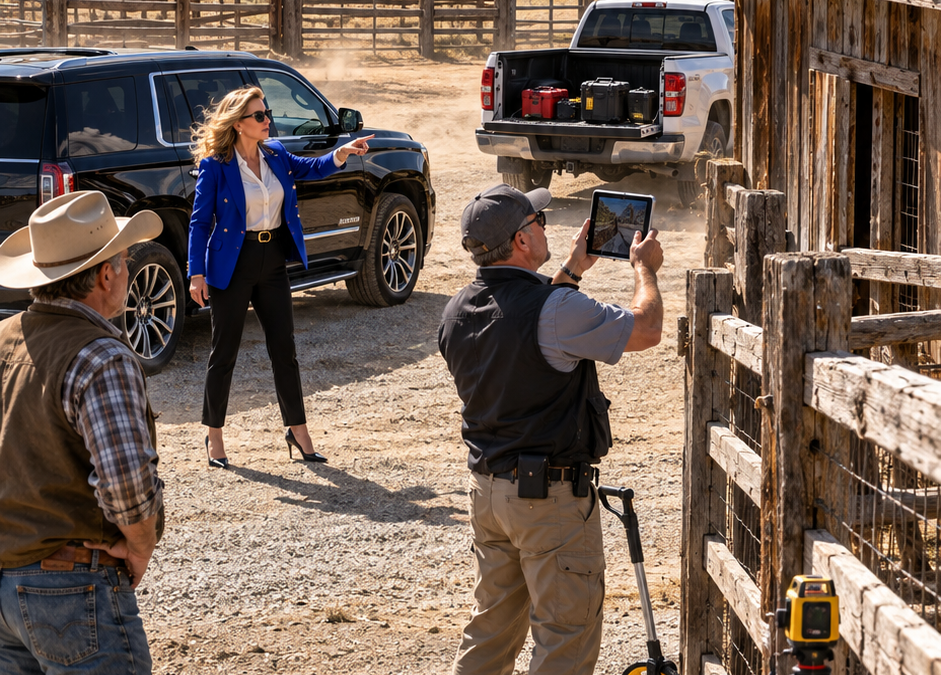
He was standing twenty feet inside my ranch yard beside a fence I had repaired myself after the last storm. A measuring wheel sat near his truck. He had already photographed the barn roof, the equipment shed, and a section of fencing along the north side of the property.
The morning was bright, dry, and windy. Cottonwood leaves rattled beyond the barn, and dust moved in small curls across the gravel lane. Nothing about the day felt unusual until I saw a stranger walking around my buildings with a tablet, a laser measure, and the confidence of a man who believed someone had already given him permission.
“I’m with Harborline Mutual,” he said. “Owen Park. Independent adjuster.”
“That doesn’t answer my question.”
He looked down at the tablet. “I was assigned this loss yesterday.”
“What loss?”
“Wind and hail damage.”
“To whose property?”
He hesitated.
Then he turned the screen toward me.
The claim listed storm damage, fencing, equipment storage, and my ranch address.
My name was nowhere on the first page.
Before I could read the policy number, tires crunched across the gravel behind us.
A glossy black SUV stopped near the barn. Lauren Whitmore stepped out.
She was president of Cedar Hollow HOA, the subdivision that sat east of my ranch. Lauren was impossible to miss. Tall, sharply dressed, controlled in everything she did. That morning, she wore a cobalt-blue tailored blazer over an ivory blouse, black trousers, and black pointed heels that looked completely wrong in a cattle yard.
She walked toward us without slowing down.
“Do not interfere with the inspection,” she said.
I looked from her to Owen.
Then back to the claim file.
“You filed an insurance claim on my property.”
Lauren did not deny it.
Instead, she looked at Owen.
“Please continue documenting the damage.”
He stayed where he was.
That was the first sign this was not going the way she expected.
I stepped between the barn and the access road.
“This is private property.”
Lauren folded one arm across her waist.
“The structures are listed under Cedar Hollow’s master coverage.”
“That barn belongs to me.”
“The claim is based on insured property records.”
I pointed at the cattle barn.
“I built half that roof after I bought this place.”
Her expression barely changed.
“Then the insurer can sort out the documentation after Mr. Park finishes photographing everything.”
“He has an assignment.”
Owen finally spoke.
“I have an assignment,” he said carefully. “But if there’s an ownership dispute, I’m not going to force an inspection.”
Lauren turned toward him.
“There is no ownership dispute.”
I almost laughed.
“You filed a claim involving my barn without calling me. I’d say there’s a dispute.”
She took out her phone.
“Mason, Cedar Hollow has carried these structures under its master policy for years.”
That stopped me.
Not because I believed her.
Because she sounded completely certain.
I had owned the ranch for fourteen years. The cattle barn, equipment shed, fencing, service road, and acreage were all part of my property. I had my own farm insurance. I paid my own premiums. I had never asked Cedar Hollow to insure anything.
Owen glanced at me.
“Do you have documentation showing ownership?”
“Yes.”
“Then send it to me.”
Lauren immediately objected.
“This claim has already been opened.”
Owen nodded. “That doesn’t mean I determined title.”
That was the second sign he was not there to fight her battle.
I took out my phone and photographed his business card, the claim number on his tablet, and the page showing my ranch address. Then I photographed the measuring wheel, his truck, and the areas he had already inspected.
Owen did not object.
Lauren did.
“You are making this unnecessarily adversarial.”
“No,” I said. “I’m making a record.”
For the first time, her jaw tightened.
I asked Owen to stop the inspection until the insurer verified who actually owned the property.
He agreed.
Lauren did not.
She stood beside her SUV in that cobalt-blue blazer while Owen packed his equipment back into his truck. Before leaving, he handed me his card.
“Send me your deed and your policy declarations,” he said. “I’ll note the file.”
I looked at the barn again.
A few minutes earlier, the problem had been a stranger taking photographs on my ranch.
Now I knew the real problem.
An insurance company had a claim file with my address on it.
And somehow, the HOA next door believed it had the right to file it.
I went straight from the barn to the ranch office.
Not because I doubted who owned the property.
Because I wanted every answer on paper before anyone else came back through my gate.
The deed was easy to find. I kept the original closing documents in a steel file cabinet beneath the desk, along with tax records, equipment titles, and insurance paperwork. Fourteen years earlier, I had bought the entire 104-acre ranch from a family that had run cattle there for two generations.
The deed included the barn.
The equipment shed.
The fencing.
The access road.
There was nothing complicated about it.
Cedar Hollow was not listed as an owner. The HOA was not named as a beneficiary. No part of the ranch was identified as common property.
Then I pulled my farm policy.
That made the situation even stranger.
My insurer had the cattle barn listed as a scheduled structure. The equipment shed was there too. So were fencing allowances and storm-related coverage provisions. I had renewed that policy every year. I had paid the premiums.
After the hailstorm, I had already called my agent about several damaged roof panels, though I had not decided whether the repairs were significant enough to file a claim.
Now another insurance company had sent an adjuster to inspect the same buildings under somebody else’s claim.
I photographed the deed pages and policy declarations and emailed them to Owen Park.
He called less than twenty minutes later.
“I got the documents.”
“Good.”
“I’m putting the inspection on hold.”
“That should have happened before you came onto the ranch.”
“I understand why you’re upset.”
His tone was calm, not defensive.
“I was given an assignment with a loss location, a list of structures, and permission from the insured’s representative to inspect.”
“The insured being Cedar Hollow.”
“Yes.”
“And nobody checked who actually owned the buildings.”
“That isn’t normally something I determine before an inspection.”
I leaned back in my chair.
Owen explained that adjusters are often sent out with a claim number, policy information, an address, and a scope. Their job is to document reported damage, roof condition, fence damage, debris, dimensions, and repair estimates. They are not title examiners.
“If the assignment says inspect Building A at a certain location,” he said, “I usually inspect Building A.”
“That seems like a problem when Building A belongs to someone else.”
“It can be.”
At least he did not pretend otherwise.
I asked him what exactly he had been told to inspect.
He opened the file while we were on the phone.
Cattle barn roof.
Equipment shed.
A section of north fencing.
Storm debris near the access road.
Temporary weather protection if needed.
Every item was mine.
I wrote them down.
“Was my name anywhere in the assignment?”
“Not that I saw.”
“Was there any document showing the HOA owned these structures?”
“I wasn’t sent one.”
That answer mattered.
Owen had not arrived with a deed.
He had arrived with an insurance assignment.
Those were two very different things.
I asked him to send me whatever portion of the inspection request he was allowed to release. He said he would need authorization from Harborline Mutual. That was fair.
Before we ended the call, he added one thing.
“I’ve added your ownership documents to the file.”
“What happens now?”
“The carrier will review them. Until then, I’m not returning to the property without direct confirmation that the access issue has been resolved.”
For the first time that day, I felt like one piece of the problem had moved into the right place.
Owen was not the person I needed to fight.
He had been following an assignment.
The larger question was why that assignment existed.
I called my own insurance agent next. Her name was Teresa Blake, and she had handled my farm coverage for six years.
I told her Cedar Hollow had filed a claim that included my barn and fencing.
She was quiet for several seconds.
“Your barn?”
“Yes.”
“Under their master policy?”
“That’s what the adjuster said.”
She asked me to send everything I had.
Ten minutes later, she called back.
“Our records still show you as the insured owner of those structures.”
“I know.”
“I don’t see Cedar Hollow anywhere in your file.”
“I know that too.”
Then she asked the question I had been waiting for someone else to ask.
“Why would their carrier have your building scheduled at all?”
That was exactly the problem.
Two insurance systems now appeared to recognize the same physical structures for completely different policyholders.
One of those systems was mine.
I knew how those buildings had gotten there. I had insured them because I owned them.
The other system belonged to Cedar Hollow, and somebody had put my barn into it long before Owen ever drove through my gate.
That afternoon, I printed one page from my farm policy and placed it beside the photograph of the HOA claim screen.
Same ranch.
Same structures.
Two different insured parties.
Whatever Cedar Hollow believed it had been insuring, the mistake had started before the storm.
The storm had only exposed it.
The claim summary arrived two days later.
Not from Lauren.
From Harborline Mutual.
Owen had requested permission to release the portion of the file that identified the reported loss. Once the carrier received my deed and farm policy declarations, they sent a redacted copy to me and to the attorney I had just hired.
Her name was Clare Bennett. She practiced real estate and insurance law out of a small office in the county seat, and she had the useful habit of reading documents before deciding what they meant.
I forwarded her everything.
The photographs from the ranch yard.
Owen’s business card.
My deed.
My farm policy.
The HOA claim.
I caught myself using the wrong word when I spoke to her. I almost called it a permit.
Not a permit.
A claim.
That was how strange the situation had already become.
By then, I had dealt with enough HOA paperwork in my life that my brain wanted to put every disagreement into the same category.
This one was different.
Nobody was claiming a right to build on my land.
Nobody had moved a fence.
Nobody had cut a road.
Cedar Hollow had placed my property inside an insurance event.
That distinction mattered.
Clare called me after reviewing the claim summary.
“This is larger than the barn.”
I had already noticed.
The first page listed the reported date of loss and described severe wind and hail affecting Cedar Hollow property and related insured structures. The second page broke the claim into categories.
Cattle barn roofing.
Equipment storage structure.
Perimeter fencing.
Storm debris removal.
Temporary weather protection.
Exterior electrical service.
I read the list again.
Every item except one belonged to my ranch.
The electrical reference was unclear.
The rest were not.
The barn sat roughly four hundred yards west of the Cedar Hollow boundary. The equipment shed stood even deeper inside my property. The fencing section included a run along my north pasture. The debris reference appeared to cover fallen branches and roofing material near my service road.
This was not someone accidentally typing my address into the wrong field.
The claim described physical assets.
My physical assets.
Clare asked me to compare the list against my own insurance schedule.
I did.
The overlap was almost exact.
“Your insurer has them by structure,” she said.
“Right.”
“And Harborline has them by structure.”
“Yes.”
“That means someone didn’t just include the parcel address.”
That was the first major shift.
If the mistake had been only an address, it could have been a clerical entry. But whoever built Cedar Hollow’s claim file knew enough to identify specific improvements on the ranch: the cattle barn, the equipment shed, the fence line.
I asked Clare whether that meant the HOA had copied my records.
“Not necessarily,” she said.
She wanted the source document.
The claim summary contained a field labeled basis of property description.
The entry said:
Per scheduled property records.
That phrase became our next target.
Clare sent a written request to Harborline asking for the property schedule used to assign the claim. She also sent Cedar Hollow a preservation notice covering all insurance-related records connected to my address, policies, renewals, property schedules, valuation worksheets, broker correspondence, board approvals, claims communications, and anything identifying my ranch, barn, shed, fencing, or parcel number.
Lauren responded before the HOA attorney did.
Her email was short.
The structures have long been included under Cedar Hollow’s master coverage. The association is cooperating fully with the carrier’s inspection process.
I read it twice.
Long been included.
Again.
She was relying on duration.
Not ownership.
Not a contract.
Not a deed.
Duration.
Clare told me not to answer, so I did not.
Instead, I called Owen.
He was willing to talk about the inspection assignment, but careful not to disclose anything the carrier had not authorized.
I asked where his scope had come from.
“The claim package.”
“What built the claim package?”
“The insured property schedule and first notice of loss.”
“Who prepared that?”
“Usually the insured or broker provides the initial information. The carrier builds the file from there.”
“Did anyone at Harborline independently verify who owned my barn before sending you?”
“I can’t speak for underwriting.”
“What about you?”
“No,” he said plainly.
His assignment contained an address, a list of assets, and a reported storm date.
He had not received title records.
He had not received a lease.
He had not received a contract showing Cedar Hollow was responsible for my structures.
He had received a scope.
That made him useful because it showed how an administrative mistake could turn into physical action.
One person entered information.
Another system accepted it.
An adjuster got dispatched.
A truck rolled through my gate.
By the time anyone asked who actually owned the buildings, the inspection had already started.
Clare described it more simply.
“Claims systems trust the data they are given until something forces a review.”
My deed had forced the review.
But we still did not know who had supplied the original data.
That afternoon, Harborline sent another document.
This one was more detailed: a preliminary loss estimate.
The number at the bottom was high enough to get my attention. Not life-changing money, but not small.
The estimate included roof replacement assumptions for the cattle barn, partial repairs to the equipment shed, fence replacement by linear foot, debris removal, and temporary protective work.
I stared at the page.
The most unsettling part was not the amount.
It was how normal the document looked.
Nothing about it screamed mistake. The format was professional. The categories were ordinary. The calculations were ordinary. If you did not know the ranch, you could read the file and assume Cedar Hollow had every reason to make the claim.
That was how institutional errors became dangerous.
They did not always look suspicious.
Sometimes they looked organized.
Clare asked me to walk the ranch and document the actual storm damage before anyone else touched anything.
I spent the rest of the afternoon doing exactly that.
The west slope of the barn roof had several dented metal panels. The equipment shed had a bent gutter and one loose fascia board. A section of fence had gone down where a large limb fell.
Nothing catastrophic.
I photographed everything with timestamps.
Then I photographed undamaged areas too.
The point was not to maximize a claim.
It was to establish the condition before competing insurance files started describing the same damage differently.
My own agent, Teresa Blake, came out the next morning. She examined the barn and shook her head when I showed her Cedar Hollow’s preliminary estimate.
“Your policy has this structure scheduled at a different value.”
“Higher or lower?”
“That’s not the interesting part.”
She pointed to the structure description.
Cedar Hollow’s file classified the barn as an association-maintained agricultural outbuilding.
I laughed once because I genuinely did not know what else to do.
“Association-maintained.”
“You maintain it?”
“I replaced the east roof section three years ago.”
“Who paid?”
“Me.”
“Siding?”
“Me.”
“Electrical?”
“Me.”
“Taxes?”
“Me.”
She looked at the document again.
“That description came from somewhere.”
There it was.
Not just the address.
Not just the barn name.
A category.
Someone had described my building in a way that made it fit Cedar Hollow’s policy.
Clare requested the underlying schedule immediately.
While we waited, I started building my own timeline.
Storm hits.
Cedar Hollow reports loss.
Claim opened.
Harborline generates inspection assignment.
Owen receives structures and ranch address.
Owen enters property.
I stop inspection.
Ownership documents are added.
Carrier pauses.
That timeline covered only a few days.
The real timeline had to start years earlier.
Lauren’s statement proved that if Cedar Hollow had long carried the buildings under its master coverage, then the problem had survived multiple renewals, multiple budgets, multiple premium payments, and possibly multiple boards.
I checked Cedar Hollow’s publicly available annual reports. Insurance appeared each year as a line item. No property detail, just premium totals. One year, the premium jumped sharply after a regional storm season. Another year, it dropped after a carrier change.
Nothing connected directly to me, but it confirmed the master policy was being renewed like any other recurring HOA expense.
Clare eventually reached Cedar Hollow’s management company.
The manager would not release the insurance schedule without board authorization.
That lasted until Harborline asked for it too.
Then the tone changed.
Late Friday afternoon, Clare received a six-page extract.
She called me immediately.
“Come in Monday.”
“What did you get?”
“The property schedule.”
“Does it list the barn?”
“Yes.”
“The shed?”
“Yes.”
“The fence?”
“Yes.”
I stood beside my truck in the ranch yard, looking directly at the buildings she had just named.
“What does it say I am?”
There was a pause.
“Nothing.”
“What do you mean?”
“It doesn’t list you at all.”
The document apparently treated the assets as scheduled locations under Cedar Hollow’s master policy without naming the actual owner.
That was bad enough.
Then Clare added something else.
“There’s a parcel reference.”
“Mine?”
“I need to compare it against the county record before I tell you that.”
I looked toward the east, past the fence line. Beyond the trees, roofs from Cedar Hollow were visible in the distance.
For fourteen years, I had thought of the HOA as a neighboring organization. Annoying sometimes, overconfident occasionally, but separate.
Now its insurance records contained my barn, my shed, my fencing, and possibly my parcel number.
The storm had not created that connection.
It had merely triggered the claim that exposed it.
By Monday morning, Clare had the master policy schedule open beside the county property records.
She did not explain the mistake when I walked into her office.
She showed it to me.
On the left monitor was the county parcel map.
On the right was Cedar Hollow’s insurance schedule.
My ranch parcel ended in 417.
A narrow maintenance tract owned by Cedar Hollow ended in 471.
Same three digits.
Different order.
The insurance schedule carried 417.
My number.
For a few seconds, I just looked at the screens.
The mistake was so small that I almost expected there to be something more complicated behind it.
There was not.
At least not at the beginning.
Clare had spent the weekend reconstructing nearly a decade of insurance renewals. Instead of handing me every document separately, she had built a timeline across the conference table. At the far left sat the oldest surviving spreadsheet. At the far right was the current storm claim.
Everything between them showed how three transposed digits had slowly become something nobody questioned.
Nine years earlier, Cedar Hollow changed insurance brokers. The incoming broker requested a statement of values, a list of buildings, structures, and other property the HOA wanted covered under its master policy.
Most of the entries made sense.
Clubhouse.
Pool equipment.
Entrance monuments.
Association storage.
Common fencing.
Then near the bottom appeared:
Agricultural outbuilding / fence buffer.
Beside it was parcel 417.
My ranch.
There was no owner name, no deed reference, no ranch address.
Just a vague description, a replacement value, and the wrong parcel number.
Clare slid the earlier management company spreadsheet toward me.
That was where the error first became visible.
Cedar Hollow’s actual maintenance parcel 471 appeared in one section. But a separate asset entry used 417.
Someone had reversed two digits.
That should have been the end of it.
One typo.
One correction.
Except nobody corrected it.
The next year’s insurance file started with the previous year’s spreadsheet.
Parcel 417 survived.
A replacement value changed.
The description became maintenance outbuilding.
Another renewal came.
The label changed again.
Association-maintained agricultural structure.
The parcel stayed.
By the fourth renewal, the original typo no longer looked like a typo.
It looked like history.
Clare had printed small excerpts from each year and arranged them in order.
I walked slowly along the table.
The same number appeared again and again.
Different insurers.
Different brokers.
Different values.
Same ranch.
That visual told me more than another hour of argument with Lauren ever could.
No one had to deliberately add my property every year.
They only had to trust the last spreadsheet.
The board minutes reflected the same pattern. Cedar Hollow’s directors reviewed premium increases, deductibles, storm exposure, and annual renewal totals. They were not sitting around discussing my cattle barn. Most years, the entire insurance renewal passed in a few paragraphs.
Approve premium.
Authorize management to bind coverage.
Move to the next agenda item.
That was how the mistake survived.
Not because everyone kept deciding my ranch belonged to the HOA.
Because almost nobody was deciding anything about my ranch at all.
The schedule simply kept moving forward.
Five years earlier, Cedar Hollow changed brokers again. The new firm sent a standard request asking the association to confirm all insured locations.
The return spreadsheet adjusted several values.
My parcel stayed untouched.
Two years later, someone renamed the structure again.
The barn became association-maintained storage agricultural building.
I stared at the wording.
It sounded increasingly official.
Yet nobody had photographed the building.
Nobody had attached a deed.
Nobody had listed me as owner.
The description became more confident while the documentation underneath it remained empty.
Clare had found one renewal packet containing reference photographs. I expected to see my barn.
Instead, the images were generic examples of agricultural structures used in the underwriting file.
That bothered me more than I expected.
The insurance system had carried a building for years without necessarily knowing what it looked like.
It knew a replacement value.
It knew a category.
It knew a parcel number.
And because those pieces kept appearing together, the listing gained credibility simply by surviving.
Then the timeline changed.
Eleven months before the storm, someone finally questioned it.
A junior account manager at the broker sent an email with the subject:
Ranch Structures Ownership Confirmation
The message asked Cedar Hollow to verify whether it owned the structures associated with parcel 417 or had some other documented responsibility for them.
The property manager answered that the assets had appeared on Cedar Hollow’s schedule for years.
The broker wrote back:
Please provide supporting ownership, lease, maintenance, or contractual responsibility documentation before next renewal.
Clare had highlighted that sentence.
Not because it proved wrongdoing.
Because it showed someone finally stopped trusting the spreadsheet.
I searched the following pages.
No deed.
No lease.
No maintenance agreement.
No contract tying Cedar Hollow financially to my barn.
Instead, the next email copied Lauren Whitmore.
Her reply was brief.
Keep existing locations on the schedule for now. We can resolve supporting parcel documentation after renewal.
I sat back.
For most of the timeline, the mistake had been invisible.
This was different.
The question had surfaced.
The documents supporting the listing had been requested.
And rather than delay the renewal, Cedar Hollow carried the existing locations forward one more time.
Clare was careful with what that meant.
“The email does not prove Lauren knew parcel 417 was your privately owned ranch,” she said. “It does not prove she intended to claim somebody else’s property. What it proves is narrower. The schedule had been questioned. Verification had not been completed. The listing remained.”
Then the storm arrived.
Clare moved the final documents into place.
First came the renewed statement of values.
Then Cedar Hollow’s notice of storm loss.
Then the claim summary.
Then Owen Park’s inspection assignment.
I could see the entire chain without anyone explaining it.
417 entered the system.
417 survived.
417 became attached to a structure.
The structure acquired a value.
The value was renewed.
The storm activated the policy.
The policy generated a claim.
The claim generated an inspection.
And an adjuster drove onto my ranch.
I had spent days asking why someone would file an insurance claim on a barn they did not own.
The timeline suggested a less dramatic answer.
By the time the claim was filed, the system had been repeating the mistake long enough that almost nobody involved saw it as a mistake.
That still left one question Clare had deliberately not answered.
Cedar Hollow had apparently paid premiums for years on values associated with my structures.
The buildings had sat on a master insurance schedule through multiple renewals.
But I owned them.
So what did all those years of insurance paperwork actually give the HOA?
That answer was not sitting in the spreadsheet.
It was in the difference between insuring something on paper and having a legal interest in the property itself.
The next morning, Clare removed the ten-year timeline from the conference table and left only five documents.
My deed.
My farm policy.
Cedar Hollow’s statement of values.
Lauren’s renewal email.
The HOA storm claim.
The entire dispute had been reduced to one question.
What could each piece of paper actually prove?
My deed was straightforward. I owned the ranch. The barn, equipment shed, and fencing sat on that property.
My farm policy made sense for the same reason. I owned the structures, faced the risk of losing them, and insured them accordingly.
Cedar Hollow’s statement of values was different.
It was an insurance document.
It showed what the HOA had asked its carrier to include in the master policy.
That mattered.
But it was not a deed.
A line in an insurance schedule could describe an asset without deciding who legally owned it.
Paying premiums did not change that.
Clare used my pickup as the simplest example.
“If someone mistakenly scheduled your truck on another policy for five years, paying those premiums would not transfer your title to them. The mistake could create an insurance problem. It could create an accounting problem. It might even create a complicated coverage dispute. But the premium receipts would not make the truck theirs.”
The barn worked the same way.
There was one important complication.
Ownership was not the only reason someone might legitimately insure property. A tenant might be required to insure a building under a lease. A lender could have a financial interest. A management company could assume repair obligations. A contract could make one party responsible for property owned by another.
That was why Clare had not stopped after finding my deed.
She had searched for anything that might explain Cedar Hollow’s position.
A lease.
A maintenance agreement.
A management contract.
A covenant.
A written obligation requiring the HOA to repair or replace my structures.
Nothing in the file supplied that missing link.
And that was where Lauren’s email mattered.
The broker had not merely asked whether the barn appeared on the schedule.
Everyone already knew it did.
The broker had asked what supported the listing: ownership, lease, maintenance responsibility, contractual responsibility, some other insurable interest.
Cedar Hollow had not produced one before renewal.
Lauren had instructed management to leave the locations in place and deal with the documentation later.
Then the storm came first.
The claim system did what it had been designed to do.
It looked at the policy.
The policy listed the assets.
Cedar Hollow reported storm damage.
The carrier opened a file.
The listed structures moved into the claim scope.
Owen received an inspection assignment.
Nobody had to create a fake deed or invent a second document.
Old data simply became current action.
That was why the first morning at the barn had felt so strange. Owen had a legitimate claim number. Harborline had a legitimate policy. Lauren had a real statement of values.
Every individual piece looked official.
The problem was the connection between them.
The schedule said Cedar Hollow had insured the structure. The deed said Cedar Hollow did not own it. And nobody had produced a separate agreement explaining why the HOA had a financial responsibility for it.
That was the issue Harborline now had to review.
Not whether the barn had hail damage.
It did.
Not whether the structure appeared on the policy.
It did.
The question was whether Cedar Hollow had a legitimate interest that allowed it to pursue that loss under its master coverage.
The inspection created a second issue.
Harborline could send Owen an assignment. The assignment could tell him where the reported damage was located, but the document did not transform Cedar Hollow’s insurance claim into permission to enter my ranch.
That was why Owen stopped as soon as I challenged the inspection and provided ownership documents.
He had been sent to document damage.
He had not been sent to settle a property rights dispute.
Clare stopped arguing with the HOA directly.
She sent the evidence where it mattered.
Harborline received my deed, farm policy declarations, the historical insurance schedule, and the broker correspondence.
The broker received a preservation request covering earlier schedule versions and renewal notes.
Cedar Hollow received a demand to identify any document that gave it ownership, contractual responsibility, or another legitimate financial interest in the ranch structures.
The response came from the HOA’s attorney.
His letter did not claim Cedar Hollow owned my barn.
It did not produce a lease.
It did not identify a maintenance contract.
Instead, he said the association had relied on long-standing insurance records when reporting the storm loss and would cooperate with Harborline’s review.
That was a major change in only a few words.
At the beginning, Lauren had treated years of coverage as the answer.
Now years of coverage were simply part of the evidence being reviewed.
The distinction mattered.
History explained how my barn ended up in Cedar Hollow’s claim.
It did not automatically establish that the claim belonged there.
Harborline now had to compare what its computer said against what the underlying property documents actually showed.
And once the carrier stopped asking what is listed on the schedule and started asking why is it listed there, the entire case moved in a different direction.
Harborline’s review took nine business days.
During that time, nobody came back to the ranch.
No adjuster.
No contractor.
No representative from Cedar Hollow.
That quiet mattered.
The claim was still open, but the part involving my property had stopped moving.
Clare received the first formal update from Harborline’s coverage counsel. The carrier had compared the deed records, underwriting file, property schedule, renewal spreadsheets, and claim materials tied to the storm.
The conclusion was careful.
Cedar Hollow’s master policy contained scheduled property descriptions that referenced my ranch, but Harborline could not find a deed, lease, maintenance contract, insurance agreement, or other current document showing that Cedar Hollow owned the barn, controlled the equipment shed, or was financially responsible for the fencing.
That did not automatically invalidate Cedar Hollow’s entire policy.
It did something narrower.
It separated my ranch from the rest of the claim.
Harborline issued a revised claim scope.
The clubhouse entrance structures remained under review.
The common area fencing remained under review.
Association-owned equipment remained under review.
My cattle barn did not.
My equipment shed did not.
My north fence did not.
The debris near my service road did not.
They were removed pending correction of the policy schedule.
Owen called me himself.
“I got the revised assignment.”
“What does it say?”
“Your property is excluded from my inspection.”
I looked out the office window toward the barn.
“That should make your job easier.”
“It definitely makes the boundaries clearer.”
He sounded relieved.
So was I.
Owen had never tried to force his way back onto the property after I challenged the first inspection. Now Harborline had put the boundary in writing.
Clare asked the carrier for the underwriting history behind the bad parcel reference. The broker produced it two days later.
That file finally confirmed what the spreadsheets had suggested.
The first incorrect entry had been created during a data migration between management and brokerage systems.
Cedar Hollow’s maintenance parcel ended in 471.
My ranch ended in 417.
The wrong parcel number had been copied into the asset schedule.
After that, later renewals imported the previous schedule rather than rebuilding the property list from source documents.
The descriptions changed.
The values changed.
The carrier changed.
The error stayed.
What had looked like a long history of HOA insurance authority was really a long history of copied data.
Harborline also reviewed the premium records. Some portion of Cedar Hollow’s total premium had been calculated using replacement values associated with the wrongly scheduled structures.
Clare warned me not to misunderstand that.
It did not mean the HOA had purchased ownership through premium payments.
It meant the policy records needed correction.
The carrier and broker would sort out any premium adjustments separately.
That was their accounting problem.
Mine was access and claim control.
Harborline handled that part in writing.
The carrier instructed Cedar Hollow not to submit additional repair estimates, inspection requests, or proof-of-loss materials involving the ranch structures unless new documentation established a valid basis for doing so.
None appeared.
Lauren joined one conference call near the end of the review.
Her tone had changed.
She did not say the structures had always been covered, as if history settled everything. She said Cedar Hollow had relied on the schedule provided through its insurance process.
Clare answered that reliance explained the claim.
It did not correct the ownership record.
The HOA attorney agreed that the current schedule would need revision before the next renewal.
That was the moment the dispute stopped being about whether my objection was reasonable.
Everyone on the call was now discussing how to remove the ranch from Cedar Hollow’s insurance system.
Harborline sent the formal claim amendment the next morning.
The ranch-related property items were withdrawn from the HOA loss. No payment would be issued to Cedar Hollow for damage to my barn, equipment shed, private fencing, or ranch debris under that claim based on the materials currently in the file.
The remaining HOA-owned losses would continue separately.
I saved the amendment in three places: laptop, external drive, printed copy.
Then I walked out to the cattle barn.
The damaged roof panels were still there. The bent gutter on the equipment shed was still there. The fallen limb had already been cleared from the fence.
Nothing physical had changed because an insurer moved some lines in a file.
But the paper now matched the property again, at least inside the claim.
The larger cleanup was not finished.
The bad parcel still had to come off the master schedule.
The broker records had to be corrected.
Cedar Hollow needed a process that would stop someone from copying the same mistake into another renewal three years from now.
And there was still the question of what the HOA would do about the expenses I had incurred simply to prove that my own barn was mine.
The claim had been corrected.
Now the system that created it had to be fixed.
The corrected property schedule arrived before the end of the month.
Clare forwarded it to me with one line in the email.
Check every page.
I did.
Cedar Hollow’s clubhouse was there.
The pool equipment was there.
Entrance monuments.
Common area fencing.
Association-owned storage.
The maintenance tract ending in 471.
My parcel was gone.
So was the cattle barn.
So was the equipment shed.
So was the north fence.
The section that had treated my ranch as part of Cedar Hollow’s insured property no longer existed.
I printed the corrected schedule and placed it beside the version Clare had pulled from the old renewal file.
The difference was only a few lines.
That was almost hard to believe.
For years, those few lines had been enough to make my ranch look like something the HOA could insure.
Then enough to make the storm claim look normal.
Then enough to send Owen through my gate with a tablet and a measuring wheel.
Cedar Hollow also filed a formal amendment to the storm claim.
The association withdrew every ranch-related item. No payment was issued to Cedar Hollow for the cattle barn. None for the equipment shed. None for my private fencing. None for debris on my service road.
Harborline continued processing legitimate damage to property Cedar Hollow actually controlled.
That separation mattered.
I had never wanted the HOA’s entire claim denied.
If their clubhouse roof had storm damage, that was their business.
If common area fencing needed repairs, that was their loss.
My issue had always been simpler.
My property did not belong inside their claim.
The broker corrected its own records next. The account file now identified the earlier parcel entry as a data error carried forward through successive renewals. The 417 reference was removed from Cedar Hollow’s account. The correct maintenance parcel, 471, remained.
Clare asked for written confirmation that the old ranch descriptions would not be restored automatically during the next renewal.
The broker agreed.
That led directly to the HOA’s internal changes.
Cedar Hollow adopted a new insurance review procedure before the next master policy renewal. Any property being added to the statement of values had to be supported by documentation showing why the HOA was responsible for insuring it: ownership, lease, contractual maintenance responsibility, another documented financial interest.
Something real.
A line in last year’s spreadsheet was no longer enough.
The property manager had to verify parcel numbers against source records. Any outside property had to be flagged separately. HOA counsel had to review it, and the full board had to approve adding it to the master schedule.
The rule applied to claim submissions too.
If a reported loss involved property outside Cedar Hollow’s common areas, the claim could not move forward on an old schedule alone. Supporting authority had to be checked first.
Lauren Whitmore remained president.
There was no packed meeting where residents shouted her out of office.
No dramatic resignation.
No criminal accusation.
What changed was authority.
The board removed the president’s ability to authorize an outside property insurance submission without documented review. Claims involving property beyond Cedar Hollow’s normal assets now required the property manager, counsel, and full board to sign off.
That consequence made sense to me.
Lauren had not created the original parcel number mistake. The records showed that clearly.
But when the broker later questioned the schedule, she had chosen continuity over verification.
The system now took that choice away.
The final issue was money.
Not the insurance proceeds.
My expenses.
I had paid Clare to stop the inspection, trace the policy history, review the claim, preserve records, and force the correction. I had also spent time assembling documents, photographing storm damage, and dealing with the access problem.
Clare told me to keep the demand narrow.
So we did.
Documented legal fees directly related to the dispute.
A replacement lock and updated gate hardware after I decided I no longer wanted unannounced access.
Administrative costs tied to retrieving records.
Nothing speculative.
Nothing designed to punish the HOA.
Cedar Hollow’s carrier and the association reached an agreement with us. The HOA reimbursed the documented expenses tied to correcting the claim and policy records. The written resolution confirmed that Cedar Hollow did not claim ownership of the ranch structures and would not schedule or submit future insurance claims involving them without a documented basis and my participation where required.
I signed.
They signed.
That was the end of it.
No courtroom.
No jury.
No oversized settlement check.
Just corrected records, corrected authority, and a system that now required somebody to prove why an asset belonged on the policy before an adjuster was sent to inspect it.
A few weeks later, another storm moved through.
Nothing severe.
Steady rain.
Wind strong enough to move the cottonwoods along the north fence.
I walked out to the cattle barn before dark and pulled the sliding door shut. The repaired roof panels caught the last gray light. The equipment shed sat farther down the service road.
Everything looked ordinary.
That was what I had wanted from the beginning.
My own insurer had the ranch listed correctly.
Cedar Hollow did not.
If another storm damaged the barn, there would not be two organizations claiming the same structure. There would not be an adjuster arriving under someone else’s policy. There would not be a spreadsheet somewhere quietly treating my property as an HOA asset.
I locked the barn and started back toward the house as the rain picked up.
For fourteen years, I had known exactly who owned that building.
The strange part was realizing how long an insurance system had been telling a different story.
A deed is not loud.
A spreadsheet can travel farther.
That was the lesson I took from the whole thing.
Lauren had shown up at my barn believing years of insurance records gave her authority. Owen had shown up because a claim assignment told him there was damage to inspect. Harborline had opened a file because its policy schedule contained asset descriptions that seemed official. Each step looked reasonable from the narrow angle of the person performing it.
But the land itself had never changed.
The barn had never moved.
The title had never transferred.
The fence had never stopped being mine.
All that had changed was the paperwork surrounding it, one copied line at a time, until a typo became a claim and a claim became a man with a measuring wheel standing in my ranch yard.
That is why I kept the corrected schedule in the same drawer as my deed.
Not because I needed it to tell me what I owned.
Because sometimes, the danger is not the person who openly says your property is theirs.
Sometimes the danger is a quiet file that has been saying it for years.
And if an adjuster ever shows up on your property because somebody else filed the claim, I would not start by asking how bad the damage is.
I would start with the paperwork.
Whose name is on the policy?
What property is actually scheduled?
And what gives the person filing the claim any right to claim yours?