𝗙𝗨𝗟𝗟 𝗦𝗧𝗢𝗥𝗬 The HOA Turned My Empty Field Into a Luxury Gala Before the Storm Showed Them Why It Stayed Empty
𝗙𝗨𝗟𝗟 𝗦𝗧𝗢𝗥𝗬
Angry landowner. Expensive community event. Witnesses everywhere. Security already standing between me and my own field.
I looked past Danielle at the work unfolding across the grass. Parking mats were stacked beside the north entrance. A portable stage sat near the lowest ground. A landscaping crew was building a decorative berm where the center swale widened.
Every improvement made the place look more finished.
Every one of them made my stomach tighten.
“I’m telling you to get everyone and everything off my property.”
Danielle stepped closer, careful to leave space between us.
“Canceling six hours before the gala would cost the association tens of thousands of dollars.”
“You should have thought about that before you spent it on land you don’t own.”
Her jaw set.
Then she turned toward the event planner.
“Continue setup.”
The hammer drill started again.
Workers moved.
The security guard repositioned himself between me and the tents.
Danielle walked away without looking back.
I stayed beside that dry channel, smelling cut grass, diesel exhaust, and hot dust. Across the field, one worker emptied another bag of mulch into the swale. I looked at the old flood marker near the fence, then at my tractor sitting by the southern outlet exactly where I had left it Thursday evening.
Danielle thought she had taken over an empty field.
What bothered me was not only that she had not asked who owned it.
It was that she had not asked why I had spent fifteen years making sure nothing stayed there.
I did not argue with Danielle again.
I walked back to my truck, pulled my phone from the cup holder, and called Miguel Santos, the ranch hand who had helped me maintain that field for nearly twelve years.
“You near Silver Creek?” I asked.
“Twenty minutes out.”
“Bring the utility trailer and the orange stakes from the equipment shed.”
He went quiet.
“They finally did something stupid.”
I watched two workers roll another section of flooring across the swale.
“Pretty much.”
I drove around to the south end of the property instead of leaving.
That field looked ordinary from the road because I had worked hard to keep it that way. No crops. No cattle. No buildings. Just eighteen acres of grass sloping gently between the subdivision and a cottonwood-lined creek.
My father had bought it when I was nineteen.
After he died, I kept it because it did one job better than anything we could have built there.
It gave stormwater somewhere safe to go.
Fifteen years earlier, a summer cloudburst had sent brown water down from the western ridge hard enough to tear out two culverts upstream. I had watched this field disappear beneath nearly two feet of moving runoff while the houses beyond the east fence stayed dry.
After that, Dad and I reshaped the shallow swales, reinforced the southern outlet with rock, and promised each other nobody would ever build on the low ground.
By 8:30, Miguel pulled in behind me. He climbed out, looked across the tents, and whistled.
“That’s a lot of money sitting in a drainage basin.”
“Don’t call it that around them yet.”
We unloaded the stakes and walked the southern edge. The outlet was still open, but the decorative crews had stacked bundles of temporary fencing less than twenty feet from it.
I moved those bundles onto higher ground myself.
I was not going to sabotage anything. I was not going to touch their tents, generators, tables, or stage. If Danielle wanted to make a bad decision, I was not giving her an excuse to make me responsible for it.
Miguel drove stakes beside the old drainage markers while I photographed the field exactly as it stood.
At 9:12, Danielle arrived in a golf cart with the event planner.
She stopped beside us.
“What are you doing?”
“Marking my drainage route.”
“You’re disrupting setup.”
“I’m staying outside your equipment.”
Her eyes moved to the orange stakes.
“Those are ugly.”
Miguel looked at me.
I almost smiled.
“They’re not decorations.”
Danielle stepped from the cart.
“I need you to understand something. Tonight’s gala has donors coming from three counties. The association has commitments.”
“So do I.”
“To an empty field?”
I looked at her.
“To everything downhill from it.”
That landed for half a second.
Then she glanced toward the subdivision roofs beyond the trees and recovered.
“We have hosted outdoor events before.”
“Not here.”
Her phone buzzed. She checked it, then said, “The weather service shows less than a ten percent chance of rain.”
“Weather doesn’t own the watershed.”
She shook her head and climbed back into the cart.
“Do not interfere with our vendors.”
“Get them off my land and I won’t have to.”
She drove away.
Miguel watched her disappear between the tents.
“You going to call the sheriff?”
“Not yet.”
That surprised him.
It surprised me too.
The easy move was to turn this into a trespass fight and spend the morning arguing over property lines while six thousand pounds of event equipment sat in the wrong place. But the deeper problem was already visible.
Danielle believed unused field meant wasted space.
If I only forced her off today, she would call it a boundary misunderstanding and try again later with better paperwork.
I needed the ownership documented, the drainage route protected, and every change they made recorded before somebody turned a trespass problem into a safety problem.
At 10:40, the wind shifted.
The cottonwood leaves flipped their pale undersides toward the west.
Miguel noticed at the same moment I did. He looked at the ridge.
The sky was still bright over us, but a dark blue-gray line had formed behind the hills, low and narrow.
My phone showed the first weather alert three minutes later.
A fast-moving thunderstorm cell had developed twenty-seven miles west, tracking east.
Not a disaster.
Not yet.
I looked across the field at the white tents, the black flooring, the stage sitting beside the shallow swale, and the expensive cars beginning to arrive for early setup.
Then I saw a landscaping crew unloading another pallet of soil near the southern outlet.
“Miguel,” I said, “get the tractor.”
He followed my eyes.
“What are they doing?”
I started walking.
“They’re about to turn a bad idea into a dam.”
I was halfway across the field when the first dump cart tipped.
Dark topsoil slid out in a heavy wave and landed across the shallow southern channel with a wet thud. A second cart followed. Then a landscaping worker started spreading the pile with a compact loader.
“Stop!” I shouted.
The loader idled down.
Danielle came toward me from the tent line, heels sinking slightly into the grass.
“Why are you yelling at my contractors?”
“Because they’re blocking the outlet.”
She looked past me at the mound.
“They’re building a landscaped privacy berm. It hides the service vehicles.”
“That channel carries runoff off this field.”
“It’s a depression in the ground.”
I crouched, pulled grass aside, and exposed the line of fist-sized river rock my father and I had set along the channel years before. Water had polished those stones smooth.
“It’s an outlet.”
Danielle folded her arms.
“The event planner approved the layout.”
“The event planner doesn’t control this land.”
Her jaw tightened.
Behind her, vendors kept moving chairs beneath the tents. A refrigerated truck hummed near the temporary kitchen. Somewhere, a sound technician struck a microphone and sent a hollow boom across the field.
The whole place smelled like cut grass, diesel exhaust, and damp soil.
Miguel arrived on the tractor but stopped thirty feet away when I raised my hand. I was not going to start moving their material while workers were standing around it.
“Danielle, have them clear this now.”
She glanced at her watch. “Guests arrive at five.”
“Then you have plenty of time.”
“No.”
One word.
Flat.
Final.
She turned toward the loader operator.
“Finish the berm.”
The machine started forward again.
I stepped clear and took out my phone. I photographed the loader, the soil pile, the rock channel, and the slope running toward the eastern homes.
Danielle noticed.
“Is that supposed to intimidate me?”
“No.”
I looked west.
The dark line above the ridge had grown taller.
“That’s for later.”
At 11:20, the HOA’s private security contractor arrived.
Two men in gray polos walked the perimeter while another vehicle parked beside my truck. Danielle had apparently decided the easiest way to solve her ownership problem was to control access to the owner.
One guard approached while I was checking the culvert beneath the ranch road.
“Sir, we’ve been instructed to keep unauthorized personnel outside the event area.”
“I’m the property owner.”
He gave me the tired expression of a man who had already been handed somebody else’s version of the story.
“You’ll need to take that up with the association.”
“I already did.”
I pointed toward my truck.
“I’m leaving through my own gate.”
He did not touch me or block me physically, but he followed me all the way there.
At the entrance, I found a temporary steel barricade stretched across the opening. My truck sat inside. The public road sat outside.
Danielle had turned my gate into an event checkpoint.
For the first time that morning, anger got ahead of me.
I grabbed one end of the barricade and dragged it aside hard enough for the metal feet to scrape across gravel.
The guard raised both hands.
“Sir, don’t make this worse.”
I stopped.
He was right about one thing.
Losing my temper would make it worse.
I released the barricade and stepped back.
“Tell Danielle this gate stays open.”
At noon, the weather alert changed.
Severe thunderstorm watch.
I called County Public Works and reported the blocked outlet, the event setup, and the runoff path toward the subdivision. The dispatcher logged it and said the field supervisor was already handling storm calls on the west side of the county.
The cell had accelerated.
Miguel stood beside me under the equipment shed roof while wind pushed warm air through the open sides.
“We can dig around that berm,” he said.
“Not without crossing through their setup.”
“So what do we do?”
I stared at the field.
Then I saw the old north swale, almost invisible beneath waist-high grass beyond the event tents.
Dad had designed the drainage with redundancy. The southern outlet carried normal runoff. The northern swale was overflow protection—lower than the subdivision road but higher than the main channel. I had nearly forgotten it because we had never needed it.
“We don’t fight their berm,” I said. “We reopen the backup route.”
Miguel followed my gaze.
“That runs behind the stage.”
“Exactly.”
We drove the tractor around the far western boundary, staying completely outside their occupied area.
The north swale had filled with weeds and years of silt. I lowered the rear blade and started clearing it inch by inch. Halfway through, Danielle’s golf cart appeared on the ridge. She stopped above us, staring down as dark clouds rolled over the western hills.
She shouted something I could not hear over the tractor.
I kept working.
Then my phone vibrated in my pocket.
Flash flood warning.
Twenty-three minutes later, the first cold drops hit the dust on my hood, each one leaving a dark circle the size of a quarter.
I shut off the tractor and listened.
Beyond the ridge came a low, steady roar.
Not thunder.
Water.
The roar reached us before the runoff did.
Miguel climbed onto the tractor step and looked west.
“That’s coming off Miller Ridge.”
I nodded.
The storm had dumped somewhere above us, probably beyond the hills where we could not see it. Here, rain was only beginning to fall, cold drops tapping the tractor hood and darkening my navy shirt at the shoulders.
Across the field, the gala still looked absurdly perfect.
White tents.
Cream tablecloths.
Rows of glassware.
A floral arch swaying in the wind.
Danielle stood near the stage directing workers as if she could organize the weather too.
Then muddy water appeared along the western fence.
At first, it was a thin sheet sliding through the grass.
Thirty seconds later, it had become a broad brown tongue pushing toward the center of the field.
“Open the north swale,” I told Miguel.
He dropped into the tractor seat.
I ran downhill beside him, boots slipping on wet grass as the blade cut through the last ridge of packed silt.
Water found the channel almost immediately. It curled into the cleared swale and accelerated north, exactly the way Dad had designed it to.
For a moment, I thought we had bought enough time.
Then I looked south.
Danielle’s landscaping berm was holding.
Water that should have escaped through the main outlet began pooling behind it.
Six inches became eight.
The temporary black flooring around the catering tent started floating at the edges.
Vendors abandoned carts and began carrying equipment toward higher ground.
Danielle came running through the rain.
“What did you do?” she shouted.
I pointed at the berm.
“I told you to remove that.”
“The water is coming from your property.”
“The water is coming through my property. There’s a difference.”
A sharp gust snapped one side panel loose from the nearest tent. Security workers immediately started moving adults away from the temporary structures.
I grabbed a vendor by the arm only long enough to get his attention and pointed uphill.
“Vehicles and people to the gravel road. Now.”
Danielle stepped between me and the stage.
“Nobody dismantles anything until I authorize it.”
I stared at her.
Rain ran from the brim of my brown cowboy hat.
“Danielle, your party is over.”
“We have hundreds of thousands of dollars invested in this event.”
“Then save the people first and argue about the furniture later.”
Another surge entered from the west. The water climbed over the grass and pushed against the landscaping berm.
Miguel drove the tractor toward us from the north. I waved him around the tents toward the southern edge, but the path narrowed between parked catering trucks and temporary fencing. He could not safely reach the blockage.
That was when Danielle made the decision that changed everything.
Instead of ordering the berm removed, she told the landscaping crew to reinforce it.
“Keep the water away from the stage!” she shouted.
Two workers hesitated.
“Don’t,” I said.
Danielle pointed toward the soil pile.
“Do it.”
They moved only after their supervisor arrived.
But by then, I was already on my phone calling the event organizer’s site manager. I did not need another argument. I needed the equipment cleared from the drainage path.
The northern swale was working, but it had never been designed to carry the whole watershed alone. Water began backing toward the eastern side of the field, toward the subdivision road and the first row of homes beyond it.
My stomach tightened.
This was not about my grass anymore.
Miguel jumped down beside me.
“North channel’s almost full.”
I looked at the stage, then at the berm, then at the line of vehicles trapping the tractor away from the outlet. The strategy I had chosen had worked, just not enough.
I had tried to protect the property without touching their setup.
Danielle had turned that restraint into a weakness.
So I changed the plan.
“Get every driver you can find,” I told Miguel. “Clear a lane to the south outlet and the event equipment. If they can move it safely, move it. If they can’t, leave it.”
Danielle heard me.
“You don’t have authority over my vendors.”
I turned toward her.
Behind us, muddy water reached the bottom step of the stage.
“You’re standing on my land inside a drainage basin you blocked while water is climbing toward your own neighborhood.”
Her face changed then.
Not surrender.
Not yet.
But the first crack in certainty.
I pointed toward the eastern road where residents had begun stopping their cars and staring down at the rising field.
“You wanted to know why eighteen acres this close to your subdivision were left empty?” I said. “You’re about to see.”
The first residents reached the eastern road just as the water touched the gravel shoulder. I could hear car doors slamming through the rain. Adults stood behind the roadside fence, some holding phones, others staring at the flooded field where their gala tables were beginning to drift crooked beneath the tents.
Miguel found three vendor drivers and cleared the catering trucks one at a time.
The moment the last box truck moved, I climbed onto the tractor and headed for the southern outlet.
Danielle stepped into the lane and raised both hands.
“You are not driving through my event.”
I stopped ten feet from her. The engine rattled beneath me.
“Move uphill.”
“You’ll destroy the setup.”
Behind her, brown water rolled over the edge of the temporary dance floor. One of the landscapers shouted that the berm was starting to wash out.
I pointed toward the road.
“Your neighborhood is on the other side of that rise.”
She looked back.
Water was now spreading east because her berm had forced it sideways.
For the first time, she moved without arguing.
I drove forward slowly while vendors carried loose equipment clear. The tractor tires sank several inches into the saturated grass.
At the berm, I lowered the bucket and started removing soil from the center. The first scoop barely changed anything. The second opened a narrow cut.
Water punched through it immediately, brown and fast, racing into the rock-lined outlet.
Miguel waved me wider.
I took another bite, then another.
The opening grew to six feet.
The pressure dropped across the field almost visibly. Water peeled away from the eastern side and turned south toward the creek. People along the road began backing away as the runoff moved through the channel below them.
I kept working until the original outlet was fully open.
For ten minutes, it looked like we had won.
The northern swale carried one side. The southern channel carried the other. The water stopped rising near the subdivision road.
Miguel climbed onto the tractor step and slapped the wet metal.
“It’s dropping.”
I looked toward the eastern fence.
He was right.
Maybe two inches, but dropping.
That was our false victory.
Then the event stage shifted.
Not much.
Maybe an inch.
But I saw it.
One corner settled while another stayed high. Underneath it, the black flooring bowed upward.
Miguel followed my stare.
A line of muddy bubbles appeared thirty feet behind the stage.
Then another.
Water was not only moving across the surface.
It was pushing through an old buried drainage path beneath the field.
I remembered Dad standing there years earlier with a shovel, explaining how the original farm ditch had been filled long before he bought the property. We had left that strip unloaded for a reason.
Danielle’s event company had parked its largest generator trailer directly over it.
“Kill the generator,” I said.
Miguel ran toward the site manager while I climbed down. The manager shut the unit off and had the area cleared.
Rain softened to a steady hiss.
Danielle stood under the edge of a tent, soaked from the shoulders down, her red pantsuit darkened by water. She watched workers abandon the stage and move uphill.
“Is the road safe?” she asked.
It was the first question she had asked all day that was not about the party.
“For now.”
“For now?”
I pointed toward the bubbling ground.
“You loaded equipment onto a saturated drainage corridor. Nobody goes back there until the soil settles.”
Her expression hardened again.
“You knew this could happen.”
“I knew this field floods. That’s why I kept it empty.”
“Then why wasn’t it fenced?”
I stared at her for a second.
“Because private property doesn’t become public property just because there’s no fence around it.”
A resident called Danielle’s name from the road.
She turned.
More homeowners had gathered now, and they were not looking at me.
They were looking at the flooded tents, the blocked outlet, and the HOA president who had brought all of it there.
Danielle straightened her shoulders.
“This was an unforeseeable weather event.”
Miguel stopped beside me, breathing hard.
I looked at the orange drainage stakes still standing above the muddy water—the same stakes she had called ugly that morning.
“No,” I said. “The storm was weather.”
I pointed at the remains of her landscaping berm washing through the reopened channel.
“That was a decision.”
Then a deep crack sounded from the soaked ground near the abandoned stage.
Everyone turned.
One section of temporary flooring dropped several inches as the soil beneath it settled into the old drainage corridor.
Danielle’s face went still.
The field had finally answered the question she never bothered to ask.
The section of flooring settled another inch, then stopped.
Nobody moved toward it.
The rain had eased enough that I could hear water rushing through the southern outlet and dripping steadily from the tent roofs.
I walked uphill and told every vendor supervisor the same thing: keep people off the saturated center strip, disconnect anything electrical that had not already been shut down, and move remaining equipment to the gravel road only if it could be reached without crossing soft ground.
This time, nobody waited for Danielle’s permission.
The site manager started directing crews while Miguel marked the unstable area with the orange stakes we had brought that morning.
Danielle followed me toward the road.
“You don’t get to take control of my event because it rained.”
I stopped beside the gate.
Mud covered my boots almost to the ankles.
“There isn’t an event anymore.”
“The association contracted this property for today.”
“From who?”
She hesitated.
“Our management company handled the arrangements.”
That answer caught my attention.
“Your management company rented my field?”
“They confirmed the association’s right to use it.”
“That’s not what I asked.”
Before she could answer, a white pickup pulled onto the shoulder.
County Public Works Supervisor Aaron Bell stepped out wearing a rain shell and rubber boots.
I knew Aaron from drainage maintenance along the creek. I had called public works before the storm hit, but one of the homeowners had apparently called again when the water reached the road.
He looked over the flooded acreage, then down at the water pouring through the rock-lined outlet.
“Who blocked that channel?”
Danielle immediately said, “Nobody blocked anything. We installed temporary landscaping.”
Aaron walked past her.
He did not need a folder or a courtroom to understand what he was seeing. The remains of the berm were still piled on both sides of the opening I had cut, with fresh loader tracks pressed into the mud.
He crouched beside the channel, then followed it with his eyes toward the creek.
“This outlet connects to the county-maintained crossing downstream.”
“Yes,” I said. “Has for years.”
He looked toward the collapsed flooring.
“Keep everyone off that center section until it drains.”
Danielle crossed her arms.
“Are you shutting down our event?”
Aaron glanced at the half-submerged dance floor.
“The weather already did that.”
A few residents laughed despite themselves.
Danielle did not.
She pulled out her phone and walked away.
I thought the worst was over.
The water was dropping. Nobody had been hurt. The houses east of the field had stayed dry.
Then Aaron noticed something beside the entrance.
A fresh trench ran from the temporary kitchen area toward the roadside ditch.
“What’s that?”
I followed him over.
A black discharge hose lay partly buried beneath decorative mulch, its end pointed into the ditch.
Miguel came up behind us.
“Wasn’t there yesterday.”
Aaron traced it back toward a portable holding tank beside the catering setup.
His expression changed.
“Who authorized this connection?”
The event site manager shook his head.
“We were told the HOA had site approval.”
Danielle heard him and turned around.
“It was temporary.”
Aaron stood.
“Temporary doesn’t mean unregulated.”
She started explaining permits, vendors, deadlines.
I stopped listening because something else had clicked into place.
Danielle had not simply mistaken an empty field for unused land.
She had built her entire event around the assumption that anything inconvenient could be made temporary and therefore harmless.
Temporary fencing.
Temporary flooring.
Temporary berm.
Temporary drainage.
Temporary control of my gate.
Each shortcut depended on the previous one.
I had spent the morning trying to stop individual mistakes.
That had been my mistake.
I needed to stop treating them individually.
I walked to my truck and called my insurance agent first.
Then the attorney who had handled my father’s estate years earlier.
Not because I expected either man to rescue me.
Because I was done improvising while Danielle’s organization kept changing the ground beneath us.
I needed one clean boundary.
Nothing else entered, moved, drained, dug, or altered on those eighteen acres without my written authorization.
I returned to the gate and chained the unused service entrance open so emergency and removal vehicles could leave without obstruction. Then I told every contractor exactly what access they had for safe removal and nothing more.
Danielle stared at me from twenty feet away, phone pressed to her ear.
For the first time all day, she was not issuing orders.
She was asking someone else what she was allowed to do.
And judging by the color leaving her face, she was not getting the answer she wanted.
Danielle ended the call and stood beside the ruined floral arch for several seconds without moving.
The wind had dropped, leaving the field strangely quiet except for pumps humming near the catering area and water running through the channels.
Then she walked straight toward me.
“The management company says they received permission from the landowner.”
“Which landowner?”
Her mouth tightened.
“Silver Creek Holdings.”
I knew the name.
It belonged to the development company that had built Danielle’s subdivision seventeen years earlier.
“Silver Creek hasn’t owned this field since before those houses existed.”
“They provided a parcel reference.”
I pulled my phone out but stopped before opening anything.
Suddenly, I understood how this had happened.
The western boundary of my acreage followed an old farm survey, while the subdivision used a newer lot-numbering system. Somewhere between those systems, somebody had treated an obsolete parcel reference as current ownership.
Danielle had found the answer she wanted and never checked whether it was still true.
“Show me what they gave you.”
She hesitated, then turned her phone toward me.
The authorization email contained the old company name and a parcel number I recognized immediately.
It was not my eighteen acres.
It was the former parent parcel that had been divided decades earlier.
“That’s your mistake,” I said.
“No,” she replied. “That’s their mistake.”
“You were standing here this morning when I told you I owned it.”
She looked toward the homeowners gathered along the road.
“You could have explained this sooner.”
I almost laughed.
“I told you to leave.”
Aaron Bell walked over while Danielle was still holding the phone. She showed him the parcel reference. He studied it briefly and handed the phone back.
“Whatever your management company gave you doesn’t change what happened with that drainage outlet.”
Danielle’s shoulders stiffened.
“We were trying to protect expensive equipment.”
“By redirecting stormwater toward occupied homes,” Aaron said.
That ended the conversation.
Not because Danielle agreed.
Because the homeowners heard him.
A man from the eastern row stepped closer to the fence.
“You knew he told you to remove that berm.”
Danielle turned toward him.
“We were managing an event under the information available at the time.”
“That’s not what he asked.”
More voices followed.
Nobody shouted.
That made it worse for her.
They asked specific questions.
Who authorized the field?
Who ordered the berm?
Why had security blocked my gate?
Why had contractors been told the property belonged to the association?
Danielle tried to answer all of them at once, and each answer contradicted the confidence she had shown that morning.
I did not join in.
Miguel and I spent the next two hours helping vendors remove equipment from stable ground.
The field itself was making the argument better than I could.
By late afternoon, the rain had stopped completely. The water had dropped enough to reveal long brown lines of flattened grass, showing exactly where runoff had traveled. The southern outlet was carved clean through Danielle’s decorative berm. The northern swale held a ribbon of moving water.
Between them, the subdivision sat dry.
Then the management company’s regional director arrived.
He parked outside my gate and walked in wearing rubber boots that looked newly purchased. Danielle met him halfway. Their conversation started quietly.
It did not stay that way.
“You told me this parcel was association-controlled,” she said.
“We told you the records we had indicated an easement relationship.”
“You said we could use it.”
“You approved the final site plan.”
There it was.
The second turn.
Danielle had pushed the event forward, but the management company had fed her just enough ambiguity to let her believe she had authority. Neither side had stopped because stopping would have meant delaying the gala.
Their shortcuts had reinforced each other until the storm exposed all of them at once.
The regional director approached me next.
“We’d like to resolve this without unnecessary escalation.”
I looked past him at crews loading soaked tables into trucks.
“Then start by restoring the field.”
He nodded too quickly.
“Of course.”
“Not tonight. Not with heavy equipment on saturated soil. You wait until I say it’s safe.”
His expression changed when he realized I was not asking for a check and a handshake.
“And the drainage channels stay exactly where they are,” I added. “Nothing gets filled, covered, landscaped, rerouted, or crossed without approval.”
Danielle stepped closer.
“You’re making demands of the association now.”
I looked at the muddy field.
Then at the dry homes behind her.
“No,” I said. “I’m setting conditions on my property.”
She had spent the entire day assuming emptiness meant availability.
Now every empty foot of that field had become something she needed permission to touch.
By Monday morning, the field had drained enough to walk without sinking past the soles of my boots.
What remained looked less like storm damage than a diagram drawn across eighteen acres. Flattened grass marked the western runoff path. The northern swale curved behind the dismantled stage site. The southern channel cut straight through what remained of the decorative berm and carried a clear stream toward the creek.
Miguel walked beside me, pushing orange stakes deeper wherever the mud had loosened them near the old buried drainage corridor.
We stopped at the depression where the temporary flooring had settled.
“Could have been worse,” he said.
I looked toward the subdivision.
“Every roof was dry. That’s why the field exists.”
By nine, the HOA’s management company had sent a restoration crew.
I kept their skid steers on the gravel until the soil was firm enough to support them. No shortcuts. No heavy equipment across the swales. No dumping fill into low spots just because they looked damaged.
The low spots were supposed to be low.
Danielle arrived before noon in a clean red pantsuit, her posture as rigid as ever, but she did not cross the gate until she asked.
That small pause told me more than an apology would have.
Two HOA board members came with her, along with the regional director.
“We need to discuss costs,” Danielle said.
I rested one hand on the gate.
“You mean mine or yours?”
Nobody answered immediately.
My attorney had already confirmed what the county parcel map showed. I held clear title to the entire field. The old Silver Creek Holdings reference gave the HOA no right to occupy it.
More important, the association’s insurer had begun asking its own questions after receiving photographs of the blocked drainage outlet and the temporary discharge hose.
Danielle tried to separate herself from those decisions.
“Vendors made operational choices on site.”
One board member, a gray-haired man named Russell, looked at her.
“Did you order them to reinforce the berm after the owner told you it was a drainage channel?”
She did not answer.
She did not need to.
Too many adults had heard her.
The board had called an emergency meeting for that evening. I was not interested in attending until Russell told me homeowners wanted me there to explain the field.
So I went.
Not with a stack of exhibits.
I brought one thing.
One of Dad’s old orange drainage stakes, washed clean and dried.
I set it on the table in front of me.
Then I explained the eighteen acres in plain English.
Water came off Miller Ridge. The field slowed it, spread it, and carried it through two routes toward the creek. Dad and I had kept it undeveloped because anything permanent placed in those routes would eventually fight gravity, and gravity had more patience than any homeowner.
Nobody interrupted.
When I finished, Danielle spoke from the other end of the room.
“The association acted on information supplied by management.”
Russell leaned forward.
“And after the actual owner told you the information was wrong?”
Silence.
That was the moment her authority broke.
Not because I produced a secret document.
Not because some official marched through the door.
She had been given repeated chances to stop.
Every time, she had chosen the party over the warning in front of her.
The board voted that night to remove her as president pending a full review of the unauthorized event and related expenses. The management company accepted responsibility for restoration costs tied to its faulty authorization, while the HOA’s insurer began reviewing the additional damage caused after my warning. The board referred excluded event expenses to counsel for a separate recovery review focused on decisions Danielle had personally authorized after the weather warning and ownership dispute became clear.
It was not theatrical.
No applause.
No victory speech.
Just numbers, votes, and the sound of a pin being placed on a table when Danielle realized the room no longer belonged to her.
Two weeks later, Miguel and I finished restoring the southern outlet.
We removed the last contaminated mulch near the roadside ditch, reseeded torn ground, and reset the rock lining Dad and I had placed years before. The HOA installed permanent boundary markers outside my property, not inside it. They also added the field’s drainage function to their emergency planning so nobody could pretend again that empty meant useless.
On the final afternoon, I stood beside the south channel while clean water from a light rain slipped between the stones. The orange stake beside me leaned slightly in the soft earth.
I straightened it with my boot.
Across the fence, Danielle’s subdivision sat quiet and dry.
My field was empty again.
Exactly the way it was supposed to be.
Three months later, the weather radio woke me at 4:17 in the morning.
Thunder rolled somewhere beyond Miller Ridge, low enough to vibrate the bedroom window. By the time I pulled on my boots and drove toward the field, rain was hammering the windshield so hard the wipers could barely clear it.
I reached the gate before five.
Headlights swept across eighteen acres of black grass and moving water.
The field was doing exactly what it had been left empty to do.
Runoff entered from the west, spread across the lower ground, then divided cleanly between the northern swale and the restored southern outlet.
I parked on the gravel and stepped into the rain.
Water soaked through my navy shirt within seconds and ran from the brim of my brown cowboy hat. I walked the southern channel with a flashlight, checking the rock lining Miguel and I had reset.
Nothing was blocked.
Nothing had been landscaped over.
Nothing had been parked on top of it.
At the eastern edge, water remained several feet below the subdivision road.
Porch lights glowed beyond the fence.
The houses were dry.
Around six, a pickup stopped on the road above me.
Russell climbed out wearing a yellow rain jacket and carried two coffees down to the gate.
“Figured you’d be here,” he said.
I took one.
“Figured you’d be asleep.”
“Hard to sleep after last time.”
He looked across the dark field.
Water covered nearly half of it now, reflecting flashes of distant lightning.
“So this is what your father built.”
“He didn’t build the floodplain,” I said. “He just respected it.”
Russell nodded slowly.
The HOA had changed more than its president after the gala. They terminated the management company’s contract when the final review showed how the obsolete parcel reference had been used without verifying current ownership. Restoration invoices, vendor losses, and excluded event costs turned Danielle’s decision into a financial lesson nobody on the board could dismiss as embarrassment.
She lost her board position permanently.
The association recovered part of its losses from the management company, while the separate recovery process eventually ended with Danielle reimbursing the association for part of the unauthorized expenditures tied directly to decisions she had personally approved after my ownership warning.
None of that mattered much to me that morning.
The water did.
At 7:15, Miguel arrived in his truck. He parked beside mine, stepped out, and looked toward the southern outlet.
“Holding better than I expected.”
We walked the boundary together. Near the gate stood the permanent survey marker the HOA had paid to install after restoration. Farther downhill, the orange drainage stake from the gala still marked the edge of the channel.
Its paint had faded, but I had left it there.
Miguel tapped it with his boot.
“Ugly thing.”
I laughed.
“I’ve heard that before.”
By nine, the storm moved east. The rain softened and pale daylight opened beneath the clouds. Water continued rushing through the field, but the level had already begun to fall.
A few residents came down from the subdivision road.
Nobody crossed the boundary.
They stood at the fence and watched the swales carry runoff toward the creek.
One man pointed toward the flooded center and said, “I used to wonder why somebody hadn’t built houses down there.”
Russell looked at me.
I did not answer.
I did not need to.
The field answered every time it rained.
Near noon, I walked alone to the southern channel. The rocks Dad and I had placed fifteen years earlier were almost invisible beneath the clear brown current. I remembered him leaning on a shovel on a summer afternoon, telling me that owning land did not mean forcing it to become whatever made the most money.
Sometimes the smartest thing you could do with a piece of ground was understand what it was already doing for everyone around it.
I had not fully understood that lesson until Danielle tried to turn eighteen empty acres into a luxury backdrop.
She saw unused space.
I saw my father’s work.
The storm saw a place to put thousands of gallons of water.
And the neighborhood beyond the fence, whether they knew it or not, depended on that difference.
I pushed the orange stake upright where the current had loosened it, then walked back toward my truck.
Behind me, the field was muddy, flooded, scarred in places, and completely empty.
Ahead of me, every house along the eastern road stood dry in the clearing light.
That was enough.
𝗧𝗛𝗘 𝗘𝗡𝗗
The HOA Turned My Empty Field Into a Luxury Gala Before the Storm Showed Them Why It Stayed Empty
The first thing I heard was a hammer drill biting into metal where no hammer drill had any business being.
By the time I saw the chandeliers, the catering vans, and the white tents spread across my field, I knew somebody had made a very expensive mistake.
Danielle Prescott thought she had found unused land for her gala, but the storm knew exactly what that field was built to do.
I came around the cottonwoods in my pickup at 7:15 that Saturday morning and hit the brakes hard enough to throw my coffee against the dashboard.
My empty field was not empty anymore.
Three wide event tents stood across the north half, their white canvas snapping in the dry breeze. Workers rolled black flooring over the grass while another crew unloaded chandeliers from padded crates. Catering vans lined my fence. A generator growled beside a row of portable bars. Fresh tire tracks cut through grass I had mowed four days earlier.
For a few seconds, I just sat there behind the wheel, staring through the windshield while my brain tried to make the scene belong somewhere else.
A wedding venue.
A country club.
A hotel lawn.
Anywhere but my eighteen acres beside Silver Creek.
I parked at the gate and stepped out into heat already pushing eighty degrees.
“Sir, you can’t come through here.”
A security guard in a black polo raised one hand.
I looked past him at the tents, the flooring, the workers, the tables, the power cables, the rows of chairs, the portable bars.
“This is my property.”
His expression changed, but before he could answer, a woman’s voice carried across the field.
“What’s the problem?”
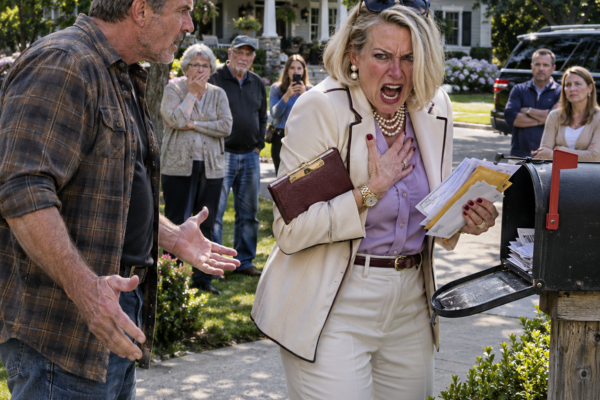
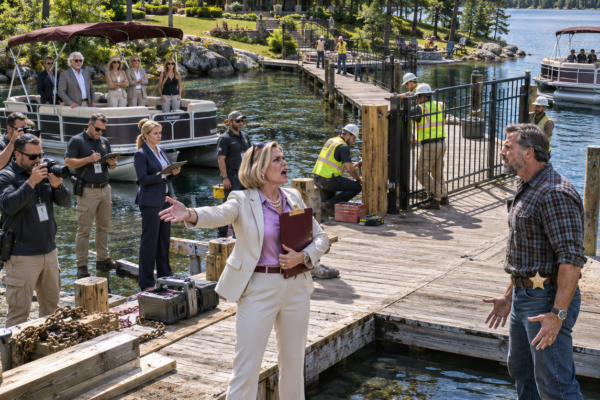
Danielle Prescott walked toward us between two rows of folding tables, her red pantsuit bright against all that white canvas. Her brown hair was pulled into a clean high ponytail, and she carried herself like everyone around her was waiting for instructions. Two HOA board members followed several steps behind.
Danielle was president of the Silver Creek HOA, though she preferred titles that sounded more important than they were. Chair of the community board. Foundation liaison. Event lead. Neighborhood ambassador. Whatever name she used, the meaning was always the same: she expected people to move when she spoke.
I pointed at the tents.
“Tell me you didn’t authorize this.”
She stopped ten feet away.
“The Silver Creek Foundation gala is tonight.”
“That is not what I asked.”
One of the workers killed a power tool.
The sudden quiet spread outward. People started watching.
Danielle folded her arms. “Wade, this field has sat unused for years. The association needed overflow space, and we have already invested substantially in the event.”
I stared at her for a second.
“You invested substantially in somebody else’s land.”
Her mouth tightened.
“Our understanding is that this parcel falls within the open buffer area maintained alongside Silver Creek.”
“Your landscapers mow six feet along the road,” I said. “That doesn’t make the next eighteen acres yours.”
A few workers exchanged looks.
Danielle glanced toward them, then back at me.
“We can discuss boundaries after the gala.”
“No,” I said. “You can take this down now.”
The event planner, a gray-haired man holding a tablet, stepped closer to Danielle and spoke quietly. She shook her head before he finished.
Then something behind them caught my eye.
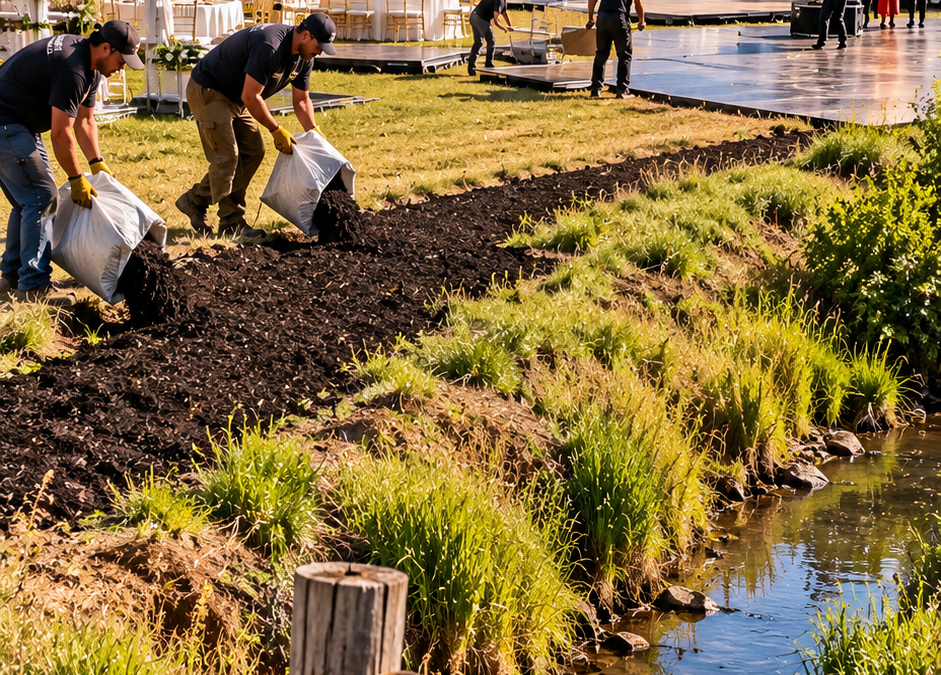
Two workers were dumping bags of dark mulch into the shallow grass depression running through the center of the field. They were smoothing it flat beneath a temporary walkway.
I stopped listening.
I walked toward them.
The security guard moved sideways.
“Sir—”
“Don’t touch me.”
I did not raise my voice.
I just kept moving until Danielle called out, “Stop the work for a minute.”
The crew paused.
I crouched beside the depression and pushed my fingers through the grass. The soil underneath was dry and hard, cracked around the roots. Near the old fence line, a weathered wooden stake stood about three feet high, gray from years of sun. Most people would have mistaken it for scrap.
I knew exactly what it was.
Danielle came up behind me.
“It’s a ditch, Wade.”
I stood and brushed dirt from my palm.
“No. It’s a swale.”
“There’s no water in it.”
I looked toward the western ridge. The sky above it was pale blue, washed almost white by the morning heat.
“Today.”
She let out a short breath through her nose.
“The forecast is clear.”
“Then you got lucky with the forecast.”
Her eyes narrowed.
“Are you threatening to interfere with this event?”
That made several people turn toward me.
I could feel the setup now.
Angry landowner. Expensive community event. Witnesses everywhere. Security already standing between me and my own field.
I looked past Danielle at the work unfolding across the grass. Parking mats were stacked beside the north entrance. A portable stage sat near the lowest ground. A landscaping crew was building a decorative berm where the center swale widened.
Every improvement made the place look more finished.
Every one of them made my stomach tighten.
“I’m telling you to get everyone and everything off my property.”
Danielle stepped closer, careful to leave space between us.
“Canceling six hours before the gala would cost the association tens of thousands of dollars.”
“You should have thought about that before you spent it on land you don’t own.”
Her jaw set.
Then she turned toward the event planner.
“Continue setup.”
The hammer drill started again.
Workers moved.
The security guard repositioned himself between me and the tents.
Danielle walked away without looking back.
I stayed beside that dry channel, smelling cut grass, diesel exhaust, and hot dust. Across the field, one worker emptied another bag of mulch into the swale. I looked at the old flood marker near the fence, then at my tractor sitting by the southern outlet exactly where I had left it Thursday evening.
Danielle thought she had taken over an empty field.
What bothered me was not only that she had not asked who owned it.
It was that she had not asked why I had spent fifteen years making sure nothing stayed there.
I did not argue with Danielle again.
I walked back to my truck, pulled my phone from the cup holder, and called Miguel Santos, the ranch hand who had helped me maintain that field for nearly twelve years.
“You near Silver Creek?” I asked.
“Twenty minutes out.”
“Bring the utility trailer and the orange stakes from the equipment shed.”
He went quiet.
“They finally did something stupid.”
I watched two workers roll another section of flooring across the swale.
“Pretty much.”
I drove around to the south end of the property instead of leaving.
That field looked ordinary from the road because I had worked hard to keep it that way. No crops. No cattle. No buildings. Just eighteen acres of grass sloping gently between the subdivision and a cottonwood-lined creek.
My father had bought it when I was nineteen.
After he died, I kept it because it did one job better than anything we could have built there.
It gave stormwater somewhere safe to go.
Fifteen years earlier, a summer cloudburst had sent brown water down from the western ridge hard enough to tear out two culverts upstream. I had watched this field disappear beneath nearly two feet of moving runoff while the houses beyond the east fence stayed dry.
After that, Dad and I reshaped the shallow swales, reinforced the southern outlet with rock, and promised each other nobody would ever build on the low ground.
By 8:30, Miguel pulled in behind me. He climbed out, looked across the tents, and whistled.
“That’s a lot of money sitting in a drainage basin.”
“Don’t call it that around them yet.”
We unloaded the stakes and walked the southern edge. The outlet was still open, but the decorative crews had stacked bundles of temporary fencing less than twenty feet from it.
I moved those bundles onto higher ground myself.
I was not going to sabotage anything. I was not going to touch their tents, generators, tables, or stage. If Danielle wanted to make a bad decision, I was not giving her an excuse to make me responsible for it.
Miguel drove stakes beside the old drainage markers while I photographed the field exactly as it stood.
At 9:12, Danielle arrived in a golf cart with the event planner.
She stopped beside us.
“What are you doing?”
“Marking my drainage route.”
“You’re disrupting setup.”
“I’m staying outside your equipment.”
Her eyes moved to the orange stakes.
“Those are ugly.”
Miguel looked at me.
I almost smiled.
“They’re not decorations.”
Danielle stepped from the cart.
“I need you to understand something. Tonight’s gala has donors coming from three counties. The association has commitments.”
“So do I.”
“To an empty field?”
I looked at her.
“To everything downhill from it.”
That landed for half a second.
Then she glanced toward the subdivision roofs beyond the trees and recovered.
“We have hosted outdoor events before.”
“Not here.”
Her phone buzzed. She checked it, then said, “The weather service shows less than a ten percent chance of rain.”
“Weather doesn’t own the watershed.”
She shook her head and climbed back into the cart.
“Do not interfere with our vendors.”
“Get them off my land and I won’t have to.”
She drove away.
Miguel watched her disappear between the tents.
“You going to call the sheriff?”
“Not yet.”
That surprised him.
It surprised me too.
The easy move was to turn this into a trespass fight and spend the morning arguing over property lines while six thousand pounds of event equipment sat in the wrong place. But the deeper problem was already visible.
Danielle believed unused field meant wasted space.
If I only forced her off today, she would call it a boundary misunderstanding and try again later with better paperwork.
I needed the ownership documented, the drainage route protected, and every change they made recorded before somebody turned a trespass problem into a safety problem.
At 10:40, the wind shifted.
The cottonwood leaves flipped their pale undersides toward the west.
Miguel noticed at the same moment I did. He looked at the ridge.
The sky was still bright over us, but a dark blue-gray line had formed behind the hills, low and narrow.
My phone showed the first weather alert three minutes later.
A fast-moving thunderstorm cell had developed twenty-seven miles west, tracking east.
Not a disaster.
Not yet.
I looked across the field at the white tents, the black flooring, the stage sitting beside the shallow swale, and the expensive cars beginning to arrive for early setup.
Then I saw a landscaping crew unloading another pallet of soil near the southern outlet.
“Miguel,” I said, “get the tractor.”
He followed my eyes.
“What are they doing?”
I started walking.
“They’re about to turn a bad idea into a dam.”
I was halfway across the field when the first dump cart tipped.
Dark topsoil slid out in a heavy wave and landed across the shallow southern channel with a wet thud. A second cart followed. Then a landscaping worker started spreading the pile with a compact loader.
“Stop!” I shouted.
The loader idled down.
Danielle came toward me from the tent line, heels sinking slightly into the grass.
“Why are you yelling at my contractors?”
“Because they’re blocking the outlet.”
She looked past me at the mound.
“They’re building a landscaped privacy berm. It hides the service vehicles.”
“That channel carries runoff off this field.”
“It’s a depression in the ground.”
I crouched, pulled grass aside, and exposed the line of fist-sized river rock my father and I had set along the channel years before. Water had polished those stones smooth.
“It’s an outlet.”
Danielle folded her arms.
“The event planner approved the layout.”
“The event planner doesn’t control this land.”
Her jaw tightened.
Behind her, vendors kept moving chairs beneath the tents. A refrigerated truck hummed near the temporary kitchen. Somewhere, a sound technician struck a microphone and sent a hollow boom across the field.
The whole place smelled like cut grass, diesel exhaust, and damp soil.
Miguel arrived on the tractor but stopped thirty feet away when I raised my hand. I was not going to start moving their material while workers were standing around it.
“Danielle, have them clear this now.”
She glanced at her watch. “Guests arrive at five.”
“Then you have plenty of time.”
“No.”
One word.
Flat.
Final.
She turned toward the loader operator.
“Finish the berm.”
The machine started forward again.
I stepped clear and took out my phone. I photographed the loader, the soil pile, the rock channel, and the slope running toward the eastern homes.
Danielle noticed.
“Is that supposed to intimidate me?”
“No.”
I looked west.
The dark line above the ridge had grown taller.
“That’s for later.”
At 11:20, the HOA’s private security contractor arrived.
Two men in gray polos walked the perimeter while another vehicle parked beside my truck. Danielle had apparently decided the easiest way to solve her ownership problem was to control access to the owner.
One guard approached while I was checking the culvert beneath the ranch road.
“Sir, we’ve been instructed to keep unauthorized personnel outside the event area.”
“I’m the property owner.”
He gave me the tired expression of a man who had already been handed somebody else’s version of the story.
“You’ll need to take that up with the association.”
“I already did.”
I pointed toward my truck.
“I’m leaving through my own gate.”
He did not touch me or block me physically, but he followed me all the way there.
At the entrance, I found a temporary steel barricade stretched across the opening. My truck sat inside. The public road sat outside.
Danielle had turned my gate into an event checkpoint.
For the first time that morning, anger got ahead of me.
I grabbed one end of the barricade and dragged it aside hard enough for the metal feet to scrape across gravel.
The guard raised both hands.
“Sir, don’t make this worse.”
I stopped.
He was right about one thing.
Losing my temper would make it worse.
I released the barricade and stepped back.
“Tell Danielle this gate stays open.”
At noon, the weather alert changed.
Severe thunderstorm watch.
I called County Public Works and reported the blocked outlet, the event setup, and the runoff path toward the subdivision. The dispatcher logged it and said the field supervisor was already handling storm calls on the west side of the county.
The cell had accelerated.
Miguel stood beside me under the equipment shed roof while wind pushed warm air through the open sides.
“We can dig around that berm,” he said.
“Not without crossing through their setup.”
“So what do we do?”
I stared at the field.
Then I saw the old north swale, almost invisible beneath waist-high grass beyond the event tents.
Dad had designed the drainage with redundancy. The southern outlet carried normal runoff. The northern swale was overflow protection—lower than the subdivision road but higher than the main channel. I had nearly forgotten it because we had never needed it.
“We don’t fight their berm,” I said. “We reopen the backup route.”
Miguel followed my gaze.
“That runs behind the stage.”
“Exactly.”
We drove the tractor around the far western boundary, staying completely outside their occupied area.
The north swale had filled with weeds and years of silt. I lowered the rear blade and started clearing it inch by inch. Halfway through, Danielle’s golf cart appeared on the ridge. She stopped above us, staring down as dark clouds rolled over the western hills.
She shouted something I could not hear over the tractor.
I kept working.
Then my phone vibrated in my pocket.
Flash flood warning.
Twenty-three minutes later, the first cold drops hit the dust on my hood, each one leaving a dark circle the size of a quarter.
I shut off the tractor and listened.
Beyond the ridge came a low, steady roar.
Not thunder.
Water.
The roar reached us before the runoff did.
Miguel climbed onto the tractor step and looked west.
“That’s coming off Miller Ridge.”
I nodded.
The storm had dumped somewhere above us, probably beyond the hills where we could not see it. Here, rain was only beginning to fall, cold drops tapping the tractor hood and darkening my navy shirt at the shoulders.
Across the field, the gala still looked absurdly perfect.
White tents.
Cream tablecloths.
Rows of glassware.
A floral arch swaying in the wind.
Danielle stood near the stage directing workers as if she could organize the weather too.
Then muddy water appeared along the western fence.
At first, it was a thin sheet sliding through the grass.
Thirty seconds later, it had become a broad brown tongue pushing toward the center of the field.
“Open the north swale,” I told Miguel.
He dropped into the tractor seat.
I ran downhill beside him, boots slipping on wet grass as the blade cut through the last ridge of packed silt.
Water found the channel almost immediately. It curled into the cleared swale and accelerated north, exactly the way Dad had designed it to.
For a moment, I thought we had bought enough time.
Then I looked south.
Danielle’s landscaping berm was holding.
Water that should have escaped through the main outlet began pooling behind it.
Six inches became eight.
The temporary black flooring around the catering tent started floating at the edges.
Vendors abandoned carts and began carrying equipment toward higher ground.
Danielle came running through the rain.
“What did you do?” she shouted.
I pointed at the berm.
“I told you to remove that.”
“The water is coming from your property.”
“The water is coming through my property. There’s a difference.”
A sharp gust snapped one side panel loose from the nearest tent. Security workers immediately started moving adults away from the temporary structures.
I grabbed a vendor by the arm only long enough to get his attention and pointed uphill.
“Vehicles and people to the gravel road. Now.”
Danielle stepped between me and the stage.
“Nobody dismantles anything until I authorize it.”
I stared at her.
Rain ran from the brim of my brown cowboy hat.
“Danielle, your party is over.”
“We have hundreds of thousands of dollars invested in this event.”
“Then save the people first and argue about the furniture later.”
Another surge entered from the west. The water climbed over the grass and pushed against the landscaping berm.
Miguel drove the tractor toward us from the north. I waved him around the tents toward the southern edge, but the path narrowed between parked catering trucks and temporary fencing. He could not safely reach the blockage.
That was when Danielle made the decision that changed everything.
Instead of ordering the berm removed, she told the landscaping crew to reinforce it.
“Keep the water away from the stage!” she shouted.
Two workers hesitated.
“Don’t,” I said.
Danielle pointed toward the soil pile.
“Do it.”
They moved only after their supervisor arrived.
But by then, I was already on my phone calling the event organizer’s site manager. I did not need another argument. I needed the equipment cleared from the drainage path.
The northern swale was working, but it had never been designed to carry the whole watershed alone. Water began backing toward the eastern side of the field, toward the subdivision road and the first row of homes beyond it.
My stomach tightened.
This was not about my grass anymore.
Miguel jumped down beside me.
“North channel’s almost full.”
I looked at the stage, then at the berm, then at the line of vehicles trapping the tractor away from the outlet. The strategy I had chosen had worked, just not enough.
I had tried to protect the property without touching their setup.
Danielle had turned that restraint into a weakness.
So I changed the plan.
“Get every driver you can find,” I told Miguel. “Clear a lane to the south outlet and the event equipment. If they can move it safely, move it. If they can’t, leave it.”
Danielle heard me.
“You don’t have authority over my vendors.”
I turned toward her.
Behind us, muddy water reached the bottom step of the stage.
“You’re standing on my land inside a drainage basin you blocked while water is climbing toward your own neighborhood.”
Her face changed then.
Not surrender.
Not yet.
But the first crack in certainty.
I pointed toward the eastern road where residents had begun stopping their cars and staring down at the rising field.
“You wanted to know why eighteen acres this close to your subdivision were left empty?” I said. “You’re about to see.”
The first residents reached the eastern road just as the water touched the gravel shoulder. I could hear car doors slamming through the rain. Adults stood behind the roadside fence, some holding phones, others staring at the flooded field where their gala tables were beginning to drift crooked beneath the tents.
Miguel found three vendor drivers and cleared the catering trucks one at a time.
The moment the last box truck moved, I climbed onto the tractor and headed for the southern outlet.
Danielle stepped into the lane and raised both hands.
“You are not driving through my event.”
I stopped ten feet from her. The engine rattled beneath me.
“Move uphill.”
“You’ll destroy the setup.”
Behind her, brown water rolled over the edge of the temporary dance floor. One of the landscapers shouted that the berm was starting to wash out.
I pointed toward the road.
“Your neighborhood is on the other side of that rise.”
She looked back.
Water was now spreading east because her berm had forced it sideways.
For the first time, she moved without arguing.
I drove forward slowly while vendors carried loose equipment clear. The tractor tires sank several inches into the saturated grass.
At the berm, I lowered the bucket and started removing soil from the center. The first scoop barely changed anything. The second opened a narrow cut.
Water punched through it immediately, brown and fast, racing into the rock-lined outlet.
Miguel waved me wider.
I took another bite, then another.
The opening grew to six feet.
The pressure dropped across the field almost visibly. Water peeled away from the eastern side and turned south toward the creek. People along the road began backing away as the runoff moved through the channel below them.
I kept working until the original outlet was fully open.
For ten minutes, it looked like we had won.
The northern swale carried one side. The southern channel carried the other. The water stopped rising near the subdivision road.
Miguel climbed onto the tractor step and slapped the wet metal.
“It’s dropping.”
I looked toward the eastern fence.
He was right.
Maybe two inches, but dropping.
That was our false victory.
Then the event stage shifted.
Not much.
Maybe an inch.
But I saw it.
One corner settled while another stayed high. Underneath it, the black flooring bowed upward.
Miguel followed my stare.
A line of muddy bubbles appeared thirty feet behind the stage.
Then another.
Water was not only moving across the surface.
It was pushing through an old buried drainage path beneath the field.
I remembered Dad standing there years earlier with a shovel, explaining how the original farm ditch had been filled long before he bought the property. We had left that strip unloaded for a reason.
Danielle’s event company had parked its largest generator trailer directly over it.
“Kill the generator,” I said.
Miguel ran toward the site manager while I climbed down. The manager shut the unit off and had the area cleared.
Rain softened to a steady hiss.
Danielle stood under the edge of a tent, soaked from the shoulders down, her red pantsuit darkened by water. She watched workers abandon the stage and move uphill.
“Is the road safe?” she asked.
It was the first question she had asked all day that was not about the party.
“For now.”
“For now?”
I pointed toward the bubbling ground.
“You loaded equipment onto a saturated drainage corridor. Nobody goes back there until the soil settles.”
Her expression hardened again.
“You knew this could happen.”
“I knew this field floods. That’s why I kept it empty.”
“Then why wasn’t it fenced?”
I stared at her for a second.
“Because private property doesn’t become public property just because there’s no fence around it.”
A resident called Danielle’s name from the road.
She turned.
More homeowners had gathered now, and they were not looking at me.
They were looking at the flooded tents, the blocked outlet, and the HOA president who had brought all of it there.
Danielle straightened her shoulders.
“This was an unforeseeable weather event.”
Miguel stopped beside me, breathing hard.
I looked at the orange drainage stakes still standing above the muddy water—the same stakes she had called ugly that morning.
“No,” I said. “The storm was weather.”
I pointed at the remains of her landscaping berm washing through the reopened channel.
“That was a decision.”
Then a deep crack sounded from the soaked ground near the abandoned stage.
Everyone turned.
One section of temporary flooring dropped several inches as the soil beneath it settled into the old drainage corridor.
Danielle’s face went still.
The field had finally answered the question she never bothered to ask.
The section of flooring settled another inch, then stopped.
Nobody moved toward it.
The rain had eased enough that I could hear water rushing through the southern outlet and dripping steadily from the tent roofs.
I walked uphill and told every vendor supervisor the same thing: keep people off the saturated center strip, disconnect anything electrical that had not already been shut down, and move remaining equipment to the gravel road only if it could be reached without crossing soft ground.
This time, nobody waited for Danielle’s permission.
The site manager started directing crews while Miguel marked the unstable area with the orange stakes we had brought that morning.
Danielle followed me toward the road.
“You don’t get to take control of my event because it rained.”
I stopped beside the gate.
Mud covered my boots almost to the ankles.
“There isn’t an event anymore.”
“The association contracted this property for today.”
“From who?”
She hesitated.
“Our management company handled the arrangements.”
That answer caught my attention.
“Your management company rented my field?”
“They confirmed the association’s right to use it.”
“That’s not what I asked.”
Before she could answer, a white pickup pulled onto the shoulder.
County Public Works Supervisor Aaron Bell stepped out wearing a rain shell and rubber boots.
I knew Aaron from drainage maintenance along the creek. I had called public works before the storm hit, but one of the homeowners had apparently called again when the water reached the road.
He looked over the flooded acreage, then down at the water pouring through the rock-lined outlet.
“Who blocked that channel?”
Danielle immediately said, “Nobody blocked anything. We installed temporary landscaping.”
Aaron walked past her.
He did not need a folder or a courtroom to understand what he was seeing. The remains of the berm were still piled on both sides of the opening I had cut, with fresh loader tracks pressed into the mud.
He crouched beside the channel, then followed it with his eyes toward the creek.
“This outlet connects to the county-maintained crossing downstream.”
“Yes,” I said. “Has for years.”
He looked toward the collapsed flooring.
“Keep everyone off that center section until it drains.”
Danielle crossed her arms.
“Are you shutting down our event?”
Aaron glanced at the half-submerged dance floor.
“The weather already did that.”
A few residents laughed despite themselves.
Danielle did not.
She pulled out her phone and walked away.
I thought the worst was over.
The water was dropping. Nobody had been hurt. The houses east of the field had stayed dry.
Then Aaron noticed something beside the entrance.
A fresh trench ran from the temporary kitchen area toward the roadside ditch.
“What’s that?”
I followed him over.
A black discharge hose lay partly buried beneath decorative mulch, its end pointed into the ditch.
Miguel came up behind us.
“Wasn’t there yesterday.”
Aaron traced it back toward a portable holding tank beside the catering setup.
His expression changed.
“Who authorized this connection?”
The event site manager shook his head.
“We were told the HOA had site approval.”
Danielle heard him and turned around.
“It was temporary.”
Aaron stood.
“Temporary doesn’t mean unregulated.”
She started explaining permits, vendors, deadlines.
I stopped listening because something else had clicked into place.
Danielle had not simply mistaken an empty field for unused land.
She had built her entire event around the assumption that anything inconvenient could be made temporary and therefore harmless.
Temporary fencing.
Temporary flooring.
Temporary berm.
Temporary drainage.
Temporary control of my gate.
Each shortcut depended on the previous one.
I had spent the morning trying to stop individual mistakes.
That had been my mistake.
I needed to stop treating them individually.
I walked to my truck and called my insurance agent first.
Then the attorney who had handled my father’s estate years earlier.
Not because I expected either man to rescue me.
Because I was done improvising while Danielle’s organization kept changing the ground beneath us.
I needed one clean boundary.
Nothing else entered, moved, drained, dug, or altered on those eighteen acres without my written authorization.
I returned to the gate and chained the unused service entrance open so emergency and removal vehicles could leave without obstruction. Then I told every contractor exactly what access they had for safe removal and nothing more.
Danielle stared at me from twenty feet away, phone pressed to her ear.
For the first time all day, she was not issuing orders.
She was asking someone else what she was allowed to do.
And judging by the color leaving her face, she was not getting the answer she wanted.
Danielle ended the call and stood beside the ruined floral arch for several seconds without moving.
The wind had dropped, leaving the field strangely quiet except for pumps humming near the catering area and water running through the channels.
Then she walked straight toward me.
“The management company says they received permission from the landowner.”
“Which landowner?”
Her mouth tightened.
“Silver Creek Holdings.”
I knew the name.
It belonged to the development company that had built Danielle’s subdivision seventeen years earlier.
“Silver Creek hasn’t owned this field since before those houses existed.”
“They provided a parcel reference.”
I pulled my phone out but stopped before opening anything.
Suddenly, I understood how this had happened.
The western boundary of my acreage followed an old farm survey, while the subdivision used a newer lot-numbering system. Somewhere between those systems, somebody had treated an obsolete parcel reference as current ownership.
Danielle had found the answer she wanted and never checked whether it was still true.
“Show me what they gave you.”
She hesitated, then turned her phone toward me.
The authorization email contained the old company name and a parcel number I recognized immediately.
It was not my eighteen acres.
It was the former parent parcel that had been divided decades earlier.
“That’s your mistake,” I said.
“No,” she replied. “That’s their mistake.”
“You were standing here this morning when I told you I owned it.”
She looked toward the homeowners gathered along the road.
“You could have explained this sooner.”
I almost laughed.
“I told you to leave.”
Aaron Bell walked over while Danielle was still holding the phone. She showed him the parcel reference. He studied it briefly and handed the phone back.
“Whatever your management company gave you doesn’t change what happened with that drainage outlet.”
Danielle’s shoulders stiffened.
“We were trying to protect expensive equipment.”
“By redirecting stormwater toward occupied homes,” Aaron said.
That ended the conversation.
Not because Danielle agreed.
Because the homeowners heard him.
A man from the eastern row stepped closer to the fence.
“You knew he told you to remove that berm.”
Danielle turned toward him.
“We were managing an event under the information available at the time.”
“That’s not what he asked.”
More voices followed.
Nobody shouted.
That made it worse for her.
They asked specific questions.
Who authorized the field?
Who ordered the berm?
Why had security blocked my gate?
Why had contractors been told the property belonged to the association?
Danielle tried to answer all of them at once, and each answer contradicted the confidence she had shown that morning.
I did not join in.
Miguel and I spent the next two hours helping vendors remove equipment from stable ground.
The field itself was making the argument better than I could.
By late afternoon, the rain had stopped completely. The water had dropped enough to reveal long brown lines of flattened grass, showing exactly where runoff had traveled. The southern outlet was carved clean through Danielle’s decorative berm. The northern swale held a ribbon of moving water.
Between them, the subdivision sat dry.
Then the management company’s regional director arrived.
He parked outside my gate and walked in wearing rubber boots that looked newly purchased. Danielle met him halfway. Their conversation started quietly.
It did not stay that way.
“You told me this parcel was association-controlled,” she said.
“We told you the records we had indicated an easement relationship.”
“You said we could use it.”
“You approved the final site plan.”
There it was.
The second turn.
Danielle had pushed the event forward, but the management company had fed her just enough ambiguity to let her believe she had authority. Neither side had stopped because stopping would have meant delaying the gala.
Their shortcuts had reinforced each other until the storm exposed all of them at once.
The regional director approached me next.
“We’d like to resolve this without unnecessary escalation.”
I looked past him at crews loading soaked tables into trucks.
“Then start by restoring the field.”
He nodded too quickly.
“Of course.”
“Not tonight. Not with heavy equipment on saturated soil. You wait until I say it’s safe.”
His expression changed when he realized I was not asking for a check and a handshake.
“And the drainage channels stay exactly where they are,” I added. “Nothing gets filled, covered, landscaped, rerouted, or crossed without approval.”
Danielle stepped closer.
“You’re making demands of the association now.”
I looked at the muddy field.
Then at the dry homes behind her.
“No,” I said. “I’m setting conditions on my property.”
She had spent the entire day assuming emptiness meant availability.
Now every empty foot of that field had become something she needed permission to touch.
By Monday morning, the field had drained enough to walk without sinking past the soles of my boots.
What remained looked less like storm damage than a diagram drawn across eighteen acres. Flattened grass marked the western runoff path. The northern swale curved behind the dismantled stage site. The southern channel cut straight through what remained of the decorative berm and carried a clear stream toward the creek.
Miguel walked beside me, pushing orange stakes deeper wherever the mud had loosened them near the old buried drainage corridor.
We stopped at the depression where the temporary flooring had settled.
“Could have been worse,” he said.
I looked toward the subdivision.
“Every roof was dry. That’s why the field exists.”
By nine, the HOA’s management company had sent a restoration crew.
I kept their skid steers on the gravel until the soil was firm enough to support them. No shortcuts. No heavy equipment across the swales. No dumping fill into low spots just because they looked damaged.
The low spots were supposed to be low.
Danielle arrived before noon in a clean red pantsuit, her posture as rigid as ever, but she did not cross the gate until she asked.
That small pause told me more than an apology would have.
Two HOA board members came with her, along with the regional director.
“We need to discuss costs,” Danielle said.
I rested one hand on the gate.
“You mean mine or yours?”
Nobody answered immediately.
My attorney had already confirmed what the county parcel map showed. I held clear title to the entire field. The old Silver Creek Holdings reference gave the HOA no right to occupy it.
More important, the association’s insurer had begun asking its own questions after receiving photographs of the blocked drainage outlet and the temporary discharge hose.
Danielle tried to separate herself from those decisions.
“Vendors made operational choices on site.”
One board member, a gray-haired man named Russell, looked at her.
“Did you order them to reinforce the berm after the owner told you it was a drainage channel?”
She did not answer.
She did not need to.
Too many adults had heard her.
The board had called an emergency meeting for that evening. I was not interested in attending until Russell told me homeowners wanted me there to explain the field.
So I went.
Not with a stack of exhibits.
I brought one thing.
One of Dad’s old orange drainage stakes, washed clean and dried.
I set it on the table in front of me.
Then I explained the eighteen acres in plain English.
Water came off Miller Ridge. The field slowed it, spread it, and carried it through two routes toward the creek. Dad and I had kept it undeveloped because anything permanent placed in those routes would eventually fight gravity, and gravity had more patience than any homeowner.
Nobody interrupted.
When I finished, Danielle spoke from the other end of the room.
“The association acted on information supplied by management.”
Russell leaned forward.
“And after the actual owner told you the information was wrong?”
Silence.
That was the moment her authority broke.
Not because I produced a secret document.
Not because some official marched through the door.
She had been given repeated chances to stop.
Every time, she had chosen the party over the warning in front of her.
The board voted that night to remove her as president pending a full review of the unauthorized event and related expenses. The management company accepted responsibility for restoration costs tied to its faulty authorization, while the HOA’s insurer began reviewing the additional damage caused after my warning. The board referred excluded event expenses to counsel for a separate recovery review focused on decisions Danielle had personally authorized after the weather warning and ownership dispute became clear.
It was not theatrical.
No applause.
No victory speech.
Just numbers, votes, and the sound of a pin being placed on a table when Danielle realized the room no longer belonged to her.
Two weeks later, Miguel and I finished restoring the southern outlet.
We removed the last contaminated mulch near the roadside ditch, reseeded torn ground, and reset the rock lining Dad and I had placed years before. The HOA installed permanent boundary markers outside my property, not inside it. They also added the field’s drainage function to their emergency planning so nobody could pretend again that empty meant useless.
On the final afternoon, I stood beside the south channel while clean water from a light rain slipped between the stones. The orange stake beside me leaned slightly in the soft earth.
I straightened it with my boot.
Across the fence, Danielle’s subdivision sat quiet and dry.
My field was empty again.
Exactly the way it was supposed to be.
Three months later, the weather radio woke me at 4:17 in the morning.
Thunder rolled somewhere beyond Miller Ridge, low enough to vibrate the bedroom window. By the time I pulled on my boots and drove toward the field, rain was hammering the windshield so hard the wipers could barely clear it.
I reached the gate before five.
Headlights swept across eighteen acres of black grass and moving water.
The field was doing exactly what it had been left empty to do.
Runoff entered from the west, spread across the lower ground, then divided cleanly between the northern swale and the restored southern outlet.
I parked on the gravel and stepped into the rain.
Water soaked through my navy shirt within seconds and ran from the brim of my brown cowboy hat. I walked the southern channel with a flashlight, checking the rock lining Miguel and I had reset.
Nothing was blocked.
Nothing had been landscaped over.
Nothing had been parked on top of it.
At the eastern edge, water remained several feet below the subdivision road.
Porch lights glowed beyond the fence.
The houses were dry.
Around six, a pickup stopped on the road above me.
Russell climbed out wearing a yellow rain jacket and carried two coffees down to the gate.
“Figured you’d be here,” he said.
I took one.
“Figured you’d be asleep.”
“Hard to sleep after last time.”
He looked across the dark field.
Water covered nearly half of it now, reflecting flashes of distant lightning.
“So this is what your father built.”
“He didn’t build the floodplain,” I said. “He just respected it.”
Russell nodded slowly.
The HOA had changed more than its president after the gala. They terminated the management company’s contract when the final review showed how the obsolete parcel reference had been used without verifying current ownership. Restoration invoices, vendor losses, and excluded event costs turned Danielle’s decision into a financial lesson nobody on the board could dismiss as embarrassment.
She lost her board position permanently.
The association recovered part of its losses from the management company, while the separate recovery process eventually ended with Danielle reimbursing the association for part of the unauthorized expenditures tied directly to decisions she had personally approved after my ownership warning.
None of that mattered much to me that morning.
The water did.
At 7:15, Miguel arrived in his truck. He parked beside mine, stepped out, and looked toward the southern outlet.
“Holding better than I expected.”
We walked the boundary together. Near the gate stood the permanent survey marker the HOA had paid to install after restoration. Farther downhill, the orange drainage stake from the gala still marked the edge of the channel.
Its paint had faded, but I had left it there.
Miguel tapped it with his boot.
“Ugly thing.”
I laughed.
“I’ve heard that before.”
By nine, the storm moved east. The rain softened and pale daylight opened beneath the clouds. Water continued rushing through the field, but the level had already begun to fall.
A few residents came down from the subdivision road.
Nobody crossed the boundary.
They stood at the fence and watched the swales carry runoff toward the creek.
One man pointed toward the flooded center and said, “I used to wonder why somebody hadn’t built houses down there.”
Russell looked at me.
I did not answer.
I did not need to.
The field answered every time it rained.
Near noon, I walked alone to the southern channel. The rocks Dad and I had placed fifteen years earlier were almost invisible beneath the clear brown current. I remembered him leaning on a shovel on a summer afternoon, telling me that owning land did not mean forcing it to become whatever made the most money.
Sometimes the smartest thing you could do with a piece of ground was understand what it was already doing for everyone around it.
I had not fully understood that lesson until Danielle tried to turn eighteen empty acres into a luxury backdrop.
She saw unused space.
I saw my father’s work.
The storm saw a place to put thousands of gallons of water.
And the neighborhood beyond the fence, whether they knew it or not, depended on that difference.
I pushed the orange stake upright where the current had loosened it, then walked back toward my truck.
Behind me, the field was muddy, flooded, scarred in places, and completely empty.
Ahead of me, every house along the eastern road stood dry in the clearing light.
That was enough.