𝗙𝗨𝗟𝗟 𝗦𝗧𝗢𝗥𝗬 The HOA Tried to Remove My Weather Station Before It Could Tell the Truth
𝗙𝗨𝗟𝗟 𝗦𝗧𝗢𝗥𝗬
The station had just recorded the most significant storm we had seen all month, and Cedar Glenn wanted it gone by tomorrow morning.
By seven that morning, Cedar Glenn already had a cleanup crew working around the clubhouse. From my side of the cottonwoods, I could hear chainsaws and see two men dragging broken branches away from the parking lot.
The storm had moved east before midnight. Mercer Ridge had come through with a few branches down, one loose sheet of metal on an equipment lean-to, and mud collecting near the lower gate. Nothing serious.
The weather station was still transmitting normally.
I opened the overnight log while drinking coffee.
Pressure dropping.
Wind building.
Rain beginning.
A sharp cluster of stronger gusts.
Then everything gradually settling as the front moved through.
The strongest gust on my station had arrived at 9:31 p.m.
Fifty-eight point four miles per hour.
Southwest.
I noted it, closed the dashboard, and went back to work.
At 8:12, another email arrived from Victoria.
Daniel,
The board’s removal order remains in effect. Contractors will arrive tomorrow at 9:00 a.m. to dismantle the unauthorized structure. Please ensure access to the equipment area. Any delay caused by refusal of access may be billed to the property owner.
Victoria Hail
President, Cedar Glenn Estates HOA
I read the sentence twice.
Please ensure access.
Cedar Glenn had never been given permission to enter my equipment yard.
I replied:
Victoria,
You do not have authorization to enter Mercer Ridge Ranch or dismantle ranch equipment. The weather station is operational equipment located on private agricultural property. Do not send contractors onto the ranch without my permission.
Daniel Mercer
Her response arrived eleven minutes later.
The board considers the matter an enforcement action affecting Cedar Glenn.
I closed the email.
Around midmorning, I drove along the eastern pasture and got a better look at the subdivision. The ornamental oak beside the clubhouse had fallen toward the parking lot. Several branches had struck the roofline, and a temporary tarp covered one section. Near the pool, damaged fence panels had been stacked beside the maintenance building. A worker was photographing siding along the west wall.
I stopped beside my own fence.
Victoria came out of the clubhouse with a folder pinned tightly beneath one arm. Her heels struck the pavement in quick, hard steps as she crossed toward me.
“You’re not seriously planning to interfere with the contractors tomorrow,” she said.
“I already told you not to send them.”
“The board approved removal.”
“The board doesn’t own my equipment.”
She pointed toward the weather mast beyond me.
“That thing has been a problem for months.”
“Yesterday it was a visual nuisance. Today it’s suddenly urgent.”
“It was scheduled before the storm.”
That caught my attention.
“Before the storm.”
“Yes.”
“So the storm has nothing to do with this?”
“Of course not.”
Behind her, workers were still photographing the clubhouse.
Victoria noticed where I was looking.
“That damage is being handled separately.”
“I didn’t say anything about the damage.”
“You didn’t have to.”
She turned and walked back toward the clubhouse.
I let her go.
Back at the equipment shed, I photographed the weather station, the mast, the mounting bolts, the logger cabinet, the power connection, and the cellular backup module. If contractors came the next morning, I wanted a clean record of the station’s condition beforehand.
At 12:46 p.m., a contractor truck stopped near the equipment lane.
Two men got out.
The older one introduced himself as Scott Lyman.
“Cedar Glenn asked us to assess removal.”
“You’re not authorized to dismantle anything on this ranch.”
“We’re not removing it today.”
“Good.”
He showed me the top of the work order.
Cedar Glenn Estates.
Weather equipment removal priority status.
The authorization date was from the previous afternoon.
Before the strongest part of the storm.
Scott lowered the clipboard.
“We were told access was arranged.”
“It wasn’t.”
He wrote that down.
“What exactly are you supposed to remove?” I asked.
“The mast and attached sensors. Disconnect associated equipment as needed.”
I looked toward the weatherproof cabinet at the base of the mast.
“That system records continuously.”
“We’re just following the order.”
“Then talk to whoever issued it before you come back.”
Scott nodded.
The two men spent several more minutes near the equipment area, took photographs, then left.
At 4:18 p.m., my phone rang.
The number was local.
“Daniel Mercer.”
“Yes. My name is Martin Cole. I’m a field property adjuster reviewing a weather loss claim for Cedar Glenn Estates.”
I looked through the office window toward the subdivision.
“All right.”
“I understand you operate a recording weather station west of the development.”
“Who told you that?”
“One of the property managers mentioned it during my site inspection.”
That surprised me.
“Is the station operational?” he asked.
“Yes.”
“Was it recording during last night’s storm?”
“Yes.”
“Would you be willing to preserve the original data from roughly twenty-four hours before the storm through today?”
I leaned back.
“Why?”
“I’m comparing several sources.”
“What kind?”
“Regional observations, property damage, site conditions, and local timing.”
“What exactly do you want from my station?”
“First, I need to know the original data still exists.”
“It does.”
“Good.”
I looked at Victoria’s removal order on the desk.
“Cedar Glenn has contractors coming tomorrow morning to dismantle it.”
Silence.
“How early?” he asked.
“Nine.”
His reply came immediately.
“Don’t erase or reset anything.”
“I wasn’t planning to.”
“I’d like to see the station before anybody disconnects it.”
“Why?”
“I’ll explain when I see what you have.”
I looked back toward the mast.
For the first time, Victoria’s removal order and Cedar Glenn’s insurance claim were occupying the same piece of ground.
And I still had no idea why.
Martin Cole arrived at Mercer Ridge twenty minutes before the contractors.
His gray SUV rolled slowly up the gravel lane and stopped beside the equipment shed. He stepped out carrying a tablet, a field notebook, and a weatherproof equipment case. He was fifty-eight, lean, gray at the temples, dressed in a charcoal field jacket and work boots.
He looked at the station first.
“That’s it?”
“That’s it.”
He walked around the mast without touching anything.
“Installed when?”
“Four years ago.”
“Professional installation?”
“Yes.”
“Logging interval?”
“Three minutes.”
“Continuous as long as the system has power. Local storage and cellular backup.”
That got his attention.
“Cloud archive?”
“Yes.”
I crossed my arms.
“You want to tell me why an insurance company cares about ranch weather data?”
“Because I’m reconstructing a storm.”
“Doesn’t the National Weather Service already do that?”
“They do.”
He pointed toward the mast.
“But the nearest official station is almost thirty miles away. Regional data tells me what happened across the area. A local station can tell me what happened here.”
“So my station decides whether Cedar Glenn gets paid.”
“No.”
The answer came immediately.
“That isn’t how this works.”
Inside the office, Martin asked for the storm window. I opened the dashboard. Wind, rain, pressure, temperature. He skipped the pretty graphs and asked for raw timestamps.
“Original values?” he asked.
“Yes.”
“Any editing?”
“Not to the archive.”
That mattered more to him than screenshots.
He checked the maintenance record, photographed the latest calibration receipt, and asked whether the logger stored power events.
I told him it did.
At that point, neither of us knew how important that question would become.
At 8:53, Victoria’s SUV turned into the lane.
She was out before the engine had fully settled, a folder pinned tightly against her side as she walked directly toward the weather station. The contractors followed in a white service truck. Scott Lyman got out first.
He saw Martin beside the mast and slowed down.
Victoria did not.
“This inspection should already be underway.”
Martin turned.
“Victoria Hail?”
“Yes.”
“Martin Cole. I’m handling Cedar Glenn’s weather loss review.”
Her stride stopped for half a beat.
“Of course.”
She looked at the station.
“We’ve already explained that equipment has nothing to do with our claim.”
“I haven’t said it does.”
“It isn’t certified government equipment.”
“I know it’s privately owned.”
“And it was already scheduled for removal.”
“I know that too.”
She tightened her grip on the folder.
“Then why are you here?”
“Verifying a potential local weather source.”
“The HOA cannot be expected to preserve a privately installed nuisance structure because an insurance company finds it interesting.”
Martin looked at her.
“I’m not asking the HOA to preserve anything.”
Then he looked at me.
“I’m asking the owner not to alter the data source while I review it.”
Scott set his toolbox beside the mast.
“So are we working or not?”
Victoria answered.
“Yes.”
I stepped between him and the mounting base.
“No.”
Victoria stared at me.
“You are obstructing an authorized enforcement action.”
“You still haven’t shown any authority to dismantle ranch equipment.”
Martin raised a hand.
“I’m not deciding your property dispute.”
Victoria’s shoulders relaxed slightly.
Then he continued.
“But if the station is disconnected before I finish, I need the exact shutdown time documented.”
She frowned.
“Why?”
“Because any interruption becomes part of the source history.”
“It won’t change last night’s storm data.”
“Maybe not.”
Martin looked toward the mast.
“But continuity matters.”
Scott picked his toolbox back up.
“I’m not touching it until somebody tells me in writing who’s responsible.”
Victoria turned toward him.
“You have a signed work order.”
“I have a work order from Cedar Glenn.”
He pointed at me.
“He says it’s his property.”
Then toward Martin.
“And he says the system is being reviewed.”
Martin corrected him.
“I said any change needs to be documented.”
Scott shrugged.
“That’s enough for me.”
Victoria exhaled through her nose.
“You’re all making this unnecessarily complicated.”
I looked at the spinning anemometer.
“No. It became complicated when contractors were sent onto my ranch to dismantle equipment I own.”
She turned away.
Inside the office, I started the raw export.
Martin checked the metadata. Start time, end time, sampling interval, sensor status.
Then he asked, “Was the station running continuously after the storm?”
“As far as I know.”
“Can you show power events?”
I opened the system log.
Normal startup.
Firmware check.
Cellular sync.
Battery status.
Then Martin stopped scrolling.
Remote power interruption.
Sensor restart.
Timestamp: 1:07 p.m. the previous afternoon.
He looked at me.
“What time did the contractors first come out?”
“Around 12:45. Yesterday.”
“Yes.”
I stared at the screen.
“I didn’t shut it off.”
Martin looked through the office window toward Scott, then back at the log.
“Who else had access to this equipment area?”
Martin did not spend the next morning behind a desk.
He called shortly after eight.
“Can you meet me at Cedar Glenn?”
“What do you need?”
“Your storm summary. Just the wind window.”
When I reached the clubhouse, Martin was standing beneath the damaged oak with a roofing consultant named Ellis Grant. Victoria was already there, a folder clamped under one arm so tightly the pages had bowed.
Martin pointed toward the fallen trunk.
“What was your strongest recorded gust?”
I opened the station summary.
“Fifty-eight point four miles per hour. Time 9:31 p.m. Direction 228 degrees. Southwest.”
Martin walked around the oak. The trunk had fallen northeast toward the parking lot. Several heavy branches had struck the clubhouse roof.
Ellis crouched beside the base.
“That direction fits,” he said.
Martin nodded.
“Southwest wind. Tree moves northeast.”
Victoria stepped closer.
“So his station confirms the claim.”
Martin looked at her.
“It confirms a strong local gust at 9:31.”
“That’s what I said.”
“No, it isn’t.”
He walked toward the pool.
Most of the damaged fencing had been stacked beside the maintenance building, but one bent post remained in place.
Martin stopped in front of it.
The post had a hard crease about three feet above the pavement.
Not a twist.
Not a pulled fastener.
A compression fold.
The metal bent inward toward the pool.
Ellis rubbed a finger across the damaged surface. A streak of white paint came away on his glove.
Martin looked at me.
“Which direction was the wind pushing?”
“At 9:31? Northeast.”
He pointed to the fence.
“This moved west.”
Victoria opened her folder.
“Wind swirls around buildings.”
“It can.”
Martin crouched.
“But wind usually doesn’t leave white paint at bumper height.”
Nobody answered.
He photographed the crease.
Another damaged panel had a similar mark.
Victoria’s voice sharpened.
“There was debris everywhere.”
“What debris?” Martin asked.
“Branches. Equipment. Anything could have hit it.”
“Then we identify what hit it.”
“You’re basing an insurance review on a scratch?”
“No.”
He pointed toward the clubhouse.
“The oak damage is consistent with the recorded southwest gust.”
Then toward the pool fence.
“This is a different damage pattern.”
That was the first visible break in Cedar Glenn’s version of events.
One storm.
One claim.
Possibly more than one cause.
Inside the clubhouse, Martin pulled the claim summary onto a conference room screen. The roof, tree removal, siding, and pool fencing had all been grouped beneath the same storm event.
Pool perimeter fencing: wind-driven collapse.
Martin looked at Victoria.
“What time did this occur?”
“During the storm.”
“That isn’t a time.”
“Around ten.”
I checked the station summary.
At 9:31, the gust had peaked at 58.4 miles per hour. By 9:47, it had dropped sharply. At 10:02, the station recorded 14.8 miles per hour.
Martin read the number.
Victoria crossed her arms.
“His private device does not establish what happened at every corner of Cedar Glenn.”
“No,” Martin said. “It doesn’t.”
He enlarged the fence photograph.
The horizontal crease was visible.
So was the white paint transfer.
“But physical damage still has to make sense.”
Victoria pushed away from the table.
“This is absurd.”
She headed toward the door.
Martin did not stop her.
He enlarged another photograph.
The clubhouse roof.
A branch had punched into the edge flashing. Its impact direction matched the fallen oak.
“Storm,” he said.
Then he returned to the fence image.
“Maybe not storm.”
I looked at him.
“So now what?”
“Now I find out when that fence was damaged.”
Afterward, Martin followed me back to the ranch.
He needed only three storm facts confirmed.
9:31 p.m.
58.4 miles per hour.
Southwest.
I showed him the raw entry.
Then he asked about the contractor visit.
“Arrival time about 12:45,” he said. “Station interruption at 1:07.”
He looked toward the weatherproof cabinet.
“Does that enclosure log openings?”
I stopped.
“I think it does.”
Two winters earlier, an animal had damaged wiring inside the box. When the station was repaired, I added a simple door contact sensor so unexpected openings would be recorded.
I opened the maintenance menu.
Cabinet status history.
12:58 p.m. Closed.
1:06 p.m. Cabinet open.
1:07 p.m. Auxiliary disconnect state change.
1:07 p.m. External power lost.
1:08 p.m. External power restored.
1:09 p.m. Cabinet closed.
Martin read the sequence twice.
The forty-three-second outage finally had a physical sequence attached to it.
Somebody had opened the cabinet.
The disconnect had changed state.
Power had stopped.
Then returned.
Outside, Victoria was walking toward her SUV.
Martin called her name.
She turned.
He held up the photograph of the damaged pool fence.
“The storm came out of the southwest at 9:31.”
She said nothing.
He pointed to the white paint transfer.
“That fence was struck from the other side.”
For the first time since I had met Victoria Hail, she had no immediate answer.
Scott Lyman came back to the ranch before noon.
This time, he brought no toolbox, no crew. Only his phone and a printed copy of the work order.
He looked at the cabinet history on my computer.
1:06. Cabinet open.
1:07. Disconnect state change.
1:07. Power lost.
1:08. Power restored.
1:09. Cabinet closed.
Scott rubbed his jaw.
“I need to correct something.”
Martin stood beside me.
Scott pointed at the 1:07 entry.
“I did that.”
I looked at him.
“You shut the station off for forty-three seconds.”
“Yes.”
“Why?”
“I was checking the disconnect.”
Martin asked, “On your own?”
Scott unlocked his phone.
“No.”
He opened a message thread and placed the phone on the desk.
The sender was Victoria Hail.
Timestamp: 12:31 p.m.
See if you can shut the power off cleanly before tomorrow’s removal. I want the station dead before the crew starts.
Nobody spoke for several seconds.
Martin photographed the message.
“Did she mention insurance?” he asked.
“No.”
“Weather data?”
“No.”
“Why didn’t you tell us yesterday?”
Scott looked uncomfortable.
“I thought you were asking whether I removed wiring.”
“You changed the power state.”
“I flipped the disconnect, saw the system go dark, and turned it back on. That was the forty-three seconds.”
I said nothing.
Scott looked at me.
“I wasn’t trying to erase anything.”
The message did not say he was.
It said Victoria wanted the station dead before the removal crew started.
Martin turned to me.
“Keep the original log untouched.”
Then to Scott.
“Forward the complete message thread with metadata.”
Scott did.
No argument.
The outage was no longer unexplained.
Scott had tested the disconnect.
He had done it because Victoria told him to.
That still left the bigger question.
Why was pool fence damage being described as storm loss?
Peter Lang answered that one.
He called at 2:17.
“Daniel, are you at the ranch?”
“Yes.”
“Is Martin there?”
“Yes.”
“I’m coming over.”
Twenty minutes later, Peter entered the office carrying a yellow maintenance folder. He was a Cedar Glenn board member, quieter than Victoria and, in my experience, less impressed with himself.
He opened the folder directly on my desk.
The first page was an incident report.
Cedar Glenn Property Management.
Dated five days before the storm.
A waste hauling truck had backed into the service lane beside the pool. The rear corner of the truck struck the perimeter fence.
Three bent panels.
Two deformed posts.
White paint transfer.
The next page was a repair estimate.
Four thousand eight hundred sixty dollars.
Dated four days before the storm.
Peter placed a printed photograph beside it.
The same horizontal crease.
The same bent posts.
The same white paint.
All of it taken before the storm existed on any forecast map.
Martin pulled up the Cedar Glenn insurance packet.
Pool perimeter fencing.
Wind-driven collapse.
Date of loss: the night of the storm.
Replacement requested: damaged fence section.
Peter stared at the screen.
“I thought maybe the storm made existing damage worse.”
Martin placed the pre-storm and post-storm photographs beside each other.
One panel had moved farther inward in the later photograph.
“But the main bends and damaged posts were already there,” Martin said. “The storm may have moved something, but the primary documented damage predates it.”
Peter looked sick.
He turned back to the original incident report.
“Who received this?”
The distribution line listed property manager, maintenance chair, HOA president.
Victoria Hail.
“She knew,” I said.
Peter nodded.
“She was copied.”
Then he pulled out an email dated two days before the storm from Victoria to the property manager.
Hold the pool fence repair for now. We’ll address it with the other common area items after this week.
Martin read it twice.
Then his phone vibrated.
An email had arrived from Cedar Glenn’s property manager.
Martin opened it.
His expression changed.
“What?” Peter asked.
He turned the screen toward us.
Mr. Cole asked this morning whether any private weather stations operated near the development. I advised Ms. Hail of the request shortly before noon.
Timestamp: 11:54 a.m.
We all looked at Victoria’s text to Scott.
12:31 p.m.
See if you can shut the power off cleanly.
Thirty-seven minutes.
That was the gap between Victoria learning the insurance adjuster was searching for nearby weather data and instructing Scott to test whether my station could be shut down.
Martin picked up his notebook.
“We’re done here.”
“Where are you going?” I asked.
“Back to Cedar Glenn.”
Peter stood.
“I’m coming.”
Martin looked at me.
“You too?”
“I thought this was your insurance review.”
“It is.”
He tapped the repair estimate.
“But the next board meeting is no longer going to be about whether your weather station is ugly.”
The next evening, the special board meeting began at six.
Peter had asked me in writing to attend because two agenda items involved Mercer Ridge directly: contractor access to my property and the interruption of my weather station. Martin was there because of the insurance review. Scott Lyman had been asked to attend because he had entered the equipment area and operated the disconnect.
This time, I did not sit near the door.
I sat at the table.
In front of me was a large aerial image of Cedar Glenn. I had marked four locations.
The weather station.
The clubhouse.
The fallen oak.
The pool fence.
Across the map, I drew one arrow.
Southwest to northeast.
Beside it:
9:31 p.m.
58.4 mph.
Victoria entered last.
She placed her folder in front of the president’s chair and sat down without looking at me. Peter had already distributed copies of the pre-storm fence report.
The HOA attorney opened the meeting.
“We have several matters requiring immediate board action.”
Martin spoke.
“Three of them need to remain separate until the evidence connects them.”
He counted them.
“The insurance submission, the contractor’s entry onto Mercer Ridge, and the interruption of Mr. Mercer’s station after the HOA learned I was seeking local weather data.”
The room went quiet.
Victoria opened her folder.
“The removal order existed before the storm.”
“Yes,” Martin said. “It did.”
For half a second, she looked relieved.
Then he continued.
“The instruction to test shutting the station down did not.”
Scott sat at the far end of the table.
Martin asked him, “Did you open Mr. Mercer’s weather cabinet at approximately 1:06 Friday afternoon?”
“Yes.”
“Did you operate the auxiliary disconnect?”
“Yes.”
“Why?”
Scott unlocked his phone.
“Because Ms. Hail told me to see whether the station could be shut off cleanly before removal.”
He handed the phone to the attorney.
The attorney read the message silently.
Then aloud.
“See if you can shut the power off cleanly before tomorrow’s removal. I want the station dead before the crew starts.”
Victoria leaned forward.
“That was a contractor instruction. We were preparing for removal.”
Martin placed another page beside the phone.
“This is from Cedar Glenn’s property manager.”
He pointed at the timestamp.
“11:54 a.m.”
Then he read the message explaining that Victoria had been told the insurance adjuster was asking about nearby private weather stations.
He pointed at her text to Scott.
“Your shutdown instruction went out thirty-seven minutes later.”
Victoria’s face tightened.
“You’re implying something that isn’t there.”
“I’m giving the board the timestamps.”
The HOA attorney looked at her.
“Did you know Mr. Cole was asking about nearby weather data before you instructed the contractor to test shutting the station down?”
Victoria paused.
“Yes.”
Nobody moved.
The attorney continued.
“Did you inform Mr. Cole that the HOA was preparing to disconnect the station?”
“No.”
“Why not?”
“Because it wasn’t HOA equipment.”
I finally spoke.
“That didn’t stop you from sending someone to shut it off.”
She turned toward me.
“It was being removed anyway.”
I slid the aerial image into the center of the table.
“No. This is what was happening while you were trying to make my station disappear.”
I pointed at the oak.
“At 9:31, the station recorded a 58.4-mile-per-hour gust from the southwest.”
My finger followed the arrow.
“The oak fell northeast.”
Martin nodded.
“Consistent with the recorded wind.”
Then I pointed at the pool fence.
“But these panels folded west.”
I placed the pre-storm photograph beside the map.
“The same fence was already bent. The same white paint was already on the posts.”
Peter placed the incident report next to it.
“Five days before the storm.”
Then the repair estimate.
“Four thousand eight hundred sixty dollars.”
The attorney looked at Victoria.
“Was this damage reported to you before the storm?”
She stared at the photograph.
“Yes.”
“Did you know a waste hauling truck had struck the fence?”
“Yes.”
“Did you know a repair estimate already existed?”
“Yes.”
Martin opened the insurance submission.
“Then why does this describe the same fencing as wind-driven collapse with the storm listed as the date of loss?”
Victoria straightened.
“The storm damaged it further.”
Martin placed the before and after photographs side by side.
“Additional movement is possible.”
He pointed to the primary bends.
“But those damaged posts and the principal deformation already existed.”
The attorney asked, “Why was full replacement submitted under the storm loss?”
Victoria looked around the table.
Nobody answered for her.
Finally, she said, “I included the fence because the carrier was already going to review the common area losses. I expected them to sort out what was covered.”
The attorney removed his glasses.
“You knowingly included documented pre-existing damage in the storm packet.”
Victoria lowered her eyes.
“I included it in the packet.”
Peter spoke quietly.
“With the storm listed as the date of loss.”
She did not answer.
I tapped the map once.
“You called my station a nuisance before the storm.”
Victoria looked at me.
I pointed at Scott’s message.
“But after your insurer asked whether local weather data existed, you wanted it dark.”
Her mouth opened.
Nothing came out.
I did not raise my voice.
“You weren’t worried about how that pole looked anymore.”
The attorney closed the claim packet.
“That is enough.”
The board went into executive discussion.
Twenty minutes later, they returned.
Peter read four motions.
The weather station violation was permanently withdrawn.
All related fines were canceled.
Cedar Glenn would immediately correct the insurance submission and disclose the pre-storm pool fence incident, photographs, and repair estimate.
No HOA officer could authorize entry onto neighboring property without written consent, specific board authority supported by legal review, or another lawful process.
And Victoria Hail was removed as HOA president effective immediately, pending further governance review.
The vote was four to one.
Victoria cast the one.
Martin made no accusation of criminal fraud. The attorney said nothing about prosecution. The insurance carrier would decide what happened to the disputed portion of the claim. The board had its own problem, and my weather station was staying.
Scott stood to leave.
Before reaching the door, he stopped beside me.
“I should have called you before opening that cabinet.”
“Yes.”
“That’s on me.”
“Yes.”
He nodded and left.
Victoria remained seated.
Peter gathered the claim documents. The attorney asked her to provide the complete insurance correspondence before leaving.
She stared at the brass nameplate in front of her.
President Victoria Hail.
For several seconds, she did not move.
Then she picked it up, turned it face down, and slid it into the center of the table.
I sent Martin the final station export before midnight.
By then, Cedar Glenn had already started correcting its insurance submission.
The pool fence damage was no longer being presented as a new storm loss. The original incident report went with the correction. So did the pre-storm photographs. So did the $4,860 repair estimate.
The roof damage remained under review. So did the fallen oak and storm-related siding damage. Those had physical patterns consistent with the front that crossed the valley at 9:31.
The insurance company had not needed my station to prove a storm existed.
It needed the station to help establish what that storm had actually done here.
The next morning, Martin sent a short email.
Final data received.
Nothing else.
Three days later, Cedar Glenn sent me a certified letter.
The weather station violation had been permanently withdrawn. Every related fine was canceled. No HOA officer, contractor, or property manager could enter Mercer Ridge without written permission, documented legal authority, or specific board action reviewed by counsel.
The letter was signed:
Peter Lang
Acting HOA President
Victoria Hail’s name appeared nowhere.
The insurance matter took another week.
Martin called on a Monday afternoon.
“I’ve completed my field review. The documented roof and tree losses are being handled as storm damage. The pool fence was removed from the storm portion after Cedar Glenn corrected the submission.”
“So my station killed that part of the claim.”
“No,” Martin said, careful as always. “The repair records established that the main fence damage predated the storm. Your station helped establish the weather window.”
That was the right answer.
There had never been one magic document.
The storm log established wind.
The physical damage showed what the wind could explain.
The pre-storm photograph showed what it could not.
The repair estimate established the date.
Scott’s message established the shutdown instruction.
The cabinet log established the forty-three seconds.
And Victoria’s own answers connected the decisions to her.
A month later, Cedar Glenn looked normal again.
The clubhouse roof had been repaired. The fallen oak was gone. New fencing surrounded the pool.
Peter stopped by once while I was replacing a valve near the equipment shed. He looked up at the weather mast.
“You keeping that thing?”
“As long as it works.”
He smiled.
“The board passed the new contractor access policy last night.”
“Unanimous?”
“Unanimous.”
“That must have been easier.”
He knew what I meant.
“Victoria resigned from the board last week.”
I set the wrench down.
“When?”
“Friday.”
“What happened with the insurance issue?”
“The carrier handled the corrected claim. That’s all I know.”
He started toward his truck, then stopped.
“For what it’s worth, the board should have asked more questions before approving enforcement.”
“You weren’t the one who sent someone onto my ranch.”
“No.”
He looked toward the mast.
“But I voted for something vague enough that somebody thought they could.”
That was fair.
He left.
I went back to the broken valve.
That was how most ranch problems ended.
Not with applause.
With another job waiting.
A few weeks later, I saw Victoria near the Cedar Glenn entrance. The navy blue blazer was unmistakable even across the pasture. She stood beside her SUV for a moment and looked toward the weather station.
She did not point at it.
She did not call anyone.
She did not walk toward my gate.
She got into her vehicle and drove away.
The station kept recording.
Three weeks later, another front began building west of Cedar Valley. Nothing severe, just colder air moving toward us. I had planned to spray thistle along the south pasture. Before loading the tank, I checked the weather dashboard.
Wind speed was rising.
The direction was wrong.
I put the sprayer away.
That was the whole decision.
No board meeting.
No contractor.
No insurance adjuster.
Just the reason the station had been installed in the first place.
That evening, clouds gathered beyond the western ridge. The anemometer turned faster. I stood beside the equipment shed and watched it.
Four years earlier, I had installed that station because guessing at weather gets expensive on a ranch. I never expected it to become part of an insurance investigation. I never expected an HOA president to send a contractor to test its disconnect. I never expected forty-three seconds without power to matter almost as much as thousands of recorded weather readings.
But machines do not care who is angry.
They do not care who has a title.
They do not care which explanation is more convenient.
They record what happens.
The clubhouse roof had been hit by the storm.
The oak had fallen with the wind.
The pool fence had been hit by a truck five days earlier.
And the station had recorded the sky.
While everyone else decided what story they wanted those facts to tell, I looked toward Cedar Glenn. New shingles covered the clubhouse. New fencing surrounded the pool.
Then I looked back at the mast.
Still standing.
Still recording.
Still mine.
They called it an eyesore until they needed to know exactly what the sky had done.
𝗧𝗛𝗘 𝗘𝗡𝗗
The HOA Tried to Remove My Weather Station Before It Could Tell the Truth
The pole beside my equipment shed looked harmless until Cedar Glenn decided it was dangerous.
They called it a nuisance, scheduled contractors to tear it down, and acted like a rancher’s weather data could not possibly matter.
Then an insurance adjuster stepped out of his car, looked up at the spinning sensors, and asked the one question that made their president stop smiling.
My name is Daniel Mercer, and I run Mercer Ridge Ranch on the west side of Cedar Valley.
I am fifty-six years old, and my family has worked this ground long enough to know that weather is not small talk out here. Weather is labor, money, timing, risk, and sometimes survival. Wind decides whether I spray weeds or leave the tank empty. Rain decides where cattle graze and whether a low crossing can hold until morning. A hard freeze can ruin a week’s planning before breakfast. A pressure drop can tell me more than a polished forecast read by someone thirty miles away.
That was why I installed the weather station.
Not because I wanted a shiny pole beside my equipment shed.
Not because I wanted something for neighbors to complain about.
Because guessing at weather gets expensive on a ranch.
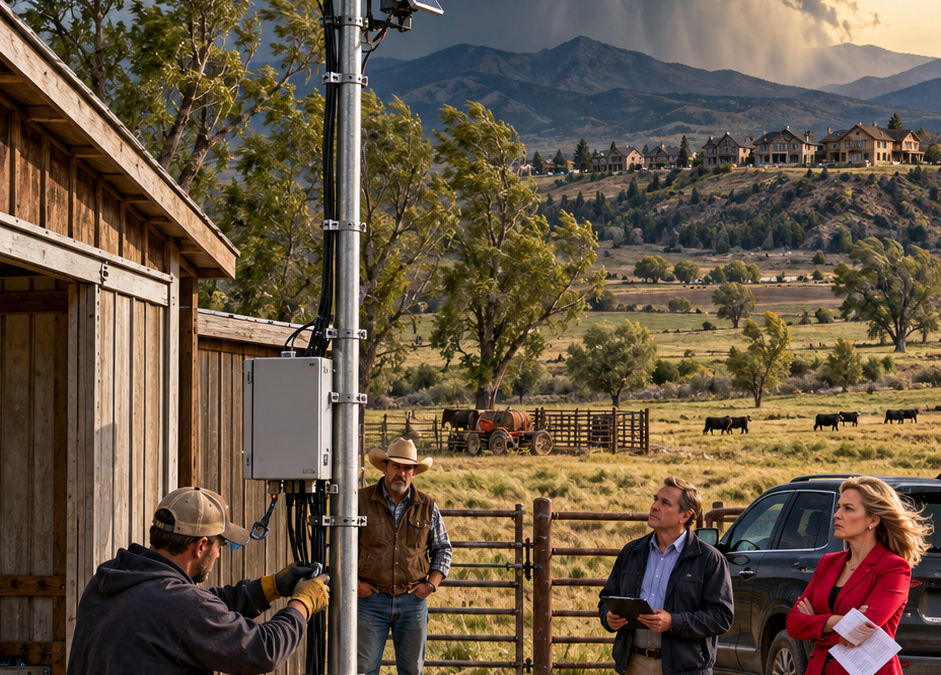
The station was professional ranch equipment tied to a data logger in the shed. The mast carried an anemometer, rain gauge, temperature sensor, humidity sensor, and barometric sensor. Every few minutes, it recorded what the sky was doing over my land. The data saved locally and backed up through a cellular connection. I checked it before moving hay, before spraying, before shifting cattle during storm season, before deciding whether a front was going to miss us or roll straight across the valley.
Most days, I barely thought about it.
It did its job quietly.
Then, on a Thursday morning, I found a white envelope zip-tied to the pipe gate beside my equipment lane.
Cedar Glenn Estates Homeowners Association.
My ranch was not part of Cedar Glenn.
Their subdivision started beyond the cottonwoods to the east, where newer houses climbed the ridge in neat rows and people paid dues to argue about mailbox finishes, pool hours, and whether outdoor lights were too warm or too white. We had argued before about dust from my road, early equipment noise, and the fact that cows sometimes stood where homeowners could see them from their patios.
But the HOA had no authority over Mercer Ridge.
That did not stop them from pretending otherwise.
Inside the envelope was a violation notice addressed to me.
Unauthorized vertical equipment/visual nuisance.
I read the phrase twice before I understood what they meant.
My weather station.
The notice claimed the station violated Cedar Glenn’s appearance standards and was visible from several residential lots. I had forty-eight hours to remove it or face escalating enforcement costs.
I stood there beside the gate with the envelope in one hand and looked toward the mast. The anemometer turned steadily in the morning breeze, doing exactly what it had done for four years without bothering anybody who did not choose to be bothered.
I called the number at the bottom of the notice.
Victoria Hail answered on the second ring.
She was forty-three, president of the Cedar Glenn HOA, and she spoke like every conversation was already halfway through a meeting she controlled.
“You received the notice,” she said.
“I received something calling my weather station unauthorized.”
“Yes.”
“Unauthorized by who?”
“The board.”
“It’s on my ranch.”
“We’ve received multiple complaints about the structure.”
“It’s a weather station.”
“That doesn’t exempt it from being a visual nuisance.”
I looked through the office window toward the mast.
“Victoria, your board doesn’t regulate ranch equipment on my property.”
“We’re addressing a structure that impacts the community.”
“That sounds like regulating my property.”
Her tone hardened.
“The board has made its position clear. You have forty-eight hours.”
The line went dead.
I printed the notice and set it beside the station manual.
For the rest of the morning, I tried not to give it more attention than it deserved. There was feed to move, a trough valve to replace, and a sagging gate in the south pasture that had needed work since Tuesday.
By early afternoon, though, the wind had changed.
I noticed it first in the cottonwoods. The leaves had turned their pale undersides toward the west. The air felt thin and unsettled, like the valley was holding its breath.
Then my phone buzzed.
The station had pushed a pressure alert.
Barometric pressure was dropping faster than it had that morning. I opened the dashboard.
Wind speed rising.
Humidity shifting.
Temperature falling.
Nothing dangerous yet, but a front was moving toward the valley. The regional forecast showed possible thunderstorms overnight, with strong gusts along the leading edge.
That was enough for me.
I moved a tractor undercover, checked loose roofing on the hay shed, and made sure the cattle in the north pasture could reach the lower draw. By sunset, the western sky had turned the color of dirty steel.
At 8:17 p.m., the station recorded the first sharp pressure drop.
At 8:43, the wind climbed again.
At 9:06, the rain gauge started registering.
I was standing under the equipment shed awning when the first hard gust rolled across the ranch. Dust lifted off the lane, then disappeared under rain. The anemometer spun faster, and my phone updated every few minutes.
Wind.
Rain.
Pressure.
Temperature.
A clean sequence.
I watched the numbers because that was what the station was for.
Not Cedar Glenn.
Not lawyers.
Not insurance.
Weather.
At 9:31, a stronger gust hit from the southwest. Somewhere beyond the cottonwoods, I heard what sounded like metal striking wood. Then the lights in Cedar Glenn flickered along the ridge.
My phone buzzed again.
Another recorded gust.
The station logged everything automatically.
By 10:30, the worst of the front had moved east. The rain softened. The wind dropped. I went inside, hung my wet jacket on the back of a chair, and forgot about the HOA notice for the night.
The next morning, Cedar Glenn looked different.
An ornamental oak had come down near the clubhouse. Sections of pool fencing leaned inward. A patch of siding had peeled from the common building. Before I finished my first cup of coffee, another email from Victoria arrived.
Subject: Final Removal Scheduling.
Two contractors would be at my ranch the following morning to dismantle the weather station.
I looked at the storm data still scrolling across my screen.
Then at the damage beyond the cottonwoods.
For the first time, the timing bothered me.
The station had just recorded the most significant storm we had seen all month, and Cedar Glenn wanted it gone by tomorrow morning.
By seven that morning, Cedar Glenn already had a cleanup crew working around the clubhouse. From my side of the cottonwoods, I could hear chainsaws and see two men dragging broken branches away from the parking lot.
The storm had moved east before midnight. Mercer Ridge had come through with a few branches down, one loose sheet of metal on an equipment lean-to, and mud collecting near the lower gate. Nothing serious.
The weather station was still transmitting normally.
I opened the overnight log while drinking coffee.
Pressure dropping.
Wind building.
Rain beginning.
A sharp cluster of stronger gusts.
Then everything gradually settling as the front moved through.
The strongest gust on my station had arrived at 9:31 p.m.
Fifty-eight point four miles per hour.
Southwest.
I noted it, closed the dashboard, and went back to work.
At 8:12, another email arrived from Victoria.
Daniel,
The board’s removal order remains in effect. Contractors will arrive tomorrow at 9:00 a.m. to dismantle the unauthorized structure. Please ensure access to the equipment area. Any delay caused by refusal of access may be billed to the property owner.
Victoria Hail
President, Cedar Glenn Estates HOA
I read the sentence twice.
Please ensure access.
Cedar Glenn had never been given permission to enter my equipment yard.
I replied:
Victoria,
You do not have authorization to enter Mercer Ridge Ranch or dismantle ranch equipment. The weather station is operational equipment located on private agricultural property. Do not send contractors onto the ranch without my permission.
Daniel Mercer
Her response arrived eleven minutes later.
The board considers the matter an enforcement action affecting Cedar Glenn.
I closed the email.
Around midmorning, I drove along the eastern pasture and got a better look at the subdivision. The ornamental oak beside the clubhouse had fallen toward the parking lot. Several branches had struck the roofline, and a temporary tarp covered one section. Near the pool, damaged fence panels had been stacked beside the maintenance building. A worker was photographing siding along the west wall.
I stopped beside my own fence.
Victoria came out of the clubhouse with a folder pinned tightly beneath one arm. Her heels struck the pavement in quick, hard steps as she crossed toward me.
“You’re not seriously planning to interfere with the contractors tomorrow,” she said.
“I already told you not to send them.”
“The board approved removal.”
“The board doesn’t own my equipment.”
She pointed toward the weather mast beyond me.
“That thing has been a problem for months.”
“Yesterday it was a visual nuisance. Today it’s suddenly urgent.”
“It was scheduled before the storm.”
That caught my attention.
“Before the storm.”
“Yes.”
“So the storm has nothing to do with this?”
“Of course not.”
Behind her, workers were still photographing the clubhouse.
Victoria noticed where I was looking.
“That damage is being handled separately.”
“I didn’t say anything about the damage.”
“You didn’t have to.”
She turned and walked back toward the clubhouse.
I let her go.
Back at the equipment shed, I photographed the weather station, the mast, the mounting bolts, the logger cabinet, the power connection, and the cellular backup module. If contractors came the next morning, I wanted a clean record of the station’s condition beforehand.
At 12:46 p.m., a contractor truck stopped near the equipment lane.
Two men got out.
The older one introduced himself as Scott Lyman.
“Cedar Glenn asked us to assess removal.”
“You’re not authorized to dismantle anything on this ranch.”
“We’re not removing it today.”
“Good.”
He showed me the top of the work order.
Cedar Glenn Estates.
Weather equipment removal priority status.
The authorization date was from the previous afternoon.
Before the strongest part of the storm.
Scott lowered the clipboard.
“We were told access was arranged.”
“It wasn’t.”
He wrote that down.
“What exactly are you supposed to remove?” I asked.
“The mast and attached sensors. Disconnect associated equipment as needed.”
I looked toward the weatherproof cabinet at the base of the mast.
“That system records continuously.”
“We’re just following the order.”
“Then talk to whoever issued it before you come back.”
Scott nodded.
The two men spent several more minutes near the equipment area, took photographs, then left.
At 4:18 p.m., my phone rang.
The number was local.
“Daniel Mercer.”
“Yes. My name is Martin Cole. I’m a field property adjuster reviewing a weather loss claim for Cedar Glenn Estates.”
I looked through the office window toward the subdivision.
“All right.”
“I understand you operate a recording weather station west of the development.”
“Who told you that?”
“One of the property managers mentioned it during my site inspection.”
That surprised me.
“Is the station operational?” he asked.
“Yes.”
“Was it recording during last night’s storm?”
“Yes.”
“Would you be willing to preserve the original data from roughly twenty-four hours before the storm through today?”
I leaned back.
“Why?”
“I’m comparing several sources.”
“What kind?”
“Regional observations, property damage, site conditions, and local timing.”
“What exactly do you want from my station?”
“First, I need to know the original data still exists.”
“It does.”
“Good.”
I looked at Victoria’s removal order on the desk.
“Cedar Glenn has contractors coming tomorrow morning to dismantle it.”
Silence.
“How early?” he asked.
“Nine.”
His reply came immediately.
“Don’t erase or reset anything.”
“I wasn’t planning to.”
“I’d like to see the station before anybody disconnects it.”
“Why?”
“I’ll explain when I see what you have.”
I looked back toward the mast.
For the first time, Victoria’s removal order and Cedar Glenn’s insurance claim were occupying the same piece of ground.
And I still had no idea why.
Martin Cole arrived at Mercer Ridge twenty minutes before the contractors.
His gray SUV rolled slowly up the gravel lane and stopped beside the equipment shed. He stepped out carrying a tablet, a field notebook, and a weatherproof equipment case. He was fifty-eight, lean, gray at the temples, dressed in a charcoal field jacket and work boots.
He looked at the station first.
“That’s it?”
“That’s it.”
He walked around the mast without touching anything.
“Installed when?”
“Four years ago.”
“Professional installation?”
“Yes.”
“Logging interval?”
“Three minutes.”
“Continuous as long as the system has power. Local storage and cellular backup.”
That got his attention.
“Cloud archive?”
“Yes.”
I crossed my arms.
“You want to tell me why an insurance company cares about ranch weather data?”
“Because I’m reconstructing a storm.”
“Doesn’t the National Weather Service already do that?”
“They do.”
He pointed toward the mast.
“But the nearest official station is almost thirty miles away. Regional data tells me what happened across the area. A local station can tell me what happened here.”
“So my station decides whether Cedar Glenn gets paid.”
“No.”
The answer came immediately.
“That isn’t how this works.”
Inside the office, Martin asked for the storm window. I opened the dashboard. Wind, rain, pressure, temperature. He skipped the pretty graphs and asked for raw timestamps.
“Original values?” he asked.
“Yes.”
“Any editing?”
“Not to the archive.”
That mattered more to him than screenshots.
He checked the maintenance record, photographed the latest calibration receipt, and asked whether the logger stored power events.
I told him it did.
At that point, neither of us knew how important that question would become.
At 8:53, Victoria’s SUV turned into the lane.
She was out before the engine had fully settled, a folder pinned tightly against her side as she walked directly toward the weather station. The contractors followed in a white service truck. Scott Lyman got out first.
He saw Martin beside the mast and slowed down.
Victoria did not.
“This inspection should already be underway.”
Martin turned.
“Victoria Hail?”
“Yes.”
“Martin Cole. I’m handling Cedar Glenn’s weather loss review.”
Her stride stopped for half a beat.
“Of course.”
She looked at the station.
“We’ve already explained that equipment has nothing to do with our claim.”
“I haven’t said it does.”
“It isn’t certified government equipment.”
“I know it’s privately owned.”
“And it was already scheduled for removal.”
“I know that too.”
She tightened her grip on the folder.
“Then why are you here?”
“Verifying a potential local weather source.”
“The HOA cannot be expected to preserve a privately installed nuisance structure because an insurance company finds it interesting.”
Martin looked at her.
“I’m not asking the HOA to preserve anything.”
Then he looked at me.
“I’m asking the owner not to alter the data source while I review it.”
Scott set his toolbox beside the mast.
“So are we working or not?”
Victoria answered.
“Yes.”
I stepped between him and the mounting base.
“No.”
Victoria stared at me.
“You are obstructing an authorized enforcement action.”
“You still haven’t shown any authority to dismantle ranch equipment.”
Martin raised a hand.
“I’m not deciding your property dispute.”
Victoria’s shoulders relaxed slightly.
Then he continued.
“But if the station is disconnected before I finish, I need the exact shutdown time documented.”
She frowned.
“Why?”
“Because any interruption becomes part of the source history.”
“It won’t change last night’s storm data.”
“Maybe not.”
Martin looked toward the mast.
“But continuity matters.”
Scott picked his toolbox back up.
“I’m not touching it until somebody tells me in writing who’s responsible.”
Victoria turned toward him.
“You have a signed work order.”
“I have a work order from Cedar Glenn.”
He pointed at me.
“He says it’s his property.”
Then toward Martin.
“And he says the system is being reviewed.”
Martin corrected him.
“I said any change needs to be documented.”
Scott shrugged.
“That’s enough for me.”
Victoria exhaled through her nose.
“You’re all making this unnecessarily complicated.”
I looked at the spinning anemometer.
“No. It became complicated when contractors were sent onto my ranch to dismantle equipment I own.”
She turned away.
Inside the office, I started the raw export.
Martin checked the metadata. Start time, end time, sampling interval, sensor status.
Then he asked, “Was the station running continuously after the storm?”
“As far as I know.”
“Can you show power events?”
I opened the system log.
Normal startup.
Firmware check.
Cellular sync.
Battery status.
Then Martin stopped scrolling.
Remote power interruption.
Sensor restart.
Timestamp: 1:07 p.m. the previous afternoon.
He looked at me.
“What time did the contractors first come out?”
“Around 12:45. Yesterday.”
“Yes.”
I stared at the screen.
“I didn’t shut it off.”
Martin looked through the office window toward Scott, then back at the log.
“Who else had access to this equipment area?”
Martin did not spend the next morning behind a desk.
He called shortly after eight.
“Can you meet me at Cedar Glenn?”
“What do you need?”
“Your storm summary. Just the wind window.”
When I reached the clubhouse, Martin was standing beneath the damaged oak with a roofing consultant named Ellis Grant. Victoria was already there, a folder clamped under one arm so tightly the pages had bowed.
Martin pointed toward the fallen trunk.
“What was your strongest recorded gust?”
I opened the station summary.
“Fifty-eight point four miles per hour. Time 9:31 p.m. Direction 228 degrees. Southwest.”
Martin walked around the oak. The trunk had fallen northeast toward the parking lot. Several heavy branches had struck the clubhouse roof.
Ellis crouched beside the base.
“That direction fits,” he said.
Martin nodded.
“Southwest wind. Tree moves northeast.”
Victoria stepped closer.
“So his station confirms the claim.”
Martin looked at her.
“It confirms a strong local gust at 9:31.”
“That’s what I said.”
“No, it isn’t.”
He walked toward the pool.
Most of the damaged fencing had been stacked beside the maintenance building, but one bent post remained in place.
Martin stopped in front of it.
The post had a hard crease about three feet above the pavement.
Not a twist.
Not a pulled fastener.
A compression fold.
The metal bent inward toward the pool.
Ellis rubbed a finger across the damaged surface. A streak of white paint came away on his glove.
Martin looked at me.
“Which direction was the wind pushing?”
“At 9:31? Northeast.”
He pointed to the fence.
“This moved west.”
Victoria opened her folder.
“Wind swirls around buildings.”
“It can.”
Martin crouched.
“But wind usually doesn’t leave white paint at bumper height.”
Nobody answered.
He photographed the crease.
Another damaged panel had a similar mark.
Victoria’s voice sharpened.
“There was debris everywhere.”
“What debris?” Martin asked.
“Branches. Equipment. Anything could have hit it.”
“Then we identify what hit it.”
“You’re basing an insurance review on a scratch?”
“No.”
He pointed toward the clubhouse.
“The oak damage is consistent with the recorded southwest gust.”
Then toward the pool fence.
“This is a different damage pattern.”
That was the first visible break in Cedar Glenn’s version of events.
One storm.
One claim.
Possibly more than one cause.
Inside the clubhouse, Martin pulled the claim summary onto a conference room screen. The roof, tree removal, siding, and pool fencing had all been grouped beneath the same storm event.
Pool perimeter fencing: wind-driven collapse.
Martin looked at Victoria.
“What time did this occur?”
“During the storm.”
“That isn’t a time.”
“Around ten.”
I checked the station summary.
At 9:31, the gust had peaked at 58.4 miles per hour. By 9:47, it had dropped sharply. At 10:02, the station recorded 14.8 miles per hour.
Martin read the number.
Victoria crossed her arms.
“His private device does not establish what happened at every corner of Cedar Glenn.”
“No,” Martin said. “It doesn’t.”
He enlarged the fence photograph.
The horizontal crease was visible.
So was the white paint transfer.
“But physical damage still has to make sense.”
Victoria pushed away from the table.
“This is absurd.”
She headed toward the door.
Martin did not stop her.
He enlarged another photograph.
The clubhouse roof.
A branch had punched into the edge flashing. Its impact direction matched the fallen oak.
“Storm,” he said.
Then he returned to the fence image.
“Maybe not storm.”
I looked at him.
“So now what?”
“Now I find out when that fence was damaged.”
Afterward, Martin followed me back to the ranch.
He needed only three storm facts confirmed.
9:31 p.m.
58.4 miles per hour.
Southwest.
I showed him the raw entry.
Then he asked about the contractor visit.
“Arrival time about 12:45,” he said. “Station interruption at 1:07.”
He looked toward the weatherproof cabinet.
“Does that enclosure log openings?”
I stopped.
“I think it does.”
Two winters earlier, an animal had damaged wiring inside the box. When the station was repaired, I added a simple door contact sensor so unexpected openings would be recorded.
I opened the maintenance menu.
Cabinet status history.
12:58 p.m. Closed.
1:06 p.m. Cabinet open.
1:07 p.m. Auxiliary disconnect state change.
1:07 p.m. External power lost.
1:08 p.m. External power restored.
1:09 p.m. Cabinet closed.
Martin read the sequence twice.
The forty-three-second outage finally had a physical sequence attached to it.
Somebody had opened the cabinet.
The disconnect had changed state.
Power had stopped.
Then returned.
Outside, Victoria was walking toward her SUV.
Martin called her name.
She turned.
He held up the photograph of the damaged pool fence.
“The storm came out of the southwest at 9:31.”
She said nothing.
He pointed to the white paint transfer.
“That fence was struck from the other side.”
For the first time since I had met Victoria Hail, she had no immediate answer.
Scott Lyman came back to the ranch before noon.
This time, he brought no toolbox, no crew. Only his phone and a printed copy of the work order.
He looked at the cabinet history on my computer.
1:06. Cabinet open.
1:07. Disconnect state change.
1:07. Power lost.
1:08. Power restored.
1:09. Cabinet closed.
Scott rubbed his jaw.
“I need to correct something.”
Martin stood beside me.
Scott pointed at the 1:07 entry.
“I did that.”
I looked at him.
“You shut the station off for forty-three seconds.”
“Yes.”
“Why?”
“I was checking the disconnect.”
Martin asked, “On your own?”
Scott unlocked his phone.
“No.”
He opened a message thread and placed the phone on the desk.
The sender was Victoria Hail.
Timestamp: 12:31 p.m.
See if you can shut the power off cleanly before tomorrow’s removal. I want the station dead before the crew starts.
Nobody spoke for several seconds.
Martin photographed the message.
“Did she mention insurance?” he asked.
“No.”
“Weather data?”
“No.”
“Why didn’t you tell us yesterday?”
Scott looked uncomfortable.
“I thought you were asking whether I removed wiring.”
“You changed the power state.”
“I flipped the disconnect, saw the system go dark, and turned it back on. That was the forty-three seconds.”
I said nothing.
Scott looked at me.
“I wasn’t trying to erase anything.”
The message did not say he was.
It said Victoria wanted the station dead before the removal crew started.
Martin turned to me.
“Keep the original log untouched.”
Then to Scott.
“Forward the complete message thread with metadata.”
Scott did.
No argument.
The outage was no longer unexplained.
Scott had tested the disconnect.
He had done it because Victoria told him to.
That still left the bigger question.
Why was pool fence damage being described as storm loss?
Peter Lang answered that one.
He called at 2:17.
“Daniel, are you at the ranch?”
“Yes.”
“Is Martin there?”
“Yes.”
“I’m coming over.”
Twenty minutes later, Peter entered the office carrying a yellow maintenance folder. He was a Cedar Glenn board member, quieter than Victoria and, in my experience, less impressed with himself.
He opened the folder directly on my desk.
The first page was an incident report.
Cedar Glenn Property Management.
Dated five days before the storm.
A waste hauling truck had backed into the service lane beside the pool. The rear corner of the truck struck the perimeter fence.
Three bent panels.
Two deformed posts.
White paint transfer.
The next page was a repair estimate.
Four thousand eight hundred sixty dollars.
Dated four days before the storm.
Peter placed a printed photograph beside it.
The same horizontal crease.
The same bent posts.
The same white paint.
All of it taken before the storm existed on any forecast map.
Martin pulled up the Cedar Glenn insurance packet.
Pool perimeter fencing.
Wind-driven collapse.
Date of loss: the night of the storm.
Replacement requested: damaged fence section.
Peter stared at the screen.
“I thought maybe the storm made existing damage worse.”
Martin placed the pre-storm and post-storm photographs beside each other.
One panel had moved farther inward in the later photograph.
“But the main bends and damaged posts were already there,” Martin said. “The storm may have moved something, but the primary documented damage predates it.”
Peter looked sick.
He turned back to the original incident report.
“Who received this?”
The distribution line listed property manager, maintenance chair, HOA president.
Victoria Hail.
“She knew,” I said.
Peter nodded.
“She was copied.”
Then he pulled out an email dated two days before the storm from Victoria to the property manager.
Hold the pool fence repair for now. We’ll address it with the other common area items after this week.
Martin read it twice.
Then his phone vibrated.
An email had arrived from Cedar Glenn’s property manager.
Martin opened it.
His expression changed.
“What?” Peter asked.
He turned the screen toward us.
Mr. Cole asked this morning whether any private weather stations operated near the development. I advised Ms. Hail of the request shortly before noon.
Timestamp: 11:54 a.m.
We all looked at Victoria’s text to Scott.
12:31 p.m.
See if you can shut the power off cleanly.
Thirty-seven minutes.
That was the gap between Victoria learning the insurance adjuster was searching for nearby weather data and instructing Scott to test whether my station could be shut down.
Martin picked up his notebook.
“We’re done here.”
“Where are you going?” I asked.
“Back to Cedar Glenn.”
Peter stood.
“I’m coming.”
Martin looked at me.
“You too?”
“I thought this was your insurance review.”
“It is.”
He tapped the repair estimate.
“But the next board meeting is no longer going to be about whether your weather station is ugly.”
The next evening, the special board meeting began at six.
Peter had asked me in writing to attend because two agenda items involved Mercer Ridge directly: contractor access to my property and the interruption of my weather station. Martin was there because of the insurance review. Scott Lyman had been asked to attend because he had entered the equipment area and operated the disconnect.
This time, I did not sit near the door.
I sat at the table.
In front of me was a large aerial image of Cedar Glenn. I had marked four locations.
The weather station.
The clubhouse.
The fallen oak.
The pool fence.
Across the map, I drew one arrow.
Southwest to northeast.
Beside it:
9:31 p.m.
58.4 mph.
Victoria entered last.
She placed her folder in front of the president’s chair and sat down without looking at me. Peter had already distributed copies of the pre-storm fence report.
The HOA attorney opened the meeting.
“We have several matters requiring immediate board action.”
Martin spoke.
“Three of them need to remain separate until the evidence connects them.”
He counted them.
“The insurance submission, the contractor’s entry onto Mercer Ridge, and the interruption of Mr. Mercer’s station after the HOA learned I was seeking local weather data.”
The room went quiet.
Victoria opened her folder.
“The removal order existed before the storm.”
“Yes,” Martin said. “It did.”
For half a second, she looked relieved.
Then he continued.
“The instruction to test shutting the station down did not.”
Scott sat at the far end of the table.
Martin asked him, “Did you open Mr. Mercer’s weather cabinet at approximately 1:06 Friday afternoon?”
“Yes.”
“Did you operate the auxiliary disconnect?”
“Yes.”
“Why?”
Scott unlocked his phone.
“Because Ms. Hail told me to see whether the station could be shut off cleanly before removal.”
He handed the phone to the attorney.
The attorney read the message silently.
Then aloud.
“See if you can shut the power off cleanly before tomorrow’s removal. I want the station dead before the crew starts.”
Victoria leaned forward.
“That was a contractor instruction. We were preparing for removal.”
Martin placed another page beside the phone.
“This is from Cedar Glenn’s property manager.”
He pointed at the timestamp.
“11:54 a.m.”
Then he read the message explaining that Victoria had been told the insurance adjuster was asking about nearby private weather stations.
He pointed at her text to Scott.
“Your shutdown instruction went out thirty-seven minutes later.”
Victoria’s face tightened.
“You’re implying something that isn’t there.”
“I’m giving the board the timestamps.”
The HOA attorney looked at her.
“Did you know Mr. Cole was asking about nearby weather data before you instructed the contractor to test shutting the station down?”
Victoria paused.
“Yes.”
Nobody moved.
The attorney continued.
“Did you inform Mr. Cole that the HOA was preparing to disconnect the station?”
“No.”
“Why not?”
“Because it wasn’t HOA equipment.”
I finally spoke.
“That didn’t stop you from sending someone to shut it off.”
She turned toward me.
“It was being removed anyway.”
I slid the aerial image into the center of the table.
“No. This is what was happening while you were trying to make my station disappear.”
I pointed at the oak.
“At 9:31, the station recorded a 58.4-mile-per-hour gust from the southwest.”
My finger followed the arrow.
“The oak fell northeast.”
Martin nodded.
“Consistent with the recorded wind.”
Then I pointed at the pool fence.
“But these panels folded west.”
I placed the pre-storm photograph beside the map.
“The same fence was already bent. The same white paint was already on the posts.”
Peter placed the incident report next to it.
“Five days before the storm.”
Then the repair estimate.
“Four thousand eight hundred sixty dollars.”
The attorney looked at Victoria.
“Was this damage reported to you before the storm?”
She stared at the photograph.
“Yes.”
“Did you know a waste hauling truck had struck the fence?”
“Yes.”
“Did you know a repair estimate already existed?”
“Yes.”
Martin opened the insurance submission.
“Then why does this describe the same fencing as wind-driven collapse with the storm listed as the date of loss?”
Victoria straightened.
“The storm damaged it further.”
Martin placed the before and after photographs side by side.
“Additional movement is possible.”
He pointed to the primary bends.
“But those damaged posts and the principal deformation already existed.”
The attorney asked, “Why was full replacement submitted under the storm loss?”
Victoria looked around the table.
Nobody answered for her.
Finally, she said, “I included the fence because the carrier was already going to review the common area losses. I expected them to sort out what was covered.”
The attorney removed his glasses.
“You knowingly included documented pre-existing damage in the storm packet.”
Victoria lowered her eyes.
“I included it in the packet.”
Peter spoke quietly.
“With the storm listed as the date of loss.”
She did not answer.
I tapped the map once.
“You called my station a nuisance before the storm.”
Victoria looked at me.
I pointed at Scott’s message.
“But after your insurer asked whether local weather data existed, you wanted it dark.”
Her mouth opened.
Nothing came out.
I did not raise my voice.
“You weren’t worried about how that pole looked anymore.”
The attorney closed the claim packet.
“That is enough.”
The board went into executive discussion.
Twenty minutes later, they returned.
Peter read four motions.
The weather station violation was permanently withdrawn.
All related fines were canceled.
Cedar Glenn would immediately correct the insurance submission and disclose the pre-storm pool fence incident, photographs, and repair estimate.
No HOA officer could authorize entry onto neighboring property without written consent, specific board authority supported by legal review, or another lawful process.
And Victoria Hail was removed as HOA president effective immediately, pending further governance review.
The vote was four to one.
Victoria cast the one.
Martin made no accusation of criminal fraud. The attorney said nothing about prosecution. The insurance carrier would decide what happened to the disputed portion of the claim. The board had its own problem, and my weather station was staying.
Scott stood to leave.
Before reaching the door, he stopped beside me.
“I should have called you before opening that cabinet.”
“Yes.”
“That’s on me.”
“Yes.”
He nodded and left.
Victoria remained seated.
Peter gathered the claim documents. The attorney asked her to provide the complete insurance correspondence before leaving.
She stared at the brass nameplate in front of her.
President Victoria Hail.
For several seconds, she did not move.
Then she picked it up, turned it face down, and slid it into the center of the table.
I sent Martin the final station export before midnight.
By then, Cedar Glenn had already started correcting its insurance submission.
The pool fence damage was no longer being presented as a new storm loss. The original incident report went with the correction. So did the pre-storm photographs. So did the $4,860 repair estimate.
The roof damage remained under review. So did the fallen oak and storm-related siding damage. Those had physical patterns consistent with the front that crossed the valley at 9:31.
The insurance company had not needed my station to prove a storm existed.
It needed the station to help establish what that storm had actually done here.
The next morning, Martin sent a short email.
Final data received.
Nothing else.
Three days later, Cedar Glenn sent me a certified letter.
The weather station violation had been permanently withdrawn. Every related fine was canceled. No HOA officer, contractor, or property manager could enter Mercer Ridge without written permission, documented legal authority, or specific board action reviewed by counsel.
The letter was signed:
Peter Lang
Acting HOA President
Victoria Hail’s name appeared nowhere.
The insurance matter took another week.
Martin called on a Monday afternoon.
“I’ve completed my field review. The documented roof and tree losses are being handled as storm damage. The pool fence was removed from the storm portion after Cedar Glenn corrected the submission.”
“So my station killed that part of the claim.”
“No,” Martin said, careful as always. “The repair records established that the main fence damage predated the storm. Your station helped establish the weather window.”
That was the right answer.
There had never been one magic document.
The storm log established wind.
The physical damage showed what the wind could explain.
The pre-storm photograph showed what it could not.
The repair estimate established the date.
Scott’s message established the shutdown instruction.
The cabinet log established the forty-three seconds.
And Victoria’s own answers connected the decisions to her.
A month later, Cedar Glenn looked normal again.
The clubhouse roof had been repaired. The fallen oak was gone. New fencing surrounded the pool.
Peter stopped by once while I was replacing a valve near the equipment shed. He looked up at the weather mast.
“You keeping that thing?”
“As long as it works.”
He smiled.
“The board passed the new contractor access policy last night.”
“Unanimous?”
“Unanimous.”
“That must have been easier.”
He knew what I meant.
“Victoria resigned from the board last week.”
I set the wrench down.
“When?”
“Friday.”
“What happened with the insurance issue?”
“The carrier handled the corrected claim. That’s all I know.”
He started toward his truck, then stopped.
“For what it’s worth, the board should have asked more questions before approving enforcement.”
“You weren’t the one who sent someone onto my ranch.”
“No.”
He looked toward the mast.
“But I voted for something vague enough that somebody thought they could.”
That was fair.
He left.
I went back to the broken valve.
That was how most ranch problems ended.
Not with applause.
With another job waiting.
A few weeks later, I saw Victoria near the Cedar Glenn entrance. The navy blue blazer was unmistakable even across the pasture. She stood beside her SUV for a moment and looked toward the weather station.
She did not point at it.
She did not call anyone.
She did not walk toward my gate.
She got into her vehicle and drove away.
The station kept recording.
Three weeks later, another front began building west of Cedar Valley. Nothing severe, just colder air moving toward us. I had planned to spray thistle along the south pasture. Before loading the tank, I checked the weather dashboard.
Wind speed was rising.
The direction was wrong.
I put the sprayer away.
That was the whole decision.
No board meeting.
No contractor.
No insurance adjuster.
Just the reason the station had been installed in the first place.
That evening, clouds gathered beyond the western ridge. The anemometer turned faster. I stood beside the equipment shed and watched it.
Four years earlier, I had installed that station because guessing at weather gets expensive on a ranch. I never expected it to become part of an insurance investigation. I never expected an HOA president to send a contractor to test its disconnect. I never expected forty-three seconds without power to matter almost as much as thousands of recorded weather readings.
But machines do not care who is angry.
They do not care who has a title.
They do not care which explanation is more convenient.
They record what happens.
The clubhouse roof had been hit by the storm.
The oak had fallen with the wind.
The pool fence had been hit by a truck five days earlier.
And the station had recorded the sky.
While everyone else decided what story they wanted those facts to tell, I looked toward Cedar Glenn. New shingles covered the clubhouse. New fencing surrounded the pool.
Then I looked back at the mast.
Still standing.
Still recording.
Still mine.
They called it an eyesore until they needed to know exactly what the sky had done.