𝗙𝗨𝗟𝗟 𝗦𝗧𝗢𝗥𝗬 The HOA Tore Down My Fence Because Their Pool Needed Somewhere to Send Its Water
𝗙𝗨𝗟𝗟 𝗦𝗧𝗢𝗥𝗬
I stared at her, waiting for the sentence to make more sense.
It did not.
“You rent access across my land.”
“We maintain it.”
“You rent it.”
One of the contractors shifted his weight and looked down.
Lauren noticed. Her voice got louder.
“The association has invested substantial money into this property, Grant. We’re not going to let one ranch owner interfere with an improvement serving more than two hundred families.”
A few murmurs came from the terrace.
I could feel every set of eyes move onto me.
She had picked her stage carefully.
I crouched beside the concrete swale. Water from the pool system trickled through it, catching white daylight in thin flashes before disappearing beneath a grate farther down my pasture.
My father had helped lay that channel years ago. He had insisted the lease identify every foot of ground Canyon Vista could use. He never trusted phrases like everybody knows, shared function, or we’ve always done it this way.
Lauren stepped closer but kept several feet between us.
“Move your truck.”
I stood.
“Put my fence back.”
Her expression barely changed.
She raised two fingers toward the excavator operator.
“Continue.”
The diesel engine climbed in pitch. Steel tracks pressed into my grass. The bucket swung toward another post.
I walked to my truck, opened the door, and pulled out the weathered ranch map I kept behind the seat.
Lauren gave me a small smile.
The kind people use when they think paperwork is the only weapon you have left.
I laid the map across the hood and looked from the marked lease corridor to the orange flags stretching into my pasture. Then I looked at the new infinity edge basin rising behind her, the retaining wall beneath it, and the drainage channel carrying its water across Mercer ground.
Something about that picture bothered me, though I could not name it yet.
I folded the map slowly.
“Lauren, you’re building outside the agreement.”
She crossed her arms.
“We’re improving property that belongs with the community.”
The excavator bucket dropped into the soil. Dark earth rolled over its teeth. I watched the first scoop come out of land my family had owned for three generations.
Then I looked directly at Lauren.
“You’d better be very sure about that.”
By sunset, the excavator was gone, but the damage stayed behind.
Three fence posts lay beside the service lane, their concrete footings still packed with red dirt. A raw trench cut across the grass where my cattle normally moved between the lower pasture and the north trough. The temporary deck forms sat like an accusation on the edge of the old fence line.
I spent the last hour of daylight setting steel panels across the opening.
The metal was hot enough to sting my palms through my gloves. Every few minutes, laughter drifted over from the pool, mixed with splashing water and the low mechanical drone from the pump house.
That sound had been part of the ranch for twelve years.
I had never minded it before.
That evening, I did.
I finished securing the last panel, drove to the house, and washed the dust from my arms at the utility sink. The water ran brown for several seconds.
On the kitchen table sat the envelope Lauren had handed me before leaving.
Inside was a formal notice stating that Canyon Vista claimed continuous control of the disputed strip and that I was prohibited from interfering with association contractors.
I read it twice.
Then I set it beside the old lease instead of calling anyone.
The lease was short.
My father liked short contracts.
I traced the legal description with my finger, then carried it to the mudroom where an old survey map hung behind a cabinet door. The measurements matched what I remembered.
The HOA had rented access.
Nothing in those pages gave them ownership.
But there was a problem I could not ignore.
Over the years, I had let things slide.
Maintenance trucks sometimes parked beyond the lane. Landscapers crossed the fence to turn around. During a pool renovation three summers earlier, I allowed pallets of stone to sit on my pasture for almost a month because moving them would have delayed work and irritated people over something temporary.
I had treated those things like neighborly favors.
Lauren was treating them like history.
The next morning, I saddled my bay gelding and rode the eastern boundary before the heat settled in.
From horseback, the change was easier to see.
Canyon Vista had expanded until the ranch looked like an island beside it. Stucco homes climbed the ridge. The pool terrace had doubled in size. New landscaping pressed against the old lease corridor. Stone retaining walls and decorative grasses disguised the fact that everything had moved closer to my line.
I stopped near the drainage swale.
Fresh blue paint marked the ground beyond it.
Utility locating marks.
Not decoration.
Somebody intended to dig deeper.
A pickup rolled slowly along the HOA service lane and stopped near me. The contractor from the day before lowered his window. He looked back toward the pool before speaking.
“Mr. Mercer, you might want to keep your cattle away from this side for a few days.”
“Why?”
He rubbed his thumb along the steering wheel.
“They’re bringing in more equipment for the cabanas.”
He hesitated.
That was enough.
“What else are they building?”
“I just handle grading.”
He shifted into drive.
“Talk to the board.”
The truck rolled away, tires crunching over gravel.
I dismounted and walked toward one of the blue marks. It continued past the proposed cabana site, across my pasture, and toward the rise above the retention basin. I followed it for nearly sixty yards before it ended beside a wooden stake driven into ground the HOA had never leased.
A strip of pink ribbon snapped in the dry wind.
I crouched and touched the disturbed soil around it.
Whatever Lauren planned, taking my fence down had not been the project.
It had only been the first move.
The machinery arrived before breakfast.
I heard diesel engines from the barn and stepped outside with a halter still looped over my shoulder. Two flatbeds crawled down the HOA service lane. One carried sections of black pipe nearly two feet across. The other hauled a track trencher.
Lauren’s white SUV followed behind them.
I crossed the pasture on foot and reached the temporary cattle panels just as the first truck stopped.
Lauren climbed out wearing the same red pantsuit, her ponytail tight, sunglasses pushed onto her head. She pointed past me toward the blue utility marks.
“The equipment goes through there.”
I stayed in front of the gate.
“No, it doesn’t.”
Four workers stood beside the trucks waiting.
Lauren glanced at them, then back at me.
“You were notified.”
“You notified me that you claim my land. That isn’t permission to enter it.”
She pulled a folded site plan from a leather folder and opened it across the hood of her SUV.
I did not reach for it.
I could see enough from where I stood.
The new pipe crossed the leased access strip, cut diagonally through my lower pasture, and connected the pool complex to the retention basin almost three hundred feet inside my property.
“What is that?” I asked.
“Stormwater modernization.”
“On my ranch?”
“For the community.”
She tapped the plan with one polished fingernail.
“The existing drainage route is inadequate for the expanded pool deck. This replaces it.”
That explained the blue marks.
It also changed the fight.
They were not just stealing twenty feet for cabanas.
They intended to turn my pasture into permanent infrastructure.
“Your lease gives you the existing swale,” I said. “Not a buried pipeline.”
“Our counsel disagrees.”
“Then your counsel can come dig it.”
One worker looked away to hide a smile.
Lauren did not.
She stepped closer to the temporary panel and lowered her voice.
“You’ve allowed association use of this corridor for years. You accepted rent. You allowed improvements. You cannot suddenly obstruct necessary maintenance because you’ve decided you dislike the board.”
“Maintenance doesn’t require a trencher.”
Her jaw tightened.
“Move the barrier.”
“No.”
For several seconds, nothing moved except the pink ribbon snapping on the stake behind me.
Then Lauren took out her phone.
Forty minutes later, a county deputy pulled onto the gravel lane. I recognized him as Deputy Cole Harris. He listened while Lauren spoke, then listened while I did.
Afterward, he studied the fence line, the equipment, and the papers Lauren handed him.
“This looks civil,” he finally said. “I’m not deciding ownership from the side of a road.”
Lauren’s shoulders dropped half an inch.
I noticed.
“So he can block our contractors?”
Harris handed the papers back.
“I’m saying I’m not ordering him to open that gate without something clearer than this.”
The trucks left before noon.
I watched the flatbed carrying the black pipe disappear behind the ridge and felt the first clean breath I had taken since Monday.
It lasted until 3:17 that afternoon.
That was when my phone rang.
It was Elena Ruiz, who ran the feed store in town and owned a house in Canyon Vista for her mother.
“Grant,” she said. “The board just sent an emergency notice.”
I leaned against the barn door.
“About what?”
“The pool.”
Wind pushed warm hay dust across the concrete.
“What about it?”
“They’re closing it indefinitely. Lauren says you blocked critical drainage repairs and created a safety risk.”
I shut my eyes.
There it was.
She had lost access to my land, so she had changed the battlefield.
By five, cars were slowing outside my ranch. People stared through the fence. Someone left a handwritten complaint under my mailbox flag. Another driver leaned on his horn as he passed.
Lauren did not need the trencher anymore.
She had two hundred families angry at the man standing between them and their pool.
I walked back toward the drainage swale as evening settled over the pasture. The water inside it was barely moving now, only a thin silver ribbon under the grate.
I crouched beside the concrete and noticed something I had not seen that morning.
The pool pumps were still running.
If the old drainage system was supposedly dangerous enough to close the entire facility, why were they still pushing water through it?
I put my fingers against the damp concrete, then looked uphill toward the silent pool terrace.
Lauren had called my refusal a safety problem.
Maybe it was.
But for the first time, I wondered whose problem she was actually trying to solve.
The next morning, the pool was still locked, and Lauren made sure everybody knew who to blame.
By eight, three homeowners were standing outside my cattle gate while I repaired the section her crew had pulled apart. One man held his phone up, recording me. Another kept asking why I was holding the neighborhood hostage.
I drove a cedar post into the ground with the hydraulic auger, killed the tractor, and waited for the engine noise to fade.
“I didn’t close your pool,” I said.
“Your board did.”
“Because you blocked the drainage work.”
“Because they tried to install a new drainage system across land they don’t lease.”
That quieted them for maybe two seconds.
Then Lauren’s SUV appeared on the service lane.
She parked beside the locked pool gate and stepped out carrying a ring of keys. She did not come toward me. Instead, she unlocked the pedestrian entrance and waved the homeowners inside.
I watched from across the fence as she led them toward the far edge of the pool deck.
That bothered me enough to follow along my side of the boundary.
When I reached the old drainage swale, I heard water before I saw it.
Not the usual trickle.
A hard, hollow rush.
I climbed the rise and stopped.
Water was spilling over the concrete lip near the pool retaining wall, running through decorative gravel and cutting muddy channels toward my pasture.
One of the homeowners backed away.
“Is that supposed to happen?”
Lauren pointed straight at me.
“This is exactly what we were trying to prevent.”
I looked at the pool.
The water level sat unusually high against the tile.
Then I heard the pump cycle again.
“Turn those off,” I said.
Lauren ignored me.
I moved along the fence until I could see the equipment pad through the landscaping. Two circulation pumps were running, and a smaller transfer pump beside them vibrated against its concrete base. The discharge line feeding the old swale shook every few seconds.
“Lauren,” I called louder this time, “you’re pushing water into a drainage channel you just told everyone was unsafe.”
She finally looked toward the equipment.
“Our contractor is managing the system.”
“Where is he?”
Nobody answered.
The water reached the pasture fence and spread around my boots in a shallow brown sheet.
I turned and ran toward the lower gate.
My cattle were already bunching away from the wet ground, crowding toward the north side. The drainage itself was not enough to threaten them, but the runoff was heading directly toward the dirt crossing I used to move feed and equipment between fields.
I started my tractor and pulled two steel panels across the low section, forcing the herd toward higher ground before the soil softened.
By the time I returned, Lauren had shut the pumps down.
The sudden silence made the dripping water sound louder.
She stood beside the pool gate with her arms folded.
“Now you understand why the upgrade is necessary.”
I looked at the muddy streak running from her equipment pad into my pasture.
“No,” I said. “Now I understand why you’re in such a hurry.”
Her eyes narrowed.
“What exactly are you accusing me of?”
I did not answer.
I walked to the point where the old swale entered my land and knelt beside the concrete. Beneath the fresh mud was a hairline stain several inches above the normal watermark.
Then another.
Repeated high-flow marks.
This had not started yesterday.
I took out my phone and photographed them.
Not because I thought a picture would win anything by itself, but because I needed to remember exactly what I was seeing.
Behind me, one of the homeowners spoke quietly.
“Lauren, how long has it been overflowing?”
She turned on him immediately.
“That isn’t relevant.”
His expression changed, just slightly.
I saw it.
So did she.
I stood and wiped mud from my hand onto my jeans.
For three days, Lauren had been telling Canyon Vista that my ranch was preventing her from fixing a drainage problem. Standing ankle-deep in runoff she had just pumped onto my property, I finally saw the shape of the problem differently.
She was not trying to improve an old system.
She was trying to move the consequences of the new pool expansion somewhere else.
The easiest place to put them was beneath my grass.
The mud at the crossing stayed soft for two days, which meant my feed truck could not reach the lower pasture. I hauled fifty-pound sacks by tractor instead, four at a time, while August heat pressed against my back and mosquitoes lifted from the wet grass around the tires.
That was the first real price Lauren’s decision cost me.
Not enough to ruin the ranch.
Enough to change how I approached her.
I stopped arguing about where her orange flags belonged.
I started controlling what happened on my side of the fence.
I called the contractor whose number was printed on an old Canyon Vista maintenance invoice and asked one question.
“How much water was the expanded pool system designed to discharge?”
He went quiet before saying he could not discuss the HOA’s project.
“Fair enough,” I said. “Then tell Lauren no contractor has permission to enter Mercer Ranch without me present.”
That afternoon, I closed the lease service lane for forty minutes, exactly as the lease allowed when livestock were being moved. I ran the herd through calmly, reopened the gate, and logged the time in my ranch notebook.
Lauren arrived before I finished fastening the chain.
“You cannot obstruct association access.”
“I didn’t. Read the livestock clause.”
She stared at me, then at the cattle disappearing over the rise.
For once, she had no immediate answer.
I thought that meant I had finally forced her back inside the agreement.
It was a small win, and I made the mistake of enjoying it.
The next morning, Canyon Vista reopened the pool.
Music came over the fence. Children splashed in the shallow end. The pumps ran normally, and no water spilled into my pasture.
Elena called and said several homeowners were asking why the emergency had suddenly vanished.
I walked the drainage line twice that day.
Dry concrete.
No overflow.
By evening, I started wondering whether Lauren had backed down.
At 6:30, I found out what she had actually done.
A tanker truck was parked behind the pool equipment building, mostly hidden by oleanders. A thick temporary hose ran from the pump pad into the tanker’s top hatch. They were hauling excess water away.
Lauren stood beside the truck speaking with the driver. When she saw me across the fence, she stopped talking.
“That looks expensive,” I said.
She walked closer.
“Temporary operations.”
“Until what?”
“Until you stop interfering.”
The tanker engine rumbled between us.
I looked at the hose, then toward families swimming fifty yards away.
She had reopened the pool to make the conflict disappear in public while paying trucks to carry away the water her expanded system could no longer handle.
That bought her time.
It also put pressure on the board to end the expense.
“You still want that pipeline across my pasture?” I asked.
“I want the infrastructure completed.”
“Then lease the additional land.”
Her expression hardened.
“We already have rights to it.”
“Then why did your board rent the original strip from my father?”
She looked toward the tanker instead of answering.
I let the silence sit.
“I’ll make you an offer,” I said. “Restore my fence, repair the crossing, and we sit down with a surveyor. If you need more land, we negotiate from zero.”
Lauren gave a short laugh.
“You think this is a negotiation?”
“It is.”
She stepped closer to the fence.
“The board is done paying your family for land Canyon Vista has maintained for years.”
There it was.
Not drainage.
Not safety.
Ownership.
She turned away before I could answer. The tanker pulled out twenty minutes later, leaving two wet tire tracks across the service lane.
I watched it disappear, then looked toward the pool terrace.
The temporary solution had given Lauren exactly what she wanted: open water, happy residents, and time to squeeze me.
But it had also created a meter that never stopped running.
Every tanker leaving Canyon Vista now cost the HOA money. Every dollar Lauren spent avoiding a fair agreement made her next decision harder to walk back.
By the end of that week, the tanker had become part of Canyon Vista’s rhythm.
It arrived before sunrise, backed behind the pump house, swallowed thousands of gallons, then rolled away while most residents were still making coffee. Lauren wanted the pool open badly enough to keep paying for that routine, but temporary fixes have a way of turning into clocks.
Elena called Friday afternoon while I was replacing a bent hinge on the north gate.
“People are asking about the trucks now,” she said.
“Let them ask.”
“Lauren scheduled an emergency board meeting tonight.”
I stopped turning the wrench.
“About the drainage?”
“About acquiring your land.”
That changed things.
At seven, I walked into the Canyon Vista clubhouse carrying nothing but the original lease and my ranch notebook.
The room smelled like air conditioning, coffee, and chlorine drifting through the open patio doors. Nearly sixty homeowners filled the folding chairs. Lauren stood at the front beside a projection screen, composed as ever in red, one hand resting on the table.
She described my pasture as a “historically integrated utility corridor” and the pipeline as essential infrastructure. Then she proposed that the board authorize legal action to establish permanent control over the strip.
I listened until she finished.
“You could lease what you need,” I said. “I offered that.”
Lauren looked toward the residents.
“Mr. Mercer is attempting to charge this community for property it has maintained for more than a decade.”
A few people muttered.
Then an older board member named Peter Lawson leaned forward.
“Lauren, what are the tankers costing us?”
The room changed.
She hesitated.
“That expense is temporary.”
“How much?”
“Approximately thirty-eight hundred dollars so far.”
Several heads turned.
Peter stared at her.
“In five days?”
Lauren straightened.
“Which demonstrates why we need permanent access.”
That was the moment I understood her trap had started closing around her instead.
Every day she refused negotiation made her ownership claim more expensive.
I opened the lease to the marked page.
“I’ll honor every inch my father agreed to,” I said. “But I won’t donate another three hundred feet because the board expanded a pool without securing drainage rights first.”
Silence held for a beat.
Peter looked at Lauren.
“Did we secure those rights before construction?”
“The association believed existing use covered them.”
“That wasn’t my question.”
She did not answer.
The vote to authorize legal action failed four to three.
For the first time, Lauren lost in her own room.
I drove home thinking the worst had broken.
That was my false victory.
At 6:15 the next morning, I heard engines outside my bedroom window.
I pulled on jeans and boots and stepped onto the porch. Two contractor pickups were parked beside the eastern fence. Workers were unloading portable barriers along the service lane. Lauren stood near my gate.
“What are you doing?” I called.
She turned without surprise.
“The board vote concerned litigation. Existing maintenance authority remains in effect.”
“That trencher isn’t maintenance.”
“There’s no trencher.”
She pointed toward the pool.
“We’re isolating the drainage corridor for emergency stabilization.”
Then I saw what the crew was actually doing.
They were fencing off the entire lease strip, including the ranch gate I used to reach the lower pasture.
If I fought the barriers physically, she could paint me as the obstruction again.
So I did not touch them.
I walked back to the barn, started my tractor, and moved the cattle through the western route instead. It added almost two miles and crossed rough ground I normally avoided. One calf balked at the rocky wash, forcing me to circle back twice.
By noon, sweat had soaked through my shirt and dust coated my teeth.
Lauren had found a way to make ownership hurt without digging another foot.
That evening, I stood beside the old concrete swale and watched another tanker leave. The temporary barriers cast long shadows across the grass.
I could keep reacting to whatever she did next, or I could make her live entirely inside the rights she claimed were already enough.
I looked down at the lease in my hand.
For years, Canyon Vista had enjoyed more than those twelve feet because my family had been generous.
Starting Monday, generosity was over.
Monday morning, I put the ranch back inside its exact boundaries.
I started at the eastern fence with a tape measure, a post driver, and the survey pins my father had protected with short pieces of white PVC. The air was already warm, carrying the dry smell of cedar and sunbaked grass.
I rebuilt the fence precisely along the property line, leaving Canyon Vista its twelve-foot service lane and not an inch more.
Where their landscapers had been turning trucks through my pasture, I set two heavy cedar posts. Where maintenance crews had been stacking chemicals beside my barn road, I closed the opening with woven wire.
I did not block the lease corridor.
I simply removed every favor surrounding it.
By ten, Lauren’s SUV appeared.
She stepped out, stared at the new fence, then walked the length of it with quick, stiff steps.
“You’re restricting operational access.”
I rested the post driver against my boot.
“I’m giving you exactly the access you claim is sufficient.”
“Our trucks need turning clearance.”
“Not in the lease.”
“Emergency vehicles need staging space.”
“Not in the lease.”
Her eyes moved toward the narrow lane.
A tanker could enter it, but there was no longer enough room to swing around on my grass. It would have to back nearly half a mile to the county road.
Lauren understood before I said anything.
“You’re deliberately interfering with pool operations.”
“No,” I said. “I’m deliberately stopping unpaid use of my ranch.”
She left without another word.
At dawn Tuesday, the tanker came in nose first. Forty minutes later, I heard its reverse alarm carrying across the pasture as it backed the entire way out. By Wednesday, the hauling company sent a smaller truck. That meant more trips. By Thursday, Elena told me the board had called another emergency meeting because temporary drainage costs had crossed eleven thousand dollars.
I did not celebrate.
My western cattle route was still costing me fuel and time, and the damaged crossing remained unusable. We were both bleeding now.
The difference was that Lauren had chosen her wound.
Friday afternoon, Peter Lawson drove out alone.
He leaned against his pickup while I repaired a water trough float.
“We want to negotiate,” he said.
“Then negotiate.”
“Lauren says the association already owns an easement by long-term use.”
I tightened the brass fitting and opened the valve. Clear water slapped against galvanized steel.
“An easement for what?”
“That’s becoming the problem.”
I looked at him.
Peter rubbed his forehead.
“The pool expansion was approved assuming the ranch could take the additional discharge. Nobody negotiated that with you because Lauren told us the existing arrangement covered it.”
“It doesn’t.”
“I know that now.”
He looked toward the concrete swale.
“There’s something else. The contractor warned the board before construction that the old drainage capacity was marginal.”
That landed harder than I expected.
Lauren had not discovered the problem after the pool expansion.
She had known there was a risk before the first new section of deck was poured.
“Was that warning in writing?” I asked.
Peter nodded once.
“Lauren received it.”
I wiped my hands on a shop rag.
The story changed in that instant.
She had not tried to take my land because an unexpected problem appeared.
She had approved the expansion while counting on land she did not control, then tried to manufacture that control after the cost was already sunk.
Peter opened his truck door.
“There’s a meeting Monday.”
“Will she be there?”
“She called it.”
Monday evening, the clubhouse was packed before I arrived.
Lauren stood at the front beside a large site plan. Her red jacket was buttoned, shoulders square, expression controlled.
She waited until I sat down, then placed one hand on the map.
“The board has a solution,” she said.
For half a second, I thought she had finally agreed to negotiate.
Then she pointed to a shaded strip running straight across my lower pasture.
“Canyon Vista will assert permanent utility rights over this corridor and proceed with installation.”
The room went still.
Peter looked at her as if he had misheard.
I had not.
Lauren had been given one last chance to step away from the edge.
Instead, she had moved the edge three hundred feet deeper into my ranch.
The room stayed quiet long enough for the air conditioner to become the loudest thing in it. Lauren kept one hand on the site plan, her finger resting over the shaded corridor she intended to take across my pasture.
“Permanent utility rights,” she repeated.
Peter leaned forward.
“On what authority?”
“Existing use, necessity, and the association’s long-term maintenance of the corridor.”
I stood and walked toward the map.
“That corridor isn’t the corridor you’ve been maintaining.”
I pointed to the original twelve-foot lane along the boundary, then traced her proposed pipeline route with my finger.
“This crosses almost three hundred feet of ranch land you’ve never used.”
Lauren pulled the plan slightly toward herself.
“The drainage system functions as one integrated facility.”
“Then show them the warning.”
Her face changed.
Not much.
Just enough.
Peter opened a folder at his seat and removed a single page.
“I was going to ask about that.”
Lauren looked at him.
“Peter.”
He slid the page onto the table.
“The pool contractor sent this six weeks before the expansion was approved.”
People shifted in their chairs.
I did not need to read it.
Peter had already told me what it said.
The existing drainage route was marginal. Additional discharge required new capacity and secured downstream rights before construction.
Lauren reached for the paper.
Peter kept his hand on it.
“Did you receive this?”
“The board received hundreds of project communications.”
“Did you receive this one?”
She stared at him, then said, “Yes.”
A woman near the back whispered something under her breath.
Lauren straightened.
“And we addressed the concern through the association’s existing property rights.”
I opened my father’s lease and placed it beside the contractor warning.
“Then this should be easy. Show me where those rights are.”
She did not look down.
“Our attorney can establish them.”
“Later,” I said. “But you approved construction first.”
That was the turn.
Not because one document magically settled ownership.
It did not.
Lauren could still fight. She could still hire lawyers and make the next year expensive for everyone. But now the homeowners could see the sequence clearly.
Warning.
Expansion.
Drainage failure.
Attempted land grab.
The tanker costs were not my doing.
They were the bill for a decision already made.
Peter looked around the table.
“I move that all attempts to expand association use beyond the recorded lease be suspended immediately.”
Another board member seconded him.
Lauren spoke over them.
“If you stop this now, the pool may have to close.”
“Then close it,” Peter said.
The words hit the room harder than shouting would have.
The vote passed five to two.
Lauren stood motionless while residents began talking all at once. For the first time since this started, I saw uncertainty in her face.
But she was not finished.
She gathered the plans and said, “The president retains emergency authority over association infrastructure.”
Peter pushed his chair back.
“Not for this.”
Lauren left before the meeting formally ended.
I drove home under a black sky heavy with heat lightning.
Around midnight, thunder rolled over the ridge. Rain hit the roof ten minutes later, hard and sudden.
I was awake before the phone rang.
Elena’s voice came fast.
“Grant, something’s happening at the pool.”
I pulled on my boots and drove toward the eastern pasture. Water was already rushing through the old swale, brown and foaming under my headlights.
At the pool fence, maintenance lights burned white through the rain.
Lauren’s SUV sat beside the pump house. Two workers were connecting temporary hoses.
She had tried to keep the expanded pool operating through a storm after the board had suspended the land plan.
I stayed on my property and called Peter.
“Get over here,” I said. “Now.”
Then I opened the western pasture gate and moved my cattle uphill while runoff spread across the lower field.
By the time Peter arrived with two other board members, water was spilling over the swale again. Lauren stood under the pump house awning, soaked from the knees down.
Peter looked at the water.
Then at her.
“Shut the system down.”
“We can manage it.”
“Shut it down.”
She did not move.
So Peter walked to the maintenance supervisor and repeated the order as a board director.
The pumps wound down one by one.
The rushing water weakened. Rain kept falling, but the artificial surge disappeared with it.
I stood behind my fence, breathing hard from moving cattle, mud halfway up my boots.
Lauren looked across at me through the rain.
She had spent weeks insisting she needed my land because the system had no other choice. Now, in front of her own board, she had demonstrated exactly why the expansion should never have been operated without securing that land first.
This time, nobody was looking at me.
By sunrise, the storm had moved east and left the ranch shining under a pale blue sky.
Mud clung to my boots as I walked the lower pasture, checking fence posts and counting cattle. The damage was not catastrophic, but it was mine to absorb.
Two washed-out sections of fencing.
A clogged stock culvert.
A strip of pasture buried beneath brown silt.
Near the old drainage lane, the ground still smelled like wet clay and chlorine.
Three days later, the pool gate stayed locked.
The board had finally understood something Lauren never had.
My father’s lease gave the HOA limited access to a specific corridor for a specific purpose. It did not give them my pasture, and it certainly did not turn rented land into HOA property because expansion had made that land convenient.
Peter called that afternoon.
“Lauren resigned as president.”
I leaned against the tailgate of my truck.
“That fast?”
“Fast enough.”
The board canceled the proposed utility corridor, stopped the expansion work Lauren had pushed beyond the lease, and began sorting out the costs her decisions had left behind.
I let them.
The only document I cared about arrived from the HOA’s attorney.
A written acknowledgment that title to the ranch remained mine, and that no permanent right existed beyond the original recorded lease.
I read that sentence twice.
Then I folded the letter and put it in the same metal box where Dad had kept the old lease.
But I was not interested in making the neighborhood pay forever for Lauren’s decisions.
Peter and three homeowners met me beside the eastern fence the following Saturday. I offered them a choice.
The HOA could restore the original drainage lane exactly as agreed decades earlier, repair the damage to my pasture, and renegotiate any future access with me like neighbors instead of conquerors.
Or the lease could expire on its own terms, and they could engineer another solution entirely on subdivision property.
Peter looked across the fence toward the silent pool.
“You’d still work with us after all this?”
I rubbed dried mud from the top rail with my thumb.
“I’ll work with people who remember whose gate they’re walking through.”
They chose restoration.
Over the next month, crews removed the temporary hoses, rebuilt the original drainage channel, repaired my fence, and installed new containment on HOA property so the expanded pool could eventually reopen without using another foot of my ranch.
Lauren’s red SUV never came back.
That was enough for me.
Not because I wanted to see her ruined, but because she had spent months transferring the cost of her choices onto everyone else: homeowners, contractors, my cattle, my fence, my pasture, my time, and my father’s careful agreement.
In the end, the cost found its way back to the person who made the decisions.
Late that fall, I was replacing a hinge on the eastern gate when Peter walked up carrying a new lease proposal. He stopped outside the fence instead of opening it.
“Mind if I come in?”
I looked at him.
Then at the gate.
That small question carried more weight than the stack of papers under his arm.
I unlatched it.
“Come on.”
We sat on the tailgate while cattle moved through dry grass behind us. The new agreement was shorter than Dad’s old one. Clearer too. Exact boundaries, exact responsibilities, no implied expansion, no permanent rights, nothing taken for granted.
I signed only after my attorney finished reviewing it.
Months later, the pool reopened.
From the ridge above my pasture, I could hear kids laughing across the subdivision on hot afternoons. The sound did not bother me. Neither did the water.
What bothered me had never been the pool.
It was the moment someone rented a piece of my land, grew comfortable using it, and decided comfort was the same thing as ownership.
One evening, I rode the fence line as the light faded across the grass.
At the eastern gate, I stopped beside the post Lauren had once treated like an inconvenience. The repaired hinge swung clean and quiet under my hand. I closed it behind me, heard the latch settle into place, and kept riding across land that had never stopped being mine.
𝗧𝗛𝗘 𝗘𝗡𝗗
The HOA Tore Down My Fence Because Their Pool Needed Somewhere to Send Its Water
The jackhammer was already chewing through concrete where my fence had stood that morning.
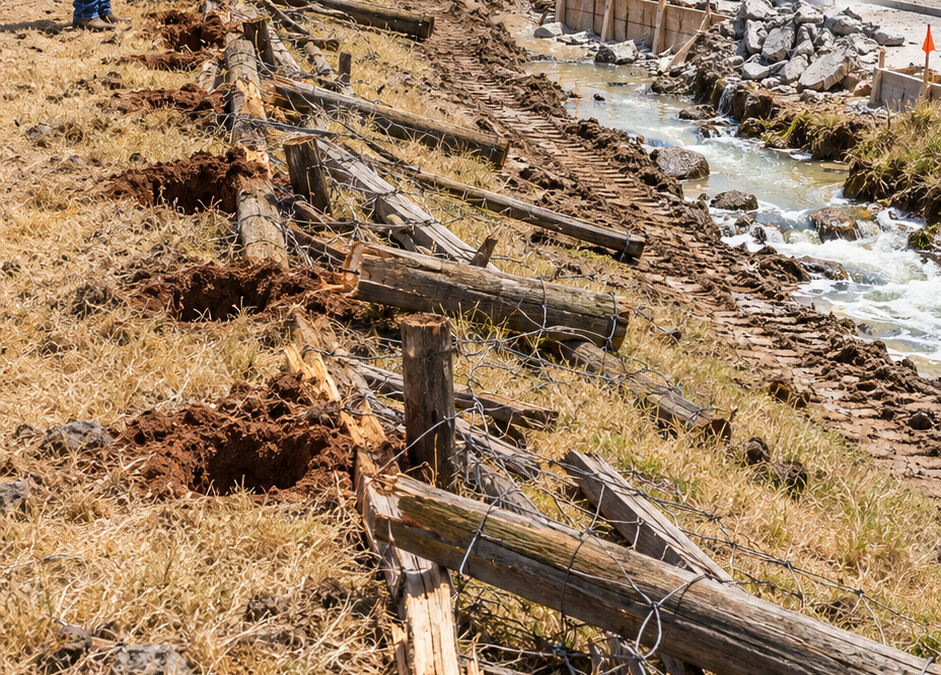
By the time I reached the service lane, forty feet of cedar posts were lying flat in the grass, and an excavator was crawling toward my pasture like it had been invited.
Lauren Whitmore looked me in the eye and called it an authorized improvement, but the mud under her pool deck would soon tell a different story.
My name is Grant Mercer, and the eastern edge of my ranch had always required patience.
That part of the property was not dramatic. It was not the kind of land people photographed at sunset or wrote about in brochures. It was working ground, mostly pasture, dry grass, stock lanes, water troughs, fence lines, and an old drainage swale that carried runoff from the Canyon Vista pool complex across one leased strip of Mercer land before emptying into a retention basin.
That was the important word.
Leased.
Not gifted.
Not surrendered.
Not merged.
Leased.
My father had made sure of that.
He was the kind of man who could shake a neighbor’s hand and still insist on writing down every inch of an agreement. He believed friendliness was good, but boundaries were better. He had a saying that irritated me when I was younger because he repeated it every time we set a post, reviewed a map, or marked a service lane.
“Four inches becomes four feet when somebody wants something.”
I laughed the first time he said it.
I stopped laughing years later.
Canyon Vista had been much smaller when Dad first agreed to the lease. Forty-eight homes then, not the sprawling hill-climbing neighborhood it became. The HOA needed access to the pool pump house and a drainage route for the old terrace. Dad saw no reason to fight neighbors over something manageable. He leased them twelve feet for a service lane and six feet around the drainage swale. Maintenance crews could reach the pump house. Runoff had a controlled path. Everybody knew where the line was because Dad made sure the line was measured, written, signed, and marked.
That was how he handled land.
Exact words.
Exact footage.
Exact purpose.
Nothing more.
For years, the arrangement worked because Canyon Vista respected it, or at least pretended to.
Their maintenance crews came and went along the narrow lane. The drainage swale carried water when it needed to. Landscapers trimmed around the pool fence. Every once in a while, a truck turned a little wide or a pallet of materials sat too far into my pasture for a day or two, and I let it go because neighbors sometimes give each other room to breathe.
That was my mistake.
I thought I was being reasonable.
Lauren Whitmore decided I was establishing history.
She became HOA president two years before the trouble started, and from the first meeting I had with her, I knew she heard words differently than other people. A favor became permission. A permission became precedent. A lease became control. A boundary became an obstacle. She wore red suits, pale blouses, and a permanent expression that made every conversation feel like I had arrived late to a hearing she had already won.
That summer, Canyon Vista was finishing its largest pool expansion yet.
The old pool had been nothing special. A rectangular basin, a pump house, a small terrace, shade umbrellas, and a few lounge chairs that faded in the sun. The new one was something else entirely: infinity edge, stone terrace, cabanas, decorative lighting, expanded deck, built-in seating, new pumps, larger circulation equipment, and landscaping designed to make the whole complex look like a resort instead of a neighborhood amenity.
I had no problem with them improving their property.
I had a problem when their improvement crossed onto mine.
The first thing I heard that morning was the jackhammer.
I was coming over the rise in my pickup with two empty cattle panels rattling in the bed. The day was already hot, the kind of ninety-degree heat that rises off the ground before noon and makes dust hang in the air instead of settling.
Then I heard it.
Concrete breaking.
Steel tracks.
Engines.
I came around the bend above the eastern pasture and saw forty feet of my cedar fence lying flat in the grass. Orange survey flags fluttered beyond the old line. A compact excavator crawled toward my pasture on steel tracks, its bucket raised and ready.
Chlorine hung in the hot air from the Canyon Vista pool, sharp enough to taste.
Behind the machine, homeowners in swim clothes watched from the new stone terrace like somebody had scheduled entertainment. Men with tool belts stood near stacked cabana footings. Forms for a widened deck lay across the grass. A shallow trench had already been cut near the concrete swale.
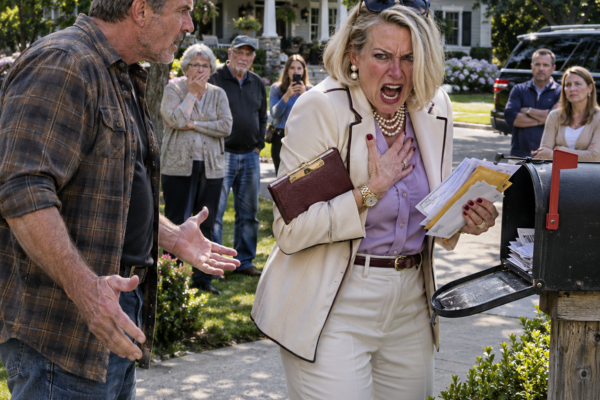
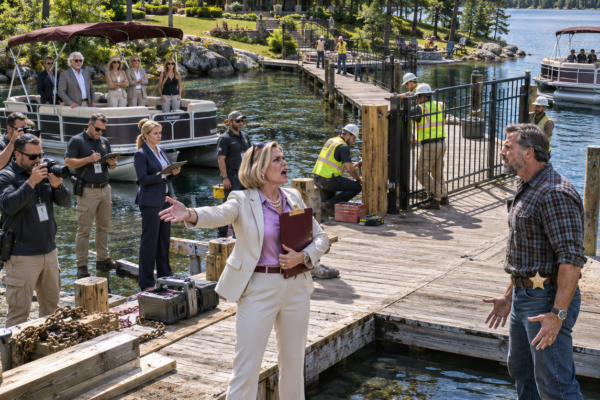
And beside the excavator stood Lauren Whitmore in a red pantsuit and pale blouse, one hand raised toward the operator.
I stopped my truck across the service lane, killed the engine, and stepped out.
“Shut it down!”
The excavator bucket froze six feet above the dirt. Conversations around the pool faded under the steady hum of the pumps.
Lauren turned toward me.
“Grant, you’re blocking an authorized improvement.”
I walked to the nearest fallen fence post and pushed my boot against the fresh hole where it had been pulled from the ground.
“Authorized by who?”
“Canyon Vista.”
She pointed toward the terrace.
“This area is part of the pool complex.”
“That fence was on my ranch when my father was alive.”
“The boundary has changed.”
That sentence told me exactly how ugly the day was going to get.
I looked past her.
The original service lane ran along the edge of my pasture, exactly where it had for years. The HOA leased that narrow strip from my family. Their crews used it to reach the pump house, and the shallow concrete drainage swale carried runoff away from the pool terrace.
That arrangement had never included the grass where Lauren’s orange flags now stood.
I stepped between two of them and paced the distance.
Nearly twenty feet beyond the lease corridor.
Enough room for cabana footings.
Enough room for deck forms.
Enough room for the beginning of something larger than maintenance.
“Your lease stops back there,” I said, pointing at the old fence line.
Lauren’s mouth tightened.
“The board approved an updated site plan.”
“The board doesn’t own my pasture.”
“These facilities have been integrated into Canyon Vista for years. This land functions as common amenity property.”
I stared at her, waiting for the sentence to make more sense.
It did not.
“You rent access across my land.”
“We maintain it.”
“You rent it.”
One of the contractors shifted his weight and looked down.
Lauren noticed. Her voice got louder.
“The association has invested substantial money into this property, Grant. We’re not going to let one ranch owner interfere with an improvement serving more than two hundred families.”
A few murmurs came from the terrace.
I could feel every set of eyes move onto me.
She had picked her stage carefully.
I crouched beside the concrete swale. Water from the pool system trickled through it, catching white daylight in thin flashes before disappearing beneath a grate farther down my pasture.
My father had helped lay that channel years ago. He had insisted the lease identify every foot of ground Canyon Vista could use. He never trusted phrases like everybody knows, shared function, or we’ve always done it this way.
Lauren stepped closer but kept several feet between us.
“Move your truck.”
I stood.
“Put my fence back.”
Her expression barely changed.
She raised two fingers toward the excavator operator.
“Continue.”
The diesel engine climbed in pitch. Steel tracks pressed into my grass. The bucket swung toward another post.
I walked to my truck, opened the door, and pulled out the weathered ranch map I kept behind the seat.
Lauren gave me a small smile.
The kind people use when they think paperwork is the only weapon you have left.
I laid the map across the hood and looked from the marked lease corridor to the orange flags stretching into my pasture. Then I looked at the new infinity edge basin rising behind her, the retaining wall beneath it, and the drainage channel carrying its water across Mercer ground.
Something about that picture bothered me, though I could not name it yet.
I folded the map slowly.
“Lauren, you’re building outside the agreement.”
She crossed her arms.
“We’re improving property that belongs with the community.”
The excavator bucket dropped into the soil. Dark earth rolled over its teeth. I watched the first scoop come out of land my family had owned for three generations.
Then I looked directly at Lauren.
“You’d better be very sure about that.”
By sunset, the excavator was gone, but the damage stayed behind.
Three fence posts lay beside the service lane, their concrete footings still packed with red dirt. A raw trench cut across the grass where my cattle normally moved between the lower pasture and the north trough. The temporary deck forms sat like an accusation on the edge of the old fence line.
I spent the last hour of daylight setting steel panels across the opening.
The metal was hot enough to sting my palms through my gloves. Every few minutes, laughter drifted over from the pool, mixed with splashing water and the low mechanical drone from the pump house.
That sound had been part of the ranch for twelve years.
I had never minded it before.
That evening, I did.
I finished securing the last panel, drove to the house, and washed the dust from my arms at the utility sink. The water ran brown for several seconds.
On the kitchen table sat the envelope Lauren had handed me before leaving.
Inside was a formal notice stating that Canyon Vista claimed continuous control of the disputed strip and that I was prohibited from interfering with association contractors.
I read it twice.
Then I set it beside the old lease instead of calling anyone.
The lease was short.
My father liked short contracts.
I traced the legal description with my finger, then carried it to the mudroom where an old survey map hung behind a cabinet door. The measurements matched what I remembered.
The HOA had rented access.
Nothing in those pages gave them ownership.
But there was a problem I could not ignore.
Over the years, I had let things slide.
Maintenance trucks sometimes parked beyond the lane. Landscapers crossed the fence to turn around. During a pool renovation three summers earlier, I allowed pallets of stone to sit on my pasture for almost a month because moving them would have delayed work and irritated people over something temporary.
I had treated those things like neighborly favors.
Lauren was treating them like history.
The next morning, I saddled my bay gelding and rode the eastern boundary before the heat settled in.
From horseback, the change was easier to see.
Canyon Vista had expanded until the ranch looked like an island beside it. Stucco homes climbed the ridge. The pool terrace had doubled in size. New landscaping pressed against the old lease corridor. Stone retaining walls and decorative grasses disguised the fact that everything had moved closer to my line.
I stopped near the drainage swale.
Fresh blue paint marked the ground beyond it.
Utility locating marks.
Not decoration.
Somebody intended to dig deeper.
A pickup rolled slowly along the HOA service lane and stopped near me. The contractor from the day before lowered his window. He looked back toward the pool before speaking.
“Mr. Mercer, you might want to keep your cattle away from this side for a few days.”
“Why?”
He rubbed his thumb along the steering wheel.
“They’re bringing in more equipment for the cabanas.”
He hesitated.
That was enough.
“What else are they building?”
“I just handle grading.”
He shifted into drive.
“Talk to the board.”
The truck rolled away, tires crunching over gravel.
I dismounted and walked toward one of the blue marks. It continued past the proposed cabana site, across my pasture, and toward the rise above the retention basin. I followed it for nearly sixty yards before it ended beside a wooden stake driven into ground the HOA had never leased.
A strip of pink ribbon snapped in the dry wind.
I crouched and touched the disturbed soil around it.
Whatever Lauren planned, taking my fence down had not been the project.
It had only been the first move.
The machinery arrived before breakfast.
I heard diesel engines from the barn and stepped outside with a halter still looped over my shoulder. Two flatbeds crawled down the HOA service lane. One carried sections of black pipe nearly two feet across. The other hauled a track trencher.
Lauren’s white SUV followed behind them.
I crossed the pasture on foot and reached the temporary cattle panels just as the first truck stopped.
Lauren climbed out wearing the same red pantsuit, her ponytail tight, sunglasses pushed onto her head. She pointed past me toward the blue utility marks.
“The equipment goes through there.”
I stayed in front of the gate.
“No, it doesn’t.”
Four workers stood beside the trucks waiting.
Lauren glanced at them, then back at me.
“You were notified.”
“You notified me that you claim my land. That isn’t permission to enter it.”
She pulled a folded site plan from a leather folder and opened it across the hood of her SUV.
I did not reach for it.
I could see enough from where I stood.
The new pipe crossed the leased access strip, cut diagonally through my lower pasture, and connected the pool complex to the retention basin almost three hundred feet inside my property.
“What is that?” I asked.
“Stormwater modernization.”
“On my ranch?”
“For the community.”
She tapped the plan with one polished fingernail.
“The existing drainage route is inadequate for the expanded pool deck. This replaces it.”
That explained the blue marks.
It also changed the fight.
They were not just stealing twenty feet for cabanas.
They intended to turn my pasture into permanent infrastructure.
“Your lease gives you the existing swale,” I said. “Not a buried pipeline.”
“Our counsel disagrees.”
“Then your counsel can come dig it.”
One worker looked away to hide a smile.
Lauren did not.
She stepped closer to the temporary panel and lowered her voice.
“You’ve allowed association use of this corridor for years. You accepted rent. You allowed improvements. You cannot suddenly obstruct necessary maintenance because you’ve decided you dislike the board.”
“Maintenance doesn’t require a trencher.”
Her jaw tightened.
“Move the barrier.”
“No.”
For several seconds, nothing moved except the pink ribbon snapping on the stake behind me.
Then Lauren took out her phone.
Forty minutes later, a county deputy pulled onto the gravel lane. I recognized him as Deputy Cole Harris. He listened while Lauren spoke, then listened while I did.
Afterward, he studied the fence line, the equipment, and the papers Lauren handed him.
“This looks civil,” he finally said. “I’m not deciding ownership from the side of a road.”
Lauren’s shoulders dropped half an inch.
I noticed.
“So he can block our contractors?”
Harris handed the papers back.
“I’m saying I’m not ordering him to open that gate without something clearer than this.”
The trucks left before noon.
I watched the flatbed carrying the black pipe disappear behind the ridge and felt the first clean breath I had taken since Monday.
It lasted until 3:17 that afternoon.
That was when my phone rang.
It was Elena Ruiz, who ran the feed store in town and owned a house in Canyon Vista for her mother.
“Grant,” she said. “The board just sent an emergency notice.”
I leaned against the barn door.
“About what?”
“The pool.”
Wind pushed warm hay dust across the concrete.
“What about it?”
“They’re closing it indefinitely. Lauren says you blocked critical drainage repairs and created a safety risk.”
I shut my eyes.
There it was.
She had lost access to my land, so she had changed the battlefield.
By five, cars were slowing outside my ranch. People stared through the fence. Someone left a handwritten complaint under my mailbox flag. Another driver leaned on his horn as he passed.
Lauren did not need the trencher anymore.
She had two hundred families angry at the man standing between them and their pool.
I walked back toward the drainage swale as evening settled over the pasture. The water inside it was barely moving now, only a thin silver ribbon under the grate.
I crouched beside the concrete and noticed something I had not seen that morning.
The pool pumps were still running.
If the old drainage system was supposedly dangerous enough to close the entire facility, why were they still pushing water through it?
I put my fingers against the damp concrete, then looked uphill toward the silent pool terrace.
Lauren had called my refusal a safety problem.
Maybe it was.
But for the first time, I wondered whose problem she was actually trying to solve.
The next morning, the pool was still locked, and Lauren made sure everybody knew who to blame.
By eight, three homeowners were standing outside my cattle gate while I repaired the section her crew had pulled apart. One man held his phone up, recording me. Another kept asking why I was holding the neighborhood hostage.
I drove a cedar post into the ground with the hydraulic auger, killed the tractor, and waited for the engine noise to fade.
“I didn’t close your pool,” I said.
“Your board did.”
“Because you blocked the drainage work.”
“Because they tried to install a new drainage system across land they don’t lease.”
That quieted them for maybe two seconds.
Then Lauren’s SUV appeared on the service lane.
She parked beside the locked pool gate and stepped out carrying a ring of keys. She did not come toward me. Instead, she unlocked the pedestrian entrance and waved the homeowners inside.
I watched from across the fence as she led them toward the far edge of the pool deck.
That bothered me enough to follow along my side of the boundary.
When I reached the old drainage swale, I heard water before I saw it.
Not the usual trickle.
A hard, hollow rush.
I climbed the rise and stopped.
Water was spilling over the concrete lip near the pool retaining wall, running through decorative gravel and cutting muddy channels toward my pasture.
One of the homeowners backed away.
“Is that supposed to happen?”
Lauren pointed straight at me.
“This is exactly what we were trying to prevent.”
I looked at the pool.
The water level sat unusually high against the tile.
Then I heard the pump cycle again.
“Turn those off,” I said.
Lauren ignored me.
I moved along the fence until I could see the equipment pad through the landscaping. Two circulation pumps were running, and a smaller transfer pump beside them vibrated against its concrete base. The discharge line feeding the old swale shook every few seconds.
“Lauren,” I called louder this time, “you’re pushing water into a drainage channel you just told everyone was unsafe.”
She finally looked toward the equipment.
“Our contractor is managing the system.”
“Where is he?”
Nobody answered.
The water reached the pasture fence and spread around my boots in a shallow brown sheet.
I turned and ran toward the lower gate.
My cattle were already bunching away from the wet ground, crowding toward the north side. The drainage itself was not enough to threaten them, but the runoff was heading directly toward the dirt crossing I used to move feed and equipment between fields.
I started my tractor and pulled two steel panels across the low section, forcing the herd toward higher ground before the soil softened.
By the time I returned, Lauren had shut the pumps down.
The sudden silence made the dripping water sound louder.
She stood beside the pool gate with her arms folded.
“Now you understand why the upgrade is necessary.”
I looked at the muddy streak running from her equipment pad into my pasture.
“No,” I said. “Now I understand why you’re in such a hurry.”
Her eyes narrowed.
“What exactly are you accusing me of?”
I did not answer.
I walked to the point where the old swale entered my land and knelt beside the concrete. Beneath the fresh mud was a hairline stain several inches above the normal watermark.
Then another.
Repeated high-flow marks.
This had not started yesterday.
I took out my phone and photographed them.
Not because I thought a picture would win anything by itself, but because I needed to remember exactly what I was seeing.
Behind me, one of the homeowners spoke quietly.
“Lauren, how long has it been overflowing?”
She turned on him immediately.
“That isn’t relevant.”
His expression changed, just slightly.
I saw it.
So did she.
I stood and wiped mud from my hand onto my jeans.
For three days, Lauren had been telling Canyon Vista that my ranch was preventing her from fixing a drainage problem. Standing ankle-deep in runoff she had just pumped onto my property, I finally saw the shape of the problem differently.
She was not trying to improve an old system.
She was trying to move the consequences of the new pool expansion somewhere else.
The easiest place to put them was beneath my grass.
The mud at the crossing stayed soft for two days, which meant my feed truck could not reach the lower pasture. I hauled fifty-pound sacks by tractor instead, four at a time, while August heat pressed against my back and mosquitoes lifted from the wet grass around the tires.
That was the first real price Lauren’s decision cost me.
Not enough to ruin the ranch.
Enough to change how I approached her.
I stopped arguing about where her orange flags belonged.
I started controlling what happened on my side of the fence.
I called the contractor whose number was printed on an old Canyon Vista maintenance invoice and asked one question.
“How much water was the expanded pool system designed to discharge?”
He went quiet before saying he could not discuss the HOA’s project.
“Fair enough,” I said. “Then tell Lauren no contractor has permission to enter Mercer Ranch without me present.”
That afternoon, I closed the lease service lane for forty minutes, exactly as the lease allowed when livestock were being moved. I ran the herd through calmly, reopened the gate, and logged the time in my ranch notebook.
Lauren arrived before I finished fastening the chain.
“You cannot obstruct association access.”
“I didn’t. Read the livestock clause.”
She stared at me, then at the cattle disappearing over the rise.
For once, she had no immediate answer.
I thought that meant I had finally forced her back inside the agreement.
It was a small win, and I made the mistake of enjoying it.
The next morning, Canyon Vista reopened the pool.
Music came over the fence. Children splashed in the shallow end. The pumps ran normally, and no water spilled into my pasture.
Elena called and said several homeowners were asking why the emergency had suddenly vanished.
I walked the drainage line twice that day.
Dry concrete.
No overflow.
By evening, I started wondering whether Lauren had backed down.
At 6:30, I found out what she had actually done.
A tanker truck was parked behind the pool equipment building, mostly hidden by oleanders. A thick temporary hose ran from the pump pad into the tanker’s top hatch. They were hauling excess water away.
Lauren stood beside the truck speaking with the driver. When she saw me across the fence, she stopped talking.
“That looks expensive,” I said.
She walked closer.
“Temporary operations.”
“Until what?”
“Until you stop interfering.”
The tanker engine rumbled between us.
I looked at the hose, then toward families swimming fifty yards away.
She had reopened the pool to make the conflict disappear in public while paying trucks to carry away the water her expanded system could no longer handle.
That bought her time.
It also put pressure on the board to end the expense.
“You still want that pipeline across my pasture?” I asked.
“I want the infrastructure completed.”
“Then lease the additional land.”
Her expression hardened.
“We already have rights to it.”
“Then why did your board rent the original strip from my father?”
She looked toward the tanker instead of answering.
I let the silence sit.
“I’ll make you an offer,” I said. “Restore my fence, repair the crossing, and we sit down with a surveyor. If you need more land, we negotiate from zero.”
Lauren gave a short laugh.
“You think this is a negotiation?”
“It is.”
She stepped closer to the fence.
“The board is done paying your family for land Canyon Vista has maintained for years.”
There it was.
Not drainage.
Not safety.
Ownership.
She turned away before I could answer. The tanker pulled out twenty minutes later, leaving two wet tire tracks across the service lane.
I watched it disappear, then looked toward the pool terrace.
The temporary solution had given Lauren exactly what she wanted: open water, happy residents, and time to squeeze me.
But it had also created a meter that never stopped running.
Every tanker leaving Canyon Vista now cost the HOA money. Every dollar Lauren spent avoiding a fair agreement made her next decision harder to walk back.
By the end of that week, the tanker had become part of Canyon Vista’s rhythm.
It arrived before sunrise, backed behind the pump house, swallowed thousands of gallons, then rolled away while most residents were still making coffee. Lauren wanted the pool open badly enough to keep paying for that routine, but temporary fixes have a way of turning into clocks.
Elena called Friday afternoon while I was replacing a bent hinge on the north gate.
“People are asking about the trucks now,” she said.
“Let them ask.”
“Lauren scheduled an emergency board meeting tonight.”
I stopped turning the wrench.
“About the drainage?”
“About acquiring your land.”
That changed things.
At seven, I walked into the Canyon Vista clubhouse carrying nothing but the original lease and my ranch notebook.
The room smelled like air conditioning, coffee, and chlorine drifting through the open patio doors. Nearly sixty homeowners filled the folding chairs. Lauren stood at the front beside a projection screen, composed as ever in red, one hand resting on the table.
She described my pasture as a “historically integrated utility corridor” and the pipeline as essential infrastructure. Then she proposed that the board authorize legal action to establish permanent control over the strip.
I listened until she finished.
“You could lease what you need,” I said. “I offered that.”
Lauren looked toward the residents.
“Mr. Mercer is attempting to charge this community for property it has maintained for more than a decade.”
A few people muttered.
Then an older board member named Peter Lawson leaned forward.
“Lauren, what are the tankers costing us?”
The room changed.
She hesitated.
“That expense is temporary.”
“How much?”
“Approximately thirty-eight hundred dollars so far.”
Several heads turned.
Peter stared at her.
“In five days?”
Lauren straightened.
“Which demonstrates why we need permanent access.”
That was the moment I understood her trap had started closing around her instead.
Every day she refused negotiation made her ownership claim more expensive.
I opened the lease to the marked page.
“I’ll honor every inch my father agreed to,” I said. “But I won’t donate another three hundred feet because the board expanded a pool without securing drainage rights first.”
Silence held for a beat.
Peter looked at Lauren.
“Did we secure those rights before construction?”
“The association believed existing use covered them.”
“That wasn’t my question.”
She did not answer.
The vote to authorize legal action failed four to three.
For the first time, Lauren lost in her own room.
I drove home thinking the worst had broken.
That was my false victory.
At 6:15 the next morning, I heard engines outside my bedroom window.
I pulled on jeans and boots and stepped onto the porch. Two contractor pickups were parked beside the eastern fence. Workers were unloading portable barriers along the service lane. Lauren stood near my gate.
“What are you doing?” I called.
She turned without surprise.
“The board vote concerned litigation. Existing maintenance authority remains in effect.”
“That trencher isn’t maintenance.”
“There’s no trencher.”
She pointed toward the pool.
“We’re isolating the drainage corridor for emergency stabilization.”
Then I saw what the crew was actually doing.
They were fencing off the entire lease strip, including the ranch gate I used to reach the lower pasture.
If I fought the barriers physically, she could paint me as the obstruction again.
So I did not touch them.
I walked back to the barn, started my tractor, and moved the cattle through the western route instead. It added almost two miles and crossed rough ground I normally avoided. One calf balked at the rocky wash, forcing me to circle back twice.
By noon, sweat had soaked through my shirt and dust coated my teeth.
Lauren had found a way to make ownership hurt without digging another foot.
That evening, I stood beside the old concrete swale and watched another tanker leave. The temporary barriers cast long shadows across the grass.
I could keep reacting to whatever she did next, or I could make her live entirely inside the rights she claimed were already enough.
I looked down at the lease in my hand.
For years, Canyon Vista had enjoyed more than those twelve feet because my family had been generous.
Starting Monday, generosity was over.
Monday morning, I put the ranch back inside its exact boundaries.
I started at the eastern fence with a tape measure, a post driver, and the survey pins my father had protected with short pieces of white PVC. The air was already warm, carrying the dry smell of cedar and sunbaked grass.
I rebuilt the fence precisely along the property line, leaving Canyon Vista its twelve-foot service lane and not an inch more.
Where their landscapers had been turning trucks through my pasture, I set two heavy cedar posts. Where maintenance crews had been stacking chemicals beside my barn road, I closed the opening with woven wire.
I did not block the lease corridor.
I simply removed every favor surrounding it.
By ten, Lauren’s SUV appeared.
She stepped out, stared at the new fence, then walked the length of it with quick, stiff steps.
“You’re restricting operational access.”
I rested the post driver against my boot.
“I’m giving you exactly the access you claim is sufficient.”
“Our trucks need turning clearance.”
“Not in the lease.”
“Emergency vehicles need staging space.”
“Not in the lease.”
Her eyes moved toward the narrow lane.
A tanker could enter it, but there was no longer enough room to swing around on my grass. It would have to back nearly half a mile to the county road.
Lauren understood before I said anything.
“You’re deliberately interfering with pool operations.”
“No,” I said. “I’m deliberately stopping unpaid use of my ranch.”
She left without another word.
At dawn Tuesday, the tanker came in nose first. Forty minutes later, I heard its reverse alarm carrying across the pasture as it backed the entire way out. By Wednesday, the hauling company sent a smaller truck. That meant more trips. By Thursday, Elena told me the board had called another emergency meeting because temporary drainage costs had crossed eleven thousand dollars.
I did not celebrate.
My western cattle route was still costing me fuel and time, and the damaged crossing remained unusable. We were both bleeding now.
The difference was that Lauren had chosen her wound.
Friday afternoon, Peter Lawson drove out alone.
He leaned against his pickup while I repaired a water trough float.
“We want to negotiate,” he said.
“Then negotiate.”
“Lauren says the association already owns an easement by long-term use.”
I tightened the brass fitting and opened the valve. Clear water slapped against galvanized steel.
“An easement for what?”
“That’s becoming the problem.”
I looked at him.
Peter rubbed his forehead.
“The pool expansion was approved assuming the ranch could take the additional discharge. Nobody negotiated that with you because Lauren told us the existing arrangement covered it.”
“It doesn’t.”
“I know that now.”
He looked toward the concrete swale.
“There’s something else. The contractor warned the board before construction that the old drainage capacity was marginal.”
That landed harder than I expected.
Lauren had not discovered the problem after the pool expansion.
She had known there was a risk before the first new section of deck was poured.
“Was that warning in writing?” I asked.
Peter nodded once.
“Lauren received it.”
I wiped my hands on a shop rag.
The story changed in that instant.
She had not tried to take my land because an unexpected problem appeared.
She had approved the expansion while counting on land she did not control, then tried to manufacture that control after the cost was already sunk.
Peter opened his truck door.
“There’s a meeting Monday.”
“Will she be there?”
“She called it.”
Monday evening, the clubhouse was packed before I arrived.
Lauren stood at the front beside a large site plan. Her red jacket was buttoned, shoulders square, expression controlled.
She waited until I sat down, then placed one hand on the map.
“The board has a solution,” she said.
For half a second, I thought she had finally agreed to negotiate.
Then she pointed to a shaded strip running straight across my lower pasture.
“Canyon Vista will assert permanent utility rights over this corridor and proceed with installation.”
The room went still.
Peter looked at her as if he had misheard.
I had not.
Lauren had been given one last chance to step away from the edge.
Instead, she had moved the edge three hundred feet deeper into my ranch.
The room stayed quiet long enough for the air conditioner to become the loudest thing in it. Lauren kept one hand on the site plan, her finger resting over the shaded corridor she intended to take across my pasture.
“Permanent utility rights,” she repeated.
Peter leaned forward.
“On what authority?”
“Existing use, necessity, and the association’s long-term maintenance of the corridor.”
I stood and walked toward the map.
“That corridor isn’t the corridor you’ve been maintaining.”
I pointed to the original twelve-foot lane along the boundary, then traced her proposed pipeline route with my finger.
“This crosses almost three hundred feet of ranch land you’ve never used.”
Lauren pulled the plan slightly toward herself.
“The drainage system functions as one integrated facility.”
“Then show them the warning.”
Her face changed.
Not much.
Just enough.
Peter opened a folder at his seat and removed a single page.
“I was going to ask about that.”
Lauren looked at him.
“Peter.”
He slid the page onto the table.
“The pool contractor sent this six weeks before the expansion was approved.”
People shifted in their chairs.
I did not need to read it.
Peter had already told me what it said.
The existing drainage route was marginal. Additional discharge required new capacity and secured downstream rights before construction.
Lauren reached for the paper.
Peter kept his hand on it.
“Did you receive this?”
“The board received hundreds of project communications.”
“Did you receive this one?”
She stared at him, then said, “Yes.”
A woman near the back whispered something under her breath.
Lauren straightened.
“And we addressed the concern through the association’s existing property rights.”
I opened my father’s lease and placed it beside the contractor warning.
“Then this should be easy. Show me where those rights are.”
She did not look down.
“Our attorney can establish them.”
“Later,” I said. “But you approved construction first.”
That was the turn.
Not because one document magically settled ownership.
It did not.
Lauren could still fight. She could still hire lawyers and make the next year expensive for everyone. But now the homeowners could see the sequence clearly.
Warning.
Expansion.
Drainage failure.
Attempted land grab.
The tanker costs were not my doing.
They were the bill for a decision already made.
Peter looked around the table.
“I move that all attempts to expand association use beyond the recorded lease be suspended immediately.”
Another board member seconded him.
Lauren spoke over them.
“If you stop this now, the pool may have to close.”
“Then close it,” Peter said.
The words hit the room harder than shouting would have.
The vote passed five to two.
Lauren stood motionless while residents began talking all at once. For the first time since this started, I saw uncertainty in her face.
But she was not finished.
She gathered the plans and said, “The president retains emergency authority over association infrastructure.”
Peter pushed his chair back.
“Not for this.”
Lauren left before the meeting formally ended.
I drove home under a black sky heavy with heat lightning.
Around midnight, thunder rolled over the ridge. Rain hit the roof ten minutes later, hard and sudden.
I was awake before the phone rang.
Elena’s voice came fast.
“Grant, something’s happening at the pool.”
I pulled on my boots and drove toward the eastern pasture. Water was already rushing through the old swale, brown and foaming under my headlights.
At the pool fence, maintenance lights burned white through the rain.
Lauren’s SUV sat beside the pump house. Two workers were connecting temporary hoses.
She had tried to keep the expanded pool operating through a storm after the board had suspended the land plan.
I stayed on my property and called Peter.
“Get over here,” I said. “Now.”
Then I opened the western pasture gate and moved my cattle uphill while runoff spread across the lower field.
By the time Peter arrived with two other board members, water was spilling over the swale again. Lauren stood under the pump house awning, soaked from the knees down.
Peter looked at the water.
Then at her.
“Shut the system down.”
“We can manage it.”
“Shut it down.”
She did not move.
So Peter walked to the maintenance supervisor and repeated the order as a board director.
The pumps wound down one by one.
The rushing water weakened. Rain kept falling, but the artificial surge disappeared with it.
I stood behind my fence, breathing hard from moving cattle, mud halfway up my boots.
Lauren looked across at me through the rain.
She had spent weeks insisting she needed my land because the system had no other choice. Now, in front of her own board, she had demonstrated exactly why the expansion should never have been operated without securing that land first.
This time, nobody was looking at me.
By sunrise, the storm had moved east and left the ranch shining under a pale blue sky.
Mud clung to my boots as I walked the lower pasture, checking fence posts and counting cattle. The damage was not catastrophic, but it was mine to absorb.
Two washed-out sections of fencing.
A clogged stock culvert.
A strip of pasture buried beneath brown silt.
Near the old drainage lane, the ground still smelled like wet clay and chlorine.
Three days later, the pool gate stayed locked.
The board had finally understood something Lauren never had.
My father’s lease gave the HOA limited access to a specific corridor for a specific purpose. It did not give them my pasture, and it certainly did not turn rented land into HOA property because expansion had made that land convenient.
Peter called that afternoon.
“Lauren resigned as president.”
I leaned against the tailgate of my truck.
“That fast?”
“Fast enough.”
The board canceled the proposed utility corridor, stopped the expansion work Lauren had pushed beyond the lease, and began sorting out the costs her decisions had left behind.
I let them.
The only document I cared about arrived from the HOA’s attorney.
A written acknowledgment that title to the ranch remained mine, and that no permanent right existed beyond the original recorded lease.
I read that sentence twice.
Then I folded the letter and put it in the same metal box where Dad had kept the old lease.
But I was not interested in making the neighborhood pay forever for Lauren’s decisions.
Peter and three homeowners met me beside the eastern fence the following Saturday. I offered them a choice.
The HOA could restore the original drainage lane exactly as agreed decades earlier, repair the damage to my pasture, and renegotiate any future access with me like neighbors instead of conquerors.
Or the lease could expire on its own terms, and they could engineer another solution entirely on subdivision property.
Peter looked across the fence toward the silent pool.
“You’d still work with us after all this?”
I rubbed dried mud from the top rail with my thumb.
“I’ll work with people who remember whose gate they’re walking through.”
They chose restoration.
Over the next month, crews removed the temporary hoses, rebuilt the original drainage channel, repaired my fence, and installed new containment on HOA property so the expanded pool could eventually reopen without using another foot of my ranch.
Lauren’s red SUV never came back.
That was enough for me.
Not because I wanted to see her ruined, but because she had spent months transferring the cost of her choices onto everyone else: homeowners, contractors, my cattle, my fence, my pasture, my time, and my father’s careful agreement.
In the end, the cost found its way back to the person who made the decisions.
Late that fall, I was replacing a hinge on the eastern gate when Peter walked up carrying a new lease proposal. He stopped outside the fence instead of opening it.
“Mind if I come in?”
I looked at him.
Then at the gate.
That small question carried more weight than the stack of papers under his arm.
I unlatched it.
“Come on.”
We sat on the tailgate while cattle moved through dry grass behind us. The new agreement was shorter than Dad’s old one. Clearer too. Exact boundaries, exact responsibilities, no implied expansion, no permanent rights, nothing taken for granted.
I signed only after my attorney finished reviewing it.
Months later, the pool reopened.
From the ridge above my pasture, I could hear kids laughing across the subdivision on hot afternoons. The sound did not bother me. Neither did the water.
What bothered me had never been the pool.
It was the moment someone rented a piece of my land, grew comfortable using it, and decided comfort was the same thing as ownership.
One evening, I rode the fence line as the light faded across the grass.
At the eastern gate, I stopped beside the post Lauren had once treated like an inconvenience. The repaired hinge swung clean and quiet under my hand. I closed it behind me, heard the latch settle into place, and kept riding across land that had never stopped being mine.