𝗙𝗨𝗟𝗟 𝗦𝗧𝗢𝗥𝗬 The HOA Sold My Ranch Ridge as a Scenic Overlook Until the Old Sales Agreement Exposed the Lie
𝗙𝗨𝗟𝗟 𝗦𝗧𝗢𝗥𝗬 ”
I photographed it anyway.
By noon, Dana sent me a short email.
Brier Glenn has legacy access rights associated with the overlook. Restricting buyer visits may interfere with established community expectations.
I stared at the phrasing until the screen timed out.
Legacy access rights.
Community expectations.
Neither one told me what right existed today.
I turned the screen back on and replied with one sentence.
Please send the document granting Brier Glenn current access to the ridge.
Then I waited.
Dana did not send the document.
What she sent instead was another sentence.
Brier Glenn has relied on established overlook access for years.
That was it.
No attachment.
No agreement.
No survey.
No easement.
Just a statement written confidently enough to sound like proof.
Rebecca called me that afternoon.
“I looked at your survey again,” she said. “Nothing in what you sent me shows a community overlook.”
“That’s what I found.”
“Do you have the full buyer packet?”
“Only the brochure page.”
“Get the rest.”
That turned out to be easier than I expected.
Melissa called me before I had to ask. She sounded uneasy.
“I spoke with my broker,” she said. “We’re pausing ridge visits until someone sorts this out.”
“That’s a good start.”
“There’s something else.”
I waited.
“The overlook isn’t just in the brochure.”
She emailed me the packet.
It was thirty-two pages long. Most of it was exactly what you would expect from a neighborhood sales package: floor plans, community landscaping, clubhouse photos, school district information, walking routes, lifestyle shots, and language polished until it barely said anything human.
Then I reached page nineteen.
At the top was a map titled Brier Glenn Community Experience.
A dotted line started near the model home parking area. It passed the clubhouse, crossed a landscaped green, continued along the subdivision’s northern edge, and then kept going right across my property line.
The route ended at a small star.
Beside the star were the words:
Scenic Community Overlook.
I zoomed in.
The map did not show my ranch fence. It did not show the cattle gate. It did not label the land as private property. Instead, the dotted route made the ridge look like a natural extension of the neighborhood trail system.
I called Melissa.
“Is this the map you use with buyers?”
“Yes.”
“Do they get it before you take them up there?”
“Usually.”
“Who gives it to you?”
“The packet comes from the sales office. Brier Glenn’s developer side created the original materials. Now the neighborhood marketing materials are coordinated through the association and the brokerage.”
That answer opened another door.
“Who told you the route was still active?”
“There are notes in our showing guide.”
“Can you send those too?”
She hesitated.
“I need my broker’s approval.”
“Ask.”
An hour later, I had another file.
The showing guide was shorter. One line under lifestyle features read:
Optional overlook stop available upon buyer request. Use north walking route or vehicle turnout depending on conditions.
That explained the SUVs.
It also explained why nobody had acted like they were trespassing.
They were following instructions.
The problem was that those instructions led directly onto my ranch.
I printed the map and took it outside. Eli was repairing a hinge on one of the lower gates. I handed him the page.
He traced the dotted line with one finger.
“That’s not a walking route.”
“No.”
“That’s the service cut.”
“I know.”
The path shown in the packet was the same rough track we used to reach the upper pasture. During wet weather, it was the only practical way to get feed or repair materials up the slope without tearing up grass. Now it had been drawn as a lifestyle feature.
Eli looked toward the ridge.
“If people keep walking that, somebody’s eventually going to leave a gate open.”
That was the concern I had not needed to explain to Dana.
A gate left open could create a much bigger problem than strangers taking sunset pictures.
I drove the route shown on the map from my side.
Near the place where the subdivision ended, I found something I had missed before. A small temporary directional marker had been pushed into the ground near the edge of the ranch track. White background, green arrow, small Brier Glenn logo.
The arrow pointed uphill.
No words.
It did not need any.
I photographed it from three angles. Then I photographed its position relative to the fence and survey marker.
I did not pull it out.
Not yet.
By evening, Melissa called again.
“My broker wants to know whether you’re claiming Brier Glenn has never had any right to use the overlook.”
“I’m saying I haven’t seen anything that gives them a current right.”
“That’s not the same answer.”
“No, it isn’t.”
I wanted to stay precise.
Rebecca had already warned me about that. Old property documents had a way of becoming dangerous when people summarized them instead of reading them.
Melissa lowered her voice.
“I’m asking because the office has older materials.”
“How old?”
“I don’t know. Some look like original development files.”
“What do they say?”
“I’ve only seen references. Nothing complete.”
“References to what?”
She paused.
“Overlook access.”
That matched Dana’s phrases.
Legacy access.
Established access.
Historical rights.
Overlook access.
Everyone kept using broad language.
Nobody had shown me the paper behind it.
The next morning, I drove into Brier Glenn.
I did not go to Dana’s house. I went to the sales center. The building was smaller than I expected, with a stone front, two flags, and a row of landscaping trimmed so cleanly it looked combed.
Inside, a wall display showed the neighborhood map: clubhouse, playground, green spaces, walking trails, and model homes.
The overlook was not on the wall.
That caught my attention immediately.
A sales associate came over.
“Can I help you?”
I showed her the brochure.
“Is this current?”
She looked at the cover.
“Yes, that’s one of our lifestyle pieces.”
I opened to the center spread.
She recognized the overlook photo.
Then I showed her the map.
Her expression changed slightly.
“We don’t use that wall map for guided tours.”
“But you use this.”
“Some agents do.”
“Who approved it?”
“I’d have to ask marketing.”
“Please do.”
She disappeared into a back office.
While I waited, I noticed a stack of printed brochures on a side table. I picked one up. Same cover. Same ridge photograph. Same wording.
Scenic Community Overlook.
There were at least fifty copies sitting there.
This was not an old brochure somebody had forgotten in a drawer.
It was active marketing.
The sales associate came back with a man named Eric Palmer, who introduced himself as the site sales manager. He was polite, careful, and immediately interested when I told him the overlook was on my ranch.
“I was under the impression that access was established,” he said.
“Based on what?”
“I don’t have that file in front of me.”
“Then who does?”
He glanced toward the back office.
“The association has historical property records.”
“Marketing was told the overlook could remain in the lifestyle materials.”
“By whom?”
He did not answer right away.
Then he said, “Dana Whitaker has been our primary HOA contact on community features.”
That was the second time her name had come up without me asking for it.
I laid the brochure flat on the counter.
“Until somebody shows me a current right to use that ridge, nobody should be sending buyers there.”
Eric nodded slowly.
“I’m going to flag it.”
“That includes digital materials.”
He looked at me.
“You’ve seen those too?”
I had not.
Not yet.
He turned one of the brochures over and pointed to a QR code.
“Most buyers scan this for the interactive tour.”
I took out my phone.
The page opened in seconds.
There was the neighborhood map, the clubhouse, the walking trail, the model homes, and one more icon on the northern edge.
I tapped it.
A photograph of my ridge filled the screen.
Under it were the words:
Overlook sunset view.
Below that:
Approx. 8-minute walk from model center.
I stared at the screen.
The physical brochure could be collected. The paper map could be corrected. But this had been sitting online quietly sending people toward my property every time someone scanned the code.
I took screenshots.
Then I sent everything to Rebecca: the printed packet, the showing guide, the directional marker, the digital map, the QR page, and the sales manager’s name.
Five minutes later, she called.
“This is bigger than a bad brochure.”
“I figured.”
“It’s a distribution system.”
That was exactly what it felt like.
A mistake had become a map.
The map had become instructions.
The instructions had become routine.
That afternoon, Dana finally replied.
The Overlook Access has been part of Brier Glenn’s community presentation since the original development phase. Historical documentation supports that use.
No attachment.
Again.
I typed back:
Then send the historical documentation.
This time, I added one more line.
Until I receive and review it, I do not authorize buyer access across my ranch.
I hit send.
Less than an hour later, Rebecca forwarded me a copy of a records request she had prepared. It asked for every agreement, map, correspondence, sales instruction, board record, marketing approval, and historical document connected to the overlook.
At the bottom, she had added one phrase I had not seen before.
Any document described as granting view access during the original sales period.
I called her.
“Why did you word it that way?”
“Because somebody used that phrase in an old index reference.”
“What phrase?”
“View access.”
“Do you have the document?”
“Not yet.”
That was the first time I realized the association might actually have something.
The question was no longer whether a document existed.
The question was what it really said.
Rebecca’s records request produced its first response two days later.
Not the complete file.
Just enough to make the problem older.
She called me from her office.
“I’ve got development-era marketing records.”
“How old?”
“About fourteen years.”
That put them well before I bought the ranch.
The oldest file was a glossy PDF from Brier Glenn’s original sales launch. The colors were dated. The houses looked newer. The trees were smaller.
But the ridge photograph was unmistakable.
Same valley.
Same cottonwood line.
Same horizon.
Across the page, the developer had written:
A view worth coming home to.
The wording was different from the current brochure.
The photograph was not.
I zoomed into the lower corner. There was no label calling it HOA property. No community overlook. No statement that residents had permanent access.
Just a scenic photograph.
Rebecca picked up on the distinction immediately.
“The old material explains how the image entered their marketing system,” she said. “It does not establish what property right existed.”
The next file was an early buyer tour schedule. It listed model home stops, clubhouse tours, and optional ridge view stop. Then came emails between the original developer and Harold Benton, the ranch owner before me.
One sales manager thanked Benton for allowing occasional escorted access to the upper ridge during active home sales. Another discussed notifying him before weekend tours. A third referenced liability insurance.
“So there was permission,” I said.
“There appears to have been some form of permission,” Rebecca corrected.
That distinction was becoming the entire case.
The emails did not tell us the duration. They did not tell us whether the privilege transferred. They did not tell us whether it survived the developer sales program.
Then we found the old site diagram.
Unlike the modern map, this version showed my property line.
At the point where the route crossed onto ranch land, someone had typed:
Escorted sales access — not trail, not amenity, not common space.
Escorted sales access.
Not trail.
Not amenity.
Not common space.
I printed the old map and placed it beside the current version. The modern dotted line looked almost identical, but the boundary had disappeared. The warning had disappeared. The escort requirement had disappeared.
Rebecca studied both copies.
“The route stayed,” she said. “The limitations vanished.”
That sentence captured fourteen years of drift.
The next archive batch contained board minutes, old insurance certificates, development transition records, and maintenance files. Most were irrelevant.
Then Rebecca found the index.
Near the middle was a single entry.
View access agreement — sales period.
The title alone narrowed the question.
“Sales period,” I said.
“Do not finish the sentence before we have the agreement,” Rebecca warned.
She requested the document by title and date, along with any renewal, assignment, extension, amendment, or later owner authorization.
“If they believe this access survived, there should be a document connecting the original agreement to the present,” she said. “If there isn’t, the gap becomes important.”
That afternoon, Eli and I walked the old route from the subdivision edge.
No buyers appeared.
No realtor SUVs.
Melissa’s brokerage pause seemed to be holding.
Halfway up the hill, Eli stopped.
“You know what’s funny?”
“What?”
“If they had asked whether a couple buyers could see the view, you might have let them.”
“Possibly.”
“But nobody asked.”
I looked down toward Brier Glenn.
“A temporary favor gets repeated long enough that people stop remembering it was a favor. Then somebody prints a map.”
“Exactly.”
Back at the house, another record arrived.
This one was only six months old.
The subject line read:
Overlook Marketing — Legacy Access.
Brier Glenn’s current management company had sent it to Dana because the sales team wanted to keep the overlook in updated buyer materials.
Then came the sentence that stripped away most of the ambiguity.
Do we have current owner authorization for access, or is new authorization required?
The sentence was so blunt it left almost no room for interpretation.
Someone inside Brier Glenn had already identified the problem.
“What did Dana answer?” I asked.
Rebecca checked the production log.
“Her reply isn’t in this batch.”
I emailed Dana.
I told her I had seen management’s question and asked for her response and whatever document she had relied upon.
No answer came.
The next archive contained insurance records from the original development. One certificate covered escorted buyer tours. An old email asked Benton whether Saturday access would interfere with livestock movement. A handwritten note reminded agents:
Call before Ridge Tour.
Fourteen years ago, the developer understood that entering the ranch required coordination with the ranch owner.
Now buyers were being handed a map that treated the same ground like a neighborhood walkway.
The documentation had not become stronger.
The safeguards had simply been forgotten.
Late that afternoon, Rebecca found another reference in a development transition checklist. The view access agreement had apparently been stored separately after control of Brier Glenn shifted from the developer to the homeowners association.
At 5:20, my phone rang.
Rebecca.
“I found it.”
“The agreement?”
“The complete agreement.”
I stood up.
“What does it say?”
“It gives them something.”
My stomach tightened.
Then she added, “Just not what Dana has been selling.”
My laptop chimed.
The scan appeared.
View Access Agreement — Sales Period.
The signatures were real. The date matched the original development. Halfway down the first page, Rebecca had highlighted one paragraph.
I started through it.
The association had not invented the access.
That would have been simpler.
Someone had taken a real limited permission and let the limits disappear.
The first paragraph looked worse for me than I expected.
The agreement gave the original Brier Glenn developer permission to bring prospective purchasers onto the upper ridge.
Then the boundaries started appearing.
Access applied only during the original sales period.
Tours had to be escorted.
The developer had to notify the ranch owner in advance.
Only prospective purchasers and authorized sales staff were covered.
The developer carried liability insurance for those visits.
The permission ended when the original sales program closed.
I moved to the termination section.
The right expired with the development sales period unless the property owner later approved a written extension.
“Any extension?” I asked.
“None.”
“Renewal?”
“None located.”
“Assignment to the HOA?”
“No.”
The agreement was genuine.
The permanence Dana had attached to it was not.
There was no language making the ridge common property.
No recreational trail.
No permanent resident access.
No community amenity.
No provision allowing future HOA boards to send buyers onto the ranch whenever they wanted.
Rebecca sent me the next file.
Dana’s response to the management company.
Six months earlier, management had asked:
Do we have current owner authorization for access, or is new authorization required?
Dana replied:
Legacy overlook documentation exists in the association file. Please continue using the established community materials while marketing is updated.
Six months of calculated evasion had been compressed into one careful sentence.
She did not claim she had my authorization.
She did not identify a current easement.
She pointed backward.
A later email from marketing was even clearer. The coordinator noticed that the old file described sales-period access and asked whether the overlook should still appear as a community feature.
Dana answered:
The overlook has been represented as part of the Brier Glenn experience for years. Keep it in the buyer materials unless counsel advises otherwise.
That gave us the sequence.
Someone raised the question.
Dana chose continuity over verification.
I forwarded the agreement, the survey, the management emails, and both versions of the marketing map to Melissa’s broker.
He scheduled a call that afternoon.
Melissa joined.
Rebecca joined.
Dana insisted on joining too.
Her tone was not defensive.
It was dismissive.
“Caleb,” Dana said, “you’re reading a fourteen-year-old operational agreement as though it erased years of established community use.”
“It doesn’t need to erase anything,” I said. “The document says what the permission was.”
“Three board presidents have treated that overlook as part of Brier Glenn’s community experience.”
Rebecca cut in calmly.
“Board practice does not expand the written license.”
Dana continued.
“Continuous community custom carries weight.”
“Custom doesn’t rewrite my recorded deed,” I said. “Harold Benton gave the developer temporary escorted access for a sales cycle that ended years before I bought this ranch.”
Dana started to answer.
The broker stopped her.
“Dana.”
His voice changed the call.
“Our agents are the ones physically leading buyers onto that property.”
Nobody spoke.
He continued.
“If an unescorted buyer crosses a cattle gate based on our showing sheet, gets injured around livestock, or claims we misrepresented access to an advertised amenity, that exposure lands on the brokerage too.”
Dana said, “The association file—”
“I have the association file in front of me,” he said.
He did not raise his voice.
He did not need to.
“There is no current authorization in what we received. There is an expired sales-period agreement and a current survey showing private ranch property.”
Silence.
Then he said the sentence that changed everything.
“The ridge comes off the showing sheet today.”
For the first time since this started, Dana had no prepared paragraph waiting.
Melissa spoke next.
“I’m sorry, Caleb. I followed the material we were given.”
“I know.”
That was true.
She had not invented the route. The buyers had not invented it. They had stepped into a system built from copied assumptions.
The broker asked Rebecca whether she had located any later extension or recorded right.
“Nothing granting current buyer access,” Rebecca said.
“That’s enough for us.”
By evening, Melissa texted me a screenshot.
The overlook icon was gone from the digital tour.
The dotted route stopped inside Brier Glenn.
Agents received instructions that the ridge was no longer an approved showing stop.
That was the first consequence nobody needed Dana’s permission to impose.
She called me separately afterward.
“You went directly to the brokerage.”
“They were sending people onto my land.”
“You’ve created a problem for active listings.”
“No. The brochure created that problem.”
She exhaled hard.
“You are treating an established practice like it appeared yesterday.”
“I’m treating a temporary license like a temporary license.”
“The board will review this.”
“Good.”
“You understand that people have used that route for years.”
“And now everyone has the chance to verify why.”
She went silent.
I looked at the agreement on the table.
“You told me to check the association file, Dana.”
Another pause.
“I did.”
The call ended.
The next archive response arrived the following morning.
No written extension.
No renewal.
No later owner authorization.
No recorded easement giving Brier Glenn general access to the ridge.
There were plenty of references to the overlook: brochures, maps, tour instructions, marketing notes, copies of copies of copies.
The underlying right had not multiplied with them.
Rebecca put it simply.
“A prior permission can explain how a practice began. It cannot by itself prove the practice still has legal authority today.”
Outside my window, the ridge looked exactly the same, but the digital map was already changing.
For the first time, Dana’s interpretation was no longer controlling what happened on the ground.
The first thing I noticed was the silence.
No unfamiliar engines on the upper track.
No car doors.
No voices drifting up from Brier Glenn.
For the first time in weeks, the ridge sounded like part of a ranch again.
Melissa texted me that morning.
All overlook stops are suspended.
A second message followed.
Brokerage compliance is reviewing every marketing reference.
Rebecca received the formal version an hour later. The brokerage had removed the ridge from its digital tour, withdrawn the showing instruction, and told agents not to direct prospective buyers onto the property unless they received verified current authorization.
That last phrase mattered.
Verified current authorization.
Not tradition.
Not historical access.
Not community expectation.
Something current.
Something they could actually show.
By noon, the QR code in the printed brochure still opened, but the page it led to had changed. The overlook icon was gone. The walking route ended inside Brier Glenn. The photograph from my ridge had been replaced with a clubhouse lawn.
It was not as dramatic.
That was probably why it was safer.
Dana emailed shortly after. The board had scheduled a special review of off-site marketing features.
I did not attend in person.
Rebecca joined by video.
Afterward, she called me.
“They’re keeping the language narrow.”
“What does that mean?”
“They’re not admitting the association owned the ridge.”
“I didn’t expect them to.”
“They’re saying the marketing process relied on historical materials without adequate current verification.”
“That sounds closer.”
The board adopted an interim rule that afternoon. Any amenity, access point, scenic feature, trail segment, event site, or recreational location outside Brier Glenn’s recorded common property had to be verified by management and association counsel before it could appear in buyer materials.
Dana could still participate in marketing decisions.
She just could not confirm off-site access by herself anymore.
That was enough for me.
I had never needed her removed from the board. I needed strangers to stop appearing on my land because her confidence had been printed into a brochure.
The paper copies took longer.
Melissa’s brokerage collected the stacks from its office. Eric Palmer told me the sales center had pulled the lifestyle brochure from the front table. A corrected version would be printed later.
He sent me the draft.
The ridge photograph was gone.
So was the phrase scenic community overlook.
I saved a copy.
Then I went outside.
Eli was waiting near the upper gate with a wrench.
“Quiet today,” he said.
“Apparently, the internet stopped owning the hill.”
He smiled.
We checked the gate hardware first. One hinge bolt had worked loose. The latch was slightly out of alignment. Nothing serious. The turnout grass had been flattened where vehicles had been parking and turning. There were a few shallow tire impressions near the edge of the track. A temporary marker stake from the sales route still stood near the subdivision boundary.
I photographed everything before we touched it.
Rebecca had already told me to separate ordinary maintenance from anything I could reasonably connect to the tours. That meant no inflated repair list, no pretending worn grass was major damage, no turning an access dispute into a payday.
Eli tightened the hinge.
I pulled the temporary marker from the ground.
It came out with almost no resistance.
Small green arrow.
Small Brier Glenn logo.
That little sign had probably directed more people onto my ranch than Dana ever had in person.
I set it in the bed of the truck.
By late afternoon, a white SUV slowed near the subdivision side of the boundary. For a second, I thought we had another buyer.
Then the driver looked at the changed digital map on her phone, turned around, and went back toward Brier Glenn.
She never crossed the fence.
That was the moment I knew the correction was working.
Not because anyone apologized.
Not because a board passed a rule.
Because a stranger reached the edge of my property and did not enter it.
Rebecca called before sunset.
“The brokerage wants confirmation that you’re not authorizing future buyer tours.”
“I’m not.”
“Permanent answer for organized sales tours?”
“Yes.”
“Good. I’ll put that in writing.”
I looked toward the ridge. The view was still there. Same valley, same cottonwoods, same evening light.
The only thing missing was the assumption that somebody else could sell access to it.
The repair list was short.
One new hinge bolt.
A reset latch.
A few hours of grading where vehicle tires had pressed into the turnout.
Two replacement boundary markers near the upper track.
That was it.
No lawsuit-sized damage.
No dramatic settlement.
Just enough work to return the ranch to the condition it had been in before somebody turned a sales shortcut into an amenity.
Rebecca sent the documented costs to Brier Glenn’s insurer. The insurer approved the reasonable repairs without much argument. A contractor smoothed the turnout the following week. Eli and I reset the fence hardware ourselves.
Then I installed one small galvanized sign beside the upper cattle gate.
It did not mention Brier Glenn.
It did not threaten anybody.
It said:
Private Ranch Property. Authorized Access Only.
The association’s revised marketing policy arrived a few days later.
Any feature outside Brier Glenn’s recorded common property now required written verification before it could appear in brochures, digital tours, showing guides, maps, or sales instructions. Management had to confirm the location. Association counsel had to review claimed access rights. If the feature sat on privately owned land, current written authorization had to be in the file.
Dana was still board president.
Her name still appeared in the neighborhood newsletter. Her deep red blazer still showed up at meetings.
But her signature alone could no longer transform an old file into present-day access.
That was more useful than an apology.
Melissa stopped by once after the corrected brochures arrived.
She remained on the public side of the fence.
“New version,” she said.
She handed me a copy.
The center spread showed the clubhouse lawn, playground, and landscaped walking paths.
No ridge.
No dotted route across my property.
No scenic overlook.
“Better?” she asked.
I flipped through it.
“Accurate.”
She smiled.
“That works too.”
Before leaving, she looked toward the hill.
“It really is a great view.”
“I know.”
A month later, Eli and I walked the ridge near sunset.
Cattle were scattered across the lower pasture. Cold air had settled into the valley. The same cottonwoods followed the creek. The same hills faded into western light.
The view had never changed.
Only the story printed underneath it had.
A limited sales permission had survived in a file after its purpose ended. Someone reused the photograph. Someone copied the route. Another person simplified the description. Eventually, the original conditions disappeared while the marketing language became more confident.
Property boundaries are rarely stolen all at once.
They do not always disappear under bulldozers or armed standoffs.
Sometimes they erode through silence.
A colored dot on a digital map.
A flattering photograph.
A casual phrase repeated thousands of times until convenience starts pretending to be ownership.
The wind crossed the valley and carried the faint sound of wind chimes from Brier Glenn.
Below me, the model homes glowed beneath streetlights, neat and enclosed inside their planned lines.
Up on the ridge, the dirt remained rough. The gate hung plumb. The pasture stayed pasture.
Some places exist to be lived on, not packaged.
I stayed there until the last light dropped behind the hills.
Then I closed the cattle gate and headed home across land that no brochure owned.
𝗧𝗛𝗘 𝗘𝗡𝗗
The HOA Sold My Ranch Ridge as a Scenic Overlook Until the Old Sales Agreement Exposed the Lie
The first stranger on my ridge was taking pictures like he had bought the view with the house he had not purchased yet.
The realtor said residents could come up there anytime, like my cattle gate was part of her showing route.
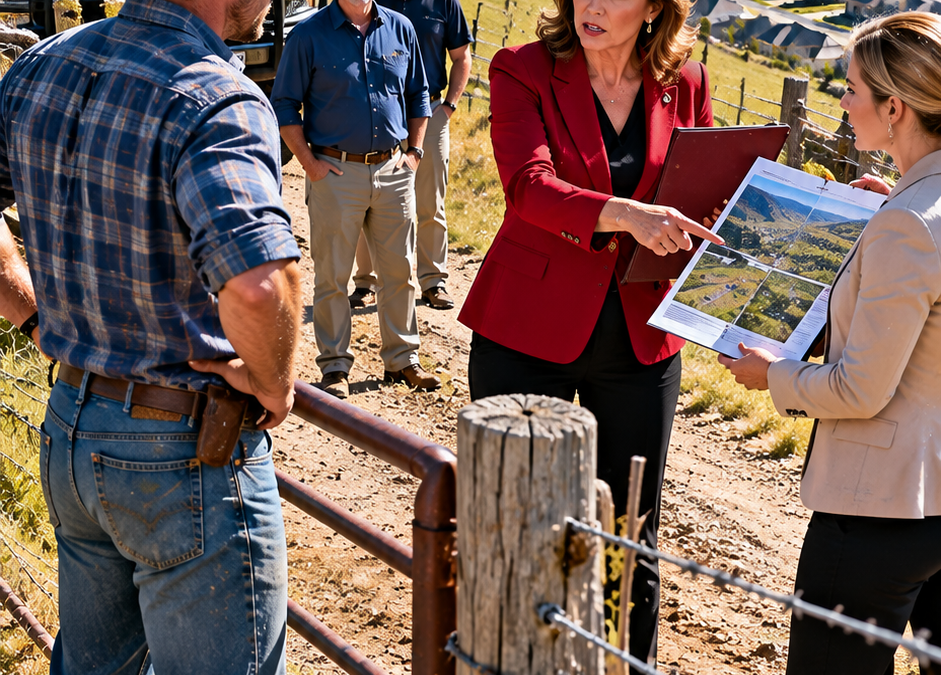
Then Dana Whitaker opened her burgundy folder and told me I should check the association file before calling my own ranch private.
My name is Caleb Mercer, and the ridge above my north pasture had never been an amenity.
It had a view. I will give it that. From the top, you could see almost the whole valley spread out beneath the ranch: the cottonwoods following the creek, the low hills folding into one another toward the west, the old highway cutting a pale line past town, and, farther down the slope, the neat rooftops of Brier Glenn arranged like someone had pressed them into the earth with a ruler.
At sunset, the place could stop a man in his tracks.
But beauty does not change ownership.
That ridge was working ground. It sat above my upper pasture where the ranch track flattened just enough for me to turn a utility trailer, check fence, unload salt blocks, or stop the truck while watching cattle move between the upper and lower grass. In late summer, I used it to watch for smoke. During dry spells, it was the first place I went if I smelled anything burning west of the creek. In winter, I checked that road after storms because if the track washed out, I lost the only practical way to reach the far side of the upper fence without tearing up the slope.
A view can be beautiful and still have a job.
People who do not work land forget that.
They look at a ridge and see a photograph. I look at one and see access, fence tension, waterline breaks, mineral tubs, cow trails, erosion cuts, fire risk, and whether the gate latch is still hanging straight after the last windstorm.
That morning, I was driving up from the equipment lane when I saw three strangers standing near the upper cattle gate.
One of them was taking pictures of the valley.
Another was reading from a glossy brochure.
The third was standing too close to the north fence, studying the pasture below like he was deciding where a deck might look nice.
A realtor stood with them, one arm extended toward the view, speaking in the easy polished voice people use when everything has already been explained to them and nothing has yet gone wrong.
I stopped beside the gate and shut off my truck.
The wind was quiet. I could hear the faint creak of the gate hinge, the soft click of a phone camera, and cattle shifting somewhere below the ridge.
The realtor turned first.
“Good morning,” she said, trying to sound friendly before she knew whether she had a reason not to.
I stepped out.
“Who told you this was HOA property?”
That was not the opening she expected.
One of the buyers lowered his phone.
The realtor looked down the hill toward Brier Glenn.
“Their board president.”
A white crossover was already climbing the track toward us.
I recognized it before it reached the turnout.
Dana Whitaker.
Of course.
Dana stepped out wearing a deep red blazer, dark slacks, and the controlled expression of a woman who had expected the scene but not my timing. She carried a burgundy folder against her chest like a shield. Her hair was smooth, her shoes were wrong for dirt, and she did not look surprised to see strangers on my land.
She looked annoyed to see me.
“Caleb,” she said. “They’re only viewing the amenity.”
I stared at her.
“You just called my ranch an amenity.”
Dana tightened her grip on the folder.
“You may want to see what’s in the association file before you argue that point.”
I looked back at the buyers.
“I think I’d better.”
The realtor took one careful step back.
“I don’t want to be in the middle of a property dispute.”
“What’s your name?”
“Melissa Grant.”
“Show me how you got here, Melissa.”
She opened the brochure in her hands.
The center spread showed a photograph taken from almost exactly where we were standing. I recognized the bent cottonwood below the ridge, my north fence, and the roof of my equipment shed in the lower corner. Across the page were three polished words in elegant type.
Scenic Community Overlook.
One buyer looked from the brochure to me.
“So this isn’t part of the neighborhood?”
“No.”
Dana stepped closer.
“The overlook has been included in Brier Glenn’s community presentation for years.”
“That doesn’t explain why these people are standing on my ranch.”
Melissa lowered the brochure.
“We were instructed to bring prospective buyers up here if they wanted to see the view.”
“By who?”
“Our sales packet.”
That answer bothered me more than Dana’s attitude.
A person can make a mistake.
A printed packet means the mistake has become procedure.
I took out my phone and photographed the brochure, the vehicles, the cattle gate, the faint tire marks beside the turnout, and the section of fence along the upper ranch track.
Nobody had damaged anything.
I was not interested in blaming confused house shoppers. They had followed a map. They had trusted a professional. They had stood where they were told to stand.
I wanted a record of what they had been told.
Dana folded her arms.
“Caleb, this really doesn’t need to become a production.”
“I agree. So nobody else comes onto the ridge until I see whatever document you think allows it.”
One of the buyers lowered his phone completely.
“We honestly thought this was part of the community.”
“I believe you.”
I opened the cattle gate.
“You can head back down the way you came.”
The buyers left without arguing. Melissa was the last one to go. Before getting into her SUV, she stopped beside the door and looked back toward the ridge.
“You should know this isn’t the first group I’ve brought up here.”
I looked at her.
“How many?”
“I don’t know exactly.”
“Since when?”
She glanced at the brochure.
“At least since spring.”
Dana said nothing.
That silence told me more than her folder did.
I watched the vehicles descend toward Brier Glenn. Then I looked at the faint tire marks near the gate again.
They suddenly made a lot more sense.
The next morning, I walked the ridge before sunrise.
Without buyers standing on it, the place looked exactly like what it was: part of a working ranch. The upper track climbed through rough grass, bent around a washout I had repaired twice, then flattened near the overlook before dropping toward the north fence. A mineral tub sat halfway down the slope. Cattle tracks curved around it in dry arcs. A coil of old wire leaned beside a cedar post. Dust clung to the gate chain.
There was nothing manicured about it.
Nothing marked it as a trail.
Nothing suggested people in sandals should wander up there for sunset pictures.
Eli found me near the cattle gate around seven.
Eli had worked with me off and on for years. He was not family, but he had been around long enough to know which gates stuck, which heifers tested weak spots, and which waterline couplings needed checking before freeze warnings. He looked at the tire marks Melissa’s SUV had left near the turnout.
“You finally figure out who’s been coming up here?”
“Prospective home buyers.”
He stared at me.
“You’re serious?”
I handed him a printed photo of the brochure.
He read the heading.
“Scenic Community Overlook.”
Then he looked around at the fence, the cattle tracks, the mineral tub farther down the slope, and the ranch track rough enough to shake a truck apart if a person drove it too fast.
“That’s ambitious.”
I asked whether he had noticed unfamiliar vehicles before the day before.
“A few.”
“How long?”
“Maybe three weeks. White SUV twice. Another car one Saturday morning.”
“Did you talk to them?”
“No. Figured they took a wrong turn.”
That fit Melissa’s timeline.
Near the upper gate, the grass had been flattened where vehicles had turned around. There were shoe prints along the ridge. Nothing broken, nothing dramatic, but enough to tell me yesterday was not an isolated visit.
Back at the house, I pulled out my deed, title policy, and survey.
The ridge sat well inside my parcel. The fence followed the survey markers. Brier Glenn’s common property ended downhill before the upper ranch track. There was no overlook parcel, no community viewing area, no obvious recorded access corridor through my land.
I checked every line again because Dana had sounded too certain to be guessing.
That was what bothered me.
Bluffing has a rhythm. I had heard it before from people who wanted to treat rural land like unclaimed convenience. But Dana’s confidence felt different. She had said I should see what was in the association file. That meant either she had something real, or she had mistaken paper for power.
Both possibilities were dangerous.
I called Rebecca Sloan.
Rebecca had handled a boundary issue for me years earlier and had the useful habit of asking questions before offering conclusions. Some attorneys liked to tell you what they could do before they understood what had happened. Rebecca liked records. She believed the paper should speak before anyone started performing.
I explained the buyers, the brochure, Melissa, and Dana’s claim that the association had something in its file.
Rebecca went quiet.
“Caleb, this may be more serious than people leaving tire marks.”
I looked through the kitchen window toward the ridge.
“How serious?”
“If Brier Glenn starts claiming open, continuous use of that ranch cut over a long enough period, somebody may eventually try to frame it as a prescriptive access claim.”
The word changed the temperature in the room.
“You’re saying they could argue the use itself created rights?”
“They could try. Whether they could prove it depends on the law, the facts, the duration, whether the use was actually adverse, and whether earlier access was permissive.”
“So yesterday matters.”
“Your response matters. We do not want years of assumptions accumulating without a written objection.”
That gave the problem a clock.
This was no longer just about keeping strangers away from cattle. If Brier Glenn was building a story that the ridge had always been used as part of the neighborhood, silence could become another exhibit in somebody else’s file.
Rebecca asked me to send the current brochure, deed, survey, title policy, and every photograph I had taken.
Then she said, “Do not overstate anything. Document what happened. Object in writing. Let the records tell us what kind of access existed before.”
That sounded like her.
Precise.
No panic.
No pretending we already knew the answer.
Outside, Eli was resetting the upper gate latch. He held up one of the bolts.
“This was loose.”
“From the buyers?”
“Could be. Could be cattle. Could be age.”
I photographed it anyway.
By noon, Dana sent me a short email.
Brier Glenn has legacy access rights associated with the overlook. Restricting buyer visits may interfere with established community expectations.
I stared at the phrasing until the screen timed out.
Legacy access rights.
Community expectations.
Neither one told me what right existed today.
I turned the screen back on and replied with one sentence.
Please send the document granting Brier Glenn current access to the ridge.
Then I waited.
Dana did not send the document.
What she sent instead was another sentence.
Brier Glenn has relied on established overlook access for years.
That was it.
No attachment.
No agreement.
No survey.
No easement.
Just a statement written confidently enough to sound like proof.
Rebecca called me that afternoon.
“I looked at your survey again,” she said. “Nothing in what you sent me shows a community overlook.”
“That’s what I found.”
“Do you have the full buyer packet?”
“Only the brochure page.”
“Get the rest.”
That turned out to be easier than I expected.
Melissa called me before I had to ask. She sounded uneasy.
“I spoke with my broker,” she said. “We’re pausing ridge visits until someone sorts this out.”
“That’s a good start.”
“There’s something else.”
I waited.
“The overlook isn’t just in the brochure.”
She emailed me the packet.
It was thirty-two pages long. Most of it was exactly what you would expect from a neighborhood sales package: floor plans, community landscaping, clubhouse photos, school district information, walking routes, lifestyle shots, and language polished until it barely said anything human.
Then I reached page nineteen.
At the top was a map titled Brier Glenn Community Experience.
A dotted line started near the model home parking area. It passed the clubhouse, crossed a landscaped green, continued along the subdivision’s northern edge, and then kept going right across my property line.
The route ended at a small star.
Beside the star were the words:
Scenic Community Overlook.
I zoomed in.
The map did not show my ranch fence. It did not show the cattle gate. It did not label the land as private property. Instead, the dotted route made the ridge look like a natural extension of the neighborhood trail system.
I called Melissa.
“Is this the map you use with buyers?”
“Yes.”
“Do they get it before you take them up there?”
“Usually.”
“Who gives it to you?”
“The packet comes from the sales office. Brier Glenn’s developer side created the original materials. Now the neighborhood marketing materials are coordinated through the association and the brokerage.”
That answer opened another door.
“Who told you the route was still active?”
“There are notes in our showing guide.”
“Can you send those too?”
She hesitated.
“I need my broker’s approval.”
“Ask.”
An hour later, I had another file.
The showing guide was shorter. One line under lifestyle features read:
Optional overlook stop available upon buyer request. Use north walking route or vehicle turnout depending on conditions.
That explained the SUVs.
It also explained why nobody had acted like they were trespassing.
They were following instructions.
The problem was that those instructions led directly onto my ranch.
I printed the map and took it outside. Eli was repairing a hinge on one of the lower gates. I handed him the page.
He traced the dotted line with one finger.
“That’s not a walking route.”
“No.”
“That’s the service cut.”
“I know.”
The path shown in the packet was the same rough track we used to reach the upper pasture. During wet weather, it was the only practical way to get feed or repair materials up the slope without tearing up grass. Now it had been drawn as a lifestyle feature.
Eli looked toward the ridge.
“If people keep walking that, somebody’s eventually going to leave a gate open.”
That was the concern I had not needed to explain to Dana.
A gate left open could create a much bigger problem than strangers taking sunset pictures.
I drove the route shown on the map from my side.
Near the place where the subdivision ended, I found something I had missed before. A small temporary directional marker had been pushed into the ground near the edge of the ranch track. White background, green arrow, small Brier Glenn logo.
The arrow pointed uphill.
No words.
It did not need any.
I photographed it from three angles. Then I photographed its position relative to the fence and survey marker.
I did not pull it out.
Not yet.
By evening, Melissa called again.
“My broker wants to know whether you’re claiming Brier Glenn has never had any right to use the overlook.”
“I’m saying I haven’t seen anything that gives them a current right.”
“That’s not the same answer.”
“No, it isn’t.”
I wanted to stay precise.
Rebecca had already warned me about that. Old property documents had a way of becoming dangerous when people summarized them instead of reading them.
Melissa lowered her voice.
“I’m asking because the office has older materials.”
“How old?”
“I don’t know. Some look like original development files.”
“What do they say?”
“I’ve only seen references. Nothing complete.”
“References to what?”
She paused.
“Overlook access.”
That matched Dana’s phrases.
Legacy access.
Established access.
Historical rights.
Overlook access.
Everyone kept using broad language.
Nobody had shown me the paper behind it.
The next morning, I drove into Brier Glenn.
I did not go to Dana’s house. I went to the sales center. The building was smaller than I expected, with a stone front, two flags, and a row of landscaping trimmed so cleanly it looked combed.
Inside, a wall display showed the neighborhood map: clubhouse, playground, green spaces, walking trails, and model homes.
The overlook was not on the wall.
That caught my attention immediately.
A sales associate came over.
“Can I help you?”
I showed her the brochure.
“Is this current?”
She looked at the cover.
“Yes, that’s one of our lifestyle pieces.”
I opened to the center spread.
She recognized the overlook photo.
Then I showed her the map.
Her expression changed slightly.
“We don’t use that wall map for guided tours.”
“But you use this.”
“Some agents do.”
“Who approved it?”
“I’d have to ask marketing.”
“Please do.”
She disappeared into a back office.
While I waited, I noticed a stack of printed brochures on a side table. I picked one up. Same cover. Same ridge photograph. Same wording.
Scenic Community Overlook.
There were at least fifty copies sitting there.
This was not an old brochure somebody had forgotten in a drawer.
It was active marketing.
The sales associate came back with a man named Eric Palmer, who introduced himself as the site sales manager. He was polite, careful, and immediately interested when I told him the overlook was on my ranch.
“I was under the impression that access was established,” he said.
“Based on what?”
“I don’t have that file in front of me.”
“Then who does?”
He glanced toward the back office.
“The association has historical property records.”
“Marketing was told the overlook could remain in the lifestyle materials.”
“By whom?”
He did not answer right away.
Then he said, “Dana Whitaker has been our primary HOA contact on community features.”
That was the second time her name had come up without me asking for it.
I laid the brochure flat on the counter.
“Until somebody shows me a current right to use that ridge, nobody should be sending buyers there.”
Eric nodded slowly.
“I’m going to flag it.”
“That includes digital materials.”
He looked at me.
“You’ve seen those too?”
I had not.
Not yet.
He turned one of the brochures over and pointed to a QR code.
“Most buyers scan this for the interactive tour.”
I took out my phone.
The page opened in seconds.
There was the neighborhood map, the clubhouse, the walking trail, the model homes, and one more icon on the northern edge.
I tapped it.
A photograph of my ridge filled the screen.
Under it were the words:
Overlook sunset view.
Below that:
Approx. 8-minute walk from model center.
I stared at the screen.
The physical brochure could be collected. The paper map could be corrected. But this had been sitting online quietly sending people toward my property every time someone scanned the code.
I took screenshots.
Then I sent everything to Rebecca: the printed packet, the showing guide, the directional marker, the digital map, the QR page, and the sales manager’s name.
Five minutes later, she called.
“This is bigger than a bad brochure.”
“I figured.”
“It’s a distribution system.”
That was exactly what it felt like.
A mistake had become a map.
The map had become instructions.
The instructions had become routine.
That afternoon, Dana finally replied.
The Overlook Access has been part of Brier Glenn’s community presentation since the original development phase. Historical documentation supports that use.
No attachment.
Again.
I typed back:
Then send the historical documentation.
This time, I added one more line.
Until I receive and review it, I do not authorize buyer access across my ranch.
I hit send.
Less than an hour later, Rebecca forwarded me a copy of a records request she had prepared. It asked for every agreement, map, correspondence, sales instruction, board record, marketing approval, and historical document connected to the overlook.
At the bottom, she had added one phrase I had not seen before.
Any document described as granting view access during the original sales period.
I called her.
“Why did you word it that way?”
“Because somebody used that phrase in an old index reference.”
“What phrase?”
“View access.”
“Do you have the document?”
“Not yet.”
That was the first time I realized the association might actually have something.
The question was no longer whether a document existed.
The question was what it really said.
Rebecca’s records request produced its first response two days later.
Not the complete file.
Just enough to make the problem older.
She called me from her office.
“I’ve got development-era marketing records.”
“How old?”
“About fourteen years.”
That put them well before I bought the ranch.
The oldest file was a glossy PDF from Brier Glenn’s original sales launch. The colors were dated. The houses looked newer. The trees were smaller.
But the ridge photograph was unmistakable.
Same valley.
Same cottonwood line.
Same horizon.
Across the page, the developer had written:
A view worth coming home to.
The wording was different from the current brochure.
The photograph was not.
I zoomed into the lower corner. There was no label calling it HOA property. No community overlook. No statement that residents had permanent access.
Just a scenic photograph.
Rebecca picked up on the distinction immediately.
“The old material explains how the image entered their marketing system,” she said. “It does not establish what property right existed.”
The next file was an early buyer tour schedule. It listed model home stops, clubhouse tours, and optional ridge view stop. Then came emails between the original developer and Harold Benton, the ranch owner before me.
One sales manager thanked Benton for allowing occasional escorted access to the upper ridge during active home sales. Another discussed notifying him before weekend tours. A third referenced liability insurance.
“So there was permission,” I said.
“There appears to have been some form of permission,” Rebecca corrected.
That distinction was becoming the entire case.
The emails did not tell us the duration. They did not tell us whether the privilege transferred. They did not tell us whether it survived the developer sales program.
Then we found the old site diagram.
Unlike the modern map, this version showed my property line.
At the point where the route crossed onto ranch land, someone had typed:
Escorted sales access — not trail, not amenity, not common space.
Escorted sales access.
Not trail.
Not amenity.
Not common space.
I printed the old map and placed it beside the current version. The modern dotted line looked almost identical, but the boundary had disappeared. The warning had disappeared. The escort requirement had disappeared.
Rebecca studied both copies.
“The route stayed,” she said. “The limitations vanished.”
That sentence captured fourteen years of drift.
The next archive batch contained board minutes, old insurance certificates, development transition records, and maintenance files. Most were irrelevant.
Then Rebecca found the index.
Near the middle was a single entry.
View access agreement — sales period.
The title alone narrowed the question.
“Sales period,” I said.
“Do not finish the sentence before we have the agreement,” Rebecca warned.
She requested the document by title and date, along with any renewal, assignment, extension, amendment, or later owner authorization.
“If they believe this access survived, there should be a document connecting the original agreement to the present,” she said. “If there isn’t, the gap becomes important.”
That afternoon, Eli and I walked the old route from the subdivision edge.
No buyers appeared.
No realtor SUVs.
Melissa’s brokerage pause seemed to be holding.
Halfway up the hill, Eli stopped.
“You know what’s funny?”
“What?”
“If they had asked whether a couple buyers could see the view, you might have let them.”
“Possibly.”
“But nobody asked.”
I looked down toward Brier Glenn.
“A temporary favor gets repeated long enough that people stop remembering it was a favor. Then somebody prints a map.”
“Exactly.”
Back at the house, another record arrived.
This one was only six months old.
The subject line read:
Overlook Marketing — Legacy Access.
Brier Glenn’s current management company had sent it to Dana because the sales team wanted to keep the overlook in updated buyer materials.
Then came the sentence that stripped away most of the ambiguity.
Do we have current owner authorization for access, or is new authorization required?
The sentence was so blunt it left almost no room for interpretation.
Someone inside Brier Glenn had already identified the problem.
“What did Dana answer?” I asked.
Rebecca checked the production log.
“Her reply isn’t in this batch.”
I emailed Dana.
I told her I had seen management’s question and asked for her response and whatever document she had relied upon.
No answer came.
The next archive contained insurance records from the original development. One certificate covered escorted buyer tours. An old email asked Benton whether Saturday access would interfere with livestock movement. A handwritten note reminded agents:
Call before Ridge Tour.
Fourteen years ago, the developer understood that entering the ranch required coordination with the ranch owner.
Now buyers were being handed a map that treated the same ground like a neighborhood walkway.
The documentation had not become stronger.
The safeguards had simply been forgotten.
Late that afternoon, Rebecca found another reference in a development transition checklist. The view access agreement had apparently been stored separately after control of Brier Glenn shifted from the developer to the homeowners association.
At 5:20, my phone rang.
Rebecca.
“I found it.”
“The agreement?”
“The complete agreement.”
I stood up.
“What does it say?”
“It gives them something.”
My stomach tightened.
Then she added, “Just not what Dana has been selling.”
My laptop chimed.
The scan appeared.
View Access Agreement — Sales Period.
The signatures were real. The date matched the original development. Halfway down the first page, Rebecca had highlighted one paragraph.
I started through it.
The association had not invented the access.
That would have been simpler.
Someone had taken a real limited permission and let the limits disappear.
The first paragraph looked worse for me than I expected.
The agreement gave the original Brier Glenn developer permission to bring prospective purchasers onto the upper ridge.
Then the boundaries started appearing.
Access applied only during the original sales period.
Tours had to be escorted.
The developer had to notify the ranch owner in advance.
Only prospective purchasers and authorized sales staff were covered.
The developer carried liability insurance for those visits.
The permission ended when the original sales program closed.
I moved to the termination section.
The right expired with the development sales period unless the property owner later approved a written extension.
“Any extension?” I asked.
“None.”
“Renewal?”
“None located.”
“Assignment to the HOA?”
“No.”
The agreement was genuine.
The permanence Dana had attached to it was not.
There was no language making the ridge common property.
No recreational trail.
No permanent resident access.
No community amenity.
No provision allowing future HOA boards to send buyers onto the ranch whenever they wanted.
Rebecca sent me the next file.
Dana’s response to the management company.
Six months earlier, management had asked:
Do we have current owner authorization for access, or is new authorization required?
Dana replied:
Legacy overlook documentation exists in the association file. Please continue using the established community materials while marketing is updated.
Six months of calculated evasion had been compressed into one careful sentence.
She did not claim she had my authorization.
She did not identify a current easement.
She pointed backward.
A later email from marketing was even clearer. The coordinator noticed that the old file described sales-period access and asked whether the overlook should still appear as a community feature.
Dana answered:
The overlook has been represented as part of the Brier Glenn experience for years. Keep it in the buyer materials unless counsel advises otherwise.
That gave us the sequence.
Someone raised the question.
Dana chose continuity over verification.
I forwarded the agreement, the survey, the management emails, and both versions of the marketing map to Melissa’s broker.
He scheduled a call that afternoon.
Melissa joined.
Rebecca joined.
Dana insisted on joining too.
Her tone was not defensive.
It was dismissive.
“Caleb,” Dana said, “you’re reading a fourteen-year-old operational agreement as though it erased years of established community use.”
“It doesn’t need to erase anything,” I said. “The document says what the permission was.”
“Three board presidents have treated that overlook as part of Brier Glenn’s community experience.”
Rebecca cut in calmly.
“Board practice does not expand the written license.”
Dana continued.
“Continuous community custom carries weight.”
“Custom doesn’t rewrite my recorded deed,” I said. “Harold Benton gave the developer temporary escorted access for a sales cycle that ended years before I bought this ranch.”
Dana started to answer.
The broker stopped her.
“Dana.”
His voice changed the call.
“Our agents are the ones physically leading buyers onto that property.”
Nobody spoke.
He continued.
“If an unescorted buyer crosses a cattle gate based on our showing sheet, gets injured around livestock, or claims we misrepresented access to an advertised amenity, that exposure lands on the brokerage too.”
Dana said, “The association file—”
“I have the association file in front of me,” he said.
He did not raise his voice.
He did not need to.
“There is no current authorization in what we received. There is an expired sales-period agreement and a current survey showing private ranch property.”
Silence.
Then he said the sentence that changed everything.
“The ridge comes off the showing sheet today.”
For the first time since this started, Dana had no prepared paragraph waiting.
Melissa spoke next.
“I’m sorry, Caleb. I followed the material we were given.”
“I know.”
That was true.
She had not invented the route. The buyers had not invented it. They had stepped into a system built from copied assumptions.
The broker asked Rebecca whether she had located any later extension or recorded right.
“Nothing granting current buyer access,” Rebecca said.
“That’s enough for us.”
By evening, Melissa texted me a screenshot.
The overlook icon was gone from the digital tour.
The dotted route stopped inside Brier Glenn.
Agents received instructions that the ridge was no longer an approved showing stop.
That was the first consequence nobody needed Dana’s permission to impose.
She called me separately afterward.
“You went directly to the brokerage.”
“They were sending people onto my land.”
“You’ve created a problem for active listings.”
“No. The brochure created that problem.”
She exhaled hard.
“You are treating an established practice like it appeared yesterday.”
“I’m treating a temporary license like a temporary license.”
“The board will review this.”
“Good.”
“You understand that people have used that route for years.”
“And now everyone has the chance to verify why.”
She went silent.
I looked at the agreement on the table.
“You told me to check the association file, Dana.”
Another pause.
“I did.”
The call ended.
The next archive response arrived the following morning.
No written extension.
No renewal.
No later owner authorization.
No recorded easement giving Brier Glenn general access to the ridge.
There were plenty of references to the overlook: brochures, maps, tour instructions, marketing notes, copies of copies of copies.
The underlying right had not multiplied with them.
Rebecca put it simply.
“A prior permission can explain how a practice began. It cannot by itself prove the practice still has legal authority today.”
Outside my window, the ridge looked exactly the same, but the digital map was already changing.
For the first time, Dana’s interpretation was no longer controlling what happened on the ground.
The first thing I noticed was the silence.
No unfamiliar engines on the upper track.
No car doors.
No voices drifting up from Brier Glenn.
For the first time in weeks, the ridge sounded like part of a ranch again.
Melissa texted me that morning.
All overlook stops are suspended.
A second message followed.
Brokerage compliance is reviewing every marketing reference.
Rebecca received the formal version an hour later. The brokerage had removed the ridge from its digital tour, withdrawn the showing instruction, and told agents not to direct prospective buyers onto the property unless they received verified current authorization.
That last phrase mattered.
Verified current authorization.
Not tradition.
Not historical access.
Not community expectation.
Something current.
Something they could actually show.
By noon, the QR code in the printed brochure still opened, but the page it led to had changed. The overlook icon was gone. The walking route ended inside Brier Glenn. The photograph from my ridge had been replaced with a clubhouse lawn.
It was not as dramatic.
That was probably why it was safer.
Dana emailed shortly after. The board had scheduled a special review of off-site marketing features.
I did not attend in person.
Rebecca joined by video.
Afterward, she called me.
“They’re keeping the language narrow.”
“What does that mean?”
“They’re not admitting the association owned the ridge.”
“I didn’t expect them to.”
“They’re saying the marketing process relied on historical materials without adequate current verification.”
“That sounds closer.”
The board adopted an interim rule that afternoon. Any amenity, access point, scenic feature, trail segment, event site, or recreational location outside Brier Glenn’s recorded common property had to be verified by management and association counsel before it could appear in buyer materials.
Dana could still participate in marketing decisions.
She just could not confirm off-site access by herself anymore.
That was enough for me.
I had never needed her removed from the board. I needed strangers to stop appearing on my land because her confidence had been printed into a brochure.
The paper copies took longer.
Melissa’s brokerage collected the stacks from its office. Eric Palmer told me the sales center had pulled the lifestyle brochure from the front table. A corrected version would be printed later.
He sent me the draft.
The ridge photograph was gone.
So was the phrase scenic community overlook.
I saved a copy.
Then I went outside.
Eli was waiting near the upper gate with a wrench.
“Quiet today,” he said.
“Apparently, the internet stopped owning the hill.”
He smiled.
We checked the gate hardware first. One hinge bolt had worked loose. The latch was slightly out of alignment. Nothing serious. The turnout grass had been flattened where vehicles had been parking and turning. There were a few shallow tire impressions near the edge of the track. A temporary marker stake from the sales route still stood near the subdivision boundary.
I photographed everything before we touched it.
Rebecca had already told me to separate ordinary maintenance from anything I could reasonably connect to the tours. That meant no inflated repair list, no pretending worn grass was major damage, no turning an access dispute into a payday.
Eli tightened the hinge.
I pulled the temporary marker from the ground.
It came out with almost no resistance.
Small green arrow.
Small Brier Glenn logo.
That little sign had probably directed more people onto my ranch than Dana ever had in person.
I set it in the bed of the truck.
By late afternoon, a white SUV slowed near the subdivision side of the boundary. For a second, I thought we had another buyer.
Then the driver looked at the changed digital map on her phone, turned around, and went back toward Brier Glenn.
She never crossed the fence.
That was the moment I knew the correction was working.
Not because anyone apologized.
Not because a board passed a rule.
Because a stranger reached the edge of my property and did not enter it.
Rebecca called before sunset.
“The brokerage wants confirmation that you’re not authorizing future buyer tours.”
“I’m not.”
“Permanent answer for organized sales tours?”
“Yes.”
“Good. I’ll put that in writing.”
I looked toward the ridge. The view was still there. Same valley, same cottonwoods, same evening light.
The only thing missing was the assumption that somebody else could sell access to it.
The repair list was short.
One new hinge bolt.
A reset latch.
A few hours of grading where vehicle tires had pressed into the turnout.
Two replacement boundary markers near the upper track.
That was it.
No lawsuit-sized damage.
No dramatic settlement.
Just enough work to return the ranch to the condition it had been in before somebody turned a sales shortcut into an amenity.
Rebecca sent the documented costs to Brier Glenn’s insurer. The insurer approved the reasonable repairs without much argument. A contractor smoothed the turnout the following week. Eli and I reset the fence hardware ourselves.
Then I installed one small galvanized sign beside the upper cattle gate.
It did not mention Brier Glenn.
It did not threaten anybody.
It said:
Private Ranch Property. Authorized Access Only.
The association’s revised marketing policy arrived a few days later.
Any feature outside Brier Glenn’s recorded common property now required written verification before it could appear in brochures, digital tours, showing guides, maps, or sales instructions. Management had to confirm the location. Association counsel had to review claimed access rights. If the feature sat on privately owned land, current written authorization had to be in the file.
Dana was still board president.
Her name still appeared in the neighborhood newsletter. Her deep red blazer still showed up at meetings.
But her signature alone could no longer transform an old file into present-day access.
That was more useful than an apology.
Melissa stopped by once after the corrected brochures arrived.
She remained on the public side of the fence.
“New version,” she said.
She handed me a copy.
The center spread showed the clubhouse lawn, playground, and landscaped walking paths.
No ridge.
No dotted route across my property.
No scenic overlook.
“Better?” she asked.
I flipped through it.
“Accurate.”
She smiled.
“That works too.”
Before leaving, she looked toward the hill.
“It really is a great view.”
“I know.”
A month later, Eli and I walked the ridge near sunset.
Cattle were scattered across the lower pasture. Cold air had settled into the valley. The same cottonwoods followed the creek. The same hills faded into western light.
The view had never changed.
Only the story printed underneath it had.
A limited sales permission had survived in a file after its purpose ended. Someone reused the photograph. Someone copied the route. Another person simplified the description. Eventually, the original conditions disappeared while the marketing language became more confident.
Property boundaries are rarely stolen all at once.
They do not always disappear under bulldozers or armed standoffs.
Sometimes they erode through silence.
A colored dot on a digital map.
A flattering photograph.
A casual phrase repeated thousands of times until convenience starts pretending to be ownership.
The wind crossed the valley and carried the faint sound of wind chimes from Brier Glenn.
Below me, the model homes glowed beneath streetlights, neat and enclosed inside their planned lines.
Up on the ridge, the dirt remained rough. The gate hung plumb. The pasture stayed pasture.
Some places exist to be lived on, not packaged.
I stayed there until the last light dropped behind the hills.
Then I closed the cattle gate and headed home across land that no brochure owned.