𝗙𝗨𝗟𝗟 𝗦𝗧𝗢𝗥𝗬 The HOA Said My Signature Put My Ranch Under Their Rules Until the Notary Journal Said Otherwise
𝗙𝗨𝗟𝗟 𝗦𝗧𝗢𝗥𝗬
I looked toward the cattle.
“How far?”
“Two hundred feet from the residential boundary.”
“That takes most of the pasture out of use.”
“That isn’t my problem.”
I turned another page.
“When did I join Brierwood Ridge?”
“You’re included in the supplemental declaration.”
“That wasn’t my question.”
I found the property exhibit.
There it was.
Cedar Run Ranch.
One hundred forty-six acres.
Not a strip beside the subdivision.
Not a fence corner.
The whole ranch.
My jaw tightened, but I kept my face still. Melissa wanted a reaction. She always did. It was the way she operated. She created a situation, acted like the conclusion had already been reached, then treated anyone who objected like they were being difficult.
I kept reading.
Then I found the page she had not started with.
Owner Consent and Joiner to Supplemental Declaration.
My full legal name appeared beneath a signature line.
Ethan Michael Cole.
Above it was a signature.
From a distance, someone might have accepted it as mine.
I did not.
I had signed my name on cattle contracts, equipment loans, insurance forms, land records, vet invoices, county documents, and thousands of checks. My signature was not elegant, but it was mine. The capital E leaned forward with a particular shove. My last name ended in a short upward stroke because I never fully lifted the pen at the end.
This signature had the general shape.
But it felt deliberate.
Almost drawn.
Copied, not written.
I said nothing.
Instead, I moved down to the acknowledgement block.
A notary’s name appeared there with commission information and a formal statement saying I had personally appeared and acknowledged the document.
I read the date twice.
September 2.
Melissa smiled.
“Like I said, it’s legal.”
September 2 was a Wednesday.
I knew exactly where I had been that Wednesday.
But memory was not evidence, and I had no intention of telling Melissa where I saw the first weak spot.
I closed the packet.
“I want the recorded copy directly from the county.”
“You can request whatever you want. It won’t change anything.”
“Maybe not.”
She pulled another envelope from the SUV.
“Your compliance schedule. Cattle moved by Friday. Exterior inspection next week. Refusing access becomes a separate violation.”
I took the envelope.
“No one enters this ranch without my permission.”
“The association has inspection rights now.”
“You keep saying now. I want to know what created now.”
Her expression tightened.
“You should talk to an attorney before you make this harder on yourself.”
“That’s the first useful thing you’ve said.”
Melissa got into the SUV and backed away from the gate, her red suit still visible through the windshield as she turned toward Brierwood Ridge.
I stayed there after she left.
The cattle kept grazing.
The barn doors were open.
The creek moved quietly beyond the lower pasture.
Nothing on Cedar Run Ranch looked different.
But according to a document sitting in the county records, someone had changed the legal story of my land without asking me.
Back at the house, I set the compliance notice on the kitchen table and wrote three things on a yellow legal pad.
September 2.
Owner Consent and Joiner.
Certified county copy.
Then I circled the question that mattered more than Melissa’s fines.
If I never signed that consent, whose authority put my name in the county record?
The next morning, I drove into Millstone County before the recorder’s office opened.
I wanted paper.
Not Melissa’s copy.
Not a scan forwarded by the HOA.
Not something pulled from an association portal.
I wanted the document exactly as it existed in the county record.
At 8:30, the clerk handed me a certified copy of the supplemental declaration and every page recorded with it. I sat in my truck in the courthouse parking lot and went through the packet from beginning to end.
The recording stamp matched Melissa’s copy.
The legal description matched Cedar Run Ranch.
All one hundred forty-six acres.
I checked the parcel number twice.
Same number that appeared on my property tax bill.
Same number on my deed.
Same number in the title paperwork I kept locked in a fireproof cabinet at home.
There was no clerical mistake obvious enough to explain this away.
Someone had deliberately identified my ranch.
Back at the house, I spread everything across the kitchen table.
My deed went on the left.
The certified HOA filing went on the right.
Between them, I placed the yellow legal pad from the day before.
Then I added another line.
Who created the authority?
The deed was straightforward.
Cedar Run Ranch had passed to me years earlier after my father retired from active ranch work. There was no Brierwood Ridge HOA language in it. No declaration reference. No covenant attachment. No association membership. No clause saying my ranch would one day be absorbed because a subdivision got tired of smelling cattle.
The legal description in the HOA filing, however, was detailed enough that whoever prepared it had access to accurate land records.
That bothered me more than a sloppy mistake would have.
A mistake could be explained.
This looked organized.
I turned to the Owner Consent and Joiner again.
The signature still bothered me.
I pulled three old documents from the office cabinet: a tractor loan agreement, a livestock insurance renewal, and a grazing contract I had signed the previous spring. I laid them beside the HOA document and compared them slowly.
My signature changed a little depending on how fast I wrote it, but certain habits never did. I always pushed the capital E forward. My last name ended with that short upward stroke. The signature on the HOA document copied the general shape but missed the habits.
It looked like somebody had studied my name.
Not like somebody had lived with it.
I took photographs of everything and called Rachel Monroe.
Rachel had handled a boundary access issue for a rancher I knew two counties over. She worked mostly in real estate, title disputes, and land-use problems. She was not dramatic. That was why I called her. Dramatic lawyers make people feel better until precision is needed.
When I explained what Melissa had handed me, Rachel did not say fraud.
She did not say forgery.
She asked one question.
“What document supposedly put your ranch into the HOA?”
“The owner consent and joiner.”
“Maybe,” she said. “But I want to see the larger chain.”
“What chain?”
“The legal mechanism. An HOA can’t usually just point at land and announce that it’s covered. There has to be a recorded basis for the restrictions to attach.”
I looked at the certified packet.
“So the signature isn’t the first question.”
“It’s an important question. It may become the most important question. But first, I want to know what they claim gave them the right to ask for that consent in the first place.”
That changed the way I looked at the stack.
Up to that point, I had been thinking like a man whose name appeared on a document he had never signed.
Rachel was thinking like someone tracing a chain of authority.
She asked me to scan the deed, the certified filing, the property exhibit, and every page of the owner consent. Within two hours, she called back.
“The parcel description is clean,” she said. “They knew exactly which property they were adding.”
“Adding.”
“That’s what it looks like. The supplemental declaration treats your ranch like property being brought into an existing restriction scheme.”
“I never agreed to that.”
“I know. That’s why I need the underlying declaration.”
Rachel requested the original Brierwood Ridge declaration, every amendment, any annexation instrument referencing Cedar Run Ranch, the board authorization for the new filing, and whatever title material the HOA relied on.
While she worked on that, Melissa sent another email.
Subject: Final Compliance Schedule — Cedar Run Ranch.
The first fine would begin Monday.
Two hundred fifty dollars for continued livestock use inside the restricted buffer. Another one hundred dollars per day if I denied the scheduled exterior inspection. Separate penalties could follow for equipment storage and barn lighting.
I forwarded the email to Rachel without replying.
She called less than five minutes later.
“Do not ignore it,” she said. “But do not concede anything either.”
“What do you want me to say?”
“Say the property’s status is disputed. Say you do not consent to inspection. Say you are reviewing the recorded instruments and reserve every right.”
That was all I sent.
No argument.
No threats.
No accusation.
Melissa replied nine minutes later.
Recorded covenants are not optional, Mr. Cole.
I saved the message.
By late afternoon, Rachel had pulled the original declaration.
She called again, but this time her voice was different.
More focused.
“I found the section they’re relying on.”
I leaned back in the kitchen chair.
“What does it say?”
“The original developer reserved a right to add certain property later, subject to specific conditions.”
“Was my ranch listed?”
“Not exactly.”
She emailed me a scanned exhibit from the old development file.
The map showed Brierwood Ridge as it had been planned years earlier. My ranch sat outside the developed subdivision, but along the eastern side of the exhibit, a shaded area carried a label I had never seen before.
Reserved Future Annexation Area.
I stared at the words.
Rachel stayed silent for a moment.
Then she said, “Ethan, we need to find out whether they’re treating an old planning concept like completed legal authority.”
That was the first moment I understood the dispute might be bigger than a questionable signature.
Because if Brierwood Ridge had been planning to reach my land for years, then someone had not simply made a mistake last week.
Someone had decided the ranch belonged inside their system.
The only question was whether the law had ever agreed.
The map Rachel sent me looked convincing at first glance.
That was the problem.
Brierwood Ridge occupied the center of the page, divided into neat residential lots, internal roads, drainage areas, and common spaces. Along the western edge, where the subdivision met Cedar Run Ranch, a broad shaded band extended beyond the developed lots.
Reserved Future Annexation Area.
If someone saw only that map, they could easily assume my ranch had always been intended to become part of Brierwood Ridge.
Rachel told me not to assume anything.
“A planning exhibit shows what somebody hoped might happen,” she said. “It doesn’t prove that it legally happened.”
We met at her office the following morning.
She had printed the original Brierwood Ridge declaration and stacked the amendments beside it. The first document was almost thirty years old. The developer had reserved certain rights to expand the subdivision over time.
That part was real.
But expansion was not automatic.
Rachel highlighted several paragraphs. The declaration allowed additional property to become subject to the restrictions through a recorded supplemental instrument. The process depended on who owned the land at the time. During the developer’s original control period, certain parcels could be added through powers reserved in the declaration.
Other property required additional documentation.
Privately owned land outside those reserved powers could not simply be absorbed because it appeared on a planning exhibit.
“So this map doesn’t put me in the HOA,” I said.
“No.”
“Then why does it matter?”
“Because it may explain why somebody thought your property could be added.”
She pointed at the shaded area. The eastern portion of Cedar Run Ranch overlapped the broad planning zone, but the map was imprecise. It did not use my current parcel number. It did not contain my deed description. It did not say Cedar Run Ranch was subject to Brierwood Ridge covenants.
It was a development concept.
Rachel turned to the newer supplemental declaration.
“This is different.”
My ranch legal description had been inserted with survey-level precision. Somebody had gone from a general shaded area on an old planning map to a specific one-hundred-forty-six-acre parcel in a recorded legal instrument.
That transition required authority.
So far, the only document we had seen claiming to provide that authority was the Owner Consent and Joiner bearing my name.
Rachel leaned back.
“I want every document between this old map and the new filing.”
The HOA had not provided them yet.
Melissa, meanwhile, was acting as if nothing was under review.
That afternoon, a white pickup stopped on the county road near my east pasture. A man stepped out wearing a polo shirt with a property compliance company logo. He photographed the cattle, then the barn, then the equipment shed.
I walked down the gravel lane and stopped inside my gate.
“Can I help you?”
He lowered his phone.
“Brierwood Ridge compliance inspection.”
“This isn’t Brierwood Ridge.”
“I was told the parcel was recently added.”
“Were you told you could come onto the property?”
He hesitated.
“I have an inspection request.”
“That wasn’t my question.”
He stayed on the public side of the gate.
At least he was smart enough to do that.
I asked for his name, company, and work order number. He gave them to me. I wrote everything down.
Then he photographed my gate and left.
Twenty minutes later, Melissa called.
“You interfered with an authorized inspection.”
“He never entered the ranch because I denied access.”
“I denied access to someone I don’t recognize acting under rights I dispute.”
“You’re making this more expensive than it needs to be.”
“No, Melissa. I’m asking you to prove you have authority over my land.”
Her tone hardened.
“The declaration has been recorded. We are done debating that.”
“Then send Rachel every document that proves how the ranch became subject to it.”
A pause.
“You hired an attorney.”
“You suggested it.”
She hung up without answering.
Rachel sent a preservation letter that afternoon.
It requested the annexation file, board approvals, management communications, title reports, draft declarations, and every document used to support the recording. The HOA responded with a short email acknowledging receipt.
No records came with it.
The following morning, another notice appeared in my inbox.
Notice of Denied Inspection Access.
A one-hundred-dollar daily penalty would begin if the association’s contractor was not permitted to complete an exterior compliance inspection.
I forwarded it to Rachel.
Her reply came back almost immediately.
Save it. Do not pay it. Do not destroy anything.
That became our routine.
Melissa sent pressure.
We saved evidence.
She cited authority.
Rachel traced the authority backward.
And the farther backward we went, the less certain the HOA’s position looked.
Rachel eventually found the operative annexation section buried inside one of the older amendments.
She called me that evening.
“I think I found the bridge they need.”
“What bridge?”
“The legal step between future annexation language and your ranch actually becoming restricted.”
I could hear paper moving on her desk.
“The old declaration did reserve expansion rights, but those rights were not unlimited forever. Your ranch was never transferred to the developer. It remained privately owned.”
“So they needed me.”
“They needed documented owner participation.”
“The consent page.”
“Yes.”
I looked at the certified packet lying on my kitchen table.
For days, the questionable signature had felt like one problem among many. Now Rachel was telling me it might be the entire hinge.
If Cedar Run Ranch could only be added through valid owner consent, then the HOA’s authority over all one hundred forty-six acres rested on one page.
One page I knew I had never signed.
By the end of that week, Rachel had reduced the entire dispute to one question.
Did I ever legally agree to bring Cedar Run Ranch into Brierwood Ridge?
Everything else came after that.
The livestock rules.
The inspection notices.
The fines.
The lighting restrictions.
If the ranch had never been validly added to the declaration, then arguing over individual HOA rules was almost beside the point.
Rachel built a timeline across one wall of her conference room. At the far left was my deed. Then came the original Brierwood Ridge declaration, the old development exhibit, several amendments, the supplemental declaration Melissa had recorded, and finally the Owner Consent and Joiner bearing my name.
Rachel drew a line under the documents.
“Ownership first.”
My family had controlled Cedar Run Ranch long before Brierwood Ridge existed. The ranch had never been sold to the subdivision developer. It had never been conveyed to the HOA. No recorded deed transferred even a portion of the one hundred forty-six acres into association ownership.
My own deed remained the controlling ownership document.
Rachel checked the county index for any separate annexation agreement tied to my parcel.
Nothing.
She reviewed the closing records from when the ranch transferred fully into my name.
Nothing there either.
No HOA disclosure.
No covenant acceptance.
No joiner.
No documents saying Cedar Run Ranch would become part of Brierwood Ridge later.
“So they don’t have another consent document?” I asked.
“Not that I can find.”
“Then this page is all they’ve got so far.”
She tapped the Owner Consent and Joiner.
“That’s why we don’t overstate anything. We prove the chain one step at a time.”
A few days earlier, the HOA had finally responded to Rachel’s records request. Most of what they produced was routine. Meeting agendas. Email printouts. Management reports. Versions of the supplemental declaration. Draft property exhibits.
But one set of board minutes stopped Rachel cold.
The meeting had taken place six weeks before Melissa came to my gate.
Under a section titled Boundary Compliance Initiative, the board discussed several properties along the western edge of Brierwood Ridge. Most were already part of the subdivision.
One was not.
Cedar Run Ranch.
The minutes did not call my ranch an existing association parcel.
They called it a pending inclusion parcel.
Rachel highlighted the phrase.
I read it again.
Pending inclusion.
“When was this meeting?”
“Six weeks before the recording.”
“And they were still calling the ranch pending.”
“Yes.”
I looked at the supplemental declaration on the table.
“Then how was Melissa saying the HOA had always had authority?”
“She may argue the board was referring to administrative completion.”
“Do you believe that?”
“I don’t believe anything yet. I document it.”
That was Rachel.
She never gave me the answer I wanted just because it sounded good. She kept asking what could be proved.
The board minutes contained another important detail.
Melissa had presented the boundary initiative herself.
According to the record, she wanted uniform enforcement standards along the rural edge of Brierwood Ridge. Homeowners had apparently complained about livestock odors, equipment noise, nighttime barn lights, and what one resident called inconsistent visual conditions beside the subdivision.
My ranch was not named in every complaint.
It did not need to be.
There was only one working cattle ranch along that boundary.
A motion authorized management to finalize whatever documents were necessary for the pending inclusion parcels and return them for recording.
Rachel underlined that sentence too.
“That tells us the board wanted something accomplished,” she said. “It does not tell us they had the legal authority to accomplish it.”
“So Melissa had a reason to want my land under those rules.”
“Yes.”
“Does that matter legally?”
“Motive is not our first concern. Authority is.”
She pulled the consent closer.
“If valid owner consent was required, this document is what bridges their intention to their claimed authority.”
I stared at the signature again.
The more I looked at it, the less it looked like something I had written.
But Rachel still refused to call it forged.
“A signature comparison is useful,” she said, “but we need independent evidence.”
She moved her finger down the page to the acknowledgement.
The notary block contained a name, commission expiration date, and official seal.
Rachel had already checked the state database. The notary was real. Her commission had been active on September 2. The basic information was legitimate.
That made the document look stronger.
Not weaker.
“If the notary confirms I appeared,” I said, “then we have a very different problem.”
“I know what you’re telling me,” Rachel said. “Now we verify it.”
Rachel drafted a short professional request.
She did not accuse the notary of misconduct.
She did not mention fraud.
She asked only whether the notary could confirm the acknowledgement associated with the Owner Consent and Joiner dated September 2.
Then we waited.
Melissa did not.
Another violation notice arrived the next morning. The accumulated assessment was now listed at seven hundred fifty dollars. The exterior inspection remained unresolved. The letter warned that continued violations could result in additional enforcement costs.
Melissa copied Rachel on the email this time.
Rachel answered with two sentences.
The authority of Brierwood Ridge HOA over Cedar Run Ranch is formally disputed. Please preserve all records relating to the preparation, execution, acknowledgement, approval, and recording of the supplemental declaration.
Melissa responded less than an hour later.
The recorded documents speak for themselves.
Rachel printed that email and added it to the file.
“What are you smiling at?” I asked.
“I’m not smiling.”
“You are a little.”
She placed the paper beside the board minutes.
“People say documents speak for themselves when they don’t want anyone asking who prepared them.”
Two days passed.
Then the notary replied.
Rachel called me before forwarding the message. Her voice was careful.
“She remembers September 2.”
My stomach tightened.
“Does she remember me?”
There was a pause.
“No.”
I said nothing.
Rachel continued.
“She says she performed notarizations that day, but your name does not sound familiar to her, and she does not recall anyone appearing before her about Cedar Run Ranch.”
“Is that enough?”
“No.”
The answer came immediately.
“It’s enough to keep going.”
The notary had agreed to review her contemporaneous records before saying anything more. That meant the next question would not depend on Melissa’s interpretation, my memory, or how a signature looked on paper.
It would depend on a record created at the time the acknowledgement supposedly happened.
For the first time since Melissa stood at my gate in that red suit, I felt the balance beginning to shift.
Not because we had proved the HOA wrong.
Not yet.
But because the one page holding their entire claim together was finally about to be checked against something they did not control.
Rachel called me at 7:12 the next morning.
“I have the journal entry.”
I was already in the barn checking a mineral feeder. I stopped with one hand on the gate latch.
“And?”
“It does not match your document.”
Those six words changed the case.
I drove to Rachel’s office before breakfast.
The notary, Diane Keller, had agreed to let Rachel review the contemporaneous journal information tied to September 2. Diane kept organized records: date, time, type of notarial act, signer identification, document description.
The kind of details people rarely notice until one line matters more than everything around it.
Rachel had copies laid out when I arrived.
“Start here.”
The acknowledgement attached to my supposed owner consent showed Diane’s name and commission information. The date was September 2. The formatting looked legitimate.
But Diane’s journal told a different story.
The entry corresponding to that transaction did not list Ethan Michael Cole.
It listed two other people.
Both were Brierwood Ridge homeowners.
The property referenced in Diane’s notes was not Cedar Run Ranch.
It was a residential lot inside the subdivision.
I read the entry twice.
“Same date?”
“Yes.”
“Same notary?”
“Yes.”
“Same acknowledgement sequence?”
Rachel nodded.
“That is why this matters. Diane notarized a legitimate real estate document for those homeowners that day. She did not record you as appearing before her. She did not record an acknowledgement involving Cedar Run Ranch. And there is no separate journal entry anywhere on September 2.”
Rachel slid another document across the table.
“This is the original transaction Diane remembers.”
It was a consent document related to a property adjustment inside Brierwood Ridge.
Different signers.
Different legal description.
Different purpose.
But the acknowledgement block looked almost identical to the one attached to my supposed joiner.
Same notary.
Same date.
Same arrangement of the text.
I felt anger rise in my chest, but Rachel was already shaking her head.
“Do not jump ahead.”
“You’re looking at the same thing I am.”
“I am looking at a document we cannot authenticate as your consent. That is a careful way to say it.”
“It’s also a very polite way to say it.”
“It is the useful way to say it.”
Rachel pointed to the journal.
“We do not need to prove today who assembled the bad document. We do not need to prove intent. We do not need to use words like fraud unless the evidence supports them. What we can say is this: the HOA is relying on an owner consent document whose acknowledgement does not correspond to the notary’s contemporaneous record.”
I looked again at the page bearing my name.
For weeks, Melissa had treated that page like a locked door.
Recorded.
Official.
Final.
Now it looked different.
Unsupported.
Diane had also prepared a written statement. She confirmed that her journal reflected the notarizations she performed on September 2. She confirmed that the relevant entry involved different signers and a different Brierwood Ridge property. She confirmed that she had no journal entry showing Ethan Michael Cole appeared before her to acknowledge an owner consent and joiner for Cedar Run Ranch.
That was the first independent evidence in the case that did not come from me, Rachel, the HOA, or an old planning file.
I asked the question I had been trying not to ask.
“So does this kill the covenants?”
Rachel folded her hands.
“It gives us the strongest challenge we’ve had yet.”
“Not the same thing.”
“No. Courts, title companies, and boards care about precise steps. The declaration required owner participation. The HOA is relying on this consent to prove that participation. If they cannot authenticate the consent, they have a serious problem establishing that your ranch was validly added.”
I leaned back.
“And the county recording?”
“The recording shows the document was recorded. It does not automatically prove every fact inside it was true.”
That sentence stayed with me.
A stamp could show that a piece of paper entered the public record.
It could not make me stand in front of a notary on a day when I had not been there.
Rachel spent the next hour assembling a formal demand package. She attached the certified supplemental declaration, the disputed owner consent, the relevant annexation provisions, the board minutes calling Cedar Run Ranch a pending inclusion parcel, and Diane’s written statement regarding the journal.
The letter demanded that Brierwood Ridge immediately suspend all enforcement against the ranch, withdraw the inspection demand, stop assessing fines, preserve every document related to the preparation of the filing, and begin correcting the county record.
Rachel copied the HOA’s management company and its registered counsel.
Then she sent it.
Melissa called me forty-three minutes later.
I let it ring.
She called again.
Then an email appeared.
You are mischaracterizing association records. The filing remains valid unless formally challenged.
I forwarded it to Rachel.
Her reply was simple.
Do not engage.
By late afternoon, the compliance portal changed.
The seven-hundred-fifty-dollar balance still appeared, but a new status line had been added.
Under Legal Review.
The inspection appointment disappeared from the calendar.
No explanation.
No apology.
Just gone.
The next morning, I saw the HOA SUV stop on the county road beyond my east pasture. Melissa was inside.
She did not come through the gate.
For the first time since the dispute began, she stayed on her side of the boundary.
I thought that would feel satisfying.
It did not.
Not yet.
Because the notary journal had answered one question and created a larger one.
If Diane had notarized a different transaction for different people on September 2, how had her acknowledgement ended up attached to a document saying I had joined my ranch to the HOA?
Rachel called just before noon.
“Brierwood Ridge retained outside counsel.”
“What does that mean?”
“It means somebody on their side has finally opened the file.”
I looked toward the subdivision beyond the pasture.
“Good.”
Rachel paused.
“Ethan, this is the point where we find out whether the bad page was an isolated document problem or part of a larger failure in how they assembled the recording package.”
That was the moment the fight changed.
Until then, I had been defending my ranch from the HOA.
Now the HOA had to explain its own records.
Three days after Brierwood Ridge hired outside counsel, the tone of every message changed.
No more warnings in bold red letters.
No more demands that I immediately comply.
No more emails from Melissa telling me the matter had already been settled.
Instead, Rachel received a short letter from an attorney named Daniel Price.
Brierwood Ridge had begun an internal review of the documents used to prepare and record the supplemental declaration. Pending that review, enforcement against Cedar Run Ranch was suspended.
That meant the livestock fines stopped.
The inspection demand stopped.
The compliance contractor was instructed not to enter the property.
The seven-hundred-fifty-dollar balance on the HOA portal changed from Under Legal Review to Suspended.
I read the letter twice.
“They finally backed off.”
Rachel shook her head.
“They paused.”
“Feels like backing off.”
“Don’t confuse temporary relief with correction.”
She was right.
The county record still showed a covenant filing tied to my ranch.
As long as that remained there, the problem was not finished.
The outside counsel requested one thing from us: ten business days to review the association’s files.
Rachel agreed, but only after confirming in writing that no additional fines, liens, inspection demands, or enforcement actions would occur during that period.
Then Brierwood Ridge started looking at its own paperwork.
According to Daniel Price’s first update, the HOA’s management company maintained a shared electronic folder for the boundary project. It contained years of material. Old subdivision maps. Draft supplemental declarations. Legal descriptions. Board packets. Email attachments. Unsigned consent forms. Scanned acknowledgement pages from earlier property transactions. Versions of the same documents with names like Final, Final 2, Board Revision, and Recording Copy.
Rachel looked at me over the conference table.
“That is never a comforting naming system.”
The deeper outside counsel went, the worse the document trail became.
The boundary project had started as an administrative effort to update restrictions along Brierwood Ridge’s western edge. Melissa had pushed for uniform enforcement because residents kept complaining about the rural properties beside the subdivision.
Management prepared draft materials for several parcels. Some were already association property. Some involved owners who had actually signed documents.
Cedar Run Ranch was different.
The ranch required valid owner participation.
That was why the draft owner consent existed.
But outside counsel could not find any email from me approving it. No appointment with me. No executed original in the management file. No transmittal showing that I, a title company, or any representative had returned a signed consent.
Nothing.
Then Daniel found the folder that mattered.
Recording Package — Western Boundary.
Inside were several PDF files prepared within days of each other. One contained the supplemental declaration. One contained the legal descriptions. Another contained owner consent pages for multiple properties. And another contained scanned acknowledgement pages from transactions the management office had handled earlier.
The acknowledgement involving Diane Keller was among them.
The same legitimate acknowledgement Rachel had matched to different Brierwood Ridge homeowners.
Daniel did not accuse anyone of deliberately falsifying a document.
Neither did Rachel.
What he could establish was that the HOA’s recording package had been assembled from files that included both unfinished drafts and completed documents from unrelated transactions.
At some point before recording, the acknowledgement page associated with the other homeowners had been placed behind the consent form bearing my name.
The resulting document looked complete.
Signature page.
Notary acknowledgement.
Commission information.
Recording package.
But the underlying records did not support the combination.
“So who attached it?” I asked Rachel.
“Outside counsel says they have not determined that.”
“Melissa?”
“They are not saying that.”
“Management?”
“They are not saying that either.”
I leaned back.
“So we still don’t know who did it.”
“We know something more important for your case.”
“What?”
“They cannot establish that you signed it.”
That was the difference between wanting someone punished and wanting my land cleared.
Rachel kept bringing me back to it.
The HOA did not need to admit a crime for Cedar Run Ranch to win the property dispute.
It needed to prove valid owner consent.
Its own review had now failed to do that.
The board scheduled an emergency executive session.
Melissa attended.
So did Daniel Price and representatives from the management company.
I was not invited.
Rachel was not either.
For almost three hours, the board reviewed the recording package.
The next morning, Daniel sent Rachel a written summary.
Brierwood Ridge could not presently authenticate the Owner Consent and Joiner attributed to Ethan Cole. All enforcement affecting Cedar Run Ranch would remain suspended indefinitely. The board had directed counsel to prepare options for correcting the public record.
I read the sentence again.
Correcting the public record.
That was the first time anyone on their side had used those words.
Melissa called that afternoon.
I answered.
Her voice was controlled.
“The board is reviewing some administrative irregularities.”
“Administrative irregularities.”
“That is how counsel described them.”
“Your HOA filed restrictions against my ranch using a consent you can’t authenticate.”
“I’m not discussing privileged board matters.”
“You called me.”
A pause.
“I wanted you to understand that the suspension is temporary while we evaluate options.”
“Then evaluate them.”
“You don’t need to make this adversarial.”
For a second, I almost laughed.
Instead, I looked out the kitchen window toward the east pasture.
“You came to my gate in a red suit and told me I had four days to move my cattle off land my family has owned for generations.”
Silence.
“You threatened inspections. You sent fines. You told me the county record ended the discussion.”
She said nothing.
“So don’t call me now and tell me I’m making this adversarial.”
Melissa ended the call.
The next HOA board meeting was held two nights later.
I did not attend, but the public portion of the minutes appeared online the following morning.
One line mattered.
All Cedar Run Ranch enforcement actions were formally suspended pending title and record correction.
No cattle deadline.
No inspection.
No daily penalties.
No claims that Melissa could send contractors through my gate.
For the first time since this started, the HOA had stopped pretending it controlled my ranch.
But Rachel still refused to call it over.
She placed the latest board minutes beside my deed.
“They have stopped enforcing. Good. They have acknowledged the document problem. Better.”
She tapped the county recording number printed on the supplemental declaration.
“But this is still there.”
I knew what she meant.
The ranch could not be left with a disputed covenant sitting in its title history just because the HOA promised not to use it. Promises changed. Boards changed. Lawyers changed. Recorded documents remained.
“What do we ask for?” I said.
Rachel looked directly at me.
“We don’t ask them to leave you alone.”
She slid a draft demand across the table.
“We make them fix the record.”
The final correction did not arrive with a dramatic confrontation.
There were no deputies at the HOA office.
No television cameras.
No public confession from Melissa.
What arrived was a draft document from Daniel Price.
Rachel called me before she forwarded it.
“They’re preparing a corrective instrument.”
I was standing beside the north cattle pens when she said it.
For almost two months, every important development in the dispute had arrived while I was doing something ordinary on the ranch. Fixing a gate. Checking cattle. Moving hay. Maybe that was fitting.
Cedar Run Ranch had never stopped being a working ranch just because Brierwood Ridge decided it belonged under HOA rules.
I drove to Rachel’s office that afternoon.
The draft was titled:
Corrective Release and Clarification of Supplemental Declaration.
It identified the recording number of the supplemental declaration. It identified Cedar Run Ranch by parcel number and legal description.
Then came the paragraph I had been waiting for.
Brierwood Ridge Homeowners Association stated that it could not establish a valid Owner Consent and Joiner executed by Ethan Michael Cole and therefore did not claim that Cedar Run Ranch had been validly subjected to the supplemental declaration.
I read it slowly.
Then again.
Rachel watched me.
“Is that enough?”
“It gets the property issue where we need it.”
“Meaning?”
“It puts their correction into the same public record where they created the problem.”
That mattered.
A private letter from the HOA would have been helpful. A promise from the board would have been better than nothing. But neither one would clean up the title history by itself.
The correction needed to be recorded.
Rachel proposed several changes.
The HOA agreed.
The final version stated that all enforcement notices issued against Cedar Run Ranch under the disputed supplemental declaration were withdrawn. Any fines or assessments based on those notices were canceled. The HOA disclaimed current authority to inspect, regulate, or enforce Brierwood Ridge restrictions against the ranch under that filing, and the association agreed to cooperate with any reasonable title inquiry concerning the correction.
Daniel sent the executed document to the Millstone County Recorder the following Monday.
Three days later, Rachel called.
“Recorded.”
That was the word I had been waiting for.
Not suspended.
Not under review.
Recorded.
I drove back to the county office where I had obtained the certified covenant packet weeks earlier. This time the clerk handed me a certified copy of the correction. The county stamp was at the top. The ranch legal description was attached. So was the recording reference connecting the correction to the disputed supplemental declaration.
I stood at the counter and read the key paragraph one more time.
For weeks, Melissa had used the existence of a county recording as proof that the HOA controlled my land.
Now the county record contained something else.
The HOA’s own statement that it could not establish the consent it had relied on.
The financial cleanup happened next.
The seven-hundred-fifty-dollar balance disappeared from the compliance portal. So did the livestock violation, the denied inspection violation, the equipment storage warning, and the barn lighting notice.
Rachel required a written account statement showing a zero balance.
The HOA provided it.
They also agreed to reimburse the reasonable title review and legal expenses directly associated with correcting the recording problem. It did not make me richer. That was never the point. It meant I did not have to pay thousands of dollars just to restore the status of land that should never have been disturbed in the first place.
The board made changes too.
At the next open meeting, Brierwood Ridge adopted a new recording verification policy. Any future annexation, joiner, or supplemental declaration affecting property not already clearly established as association land would require independent verification of ownership. Executed documents had to be matched to the correct property. Acknowledgements had to be reviewed against the execution documents. Drafts and completed instruments could no longer be stored in the same recording folder without clear status labels. Outside counsel had to review any future addition of privately owned land before recording.
Rachel read the policy and nodded.
“They learned an expensive lesson.”
“Think they’ll remember it?”
“Policies are usually written because someone wants the next person to remember.”
Melissa was still on the board when the correction was recorded, but she was no longer speaking for it. Daniel handled the legal communications. Another director handled the public meeting. The management company answered the administrative questions.
Melissa’s name appeared less and less.
About a month later, Brierwood Ridge reorganized its board leadership.
Melissa Grant was no longer president.
The HOA did not issue a dramatic announcement. The minutes simply recorded the election of a new president and reassignment of officer positions.
That was enough for me.
I never needed to see Melissa humiliated. I did not need an apology in front of the neighborhood. I did not need her to admit that she had been wrong at my gate.
The record had already done something stronger.
It had removed her authority from my land.
A week after the board reorganization, I saw Melissa’s SUV on the county road. She slowed near the east pasture. For a moment, I thought she might stop.
She did not.
She continued toward Brierwood Ridge.
I was repairing a section of fence where one of the calves had pushed a lower strand loose. The same cattle Melissa once told me I had four days to move were grazing behind me. The barn lights were exactly where they had always been. My equipment was parked beside the shed.
No inspection vehicle was waiting at the gate.
No compliance contractor was photographing the pasture.
No HOA notice was taped to anything.
Later that afternoon, I took the certified corrective instrument into the ranch office. I opened the fireproof cabinet. Inside were the documents my family had relied on for decades.
The deed.
Old surveys.
Loan papers.
Insurance records.
My father’s transfer documents.
I placed the corrective filing beside the deed.
Then I closed the cabinet.
That was the end of it.
Not because Cedar Run Ranch had changed.
It had not.
The land was still one hundred forty-six acres. The cattle still needed water. Fences still broke. Hay still had to be cut. Brierwood Ridge was still visible beyond the eastern pasture.
The difference was that the line between the subdivision and my ranch meant something again.
Melissa had walked onto my property carrying a recorded document and treated the county stamp like it ended every question.
It did not.
The stamp proved the document had been filed.
The evidence showed whether the story behind it was real.
And in the end, that was all I had ever needed.
A document can be stamped, filed, and sitting in a county record for anyone to see.
That still does not make the story behind it true.
𝗧𝗛𝗘 𝗘𝗡𝗗
The HOA Said My Signature Put My Ranch Under Their Rules Until the Notary Journal Said Otherwise
The covenant packet had my name on it, but the signature did not move like my hand.
Melissa Grant stood at my gate in a red suit, telling me I had four days to move cattle off land my family had worked for three generations.
Then I noticed the notary date, and the whole story they had recorded at the county courthouse began to crack.
My name is Ethan Cole, and Cedar Run Ranch has been in my family for three generations.
I am fifty-five years old, old enough to know that a ranch does not survive on pride alone, but young enough to still feel my temper rise when someone stands at my gate and tells me my own land has been placed under rules I never saw, approved, or signed.
Cedar Run covers one hundred forty-six acres in Millstone County. Pasture. Cattle pens. A hay barn. Creek ground. Water lines buried where my grandfather needed them. Gates placed where cattle actually move instead of where a planner would draw them on a clean map. Every fence, every lane, every light on that ranch has a reason for being where it is.
Nothing is decorative.
Nothing is accidental.
Brierwood Ridge came much later.
The subdivision rose beyond my eastern pasture where soybean fields used to be. At first, there were survey stakes, then road cuts, then concrete pads, then framed houses wrapped in plastic, then brick fronts, trimmed lawns, cul-de-sacs, and people who had moved to the edge of the country but still wanted the country to behave like a brochure.
For years, we had managed to coexist by staying on our own sides of the fence.
I knew a few homeowners by name. Some bought hay from me for garden mulch. A couple waved when they drove past. I had pulled one man’s truck out of wet shoulder gravel one spring without charging him a dime. Nobody in Brierwood Ridge owned me anything, and I owed them the same.
I had never attended one of their meetings.
Never paid one of their dues.
Never signed one of their forms.
As far as I was concerned, Brierwood Ridge ended at its recorded boundary.
That morning, Melissa Grant came to my front gate to tell me that arrangement no longer existed.
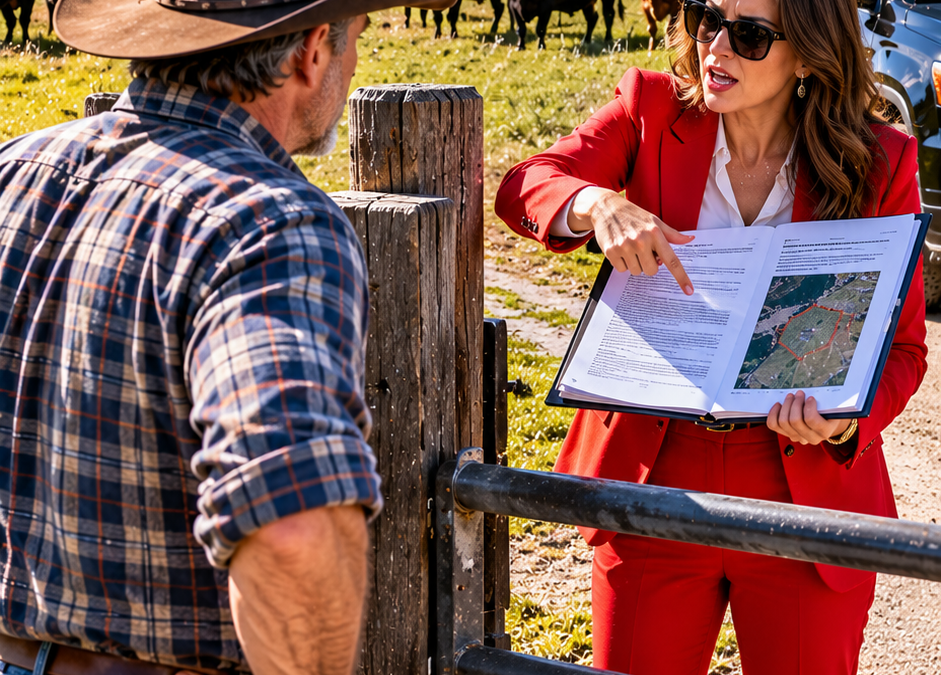
She arrived in the HOA SUV just after eight, dust trailing behind her tires as she turned off the county road. She wore her usual red suit, the one that made her look less like a neighbor and more like a warning. In one hand, she carried a thick packet clipped with colored tabs.
Behind me, thirty-seven black Angus cows grazed in the east pasture, their heads low in the cool grass.
Melissa did not look at them like animals.
She looked at them like violations.
“Move those cattle by Friday or we start fining you,” she said.
No good morning.
No explanation.
Just a deadline.
I leaned one forearm against the gate.
“Fining me for what?”
She lifted the packet as if it were a court order.
“Noncompliance with the newly recorded Brierwood Ridge supplemental covenants.”
I stared at her for a second, waiting for the sentence to start making sense.
It did not.
“Melissa, my ranch is not in your HOA.”
“It is now.”
She said it too smoothly.
Like she had practiced the line in a mirror.
I reached through the gate.
“Let me see it.”
She handed me the packet with the satisfaction of someone who believed the paper had already won the argument.
The cover page carried a Millstone County recording stamp.
The title read:
Supplemental Declaration of Covenants, Conditions, and Restrictions for Brierwood Ridge.
Inside were livestock limits, exterior lighting rules, architectural controls, equipment restrictions, inspection rights, and daily fines. The language was clean, polished, and aggressive. If the document actually controlled my property, the HOA could interfere with nearly every practical part of running Cedar Run.
Melissa opened the packet and tapped a highlighted paragraph.
“Section Nine. Livestock cannot be maintained within the restricted buffer. You’ll need to move the herd from this pasture.”
I looked toward the cattle.
“How far?”
“Two hundred feet from the residential boundary.”
“That takes most of the pasture out of use.”
“That isn’t my problem.”
I turned another page.
“When did I join Brierwood Ridge?”
“You’re included in the supplemental declaration.”
“That wasn’t my question.”
I found the property exhibit.
There it was.
Cedar Run Ranch.
One hundred forty-six acres.
Not a strip beside the subdivision.
Not a fence corner.
The whole ranch.
My jaw tightened, but I kept my face still. Melissa wanted a reaction. She always did. It was the way she operated. She created a situation, acted like the conclusion had already been reached, then treated anyone who objected like they were being difficult.
I kept reading.
Then I found the page she had not started with.
Owner Consent and Joiner to Supplemental Declaration.
My full legal name appeared beneath a signature line.
Ethan Michael Cole.
Above it was a signature.
From a distance, someone might have accepted it as mine.
I did not.
I had signed my name on cattle contracts, equipment loans, insurance forms, land records, vet invoices, county documents, and thousands of checks. My signature was not elegant, but it was mine. The capital E leaned forward with a particular shove. My last name ended in a short upward stroke because I never fully lifted the pen at the end.
This signature had the general shape.
But it felt deliberate.
Almost drawn.
Copied, not written.
I said nothing.
Instead, I moved down to the acknowledgement block.
A notary’s name appeared there with commission information and a formal statement saying I had personally appeared and acknowledged the document.
I read the date twice.
September 2.
Melissa smiled.
“Like I said, it’s legal.”
September 2 was a Wednesday.
I knew exactly where I had been that Wednesday.
But memory was not evidence, and I had no intention of telling Melissa where I saw the first weak spot.
I closed the packet.
“I want the recorded copy directly from the county.”
“You can request whatever you want. It won’t change anything.”
“Maybe not.”
She pulled another envelope from the SUV.
“Your compliance schedule. Cattle moved by Friday. Exterior inspection next week. Refusing access becomes a separate violation.”
I took the envelope.
“No one enters this ranch without my permission.”
“The association has inspection rights now.”
“You keep saying now. I want to know what created now.”
Her expression tightened.
“You should talk to an attorney before you make this harder on yourself.”
“That’s the first useful thing you’ve said.”
Melissa got into the SUV and backed away from the gate, her red suit still visible through the windshield as she turned toward Brierwood Ridge.
I stayed there after she left.
The cattle kept grazing.
The barn doors were open.
The creek moved quietly beyond the lower pasture.
Nothing on Cedar Run Ranch looked different.
But according to a document sitting in the county records, someone had changed the legal story of my land without asking me.
Back at the house, I set the compliance notice on the kitchen table and wrote three things on a yellow legal pad.
September 2.
Owner Consent and Joiner.
Certified county copy.
Then I circled the question that mattered more than Melissa’s fines.
If I never signed that consent, whose authority put my name in the county record?
The next morning, I drove into Millstone County before the recorder’s office opened.
I wanted paper.
Not Melissa’s copy.
Not a scan forwarded by the HOA.
Not something pulled from an association portal.
I wanted the document exactly as it existed in the county record.
At 8:30, the clerk handed me a certified copy of the supplemental declaration and every page recorded with it. I sat in my truck in the courthouse parking lot and went through the packet from beginning to end.
The recording stamp matched Melissa’s copy.
The legal description matched Cedar Run Ranch.
All one hundred forty-six acres.
I checked the parcel number twice.
Same number that appeared on my property tax bill.
Same number on my deed.
Same number in the title paperwork I kept locked in a fireproof cabinet at home.
There was no clerical mistake obvious enough to explain this away.
Someone had deliberately identified my ranch.
Back at the house, I spread everything across the kitchen table.
My deed went on the left.
The certified HOA filing went on the right.
Between them, I placed the yellow legal pad from the day before.
Then I added another line.
Who created the authority?
The deed was straightforward.
Cedar Run Ranch had passed to me years earlier after my father retired from active ranch work. There was no Brierwood Ridge HOA language in it. No declaration reference. No covenant attachment. No association membership. No clause saying my ranch would one day be absorbed because a subdivision got tired of smelling cattle.
The legal description in the HOA filing, however, was detailed enough that whoever prepared it had access to accurate land records.
That bothered me more than a sloppy mistake would have.
A mistake could be explained.
This looked organized.
I turned to the Owner Consent and Joiner again.
The signature still bothered me.
I pulled three old documents from the office cabinet: a tractor loan agreement, a livestock insurance renewal, and a grazing contract I had signed the previous spring. I laid them beside the HOA document and compared them slowly.
My signature changed a little depending on how fast I wrote it, but certain habits never did. I always pushed the capital E forward. My last name ended with that short upward stroke. The signature on the HOA document copied the general shape but missed the habits.
It looked like somebody had studied my name.
Not like somebody had lived with it.
I took photographs of everything and called Rachel Monroe.
Rachel had handled a boundary access issue for a rancher I knew two counties over. She worked mostly in real estate, title disputes, and land-use problems. She was not dramatic. That was why I called her. Dramatic lawyers make people feel better until precision is needed.
When I explained what Melissa had handed me, Rachel did not say fraud.
She did not say forgery.
She asked one question.
“What document supposedly put your ranch into the HOA?”
“The owner consent and joiner.”
“Maybe,” she said. “But I want to see the larger chain.”
“What chain?”
“The legal mechanism. An HOA can’t usually just point at land and announce that it’s covered. There has to be a recorded basis for the restrictions to attach.”
I looked at the certified packet.
“So the signature isn’t the first question.”
“It’s an important question. It may become the most important question. But first, I want to know what they claim gave them the right to ask for that consent in the first place.”
That changed the way I looked at the stack.
Up to that point, I had been thinking like a man whose name appeared on a document he had never signed.
Rachel was thinking like someone tracing a chain of authority.
She asked me to scan the deed, the certified filing, the property exhibit, and every page of the owner consent. Within two hours, she called back.
“The parcel description is clean,” she said. “They knew exactly which property they were adding.”
“Adding.”
“That’s what it looks like. The supplemental declaration treats your ranch like property being brought into an existing restriction scheme.”
“I never agreed to that.”
“I know. That’s why I need the underlying declaration.”
Rachel requested the original Brierwood Ridge declaration, every amendment, any annexation instrument referencing Cedar Run Ranch, the board authorization for the new filing, and whatever title material the HOA relied on.
While she worked on that, Melissa sent another email.
Subject: Final Compliance Schedule — Cedar Run Ranch.
The first fine would begin Monday.
Two hundred fifty dollars for continued livestock use inside the restricted buffer. Another one hundred dollars per day if I denied the scheduled exterior inspection. Separate penalties could follow for equipment storage and barn lighting.
I forwarded the email to Rachel without replying.
She called less than five minutes later.
“Do not ignore it,” she said. “But do not concede anything either.”
“What do you want me to say?”
“Say the property’s status is disputed. Say you do not consent to inspection. Say you are reviewing the recorded instruments and reserve every right.”
That was all I sent.
No argument.
No threats.
No accusation.
Melissa replied nine minutes later.
Recorded covenants are not optional, Mr. Cole.
I saved the message.
By late afternoon, Rachel had pulled the original declaration.
She called again, but this time her voice was different.
More focused.
“I found the section they’re relying on.”
I leaned back in the kitchen chair.
“What does it say?”
“The original developer reserved a right to add certain property later, subject to specific conditions.”
“Was my ranch listed?”
“Not exactly.”
She emailed me a scanned exhibit from the old development file.
The map showed Brierwood Ridge as it had been planned years earlier. My ranch sat outside the developed subdivision, but along the eastern side of the exhibit, a shaded area carried a label I had never seen before.
Reserved Future Annexation Area.
I stared at the words.
Rachel stayed silent for a moment.
Then she said, “Ethan, we need to find out whether they’re treating an old planning concept like completed legal authority.”
That was the first moment I understood the dispute might be bigger than a questionable signature.
Because if Brierwood Ridge had been planning to reach my land for years, then someone had not simply made a mistake last week.
Someone had decided the ranch belonged inside their system.
The only question was whether the law had ever agreed.
The map Rachel sent me looked convincing at first glance.
That was the problem.
Brierwood Ridge occupied the center of the page, divided into neat residential lots, internal roads, drainage areas, and common spaces. Along the western edge, where the subdivision met Cedar Run Ranch, a broad shaded band extended beyond the developed lots.
Reserved Future Annexation Area.
If someone saw only that map, they could easily assume my ranch had always been intended to become part of Brierwood Ridge.
Rachel told me not to assume anything.
“A planning exhibit shows what somebody hoped might happen,” she said. “It doesn’t prove that it legally happened.”
We met at her office the following morning.
She had printed the original Brierwood Ridge declaration and stacked the amendments beside it. The first document was almost thirty years old. The developer had reserved certain rights to expand the subdivision over time.
That part was real.
But expansion was not automatic.
Rachel highlighted several paragraphs. The declaration allowed additional property to become subject to the restrictions through a recorded supplemental instrument. The process depended on who owned the land at the time. During the developer’s original control period, certain parcels could be added through powers reserved in the declaration.
Other property required additional documentation.
Privately owned land outside those reserved powers could not simply be absorbed because it appeared on a planning exhibit.
“So this map doesn’t put me in the HOA,” I said.
“No.”
“Then why does it matter?”
“Because it may explain why somebody thought your property could be added.”
She pointed at the shaded area. The eastern portion of Cedar Run Ranch overlapped the broad planning zone, but the map was imprecise. It did not use my current parcel number. It did not contain my deed description. It did not say Cedar Run Ranch was subject to Brierwood Ridge covenants.
It was a development concept.
Rachel turned to the newer supplemental declaration.
“This is different.”
My ranch legal description had been inserted with survey-level precision. Somebody had gone from a general shaded area on an old planning map to a specific one-hundred-forty-six-acre parcel in a recorded legal instrument.
That transition required authority.
So far, the only document we had seen claiming to provide that authority was the Owner Consent and Joiner bearing my name.
Rachel leaned back.
“I want every document between this old map and the new filing.”
The HOA had not provided them yet.
Melissa, meanwhile, was acting as if nothing was under review.
That afternoon, a white pickup stopped on the county road near my east pasture. A man stepped out wearing a polo shirt with a property compliance company logo. He photographed the cattle, then the barn, then the equipment shed.
I walked down the gravel lane and stopped inside my gate.
“Can I help you?”
He lowered his phone.
“Brierwood Ridge compliance inspection.”
“This isn’t Brierwood Ridge.”
“I was told the parcel was recently added.”
“Were you told you could come onto the property?”
He hesitated.
“I have an inspection request.”
“That wasn’t my question.”
He stayed on the public side of the gate.
At least he was smart enough to do that.
I asked for his name, company, and work order number. He gave them to me. I wrote everything down.
Then he photographed my gate and left.
Twenty minutes later, Melissa called.
“You interfered with an authorized inspection.”
“He never entered the ranch because I denied access.”
“I denied access to someone I don’t recognize acting under rights I dispute.”
“You’re making this more expensive than it needs to be.”
“No, Melissa. I’m asking you to prove you have authority over my land.”
Her tone hardened.
“The declaration has been recorded. We are done debating that.”
“Then send Rachel every document that proves how the ranch became subject to it.”
A pause.
“You hired an attorney.”
“You suggested it.”
She hung up without answering.
Rachel sent a preservation letter that afternoon.
It requested the annexation file, board approvals, management communications, title reports, draft declarations, and every document used to support the recording. The HOA responded with a short email acknowledging receipt.
No records came with it.
The following morning, another notice appeared in my inbox.
Notice of Denied Inspection Access.
A one-hundred-dollar daily penalty would begin if the association’s contractor was not permitted to complete an exterior compliance inspection.
I forwarded it to Rachel.
Her reply came back almost immediately.
Save it. Do not pay it. Do not destroy anything.
That became our routine.
Melissa sent pressure.
We saved evidence.
She cited authority.
Rachel traced the authority backward.
And the farther backward we went, the less certain the HOA’s position looked.
Rachel eventually found the operative annexation section buried inside one of the older amendments.
She called me that evening.
“I think I found the bridge they need.”
“What bridge?”
“The legal step between future annexation language and your ranch actually becoming restricted.”
I could hear paper moving on her desk.
“The old declaration did reserve expansion rights, but those rights were not unlimited forever. Your ranch was never transferred to the developer. It remained privately owned.”
“So they needed me.”
“They needed documented owner participation.”
“The consent page.”
“Yes.”
I looked at the certified packet lying on my kitchen table.
For days, the questionable signature had felt like one problem among many. Now Rachel was telling me it might be the entire hinge.
If Cedar Run Ranch could only be added through valid owner consent, then the HOA’s authority over all one hundred forty-six acres rested on one page.
One page I knew I had never signed.
By the end of that week, Rachel had reduced the entire dispute to one question.
Did I ever legally agree to bring Cedar Run Ranch into Brierwood Ridge?
Everything else came after that.
The livestock rules.
The inspection notices.
The fines.
The lighting restrictions.
If the ranch had never been validly added to the declaration, then arguing over individual HOA rules was almost beside the point.
Rachel built a timeline across one wall of her conference room. At the far left was my deed. Then came the original Brierwood Ridge declaration, the old development exhibit, several amendments, the supplemental declaration Melissa had recorded, and finally the Owner Consent and Joiner bearing my name.
Rachel drew a line under the documents.
“Ownership first.”
My family had controlled Cedar Run Ranch long before Brierwood Ridge existed. The ranch had never been sold to the subdivision developer. It had never been conveyed to the HOA. No recorded deed transferred even a portion of the one hundred forty-six acres into association ownership.
My own deed remained the controlling ownership document.
Rachel checked the county index for any separate annexation agreement tied to my parcel.
Nothing.
She reviewed the closing records from when the ranch transferred fully into my name.
Nothing there either.
No HOA disclosure.
No covenant acceptance.
No joiner.
No documents saying Cedar Run Ranch would become part of Brierwood Ridge later.
“So they don’t have another consent document?” I asked.
“Not that I can find.”
“Then this page is all they’ve got so far.”
She tapped the Owner Consent and Joiner.
“That’s why we don’t overstate anything. We prove the chain one step at a time.”
A few days earlier, the HOA had finally responded to Rachel’s records request. Most of what they produced was routine. Meeting agendas. Email printouts. Management reports. Versions of the supplemental declaration. Draft property exhibits.
But one set of board minutes stopped Rachel cold.
The meeting had taken place six weeks before Melissa came to my gate.
Under a section titled Boundary Compliance Initiative, the board discussed several properties along the western edge of Brierwood Ridge. Most were already part of the subdivision.
One was not.
Cedar Run Ranch.
The minutes did not call my ranch an existing association parcel.
They called it a pending inclusion parcel.
Rachel highlighted the phrase.
I read it again.
Pending inclusion.
“When was this meeting?”
“Six weeks before the recording.”
“And they were still calling the ranch pending.”
“Yes.”
I looked at the supplemental declaration on the table.
“Then how was Melissa saying the HOA had always had authority?”
“She may argue the board was referring to administrative completion.”
“Do you believe that?”
“I don’t believe anything yet. I document it.”
That was Rachel.
She never gave me the answer I wanted just because it sounded good. She kept asking what could be proved.
The board minutes contained another important detail.
Melissa had presented the boundary initiative herself.
According to the record, she wanted uniform enforcement standards along the rural edge of Brierwood Ridge. Homeowners had apparently complained about livestock odors, equipment noise, nighttime barn lights, and what one resident called inconsistent visual conditions beside the subdivision.
My ranch was not named in every complaint.
It did not need to be.
There was only one working cattle ranch along that boundary.
A motion authorized management to finalize whatever documents were necessary for the pending inclusion parcels and return them for recording.
Rachel underlined that sentence too.
“That tells us the board wanted something accomplished,” she said. “It does not tell us they had the legal authority to accomplish it.”
“So Melissa had a reason to want my land under those rules.”
“Yes.”
“Does that matter legally?”
“Motive is not our first concern. Authority is.”
She pulled the consent closer.
“If valid owner consent was required, this document is what bridges their intention to their claimed authority.”
I stared at the signature again.
The more I looked at it, the less it looked like something I had written.
But Rachel still refused to call it forged.
“A signature comparison is useful,” she said, “but we need independent evidence.”
She moved her finger down the page to the acknowledgement.
The notary block contained a name, commission expiration date, and official seal.
Rachel had already checked the state database. The notary was real. Her commission had been active on September 2. The basic information was legitimate.
That made the document look stronger.
Not weaker.
“If the notary confirms I appeared,” I said, “then we have a very different problem.”
“I know what you’re telling me,” Rachel said. “Now we verify it.”
Rachel drafted a short professional request.
She did not accuse the notary of misconduct.
She did not mention fraud.
She asked only whether the notary could confirm the acknowledgement associated with the Owner Consent and Joiner dated September 2.
Then we waited.
Melissa did not.
Another violation notice arrived the next morning. The accumulated assessment was now listed at seven hundred fifty dollars. The exterior inspection remained unresolved. The letter warned that continued violations could result in additional enforcement costs.
Melissa copied Rachel on the email this time.
Rachel answered with two sentences.
The authority of Brierwood Ridge HOA over Cedar Run Ranch is formally disputed. Please preserve all records relating to the preparation, execution, acknowledgement, approval, and recording of the supplemental declaration.
Melissa responded less than an hour later.
The recorded documents speak for themselves.
Rachel printed that email and added it to the file.
“What are you smiling at?” I asked.
“I’m not smiling.”
“You are a little.”
She placed the paper beside the board minutes.
“People say documents speak for themselves when they don’t want anyone asking who prepared them.”
Two days passed.
Then the notary replied.
Rachel called me before forwarding the message. Her voice was careful.
“She remembers September 2.”
My stomach tightened.
“Does she remember me?”
There was a pause.
“No.”
I said nothing.
Rachel continued.
“She says she performed notarizations that day, but your name does not sound familiar to her, and she does not recall anyone appearing before her about Cedar Run Ranch.”
“Is that enough?”
“No.”
The answer came immediately.
“It’s enough to keep going.”
The notary had agreed to review her contemporaneous records before saying anything more. That meant the next question would not depend on Melissa’s interpretation, my memory, or how a signature looked on paper.
It would depend on a record created at the time the acknowledgement supposedly happened.
For the first time since Melissa stood at my gate in that red suit, I felt the balance beginning to shift.
Not because we had proved the HOA wrong.
Not yet.
But because the one page holding their entire claim together was finally about to be checked against something they did not control.
Rachel called me at 7:12 the next morning.
“I have the journal entry.”
I was already in the barn checking a mineral feeder. I stopped with one hand on the gate latch.
“And?”
“It does not match your document.”
Those six words changed the case.
I drove to Rachel’s office before breakfast.
The notary, Diane Keller, had agreed to let Rachel review the contemporaneous journal information tied to September 2. Diane kept organized records: date, time, type of notarial act, signer identification, document description.
The kind of details people rarely notice until one line matters more than everything around it.
Rachel had copies laid out when I arrived.
“Start here.”
The acknowledgement attached to my supposed owner consent showed Diane’s name and commission information. The date was September 2. The formatting looked legitimate.
But Diane’s journal told a different story.
The entry corresponding to that transaction did not list Ethan Michael Cole.
It listed two other people.
Both were Brierwood Ridge homeowners.
The property referenced in Diane’s notes was not Cedar Run Ranch.
It was a residential lot inside the subdivision.
I read the entry twice.
“Same date?”
“Yes.”
“Same notary?”
“Yes.”
“Same acknowledgement sequence?”
Rachel nodded.
“That is why this matters. Diane notarized a legitimate real estate document for those homeowners that day. She did not record you as appearing before her. She did not record an acknowledgement involving Cedar Run Ranch. And there is no separate journal entry anywhere on September 2.”
Rachel slid another document across the table.
“This is the original transaction Diane remembers.”
It was a consent document related to a property adjustment inside Brierwood Ridge.
Different signers.
Different legal description.
Different purpose.
But the acknowledgement block looked almost identical to the one attached to my supposed joiner.
Same notary.
Same date.
Same arrangement of the text.
I felt anger rise in my chest, but Rachel was already shaking her head.
“Do not jump ahead.”
“You’re looking at the same thing I am.”
“I am looking at a document we cannot authenticate as your consent. That is a careful way to say it.”
“It’s also a very polite way to say it.”
“It is the useful way to say it.”
Rachel pointed to the journal.
“We do not need to prove today who assembled the bad document. We do not need to prove intent. We do not need to use words like fraud unless the evidence supports them. What we can say is this: the HOA is relying on an owner consent document whose acknowledgement does not correspond to the notary’s contemporaneous record.”
I looked again at the page bearing my name.
For weeks, Melissa had treated that page like a locked door.
Recorded.
Official.
Final.
Now it looked different.
Unsupported.
Diane had also prepared a written statement. She confirmed that her journal reflected the notarizations she performed on September 2. She confirmed that the relevant entry involved different signers and a different Brierwood Ridge property. She confirmed that she had no journal entry showing Ethan Michael Cole appeared before her to acknowledge an owner consent and joiner for Cedar Run Ranch.
That was the first independent evidence in the case that did not come from me, Rachel, the HOA, or an old planning file.
I asked the question I had been trying not to ask.
“So does this kill the covenants?”
Rachel folded her hands.
“It gives us the strongest challenge we’ve had yet.”
“Not the same thing.”
“No. Courts, title companies, and boards care about precise steps. The declaration required owner participation. The HOA is relying on this consent to prove that participation. If they cannot authenticate the consent, they have a serious problem establishing that your ranch was validly added.”
I leaned back.
“And the county recording?”
“The recording shows the document was recorded. It does not automatically prove every fact inside it was true.”
That sentence stayed with me.
A stamp could show that a piece of paper entered the public record.
It could not make me stand in front of a notary on a day when I had not been there.
Rachel spent the next hour assembling a formal demand package. She attached the certified supplemental declaration, the disputed owner consent, the relevant annexation provisions, the board minutes calling Cedar Run Ranch a pending inclusion parcel, and Diane’s written statement regarding the journal.
The letter demanded that Brierwood Ridge immediately suspend all enforcement against the ranch, withdraw the inspection demand, stop assessing fines, preserve every document related to the preparation of the filing, and begin correcting the county record.
Rachel copied the HOA’s management company and its registered counsel.
Then she sent it.
Melissa called me forty-three minutes later.
I let it ring.
She called again.
Then an email appeared.
You are mischaracterizing association records. The filing remains valid unless formally challenged.
I forwarded it to Rachel.
Her reply was simple.
Do not engage.
By late afternoon, the compliance portal changed.
The seven-hundred-fifty-dollar balance still appeared, but a new status line had been added.
Under Legal Review.
The inspection appointment disappeared from the calendar.
No explanation.
No apology.
Just gone.
The next morning, I saw the HOA SUV stop on the county road beyond my east pasture. Melissa was inside.
She did not come through the gate.
For the first time since the dispute began, she stayed on her side of the boundary.
I thought that would feel satisfying.
It did not.
Not yet.
Because the notary journal had answered one question and created a larger one.
If Diane had notarized a different transaction for different people on September 2, how had her acknowledgement ended up attached to a document saying I had joined my ranch to the HOA?
Rachel called just before noon.
“Brierwood Ridge retained outside counsel.”
“What does that mean?”
“It means somebody on their side has finally opened the file.”
I looked toward the subdivision beyond the pasture.
“Good.”
Rachel paused.
“Ethan, this is the point where we find out whether the bad page was an isolated document problem or part of a larger failure in how they assembled the recording package.”
That was the moment the fight changed.
Until then, I had been defending my ranch from the HOA.
Now the HOA had to explain its own records.
Three days after Brierwood Ridge hired outside counsel, the tone of every message changed.
No more warnings in bold red letters.
No more demands that I immediately comply.
No more emails from Melissa telling me the matter had already been settled.
Instead, Rachel received a short letter from an attorney named Daniel Price.
Brierwood Ridge had begun an internal review of the documents used to prepare and record the supplemental declaration. Pending that review, enforcement against Cedar Run Ranch was suspended.
That meant the livestock fines stopped.
The inspection demand stopped.
The compliance contractor was instructed not to enter the property.
The seven-hundred-fifty-dollar balance on the HOA portal changed from Under Legal Review to Suspended.
I read the letter twice.
“They finally backed off.”
Rachel shook her head.
“They paused.”
“Feels like backing off.”
“Don’t confuse temporary relief with correction.”
She was right.
The county record still showed a covenant filing tied to my ranch.
As long as that remained there, the problem was not finished.
The outside counsel requested one thing from us: ten business days to review the association’s files.
Rachel agreed, but only after confirming in writing that no additional fines, liens, inspection demands, or enforcement actions would occur during that period.
Then Brierwood Ridge started looking at its own paperwork.
According to Daniel Price’s first update, the HOA’s management company maintained a shared electronic folder for the boundary project. It contained years of material. Old subdivision maps. Draft supplemental declarations. Legal descriptions. Board packets. Email attachments. Unsigned consent forms. Scanned acknowledgement pages from earlier property transactions. Versions of the same documents with names like Final, Final 2, Board Revision, and Recording Copy.
Rachel looked at me over the conference table.
“That is never a comforting naming system.”
The deeper outside counsel went, the worse the document trail became.
The boundary project had started as an administrative effort to update restrictions along Brierwood Ridge’s western edge. Melissa had pushed for uniform enforcement because residents kept complaining about the rural properties beside the subdivision.
Management prepared draft materials for several parcels. Some were already association property. Some involved owners who had actually signed documents.
Cedar Run Ranch was different.
The ranch required valid owner participation.
That was why the draft owner consent existed.
But outside counsel could not find any email from me approving it. No appointment with me. No executed original in the management file. No transmittal showing that I, a title company, or any representative had returned a signed consent.
Nothing.
Then Daniel found the folder that mattered.
Recording Package — Western Boundary.
Inside were several PDF files prepared within days of each other. One contained the supplemental declaration. One contained the legal descriptions. Another contained owner consent pages for multiple properties. And another contained scanned acknowledgement pages from transactions the management office had handled earlier.
The acknowledgement involving Diane Keller was among them.
The same legitimate acknowledgement Rachel had matched to different Brierwood Ridge homeowners.
Daniel did not accuse anyone of deliberately falsifying a document.
Neither did Rachel.
What he could establish was that the HOA’s recording package had been assembled from files that included both unfinished drafts and completed documents from unrelated transactions.
At some point before recording, the acknowledgement page associated with the other homeowners had been placed behind the consent form bearing my name.
The resulting document looked complete.
Signature page.
Notary acknowledgement.
Commission information.
Recording package.
But the underlying records did not support the combination.
“So who attached it?” I asked Rachel.
“Outside counsel says they have not determined that.”
“Melissa?”
“They are not saying that.”
“Management?”
“They are not saying that either.”
I leaned back.
“So we still don’t know who did it.”
“We know something more important for your case.”
“What?”
“They cannot establish that you signed it.”
That was the difference between wanting someone punished and wanting my land cleared.
Rachel kept bringing me back to it.
The HOA did not need to admit a crime for Cedar Run Ranch to win the property dispute.
It needed to prove valid owner consent.
Its own review had now failed to do that.
The board scheduled an emergency executive session.
Melissa attended.
So did Daniel Price and representatives from the management company.
I was not invited.
Rachel was not either.
For almost three hours, the board reviewed the recording package.
The next morning, Daniel sent Rachel a written summary.
Brierwood Ridge could not presently authenticate the Owner Consent and Joiner attributed to Ethan Cole. All enforcement affecting Cedar Run Ranch would remain suspended indefinitely. The board had directed counsel to prepare options for correcting the public record.
I read the sentence again.
Correcting the public record.
That was the first time anyone on their side had used those words.
Melissa called that afternoon.
I answered.
Her voice was controlled.
“The board is reviewing some administrative irregularities.”
“Administrative irregularities.”
“That is how counsel described them.”
“Your HOA filed restrictions against my ranch using a consent you can’t authenticate.”
“I’m not discussing privileged board matters.”
“You called me.”
A pause.
“I wanted you to understand that the suspension is temporary while we evaluate options.”
“Then evaluate them.”
“You don’t need to make this adversarial.”
For a second, I almost laughed.
Instead, I looked out the kitchen window toward the east pasture.
“You came to my gate in a red suit and told me I had four days to move my cattle off land my family has owned for generations.”
Silence.
“You threatened inspections. You sent fines. You told me the county record ended the discussion.”
She said nothing.
“So don’t call me now and tell me I’m making this adversarial.”
Melissa ended the call.
The next HOA board meeting was held two nights later.
I did not attend, but the public portion of the minutes appeared online the following morning.
One line mattered.
All Cedar Run Ranch enforcement actions were formally suspended pending title and record correction.
No cattle deadline.
No inspection.
No daily penalties.
No claims that Melissa could send contractors through my gate.
For the first time since this started, the HOA had stopped pretending it controlled my ranch.
But Rachel still refused to call it over.
She placed the latest board minutes beside my deed.
“They have stopped enforcing. Good. They have acknowledged the document problem. Better.”
She tapped the county recording number printed on the supplemental declaration.
“But this is still there.”
I knew what she meant.
The ranch could not be left with a disputed covenant sitting in its title history just because the HOA promised not to use it. Promises changed. Boards changed. Lawyers changed. Recorded documents remained.
“What do we ask for?” I said.
Rachel looked directly at me.
“We don’t ask them to leave you alone.”
She slid a draft demand across the table.
“We make them fix the record.”
The final correction did not arrive with a dramatic confrontation.
There were no deputies at the HOA office.
No television cameras.
No public confession from Melissa.
What arrived was a draft document from Daniel Price.
Rachel called me before she forwarded it.
“They’re preparing a corrective instrument.”
I was standing beside the north cattle pens when she said it.
For almost two months, every important development in the dispute had arrived while I was doing something ordinary on the ranch. Fixing a gate. Checking cattle. Moving hay. Maybe that was fitting.
Cedar Run Ranch had never stopped being a working ranch just because Brierwood Ridge decided it belonged under HOA rules.
I drove to Rachel’s office that afternoon.
The draft was titled:
Corrective Release and Clarification of Supplemental Declaration.
It identified the recording number of the supplemental declaration. It identified Cedar Run Ranch by parcel number and legal description.
Then came the paragraph I had been waiting for.
Brierwood Ridge Homeowners Association stated that it could not establish a valid Owner Consent and Joiner executed by Ethan Michael Cole and therefore did not claim that Cedar Run Ranch had been validly subjected to the supplemental declaration.
I read it slowly.
Then again.
Rachel watched me.
“Is that enough?”
“It gets the property issue where we need it.”
“Meaning?”
“It puts their correction into the same public record where they created the problem.”
That mattered.
A private letter from the HOA would have been helpful. A promise from the board would have been better than nothing. But neither one would clean up the title history by itself.
The correction needed to be recorded.
Rachel proposed several changes.
The HOA agreed.
The final version stated that all enforcement notices issued against Cedar Run Ranch under the disputed supplemental declaration were withdrawn. Any fines or assessments based on those notices were canceled. The HOA disclaimed current authority to inspect, regulate, or enforce Brierwood Ridge restrictions against the ranch under that filing, and the association agreed to cooperate with any reasonable title inquiry concerning the correction.
Daniel sent the executed document to the Millstone County Recorder the following Monday.
Three days later, Rachel called.
“Recorded.”
That was the word I had been waiting for.
Not suspended.
Not under review.
Recorded.
I drove back to the county office where I had obtained the certified covenant packet weeks earlier. This time the clerk handed me a certified copy of the correction. The county stamp was at the top. The ranch legal description was attached. So was the recording reference connecting the correction to the disputed supplemental declaration.
I stood at the counter and read the key paragraph one more time.
For weeks, Melissa had used the existence of a county recording as proof that the HOA controlled my land.
Now the county record contained something else.
The HOA’s own statement that it could not establish the consent it had relied on.
The financial cleanup happened next.
The seven-hundred-fifty-dollar balance disappeared from the compliance portal. So did the livestock violation, the denied inspection violation, the equipment storage warning, and the barn lighting notice.
Rachel required a written account statement showing a zero balance.
The HOA provided it.
They also agreed to reimburse the reasonable title review and legal expenses directly associated with correcting the recording problem. It did not make me richer. That was never the point. It meant I did not have to pay thousands of dollars just to restore the status of land that should never have been disturbed in the first place.
The board made changes too.
At the next open meeting, Brierwood Ridge adopted a new recording verification policy. Any future annexation, joiner, or supplemental declaration affecting property not already clearly established as association land would require independent verification of ownership. Executed documents had to be matched to the correct property. Acknowledgements had to be reviewed against the execution documents. Drafts and completed instruments could no longer be stored in the same recording folder without clear status labels. Outside counsel had to review any future addition of privately owned land before recording.
Rachel read the policy and nodded.
“They learned an expensive lesson.”
“Think they’ll remember it?”
“Policies are usually written because someone wants the next person to remember.”
Melissa was still on the board when the correction was recorded, but she was no longer speaking for it. Daniel handled the legal communications. Another director handled the public meeting. The management company answered the administrative questions.
Melissa’s name appeared less and less.
About a month later, Brierwood Ridge reorganized its board leadership.
Melissa Grant was no longer president.
The HOA did not issue a dramatic announcement. The minutes simply recorded the election of a new president and reassignment of officer positions.
That was enough for me.
I never needed to see Melissa humiliated. I did not need an apology in front of the neighborhood. I did not need her to admit that she had been wrong at my gate.
The record had already done something stronger.
It had removed her authority from my land.
A week after the board reorganization, I saw Melissa’s SUV on the county road. She slowed near the east pasture. For a moment, I thought she might stop.
She did not.
She continued toward Brierwood Ridge.
I was repairing a section of fence where one of the calves had pushed a lower strand loose. The same cattle Melissa once told me I had four days to move were grazing behind me. The barn lights were exactly where they had always been. My equipment was parked beside the shed.
No inspection vehicle was waiting at the gate.
No compliance contractor was photographing the pasture.
No HOA notice was taped to anything.
Later that afternoon, I took the certified corrective instrument into the ranch office. I opened the fireproof cabinet. Inside were the documents my family had relied on for decades.
The deed.
Old surveys.
Loan papers.
Insurance records.
My father’s transfer documents.
I placed the corrective filing beside the deed.
Then I closed the cabinet.
That was the end of it.
Not because Cedar Run Ranch had changed.
It had not.
The land was still one hundred forty-six acres. The cattle still needed water. Fences still broke. Hay still had to be cut. Brierwood Ridge was still visible beyond the eastern pasture.
The difference was that the line between the subdivision and my ranch meant something again.
Melissa had walked onto my property carrying a recorded document and treated the county stamp like it ended every question.
It did not.
The stamp proved the document had been filed.
The evidence showed whether the story behind it was real.
And in the end, that was all I had ever needed.
A document can be stamped, filed, and sitting in a county record for anyone to see.
That still does not make the story behind it true.