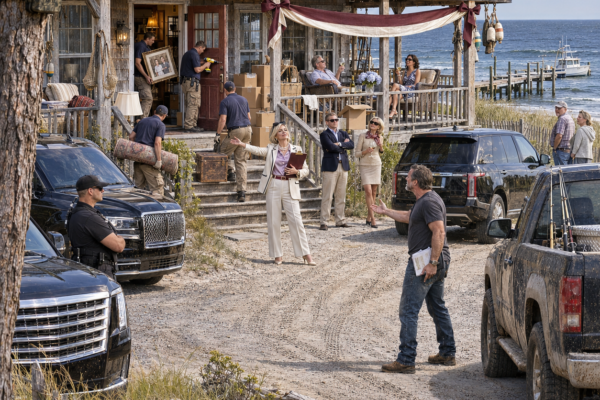
𝗙𝗨𝗟𝗟 𝗦𝗧𝗢𝗥𝗬 The HOA Buried My Meadow Under 60 Loads of Dirt Before Anyone Checked Where the Approved Line Ended
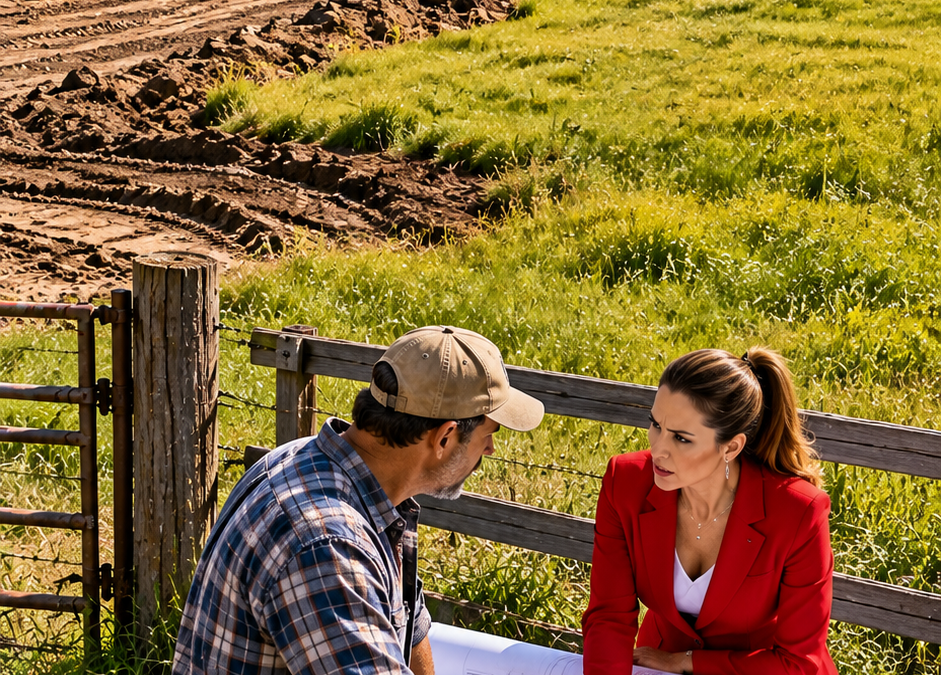
𝗙𝗨𝗟𝗟 𝗦𝗧𝗢𝗥𝗬
Me.
The survey answered another.
Where did my parcel end?
At the eastern fence.
The county parcel map agreed.
The lower meadow was eleven acres along the eastern edge of my eighty-four-acre ranch. Most of my place was hay ground and pasture, with a narrow seasonal swale crossing the lower side before the land rose toward Cedar Hollow.
My ranch had been there long before the subdivision.
For years, I had mowed that lower ground, repaired the fence, paid the taxes, and watched spring runoff follow the same shallow route without anyone ever treating the meadow as HOA property.
When Cedar Hollow was built, runoff from roofs, streets, and driveways had to be managed so it would not simply spill downhill onto existing agricultural land.
That was where the drainage easement came from.
Then I reached the document that complicated everything.
Drainage Maintenance Easement.
I had seen it during closing. At the time, it had looked like the kind of routine burden land near a subdivision often carries. An access right. A maintenance right. Something to let Cedar Hollow inspect and maintain a defined drainage feature.
Now that document had teeth.
It named Cedar Hollow and the original developer and gave rights connected to drainage.
That meant Dana had not invented the entire issue.
She had a document.
The question was what it actually allowed.
I took the easement outside with the survey folded under my arm. The legal description followed a narrow corridor near the seasonal swale. I stood in that corridor, then looked toward the fresh soil spread far beyond it.
The difference was visible without a courtroom.
Still, I did not assume that meant I had already won the argument.
Old easements can be amended.
Maps can be misread.
Legal descriptions can hide important details in one sentence.
So I measured.
Then I photographed.
Then I went back inside and read another page.
I used a measuring wheel to mark the length and width of the disturbed area. I flagged where imported soil touched undisturbed grass. I photographed the fence posts, the swale, and the places where truck tires had cut through turf.
I also found an aerial image from the year Cedar Hollow was first laid out. The same fence line was visible. So was the swale. A fencing invoice from years earlier listed the corner posts.
Neither document decided the dispute.
Together, they gave me a picture of the property before the HOA’s grading project existed.
By late afternoon, dark clouds were building over the ranch.
Wind pressed the meadow flat in waves.
The brown fill did not move.
I stood at the window with Dana’s email in one hand and the drainage easement in the other.
Her subject line read:
Required Drainage Correction — Cedar Hollow
She claimed the association possessed maintenance rights affecting the lower meadow and warned me not to obstruct the contractor when work resumed.
I printed the email.
Then I opened the county parcel viewer one more time.
The meadow was still exactly where I expected it to be.
Inside my parcel.
Outside Cedar Hollow’s property line.
The easement was the only thing connecting the HOA to that ground.
That was what made the problem harder, not easier.
Dana did not need to prove she owned the meadow if she could prove some separate right to enter and work there. The sky outside kept getting darker. I looked again at the narrow corridor on the survey, then at the broad brown scar beyond the window.
The most dangerous part of the dispute was not that Dana had no paperwork.
It was that she had just enough paperwork to make her version sound possible.
I owned the meadow.
The next question was narrower.
How much authority had that drainage easement actually given Cedar Hollow once they crossed my fence?
Sixty loads.
Once Luis Ortega gave me the ticket count, I stopped seeing the fill as a construction mistake.
Fifty-eight deliveries were confirmed.
Two more were coded to the same job.
Potentially sixty truckloads of brown-gray soil had been carried through my gate and spread across grass that had been green two mornings earlier.
The contrast was almost violent.
Fresh turf stopped in a clean line. Then came churned mud, black tire grooves, crushed grass, raw fill. The seasonal swale disappeared beneath one of the thickest bands.
I stood there longer than I should have.
For the first time since the trucks arrived, I wondered whether I had underestimated how hard it would be to undo what had already happened.
Stopping the next truck was easy.
Removing what sixty loads had changed was something else.
I walked to the deepest rut and put my boot beside it. The tire groove was wider than my foot and pressed several inches into ground I had spent years keeping smooth.
That detail hit harder than the number.
Sixty loads sounded abstract.
A scar in the meadow did not.
Luis had called me at 8:10 that morning.
“I wanted to talk before anyone sends another truck,” he said. “We’ve stopped deliveries for now.”
“For now.”
“Until the property line dispute is clarified.”
The phrase caught my attention.
Not drainage maintenance.
Not grading adjustment.
Property line dispute.
Twenty minutes later, he pulled up in the same white work truck I had seen at the gate. He brought a clipboard, a rolled plan set, and a stack of carbon-copy delivery tickets.
Dana was not with him.
That was useful.
Luis opened the tailgate and spread the paperwork across it. A gust of wind caught the corner of the top ticket. He pinned it down with two fingers.
“I checked yesterday’s records,” he said. “The crew made more cycles before you arrived than I realized.”
“How many?”
His finger moved down the column, stopping on each ticket number.
“Fifty-eight confirmed deliveries to the lower placement area. Two more are coded to the same job, but don’t have placement notes.”
“So potentially sixty.”
“Yes.”
I looked over his shoulder.
Beyond the white pickup, the meadow split into two colors.
Green grass on the high side.
Brown-gray fill below.
“What kind of material?”
“Clean fill. Mostly sandy loam and compactable soil from another permitted site.”
“Any contaminated material?”
“Not that I know of. We have source paperwork.”
I nodded.
Contamination was not the fight in front of me.
“Why did your drivers cross my fence?”
Luis unrolled the full-size grading plan across the tailgate. The paper snapped in the wind. He placed a socket wrench on one corner and his clipboard on the other.
“This is the issued set.”
Then he placed a smaller printed sheet beside it.
“This is what we received later.”
The second sheet was Dana’s version.
Same roads. Same drainage labels. Same base drawing. But someone had colored past the heavy dashed limit of disturbance.
I watched Luis drag his index finger along the official dashed line.
It stopped before my fence.
Then he moved the same finger to Dana’s sheet.
The colored extension kept going across the fence into my meadow.
“Who sent this?”
He flipped the page over.
“Dana Whitmore. Cedar Hollow HOA.”
“Subject?”
“Field Direction — Lower Drainage Transition.”
A few drops of leftover rainwater slid from the pickup roof and struck the paper. One drop hit the margin beside Dana’s email. The ink feathered slightly at the edge.
Luis covered the sheet with his hand, but I read the first visible line before he moved it.
Proceed with feathering beyond existing fence to eliminate low pocket and create positive drainage transition.
I looked at him.
“You followed this instead of the stamped plan.”
“We treated it as an owner-directed field adjustment.”
“Owner?”
“Project owner. Cedar Hollow.”
I looked toward the fence.
“They don’t own this side.”
“I understand that now.”
He pulled out the daily log his foreman had written in block letters.
Extended fill placement beyond east fence per owner representative direction. Authorization to be verified.
The words sat between truck counts and equipment hours like they had been waiting for someone to notice them.
I tapped the line.
“Who wrote that?”
“My foreman.”
“Before or after the work started?”
“After Dana told him to keep going.”
“So somebody on your crew had already raised the boundary?”
“Yes.”
“And the trucks kept moving.”
Luis nodded.
“We had an active project, a representative directing the work, and what looked like a field revision. I’m not saying that settles the property line dispute.”
It did not.
But it showed me the chain of action.
I asked for copies.
By noon, his office had scanned the tickets, the daily log, Dana’s marked-up sheet, and the email into my inbox. I saved everything twice. Cloud folder. External drive.
Then I printed the key pages and carried them outside.
I held the official plan at chest level with the meadow behind it.
The dashed limit of disturbance stopped on paper.
The brown soil kept going in real life.
That was the image I wanted to remember.
A line on a plan.
A line on the ground.
Sixty loads on the wrong side of both.
The weather changed that afternoon.
A heavy thunderstorm rolled through.
Not a historic storm.
Not a flood.
Just a normal hard rain.
I stood under the porch roof and watched water darken the raw fill almost black. Thin rivulets ran over the new slope. The old green grass absorbed water differently. The imported soil shed it faster.
When the worst of the storm passed, I walked down with my phone, a measuring rod, and the folded survey inside a clear plastic sleeve.
Water that normally followed the shallow swale had backed against one of the new fill bands.
Three or four inches at the deepest point.
Nothing dramatic.
That was exactly why it mattered.
The storm had not been extraordinary.
The ground had changed.
I pushed the measuring rod into the center of the puddle.
Click.
Photo.
I stepped sideways until the buried swale, the standing water, and the brown fill all sat in the same frame.
Click.
Another photo.
Then I filmed a slow pan from untouched green grass to the blocked low channel.
No commentary.
The picture explained enough.
The next morning, water was still standing.
No barn underwater.
No dead cattle.
No washed-out road.
Just a measurable drainage change after the grade had been altered.
I called a local excavation contractor I had used before. He refused to pretend he was an engineer, which was one of the reasons I trusted him.
He looked at the tickets, then at the field.
“That’s a lot of imported material,” he said. “If it has to come back out, you’re not just paying for dirt removal. You’re dealing with compaction, topsoil, reseeding, access, maybe drainage restoration.”
The words landed harder than Dana’s threats.
Until then, I had been focused on stopping the next truck.
Now I was looking at the cost of putting the meadow back.
At 3:25, Dana emailed again.
Notice of Interference With Required Storm Water Work
I printed it.
Then, instead of sitting at the desk, I took the page to the fence. Dana’s argument was on white paper. Her result was brown mud under my boots.
She wrote that Cedar Hollow had a duty to correct drainage affecting the subdivision and that my refusal to permit completion was increasing risk to homeowners.
Then came the sentence that mattered.
The association’s recorded drainage rights authorize all work reasonably necessary to correct the contributing condition.
I read it aloud once.
Then I looked across the property line.
If this was HOA overreach, I still needed to prove where legitimate easement rights ended and unauthorized work began.
So I did not call it overreach yet.
I built a timeline.
Delivery tickets. Truck numbers. Dana’s field direction. Luis’s log. Rainfall photos. My measurements.
Then Luis called again.
“There’s another note in the file.”
I opened the PDF.
One short line sat between equipment entries.
Property boundary concern raised. Owner representative states easement permits continuation.
I read it twice.
“Owner representative means Dana.”
“Yes.”
That changed the picture again.
The contractor had not wandered across a fence by accident. The property line dispute had been raised before the work continued.
Someone had asked the right question.
Dana had answered it.
Now I needed to know whether her answer had any legal weight at all.
I went back through every photograph from the first morning and matched visible truck numbers to the delivery tickets. Each match turned a vague memory into a timestamp. One silver cab appeared at 7:14. The same number appeared again at 8:02. Another truck showed up three times before I ever reached the gate.
I made a simple board on the dining table.
Left side: what I could see.
Right side: what the records claimed.
Truck. Time. Load. Direction. Location.
By midnight, the pattern was no longer confusing.
The paper trail and the physical scars lined up.
Then I drafted a records request to the county engineering office. I asked for the issued grading permit, every stamped sheet, every approved revision, inspection notes, erosion control records, and any correspondence changing the limit of disturbance.
I did not ask the county to decide whether Dana was guilty of anything.
I asked a cleaner question.
Show me the approved line.
If Cedar Hollow had a legitimate revision, it should exist outside Dana’s inbox and outside the HOA boardroom.
If it did not, then the next stage of this dispute would not depend on who sounded more confident at a gate.
It would depend on whether an official plan, an easement, and a property line all pointed to the same place.
And I wanted that answer before another tire touched my grass again.
The answer I needed had a name.
Limit of disturbance.
I spread the stamped grading sheets across my kitchen table while wind pushed the first drops of another storm against the window. Outside, the meadow was half green and half brown. Inside, the approved line stopped before my fence.
I put a ruler along the dashed boundary and ran my fingertip from the first station mark to the last.
The line ended.
Dana’s colored extension did not.
I checked the revision block.
Two changes.
One storm drain inlet.
One erosion control sequence.
Nothing moving the project onto my land.
Instead of reading forty pages in order, I built four questions on a yellow note card.
Where did the approved work stop?
At the stamped LOD.
Was there an approved revision crossing my fence?
No.
Did the project engineer authorize Dana’s colored extension?
That was the next call.
Did the HOA have some separate property right that could change the answer?
Still unresolved.
That structure kept the paperwork from swallowing the story. Every document had to answer something. If it answered nothing, it went back in the pile.
The county correspondence gave me the first important answer outside Dana’s version.
A reviewer had asked the project engineer to confirm that off-site drainage patterns would be preserved. The engineer responded that the work would remain within approved construction limits and would not require grading on adjacent private property.
I underlined the sentence.
Then I carried the sheet outside.
Rain dotted the plastic sleeve around it.
I stood where the construction stakes were still visible on Cedar Hollow’s side and lined the printed LOD up with the fence. On paper, the heavy dashed line stopped on the ground.
Brown fill crossed well beyond it.
That was what a limit of disturbance meant visually.
Not an abstract acronym.
A place where machinery was supposed to stop.
I measured from the nearest approved stake to the disturbed edge. Then I crouched low and framed one photograph with three things in it.
The orange stake.
The wire fence.
The brown fill beyond both.
Behind the camera, Dana’s argument felt smaller.
Not defeated.
Smaller.
I called the engineering firm listed on the plans.
The receptionist transferred me to Maya Bennett, the civil engineer who had signed the drainage calculations.
I gave her the permit number.
There was a pause.
Then she said, “I’ve heard there’s an issue.”
“That depends on what your plans say.”
“They say what was approved.”
“Did your office approve grading across my fence?”
“No.”
The answer came fast.
Two days later, Maya met me at the site.
Dana arrived while Maya was comparing the stamped sheet to the field stakes. The visual difference was almost absurd. Maya wore practical field shoes already darkened by mud around the edges. Dana stepped out in clean black pointed-toe heels beneath a crimson red blazer.
One set of shoes belonged on wet ground.
The other looked like it expected the ground to cooperate.
Dana started confidently.
“The eastern transition was necessary to complete the drainage correction.”
Maya kept looking at the plan.
I placed Dana’s marked-up sheet beside the stamped copy on the hood of Maya’s field vehicle.
A light drizzle began.
One drop hit the corner of Dana’s printed email and spread a gray crescent through the ink. I covered the page with my palm.
“Did your office approve this extension?” I asked.
Maya traced the official dashed line with one finger.
“No.”
Dana’s eyebrows lifted.
Barely.
“Did your office create this version?”
Maya studied the colored markup.
“No.”
Dana’s jaw set.
“It’s based on your design.”
“The base drawing is ours,” Maya said. “The extension is not.”
For half a second, Dana’s eyes shifted toward the fence.
Then back to Maya.
The confidence did not vanish.
It tightened.
“That was different.”
Maya pointed to the heavy dashed line.
“Our approved grading stops here.”
Dana folded her arms.
“The HOA has easement rights.”
Maya nodded once.
“That is a property-rights question. I am telling you what our construction drawings authorized.”
No shouting.
No accusation.
Just two sheets of paper on a hood.
And Dana no longer had the project engineer standing behind hers.
The rain strengthened. Water darkened the imported fill from brown-gray to almost black. Thin rivulets began moving over the compacted surface. Maya watched one of them curve sideways toward the shallow depression I had photographed after the earlier storm.
She took out her phone.
Dana watched too.
Her mouth tightened when the water stopped against the raised strip.
Maya did not announce that the grading caused it.
She marked a point on her plan.
“That needs elevations.”
That restraint made the moment stronger.
The ground was becoming evidence, but only after someone qualified measured it.
Back at the county file, Maya opened the project revision log on her laptop.
No amendment moved the LOD east.
No revised grading sheet added my meadow.
No engineer’s field directive authorized placement beyond the fence.
I asked her to say it one more time without engineering shorthand.
She turned the screen toward me.
“This permit does not show approved grading on your parcel.”
That sentence was easier than forty pages.
But the property-rights question remained.
From there, I went to the recorder and ordered a certified copy of the full drainage easement, including every exhibit and amendment. The packet was thick enough to look intimidating, so I reduced it the same way.
What area?
What purpose?
What conditions?
I laid the survey beside the legal description.
My finger followed the easement corridor, a narrow strip around the drainage feature. Then I moved my finger to the broad disturbed area in the field photograph.
They were not the same shape.
The easement allowed Cedar Hollow access for inspection, clearing, maintenance, repair, and restoration of the defined drainage feature under specified conditions. It included notice provisions except in defined emergencies. It described access routes. It referenced restoration of disturbed surfaces.
It did not say entire lower meadow.
It did not contain Dana’s colored shading.
One clause allowed reasonable work necessary to maintain drainage function.
Another limited the granted rights to the area described in the legal exhibit.
Those clauses mattered.
They did not explain themselves.
That was where easement rights stopped being a visual question and became a legal one.
Before calling a lawyer, I requested Cedar Hollow’s project records: meeting minutes, project approvals, contractor instructions, engineering correspondence, invoices, emails about extending work beyond the LOD.
Three days later, the first batch arrived.
I did not sit down and read it like a novel.
I spread the records across the kitchen floor in a line.
Board.
Engineer.
Contractor.
Dana.
Then I walked the line.
The board minutes gave me motive.
Cedar Hollow had been getting homeowner complaints about standing water near the lower end of the subdivision. The engineer’s original design corrected the HOA-side swale without crossing onto my property.
An internal memo identified what Dana called a low pocket near my fence.
The approved design left it alone.
Dana proposed extending fill beyond the fence for a smoother transition, fewer future complaints, and easier maintenance.
Then I found the question that should have slowed everything down.
A board member named Paul Reyes had asked, “Do we have written authorization to grade private land east of the fence?”
I stopped walking.
The next line showed Dana answering that the drainage easement provided maintenance authority.
Paul asked whether that had been confirmed against the grading permit.
The minutes ended the exchange with: counsel review to be confirmed.
No attached opinion.
No signed permission from me.
No county revision.
The next records were emails.
The contractor had asked, “Please confirm whether east-side feathering is within owner-controlled property or easement rights.”
Dana replied, “HOA has drainage maintenance authority. Proceed as directed.”
Then came Maya’s message, sent before the dumping began.
Any grading outside the stamped LOD should be held pending confirmation of property authorization and permit implications.
I placed that email beside Dana’s.
One said hold.
One said proceed.
The trucks followed the second one.
I called Luis.
“Did your project manager see Maya’s warning before the trucks crossed?”
“Yes.”
“And Dana still told you to proceed?”
“Yes.”
“Why?”
“She said the easement covered it and the HOA would take responsibility for authorization.”
Take responsibility.
That was different from having authority.
Luis sent me the internal daily report.
I printed it and pinned it to the fence post nearest the disturbed ground long enough to photograph it against the actual site.
The entry read:
East extension questioned due to LOD. Owner rep confirms easement authority and directs continuation. Engineering revision not received.
Paper in the foreground.
Brown fill in the background.
That single frame connected the administrative record to the damage.
Three paper trails now pointed in different directions.
The county plan said stop.
The engineer said hold.
The contractor asked for authorization.
Dana said proceed.
Still, Cedar Hollow was not easy to dismiss.
The easement was real. It gave the HOA rights on part of my property.
That was why I resisted calling the entire dispute simple HOA overreach.
The real question was narrower and stronger.
How far did those easement rights actually reach?
And could they override a county-approved limit of disturbance that had never moved?
I arranged the evidence in five piles.
Property.
Permit.
Easement.
Contractor.
HOA.
My deed answered who owned the meadow.
The permit answered where approved grading stopped.
The easement described a drainage right.
The contractor log showed who directed the off-plan work.
The board records showed why.
The next step was no longer finding more paper.
It was finding someone who could explain what all five piles meant together.
Evidence only becomes power when someone can connect the line on paper to the line on land.
Evan Price drew three boxes on a yellow legal pad.
Then he showed me why sixty truckloads of dirt could fit inside none of them.
Drainage easement.
Maintenance authority.
Grading authority.
“For the last week,” he said, “Cedar Hollow has been talking about these like they’re the same thing. They are not. Not even close.”
From that point, the meeting stopped feeling like a lecture.
It turned into a sequence.
Evan tapped the first box.
Drainage easement.
Then came the certified easement spread across his desk.
“The easement is the property right.”
Then came my survey, his finger tracing the narrow drainage corridor.
“It tells us what area is burdened and for what purpose.”
Then came a photograph of the brown fill crossing beyond that corridor.
“It does not automatically give the HOA control over everything around it.”
He tapped the second box.
Maintenance authority.
Then came the old drainage language highlighted in yellow.
Inspection.
Clearing.
Repair.
Restoration.
“Those can be real easement rights if the document grants them.”
Then came the seasonal swale, partly buried beneath imported soil.
“Maintenance can involve physical work.”
Then he tapped the third box.
Grading authority.
Then came the stamped county plan. His finger slid along the heavy dashed limit of disturbance and stopped before my fence.
“This answers a different question. What did this permitted project authorize the contractor to disturb?”
Then came Dana at the gate on the first morning.
Crimson red blazer bright against brown mud. One hand gripping her marked-up plan.
Back to Evan’s yellow pad.
Three boxes.
Three different sources of authority.
That made the legal issue easier to understand than any paragraph could.
I looked at the boxes.
“So the HOA can have easement rights and still exceed them.”
“Yes.”
“And even work that might be allowed under an easement does not automatically expand the permit.”
“Exactly.”
He slid Dana’s marked-up plan between us.
“This is where the HOA overreach question gets precise.”
I liked that wording better than calling everything illegal. It forced us to identify the exact step that had gone too far.
Evan turned to the legal description.
“This easement identifies a defined corridor. It does not describe your entire lower meadow.”
He placed the survey beside it.
“The fill shown in your photographs extends beyond that corridor.”
Then he opened the permit file.
“The stamped grading plan stops on the HOA side of the fence.”
“So they crossed two lines.”
“Possibly two different lines for two different reasons. Do not collapse them.”
He drew a short arrow between the first two boxes.
“The easement line answers what property right Cedar Hollow may have on your land.”
Then another arrow toward the third box.
“The limit of disturbance answers what this construction project was approved to disturb.”
He circled the gap between them.
“Dana’s field direction does not magically bridge that gap.”
That was the moment the whole property-line dispute changed shape.
The question was no longer whether Cedar Hollow had drainage rights.
It did.
The question was whether those easement rights authorized this specific grading operation, at this scale, in this location, under this permit.
Evan moved quickly through the strongest argument on Dana’s side.
He placed Dana’s email on the desk.
The association’s recorded drainage rights authorize all work reasonably necessary to correct the contributing condition.
Evan tapped the sentence.
“This is their best position. They will say the imported fill was reasonably necessary maintenance.”
Then came the easement corridor.
Then the truck tickets.
Then the buried swale.
Then Maya’s warning email.
Then the contractor log.
Evan’s voice continued over the sequence.
“Then we ask: Was the work inside the easement area? Was this maintenance or material regrading? Were notice requirements followed? Was there an emergency? Did the easement authorize imported fill at this scale? Did the county approve the expanded disturbance? Did you consent?”
Each question landed over a different image.
No long speech.
No legal fog.
Just one test after another.
I handed him Dana’s email.
“That is her interpretation,” he said. “It is not a substitute for the actual grant.”
Then Maya’s warning.
Outside the stamped LOD should be held pending authorization.
Then Luis’s daily log.
Owner representative confirms easement authority and directs continuation. Engineering revision not received.
Evan stopped there.
“That one matters.”
“Because Dana told them to cross.”
“Because the contractor recognized a boundary problem before continuing. That is different from accidental encroachment.”
Then the haul tickets.
Sixty loads.
Fifty-eight confirmed.
Two tied to the same job.
“And ponding appeared after a normal storm,” he said.
“Yes.”
“Keep saying normal storm. Do not turn it into flooding. The facts do not need exaggeration.”
He asked whether Cedar Hollow had sent any prior notice that the swale was blocked or failing.
No.
Any notice giving me time to perform maintenance?
No.
Any emergency declaration?
No.
He nodded.
“If the easement has notice or trigger requirements, sequence matters.”
Then the montage stopped.
Evan pulled a blank sheet forward.
Now came action.
He drafted a formal demand.
Stop all grading and fill placement beyond whatever rights Cedar Hollow could actually establish.
Preserve emails, markups, board communications, contractor logs, haul tickets, invoices, engineering records, and permit correspondence.
Identify who authorized work beyond the stamped LOD.
State the legal basis for treating my lower meadow as part of the project.
Provide an engineering stabilization plan.
Propose restoration.
No accusation of fraud.
No criminal threat.
No demand for a fantasy payout.
Scope.
Evidence.
Correction.
Near the end, Evan wrote one paragraph slowly.
A limited easement for drainage maintenance does not, without additional authority, grant a right to materially regrade private land outside the easement area, nor does it enlarge the approved limits of a separate permitted construction project.
That was the cleanest definition of the dispute I had heard.
For days, Dana had used the word drainage as if it settled everything.
It did not.
Drainage explained the purpose.
It did not answer the scope.
The demand went out by certified mail and email. Luis’s company received a preservation notice. Maya’s firm received a request to retain the project file. The county was notified that a private property dispute involved work outside the approved limit of disturbance.
That evening, Dana replied.
Cedar Hollow maintains that its easement rights authorized the necessary work and will not agree to remove fill until the issue is formally resolved.
I forwarded the message to Evan.
He called five minutes later.
“She’s entitled to make that argument.”
“What happens now?”
“Now someone outside Cedar Hollow checks the line.”
I looked at the three boxes still visible in the photograph I had taken of his legal pad.
Easement.
Maintenance.
Grading.
For the first time, I did not need Dana to agree with me.
I needed an independent authority to decide whether those three things had been improperly turned into one.
That was exactly where the next fight moved.
Mark Ellison never asked Dana where she believed the line was.
He walked directly to the construction stakes.
That was the moment I knew the argument had changed.
Behind him, the meadow still carried its two colors. Green grass where the project had never reached. Brown-gray fill where it had. Dana stood nearby in her crimson red blazer. Luis held the contractor file.
Mark opened the stamped grading plan on his tablet.
Then he stepped over the fence and started measuring.
For the first time since the first truck arrived, Dana was no longer the person defining what the map meant.
Mark worked from the Cedar Hollow side first. He located the stakes, checked the plan, walked the dashed limit of disturbance against the ground. Then he crossed to my side. The truck tracks were visible. He hooked the end of his measuring tape near the approved stake and pulled it toward the disturbed edge.
The metal tape clicked for three seconds.
Everything else seemed to go quiet.
The idling pickup.
The wind.
Dana shifting behind me.
All I could see was that tape stretched across the grass.
If Mark agreed with Dana’s interpretation, sixty loads might not be the end of the story. The HOA could keep treating my lower meadow like the overflow zone for every future drainage problem.
That was the real risk.
Not dirt already dumped.
A precedent.
Mark looked at the tablet, then at the tape, then back at the stake.
“How far outside the LOD?” I asked.
He did not answer immediately.
“I need to document it before I give you a number.”
The pause felt longer than it was.
He photographed the fill, checked the fence location, and compared his measurements to the county plan.
Dana stepped closer.
“The work was required for drainage.”
Mark looked up.
“I’m reviewing the permit footprint.”
“The HOA has easement rights that may be relevant to the property-line dispute.”
“I’m checking whether the permitted grading stayed inside the approved disturbance limits.”
Dana’s lips pressed into a thin line.
Mark asked Luis for the field records.
Luis handed over the daily logs, Dana’s marked-up plan, and the email directing the east-side feathering.
Mark read them.
Then he asked one question.
“Did the county approve this revised limit?”
Luis shook his head.
“Not that we received.”
Mark looked at Dana.
“Do you have an approved revision?”
Dana said, “The easement authorized the work.”
He asked again.
“Do you have a county-approved revision moving the limit of disturbance onto this parcel?”
“No.”
That single word released more tension than any argument at the gate had.
Mark still did not decide the private easement dispute.
He did not need to.
His written notice arrived the next afternoon.
Grading and fill placement had occurred outside the approved limit of disturbance.
The unapproved portion required corrective action or a properly reviewed revision before additional work could occur. The contractor also had to stabilize the off-site area while a correction plan was developed.
Cedar Hollow’s attorney contacted Evan.
The insurer requested photographs, haul tickets, engineering correspondence, and contractor records.
Luis’s company confirmed no additional work would happen on my parcel without authorization from all required parties.
Then came the harder question.
What had sixty loads actually done to the land?
Rachel Kim cared about elevations, not board politics.
She surveyed the meadow, shot grades along the swale, and compared undisturbed points to the filled area.
Her conclusion was practical.
Some fill could remain if regraded correctly.
Other portions needed removal because they raised the natural low path and contributed to ponding after the storm.
“Can you put it back exactly?” I asked.
“No engineer is going to promise exactly,” she said. “But we can restore drainage function and rebuild the surface to a defensible grade.”
Dana still defended the project’s purpose.
I never argued with that.
Protecting homes from runoff was legitimate.
Using that goal to justify HOA overreach beyond easement rights and beyond the approved LOD was the issue.
By then, even Cedar Hollow’s counsel stopped claiming the grading plan itself authorized work inside my meadow. The conversation moved from authority to responsibility to restoration.
And finally to the question everyone had avoided since the first truck crossed my gate.
Who was going to pay to fix the wrong side of the line?
The first excavator bucket lifted a strip of brown fill and exposed green-black topsoil underneath.
That was the first moment the meadow looked like it might actually come back.
Nobody removed sixty truckloads just to make a point.
Rachel Kim’s restoration plan was more precise than that. Some material could be reshaped. Some had to be moved. Some had to leave. The goal was not revenge.
The goal was to make the ground work again.
Cedar Hollow could still argue about what the drainage easement allowed, but it could no longer pretend the grading plan authorized what had happened in my meadow.
That left restoration, responsibility, and cost.
Rachel’s final report divided the disturbed ground into three areas. One section could stay if it was reshaped to match the intended drainage path. A second section needed partial excavation because the added material had raised the soil. The third needed most of the imported fill removed, followed by topsoil replacement, seed, and erosion protection.
She also recommended repairing the access point where trucks had widened the opening near my fence.
It was not sixty truckloads hauled back out exactly as they had come in.
It was better than that.
It was an answer tied to the land instead of somebody’s pride.
Evan sent Rachel’s report to Cedar Hollow’s attorney, the insurer, and the contractor. The insurer wanted proof of condition before the work.
I had photographs.
The contractor wanted confirmation of who directed the field change.
Its own log answered that.
Cedar Hollow wanted to preserve its drainage rights.
We never asked them to give those up. We asked them to stop treating those rights as permission to redesign everything around them.
The eventual agreement was practical.
Cedar Hollow funded the corrective grading plan. The contractor removed or redistributed fill according to Rachel’s elevations. Topsoil was replaced where the original surface had been buried too deeply. The swale was reopened. The disturbed meadow was reseeded. The fence access was rebuilt to its prior width.
Cedar Hollow also reimbursed my documented engineering expenses and an agreed portion of my legal fees.
No dramatic courtroom scene.
No last-minute confession.
No sheriff standing beside the fence while Dana lowered her eyes.
Just a written resolution tied to actual harm.
Every payment was tied to invoices, surveys, repairs, or documented professional work.
The agreement also addressed what could happen next time.
Before any future Cedar Hollow project crossed onto land the association did not own, the board had to confirm property authority in writing and verify that the approved permit covered the work.
Contractors received a new instruction as well.
No field directive could move work beyond a stamped limit of disturbance without written engineering review and documented authorization.
Dana did not disappear overnight.
She finished the remainder of her term on the board. But by the next election cycle, another director was chairing the meetings, and Dana did not return as president.
I did not need her humiliated.
I needed trucks to stop entering my meadow because one person had decided a drainage easement meant more than it actually did.
Luis came out once during restoration.
He watched an excavator peel back one of the deeper fill sections.
“I should have stopped when my foreman flagged the boundary,” he said.
I nodded.
“I should have asked for the county revision before trusting a colored markup.”
He looked toward the fence.
“Next time, I will.”
Months later, the lower meadow looked ordinary again.
The recovery was quiet, almost boring, and that was exactly what I wanted after weeks of engines, mud, paperwork, and arguments.
The fresh seed had taken. The repaired swale carried water after rain instead of holding it against the raised grade. The fence opening was back where it belonged. The brown bands of fill were gone from the places where they had never been approved.
One evening, I walked the meadow after a light storm.
Water moved through the shallow channel the way it had before the trucks came. Beyond the fence, Cedar Hollow was still there.
So was the drainage easement.
The HOA still had legitimate rights connected to that narrow corridor.
I still owned the meadow around it.
What changed was that everyone involved finally had to respect the difference.
A drainage problem can justify fixing drainage.
It does not automatically give someone permission to redesign the land next door.
And if a line on an approved plan stops at your fence, it is worth asking why the trucks did not.
𝗧𝗛𝗘 𝗘𝗡𝗗
The HOA Buried My Meadow Under 60 Loads of Dirt Before Anyone Checked Where the Approved Line Ended
Six dump trucks had already turned my lower meadow into a brown scar before Dana Whitmore smiled and told me the HOA had authorization.
The plan in her hand stopped at my fence, but the dirt on my land told a different story.
By the time the county measured the line, sixty loads of fill had become the most expensive shortcut Cedar Hollow had ever taken.
The first thing I saw was the color.
Not the trucks.
Not Dana Whitmore standing in her crimson red blazer like she had personally improved the weather.
Not the grading crew, or the idling dump truck at my gate, or the fresh tire tracks carved into the damp ground.
The color.
My lower meadow had been bright clean green the night before. Hay grass stood knee-high in places, darker along the shallow swale where spring water always lingered a little longer. I knew that ground the way a carpenter knows the grain of a board before cutting it. I knew every low spot, every soft patch after rain, every place the mower pulled harder in June.
Now a brown-gray scar cut across it.
Fresh fill lay in rough bands where grass had been standing less than twenty-four hours earlier. Deep truck tires had carved black grooves through the turf, turning one of the quietest parts of my ranch into something temporarily industrial.
For about three seconds, I forgot Dana was talking.
I just stared.
My stomach tightened.
Not rage.
Something closer to the sick feeling you get when you walk into a familiar room and realize somebody has moved everything while you were gone.
“Grant,” Dana said, stepping into my line of sight. “You need to understand this is authorized work.”
I looked from her blazer to the raw soil behind her, then back to the folded grading plan in her hand.
“Plan number.”
The small confident half smile on her face disappeared.
Only for a second.
Her jaw tightened just below her left cheek, but I saw it.
The site foreman saw it too. He stood near a white work pickup with a rolled plan set under one arm. Behind him, the sixth truck idled at my gate, reverse alarm chirping in slow intervals as if the machine were impatient to finish what people had started.
Dana recovered quickly.
“This is Cedar Hollow’s required drainage correction.”
“Plan number,” I said again.
“You are interfering with an approved project.”
“Then the approved plan should make this easy.”
I stepped aside from the gate so nobody could claim I was trapping the truck.
“I’m not stopping anyone from leaving,” I said. “I’m stopping another load from being dumped until someone shows me why this work crossed onto my property.”
Dana’s expression hardened.
“You are creating unnecessary risk for homeowners.”
“No,” I said, pointing past her at the meadow. “Someone already created risk. I’m trying to find out who gave them permission.”
The foreman walked to his truck, opened the passenger door, and pulled out a full-size construction set.
I took out my phone and started recording.
First the open gate.
Then the dump trucks.
Then the contractor logo on the nearest cab.
Then the truck numbers.
Then the tire tracks tearing through green turf and disappearing into the brown-gray fill. At the first mound, loose soil held fresh tread marks, and blades of grass stuck out from beneath it like the meadow had been covered before it had time to disappear.
I photographed the edge where untouched grass met imported soil.
I photographed fence posts where equipment had passed.
I photographed Dana holding the folded sheet.
No shouting.
No touching equipment.
No dramatic standoff.
Just a record.
That was something my father taught me long before Cedar Hollow existed. When people start moving land, you do not argue with their confidence. You measure what changed.
The foreman spread his plan across the hood of the pickup.
The title block carried a county project number and an engineering stamp.
Dana moved closer.
“That’s the same plan.”
The foreman compared the two sheets.
His finger stopped at a heavy dashed line.
“They’re related,” he said.
Dana’s grip tightened around the edge of her black portfolio.
“Related how?”
“This one has additional markup.”
For the first time since she arrived, Dana blinked without answering.
Behind her, another loaded truck waited at the gate.
The engine rumbled. The meadow was green on one side of the disturbance and brown on the other. Suddenly, the difference between those two plans felt more important than anything Dana had said.
The dirt looked worse from a distance.
From my kitchen window, the untouched meadow still spread wide and green toward the eastern fence. The imported fill sat across it like somebody had dragged a dirty brown brush through the middle.
I opened my closing file on the kitchen table.
Outside, one of the contractor’s white pickups rolled slowly along Cedar Hollow’s side of the fence.
I found the deed.
Looked outside.
Found the survey.
Went back to the meadow.
Found the easement.
Measured the swale.
For the next few hours, I stopped treating the documents like a stack of paper and started treating them like questions I could carry outside.
The deed answered one.
Who owned the meadow?
Me.
The survey answered another.
Where did my parcel end?
At the eastern fence.
The county parcel map agreed.
The lower meadow was eleven acres along the eastern edge of my eighty-four-acre ranch. Most of my place was hay ground and pasture, with a narrow seasonal swale crossing the lower side before the land rose toward Cedar Hollow.
My ranch had been there long before the subdivision.
For years, I had mowed that lower ground, repaired the fence, paid the taxes, and watched spring runoff follow the same shallow route without anyone ever treating the meadow as HOA property.
When Cedar Hollow was built, runoff from roofs, streets, and driveways had to be managed so it would not simply spill downhill onto existing agricultural land.
That was where the drainage easement came from.
Then I reached the document that complicated everything.
Drainage Maintenance Easement.
I had seen it during closing. At the time, it had looked like the kind of routine burden land near a subdivision often carries. An access right. A maintenance right. Something to let Cedar Hollow inspect and maintain a defined drainage feature.
Now that document had teeth.
It named Cedar Hollow and the original developer and gave rights connected to drainage.
That meant Dana had not invented the entire issue.
She had a document.
The question was what it actually allowed.
I took the easement outside with the survey folded under my arm. The legal description followed a narrow corridor near the seasonal swale. I stood in that corridor, then looked toward the fresh soil spread far beyond it.
The difference was visible without a courtroom.
Still, I did not assume that meant I had already won the argument.
Old easements can be amended.
Maps can be misread.
Legal descriptions can hide important details in one sentence.
So I measured.
Then I photographed.
Then I went back inside and read another page.
I used a measuring wheel to mark the length and width of the disturbed area. I flagged where imported soil touched undisturbed grass. I photographed the fence posts, the swale, and the places where truck tires had cut through turf.
I also found an aerial image from the year Cedar Hollow was first laid out. The same fence line was visible. So was the swale. A fencing invoice from years earlier listed the corner posts.
Neither document decided the dispute.
Together, they gave me a picture of the property before the HOA’s grading project existed.
By late afternoon, dark clouds were building over the ranch.
Wind pressed the meadow flat in waves.
The brown fill did not move.
I stood at the window with Dana’s email in one hand and the drainage easement in the other.
Her subject line read:
Required Drainage Correction — Cedar Hollow
She claimed the association possessed maintenance rights affecting the lower meadow and warned me not to obstruct the contractor when work resumed.
I printed the email.
Then I opened the county parcel viewer one more time.
The meadow was still exactly where I expected it to be.
Inside my parcel.
Outside Cedar Hollow’s property line.
The easement was the only thing connecting the HOA to that ground.
That was what made the problem harder, not easier.
Dana did not need to prove she owned the meadow if she could prove some separate right to enter and work there. The sky outside kept getting darker. I looked again at the narrow corridor on the survey, then at the broad brown scar beyond the window.
The most dangerous part of the dispute was not that Dana had no paperwork.
It was that she had just enough paperwork to make her version sound possible.
I owned the meadow.
The next question was narrower.
How much authority had that drainage easement actually given Cedar Hollow once they crossed my fence?
Sixty loads.
Once Luis Ortega gave me the ticket count, I stopped seeing the fill as a construction mistake.
Fifty-eight deliveries were confirmed.
Two more were coded to the same job.
Potentially sixty truckloads of brown-gray soil had been carried through my gate and spread across grass that had been green two mornings earlier.
The contrast was almost violent.
Fresh turf stopped in a clean line. Then came churned mud, black tire grooves, crushed grass, raw fill. The seasonal swale disappeared beneath one of the thickest bands.
I stood there longer than I should have.
For the first time since the trucks arrived, I wondered whether I had underestimated how hard it would be to undo what had already happened.
Stopping the next truck was easy.
Removing what sixty loads had changed was something else.
I walked to the deepest rut and put my boot beside it. The tire groove was wider than my foot and pressed several inches into ground I had spent years keeping smooth.
That detail hit harder than the number.
Sixty loads sounded abstract.
A scar in the meadow did not.
Luis had called me at 8:10 that morning.
“I wanted to talk before anyone sends another truck,” he said. “We’ve stopped deliveries for now.”
“For now.”
“Until the property line dispute is clarified.”
The phrase caught my attention.
Not drainage maintenance.
Not grading adjustment.
Property line dispute.
Twenty minutes later, he pulled up in the same white work truck I had seen at the gate. He brought a clipboard, a rolled plan set, and a stack of carbon-copy delivery tickets.
Dana was not with him.
That was useful.
Luis opened the tailgate and spread the paperwork across it. A gust of wind caught the corner of the top ticket. He pinned it down with two fingers.
“I checked yesterday’s records,” he said. “The crew made more cycles before you arrived than I realized.”
“How many?”
His finger moved down the column, stopping on each ticket number.
“Fifty-eight confirmed deliveries to the lower placement area. Two more are coded to the same job, but don’t have placement notes.”
“So potentially sixty.”
“Yes.”
I looked over his shoulder.
Beyond the white pickup, the meadow split into two colors.
Green grass on the high side.
Brown-gray fill below.
“What kind of material?”
“Clean fill. Mostly sandy loam and compactable soil from another permitted site.”
“Any contaminated material?”
“Not that I know of. We have source paperwork.”
I nodded.
Contamination was not the fight in front of me.
“Why did your drivers cross my fence?”
Luis unrolled the full-size grading plan across the tailgate. The paper snapped in the wind. He placed a socket wrench on one corner and his clipboard on the other.
“This is the issued set.”
Then he placed a smaller printed sheet beside it.
“This is what we received later.”
The second sheet was Dana’s version.
Same roads. Same drainage labels. Same base drawing. But someone had colored past the heavy dashed limit of disturbance.
I watched Luis drag his index finger along the official dashed line.
It stopped before my fence.
Then he moved the same finger to Dana’s sheet.
The colored extension kept going across the fence into my meadow.
“Who sent this?”
He flipped the page over.
“Dana Whitmore. Cedar Hollow HOA.”
“Subject?”
“Field Direction — Lower Drainage Transition.”
A few drops of leftover rainwater slid from the pickup roof and struck the paper. One drop hit the margin beside Dana’s email. The ink feathered slightly at the edge.
Luis covered the sheet with his hand, but I read the first visible line before he moved it.
Proceed with feathering beyond existing fence to eliminate low pocket and create positive drainage transition.
I looked at him.
“You followed this instead of the stamped plan.”
“We treated it as an owner-directed field adjustment.”
“Owner?”
“Project owner. Cedar Hollow.”
I looked toward the fence.
“They don’t own this side.”
“I understand that now.”
He pulled out the daily log his foreman had written in block letters.
Extended fill placement beyond east fence per owner representative direction. Authorization to be verified.
The words sat between truck counts and equipment hours like they had been waiting for someone to notice them.
I tapped the line.
“Who wrote that?”
“My foreman.”
“Before or after the work started?”
“After Dana told him to keep going.”
“So somebody on your crew had already raised the boundary?”
“Yes.”
“And the trucks kept moving.”
Luis nodded.
“We had an active project, a representative directing the work, and what looked like a field revision. I’m not saying that settles the property line dispute.”
It did not.
But it showed me the chain of action.
I asked for copies.
By noon, his office had scanned the tickets, the daily log, Dana’s marked-up sheet, and the email into my inbox. I saved everything twice. Cloud folder. External drive.
Then I printed the key pages and carried them outside.
I held the official plan at chest level with the meadow behind it.
The dashed limit of disturbance stopped on paper.
The brown soil kept going in real life.
That was the image I wanted to remember.
A line on a plan.
A line on the ground.
Sixty loads on the wrong side of both.
The weather changed that afternoon.
A heavy thunderstorm rolled through.
Not a historic storm.
Not a flood.
Just a normal hard rain.
I stood under the porch roof and watched water darken the raw fill almost black. Thin rivulets ran over the new slope. The old green grass absorbed water differently. The imported soil shed it faster.
When the worst of the storm passed, I walked down with my phone, a measuring rod, and the folded survey inside a clear plastic sleeve.
Water that normally followed the shallow swale had backed against one of the new fill bands.
Three or four inches at the deepest point.
Nothing dramatic.
That was exactly why it mattered.
The storm had not been extraordinary.
The ground had changed.
I pushed the measuring rod into the center of the puddle.
Click.
Photo.
I stepped sideways until the buried swale, the standing water, and the brown fill all sat in the same frame.
Click.
Another photo.
Then I filmed a slow pan from untouched green grass to the blocked low channel.
No commentary.
The picture explained enough.
The next morning, water was still standing.
No barn underwater.
No dead cattle.
No washed-out road.
Just a measurable drainage change after the grade had been altered.
I called a local excavation contractor I had used before. He refused to pretend he was an engineer, which was one of the reasons I trusted him.
He looked at the tickets, then at the field.
“That’s a lot of imported material,” he said. “If it has to come back out, you’re not just paying for dirt removal. You’re dealing with compaction, topsoil, reseeding, access, maybe drainage restoration.”
The words landed harder than Dana’s threats.
Until then, I had been focused on stopping the next truck.
Now I was looking at the cost of putting the meadow back.
At 3:25, Dana emailed again.
Notice of Interference With Required Storm Water Work
I printed it.
Then, instead of sitting at the desk, I took the page to the fence. Dana’s argument was on white paper. Her result was brown mud under my boots.
She wrote that Cedar Hollow had a duty to correct drainage affecting the subdivision and that my refusal to permit completion was increasing risk to homeowners.
Then came the sentence that mattered.
The association’s recorded drainage rights authorize all work reasonably necessary to correct the contributing condition.
I read it aloud once.
Then I looked across the property line.
If this was HOA overreach, I still needed to prove where legitimate easement rights ended and unauthorized work began.
So I did not call it overreach yet.
I built a timeline.
Delivery tickets. Truck numbers. Dana’s field direction. Luis’s log. Rainfall photos. My measurements.
Then Luis called again.
“There’s another note in the file.”
I opened the PDF.
One short line sat between equipment entries.
Property boundary concern raised. Owner representative states easement permits continuation.
I read it twice.
“Owner representative means Dana.”
“Yes.”
That changed the picture again.
The contractor had not wandered across a fence by accident. The property line dispute had been raised before the work continued.
Someone had asked the right question.
Dana had answered it.
Now I needed to know whether her answer had any legal weight at all.
I went back through every photograph from the first morning and matched visible truck numbers to the delivery tickets. Each match turned a vague memory into a timestamp. One silver cab appeared at 7:14. The same number appeared again at 8:02. Another truck showed up three times before I ever reached the gate.
I made a simple board on the dining table.
Left side: what I could see.
Right side: what the records claimed.
Truck. Time. Load. Direction. Location.
By midnight, the pattern was no longer confusing.
The paper trail and the physical scars lined up.
Then I drafted a records request to the county engineering office. I asked for the issued grading permit, every stamped sheet, every approved revision, inspection notes, erosion control records, and any correspondence changing the limit of disturbance.
I did not ask the county to decide whether Dana was guilty of anything.
I asked a cleaner question.
Show me the approved line.
If Cedar Hollow had a legitimate revision, it should exist outside Dana’s inbox and outside the HOA boardroom.
If it did not, then the next stage of this dispute would not depend on who sounded more confident at a gate.
It would depend on whether an official plan, an easement, and a property line all pointed to the same place.
And I wanted that answer before another tire touched my grass again.
The answer I needed had a name.
Limit of disturbance.
I spread the stamped grading sheets across my kitchen table while wind pushed the first drops of another storm against the window. Outside, the meadow was half green and half brown. Inside, the approved line stopped before my fence.
I put a ruler along the dashed boundary and ran my fingertip from the first station mark to the last.
The line ended.
Dana’s colored extension did not.
I checked the revision block.
Two changes.
One storm drain inlet.
One erosion control sequence.
Nothing moving the project onto my land.
Instead of reading forty pages in order, I built four questions on a yellow note card.
Where did the approved work stop?
At the stamped LOD.
Was there an approved revision crossing my fence?
No.
Did the project engineer authorize Dana’s colored extension?
That was the next call.
Did the HOA have some separate property right that could change the answer?
Still unresolved.
That structure kept the paperwork from swallowing the story. Every document had to answer something. If it answered nothing, it went back in the pile.
The county correspondence gave me the first important answer outside Dana’s version.
A reviewer had asked the project engineer to confirm that off-site drainage patterns would be preserved. The engineer responded that the work would remain within approved construction limits and would not require grading on adjacent private property.
I underlined the sentence.
Then I carried the sheet outside.
Rain dotted the plastic sleeve around it.
I stood where the construction stakes were still visible on Cedar Hollow’s side and lined the printed LOD up with the fence. On paper, the heavy dashed line stopped on the ground.
Brown fill crossed well beyond it.
That was what a limit of disturbance meant visually.
Not an abstract acronym.
A place where machinery was supposed to stop.
I measured from the nearest approved stake to the disturbed edge. Then I crouched low and framed one photograph with three things in it.
The orange stake.
The wire fence.
The brown fill beyond both.
Behind the camera, Dana’s argument felt smaller.
Not defeated.
Smaller.
I called the engineering firm listed on the plans.
The receptionist transferred me to Maya Bennett, the civil engineer who had signed the drainage calculations.
I gave her the permit number.
There was a pause.
Then she said, “I’ve heard there’s an issue.”
“That depends on what your plans say.”
“They say what was approved.”
“Did your office approve grading across my fence?”
“No.”
The answer came fast.
Two days later, Maya met me at the site.
Dana arrived while Maya was comparing the stamped sheet to the field stakes. The visual difference was almost absurd. Maya wore practical field shoes already darkened by mud around the edges. Dana stepped out in clean black pointed-toe heels beneath a crimson red blazer.
One set of shoes belonged on wet ground.
The other looked like it expected the ground to cooperate.
Dana started confidently.
“The eastern transition was necessary to complete the drainage correction.”
Maya kept looking at the plan.
I placed Dana’s marked-up sheet beside the stamped copy on the hood of Maya’s field vehicle.
A light drizzle began.
One drop hit the corner of Dana’s printed email and spread a gray crescent through the ink. I covered the page with my palm.
“Did your office approve this extension?” I asked.
Maya traced the official dashed line with one finger.
“No.”
Dana’s eyebrows lifted.
Barely.
“Did your office create this version?”
Maya studied the colored markup.
“No.”
Dana’s jaw set.
“It’s based on your design.”
“The base drawing is ours,” Maya said. “The extension is not.”
For half a second, Dana’s eyes shifted toward the fence.
Then back to Maya.
The confidence did not vanish.
It tightened.
“That was different.”
Maya pointed to the heavy dashed line.
“Our approved grading stops here.”
Dana folded her arms.
“The HOA has easement rights.”
Maya nodded once.
“That is a property-rights question. I am telling you what our construction drawings authorized.”
No shouting.
No accusation.
Just two sheets of paper on a hood.
And Dana no longer had the project engineer standing behind hers.
The rain strengthened. Water darkened the imported fill from brown-gray to almost black. Thin rivulets began moving over the compacted surface. Maya watched one of them curve sideways toward the shallow depression I had photographed after the earlier storm.
She took out her phone.
Dana watched too.
Her mouth tightened when the water stopped against the raised strip.
Maya did not announce that the grading caused it.
She marked a point on her plan.
“That needs elevations.”
That restraint made the moment stronger.
The ground was becoming evidence, but only after someone qualified measured it.
Back at the county file, Maya opened the project revision log on her laptop.
No amendment moved the LOD east.
No revised grading sheet added my meadow.
No engineer’s field directive authorized placement beyond the fence.
I asked her to say it one more time without engineering shorthand.
She turned the screen toward me.
“This permit does not show approved grading on your parcel.”
That sentence was easier than forty pages.
But the property-rights question remained.
From there, I went to the recorder and ordered a certified copy of the full drainage easement, including every exhibit and amendment. The packet was thick enough to look intimidating, so I reduced it the same way.
What area?
What purpose?
What conditions?
I laid the survey beside the legal description.
My finger followed the easement corridor, a narrow strip around the drainage feature. Then I moved my finger to the broad disturbed area in the field photograph.
They were not the same shape.
The easement allowed Cedar Hollow access for inspection, clearing, maintenance, repair, and restoration of the defined drainage feature under specified conditions. It included notice provisions except in defined emergencies. It described access routes. It referenced restoration of disturbed surfaces.
It did not say entire lower meadow.
It did not contain Dana’s colored shading.
One clause allowed reasonable work necessary to maintain drainage function.
Another limited the granted rights to the area described in the legal exhibit.
Those clauses mattered.
They did not explain themselves.
That was where easement rights stopped being a visual question and became a legal one.
Before calling a lawyer, I requested Cedar Hollow’s project records: meeting minutes, project approvals, contractor instructions, engineering correspondence, invoices, emails about extending work beyond the LOD.
Three days later, the first batch arrived.
I did not sit down and read it like a novel.
I spread the records across the kitchen floor in a line.
Board.
Engineer.
Contractor.
Dana.
Then I walked the line.
The board minutes gave me motive.
Cedar Hollow had been getting homeowner complaints about standing water near the lower end of the subdivision. The engineer’s original design corrected the HOA-side swale without crossing onto my property.
An internal memo identified what Dana called a low pocket near my fence.
The approved design left it alone.
Dana proposed extending fill beyond the fence for a smoother transition, fewer future complaints, and easier maintenance.
Then I found the question that should have slowed everything down.
A board member named Paul Reyes had asked, “Do we have written authorization to grade private land east of the fence?”
I stopped walking.
The next line showed Dana answering that the drainage easement provided maintenance authority.
Paul asked whether that had been confirmed against the grading permit.
The minutes ended the exchange with: counsel review to be confirmed.
No attached opinion.
No signed permission from me.
No county revision.
The next records were emails.
The contractor had asked, “Please confirm whether east-side feathering is within owner-controlled property or easement rights.”
Dana replied, “HOA has drainage maintenance authority. Proceed as directed.”
Then came Maya’s message, sent before the dumping began.
Any grading outside the stamped LOD should be held pending confirmation of property authorization and permit implications.
I placed that email beside Dana’s.
One said hold.
One said proceed.
The trucks followed the second one.
I called Luis.
“Did your project manager see Maya’s warning before the trucks crossed?”
“Yes.”
“And Dana still told you to proceed?”
“Yes.”
“Why?”
“She said the easement covered it and the HOA would take responsibility for authorization.”
Take responsibility.
That was different from having authority.
Luis sent me the internal daily report.
I printed it and pinned it to the fence post nearest the disturbed ground long enough to photograph it against the actual site.
The entry read:
East extension questioned due to LOD. Owner rep confirms easement authority and directs continuation. Engineering revision not received.
Paper in the foreground.
Brown fill in the background.
That single frame connected the administrative record to the damage.
Three paper trails now pointed in different directions.
The county plan said stop.
The engineer said hold.
The contractor asked for authorization.
Dana said proceed.
Still, Cedar Hollow was not easy to dismiss.
The easement was real. It gave the HOA rights on part of my property.
That was why I resisted calling the entire dispute simple HOA overreach.
The real question was narrower and stronger.
How far did those easement rights actually reach?
And could they override a county-approved limit of disturbance that had never moved?
I arranged the evidence in five piles.
Property.
Permit.
Easement.
Contractor.
HOA.
My deed answered who owned the meadow.
The permit answered where approved grading stopped.
The easement described a drainage right.
The contractor log showed who directed the off-plan work.
The board records showed why.
The next step was no longer finding more paper.
It was finding someone who could explain what all five piles meant together.
Evidence only becomes power when someone can connect the line on paper to the line on land.
Evan Price drew three boxes on a yellow legal pad.
Then he showed me why sixty truckloads of dirt could fit inside none of them.
Drainage easement.
Maintenance authority.
Grading authority.
“For the last week,” he said, “Cedar Hollow has been talking about these like they’re the same thing. They are not. Not even close.”
From that point, the meeting stopped feeling like a lecture.
It turned into a sequence.
Evan tapped the first box.
Drainage easement.
Then came the certified easement spread across his desk.
“The easement is the property right.”
Then came my survey, his finger tracing the narrow drainage corridor.
“It tells us what area is burdened and for what purpose.”
Then came a photograph of the brown fill crossing beyond that corridor.
“It does not automatically give the HOA control over everything around it.”
He tapped the second box.
Maintenance authority.
Then came the old drainage language highlighted in yellow.
Inspection.
Clearing.
Repair.
Restoration.
“Those can be real easement rights if the document grants them.”
Then came the seasonal swale, partly buried beneath imported soil.
“Maintenance can involve physical work.”
Then he tapped the third box.
Grading authority.
Then came the stamped county plan. His finger slid along the heavy dashed limit of disturbance and stopped before my fence.
“This answers a different question. What did this permitted project authorize the contractor to disturb?”
Then came Dana at the gate on the first morning.
Crimson red blazer bright against brown mud. One hand gripping her marked-up plan.
Back to Evan’s yellow pad.
Three boxes.
Three different sources of authority.
That made the legal issue easier to understand than any paragraph could.
I looked at the boxes.
“So the HOA can have easement rights and still exceed them.”
“Yes.”
“And even work that might be allowed under an easement does not automatically expand the permit.”
“Exactly.”
He slid Dana’s marked-up plan between us.
“This is where the HOA overreach question gets precise.”
I liked that wording better than calling everything illegal. It forced us to identify the exact step that had gone too far.
Evan turned to the legal description.
“This easement identifies a defined corridor. It does not describe your entire lower meadow.”
He placed the survey beside it.
“The fill shown in your photographs extends beyond that corridor.”
Then he opened the permit file.
“The stamped grading plan stops on the HOA side of the fence.”
“So they crossed two lines.”
“Possibly two different lines for two different reasons. Do not collapse them.”
He drew a short arrow between the first two boxes.
“The easement line answers what property right Cedar Hollow may have on your land.”
Then another arrow toward the third box.
“The limit of disturbance answers what this construction project was approved to disturb.”
He circled the gap between them.
“Dana’s field direction does not magically bridge that gap.”
That was the moment the whole property-line dispute changed shape.
The question was no longer whether Cedar Hollow had drainage rights.
It did.
The question was whether those easement rights authorized this specific grading operation, at this scale, in this location, under this permit.
Evan moved quickly through the strongest argument on Dana’s side.
He placed Dana’s email on the desk.
The association’s recorded drainage rights authorize all work reasonably necessary to correct the contributing condition.
Evan tapped the sentence.
“This is their best position. They will say the imported fill was reasonably necessary maintenance.”
Then came the easement corridor.
Then the truck tickets.
Then the buried swale.
Then Maya’s warning email.
Then the contractor log.
Evan’s voice continued over the sequence.
“Then we ask: Was the work inside the easement area? Was this maintenance or material regrading? Were notice requirements followed? Was there an emergency? Did the easement authorize imported fill at this scale? Did the county approve the expanded disturbance? Did you consent?”
Each question landed over a different image.
No long speech.
No legal fog.
Just one test after another.
I handed him Dana’s email.
“That is her interpretation,” he said. “It is not a substitute for the actual grant.”
Then Maya’s warning.
Outside the stamped LOD should be held pending authorization.
Then Luis’s daily log.
Owner representative confirms easement authority and directs continuation. Engineering revision not received.
Evan stopped there.
“That one matters.”
“Because Dana told them to cross.”
“Because the contractor recognized a boundary problem before continuing. That is different from accidental encroachment.”
Then the haul tickets.
Sixty loads.
Fifty-eight confirmed.
Two tied to the same job.
“And ponding appeared after a normal storm,” he said.
“Yes.”
“Keep saying normal storm. Do not turn it into flooding. The facts do not need exaggeration.”
He asked whether Cedar Hollow had sent any prior notice that the swale was blocked or failing.
No.
Any notice giving me time to perform maintenance?
No.
Any emergency declaration?
No.
He nodded.
“If the easement has notice or trigger requirements, sequence matters.”
Then the montage stopped.
Evan pulled a blank sheet forward.
Now came action.
He drafted a formal demand.
Stop all grading and fill placement beyond whatever rights Cedar Hollow could actually establish.
Preserve emails, markups, board communications, contractor logs, haul tickets, invoices, engineering records, and permit correspondence.
Identify who authorized work beyond the stamped LOD.
State the legal basis for treating my lower meadow as part of the project.
Provide an engineering stabilization plan.
Propose restoration.
No accusation of fraud.
No criminal threat.
No demand for a fantasy payout.
Scope.
Evidence.
Correction.
Near the end, Evan wrote one paragraph slowly.
A limited easement for drainage maintenance does not, without additional authority, grant a right to materially regrade private land outside the easement area, nor does it enlarge the approved limits of a separate permitted construction project.
That was the cleanest definition of the dispute I had heard.
For days, Dana had used the word drainage as if it settled everything.
It did not.
Drainage explained the purpose.
It did not answer the scope.
The demand went out by certified mail and email. Luis’s company received a preservation notice. Maya’s firm received a request to retain the project file. The county was notified that a private property dispute involved work outside the approved limit of disturbance.
That evening, Dana replied.
Cedar Hollow maintains that its easement rights authorized the necessary work and will not agree to remove fill until the issue is formally resolved.
I forwarded the message to Evan.
He called five minutes later.
“She’s entitled to make that argument.”
“What happens now?”
“Now someone outside Cedar Hollow checks the line.”
I looked at the three boxes still visible in the photograph I had taken of his legal pad.
Easement.
Maintenance.
Grading.
For the first time, I did not need Dana to agree with me.
I needed an independent authority to decide whether those three things had been improperly turned into one.
That was exactly where the next fight moved.
Mark Ellison never asked Dana where she believed the line was.
He walked directly to the construction stakes.
That was the moment I knew the argument had changed.
Behind him, the meadow still carried its two colors. Green grass where the project had never reached. Brown-gray fill where it had. Dana stood nearby in her crimson red blazer. Luis held the contractor file.
Mark opened the stamped grading plan on his tablet.
Then he stepped over the fence and started measuring.
For the first time since the first truck arrived, Dana was no longer the person defining what the map meant.
Mark worked from the Cedar Hollow side first. He located the stakes, checked the plan, walked the dashed limit of disturbance against the ground. Then he crossed to my side. The truck tracks were visible. He hooked the end of his measuring tape near the approved stake and pulled it toward the disturbed edge.
The metal tape clicked for three seconds.
Everything else seemed to go quiet.
The idling pickup.
The wind.
Dana shifting behind me.
All I could see was that tape stretched across the grass.
If Mark agreed with Dana’s interpretation, sixty loads might not be the end of the story. The HOA could keep treating my lower meadow like the overflow zone for every future drainage problem.
That was the real risk.
Not dirt already dumped.
A precedent.
Mark looked at the tablet, then at the tape, then back at the stake.
“How far outside the LOD?” I asked.
He did not answer immediately.
“I need to document it before I give you a number.”
The pause felt longer than it was.
He photographed the fill, checked the fence location, and compared his measurements to the county plan.
Dana stepped closer.
“The work was required for drainage.”
Mark looked up.
“I’m reviewing the permit footprint.”
“The HOA has easement rights that may be relevant to the property-line dispute.”
“I’m checking whether the permitted grading stayed inside the approved disturbance limits.”
Dana’s lips pressed into a thin line.
Mark asked Luis for the field records.
Luis handed over the daily logs, Dana’s marked-up plan, and the email directing the east-side feathering.
Mark read them.
Then he asked one question.
“Did the county approve this revised limit?”
Luis shook his head.
“Not that we received.”
Mark looked at Dana.
“Do you have an approved revision?”
Dana said, “The easement authorized the work.”
He asked again.
“Do you have a county-approved revision moving the limit of disturbance onto this parcel?”
“No.”
That single word released more tension than any argument at the gate had.
Mark still did not decide the private easement dispute.
He did not need to.
His written notice arrived the next afternoon.
Grading and fill placement had occurred outside the approved limit of disturbance.
The unapproved portion required corrective action or a properly reviewed revision before additional work could occur. The contractor also had to stabilize the off-site area while a correction plan was developed.
Cedar Hollow’s attorney contacted Evan.
The insurer requested photographs, haul tickets, engineering correspondence, and contractor records.
Luis’s company confirmed no additional work would happen on my parcel without authorization from all required parties.
Then came the harder question.
What had sixty loads actually done to the land?
Rachel Kim cared about elevations, not board politics.
She surveyed the meadow, shot grades along the swale, and compared undisturbed points to the filled area.
Her conclusion was practical.
Some fill could remain if regraded correctly.
Other portions needed removal because they raised the natural low path and contributed to ponding after the storm.
“Can you put it back exactly?” I asked.
“No engineer is going to promise exactly,” she said. “But we can restore drainage function and rebuild the surface to a defensible grade.”
Dana still defended the project’s purpose.
I never argued with that.
Protecting homes from runoff was legitimate.
Using that goal to justify HOA overreach beyond easement rights and beyond the approved LOD was the issue.
By then, even Cedar Hollow’s counsel stopped claiming the grading plan itself authorized work inside my meadow. The conversation moved from authority to responsibility to restoration.
And finally to the question everyone had avoided since the first truck crossed my gate.
Who was going to pay to fix the wrong side of the line?
The first excavator bucket lifted a strip of brown fill and exposed green-black topsoil underneath.
That was the first moment the meadow looked like it might actually come back.
Nobody removed sixty truckloads just to make a point.
Rachel Kim’s restoration plan was more precise than that. Some material could be reshaped. Some had to be moved. Some had to leave. The goal was not revenge.
The goal was to make the ground work again.
Cedar Hollow could still argue about what the drainage easement allowed, but it could no longer pretend the grading plan authorized what had happened in my meadow.
That left restoration, responsibility, and cost.
Rachel’s final report divided the disturbed ground into three areas. One section could stay if it was reshaped to match the intended drainage path. A second section needed partial excavation because the added material had raised the soil. The third needed most of the imported fill removed, followed by topsoil replacement, seed, and erosion protection.
She also recommended repairing the access point where trucks had widened the opening near my fence.
It was not sixty truckloads hauled back out exactly as they had come in.
It was better than that.
It was an answer tied to the land instead of somebody’s pride.
Evan sent Rachel’s report to Cedar Hollow’s attorney, the insurer, and the contractor. The insurer wanted proof of condition before the work.
I had photographs.
The contractor wanted confirmation of who directed the field change.
Its own log answered that.
Cedar Hollow wanted to preserve its drainage rights.
We never asked them to give those up. We asked them to stop treating those rights as permission to redesign everything around them.
The eventual agreement was practical.
Cedar Hollow funded the corrective grading plan. The contractor removed or redistributed fill according to Rachel’s elevations. Topsoil was replaced where the original surface had been buried too deeply. The swale was reopened. The disturbed meadow was reseeded. The fence access was rebuilt to its prior width.
Cedar Hollow also reimbursed my documented engineering expenses and an agreed portion of my legal fees.
No dramatic courtroom scene.
No last-minute confession.
No sheriff standing beside the fence while Dana lowered her eyes.
Just a written resolution tied to actual harm.
Every payment was tied to invoices, surveys, repairs, or documented professional work.
The agreement also addressed what could happen next time.
Before any future Cedar Hollow project crossed onto land the association did not own, the board had to confirm property authority in writing and verify that the approved permit covered the work.
Contractors received a new instruction as well.
No field directive could move work beyond a stamped limit of disturbance without written engineering review and documented authorization.
Dana did not disappear overnight.
She finished the remainder of her term on the board. But by the next election cycle, another director was chairing the meetings, and Dana did not return as president.
I did not need her humiliated.
I needed trucks to stop entering my meadow because one person had decided a drainage easement meant more than it actually did.
Luis came out once during restoration.
He watched an excavator peel back one of the deeper fill sections.
“I should have stopped when my foreman flagged the boundary,” he said.
I nodded.
“I should have asked for the county revision before trusting a colored markup.”
He looked toward the fence.
“Next time, I will.”
Months later, the lower meadow looked ordinary again.
The recovery was quiet, almost boring, and that was exactly what I wanted after weeks of engines, mud, paperwork, and arguments.
The fresh seed had taken. The repaired swale carried water after rain instead of holding it against the raised grade. The fence opening was back where it belonged. The brown bands of fill were gone from the places where they had never been approved.
One evening, I walked the meadow after a light storm.
Water moved through the shallow channel the way it had before the trucks came. Beyond the fence, Cedar Hollow was still there.
So was the drainage easement.
The HOA still had legitimate rights connected to that narrow corridor.
I still owned the meadow around it.
What changed was that everyone involved finally had to respect the difference.
A drainage problem can justify fixing drainage.
It does not automatically give someone permission to redesign the land next door.
And if a line on an approved plan stops at your fence, it is worth asking why the trucks did not.