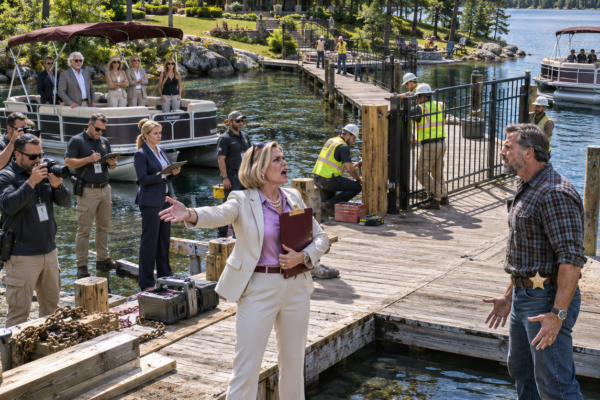
𝗙𝗨𝗟𝗟 𝗦𝗧𝗢𝗥𝗬 The Chain Across My Ranch Gate Was Only There Because of What They Were Hiding Underground
𝗙𝗨𝗟𝗟 𝗦𝗧𝗢𝗥𝗬
They were interested in one strip of ground.
That bothered me more than her claim about ownership.
By noon, the temperature had climbed past ninety. Heat shimmered over the fence wire. I parked under an old cottonwood and called Calvin Mercer, the surveyor who had handled the boundary adjustment after my father died.
Calvin was sixty-three, narrow as a fence post, with sunburned hands and a mind that kept land records sharper than most people kept birthdays. He remembered the ranch before I finished giving him the parcel number.
“Cedar Crown,” he said.
“Yes.”
“That subdivision wasn’t even platted when your family recorded the eastern tract.”
“They’re calling it a drainage corridor.”
Silence came through the phone.
Then paper moved on his end.
“Don’t touch their stakes.”
“Wasn’t planning to.”
“And don’t assume they’re trying to take the whole ranch.”
I watched the orange line disappear toward the ridge.
“I’m starting to figure that out.”
Calvin promised to meet me the next morning.
Until then, I had cattle to move.
Their digging had pushed half the herd away from the eastern trough, so I opened the south pasture and spent three hours shifting them through a narrow gate, one group at a time. Dust coated my jeans to the knees. By late afternoon, my shirt was dark between the shoulder blades, and my hands smelled like leather, mineral salt, and hot steel from the gate latch.
That work kept me from doing something stupid.
Near sunset, the security vehicles finally left.
The chain stayed.
I walked the fence instead of cutting it.
From the north side, I followed the green strip I had noticed that morning. Up close, it was even stranger. The surrounding grass broke dry under my boots, but this line stayed cool and thick. It ran almost perfectly beneath the survey flags.
Forty yards from the pond, I found a shallow place where the excavator had scraped away six inches of soil.
Something gray showed through the dirt.
Not rock.
Concrete.
I crouched and brushed loose clay aside with two fingers. The surface was old, rough, and rounded at the edge. Some kind of buried structure, maybe three feet across, running directly beneath the green line.
I stopped digging.
My father had taught me that much.
When you do not know what you are standing over, you do not put a shovel into it.
I wiped my hand on my jeans and looked toward the ridge.
Cedar Crown sat beyond it, rows of expensive roofs catching the last white light.
Then I remembered something I had not thought about in twenty years.
Every August, no matter how dry the ranch got, my father checked this pasture before anything else.
He called it the old run.
I had assumed he meant runoff.
That night, I went into the barn loft and pulled down his dented green toolbox.
Most of what was inside was exactly what I remembered. Fencing pliers. Grease pencils. A cracked voltmeter. Old receipts folded into quarters. Under the removable tray was a brass key tied to a faded wooden tag.
Two words had been burned into it by hand.
East Vault.
I turned the tag over in my palm.
On the back was a date.
Long before Cedar Crown existed.
Outside, somewhere beyond the barn wall, a diesel engine started near the eastern field.
I stepped to the loft window.
Headlights moved slowly along the ridge.
Meredith’s people had come back after dark.
The headlights stopped below the eastern ridge.
I killed the barn light and watched through the dusty loft window.
Two men climbed from a utility truck, followed by Meredith. Even at that distance, her red suit caught the beams when she crossed in front of them. One man carried a flashlight. The other dragged something long and dark from the truck bed.
A portable pump hose.
They were not surveying anymore.
I slipped the brass key into my pocket, went downstairs, and drove the north lease road without headlights until the cottonwoods hid my truck.
From there, I walked.
Dry grass scraped my boots. Crickets worked the creek bottom, but above them I heard metal strike concrete once, twice, then a hollow scrape.
I stopped behind the fence.
Meredith stood beside the exposed structure I had found earlier.
The men had cleared more soil from it, revealing a round concrete collar and a rusted steel hatch. One of them knelt over the lock.
“That isn’t going to fit,” Meredith said.
“Then we’ll cut it tomorrow.”
“Tomorrow is too late.”
Her voice carried cleanly through the warm night air.
“The county crew comes Thursday.”
The kneeling man looked up.
“You said Hail didn’t know.”
“He doesn’t.”
I felt the brass key against my thigh.
Nobody moved for several seconds.
Then Meredith pointed toward Cedar Crown.
“We need to know whether it’s still connected before anyone else gets near it.”
That changed the question.
Whatever sat beneath my pasture was not something they had discovered while challenging my deed.
They had challenged my deed because they wanted access to it.
I backed away without confronting them.
By sunrise, Calvin Mercer’s white survey pickup was beside my barn.
He stepped out wearing faded jeans, a survey vest, and reading glasses hanging from his shirt pocket. His face was already serious before I told him about the night before.
I showed him the concrete collar first.
He crouched beside it, ran his palm over the rim, then looked toward the ridge.
“I’ve seen these.”
“What is it?”
“Old water infrastructure. Could be a valve chamber.”
He stood and followed the green strip with his eyes.
“Could be more than that.”
We spent the morning checking monuments, not mysteries. Calvin located the original iron pins at the north and southeast corners and compared them against his field notes. By eleven, his answer was simple.
“Your fence is inside your recorded boundary,” he said. “Their stakes aren’t marking ownership.”
He tapped one orange marker with his boot.
“They’re tracing something.”
I showed him the brass key.
His expression changed.
“Where’d you get that?”
“My father’s toolbox.”
We returned to the concrete hatch.
I did not open it immediately.
First, I photographed its condition. Then I called the county utility office and asked whether they had any active equipment registered on my parcel.
The woman who answered put me on hold for six minutes.
When she came back, her voice was slower.
“Nothing active under county ownership, sir. But I have a retired reference to a private agricultural conveyance line.”
“From when?”
“Late seventies.”
Calvin looked at me.
I looked toward Cedar Crown.
I slid the brass key into the corroded lock.
It resisted.
Then turned with a hard metallic click.
We lifted the hatch together.
Cool air rose from below, carrying the smell of wet concrete and iron. A ladder disappeared about eight feet into darkness. At the bottom sat a heavy valve assembly attached to a pipe wide enough that I could have wrapped both arms around it and still not touched my hands.
The metal was old.
The fittings around it were not.
One section had newer bolts, fresh sealant, and a blue plastic tag hanging from a modern coupling.
Calvin aimed his flashlight toward the far wall.
A newer pipe disappeared through the concrete in the direction of Cedar Crown.
I heard tires on gravel behind us.
Meredith’s SUV stopped at the pasture gate.
She stepped out before the engine died.
This time, she was not smiling.
“Close that vault,” she shouted.
Calvin slowly straightened.
I stayed beside the open hatch.
“Yesterday you said this ranch wasn’t mine.”
Meredith walked toward us, heels sinking slightly into the dirt.
“You were interfering with community infrastructure.”
I looked down at the old valve, then at the newer line branching toward her subdivision.
“Funny,” I said. “Yesterday it was my property you wanted. Today it’s your infrastructure buried under it.”
She stopped ten feet away.
And that was when I knew she had finally said too much.
Meredith’s eyes dropped to the open vault, then snapped back to me.
“You don’t understand what you’re looking at.”
“Then explain it.”
She ignored me and pointed at Calvin.
“Who authorized him to inspect HOA infrastructure?”
Calvin took off his glasses and wiped them on his shirt.
“Lady, I’m standing on Mr. Hail’s recorded parcel.”
Her jaw tightened.
“This corridor predates his ownership.”
“So does he,” Calvin said, nodding toward the old concrete. “His family owned this ground before Cedar Crown existed.”
Meredith turned toward the security SUV.
“Close the vault.”
One of the guards started forward.
I stepped beside the hatch, not blocking him, just making the boundary clear.
“Nobody touches it.”
He stopped and looked at Meredith.
The wind pushed hot air across the pasture, carrying the sharp smell of dust and sunbaked weeds. Somewhere behind us, cattle knocked against a metal trough.
Meredith lowered her voice.
“You’re creating a serious problem for yourself.”
“No,” I said. “I’m trying to understand the one you brought onto my ranch.”
Her phone rang.
She glanced at the screen and walked twenty feet away before answering.
Calvin crouched again and studied the newer branch line without touching it.
“That coupling isn’t old,” he murmured.
“How new?”
“Years maybe. Not decades.”
I looked toward the subdivision roofs beyond the ridge.
Cedar Crown had expanded in three phases. The newest section sat highest on the hill where swimming pools and green lawns stayed bright through every dry summer.
Meredith ended her call and came back fast.
“The HOA will provide documentation through counsel. Until then, you are not to operate, alter, close, or interfere with anything in this vault.”
“I haven’t.”
“Good.”
She pointed at me.
“Keep it that way.”
Then she left.
That afternoon, I changed strategy.
I had spent two days reacting to her trucks, her chain, her stakes.
I was not going to chase her anymore.
I called the county utility office again and asked one question.
If an old private agricultural line crossed my parcel, who was responsible for any modern connection attached to it?
The answer was not immediate.
They scheduled a field review for Friday, two days away.
That gave Meredith forty-eight hours.
By Wednesday evening, Cedar Crown’s contractors had removed their excavator, their stakes, and even the chain from my gate. The pasture went quiet. It looked like a retreat.
Calvin called it good news.
I wanted to believe him.
Thursday morning, I found out why they had left.
The stock pond had dropped nearly eight inches overnight.
Mud showed around the shoreline in a dark ring. My cattle crowded the trough below it, but the float valve coughed air instead of water.
I walked straight to the east vault.
The hatch was still locked. The brass key turned normally.
Down below, the old main valve sat exactly where we had left it, but the newer branch line vibrated faintly under my palm.
Water was moving through it.
A lot of water.
I climbed out and followed the green strip uphill until I reached the property fence.
On the other side, Cedar Crown’s irrigation system was running in broad silver arcs across the common lawns. Sprinklers hissed over flower beds. Water streamed along the curb.
My pasture behind me was already beginning to dry around the trough.
That was the first time the cost of Meredith’s game stopped being abstract.
I had eighty-seven head depending on that water.
Moving them was not impossible, but it meant leased pasture, trucking, feed, temporary tanks, and days of work I had not planned to spend.
By sunset, I had arranged temporary tanks and called two neighbors for help.
I did not touch the buried line.
I did not turn the valve.
That was exactly what Meredith expected me to do.
At 6:40 the next morning, a courier delivered an envelope to my porch.
Inside was a notice from Cedar Crown’s attorney accusing me of threatening essential community water service and warning that any interruption could expose me to damages.
I read it twice.
Then I looked across the yard at three temporary water tanks I had paid to bring in before dawn.
Meredith had created the shortage, waited for me to react, and prepared to blame me if Cedar Crown lost water.
For a few hours, it looked like she had boxed me in.
Then Calvin arrived for the county inspection and stared at the shrinking pond.
“They increased the draw.”
I folded the attorney’s letter and slipped it into my pocket.
“I know.”
A white county truck appeared at the end of my road.
Meredith’s SUV turned in directly behind it.
The county truck rolled to a stop beside my barn, and a woman in a tan work shirt climbed out carrying a hard case and a clipboard. Her name was Dana Whitam, senior field inspector for the county water resources office.
Meredith parked twenty feet behind her and stepped out before Dana had even closed her door.
“Before we begin,” Meredith said, “Cedar Crown has continuous use rights to this system.”
Dana looked at her.
Then at me.
“I’m here to inspect infrastructure, not settle an argument.”
That shut everybody up.
We walked to the pond first.
Dana pushed a marked aluminum rod into the water at the old spillway, checked the exposed shoreline, then photographed the dry trough line.
I showed her the temporary tanks and the delivery invoice.
She asked when the pond had started falling.
“Wednesday night.”
Meredith folded her arms.
“Regional evaporation has been significant.”
Dana looked across the water.
“Eight inches overnight is not evaporation.”
Meredith’s face stayed still, but one finger began tapping against her sleeve.
At the east vault, I unlocked the hatch and stepped back.
Dana went down with a flashlight and a compact flow meter. Calvin remained above with me. Meredith stayed near the opening, watching every movement.
After several minutes, Dana called up, “Who installed the six-inch branch?”
Meredith answered immediately.
“It services Cedar Crown under an established utility easement.”
“I asked who installed it.”
Silence.
Dana climbed out and wiped dust from her knees.
“The original line is an agricultural conveyance system. The branch is modern. I need the installation permit and connection authorization.”
Meredith reached into her leather folder.
“Our counsel has the relevant records.”
“Then counsel can send them.”
For the first time all week, I saw Meredith lose control of the pace.
She could not order Dana off the ranch. She could not move the inspection somewhere private. Every answer created another question she had not chosen.
Dana followed the buried line toward the ridge near my boundary. She stopped beside a rectangular irrigation control box on Cedar Crown’s side of the fence. Fresh soil surrounded it. The grass was still flattened from recent work.
“Was this serviced this week?” she asked.
Meredith looked toward the subdivision maintenance supervisor.
He hesitated.
That hesitation was enough.
“Tuesday night,” he said.
Meredith turned sharply.
“Routine maintenance.”
Dana opened the box. Inside, a newer control valve sat fully open. She checked the meter, wrote down a number, then checked it again.
“This isn’t routine flow.”
She looked at me.
“Your pond feeds this line.”
“That’s what we’re trying to establish,” I said.
“No,” Meredith said. “The community system draws from a shared source.”
Dana stood and faced her.
“Then show me the source.”
Meredith did not answer.
By early afternoon, Dana ordered Cedar Crown to reduce the draw to its documented historical operating level until the connection could be reviewed.
Within an hour, the irrigation arcs across the ridge stopped.
By evening, the trough below my pond was running again.
I stood beside it while cattle crowded in, water slapping against galvanized steel.
For the first time since Monday, I thought we had turned the corner.
It felt like a win.
It was not.
At 9:17 that night, Calvin called.
“Evan, check your email.”
I opened the message at my kitchen table.
Attached was an old county scan Dana had sent him after locating the retired system reference. The drawing showed the 1978 agricultural line, the east vault, and something we had not seen underground because it sat nearly half a mile upstream.
A collection gallery beneath the limestone shelf on my western acreage.
The line did not merely cross my ranch.
It began there.
I stared at the drawing until the shapes settled into meaning.
Then Calvin said, “There’s another problem.”
“What?”
“Look at the capacity notation. I found it beside the old pipe symbol.”
The system had been designed to carry far more water than my cattle had ever needed.
Enough to supply hundreds of homes if someone quietly modernized the downstream connection.
Outside my kitchen window, the porch light caught dust moving across the yard. My father’s brass key lay beside the laptop.
Meredith had not been trying to protect a pipe under land she claimed was not mine.
She had been trying to control access to the source before anyone proved where Cedar Crown’s water actually came from.
The next morning, I did not go looking for the collection gallery.
I already knew roughly where it was, and tearing into limestone without knowing the condition of a forty-eight-year-old water system would have been reckless. Instead, I moved the cattle into the south pasture, checked every temporary tank, and waited for Dana.
She arrived just after eight with Calvin and a county hydrology technician named Luis Ortega. We walked west along the route shown on the 1978 drawing. The air was already hot, and grasshoppers snapped out of the weeds ahead of our boots.
Near the limestone shelf, Luis stopped beside a cluster of cottonwoods.
“Feel that?”
The ground beneath them was cool.
Ten feet farther, everything was dry enough to crack under my heel.
We found the old access structure behind a collapsed section of stone wall, almost completely hidden by roots and brush. A rusted steel plate sat flush with the ground.
No HOA equipment.
No new fittings.
Just something my father had apparently left alone for decades.
Dana photographed it and told me not to open anything until she confirmed the county records.
I agreed.
That decision cost me before lunch.
At 11:26, two Cedar Crown maintenance trucks appeared on the county road beyond my western fence.
They did not enter my property.
They did not need to.
A crew began excavating beside a downstream junction located inside the subdivision’s utility strip.
Meredith arrived twenty minutes later.
I drove to my boundary and watched from my side.
“What are you doing?” I called.
She stood across the fence with her arms folded.
“Protecting our residents.”
Behind her, workers exposed the Cedar Crown branch connection.
“From what?”
“From you.”
The words landed flat in the heat.
Then I understood.
Dana’s temporary restriction had weakened Meredith’s control. So she was changing the physical system before the source review could finish. If she could separate Cedar Crown from the old ranch line and establish another temporary supply, she could argue that whatever happened before was irrelevant.
By midafternoon, water trucks were entering the subdivision. Residents filled the sidewalks, watching hoses run toward temporary storage bladders near the clubhouse.
It looked expensive, hurried, and almost competent.
Meredith had adapted faster than I expected.
Then my phone rang.
Dana.
“Evan, don’t operate anything on your system.”
“I haven’t.”
“Good. Cedar Crown just submitted an emergency disconnection notice.”
I watched a worker lower a section of pipe beside the trench.
“Can they do that?”
“On their side, they can isolate their branch. But there’s something they may not understand about that old design.”
She paused.
“The original line wasn’t pressurized by a municipal pump. It is gravity-fed from your collection gallery. The downstream branch helped maintain a controlled draw.”
I looked back toward my pasture.
“Meaning?”
“Meaning if they close the wrong point too quickly, pressure can redistribute upstream. Your pond level may rise.”
That did not sound dangerous yet.
“How much?”
“That’s what we don’t know.”
I was already walking toward my truck.
By four o’clock, the trough overflowed.
At five, water reached the top of the pond’s normal bank and spread into the grass. The same green strip that had led me to the vault now darkened across the pasture as moisture pushed upward along the buried line.
I opened the cattle gate and moved the herd farther south.
No panic.
No heroics.
Just work before dark.
Calvin arrived as I finished. He stood beside the pond, staring at water curling over the old spillway.
“They shut their branch.”
I nodded.
“Looks that way.”
He rubbed his jaw.
“Your father built his whole pasture drainage around this system.”
That was when the second memory came back.
Every spring, Dad cleared a shallow channel from the pond toward the creek. He never called it drainage.
He called it the relief run.
I grabbed a shovel from the truck.
The channel was still there, buried under twenty years of grass and silt. Calvin and I cleared the blocked mouth by hand, enough to let the rising water move safely toward the creek without touching the old valves.
Cold water rushed around my boots and carried loose dirt downstream.
At sunset, the pond stopped climbing.
Across the ridge, generators hummed beside Cedar Crown’s emergency tanks.
Meredith had disconnected herself from my water before anyone forced her to.
And in doing it, she had demonstrated exactly what the county still needed to establish.
When Cedar Crown stopped drawing, my ranch filled back up.
By sunrise, the relief run had carved a clean ribbon through the mud toward the creek. My boots were still wet when Dana arrived with Luis.
Neither of them needed me to explain what had happened.
The pond had stabilized.
Cedar Crown’s irrigation fields beyond the ridge were brown and silent, while three water tankers idled beside the clubhouse.
Dana walked the spillway, photographed the freshwater marks, then checked the east vault.
“Nobody touched this valve?”
“Not me.”
Calvin pointed toward the subdivision.
“Their branch closed yesterday afternoon. His pond started rising afterward.”
Luis set two pressure gauges on the old line and another at the boundary connection.
We waited.
The morning heat climbed. Cicadas buzzed in the cottonwoods. Every few minutes, Luis wrote down another reading.
Meredith arrived around ten with an attorney and Cedar Crown’s maintenance supervisor.
She stayed on the subdivision side of the fence this time.
“Our emergency isolation was lawful,” her attorney said.
Dana did not look up from the gauge.
“Nobody said it wasn’t.”
Meredith’s eyes settled on me.
“Then this proves nothing.”
I wiped mud from the shovel handle and leaned it against my truck.
“Reconnect it.”
Her expression changed just slightly.
Dana looked at me.
“Mr. Hail—”
“If their line has nothing to do with my source, reconnecting it shouldn’t change anything here.”
Meredith stepped forward.
“Absolutely not.”
“Yesterday, you couldn’t disconnect fast enough.”
Her attorney whispered something to her.
She shook her head.
That refusal mattered more than another stack of records.
Dana could not force an immediate reconnection simply to test my theory, but Cedar Crown had already created the first half of the experiment themselves.
I decided to create the second half without touching their equipment.
The temporary tanks had bought me time, so I stopped fighting to preserve normal ranch operations. I leased another forty acres from my neighbor for thirty days and moved most of the herd there. It cost me money I had not planned to spend, but it removed the pressure Meredith had been using against me.
She could not drain my pond and wait for desperate cattle to force my hand anymore.
That afternoon, the county approved a controlled flow test on my side of the original agricultural system. Luis installed temporary monitoring equipment at the east vault and the western collection gallery while I left every permanent valve exactly where it was.
At 3:12, the readings confirmed steady gravity-fed flow from the limestone shelf to the pond.
Then Luis compared that rate with Cedar Crown’s consumption records from before the emergency disconnection.
He stared at the numbers for a long time.
“Their historical draw is almost the difference.”
Dana took the sheet from him.
Meredith crossed her arms.
“Almost isn’t proof.”
Dana nodded once.
“You’re right.”
Meredith looked relieved.
Too relieved.
Then the maintenance supervisor beside her cleared his throat.
“There is something else.”
Meredith turned toward him.
“Tom.”
He did not look at her.
“When we isolated the branch yesterday, the clubhouse pressure alarms went off before the tankers were connected.”
Dana’s head lifted.
“How quickly?”
“About four minutes.”
“Tom,” Meredith said again, harder this time.
He finally faced her.
“You told me this ranch line was backup supply. Backup doesn’t kill our pressure in four minutes.”
The attorney stopped writing.
Wind moved through the fence grass between us.
Meredith’s face went pale beneath the summer heat.
The man she had brought to protect Cedar Crown had just changed the entire balance of the fight.
Dana closed her clipboard.
“I want the HOA’s installation records for that branch, all water service contracts, and the engineering files from every Cedar Crown expansion phase.”
Meredith opened her mouth.
Dana cut her off.
“Today.”
For the first time since she had chained my gate, Meredith was not telling anyone what happened next.
Her own system was doing that for her.
By noon the next day, Cedar Crown’s clubhouse parking lot was packed with residents carrying bottled water, contractor invoices, and questions Meredith could no longer answer with a pointed finger. The tankers had kept toilets flushing, but lawn irrigation was suspended, the clubhouse pool was closed, and temporary hoses ran across the landscaping like exposed veins.
I did not go there to celebrate.
I went because Dana asked me to attend the controlled reconnection test at the subdivision’s utility junction.
Meredith stood beside the open trench in the same red pantsuit, immaculate except for a stripe of dust near one cuff. Her attorney stayed close. Tom, the maintenance supervisor, worked with Luis beside the isolated branch.
Dana explained the test once.
Cedar Crown would reopen its connection gradually while gauges recorded flow at the ranch vault, the collection gallery, and the subdivision junction. Nobody would touch my original valves.
“Proceed,” Dana said.
Tom turned the control slowly.
Metal groaned inside the box.
Thirty seconds later, Luis called out the first reading.
“Flow increased at the east vault.”
Another quarter turn.
The pond level sensor began dropping.
The change was small but immediate.
Dana watched the numbers without speaking.
Meredith stared at Tom’s hand.
“Stop,” she said.
Dana looked up.
“Why?”
“Because you’re destabilizing our system.”
“Your system?” Dana asked.
Meredith caught herself too late.
Tom stopped turning. Luis compared the readings and handed Dana the tablet.
The relationship was clean enough to see without an engineering degree.
Cedar Crown opened its branch, and water left the ranch system toward the subdivision.
Dana ordered the valve returned to the isolated position.
That should have been the turning point.
Then Meredith’s attorney handed her a folder.
“The HOA purchased conveyance rights from the original developer,” he said. “Those rights predate several current homeowners.”
For half a minute, I thought they had found their escape.
A legitimate water agreement could explain the connection, even if Meredith had lied about the land.
Dana read the first page, then passed it to Calvin.
He scanned it and looked at me.
“Evan, this agreement is real.”
My stomach tightened.
Meredith finally smiled.
“Then we’re finished here.”
Calvin kept reading.
“No.”
Her smile disappeared.
He tapped the page.
“The developer purchased a limited agricultural overflow allocation. Seasonal use. Maximum volume specified.”
Dana took the document back.
“And it doesn’t grant ownership of the source, the vault, or the ranch corridor.”
Tom leaned over her shoulder.
“We’re way above that volume.”
Meredith said nothing.
Dana compared the agreement with Cedar Crown’s consumption records. The subdivision had grown from forty-six homes to more than three hundred, but the old allocation had never been expanded.
The modern six-inch branch had not preserved an old right.
It had multiplied the draw far beyond it.
Worse, the agreement required written consent from the source owner before any material modification.
My father’s signature was not there.
Neither was mine.
I looked across the trench at Meredith.
“That’s why you needed the corridor.”
Her attorney lowered his folder.
She did not answer.
She did not have to.
If Cedar Crown could make the strip of land containing the line appear to belong to the HOA, the missing consent became easier to bury beneath a manufactured boundary dispute. Meredith had ordered me off my own ranch because the ranch itself was the one thing she could not let remain unquestioned.
Dana closed the file.
“The unauthorized branch remains isolated effective immediately.”
Meredith stepped toward her.
“Three hundred families depend on that water.”
“Then you should have secured a lawful supply before expanding the system.”
Behind us, residents had gathered along the sidewalk.
No cheering.
Just silence.
Meredith looked past them toward the tankers, then back at me.
For the first time, the cost of every shortcut she had taken was standing where she could see it.
And the county still had not reached the part about who ordered the unauthorized connection installed.
Three mornings later, I found the chain from my gate lying beside the Cedar Crown maintenance shed.
Somebody had cut it into short sections and dropped them in a scrap bin.
I stood there with my hands on my belt while county contractors worked twenty yards away, disconnecting the unauthorized six-inch branch and installing a temporary metered supply from Cedar Crown’s approved municipal connection.
The subdivision had water again.
This time, they were paying for it.
Tom had turned over the maintenance files the evening after the reconnection test. The installation order for the oversized branch was six years old, signed during Cedar Crown’s second expansion.
Meredith had not signed that original order.
But the records showed something worse for her personally.
Eighteen months earlier, after an engineer warned the board that Cedar Crown was exceeding its limited ranch water allocation, Meredith had approved continued high-volume use and postponed conversion to municipal service because the connection fees would have forced a large special assessment.
Then, when the county scheduled a review of the old system, she authorized the survey crew that entered my ranch and tried to recast the water corridor as association-controlled property.
That was the choice that finished her.
Not the old pipe.
Not my father’s key.
Hers.
Cedar Crown’s board called an emergency meeting that Friday.
I attended only long enough to answer questions about the ranch.
The room smelled like coffee, hot printer paper, and too many people packed under fluorescent lights. Meredith sat at the front table without her usual folder.
When a board member asked whether she had known about the engineer’s warning before ordering work on my property, she stared at the tabletop for several seconds.
“I was protecting the community from a catastrophic increase in water costs.”
Nobody shouted.
A woman in the second row simply asked, “By taking his?”
Meredith looked toward me.
I did not answer for her.
By the end of the meeting, the board removed Meredith as president and terminated her authority to act for Cedar Crown. The county penalties, the trespass claim, and the cost of repairing my pasture went where they belonged: to the people and decisions that had created them.
My attorney handled the rest.
What mattered to me was simpler.
Cedar Crown recorded my ranch boundary for what it had always been and abandoned every claim to the east corridor.
Meredith had spent a week trying to turn a buried water line into a reason my land was not mine.
In the end, that same line became the reason nobody could pretend otherwise.
I did not shut off water to three hundred families.
I never wanted that.
Cedar Crown completed its municipal connection and paid the rates it should have been paying all along. The original 1978 allocation returned to its limited agricultural purpose under a new metered agreement that could not be quietly expanded again.
A month later, I walked the eastern pasture after a light rain.
The excavator scars had been graded and reseeded. The stock pond sat full beneath a gray-blue morning sky.
At the east vault, I replaced the corroded lock with a new one. Then I held my father’s brass key for a moment before putting it back in the green toolbox.
I finally understood why he had kept it.
Not because the key was valuable.
Because knowing what belonged to you sometimes meant knowing what ran beneath your feet.
On my way back to the barn, I stopped where Meredith had stood that first morning and told me the ranch had never been mine.
The orange stakes were gone.
The security trucks were gone.
Cedar Crown sprinklers turned in measured arcs beyond the ridge, fed by water they were finally buying through their own system.
Behind me, my cattle drank from the trough, and the float valve clicked shut when the tank reached full.
Small sound.
Clean sound.
Nothing dramatic about it.
I picked up the last piece of orange survey ribbon caught beneath the fence wire, rolled it between my fingers, and dropped it into my pocket.
They had come onto my land believing the ground beneath it was their leverage.
In the end, it was the one thing that told the truth every time they tried to change the story.
𝗧𝗛𝗘 𝗘𝗡𝗗
The Chain Across My Ranch Gate Was Only There Because of What They Were Hiding Underground
The chain across my ranch road was new enough to shine in the morning light.
Behind it, an excavator was already tearing into pasture my father had worked before the subdivision over the ridge had a name.
And the woman in the red pantsuit told me to leave my own land before I found out what she had really come to dig up.
My name is Evan Hail, and I had driven through that gate since I was sixteen years old.
I had opened it in the dark before cattle sales, in the heat before summer storms, and in the cold when the latch burned my fingers through my gloves. I had leaned against its cedar post with my father while he talked about grass, water, and the strange way land remembers what people forget. I had replaced that post with him one August afternoon when the temperature hit a hundred and four, and the old man still refused to quit before the concrete set.
Twelve years later, I buried him on the western rise above the stock pond.
From that hill, you could see nearly all of our ranch: the farmhouse, the barn, the eastern pasture, the pond, the creek, the ridge, and beyond it, the expensive roofs of Cedar Crown, the subdivision that had grown over the hill like a polished machine.
My father never liked Cedar Crown.
He did not hate the people who lived there. That was not his way. He believed most people were decent until paperwork convinced them they owned more than they did. But he never trusted the board, the developers, or anyone who called land “a corridor” before asking whose boots had worn paths into it.
“Anytime someone calls your ground a corridor,” he once told me, “they already stopped seeing it as yours.”
I was too young then to know how right he was.
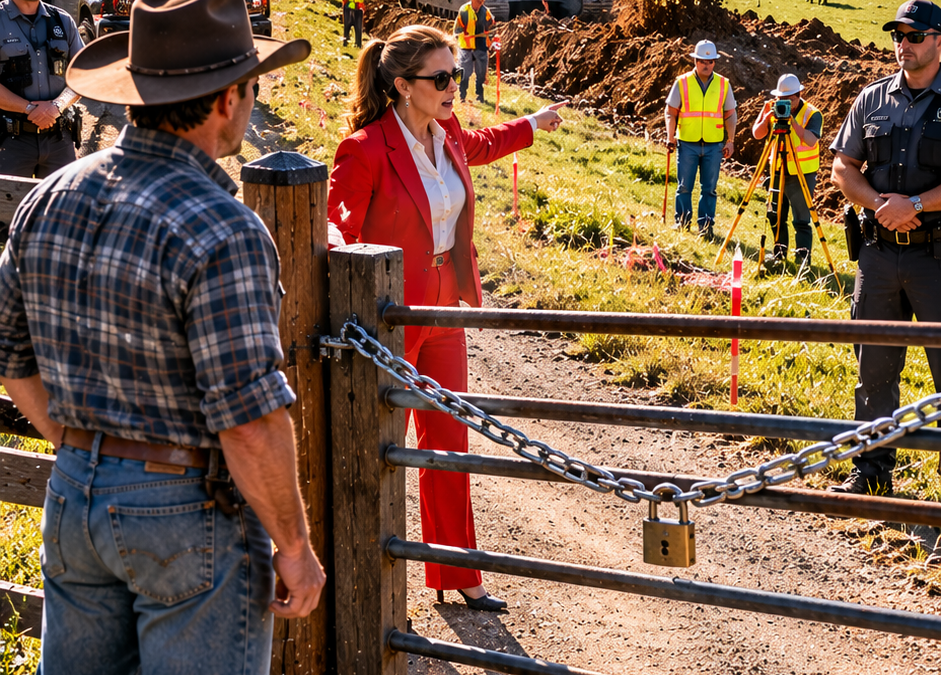
The morning it happened, I saw the steel chain from fifty yards out and eased my truck off the gas.
At first, my brain refused to understand it.
A chain across my ranch road.
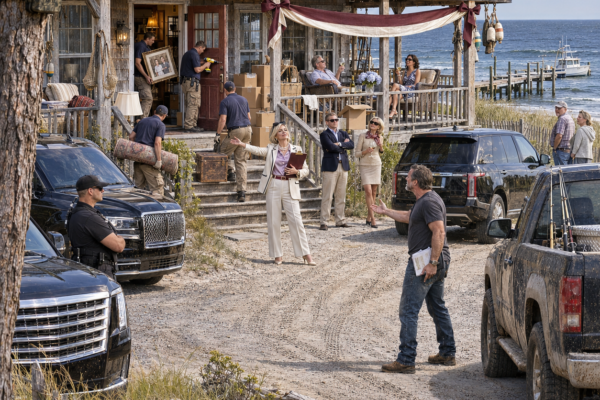
Two black security SUVs sitting beyond my gate with their engines running.
Three men in gray uniforms standing inside my fence like they belonged there.
And beyond them, in my eastern pasture, an excavator swung its bucket over fresh dirt.
The bucket teeth opened.
Wet clay rolled off and hit the ground with a heavy thump.
I stopped the truck, stepped out, and smelled diesel, crushed grass, and exposed earth.
My cattle had already drifted away from the noise, heads raised, bodies tight, moving toward the far fence like they knew better than the humans where trouble was coming from.
“Who authorized that machine?” I called.
One of the guards moved toward the gate.
Then Meredith Sloan stepped around the nearest SUV.
I knew her before she said a word.
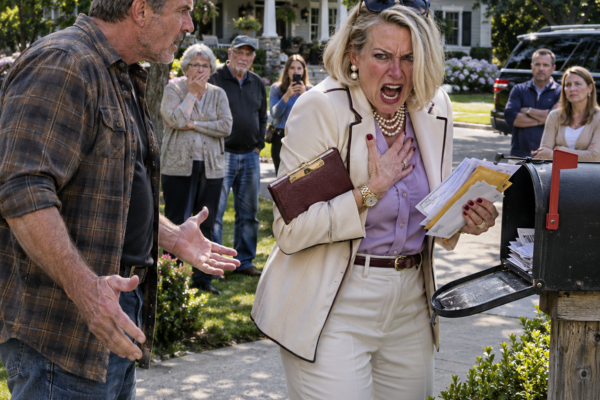
Everyone within five miles of Cedar Crown knew Meredith Sloan. She was the HOA president, though she carried herself more like a mayor of something larger than a subdivision. Red pantsuit, light blouse, brown hair pulled into a tight ponytail, not a speck of mud on her shoes despite standing in a pasture she had no right to enter.
She looked at the chain, then at me.
“Mr. Hail,” she said. “You need to leave the property.”
For a second, I thought I had misheard her.
I hooked my thumbs over my belt and looked past her at the excavator.
“Try that again.”
Meredith pointed toward a row of fresh survey stakes cutting across the pasture. Bright orange paint marked the grass every few yards.
“This parcel was never legally yours.”
A pickup from Cedar Crown sat beside the excavator. Two surveyors worked near my stock pond while another man stretched temporary marking line toward the ridge. They were not looking at me like trespassers. They looked like people who had been told they were supposed to be there.
That was the dangerous part.
A thief knows he is stealing.
People with bad paperwork think they are enforcing order.
I walked to the chain but did not touch it.
“You crossed my gate, chained it behind you, and started digging before anyone proved a damn thing.”
Meredith’s mouth tightened.
“The HOA has documentation showing this corridor was designated for community drainage use.”
“A corridor.”
I looked toward the survey stakes.
That was the first detail that did not fit.
They were not marking the farmhouse.
They were not surrounding the barn or cutting across the grazing fields.
They formed a narrow line, maybe forty feet wide, running from the Cedar Crown side of the ridge toward the low creek beyond my stock pond.
The excavator bucket dropped again.
Dirt slapped against dirt.
One of my steers bawled from the far fence.
“If this ranch was never mine,” I said, “why aren’t you surveying the ranch?”
Meredith glanced toward the machine.
Just once.
Quick enough that she probably thought I missed it.
I did not.
“This is not a discussion we’re having at the gate,” she said.
“It’s my gate.”
The closest guard shifted his weight.
I looked at him.
Then at Meredith.
Nobody reached for anybody.
Nobody needed to.
The chain said enough.
Meredith raised one hand toward the security team.
“Do not allow him beyond this point until the boundary issue is resolved.”
The excavator crawled several feet forward. Its tracks pressed dark scars into grass my cattle had been grazing the night before.
I could see the operator aiming for a shallow depression beside the pond.
My father used to walk that same stretch after hard rain. He would carry a shovel, clear mud from the ditch, then stand there listening longer than the job required. I always thought he was checking runoff.
Something else caught my eye now.
The summer had burned most of the pasture pale brown, but beneath those orange stakes ran a ribbon of green grass. Unnaturally straight. Narrow. Cooler and thicker than everything around it.
It disappeared toward the ridge.
I stared at it.
Meredith noticed.
“Mr. Hail.”
I lifted my eyes to hers.
“You still haven’t answered me.”
“Answered what?”
I pointed past her toward the excavator.
“If this land was never mine, why were you in such a hurry to start digging before I got home?”
For the first time that morning, Meredith Sloan had nothing ready to say.
I stayed outside the chain until the excavator shut down.
That mattered.
Meredith wanted an argument she could point to later. Something loud enough to turn trespassing into a dispute between two unreasonable people. She wanted me pushing through the chain. She wanted me grabbing a guard by the shirt. She wanted phone footage of a rancher losing his temper while she stood there calm and official.
I gave her nothing.
I took out my phone and photographed the chain, the security trucks, the orange stakes, and every track the excavator had pressed into my pasture.
Then I drove around to the north lease road where my neighbor’s fence ran along the ridge.
From there, I could see almost the entire eastern field. The machine sat beside the stock pond with its bucket lowered. Meredith stood with two surveyors over a patch of exposed soil. Nobody was looking at the farmhouse. Nobody was measuring the barn.
They were interested in one strip of ground.
That bothered me more than her claim about ownership.
By noon, the temperature had climbed past ninety. Heat shimmered over the fence wire. I parked under an old cottonwood and called Calvin Mercer, the surveyor who had handled the boundary adjustment after my father died.
Calvin was sixty-three, narrow as a fence post, with sunburned hands and a mind that kept land records sharper than most people kept birthdays. He remembered the ranch before I finished giving him the parcel number.
“Cedar Crown,” he said.
“Yes.”
“That subdivision wasn’t even platted when your family recorded the eastern tract.”
“They’re calling it a drainage corridor.”
Silence came through the phone.
Then paper moved on his end.
“Don’t touch their stakes.”
“Wasn’t planning to.”
“And don’t assume they’re trying to take the whole ranch.”
I watched the orange line disappear toward the ridge.
“I’m starting to figure that out.”
Calvin promised to meet me the next morning.
Until then, I had cattle to move.
Their digging had pushed half the herd away from the eastern trough, so I opened the south pasture and spent three hours shifting them through a narrow gate, one group at a time. Dust coated my jeans to the knees. By late afternoon, my shirt was dark between the shoulder blades, and my hands smelled like leather, mineral salt, and hot steel from the gate latch.
That work kept me from doing something stupid.
Near sunset, the security vehicles finally left.
The chain stayed.
I walked the fence instead of cutting it.
From the north side, I followed the green strip I had noticed that morning. Up close, it was even stranger. The surrounding grass broke dry under my boots, but this line stayed cool and thick. It ran almost perfectly beneath the survey flags.
Forty yards from the pond, I found a shallow place where the excavator had scraped away six inches of soil.
Something gray showed through the dirt.
Not rock.
Concrete.
I crouched and brushed loose clay aside with two fingers. The surface was old, rough, and rounded at the edge. Some kind of buried structure, maybe three feet across, running directly beneath the green line.
I stopped digging.
My father had taught me that much.
When you do not know what you are standing over, you do not put a shovel into it.
I wiped my hand on my jeans and looked toward the ridge.
Cedar Crown sat beyond it, rows of expensive roofs catching the last white light.
Then I remembered something I had not thought about in twenty years.
Every August, no matter how dry the ranch got, my father checked this pasture before anything else.
He called it the old run.
I had assumed he meant runoff.
That night, I went into the barn loft and pulled down his dented green toolbox.
Most of what was inside was exactly what I remembered. Fencing pliers. Grease pencils. A cracked voltmeter. Old receipts folded into quarters. Under the removable tray was a brass key tied to a faded wooden tag.
Two words had been burned into it by hand.
East Vault.
I turned the tag over in my palm.
On the back was a date.
Long before Cedar Crown existed.
Outside, somewhere beyond the barn wall, a diesel engine started near the eastern field.
I stepped to the loft window.
Headlights moved slowly along the ridge.
Meredith’s people had come back after dark.
The headlights stopped below the eastern ridge.
I killed the barn light and watched through the dusty loft window.
Two men climbed from a utility truck, followed by Meredith. Even at that distance, her red suit caught the beams when she crossed in front of them. One man carried a flashlight. The other dragged something long and dark from the truck bed.
A portable pump hose.
They were not surveying anymore.
I slipped the brass key into my pocket, went downstairs, and drove the north lease road without headlights until the cottonwoods hid my truck.
From there, I walked.
Dry grass scraped my boots. Crickets worked the creek bottom, but above them I heard metal strike concrete once, twice, then a hollow scrape.
I stopped behind the fence.
Meredith stood beside the exposed structure I had found earlier.
The men had cleared more soil from it, revealing a round concrete collar and a rusted steel hatch. One of them knelt over the lock.
“That isn’t going to fit,” Meredith said.
“Then we’ll cut it tomorrow.”
“Tomorrow is too late.”
Her voice carried cleanly through the warm night air.
“The county crew comes Thursday.”
The kneeling man looked up.
“You said Hail didn’t know.”
“He doesn’t.”
I felt the brass key against my thigh.
Nobody moved for several seconds.
Then Meredith pointed toward Cedar Crown.
“We need to know whether it’s still connected before anyone else gets near it.”
That changed the question.
Whatever sat beneath my pasture was not something they had discovered while challenging my deed.
They had challenged my deed because they wanted access to it.
I backed away without confronting them.
By sunrise, Calvin Mercer’s white survey pickup was beside my barn.
He stepped out wearing faded jeans, a survey vest, and reading glasses hanging from his shirt pocket. His face was already serious before I told him about the night before.
I showed him the concrete collar first.
He crouched beside it, ran his palm over the rim, then looked toward the ridge.
“I’ve seen these.”
“What is it?”
“Old water infrastructure. Could be a valve chamber.”
He stood and followed the green strip with his eyes.
“Could be more than that.”
We spent the morning checking monuments, not mysteries. Calvin located the original iron pins at the north and southeast corners and compared them against his field notes. By eleven, his answer was simple.
“Your fence is inside your recorded boundary,” he said. “Their stakes aren’t marking ownership.”
He tapped one orange marker with his boot.
“They’re tracing something.”
I showed him the brass key.
His expression changed.
“Where’d you get that?”
“My father’s toolbox.”
We returned to the concrete hatch.
I did not open it immediately.
First, I photographed its condition. Then I called the county utility office and asked whether they had any active equipment registered on my parcel.
The woman who answered put me on hold for six minutes.
When she came back, her voice was slower.
“Nothing active under county ownership, sir. But I have a retired reference to a private agricultural conveyance line.”
“From when?”
“Late seventies.”
Calvin looked at me.
I looked toward Cedar Crown.
I slid the brass key into the corroded lock.
It resisted.
Then turned with a hard metallic click.
We lifted the hatch together.
Cool air rose from below, carrying the smell of wet concrete and iron. A ladder disappeared about eight feet into darkness. At the bottom sat a heavy valve assembly attached to a pipe wide enough that I could have wrapped both arms around it and still not touched my hands.
The metal was old.
The fittings around it were not.
One section had newer bolts, fresh sealant, and a blue plastic tag hanging from a modern coupling.
Calvin aimed his flashlight toward the far wall.
A newer pipe disappeared through the concrete in the direction of Cedar Crown.
I heard tires on gravel behind us.
Meredith’s SUV stopped at the pasture gate.
She stepped out before the engine died.
This time, she was not smiling.
“Close that vault,” she shouted.
Calvin slowly straightened.
I stayed beside the open hatch.
“Yesterday you said this ranch wasn’t mine.”
Meredith walked toward us, heels sinking slightly into the dirt.
“You were interfering with community infrastructure.”
I looked down at the old valve, then at the newer line branching toward her subdivision.
“Funny,” I said. “Yesterday it was my property you wanted. Today it’s your infrastructure buried under it.”
She stopped ten feet away.
And that was when I knew she had finally said too much.
Meredith’s eyes dropped to the open vault, then snapped back to me.
“You don’t understand what you’re looking at.”
“Then explain it.”
She ignored me and pointed at Calvin.
“Who authorized him to inspect HOA infrastructure?”
Calvin took off his glasses and wiped them on his shirt.
“Lady, I’m standing on Mr. Hail’s recorded parcel.”
Her jaw tightened.
“This corridor predates his ownership.”
“So does he,” Calvin said, nodding toward the old concrete. “His family owned this ground before Cedar Crown existed.”
Meredith turned toward the security SUV.
“Close the vault.”
One of the guards started forward.
I stepped beside the hatch, not blocking him, just making the boundary clear.
“Nobody touches it.”
He stopped and looked at Meredith.
The wind pushed hot air across the pasture, carrying the sharp smell of dust and sunbaked weeds. Somewhere behind us, cattle knocked against a metal trough.
Meredith lowered her voice.
“You’re creating a serious problem for yourself.”
“No,” I said. “I’m trying to understand the one you brought onto my ranch.”
Her phone rang.
She glanced at the screen and walked twenty feet away before answering.
Calvin crouched again and studied the newer branch line without touching it.
“That coupling isn’t old,” he murmured.
“How new?”
“Years maybe. Not decades.”
I looked toward the subdivision roofs beyond the ridge.
Cedar Crown had expanded in three phases. The newest section sat highest on the hill where swimming pools and green lawns stayed bright through every dry summer.
Meredith ended her call and came back fast.
“The HOA will provide documentation through counsel. Until then, you are not to operate, alter, close, or interfere with anything in this vault.”
“I haven’t.”
“Good.”
She pointed at me.
“Keep it that way.”
Then she left.
That afternoon, I changed strategy.
I had spent two days reacting to her trucks, her chain, her stakes.
I was not going to chase her anymore.
I called the county utility office again and asked one question.
If an old private agricultural line crossed my parcel, who was responsible for any modern connection attached to it?
The answer was not immediate.
They scheduled a field review for Friday, two days away.
That gave Meredith forty-eight hours.
By Wednesday evening, Cedar Crown’s contractors had removed their excavator, their stakes, and even the chain from my gate. The pasture went quiet. It looked like a retreat.
Calvin called it good news.
I wanted to believe him.
Thursday morning, I found out why they had left.
The stock pond had dropped nearly eight inches overnight.
Mud showed around the shoreline in a dark ring. My cattle crowded the trough below it, but the float valve coughed air instead of water.
I walked straight to the east vault.
The hatch was still locked. The brass key turned normally.
Down below, the old main valve sat exactly where we had left it, but the newer branch line vibrated faintly under my palm.
Water was moving through it.
A lot of water.
I climbed out and followed the green strip uphill until I reached the property fence.
On the other side, Cedar Crown’s irrigation system was running in broad silver arcs across the common lawns. Sprinklers hissed over flower beds. Water streamed along the curb.
My pasture behind me was already beginning to dry around the trough.
That was the first time the cost of Meredith’s game stopped being abstract.
I had eighty-seven head depending on that water.
Moving them was not impossible, but it meant leased pasture, trucking, feed, temporary tanks, and days of work I had not planned to spend.
By sunset, I had arranged temporary tanks and called two neighbors for help.
I did not touch the buried line.
I did not turn the valve.
That was exactly what Meredith expected me to do.
At 6:40 the next morning, a courier delivered an envelope to my porch.
Inside was a notice from Cedar Crown’s attorney accusing me of threatening essential community water service and warning that any interruption could expose me to damages.
I read it twice.
Then I looked across the yard at three temporary water tanks I had paid to bring in before dawn.
Meredith had created the shortage, waited for me to react, and prepared to blame me if Cedar Crown lost water.
For a few hours, it looked like she had boxed me in.
Then Calvin arrived for the county inspection and stared at the shrinking pond.
“They increased the draw.”
I folded the attorney’s letter and slipped it into my pocket.
“I know.”
A white county truck appeared at the end of my road.
Meredith’s SUV turned in directly behind it.
The county truck rolled to a stop beside my barn, and a woman in a tan work shirt climbed out carrying a hard case and a clipboard. Her name was Dana Whitam, senior field inspector for the county water resources office.
Meredith parked twenty feet behind her and stepped out before Dana had even closed her door.
“Before we begin,” Meredith said, “Cedar Crown has continuous use rights to this system.”
Dana looked at her.
Then at me.
“I’m here to inspect infrastructure, not settle an argument.”
That shut everybody up.
We walked to the pond first.
Dana pushed a marked aluminum rod into the water at the old spillway, checked the exposed shoreline, then photographed the dry trough line.
I showed her the temporary tanks and the delivery invoice.
She asked when the pond had started falling.
“Wednesday night.”
Meredith folded her arms.
“Regional evaporation has been significant.”
Dana looked across the water.
“Eight inches overnight is not evaporation.”
Meredith’s face stayed still, but one finger began tapping against her sleeve.
At the east vault, I unlocked the hatch and stepped back.
Dana went down with a flashlight and a compact flow meter. Calvin remained above with me. Meredith stayed near the opening, watching every movement.
After several minutes, Dana called up, “Who installed the six-inch branch?”
Meredith answered immediately.
“It services Cedar Crown under an established utility easement.”
“I asked who installed it.”
Silence.
Dana climbed out and wiped dust from her knees.
“The original line is an agricultural conveyance system. The branch is modern. I need the installation permit and connection authorization.”
Meredith reached into her leather folder.
“Our counsel has the relevant records.”
“Then counsel can send them.”
For the first time all week, I saw Meredith lose control of the pace.
She could not order Dana off the ranch. She could not move the inspection somewhere private. Every answer created another question she had not chosen.
Dana followed the buried line toward the ridge near my boundary. She stopped beside a rectangular irrigation control box on Cedar Crown’s side of the fence. Fresh soil surrounded it. The grass was still flattened from recent work.
“Was this serviced this week?” she asked.
Meredith looked toward the subdivision maintenance supervisor.
He hesitated.
That hesitation was enough.
“Tuesday night,” he said.
Meredith turned sharply.
“Routine maintenance.”
Dana opened the box. Inside, a newer control valve sat fully open. She checked the meter, wrote down a number, then checked it again.
“This isn’t routine flow.”
She looked at me.
“Your pond feeds this line.”
“That’s what we’re trying to establish,” I said.
“No,” Meredith said. “The community system draws from a shared source.”
Dana stood and faced her.
“Then show me the source.”
Meredith did not answer.
By early afternoon, Dana ordered Cedar Crown to reduce the draw to its documented historical operating level until the connection could be reviewed.
Within an hour, the irrigation arcs across the ridge stopped.
By evening, the trough below my pond was running again.
I stood beside it while cattle crowded in, water slapping against galvanized steel.
For the first time since Monday, I thought we had turned the corner.
It felt like a win.
It was not.
At 9:17 that night, Calvin called.
“Evan, check your email.”
I opened the message at my kitchen table.
Attached was an old county scan Dana had sent him after locating the retired system reference. The drawing showed the 1978 agricultural line, the east vault, and something we had not seen underground because it sat nearly half a mile upstream.
A collection gallery beneath the limestone shelf on my western acreage.
The line did not merely cross my ranch.
It began there.
I stared at the drawing until the shapes settled into meaning.
Then Calvin said, “There’s another problem.”
“What?”
“Look at the capacity notation. I found it beside the old pipe symbol.”
The system had been designed to carry far more water than my cattle had ever needed.
Enough to supply hundreds of homes if someone quietly modernized the downstream connection.
Outside my kitchen window, the porch light caught dust moving across the yard. My father’s brass key lay beside the laptop.
Meredith had not been trying to protect a pipe under land she claimed was not mine.
She had been trying to control access to the source before anyone proved where Cedar Crown’s water actually came from.
The next morning, I did not go looking for the collection gallery.
I already knew roughly where it was, and tearing into limestone without knowing the condition of a forty-eight-year-old water system would have been reckless. Instead, I moved the cattle into the south pasture, checked every temporary tank, and waited for Dana.
She arrived just after eight with Calvin and a county hydrology technician named Luis Ortega. We walked west along the route shown on the 1978 drawing. The air was already hot, and grasshoppers snapped out of the weeds ahead of our boots.
Near the limestone shelf, Luis stopped beside a cluster of cottonwoods.
“Feel that?”
The ground beneath them was cool.
Ten feet farther, everything was dry enough to crack under my heel.
We found the old access structure behind a collapsed section of stone wall, almost completely hidden by roots and brush. A rusted steel plate sat flush with the ground.
No HOA equipment.
No new fittings.
Just something my father had apparently left alone for decades.
Dana photographed it and told me not to open anything until she confirmed the county records.
I agreed.
That decision cost me before lunch.
At 11:26, two Cedar Crown maintenance trucks appeared on the county road beyond my western fence.
They did not enter my property.
They did not need to.
A crew began excavating beside a downstream junction located inside the subdivision’s utility strip.
Meredith arrived twenty minutes later.
I drove to my boundary and watched from my side.
“What are you doing?” I called.
She stood across the fence with her arms folded.
“Protecting our residents.”
Behind her, workers exposed the Cedar Crown branch connection.
“From what?”
“From you.”
The words landed flat in the heat.
Then I understood.
Dana’s temporary restriction had weakened Meredith’s control. So she was changing the physical system before the source review could finish. If she could separate Cedar Crown from the old ranch line and establish another temporary supply, she could argue that whatever happened before was irrelevant.
By midafternoon, water trucks were entering the subdivision. Residents filled the sidewalks, watching hoses run toward temporary storage bladders near the clubhouse.
It looked expensive, hurried, and almost competent.
Meredith had adapted faster than I expected.
Then my phone rang.
Dana.
“Evan, don’t operate anything on your system.”
“I haven’t.”
“Good. Cedar Crown just submitted an emergency disconnection notice.”
I watched a worker lower a section of pipe beside the trench.
“Can they do that?”
“On their side, they can isolate their branch. But there’s something they may not understand about that old design.”
She paused.
“The original line wasn’t pressurized by a municipal pump. It is gravity-fed from your collection gallery. The downstream branch helped maintain a controlled draw.”
I looked back toward my pasture.
“Meaning?”
“Meaning if they close the wrong point too quickly, pressure can redistribute upstream. Your pond level may rise.”
That did not sound dangerous yet.
“How much?”
“That’s what we don’t know.”
I was already walking toward my truck.
By four o’clock, the trough overflowed.
At five, water reached the top of the pond’s normal bank and spread into the grass. The same green strip that had led me to the vault now darkened across the pasture as moisture pushed upward along the buried line.
I opened the cattle gate and moved the herd farther south.
No panic.
No heroics.
Just work before dark.
Calvin arrived as I finished. He stood beside the pond, staring at water curling over the old spillway.
“They shut their branch.”
I nodded.
“Looks that way.”
He rubbed his jaw.
“Your father built his whole pasture drainage around this system.”
That was when the second memory came back.
Every spring, Dad cleared a shallow channel from the pond toward the creek. He never called it drainage.
He called it the relief run.
I grabbed a shovel from the truck.
The channel was still there, buried under twenty years of grass and silt. Calvin and I cleared the blocked mouth by hand, enough to let the rising water move safely toward the creek without touching the old valves.
Cold water rushed around my boots and carried loose dirt downstream.
At sunset, the pond stopped climbing.
Across the ridge, generators hummed beside Cedar Crown’s emergency tanks.
Meredith had disconnected herself from my water before anyone forced her to.
And in doing it, she had demonstrated exactly what the county still needed to establish.
When Cedar Crown stopped drawing, my ranch filled back up.
By sunrise, the relief run had carved a clean ribbon through the mud toward the creek. My boots were still wet when Dana arrived with Luis.
Neither of them needed me to explain what had happened.
The pond had stabilized.
Cedar Crown’s irrigation fields beyond the ridge were brown and silent, while three water tankers idled beside the clubhouse.
Dana walked the spillway, photographed the freshwater marks, then checked the east vault.
“Nobody touched this valve?”
“Not me.”
Calvin pointed toward the subdivision.
“Their branch closed yesterday afternoon. His pond started rising afterward.”
Luis set two pressure gauges on the old line and another at the boundary connection.
We waited.
The morning heat climbed. Cicadas buzzed in the cottonwoods. Every few minutes, Luis wrote down another reading.
Meredith arrived around ten with an attorney and Cedar Crown’s maintenance supervisor.
She stayed on the subdivision side of the fence this time.
“Our emergency isolation was lawful,” her attorney said.
Dana did not look up from the gauge.
“Nobody said it wasn’t.”
Meredith’s eyes settled on me.
“Then this proves nothing.”
I wiped mud from the shovel handle and leaned it against my truck.
“Reconnect it.”
Her expression changed just slightly.
Dana looked at me.
“Mr. Hail—”
“If their line has nothing to do with my source, reconnecting it shouldn’t change anything here.”
Meredith stepped forward.
“Absolutely not.”
“Yesterday, you couldn’t disconnect fast enough.”
Her attorney whispered something to her.
She shook her head.
That refusal mattered more than another stack of records.
Dana could not force an immediate reconnection simply to test my theory, but Cedar Crown had already created the first half of the experiment themselves.
I decided to create the second half without touching their equipment.
The temporary tanks had bought me time, so I stopped fighting to preserve normal ranch operations. I leased another forty acres from my neighbor for thirty days and moved most of the herd there. It cost me money I had not planned to spend, but it removed the pressure Meredith had been using against me.
She could not drain my pond and wait for desperate cattle to force my hand anymore.
That afternoon, the county approved a controlled flow test on my side of the original agricultural system. Luis installed temporary monitoring equipment at the east vault and the western collection gallery while I left every permanent valve exactly where it was.
At 3:12, the readings confirmed steady gravity-fed flow from the limestone shelf to the pond.
Then Luis compared that rate with Cedar Crown’s consumption records from before the emergency disconnection.
He stared at the numbers for a long time.
“Their historical draw is almost the difference.”
Dana took the sheet from him.
Meredith crossed her arms.
“Almost isn’t proof.”
Dana nodded once.
“You’re right.”
Meredith looked relieved.
Too relieved.
Then the maintenance supervisor beside her cleared his throat.
“There is something else.”
Meredith turned toward him.
“Tom.”
He did not look at her.
“When we isolated the branch yesterday, the clubhouse pressure alarms went off before the tankers were connected.”
Dana’s head lifted.
“How quickly?”
“About four minutes.”
“Tom,” Meredith said again, harder this time.
He finally faced her.
“You told me this ranch line was backup supply. Backup doesn’t kill our pressure in four minutes.”
The attorney stopped writing.
Wind moved through the fence grass between us.
Meredith’s face went pale beneath the summer heat.
The man she had brought to protect Cedar Crown had just changed the entire balance of the fight.
Dana closed her clipboard.
“I want the HOA’s installation records for that branch, all water service contracts, and the engineering files from every Cedar Crown expansion phase.”
Meredith opened her mouth.
Dana cut her off.
“Today.”
For the first time since she had chained my gate, Meredith was not telling anyone what happened next.
Her own system was doing that for her.
By noon the next day, Cedar Crown’s clubhouse parking lot was packed with residents carrying bottled water, contractor invoices, and questions Meredith could no longer answer with a pointed finger. The tankers had kept toilets flushing, but lawn irrigation was suspended, the clubhouse pool was closed, and temporary hoses ran across the landscaping like exposed veins.
I did not go there to celebrate.
I went because Dana asked me to attend the controlled reconnection test at the subdivision’s utility junction.
Meredith stood beside the open trench in the same red pantsuit, immaculate except for a stripe of dust near one cuff. Her attorney stayed close. Tom, the maintenance supervisor, worked with Luis beside the isolated branch.
Dana explained the test once.
Cedar Crown would reopen its connection gradually while gauges recorded flow at the ranch vault, the collection gallery, and the subdivision junction. Nobody would touch my original valves.
“Proceed,” Dana said.
Tom turned the control slowly.
Metal groaned inside the box.
Thirty seconds later, Luis called out the first reading.
“Flow increased at the east vault.”
Another quarter turn.
The pond level sensor began dropping.
The change was small but immediate.
Dana watched the numbers without speaking.
Meredith stared at Tom’s hand.
“Stop,” she said.
Dana looked up.
“Why?”
“Because you’re destabilizing our system.”
“Your system?” Dana asked.
Meredith caught herself too late.
Tom stopped turning. Luis compared the readings and handed Dana the tablet.
The relationship was clean enough to see without an engineering degree.
Cedar Crown opened its branch, and water left the ranch system toward the subdivision.
Dana ordered the valve returned to the isolated position.
That should have been the turning point.
Then Meredith’s attorney handed her a folder.
“The HOA purchased conveyance rights from the original developer,” he said. “Those rights predate several current homeowners.”
For half a minute, I thought they had found their escape.
A legitimate water agreement could explain the connection, even if Meredith had lied about the land.
Dana read the first page, then passed it to Calvin.
He scanned it and looked at me.
“Evan, this agreement is real.”
My stomach tightened.
Meredith finally smiled.
“Then we’re finished here.”
Calvin kept reading.
“No.”
Her smile disappeared.
He tapped the page.
“The developer purchased a limited agricultural overflow allocation. Seasonal use. Maximum volume specified.”
Dana took the document back.
“And it doesn’t grant ownership of the source, the vault, or the ranch corridor.”
Tom leaned over her shoulder.
“We’re way above that volume.”
Meredith said nothing.
Dana compared the agreement with Cedar Crown’s consumption records. The subdivision had grown from forty-six homes to more than three hundred, but the old allocation had never been expanded.
The modern six-inch branch had not preserved an old right.
It had multiplied the draw far beyond it.
Worse, the agreement required written consent from the source owner before any material modification.
My father’s signature was not there.
Neither was mine.
I looked across the trench at Meredith.
“That’s why you needed the corridor.”
Her attorney lowered his folder.
She did not answer.
She did not have to.
If Cedar Crown could make the strip of land containing the line appear to belong to the HOA, the missing consent became easier to bury beneath a manufactured boundary dispute. Meredith had ordered me off my own ranch because the ranch itself was the one thing she could not let remain unquestioned.
Dana closed the file.
“The unauthorized branch remains isolated effective immediately.”
Meredith stepped toward her.
“Three hundred families depend on that water.”
“Then you should have secured a lawful supply before expanding the system.”
Behind us, residents had gathered along the sidewalk.
No cheering.
Just silence.
Meredith looked past them toward the tankers, then back at me.
For the first time, the cost of every shortcut she had taken was standing where she could see it.
And the county still had not reached the part about who ordered the unauthorized connection installed.
Three mornings later, I found the chain from my gate lying beside the Cedar Crown maintenance shed.
Somebody had cut it into short sections and dropped them in a scrap bin.
I stood there with my hands on my belt while county contractors worked twenty yards away, disconnecting the unauthorized six-inch branch and installing a temporary metered supply from Cedar Crown’s approved municipal connection.
The subdivision had water again.
This time, they were paying for it.
Tom had turned over the maintenance files the evening after the reconnection test. The installation order for the oversized branch was six years old, signed during Cedar Crown’s second expansion.
Meredith had not signed that original order.
But the records showed something worse for her personally.
Eighteen months earlier, after an engineer warned the board that Cedar Crown was exceeding its limited ranch water allocation, Meredith had approved continued high-volume use and postponed conversion to municipal service because the connection fees would have forced a large special assessment.
Then, when the county scheduled a review of the old system, she authorized the survey crew that entered my ranch and tried to recast the water corridor as association-controlled property.
That was the choice that finished her.
Not the old pipe.
Not my father’s key.
Hers.
Cedar Crown’s board called an emergency meeting that Friday.
I attended only long enough to answer questions about the ranch.
The room smelled like coffee, hot printer paper, and too many people packed under fluorescent lights. Meredith sat at the front table without her usual folder.
When a board member asked whether she had known about the engineer’s warning before ordering work on my property, she stared at the tabletop for several seconds.
“I was protecting the community from a catastrophic increase in water costs.”
Nobody shouted.
A woman in the second row simply asked, “By taking his?”
Meredith looked toward me.
I did not answer for her.
By the end of the meeting, the board removed Meredith as president and terminated her authority to act for Cedar Crown. The county penalties, the trespass claim, and the cost of repairing my pasture went where they belonged: to the people and decisions that had created them.
My attorney handled the rest.
What mattered to me was simpler.
Cedar Crown recorded my ranch boundary for what it had always been and abandoned every claim to the east corridor.
Meredith had spent a week trying to turn a buried water line into a reason my land was not mine.
In the end, that same line became the reason nobody could pretend otherwise.
I did not shut off water to three hundred families.
I never wanted that.
Cedar Crown completed its municipal connection and paid the rates it should have been paying all along. The original 1978 allocation returned to its limited agricultural purpose under a new metered agreement that could not be quietly expanded again.
A month later, I walked the eastern pasture after a light rain.
The excavator scars had been graded and reseeded. The stock pond sat full beneath a gray-blue morning sky.
At the east vault, I replaced the corroded lock with a new one. Then I held my father’s brass key for a moment before putting it back in the green toolbox.
I finally understood why he had kept it.
Not because the key was valuable.
Because knowing what belonged to you sometimes meant knowing what ran beneath your feet.
On my way back to the barn, I stopped where Meredith had stood that first morning and told me the ranch had never been mine.
The orange stakes were gone.
The security trucks were gone.
Cedar Crown sprinklers turned in measured arcs beyond the ridge, fed by water they were finally buying through their own system.
Behind me, my cattle drank from the trough, and the float valve clicked shut when the tank reached full.
Small sound.
Clean sound.
Nothing dramatic about it.
I picked up the last piece of orange survey ribbon caught beneath the fence wire, rolled it between my fingers, and dropped it into my pocket.
They had come onto my land believing the ground beneath it was their leverage.
In the end, it was the one thing that told the truth every time they tried to change the story.