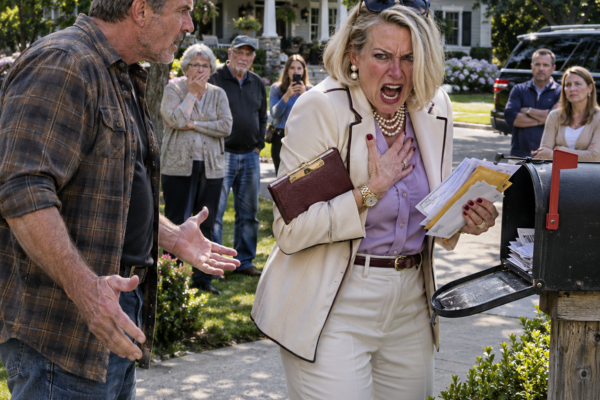
𝗙𝗨𝗟𝗟 𝗦𝗧𝗢𝗥𝗬 The $75 Ticket on My Windshield Was Only the First Charge
𝗙𝗨𝗟𝗟 𝗦𝗧𝗢𝗥𝗬
A woman answered with the flat, practiced voice of someone reading from a screen.
I gave her my account number and told her there had to be a mistake.
“The original violation was $75,” I said. “Your letter says $5,038.”
I heard keys clicking.
“The balance is correct, Mr. Hayes.”
“Then explain it.”
She walked me through the charges one by one. Some belonged to the HOA. Most were administrative fees from the compliance company handling the account.
I rested my forehead against the steering wheel.
“Fine,” I said. “I dispute the parking violation.”
More clicking.
“I can open an appeal.”
“Do that.”
“There is an appeal processing charge.”
I lifted my head.
“You charge me to dispute a charge?”
A pause.
“It is an administrative service.”
I wrote the amount on the back of a lumber receipt.
By lunchtime, an email confirmed the appeal.
The balance had increased.
I called again and requested a hearing before the board.
Another fee appeared.
That afternoon, I asked for an itemized accounting because half the descriptions meant nothing to me.
The next morning, there was an account research charge.
I stood beside my trailer staring at the screen while my employee, Luis, tightened ratchet straps over a stack of fence panels.
“Everything good?” he asked.
“Apparently asking what I owe costs money.”
He gave me a look, waiting for the joke.
There was not one.
For the next several days, I treated the account the way I treated a bad measurement on a job site.
Isolate the problem.
Check every number.
Correct it before it spreads.
But this thing worked backward.
Every correction created another line item. Every phone call produced another email. Every email carried that same little vendor code at the bottom.
I started printing them and laying them across my kitchen table at night.
The paper smelled faintly of hot toner. My coffee went cold beside the calculator.
Thursday morning, I was supposed to meet a property owner about a $14,000 ranch-style perimeter fence. Instead, I spent forty-three minutes on hold because a new collection preparation notice had appeared overnight.
By the time I reached the job site, the owner had already left.
He called later and said he had hired somebody else.
I sat in my truck outside the property with the phone against my ear and watched a crew from another company unload steel posts where mine should have been.
That one hurt more than the ticket.
I had let Victoria’s $75 violation climb into my workday and take money out of my pocket before I had paid them a cent.
That evening, I stopped answering every new message immediately.
I spread the notices across the kitchen table in the order they had arrived.
Original violation.
Reminder.
Review.
Appeal.
Hearing.
Request.
Account research.
Collection preparation.
I moved them with one finger, arranging them by date.
Then I noticed something I should have seen earlier.
The balance did not rise because time was passing.
It jumped after I did something.
I appealed.
Fee.
I requested a hearing.
Fee.
I asked for an explanation.
Fee.
My phone buzzed against the table.
Another compliance email.
I opened it.
A new administrative charge had been posted for processing my latest dispute correspondence.
I stared at the number, then at the rows of paper under the kitchen light.
For the first time since the certified letter arrived, I did not reach for the phone.
I leaned back in the chair and let the silence sit there.
The system was not just punishing me for that truck.
It was charging me for trying to defend myself.
Victoria called me herself the next afternoon.
I was setting a gate hinge on a cedar post when my phone started vibrating across the tailgate. I wiped sawdust from my fingers and answered.
“Daniel, this is Victoria Lang.”
No hello beyond that.
Her voice was smooth, almost friendly.
“I understand you’ve been having difficulty with your compliance account.”
I looked at the drill in my hand.
“Difficulty is one word for it.”
“I think we can resolve this without wasting more of anyone’s time. Can you meet me at the clubhouse at four?”
The clubhouse smelled like lemon cleaner and cold air conditioning. Victoria was waiting at a long conference table with a thin folder in front of her. Same red pantsuit. Same tight ponytail.
She gestured toward the chair across from her.
“Your current balance is continuing to accrue administrative costs,” she said. “I’ve been authorized to offer a settlement.”
She slid one sheet of paper toward me.
$2,500 payable immediately.
Remaining balance waived.
I read it twice.
Two weeks earlier, I would have laughed.
After losing the fencing contract and spending hours on the phone, $2,500 suddenly looked like the price of getting my life back.
Victoria must have seen that calculation on my face.
“Once payment clears, the account closes.”
I rubbed my thumb along the edge of the paper.
“And the original parking violation?”
“Included.”
“The $75 violation you turned into more than $5,000.”
Her expression did not move.
“The balance reflects administrative activity, not simply the original violation.”
“Administrative activity I never asked for.”
“You requested an appeal. You requested a hearing. You requested account research.”
She counted them with one finger against the tabletop.
“Those services have costs.”
I looked up.
“So every time I challenge you, I owe you more.”
“You owe the vendor for services performed.”
“Your vendor.”
“The association’s contracted compliance provider.”
The air vent above us clicked on. A cold stream touched the sweat drying along the back of my neck.
Victoria leaned slightly forward.
“Daniel, I’m trying to help you. Pay the settlement, and this stops today. If you keep appealing, the vendor charges continue. That’s your choice.”
My hand stopped on the paper.
There it was again.
Not a threat exactly.
More like a rule she expected me to accept.
I looked at the settlement amount, then at her.
“Why am I paying your vendor for challenging your fine?”
“That’s how compliance works.”
“No,” I said. “That’s how this compliance works.”
Her jaw tightened for the first time.
“You have until five tomorrow afternoon.”
She pushed a pen toward me.
I did not touch it.
I had $2,500 in the business account. I could pay it. It would hurt, but I could work through it.
What I could not get past was the way she had described the growing charges, as if I were the one turning the crank.
Appeal fee.
Hearing fee.
Question fee.
And she knew exactly what would happen each time.
I folded the settlement sheet once and pushed it back across the table.
“I’ll be at the hearing.”
Victoria looked down at the paper between us.
“Then understand the balance may continue increasing.”
I stood.
“I understand that now.”
Outside, the late afternoon heat hit me hard after the refrigerated clubhouse. Sprinklers clicked across the entrance lawn. My truck sat under a cottonwood with dust along the doors and a coil of orange extension cord in the bed.
I climbed in but did not start the engine.
For days, I had been trying to prove that $75 should not become $5,000.
That was not the question anymore.
Victoria had just told me without realizing it where to look.
The fine was not growing despite my resistance.
It was growing because of it.
The hearing was held the following Tuesday in the same clubhouse.
But Victoria was not alone this time.
Four board members sat behind two folding tables pushed together beneath fluorescent lights. A ceiling fan turned slowly overhead, stirring air that smelled faintly of coffee and furniture polish.
I took the chair facing them and set the original $75 notice on the table.
Victoria sat at the far end in her red pantsuit with a tablet open in front of her.
“Mr. Hayes,” a gray-haired board member named Clare Donovan said, “you’re appealing the commercial vehicle violation issued on August fourth.”
“Yes.”
I explained the Parker job, the fence materials, and the eleven minutes at the curb. Mrs. Parker had sent a short statement confirming I was actively unloading materials for contracted work.
Clare read it, then looked toward Victoria.
“Our rules have a service exception, correct?”
Victoria’s fingers stopped over her tablet.
“Under limited circumstances.”
Another board member pulled up the rule. He read the relevant sentence aloud.
Contractors actively loading or unloading for authorized residential work were exempt from the commercial parking restriction.
Nobody spoke for a moment.
I could hear ice shifting inside someone’s plastic cup.
Clare finally said, “I don’t believe the underlying violation should stand.”
Victoria leaned back.
“The board can reduce it to a warning if that’s the consensus.”
A vote followed.
Four hands.
The $75 violation was removed and replaced with a warning.
I let out a breath I had not realized I was holding.
For the first time in two weeks, something had gone the right direction.
I reached for my papers.
“So the account closes.”
Victoria looked at me.
“No.”
My hand stopped.
“Excuse me?”
She turned her tablet slightly and scrolled.
“The violation has been resolved. The administrative services already performed remain billable.”
Clare frowned.
“How much remains?”
Victoria read the number.
“$4,386.”
The room went still.
I stared at her.
“You just voted that I didn’t owe the ticket.”
“The board addressed the parking violation,” she said. “The vendor charges are separate.”
“Separate from what?” I asked. “Because every one of those charges exists because of that ticket.”
Victoria’s voice stayed level.
“The vendor processed notices, correspondence, account research, your appeal, and this hearing. Those services occurred whether the original violation was upheld or not.”
I looked down at the $75 notice lying beside more than $4,000 in administrative charges.
That was when a chair scraped behind me.
I turned.
Three residents were waiting along the back wall for their own hearings. An older man held a yellow envelope against his knee. A woman in running clothes had a stack of notices clipped together. Beside her, a younger guy kept scrolling through something on his phone.
The older man caught my eye.
“They charged you for the appeal too?”
Victoria turned toward him.
“Sir, please wait until your account is called.”
He lifted the envelope.
“Mine started with a trash can.”
The woman beside him gave a dry laugh.
“Lawn edging for me.”
The younger man raised his phone.
“Parking warning.”
I looked back at Victoria.
Different violations.
Same envelopes.
On the bottom corner of the woman’s top page, I could see the same small vendor code printed on mine.
Clare noticed me staring.
“Mr. Hayes?”
I gathered my papers slowly.
“Nothing.”
But it was not nothing.
I had walked into that room believing the $5,000 balance was an outrageous punishment attached to my parking ticket.
Now the parking ticket was gone, and almost all the money was still there.
I stepped into the hallway after the hearing, and the older man followed me out.
His name was Frank Ellison. His trash can violation had started at $50 and was sitting at $1,940.
The woman with the lawn notice was Denise Cole. Hers had crossed $2,700.
We stood under the clubhouse awning while warm rain tapped the parking lot and compared the sequence of charges on our phones.
Different violations.
Same rhythm.
Notice.
Response.
Processing fee.
Review fee.
Hearing fee.
Collection preparation.
I asked Frank one question.
“What happened every time you challenged something?”
He looked at his envelope.
“They charged me again.”
Denise nodded.
“Same.”
Over the next four days, I heard that answer twelve more times.
I did not ask people for bank records or private information. I asked what action they took and what happened next.
A retired teacher disputed a mailbox warning and got an administrative review charge.
A young couple requested photographs of an alleged landscaping violation and got an account research fee.
A widower asked for a hearing over his camper being visible from the road. His balance jumped before the hearing even happened.
Friday evening, seventeen of us met in Frank’s garage.
The concrete still held the day’s heat. A box fan rattled beside his workbench while people spread notices across folding tables between cans of soda and a bowl of pretzels nobody touched.
I stood at the end of the table with my own stack in front of me.
“We’ve been doing exactly what they expect,” I said.
Denise folded her arms.
“Paying?”
“No. Fighting one account at a time.”
I pointed to the notices.
“Every private dispute goes through the vendor. Every step creates another service.”
Frank squinted at me.
“So what do we do?”
“Stop fighting.”
He stared at me.
“Stop fighting their way.”
Stonegate Ridge’s bylaws gave homeowners the right to request formal board review of disputed enforcement balances. Not a customer service call. Not another vendor appeal. A board review.
I had ignored procedures when this started because I hated paperwork.
Now I sat there with seventeen people making sure every request was dated, signed, and delivered exactly the way the bylaws required.
Monday morning, we walked into the HOA office together.
The receptionist’s eyes widened when Frank set the first envelope on the counter. Then Denise placed hers beside it. Then another. Then another.
Seventeen formal review requests formed a neat white stack beneath the fluorescent lights.
Victoria came out of the back office before we finished.
Her heels clicked across the tile.
She stopped when she saw us.
“What is this?”
“Board review requests,” I said. “For disputed enforcement balances.”
She looked at the stack, then at me.
“Submitting identical requests as a group doesn’t change the validity of individual accounts.”
“Good,” I said. “Then review them individually. In front of the board.”
Her eyes narrowed slightly.
“The compliance process will continue while reviews are pending.”
There it was.
She could have paused the accounts. She could have told the vendor to hold disputed charges until the board looked at them.
Instead, she picked up the top envelope and tapped its edge against the counter.
“Normal processing remains in effect.”
I watched her carry the stack into the office.
By Wednesday, Frank received another fee.
Denise got one too.
So did I.
Seventeen formal reviews had triggered seventeen new rounds of administrative work.
But this time, nobody panicked.
Nobody called the vendor.
Nobody sent another appeal.
We saved every notice and waited.
Victoria thought she had kept the machine running.
She had.
The difference was that now seventeen of us were standing beside it, watching every turn.
The next board meeting started at seven on Thursday night.
By 6:40, every folding chair in the clubhouse was taken. Frank sat two rows behind me with his yellow envelope tucked under one arm. Denise had her notices clipped together on her lap. The air conditioner ran hard enough to make the ceiling vents whistle, but the room still smelled like warm bodies and burnt coffee.
Victoria sat at the center of the board table in her red pantsuit, posture straight, tablet beside her. She moved through landscaping approvals, reserve maintenance, and a roofing request without looking toward our side of the room.
Then the treasurer reached the monthly expenses.
“Compliance services,” he said, and stopped.
He leaned closer to the page.
“$21,640.”
A murmur moved through the chairs behind me.
Victoria answered before anyone else could.
“We had an unusual volume of disputed accounts this month.”
Clare Donovan looked down at the invoice.
“This is almost three times last month.”
“Seventeen formal reviews were submitted simultaneously,” Victoria said. “The vendor had to prepare each account.”
Clare turned a page.
“Intake processing. Hearing packages. Document preparation. Collection monitoring.”
I recognized the language immediately.
It was the same language printed across my kitchen table.
The treasurer rubbed his glasses with the corner of his shirt.
“Why are we paying more when residents challenge us?”
Victoria’s expression hardened.
“Because enforcement has costs.”
I raised my hand.
Clare nodded toward me.
“Mr. Hayes.”
I stood. My chair legs scraped against the tile.
“Then why are those same costs being added back onto us?”
Nobody answered.
I held up my latest statement.
“My parking violation was removed. I still owe more than $4,000 because your vendor says it performed services. Now this invoice says the HOA is also paying the vendor to perform those services.”
Victoria turned toward me.
“Homeowner assessments reimburse association expenses associated with individual enforcement.”
“I understand reimbursement,” I said. “I’m asking why every attempt to dispute an account creates more billable work.”
Frank spoke from behind me.
“Mine went up again this week.”
Denise lifted her packet.
“So did mine.”
More voices followed.
Not shouting.
Just numbers.
$900.
$1,800.
$2,600.
$3,100.
Clare raised a hand, and the room settled.
She looked at the invoice again, then at the seventeen review requests stacked beside the board secretary.
“If these residents had not requested review, would we have received these charges?”
Victoria hesitated.
Barely a second.
But I saw it.
“Not in this billing cycle.”
Clare tapped the invoice with one finger.
“So the increase is directly tied to their disputes.”
“To services required by their disputes,” Victoria corrected.
I watched the treasurer turn another page, his eyebrows pulled together.
For weeks, I had been staring at my own balance, trying to understand how it became so large.
Now the board was looking at the other side of the same machine.
Every fee added to us had a matching service being sold to them.
Seventeen homeowners had not uncovered a hidden document.
We had simply made the system work at a scale too large to disappear inside routine expenses.
Clare leaned toward the microphone.
“I want the full compliance contract available to the board before we approve this invoice.”
Victoria’s head turned sharply.
“The contract has already been reviewed.”
“Not by me.”
“This vendor relationship predates your term.”
“Then it shouldn’t be difficult to review.”
The room went quiet again.
Victoria closed her tablet cover with a soft snap.
For the first time since she had photographed my truck, she was not controlling the next step.
Clare moved to postpone approval of the compliance invoice until the board could examine the contract and fee structure.
The motion passed three to two.
I sat down.
Frank leaned forward behind me and whispered, “That good?”
I looked at Victoria.
She was staring at the unpaid invoice instead of us.
“It changed something,” I said.
After a month of watching every move I made increase my debt, that was enough.
The machine had finally produced a bill Victoria could not quietly send to somebody else.
The change lasted forty-eight hours.
Saturday morning, I was tightening a loose hinge on the side gate when a white courier van stopped at my curb. The driver handed me a thick envelope that required a signature.
Inside was a notice from the HOA’s collection firm demanding payment within ten business days.
My balance was now $4,860.
At the bottom, one sentence warned that continued delinquency could trigger additional collection remedies against my property.
I read it twice under the hard morning light.
Victoria had lost control of the invoice at the meeting, so she had moved the pressure somewhere the board could not see it.
By noon, Frank had received the same kind of envelope.
Denise called twenty minutes later. Hers had arrived too.
The seventeen reviews had forced the machine into daylight, and somebody had responded by accelerating the machine.
I drove to Frank’s place and found him standing beside his mailbox with the notice folded in his hand.
“Ten days,” he said. “They know I can’t write a check for this.”
I could have told him to wait for Clare.
I could have told everyone to hire lawyers and fight seventeen separate battles.
Instead, I looked at the deadline printed on my own notice and realized that was exactly what the system expected.
Separate homeowners were expensive, frightened, and easy to exhaust.
A group was different.
That afternoon, we met in Denise’s garage with the door open to the heat. A box fan rattled beside a workbench while seventeen homeowners laid their account histories across two folding tables.
I did not ask them for rumors.
I asked for dates.
Original violation.
Original fine.
First dispute.
First administrative charge.
Every charge after that.
We used colored markers and built one timeline for each account.
By sunset, the pattern was visible without anyone needing to explain it.
The balances did not grow fastest after violations.
They grew fastest after objections.
Frank stared at the rows of red marks.
“They’re charging us for fighting the charges.”
“That’s what it looks like,” I said. “But looking wrong isn’t enough.”
On Monday, Clare called me from her car.
The board had finally received the compliance contract.
Her voice was tight.
“There’s a performance schedule attached.”
“What kind of performance?”
“The vendor gets a higher monthly service tier when delinquent compliance revenue crosses certain thresholds.”
I stopped walking. Gravel pressed under my boots.
“Revenue from homeowner accounts?”
“That’s how the schedule defines it.”
The pieces shifted into place, but not the way I expected.
This was not simply a contractor charging too much.
The system rewarded volume.
More unresolved balances meant a more valuable contract.
“Who approved that schedule?” I asked.
Silence came through the phone.
Then Clare said, “Victoria signed the renewal last year.”
That evening, Victoria called me directly for the first time since the clubhouse meeting.
Her voice was smooth again.
“Mr. Hayes, I understand you’ve been organizing residents around confidential association business.”
I leaned against my truck, looking across the street at Frank’s porch light.
“I’ve been comparing our own bills.”
“You’re creating unnecessary panic.”
“Then suspend the collection deadlines while the board reviews the contract.”
“That isn’t your decision.”
“No,” I said. “It’s yours.”
She went quiet.
I could hear faint traffic on her end.
“Pay your balance,” she said. “This can still end quietly.”
There it was.
Not an explanation.
Not a correction.
A choice.
Quiet or expensive.
I looked at the original parking notice sitting on the passenger seat of my truck. Its paper had curled from weeks in the heat.
Eleven minutes at a curb had become nearly $5,000 because every time I pushed back, someone found another way to bill the resistance.
“I’m done trying to make it quiet,” I said.
The next morning, all seventeen homeowners submitted one joint written demand to freeze collection activity until the board completed its contract review.
We copied every director individually.
No accusations.
No speeches.
Just the timelines, the matching fee categories, and the ten-day deadlines.
By lunch, Clare confirmed three board members supported an emergency vote.
For the first time, we had enough votes to stop the clock.
At 3:17 that afternoon, my phone buzzed.
The emergency meeting had been scheduled for Friday.
I should have felt relief.
Instead, I noticed a second email underneath it from the collection firm.
My account had already been advanced to the next collection stage that morning, hours before the board could vote.
Victoria had seen the door closing and shoved seventeen accounts through it first.
Friday came with low clouds and the smell of rain on hot pavement.
I reached the clubhouse twenty minutes early and found Frank, Denise, and several other homeowners already waiting beneath the covered entrance. Nobody talked much.
Across the parking lot, Victoria stepped from her SUV in that sharp red pantsuit, phone pressed to her ear, moving like the meeting had already been decided.
When she saw us, she lowered the phone and gave me a thin smile.
“Quite a turnout.”
I held the door open.
“You made it expensive enough.”
Inside, every board seat was filled. Clare had placed copies of the contract, the seventeen account timelines, and the collection notices at each position.
Victoria sat at the head of the table and immediately challenged the meeting. She said the accounts were individual enforcement matters and could not be treated as one issue.
Clare answered by sliding the performance schedule into the center.
Then she explained why seventeen individual disputes generated revenue under the same incentive structure.
Victoria’s expression barely moved, but her hand stopped on her pen.
One director asked whether she had authorized the collection firm to advance the accounts before the emergency vote.
“Standard procedure,” Victoria said.
“Was it automatic?” Clare asked.
Victoria looked toward the association manager.
He stared down at his laptop.
That silence changed the room.
I opened my folder but left the papers inside.
“My original parking fine was $75,” I said. “I disputed it. Every step after that cost me more money. Frank disputed his. Same thing. Denise disputed hers. Same thing. We thought the problem was the amount. It wasn’t. The problem was what happened whenever someone resisted.”
Victoria leaned forward.
“You are implying misconduct based on a handful of dissatisfied homeowners.”
“Seventeen,” Frank said from behind me.
Victoria turned.
That was when Clare placed one final page beside the contract.
It was the collection firm’s activity report from the morning before our joint demand.
Seventeen accounts had been manually advanced within a narrow window.
The authorization field carried the same administrative credential tied to Victoria’s office.
The room went still except for the air conditioner humming above us.
Victoria’s confidence hardened into anger.
“Those accounts were delinquent. I had every authority to protect the association.”
“Before the board could vote on freezing them?” Clare asked.
“Because waiting would have compromised collection.”
There it was again.
Her own decision spoken clearly in front of the board.
She had not merely benefited from the system.
When threatened, she had accelerated it.
One director pushed his chair back.
“I move to suspend all seventeen collections immediately and terminate the incentive schedule pending independent accounting.”
Another seconded.
Victoria tried to interrupt, but Clare called the vote.
Four hands rose.
Then a fifth.
The motion passed.
Frank exhaled behind me like he had been holding his breath for a month.
For half a second, it felt finished.
Then the association manager cleared his throat.
“There’s another problem.”
He rotated his laptop toward the board.
“The collection firm had already transmitted several advanced balances to outside counsel before the suspension took effect.”
Mine was one of them.
So was Frank’s.
Victoria folded her arms.
“Which is precisely why this meeting is too late.”
I watched her face as she said it, and something clicked.
She thought the damage protected her.
She thought once the accounts crossed that line, nobody could pull them back.
Clare looked at me.
I looked at the contract.
“Not too late,” I said. “More expensive.”
Victoria frowned.
I tapped the indemnification section we had nearly ignored because it looked like boilerplate.
Unauthorized collection actions initiated outside board-approved policy could shift resulting costs back to the party responsible for directing them.
The board attorney attending by speakerphone asked Clare to read the clause aloud.
Victoria’s color changed before Clare reached the end.
The room no longer felt like seventeen homeowners against an HOA.
It felt like Victoria standing alone beside a machine.
She had pushed too far.
The board voted again, this time to revoke her enforcement authority immediately and preserve every communication connected to the advanced accounts.
She stood so quickly her chair rolled backward.
“You have no idea what you’re doing.”
I met her eyes across the table.
“For weeks, that was true.”
Rain began ticking against the windows.
“Not anymore.”
By Monday morning, Victoria’s reserved parking space outside the clubhouse was empty.
The board had disabled her association credentials and ordered the collection firm to stop every account it could still control. Mine had already reached outside counsel, but the demand was withdrawn after the board confirmed that the escalation had never been properly authorized.
The $5,000 balance disappeared from my account almost as quickly as it had grown.
The original $75 violation was gone too.
Clare insisted that every disputed charge tied to the incentive system be independently reviewed instead of quietly reduced.
Frank called ten minutes later.
His account was clear.
Denise texted after that.
Hers was too.
An outside review confirmed what the seventeen timelines had already shown. Disputed homeowner accounts had been generating additional vendor fees, and Victoria had pushed those accounts forward even as the board moved to stop them.
The association terminated the incentive arrangement, removed Victoria from enforcement authority, and began sorting out the costs her decisions had created.
I left that part to them.
I had spent enough time watching numbers climb on statements that should never have existed.
The part I wanted to see happened three weeks later on a bright Saturday morning.
A folding table stood outside the clubhouse where homeowners could review corrected account balances. No security guard watched the door. No one whispered before walking inside.
Frank arrived carrying two coffees and handed me one.
“Seventy-five dollars,” he said. “That’s all it took.”
I shook my head.
“No. Five thousand.”
He smiled because he understood.
The amount had been the mistake that made the machine visible.
Across the lot, workers removed the reserved placard from Victoria’s old space. The metal post gave a sharp squeal as the bolts came loose.
I remembered standing near that same curb weeks earlier with a parking notice under my windshield wiper, thinking I was dealing with an irritating rule and an arrogant board president.
I had nearly paid the first inflated demand just to make the pressure stop.
That was the part I kept thinking about.
If I had paid, Frank probably would have paid.
Denise might have paid.
Seventeen separate people would have remained seventeen separate problems.
Instead, we had compared what happened when each of us refused.
The pattern had done the rest.
A dark SUV slowed near the entrance.
Victoria was driving.
She looked toward the clubhouse, saw the workers carrying away the placard, and kept moving.
No confrontation.
No speech.
Just the SUV disappearing around the curve between the houses.
Frank watched it go, then looked at me.
“You feel better?”
I took a drink of coffee.
“I feel finished.”
That afternoon, I parked my truck in my own driveway, set the brake, and sat there for a moment with the engine ticking as it cooled.
The same windshield that had once held a violation notice reflected nothing but blue sky.
I pulled the old yellow ticket from the glove compartment. I had kept it through every meeting, every demand, every sleepless calculation at the kitchen table.
$75 printed at the bottom.
Such a small number compared with where they had tried to take it.
I folded it once and put it back.
Not as evidence anymore.
Just as a reminder that systems built on intimidation depend on people believing they are alone.
Victoria had counted on that.
Then, when we stopped acting alone, she made the decision that finally broke her control.
She pushed harder.
She accelerated the accounts, increased the exposure, and left her own fingerprints on the mechanism she thought would protect her.
I stepped out of the truck, closed the door, and walked toward the house while the late-afternoon sprinklers clicked across the neighboring lawns.
For the first time in months, the sound was just water hitting grass.
𝗧𝗛𝗘 𝗘𝗡𝗗
The $75 Ticket on My Windshield Was Only the First Charge
I thought the woman photographing my truck was only trying to ruin my morning.
Then the $75 notice turned into a balance large enough to cost me real work.
By the time the board admitted the ticket should never have stood, I finally understood where the real money was hiding.
The first thing I heard was the sharp click of a phone camera behind me.
I had one end of a cedar fence post balanced against my shoulder, the other scraping lightly across the bed liner of my pickup, when a woman’s voice cut through the whine of a circular saw two houses down.
“You need to move that truck.”
I lowered the post onto the grass and turned.
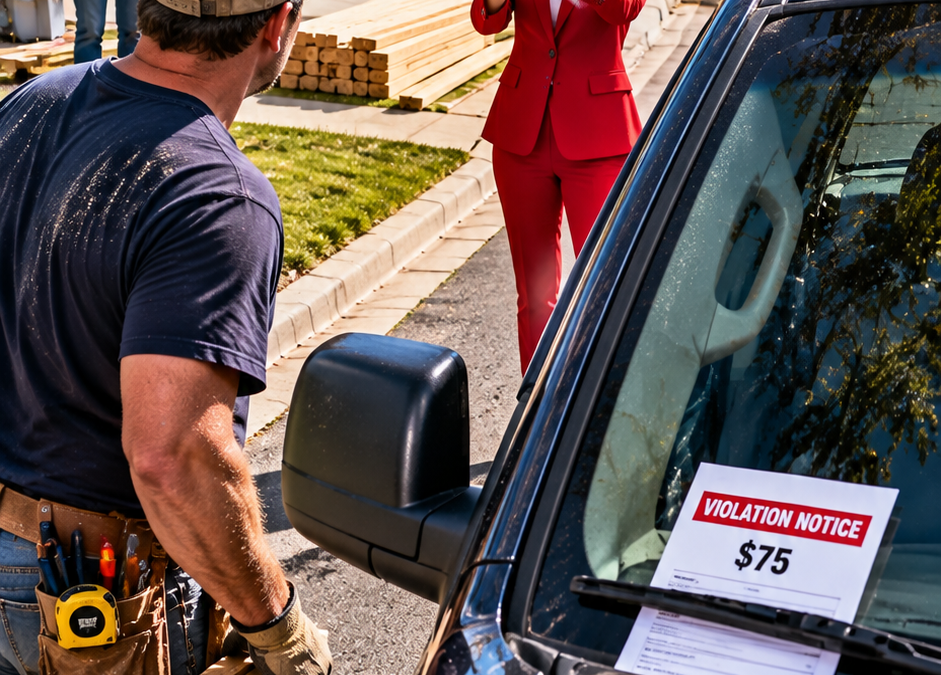
Victoria Lang stood beside the curb in a red pantsuit that looked almost too clean for a street full of sawdust and fresh-cut lumber. Her brown hair was pulled into a tight ponytail. One hand held her phone. The other pointed at my pickup like she had discovered evidence at a crime scene.
“Commercial vehicles are prohibited from parking on HOA streets,” she said.
I looked at the truck.
Then at the house twenty yards behind me.
Half the old fence was already down. New cedar panels lay stacked beside the driveway. My magnetic company sign was on the driver’s door.
“I’m installing a fence for the Parkers,” I said. “I’m not parking here for the afternoon. I’m unloading.”
“That doesn’t change the rule.”
She lifted the phone again.
Click.
It was already pushing ninety degrees, and sweat had darkened the back of my navy work shirt. I checked my watch. I had arrived eleven minutes earlier.
“You watched me carry material out of this truck.”
Her mouth tightened.
“I saw a commercial vehicle parked on an HOA-controlled street.”
Mrs. Parker stepped out from her garage, still wearing gardening gloves.
“Victoria, he’s working for us.”
Victoria barely looked at her.
“Then your contractor should know the community rules.”
She tapped her screen, walked to the windshield, and tucked a white violation notice beneath the driver’s side wiper.
I pulled it free before the breeze could take it.
Seventy-five dollars.
I read it once, folded it in half, and slid it into my shirt pocket.
“You’re writing a $75 ticket over eleven minutes.”
“You can appeal it.”
She said that like she was doing me a favor.
Then she turned and walked back toward a white SUV parked across the intersection.
I watched her leave, picked up the cedar post, and went back to work.
That should have been the whole story.
A stupid ticket.
An appeal.
Maybe an irritated evening filling out a form.
Instead, I made the mistake of assuming something that ridiculous could not become serious.
My name is Daniel Hayes. I owned a small fencing business, the kind where the owner still unloads posts, sets lines, pours concrete, writes estimates, answers customer calls, and argues with suppliers when cedar prices jump for the third time in a season.
I was used to problems.
Crooked lots. Bad soil. Angry dogs. Missed deliveries. Homeowners who changed their minds after half the posts were already set.
A $75 HOA parking notice did not scare me.
It annoyed me.
That was all.
I finished the Parker fence two days later. The notice stayed folded on the corner of my kitchen counter under a stack of supplier receipts. An email came in from Stonegate Ridge Compliance. I skimmed the subject line and closed it. Another arrived three days later while I was measuring a gate opening. I told myself I would deal with it Sunday.
Sunday became Tuesday.
Then ten days after Victoria photographed my truck, I came home after sunset and found a certified envelope wedged inside my storm door.
The paper felt warm from the August heat.
I opened it standing under the porch light.
The first line listed the parking violation.
$75.
The next line was a late assessment.
Then compliance review.
Administrative processing.
Certified notice expense.
Appeal intake.
Collection preparation.
I stopped reading and looked at the number printed near the bottom.
$5,038.
For a few seconds, the only sound was the cicadas in the trees and the low hum of my porch light.
I read the total again.
Same number.
Five thousand thirty-eight dollars.
At the bottom corner of the page was a small vendor code I had noticed on the original notice without thinking much about it. Same letters. Same number sequence.
I carried the envelope inside, spread every page across my kitchen table, and pulled the folded $75 ticket from beneath my receipts.
I put the two amounts side by side.
Eleven minutes at a curb had somehow turned into five grand.
I picked up my phone and stared at the compliance number printed on the letter.
Whatever I had ignored for ten days was not a parking ticket anymore.
I called the compliance number at 7:12 the next morning from the cab of my truck, parked outside a lumber yard with the engine idling and the air conditioner fighting the heat.
A woman answered with the flat, practiced voice of someone reading from a screen.
I gave her my account number and told her there had to be a mistake.
“The original violation was $75,” I said. “Your letter says $5,038.”
I heard keys clicking.
“The balance is correct, Mr. Hayes.”
“Then explain it.”
She walked me through the charges one by one. Some belonged to the HOA. Most were administrative fees from the compliance company handling the account.
I rested my forehead against the steering wheel.
“Fine,” I said. “I dispute the parking violation.”
More clicking.
“I can open an appeal.”
“Do that.”
“There is an appeal processing charge.”
I lifted my head.
“You charge me to dispute a charge?”
A pause.
“It is an administrative service.”
I wrote the amount on the back of a lumber receipt.
By lunchtime, an email confirmed the appeal.
The balance had increased.
I called again and requested a hearing before the board.
Another fee appeared.
That afternoon, I asked for an itemized accounting because half the descriptions meant nothing to me.
The next morning, there was an account research charge.
I stood beside my trailer staring at the screen while my employee, Luis, tightened ratchet straps over a stack of fence panels.
“Everything good?” he asked.
“Apparently asking what I owe costs money.”
He gave me a look, waiting for the joke.
There was not one.
For the next several days, I treated the account the way I treated a bad measurement on a job site.
Isolate the problem.
Check every number.
Correct it before it spreads.
But this thing worked backward.
Every correction created another line item. Every phone call produced another email. Every email carried that same little vendor code at the bottom.
I started printing them and laying them across my kitchen table at night.
The paper smelled faintly of hot toner. My coffee went cold beside the calculator.
Thursday morning, I was supposed to meet a property owner about a $14,000 ranch-style perimeter fence. Instead, I spent forty-three minutes on hold because a new collection preparation notice had appeared overnight.
By the time I reached the job site, the owner had already left.
He called later and said he had hired somebody else.
I sat in my truck outside the property with the phone against my ear and watched a crew from another company unload steel posts where mine should have been.
That one hurt more than the ticket.
I had let Victoria’s $75 violation climb into my workday and take money out of my pocket before I had paid them a cent.
That evening, I stopped answering every new message immediately.
I spread the notices across the kitchen table in the order they had arrived.
Original violation.
Reminder.
Review.
Appeal.
Hearing.
Request.
Account research.
Collection preparation.
I moved them with one finger, arranging them by date.
Then I noticed something I should have seen earlier.
The balance did not rise because time was passing.
It jumped after I did something.
I appealed.
Fee.
I requested a hearing.
Fee.
I asked for an explanation.
Fee.
My phone buzzed against the table.
Another compliance email.
I opened it.
A new administrative charge had been posted for processing my latest dispute correspondence.
I stared at the number, then at the rows of paper under the kitchen light.
For the first time since the certified letter arrived, I did not reach for the phone.
I leaned back in the chair and let the silence sit there.
The system was not just punishing me for that truck.
It was charging me for trying to defend myself.
Victoria called me herself the next afternoon.
I was setting a gate hinge on a cedar post when my phone started vibrating across the tailgate. I wiped sawdust from my fingers and answered.
“Daniel, this is Victoria Lang.”
No hello beyond that.
Her voice was smooth, almost friendly.
“I understand you’ve been having difficulty with your compliance account.”
I looked at the drill in my hand.
“Difficulty is one word for it.”
“I think we can resolve this without wasting more of anyone’s time. Can you meet me at the clubhouse at four?”
The clubhouse smelled like lemon cleaner and cold air conditioning. Victoria was waiting at a long conference table with a thin folder in front of her. Same red pantsuit. Same tight ponytail.
She gestured toward the chair across from her.
“Your current balance is continuing to accrue administrative costs,” she said. “I’ve been authorized to offer a settlement.”
She slid one sheet of paper toward me.
$2,500 payable immediately.
Remaining balance waived.
I read it twice.
Two weeks earlier, I would have laughed.
After losing the fencing contract and spending hours on the phone, $2,500 suddenly looked like the price of getting my life back.
Victoria must have seen that calculation on my face.
“Once payment clears, the account closes.”
I rubbed my thumb along the edge of the paper.
“And the original parking violation?”
“Included.”
“The $75 violation you turned into more than $5,000.”
Her expression did not move.
“The balance reflects administrative activity, not simply the original violation.”
“Administrative activity I never asked for.”
“You requested an appeal. You requested a hearing. You requested account research.”
She counted them with one finger against the tabletop.
“Those services have costs.”
I looked up.
“So every time I challenge you, I owe you more.”
“You owe the vendor for services performed.”
“Your vendor.”
“The association’s contracted compliance provider.”
The air vent above us clicked on. A cold stream touched the sweat drying along the back of my neck.
Victoria leaned slightly forward.
“Daniel, I’m trying to help you. Pay the settlement, and this stops today. If you keep appealing, the vendor charges continue. That’s your choice.”
My hand stopped on the paper.
There it was again.
Not a threat exactly.
More like a rule she expected me to accept.
I looked at the settlement amount, then at her.
“Why am I paying your vendor for challenging your fine?”
“That’s how compliance works.”
“No,” I said. “That’s how this compliance works.”
Her jaw tightened for the first time.
“You have until five tomorrow afternoon.”
She pushed a pen toward me.
I did not touch it.
I had $2,500 in the business account. I could pay it. It would hurt, but I could work through it.
What I could not get past was the way she had described the growing charges, as if I were the one turning the crank.
Appeal fee.
Hearing fee.
Question fee.
And she knew exactly what would happen each time.
I folded the settlement sheet once and pushed it back across the table.
“I’ll be at the hearing.”
Victoria looked down at the paper between us.
“Then understand the balance may continue increasing.”
I stood.
“I understand that now.”
Outside, the late afternoon heat hit me hard after the refrigerated clubhouse. Sprinklers clicked across the entrance lawn. My truck sat under a cottonwood with dust along the doors and a coil of orange extension cord in the bed.
I climbed in but did not start the engine.
For days, I had been trying to prove that $75 should not become $5,000.
That was not the question anymore.
Victoria had just told me without realizing it where to look.
The fine was not growing despite my resistance.
It was growing because of it.
The hearing was held the following Tuesday in the same clubhouse.
But Victoria was not alone this time.
Four board members sat behind two folding tables pushed together beneath fluorescent lights. A ceiling fan turned slowly overhead, stirring air that smelled faintly of coffee and furniture polish.
I took the chair facing them and set the original $75 notice on the table.
Victoria sat at the far end in her red pantsuit with a tablet open in front of her.
“Mr. Hayes,” a gray-haired board member named Clare Donovan said, “you’re appealing the commercial vehicle violation issued on August fourth.”
“Yes.”
I explained the Parker job, the fence materials, and the eleven minutes at the curb. Mrs. Parker had sent a short statement confirming I was actively unloading materials for contracted work.
Clare read it, then looked toward Victoria.
“Our rules have a service exception, correct?”
Victoria’s fingers stopped over her tablet.
“Under limited circumstances.”
Another board member pulled up the rule. He read the relevant sentence aloud.
Contractors actively loading or unloading for authorized residential work were exempt from the commercial parking restriction.
Nobody spoke for a moment.
I could hear ice shifting inside someone’s plastic cup.
Clare finally said, “I don’t believe the underlying violation should stand.”
Victoria leaned back.
“The board can reduce it to a warning if that’s the consensus.”
A vote followed.
Four hands.
The $75 violation was removed and replaced with a warning.
I let out a breath I had not realized I was holding.
For the first time in two weeks, something had gone the right direction.
I reached for my papers.
“So the account closes.”
Victoria looked at me.
“No.”
My hand stopped.
“Excuse me?”
She turned her tablet slightly and scrolled.
“The violation has been resolved. The administrative services already performed remain billable.”
Clare frowned.
“How much remains?”
Victoria read the number.
“$4,386.”
The room went still.
I stared at her.
“You just voted that I didn’t owe the ticket.”
“The board addressed the parking violation,” she said. “The vendor charges are separate.”
“Separate from what?” I asked. “Because every one of those charges exists because of that ticket.”
Victoria’s voice stayed level.
“The vendor processed notices, correspondence, account research, your appeal, and this hearing. Those services occurred whether the original violation was upheld or not.”
I looked down at the $75 notice lying beside more than $4,000 in administrative charges.
That was when a chair scraped behind me.
I turned.
Three residents were waiting along the back wall for their own hearings. An older man held a yellow envelope against his knee. A woman in running clothes had a stack of notices clipped together. Beside her, a younger guy kept scrolling through something on his phone.
The older man caught my eye.
“They charged you for the appeal too?”
Victoria turned toward him.
“Sir, please wait until your account is called.”
He lifted the envelope.
“Mine started with a trash can.”
The woman beside him gave a dry laugh.
“Lawn edging for me.”
The younger man raised his phone.
“Parking warning.”
I looked back at Victoria.
Different violations.
Same envelopes.
On the bottom corner of the woman’s top page, I could see the same small vendor code printed on mine.
Clare noticed me staring.
“Mr. Hayes?”
I gathered my papers slowly.
“Nothing.”
But it was not nothing.
I had walked into that room believing the $5,000 balance was an outrageous punishment attached to my parking ticket.
Now the parking ticket was gone, and almost all the money was still there.
I stepped into the hallway after the hearing, and the older man followed me out.
His name was Frank Ellison. His trash can violation had started at $50 and was sitting at $1,940.
The woman with the lawn notice was Denise Cole. Hers had crossed $2,700.
We stood under the clubhouse awning while warm rain tapped the parking lot and compared the sequence of charges on our phones.
Different violations.
Same rhythm.
Notice.
Response.
Processing fee.
Review fee.
Hearing fee.
Collection preparation.
I asked Frank one question.
“What happened every time you challenged something?”
He looked at his envelope.
“They charged me again.”
Denise nodded.
“Same.”
Over the next four days, I heard that answer twelve more times.
I did not ask people for bank records or private information. I asked what action they took and what happened next.
A retired teacher disputed a mailbox warning and got an administrative review charge.
A young couple requested photographs of an alleged landscaping violation and got an account research fee.
A widower asked for a hearing over his camper being visible from the road. His balance jumped before the hearing even happened.
Friday evening, seventeen of us met in Frank’s garage.
The concrete still held the day’s heat. A box fan rattled beside his workbench while people spread notices across folding tables between cans of soda and a bowl of pretzels nobody touched.
I stood at the end of the table with my own stack in front of me.
“We’ve been doing exactly what they expect,” I said.
Denise folded her arms.
“Paying?”
“No. Fighting one account at a time.”
I pointed to the notices.
“Every private dispute goes through the vendor. Every step creates another service.”
Frank squinted at me.
“So what do we do?”
“Stop fighting.”
He stared at me.
“Stop fighting their way.”
Stonegate Ridge’s bylaws gave homeowners the right to request formal board review of disputed enforcement balances. Not a customer service call. Not another vendor appeal. A board review.
I had ignored procedures when this started because I hated paperwork.
Now I sat there with seventeen people making sure every request was dated, signed, and delivered exactly the way the bylaws required.
Monday morning, we walked into the HOA office together.
The receptionist’s eyes widened when Frank set the first envelope on the counter. Then Denise placed hers beside it. Then another. Then another.
Seventeen formal review requests formed a neat white stack beneath the fluorescent lights.
Victoria came out of the back office before we finished.
Her heels clicked across the tile.
She stopped when she saw us.
“What is this?”
“Board review requests,” I said. “For disputed enforcement balances.”
She looked at the stack, then at me.
“Submitting identical requests as a group doesn’t change the validity of individual accounts.”
“Good,” I said. “Then review them individually. In front of the board.”
Her eyes narrowed slightly.
“The compliance process will continue while reviews are pending.”
There it was.
She could have paused the accounts. She could have told the vendor to hold disputed charges until the board looked at them.
Instead, she picked up the top envelope and tapped its edge against the counter.
“Normal processing remains in effect.”
I watched her carry the stack into the office.
By Wednesday, Frank received another fee.
Denise got one too.
So did I.
Seventeen formal reviews had triggered seventeen new rounds of administrative work.
But this time, nobody panicked.
Nobody called the vendor.
Nobody sent another appeal.
We saved every notice and waited.
Victoria thought she had kept the machine running.
She had.
The difference was that now seventeen of us were standing beside it, watching every turn.
The next board meeting started at seven on Thursday night.
By 6:40, every folding chair in the clubhouse was taken. Frank sat two rows behind me with his yellow envelope tucked under one arm. Denise had her notices clipped together on her lap. The air conditioner ran hard enough to make the ceiling vents whistle, but the room still smelled like warm bodies and burnt coffee.
Victoria sat at the center of the board table in her red pantsuit, posture straight, tablet beside her. She moved through landscaping approvals, reserve maintenance, and a roofing request without looking toward our side of the room.
Then the treasurer reached the monthly expenses.
“Compliance services,” he said, and stopped.
He leaned closer to the page.
“$21,640.”
A murmur moved through the chairs behind me.
Victoria answered before anyone else could.
“We had an unusual volume of disputed accounts this month.”
Clare Donovan looked down at the invoice.
“This is almost three times last month.”
“Seventeen formal reviews were submitted simultaneously,” Victoria said. “The vendor had to prepare each account.”
Clare turned a page.
“Intake processing. Hearing packages. Document preparation. Collection monitoring.”
I recognized the language immediately.
It was the same language printed across my kitchen table.
The treasurer rubbed his glasses with the corner of his shirt.
“Why are we paying more when residents challenge us?”
Victoria’s expression hardened.
“Because enforcement has costs.”
I raised my hand.
Clare nodded toward me.
“Mr. Hayes.”
I stood. My chair legs scraped against the tile.
“Then why are those same costs being added back onto us?”
Nobody answered.
I held up my latest statement.
“My parking violation was removed. I still owe more than $4,000 because your vendor says it performed services. Now this invoice says the HOA is also paying the vendor to perform those services.”
Victoria turned toward me.
“Homeowner assessments reimburse association expenses associated with individual enforcement.”
“I understand reimbursement,” I said. “I’m asking why every attempt to dispute an account creates more billable work.”
Frank spoke from behind me.
“Mine went up again this week.”
Denise lifted her packet.
“So did mine.”
More voices followed.
Not shouting.
Just numbers.
$900.
$1,800.
$2,600.
$3,100.
Clare raised a hand, and the room settled.
She looked at the invoice again, then at the seventeen review requests stacked beside the board secretary.
“If these residents had not requested review, would we have received these charges?”
Victoria hesitated.
Barely a second.
But I saw it.
“Not in this billing cycle.”
Clare tapped the invoice with one finger.
“So the increase is directly tied to their disputes.”
“To services required by their disputes,” Victoria corrected.
I watched the treasurer turn another page, his eyebrows pulled together.
For weeks, I had been staring at my own balance, trying to understand how it became so large.
Now the board was looking at the other side of the same machine.
Every fee added to us had a matching service being sold to them.
Seventeen homeowners had not uncovered a hidden document.
We had simply made the system work at a scale too large to disappear inside routine expenses.
Clare leaned toward the microphone.
“I want the full compliance contract available to the board before we approve this invoice.”
Victoria’s head turned sharply.
“The contract has already been reviewed.”
“Not by me.”
“This vendor relationship predates your term.”
“Then it shouldn’t be difficult to review.”
The room went quiet again.
Victoria closed her tablet cover with a soft snap.
For the first time since she had photographed my truck, she was not controlling the next step.
Clare moved to postpone approval of the compliance invoice until the board could examine the contract and fee structure.
The motion passed three to two.
I sat down.
Frank leaned forward behind me and whispered, “That good?”
I looked at Victoria.
She was staring at the unpaid invoice instead of us.
“It changed something,” I said.
After a month of watching every move I made increase my debt, that was enough.
The machine had finally produced a bill Victoria could not quietly send to somebody else.
The change lasted forty-eight hours.
Saturday morning, I was tightening a loose hinge on the side gate when a white courier van stopped at my curb. The driver handed me a thick envelope that required a signature.
Inside was a notice from the HOA’s collection firm demanding payment within ten business days.
My balance was now $4,860.
At the bottom, one sentence warned that continued delinquency could trigger additional collection remedies against my property.
I read it twice under the hard morning light.
Victoria had lost control of the invoice at the meeting, so she had moved the pressure somewhere the board could not see it.
By noon, Frank had received the same kind of envelope.
Denise called twenty minutes later. Hers had arrived too.
The seventeen reviews had forced the machine into daylight, and somebody had responded by accelerating the machine.
I drove to Frank’s place and found him standing beside his mailbox with the notice folded in his hand.
“Ten days,” he said. “They know I can’t write a check for this.”
I could have told him to wait for Clare.
I could have told everyone to hire lawyers and fight seventeen separate battles.
Instead, I looked at the deadline printed on my own notice and realized that was exactly what the system expected.
Separate homeowners were expensive, frightened, and easy to exhaust.
A group was different.
That afternoon, we met in Denise’s garage with the door open to the heat. A box fan rattled beside a workbench while seventeen homeowners laid their account histories across two folding tables.
I did not ask them for rumors.
I asked for dates.
Original violation.
Original fine.
First dispute.
First administrative charge.
Every charge after that.
We used colored markers and built one timeline for each account.
By sunset, the pattern was visible without anyone needing to explain it.
The balances did not grow fastest after violations.
They grew fastest after objections.
Frank stared at the rows of red marks.
“They’re charging us for fighting the charges.”
“That’s what it looks like,” I said. “But looking wrong isn’t enough.”
On Monday, Clare called me from her car.
The board had finally received the compliance contract.
Her voice was tight.
“There’s a performance schedule attached.”
“What kind of performance?”
“The vendor gets a higher monthly service tier when delinquent compliance revenue crosses certain thresholds.”
I stopped walking. Gravel pressed under my boots.
“Revenue from homeowner accounts?”
“That’s how the schedule defines it.”
The pieces shifted into place, but not the way I expected.
This was not simply a contractor charging too much.
The system rewarded volume.
More unresolved balances meant a more valuable contract.
“Who approved that schedule?” I asked.
Silence came through the phone.
Then Clare said, “Victoria signed the renewal last year.”
That evening, Victoria called me directly for the first time since the clubhouse meeting.
Her voice was smooth again.
“Mr. Hayes, I understand you’ve been organizing residents around confidential association business.”
I leaned against my truck, looking across the street at Frank’s porch light.
“I’ve been comparing our own bills.”
“You’re creating unnecessary panic.”
“Then suspend the collection deadlines while the board reviews the contract.”
“That isn’t your decision.”
“No,” I said. “It’s yours.”
She went quiet.
I could hear faint traffic on her end.
“Pay your balance,” she said. “This can still end quietly.”
There it was.
Not an explanation.
Not a correction.
A choice.
Quiet or expensive.
I looked at the original parking notice sitting on the passenger seat of my truck. Its paper had curled from weeks in the heat.
Eleven minutes at a curb had become nearly $5,000 because every time I pushed back, someone found another way to bill the resistance.
“I’m done trying to make it quiet,” I said.
The next morning, all seventeen homeowners submitted one joint written demand to freeze collection activity until the board completed its contract review.
We copied every director individually.
No accusations.
No speeches.
Just the timelines, the matching fee categories, and the ten-day deadlines.
By lunch, Clare confirmed three board members supported an emergency vote.
For the first time, we had enough votes to stop the clock.
At 3:17 that afternoon, my phone buzzed.
The emergency meeting had been scheduled for Friday.
I should have felt relief.
Instead, I noticed a second email underneath it from the collection firm.
My account had already been advanced to the next collection stage that morning, hours before the board could vote.
Victoria had seen the door closing and shoved seventeen accounts through it first.
Friday came with low clouds and the smell of rain on hot pavement.
I reached the clubhouse twenty minutes early and found Frank, Denise, and several other homeowners already waiting beneath the covered entrance. Nobody talked much.
Across the parking lot, Victoria stepped from her SUV in that sharp red pantsuit, phone pressed to her ear, moving like the meeting had already been decided.
When she saw us, she lowered the phone and gave me a thin smile.
“Quite a turnout.”
I held the door open.
“You made it expensive enough.”
Inside, every board seat was filled. Clare had placed copies of the contract, the seventeen account timelines, and the collection notices at each position.
Victoria sat at the head of the table and immediately challenged the meeting. She said the accounts were individual enforcement matters and could not be treated as one issue.
Clare answered by sliding the performance schedule into the center.
Then she explained why seventeen individual disputes generated revenue under the same incentive structure.
Victoria’s expression barely moved, but her hand stopped on her pen.
One director asked whether she had authorized the collection firm to advance the accounts before the emergency vote.
“Standard procedure,” Victoria said.
“Was it automatic?” Clare asked.
Victoria looked toward the association manager.
He stared down at his laptop.
That silence changed the room.
I opened my folder but left the papers inside.
“My original parking fine was $75,” I said. “I disputed it. Every step after that cost me more money. Frank disputed his. Same thing. Denise disputed hers. Same thing. We thought the problem was the amount. It wasn’t. The problem was what happened whenever someone resisted.”
Victoria leaned forward.
“You are implying misconduct based on a handful of dissatisfied homeowners.”
“Seventeen,” Frank said from behind me.
Victoria turned.
That was when Clare placed one final page beside the contract.
It was the collection firm’s activity report from the morning before our joint demand.
Seventeen accounts had been manually advanced within a narrow window.
The authorization field carried the same administrative credential tied to Victoria’s office.
The room went still except for the air conditioner humming above us.
Victoria’s confidence hardened into anger.
“Those accounts were delinquent. I had every authority to protect the association.”
“Before the board could vote on freezing them?” Clare asked.
“Because waiting would have compromised collection.”
There it was again.
Her own decision spoken clearly in front of the board.
She had not merely benefited from the system.
When threatened, she had accelerated it.
One director pushed his chair back.
“I move to suspend all seventeen collections immediately and terminate the incentive schedule pending independent accounting.”
Another seconded.
Victoria tried to interrupt, but Clare called the vote.
Four hands rose.
Then a fifth.
The motion passed.
Frank exhaled behind me like he had been holding his breath for a month.
For half a second, it felt finished.
Then the association manager cleared his throat.
“There’s another problem.”
He rotated his laptop toward the board.
“The collection firm had already transmitted several advanced balances to outside counsel before the suspension took effect.”
Mine was one of them.
So was Frank’s.
Victoria folded her arms.
“Which is precisely why this meeting is too late.”
I watched her face as she said it, and something clicked.
She thought the damage protected her.
She thought once the accounts crossed that line, nobody could pull them back.
Clare looked at me.
I looked at the contract.
“Not too late,” I said. “More expensive.”
Victoria frowned.
I tapped the indemnification section we had nearly ignored because it looked like boilerplate.
Unauthorized collection actions initiated outside board-approved policy could shift resulting costs back to the party responsible for directing them.
The board attorney attending by speakerphone asked Clare to read the clause aloud.
Victoria’s color changed before Clare reached the end.
The room no longer felt like seventeen homeowners against an HOA.
It felt like Victoria standing alone beside a machine.
She had pushed too far.
The board voted again, this time to revoke her enforcement authority immediately and preserve every communication connected to the advanced accounts.
She stood so quickly her chair rolled backward.
“You have no idea what you’re doing.”
I met her eyes across the table.
“For weeks, that was true.”
Rain began ticking against the windows.
“Not anymore.”
By Monday morning, Victoria’s reserved parking space outside the clubhouse was empty.
The board had disabled her association credentials and ordered the collection firm to stop every account it could still control. Mine had already reached outside counsel, but the demand was withdrawn after the board confirmed that the escalation had never been properly authorized.
The $5,000 balance disappeared from my account almost as quickly as it had grown.
The original $75 violation was gone too.
Clare insisted that every disputed charge tied to the incentive system be independently reviewed instead of quietly reduced.
Frank called ten minutes later.
His account was clear.
Denise texted after that.
Hers was too.
An outside review confirmed what the seventeen timelines had already shown. Disputed homeowner accounts had been generating additional vendor fees, and Victoria had pushed those accounts forward even as the board moved to stop them.
The association terminated the incentive arrangement, removed Victoria from enforcement authority, and began sorting out the costs her decisions had created.
I left that part to them.
I had spent enough time watching numbers climb on statements that should never have existed.
The part I wanted to see happened three weeks later on a bright Saturday morning.
A folding table stood outside the clubhouse where homeowners could review corrected account balances. No security guard watched the door. No one whispered before walking inside.
Frank arrived carrying two coffees and handed me one.
“Seventy-five dollars,” he said. “That’s all it took.”
I shook my head.
“No. Five thousand.”
He smiled because he understood.
The amount had been the mistake that made the machine visible.
Across the lot, workers removed the reserved placard from Victoria’s old space. The metal post gave a sharp squeal as the bolts came loose.
I remembered standing near that same curb weeks earlier with a parking notice under my windshield wiper, thinking I was dealing with an irritating rule and an arrogant board president.
I had nearly paid the first inflated demand just to make the pressure stop.
That was the part I kept thinking about.
If I had paid, Frank probably would have paid.
Denise might have paid.
Seventeen separate people would have remained seventeen separate problems.
Instead, we had compared what happened when each of us refused.
The pattern had done the rest.
A dark SUV slowed near the entrance.
Victoria was driving.
She looked toward the clubhouse, saw the workers carrying away the placard, and kept moving.
No confrontation.
No speech.
Just the SUV disappearing around the curve between the houses.
Frank watched it go, then looked at me.
“You feel better?”
I took a drink of coffee.
“I feel finished.”
That afternoon, I parked my truck in my own driveway, set the brake, and sat there for a moment with the engine ticking as it cooled.
The same windshield that had once held a violation notice reflected nothing but blue sky.
I pulled the old yellow ticket from the glove compartment. I had kept it through every meeting, every demand, every sleepless calculation at the kitchen table.
$75 printed at the bottom.
Such a small number compared with where they had tried to take it.
I folded it once and put it back.
Not as evidence anymore.
Just as a reminder that systems built on intimidation depend on people believing they are alone.
Victoria had counted on that.
Then, when we stopped acting alone, she made the decision that finally broke her control.
She pushed harder.
She accelerated the accounts, increased the exposure, and left her own fingerprints on the mechanism she thought would protect her.
I stepped out of the truck, closed the door, and walked toward the house while the late-afternoon sprinklers clicked across the neighboring lawns.
For the first time in months, the sound was just water hitting grass.