𝗙𝗨𝗟𝗟 𝗦𝗧𝗢𝗥𝗬 Marissa Fined Me for Helping an Elderly Neighbor Before Her Own Records Exposed the Rule She Invented
𝗙𝗨𝗟𝗟 𝗦𝗧𝗢𝗥𝗬
That evening, I set the violation notice on my kitchen counter beside a cold bottle of water and left it there while I washed dirt from my hands.
Brown water curled around the stainless steel sink.
Through the open window, sprinklers whispered across neighboring lawns, and cicadas buzzed in the cottonwoods beyond the subdivision wall. I kept seeing Marissa walking past Gordon’s fence without slowing down.
Maybe she had missed it.
Maybe Gordon had approval.
I wasn’t interested in accusing anybody because I was angry. That was how people made bad decisions. Anger made patterns out of coincidence. It turned suspicion into certainty before facts had time to catch up.
So the next morning, I started with the simplest thing I could do.
I walked the neighborhood.
Not snooping.
Looking.
I had lived in Cedar Ridge for eight years. I knew which roofs had been replaced after the hailstorm, which driveways had widened, which homeowners borrowed tools and returned them clean. I knew who helped whom after storms, who mowed for elderly neighbors, who climbed ladders for widows, who showed up with a truck when someone needed mulch hauled.
By 7:30, Gordon was outside fitting another cedar panel into place. His neighbor Frank held the opposite end.
“Morning, Luke,” Gordon said.
He nodded toward Mrs. Parker’s house.
“Heard you got nailed yesterday.”
“Two-fifty.”
Frank gave a low whistle. “For the sprinkler?”
“For helping.”
I pointed at their fence.
“You guys file anything for this?”
Gordon laughed.
Then he stopped when he saw I wasn’t joking.
“No.”
Frank lifted the nail gun slightly. “Storm warped three sections. I had the nail gun.”
“Marissa walked right past you yesterday.”
Gordon’s smile disappeared.
He looked toward the HOA clubhouse at the end of the block.
“Yeah,” he said. “She did.”
That changed something.
Not enough to prove anything.
Enough to keep me walking.
On Juniper Court, a homeowner was repainting shutters with his brother. On Ridge Lane, two men were rebuilding a mailbox surround with fresh stone. On Cedar Bend, someone had trimmed hedges so aggressively that the front yard looked like it had received a military haircut.
Nobody had violation stickers taped to their doors.
Nobody had stopped working because the HOA president had appeared with a camera.
By noon, the heat had turned the sidewalks white and hard under the sun. I went home, opened my laptop, and pulled up the HOA’s online violation portal. Homeowners could view their own notices, not everyone else’s. That meant I could not simply search who had been fined.
And I wasn’t going to pretend I had access I did not have.
Instead, I opened the monthly board minutes.
Most were painfully ordinary.
Pool maintenance.
Landscaping bids.
Streetlight repairs.
Discussion about replacing clubhouse chairs that had somehow become a twenty-minute agenda item.
Then I noticed something small.
Violation totals appeared in every report.
No names.
Just numbers.
Eleven in April.
Fourteen in May.
Nine in June.
Enforcement was active. Clearly active. Yet the neighborhood around me was full of exactly the kind of unapproved maintenance Marissa had called punishable.
My phone buzzed against the counter.
Mrs. Parker.
“Luke,” she said, “there’s another letter.”
I was across the street two minutes later.
She stood inside her doorway holding an envelope with both hands. The paper shook slightly between her fingers.
Her own violation notice was for the same yard work.
The fine was $150.
“They fined you too?” I asked.
She nodded.
“It says I permitted an unauthorized alteration.”
I felt my teeth press together.
Marissa had not just punished me for helping.
She had charged a seventy-eight-year-old woman because she accepted the help.
Mrs. Parker lowered herself into the porch chair.
“Maybe we should just pay it.”
I looked at the repaired sprinkler sending a narrow, even arc over the roses.
Then I looked at that old photograph beside her glass of tea.
The one with neighbors helping neighbors in this same yard.
“Not yet,” I said.
I took out my phone.
“I’m appealing mine. You appeal yours.”
Then I looked across the street at Gordon’s unfinished fence. Then down the block where a new stone mailbox caught the afternoon light.
“We stop asking who broke the rules.”
I folded my notice once and slipped it into my shirt pocket.
“We find out who the rules are actually being used against.”
The appeals meeting was held Thursday evening in the clubhouse, where the air conditioning ran hard enough to make the room smell faintly of cold carpet and burnt coffee.
Mrs. Parker sat beside me with her purse in her lap.
Across the folding tables, Marissa Cole had arranged three board members beneath fluorescent lights. She wore the same controlled expression she had worn in the yard, her red pantsuit sharp against the beige walls.
“Mr. Barrett,” she said. “Your appeal concerns unauthorized work at another residence.”
“It concerns selective enforcement.”
One board member shifted in his chair.
Marissa folded her hands.
“That is not what your appeal says.”
“Because I didn’t know it when I filed.”
I placed my phone on the table, screen down.
I had spent three days talking to neighbors. Not interrogating them. Just asking one question.
Have you ever been fined when a friend or neighbor helped repair something outside your house?
Most said no.
A few remembered warnings.
Then a pattern started forming.
Gordon had replaced fence panels with Frank. No fine.
A former board treasurer had rebuilt a pergola with two neighbors. No fine.
Marissa’s own next-door neighbor had installed landscape lighting with help from his brother. No fine.
But Mrs. Parker was not the only homeowner who had been charged.
Linda Mercer, a widow on Cedar Bend, had received a violation after a neighbor repaired her sagging gate.
Harold Vance, eighty-one, had been fined after his nephew cleaned storm debris and replaced damaged edging.
Neither had challenged it.
Both had paid.
I slid copies of their notices across the table. They had given them to me voluntarily. Their names and addresses were covered.
Marissa glanced down but did not touch them.
“Individual enforcement matters are confidential.”
“The names are covered.”
“That does not make your conclusions accurate.”
“Then explain the difference.”
Silence settled over the room except for the vent humming above us.
I pointed toward Gordon sitting in the back row.
“He replaced a fence with another homeowner helping him.”
Gordon raised his hand.
“No approval. No fine.”
Frank raised his hand beside him.
“I helped.”
Marissa’s eyes narrowed.
“Failure to observe one violation does not invalidate another.”
“Agreed,” I said. “So I checked whether this was one missed violation.”
That was when I placed the old photograph from Mrs. Parker’s porch on the table.
The neighborhood cleanup.
Twelve residents helping one another before Marissa joined the board.
“This community used to encourage people to help neighbors who couldn’t handle heavy yard work themselves.”
Marissa leaned forward.
“This board is responsible for current standards, not nostalgia.”
Mrs. Parker’s fingers tightened around her purse strap.
I saw it and stopped myself from answering too quickly.
Anger would make this about me.
I needed it to stay about what they were doing.
“Then apply the current standards equally.”
Marissa turned to the other board members.
“I think we’ve heard enough.”
The vote came fast.
My fine was suspended pending review.
Mrs. Parker’s fine was suspended too.
Gordon gave me a small nod from the back.
For about thirty seconds, it felt like we had won.
Then Marissa opened another folder.
“Since Mr. Barrett has raised concerns regarding consistency, the association will conduct a broader compliance sweep beginning Monday.”
A murmur moved through the room.
She looked directly at me.
“All exterior violations will be documented without exception.”
I understood immediately.
She wasn’t backing down.
She was changing the cost of challenging her.
Outside, the evening air felt thick after the clubhouse cold. Mrs. Parker stopped beside my truck.
“Luke,” she said, “did we just make this worse for everyone?”
Through the clubhouse windows, I could see Marissa speaking to the board, one finger moving down a printed list.
“Maybe,” I said.
Across the parking lot, Gordon stood beside his truck, staring back at the building.
The temporary victory had lasted less than a minute.
Now every homeowner in the neighborhood was about to feel the rule Marissa had used on us. And if she meant what she said, Monday morning was going to show whether she wanted equal enforcement or whether she only wanted everyone afraid to question her.
Monday started with the sound of car doors closing up and down the block.
I stepped onto my porch at 7:15 and counted three people in gray HOA polos moving from house to house with tablets. One photographed a trash can visible behind a side gate. Another crouched beside a driveway and measured an oil stain with a tape measure.
Across the street, Gordon stood beside his half-finished fence, arms folded.
“Guess she meant it,” he called.
By noon, violation notices were appearing everywhere.
Frank got one for faded mailbox numbers.
Gordon got two for his fence.
A couple on Juniper Court got cited for decorative planters that had been sitting beside their garage for six years.
Marissa had answered my challenge by turning the neighborhood into an inspection zone.
The strange part was what happened next.
People started calling me.
Not because I was on the board.
I wasn’t.
They called because they knew why the sweep had started.
By Tuesday night, my kitchen table was covered with coffee cups, envelopes, and photographs brought over by homeowners. I kept telling them the same thing.
“Don’t bring me rumors. Bring me your own notice, your own dates, your own experience.”
That narrowed things quickly.
Most of the new citations were petty, but technically defensible.
Then Linda Mercer placed an older envelope on my table.
“You asked who they never fine,” she said. “Maybe you should ask who they stopped fining.”
Her notice was eighteen months old. She had paid $300 after her neighbor repaired her gate. Stapled behind it was a warning from two years earlier for overgrown shrubs.
Then nothing.
“What changed?” I asked.
Linda pointed toward the north entrance.
“The landscaping committee.”
I knew the committee. Marissa had created it the previous spring to coordinate neighborhood appearance projects.
Linda slid her phone toward me.
On the screen was a photograph from a committee volunteer day. Homeowners were trimming hedges, replacing mulch, repairing decorative fencing—the exact kinds of work Marissa had called unauthorized at Mrs. Parker’s house.
“HOA sponsored?” I asked.
Linda nodded.
“No fines when Marissa organizes it.”
That was the first real shift.
The rule was not simply being enforced against people helping neighbors. Helping was apparently acceptable when the board controlled who helped, where, and when.
Wednesday afternoon, I found the second shift without searching for it.
Mrs. Parker called while I was working in my garage.
“Luke, there are men measuring my yard.”
I crossed the street and found two contractors near her side fence. Marissa stood beside them with her tablet.
“What’s going on?” I asked.
She turned.
“Association business.”
Mrs. Parker came down the porch steps carefully.
“It’s my property.”
One contractor looked uncomfortable.
“Ma’am, we were told the HOA had authorization to evaluate lots for the neighborhood landscape assistance program.”
I looked at Marissa.
“Assistance program?”
“A voluntary maintenance initiative.”
“Voluntary usually means the homeowner volunteers.”
Marissa’s mouth tightened.
Mrs. Parker had not signed anything.
The contractors packed their measuring wheel away and left after she told them clearly that she did not consent.
Marissa stayed.
“You’ve created unnecessary confusion, Luke.”
“I fixed a sprinkler.”
“You challenged the board publicly because you were fined.”
She lowered her tablet.
“And now residents are refusing programs designed to protect property values.”
There it was.
Not in a document.
Not hidden in a file.
She said it standing ten feet from the rose bed where this started.
Control mattered more to her than the repair ever had.
I looked toward Mrs. Parker’s porch and noticed the old cleanup photograph still sitting beside the window. Twelve neighbors helping because somebody needed help. No committee. No approved volunteer list. No board president deciding who was allowed to hold a rake.
Marissa followed my eyes.
“Monday’s enforcement was necessary because you demanded consistency.”
“No,” I said. “I demanded fairness.”
She gave me a thin smile.
“Those aren’t always the same thing.”
Then she walked away.
Mrs. Parker watched her reach the sidewalk.
“What do we do now?”
I looked at the notices accumulating across the neighborhood, then at the contractors driving out through the north entrance.
Fighting individual fines had put us exactly where Marissa wanted us: arguing over individual rules while she controlled the system around them.
So I changed the question.
I was not going to prove that nobody should ever be fined.
I was going to make Marissa explain, in front of the people paying those fines, why neighborly help became acceptable the moment she was the one granting permission.
By Friday evening, twenty-three homeowners were packed into Gordon’s garage, standing between tool cabinets, folding chairs, and a workbench that still smelled like fresh-cut cedar.
I did not give them a speech.
I put three things on the bench.
My fine.
Mrs. Parker’s fine.
A photograph from Marissa’s landscaping committee volunteer day.
“Same kind of work,” I said. “Different permission.”
Frank leaned over the photograph.
“So what? We demand they cancel every fine?”
“No.”
That surprised them.
“If we argue that rules shouldn’t exist, Marissa wins. She’ll point at the bylaws and make us look unreasonable.”
I tapped the committee photograph.
“We ask for one standard.”
Gordon rubbed sawdust from his palm.
“Meaning?”
“If neighbors can help each other during an HOA event, they can help each other outside one unless the work itself requires approval.”
Mrs. Parker sat near the open garage door, listening quietly.
Then she said, “And people who can’t do the work themselves shouldn’t have to wait three weeks for permission to stop water from leaking into their house.”
Nobody argued with that.
We drafted a simple homeowner proposal.
Emergency maintenance could be performed immediately.
Routine repairs that did not materially alter exterior appearance would not require architectural approval.
Volunteer assistance could not be punished merely because the person holding the tool lived at another address.
We needed signatures to force the board to place it on the next meeting agenda under the association rules.
By Saturday afternoon, we had enough.
That should have been the turning point.
Instead, Marissa changed the ground again.
Sunday morning, an email went to the entire neighborhood announcing that the compliance sweep had identified widespread violations and that enforcement would continue until residents demonstrated renewed respect for community standards.
My name was not mentioned.
It did not need to be.
By noon, two homeowners who had signed our proposal called me and asked to remove their names. A third stopped me near the mailboxes.
“Luke, I agree with you,” he said, keeping his voice low. “But I can’t afford five hundred bucks in fines if they start looking at everything.”
I understood then the cost I had not calculated.
Marissa did not need everyone to agree with her.
She only needed them worried enough to stand alone.
That afternoon, I found Mrs. Parker sitting on her porch with another envelope unopened beside her.
“I’m tired of letters,” she said.
I sat on the step below her.
The repaired sprinkler clicked on, throwing clean water across the roses.
“I can drop this,” I said.
She looked at me for several seconds.
“Would you?”
I did not answer.
She reached for the old cleanup photograph on the table. Her thumb moved across the faded faces.
“My husband was alive when this was taken,” she said. “That man there broke his hip the next winter. Half these people came over and handled his yard until he could walk again.”
She handed me the picture.
“Nobody asked who authorized kindness.”
Monday morning, I went to the management office and submitted the petition myself.
Marissa was behind the reception counter when the clerk stamped it received. She looked at the signature pages, then at me.
“You’re making this much larger than your fine.”
“It became larger when you fined Mrs. Parker.”
“You think a petition changes the governing documents?”
“No. It forces the conversation you keep avoiding.”
Her eyes stayed on mine.
“Be careful what you force into public discussion.”
I started toward the door, then stopped when the clerk behind her opened a storage cabinet to file my packet. Inside were several cardboard archive boxes marked by year.
One label caught my eye.
Enforcement Logs.
I did not touch them.
I did not ask to see anything I was not entitled to.
I simply remembered the wording.
That night, I reread the association’s records access section.
Owners could request certain association records, including financial records and board-approved enforcement policies, subject to privacy restrictions.
I submitted a narrow request the next morning.
Not homeowner files.
Not names.
I asked for the written enforcement policy, aggregate fine records, and records showing how collected violation revenue had been categorized.
Marissa had spent two weeks insisting this was about consistent rules.
Fine.
I was done arguing about what she said the system was.
I wanted to see what the system had actually been built to reward.
The records arrived Thursday afternoon as a password-protected PDF from the management company, not from Marissa.
I printed only the pages I needed and spread them across my kitchen table.
The first thing that caught me was not a smoking gun.
It was the absence of one.
The enforcement policy was four pages long, full of deadlines, hearing procedures, and fine schedules. But nowhere did it say a homeowner needed permission simply because another homeowner helped perform ordinary maintenance.
Architectural approval applied to material changes.
The phrase Marissa had used against me—unauthorized work at another residence—did not appear anywhere.
I read the page again.
Slower.
Then I checked the board minutes attached to the records.
Six months earlier, Marissa had proposed what she called a neighborhood assistance initiative. The board approved volunteer cleanup days.
They had not approved a new enforcement rule against private neighbor-to-neighbor help.
I leaned back and listened to my refrigerator hum in the quiet kitchen.
That changed the fight.
She had not been applying a harsh rule equally.
She had been stretching an existing rule beyond what the board had adopted.
Then I opened the aggregate fine reports.
No homeowner names. Just dates, categories, amounts, and whether fines were paid, waived, or outstanding. The numbers climbed sharply after Marissa became president.
What interested me more was where the money went.
Fine revenue flowed into the association’s operating account, which was normal enough. But several months showed landscaping program expenses rising almost in step with enforcement revenue. That was not proof of wrongdoing, and I knew better than to pretend it was.
So I stayed with what I could establish.
The board had created a program Marissa controlled.
She promoted volunteer work through that program.
At the same time, residents outside that program had been fined under language that did not exist in the written policy.
I called Gordon.
“Meeting at my place. Six o’clock. Bring Frank.”
By 6:15, five homeowners sat around my kitchen table. Mrs. Parker came last, carrying a plate of oatmeal cookies nobody touched.
I showed them the policy.
Gordon read the relevant section twice.
“So your repair wasn’t prohibited.”
“The sprinkler repair itself wasn’t an architectural change.”
“Then why did they fine you?” Frank asked.
“That’s what Marissa gets to explain.”
Mrs. Parker stared at her own violation notice.
“And mine?”
“Same problem.”
Her shoulders dropped slightly, but I raised a hand before anyone celebrated.
“This doesn’t erase every citation from the sweep. Some people really do have violations. We keep this narrow.”
Gordon nodded.
“Your fine. Parker’s fine. The invented interpretation. And the petition.”
I said, “We also change the rule so nobody can play this game again.”
The next morning, Marissa called me herself.
Her voice was clipped.
“I understand you requested association records.”
“Owners are allowed to request them.”
“You are drawing conclusions from administrative documents you may not understand.”
“Then explain them at the meeting.”
Silence.
I could hear faint keyboard clicks on her end.
“Your fine can be waived,” she said.
I looked through my window toward Mrs. Parker’s porch.
The sprinkler had just switched on, water flashing silver in the morning light.
“And hers.”
Another pause.
“We can review hers separately.”
There it was.
The exit ramp.
My fine disappears.
The pressure drops.
The larger question dies quietly.
For a second, I wanted it.
I was tired of envelopes, meetings, neighbors calling after dinner, people looking at me like I had started a war over a sprinkler head.
Then Mrs. Parker stepped onto her porch carrying that old cleanup photograph to move it out of the sun.
“No,” I said.
“Excuse me?”
“Don’t waive mine privately.”
“Mr. Barrett, I am offering you the outcome you requested.”
“I requested equal treatment.”
Her voice hardened.
“Then you’re choosing escalation.”
“No, Marissa. I’m choosing the meeting.”
She hung up without answering.
Ten minutes later, an association email hit every homeowner’s inbox.
The subject announced a special board session to review enforcement standards and the homeowner petition.
Marissa had tried to end the dispute with one quiet exception.
By refusing it, I had given up the easiest win I was ever going to get.
But for the first time since she walked into Mrs. Parker’s yard, the question was no longer whether I deserved a fine.
It was whether Marissa could defend the system she had built when everyone affected by it was sitting in the same room.
The clubhouse parking lot was full twenty minutes before the special meeting started.
Cars lined both curbs, and people I usually saw waving from driveways were carrying folding chairs toward the entrance. Inside, the room smelled like coffee, warm bodies, and the lemon cleaner they used on the tile floor.
Marissa sat at the center of the board table in her red pantsuit, a stack of folders squared perfectly in front of her.
Mrs. Parker took a seat in the second row.
Gordon and Frank stood along the back wall.
I sat near the aisle with three pages in my hand.
Nothing more.
Marissa called the meeting to order at 7:00.
She began with the compliance sweep, describing it as an unfortunate but necessary response to concerns about inconsistent enforcement.
Then she looked directly at me.
“Those concerns were raised publicly by Mr. Barrett.”
A few heads turned.
I stayed seated.
“That’s correct.”
“And the board responded by applying standards more uniformly.”
“No,” I said. “You responded by increasing enforcement. Those aren’t the same thing.”
One board member, Thomas Reed, leaned toward his microphone.
“Luke, what exactly are you asking us to decide tonight?”
That was the opening I needed.
I stood and placed the written enforcement policy on the table.
“Three things. Whether ordinary maintenance becomes a violation because a neighbor helps. Whether that interpretation was ever adopted by this board. And whether homeowners should be punished for doing privately what the HOA encourages during its own volunteer events.”
Marissa reached for the policy.
“The architectural guidelines give the association broad discretion for alterations.”
I pointed to the section.
“Replacing a broken sprinkler head with the same type isn’t an alteration.”
“The edging was modified.”
“Straightened.”
A few people laughed softly.
Marissa’s eyes moved toward them, and the room went quiet again.
Then Thomas asked the question that changed the temperature.
“Marissa, where is the rule requiring approval for one homeowner to perform maintenance at another homeowner’s property?”
She opened one folder.
Then another.
“It falls under our enforcement interpretation.”
“Where was that interpretation approved?” Thomas asked.
Marissa stopped turning pages.
Another board member, Denise Hall, looked toward the association manager sitting near the wall.
“Do we have a board resolution?”
The manager shook his head.
“Not that I located.”
Marissa’s face remained composed, but her right hand flattened against the table.
“Presidents have historically exercised discretion in enforcement.”
Gordon spoke from the back.
“Apparently some more than others.”
Marissa ignored him.
I set down the photograph from the landscaping committee volunteer day.
“This was an HOA-sponsored event six weeks before you fined me. Homeowners are repairing edging, trimming shrubs, and working on property they don’t own.”
Marissa looked at the photograph.
“That was supervised by the association.”
“Exactly.”
The room became still.
She had walked straight into it.
If the work was dangerous or prohibited, supervision did not change its nature. If it was acceptable maintenance, then the problem was not the work.
The problem was who controlled it.
Mrs. Parker stood slowly behind me.
“I asked Luke for help because water was running against my foundation,” she said. “I waited twelve days for a response before I asked him.”
Denise turned toward the manager.
“Twelve days?”
He checked his laptop.
“The maintenance inquiry was received. It appears no response was sent before the repair.”
Marissa leaned toward her microphone.
“We are drifting away from the agenda.”
“No,” Thomas said. “I think we finally reached it.”
For the first time, she looked genuinely caught off balance.
Then she recovered.
“Fine. If the board believes clarification is necessary, we can adopt revised language going forward.”
It sounded reasonable.
For half a second, I thought she was giving ground.
Then Denise lifted another page from the records packet.
“Before we do that, I want to understand something else.”
She turned it toward Marissa.
“Why were Luke’s and Mrs. Parker’s fines coded under architectural violations when the management company’s own review says no architectural application was required for like-for-like sprinkler replacement?”
Marissa’s jaw tightened.
“Because the violation involved unauthorized work.”
“That category doesn’t exist,” Denise said.
The room went silent enough that I could hear the air conditioner click off.
Marissa had spent weeks insisting the rules forced her hand. Now the board was not debating my interpretation anymore. They were asking why she had created one of her own.
And judging by the way Thomas closed his folder and looked down the table at her, the next vote was not going to be about my sprinkler.
Thomas did not call for a vote.
That surprised Marissa more than anything.
He pushed his chair back, folded his arms, and said, “Before this board decides anything, I want the full enforcement log on the screen.”
The association manager hesitated, then opened the enforcement log on his laptop and turned the screen toward the board. He angled it so only the board could see the identifying details.
From where I stood, I could not read the addresses, but I could watch their expressions change as he sorted the entries.
Marissa turned toward him.
“Those records contain private homeowner information.”
“They’re board records,” Denise said. “And we’re the board.”
I stayed near the aisle while the manager filtered the list by violation category. He confirmed that Mrs. Parker’s property was in the list with mine immediately after it.
Then dozens more.
Thomas asked him to sort by property.
That was when the room changed.
The same handful of addresses kept appearing with warnings, fines, second notices, and administrative fees. Others showed repeated inspections but no penalties.
Thomas asked the manager to check several properties the board members recognized from recent inspections.
One showed inspection entries but no fines.
Another showed the same pattern.
Then another.
Marissa stood.
“This is becoming a public trial based on incomplete data.”
“Sit down, please,” Thomas said.
His voice was quiet, but nobody mistook it for a request.
She remained standing for two seconds.
Then she lowered herself into the chair.
As the board worked through the records, Thomas and Denise began identifying who some of the repeatedly waived properties belonged to.
One was owned by a board member’s brother-in-law.
Another belonged to the landscaping committee chair.
The pattern was becoming harder to dismiss.
That was what I had started checking after Marissa fined me.
Not who had broken rules.
Who somehow never paid for breaking them.
Denise asked the manager to filter the records by waived violations.
The screen filled with entries.
Several had notes showing presidential discretion.
Marissa’s gold bracelet clicked against the tabletop as she reached for her water.
Thomas stared at the screen.
“Did the board authorize these waivers?”
“Not individually,” the manager said. “We were instructed that the president had authority to resolve minor matters.”
Marissa leaned forward.
“Which saved this association time and legal expense.”
“Except you didn’t use that discretion to save Mrs. Parker anything,” I said.
Her eyes snapped toward me.
“You fined the seventy-eight-year-old homeowner after she asked for help with drainage you ignored for twelve days. Then you fined me for helping her. Meanwhile, people connected to this board got warnings erased.”
“You have no idea why those cases were resolved.”
“Maybe not.”
I looked at Thomas.
“That’s why I stopped trying to prove what was in her head.”
Marissa’s expression shifted slightly.
She knew what I meant.
I did not need to prove favoritism as a motive if the board could see unequal treatment as a pattern.
Thomas asked the manager one final question.
“Were Luke Barrett’s fines discretionary?”
“Yes.”
“Could they have been waived?”
“Yes.”
“Were you instructed not to waive them?”
The manager looked at Marissa, then back at Thomas.
“Yes.”
A murmur rolled across the room.
Marissa rose again.
“Because he challenged enforcement and encouraged other residents to disregard established procedure.”
There it was.
Not hidden in an email.
Not buried in a file.
She said it herself into the microphone with half the neighborhood listening.
Denise stared at her.
“You increased enforcement because a homeowner challenged you.”
Marissa realized the sentence she had just handed them.
“That is not what I said.”
“It’s exactly what you said,” Gordon replied.
Thomas called a five-minute recess.
Chairs scraped across tile. People clustered near the walls, speaking in low voices. Mrs. Parker touched my forearm as she passed.
“You all right?”
I nodded, though my mouth was dry.
Across the room, Marissa was speaking urgently with the association manager. Then I saw her point at his laptop.
He shook his head.
She pointed again.
He closed the screen.
When the meeting resumed, Thomas looked different.
The careful neutrality was gone.
“The manager has informed us,” he said, “that during recess, Marissa requested that several enforcement notes be reclassified before the board completed its review.”
Nobody moved.
Marissa’s face drained of color.
The manager stared down at his hands.
That was the mistake she could not explain as discretion.
She had been losing control.
And instead of stopping, she had tried to change the board’s view of the record while they were looking at it.
Thomas placed both palms on the table.
“I move that all fines against Mr. Barrett and Mrs. Parker be suspended immediately, that presidential enforcement authority be revoked pending board action, and that Marissa be removed from all compliance decisions effective tonight.”
Denise said, “Second.”
This time, when the vote came, every hand except Marissa’s went up.
By sunrise, the orange violation tag on Mrs. Parker’s mailbox was gone.
I noticed the empty strip of adhesive while I was carrying two bags of mulch across her driveway. The morning air was cool enough to smell damp soil and fresh-cut grass. Mrs. Parker stood beside the porch in gardening gloves, watching me spread mulch beneath the hydrangeas we had nearly finished before Marissa turned a neighbor helping a neighbor into an enforcement case.
“Looks strange without that ugly thing,” Mrs. Parker said.
“I could put it back if you miss it.”
She laughed.
For the first time in weeks, the sound did not carry any worry.
The board’s vote the night before had suspended every fine against us, but Thomas had warned me not to confuse that with the end. Marissa still held the title of HOA president until the board completed the removal process, and she had already sent residents an email claiming the meeting had been manipulated by hostile homeowners.
I read it once and deleted it.
That had been my mistake early on.
Every threat from her had made me react.
Every envelope had changed my day.
I was not doing that anymore.
Three days later, the board held an emergency meeting in the clubhouse. This one was packed before I arrived. I stood along the back wall while Thomas presented the enforcement review.
The numbers were simple enough that nobody needed a lawyer to translate them.
Over eighteen months, Marissa had personally directed or approved dozens of discretionary waivers. Properties tied to board allies repeatedly received warnings or cancellations. Homeowners outside that circle received escalating penalties for comparable violations.
My case was worse because the association manager had documented her instruction to continue fining me after I challenged her authority.
Then Thomas reached the part that changed the room.
During the recess at the previous meeting, Marissa had attempted to alter enforcement classifications while the board was actively reviewing them. The management company had preserved the original entries automatically.
Marissa stood near the front in her red pantsuit, shoulders square, brown ponytail pulled tight, one hand resting on the chair beside her.
“This is administrative interpretation,” she said.
Denise shook her head.
“No. This is selective enforcement, retaliation, and an attempt to change records during a board review.”
The board voted to remove Marissa as president that night.
Whatever happened to her board seat would follow the association’s governing process, but her officer authority ended immediately. She lost access to the association’s enforcement system and authority to issue, waive, or direct violations.
The board ordered the management company to reverse improperly assessed penalties, including mine and Mrs. Parker’s.
It also referred the outside review costs tied to Marissa’s unauthorized record-change request, along with the broader enforcement issue, to the association’s insurer and counsel for a separate responsibility and recovery review.
I did not clap.
Neither did Mrs. Parker.
We just watched while Marissa removed her access badge from her purse and placed it on the table.
The plastic made a small click against the wood.
That sound stayed with me.
All those weeks, her power had felt enormous because it arrived in official envelopes, violation tags, deadlines, and fees.
In the end, it fit in the palm of her hand.
A month later, the landscaping rules were rewritten so one person could no longer direct discretionary enforcement alone. Waivers required documented reasons. Comparable violations had to be treated consistently. Emergency maintenance could be performed without waiting weeks for approval. Routine like-for-like repairs were clarified. Volunteer help could not be punished simply because the person helping lived at a different address.
Mrs. Parker’s drainage problem was finally repaired by the association because the failed common-area runoff channel had contributed to the damage in her yard from the beginning.
I was there the morning the crew finished.
Water ran cleanly through the new channel after they tested it, disappearing toward the storm drain instead of pooling beside her flower bed.
Mrs. Parker handed me the same old garden rake I had used the day this started.
“You know,” she said, “you never finished what they fined you for.”
I looked at the bare patch beside the hydrangeas.
“That sounds like a violation.”
She smiled.
I pulled my gloves on and started spreading the last of the mulch.
No audience.
No meeting room.
No microphone.
Just the scrape of the rake, the smell of wet earth, and an elderly neighbor standing in a yard that finally belonged to her again in every way that mattered.
I thought about that old photograph on her porch, the one where neighbors stood with tools in their hands and no one looked afraid of being punished for kindness.
Maybe Cedar Ridge would never become exactly that place again.
Communities change.
People move.
Rules multiply.
Boards forget that authority is supposed to serve the people who gave it power.
But that morning, as water moved where it was supposed to move and Mrs. Parker’s roses lifted in the sun, something in the neighborhood felt repaired beyond the sprinkler.
Marissa had believed control was the same as order.
She was wrong.
Order is a system people can trust.
Control is what happens when one person gets to decide who the rules touch and who they spare.
She fined me because I helped.
She fined Mrs. Parker because she needed help.
And in the end, the same records she used to make us feel powerless became the evidence that took her power away.
The rake teeth scraped softly through the mulch.
This time, nobody told me to stop.
𝗧𝗛𝗘 𝗘𝗡𝗗
Marissa Fined Me for Helping an Elderly Neighbor Before Her Own Records Exposed the Rule She Invented
The rake was still in my hand when Marissa Cole stepped onto Mrs. Parker’s lawn and treated a repaired sprinkler like a crime scene. I thought the worst thing that could happen was a ridiculous two-hundred-and-fifty-dollar fine. Then I learned the fine was never really about the sprinkler—it was about who Marissa allowed to help, who she punished for needing help, and who quietly never paid for breaking the same rules.
The first sound I remember was the rake teeth scraping across Mrs. Parker’s gravel border.
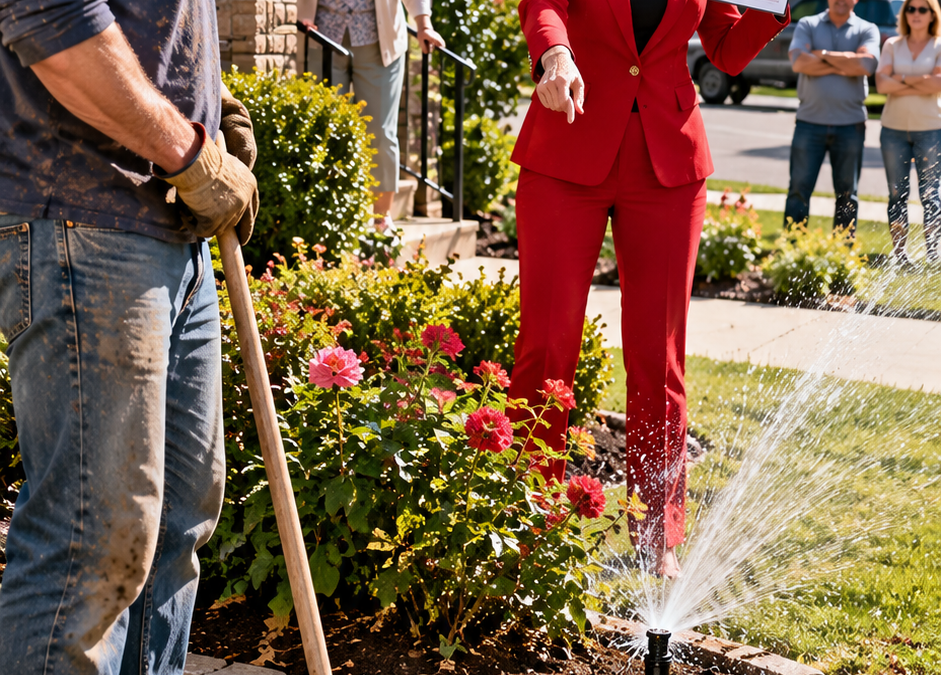
It was a dry, sharp sound, the kind that usually meant ordinary work was almost done. The sprinkler I had just replaced clicked behind me, sending a clean fan of water across the rose bed instead of spraying the sidewalk and soaking the foundation like it had been doing for two days. My gloves were muddy. My shirt was stuck to my back from the August heat. The air smelled like cut grass, hot concrete, and wet leaves.
Then a woman’s voice cut across the hiss of the sprinkler.
“Stop what you’re doing.”
I straightened slowly.
Twenty feet away, Marissa Cole stood at the end of the driveway in a bright red pantsuit, one hand holding her phone toward me like she was documenting a burglary.
Behind her, two neighbors had paused beside their mailboxes. A landscaping truck rolled past, slowed just enough for the driver to look, then kept going.
“Excuse me?” I said.
Water ticked against the dry leaves around my boots.
Marissa stepped onto the lawn without taking her eyes off me.
“Do you have architectural approval for this work?”
I looked at the rake in my hand, then at the fresh black sprinkler head I had installed beside the rose bed.
“I replaced a broken sprinkler and pulled weeds.”
Her phone clicked.
“And altered the edging.”
“I straightened it.”
“On property that isn’t yours.”
Mrs. Parker pushed herself up from the porch chair.
She was seventy-eight and moved carefully these days, one hand gripping the railing, the other pressed against her hip in that unconscious way people do when pain has become part of how they stand.
“Marissa,” she said, “I asked Luke to help me.”
Marissa barely turned her head.
“That doesn’t exempt either of you from association rules.”
She reached into a slim folder and pulled out a white notice.
I wiped my muddy glove against my jeans before taking it.
At the top was my address.
Underneath, in clean black type, was the violation description:
Unauthorized exterior alterations performed on another homeowner’s lot.
The fine was $250.
I read it twice.
“You fined me for fixing her yard.”
“You performed work without approval.”
“Her sprinkler was shooting water into the sidewalk.”
“Then she should have submitted a maintenance request.”
Mrs. Parker stared at her.
“It takes your office three weeks to answer those.”
Marissa’s jaw tightened.
“There’s a process for a reason.”
The sprinkler clicked behind me and sent another even arc across the roses. Two days earlier, that same line had been dumping gallons against the foundation. Mrs. Parker had called the management office twice and left one voicemail. Nobody came. Nobody called back. Nobody sent help.
So she asked me.
I lived across the street. I had tools. I had fixed the same sprinkler head at my own house the previous spring. It took me fifteen minutes and a six-dollar part.
I pointed toward it.
“That’s the process I used. I found the leak, replaced the head, and now it works.”
Marissa’s expression did not change.
“You are not authorized to decide which rules matter, Mr. Barrett.”
That got another neighbor’s attention.
Gordon Ellis had been trimming a hedge across the street. His clippers stopped halfway through a branch. Marissa noticed him watching and lowered her voice.
“You have ten days to pay or appeal.”
“And if I finish cleaning this up?”
“Additional violations may be assessed.”
I looked past her at Mrs. Parker.
On the porch beside her iced tea sat an old framed photograph she had brought outside that morning while we talked. It was maybe fifteen years old. A dozen neighbors stood in this same yard holding rakes, trash bags, and hedge trimmers, smiling beneath a younger maple tree. Mrs. Parker stood in the center, her late husband beside her, both of them laughing.
Nobody in that photograph looked like they had asked permission to help somebody.
I set my rake against the porch rail.
The wooden handle made a hollow knock.
Mrs. Parker’s face changed when she heard it.
She knew what it meant.
I was stopping.
Marissa slipped the folder beneath her arm.
“Thank you for cooperating.”
I turned toward her.
“Don’t mistake stopping for agreeing.”
For the first time, her polished expression slipped.
Just a little.
Then she raised her phone and took one more picture of the repaired rose bed before walking back toward the street. Her heels clicked sharply against the driveway.
I watched her pass Gordon’s house.
His freshly replaced fence panels were stacked beside the garage, and another neighbor was helping him install them. Marissa glanced directly at the work.
She kept walking.
I looked down at the violation notice in my hand.
Then across the street at Gordon’s fence.
Same neighborhood.
Same afternoon.
Same kind of neighbor helping neighbor.
Only one of us had a fine.
Standing there with sprinkler water cooling the dust around my boots, I stopped wondering whether I had broken a rule.
I started wondering who never seemed to break one.
That evening, I set the violation notice on my kitchen counter beside a cold bottle of water and left it there while I washed dirt from my hands.
Brown water curled around the stainless steel sink.
Through the open window, sprinklers whispered across neighboring lawns, and cicadas buzzed in the cottonwoods beyond the subdivision wall. I kept seeing Marissa walking past Gordon’s fence without slowing down.
Maybe she had missed it.
Maybe Gordon had approval.
I wasn’t interested in accusing anybody because I was angry. That was how people made bad decisions. Anger made patterns out of coincidence. It turned suspicion into certainty before facts had time to catch up.
So the next morning, I started with the simplest thing I could do.
I walked the neighborhood.
Not snooping.
Looking.
I had lived in Cedar Ridge for eight years. I knew which roofs had been replaced after the hailstorm, which driveways had widened, which homeowners borrowed tools and returned them clean. I knew who helped whom after storms, who mowed for elderly neighbors, who climbed ladders for widows, who showed up with a truck when someone needed mulch hauled.
By 7:30, Gordon was outside fitting another cedar panel into place. His neighbor Frank held the opposite end.
“Morning, Luke,” Gordon said.
He nodded toward Mrs. Parker’s house.
“Heard you got nailed yesterday.”
“Two-fifty.”
Frank gave a low whistle. “For the sprinkler?”
“For helping.”
I pointed at their fence.
“You guys file anything for this?”
Gordon laughed.
Then he stopped when he saw I wasn’t joking.
“No.”
Frank lifted the nail gun slightly. “Storm warped three sections. I had the nail gun.”
“Marissa walked right past you yesterday.”
Gordon’s smile disappeared.
He looked toward the HOA clubhouse at the end of the block.
“Yeah,” he said. “She did.”
That changed something.
Not enough to prove anything.
Enough to keep me walking.
On Juniper Court, a homeowner was repainting shutters with his brother. On Ridge Lane, two men were rebuilding a mailbox surround with fresh stone. On Cedar Bend, someone had trimmed hedges so aggressively that the front yard looked like it had received a military haircut.
Nobody had violation stickers taped to their doors.
Nobody had stopped working because the HOA president had appeared with a camera.
By noon, the heat had turned the sidewalks white and hard under the sun. I went home, opened my laptop, and pulled up the HOA’s online violation portal. Homeowners could view their own notices, not everyone else’s. That meant I could not simply search who had been fined.
And I wasn’t going to pretend I had access I did not have.
Instead, I opened the monthly board minutes.
Most were painfully ordinary.
Pool maintenance.
Landscaping bids.
Streetlight repairs.
Discussion about replacing clubhouse chairs that had somehow become a twenty-minute agenda item.
Then I noticed something small.
Violation totals appeared in every report.
No names.
Just numbers.
Eleven in April.
Fourteen in May.
Nine in June.
Enforcement was active. Clearly active. Yet the neighborhood around me was full of exactly the kind of unapproved maintenance Marissa had called punishable.
My phone buzzed against the counter.
Mrs. Parker.
“Luke,” she said, “there’s another letter.”
I was across the street two minutes later.
She stood inside her doorway holding an envelope with both hands. The paper shook slightly between her fingers.
Her own violation notice was for the same yard work.
The fine was $150.
“They fined you too?” I asked.
She nodded.
“It says I permitted an unauthorized alteration.”
I felt my teeth press together.
Marissa had not just punished me for helping.
She had charged a seventy-eight-year-old woman because she accepted the help.
Mrs. Parker lowered herself into the porch chair.
“Maybe we should just pay it.”
I looked at the repaired sprinkler sending a narrow, even arc over the roses.
Then I looked at that old photograph beside her glass of tea.
The one with neighbors helping neighbors in this same yard.
“Not yet,” I said.
I took out my phone.
“I’m appealing mine. You appeal yours.”
Then I looked across the street at Gordon’s unfinished fence. Then down the block where a new stone mailbox caught the afternoon light.
“We stop asking who broke the rules.”
I folded my notice once and slipped it into my shirt pocket.
“We find out who the rules are actually being used against.”
The appeals meeting was held Thursday evening in the clubhouse, where the air conditioning ran hard enough to make the room smell faintly of cold carpet and burnt coffee.
Mrs. Parker sat beside me with her purse in her lap.
Across the folding tables, Marissa Cole had arranged three board members beneath fluorescent lights. She wore the same controlled expression she had worn in the yard, her red pantsuit sharp against the beige walls.
“Mr. Barrett,” she said. “Your appeal concerns unauthorized work at another residence.”
“It concerns selective enforcement.”
One board member shifted in his chair.
Marissa folded her hands.
“That is not what your appeal says.”
“Because I didn’t know it when I filed.”
I placed my phone on the table, screen down.
I had spent three days talking to neighbors. Not interrogating them. Just asking one question.
Have you ever been fined when a friend or neighbor helped repair something outside your house?
Most said no.
A few remembered warnings.
Then a pattern started forming.
Gordon had replaced fence panels with Frank. No fine.
A former board treasurer had rebuilt a pergola with two neighbors. No fine.
Marissa’s own next-door neighbor had installed landscape lighting with help from his brother. No fine.
But Mrs. Parker was not the only homeowner who had been charged.
Linda Mercer, a widow on Cedar Bend, had received a violation after a neighbor repaired her sagging gate.
Harold Vance, eighty-one, had been fined after his nephew cleaned storm debris and replaced damaged edging.
Neither had challenged it.
Both had paid.
I slid copies of their notices across the table. They had given them to me voluntarily. Their names and addresses were covered.
Marissa glanced down but did not touch them.
“Individual enforcement matters are confidential.”
“The names are covered.”
“That does not make your conclusions accurate.”
“Then explain the difference.”
Silence settled over the room except for the vent humming above us.
I pointed toward Gordon sitting in the back row.
“He replaced a fence with another homeowner helping him.”
Gordon raised his hand.
“No approval. No fine.”
Frank raised his hand beside him.
“I helped.”
Marissa’s eyes narrowed.
“Failure to observe one violation does not invalidate another.”
“Agreed,” I said. “So I checked whether this was one missed violation.”
That was when I placed the old photograph from Mrs. Parker’s porch on the table.
The neighborhood cleanup.
Twelve residents helping one another before Marissa joined the board.
“This community used to encourage people to help neighbors who couldn’t handle heavy yard work themselves.”
Marissa leaned forward.
“This board is responsible for current standards, not nostalgia.”
Mrs. Parker’s fingers tightened around her purse strap.
I saw it and stopped myself from answering too quickly.
Anger would make this about me.
I needed it to stay about what they were doing.
“Then apply the current standards equally.”
Marissa turned to the other board members.
“I think we’ve heard enough.”
The vote came fast.
My fine was suspended pending review.
Mrs. Parker’s fine was suspended too.
Gordon gave me a small nod from the back.
For about thirty seconds, it felt like we had won.
Then Marissa opened another folder.
“Since Mr. Barrett has raised concerns regarding consistency, the association will conduct a broader compliance sweep beginning Monday.”
A murmur moved through the room.
She looked directly at me.
“All exterior violations will be documented without exception.”
I understood immediately.
She wasn’t backing down.
She was changing the cost of challenging her.
Outside, the evening air felt thick after the clubhouse cold. Mrs. Parker stopped beside my truck.
“Luke,” she said, “did we just make this worse for everyone?”
Through the clubhouse windows, I could see Marissa speaking to the board, one finger moving down a printed list.
“Maybe,” I said.
Across the parking lot, Gordon stood beside his truck, staring back at the building.
The temporary victory had lasted less than a minute.
Now every homeowner in the neighborhood was about to feel the rule Marissa had used on us. And if she meant what she said, Monday morning was going to show whether she wanted equal enforcement or whether she only wanted everyone afraid to question her.
Monday started with the sound of car doors closing up and down the block.
I stepped onto my porch at 7:15 and counted three people in gray HOA polos moving from house to house with tablets. One photographed a trash can visible behind a side gate. Another crouched beside a driveway and measured an oil stain with a tape measure.
Across the street, Gordon stood beside his half-finished fence, arms folded.
“Guess she meant it,” he called.
By noon, violation notices were appearing everywhere.
Frank got one for faded mailbox numbers.
Gordon got two for his fence.
A couple on Juniper Court got cited for decorative planters that had been sitting beside their garage for six years.
Marissa had answered my challenge by turning the neighborhood into an inspection zone.
The strange part was what happened next.
People started calling me.
Not because I was on the board.
I wasn’t.
They called because they knew why the sweep had started.
By Tuesday night, my kitchen table was covered with coffee cups, envelopes, and photographs brought over by homeowners. I kept telling them the same thing.
“Don’t bring me rumors. Bring me your own notice, your own dates, your own experience.”
That narrowed things quickly.
Most of the new citations were petty, but technically defensible.
Then Linda Mercer placed an older envelope on my table.
“You asked who they never fine,” she said. “Maybe you should ask who they stopped fining.”
Her notice was eighteen months old. She had paid $300 after her neighbor repaired her gate. Stapled behind it was a warning from two years earlier for overgrown shrubs.
Then nothing.
“What changed?” I asked.
Linda pointed toward the north entrance.
“The landscaping committee.”
I knew the committee. Marissa had created it the previous spring to coordinate neighborhood appearance projects.
Linda slid her phone toward me.
On the screen was a photograph from a committee volunteer day. Homeowners were trimming hedges, replacing mulch, repairing decorative fencing—the exact kinds of work Marissa had called unauthorized at Mrs. Parker’s house.
“HOA sponsored?” I asked.
Linda nodded.
“No fines when Marissa organizes it.”
That was the first real shift.
The rule was not simply being enforced against people helping neighbors. Helping was apparently acceptable when the board controlled who helped, where, and when.
Wednesday afternoon, I found the second shift without searching for it.
Mrs. Parker called while I was working in my garage.
“Luke, there are men measuring my yard.”
I crossed the street and found two contractors near her side fence. Marissa stood beside them with her tablet.
“What’s going on?” I asked.
She turned.
“Association business.”
Mrs. Parker came down the porch steps carefully.
“It’s my property.”
One contractor looked uncomfortable.
“Ma’am, we were told the HOA had authorization to evaluate lots for the neighborhood landscape assistance program.”
I looked at Marissa.
“Assistance program?”
“A voluntary maintenance initiative.”
“Voluntary usually means the homeowner volunteers.”
Marissa’s mouth tightened.
Mrs. Parker had not signed anything.
The contractors packed their measuring wheel away and left after she told them clearly that she did not consent.
Marissa stayed.
“You’ve created unnecessary confusion, Luke.”
“I fixed a sprinkler.”
“You challenged the board publicly because you were fined.”
She lowered her tablet.
“And now residents are refusing programs designed to protect property values.”
There it was.
Not in a document.
Not hidden in a file.
She said it standing ten feet from the rose bed where this started.
Control mattered more to her than the repair ever had.
I looked toward Mrs. Parker’s porch and noticed the old cleanup photograph still sitting beside the window. Twelve neighbors helping because somebody needed help. No committee. No approved volunteer list. No board president deciding who was allowed to hold a rake.
Marissa followed my eyes.
“Monday’s enforcement was necessary because you demanded consistency.”
“No,” I said. “I demanded fairness.”
She gave me a thin smile.
“Those aren’t always the same thing.”
Then she walked away.
Mrs. Parker watched her reach the sidewalk.
“What do we do now?”
I looked at the notices accumulating across the neighborhood, then at the contractors driving out through the north entrance.
Fighting individual fines had put us exactly where Marissa wanted us: arguing over individual rules while she controlled the system around them.
So I changed the question.
I was not going to prove that nobody should ever be fined.
I was going to make Marissa explain, in front of the people paying those fines, why neighborly help became acceptable the moment she was the one granting permission.
By Friday evening, twenty-three homeowners were packed into Gordon’s garage, standing between tool cabinets, folding chairs, and a workbench that still smelled like fresh-cut cedar.
I did not give them a speech.
I put three things on the bench.
My fine.
Mrs. Parker’s fine.
A photograph from Marissa’s landscaping committee volunteer day.
“Same kind of work,” I said. “Different permission.”
Frank leaned over the photograph.
“So what? We demand they cancel every fine?”
“No.”
That surprised them.
“If we argue that rules shouldn’t exist, Marissa wins. She’ll point at the bylaws and make us look unreasonable.”
I tapped the committee photograph.
“We ask for one standard.”
Gordon rubbed sawdust from his palm.
“Meaning?”
“If neighbors can help each other during an HOA event, they can help each other outside one unless the work itself requires approval.”
Mrs. Parker sat near the open garage door, listening quietly.
Then she said, “And people who can’t do the work themselves shouldn’t have to wait three weeks for permission to stop water from leaking into their house.”
Nobody argued with that.
We drafted a simple homeowner proposal.
Emergency maintenance could be performed immediately.
Routine repairs that did not materially alter exterior appearance would not require architectural approval.
Volunteer assistance could not be punished merely because the person holding the tool lived at another address.
We needed signatures to force the board to place it on the next meeting agenda under the association rules.
By Saturday afternoon, we had enough.
That should have been the turning point.
Instead, Marissa changed the ground again.
Sunday morning, an email went to the entire neighborhood announcing that the compliance sweep had identified widespread violations and that enforcement would continue until residents demonstrated renewed respect for community standards.
My name was not mentioned.
It did not need to be.
By noon, two homeowners who had signed our proposal called me and asked to remove their names. A third stopped me near the mailboxes.
“Luke, I agree with you,” he said, keeping his voice low. “But I can’t afford five hundred bucks in fines if they start looking at everything.”
I understood then the cost I had not calculated.
Marissa did not need everyone to agree with her.
She only needed them worried enough to stand alone.
That afternoon, I found Mrs. Parker sitting on her porch with another envelope unopened beside her.
“I’m tired of letters,” she said.
I sat on the step below her.
The repaired sprinkler clicked on, throwing clean water across the roses.
“I can drop this,” I said.
She looked at me for several seconds.
“Would you?”
I did not answer.
She reached for the old cleanup photograph on the table. Her thumb moved across the faded faces.
“My husband was alive when this was taken,” she said. “That man there broke his hip the next winter. Half these people came over and handled his yard until he could walk again.”
She handed me the picture.
“Nobody asked who authorized kindness.”
Monday morning, I went to the management office and submitted the petition myself.
Marissa was behind the reception counter when the clerk stamped it received. She looked at the signature pages, then at me.
“You’re making this much larger than your fine.”
“It became larger when you fined Mrs. Parker.”
“You think a petition changes the governing documents?”
“No. It forces the conversation you keep avoiding.”
Her eyes stayed on mine.
“Be careful what you force into public discussion.”
I started toward the door, then stopped when the clerk behind her opened a storage cabinet to file my packet. Inside were several cardboard archive boxes marked by year.
One label caught my eye.
Enforcement Logs.
I did not touch them.
I did not ask to see anything I was not entitled to.
I simply remembered the wording.
That night, I reread the association’s records access section.
Owners could request certain association records, including financial records and board-approved enforcement policies, subject to privacy restrictions.
I submitted a narrow request the next morning.
Not homeowner files.
Not names.
I asked for the written enforcement policy, aggregate fine records, and records showing how collected violation revenue had been categorized.
Marissa had spent two weeks insisting this was about consistent rules.
Fine.
I was done arguing about what she said the system was.
I wanted to see what the system had actually been built to reward.
The records arrived Thursday afternoon as a password-protected PDF from the management company, not from Marissa.
I printed only the pages I needed and spread them across my kitchen table.
The first thing that caught me was not a smoking gun.
It was the absence of one.
The enforcement policy was four pages long, full of deadlines, hearing procedures, and fine schedules. But nowhere did it say a homeowner needed permission simply because another homeowner helped perform ordinary maintenance.
Architectural approval applied to material changes.
The phrase Marissa had used against me—unauthorized work at another residence—did not appear anywhere.
I read the page again.
Slower.
Then I checked the board minutes attached to the records.
Six months earlier, Marissa had proposed what she called a neighborhood assistance initiative. The board approved volunteer cleanup days.
They had not approved a new enforcement rule against private neighbor-to-neighbor help.
I leaned back and listened to my refrigerator hum in the quiet kitchen.
That changed the fight.
She had not been applying a harsh rule equally.
She had been stretching an existing rule beyond what the board had adopted.
Then I opened the aggregate fine reports.
No homeowner names. Just dates, categories, amounts, and whether fines were paid, waived, or outstanding. The numbers climbed sharply after Marissa became president.
What interested me more was where the money went.
Fine revenue flowed into the association’s operating account, which was normal enough. But several months showed landscaping program expenses rising almost in step with enforcement revenue. That was not proof of wrongdoing, and I knew better than to pretend it was.
So I stayed with what I could establish.
The board had created a program Marissa controlled.
She promoted volunteer work through that program.
At the same time, residents outside that program had been fined under language that did not exist in the written policy.
I called Gordon.
“Meeting at my place. Six o’clock. Bring Frank.”
By 6:15, five homeowners sat around my kitchen table. Mrs. Parker came last, carrying a plate of oatmeal cookies nobody touched.
I showed them the policy.
Gordon read the relevant section twice.
“So your repair wasn’t prohibited.”
“The sprinkler repair itself wasn’t an architectural change.”
“Then why did they fine you?” Frank asked.
“That’s what Marissa gets to explain.”
Mrs. Parker stared at her own violation notice.
“And mine?”
“Same problem.”
Her shoulders dropped slightly, but I raised a hand before anyone celebrated.
“This doesn’t erase every citation from the sweep. Some people really do have violations. We keep this narrow.”
Gordon nodded.
“Your fine. Parker’s fine. The invented interpretation. And the petition.”
I said, “We also change the rule so nobody can play this game again.”
The next morning, Marissa called me herself.
Her voice was clipped.
“I understand you requested association records.”
“Owners are allowed to request them.”
“You are drawing conclusions from administrative documents you may not understand.”
“Then explain them at the meeting.”
Silence.
I could hear faint keyboard clicks on her end.
“Your fine can be waived,” she said.
I looked through my window toward Mrs. Parker’s porch.
The sprinkler had just switched on, water flashing silver in the morning light.
“And hers.”
Another pause.
“We can review hers separately.”
There it was.
The exit ramp.
My fine disappears.
The pressure drops.
The larger question dies quietly.
For a second, I wanted it.
I was tired of envelopes, meetings, neighbors calling after dinner, people looking at me like I had started a war over a sprinkler head.
Then Mrs. Parker stepped onto her porch carrying that old cleanup photograph to move it out of the sun.
“No,” I said.
“Excuse me?”
“Don’t waive mine privately.”
“Mr. Barrett, I am offering you the outcome you requested.”
“I requested equal treatment.”
Her voice hardened.
“Then you’re choosing escalation.”
“No, Marissa. I’m choosing the meeting.”
She hung up without answering.
Ten minutes later, an association email hit every homeowner’s inbox.
The subject announced a special board session to review enforcement standards and the homeowner petition.
Marissa had tried to end the dispute with one quiet exception.
By refusing it, I had given up the easiest win I was ever going to get.
But for the first time since she walked into Mrs. Parker’s yard, the question was no longer whether I deserved a fine.
It was whether Marissa could defend the system she had built when everyone affected by it was sitting in the same room.
The clubhouse parking lot was full twenty minutes before the special meeting started.
Cars lined both curbs, and people I usually saw waving from driveways were carrying folding chairs toward the entrance. Inside, the room smelled like coffee, warm bodies, and the lemon cleaner they used on the tile floor.
Marissa sat at the center of the board table in her red pantsuit, a stack of folders squared perfectly in front of her.
Mrs. Parker took a seat in the second row.
Gordon and Frank stood along the back wall.
I sat near the aisle with three pages in my hand.
Nothing more.
Marissa called the meeting to order at 7:00.
She began with the compliance sweep, describing it as an unfortunate but necessary response to concerns about inconsistent enforcement.
Then she looked directly at me.
“Those concerns were raised publicly by Mr. Barrett.”
A few heads turned.
I stayed seated.
“That’s correct.”
“And the board responded by applying standards more uniformly.”
“No,” I said. “You responded by increasing enforcement. Those aren’t the same thing.”
One board member, Thomas Reed, leaned toward his microphone.
“Luke, what exactly are you asking us to decide tonight?”
That was the opening I needed.
I stood and placed the written enforcement policy on the table.
“Three things. Whether ordinary maintenance becomes a violation because a neighbor helps. Whether that interpretation was ever adopted by this board. And whether homeowners should be punished for doing privately what the HOA encourages during its own volunteer events.”
Marissa reached for the policy.
“The architectural guidelines give the association broad discretion for alterations.”
I pointed to the section.
“Replacing a broken sprinkler head with the same type isn’t an alteration.”
“The edging was modified.”
“Straightened.”
A few people laughed softly.
Marissa’s eyes moved toward them, and the room went quiet again.
Then Thomas asked the question that changed the temperature.
“Marissa, where is the rule requiring approval for one homeowner to perform maintenance at another homeowner’s property?”
She opened one folder.
Then another.
“It falls under our enforcement interpretation.”
“Where was that interpretation approved?” Thomas asked.
Marissa stopped turning pages.
Another board member, Denise Hall, looked toward the association manager sitting near the wall.
“Do we have a board resolution?”
The manager shook his head.
“Not that I located.”
Marissa’s face remained composed, but her right hand flattened against the table.
“Presidents have historically exercised discretion in enforcement.”
Gordon spoke from the back.
“Apparently some more than others.”
Marissa ignored him.
I set down the photograph from the landscaping committee volunteer day.
“This was an HOA-sponsored event six weeks before you fined me. Homeowners are repairing edging, trimming shrubs, and working on property they don’t own.”
Marissa looked at the photograph.
“That was supervised by the association.”
“Exactly.”
The room became still.
She had walked straight into it.
If the work was dangerous or prohibited, supervision did not change its nature. If it was acceptable maintenance, then the problem was not the work.
The problem was who controlled it.
Mrs. Parker stood slowly behind me.
“I asked Luke for help because water was running against my foundation,” she said. “I waited twelve days for a response before I asked him.”
Denise turned toward the manager.
“Twelve days?”
He checked his laptop.
“The maintenance inquiry was received. It appears no response was sent before the repair.”
Marissa leaned toward her microphone.
“We are drifting away from the agenda.”
“No,” Thomas said. “I think we finally reached it.”
For the first time, she looked genuinely caught off balance.
Then she recovered.
“Fine. If the board believes clarification is necessary, we can adopt revised language going forward.”
It sounded reasonable.
For half a second, I thought she was giving ground.
Then Denise lifted another page from the records packet.
“Before we do that, I want to understand something else.”
She turned it toward Marissa.
“Why were Luke’s and Mrs. Parker’s fines coded under architectural violations when the management company’s own review says no architectural application was required for like-for-like sprinkler replacement?”
Marissa’s jaw tightened.
“Because the violation involved unauthorized work.”
“That category doesn’t exist,” Denise said.
The room went silent enough that I could hear the air conditioner click off.
Marissa had spent weeks insisting the rules forced her hand. Now the board was not debating my interpretation anymore. They were asking why she had created one of her own.
And judging by the way Thomas closed his folder and looked down the table at her, the next vote was not going to be about my sprinkler.
Thomas did not call for a vote.
That surprised Marissa more than anything.
He pushed his chair back, folded his arms, and said, “Before this board decides anything, I want the full enforcement log on the screen.”
The association manager hesitated, then opened the enforcement log on his laptop and turned the screen toward the board. He angled it so only the board could see the identifying details.
From where I stood, I could not read the addresses, but I could watch their expressions change as he sorted the entries.
Marissa turned toward him.
“Those records contain private homeowner information.”
“They’re board records,” Denise said. “And we’re the board.”
I stayed near the aisle while the manager filtered the list by violation category. He confirmed that Mrs. Parker’s property was in the list with mine immediately after it.
Then dozens more.
Thomas asked him to sort by property.
That was when the room changed.
The same handful of addresses kept appearing with warnings, fines, second notices, and administrative fees. Others showed repeated inspections but no penalties.
Thomas asked the manager to check several properties the board members recognized from recent inspections.
One showed inspection entries but no fines.
Another showed the same pattern.
Then another.
Marissa stood.
“This is becoming a public trial based on incomplete data.”
“Sit down, please,” Thomas said.
His voice was quiet, but nobody mistook it for a request.
She remained standing for two seconds.
Then she lowered herself into the chair.
As the board worked through the records, Thomas and Denise began identifying who some of the repeatedly waived properties belonged to.
One was owned by a board member’s brother-in-law.
Another belonged to the landscaping committee chair.
The pattern was becoming harder to dismiss.
That was what I had started checking after Marissa fined me.
Not who had broken rules.
Who somehow never paid for breaking them.
Denise asked the manager to filter the records by waived violations.
The screen filled with entries.
Several had notes showing presidential discretion.
Marissa’s gold bracelet clicked against the tabletop as she reached for her water.
Thomas stared at the screen.
“Did the board authorize these waivers?”
“Not individually,” the manager said. “We were instructed that the president had authority to resolve minor matters.”
Marissa leaned forward.
“Which saved this association time and legal expense.”
“Except you didn’t use that discretion to save Mrs. Parker anything,” I said.
Her eyes snapped toward me.
“You fined the seventy-eight-year-old homeowner after she asked for help with drainage you ignored for twelve days. Then you fined me for helping her. Meanwhile, people connected to this board got warnings erased.”
“You have no idea why those cases were resolved.”
“Maybe not.”
I looked at Thomas.
“That’s why I stopped trying to prove what was in her head.”
Marissa’s expression shifted slightly.
She knew what I meant.
I did not need to prove favoritism as a motive if the board could see unequal treatment as a pattern.
Thomas asked the manager one final question.
“Were Luke Barrett’s fines discretionary?”
“Yes.”
“Could they have been waived?”
“Yes.”
“Were you instructed not to waive them?”
The manager looked at Marissa, then back at Thomas.
“Yes.”
A murmur rolled across the room.
Marissa rose again.
“Because he challenged enforcement and encouraged other residents to disregard established procedure.”
There it was.
Not hidden in an email.
Not buried in a file.
She said it herself into the microphone with half the neighborhood listening.
Denise stared at her.
“You increased enforcement because a homeowner challenged you.”
Marissa realized the sentence she had just handed them.
“That is not what I said.”
“It’s exactly what you said,” Gordon replied.
Thomas called a five-minute recess.
Chairs scraped across tile. People clustered near the walls, speaking in low voices. Mrs. Parker touched my forearm as she passed.
“You all right?”
I nodded, though my mouth was dry.
Across the room, Marissa was speaking urgently with the association manager. Then I saw her point at his laptop.
He shook his head.
She pointed again.
He closed the screen.
When the meeting resumed, Thomas looked different.
The careful neutrality was gone.
“The manager has informed us,” he said, “that during recess, Marissa requested that several enforcement notes be reclassified before the board completed its review.”
Nobody moved.
Marissa’s face drained of color.
The manager stared down at his hands.
That was the mistake she could not explain as discretion.
She had been losing control.
And instead of stopping, she had tried to change the board’s view of the record while they were looking at it.
Thomas placed both palms on the table.
“I move that all fines against Mr. Barrett and Mrs. Parker be suspended immediately, that presidential enforcement authority be revoked pending board action, and that Marissa be removed from all compliance decisions effective tonight.”
Denise said, “Second.”
This time, when the vote came, every hand except Marissa’s went up.
By sunrise, the orange violation tag on Mrs. Parker’s mailbox was gone.
I noticed the empty strip of adhesive while I was carrying two bags of mulch across her driveway. The morning air was cool enough to smell damp soil and fresh-cut grass. Mrs. Parker stood beside the porch in gardening gloves, watching me spread mulch beneath the hydrangeas we had nearly finished before Marissa turned a neighbor helping a neighbor into an enforcement case.
“Looks strange without that ugly thing,” Mrs. Parker said.
“I could put it back if you miss it.”
She laughed.
For the first time in weeks, the sound did not carry any worry.
The board’s vote the night before had suspended every fine against us, but Thomas had warned me not to confuse that with the end. Marissa still held the title of HOA president until the board completed the removal process, and she had already sent residents an email claiming the meeting had been manipulated by hostile homeowners.
I read it once and deleted it.
That had been my mistake early on.
Every threat from her had made me react.
Every envelope had changed my day.
I was not doing that anymore.
Three days later, the board held an emergency meeting in the clubhouse. This one was packed before I arrived. I stood along the back wall while Thomas presented the enforcement review.
The numbers were simple enough that nobody needed a lawyer to translate them.
Over eighteen months, Marissa had personally directed or approved dozens of discretionary waivers. Properties tied to board allies repeatedly received warnings or cancellations. Homeowners outside that circle received escalating penalties for comparable violations.
My case was worse because the association manager had documented her instruction to continue fining me after I challenged her authority.
Then Thomas reached the part that changed the room.
During the recess at the previous meeting, Marissa had attempted to alter enforcement classifications while the board was actively reviewing them. The management company had preserved the original entries automatically.
Marissa stood near the front in her red pantsuit, shoulders square, brown ponytail pulled tight, one hand resting on the chair beside her.
“This is administrative interpretation,” she said.
Denise shook her head.
“No. This is selective enforcement, retaliation, and an attempt to change records during a board review.”
The board voted to remove Marissa as president that night.
Whatever happened to her board seat would follow the association’s governing process, but her officer authority ended immediately. She lost access to the association’s enforcement system and authority to issue, waive, or direct violations.
The board ordered the management company to reverse improperly assessed penalties, including mine and Mrs. Parker’s.
It also referred the outside review costs tied to Marissa’s unauthorized record-change request, along with the broader enforcement issue, to the association’s insurer and counsel for a separate responsibility and recovery review.
I did not clap.
Neither did Mrs. Parker.
We just watched while Marissa removed her access badge from her purse and placed it on the table.
The plastic made a small click against the wood.
That sound stayed with me.
All those weeks, her power had felt enormous because it arrived in official envelopes, violation tags, deadlines, and fees.
In the end, it fit in the palm of her hand.
A month later, the landscaping rules were rewritten so one person could no longer direct discretionary enforcement alone. Waivers required documented reasons. Comparable violations had to be treated consistently. Emergency maintenance could be performed without waiting weeks for approval. Routine like-for-like repairs were clarified. Volunteer help could not be punished simply because the person helping lived at a different address.
Mrs. Parker’s drainage problem was finally repaired by the association because the failed common-area runoff channel had contributed to the damage in her yard from the beginning.
I was there the morning the crew finished.
Water ran cleanly through the new channel after they tested it, disappearing toward the storm drain instead of pooling beside her flower bed.
Mrs. Parker handed me the same old garden rake I had used the day this started.
“You know,” she said, “you never finished what they fined you for.”
I looked at the bare patch beside the hydrangeas.
“That sounds like a violation.”
She smiled.
I pulled my gloves on and started spreading the last of the mulch.
No audience.
No meeting room.
No microphone.
Just the scrape of the rake, the smell of wet earth, and an elderly neighbor standing in a yard that finally belonged to her again in every way that mattered.
I thought about that old photograph on her porch, the one where neighbors stood with tools in their hands and no one looked afraid of being punished for kindness.
Maybe Cedar Ridge would never become exactly that place again.
Communities change.
People move.
Rules multiply.
Boards forget that authority is supposed to serve the people who gave it power.
But that morning, as water moved where it was supposed to move and Mrs. Parker’s roses lifted in the sun, something in the neighborhood felt repaired beyond the sprinkler.
Marissa had believed control was the same as order.
She was wrong.
Order is a system people can trust.
Control is what happens when one person gets to decide who the rules touch and who they spare.
She fined me because I helped.
She fined Mrs. Parker because she needed help.
And in the end, the same records she used to make us feel powerless became the evidence that took her power away.
The rake teeth scraped softly through the mulch.
This time, nobody told me to stop.