FULL STORY:The Pit Bull Who Survived Six Years of Fighting Wouldn’t Let Me Touch Him—Then My Neighbor’s Golden Retriever Lay Down Beside Him
FULL STORY CONTINUATION
For several seconds, I stayed silent.
The phone remained pressed against my ear.
I looked across the living room.
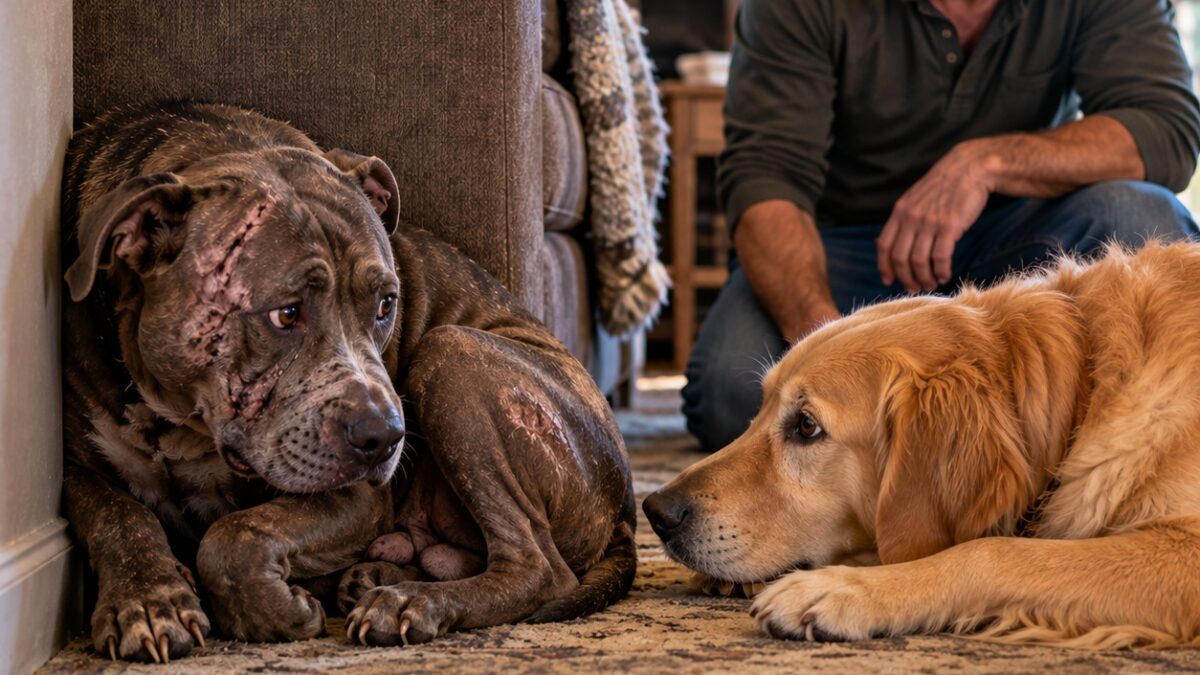
Rex was in his corner.
Same posture.
Same quiet face.
Same dog I had watched the previous afternoon appear almost completely indifferent while my neighbor’s retriever lay across the room.
“What do you mean he wants to come back?”
“He’s been strange since we left.”
“Strange how?”
“He barely ate dinner.”
That got my attention.
The golden retriever loved food.
I had seen him steal half a sandwich from my neighbor’s hand and look offended when she objected.
“He slept by the front door all night,” she continued. “Every time I moved, he stood up.”
I looked at Rex again.
His ears moved slightly.
He could hear my voice.
“What do you think happened?”
“I don’t know.”
Neither did I.
But a thought came so quickly that I almost dismissed it because it sounded sentimental.
What if the retriever had noticed something?
Not magic.
Not some mystical conversation.
Something simpler.
Body language.
Fear.
The kind of signals dogs read from one another before humans even realize communication is happening.
Maybe the retriever understood that Rex wasn’t rejecting him.
Maybe he recognized a dog who did not know how to approach.
“Bring him back.”
“You sure?”
I hesitated.
“Slowly.”
She arrived less than fifteen minutes later.
I heard them outside.
Rex heard them too.
His head lifted.
His body tightened.
The door opened.
The golden retriever entered.
But he was different from the previous afternoon.
No bouncing.
No tail whipping furniture.
No enthusiastic greeting.
He walked slowly.
Almost cautiously.
My neighbor kept the leash loose.
The retriever looked toward Rex.
Then stopped.
Rex pressed himself slightly deeper into the corner.
I held my breath.
The retriever moved forward perhaps two steps.
Then lay down.
About six feet from Rex.
Head lowered onto his front paws.
He did not stare.
That detail mattered.
He turned his face slightly sideways.
Nonthreatening.
Present without demanding.
My neighbor whispered:
“He never does this.”
“Don’t move.”
We sat.
For nearly twenty minutes, nothing happened.
Then Rex lifted his head.
Not much.
Maybe an inch.
His eyes moved toward the retriever.
The retriever’s tail touched the floor once.
Slow.
Then stopped.
Rex continued looking.
I realized I had never seen him study another living creature with curiosity.
Fear, yes.
Vigilance constantly.
But curiosity requires a tiny amount of safety.
It means the mind has space left for a question.
Who are you?
Why are you here?
What do you want?
The golden retriever’s answer seemed to be:
Nothing.
That was apparently the right answer.
My neighbor stayed most of the day.
Not because we planned to.
Neither of us wanted to break whatever was happening.
We drank coffee.
Spoke quietly.
At one point, I read.
She answered emails.
The retriever remained on the floor.
Sometimes he slept.
Sometimes he looked toward Rex.
Rex never approached.
But he also never turned his face toward the wall.
At dinner, I prepared Rex’s bowl.
Usually I placed it down and left the room.
If I remained visible, he would wait.
Sometimes thirty minutes.
Sometimes longer.
That evening, I placed his bowl where I always did.
My neighbor filled the retriever’s bowl on the other side of the room.
The golden retriever stood.
I assumed he would eat.
He didn’t.
He walked toward Rex’s food.
Not close enough to take it.
Then sat beside the bowl.
My neighbor frowned.
“What is he doing?”
“I don’t know.”
The retriever looked at Rex.
Tail moved once.
Rex watched him.
Five seconds.
Ten.
Then Rex stood.
My heart started pounding.
He rarely moved while we were watching.
He stepped out of the corner.
One step.
Stopped.
The retriever did not move.
Second step.
Rex stretched his neck toward the bowl.
Stopped again.
The retriever turned his face away.
That gesture almost broke me.
He gave Rex the space to approach without feeling watched.
Rex took another step.
Then another.
Reached the bowl.
Looked at me.
I stayed completely still.
He lowered his head.
Ate one bite.
Then another.
For the first time since I had brought him home, Rex ate while I was in the room.
I covered my mouth with my hand.
My neighbor looked at me.
Her eyes were wet too.
Neither of us spoke.
Rex finished half the food.
Then returned to his corner.
The retriever finally ate his own dinner.
That night, after my neighbor took him home, Rex behaved differently.
Not dramatically.
He did not come sit beside me.
He did not suddenly become affectionate.
But when I stood to turn off the lamp, Rex looked toward the front door.
Then back at me.
As though asking a question.
“He’ll come back.”
His ears shifted.
“I think.”
The next morning, the retriever was waiting at my door before eight.
My neighbor laughed.
“He practically dragged me.”
Again, the dog entered calmly.
Again, Rex watched.
This time the retriever lay closer.
Maybe three feet away.
Rex stiffened briefly.
Then relaxed.
Hours passed.
At noon, Rex stood.
Walked two steps.
Lay down.
Not beside the retriever.
But outside his corner.
That was enormous.
I wanted to celebrate.
Instead, I kept reading.
Quiet joy.
I was beginning to learn.
The retriever slept.
Rex watched him breathe.
Sometimes I wondered whether that was part of the lesson.
The golden retriever slept deeply because he expected to wake safely.
Rex did not know how to do that.
Sleep, for him, still meant vulnerability.
Even at night, he rested lightly.
Any sound woke him.
Any movement made his eyes open.
But the retriever sprawled on the floor with his legs loose and belly partly exposed.
Nothing happened.
Hour after hour.
No attack.
No punishment.
No forced interaction.
Just sleep.
By evening, the distance between them was less than two feet.
Neither of us had moved them.
Rex had done it.
Then something happened I will remember for the rest of my life.
The room was dim.
Rain had begun tapping against the windows.
I sat in my chair pretending to read.
My neighbor had gone to the kitchen.
The retriever lay on his side.
Rex stood.
He looked toward me first.
Then toward the golden dog.
Took one step.
Stopped.
His breathing became faster.
I could see the old conflict inside him.
Want.
Fear.
Want.
Fear.
He took another step.
The retriever opened his eyes.
Did nothing.
Rex moved closer.
His front paw touched the retriever’s fur.
He froze.
No reaction.
Then Rex lowered himself onto the floor.
Beside him.
Their bodies touched.
Just along the shoulder.
Rex immediately tensed.
The retriever stayed completely still.
Then he turned his head slightly and rested his chin near Rex’s front leg.
Rex exhaled.
A long breath.
The kind that sounds almost human when an animal finally releases tension.
Then he pushed his muzzle into the retriever’s golden coat.
His eyes closed.
I stopped breathing.
My neighbor returned.
Saw them.
Stopped in the doorway.
Neither of us moved for several minutes.
Rex slept.
Not lightly.
Deeply.
His face softened.
His paws twitched once.
The muscles across his shoulders lost the rigid tension I had come to consider permanent.
I cried without making a sound.
Not because Rex was cured.
He wasn’t.
Because for one night, he believed enough in safety to sleep beside another dog.
That was the beginning.
The retriever returned the next day.
And the next.
Soon my neighbor no longer needed to ask.
If she opened her front door in the morning, he headed toward my house.
Rex began expecting him.
I noticed because around the usual arrival time, Rex watched the door.
He never wagged.
Not yet.
But anticipation had entered his world.
That mattered.
The retriever became a translator.
He showed Rex ordinary things.
A door opening did not always mean danger.
A human approaching could bring food.
A hand reaching downward might become affection.
A sudden sound could simply be a spoon falling.
Grass was for rolling.
Sunlight was for sleeping.
Toys were objects you could shake without punishment.
Humans sometimes laughed for reasons that had nothing to do with cruelty.
Rex learned by watching.
At first, he followed from a distance.
The retriever walked into the kitchen.
Rex stood near the living room doorway.
The retriever drank water.
Rex watched.
The retriever let me rub his ears.
Rex watched every movement of my hand.
One afternoon, I sat on the floor scratching the retriever’s neck.
Rex was perhaps four feet away.
I deliberately did not look at him.
The golden retriever leaned against me.
Tail wagging.
Relaxed.
Nothing bad happened.
Rex moved one step closer.
Then another.
His nose extended toward my hand.
I stopped moving.
He smelled my fingers.
Quickly.
Retreated.
My entire body filled with emotion.
But I did nothing.
The following day, he did it again.
Longer.
Three days later, while I sat beside the retriever, Rex approached without stopping.
He sniffed my hand.
Then my sleeve.
My knee.
I remained still.
He stepped away.
That was enough.
A week passed before he let me touch him voluntarily.
He came toward my hand.
I held it low.
Rex pressed his nose into my palm.
Then remained.
I moved one finger along his cheek.
His body stiffened.
I stopped.
He did not retreat.
So I waited.
When his shoulders softened slightly, I touched his cheek again.
One slow movement.
Nothing more.
Rex closed his eyes.
For less than one second.
Then opened them.
I looked away so he would not feel watched.
The retriever was lying nearby.
Tail moving.
As though approving my work.
“You’re very smug,” I told him.
He wagged harder.
Rex’s first tail movement happened three weeks later.
I came home from work.
My neighbor had been watching both dogs.
When I opened the door, the retriever charged toward me as usual.
Rex stood behind him.
I crouched to greet the golden dog.
Then looked up.
Rex’s tail moved.
One small sweep.
Stopped.
I froze.
He looked uncertain.
Then the tail moved again.
I cried immediately.
My neighbor laughed.
“You’re going to scare him.”
“I’m trying not to.”
Rex stared.
I wiped my face.
“Nothing happened.”
The tail moved again.
It became easier after that.
Not fast.
Easier.
There is a difference.
Trauma remained inside Rex.
A pan falling in the kitchen could send him under a table.
Men shouting outside made him tremble.
Certain dogs caused him to freeze.
If another animal stared too directly, Rex’s breathing changed.
Some scars never became invisible.
But fear stopped controlling every decision.
That was the miracle.
Not erasure.
Choice.
One afternoon, the retriever carried a tennis ball into the yard.
Rex followed.
The golden dropped it.
Picked it up.
Ran.
Rex watched.
Again.
Again.
Then Rex moved.
Not running.
Trotting.
The retriever dropped the ball.
Rex sniffed it.
The golden waited.
Rex picked it up.
For perhaps three seconds.
Then dropped it.
My neighbor gasped.
“Did he just—”
“Quiet.”
She covered her mouth.
The retriever grabbed the ball and ran.
Rex followed.
Faster.
By the end of the week, they were playing.
Really playing.
Running through grass.
Turning circles.
Shoulder against shoulder.
Rex discovered a strange bouncing movement that made him look like a dog several years younger.
I would stand at the back door watching.
Sometimes laughing.
Sometimes crying.
Often both.
The scars remained.
But now they moved across a body capable of joy.
That mattered more than pretending they were gone.
My neighbor saw it too.
One afternoon, she stood beside me while the dogs chased each other.
“He’s different.”
“Rex?”
“My dog.”
I looked at her.
“What do you mean?”
“He waits for him every morning.”
The golden retriever stopped running.
Rex stopped beside him.
They drank from the same water bowl.
My neighbor smiled.
“They’re best friends.”
I laughed.
“Apparently.”
Then her expression changed.
“I’ve been thinking.”
That made me nervous.
“About?”
She looked toward the dogs.
“He’s happier here.”
“Your dog?”
“Yes.”
“He loves you.”
“I know.”
She smiled sadly.
“This isn’t about whether he loves me.”
I understood before she finished.
“No.”
“He spends almost every day here anyway.”
“You don’t have to—”
“I want to.”
I looked at her.
She wiped one eye.
“I think they chose each other.”
That was how the golden retriever became part of my household permanently.
Not because my neighbor stopped loving him.
She loved him enough to notice where he wanted to be.
We handled everything properly.
Veterinary records.
Ownership paperwork.
Long conversations.
Frequent visits.
She lived close enough that he still saw her constantly.
But at night, he slept beside Rex.
That seemed to matter most.
The first week after the arrangement became permanent, I bought a large dog bed.
Both dogs ignored it.
They slept on the rug.
Of course.
“Money well spent.”
The retriever stretched.
Rex rested his head against him.
I stopped complaining.
Rex’s world expanded.
Living room.
Kitchen.
Yard.
Short walks.
Longer walks.
The first leash sessions were difficult.
Anything around his neck created panic.
So we used carefully fitted equipment recommended by professionals and moved slowly.
The golden retriever walked beside him.
That helped.
At first, we made it to the mailbox.
Then halfway down the street.
Then around the block.
The retriever’s confidence pulled Rex forward without force.
If a truck passed loudly, Rex looked at him.
The golden kept walking.
Rex followed.
Dogs teach safety differently.
Humans explain.
Dogs demonstrate.
That became obvious again and again.
One morning, Rex stopped at a puddle.
The retriever walked through it.
Rex stared.
Then stepped in.
The golden shook water everywhere.
Rex jumped.
Then, for the first time, did something that looked unmistakably playful.
He slapped one front paw into the puddle.
Water splashed.
The retriever responded.
Within seconds, both were soaked.
So was I.
I stood there laughing.
Rex looked at me.
Tail high.
Mouth slightly open.
Relaxed.
I took a photograph.
Not because I needed proof.
Because I wanted to remember the day an animal who spent years learning violence discovered puddles.
Rex also began sleeping differently.
That mattered more than outsiders understood.
When he first came home, sleep was shallow.
Body curled.
Head lifted at every sound.
Eyes opening instantly.
After months beside the golden retriever, Rex stretched out.
Legs extended.
Sometimes rolled onto his side.
Once, incredibly, onto his back.
I found him that way one afternoon.
Belly exposed.
Mouth slightly open.
The retriever beside him.
I stood in the doorway.
My first instinct was to take a picture.
I didn’t.
Some moments belong to the creature experiencing them.
Instead, I backed away.
Let him sleep.
The veterinarian noticed his progress.
Rex had arrived underweight despite his muscular frame.
Old injuries created stiffness.
Scars required monitoring.
His teeth showed years of neglect and damage.
We managed each problem.
Nutrition.
Pain relief.
Skin care.
Regular exams.
Nothing dramatic.
Real recovery is often boring.
Medication schedules.
Quiet routines.
Repeated safe experiences.
The veterinarian once told me:
“His nervous system has had years of practice expecting danger.”
“How long before that changes?”
She shook her head.
“Don’t think of it as replacing the old wiring.”
“Then what?”
“Build enough new pathways that fear isn’t his only route.”
I liked that.
It described exactly what the golden retriever had been doing.
Rex had an old map.
Dogs equal danger.
Humans unpredictable.
Touch risky.
Sleep dangerous.
Noise means prepare.
The retriever created alternate roads.
Dog can mean warmth.
Human can mean food.
Touch can stop when you ask.
Sleep can end with everyone still safe.
Noise can just be noise.
The old roads remained.
He simply didn’t have to use them every time.
One evening, a television program unexpectedly played barking dogs.
Rex woke from sleep.
Instantly rigid.
The retriever lifted his head.
Rex looked at him.
The golden yawned.
Actually yawned.
Then went back to sleep.
Rex stood frozen another ten seconds.
Then lay down again.
That small moment captured everything.
A year earlier, fear would have taken over the entire night.
Now he could borrow another dog’s calm.
Eventually, he developed his own.
The first time Rex approached a stranger voluntarily happened almost a year after adoption.
My brother visited.
He knew the rules.
No staring.
No reaching.
No sudden movement.
He sat at the kitchen table.
Rex remained near the doorway.
The golden retriever greeted my brother like a long-lost relative despite having seen him two weeks earlier.
Embarrassing.
Rex watched.
My brother ignored him.
Thirty minutes later, Rex crossed the room.
Sniffed his shoe.
My brother kept talking to me.
Rex sniffed his hand.
Still no movement.
Then Rex walked away.
My brother looked at me only after he was gone.
“Was that good?”
I whispered:
“That was huge.”
He smiled.
“Good.”
That became the pattern.
Rex gained confidence because people stopped demanding evidence of affection.
That lesson changed me too.
Before Rex, I thought kindness was what you gave.
Food.
Shelter.
Gentle touch.
After Rex, I understood kindness also includes what you choose not to take.
Attention.
Touch.
Progress.
Gratitude.
Control.
I had wanted him to understand I was safe.
Eventually, I learned safety meant allowing him to discover it rather than insisting.
The golden retriever understood from the first afternoon.
Lie down.
Look away.
Stay.
No demand.
Sometimes I joked that I should have paid him as a therapist.
Payment was treats.
He considered the rate acceptable.
Rex became affectionate eventually.
Not in the same way as the golden.
The retriever loved everyone loudly.
Rex loved quietly.
He followed me from room to room.
If I sat outside, he lay nearby.
If I was sick, he stayed beside the couch.
When I returned home, his tail moved slowly but steadily.
He leaned into my leg.
That was his version of celebration.
The first time he rested his head on my lap, I nearly stopped breathing.
We were watching television.
The retriever occupied half the couch, naturally.
Rex sat on the rug.
Then stood.
Walked over.
Placed his chin against my knee.
I looked down.
He stayed.
My hand touched his head.
No tension.
“You know,” I whispered, “you are allowed on the couch.”
He ignored me.
Progress has limits.
Several weeks later, he climbed up.
The golden retriever looked offended because Rex had taken his usual spot.
I laughed.
“Share.”
The golden sighed dramatically.
Rex lay against my hip.
Warm.
Heavy.
Scarred.
Safe.
I thought about the first time I saw him.
That motionless body against kennel concrete.
The eyes that seemed to expect nothing.
If someone had shown me this moment then, I would have called it impossible.
But nothing about it had happened quickly.
That was the important part.
Hundreds of meals.
Hundreds of quiet evenings.
Thousands of moments when nobody hurt him.
Healing accumulated.
Like drops filling a bowl.
You barely notice until one day it is full enough to reflect light.
Rex still startled.
He probably always would.
One July afternoon, fireworks exploded unexpectedly nearby.
Rex disappeared beneath the dining table.
The golden followed.
Did not crowd him.
Just lay nearby.
I sat on the floor several feet away.
We waited.
Eventually, Rex crawled out.
He came toward me.
Then leaned against the retriever.
Old fear.
New choices.
Both true.
I stopped describing setbacks as going backward.
A frightened response was not failure.
It was memory.
Recovery meant returning afterward.
Rex became very good at returning.
So did I.
I had not realized how much his story affected me until one evening in the garden.
I came home early.
Neither dog heard the car immediately.
I stayed near the gate.
The sun was low.
Grass glowed gold.
The retriever ran in circles.
Rex chased him.
Not cautiously.
Not because he was copying.
He was playing.
Mouth open.
Tail high.
Body loose.
At one point, the golden changed direction suddenly.
Rex spun.
Almost fell.
Recovered.
Then bounded after him again.
I stood there watching.
Six years.
I thought.
Six years of learning the world was dangerous.
Then months of learning something else.
I cried.
Not sad tears.
Not exactly happy either.
Something deeper.
Witnessing freedom can be overwhelming when you remember captivity.
That was the moment I finally understood what Rex had needed.
Not strict obedience lessons.
Not expensive toys.
Not constant physical affection.
Not somebody proving how much she loved him.
He needed a stable presence.
And strangely, another dog had been able to provide something I couldn’t at first.
A bridge.
The retriever spoke the language Rex trusted enough to begin listening.
Lie down.
Don’t stare.
Share space.
Sleep.
Eat.
Play.
Nothing bad happens.
Again.
Again.
Again.
Once Rex crossed that bridge, humans became easier too.
I stopped feeling jealous of that.
At first, I’ll admit, part of me wondered why Rex trusted another dog before he trusted me.
Considering his history, that seemed backwards.
Then I realized trust isn’t mathematical.
Trauma doesn’t follow logic from the outside.
Perhaps the retriever’s silence felt safer.
Maybe Rex understood canine body language more clearly than human intention.
Maybe he saw an animal so relaxed that his own nervous system finally believed relaxation was possible.
Whatever the mechanism, I became grateful.
The golden retriever did not replace me in Rex’s healing.
He helped Rex reach me.
That distinction mattered.
My neighbor remained part of our lives.
She visited constantly.
The retriever lost his mind with happiness every time she arrived.
Rex learned to greet her too.
Slowly.
First from across the room.
Then sniffing.
Then one afternoon allowing her to touch his shoulder.
She looked at me afterward.
“I can’t believe that.”
“I can.”
“You couldn’t last year.”
She was right.
Last year, I wanted guarantees.
Now I understood time.
The dogs grew inseparable.
If one went to the veterinarian, the other waited by the door.
If Rex settled outside, the retriever joined him.
If the golden started a game, Rex eventually participated.
Sometimes they slept with their backs touching.
Sometimes separate.
They did not need constant contact.
Trust had become ordinary enough not to require proof.
That may have been Rex’s greatest transformation.
Safety stopped being an event.
It became the background.
People who learned his history sometimes reacted badly.
They would stare at scars.
Whisper.
Ask if he was dangerous.
I learned to answer carefully.
“He’s a dog with a traumatic past.”
“But was he used for fighting?”
“Yes.”
“Aren’t pit bulls—”
“No.”
I would stop them there.
Rex did not need strangers turning what had been done to him into his identity.
His scars told a history.
They did not predict his character.
The dog asleep beside my feet cared more about cheese than violence.
The dog who once fought because humans forced him now stepped away from conflict whenever possible.
That taught me something uncomfortable.
Humans often punish animals for adaptations humans created.
Fear becomes aggression.
Hypervigilance becomes “bad behavior.”
Shutdown becomes “unfriendly.”
Then we judge the animal for surviving incorrectly.
Rex made me slower to judge everything.
Dogs.
People.
Myself.
There were times I became frustrated.
Healing is beautiful in hindsight.
In real time, it is repetitive.
Some days Rex refused a walk we had successfully taken ten times.
Sometimes progress vanished after one loud noise.
I had moments when I thought:
Why are we back here?
Then I learned the better question.
What happened today that made him need more safety?
That changed everything.
Patience became active rather than passive.
Observe.
Adjust.
Give space.
Try later.
The golden retriever seemed naturally gifted at this.
One afternoon Rex had a difficult veterinary visit.
When we returned home, he went directly to his corner.
The retriever followed.
Stopped outside the corner.
Lay down.
Didn’t enter.
Didn’t touch him.
Two hours later, Rex came out.
Lay beside him.
I remember thinking:
He knows boundaries better than half the adults I have met.
Years passed.
Rex’s scars softened in appearance as his coat improved.
His body became stronger.
The old marks never disappeared.
I stopped wishing they would.
They belonged to the truth.
What changed was what surrounded them.
A healthy body.
Soft bed.
Full bowl.
Friend.
Home.
Joy.
The golden retriever eventually developed a little gray around his muzzle.
Rex’s face whitened too.
Two older dogs stretched in sunlight.
Sometimes I looked at them and thought about time.
How unfairly much of Rex’s had been stolen.
For a while, that made me angry.
Six years.
What could his puppyhood have been?
What games did he never learn?
What ordinary pleasures did he miss?
Then I realized anger could consume the years he had now.
Rex didn’t live inside the arithmetic.
He cared about breakfast.
The yard.
His friend.
My return from work.
Sun.
That was a wiser way to live.
One spring morning, I opened the back door.
Both dogs ran into the garden.
Rex stopped in the grass.
Rolled onto his back.
Legs in the air.
I laughed.
The golden retriever immediately copied him.
Two large dogs rolling around like idiots.
I sat on the step.
Rex stood.
Shook himself.
Then ran toward me.
He stopped close enough that his chest touched my knees.
Tail wagging.
I rested both hands on his shoulders.
Years earlier, touching him with two hands would have terrified him.
Now he leaned forward.
More.
Almost knocking me backward.
“Easy.”
The retriever joined.
Now both were pushing.
“You are both terrible.”
Tails.
I laughed.
That became an ordinary morning.
That sentence still means everything.
Ordinary.
Not a milestone.
Not a breakthrough.
Not something I called my neighbor crying about.
Just life.
That was what Rex had been denied longest.
Not only safety.
Ordinary life.
He deserved boredom.
Lazy afternoons.
Same meals.
Predictable walks.
Rainy days.
Arguments about couch space.
Nothing dramatic.
I became protective of boring days.
They were evidence of success.
The dogfighting years had been chaos.
Our home became repetition.
Repetition repaired what chaos had trained.
The golden retriever eventually belonged to our home as fully as Rex did.
My neighbor still joked that I stole her dog.
“He moved voluntarily.”
“Traitor.”
The retriever kissed her face.
“You see? No loyalty.”
Then she would stay for dinner.
Our strange little arrangement became normal too.
There were no grand speeches about adoption.
She had seen something true.
Separating them served nobody.
Keeping them together gave both dogs joy.
Love sometimes means recognizing that another home can also be yours.
When people asked why she gave him to me, she said:
“I didn’t give him away. I expanded his address.”
I loved that.
Rex’s final step toward me happened so quietly that I nearly missed what it meant.
One night, I woke during a storm.
Thunder.
Rain.
I expected to find Rex hiding.
Instead, I felt weight against the bed.
I turned on the lamp.
Rex stood beside me.
The golden retriever slept on the rug.
Rex looked at me.
Thunder cracked.
He flinched.
Then placed his front paws on the mattress.
I lifted the blanket.
He climbed up.
Turned once.
Lay beside me.
His body trembled with every thunderclap.
I put one hand on his shoulder.
Not restraining.
Just there.
Eventually, the trembling slowed.
Rex slept.
I stayed awake longer.
My hand rested over one of the old scars.
I thought about how many nights in his former life fear must have been followed by pain.
That night fear was followed by a bed.
A friend on the floor.
A hand that asked nothing.
A morning.
That is how the past loses power.
Not because we rewrite it.
Because something different follows.
Today, Rex is an older dog.
His body carries history.
Cold weather makes old injuries stiff.
Sudden bangs still startle him.
He sometimes pauses when unfamiliar dogs approach.
But fear is no longer his entire world.
He runs in the garden.
Sleeps in sunlight.
Steals the golden retriever’s bed despite owning three of his own.
Waits beside the window when I come home.
Leans his whole weight against me when I sit on the floor.
His eyes changed most.
That was always the part I watched.
At the rescue, they looked empty.
Then frightened.
Then curious.
Now, when he looks at me, there is softness.
Expectation.
Recognition.
Home.
People call his recovery miraculous.
I understand why.
They see before-and-after photographs.
One shows a scarred pit bull shrinking against a wall.
Another shows Rex stretched in green grass beside a golden retriever.
It looks like transformation.
But photographs hide the middle.
The middle is where everything happened.
Hours of nothing.
Meals.
Distance.
Setbacks.
Sleeping.
Waiting.
The golden retriever lying six feet away.
Then five.
Then three.
Rex choosing the next foot himself.
That is healing.
Not dramatic enough for headlines.
Powerful enough to change a life.
I thought I was rescuing Rex when I brought him home.
Really, I was giving him a location where healing might become possible.
He had to do the rest.
And he didn’t do it alone.
Neither did I.
My neighbor helped.
The veterinarian helped.
People who understood trauma helped.
Most of all, a gentle golden retriever helped by doing something almost embarrassingly simple.
He stayed.
No demand.
No fear.
No judgment.
Just:
I am here.
You can come closer when you are ready.
Rex eventually did.
Then kept coming.
Sometimes I wonder whether the retriever understood exactly what he was doing.
Probably not in the complicated human story I built around it.
He did not know six years.
Dogfighting.
Recovery.
Trauma.
He knew another dog was afraid.
And he knew how to be calm.
Maybe compassion doesn’t require understanding everything.
Maybe it requires noticing enough.
I think about that whenever someone asks what saved Rex.
They expect a treatment.
Training method.
Medication.
Special diet.
Those things mattered.
Professional care mattered.
But if I had to choose one turning point, it was a dog lying on a floor without asking Rex to become anything.
That moment changed me too.
I became less interested in fixing.
More interested in accompanying.
That has followed me into every relationship.
When someone is hurting, I no longer assume the right sentence will solve it.
Sometimes there is no sentence.
Sit nearby.
Do not stare.
Stay.
I learned that from a golden retriever.
Rex taught me another lesson.
Survival behavior is not character.
A frightened creature may look distant.
Unfriendly.
Difficult.
That doesn’t mean love is absent.
It may be buried beneath strategies that once kept him alive.
You cannot demand those strategies disappear simply because circumstances improved.
You have to give the nervous system time to learn what the mind cannot be told.
Safe today.
Safe tomorrow.
Safe again.
Eventually safety becomes believable.
That is what happened to Rex.
Not all at once.
Repeatedly.
The first night he slept beside the retriever, I called it a miracle.
Years later, I think a better word is evidence.
Evidence that somewhere beneath all that conditioning, Rex still had the capacity to trust.
Nobody had destroyed it completely.
They had buried it.
His friend helped uncover it.
One quiet day at a time.
This evening, both dogs are asleep in the living room.
Rex is on the couch.
Yes, the same dog who once refused to leave a dark corner now occupies my couch as if he purchased it.
The golden retriever lies below him.
Their paws almost touch.
Sunset turns the room orange.
Rex’s scars catch the light.
I can see them clearly.
I no longer wish I couldn’t.
They remind me of what happened.
But they also remind me what did not happen.
Cruelty did not get the final word.
Fear did not keep every room.
The humans who used Rex for violence did not decide the rest of his life.
They took six years.
They did not take all of him.
His friend found what remained.
So did I.
Sometimes, in the middle of the night, Rex dreams.
His paws move.
A soft sound leaves his throat.
I do not know what dogs dream about.
Maybe fields.
Maybe memories.
Maybe nothing we could recognize.
When it happens, the golden retriever often lifts his head.
Checks him.
Then settles again.
Rex keeps sleeping.
That small scene means more to me than every dramatic moment that came before it.
Once, Rex could not sleep without guarding himself.
Now another dog guards nothing.
He simply exists nearby.
And that is enough.
If I could speak to the version of myself who first brought Rex home, I would tell her to stop waiting for gratitude.
Stop measuring progress.
Stop believing kindness creates a debt an animal must repay with affection.
I would tell her:
Your job is not to make him love you.
Your job is to make love safe enough that someday he can choose it.
I would tell her another dog may reach a place in him you cannot.
Do not be offended.
Be grateful.
I was.
I am.
My neighbor once asked whether I regretted bringing Rex home.
I laughed.
“No.”
“Not even in the beginning?”
“The beginning nearly broke me.”
“So?”
I looked toward the yard.
Both dogs were asleep in the grass.
“I regret thinking the beginning was supposed to be easy.”
She nodded.
That was it.
Love is not measured by how quickly suffering disappears.
Sometimes it is measured by how long you remain gentle while it doesn’t.
Rex taught me that.
His golden friend proved it.
Today we walk together most evenings.
Me in the middle.
Golden retriever on one side.
Rex on the other.
People sometimes notice the scars.
A few ask questions.
Most don’t.
I prefer that.
Rex is not obligated to spend the rest of his life representing what humans did to him.
He is allowed to simply be a dog on a walk.
Sniffing grass.
Ignoring squirrels badly.
Stopping too long at interesting trees.
Coming home for dinner.
That normality is precious.
There is a field near our house where I sometimes let them run in the fenced area.
The golden retriever always starts first.
Rex waits.
Then follows.
They race.
Rex no longer moves like a dog trying to escape something.
He moves toward something.
His friend.
A ball.
Me.
Home.
That may be the clearest definition of healing I know.
Not forgetting what chased you.
Learning there are things worth running toward.
Six years of Rex’s life were shaped by people who taught him that another dog meant danger.
One golden retriever spent a single afternoon showing him another possibility.
Then another afternoon.
Then another.
Eventually, possibility became experience.
Experience became trust.
Trust became friendship.
Friendship became home.
And somewhere along the way, Rex stopped merely surviving long enough to see tomorrow.
He began expecting tomorrow to be good.
That is the transformation I care about.
Not that he stopped flinching completely.
He didn’t.
Not that the scars disappeared.
They didn’t.
Not that love erased six years.
Nothing can.
What changed was the balance.
Once, almost every memory told Rex the world was dangerous.
Now he has thousands of memories saying something else.
A bowl filled.
A door opening.
Sunlight.
A quiet hand.
A friend asleep beside him.
A yard.
A couch.
My footsteps returning at the end of the day.
Enough safe memories to challenge the old ones.
Maybe that is all any of us can do after trauma.
We cannot erase.
We add.
Again and again.
Until pain no longer owns the entire story.
Tonight, I will turn off the lights.
The golden retriever will probably sleep near the couch.
Rex may stay beside him.
Or he may follow me to the bedroom.
He chooses now.
That matters most.
For six years, choice was taken from him.
Now his life is filled with small choices.
Where to sleep.
When to approach.
Which toy.
Which patch of sunlight.
Whether he wants affection.
Whether he wants space.
Ordinary choices.
Freedom often looks ordinary from the outside.
I know better.
When Rex gets up from the couch, walks toward me, and presses his scarred head into my hands because he wants to be touched, I still feel the same emotion I felt that first evening when he finally lay against his golden friend.
Gratitude.
Not because I fixed him.
Because after everything humans taught him about fear, Rex found enough courage to risk trust anyway.
And somehow, the creature who first showed him how was another dog who understood that the most powerful thing he could offer was not excitement, instruction, protection, or force.
It was presence.
Quiet.
Patient.
Unconditional presence.
Rex spent six years surviving a world that demanded everything from him.
His friend asked for nothing.
That was where healing finally began.








