FULL STORY:“I DON’T NEED YOUR PITY—PLEASE JUST LEAVE ME ALONE!” A Homeless Woman Refused a Navy SEAL’s Christmas Invitation—Then His Dog Revealed the Loneliness Neither Could Hide
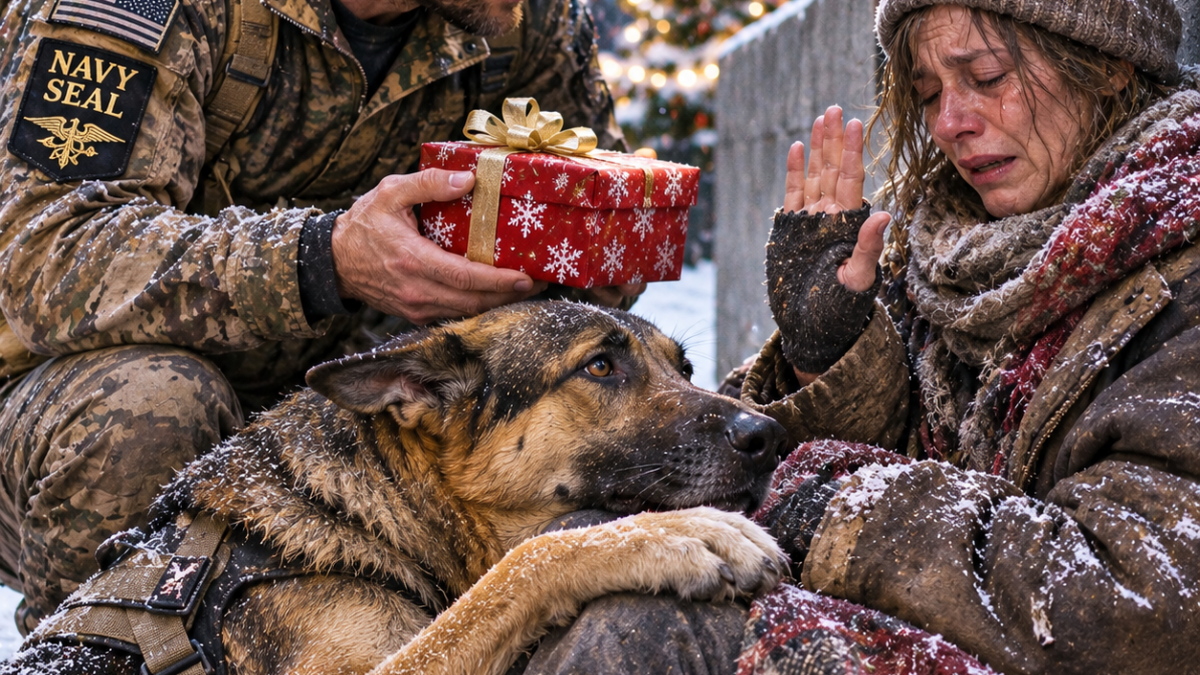
I didn’t answer right away.
There are sentences that sound ordinary until you hear the pain beneath them.
That was one.
Hannah continued stroking Ranger’s ears.
Her fingers were red from the cold.
I noticed a small tear along the cuff of her sweater.
A paperback book was tucked into the outer pocket of her backpack, its cover wrinkled from use.
She looked about twenty-seven.
Too young to have such exhaustion in her eyes.
“Are you waiting for a ride?” I asked.
She nodded immediately.
“Yeah.”
I glanced toward the empty bus stop down the street.
“The buses still running?”
Her smile disappeared.
“I think I missed the last one.”
“Where were you headed?”
She hesitated.
Then said:
“Across town.”
I waited.
She tightened her grip on the backpack.
“To a church.”
I nodded.
“St. Andrew’s?”
She looked surprised.
“You know it?”
“Yeah.”
“They run a winter shelter.”
Her eyes dropped.
“That’s what I heard.”
I glanced at the snow.
Then back at her.
“Have you called?”
“My phone’s almost dead.”
She pulled it out.
A cracked screen.
One percent battery.
Then it went black.
Her expression changed in a way that hurt to watch.
It wasn’t just frustration.
It was the look of someone who had been depending on one tiny thing to keep a plan alive.
And now even that had failed.
I crouched beside Ranger.
“Hannah, it’s getting dangerously cold.”
She nodded.
“I know.”
“Would you like to come inside for something warm while we figure out the shelter situation?”
She shook her head.
“I’m okay.”
“You’re shaking.”
“I’m just cold.”
I looked at her.
Then said quietly:
“You don’t have to explain anything to me.”
Her eyes filled.
For a second, I thought she might accept.
Instead, she whispered:
“People always say that.”
I went still.
She continued:
“Then they start asking questions.”
“Why are you out here?”
“Where’s your family?”
“Why don’t you have a place?”
“Why didn’t you plan better?”
Her voice cracked.
I said nothing.
She laughed bitterly.
“Sometimes they give you five dollars and look at you like you should be grateful they noticed you.”
I looked down at Ranger.
Then back at her.
“I’m sorry people have treated you that way.”
She shrugged.
“It’s fine.”
But her eyes said it wasn’t.
I stood.
“Okay.”
She looked up.
“Okay?”
“I won’t ask questions you don’t want to answer.”
She stared.
I nodded toward the café.
“But I am going inside to get some food.”
“Ranger’s getting water.”
“And if you’d like to sit where it’s warm, you’re welcome to join us.”
She looked toward the window.
Families were eating dinner.
A waitress was carrying a tray of steaming plates.
Hannah swallowed.
“I don’t have enough money.”
“I’m buying dinner.”
Her expression hardened.
“I don’t want charity.”
“I understand.”
“Then why—”
“Because I’m hungry.”
She frowned.
“And I’d rather not eat alone.”
For the first time, she looked directly into my eyes.
“Why?”
I thought about Matthew.
The empty farmhouse.
The Christmas tree I hadn’t decorated in years.
Then answered:
“Because sometimes eating alone gets old.”
She stared for a long moment.
Ranger placed one paw gently against her boot.
Hannah looked down.
A trembling smile appeared.
Then she whispered:
“Just dinner?”
“Just dinner.”
“No questions?”
“Only whether you prefer soup or something else.”
She almost laughed.
Then stood carefully.
I stepped aside to give her room.
And as we walked toward the café, I heard her whisper to Ranger:
“Your person seems nice.”
I smiled.
“Don’t tell him that.”
She looked at me.
“Why?”
“Goes straight to his head.”
And for the first time that Christmas Eve, Hannah Bennett laughed.
A tiny sound.
Almost lost beneath the wind.
But it was enough to make me remember what laughter felt like.
Inside Miller’s Café, warm air rushed over us.
Hannah stopped just beyond the doorway.
Her shoulders tightened.
I recognized the reaction.
A person who’s been cold too long can find warmth almost painful when it comes suddenly.
She looked around.
At the crowded booths.
The Christmas decorations.
The families.
Then she glanced down at her sweater.
I understood.
Her clothes were worn.
Her backpack was old.
She felt out of place.
I pointed toward a small table near the rear window.
“That’s our spot.”
She looked at me.
“You come here a lot?”
“More than my doctor would approve of.”
“Why?”
“Best coffee in town.”
She raised an eyebrow.
“That’s a high standard?”
“Only if you haven’t tried my coffee.”
She smiled.
We sat.
Ranger settled beneath the table.
A waitress approached.
Her name was Ruth.
She’d worked at the café for years.
She knew me well enough to stop asking why I never came in with anybody.
“Caleb.”
“Hey, Ruth.”
She looked toward Hannah.
Then smiled warmly.
“Welcome in, honey.”
Hannah lowered her eyes.
“Thank you.”
Ruth handed us menus.
“You folks need a minute?”
I looked at Hannah.
She nodded.
“Please.”
Ruth walked away.
Hannah opened the menu.
Stared.
Then closed it.
I noticed.
“What looks good?”
She shrugged.
“Whatever you’re having.”
“I’m getting the chicken pot pie.”
She hesitated.
“Is it expensive?”
I looked at her.
“Hannah.”
She met my eyes.
“You can choose something because you want it.”
“Not because it’s the least expensive thing on the menu.”
Her expression changed.
She opened the menu again.
Slowly.
Then pointed toward a picture.
“Could I have the turkey dinner?”
I smiled.
“Absolutely.”
She stared at the photograph.
Mashed potatoes.
Gravy.
Green beans.
Turkey.
A little serving of cranberry sauce.
Then she whispered:
“My mom used to make that.”
My chest tightened.
I kept my voice gentle.
“Sounds good.”
She nodded.
Then looked away.
I didn’t ask about her mother.
Not yet.
Ruth returned.
I ordered coffee and pot pie.
Hannah ordered turkey dinner and hot chocolate.
When Ruth asked whether she wanted whipped cream, Hannah hesitated.
Then smiled faintly.
“Yes, please.”
I watched her.
It seemed such a small decision.
Whipped cream.
Something most people wouldn’t think twice about.
But she’d spent the previous several days measuring every dollar against how long she could stay warm.
Now she was choosing something simply because it sounded good.
I looked down at Ranger.
He watched me as though he deserved whipped cream too.
“Don’t even think about it.”
Hannah laughed.
“He looks disappointed.”
“That’s his natural expression when food isn’t being shared.”
She smiled.
And for the first time since we met, her shoulders began to relax.
The food arrived steaming.
Hannah stared at her plate.
She didn’t touch it immediately.
Ruth set down the hot chocolate.
Whipped cream rose above the rim.
“Anything else, honey?”
Hannah shook her head.
“Thank you.”
Ruth smiled.
Then left.
I picked up my fork.
Hannah still wasn’t eating.
I looked at her.
“You okay?”
She nodded.
Then shook her head.
Her eyes filled.
“Sorry.”
“For what?”
She looked at the plate.
“I haven’t had a real meal like this in a while.”
I said nothing.
She picked up her fork.
Took a bite.
Then closed her eyes.
A tear ran down her cheek.
I turned slightly toward the window.
Gave her space.
Because sometimes the kindest thing you can do for a person is not stare while they’re trying to hold themselves together.
After a few minutes, she began talking.
Not about herself.
About the café.
The decorations.
The unusual number of snowflakes painted on the window.
She counted them.
Twenty-three.
I told her the staff probably ran out of enthusiasm after twenty.
She smiled.
Then asked about Ranger.
“How old is he?”
“Eight.”
“Have you had him since he was a puppy?”
“No.”
“Where’d you get him?”
I looked beneath the table.
Ranger was resting with his head on his paws.
“A rescue group.”
“He’d had a difficult time before I adopted him.”
Hannah looked down at the dog.
“Poor boy.”
“He’s doing okay now.”
She stroked his neck.
“Did it take him long to trust you?”
I considered.
“Yeah.”
“How long?”
“Months.”
Her expression softened.
“What finally changed?”
I smiled faintly.
“I stopped expecting him to trust me on my schedule.”
She looked up.
I continued.
“I made sure he had food.”
“A quiet place to sleep.”
“A routine.”
“And I let him decide when he was ready to come closer.”
Hannah stared at me for a moment.
Then looked down at her plate.
“That sounds nice.”
I took a sip of coffee.
For some reason, I had the feeling we weren’t talking only about Ranger anymore.
We finished dinner slowly.
Hannah ate everything except the cranberry sauce.
She pushed it around the plate.
I raised an eyebrow.
“Not a fan?”
She smiled.
“My mom loved it.”
“But I always thought it tasted like somebody tried to make jelly out of disappointment.”
I laughed.
Loud enough that Ruth looked toward us from the counter.
Hannah looked surprised by her own joke.
Then started laughing too.
For a few seconds, the table felt light.
Ordinary.
Like two people enjoying dinner.
Then her smile faded.
She stared at the empty plate.
“My mom died three weeks ago.”
The words came so quietly I nearly missed them.
I set down my cup.
“I’m sorry.”
She nodded.
Then looked toward the window.
Snow fell beyond the glass.
“She was fifty-eight.”
I waited.
“Cancer.”
My chest tightened.
“She was sick for almost two years.”
Hannah swallowed.
“I took care of her.”
“Every day.”
I nodded.
She continued.
“I used to work at the library.”
“Assistant librarian.”
“Not a big job.”
She smiled sadly.
“But I loved it.”
I leaned forward slightly.
“What did you love about it?”
Her expression changed.
For a moment, she looked less tired.
“The children’s section.”
“Story hour.”
“The little ones who’d come in pretending they didn’t like books.”
She smiled.
“Then you’d find them sitting in a corner reading about dragons.”
I laughed softly.
“Sounds like a good job.”
“It was.”
Her smile disappeared.
“Then Mom got worse.”
“Appointments.”
“Treatment.”
“Medication.”
“She couldn’t manage alone.”
I waited.
“So I quit.”
The words came out flat.
Not self-pitying.
Just exhausted.
“I thought it would be temporary.”
“It wasn’t.”
She looked down.
“I don’t regret caring for her.”
“I would do it again.”
Her voice broke.
“But when she died…”
She stopped.
I let the silence stay.
Then she whispered:
“I didn’t know who I was anymore.”
I understood that more than she could possibly know.
For years, I’d been Caleb the SEAL.
Caleb who could handle pressure.
Caleb who always had a plan.
Then I came home.
And my brother was dead.
And I had no idea who I was when nobody needed me to lead a team.
Hannah continued.
“The apartment was being sold.”
“I had some savings, but most of it was gone.”
“Medical expenses.”
“Living costs.”
“Funeral costs.”
She wiped her cheek.
“I tried finding another place.”
“But I didn’t have a recent job history.”
“Or enough money for deposits.”
I stared at the table.
She laughed bitterly.
“People keep saying there are resources.”
“There are.”
“Some help.”
“Some don’t.”
“Some have waiting lists.”
She looked at me.
“And every time you fill out another form, you have to explain everything again.”
Her eyes filled.
“Why you don’t have an address.”
“Why you left your job.”
“Why you’re alone.”
I swallowed.
She whispered:
“I don’t want to be alone.”
Then quickly looked away.
“Sorry.”
I shook my head.
“You don’t have to apologize.”
She covered her mouth.
Then said:
“I miss my mom.”
Her shoulders began shaking.
I didn’t reach across the table without asking.
Didn’t tell her everything happened for a reason.
Didn’t say her mother was in a better place.
I simply sat beside her grief.
And eventually, when she looked up, I said:
“I lost my brother.”
She stopped.
I looked toward the window.
“Matthew.”
“He was younger.”
“Military operation.”
“Several years ago.”
Her expression softened.
“I’m so sorry.”
I nodded.
“Yeah.”
She waited.
I continued.
“He was the last person who knew me before everything got complicated.”
I stared at the snow.
“He could look at me and remember the kid who fell off his bike.”
“Not the man people call a veteran.”
“Not the guy who came home with too many memories.”
“Just Caleb.”
Hannah’s eyes filled again.
“That must be hard.”
I smiled sadly.
“It is.”
Then I looked at her.
“Christmas makes it worse.”
She nodded slowly.
“Yeah.”
We sat quietly.
Ranger sighed beneath the table.
Hannah reached down and touched his head.
Then whispered:
“I think he’s the only one here who knows what he’s doing.”
I laughed softly.
“Don’t tell him that either.”
When the café began closing, Hannah glanced at the clock.
Eight-fifteen.
Her expression tightened.
I noticed immediately.
“What’s wrong?”
She looked toward the door.
“The shelter.”
I nodded.
“Let’s call.”
I asked Ruth whether we could use the café phone.
She brought it over without questions.
I called St. Andrew’s.
A volunteer answered.
I explained that Hannah was trying to reach the shelter and that the last bus had stopped running.
The woman was kind.
But the shelter was full.
They were coordinating additional emergency beds through another organization.
Transport was limited because of the weather.
She offered the number of a regional assistance line and explained how emergency placement requests worked.
I wrote everything down.
Then returned to the table.
Hannah watched my face.
“Full?”
I hesitated.
“Yes.”
She nodded as though she’d expected it.
“Okay.”
I placed the information beside her.
“There may be another option through the regional system.”
“Do you think there’ll be space?”
“I don’t know.”
She looked at the floor.
Then picked up her backpack.
“I’ll figure something out.”
I stood.
“Hannah.”
She looked up.
“Can I offer another possibility?”
Her shoulders tightened.
I continued carefully.
“I have a guest cottage behind my farmhouse.”
She stared.
“It has its own entrance.”
“Bathroom.”
“Kitchenette.”
“Heat.”
“It isn’t luxurious.”
“But it’s clean.”
Her expression changed immediately.
“No.”
I nodded.
“Okay.”
She blinked.
“You’re not going to argue?”
“No.”
I looked at her.
“It’s your decision.”
She tightened her grip on the backpack.
“Why would you invite someone you don’t know to your house?”
I thought about that.
Then answered:
“Because you’re standing here without a safe place for the night.”
“And I have a warm space I’m not using.”
She shook her head.
“That’s not enough.”
I nodded.
“Fair.”
She looked toward the window.
“People don’t give things away for nothing.”
I said nothing.
She continued.
“Eventually, they expect something.”
“Money.”
“Work.”
“Gratitude.”
“Whatever makes them feel like they own you.”
Her voice trembled.
“I don’t want to owe anybody my life.”
I stood quietly.
Then said:
“You wouldn’t owe me your life.”
She looked at me.
“You don’t understand.”
“Maybe not everything.”
I took a breath.
“But I understand that a stranger offering you a room is a big thing to ask you to trust.”
She stared.
“So I’m not going to pressure you.”
I reached for the paper with the shelter information.
“We can keep working on the other options.”
She looked down.
Then whispered:
“Thank you.”
I nodded.
“Of course.”
And we began making calls.
Ruth let us stay at the back table while she finished closing.
The kitchen staff washed dishes.
A teenager stacked chairs along the far wall.
Outside, the snow thickened.
The road was disappearing beneath a white layer that reflected the streetlights.
I called the assistance number.
Then a second.
Then the overnight contact for a nearby church.
A woman named Denise answered.
She spent ten minutes checking available emergency placements.
Finally, she said there might be an opening at a small transitional shelter, but transportation arrangements could not be confirmed for that night.
I thanked her.
Wrote down the address.
Then asked whether Hannah could call again in the morning.
“Absolutely.”
I looked toward Hannah.
She was listening carefully.
Not interrupting.
Not asking me to solve everything.
Just watching as though she was afraid hope itself might cost more than she could afford.
When the call ended, I told her what Denise had said.
Hannah nodded.
“So maybe tomorrow.”
“Yes.”
She looked at the snow.
“What about tonight?”
I didn’t answer immediately.
Because there was no simple answer.
A stranger offering private shelter can be frightening, particularly for a woman alone.
Hannah’s caution made sense.
I had no right to ask her to ignore it simply because I believed my intentions were good.
I looked toward Ruth.
Then asked:
“Would you feel more comfortable talking through the options with her?”
Hannah glanced up.
Ruth approached.
She had been listening without pretending not to.
“Of course, honey.”
She sat beside Hannah.
They talked quietly.
I moved toward the counter and gave them privacy.
Ranger remained near their table.
After a while, Ruth called me over.
“Caleb.”
I approached.
Hannah looked nervous.
But determined.
“She has some questions,” Ruth said.
I nodded.
“Ask anything.”
Hannah gripped the edge of the table.
“Does the cottage actually have its own entrance?”
“Yes.”
“And a lock?”
“Yes.”
“From the inside?”
“Yes.”
“Would you have to come in?”
“No.”
“What if I wanted to leave?”
“You could leave whenever you wanted.”
She studied my face.
“Would you ask me to work for you?”
“No.”
“Would I owe rent?”
“Not for a short emergency stay.”
She looked down.
“I don’t want an arrangement that changes after I move in.”
“That makes sense.”
I considered.
“We could write down the terms.”
Her eyes lifted.
“Really?”
“Yes.”
“Short, clear, in plain English.”
“Your room is private.”
“No personal obligation.”
“No work requirement.”
“No pressure to spend time with me.”
“And if you decide you’d rather use a shelter placement or another housing option, I’ll help with transportation if it’s safe and you want that.”
Ruth nodded.
“That’s sensible.”
Hannah looked at her.
“Would you read it?”
“Of course.”
I added:
“And I’ll give you my full name, address, and a way to contact someone who knows me.”
Ruth smiled.
“You can start with me.”
Hannah stared.
Then a nervous laugh escaped her.
“Are you his mother?”
Ruth burst out laughing.
“Good Lord, no.”
I grinned.
“She’d never tolerate raising me.”
“Absolutely correct,” Ruth said.
Then her expression softened.
“I’ve known Caleb for years.”
“He’s not perfect.”
I raised an eyebrow.
“Thanks.”
“He’s stubborn, drinks terrible coffee, and once tried to repair my back steps without admitting he’d hurt his shoulder.”
Hannah smiled.
Ruth continued.
“But when my husband was sick, he cleared my driveway every time it snowed.”
“I didn’t ask.”
“He just did it.”
I looked away.
I hadn’t known she remembered.
Ruth touched Hannah’s hand.
“You should still make your own decision, honey.”
“Don’t take my word as a guarantee.”
“But if you want a warm place while you figure out the next step, I don’t think he’ll make you regret accepting.”
Hannah was quiet for a long time.
Then she looked at Ranger.
He had placed one paw against her boot again.
She laughed softly.
“Does he always do that?”
“Only when he wants attention,” I said.
Ruth smiled.
“Or when he’s decided somebody belongs at his table.”
Hannah’s eyes filled.
She wiped them quickly.
Then looked at me.
“One night.”
I nodded.
“One night.”
She took a breath.
“And tomorrow, I decide what happens next.”
“Absolutely.”
She nodded again.
“Okay.”
It was not a dramatic rescue.
Not the kind where a woman throws herself into a stranger’s arms and declares him her savior.
It was a frightened person agreeing to one night of warmth because her other options had temporarily failed.
That distinction mattered.
And I was grateful she trusted me enough to make even that small decision.
Before we left, Ruth packed two portions of pie into a box.
Hannah protested.
“Oh, I couldn’t.”
Ruth gave her a look.
“Sweetheart, I am not carrying those things home.”
“But—”
“Please don’t make an old woman eat both.”
I laughed.
Ruth winked.
Hannah smiled.
Then accepted the box.
We walked outside.
The snow came down in soft, relentless sheets.
I opened the truck door for Hannah.
She hesitated.
Ranger climbed into his usual spot on the rear seat.
I placed Hannah’s backpack in the front passenger footwell where she could reach it.
Then handed her a phone charger.
“There’s a cable right here.”
She looked at it.
“Thank you.”
“You can call whoever you want.”
She nodded.
We began driving.
The roads were slick.
I kept my speed low.
No hurry.
No reason to take risks.
For several miles, neither of us spoke.
Christmas lights glowed through the snow.
A church sign announced an evening candlelight service.
Someone had placed an inflatable snowman in their front yard.
It leaned so far sideways that it appeared to be surrendering to the storm.
Hannah looked at it.
Then laughed.
“What happened to him?”
I glanced over.
“Probably tired of Christmas.”
She laughed harder.
Then grew quiet.
We passed a row of houses decorated with lights.
She watched them through the window.
After a while, she whispered:
“My mom loved Christmas.”
I kept my eyes on the road.
“Yeah?”
“She had this ridiculous tradition.”
“What was it?”
“Every year, she’d buy one ornament from a thrift store.”
I smiled.
“Any kind?”
“The uglier, the better.”
I laughed.
“Sounds like my brother.”
Hannah looked toward me.
“She said ugly ornaments made trees interesting.”
I smiled.
“She might’ve been right.”
Hannah nodded.
Then looked out the window again.
“We had a box full of them.”
Her voice softened.
“A little ceramic duck.”
“A snowman missing an eye.”
“A glittery pineapple.”
I laughed.
“A pineapple?”
“Bright pink.”
“Obviously festive.”
She smiled.
Then the smile faded.
“I don’t know where the box ended up.”
I glanced toward her.
She was staring at her hands.
“The landlord’s agent cleared some things.”
“I packed what I could.”
She touched the backpack.
“Mostly Mom’s photographs.”
I swallowed.
The truck grew quiet.
Then I said:
“I’m glad you kept those.”
She nodded.
“Me too.”
For a moment, her expression looked peaceful.
Then she looked toward the road.
“Are we almost there?”
“About ten minutes.”
She nodded.
Ranger sighed from the back.
Hannah turned toward him.
“Are you excited to get home?”
His ears moved.
I smiled.
“He’s excited for dinner.”
She laughed.
Then asked:
“Does he have a stocking?”
I glanced at her.
“A what?”
“A Christmas stocking.”
I nearly laughed.
“No.”
She stared.
“You don’t give your dog a stocking?”
“Apparently I’m neglecting him.”
She shook her head.
“That’s terrible.”
I grinned.
“I’ll report myself.”
And somewhere between the café and my farmhouse, Hannah began talking to me as though we were two ordinary people driving home from dinner.
Not a former soldier.
Not a woman without stable housing.
Just Caleb and Hannah.
And a dog who absolutely deserved a Christmas stocking.
The farmhouse came into view shortly before nine-thirty.
Snow lay along the fence.
The porch lights glowed.
The barn stood dark against the white fields.
I pulled into the driveway.
Hannah looked toward the house.
Then toward the smaller building behind it.
“That’s the cottage?”
“Yeah.”
It had once been a guesthouse for my grandparents’ visiting relatives.
One bedroom.
A little living area.
Kitchenette.
Private bathroom.
A narrow porch overlooking the orchard.
I’d renovated it after returning to Millbrook.
New insulation.
Updated plumbing.
A reliable heater.
A smoke alarm.
Fresh paint.
I’d imagined friends visiting.
Maybe Matthew coming over for a fishing weekend.
But after my brother died, the cottage remained empty.
I maintained it.
Kept the utilities working.
Checked it occasionally.
Yet no one had slept there in more than a year.
We got out.
Ranger shook snow from his coat.
Hannah looked toward the farmhouse.
A few white lights traced the porch railings.
She smiled faintly.
“You decorated?”
“Just the outside.”
“Why not a tree?”
I shrugged.
“Never got around to it.”
She studied me.
I knew she understood there was more to that answer.
But she didn’t push.
I led her toward the cottage.
Opened the door.
Turned on the lights.
Warm air greeted us.
The living room was simple.
A brown couch.
A small bookcase.
A rug.
A table with two chairs.
A kitchenette stocked with basic supplies.
A bedroom with clean linens and extra blankets.
Hannah stepped inside.
Stopped.
Then looked around.
For a long moment, she said nothing.
I placed her backpack beside a chair.
“The thermostat’s there.”
“Bathroom’s through that door.”
“Fresh towels in the cabinet.”
“The kitchen has a kettle, microwave, and a few groceries.”
She looked toward the bedroom.
“You prepared all this?”
“I keep it ready for guests.”
She turned.
“Even though you live alone?”
I smiled faintly.
“Old habit.”
She nodded.
Then walked toward the window.
Outside, snow covered the orchard.
A string of lights hung along the fence.
The little cottage felt warm.
Protected.
Quiet.
Hannah pressed her hand against the window frame.
Then whispered:
“It’s beautiful.”
I looked around.
The furniture was mismatched.
The couch had a repaired seam.
One kitchen cabinet hung slightly crooked.
“It’s not fancy.”
She turned.
“I didn’t say fancy.”
Her eyes filled.
“I said beautiful.”
I swallowed.
Then pointed toward the door.
“I’ll leave you to settle in.”
She looked startled.
“Now?”
“Unless you need anything.”
She shook her head.
“No.”
I nodded.
“My number’s written on the note by the kettle.”
“Ruth’s too, with her permission.”
“There’s information about the regional shelter program beside it.”
“And I’ve put the temporary stay terms on the table for you to read.”
Hannah stared.
“You really are leaving?”
I smiled gently.
“It’s your space tonight.”
She looked down.
Then whispered:
“Thank you.”
I nodded.
“Good night, Hannah.”
I started toward the door.
Then she called:
“Caleb?”
I turned.
She looked as though she wanted to say something important but couldn’t find the words.
Finally:
“Can Ranger visit tomorrow?”
I smiled.
“If he behaves.”
She looked toward the dog.
Ranger wagged his tail.
“I think he will.”
I laughed.
“That’s because you haven’t seen him steal a sandwich.”
Hannah smiled.
Then:
“Merry Christmas.”
The words caught me off guard.
For years, I’d avoided saying them.
Not because I hated Christmas.
Because the words carried too many memories.
I looked at her.
Then answered:
“Merry Christmas, Hannah.”
I stepped outside.
Closed the door behind me.
And walked toward the farmhouse.
Snow fell around the porch lights.
Ranger followed.
Halfway across the yard, I looked back.
Through the cottage window, Hannah was standing beside the small table.
She touched the folded blanket.
Then sat on the couch.
For a moment, she covered her face.
I couldn’t tell whether she was crying.
I didn’t go back.
She deserved privacy.
So I returned to my house.
And for the first time in years, the darkness inside didn’t feel quite so complete.
Christmas morning began with Ranger barking at the back door.
I opened one eye.
Six-fifteen.
“Seriously?”
He barked again.
I rolled over.
“It’s Christmas.”
Ranger looked unimpressed.
Apparently the holiday offered no exemption from breakfast.
I got up.
Pulled on a sweatshirt.
Fed him.
Then made coffee.
The farmhouse was cold in the way old houses often are before the heating system catches up with an overnight temperature drop.
I turned on the kitchen light.
Looked toward Matthew’s old photograph on the mantel.
Then stopped.
It was a picture from our last Christmas together.
My brother wearing a hideous green sweater.
A plastic reindeer antler headband tilted sideways.
Grinning so hard his eyes nearly disappeared.
I’d kept the photo there for years.
But I’d stopped looking at it.
This morning, I looked.
Really looked.
And instead of immediately feeling the old pain, I remembered what he’d said just before the photograph was taken.
“Caleb, if you ever become a grumpy old man, I’m haunting your house until you loosen up.”
I almost laughed.
Then my chest tightened.
“Working on it, Matt.”
Ranger pressed his head against my leg.
I scratched his ears.
Then glanced toward the cottage.
A faint light glowed behind the curtains.
Hannah was awake.
I wondered whether she’d slept.
Whether the warmth had helped.
Whether she was already thinking about where she would go next.
Then I made a decision.
I wasn’t going to knock before she’d had time to wake fully.
I wasn’t going to make her feel watched.
Instead, I sent a brief message to the number she’d given me after charging her phone.
Merry Christmas. Coffee and breakfast available at the main house whenever you’d like. No rush. Ranger is lobbying for pancakes.
I placed the phone on the counter.
Then opened a cupboard.
Found flour.
Eggs.
Milk.
A little cinnamon.
And began making pancakes.
I hadn’t made them on Christmas morning in years.
Hannah arrived at eight-thirty.
She knocked softly.
I opened the door.
She stood on the porch wearing the same red sweater, now dry, with her hair brushed and tied back.
She held the paperback book against her chest.
“Morning.”
I smiled.
“Morning.”
“Merry Christmas.”
“Merry Christmas.”
Her eyes moved past me.
Toward the kitchen.
“You’re cooking?”
“Attempting to.”
She laughed.
“Should I be concerned?”
“Absolutely.”
Ranger appeared beside me.
His tail began moving.
Hannah crouched.
“Hello, handsome.”
The dog pressed against her.
I watched him.
“You’re embarrassing me.”
She looked up.
“He likes me.”
“He likes anyone who might give him pancakes.”
Hannah smiled.
Then stood.
“Would it be okay if I came in?”
The question hit me.
She was standing on my porch, asking permission to enter a home where she’d been invited.
She wasn’t taking anything for granted.
I stepped aside.
“Of course.”
She entered.
The farmhouse smelled of cinnamon and coffee.
A small fire burned in the living-room stove.
The old wooden floors creaked beneath her steps.
She looked around.
Family photographs lined the hallway.
My parents.
Matthew.
Me in uniform.
A picture of Ranger covered in mud.
Hannah smiled at that one.
“He looks proud of himself.”
“He was.”
“What happened?”
“He found the creek.”
“And?”
“Then decided the furniture needed to experience the creek too.”
She laughed.
We walked into the kitchen.
I set two plates on the table.
Pancakes.
Eggs.
Orange slices.
Coffee for me.
Hot chocolate for Hannah.
She looked at the food.
Then at me.
“Did you make all this?”
I shrugged.
“Mostly.”
“Mostly?”
“Ranger supervised.”
She smiled.
Then sat.
For several minutes, we ate without speaking much.
It wasn’t uncomfortable.
The kind of silence that feels safe is different from the kind that feels empty.
I’d almost forgotten that.
Then Hannah asked:
“Do you usually spend Christmas alone?”
I looked at my plate.
“Yes.”
She hesitated.
“Because of your brother?”
I nodded.
“Mostly.”
She considered.
“I’m sorry.”
I looked at her.
“You don’t need to apologize for asking.”
She smiled faintly.
Then looked toward the living room.
“No Christmas tree?”
I shook my head.
“Haven’t done one in a while.”
She stared at her pancakes.
Then said:
“Mom used to say a tree didn’t have to be perfect.”
“She loved the crooked ones.”
I laughed.
“Matthew would agree.”
She smiled.
Then asked:
“What was he like?”
No one had asked me that in a long time.
People asked how he died.
What unit he’d served in.
Whether I’d been with him.
How I was handling it.
But they rarely asked who Matthew had been.
I set down my fork.
“He was ridiculous.”
Hannah smiled.
“That’s a good start.”
I laughed.
“Absolutely no sense of embarrassment.”
“He once showed up at a family dinner dressed as an inflatable turkey.”
She burst out laughing.
“Why?”
“He said somebody had to bring the main course.”
Hannah covered her mouth.
“Oh, no.”
“Oh, yes.”
I smiled.
“He was the kind of guy who’d drive two hours to help you change a tire, then complain the whole time about how you owed him breakfast.”
She looked at me.
“He sounds wonderful.”
My smile faded.
“He was.”
Hannah reached for her cup.
Then said quietly:
“My mom was like that.”
I looked up.
“She could make the worst day feel survivable.”
I nodded.
Hannah looked toward the window.
“After she died, I kept expecting to call her.”
“Every time something happened.”
“Something good.”
“Something bad.”
“Something stupid.”
She laughed sadly.
“I’d pick up my phone before I remembered.”
My throat tightened.
“I still do that with Matthew.”
She stared.
“Really?”
“Sometimes.”
I smiled faintly.
“I’ll hear a joke and think, Matt would love this.”
“Then remember I can’t send it.”
Hannah looked down.
Tears gathered in her eyes.
Then she whispered:
“That’s exactly it.”
We sat quietly.
Two people who had lost different kinds of love.
But recognized the shape of the absence.
For the first time, I didn’t feel the need to explain my grief.
And neither did she.
After breakfast, I asked Hannah whether she wanted to call the transitional shelter contact.
She nodded.
We called together.
Denise answered.
The emergency holiday schedule had created delays, but there was a possible placement later that week.
Hannah asked about the rules.
The expected length of stay.
Employment support.
Transportation.
The waiting list.
I listened while she took notes.
She asked good questions.
Practical questions.
The kind someone asks when they’re not waiting for a miracle but trying to build a plan.
When the call ended, she set down the pen.
Then looked at me.
“I don’t want to keep imposing.”
I shook my head.
“You aren’t.”
She looked uncomfortable.
“I don’t know how long it’s going to take to find work.”
“Then we’ll figure out what options are available.”
She shook her head.
“No, Caleb.”
Her tone was firmer.
I looked at her.
She took a breath.
“I need to do this myself.”
I nodded.
“Okay.”
She looked surprised.
“You’re not upset?”
“Why would I be?”
“Because you helped me.”
I thought for a moment.
Then said:
“Hannah, helping you doesn’t give me control over your decisions.”
Her eyes filled.
I continued.
“If you want to use the transitional shelter, I’ll help you get there.”
“If you want to apply for jobs first, I can help you find transportation.”
“If you want to stay in the cottage a little longer while working out a plan, we can discuss a clear temporary arrangement.”
She stared.
“But you choose.”
For a long moment, she didn’t answer.
Then she whispered:
“Thank you for saying it that way.”
I nodded.
She looked down at her notes.
Then asked:
“Could I stay for a few more days while I contact employers?”
“Of course.”
She swallowed.
“I want to pay something when I can.”
“We can discuss that once you’re earning.”
She nodded.
Then added:
“I’d like it in writing.”
I smiled.
“Already thought you might.”
She laughed softly.
And that afternoon, we sat at the kitchen table and agreed on a straightforward temporary arrangement.
Privacy.
Access to the cottage.
No work obligations.
A clear timeline for reviewing housing options.
No surprise expectations.
Hannah read every line.
Asked questions.
Changed a few words.
I accepted the changes.
When she signed, her hands were steady.
And I realized that what she needed most was not to be rescued.
She needed the chance to make decisions again.
Decisions that belonged to her.
Over the next three days, Hannah began looking for work.
She borrowed my laptop with permission and sat at the cottage table filling out applications.
Library assistant.
Receptionist.
Bookstore clerk.
Administrative aide.
Childcare program assistant.
She created a new résumé.
Then asked if I could look at it.
I sat beside her at the cottage table.
She pointed to a three-year gap in her employment history.
“I don’t know what to put here.”
I read the dates.
The years caring for her mother.
Then looked at Hannah.
“What did you do during those years?”
She laughed sadly.
“Everything.”
“Like what?”
“Managed appointments.”
“Kept medication schedules.”
“Talked to insurance companies.”
“Tracked bills.”
“Organized transportation.”
“Helped her with meals.”
“Kept the house running.”
I nodded.
“That’s a lot of responsibility.”
She stared at me.
“It doesn’t count as work.”
I shook my head.
“Employers may treat it differently from paid employment, but the skills are real.”
She looked at the screen.
I continued.
“Don’t invent a job title you didn’t hold.”
“But you can describe the period honestly and explain the relevant skills.”
She considered.
Then typed.
Full-Time Family Caregiver.
Underneath, she listed coordination, scheduling, record organization, and communication responsibilities.
She stared.
Then whispered:
“That looks better.”
I smiled.
“Because it tells the truth.”
She nodded slowly.
Then looked toward me.
“Caleb?”
“Yeah?”
“Do you think anybody will hire me?”
I didn’t promise.
I couldn’t.
But I said:
“I think you have experience, skills, and a real reason for the gap.”
“I think you deserve to be considered.”
She swallowed.
“That isn’t the same as yes.”
“No.”
I smiled gently.
“But it’s a place to start.”
She nodded.
Then returned to the application.
For the next two hours, she worked without asking me another question.
And I was proud of her.
Not because she’d accepted my help.
Because she’d begun moving toward the future she wanted.
The library job appeared on a Thursday afternoon.
Hannah was sitting at the cottage table when I heard a knock on my back door.
I opened it.
She stood there holding her laptop.
Her face was pale.
“Caleb?”
I frowned.
“What happened?”
She turned the screen toward me.
MILLBROOK PUBLIC LIBRARY — CHILDREN’S PROGRAM ASSISTANT.
I looked at her.
“That’s right up your alley.”
She nodded quickly.
“They’re hiring.”
“Then apply.”
“I did.”
I smiled.
“Great.”
She shook her head.
“No, you don’t understand.”
I waited.
“They emailed me.”
My chest tightened.
“What did they say?”
Her hands trembled.
“They want an interview.”
I grinned.
“Hannah, that’s wonderful.”
She stared at the screen.
Then whispered:
“I’m terrified.”
I laughed softly.
“That’s allowed.”
She looked at me.
“What if they ask why I left my last job?”
“Tell them what you told me.”
“What if they think I can’t handle working again?”
“Explain what you’ve been doing to prepare.”
“What if I cry?”
I considered.
“Then take a breath and continue.”
She looked down.
“What if I mess everything up?”
I leaned against the doorway.
“Hannah.”
She looked up.
“An interview isn’t a test of whether you’re worthy of having a life.”
She stared.
“It’s a conversation about whether the job fits.”
Tears filled her eyes.
I continued.
“You’ve been through something terrible.”
“That doesn’t mean you’re incapable.”
She nodded slowly.
Then whispered:
“My mom would’ve been so excited.”
My throat tightened.
I smiled.
“Then let’s make sure you’re ready.”
We spent the following evening practicing.
I played the hiring manager.
Hannah answered questions.
At first, she spoke so quietly I could barely hear her.
Then she began describing the children’s reading programs she’d helped run before her mother became ill.
The way she’d organized story hours.
Selected age-appropriate books.
Helped shy children feel comfortable.
Worked with parents.
Managed library materials.
Her voice changed.
Her posture changed.
She stopped sounding like someone asking permission to be considered.
And began sounding like someone who remembered she had something to offer.
When we finished, I looked at her.
“That’s the person they need to meet.”
She smiled.
Then glanced at Ranger.
“Do you think he agrees?”
Ranger wagged his tail.
I laughed.
“He’s a terrible judge of interviews.”
“Why?”
“He hired me without checking references.”
She laughed so hard she nearly dropped the notebook.
The interview was on Monday.
The roads had cleared.
The sky was bright.
Hannah wore a navy blouse Ruth had helped her find at a local resale shop.
She had insisted on paying for it with money from a small temporary administrative project she’d completed for a community organization.
I respected that.
Every dollar she earned seemed to matter differently to her now.
Not because money itself was happiness.
Because it gave her choices.
She stood beside my truck holding a folder.
“Do I look okay?”
I smiled.
“You look professional.”
“Too formal?”
“No.”
“Too nervous?”
“Yes.”
She groaned.
I laughed.
“But so does everyone before an interview.”
She took a breath.
Then nodded.
“Okay.”
I drove her to the library.
We arrived ten minutes early.
Hannah sat in the passenger seat staring at the entrance.
I waited.
Finally, she said:
“Caleb?”
“Yeah?”
“If I don’t get it…”
I looked at her.
“Then you try again.”
She swallowed.
“What if I keep failing?”
“You keep adjusting your plan.”
She nodded.
Then looked at Ranger in the back seat.
“Any advice?”
The dog yawned.
I smiled.
“He suggests you be yourself and ask whether they offer snacks.”
Hannah laughed.
Then opened the door.
She stepped onto the sidewalk.
Turned back.
And gave me a small wave.
I watched her walk toward the library.
Her shoulders were straight.
Her folder tucked beneath one arm.
She hesitated at the entrance.
Just briefly.
Then went inside.
I sat in the truck with Ranger.
And found myself feeling something I hadn’t felt in years.
Hope for another person’s future.
Not the kind of hope that demands a particular outcome.
Just the quiet wish that somebody good might finally catch a break.
Hannah came out forty-five minutes later.
Her expression was unreadable.
I opened my window.
“Well?”
She walked slowly toward the truck.
Then stopped.
Looked at me.
And smiled.
“I think it went okay.”
I grinned.
“Just okay?”
She laughed.
“Really okay.”
She climbed in.
Closed the door.
Then began talking so quickly I could barely follow.
The library manager.
The children’s programs.
The holiday reading schedule.
The possibility of working with local schools.
The need for someone who understood how to make nervous children feel comfortable.
Hannah had spoken about her previous experience.
And about caring for her mother.
The manager had listened.
Asked practical questions.
Discussed the position.
Then told Hannah they’d contact her after completing interviews.
I watched her expression as she talked.
She was alive in a way I hadn’t seen at the café.
Animated.
Excited.
Nervous, certainly.
But no longer defeated.
When she finally stopped, I said:
“Sounds promising.”
She nodded.
Then whispered:
“I forgot how much I love talking about books.”
I smiled.
“Didn’t sound like you’d forgotten.”
She laughed.
Then looked out the window.
“Thanks for driving me.”
“Anytime.”
She turned toward me.
“Caleb?”
“Yeah?”
“Even if I don’t get it, I’m glad I went.”
I nodded.
“Me too.”
Because that was progress.
Not a guaranteed job.
Not a fairy-tale ending.
A woman who’d spent Christmas Eve frightened of tomorrow had begun making plans for it again.
The phone call came three days later.
I was repairing a loose gate hinge near the barn.
Ranger lay in the grass.
Hannah was in the cottage.
Suddenly, I heard the door open.
Then footsteps.
“CALEB!”
I looked up.
Hannah was running toward me.
Not carefully.
Not cautiously.
Running.
A phone in one hand.
Her hair blowing behind her.
I dropped the wrench.
“What?”
She stopped several feet away.
Out of breath.
“They called.”
My heart accelerated.
“And?”
Her eyes filled.
“I got it.”
For a moment, I stared.
Then grinned.
“You got the job?”
She nodded.
“I got the job!”
I laughed.
She laughed.
Then covered her face.
“Oh, my God.”
I stepped closer.
“Can I hug you?”
She nodded immediately.
I put my arms around her.
She hugged me tightly.
And started crying.
Not the desperate tears from the café.
Different ones.
Relief.
Excitement.
The shock of discovering that life could still offer something good.
I stepped back.
She wiped her face.
“I have a job.”
I smiled.
“Yes, you do.”
“A real job.”
“Yes.”
“With books.”
I laughed.
“With books.”
She stared toward the farmhouse.
Then whispered:
“Mom would’ve been proud.”
My smile softened.
“I think she’d have plenty to be proud of.”
Hannah nodded.
Then laughed through her tears.
“I’m going to make a fool of myself.”
“Why?”
“I might cry at the library.”
I grinned.
“They hired you.”
“She can’t take it back just because you have feelings.”
Hannah laughed.
Then looked down at Ranger.
She knelt.
Wrapped her arms gently around his neck.
“Did you hear that?”
Ranger wagged his tail.
“I got the job.”
He licked her cheek.
She laughed.
And I stood in the yard watching two creatures who had known abandonment and fear find another reason to trust the world.
Work changed Hannah’s days.
She woke early.
Made coffee.
Packed lunch.
Left for the library with her backpack, now carrying notebooks and library materials instead of everything she owned.
She came home tired.
Sometimes frustrated.
Often smiling.
She told me about the children.
A little boy named Oliver who refused to read anything without dinosaurs.
A shy girl named Emma who whispered stories instead of reading them aloud.
A group of first graders who had decided Ranger should become the official library mascot despite having met him only through photographs.
I laughed.
“Absolutely not.”
Hannah grinned.
“Why?”
“He’d demand a salary.”
“Probably in biscuits.”
“Union contract too.”
She laughed.
Some evenings she joined me for dinner in the farmhouse.
Other evenings she stayed in the cottage.
We developed a simple habit of asking instead of assuming.
No one had to be available simply because the other person wanted company.
Sometimes she needed quiet.
Sometimes I did.
And somehow that made our time together more meaningful.
We weren’t trying to fill every silence.
We were learning to feel comfortable inside one.
Hannah also began volunteering at the community center.
The center ran after-school programs for children whose families were struggling financially.
Homework help.
Reading groups.
Art activities.
Simple meals.
Hannah offered to help with books.
At first, she volunteered one afternoon a week.
Then two.
One evening she returned carrying a stack of drawings.
She spread them across my kitchen table.
“Look.”
I picked one up.
A bright green dragon wearing sunglasses.
“What am I looking at?”
“Oliver’s dragon.”
I smiled.
“He looks confident.”
“He’s terrifying.”
“Obviously.”
Hannah laughed.
Then showed me another.
A little house.
Yellow windows.
Snow on the roof.
A person standing in the doorway.
Underneath were the words:
EVERYBODY NEEDS A WARM PLACE.
I stared.
“Who made this?”
“A little girl at the center.”
Hannah sat down.
“She said her family stayed with relatives last winter when their apartment heater failed.”
My chest tightened.
She continued.
“So we talked about what makes a place feel safe.”
I looked at the drawing.
“What did she say?”
Hannah smiled sadly.
“That somebody should be glad when you arrive.”
For a moment, I couldn’t speak.
I thought of the night Ranger pulled toward the café bench.
Hannah’s frozen hands.
The red sweater.
The backpack.
The question she’d asked about having someone happy to see you come home.
I looked at her.
Then said:
“Sounds like an important lesson.”
She nodded.
“It was.”
As Hannah’s income became stable, she began looking for longer-term housing.
She approached it seriously.
Made a budget.
Compared apartments.
Calculated transportation costs.
Asked about deposits.
Researched tenant rights.
Checked the availability of safe units near the library.
I helped when she asked.
Sometimes by driving.
Sometimes by looking at a listing.
Sometimes by doing nothing except listening while she worked through the numbers.
One afternoon, she came into the kitchen holding a notebook.
“I think I can afford a place in a few months.”
I smiled.
“That’s good.”
She looked at me.
“Really?”
“Of course.”
Her expression was uncertain.
For a moment, I wondered whether she thought I wanted her to stay because I was lonely.
And she wasn’t entirely wrong.
The farmhouse felt different with her nearby.
Ranger spent half his time waiting outside the cottage.
The kitchen had laughter in it again.
I looked forward to hearing Hannah’s stories.
But she had never agreed to become the solution to my loneliness.
And I wasn’t going to turn my kindness into a reason she couldn’t leave.
I set down my coffee.
“Hannah.”
She looked up.
“You getting your own place would be a good thing.”
She swallowed.
“Even if it means I move out?”
“Especially if it’s what you want.”
Her eyes filled.
She looked down at the notebook.
“I don’t want you to think I was using you.”
I stared.
“Using me?”
She nodded.
“The cottage.”
“The rides.”
“The dinners.”
“Everything.”
I leaned forward.
“You’ve been working toward exactly what you told me you wanted that first night.”
She looked at me.
“Independence.”
“Stability.”
“A chance to build your own life.”
I smiled.
“You don’t owe me permanent gratitude.”
Her eyes brimmed.
I continued.
“And you don’t owe me company.”
She wiped her cheek.
For a moment, neither of us spoke.
Then she whispered:
“I think that’s why I trust you.”
I swallowed.
“Why?”
“Because you’re not trying to make me stay.”
That sentence remained with me.
Long after she went back to the cottage.
Because in the military, I’d learned how to hold a position.
Protect a team.
Stay committed until the mission was complete.
But kindness sometimes asks something very different.
It asks you to help someone become strong enough to walk away.
And to be glad when they can.
Spring arrived.
The snow melted from the fields.
Green buds appeared along the orchard.
The creek ran high after several days of rain.
Hannah spent weekends visiting apartments.
Some were too expensive.
Some too far from work.
One looked promising online but had a serious moisture problem.
Another was lovely but required a deposit she wasn’t yet ready to pay.
She didn’t panic when things didn’t work.
That was new.
At Christmas, one closed shelter had made her feel as though the world was ending.
Now she could experience a disappointment and think:
I’ll try another option.
I watched her grow into that confidence.
And I learned something myself.
I wasn’t needed every moment.
That was okay.
The farmhouse didn’t become empty when Hannah went to work or visited friends.
It simply waited.
And I had a life to build too.
One afternoon, I walked into Matthew’s old room.
I’d avoided it for years.
The door remained closed most of the time.
Inside were boxes.
A few of his books.
A baseball cap.
An old guitar with a broken string.
A photograph from a fishing trip we’d taken when he was nineteen.
I sat on the bed.
Picked up the guitar.
Then laughed softly.
Matthew couldn’t play it well.
He insisted he was improving.
He wasn’t.
I remembered him sitting on our parents’ porch, playing the same three chords while singing increasingly ridiculous lyrics.
“Caleb, I’m going to be famous.”
“You’re going to be arrested for disturbing the peace.”
He’d laugh.
Then keep playing.
I ran one finger across the dusty wood.
And for the first time in years, I let myself remember him without immediately closing the door on the pain.
I stayed there for nearly an hour.
Looked through photographs.
Read old notes.
Found a Christmas card he’d once given me.
On the front was a cartoon reindeer.
Inside, he’d written:
Don’t get so busy surviving that you forget to live, big brother.
I stared.
Then sat back.
The words felt almost unbearable.
Not because they were prophetic.
Because Matthew had known me.
He knew how serious I could become.
How easily I turned responsibility into a shield against feeling anything.
He used to remind me that life wasn’t only something to endure.
Sometimes it was something to enjoy.
I pressed the card against my chest.
Then whispered:
“I’m trying, Matt.”
Outside, Ranger barked.
Hannah laughed.
The sound drifted through the open window.
I looked toward it.
Then smiled through tears.
“I think you’d like her.”
By summer, Hannah had saved enough to move into a small apartment near the library.
It wasn’t fancy.
One bedroom.
A narrow kitchen.
A living room with enough space for a couch and a bookshelf.
But the windows faced a little courtyard.
The building was well maintained.
The rent fit her budget.
And the lease was in her own name.
I helped her move.
So did Ruth.
So did one of Hannah’s coworkers from the library.
We carried boxes.
Assembled furniture.
Argued over how to hang curtains.
Ranger supervised every trip from the truck to the apartment.
At one point, he lay across the doorway and refused to move.
Hannah laughed.
“Ranger!”
The dog wagged his tail.
I grinned.
“He’s protesting.”
“Against what?”
“Labor conditions.”
Ruth snorted.
“He hasn’t carried one box.”
“Exactly,” I said.
“Management.”
Everyone laughed.
By late afternoon, the apartment was mostly arranged.
Books lined the shelves.
A little table stood beside the window.
A blue blanket lay across the couch.
And on the kitchen counter sat a framed photograph of Hannah’s mother.
I saw it when I carried in the final box.
Hannah stood beside me.
“That’s her.”
I looked at the photograph.
A smiling woman with kind eyes and dark hair.
She was holding a mug with a ridiculous cartoon cat printed on it.
I smiled.
“She looks happy.”
Hannah nodded.
“She loved terrible mugs.”
I laughed.
“Your family had interesting decorating habits.”
She smiled.
“Very.”
Then she looked around the apartment.
Her own apartment.
Her own furniture.
Her own books.
Her own key.
Her eyes filled.
“I did it.”
I set down the box.
“Yes.”
She looked at me.
Then shook her head.
“We did.”
I smiled.
“You did the work.”
She took a breath.
“You gave me somewhere safe enough to do it.”
I swallowed.
We stood quietly.
Then she asked:
“Can I hug you?”
I opened my arms.
“Of course.”
She hugged me tightly.
I held her.
And for a moment, I thought of the girl on the bench.
Frozen.
Frightened.
Convinced tomorrow had nothing left to offer.
Now she stood in a sunlit apartment, holding a key to her own front door.
I couldn’t imagine a more beautiful Christmas gift.
Even though it was July.
I went home that evening.
Alone.
Ranger jumped into his usual place beside the kitchen table.
The farmhouse was quiet.
The cottage behind it was empty again.
I looked through the window.
The lights were off.
The little porch stood still.
For a moment, an old sadness moved through me.
Not because Hannah had done anything wrong.
Because I’d gotten used to hearing another voice.
Another set of footsteps.
Another person asking whether I’d eaten dinner.
I warmed leftovers.
Sat at the table.
Ranger rested his head against my knee.
I looked down.
“Don’t start.”
He blinked.
I scratched his ears.
“She has her own place.”
Ranger sighed.
I smiled faintly.
“That’s good.”
The house remained quiet.
Then my phone buzzed.
A message from Hannah.
First dinner in my own apartment. It’s cereal because I forgot to buy groceries. Still the best dinner I’ve had in years.
A photograph followed.
A bowl of cereal.
A little lamp.
A bookshelf.
Her mother’s picture in the background.
I laughed.
Then typed:
Impressive culinary achievement. Ranger wants to know if you’re sharing.
She replied immediately.
Tell him he’s invited for a proper dinner when I learn how to cook one. You can come too.
I stared at the message.
Then smiled.
The cottage was empty.
But I hadn’t been abandoned.
Hannah had simply gone home.
And she still wanted me in her life.
There was a difference.
A difference I was finally learning to understand.
Over the next few months, our friendship changed.
We didn’t see each other every day.
Sometimes a week passed between visits.
Hannah was busy with work.
I took on consulting jobs.
Ranger developed a habit of lying near the truck whenever I mentioned her name.
On Sundays, Hannah sometimes came to dinner.
Other times, I drove into town and joined her at a small restaurant.
We talked about books.
Work.
Family.
The children at the community center.
The absurd things Ranger had done.
Sometimes we talked about Matthew.
Sometimes about Hannah’s mother.
And sometimes we talked about nothing important at all.
That was the best part.
Neither of us needed every conversation to become a discussion about grief.
There was room for ordinary life.
One evening, Hannah came over carrying a bag of groceries.
“What are those?”
“Ingredients.”
“For what?”
“Dinner.”
I stared.
“You’re cooking?”
She raised an eyebrow.
“Don’t sound so frightened.”
“I’m not frightened.”
“Your face says otherwise.”
Ranger wagged his tail.
Hannah pointed at him.
“At least somebody believes in me.”
I laughed.
Then let her take over the kitchen.
She made baked chicken with rosemary potatoes.
It was excellent.
I told her so.
She looked absurdly pleased.
Then said:
“My mom taught me.”
I smiled.
“She taught you well.”
Hannah’s expression softened.
Then she looked toward the living room.
Matthew’s photograph rested on the mantel.
She studied it.
Then asked:
“Can I tell you something?”
“Sure.”
“I think your brother would’ve liked you being less grumpy.”
I laughed.
“Did you just call me grumpy?”
She smiled.
“Very.”
I shook my head.
“Ranger, we’re outnumbered.”
The dog sighed.
Hannah laughed.
And the farmhouse felt warm in a way the heater couldn’t explain.
Autumn arrived.
The oak trees turned red and gold.
The air grew crisp.
Hannah’s library program expanded.
She began organizing reading visits with the community center.
Children who’d never owned a book were allowed to choose one to take home through a small donated-books initiative.
Hannah handled it carefully.
No speeches about poverty.
No making children feel embarrassed.
Just books.
Stories.
Characters.
Places they could visit in their minds.
One afternoon, she invited me to a reading event.
I arrived with Ranger, after the library had approved an appropriate supervised visit.
The children gathered around us.
Ranger sat calmly beside my chair.
Hannah read a story about a little fox trying to find its way home.
The children listened.
Some asked questions.
One little boy raised his hand.
“Miss Hannah?”
“Yes, Oliver?”
“Does the fox find his family?”
Hannah smiled.
“Keep listening.”
The boy frowned.
“But what if he doesn’t?”
She looked at him gently.
“Then he might find people who care about him along the way.”
I stared.
Something moved inside my chest.
Hannah continued reading.
At the end of the story, the fox found safety with other animals in the forest.
Oliver looked relieved.
“Good.”
Hannah smiled.
“Good.”
Afterward, I helped stack chairs.
Hannah approached.
“Well?”
I looked at her.
“Well what?”
“How’d I do?”
I smiled.
“You were wonderful.”
She blushed.
“Caleb.”
“I mean it.”
She looked toward the books.
Then whispered:
“I think this is what I’m supposed to be doing.”
I nodded.
“Looks that way.”
She smiled.
Then glanced at Ranger.
“And what does he think?”
The dog was asleep.
I laughed.
“He’s emotionally overwhelmed.”
Hannah burst out laughing.
Then leaned against the table.
And I realized she wasn’t merely surviving anymore.
She was building a life she loved.
The first anniversary of her mother’s death came in November.
Hannah had been dreading it.
I knew because she became quieter as the date approached.
She worked.
Smiled.
Answered messages.
But something about her expression reminded me of myself before Matthew’s birthday.
The way grief can move closer long before the actual day arrives.
I didn’t ask whether she wanted company until the week before.
When I did, she looked relieved.
“Could you come over?”
“Of course.”
She hesitated.
“I want to make Mom’s favorite dinner.”
I smiled.
“What is it?”
“Chicken and dumplings.”
I laughed.
“Sounds good.”
“I haven’t made it since she died.”
My expression softened.
“Then we can take our time.”
We cooked together in her little apartment.
Flour covered the counter.
The dumplings were uneven.
The broth needed more salt.
Hannah laughed at herself.
Then cried.
Then laughed again.
She told stories about her mother.
How she sang while washing dishes.
How she collected ugly ornaments.
How she never let anyone leave the house hungry.
At one point, Hannah stopped stirring.
Her face changed.
“I don’t want to forget her voice.”
I set down the spoon.
She swallowed.
“Sometimes I try to remember exactly how she said my name.”
“And it gets harder.”
Tears ran down her cheeks.
I didn’t tell her memory would never change.
It would.
I knew.
Instead, I said:
“What are some things she used to say?”
Hannah laughed through tears.
“She always told me to take a sweater.”
I smiled.
“Sounds familiar.”
“She’d say, ‘Hannah, you’ll be cold.’”
Her voice broke.
Then she laughed again.
“And she’d tell me not to leave dishes in the sink.”
I nodded.
“Good advice.”
She looked at me.
“Caleb.”
“Yeah?”
“I was so angry at her for dying.”
I went still.
Hannah covered her mouth.
“I know she didn’t choose it.”
“I know she fought.”
“But I was angry anyway.”
I stepped closer.
“Grief can do that.”
She stared.
“Were you angry at Matthew?”
I took a breath.
“Yes.”
Her eyes widened.
I continued.
“Sometimes.”
“I was angry he wasn’t here.”
“Angry that he had died.”
“Angry that I couldn’t help.”
“Angry that the world kept going.”
Hannah nodded slowly.
“I thought that made me terrible.”
I shook my head.
“No.”
I looked at the simmering pot.
“It makes you someone who loved her and didn’t want to say goodbye.”
She began crying.
I asked if she wanted a hug.
She nodded.
I held her while the dumplings cooked.
And for a moment, grief wasn’t something either of us had to hide.
December returned.
Snow came early.
The café decorated its windows again.
The same little snowflakes.
The same yellow lights.
Ruth complained that the young employees kept playing the same Christmas songs.
Hannah had been in her apartment for months.
She had stable work.
Friends.
A routine.
A growing savings account.
And an application underway for a program that would let her pursue further training in education while continuing her job.
Her future wasn’t guaranteed.
There would be difficult days.
Money would still be tight sometimes.
Grief would still arrive unexpectedly.
But she had choices now.
And people who cared about her.
One afternoon, she called.
“Caleb?”
“Yeah?”
“Are you doing anything Christmas Eve?”
I looked around the farmhouse.
Ranger lay beside the fireplace.
The living room was still undecorated.
“Not much.”
She paused.
“Could I come over?”
I smiled.
“Of course.”
“And maybe…”
She hesitated.
“What?”
“Could we put up a tree?”
I stared toward Matthew’s photograph.
For a moment, my chest tightened.
Then I remembered his Christmas card.
Don’t get so busy surviving that you forget to live.
I swallowed.
“Yeah.”
Hannah’s voice brightened.
“Really?”
“Really.”
She laughed.
“Good.”
Then:
“Because I’ve already bought ornaments.”
I raised an eyebrow.
“Plural?”
“Several.”
“Hannah.”
“What?”
“How many?”
She laughed.
“Enough.”
I stared at the phone.
“That’s not reassuring.”
She laughed harder.
And I smiled.
Because for the first time in years, the thought of Christmas didn’t make me want to disappear.
It made me wonder what ridiculous decorations Hannah had found.
We bought the tree two days before Christmas.
Not an enormous one.
A modest evergreen from a farm stand outside town.
It was slightly uneven.
The top leaned to one side.
Hannah loved it immediately.
“Perfect.”
I stared.
“It’s crooked.”
“Exactly.”
I looked at her.
She smiled.
“My mom would approve.”
I laughed.
“Matthew too.”
We carried it home.
Placed it beside the living-room window.
Then spent an hour trying to make it stand upright.
It refused.
Finally, Hannah crossed her arms.
“Leave it.”
I stepped back.
“It looks like it’s about to fall over.”
“It has personality.”
I laughed.
“That’s one word.”
We hung lights.
Then ornaments.
A little wooden snowman.
A silver bell.
A glass reindeer.
A bright pink pineapple.
I stopped.
“Where did you find that?”
Hannah grinned.
“Thrift store.”
I stared.
“Your mom’s tradition.”
She nodded.
“I thought I’d start again.”
I touched the ornament.
A cheap little thing.
Pink glitter.
Green leaves.
Completely ridiculous.
Then smiled.
“It’s terrible.”
Hannah laughed.
“Isn’t it wonderful?”
“Absolutely.”
We hung it near the front.
Ranger sniffed the lower branches.
Then tried taking a ribbon in his mouth.
I stepped forward.
“Drop it.”
He did.
Hannah laughed.
“Your dog is helping.”
“Your definition of helping is generous.”
She smiled.
Then reached into her bag.
“I have one more ornament.”
I looked at her.
She held out a small handmade decoration shaped like a book.
Brown cover.
Cream-colored pages.
A thin red ribbon.
Simple.
Beautiful.
She placed it in my hand.
“Made it myself.”
I turned it over.
On the back, written in careful lettering, were nine words.
Sometimes strangers become the family we thought we’d lost.
I stared.
Read it once.
Then again.
My throat tightened.
Hannah watched me.
For a moment, neither spoke.
Then she said:
“I wanted you to have something that didn’t come from a store.”
I looked up.
Her eyes were shining.
She continued.
“You gave me a warm place when I didn’t have one.”
“You helped me get back on my feet.”
“But you never made me feel like I belonged to you because of it.”
My chest tightened.
She took a breath.
“That’s why I could stay long enough to leave when I was ready.”
I swallowed.
Hannah smiled through tears.
“And when I left, you didn’t disappear.”
I looked down at the ornament.
She continued.
“You still called.”
“Still invited me to dinner.”
“Still made terrible jokes.”
“Still let Ranger visit.”
I laughed softly.
She smiled.
“That’s what family feels like to me now.”
I couldn’t speak.
For years, I’d believed family was a list of people I’d lost.
My parents.
Matthew.
The life I remembered.
The dinner table that would never feel complete.
But Hannah had walked into my world carrying a backpack and a grief as deep as mine.
And somewhere along the way, we’d learned that missing the people who were gone didn’t prevent us from caring about the people still here.
I touched the ornament.
Then whispered:
“Thank you.”
Hannah smiled.
“You’re welcome.”
I looked toward Matthew’s photograph.
Then at her.
“Can I tell you something?”
She nodded.
“Anything.”
I swallowed.
“I thought I was helping you that night.”
She smiled faintly.
“You were.”
I shook my head.
“But I didn’t know how much I needed someone to remind me that life was still happening.”
Her eyes filled.
I continued.
“I’d been hiding in this house for years.”
“Going to work.”
“Taking care of Ranger.”
“Keeping busy.”
“But not really letting myself feel much of anything.”
I looked at the tree.
“And then you showed up.”
Hannah laughed through tears.
“I was sitting on a bench.”
“Exactly.”
I smiled.
“And somehow, you convinced me to buy a crooked Christmas tree.”
She laughed harder.
I held up the ornament.
“And a pink pineapple.”
“Don’t insult the pineapple.”
I grinned.
“Wouldn’t dream of it.”
Then I stepped forward.
“Can I hug you?”
She nodded.
I held her.
Not because either of us needed saving anymore.
Because we cared about each other.
Because we’d become important in one another’s lives.
And because sometimes the strongest bonds begin with two people admitting they’re lonely.
Christmas Eve dinner was at my farmhouse.
Hannah arrived in a dark green sweater.
She carried a casserole, homemade bread, and the ugliest ceramic snowman I’d ever seen.
It had one blue eye.
One green eye.
And a crooked carrot nose.
I stared.
“What is that?”
Hannah looked offended.
“Christmas décor.”
“It looks haunted.”
She burst out laughing.
“Mom would’ve loved it.”
I smiled.
“Then it stays.”
We placed the snowman on the mantel beside Matthew’s photograph.
For a moment, Hannah looked at the picture.
Then at me.
“Is that okay?”
I nodded.
“Yeah.”
She smiled.
“Good.”
We cooked dinner together.
Ranger lay beneath the table.
The windows glowed against the falling snow.
Christmas music played softly from the radio.
At one point, I realized we were singing.
Badly.
Both of us.
I stopped.
Hannah looked at me.
“What?”
“Nothing.”
She smiled.
“You were singing.”
“I was not.”
“You absolutely were.”
I looked toward Ranger.
“Witness is unreliable.”
Hannah laughed.
Then reached for the serving spoon.
We sat at the table.
Two plates.
Not because we’d forgotten the people who should’ve been there.
But because we’d learned to live with their absence without letting it consume every moment.
Before we ate, Hannah looked toward the tree.
“Can we do something?”
I nodded.
“Sure.”
She took a breath.
“I’d like to say Mom’s name.”
My throat tightened.
“Okay.”
She smiled sadly.
“Her name was Rebecca Bennett.”
I looked at her.
“Rebecca.”
Hannah nodded.
“She was funny.”
“Stubborn.”
“Loved ugly ornaments.”
“And she made the best chicken and dumplings in the world.”
I smiled.
“She sounds wonderful.”
“She was.”
Hannah wiped one tear.
Then looked at me.
“Your turn.”
I stared.
She nodded toward Matthew’s photograph.
I swallowed.
“Matthew Mitchell.”
My voice broke.
“My little brother.”
I smiled through tears.
“He was loud.”
“Completely ridiculous.”
“Couldn’t sing.”
“Couldn’t cook.”
“And thought every problem could be solved with a joke.”
Hannah smiled.
“He sounds like someone I’d have liked.”
I nodded.
“You would’ve.”
We sat quietly.
Then I lifted my glass.
“To Rebecca and Matthew.”
Hannah lifted hers.
“To the people who taught us how to love.”
Our glasses touched.
And Christmas dinner began.
Later that night, Ranger fell asleep beside the tree.
Hannah sat on the floor arranging the presents she’d brought for the children at the community center.
Small things.
Books.
Puzzles.
Coloring supplies.
Each wrapped carefully.
I helped tie ribbons.
She looked at me.
“You’re terrible at this.”
I frowned.
“I’m excellent with knots.”
“Not decorative ones.”
“That’s discrimination.”
She laughed.
I looked toward the window.
Snow drifted past the lights.
Then I remembered the previous Christmas Eve.
The red sweater.
The empty bus stop.
The cracked phone.
The woman trying desperately not to cry outside Miller’s Café.
I looked back at Hannah.
She was laughing over a badly tied ribbon.
The difference nearly overwhelmed me.
She glanced up.
“What?”
I shook my head.
“Nothing.”
She narrowed her eyes.
“Caleb.”
I smiled.
“Just thinking.”
“About?”
“Last year.”
Her expression softened.
She looked toward the tree.
Then back at me.
“Me too.”
We sat quietly.
Finally, she said:
“I was so scared that night.”
My throat tightened.
“I know.”
She looked down.
“I thought if I accepted help, I’d lose the last bit of control I had over my own life.”
I nodded.
She continued.
“I didn’t know how to trust anybody.”
Ranger shifted in his sleep.
Hannah smiled.
“Except maybe him.”
I laughed softly.
“He has that effect.”
She looked at me.
“Thank you for not getting angry when I said no.”
I swallowed.
“You were allowed to say no.”
She nodded.
“That made it possible to say yes later.”
I thought about that.
Then smiled.
“I’m glad you did.”
She looked toward the cottage outside.
The little building where she’d spent her first safe nights after losing almost everything.
Then she turned back.
“So am I.”
After Hannah left that evening, I sat beside the tree.
Ranger rested his head against my leg.
The fire had burned low.
The house was quiet.
But not empty.
Hannah had her own apartment now.
Her own job.
Her own friends.
Her own plans.
She didn’t need me to decide what came next.
And that was one of the best things I’d witnessed in years.
I looked toward Matthew’s photograph.
His ridiculous grin.
The Christmas sweater.
The joy I’d spent so long avoiding.
Then I looked at the handmade book ornament.
Sometimes strangers become the family we thought we’d lost.
For years, I’d believed grief meant protecting myself from getting close to anyone again.
Because if you love someone, you can lose them.
And losing Matthew had nearly destroyed me.
But loneliness hadn’t protected me.
It had simply made the loss last longer in every corner of my life.
Hannah hadn’t erased Matthew.
Nobody could.
She hadn’t replaced my family.
She had reminded me that family didn’t have to end where loss began.
Sometimes the people who become important to us arrive unexpectedly.
Cold.
Frightened.
Carrying their whole lives in one old backpack.
And sometimes the right thing isn’t a grand gesture.
It isn’t rescuing someone so they’ll be grateful forever.
It isn’t promising to fix every problem.
Sometimes it’s buying dinner.
Listening.
Respecting a refusal.
Offering practical help without demanding control.
Then staying kind after the emergency is over.
I looked down at Ranger.
“You knew, didn’t you?”
He lifted one ear.
I smiled.
“That she needed a friend.”
The dog sighed.
I scratched his head.
Then looked toward the tree again.
“Guess I did too.”
The lights reflected softly against the window.
Outside, snow covered the same Tennessee roads where I’d met Hannah a year earlier.
Somewhere across town, she was going home to her own apartment.
Her books.
Her mother’s photograph.
The life she’d built with determination, grief, help, and countless small decisions.
And here I was.
Sitting beside a Christmas tree for the first time in years.
Thinking about inviting friends over on New Year’s Day.
Wondering whether Ruth would make pie.
Wondering if Hannah could persuade the library to let Ranger visit again.
Making plans.
Ordinary plans.
The kind I’d stopped making after Matthew died.
I reached for the old Christmas card my brother had written.
The one I’d found in his room that spring.
I read the line once more.
Don’t get so busy surviving that you forget to live, big brother.
Then I looked at the ornament Hannah had made.
Two messages.
Written years apart.
From two people who had never met.
Both reminding me of the same thing.
Life could hurt terribly.
People could leave.
The future could collapse without warning.
But none of those truths meant the rest of our days had to remain empty.
I smiled through tears.
“Merry Christmas, Matt.”
Ranger shifted closer.
I rested one hand against his fur.
Then turned off the final lamp.
The Christmas tree continued glowing in the darkened room.
And for the first time in a long time, I didn’t feel as though I was waiting for the holidays to be over.
I was glad to be there.
Glad to be home.
Glad Hannah had a home of her own.
Glad there were people I cared about who cared about me too.
Because the greatest gift Hannah Bennett gave me wasn’t gratitude, affection, or even friendship.
It was the reminder that opening your door to someone doesn’t mean you have to become their savior.
Sometimes you simply offer them room to stand on their own feet.
And in doing so, you discover that the walls you’ve built around your own grief have begun to open too.
That Christmas Eve, Ranger stopped beside a freezing stranger because he noticed someone who needed warmth—and the year that followed taught me that the best kind of kindness doesn’t make someone dependent on you; it helps them find a place in the world while reminding you that you still have one too.








