PART 2: HOA Karen Called the Cops on My Lake Cabin—Then the Sheriff Read the Deed and Learned I Owned the Entire Valley
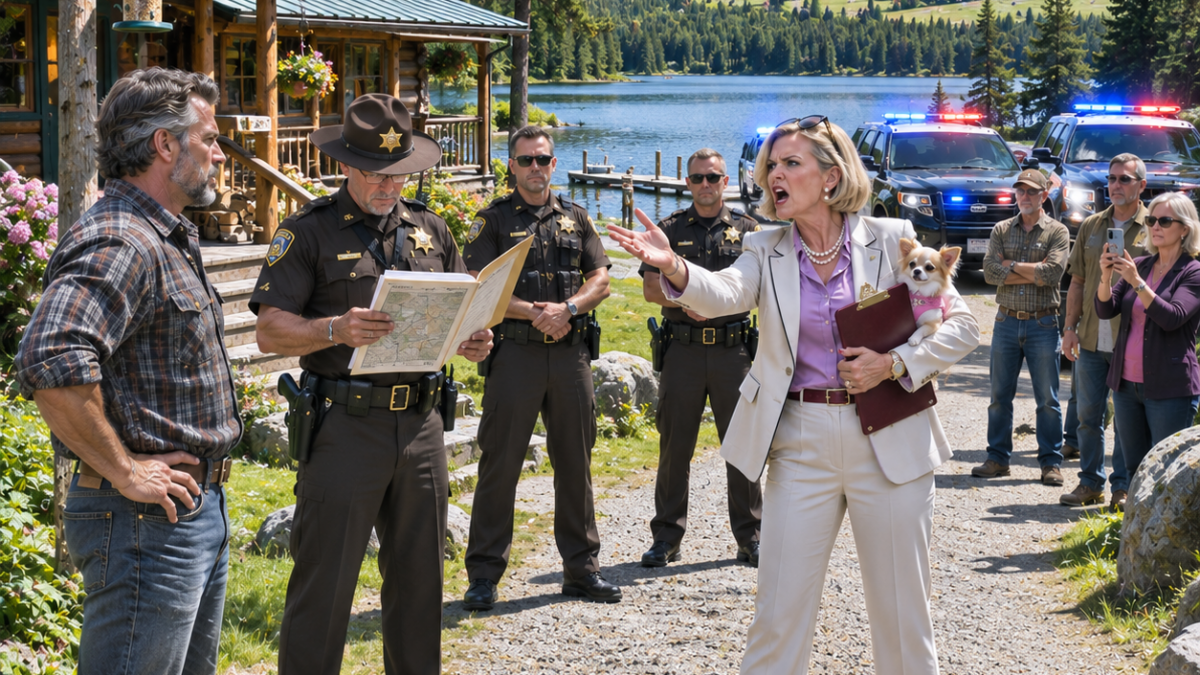
Three police cruisers came tearing down the gravel road toward my late father’s lake cabin before I had even finished my first cup of coffee, all because Aria White—the self-appointed HOA president from across the valley—had decided that the small bird feeder hanging from my porch was an “unauthorized environmental interference” serious enough to justify calling law enforcement on a man quietly spending his first morning back on his own property.
Ten minutes later, I was standing barefoot on the dock while red-and-blue lights flashed across the lake, two deputies asked for identification like I might be trespassing, and Aria stood behind them in a bright pink windbreaker with a Chihuahua under one arm and a clipboard under the other, confidently explaining that her HOA controlled the shoreline, the wildlife, the water, and apparently everything I was allowed to do at the cabin my father had left me.
What she didn’t know was that inside an old metal lockbox beneath my father’s desk sat a set of county-stamped documents I hadn’t needed to open in years—and once those papers came out, the argument stopped being about a bird feeder and became the first crack in an empire Aria had spent three years convincing an entire valley was real.
My name is Timothy Roberts.
Silver Ridge Valley had been part of my life since I was nine years old.
My father, Daniel Roberts, bought the original tract in 1989, long before the glass houses, decorative gates, lake committees, environmental councils, and neighborhood newsletters arrived.
Back then, the valley was mostly pine forest.
Two hundred sixty acres wrapped around a cold mountain lake, with a narrow creek feeding it from the north and ridges rising along both sides like walls.
Dad never saw it as an investment.
He saw it as a place to breathe.
He worked construction most of his life, and by the time he was forty-five, his knees hurt every morning and his hands had become permanently rough from concrete, lumber, steel, and weather.
But the first summer after he bought Silver Ridge, I watched him become younger.
We built the cabin together.
Not a mansion.
Not some luxury lodge.
Two bedrooms, a stone fireplace, a wide porch, and a dock extending far enough into the lake that Dad could sit with his fishing rod and pretend the rest of the world didn’t exist.
He taught me how to split firewood there.
How to read clouds before a storm.
How to repair a leaking roof without complaining every thirty seconds.
And how to leave land better than you found it.
When I was a teenager, I once asked him why he had bought so much acreage when we used only a tiny part of it.
He looked across the lake and said, “Because one day people are going to look at something beautiful like this and decide beauty gives them the right to control it.”
At fifteen, I thought that sounded dramatic.
Thirty years later, I finally understood.
Dad died the previous winter.
Cancer.
Fast enough that neither of us had much time to pretend it wasn’t happening.
The last afternoon I spent with him, he was sitting beside the hospital window with Silver Ridge photographs spread across his blanket.
He tapped one picture of the cabin.
“Go back.”
“I will.”
“Don’t sell it because you’re sad.”
“I won’t.”
“And check the old survey lines.”
I laughed.
“Dad, you’re dying and you’re worried about survey stakes?”
“I’m dying. The stakes aren’t.”
That was him.
Even at the end.
So six months later, I drove back to Silver Ridge.
I expected grief.
I expected memories.
I did not expect Aria White.
I had been on the porch less than an hour when I heard the electric whine of a golf cart coming down the old service trail.
Aria appeared wearing a pink windbreaker, white pants, oversized sunglasses, and an expression that suggested she had just discovered a felony.
Her Chihuahua barked at me from under her arm.
She pointed at my bird feeder.
“What is that?”
I looked at it.
“A bird feeder.”
“You can’t have that here.”
“Why?”
“It violates Section Four-B.”
“Of what?”
“The Silver Ridge HOA environmental code.”
I took a sip of coffee.
“I’m not in your HOA.”
Her smile hardened.
“Everyone in Silver Ridge is subject to community regulations.”
“No.”
“Yes.”
“No.”
She pulled out her phone.
“You’re interfering with protected wildlife.”
“With sunflower seeds?”
“Do you think this is funny?”
“A little.”
She turned away.
“I’m calling the police.”
I thought she was bluffing.
She wasn’t.
And when the first cruiser appeared through the pines, followed by two more, I realized my quiet return to my father’s cabin had just become something else entirely.
PART 2
The first deputy approached carefully.
“Sir, can I see some identification?”
“Sure.”
I handed him my driver’s license.
Behind him, Aria was already talking.
“He’s been warned about environmental violations.”
I turned.
“You warned me seven minutes ago.”
She ignored me.
“He’s also occupying a restricted community structure.”
That got my attention.
“My cabin?”
She looked at the deputy.
“You see what I’m dealing with.”
The deputy glanced toward me.
“Who owns the cabin?”
“I do.”
Aria laughed.
“He inherited a structure located inside HOA-managed territory.”
I stared at her.
There was confidence in her voice.
Not the kind you fake on the spot.
The kind you develop after people stop questioning you.
The deputy looked uncomfortable.
“Do you have proof of ownership?”
“Yes.”
I walked into the cabin.
Dad’s metal lockbox sat under his desk exactly where it had always been.
The key still hung from a nail behind an old photograph of us fishing.
I opened it.
Property deed.
Survey map.
Tax assessments.
Water-right documentation.
County correspondence.
Dad had kept everything.
Of course he had.
When I returned, Aria was lecturing the second officer about migratory birds.
I handed the folder to the older deputy.
He unfolded the deed.
Read the first page.
Then the second.
His expression changed.
He looked at the map.
Then at me.
“This says the Roberts parcel is two hundred sixty acres.”
“That’s right.”
He looked toward the lake.
“The entire lake?”
“Yes.”
“Shoreline?”
“Yes.”
“Creek?”
“Yes.”
“Woodlands up to the northern ridge?”
“Yes.”
Aria laughed.
“That’s impossible.”
The deputy continued reading.
“County deed. Recorded water rights. Riparian rights.”
He turned another page.
Then looked at her.
“Ma’am, this appears pretty clear.”
“No.”
She stepped closer.
“The lake is a shared community resource.”
“Not according to these records.”
“The HOA manages it.”
“That doesn’t mean the HOA owns it.”
Her face reddened.
“You don’t understand our charter.”
The deputy looked at her.
“I understand a recorded deed.”
She pointed toward the valley.
“We maintain these roads. We regulate wildlife. We collect environmental fees.”
I finally spoke.
“Then it sounds like your HOA has been managing my property.”
Silence.
Even the Chihuahua stopped barking.
Aria looked at me as if I had slapped her.
“That’s ridiculous.”
The deputy handed my papers back.
“As far as law enforcement is concerned, Mr. Roberts is not trespassing.”
“What about the feeder?”
The younger deputy coughed, hiding a smile.
The older officer looked toward the tiny wooden feeder hanging from my porch.
“Ma’am, unless you can show us a law prohibiting a property owner from hanging a bird feeder, there’s nothing for us to enforce.”
Aria’s sunglasses hid her eyes.
Her jaw did the talking.
“This isn’t over.”
I folded the deed.
“Why does everybody like you always say that?”
She spun around.
“You cannot walk in here and destroy the structure we’ve built.”
I looked around.
Pines.
Lake.
Mountains.
The cabin Dad built.
“I didn’t walk into your structure.”
I held up the deed.
“You built yours on mine.”
***
The deputies left twenty minutes later.
One joked that I had apparently declared independence from the HOA.
I laughed.
Aria didn’t.
She climbed onto her golf cart and disappeared along the ridge.
When the sound faded, the valley became quiet again.
But not peaceful.
Different.
Charged.
I walked back onto the porch.
Dad’s papers were still in my hands.
His signature appeared near the bottom of the original purchase agreement.
**Daniel H. Roberts.**
I ran my thumb over it.
Suddenly his comment about survey lines didn’t sound like the rambling concern of a dying man.
He had known something.
Maybe not everything.
But enough.
That evening, I opened his filing cabinets.
Three hours later, I found a folder labeled:
**SILVER RIDGE — COMMUNITY ISSUES**
Inside were letters.
Not many.
The earliest came from a legitimate neighborhood association formed years after Dad bought the valley.
It represented homeowners on parcels sold along the outer ridge.
Their jurisdiction was limited to those residential lots.
Dad had apparently cooperated voluntarily on road maintenance.
Then I found a dissolution notice.
Four years old.
The original Silver Ridge Homeowners Association had ceased operating after membership dropped and nobody agreed to serve on the board.
I stared at the paper.
Dissolved.
Then what exactly was Aria president of?
***
The next morning, I drove into town.
Silver Ridge’s nearest town was the kind of place with one diner, one gas station, a post office, and enough gossip to qualify as an intelligence agency.
I stopped at a small real-estate office.
**WHITE & ASSOCIATES PROPERTY MANAGEMENT**
That name did not improve my mood.
The receptionist looked nervous when I mentioned Aria.
“Mrs. White?”
“Yes.”
“She manages Silver Ridge.”
“Does she?”
The woman hesitated.
“What do you mean?”
“I found a dissolution filing for the HOA.”
Her eyes widened.
Then she lowered her voice.
“I probably shouldn’t say anything.”
“Then don’t.”
I started to stand.
She stopped me.
“Wait.”
I sat.
She looked toward the back office.
“The old association dissolved.”
“I know.”
“Mrs. White started holding meetings again about three years ago.”
“Under what authority?”
“She said residents voted to reactivate it.”
“Was it filed?”
“I don’t know.”
“County registration?”
“I really don’t know.”
“But she collects fees?”
The receptionist looked away.
That was enough.
“How many people pay?”
“Most.”
“Why?”
“She sends notices.”
I almost laughed.
“Notices.”
“People don’t want trouble.”
There it was.
Aria didn’t need a legal HOA if everyone behaved as though she had one.
She had created authority through repetition.
Meeting notices.
Letterhead.
Fines.
Committees.
Rules.
People paid because other people paid.
They complied because other people complied.
Eventually nobody remembered to ask the most important question.
Who gave you the right?
***
On my way back, I stopped at the county recorder.
A clerk named Morris pulled the file.
He read Aria’s name and sighed.
“You too?”
“That encouraging?”
“Depends how much you enjoy paperwork.”
He confirmed the original HOA had dissolved.
No renewal.
No reinstatement.
No current legal entity matching Aria’s Silver Ridge HOA.
“So what is she running?”
Morris leaned back.
“From the county’s perspective?”
“Yes.”
“A club.”
“A club that issues fines.”
“Unauthorized fines.”
“A club that claims my lake.”
“Very ambitious club.”
I laughed.
Then stopped.
“Has she filed anything against my property?”
He typed.
His face changed.
“Actually.”
“What?”
“Six complaints.”
“How recent?”
“Two weeks.”
I stared.
“I arrived yesterday.”
Morris frowned.
“Then some predate your arrival.”
Noise.
Environmental hazards.
Shoreline concerns.
Unauthorized construction.
Wildlife interference.
One complaint described me as an “uncooperative absentee landholder.”
“Absentee?”
Morris shrugged.
“Apparently.”
Dad’s warning returned to me.
Check the survey lines.
I left with certified copies of the HOA dissolution, my property record, and every complaint Aria had filed.
Then I started walking the valley.
***
Dad had taught me to find boundary markers when I was twelve.
They were old iron stakes, some stamped with his initials.
Most remained exactly where the survey showed.
Then I reached the southern creek.
A bright new metal post stood nearly thirty feet inside the legal boundary.
Attached:
**PRIVATE HOA PROPERTY
NO TRESPASSING**
I actually laughed.
Thirty feet away, half buried under moss, was Dad’s original survey stake.
I took photographs.
GPS coordinates.
Video.
Then followed the line.
Another fake marker.
Then another.
Someone had been slowly creating a new boundary.
Not enough to look outrageous on a casual map.
Just enough to move the perceived HOA line deeper into the valley.
By afternoon, I had documented seven signs.
One sat within sight of my boathouse.
I returned to the cabin and started a digital evidence folder.
Dates.
Coordinates.
Photos.
County maps.
Dad’s survey.
Aria’s complaints.
The fake HOA documents.
This was no longer about arguing with a woman in a pink jacket.
If she wanted paperwork, I would give her paperwork.
Real paperwork.
***
Her first fine arrived two days later.
Five hundred dollars.
**UNAUTHORIZED SHORELINE MODIFICATION.**
I had modified nothing.
Then another:
**ENVIRONMENTAL INTERFERENCE.**
Then another.
Daily penalties threatened to increase to ten thousand dollars.
The letterhead displayed a pine tree surrounded by the words:
**SILVER RIDGE HOMEOWNERS ENVIRONMENTAL COUNCIL**
That organization did not exist either.
I hung the notices on the refrigerator.
They looked ridiculous.
Then I found one taped to a tree beside my dock.
And another on my truck.
That wasn’t funny.
***
Aria knocked the following morning.
“Last chance.”
“To do what?”
“Comply.”
“With your imaginary HOA?”
Her face tightened.
“This community existed before you returned.”
“My family owned this valley before your house existed.”
“You abandoned it.”
“No.”
“You weren’t here.”
“My father was.”
“He’s gone.”
The sentence hit me harder than she intended.
Or maybe exactly as hard.
I stepped onto the porch.
Aria took half a step back.
“My father dying did not transfer ownership to you.”
“That isn’t what I said.”
“It’s what you meant.”
She crossed her arms.
“This valley belongs to the community.”
“No.”
“It should.”
There it was.
Not law.
Not documents.
Not deeds.
Should.
Aria believed her idea of fairness outweighed ownership.
“You think because you inherited a deed you get to tear apart everything we built?”
I looked toward the lake.
“You built rules.”
“We built order.”
“You built them on land you don’t own.”
Her jaw flexed.
“You’ll regret this.”
“I already regret answering the door.”
She turned.
The Chihuahua barked at me from the golf cart.
“Your dog has a stronger legal argument,” I called.
She didn’t appreciate that.
***
I installed trail cameras that afternoon.
Four obvious.
Two hidden.
Dad had taught me something else.
When somebody thinks they control the narrative, let them believe nobody is watching.
The first night showed deer.
Raccoons.
Wind.
At 1:37 a.m., Aria appeared.
Dark jacket.
Flashlight.
Roll of laminated notices.
She moved tree to tree.
Stapling.
Photographing.
Then adjusting one of the fake boundary signs.
She looked directly at the visible camera.
Smiled.
And turned it away.
Twenty feet behind her, the hidden camera captured everything.
Perfectly.
I watched the clip twice.
Then backed it up to the cloud.
Sent copies to my attorney.
And poured a whiskey.
Dad would have laughed.
Not because it was funny.
Because Aria was doing all the work for me.
***
My lawyer’s name was Mason Hale.
He watched the video in silence.
Then looked at me.
“Your HOA president likes cameras.”
“Fake HOA president.”
“Even better.”
“What can we do?”
“Cease-and-desist first.”
“Already drafted one.”
He read it.
“You’ve been bored.”
“I learned from my father.”
Mason made a few revisions.
We cited trespass statutes.
Harassment.
Property interference.
False representation.
I delivered it personally.
Aria answered her door wearing a silk robe and green facial mask.
The Chihuahua nearly launched itself through the doorway.
I handed her the envelope.
“You step onto my land again, we stop talking.”
She skimmed the first page.
“You think this intimidates me?”
“No.”
“You don’t know who I know.”
“I know who owns the land.”
“I know every official in this county.”
“Then you should ask one of them to explain a deed.”
Her face twisted.
“No one defies the HOA.”
I looked at her mud mask.
“Aria, there is no HOA.”
For the first time, she looked uncertain.
Only for a second.
Then the door slammed.
***
When I got back to the cabin, Deputy Cole was waiting.
“Guess who called us?”
“Wild guess. Aria?”
“She says you threatened her.”
“With legal stationery?”
Cole laughed.
“We saw your footage.”
“And?”
“She’s trespassing.”
“Correct.”
“Fake notices.”
“Correct.”
“False complaints.”
“Correct.”
He shook his head.
“We’re issuing a warning.”
“That’s all?”
“For now.”
I didn’t like it.
But I understood.
Cole looked toward the lake.
“Keep your cameras going.”
“Planning to.”
“Something tells me she doesn’t know when to stop.”
He was right.
As his cruiser disappeared, a flash of light appeared above the ridge.
I lifted my binoculars.
Drone.
Large.
Professional.
Hovering directly above my cabin.
The camera tilted.
Toward me.
I slowly raised my coffee cup.
“Morning, Aria.”
***
The drone returned three times that week.
Always from the direction of her house.
One afternoon, I followed it with binoculars until it landed on her deck.
A sticker was visible beneath the body.
**WHITE & ASSOCIATES PROPERTY MANAGEMENT**
Subtle.
I photographed it.
Then drove to county environmental services.
Inspector Landon Pierce had twenty years on the job and the exhausted expression of a man who had once argued with someone about whether a drainage ditch counted as a historic waterway.
I explained everything.
He watched the trail-camera footage.
“Wow.”
“That good?”
“For your case? Yes.”
He examined the drone photographs.
“If she’s using remote surveillance to monitor private areas, that can create separate problems.”
“She filed environmental complaints too.”
Landon typed.
“Three.”
“Any valid?”
“No.”
“What was the latest?”
He read.
Then looked at me.
“Lake poisoning.”
I stared.
“With what?”
“Apparently your bird feeder.”
I laughed.
Landon smiled.
“I’ll prepare a report.”
***
When I returned home, two men in construction vests were measuring beside the dock.
“Can I help you?”
One held up a work order.
“HOA inspection.”
“Who hired you?”
“President White.”
I took out my phone.
“Say that again.”
They looked at each other.
“Sir, we were told this was community property.”
“It isn’t.”
I pointed toward the county boundary marker.
“You’ve got thirty seconds to get back in your truck.”
“We didn’t know.”
“Now you do.”
They left in under thirty.
I photographed their tire tracks.
Not because I wanted revenge.
Because by then I understood Aria’s strategy.
She was manufacturing normality.
Every worker.
Every notice.
Every sign.
Every inspection.
If enough people acted as though her authority were real, she could point to all that activity later and say:
See?
Everyone accepted it.
She was building a history of control.
I needed a history of evidence.
***
The creek exposed the next problem.
Water levels had changed.
Barely.
But Dad had taught me that water always tells you when someone has interfered with it.
I hiked upstream.
Half a mile north, I found a crude dam.
Rocks.
Timber.
Fresh earth.
Enough to slow the creek.
Beside it stood another sign:
**PROTECTED WETLAND
MANAGED BY SILVER RIDGE HOA**
I stood staring.
If the blockage raised the lake enough, overflow would erode the southern slope near my cabin.
I photographed everything.
Sent it to Landon.
His response came quickly.
**DO NOT TOUCH IT. INSPECTION TOMORROW.**
He arrived the next morning.
Aria appeared ten minutes later.
Of course.
“What are you doing?”
Landon looked up.
“County environmental inspection.”
“You need HOA authorization.”
“No.”
“You’re on community property.”
“No, ma’am.”
“I manage this shoreline.”
“No, ma’am.”
Her voice rose.
“I have documents.”
“Excellent.”
Landon smiled.
“Show me.”
Silence.
“They’re being processed.”
“Then while they process, I’ll process this.”
He examined the dam.
Took measurements.
Photographs.
Samples.
Then wrote.
“Unpermitted alteration of a natural watercourse.”
Aria’s face drained.
“Potential sediment obstruction.”
She looked at me.
“Potential downstream erosion.”
“This is ridiculous.”
“You’ll receive formal notice.”
She stepped toward me.
“You think you won.”
“No.”
“You have no idea how much influence I have here.”
I looked across the lake.
“Then maybe it’s time everyone found out how much land you actually have.”
***
That night, my camera alerted at 2:14.
Aria.
Black clothes.
Headlamp.
Hammer.
She crouched near a county survey stake.
Pulled it out.
Took a photograph of the hole.
Then carried the stake away.
I watched twice.
Cold anger replaced exhaustion.
The next morning, I drove to the sheriff.
Cole watched the footage.
“She’s pushing it.”
“She’s stealing boundary markers.”
“Criminal mischief is possible.”
“Possible?”
He looked at me.
“Timothy, I know you want cuffs.”
“I want her off my property.”
“I know.”
“Then make that happen.”
“We’ll warn her.”
“She’s had warnings.”
Cole sighed.
“We need to build this correctly.”
I hated that answer.
But he was right.
Evidence mattered because procedure mattered.
The same thing that protected Aria from immediate arrest protected me from her imaginary authority.
I nodded.
“Fine.”
Then I went home.
And called Mason.
“Courthouse.”
He didn’t ask why.
“Finally.”
***
The hearing drew half the valley.
Twenty residents.
Some Aria supporters.
Some curious.
Some clearly hoping for entertainment.
Mason met me outside.
I had three folders.
Property.
Harassment.
Environmental.
Plus video backups.
“You ready?”
“No.”
“Good.”
“What?”
“People who are too ready usually talk too much.”
We went inside.
Judge Harris presided.
Aria sat at the front wearing a beige suit and pearls.
No pink.
She had brought what she called the HOA treasurer and a real-estate broker from White & Associates.
When Harris called the matter, Aria stood immediately.
“This man has endangered wildlife, polluted community water, erected illegal structures, and threatened residents.”
Judge Harris lifted one hand.
“Sit.”
She froze.
“You will have an opportunity.”
Mason rose.
“Your Honor, this case is simpler than Mrs. White would prefer.”
He placed the certified deed on the clerk’s table.
“My client owns two hundred sixty acres encompassing Silver Ridge Valley, including the lake, creek, shoreline, and the property on which many of Mrs. White’s supposed community-control activities have occurred.”
Harris studied the records.
Then the tax maps.
Then the water rights.
Aria stood.
“These could be fabricated.”
The room murmured.
Judge Harris looked at her.
“These came from the county recorder.”
She sat.
Mason continued.
“The original Silver Ridge association dissolved four years ago.”
He displayed the filing.
“Mrs. White never legally reinstated it.”
More murmurs.
Someone behind me whispered:
“There’s no HOA?”
Aria jumped up again.
“We have a charter.”
She produced papers.
Harris read them.
His eyebrows rose.
“Mrs. White.”
“Yes?”
“These have no recording numbers.”
“The community approved them.”
“No county filing.”
“That isn’t required for community governance.”
Mason spoke.
“It is if she intends to collect mandatory fees and assert property jurisdiction.”
Harris looked at a page.
“And this seal?”
Aria straightened.
“Official Silver Ridge seal.”
The judge rubbed it with his thumb.
“It appears drawn with a pen.”
“It’s symbolic.”
Someone laughed.
Then everyone did.
Harris struck the gavel.
“Order.”
Aria turned red.
Mason looked at me.
I knew what came next.
The lights dimmed.
First photograph.
Aria stapling a fake notice to my tree.
Second.
Installing an HOA sign inside my boundary.
Third.
The drone.
Then video.
2:14 a.m.
Aria removing the survey stake.
No one laughed.
Judge Harris watched silently.
Then:
“Mrs. White, is that you?”
She stared at the screen.
“It’s out of context.”
Mason almost smiled.
“What context makes removing another person’s boundary marker appropriate?”
“I was checking community lines.”
“At two fourteen in the morning?”
“We have had vandalism.”
Mason clicked again.
Aria faced the camera.
Her own voice played.
“He’ll regret ever coming back here.”
The room went silent.
Harris removed his glasses.
“Mrs. White.”
Her face had changed.
Not queen anymore.
Cornered.
“This tribunal finds no legal HOA jurisdiction over Mr. Roberts’s property.”
Her lips parted.
“You are ordered to cease enforcement activities.”
She started shaking her head.
“All unauthorized signs are to be removed.”
“No.”
“All fees and fines issued under this unregistered association are subject to review.”
“You can’t—”
“And the environmental matter regarding the creek dam is referred for penalties and restoration.”
Aria stood.
“This valley needs order!”
Harris looked at her.
“No.”
His voice was quiet.
“This valley needs lawful conduct.”
She stared.
“Control is not the same thing.”
The gavel came down.
***
Outside, Doug approached me.
Retired surveyor.
Gray beard.
One of Aria’s early supporters.
“Mr. Roberts.”
“Timothy.”
He nodded.
“Timothy.”
He looked embarrassed.
“She told us everything was registered.”
“I figured.”
“I paid fees for two years.”
“I’m sorry.”
“She said they maintained the lake.”
I looked toward Aria leaving the courthouse.
“That’s the problem with confidence.”
Doug frowned.
“What?”
“It looks a lot like authority until somebody checks.”
He nodded slowly.
Then offered his hand.
I shook it.
***
For three days, nothing happened.
No drone.
No notices.
No golf cart.
The valley felt normal.
I fixed fencing.
Cut dead branches.
Sat on Dad’s dock.
Then I found the sign.
**COMMUNITY WATCH ZONE
REPORT THE OUTSIDER**
The outsider.
On land my family had owned since 1989.
I tore it down.
Checked cameras.
Aria had returned at 1:47 a.m.
Black hoodie.
Gloves.
Removing the new county survey stakes.
She looked directly into the lens.
No fear.
I sent the footage to Cole.
He issued a formal harassment warning.
I upgraded everything.
Motion lights.
Cellular cameras.
Backup power.
Two nights later, the alert came.
1:23 a.m.
Lights exploded across the ridge.
Aria froze.
Hammer.
Crowbar.
Dark clothes.
She looked toward the camera.
Then ran.
I called the sheriff.
Officers found:
Two uprooted markers.
One smashed camera.
Damage to my observation deck.
The report finally used language Aria couldn’t turn into a community disagreement.
Criminal mischief.
Property damage.
Trespassing.
Harassment.
Cole called the next morning.
“We can pursue charges.”
I looked at the lake.
I was tired.
Not angry anymore.
Just tired.
“Do it.”
“Sure?”
“Yes.”
“And Timothy?”
“Yeah?”
“She stays off the property after this.”
“That’s all I ever wanted.”
***
Neighbors started helping.
That surprised me most.
Doug arrived carrying tools.
“Deck needs work.”
“You don’t have to.”
“I know.”
That afternoon, Rose from the creek brought sandwiches.
Teenagers showed up with lumber.
A man I barely knew helped reset fencing.
Aria had always talked about community.
But this was the first time I saw one.
Nobody collected dues.
Nobody issued orders.
Nobody wore a badge.
They just came.
Hammered.
Laughed.
Ate.
Helped.
By sunset, the deck looked better.
Doug leaned against the railing.
“I worked on Aria’s house.”
“Really?”
“When she built it.”
He nodded toward the glass structure across the lake.
“She kept changing the plans.”
“How?”
“Bigger windows. Higher deck. More lights.”
“Why?”
Doug smiled sadly.
“She said she wanted to own the view.”
I looked across the water.
“You can’t own a view.”
“That’s what I told her.”
He looked at me.
“Funny thing.”
“What?”
“You actually own the land under most of it.”
We laughed.
***
The county inspector came the next day because, naturally, someone had reported my deck repair.
He reviewed the permit.
Supports.
Dimensions.
Then sighed.
“Everything’s legal.”
“Anonymous complaint?”
He smiled.
“You already know.”
Across the lake, Aria’s curtains moved.
I saw her silhouette.
Watching.
But her house was darker now.
Fewer visitors.
No board meetings.
No golf carts.
No followers.
Cole had said people like her stop when they run out of an audience.
Aria was running out.
Then a petition arrived.
**EMERGENCY ACTION TO RESTORE COMMUNITY OVERSIGHT**
Twenty signatures.
New title for Aria:
**COMMUNITY DEFENSE COORDINATOR**
I laughed.
Then flipped it over.
Names crossed out.
Notes:
**REFUSED.**
**NO RESPONSE.**
**THREATENED POLICE.**
**DOES NOT SUPPORT.**
Her army was disappearing.
***
But Aria wasn’t done.
My cameras caught her again before dawn.
Crowbar.
Near the boathouse.
The sheriff issued a restraining order.
Three hundred feet.
One more violation could mean arrest.
For a week, it worked.
Then the storm arrived.
Thunder rolled through Silver Ridge after midnight.
Rain hammered the cabin.
Wind tore branches from trees.
At 2:30, I heard wood crack.
I ran outside.
The observation deck had collapsed.
Half hung into the lake.
I assumed wind.
Then lightning flashed.
The support posts.
Saw cuts.
Clean.
Deliberate.
My stomach turned.
I checked cameras.
Most were destroyed.
One hidden camera survived.
The footage showed Aria.
2:06 a.m.
Soaked.
Black hoodie.
Saw in hand.
Cutting the deck supports during the storm.
Using thunder to hide the noise.
A lightning flash illuminated her face.
Perfectly.
I drove to the sheriff’s office at sunrise.
Mud on my boots.
Rain still dripping from my jacket.
I put the flash drive on Cole’s desk.
“No more warnings.”
He watched.
Once.
Twice.
Then looked at me.
“No more warnings.”
***
Aria was charged.
Criminal mischief.
Property destruction.
Trespass.
Violation of the restraining order.
Environmental penalties were already pending.
Her fake HOA operation collapsed completely.
The remaining “board” members walked away.
People stopped paying her.
White & Associates lost clients.
The county began reviewing fees she had collected.
Some residents pursued reimbursement.
I expected to feel victorious.
Instead, I sat on Dad’s dock and felt exhausted.
Sarah—my sister—called that evening.
“You okay?”
“Yeah.”
“You don’t sound okay.”
“I wanted peace.”
“I know.”
“I came here because Dad died.”
Silence.
Then she said:
“And instead you inherited his war.”
“No.”
I looked across the valley.
“I think he prevented this war for years just by being here.”
“Maybe.”
“He knew.”
“Knew what?”
“That people were pushing boundaries.”
She was quiet.
Then:
“You protected it.”
I looked at the damaged deck.
“Feels like I broke half of it.”
“You didn’t.”
I knew what she meant.
But grief is strange.
Sometimes when someone leaves you responsibility, every new crack feels like failure.
***
Two days later, the neighbors returned.
More tools.
More boards.
Food.
Coffee.
No invitation.
We rebuilt the deck.
Stronger.
Steel reinforcement.
New footings.
Doug checked every measurement twice.
Rose told him he was obsessive.
He replied that surveyors were legally required to annoy everyone.
For hours, the valley filled with hammering and laughter.
When the final railing went in, I stood back.
Dad would have liked it.
Maybe criticized the alignment.
Then liked it.
That evening, everyone left except Doug.
He stared across the lake.
“Aria’s probably going to lose that house.”
“Not my problem.”
“Part of her deck encroaches onto your shoreline parcel.”
“Mason mentioned that.”
“You ever think about buying it?”
I looked at him.
“Why would I want Aria’s house?”
He shrugged.
“Close the loop.”
I didn’t answer.
***
The county hearing finalized the encroachment.
Part of Aria’s shoreline improvements sat on land legally tied to my parcel.
Her environmental fines multiplied.
Then the bank began foreclosure proceedings after she fell behind.
Winter arrived.
Her house went dark.
A crooked for-sale sign appeared.
Two weeks before Christmas, a real-estate agent called.
“Mr. Roberts?”
“Yes.”
“I’m handling the former White property.”
“Congratulations.”
He laughed nervously.
“I’m told you might want first consideration.”
“I don’t need another house.”
“Understandable.”
He explained the parcel.
Northern ridge.
Structures.
Remaining legal issues.
Price.
I almost said no.
Then I looked at Dad’s old valley map on the wall.
One section remained complicated because of decades of subdivision transfers.
Buying the property would simplify everything.
Protect the watershed.
Prevent another person from inheriting Aria’s mess.
“How much?”
He told me.
I called Mason.
He laughed.
“You’re actually considering it.”
“Not revenge.”
“Of course not.”
“Seriously.”
“I know.”
“Will it clean up the boundary situation?”
“Yes.”
“Protect the creek access?”
“Yes.”
“End the easement problem?”
“Yes.”
I looked toward the dark house.
“Make an offer.”
***
Two weeks later, I owned it.
No dramatic confrontation.
No Aria watching me sign.
No champagne.
Just paperwork.
Mason slid the final page across the table.
“Congratulations.”
I signed.
“How does it feel?”
I thought about it.
“Quiet.”
“That’s all?”
“That’s enough.”
***
The first time I entered Aria’s house as the legal owner, dust covered the glass walls.
The furniture was mostly gone.
Her office remained.
On the desk:
A cracked mug.
**I MAKE THE RULES.**
I laughed despite myself.
Then opened the cabinets.
Folders.
Hundreds.
Violations.
Fines.
Surveillance logs.
Photographs.
Notes about neighbors.
Doug’s mailbox.
Rose’s wind chimes.
A veteran’s flag.
Children playing too loudly.
Holiday decorations.
And me.
A folder labeled:
**ROBERTS — THREAT LEVEL HIGH**
I stared.
Inside were drone photographs of my cabin.
Copies of my plates.
Notes about when I arrived.
Where I walked.
Who visited.
One page read:
**Must establish community ownership narrative before he permanently returns.**
My stomach tightened.
Dad knew.
That was what he had been guarding.
Aria—or someone around her—had been waiting for the property to become vulnerable after his death.
His final warning wasn’t random.
Check the survey lines.
I sat in her chair.
For a long time.
Then I carried the papers to the fireplace.
Mason later told me I probably should have preserved anything legally relevant first.
I did.
Scanned what mattered.
Then I burned the copies.
One folder at a time.
Not because fire erased history.
Because I didn’t want her paper empire occupying one more room in the valley.
The mug went into a box.
I kept it.
As a reminder.
***
I didn’t want the glass house.
So I changed it.
Removed sterile furniture.
Opened the windows.
Rebuilt the deck.
Converted the upstairs office into a reading room.
Turned one bedroom into bunk space.
Built a large table downstairs.
Doug asked:
“What exactly are you making?”
I looked around.
“A retreat.”
“For who?”
“People who need one.”
Rose smiled.
“No HOA?”
“Absolutely no HOA.”
“What rules?”
I thought.
“Don’t destroy the place.”
Doug laughed.
“Strong governance.”
We called it:
**LOOKOUT LODGE**
Hikers stayed.
Veterans.
Families.
Volunteers helping restore the creek.
People recovering from difficult years.
No rental fee.
No membership.
Just respect.
Some left letters.
One came from a woman named Evelyn.
She had lived in Silver Ridge under Aria’s rule.
**You probably don’t remember me. Aria fined me because my wind chimes were “audible beyond approved hours.” Eventually I took them down. Then I stopped sitting outside because I was afraid of being reported. Last night I sat on the Lookout Lodge deck until midnight and listened to the lake. No one told me to leave. Thank you for giving the valley back its silence.**
I read it three times.
Then placed it inside Dad’s journal.
***
Spring arrived slowly.
Snow melted from the northern ridge.
The creek ran clear after county crews removed Aria’s illegal dam and restored the bank.
Birds returned.
Including the ones that had apparently started the entire war.
I hung the old feeder back on Dad’s porch.
Doug saw it.
“Careful.”
“What?”
“Environmental terrorism.”
I laughed so hard coffee came through my nose.
***
One afternoon, clearing brush near the original boundary, I found something rusted beneath the soil.
Iron stake.
Old.
Paint almost gone.
Three letters remained.
**D.H.R.**
Daniel H. Roberts.
Dad.
I crouched beside it.
For a second, the whole year disappeared.
Aria.
Police.
Court.
Cameras.
Storm.
All gone.
I was twelve again.
Dad stood beside me holding a survey map.
“Don’t trust fences,” he had said.
“Why?”
“Fences move.”
“Then what do you trust?”
“Records. Landmarks. And people who remember where things started.”
I touched his initials.
My throat tightened.
“So that’s what you meant.”
No answer.
Only wind.
That was enough.
***
That night, I climbed the rebuilt lookout deck.
Below, lights glowed at the lodge.
A father and son were cooking dinner.
Someone laughed.
Rose had left flowers near the entrance.
Doug had installed a ridiculously straight new railing.
Across the lake, Dad’s cabin sat under the pines.
I owned all of it.
But for the first time, ownership didn’t feel like power.
It felt like responsibility.
Aria had wanted to own the view.
Control the people.
Name the rules.
Put signs everywhere.
She thought possession meant deciding who belonged.
Dad had understood the opposite.
Land lasts longer than titles.
Longer than arguments.
Longer than the people who believe they rule it.
You don’t prove ownership by controlling everything.
You prove it by taking care of what will remain after you’re gone.
***
Months later, Aria’s criminal case concluded.
Restitution.
Fines.
Probation conditions.
No contact with me.
No entry into Silver Ridge Valley without authorization.
The fake HOA collections became part of separate civil claims.
Some residents recovered money.
White & Associates closed.
I heard Aria moved to another county.
People occasionally asked whether I hoped she had learned something.
I didn’t know.
That part wasn’t mine to control.
And maybe that was the final lesson.
For almost a year, I had been angry because Aria wanted control over everything.
Then I realized I didn’t need control over her ending.
I only needed to protect mine.
***
Silver Ridge changed.
Not into some ruleless paradise.
People still argued.
Parking.
Road maintenance.
Trash.
Noise.
Human beings can generate disputes out of oxygen.
But now they solved them differently.
Voluntary road committee.
Transparent expenses.
Recorded easements.
County-approved agreements.
No pretend police badges.
No invented environmental councils.
No one-person kingdoms.
When somebody proposed a formal association, Doug raised his hand.
“Can we legally forbid pink windbreakers?”
Everyone laughed.
I voted no.
Barely.
***
On the anniversary of Dad’s death, I slept at the old cabin.
Before sunrise, I made coffee.
Hung the bird feeder.
Walked to the dock.
Mist covered the lake.
Nothing moved.
No sirens.
No drone.
No golf cart.
No clipboard.
I sat in Dad’s chair.
His old fishing rod leaned against the wall.
For a long time, I thought about that first morning.
Three police cruisers.
Aria shouting.
Me opening the lockbox.
The officer looking at the deed.
**You own the entire valley?**
At the time, that sentence felt like victory.
It wasn’t.
The deed had given me ownership.
Everything afterward taught me what ownership meant.
***
A family staying at Lookout Lodge appeared across the water.
Two children ran onto the deck.
Their mother called after them.
The father carried fishing rods.
One boy pointed toward my cabin.
I couldn’t hear the question.
The father answered.
Then waved.
I waved back.
Dad would have liked that.
Not because strangers were using our valley.
Because they were enjoying it without being afraid of somebody measuring the experience.
***
Later that morning, I opened Dad’s journal.
Near the back, I found an entry I had somehow missed.
The handwriting was shakier.
Written during his final year.
**Tim will come back eventually. I hope he understands that the valley was never meant to make us important. It was meant to remind us how small we are. Protect the water. Protect the trees. Don’t let anyone turn it into a kingdom.**
I stopped breathing for a second.
Read it again.
Then once more.
Don’t let anyone turn it into a kingdom.
I looked across the lake toward Lookout Lodge.
The house where Aria once sat behind glass believing she controlled everything.
Now the door was open.
People came and went.
No throne.
No president.
No kingdom.
Just a place to rest.
I smiled.
“Got it, Dad.”
***
That afternoon, I walked the southern trail.
The fake HOA signs were long gone.
At the place where Aria had moved the first marker, Doug and I installed something new.
Not a warning.
Not a declaration.
A simple wooden sign.
**SILVER RIDGE VALLEY
PRIVATE CONSERVATION LAND
PLEASE RESPECT THE WATER, WILDLIFE, AND EACH OTHER**
Doug read it.
“Too reasonable.”
“I’m getting old.”
“Needs a fine schedule.”
“How about five hundred dollars for sarcastic surveyors?”
“Unconstitutional.”
We laughed.
Then he became quiet.
“You know, people still call you the guy who owns the valley.”
“I know.”
“Bother you?”
“A little.”
“Why?”
I looked around.
The pines.
The lake.
Dad’s mountain.
“Because it sounds like I own something bigger than I really do.”
Doug nodded.
“You’ve got the deed.”
“Yeah.”
I looked toward the ridge.
“But eventually somebody else will.”
***
That evening, the sun dropped behind the western mountain.
Orange light spread across the water.
I climbed the lookout deck one more time.
Wind moved through the trees.
Below, someone at the lodge started laughing.
The sound traveled across the lake.
For months, Silver Ridge had echoed with accusations.
Sirens.
Drones.
Arguments.
Hammers breaking things.
Now it carried laughter.
That was the sound Aria had claimed to protect with her rules.
The irony was that we didn’t get it back until her rules disappeared.
***
I thought about revenge.
There had been moments when I wanted it.
Real revenge.
I wanted Aria humiliated.
I wanted her house gone.
Her fake organization destroyed.
Her supporters embarrassed.
Then most of those things happened.
And none of them felt as satisfying as I expected.
What satisfied me was Doug helping rebuild my deck.
Rose bringing sandwiches.
Evelyn sitting outside with her wind chimes again.
A veteran hanging his flag without measuring the pole.
Children feeding birds.
People staying at the lodge because they needed peace.
That was better.
Aria spent years turning power into fear.
The only revenge worth keeping was turning what remained of her power into something generous.
She built an office for controlling people.
I turned it into a reading room.
She built a deck to “own the view.”
I opened it to people who needed one.
She collected files on her neighbors.
I replaced the filing cabinets with books.
She hung signs saying who could not enter.
I hung one asking people to respect each other.
That was enough.
More than enough.
***
Winter returned the following year.
Snow covered the ridge.
Dad’s cabin lights reflected across the frozen edge of the lake.
I stood outside holding a cup of coffee when a county cruiser appeared.
For half a second, I laughed at the memory.
Deputy Cole stepped out.
“No bird feeder complaint.”
“Disappointing.”
“Actually, I’m off duty.”
He held up a fishing rod.
“You said there were trout.”
“There are.”
“HOA permit?”
“Very expensive.”
He stared.
I smiled.
“Coffee?”
“Absolutely.”
We sat on the dock.
After a while, Cole asked:
“You ever think about selling?”
“The valley?”
“Yeah.”
“No.”
“Why?”
I looked toward Dad’s cabin.
“Because he asked me not to sell it while I was sad.”
Cole waited.
“And?”
“I’m not sad anymore.”
“So why keep it?”
I thought about that.
Then looked toward the lodge.
“Because now I know what it’s for.”
***
That answer stayed with me.
For years, Dad had protected Silver Ridge privately.
Quietly.
Paid taxes.
Maintained water.
Cleared trails.
Let neighbors use certain roads.
Never asked for gratitude.
Aria saw the same land and imagined a hierarchy.
President.
Board.
Members.
Violators.
Fines.
Permission.
Control.
Dad saw stewardship.
That difference had been the real fight.
Not Timothy Roberts versus Aria White.
Not property owner versus HOA Karen.
Not even truth versus lies.
It was two completely different ideas of what it means to have power over a place.
One says:
This belongs to me, so you obey.
The other says:
This is my responsibility, so I protect it.
I knew which one I wanted to leave behind.
***
On the second anniversary of Dad’s death, I placed his old survey stake inside a small glass case at Lookout Lodge.
Below it, I added a plaque.
**DANIEL H. ROBERTS
1989
“PROTECT THE WATER. PROTECT THE TREES.
DON’T TURN IT INTO A KINGDOM.”**
People asked about it.
So I told them.
Not every detail.
Not every ridiculous fine.
Not every midnight camera clip.
Just enough.
A man bought a valley because he loved it.
Years later, someone mistook his quietness for weakness.
His son came home.
The paperwork mattered.
The truth mattered.
But the ending mattered more.
The valley survived.
***
One spring morning, I was repairing the old feeder when a little girl staying at the lodge walked over with her mother.
She looked up.
“What are you doing?”
“Feeding birds.”
“Is that allowed?”
I stopped.
Her mother looked embarrassed.
“Sorry. She heard some neighbors talking about the old HOA.”
I crouched.
“Want to know a secret?”
The girl nodded.
“The whole thing started because somebody told me I wasn’t allowed to have this bird feeder.”
Her eyes widened.
“That’s silly.”
“Yes.”
“Did you get in trouble?”
I thought about three police cars.
Court hearings.
Drones.
Sawed deck supports.
A fake government.
Aria’s pink jacket.
“No.”
I smiled.
“She did.”
The girl laughed.
Then helped me pour seed.
We hung the feeder.
Within five minutes, two chickadees landed on it.
The girl whispered:
“They don’t know about the rules.”
I looked across the valley.
“Good.”
***
That night, I sat alone on Dad’s porch.
The lake was completely still.
Lookout Lodge glowed across the water.
Stars filled the sky.
I opened the metal lockbox.
The deed remained inside.
Old paper.
County seal.
Dad’s signature.
The same pages that had changed the look on the sheriff’s face the first morning.
I could still hear him.
“This says you own the entire Silver Ridge Valley.”
At the time, I was proud.
Now the sentence made me smile for another reason.
A deed can tell you who owns land.
It cannot tell you who deserves it.
That part is proven afterward.
By what you protect.
By what you destroy.
By whether people feel smaller or safer when you have power.
Aria had spent three years proving the valley didn’t belong in her hands.
I hoped I would spend the rest of my life proving Dad had been right to put it in mine.
I folded the deed.
Closed the box.
And stepped outside.
***
The wind moved softly through the pines.
Somewhere near Lookout Lodge, laughter floated across the water.
A bird landed on the feeder beside me.
I looked toward the ridge where Aria’s golf cart once appeared like a tiny patrol vehicle.
Nothing.
No pink jacket.
No drone.
No fake signs.
No midnight footsteps.
Only mountain.
Water.
Trees.
Home.
I raised my coffee toward the darkness.
“To you, Dad.”
The lake gave no answer.
It didn’t need to.
For the first time since I returned, the silence felt exactly the way I remembered it.
Not empty.
Not tense.
Not controlled.
Free.
And that was when I finally understood why my father had bought the entire valley instead of just the little patch where our cabin stood.
He hadn’t been trying to own more.
He had been trying to protect enough.
Aria spent years believing the person who wrote the most rules owned Silver Ridge.
She was wrong.
I had the deed.
But even I didn’t truly own the valley in the way she imagined ownership.
I was only the man holding it for a while.
Keeping the lake clear.
Keeping the creek moving.
Keeping the trees standing.
Keeping my father’s promise.
Someday somebody else would sit on that porch.
Somebody else would open that metal lockbox.
Somebody else would read Daniel Roberts’s name.
And if I did this right, they wouldn’t inherit a kingdom.
They would inherit peace.
That was the ending Aria could never understand.
She called the cops because she thought authority was something you could summon.
She printed fines because she thought authority was something you could invent.
She moved survey markers because she thought truth moved when you pushed hard enough.
She sent drones because she believed watching people meant controlling them.
She damaged property because she thought fear would do what paperwork couldn’t.
In the end, none of it mattered.
The deed remained.
The lake remained.
The mountain remained.
And after all her noise was finally gone, the valley did what it had always done.
It became quiet again.
I switched off the porch light.
The stars reflected across the black water.
And somewhere in the darkness, the tiny bird feeder moved gently in the wind—the same ridiculous little thing Aria White had once called an environmental violation.
I smiled.
Because after everything she had tried to take from me, that small wooden feeder was still hanging exactly where I wanted it.
On my father’s cabin.
Above my father’s lake.
In the middle of the valley he trusted me to protect.
And nobody needed an HOA president’s permission anymore.








