FULL STORY:“I MARRIED YOU FOR YOUR UNCLE’S MONEY—YOU WERE NEVER GOOD ENOUGH FOR ME!” My Husband Abandoned Me on Our Honeymoon Train, Then a Billionaire Discovered What He Had Really Stolen
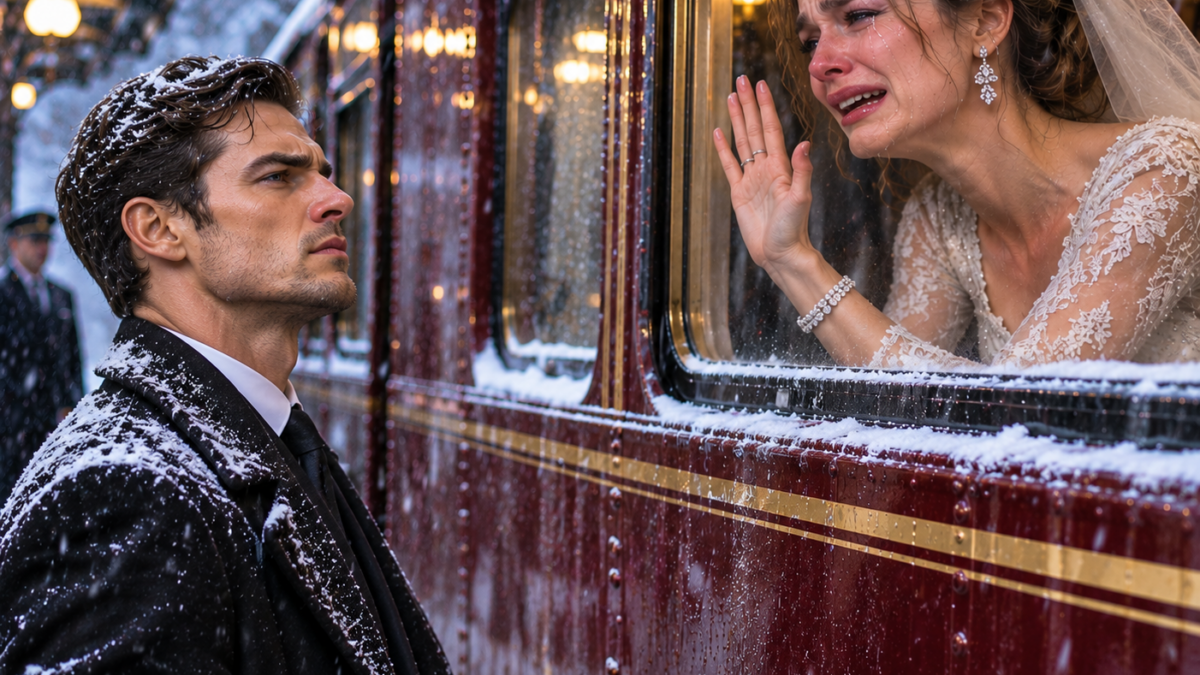
People passed around me.
Business travelers rolling luggage.
Families embracing.
Couples laughing.
A man talking loudly into his phone.
I looked at every stranger’s face, hoping Brett would suddenly appear.
That he’d run toward me.
Say he’d been robbed.
Say someone had taken our things.
Say the letter wasn’t real.
But he didn’t come.
Eventually, I walked toward the main exit.
I had no money for a taxi.
No phone to call anyone.
No identification.
No idea where Brett had gone.
The conductor had tried to help, but there was only so much he could do.
I was an adult woman in a city where I knew nobody.
And the last person I’d trusted had taken everything that might have helped me get home.
Outside, the air was cold.
Wind moved between the buildings.
I pulled my thin coat tighter and stood beside my suitcase.
Then two men approached.
One was tall.
The other wore a dark hooded jacket.
The taller man looked at my clothes.
Then smiled.
“Well, look at this.”
I took a step back.
“Excuse me?”
“A bride.”
He glanced around.
“Where’s the groom?”
I tightened my grip on the suitcase handle.
“I don’t need any help.”
The second man pointed toward my bag.
“What’s in there?”
“Nothing.”
He smiled.
“Then you won’t mind giving it to us.”
My stomach dropped.
I turned.
The taller man caught the handle.
“Hold on.”
“Let go.”
He pulled.
I pulled back.
“That’s all I’ve got!”
The second man laughed.
“Not for long.”
The suitcase jerked between us.
My hand slipped.
I nearly fell.
“HELP!”
People turned.
Some kept walking.
I screamed again.
“Somebody help me!”
Then a woman’s voice cut through the street.
“HEY!”
Both men froze.
“GET YOUR HANDS OFF THAT GIRL’S SUITCASE!”
An elderly woman stood outside a small café across the street.
She wore a red cardigan beneath a winter coat.
Her silver hair was pinned loosely behind her head.
In one hand she held a phone.
In the other, a heavy metal umbrella.
She looked furious.
“I ALREADY CALLED 911!”
The tall man released my suitcase.
The older woman stepped closer.
“You boys want to wait right here for the police?”
Her voice sharpened.
“Be my guest.”
The men exchanged a look.
Then ran.
One shouted something ugly at her as they disappeared around the corner.
She didn’t move until they were gone.
Then she turned toward me.
Her expression changed completely.
“Oh, honey.”
I stood trembling.
The suitcase handle was still in my hand.
My fingers hurt from holding it.
The woman approached carefully.
“Are you hurt?”
I shook my head.
Tears began spilling down my face.
She touched my shoulder.
“Sweetheart.”
I tried to speak.
Couldn’t.
She looked toward my wedding clothes.
Then toward the station.
“Where’s your family?”
That question broke me.
I covered my face.
“My husband left me.”
Her hand tightened gently around my shoulder.
“He took everything.”
For a moment, she said nothing.
Then she stepped closer and wrapped one arm around me.
“Well.”
Her voice was warm and steady.
“You’ve got me now.”
I looked up.
She smiled.
“My name’s Maggie.”
I swallowed.
“Ivy.”
“Nice to meet you, Ivy.”
She looked toward the café.
“Mine’s right across the street.”
“Come on.”
I hesitated.
“I don’t have any money.”
Maggie stared at me.
Then said:
“Did I ask?”
I shook my head.
“Good.”
She picked up the handle of my suitcase.
“Now let’s get you somewhere warm.”
Maggie’s Café was narrow and old-fashioned, tucked between a small convenience store and a closed tailor shop.
A brass bell jingled when she opened the door.
Warm air washed over my face.
The smell of coffee and buttered toast made my stomach ache with hunger.
Red vinyl booths lined one wall.
A long counter ran along the other.
A chalkboard listed breakfast specials in handwriting that curved unevenly across the black surface.
Nothing matched perfectly.
Not the mugs.
Not the chairs.
Not the little framed pictures above the booths.
But after the cold confusion of the station, the room felt like safety.
Maggie led me to a booth.
“Sit.”
I obeyed.
She disappeared into the kitchen.
A few minutes later, she returned with a plate.
Scrambled eggs.
Toast.
Potatoes.
A bowl of hot soup.
I stared.
“Maggie—”
“Eat first.”
She placed a glass of water beside it.
“Questions later.”
I looked at the food.
My throat tightened.
“I can’t pay you.”
She folded her arms.
“Still didn’t ask.”
I started crying again.
She sighed softly.
Then sat across from me.
“Oh, sweetheart.”
I looked down.
“I don’t know what’s wrong with me.”
“Nothing’s wrong with crying after what happened.”
I stared.
She leaned closer.
“But you’ve got to eat.”
“An empty stomach makes every bad thing feel twice as big.”
I picked up the fork.
My hand shook.
The first bite almost made me cry harder.
I hadn’t eaten since the previous evening.
Brett had told me breakfast would be waiting at the hotel.
There hadn’t been a hotel.
There had only been the letter.
Maggie watched until I finished most of the plate.
Then asked:
“Now.”
“What happened?”
I told her everything.
The wedding.
The train.
The missing purse.
The letter.
The money.
My mother’s ring.
The uncle who controlled my orchard.
Maggie listened without interrupting.
When I finished, she held out her hand.
“May I see the letter?”
I gave it to her.
She read.
Her expression hardened.
Then she placed it carefully on the table.
“Well,” she said.
I looked at her.
“That man is a coward.”
I almost laughed through tears.
Maggie continued.
“And apparently a thief.”
I wiped my face.
“He took my mother’s ring.”
Her expression softened.
“Tell me about it.”
I swallowed.
“It’s gold.”
“Thin.”
“There’s a little apple blossom engraved inside.”
I looked down at my empty hands.
“Mom wore it almost every day.”
“She gave it to me before she died.”
Maggie said nothing.
I whispered:
“It was the only thing of hers I still carried everywhere.”
Maggie reached across the table.
Took my hand.
“Then we’re going to report it.”
I stared.
“Can we?”
“Of course we can.”
She squeezed gently.
“And whatever happens next, Ivy, you’re not sleeping on the street tonight.”
That afternoon, a police officer came to the café.
He took my statement.
Asked about Brett.
The missing purse.
My identification.
My phone.
The cash.
And my mother’s ring.
I gave him the letter.
He read it.
Then looked up.
“Your husband took these things?”
I nodded.
“Yes.”
He asked more questions.
Some uncomfortable.
Some necessary.
Maggie sat beside me the entire time.
I learned that the legal treatment of property taken by a spouse could be complicated, but the fact that Brett was my husband did not automatically excuse theft.
The ring had belonged to my mother.
I described the engraving.
The officer recorded it.
He gave me a report number.
Then explained that investigators could review leads, including whether the ring appeared through a pawn transaction.
I held the paper like it was something precious.
Because it was.
For the first time that day, somebody had written down what Brett did without telling me to forget about it.
When the officer left, Maggie handed me her phone.
“Go on.”
I looked at her.
“What?”
“Call home.”
I hesitated.
“Uncle Walt might be angry.”
Maggie’s expression tightened.
“Honey, a man leaving you penniless in a strange city is not something you should have to apologize for.”
I swallowed.
Then dialed.
The phone rang three times.
“Hello?”
My uncle’s voice.
I nearly cried from relief.
“Uncle Walt?”
A pause.
“Who is this?”
“It’s Ivy.”
Silence.
Then:
“Where are you calling from?”
“Chicago.”
My voice broke.
“Brett left me.”
He didn’t answer.
“He took my purse.”
“My phone.”
“My wallet.”
“Mom’s ring.”
I swallowed.
“I don’t know what to do.”
Uncle Walt sighed.
Not with concern.
With irritation.
“Ivy.”
“Can I come home?”
Silence.
Then:
“That’s between you and your husband.”
I stared.
“What?”
“You’re married now.”
“Your husband is responsible for you.”
I felt my stomach drop.
“Uncle Walt, he abandoned me.”
“Maybe you did something to upset him.”
I stopped breathing.
“What?”
He continued.
“Brett seemed like a reasonable young man.”
I stared at the café wall.
Maggie was watching my face.
I whispered:
“Please.”
“I just need to come home.”
My uncle’s voice turned cold.
“Listen carefully, Ivy.”
I closed my eyes.
“Don’t come back to Harlow Ridge.”
I froze.
“What?”
“Don’t come back.”
“Not now.”
“Not ever.”
Then the line went dead.
I remained holding the phone.
Maggie waited.
I looked up.
My lips trembled.
“He said I can’t come home.”
For a moment, she looked furious.
Then she reached over and took the phone gently from my hand.
“Then you can stay here.”
I stared.
“Maggie—”
“There’s an empty room upstairs.”
I shook my head.
“I can’t.”
“Yes, you can.”
“I don’t have any money.”
She leaned forward.
“Ivy, listen to me.”
I looked at her.
“You’ve had enough people deciding what you deserve today.”
She pointed toward the staircase.
“I’m offering you a warm bed.”
“You can say yes.”
I began crying.
She smiled gently.
“Good.”
“Now let’s find you some clean clothes.”
Maggie lived above the café.
Two small bedrooms.
A narrow hallway.
A kitchen with yellow curtains.
Books stacked beside an old armchair.
Photographs covering nearly every wall.
Some showed Maggie as a younger woman.
Others showed a man with kind eyes and a broad smile.
In several, a little girl stood between them.
Dark curls.
Bright eyes.
A gap between her front teeth.
I noticed the girl immediately.
Maggie saw me looking.
“My daughter.”
I turned.
“She’s beautiful.”
Maggie’s smile faded slightly.
“Yes.”
“She was.”
I looked at her.
For a moment, neither of us spoke.
Then Maggie opened a closet.
She took out jeans.
A sweater.
A soft flannel shirt.
“These were mine about a hundred years ago.”
She laughed.
“They’ll do until we get you something better.”
I looked at the clothes.
Then at her.
“Maggie.”
“Hmm?”
“Why are you doing this?”
She studied me.
Then smiled sadly.
“Because somebody should.”
I started crying again.
Maggie shook her head.
“Oh, honey.”
She stepped closer.
“Come here.”
I hugged her.
She held me tightly.
Then whispered:
“You’re safe tonight.”
It was the first time since the train arrived that I believed those words might be true.
The next morning, I woke to the smell of coffee.
For one confused moment, I thought I was back in Harlow Ridge.
I expected to hear my mother’s footsteps downstairs.
The sound of the kettle.
The old kitchen radio.
Then I remembered.
Chicago.
Brett.
The letter.
Maggie’s spare bedroom.
I lay staring at the ceiling.
My wedding ring was still on my finger.
I removed it.
Held it in my palm.
Then placed it on the bedside table.
For a long time, I looked at it.
A small circle of gold.
A promise made by a man who never intended to keep it.
I didn’t know whether to throw it away.
Sell it.
Hide it.
Finally I slipped it into the pocket of my suitcase.
Not because I wanted Brett back.
Because I wanted to remember the day I stopped believing that somebody loving me and somebody saying they loved me were the same thing.
I dressed.
Went downstairs.
And found Maggie struggling to carry a tray of dishes.
“Let me help.”
She looked up.
“Honey, you’re supposed to rest.”
I took the tray.
“You helped me yesterday.”
“Now let me help you.”
She smiled.
“Well.”
“Look at you.”
I carried the dishes to the kitchen.
Washed them.
Wiped the counter.
Then began clearing tables.
Customers watched with curiosity.
One older man sitting near the window laughed.
“Maggie, I’ve been coming here thirty years.”
“Never seen a bride bus tables.”
Maggie rolled her eyes.
“Harold, eat your eggs.”
I smiled.
“It’s been a day of firsts.”
He laughed.
And for the first time in two days, I laughed too.
It felt strange.
Almost disloyal to my own pain.
But it felt good.
That evening, after the café closed, Maggie found me wiping down the counter.
She looked around.
“Good Lord.”
I turned.
“What?”
“This counter hasn’t shined like that in years.”
I smiled.
“I like cleaning.”
She laughed.
“Then you’re a rare treasure.”
I hesitated.
“Maggie?”
“Hmm?”
“Could I work here?”
She stared.
I rushed on.
“I’ll do dishes.”
“Clean floors.”
“Serve tables.”
“I learn fast.”
“I don’t need much.”
“Just enough to buy clothes and replace my identification.”
Maggie’s expression softened.
“Work for me?”
I nodded.
“Yes.”
She was quiet for a moment.
Then smiled.
“Honey, I’ve been short a pair of hands since last spring.”
I blinked.
“Really?”
“Really.”
She held out her hand.
“You’re hired.”
I stared.
Then laughed through tears.
“Thank you.”
She shook my hand firmly.
“Now.”
“Let’s discuss something important.”
I straightened.
“Okay.”
“Can you make tea?”
I smiled.
“My mother taught me.”
Maggie raised an eyebrow.
“Good tea?”
I laughed.
“The best.”
My mother’s apple-cinnamon tea became the first thing I brought from Harlow Ridge into Maggie’s Café.
She used to make it whenever I was sick.
Fresh apple slices.
Cinnamon.
A little honey when needed.
Warm spices.
Nothing expensive.
Nothing complicated.
Just something that made a cold day feel kinder.
The first evening I prepared it, Maggie stood beside me watching.
“What’s that smell?”
“Apple cinnamon.”
I stirred gently.
“My mom used to make it.”
Maggie took a cup.
Tasted.
Then closed her eyes.
“Oh.”
I smiled nervously.
“Is it okay?”
She opened her eyes.
“Ivy.”
“What?”
“That’s wonderful.”
I laughed.
“Really?”
She nodded.
“Your mama must have loved you.”
My throat tightened.
“She did.”
I looked down.
“I miss her every day.”
Maggie set the cup aside.
Then said quietly:
“I lost a daughter.”
I looked up.
The photographs upstairs flashed through my mind.
The little girl.
The gap between her teeth.
The bright smile.
Maggie’s eyes filled.
“A long time ago.”
I swallowed.
“I’m sorry.”
She nodded.
“Some days still feel like yesterday.”
For a moment, the kitchen was silent.
Then Maggie smiled through tears.
“Well.”
She reached for my hand.
“Maybe we’ve got each other now.”
I couldn’t speak.
I simply hugged her.
And somewhere in that small kitchen, between the scent of cinnamon and the grief of two women who had lost somebody they loved, something began to heal.
I met Adrian Cole on a Thursday night.
It was nearly closing time.
Rain tapped against the café windows.
Maggie had gone upstairs.
I was wiping down tables when the door opened.
A man stepped inside wearing a dark coat.
Tall.
Broad-shouldered.
Dark hair.
Tired eyes.
He looked as though he hadn’t slept properly in weeks.
I glanced at the clock.
“Evening.”
He smiled faintly.
“Are you still open?”
“For a few more minutes.”
He sat at the counter.
“Double espresso.”
I stared.
“At this hour?”
He looked up.
“What?”
I glanced toward the clock.
“It’s almost midnight.”
He smiled.
“I’m aware.”
I folded my arms.
“Are you planning on sleeping at all tonight?”
He laughed softly.
“Sleep’s not really my thing.”
Something about the answer made me pause.
Not the words.
The exhaustion beneath them.
I knew what it felt like to be awake when your mind wouldn’t stop.
I thought about Brett.
The train.
The nights I’d lain in Maggie’s spare bedroom staring at the ceiling.
Then I looked at the man.
“I have something better.”
He raised one eyebrow.
“Better than espresso?”
“Yes.”
“That seems unlikely.”
I turned toward the kitchen.
“Trust me.”
A few minutes later, I placed a cup of apple-cinnamon tea in front of him.
He stared.
“Tea?”
I smiled.
“No caffeine.”
He looked disappointed.
“I asked for coffee.”
“And I decided you needed sleep.”
He laughed.
“Bold service.”
I shrugged.
“Occupational hazard.”
He lifted the cup.
Tasted.
Then stopped.
I watched nervously.
“Well?”
He took another sip.
His expression changed.
“That’s…”
He looked up.
“Really good.”
I smiled.
“Told you.”
He held the cup between his hands.
“What’s in it?”
“Apples.”
“Cinnamon.”
“A few other things.”
He smiled.
“Secret recipe?”
“My mother’s.”
That made him quiet.
He looked at the tea again.
Then said:
“She taught you well.”
My throat tightened.
“Yes.”
“She did.”
He finished the cup slowly.
When he stood, he placed a large bill on the counter.
“Keep the change.”
I looked down.
Then pushed most of it back.
He frowned.
“What’s wrong?”
“The tea is three dollars.”
He smiled.
“I know.”
“Then you’re leaving too much.”
“It’s a tip.”
I stared.
“I don’t take tips that feel like charity.”
He blinked.
Then laughed.
Not at me.
With genuine surprise.
“All right.”
He picked up the bill.
Left five dollars instead.
“Better?”
I nodded.
“Much.”
He walked toward the door.
Then stopped.
“What’s your name?”
“Ivy.”
He smiled.
“I’m Adrian.”
“Goodnight, Adrian.”
He opened the door.
Then looked back.
“Guess I’ll have to come back tomorrow.”
I smiled.
“You can.”
“Just don’t order espresso at midnight.”
He laughed.
Then disappeared into the rain.
I stood behind the counter smiling like an idiot.
Maggie’s voice came from the stairs.
“Well.”
I turned.
She leaned against the doorway.
“Who was that smile for?”
I blushed.
“Nobody.”
She raised one eyebrow.
“Nobody?”
“Just a strange customer.”
Maggie laughed.
“A strange customer who makes you smile like that?”
She looked toward the door.
“I’ll take it.”
Adrian returned the next night.
And the next.
And several nights after that.
Sometimes he arrived at ten.
Sometimes eleven.
Once at almost midnight.
But he never ordered espresso again.
He asked for the apple-cinnamon tea.
Then stayed to talk.
At first, our conversations were simple.
Chicago weather.
Books.
Food.
The difference between city life and growing up on a farm.
He told me he worked in the hotel business.
I assumed he was a manager.
Maybe an accountant.
He had a way of noticing details that made me suspect he was very good at his job.
He noticed which tables stayed empty.
Which pastries sold first.
How often customers ordered the same thing.
One evening, he asked:
“Do you know how much bread you throw away every day?”
I stared.
“Excuse me?”
He nodded toward a basket behind the counter.
“Yesterday’s leftovers.”
I shrugged.
“About a basket.”
“Every day?”
“Usually.”
He smiled.
“That’s money.”
I laughed.
“It’s stale bread.”
“It was purchased at full cost.”
I considered.
Then nodded.
“Fair point.”
He asked whether Maggie tracked inventory waste.
I admitted we didn’t do it very carefully.
Then he showed me a simple way to calculate it.
Not as a lecture.
As a conversation.
He’d ask a question.
I’d think.
Then answer.
And he’d smile when I reached the right conclusion.
Sometimes I asked questions that surprised him.
About supplier contracts.
Labor costs.
Margins.
Seasonal demand.
He seemed impressed.
“Where’d you learn all this?”
I looked down.
“My mom.”
“She ran a farm stand.”
“Every Sunday, I helped her with the books.”
Adrian smiled.
“She sounds like a remarkable woman.”
I swallowed.
“She was.”
Then I looked toward his empty tea cup.
“What about you?”
He raised one eyebrow.
“What about me?”
“Why don’t you sleep?”
His smile faded.
For a moment, I thought I’d asked too much.
Then he looked toward the window.
“My father died.”
I sat down across from him.
“I’m sorry.”
He nodded.
“It’s been a difficult year.”
I waited.
He continued.
“There’s a house full of things that belonged to him.”
“Furniture.”
“Photographs.”
“Books.”
“Everything except him.”
My throat tightened.
“I know what that feels like.”
Adrian looked at me.
“You do?”
I nodded.
“When my mother died, the orchard still smelled like her.”
“Her apron hung beside the kitchen door.”
“Her favorite mug was still on the shelf.”
“And I kept expecting her to walk into the room.”
He looked down.
Then said quietly:
“Exactly.”
For a moment, neither of us spoke.
Then I pushed another cup of tea toward him.
“Here.”
He smiled.
“What’s this?”
“Something warm.”
His eyes met mine.
For the first time, I saw the sadness beneath his expensive coat and careful manners.
And I realized he wasn’t coming to the café because he couldn’t find better coffee.
He was coming because, for an hour or two, he didn’t have to sit alone with his grief.
Our friendship deepened slowly.
Adrian never pressured me to talk about Brett.
He noticed that I flinched when men raised their voices.
That I sometimes looked toward the door when a customer entered.
That I hesitated whenever someone offered something expensive.
One evening, he found me staring at the old wedding ring I’d taken from my suitcase.
I was sitting at the counter after closing.
The ring lay beside Maggie’s cash register.
Adrian stopped.
“Everything okay?”
I closed my hand around it.
“Fine.”
He sat.
“That’s not a very convincing answer.”
I gave a small laugh.
Then looked at the ring.
“My husband.”
Adrian’s expression changed.
“You’re married?”
I swallowed.
“Technically.”
He waited.
I told him.
The wedding.
The train.
The letter.
The stolen purse.
My mother’s ring.
My uncle refusing to let me return home.
Everything.
He listened without interrupting.
When I finished, he sat very still.
Then asked:
“Do you still have the letter?”
I nodded.
“Yes.”
“Good.”
I frowned.
“Good?”
“Keep it.”
“It’s evidence.”
I looked down.
“He wrote that he married me for my uncle’s money.”
Adrian’s expression hardened.
Then he said:
“Ivy, you need a lawyer.”
I laughed bitterly.
“With what money?”
He leaned forward.
“Legal aid.”
“Community services.”
“Someone who can review the marriage and the property issues without charging you thousands just to start.”
I stared.
He continued.
“You don’t have to stay trapped because he made you believe you can’t afford to leave.”
My throat tightened.
I looked toward the ring.
Then whispered:
“I want the marriage over.”
Adrian nodded.
“Then that’s where you start.”
He didn’t promise to fix it.
Didn’t tell me he’d handle everything.
He simply helped me understand that there might be a path forward.
And after weeks of feeling powerless, even that felt extraordinary.
The legal aid attorney’s name was Rachel Monroe.
She worked from a modest office in downtown Chicago.
Practical.
Direct.
Calm.
She listened to my story.
Read Brett’s letter.
Reviewed the police report.
Then explained that the legal route to ending the marriage would depend on the facts and applicable Illinois law.
Fraud could support a declaration of invalidity in certain circumstances, but it wasn’t automatic simply because a spouse admitted marrying for money.
We would need to establish the legally relevant grounds and meet the applicable deadlines.
Brett would have to receive proper notice and could contest the case.
I nodded.
“How long?”
Rachel considered.
“Months, potentially.”
I looked down.
“That long?”
“Possibly.”
She leaned forward.
“But you can begin now.”
I swallowed.
“And my mother’s ring?”
She tapped the police report.
“Keep that documentation.”
“We’ll coordinate appropriately with the criminal investigation and any property recovery options.”
I nodded.
Then hesitated.
“There’s something else.”
Rachel looked up.
“What?”
“My uncle.”
I told her about the orchard trust.
The wedding-day paperwork.
The power he claimed to have over the property until my twenty-fifth birthday.
And the way he refused to let me come home.
Rachel listened.
Then asked:
“What exactly did you sign?”
I stared.
“I don’t know.”
Her expression changed.
“Tell me.”
I swallowed.
“It was the morning of my wedding.”
“I was wearing my dress.”
“Uncle Walt brought a stack of papers into the church office.”
“He said they were farm documents.”
“So he could manage the orchard while I was on my honeymoon.”
Rachel leaned forward.
“Did you read them?”
I shook my head.
“No.”
“Were they notarized?”
“I remember someone being there.”
“Signing.”
“Maybe.”
She paused.
Then said something that frightened me more than anything Brett had written.
“Ivy, we need copies of those documents.”
I stared.
“Why?”
“Because somebody who manages a trust has legal duties.”
“And a power of attorney can have serious consequences.”
I swallowed.
“What kind?”
She looked at me carefully.
“The kind that depend on what you actually signed.”
I left her office with a list of documents to request.
For the first time, I began wondering whether Brett had stolen more than my purse.
Maggie found me sitting in the café kitchen that night.
The lights were low.
The day’s receipts lay on the counter.
I was holding my mother’s recipe card.
Handwritten.
Faded.
A little cinnamon stain near the corner.
Maggie sat beside me.
“What happened?”
I told her about the lawyer.
The marriage.
The papers.
The trust.
She listened quietly.
Then asked:
“Did your mother trust your uncle?”
I hesitated.
“I thought so.”
Maggie nodded.
“That’s not what I asked.”
I looked down.
The truth was complicated.
Mom had loved her brother.
But they’d argued about the orchard.
About money.
About who deserved to own family land.
Uncle Walt always said farms should pass through the men in the family.
Mom disagreed.
She wanted the orchard to be mine.
After her diagnosis, she created the trust.
At the time, I’d assumed it was simply a way to protect the property until I was older.
But now I remembered how angry Uncle Walt looked when she told him.
I swallowed.
“Maggie.”
“Hmm?”
“I think he always believed the orchard should’ve been his.”
She looked at me.
“Then we need to find out whether he’s been treating it like it is.”
I stared.
“How?”
Maggie smiled gently.
“One document at a time.”
Then she pushed the café’s supplier ledger toward me.
“Speaking of documents.”
I frowned.
“What?”
“Gary’s billed us again.”
Gary was our produce supplier.
He’d been delivering to Maggie’s Café for years.
I opened the ledger.
Compared the latest invoice to the previous month.
Then stopped.
“Maggie.”
She looked up.
“What?”
“Have you seen this number before?”
I pointed.
4471.
She frowned.
“Maybe.”
I pulled the previous invoice.
Same number.
Same quantities.
But different prices.
I looked again.
Then pulled the month before that.
Another discrepancy.
My mother’s voice seemed to return.
Look for repeats, Ivy.
People who cheat you often repeat the same trick because it worked the first time.
I began calculating.
Maggie watched.
Then gasped.
“He’s been charging us twice?”
“Sometimes.”
“And raising prices without telling us.”
I pointed toward the contract.
“These aren’t the agreed rates.”
Maggie’s face tightened.
“That little snake.”
I almost laughed.
Then remembered my own situation.
The wedding papers.
My uncle.
Brett.
I looked toward the ledger.
And realized something.
The same habit that could help Maggie protect her café might help me protect my mother’s orchard.
Look for repeats.
Compare records.
Follow the money.
The next morning, Gary arrived with his usual delivery.
He was cheerful.
Smiling.
Carrying a clipboard.
“Morning, ladies.”
Maggie folded her arms.
“Gary.”
He stopped.
“Everything okay?”
I placed the invoices on the counter.
“We need to talk.”
His smile weakened.
“About what?”
“Invoice 4471.”
I pointed.
“You billed it twice.”
He shrugged.
“Accounting mistake.”
I slid another sheet forward.
“And the unit prices don’t match the contract.”
His expression changed.
“Prices go up.”
“Not without the adjustments permitted by this contract.”
He stared.
Then laughed dismissively.
“Sweetheart, I’ve been supplying this place longer than you’ve been alive.”
I looked at him.
“That doesn’t change the numbers.”
He turned toward Maggie.
“You letting this girl handle your business now?”
Maggie’s eyes narrowed.
“This girl caught something I missed.”
Gary sighed.
“Look, I don’t have time for this.”
He reached for his clipboard.
Then Adrian stepped into the café.
He had arrived during the conversation.
I hadn’t noticed.
Gary saw him.
And froze.
Adrian looked at the invoices.
Then at Gary.
“Problem?”
Gary swallowed.
“Nothing.”
I turned.
“Adrian.”
He smiled faintly.
“Morning.”
Then looked at Maggie.
“Everything all right?”
Maggie folded her arms.
“Apparently, we’ve been paying the same bill twice.”
Adrian studied the documents.
Then said:
“That’s easy to verify.”
Gary stared at him.
Adrian continued.
“The contract.”
“The invoices.”
“The payment records.”
“It’s all in writing.”
He looked toward Gary.
“You can resolve the discrepancy with them now.”
“Or they can pursue the matter formally.”
Gary swallowed.
His face had gone pale.
For a moment, I wondered why.
Then he nodded quickly.
“No need for that.”
He looked at Maggie.
“I’ll refund the difference.”
I folded my arms.
“In writing.”
Gary stared at me.
Then nodded.
“Yes.”
“Of course.”
“And future deliveries follow the contract.”
He swallowed again.
“Absolutely.”
When he finally left, Maggie let out a breath.
Then laughed.
“Well!”
She turned toward me.
“Look at you.”
I smiled.
“You helped.”
Adrian shook his head.
“Ivy found the discrepancy.”
“I just pointed out the obvious next step.”
I looked at him.
Then asked:
“Why did Gary look at you like he’d seen a ghost?”
Adrian smiled.
“Maybe he doesn’t like being caught.”
I studied him.
For the first time, I suspected there was more to his job than he’d told me.
But I didn’t push.
Not yet.
Over the next few weeks, Adrian helped me learn more about running a business.
He never treated me like I was stupid.
That mattered.
Brett had constantly told me I was too simple for his world.
Uncle Walt said farm girls didn’t understand serious money.
Adrian asked questions.
Then let me think.
If I got something wrong, he showed me why.
If I got it right, he didn’t act surprised.
We studied Maggie’s café expenses.
Supplier contracts.
Inventory.
Payroll.
Customer demand.
He helped me think about creating a business plan.
I told him someday I wanted a café of my own.
He smiled.
“Then start preparing.”
I laughed.
“With what money?”
“Knowledge first.”
I stared.
He continued.
“Money matters.”
“But understanding what you’re building matters too.”
I looked toward Maggie wiping down the counter.
Then smiled.
“I’d want a place like this.”
“Warm.”
“Simple.”
“Somewhere people could come when they didn’t have anywhere else to go.”
Adrian’s expression softened.
“Then that’s a very good reason to build one.”
I looked at him.
“What about you?”
He raised an eyebrow.
“What?”
“What’s your dream?”
For a moment, he looked surprised.
Then said:
“I haven’t thought about that in a while.”
I frowned.
“Really?”
He stared at his tea.
“I’ve spent years managing the dreams other people expected me to have.”
I didn’t fully understand.
But I recognized the sadness.
I reached across the table.
Touched his hand.
“Then maybe it’s time to think about what you actually want.”
He looked at me.
And smiled in a way that made my heart stumble.
“Maybe.”
I fell in love with Adrian slowly.
Not because he was wealthy.
I didn’t know he was.
Not because he promised to save me.
He didn’t.
I fell in love because he listened.
Because when I spoke about my mother, he didn’t try to change the subject.
Because when I became frightened about Brett, he didn’t tell me to forget the past.
Because he never treated Maggie like a servant or an inconvenience.
He helped carry boxes.
Fixed a broken shelf.
Stayed late when the café was busy.
And once, when an elderly customer dropped a tray, Adrian knelt beside me to help clean it up without worrying that anyone might recognize him.
We began taking walks along the river after closing.
Sometimes we talked for hours.
Other nights, we simply walked.
One evening, he stopped near the water.
The city lights shimmered across the surface.
He looked at me.
“Ivy.”
I turned.
“Yeah?”
“Do you know what the strangest thing about meeting you is?”
I smiled.
“That you finally learned not to drink espresso at midnight?”
He laughed.
“That too.”
Then his face softened.
“I can breathe again.”
I stared.
He continued.
“Before I found Maggie’s Café, every night felt like a room I couldn’t leave.”
I swallowed.
He took my hand.
“Then you handed me a cup of tea.”
I looked down.
“That sounds ridiculous.”
He smiled.
“Probably.”
Then:
“But it’s true.”
My eyes filled.
I squeezed his hand.
“With you, I remember how to laugh.”
Adrian looked at me.
“Do I really matter that much?”
I swallowed.
“More than you know.”
He stepped closer.
I looked up.
For one second, I was afraid.
Brett had been charming too.
He’d made promises.
He’d told me I mattered.
Then he’d taken everything.
Adrian seemed to understand my hesitation.
He didn’t move closer.
Didn’t pressure me.
He simply held my hand.
And waited.
When I finally leaned toward him, the kiss was gentle.
Quiet.
Nothing like the hurried certainty Brett had used to convince me we were meant to be together.
Adrian kissed me as if he understood that trust was something I had to choose.
And that made all the difference.
The first person to try to destroy that happiness was Celeste Cole.
Adrian’s aunt.
I didn’t know who she was when she entered the café.
She wore a tailored cream suit.
A diamond bracelet.
Expensive shoes.
Her hair was perfectly styled.
She looked around Maggie’s Café with an expression of barely concealed disgust.
Then walked to the counter.
“So.”
I looked up.
“Can I help you?”
She studied me.
“You’re the tea girl.”
I blinked.
“Excuse me?”
She smiled thinly.
“I hear somebody comes all the way down here every night for your tea.”
I felt my stomach tighten.
“Would you like a cup?”
She looked at the chalkboard.
“Rustic.”
Then turned toward the booths.
“Very charming.”
Her tone made the word sound like an insult.
I remained polite.
“Is there something I can help you with?”
She studied me.
“Where are you from?”
“Michigan.”
“Where in Michigan?”
“Harlow Ridge.”
“An apple orchard.”
Her expression changed slightly.
“Michigan land.”
She smiled.
“Interesting.”
I frowned.
“Why?”
She ignored the question.
Then said:
“My name is Celeste Cole.”
I stared.
“Cole?”
She smiled.
“Adrian’s aunt.”
My pulse quickened.
She leaned closer.
“Do you know who he is?”
I hesitated.
“He works in the hotel business.”
Celeste laughed.
A sharp, humiliating sound.
“Works in it?”
She looked around the café.
Then back at me.
“Sweetheart, Adrian Cole owns Cole Hotel Group.”
I stared.
“I’m sorry?”
“Forty hotels.”
“His company.”
“His family’s empire.”
The room seemed to tilt.
Forty hotels.
Adrian had told me he worked in hotels.
He hadn’t told me he owned forty of them.
Celeste watched my face with satisfaction.
Then removed an envelope from her purse.
She placed it on the counter.
“Fifty thousand dollars.”
I stared.
“What?”
“Leave Chicago.”
I looked at the envelope.
Then at her.
She continued.
“A man like Adrian marries somebody from his own world.”
My throat tightened.
“His world?”
She smiled.
“People with the right background.”
“Education.”
“Connections.”
“Social standing.”
I thought about my mother’s orchard.
My old jeans.
The wedding dress folded in Maggie’s spare room.
The café where I washed dishes.
Then I looked at Celeste.
“My dignity isn’t for sale.”
She laughed.
“Everybody has a price.”
I pushed the envelope back.
“Then you’ve got the wrong girl.”
Her expression hardened.
“You don’t understand what’s at stake.”
I held her gaze.
“You can choose where your money goes.”
“You don’t get to choose where I stand.”
For a moment, she looked genuinely shocked.
Then Adrian’s voice came from the doorway.
“Celeste.”
We both turned.
He stood just inside the café.
His expression was cold.
“That’s enough.”
Celeste straightened.
“Adrian.”
“What are you doing?”
“Protecting your future.”
He walked toward us.
“My future is mine to decide.”
She gestured toward me.
“This girl—”
He interrupted.
“Has a name.”
Celeste’s face reddened.
He stepped beside me.
“And you’ll show her respect.”
For a moment, nobody spoke.
Then Celeste picked up her envelope.
Smiled thinly.
And left.
But she had already done enough.
Because now I knew Adrian had been hiding something important.
And I didn’t know whether I could trust him.
After Celeste left, I turned toward Adrian.
“Forty hotels?”
He closed his eyes briefly.
“Ivy—”
“Forty?”
“Yes.”
I stared.
“You told me you worked in the hotel business.”
“I do.”
“You own it.”
He looked down.
“Yes.”
For a moment, I couldn’t speak.
Then the words came.
“I told you everything.”
Adrian looked up.
I continued.
“My husband.”
“My uncle.”
“My mother’s death.”
“The orchard.”
“The train.”
“Everything.”
His face tightened.
“I know.”
“And you let me believe you were a hotel manager?”
He took a step closer.
“I didn’t want you to see the money first.”
I stared.
“What?”
“Most people do.”
He swallowed.
“They hear the name Cole.”
“They know the hotels.”
“And suddenly I’m not Adrian anymore.”
“I become the money.”
I understood the fear.
But I was still hurt.
I shook my head.
“The last man who hid who he was left me on a train.”
Adrian went completely still.
I continued.
“I know you’re not Brett.”
“But you knew what he did to me.”
“And you still let me discover the truth from someone who came here to humiliate me.”
His eyes filled.
“Ivy.”
I stepped back.
“I need time.”
He nodded slowly.
“Okay.”
“I won’t push.”
I looked at him.
For the first time since meeting him, I wanted him to leave.
And I hated that.
Because I was beginning to love him.
He seemed to understand.
He stepped away.
Then said quietly:
“I’m sorry.”
I watched him leave.
And when the door closed, I stood behind the counter feeling as though the world had become uncertain again.
Maggie found me crying in the kitchen.
I told her.
The hotels.
Celeste.
The money.
The envelope.
She listened.
Then said:
“Well.”
I looked up.
“What?”
“Fifty thousand dollars.”
I stared.
She shook her head.
“That’s a lot of money to spend being rude.”
I let out a surprised laugh.
Maggie smiled.
Then sat beside me.
“Sweetheart, Adrian was wrong not to tell you.”
I nodded.
“Yes.”
“But being wrong doesn’t automatically make him Brett.”
I looked down.
“I know.”
She took my hand.
“Then give yourself time to decide what this means.”
I swallowed.
“I don’t want to be somebody’s project.”
Maggie’s expression softened.
“Then don’t be.”
I looked at her.
She smiled.
“You’ve already begun building your own life.”
“Keep doing that.”
I nodded.
Then she added:
“And if he comes back, make him order the tea like everybody else.”
I laughed.
For the first time that evening, the ache in my chest loosened slightly.
Two days later, a large catering order arrived.
Three hundred cups of apple-cinnamon tea.
Pastries.
Desserts.
Service for a formal event.
The customer was Cole Hotel Group.
Their annual gala.
Maggie stared at the order.
Then at me.
“Ivy.”
I looked up.
“What?”
“Look at this.”
I read the paperwork.
The deposit had already been paid.
The order had been placed two weeks earlier by someone named Theo from Adrian’s office.
Before Celeste visited.
Before I learned who Adrian really was.
I stared.
Maggie watched me.
“What are you thinking?”
I swallowed.
“That he ordered from us before telling me the truth.”
She nodded.
“Yes.”
I looked at the amount.
It was enormous for Maggie’s Café.
Enough to cover overdue property taxes.
Repairs.
Supplier bills.
And give the business breathing room for months.
Maggie sighed.
“Honey, we need this.”
I looked at her.
“I know.”
She touched my hand.
“But I won’t force you.”
I stared at the order.
Then thought about the café.
The room Maggie gave me.
The food.
The kindness.
The chance to work.
The dignity I’d begun rebuilding.
I wasn’t going to let Adrian’s mistake cost Maggie her livelihood.
I straightened.
“We’ll do it.”
Maggie smiled.
“You sure?”
“Yes.”
“We’re serving tea.”
“Not attending as anybody’s date.”
She laughed.
“Good.”
Then looked me up and down.
“And you’re wearing the green dress.”
I blinked.
“What green dress?”
She smiled.
“The one I bought you.”
“Maggie—”
“No arguments.”
I laughed.
And we went back to work.
The Cole Hotel Group gala was held in a magnificent downtown ballroom.
Crystal chandeliers.
White tablecloths.
Fresh flowers.
Gold accents.
A stage with enormous screens displaying the company’s latest developments.
I had never seen anything like it.
The hotel itself looked more expensive than every building in Harlow Ridge combined.
Maggie and I arrived early with our catering equipment.
The staff directed us toward a service area.
We prepared the tea.
Arranged pastries.
Checked supplies.
I wore the green dress beneath my serving apron.
Maggie had pinned my hair back.
She said I looked beautiful.
I didn’t feel beautiful.
I felt nervous.
Out of place.
And painfully aware that Adrian belonged to this world in a way I never would.
Guests arrived.
Designer gowns.
Tuxedos.
Expensive jewelry.
Conversations about investments and resorts.
Some smiled politely when I served them.
Others barely looked at me.
A woman tasted the tea.
Then said:
“Oh.”
“That’s lovely.”
I smiled.
“Thank you.”
Another guest whispered:
“They hired a diner?”
Her friend laughed.
“Charming.”
“In a small-town sort of way.”
I pretended not to hear.
I’d heard worse.
Then I saw Celeste.
She stood near the stage speaking to several executives.
When she noticed me, her smile sharpened.
She looked toward my apron.
Then turned back to her friends.
I knew she was talking about me.
I continued serving tea.
Because I had work to do.
And Maggie was counting on me.
Then the ballroom doors opened again.
And Brett Mercer walked inside.
At first, I didn’t recognize him.
He wore a beautifully tailored tuxedo.
His hair was styled differently.
He had one arm around a young woman in an expensive silver gown.
He was laughing.
Confident.
Relaxed.
The same smile he’d used when he first arrived in Harlow Ridge.
Then he turned toward the tea station.
Our eyes met.
Everything inside me stopped.
Brett.
My husband.
The man who had abandoned me in Chicago Union Station.
The man who stole my mother’s ring.
The man whose letter I’d carried in my suitcase like proof that I hadn’t imagined what happened.
He stared.
His smile disappeared.
For one second, he looked frightened.
Then his expression changed.
He smiled again.
Cruelly.
“Well.”
He approached with the woman beside him.
“Look who it is.”
I gripped the edge of the counter.
Brett looked at my apron.
Then laughed.
“So this is where you ended up.”
The young woman frowned.
“Babe?”
He ignored her.
“Ivy Calloway.”
I felt my stomach tighten.
Then I straightened.
“Brett.”
He looked me up and down.
“Still working for tips?”
The young woman glanced between us.
“Brett, who is this?”
He smiled.
“Oh, nobody important.”
I felt something inside me harden.
“No.”
He turned.
I looked straight at the woman.
“I’m Ivy Calloway.”
I swallowed.
“Brett’s wife.”
The woman went completely still.
“What?”
Brett’s face changed.
“Ivy—”
I continued.
“We got married in Michigan.”
“He abandoned me on our honeymoon train the next morning.”
The woman stared at him.
“Brett?”
He laughed nervously.
“Paige, I can explain.”
I looked at her.
“He stole my purse.”
“My phone.”
“My money.”
“My mother’s ring.”
“And left me a letter admitting he married me for my uncle’s money.”
Paige stepped away from him.
“You told me you were single.”
Brett’s jaw tightened.
“It’s complicated.”
I stared.
“No.”
“It isn’t.”
He turned toward me.
“Keep your voice down.”
I held his gaze.
“Why?”
He looked around.
People were watching.
“Because you’re embarrassing yourself.”
I almost laughed.
He continued.
“You never belonged in this world.”
There it was again.
The same phrase he’d written in the letter.
The same insult.
The same belief that my worth depended on whether I could stand beside him in an expensive room.
I took a breath.
Then said:
“You left me on a train.”
He shrugged.
“Things didn’t work out.”
“Twenty-four hours after our wedding?”
He smiled coldly.
“Your uncle promised me a lot more than he paid.”
I froze.
“What?”
For a moment, Brett seemed to realize he’d said too much.
Then he sneered.
“Look around, Ivy.”
“You’re pouring tea.”
“I’m here with people who matter.”
I stared.
My uncle.
Payment.
Brett had just admitted there was more to the marriage than I’d known.
I reached for the phone Maggie used for business documentation, but I didn’t make a show of it.
I simply fixed the words in my memory.
“Brett.”
He looked at me.
“What did my uncle promise you?”
His expression hardened.
“Nothing you need to worry about.”
I stared.
Then said:
“I have a lawyer.”
He laughed.
“And I have your marriage letter.”
His face changed.
I continued.
“Your handwritten admission that you married me for money.”
“And the police report about my mother’s ring.”
Paige looked horrified.
Brett leaned closer.
“Cops don’t care about husbands taking their wives’ things.”
I looked at him.
“You don’t get to decide that.”
Then a voice behind him said:
“Step away from her.”
I turned.
Adrian.
He stood a few feet away.
His expression was cold.
Brett looked him up and down.
“And who are you supposed to be?”
Adrian didn’t answer immediately.
He stepped beside me.
Then looked at Brett.
“Someone who expects you to speak to her respectfully.”
Brett laughed.
“Oh, I get it.”
He looked toward me.
“You traded up.”
“Found yourself a richer man.”
Adrian’s jaw tightened.
I touched his arm.
Then stepped forward.
“No.”
I looked straight at Brett.
“I can speak for myself.”
He smirked.
“Then speak.”
I held his gaze.
“You married me under false pretenses.”
“You robbed me.”
“You abandoned me.”
“And now you’re standing here acting as though I’m the one who should be ashamed.”
Brett’s smile weakened.
I continued.
“I’m ending this marriage.”
“I’m recovering what belongs to me.”
“And whatever arrangement you made with my uncle, we’re going to find out exactly what it was.”
For one moment, he looked genuinely afraid.
Then the ballroom lights dimmed.
A voice came over the speakers.
“Ladies and gentlemen, please direct your attention to the stage.”
Brett glanced toward the screen.
Then smiled again.
And what he said next changed everything.
“You think you’ve won something tonight, Ivy?”
I stared.
He leaned closer.
“Your uncle already sold your mother’s orchard.”
My blood went cold.
“What?”
He looked toward the stage.
Then whispered:
“And the consent on that contract?”
His smile widened.
“It’s your signature.”
The enormous screen behind the stage lit up.
A map appeared.
Michigan.
A lake.
Rolling farmland.
A proposed luxury resort.
Then a photograph filled the screen.
A red barn.
White shutters.
Apple trees.
And a large white apple blossom painted on the side.
My heart stopped.
My mother’s barn.
The one she’d painted when I was nine.
The one with the crooked petal I insisted looked like a potato.
I gripped the counter.
“No.”
The presenter smiled.
“Next spring, Cole Hotel Group will break ground on our first lakeside resort development in Michigan.”
The screen displayed the project name.
COLE HARLOW RIDGE.
My knees weakened.
The presenter continued.
“The purchase agreement has been signed, with closing scheduled shortly.”
The ballroom applauded.
I couldn’t move.
The screen changed.
Another photograph of the orchard.
The old farm stand.
The main entrance.
My mother’s apple trees.
Everything I loved.
Everything I’d spent years believing would be mine at twenty-five.
Now displayed as land for a luxury hotel.
The presenter smiled.
“And a special thank-you to the consultant who helped identify this exceptional property.”
He gestured toward the audience.
“Brett Mercer.”
Applause.
Brett straightened.
Smiled.
Then turned toward me.
His eyes were full of triumph.
I stared at him.
“You knew.”
He leaned closer.
“Of course I knew.”
My voice shook.
“You came to Harlow Ridge for the orchard.”
He smiled.
“And for you.”
I felt sick.
He continued.
“Your uncle needed signatures.”
“You were too sentimental to sell.”
“So we found a way around the problem.”
For one moment, the room seemed to spin.
The wedding papers.
Uncle Walt’s urgency.
The honeymoon train.
The money.
The letter.
The order not to return.
It all fit together.
Brett had married me to help my uncle control the orchard.
Then he’d taken me away before I could discover what they were doing.
And the buyer was Adrian’s company.
I turned toward him.
Adrian looked stunned.
He was staring at the screen.
Then at Brett.
Then at me.
“Ivy.”
My eyes filled.
“That’s my mother’s land.”
His face drained.
“What?”
I pointed toward the red barn.
“She painted that flower.”
My voice broke.
“I helped.”
Adrian stared at the screen again.
Then whispered:
“I didn’t know.”
I wanted to believe him.
God help me, I wanted to believe him.
But the last man I’d trusted had already destroyed my life.
And now I was standing in a ballroom full of wealthy strangers watching another man announce plans to build a resort on the only home my mother had left me.
I turned away.
And for the first time since leaving the train, I felt completely powerless again.
Adrian followed me into a quiet corridor.
“Ivy.”
I kept walking.
He caught up.
“Please.”
I stopped.
Turned.
“Did you know?”
He looked devastated.
“No.”
“Your company bought my orchard.”
“Our development team signed an agreement.”
“Did you approve it?”
He hesitated.
“The board approved the project.”
My chest tightened.
“Adrian.”
“Ivy, I didn’t know it was your family’s property.”
I stared.
He continued.
“The seller represented that the trust had authority to sell.”
“And that the required beneficiary consent had been obtained.”
I thought of the wedding documents.
The papers Uncle Walt placed beneath my hands.
The notary.
The signatures.
My stomach twisted.
“Brett said I signed.”
Adrian closed his eyes.
Then looked at me.
“Tell me exactly what happened that morning.”
I did.
The church office.
The wedding dress.
The tabs.
Uncle Walt telling me they were routine farm papers.
Adrian listened.
Then said:
“We need every document.”
I looked up.
“What?”
“The trust.”
“The power of attorney.”
“The consent.”
“The purchase agreement.”
“Everything.”
I stared.
Then shook my head.
“No.”
His expression changed.
“No?”
“I don’t want you buying my problems away.”
He looked at me.
“Ivy—”
I stepped back.
“Brett just told everyone I traded up to a richer man.”
My voice broke.
“If you fix this because you have money, then I’m exactly what they think I am.”
Adrian stood still.
For a moment, I thought he would argue.
Instead, he nodded.
“Then what do you want?”
I took a breath.
“Every piece of paper my uncle signed using my name.”
He studied me.
Then nodded again.
“You’ll have access to the buyer’s copies through the proper process.”
I looked at him.
“And Adrian?”
“Yes?”
“No secrets.”
His eyes filled.
“No more.”
The next morning, I sat in Rachel Monroe’s office with a stack of documents.
Adrian had arranged for the relevant materials held by Cole Hotel Group to be provided through its legal department, with appropriate authorization.
I didn’t ask him to interpret them.
I wanted my lawyer.
My own lawyer.
Rachel spread the documents across the table.
The trust.
The wedding-day consent.
The power of attorney.
The purchase agreement.
The notarization.
I stared at the signatures.
Mine.
Every one.
My handwriting.
The same looping I I’d practiced in school.
The same uneven y.
Rachel looked toward me.
“Do you recognize these?”
I nodded.
“Yes.”
“Did you understand what you were signing?”
I shook my head.
“No.”
She pointed toward one document.
“This purportedly authorizes the sale.”
Then another.
“This grants your uncle authority to execute certain documents for you.”
My throat tightened.
“He told me they were for managing the orchard while I was gone.”
Rachel nodded.
“We need to investigate the circumstances.”
I looked toward the date.
My wedding day.
The time.
10:42 a.m.
I remembered it.
The church office.
The flowers.
My dress spread around the chair.
Uncle Walt smiling.
Just farm papers, Ivy.
Sign where the tabs are.
I felt tears rise.
Then anger.
For the first time, anger stronger than shame.
I looked at Rachel.
“What can I do?”
She leaned forward.
“First, we revoke any continuing power of attorney to the extent the law permits, in writing, with proper notice.”
I nodded.
“And the sale?”
“The earlier consent and signed agreement raise separate issues.”
“Revocation alone doesn’t automatically undo them.”
I swallowed.
“Then how do we stop it?”
Rachel tapped the papers.
“We examine fraud.”
“Misrepresentation.”
“Trustee misconduct.”
“Conflicts of interest.”
“And the buyer’s rights and obligations.”
I stared.
She continued.
“You’re the beneficiary.”
“You have a right to seek appropriate information and relief.”
I took a breath.
“Then let’s do it.”
I delivered the revocation notice to Uncle Walt myself.
Rachel advised me to make sure the communication was properly documented.
Adrian offered to accompany me.
I declined.
Maggie wanted to go.
I told her I needed to face my uncle on my own, with support available nearby.
Walt arrived at the café that afternoon.
He wore a brown jacket.
His hair was thinner than I remembered.
He looked tired.
But his eyes were the same.
Cold.
Impatient.
Always calculating.
He glanced around the café.
Then at my apron.
“Well.”
I stood behind the counter.
“Uncle Walt.”
He smiled.
“Celeste called me.”
I froze.
He continued.
“Told me you were pouring tea at some fancy Chicago party.”
His eyes moved toward the tables.
“Guess you found yourself a job.”
I said nothing.
He leaned closer.
“Figured you’d be sleeping under a bridge by now.”
Maggie, standing near the kitchen doorway, stiffened.
I looked at him.
“Sorry to disappoint you.”
His smile weakened.
Then he removed an envelope.
“I brought something.”
He slid it toward me.
A release.
A document stating that I accepted the orchard sale and would not challenge it.
Attached was a proposed payment.
Twenty thousand dollars.
Walt smiled.
“Sign it.”
I stared.
“What?”
“Twenty thousand cash.”
“Enough to start over.”
He looked around.
“Maybe buy yourself a little coffee shop someday.”
I felt my stomach tighten.
“You’re offering me twenty thousand dollars for my mother’s orchard?”
He shrugged.
“The land’s drowning in debt.”
“You know that.”
I looked at him.
“Then show me the books.”
His expression changed.
“What?”
“The financial records.”
“For the last five years.”
He laughed.
“Sweetheart, you wouldn’t understand them.”
I felt something inside me settle.
The same insult.
The same assumption.
The same contempt disguised as concern.
I looked straight at him.
“Mom taught me.”
His face hardened.
“Your mother made plenty of mistakes.”
I swallowed.
Then asked the question I’d been carrying since the gala.
“How much did you pay Brett?”
Walt went still.
For a moment, neither of us spoke.
Then he smiled coldly.
“Enough.”
The word landed like a slap.
I stared.
He continued.
“You were never going to agree to sell.”
“You had to be managed.”
My throat tightened.
“You paid him to marry me?”
He shrugged.
“Somebody had to convince you to stop interfering.”
I felt dizzy.
Then anger steadied me.
I took Rachel’s letter from my bag.
Placed it on the counter.
“As of today, you no longer have authority to act under that power of attorney.”
Walt stared.
“You think a piece of paper changes anything?”
I held his gaze.
“The lawyer says it changes what you can sign in my name going forward.”
He laughed.
“The sale contract’s already signed.”
I didn’t move.
He stepped closer.
“And the closing got moved up.”
My stomach dropped.
“When?”
“Wednesday.”
“Nine in the morning.”
He smiled.
“Three days.”
I stared.
Then he leaned closer.
“Your mother had no right leaving that orchard to a girl.”
The words hit harder than anything he’d said before.
For years, I’d blamed myself for being a burden.
For not understanding the finances.
For needing him.
For being too sentimental.
Now I saw the truth.
He had never believed the orchard should belong to me.
And every cruel thing he’d said was meant to make me believe it too.
I straightened.
“Get out.”
He stared.
“What?”
“Out of Maggie’s Café.”
His face reddened.
“You ungrateful little—”
Maggie stepped forward.
“She’s asked you to leave.”
Walt turned.
“Who the hell are you?”
Maggie folded her arms.
“The woman who owns this building.”
She pointed toward the door.
“And unlike you, I know exactly what belongs to me.”
Walt stared.
Then grabbed his envelope.
He looked at me one last time.
“You’ll lose everything.”
I held his gaze.
“Then a judge can hear why.”
He left.
And when the bell above the door stopped ringing, my knees began to shake.
Maggie caught my arm.
I started crying.
Not because I was afraid anymore.
Because I had finally heard my uncle admit that he never intended to protect what my mother left me.
Brett came back the next evening.
I was closing the café when he appeared outside the window.
He looked worse.
No expensive tuxedo.
No polished smile.
His hair was untidy.
His coat wrinkled.
He tapped on the glass.
I stared.
Maggie emerged from the kitchen.
“Don’t you dare let him in.”
I took a breath.
“I need to hear what he wants.”
She looked at me.
Then nodded reluctantly.
“I’ll be right here.”
I opened the door.
Brett stepped inside.
He smiled nervously.
“Hey, Ivy.”
I folded my arms.
“What do you want?”
He looked around.
“Can we talk?”
“We are.”
He sighed.
“Paige dumped me.”
I stared.
“I’m sorry to hear that.”
He smiled hopefully.
“Look, I know things went badly.”
I almost laughed.
“Badly?”
“Ivy—”
“You abandoned me on a train.”
He looked uncomfortable.
“I made a mistake.”
“You stole my mother’s ring.”
He looked away.
“Things got complicated.”
I stared.
Then he said:
“Let’s start over.”
For one moment, I thought I’d misheard him.
“What?”
He stepped closer.
“We’re still married.”
“I know you don’t trust me.”
“But there’s money coming.”
“A lot of money.”
My stomach tightened.
“The orchard.”
He nodded.
“Your uncle promised me a share.”
“He still owes me.”
I stared.
“And you think I’ll help you collect it?”
He smiled.
“Half that land money should be ours.”
I felt disgust rise through me.
“That land is what my mother left me.”
He shrugged.
“We’re husband and wife.”
I looked at him.
“You married me for money.”
His expression hardened.
“You knew I wasn’t going to stay in Harlow Ridge forever.”
I stared.
Then walked toward my suitcase near the storage room.
I opened it.
Removed my wedding ring.
The one I’d kept since the train.
I returned to the counter.
Placed it in front of him.
He frowned.
“What’s that?”
“Your ring.”
He stared.
I continued.
“I kept it because I thought I needed to remember the day I was a fool.”
My voice steadied.
“But I don’t need it anymore.”
Brett looked up.
“Ivy—”
“Take it.”
He didn’t move.
I pushed it closer.
“I’m never coming back to you.”
He stared.
Then something in his face changed.
Anger.
Bitterness.
Resentment.
“Fine.”
He grabbed the ring.
Then looked toward the door.
“Your uncle’s not the honest farmer you think he is.”
I froze.
“What?”
Brett laughed bitterly.
“He stiffed me too.”
I stepped forward.
“What are you talking about?”
He turned.
“You want to know why he’s desperate to sell?”
I stared.
He smiled without humor.
“Ask him where the orchard money went.”
My heart pounded.
He continued.
“Ask about the casino in Battle Creek.”
Then he walked out.
Leaving me standing in the café with one more piece of a conspiracy I could no longer pretend was impossible.
The next morning, Adrian brought the financial records.
Not secretly.
Not by accessing anything he wasn’t entitled to share.
The documents were part of the seller’s materials provided to Cole Hotel Group for the proposed transaction, and the legal team had reviewed how they could be supplied to the beneficiary and her counsel.
Adrian placed the binder on the table.
“Five years.”
I stared.
“Everything?”
“The records we received.”
“The trust documents.”
“The operating statements.”
“The draft closing materials.”
I touched the binder.
He watched me.
Then said:
“Ivy, I haven’t analyzed it for you.”
I looked up.
“Why?”
He smiled sadly.
“Because you told me you wanted to do this yourself.”
My throat tightened.
I nodded.
“Thank you.”
He looked at me.
“I can help you understand anything confusing.”
I shook my head.
“Not yet.”
He nodded.
“Okay.”
Then he stepped back.
And for the first time, I began investigating the finances of the orchard my uncle had spent five years telling me was failing.
The first false expense was a tractor.
Sixty-eight thousand dollars.
Purchased three years earlier.
According to the books.
I stared at the entry.
Then opened the supporting invoice.
A red agricultural tractor.
New.
Expensive.
Delivered to Calloway Orchard.
My hands went cold.
We hadn’t bought a new tractor.
Not in three years.
Not in ten.
The same red tractor sat beside our barn when I left.
The one I’d learned to drive at nine.
The one with a dented fender from the day Uncle Walt backed it into the shed.
I checked the invoice again.
Then searched the equipment list.
The serial number didn’t match any tractor I knew.
I wrote down the amount.
$68,000.
Then turned the page.
Payroll.
Seasonal workers.
Hours.
Wages.
A name caught my eye.
Harold Bixby.
Four hundred hours of picking work.
Paid during the previous season.
I stared.
Harold Bixby had died four years earlier.
I knew because I’d attended his funeral.
I had sung at the service.
My mother’s favorite hymn.
I remembered his widow crying in the church.
I remembered placing flowers near the casket.
And now the books claimed he’d picked apples long after his death.
I felt sick.
I wrote down the entry.
Then kept reading.
Supplier invoices.
Fuel.
Equipment.
Consulting.
Maintenance.
One invoice number appeared twice.
8319.
Same supplier.
Same date.
Same amount.
Two payments.
I stared.
Then remembered Maggie’s café.
Gary’s duplicated invoice.
Adrian’s words.
People who cheat you are lazy.
If a trick works once, they’ll use it again.
My mother used to say almost the same thing.
I kept reading.
The same patterns appeared.
False expenses.
Duplicated bills.
Payroll anomalies.
Charges that didn’t make sense.
The orchard’s reported losses were beginning to look manufactured.
I worked through the night.
Maggie brought tea.
Adrian sat nearby without interfering.
At three in the morning, I found the first large transfer I couldn’t explain.
Then another.
Then another.
Over five years, the questionable withdrawals and inflated expenses suggested that Uncle Walt had diverted roughly two hundred thousand dollars a year.
Nearly a million dollars.
I stared at the number.
My hands began shaking.
For five years, he’d told me the orchard was failing.
That my mother left debt.
That I was a burden.
That the trees barely produced enough to survive.
And all the while, someone had been draining the money.
I looked at Adrian.
He was watching me.
I whispered:
“He stole it.”
Adrian didn’t answer.
I pushed the spreadsheet toward him.
“Look.”
He studied the entries.
Then his expression changed.
I swallowed.
“He’s been stealing from the trust.”
My voice broke.
“From my mother.”
Maggie came around the counter.
Rested one hand on my shoulder.
I looked at her.
And started crying.
Because the orchard hadn’t failed.
My uncle had made it look like it was failing.
So he could sell it.
And convince me I deserved nothing.
The next discovery was worse.
A mortgage payoff entry.
LAKESHORE FARM BANK — $912,000.
I stared.
Then read it again.
A mortgage.
Against the orchard.
My mother had never told me about a loan that large.
Uncle Walt had claimed she left debts.
But this loan had been taken after her death.
While he managed the trust.
I checked the dates.
The loan documents.
The trust provisions.
The financial records.
It appeared he’d borrowed heavily against the orchard during his trusteeship.
Then used the borrowed money in ways the records didn’t properly explain.
My hands trembled.
I looked toward Adrian.
“He borrowed against it.”
Adrian studied the page.
“That’s what it shows.”
I swallowed.
“Can he do that?”
“It depends on the trust instrument and applicable law.”
I stared at him.
“And if he used the money for himself?”
Adrian’s expression hardened.
“Then your lawyer needs to know immediately.”
I looked back at the file.
Then found another entry.
A closing statement.
A seller-paid consulting fee.
LARKSPUR ADVISORY LLC — $300,000.
I stared.
Three hundred thousand dollars.
Paid from the seller’s proceeds.
My proceeds.
To a consulting company.
I searched the business information included in the file.
Then stopped.
The mailing address.
1420 North Astor Street.
Chicago.
I recognized it.
Celeste’s residence.
Adrian’s aunt.
The woman who had offered me fifty thousand dollars to disappear.
I looked up slowly.
“Adrian.”
He turned.
“What?”
I pointed toward the address.
“Isn’t this Celeste’s building?”
He leaned forward.
Read the line.
His face drained.
“Yes.”
I swallowed.
“She’s taking a cut.”
Adrian stared at the document.
I continued.
“From the seller’s money.”
“From my mother’s orchard.”
“And she pushed your board to approve the deal.”
His expression became cold.
I watched him.
Then whispered:
“She wasn’t just trying to get rid of me.”
He looked up.
I continued.
“She was protecting the transaction.”
Adrian closed his eyes.
For a moment, he looked older.
Then he took a breath.
“I’m bringing this to our independent legal and governance team.”
I nodded.
“Good.”
He looked at me.
“Ivy.”
“What?”
“You found this.”
I stared.
He continued.
“Not me.”
“You.”
For the first time since the wedding, I began to believe that I might actually be capable of protecting what my mother left me.
Wednesday morning, we walked into the closing conference room.
I wore a navy dress Maggie had helped me choose.
Nothing flashy.
Nothing expensive.
But clean.
Professional.
Mine.
Rachel stood beside me.
Adrian was there with the company’s legal representatives and senior decision-makers.
Celeste sat near the head of the table.
Uncle Walt sat across from her.
He looked smug.
Brett wasn’t present.
The closing documents were stacked in neat folders.
Pens arranged beside them.
A ceremonial photograph had apparently been planned.
I stared at the polished table.
Then at the people who had spent months making arrangements around my land without ever telling me the truth.
Uncle Walt smiled.
“Well.”
“Look who decided to come home.”
I sat.
Rachel opened her folder.
“My client is the beneficiary of the trust holding Calloway Orchard.”
The closing attorney nodded.
“We understand.”
Rachel continued.
“She has revoked the continuing power of attorney and challenges the consent obtained on her wedding day.”
Walt leaned back.
“Doesn’t matter.”
“Agreement’s signed.”
Celeste nodded.
“The buyer has a binding contract.”
I looked at her.
Then said:
“Before anyone signs anything else, I think the buyer should know what it’s buying.”
Celeste’s smile tightened.
“What?”
I placed the first document on the table.
“A tractor.”
Walt frowned.
I continued.
“Sixty-eight thousand dollars.”
“According to the orchard books, we bought it three years ago.”
I looked at him.
“Where is it?”
Walt shifted.
“In storage.”
I shook my head.
“The equipment schedule doesn’t identify a matching machine.”
“And the tractor at our barn is the same one I’ve known since I was nine.”
I placed another record on the table.
“Harold Bixby.”
“Four hundred hours of picking work.”
Walt’s expression changed.
I looked straight at him.
“Harold died four years ago.”
Silence.
I continued.
“I attended his funeral.”
“So did you.”
Walt opened his mouth.
Then closed it.
I slid another paper forward.
“Invoice 8319.”
“Booked twice.”
“Same supplier.”
“Same amount.”
“Same date.”
Celeste shifted in her chair.
I continued.
“The records show repeated expenses that don’t match the orchard’s actual operations.”
“Those entries were used to make the farm look like it was losing money.”
Walt laughed nervously.
“Bookkeeping errors.”
I stared.
“For five years?”
Silence.
I placed my analysis on the table.
“Approximately two hundred thousand dollars a year in questionable outflows.”
I looked toward the buyer’s counsel.
“The orchard didn’t lose what these statements claim.”
“The records need a full forensic audit.”
The room grew quiet.
Then I placed the final document down.
“Three hundred thousand dollars.”
Celeste went still.
“A consulting fee.”
“Paid by the seller.”
I looked at her.
“To Larkspur Advisory LLC.”
Her face tightened.
I read the address aloud.
“1420 North Astor Street.”
Then looked directly at her.
“Your address.”
For the first time, Celeste had nothing to say.
Adrian’s legal representative examined the document.
Then looked toward Celeste.
“Is this your company?”
She straightened.
“It’s a legitimate consulting arrangement.”
The attorney asked:
“Was it disclosed through the proper conflict-of-interest process?”
Celeste hesitated.
“I contributed substantial value to this project.”
Adrian’s voice cut through the room.
“That’s not the question.”
She turned.
“Adrian—”
He looked at her.
“Did you disclose that you personally benefited from a seller-paid fee while advocating for board approval?”
Celeste stared.
Then said:
“This is a family matter.”
Adrian’s expression hardened.
“No.”
He looked toward the company counsel.
“This is a corporate governance matter.”
Then toward the seller’s records.
“And potentially a much more serious one.”
The room fell silent.
The company’s lawyers requested a recess.
They reviewed the representations supporting the proposed purchase.
The questionable financial statements.
The undisclosed payment.
The concerns about the beneficiary’s consent.
The legal team determined that the circumstances provided grounds to challenge and terminate the agreement under its contractual protections.
When everyone reconvened, Adrian’s counsel announced the company’s decision.
The purchase would not close.
The contract would be terminated for cause based on the identified misrepresentations and other applicable grounds.
Further review would follow.
Celeste stood.
“You cannot do this.”
Adrian looked at her.
“The company cannot proceed with a transaction contaminated by undisclosed conflicts and false financial information.”
She stared.
“The board approved it.”
He nodded.
“On representations that are now seriously disputed.”
Celeste’s face reddened.
“You’ll cost us millions.”
Adrian remained calm.
“Then we should have known what we were buying.”
He turned toward the company officials.
“Celeste is to step away from the matter immediately.”
The appropriate governance process would determine the rest.
She looked at me.
Pure hatred.
“You stupid little farm girl.”
I stood.
I wasn’t shaking anymore.
“I’m the owner your transaction was designed to erase.”
She laughed bitterly.
“You’ve just destroyed your only chance of saving that orchard.”
I looked at her.
“No.”
“I’ve stopped you from taking it.”
Then Uncle Walt spoke.
Slowly.
Almost pleasantly.
“You think that means you’ve won?”
I turned.
He leaned back.
“The bank loan is still there.”
My stomach tightened.
He smiled.
“Nine hundred thousand dollars.”
“The bank’s been sending notices since last winter.”
I stared.
He continued.
“The foreclosure auction is next Friday.”
The room went silent.
I felt the blood drain from my face.
Walt smiled.
“No sale.”
“No money.”
“Nothing.”
He leaned closer.
“You wanted to come home?”
His voice turned cruel.
“Come watch it sell on the courthouse steps.”
For a moment, I couldn’t breathe.
I’d stopped the developer.
Exposed the false expenses.
Found the secret consulting fee.
But the orchard was still in danger.
A foreclosure auction.
Nine days away.
And I didn’t have nearly enough money to stop it.
Outside the building, Adrian approached me.
“Ivy.”
I turned.
He looked devastated.
“I can help.”
I shook my head.
“No.”
“Let me speak to the bank.”
“No.”
“I can cover the debt.”
I stared.
“Adrian.”
He stopped.
“If you write a check for nine hundred thousand dollars, what happens?”
He looked confused.
I continued.
“Brett says I traded up to a richer man.”
“Celeste says everybody has a price.”
“Walt says I don’t deserve the orchard.”
My voice broke.
“If you save it by paying for it, they’ll say I was only ever waiting for someone rich enough to rescue me.”
Adrian took a breath.
“Then let them talk.”
I shook my head.
“No.”
“Because I need to know I can do this.”
He looked at me for a long time.
Then nodded.
“Okay.”
I stared.
He continued.
“No check.”
“No rescue.”
I swallowed.
“Thank you.”
Then he smiled gently.
“But Ivy?”
“What?”
“Doing it yourself doesn’t mean you have to do it alone.”
My eyes filled.
He stepped closer.
“Let me help you think.”
I looked at him.
Then nodded.
And together, we began looking for a way to save Calloway Orchard without turning my mother’s inheritance into somebody else’s gift.
The first thing Adrian asked was simple.
“What does the orchard actually produce?”
I stared.
“Apples.”
He smiled.
“How many?”
I opened the records.
Last year’s harvest.
Approximately 1.2 million pounds.
He nodded.
“And who buys apples?”
I considered.
“Grocery stores.”
“Processors.”
“Restaurants.”
“Hotels.”
He smiled.
“Hotels.”
I looked up.
Forty hotels.
Cole Hotel Group.
A company that purchased enormous quantities of food and beverages every year.
My pulse quickened.
Adrian didn’t offer to buy the orchard.
Didn’t offer to pay the bank.
He asked another question.
“If your orchard were managed honestly, what could it produce financially?”
I began calculating.
Historical harvests.
Real expenses.
Farm stand revenue.
Cider.
Wholesale sales.
Processing.
Labor.
Transportation.
The figures were far better than Uncle Walt’s fraudulent reports suggested.
The orchard was not worthless.
It needed responsible management and a realistic financing plan.
But it could survive.
Rachel contacted Lakeshore Farm Bank.
The total outstanding mortgage debt was approximately $910,000.
But the immediate amount needed to cure the default and stop the scheduled auction was much smaller.
Missed payments.
Charges.
Penalties.
Documented arrears.
$186,000.
I stared at the figure.
Still enormous.
But no longer impossible in the same way as nine hundred thousand dollars.
Rachel looked at me.
“The deadline is Thursday at five.”
I swallowed.
“Eight days.”
She nodded.
“Yes.”
I looked toward Adrian.
Then said:
“Let’s write a business proposal.”
We worked through the night.
Maggie’s Café became our office after closing.
Invoices spread across booths.
Spreadsheets on the counter.
Apple production records.
Shipping estimates.
Processing costs.
Seasonal supply schedules.
Contract terms.
Adrian showed me how hotel procurement worked.
But he made me prepare the numbers.
Every time I wanted to guess, he pushed me to verify.
Every time I hesitated, he asked what my mother would’ve done.
By the second evening, we had a proposal.
Calloway Orchard would supply apples, cider, and apple products to Cole Hotel Group.
Forty hotels.
A five-year arrangement.
Commercial quantities and pricing.
Performance requirements.
Quality standards.
And a first-year contract value of $240,000.
It wasn’t a gift.
The hotels would receive products they already bought.
The orchard would gain a stable customer.
The agreement would be conditional on legal control of the orchard and cancellation of the foreclosure auction.
The company would pay according to defined contractual milestones and terms.
I stared at the proposal.
Then looked at Adrian.
“Would they approve this if they didn’t know me?”
His expression became serious.
“That’s the question you need to answer in the meeting.”
I nodded.
He continued.
“And because I’m personally involved with you, I shouldn’t vote.”
I looked up.
“What?”
“Conflict of interest.”
He smiled faintly.
“I’ve learned something from this experience too.”
I stared.
Then laughed.
“Good.”
He took my hand.
“Your proposal should stand on its own.”
I squeezed his fingers.
“Then let’s make sure it does.”
The next obstacle came from Maggie.
I found her sitting at the kitchen table upstairs.
She held an old bank folder.
Her expression was determined.
I frowned.
“Maggie?”
She looked up.
“Sit down.”
I obeyed.
She opened the folder.
“Frank and I bought this building before you were born.”
Frank was her late husband.
The man in the photographs.
She continued.
“We paid it off years ago.”
I nodded.
“I know.”
“After Frank died, I opened a home equity line of credit.”
I stared.
“Why?”
“Just in case.”
She slid the document toward me.
“I’ve never used it.”
My stomach tightened.
“Maggie.”
She looked straight at me.
“I can help with the bank arrears.”
I shook my head immediately.
“No.”
“Ivy—”
“No.”
I stood.
“You could lose the café.”
“I know.”
“You could lose your home.”
“I know.”
Tears filled my eyes.
“I can’t let you do that.”
Maggie stood slowly.
Her expression changed.
Not anger.
Pain.
“Ivy.”
I stared.
She took my hands.
“I lost my daughter.”
My throat closed.
She continued.
“I couldn’t save her.”
Her voice shook.
“That’s something I’ve carried for years.”
I started crying.
Maggie squeezed my fingers.
“Then you walked into my café.”
“Wearing a wedding dress.”
“With nowhere to go.”
“I didn’t plan to love you.”
She laughed through tears.
“But I did.”
I shook my head.
“Maggie—”
She continued.
“I watched you work.”
“Learn.”
“Get back on your feet.”
“I watched you become brave enough to face the people who hurt you.”
Her eyes filled.
“And I’m not going to stand here pretending you’re a stranger when you need help.”
I covered my mouth.
Maggie stepped closer.
“You’ll always be my daughter, Ivy.”
I began sobbing.
She wrapped her arms around me.
For a long time, we stood in her kitchen holding each other.
Then I whispered:
“If I lose, you could lose everything.”
Maggie pulled back.
Looked straight at me.
“Then we’ll make a responsible plan.”
She wiped my tears.
“We’ll document it.”
“Repayment terms.”
“Risks.”
“All of it.”
I stared.
She smiled gently.
“But don’t mistake being loved for being weak.”
I started crying again.
Then nodded.
“Okay.”
And for the first time, I accepted help without believing it meant I had failed.
The Cole Hotel Group procurement meeting took place three days later.
I stood before executives who managed more money in a week than I’d ever seen in my life.
My hands were cold.
My stomach twisted.
But I had prepared.
Adrian introduced the conflict-of-interest disclosure and recused himself from the decision.
Then sat away from the voting process.
I stood alone at the front.
Not because he’d abandoned me.
Because the proposal was mine.
I began.
“My name is Ivy Calloway.”
“I represent the beneficial interest in Calloway Orchard, subject to the ongoing trust proceedings.”
I paused.
“Our orchard produced approximately 1.2 million pounds of apples last year.”
I showed the production figures.
Historical yields.
Quality controls.
Distribution opportunities.
Processing capabilities.
Then I presented the pricing.
The logistics.
The delivery schedules.
The proposed cider and breakfast products.
I explained the risks.
The foreclosure deadline.
The pending trustee removal.
The need for conditional contract effectiveness.
I didn’t pretend everything was already solved.
I told them exactly what remained uncertain.
One executive leaned forward.
“Why should we trust another Calloway?”
The words hurt.
But I expected them.
I looked straight at him.
“Because I’m the one who caught the last one.”
The room went quiet.
I continued.
“I didn’t discover the fraud by pretending it wasn’t there.”
“I found the false tractor.”
“The dead worker listed on payroll.”
“The duplicated invoices.”
“The undisclosed consulting payment.”
I paused.
“And I brought those facts to your company before it spent millions on a transaction it didn’t properly understand.”
The executive studied me.
Then nodded slowly.
Another asked:
“Why should we sign a supply agreement with an orchard facing foreclosure?”
I took a breath.
“Make the agreement conditional.”
I pointed toward the proposed terms.
“It becomes effective only if the foreclosure is canceled and I obtain lawful authority to operate the orchard.”
“If those conditions fail, the company has no obligation to purchase.”
I looked around.
“You’re not paying me because you feel sorry for me.”
“You’re buying a product your hotels already need.”
I paused.
“And if I can’t deliver it under the contract, you have remedies.”
The executives reviewed the proposal.
Asked questions.
I answered.
Some answers were easy.
Others required me to refer to supporting data.
I didn’t pretend to know what I didn’t know.
Finally, the chair called for a vote.
I stood very still.
Hands folded.
Heart pounding.
The proposal passed.
Subject to conditions.
I stared.
For a moment, I couldn’t understand what I’d heard.
Then the chair smiled.
“Ms. Calloway, congratulations.”
I covered my mouth.
Adrian stood near the back.
His eyes were shining.
He didn’t rush forward.
Didn’t claim credit.
He simply smiled.
And I realized that for the first time in my adult life, I had walked into a room full of powerful people and convinced them to believe in my work.
Not my uncle’s.
Not Brett’s.
Not Adrian’s.
Mine.
The victory lasted less than twenty-four hours.
Rachel called the next morning.
Her voice sounded grim.
“Ivy.”
I sat straighter.
“What happened?”
“The bank.”
My stomach tightened.
“They’ve confirmed the cure amount.”
“$186,000.”
“Yes.”
“But there’s a problem.”
I closed my eyes.
“What?”
“Under the current account arrangements, the bank is insisting payment must come from or be authorized by the trustee.”
I stared.
“Uncle Walt.”
“Yes.”
“He contacted the bank.”
I felt cold.
Rachel continued.
“He told them not to accept payment from you.”
For a moment, I couldn’t speak.
Then whispered:
“Even if I have the money?”
“That’s their current position.”
I looked toward the window.
Rain moved across the glass.
I wanted to scream.
Walt had borrowed against my orchard.
Missed payments.
Hidden the records.
Tried to sell the land.
And now he was using his position as trustee to block the very money that could save it.
Rachel continued.
“We’ve filed an emergency petition in Michigan.”
“To remove him?”
“Yes.”
“And seek immediate protective relief.”
“When’s the hearing?”
“Thursday morning.”
I stared.
The payment deadline was Thursday at five.
The auction Friday.
One bad ruling.
One delay.
One missing document.
And everything could be gone.
I closed my eyes.
Then asked:
“What do you need from me?”
Rachel took a breath.
“Every piece of evidence we have.”
“And Ivy?”
“Yes?”
“You need to come home.”
I looked toward the café.
The little room where Maggie had saved me.
The city where I’d learned to stand up for myself.
Then whispered:
“Okay.”
“I’m coming.”
We took the train to Michigan.
I bought my own ticket.
Paid for it with money I’d earned at Maggie’s Café.
That mattered to me.
The last time I’d boarded a train, Brett had told me not to worry about anything.
He’d chosen the route.
Handled the tickets.
Told me where to sit.
Then left me with nothing.
This time, I stood on the platform holding my own suitcase.
My own phone.
My own identification.
And a folder containing the evidence of what my uncle had done.
Adrian stood beside me.
Maggie had insisted on coming too.
I looked at them.
“You don’t have to do this.”
Maggie snorted.
“Oh, hush.”
Adrian smiled.
“We know.”
I swallowed.
“Then why?”
Maggie took my hand.
“Because you’re going home.”
I looked toward the train.
Then whispered:
“The last time somebody else put me on one.”
Adrian’s expression softened.
I lifted my ticket.
“This time, I bought it myself.”
Maggie smiled through tears.
Then said:
“That’s my girl.”
We boarded.
And as the train began moving toward Michigan, I looked out the window and realized something.
I was still frightened.
But I wasn’t helpless.
Not anymore.
The courtroom in Harlow County was smaller than I expected.
Wooden benches.
High windows.
A state seal above the judge’s chair.
A faint smell of old paper and polished wood.
Uncle Walt sat at one table with his lawyer.
He wore a dark suit.
His hair neatly combed.
He looked like a respectable farmer who’d spent decades caring for family property.
I knew that was the story he intended to tell.
The devoted uncle.
The struggling orchard.
The irresponsible niece who ran off to Chicago.
I had heard it already.
At the grocery store.
Through neighbors.
In messages.
Walt had been telling people I abandoned the farm after marrying a wealthy stranger.
That he was the only person trying to save it.
That I was selfish.
Ungrateful.
Too inexperienced to understand financial responsibility.
For years, I would have lowered my head and let him speak.
Not that morning.
Rachel sat beside me.
Adrian and Maggie were behind us.
I could feel their presence.
Not as a shield.
As a reminder.
I wasn’t alone.
The hearing began.
Walt’s attorney spoke first.
He described the orchard’s financial distress.
The pending foreclosure.
The signed purchase agreement.
The beneficiary’s alleged consent.
Then he looked toward me.
“Ms. Calloway left Harlow Ridge and moved to Chicago.”
I felt my chest tighten.
He continued.
“She has now returned to interfere with the only transaction capable of protecting the trust’s remaining value.”
I looked toward Uncle Walt.
He sat with his hands folded.
Perfectly calm.
Then Rachel stood.
“Your Honor.”
She introduced the trust documents.
The challenged wedding-day consent.
The revocation of the power of attorney.
The financial records.
The allegations of trustee misconduct.
Then she called me.
I stood.
Walked to the witness chair.
Swore to tell the truth.
And looked toward the judge.
My hands were trembling.
But my voice wasn’t.
“My name is Ivy Calloway.”
“I grew up at Calloway Orchard.”
“My mother left the property in trust for me.”
I explained the wedding morning.
The documents.
The way Uncle Walt described them.
The pressure to sign quickly.
The absence of any meaningful explanation that I was authorizing the orchard’s sale.
Then I described the financial records.
The tractor.
The payroll.
Harold Bixby.
The duplicated invoice.
The transfers.
I spoke about the red barn.
My mother’s painted apple blossom.
The farm stand.
The Sunday bookkeeping sessions.
Then Rachel asked:
“Why do you believe the financial statements are unreliable?”
I looked toward the judge.
“Because I know what our orchard produced.”
I took a breath.
“And because the records show expenses for things that didn’t happen.”
I held up the tractor entry.
“Sixty-eight thousand dollars.”
“For a tractor that wasn’t delivered to our farm as claimed.”
Then the payroll record.
“Four hundred hours for Harold Bixby.”
My voice shook.
“Harold died four years ago.”
I swallowed.
“I sang at his funeral.”
The courtroom became quiet.
Then I held up invoice 8319.
“The same charge booked twice.”
I looked toward Walt.
“He told me the orchard lost money every year.”
My eyes filled.
“But the records show money leaving through questionable payments.”
Rachel nodded.
“Thank you.”
Then she asked:
“Did you knowingly agree to sell your mother’s orchard?”
I looked directly at the judge.
“No.”
I paused.
“I thought I was signing routine management papers before my honeymoon.”
“And if you’d known?”
I swallowed.
“I would’ve said no.”
Then Brett Mercer entered the courtroom.
Escorted through the proper legal process and represented by counsel, he had agreed to provide testimony as part of his cooperation with investigators.
I hadn’t known whether he would actually appear.
When I saw him, my stomach tightened.
He looked smaller than I remembered.
Not physically.
Something about him seemed diminished.
No polished charm.
No confident smile.
He avoided my eyes.
Rachel called him.
He took the oath.
Then the questions began.
“Mr. Mercer, did Walter Calloway contact you before you met Ivy?”
Brett hesitated.
Then nodded.
“Yes.”
“Why?”
He looked toward my uncle.
Walt stared at him.
Brett swallowed.
“He wanted me to get close to her.”
I felt the room tilt.
Rachel continued.
“Why?”
“To marry her.”
A quiet murmur moved through the courtroom.
The judge called for order.
Rachel asked:
“Were you paid?”
Brett looked down.
“Yes.”
“How much?”
“Ten thousand dollars.”
My throat closed.
Rachel continued.
“Were additional payments promised?”
“Yes.”
“How much?”
“Forty thousand after the land sale closed.”
I stared at my hands.
Ten thousand dollars.
That was what my uncle paid for somebody to pretend to love me.
The flowers.
The dinners.
The wedding.
The vows.
All purchased.
Brett continued.
He described the arrangement.
The pressure to get me to sign documents.
The instruction to take me away from Harlow Ridge.
The demand that I not return before closing.
Then Rachel introduced text messages.
Messages sent by Uncle Walt.
Instructions.
Dates.
References to the wedding-day documents.
Get her to sign at the wedding.
Don’t let her call anyone.
Don’t let her back until closing.
I heard the words read aloud.
And something inside me broke open.
For years, Uncle Walt had told me I was unwanted.
Unimportant.
A burden.
Now the courtroom was hearing evidence that he’d orchestrated my marriage to remove me from the property my mother left me.
I looked toward him.
He was pale.
His lawyer leaned close.
Whispered something.
But Walt suddenly stood.
“I paid you to get rid of her, not to—”
He stopped.
Too late.
The judge’s voice cut through the room.
“Mr. Calloway.”
Walt froze.
“Sit down.”
He obeyed.
I stared.
He had just confirmed the ugliest part of the story with his own mouth.
My uncle hadn’t been trying to save the orchard.
He’d been trying to get rid of me.
The court examined the evidence supporting the emergency petition.
The false financial statements.
The challenged consent.
The power of attorney.
Brett’s testimony.
The communications.
The trust obligations.
The pending foreclosure.
Rachel requested removal of Walt as trustee and immediate authority for a qualified replacement to protect the orchard.
The judge questioned both sides.
Reviewed the applicable documents.
Then issued emergency findings and orders based on the evidence presented.
The consent and power of attorney had been procured through fraud, according to the court’s ruling.
They could not be relied upon as valid authority for the challenged transaction.
Walter Calloway was removed as trustee.
I was appointed to serve in the trustee role for the remaining period before the trust’s scheduled termination, subject to the court’s orders.
Additional accounting and preservation requirements followed.
The financial evidence was referred to the appropriate criminal authorities.
I sat motionless.
Rachel touched my arm.
“Ivy.”
I looked at her.
She smiled.
“We did it.”
I stared toward the judge.
The words were still echoing in my mind.
Removed as trustee.
Fraud.
Emergency relief.
For years, Uncle Walt had controlled everything.
The money.
The paperwork.
The orchard.
My future.
Now the court had taken that authority away.
But I still had one terrifying problem.
The bank.
The deadline.
And the $186,000 needed to stop the auction.
We rushed from the courthouse to Lakeshore Farm Bank.
Rachel carried the certified order.
I carried the financing documents.
Maggie had arranged the agreed draw on her home equity line, with the terms properly documented.
The money was available.
But the bank needed to accept payment under my new authority as trustee.
I stood in the branch manager’s office while the documents were reviewed.
The clock seemed impossibly loud.
3:42 p.m.
Then 4:03.
Then 4:21.
Every minute felt like a threat.
The manager returned.
His expression was serious.
“Ms. Calloway.”
I stood.
“Yes?”
“The court order has been verified.”
I held my breath.
“We can accept the cure payment through the trust’s authorized representative.”
My knees weakened.
I looked at Rachel.
She nodded.
The bank processed the payment.
One hundred eighty-six thousand dollars.
The amount required to cure the default under the bank’s confirmed terms.
The transfer was completed.
The account status updated.
The foreclosure auction canceled.
I stared at the confirmation.
Then at the manager.
“It’s stopped?”
He nodded.
“Yes.”
“The auction is canceled.”
For one moment, I couldn’t move.
Then I began crying.
Maggie wrapped her arms around me.
Adrian stood beside the door, smiling through tears.
Rachel exhaled and sat down.
I clutched the receipt.
My mother’s orchard.
The apple trees.
The red barn.
The farm stand.
The place where I learned to count change.
The place where my mother loved me.
Still ours.
Not sold.
Not auctioned.
Not taken.
I looked toward Maggie.
She was crying.
I whispered:
“We saved it.”
She nodded.
“Yes, baby.”
I hugged her harder.
“We saved Mom’s orchard.”
The first thing I did when we returned to Harlow Ridge was drive to the farm.
Not the bank.
Not the courthouse.
Not the motel.
The orchard.
The road curved between familiar fields.
The trees stood in long rows.
The farmhouse appeared beyond the hill.
Then the red barn.
The white apple blossom.
I saw it from the road.
Exactly where my mother painted it.
My chest tightened.
The blossom had faded.
The red paint was peeling.
One barn door sagged slightly.
But it was still there.
I made Adrian stop the car.
He looked at me.
“Ivy?”
I opened the door.
Stepped onto the gravel.
Then began walking.
Past the gate.
Along the familiar path.
Toward the barn.
Maggie followed at a distance.
Adrian stayed behind.
He seemed to understand that I needed this moment.
I reached the barn.
Placed one hand against the wooden boards.
Looked up at the painted blossom.
And began crying.
“Mom.”
The word came out broken.
I pressed my forehead against the wood.
“I’m home.”
For five years, I’d believed my uncle when he said the orchard was failing.
For months, I’d believed Brett loved me.
For weeks, I’d believed I might lose everything.
Now I stood beside the barn where my mother taught me what belonged to us.
I touched the crooked white petal.
The one I’d painted when I was nine.
And whispered:
“I didn’t let them take it.”
The wind moved through the trees.
Somewhere nearby, birds called.
I closed my eyes.
And for one moment, I could almost hear my mother’s laugh.
Leave it, Ivy.
It looks like ours.
I smiled through tears.
“Yes, Mom.”
“It does.”
The months that followed were harder than any triumphant courtroom scene could show.
Saving the orchard from foreclosure didn’t erase the debt.
It didn’t repair the equipment.
Didn’t restore stolen money overnight.
Didn’t resolve every contract or employee issue.
I had to run the business.
Really run it.
Not just talk about it.
Hire reliable staff.
Review accounts.
Negotiate supply agreements.
Arrange transportation.
Repair equipment.
Manage harvest schedules.
Work with accountants.
Coordinate with lenders.
And rebuild trust in a business my uncle had nearly destroyed.
It was exhausting.
Some nights I cried.
Some mornings I wondered whether I was capable.
But I’d spent years learning from my mother.
Then months learning from Maggie and Adrian.
And I had something Walt never possessed.
A genuine interest in keeping the orchard alive.
Not draining it.
I visited the farm stand every week.
Spoke with workers.
Reviewed expenses.
Compared invoices.
Asked questions.
One afternoon, an employee named George approached me.
He’d worked at the orchard for twenty years.
He held his cap in both hands.
“Miss Ivy.”
I looked up.
“George.”
He smiled nervously.
“I just wanted to say…”
He paused.
Then:
“Your mom would’ve been proud.”
My throat tightened.
I stared.
He continued.
“Things feel different now.”
I smiled through tears.
“Better?”
He nodded.
“Honest.”
That one word meant more than he knew.
The Cole Hotel Group contract became effective after the required conditions were satisfied.
The orchard gained a stable commercial customer.
The hotels received apples, cider, and related products.
The first-year payment was made according to the contract’s terms.
The business began generating the cash flow needed to support operations and debt repayment.
I did not become rich overnight.
Nor did the orchard suddenly become easy to manage.
But the numbers worked.
Real numbers.
Verified.
Documented.
Understood.
I reviewed them every month.
Sometimes I sat at my mother’s old kitchen table.
Opened the accounts.
And imagined her watching.
When I found a discrepancy, I checked it.
When an invoice looked strange, I asked questions.
When a supplier tried to rush me, I slowed down.
And whenever someone said:
“Just sign here.”
I smiled.
Then replied:
“After I read it.”
Brett’s criminal case continued separately.
The police recovered my mother’s ring after it appeared at a pawnshop.
The transaction records helped identify who had sold it.
Brett ultimately resolved charges relating to the theft and his participation in the broader scheme.
The outcome included probation and repayment obligations.
The marriage proceedings also concluded.
The court granted the requested declaration that the marriage was invalid under the applicable legal findings.
I received the final order in the mail.
I sat at Maggie’s Café holding it.
Rachel had called to explain everything.
The legal relationship was ended.
The man who’d abandoned me on a train no longer had any marital claim over my future.
I stared at the document.
Then laughed.
A small laugh.
Maggie looked up.
“What?”
I held it out.
She read.
Then smiled.
“Well.”
I began crying.
She came around the counter.
Wrapped her arms around me.
And whispered:
“Happy freedom day, sweetheart.”
I laughed through tears.
“Yes.”
I held the order close.
“Happy freedom day.”
I turned twenty-five in October.
That was the date my mother had chosen.
The date the trust was supposed to end.
The date I would finally receive full ownership of Calloway Orchard under the governing documents and court-supervised administration.
I woke early.
The farmhouse was quiet.
Morning sunlight moved through the curtains.
Maggie had come to Michigan for the occasion.
Adrian was there too.
We gathered around the kitchen table.
The same table where my mother taught me bookkeeping.
Rachel arrived with the final documents.
She smiled.
“Happy birthday, Ivy.”
I laughed nervously.
“Thank you.”
She placed the papers in front of me.
The trust termination had been completed through the required process.
The orchard was now legally mine.
Not held for me by Uncle Walt.
Not managed by someone who despised me.
Mine.
I looked at the documents.
Then toward the window.
Rows of apple trees stretched across the hills.
The barn stood beyond them.
The morning sun caught the white blossom.
My eyes filled.
Rachel smiled.
“Congratulations.”
I swallowed.
“Thank you.”
Maggie began crying.
Adrian squeezed my hand.
Then Rachel left us with a copy of the completed records.
I sat at the table.
For a long time, I couldn’t speak.
Finally I whispered:
“Mom.”
Maggie looked at me.
I smiled through tears.
“I did it.”
The first thing I bought with my own savings and a small business loan was not a luxury car.
Not an expensive dress.
Not a new house.
I paid back Maggie’s home equity line.
Every cent.
The orchard’s business improvement and the Cole contract helped create the financial foundation for repayment, but I arranged the funds in my own name rather than asking Adrian to pay the debt.
When the final confirmation arrived, I printed it.
Folded it.
And carried it to Maggie’s Café.
She was behind the counter wiping coffee cups.
I smiled.
“Maggie.”
She looked up.
“Hey, sweetheart.”
I placed the letter in front of her.
She frowned.
“What’s this?”
“Read it.”
She opened it.
Her eyes moved across the page.
Then stopped.
She looked up.
“Ivy?”
I smiled through tears.
“Your credit line.”
“Paid off.”
She stared.
Then looked at the letter again.
“Honey—”
“I told you I’d pay back every cent.”
Her eyes filled.
“I know.”
I swallowed.
“But it wasn’t just about money.”
She stepped closer.
I continued.
“The day I walked into your café, I had nothing.”
“No phone.”
“No wallet.”
“No home.”
“No one.”
My voice broke.
“You fed me.”
“Gave me a room.”
“A job.”
“A reason to believe I wasn’t worthless.”
Maggie’s tears began falling.
I took her hands.
“You saved me.”
She shook her head.
“Oh, Ivy.”
I smiled through tears.
“And now I can finally give something back.”
Maggie hugged me.
For a long time, we stood behind the counter crying.
Then she laughed.
“Good Lord.”
I pulled back.
“What?”
She wiped her face.
“We’re going to scare the customers.”
I laughed.
“Then let’s make tea.”
She smiled.
“That’s my girl.”
Adrian proposed on a rainy evening nearly two years after I first met him.
We were back at Maggie’s Café.
The same narrow counter.
The same red booths.
The same chalkboard.
Maggie had gone upstairs.
The café was closed.
I stood near the espresso machine when Adrian walked in.
He wore a dark coat.
His hair damp from the rain.
I smiled.
“Evening.”
He sat at the counter.
“Double espresso.”
I stared.
“At this hour?”
He smiled.
“It’s almost midnight.”
I folded my arms.
“Are you planning on sleeping at all tonight?”
He laughed.
“Sleep’s not really my thing.”
I shook my head.
“Some people never learn.”
Then I turned toward the kitchen.
“Apple-cinnamon tea?”
He looked at me.
“Actually.”
I turned.
He stood.
Then walked around the counter.
My heart began racing.
“Adrian?”
He took my hands.
For a moment, he looked nervous.
Really nervous.
The man who owned forty hotels.
Who negotiated enormous contracts.
Who stood before boards and investors without trembling.
Now couldn’t seem to find his words.
I smiled.
“What?”
He swallowed.
“I’ve been trying to figure out how to ask you something.”
I laughed softly.
“You could just ask.”
He smiled.
“That’s what I’m trying to do.”
Then he lowered himself onto one knee.
I stopped breathing.
He opened a small ring box.
Inside was a beautiful ring.
Simple.
Elegant.
Nothing like the oversized jewelry Celeste wore.
Adrian looked up.
“Ivy Calloway.”
His voice shook.
“You taught me what home feels like.”
My eyes filled.
He continued.
“You taught me that being loved isn’t the same as being admired.”
“That being wealthy isn’t the same as being happy.”
“And that sometimes the best thing a man can find isn’t another company or another hotel.”
He smiled through tears.
“It’s a little café where somebody tells him not to drink espresso at midnight.”
I laughed and cried at the same time.
He held my hand.
“Will you marry me?”
I looked at him.
Then whispered:
“Before I answer, there’s something you need to know.”
His smile faded slightly.
“Anything.”
I took a breath.
“Maggie is my mom.”
Adrian stared.
“Not by blood.”
“But she’s my mom.”
My voice shook.
“She gave me a home when nobody else would.”
“And wherever I live, she lives.”
I looked straight at him.
“She’s part of my family.”
Adrian’s expression softened.
Then he smiled.
“Then she’s my mom too.”
I started crying harder.
He continued.
“Our home is her home.”
“Always.”
I covered my mouth.
Then laughed through tears.
“Yes.”
His eyes widened.
“Yes?”
I nodded.
“Yes, Adrian.”
He stood.
I threw my arms around him.
He held me.
And for the first time in my life, the word forever didn’t sound like a trap.
It sounded like a choice.
One we were both making freely.
Our wedding took place at Calloway Orchard.
Not in a luxury hotel.
Not in a ballroom.
Not beneath crystal chandeliers.
At the red barn.
Under the white apple blossom my mother painted years earlier.
We hung flowers from the rafters.
Set long wooden tables beneath the trees.
Served apple cider.
Fresh bread.
Simple food.
And Maggie’s Café apple-cinnamon tea.
The day was warm.
The orchard smelled of ripe fruit.
Birds moved through the branches.
Guests arrived from Chicago and Michigan.
Maggie’s regular customers.
Adrian’s friends.
My orchard workers.
People who had helped us through the worst months.
Maggie wore a soft blue dress.
She cried before the ceremony even began.
I laughed.
“Mom.”
She looked up.
Her eyes widened.
I had called her Mom before.
But not like that.
Not in front of everyone.
Not while standing in my wedding dress.
I took her hands.
“Come stand with me.”
She shook her head.
“Oh, sweetheart.”
I smiled through tears.
“You belong here.”
She began crying harder.
Then nodded.
Adrian stood beneath the flower-covered arch.
He looked at me as though the entire world had disappeared.
And when I walked toward him, I didn’t feel like the abandoned bride from the train.
I didn’t feel like the unwanted farm girl Uncle Walt tried to erase.
I felt like Ivy.
A woman who owned her mother’s orchard.
Who knew how to read contracts.
Who had survived betrayal.
Who had built a business.
Who had found a family.
And who was choosing love because she wanted it.
Not because someone promised her a better world.
Because this one was already hers.
After the vows, Adrian took my hands.
His eyes filled.
“I promise you something.”
I smiled.
“What?”
“No secrets.”
I laughed softly.
“Not one?”
He shook his head.
“Not one.”
Then he smiled.
“Except maybe how much tea I drank before meeting you.”
I laughed.
“You’d better not start drinking espresso again.”
He grinned.
“Wouldn’t dream of it.”
The officiant announced us married.
People applauded.
Maggie began crying loudly.
Then laughing.
Then crying again.
Adrian kissed me.
Gentle.
Warm.
Certain.
And when we turned toward the guests, Maggie stood with both hands over her mouth.
I reached for her.
“Mom.”
She looked at me.
“Come stand with us.”
She approached slowly.
Her eyes filled.
Then she hugged us both.
And whispered:
“I lost a daughter once.”
Her voice broke.
She looked at me.
“And somehow, life gave me another one.”
I couldn’t speak.
I just held her.
Adrian wrapped one arm around both of us.
And beneath the apple blossom my mother painted, the three of us stood together as a family.
That evening, after the guests had gone and the lights were dimming, I walked alone toward the barn.
The orchard was quiet.
A warm breeze moved through the trees.
The white apple blossom glowed faintly beneath the string lights.
I stopped in front of it.
Touched the crooked petal.
And smiled.
“Mom.”
For a moment, I couldn’t speak.
Then I whispered:
“You were right.”
I looked toward the farmhouse.
The tables.
The people cleaning up after the wedding.
Maggie laughing with one of the orchard workers.
Adrian carrying boxes toward the barn.
I smiled through tears.
“You told me this place would always be mine.”
I touched the wood again.
“And I almost lost it.”
The memories returned.
The train.
Brett’s letter.
The stolen ring.
The cold station.
Maggie’s café.
The first cup of tea.
Adrian’s smile.
Celeste’s envelope.
The gala.
The red barn on the enormous screen.
Uncle Walt’s threats.
The duplicated invoices.
The court hearing.
The bank deadline.
The moment the auction was canceled.
The birthday when the orchard finally became mine.
I took a long breath.
Then looked toward the stars.
“I’m home.”
The words felt different now.
Not desperate.
Not frightened.
Certain.
I was home.
And no one could take that truth from me.
Sometimes people ask whether I hate Brett Mercer.
I don’t know how to answer simply.
He took my trust.
My dignity.
My mother’s ring.
Then left me alone in a city where I knew nobody.
He participated in an arrangement designed to steal the future my mother left me.
For a long time, I thought about him every day.
Wondered what I’d done wrong.
Why I wasn’t good enough.
Why someone could say they loved me and then disappear without hesitation.
But eventually, those questions changed.
I stopped asking why Brett didn’t love me.
And started asking why I’d believed I had to earn love from someone who was willing to hurt me.
The answer was painful.
For years, Uncle Walt had taught me that I was a burden.
That I was too young.
Too foolish.
Too sentimental.
Too incapable.
Brett simply used the same weakness.
Then Maggie changed it.
Not by giving me expensive things.
By giving me respect.
A place to sleep.
A job.
A warm meal.
The freedom to make mistakes without being humiliated.
Adrian changed it too.
Not by saving me with his money.
But by teaching me, listening to me, and eventually trusting me to make my own decisions.
And most importantly, I changed it.
I learned to read every contract.
Question every number.
Protect what belonged to me.
And stop apologizing for wanting a life that was mine.
The apple orchard still stands in Harlow Ridge.
The old red tractor is still there, although we eventually replaced it when the business could properly afford new equipment.
The farmhouse has been repaired.
The farm stand expanded.
The apple trees are cared for.
The accounts are reviewed.
The workers are paid.
And every autumn, the first harvest fills the air with the scent of apples and earth.
Maggie spends part of the year in Chicago and part in Michigan.
She still insists on working at the café even when everyone tells her to rest.
Adrian runs his hotels.
I run the orchard and continue developing my own café plans.
Sometimes we sit together after dinner, all three of us, laughing about how none of this would’ve happened if Adrian had simply ordered a sensible drink at a sensible hour.
He always protests.
“I asked for espresso.”
I smile.
“And I knew better.”
Maggie laughs.
“Thank God somebody did.”
Then we make tea.
Apple.
Cinnamon.
My mother’s recipe.
The same taste that once comforted me as a child.
The same tea that brought Adrian into my life.
The same tea that became part of the contract that helped save our orchard.
It always reminds me of the women who made me strong.
My mother, June.
And Maggie.
One gave me roots.
The other gave me a place to grow again.
I keep Brett’s letter in a small box.
Not because I miss him.
Not because I want revenge.
Because there was a time when I believed every word.
You don’t belong in my world.
You never did.
I thought those sentences described me.
The farm girl.
The unwanted niece.
The abandoned bride.
The woman nobody wanted.
Now I know they described Brett.
A man who believed money determined human worth.
Who confused status with character.
Who thought somebody’s background made them disposable.
He was wrong.
About me.
About my mother.
About the orchard.
About everything that mattered.
And if I could speak to the crying girl standing in Chicago Union Station with one suitcase and no money, I would tell her something.
I’d tell her she wasn’t foolish for loving someone.
She was simply wrong about who deserved that love.
I’d tell her the train wasn’t the end.
That the stranger who frightened away two thieves would become her mother.
That the café where she washed dishes would become the place she found her strength.
That a tired man ordering espresso would eventually become her husband.
And that the orchard her mother left her was worth fighting for—not because of what a developer would pay, but because it was hers.
Most of all, I’d tell her this.
The day Brett walked away wasn’t the day she lost everything.
It was the day the lies began falling apart.
Because he took my purse.
My money.
My ring.
And my trust.
But he couldn’t take the things I didn’t yet know I possessed.
My mother’s lessons.
My courage.
My ability to learn.
My right to say no.
My ability to love again.
And the quiet determination to stand up for myself even when the people hurting me insisted I didn’t belong.
On my wedding day to Adrian, I looked toward the red barn and saw my mother’s apple blossom.
One crooked petal.
Still there.
Still imperfect.
Still ours.
And I finally understood why Mom refused to paint over it all those years ago.
Because beautiful things don’t have to be flawless to be worth keeping.
And neither do people.
Brett Mercer abandoned me on a train because he thought I was nothing without his money—but by the time I came home, I had saved my mother’s orchard, found a family who loved me for who I was, and learned that the only world I ever needed to belong in was the one I had the courage to build for myself.








