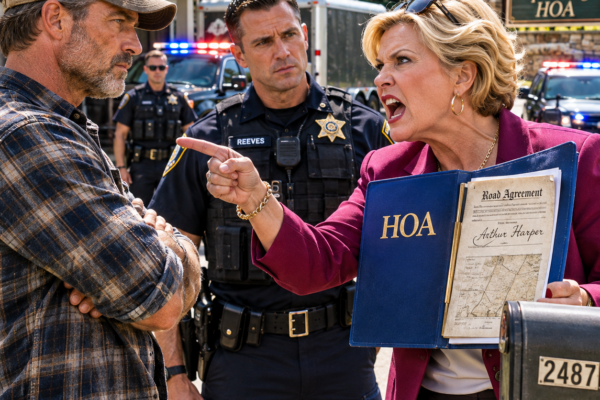
“PAY YOUR HOA FINES OR LET YOUR DAUGHTER FREEZE!” Karen Cut My Heat at −14°F—Then the Contract She Signed Put Her $9.8 Million Empire at Risk
“PAY YOUR HOA FINES OR LET YOUR DAUGHTER FREEZE!” Karen Cut My Heat at −14°F—Then the Contract She Signed Put Her $9.8 Million Empire at Risk
“TURN OFF HIS HEAT—LET HIM EXPLAIN TO HIS LITTLE GIRL WHAT HAPPENS WHEN YOU DEFY ME!” HOA president Kimberly Ashworth ordered at 11:52 p.m., while a blizzard buried our Colorado neighborhood, my nine-year-old daughter Mia shivered inside her winter snowsuit, and thirty-one families suddenly lost the warmth that was supposed to keep them alive through the coldest night in a decade.
Kim thought she could freeze me into paying $1,150 in fabricated violations, but she had forgotten that I was Ben Kowalski, the hydronic engineer who owned the land beneath our neighborhood’s geothermal pump house—and that two years earlier, she’d personally signed an operating agreement containing a provision that could put every one of her eighty vacant investment properties at risk if she deliberately interfered with residents’ heat.
What she never anticipated was the frightened bookkeeper who appeared at my door shortly before two in the morning carrying evidence of $1.4 million in diverted reserve funds, because by sunrise, the documents Kim had tried to hide would become more devastating than the frost alarms screaming across her eighty empty houses.
At 11:52 p.m., the sound that woke me wasn’t an explosion.
It wasn’t a car alarm.
It wasn’t even the wind.
It was the absence of a sound I’d been listening to for eleven years.
The low, steady hum of the geothermal circulation pumps.
I opened my eyes in the darkness and lay perfectly still.
Something was wrong.
Our bedroom felt colder than it should.
The house was silent.
My wife, Laura, was asleep beside me, one hand tucked beneath her cheek.
Beyond the window, snow struck the glass hard enough to sound like handfuls of gravel.
I reached toward the thermostat.
Fifty-eight degrees.
I stared.
Our house had been set to seventy.
I waited for the heat to respond.
Nothing.
No circulation.
No familiar vibration in the floor beneath the mechanical room.
I stepped out of bed.
The hardwood was cold against my bare feet.
Then I heard something that made my stomach tighten.
A small voice from the hallway.
“Daddy?”
I turned.
Mia stood in her bedroom doorway wearing pink pajamas covered in little stars.
She was nine years old.
Her dark hair hung around her shoulders.
She held a stuffed rabbit by one ear.
“Sweetheart?”
She rubbed her eyes.
“Why is it so cold?”
I crossed the room and put my arms around her.
Her hands felt icy.
I touched her cheek.
“Go get under your blankets, baby.”
“Is the heater broken?”
“I don’t know yet.”
She looked toward the window.
The storm was raging.
“Are we going to be okay?”
I wanted to tell her yes immediately.
I wanted to promise her everything was fine.
But I knew too much about what could happen to a neighborhood when its heating system failed at fourteen degrees below zero.
So I kissed her forehead.
“We’re going to take care of it.”
I carried her back to bed.
Pulled another blanket over her.
Then went downstairs.
By the time I reached the mechanical room, the thermostat had fallen another degree.
I checked the local circulation controls.
The equipment was responding.
The house wasn’t getting the thermal energy it needed from the shared loop.
I put my palm against the supply pipe.
Cold.
Too cold.
The return line wasn’t much better.
I grabbed my phone.
Opened the monitoring software.
Thirty-one service alarms glowed red.
Every home on Aspen Court.
Every single one.
I felt the blood leave my face.
This wasn’t a furnace failure.
This wasn’t an ordinary power interruption.
The central pump house still had power.
The main equipment was running.
But the entire Aspen Court branch had stopped receiving circulation.
Someone had isolated it.
Deliberately.
I stood in the cold mechanical room staring at the alarm screen.
Then whispered:
“Kim.”
I didn’t have proof yet.
But three days earlier, she’d sent the entire neighborhood a letter threatening a winter compliance service review against homeowners with unpaid HOA fines.
I’d laughed when I read it.
Laura hadn’t.
Now, at almost midnight, while the biggest blizzard of the decade buried our street, thirty-one homes had lost their heat.
And my daughter was upstairs trying to understand why our house was becoming colder by the minute.
I pulled on thermal clothing, a heavy coat, gloves, and boots.
Then went outside.
The wind hit me so hard I nearly stumbled.
Snow swept across the driveway in horizontal sheets.
The streetlights glowed inside halos of white.
Twenty yards from my front yard, beside the buried valve enclosure, a pickup truck sat idling.
Its headlights were off.
A man stood near the valve box holding a tool bag.
Vince Dolan.
The HOA maintenance contractor.
I walked toward him.
“Vince!”
He turned.
His face tightened.
“Ben?”
“What did you do?”
He looked toward the truck.
Then at me.
“Orders from the president.”
I stared.
“Which president?”
He shifted his weight.
“Kim.”
The wind howled between us.
“Did you isolate Aspen Court?”
He didn’t answer.
I pointed toward the valve box.
“Thirty-one homes, Vince!”
He swallowed.
“I’m just doing what I was told.”
I stepped closer.
“People live in those houses!”
“I know.”
“Children.”
“I know.”
“Elderly residents.”
His eyes dropped.
“Ben, don’t make this harder.”
I stared at him.
“Harder?”
I pointed toward the snow-covered houses.
“There’s a nine-year-old girl in my house putting on extra blankets because you shut off her heat.”
Vince looked miserable.
Then he said the sentence I’d remember for the rest of my life.
“Kim said nobody would dare let it stay off long enough to matter.”
I looked at the valve.
Then at the truck.
Then back at him.
“Get away from the equipment.”
He hesitated.
“Ben—”
“Now.”
Vince stepped back.
I photographed the valve enclosure, the isolation position, the attached HOA service-suspension tag, and the vehicle.
My exterior security camera had also captured the approach.
Then I called emergency dispatch.
Because whatever Kim believed about my unpaid fines, she had crossed from an argument about neighborhood rules into an immediate threat to public safety.
And I was about to discover that Aspen Court was only the beginning.
PART2
The dispatcher initially thought I was reporting a dispute between a homeowner and an HOA contractor.
Then I explained the temperature.
The shared geothermal system.
The number of homes without circulation.
And the medical risks to people living along Aspen Court.
Her tone changed.
She asked whether anyone was in immediate danger.
I told her we were checking.
Then I called our local emergency-services contact and requested assistance with a warming location, welfare checks, and restoring service safely.
I didn’t want somebody at a desk deciding this could wait until Monday because the words homeowners association appeared in the complaint.
Outside, Vince stood beside his truck.
The wind had coated his shoulders in snow.
I opened the service enclosure.
The valve had been closed and secured with a padlock.
A laminated tag hung from it.
HOA SERVICE SUSPENDED — NONCOMPLIANCE.
The sight made my hands shake.
Not because I didn’t know what to do.
I knew exactly what to do.
That was the problem.
I had designed hydronic heating networks for twenty-six years.
I understood thermal mass, flow rates, heat loss, freeze protection, balancing valves, pumps, air separators, and the ugly things that happen when water stops moving in extreme cold.
In a house at seventy degrees, you have some time before the indoor temperature becomes dangerous.
How much depends on the construction.
Insulation.
Outdoor exposure.
Wind.
Thermal storage.
Whether the water system remains protected.
But I also knew that a stalled heating loop in severe cold could put mechanical rooms and other vulnerable sections of piping at risk long before the entire home became freezing.
This wasn’t a harmless inconvenience.
It was dangerous.
I called my wife.
She answered immediately.
“Ben?”
“Laura, listen.”
Her voice tightened.
“What happened?”
“The Aspen Court loop has been isolated.”
“By whom?”
“Vince.”
Silence.
Then:
“Kim?”
“Yes.”
Laura took a breath.
“What do you need me to do?”
That was Laura.
She had been a trauma nurse for eighteen years before moving into hospital administration.
When everybody else panicked, she started asking practical questions.
“Get Mia dressed warmly.”
“Check on Walt and Dorothy Henley.”
“Call the Ortegas.”
“Tell anyone without heat to gather in a safe warm place while we restore service.”
“What about the workshop?”
“I’m opening it.”
“Ben, can you get the heat back on?”
“I have to inspect the system first.”
A pause.
“Don’t take chances.”
“I won’t.”
I ended the call.
Then looked at Vince.
“Who authorized this?”
He stared at the snow.
“Kim.”
“Did she give you a written work order?”
He hesitated.
“Yes.”
“Preserve it.”
He looked up.
“What?”
“Don’t delete anything.”
I pointed toward the truck.
“Your instructions, your messages, the time you arrived—everything.”
His face paled.
“Ben, I didn’t think—”
“I know.”
I swallowed my anger.
“Now we need to keep people safe.”
My name is Ben Kowalski.
I’m forty-four years old.
I grew up in northern Colorado, where winter weather has a way of teaching you that nature doesn’t care how confident you are.
My father worked as an electrician.
My mother taught elementary school.
When I was seventeen, our furnace failed during a January cold snap.
Dad spent half the night repairing the controls.
I watched him kneeling beside the equipment with a flashlight between his teeth.
Eventually, the burner ignited.
Warm air began moving through the ducts.
I remember how relieved everyone looked.
Dad glanced at me and said:
“People don’t think about heat until they don’t have it.”
He was right.
That sentence stayed with me.
I studied mechanical engineering, specialized in hydronic systems, and eventually built a business called Kowalski Mechanical.
We designed and maintained commercial heating plants, district heating systems, and high-efficiency residential loops.
I loved the work.
Not because pipes and pumps are romantic.
Because good infrastructure changes people’s lives without demanding recognition.
When a heating system works, children sleep.
Elderly people remain safe.
Families gather around dinner tables.
Nobody has to wonder whether the water will freeze in the walls.
That’s what good engineering is supposed to do.
Make ordinary life possible.
I met Frank Delmare early in my career.
He was a developer with a stubborn streak and an unusually strong interest in sustainable heating.
Frank believed Pinerest Hollow could be built around a shared geothermal loop instead of individual fossil-fuel furnaces.
Most developers thought he was crazy.
Shared infrastructure was complicated.
It required careful design.
Long-term maintenance.
Transparent operating costs.
And an understanding that critical services couldn’t be managed like decorative landscaping.
Frank hired me to help design and commission the system.
For years, he treated me like a son.
He taught me about business.
I taught him about pumps.
We argued constantly.
And somehow became close friends.
When his development company encountered financial trouble, he made one final decision that changed my life.
He transferred the pump house parcel to me under a documented arrangement.
Not the neighborhood homes.
Not the geothermal rights of every resident.
The land and operating facilities, subject to the relevant recorded rights and service obligations.
He wanted the system protected from being sold off casually as part of a corporate liquidation.
Then we worked with counsel to establish an operating agreement between the pump-house operator and the homeowners association.
It defined maintenance responsibilities.
Service obligations.
Emergency procedures.
Payments.
Dispute resolution.
And restrictions against using essential heat as leverage in unrelated disagreements.
Frank was adamant about that last part.
“Ben,” he told me, “if somebody controls the heat, they control people’s lives.”
I nodded.
“So we write safeguards.”
“Strong ones.”
We did.
The final agreement was thirty-eight pages.
Kimberly Ashworth signed it two years before the blizzard.
By then, she’d become president of the Pinerest Hollow HOA.
She barely glanced at the document.
I remember standing beside the conference table as she flipped through it.
“Thirty-eight pages for a heating contract?”
Frank smiled.
“It’s an operating agreement.”
“Whatever.”
She signed.
Then stood.
“I trust you gentlemen understand that the HOA still sets community policy.”
Frank looked at me.
Then back at her.
“Not heating safety.”
Kim laughed.
“Of course.”
But I could tell she hadn’t really heard him.
And two years later, at 11:52 on a Friday night, that failure would put thirty-one families in danger.
By the time I reached the pump house, I had three priorities.
Verify the isolation hadn’t damaged the system.
Get heat restored to Aspen Court safely.
And make sure nobody remained in a cold house without help.
I opened the building.
The pumps were still running.
The control panel glowed.
Supply temperatures elsewhere in the loop were within operating range.
The Aspen Court branch showed almost no flow.
I checked the pressure trends.
Then the isolation sequence.
The valves had been closed in a way that should never have been used as an enforcement measure.
Thankfully, the branch’s freeze-protection alarms had triggered promptly.
There was no evidence yet of a major rupture.
I contacted two members of my on-call team.
They lived nearby.
Both were experienced enough to understand the weather and the urgency.
I told them not to drive unless the roads were passable and their travel could be made safely.
One was already working at the shop.
The other had equipment staged near the subdivision.
Within a short time, we had a coordinated response.
I also opened Kowalski Mechanical’s heated service workshop.
It had emergency backup heat, accessible restrooms, bottled water, and enough space to shelter people temporarily.
It wasn’t a hospital.
It wasn’t an official public shelter.
But in that storm, it was warmer than thirty-one homes whose heat had been deliberately interrupted.
Laura organized the residents.
Walt Henley arrived first.
Seventy-one.
Retired firefighter.
A man who could repair almost anything except his own tendency to worry about everyone else.
He came through the workshop door with snow on his eyebrows.
“Ben.”
“Walt.”
“What the hell happened?”
I looked at him.
“Someone closed the branch isolation.”
His expression changed.
“On purpose?”
“Yes.”
He stared.
Then whispered:
“Good God.”
Behind him came Dorothy Henley.
Wrapped in a thick coat.
Carrying a bag of medication.
Then the Dut family with their infant twins.
A young mother named April, holding her sleeping toddler beneath three blankets.
Mr. Ortega arrived with his portable oxygen equipment and a neighbor who had helped him through the snow.
More families followed.
Forty people.
Then nearly fifty.
Some had just enough time to grab coats.
Others carried medication, baby supplies, phones, and blankets.
I stood near the workshop entrance greeting people I had known for years.
Neighbors who had trusted the shared heating system.
Neighbors who had paid their dues.
Neighbors who had never imagined an HOA president could order their heat interrupted as punishment.
A little girl looked up at me.
“Are we going to be warm?”
I crouched.
“Yes.”
She nodded.
Then asked:
“Is our house broken?”
I swallowed.
“That’s what we’re checking.”
She held her mother’s hand tighter.
And I felt an anger so deep it became almost quiet.
Kim hadn’t merely gone after me.
She had made innocent families pay for her obsession with control.
Laura came through the workshop door at half past midnight.
Mia followed.
My daughter wore her winter snowsuit over her pajamas.
Pink gloves.
A knitted hat with a pom-pom.
Snow boots.
She looked exhausted.
I crossed the room.
“Hey, peanut.”
She ran toward me.
I knelt.
Caught her.
Held her tightly.
“Daddy.”
“I’m here.”
“Why did the heater stop?”
I looked at Laura.
She shook her head slightly.
Not now.
Mia didn’t need a detailed explanation of adult cruelty.
Not in the middle of the night.
Not when she was frightened.
I pulled her closer.
“Something happened to the neighborhood heating system.”
“Can you fix it?”
I kissed her forehead.
“That’s what I’m working on.”
She looked around the crowded workshop.
“Why is everybody here?”
“Because it’s warm.”
She thought about that.
Then whispered:
“Are all their heaters broken too?”
I swallowed.
“Yes.”
Her eyes widened.
“All of them?”
“Thirty-one houses.”
Mia looked toward the door.
Snow was still pouring past the windows.
Then she asked a question that hurt more than anything Kim had ever said to me.
“Did we do something wrong?”
I froze.
Laura turned away.
I looked at my daughter.
“No.”
“Are you sure?”
“Absolutely.”
She stared.
“Because Mrs. Ashworth said you weren’t following the rules.”
I felt my chest tighten.
Of course Kim had said that.
Probably at one of the neighborhood events.
Probably with that careful smile she used when she wanted children to repeat her words at home.
I took Mia’s hands.
“Listen to me.”
She nodded.
“People can disagree about rules.”
“That’s normal.”
“But nobody should have to be cold because of a disagreement about fines.”
Mia looked toward the families sitting on folding chairs.
Then back at me.
“Especially babies?”
My throat closed.
“Especially babies.”
She hugged me.
And whispered:
“I don’t like Mrs. Ashworth.”
I held her.
“Tonight, sweetheart, I understand why.”
Laura took Mia to the office, where a small electric heater was operating safely under supervision.
Mia curled up on the couch.
Her stuffed rabbit tucked beneath one arm.
Within minutes, she was asleep.
I watched her through the doorway.
The snowsuit made her look smaller than she was.
A little girl who should have been dreaming about Christmas, school, and the snowman she planned to build.
Instead, she had been carried out of her house in the middle of a blizzard because an adult wanted to punish her father.
I closed the office door gently.
Then went back to work.
At the pump house, we began restoring circulation through the isolated branch after confirming the equipment was safe to restart.
We monitored pressure.
Supply temperature.
Flow.
Alarm status.
We checked for any signs of damage.
We coordinated with the emergency responders conducting welfare checks.
Restoring heat wasn’t as simple as throwing one switch and declaring victory.
A cold loop can behave differently from a warm one.
Piping expands.
Air pockets move.
Flow can become unstable.
And if any section has frozen, careless restoration can make a bad situation worse.
So we worked carefully.
By the early morning hours, portions of Aspen Court were receiving heat again.
Other homes required additional verification before we could clear them for normal operation.
The families remained in the warm workshop until their homes were confirmed safe.
Meanwhile, I called Kim.
She answered on the first ring.
Wide awake.
Of course.
“Benjamin.”
I hated when she called me that.
“Kim.”
“I assume you’ve received the compliance review.”
I stared at the phone.
“Thirty-one families have lost heat.”
“Accounts with unpaid balances are subject to enforcement.”
“Not heating service.”
She laughed.
“Compliance has consequences.”
I looked through the window.
At Walt carrying a cup of tea to Dorothy.
At April rocking her baby.
At Laura helping Mr. Ortega adjust his portable equipment.
Then I said:
“Kim, you ordered a critical heating branch isolated during a blizzard.”
She didn’t answer.
I continued.
“That’s a public-safety issue.”
She snapped:
“Don’t lecture me about my authority.”
“I own the pump house, Ben.”
“No.”
I said.
“You don’t.”
Silence.
Then:
“What?”
“You signed an operating agreement two years ago.”
She laughed again.
“Of course I did.”
“You should read Section Fourteen.”
She paused.
Then said:
“Good night, Benjamin.”
And hung up.
I stared at the phone.
Then opened the operating agreement.
Because I knew exactly what Section Fourteen said.
And I also knew that Kim had apparently forgotten.
Section Fourteen had been Frank Delmare’s idea.
I remembered the afternoon we wrote it.
Frank was sitting across from me in his office.
A half-empty coffee cup beside his laptop.
The original loop drawings spread across the conference table.
He tapped the operating agreement.
“Ben, what happens when somebody who runs the HOA decides they don’t like a homeowner?”
I looked at him.
“What do you mean?”
“Suppose they don’t like the color of his fence.”
“Then they handle it under the covenants.”
“And suppose he refuses?”
I shrugged.
“Fine him if the rules authorize it.”
Frank leaned forward.
“What if the HOA controls access to the valves?”
I stopped.
He watched my expression.
“Now you see the problem.”
We spent the next several hours discussing protections.
No resident’s heat could be intentionally interrupted for unpaid architectural fines or unrelated association disputes.
Emergency shutdowns would remain permitted for genuine safety threats, equipment failures, and necessary repairs.
But deliberate interference with the system would trigger a formal breach procedure.
The agreement also contained special protections for the operator if the association or an affiliated property owner interfered with service.
Section Fourteen was written to discourage exactly that kind of behavior.
It required written notice and an opportunity to cure.
And under certain circumstances, it allowed suspension of particular contractual services to parcels owned by the HOA or its affiliated entities.
Not to occupied homes.
Not to vulnerable residents.
Not as a substitute for safety procedures.
Frank insisted on operational safeguards.
No critical heating shutdown should proceed without considering winterization, property protection, and the risk of loss.
“Keep the consequences where the decision-maker can feel them,” he said.
“Not on families who have nothing to do with the disagreement.”
That was the principle.
Two years later, Kim had created the very situation Frank feared.
I opened Section Fourteen on my laptop.
Read every word.
Then opened Schedule B.
The schedule identified eighty parcels associated with Summit Crest Holdings.
The company had built eighty speculative homes in the third phase of Pinerest Hollow.
Large homes.
Expensive finishes.
Stone fireplaces.
Vaulted ceilings.
The kind of houses advertised with phrases like mountain luxury and exclusive lifestyle.
Most were still unsold.
All eighty were vacant according to the latest property records and management reports.
Summit Crest’s accounts were maintained separately from ordinary homeowners’ accounts under the operating agreement.
I checked the company’s registration.
One name appeared as managing member.
Kimberly Ashworth.
I stared.
Then opened a second record.
Kim’s ownership interest had been disclosed in some older development materials, but it was not something she’d ever mentioned when demanding that ordinary homeowners pay their fines immediately.
Her company owned eighty properties.
Properties requiring heat.
Properties dependent on the same geothermal infrastructure she had just used to threaten residents.
I leaned back.
And understood why Frank had insisted on Section Fourteen.
Kim wasn’t merely HOA president.
She was a major property investor.
The operating agreement created obligations for her company as well.
And she had signed it.
Personally.
I called my attorney, Olivia Grant.
It was after midnight.
She answered on the fourth ring.
“Ben?”
Her voice was thick with sleep.
“Olivia.”
“Please tell me everybody’s okay.”
“Thirty-one houses lost heat.”
Silence.
Then she was awake.
“What?”
I explained.
Vince.
The valve.
The suspension tag.
Kim’s phone call.
The workshop.
The service restoration.
Then Section Fourteen.
Olivia listened.
When I finished, she said:
“First priority is the occupied homes.”
“We’re restoring heat.”
“Good.”
“Second, preserve every record.”
“Done.”
“Third, don’t use the agreement to do something dangerous.”
I looked at the screen.
“I’m not going to.”
She paused.
“Ben, I know how angry you are.”
I stared through the pump-house window.
Snow still swept across the road.
“I’m beyond angry.”
“I understand.”
“No.”
My voice broke.
“My daughter is sleeping in a snowsuit.”
Olivia was quiet.
Then:
“I’m sorry.”
I took a breath.
She continued.
“I’ll review Section Fourteen with you.”
“But a contractual right isn’t a blank check to create foreseeable damage during a severe weather emergency.”
“I know.”
“Especially if the other properties contain water-filled systems.”
“I know that too.”
She paused.
“Then let’s handle this in a way that protects the people Kim endangered and doesn’t endanger anyone else.”
I looked at the Schedule B parcels.
Eighty empty houses.
Millions of dollars in property.
And a woman who believed the neighborhood’s heat was hers to control.
“Okay.”
Olivia continued.
“Send formal notice of the breach.”
“Demand immediate restoration and full access to the controls.”
“Offer practical emergency mitigation.”
“And make sure the independent responders know what happened.”
I nodded.
“Then what?”
“Then we determine what remedies can lawfully be used without creating a second disaster.”
I stared at the agreement.
That was why I paid Olivia.
She wasn’t interested in helping me stage a satisfying revenge scene.
She was interested in making sure a real dispute didn’t become a tragedy.
I began preparing the notice.
At 12:40 a.m., I sent Kim a formal breach notice.
It identified the unauthorized interruption of Aspen Court’s heating branch.
It demanded that the HOA cease interference and surrender any unauthorized keys or locks.
It preserved the contractual claims available under Section Fourteen.
And it provided the two-hour cure period required by the agreement.
Attached was an emergency mitigation offer.
My company would help inspect and winterize the vacant Summit Crest properties if their owner elected to take them out of normal heating service.
At no labor charge that night.
We could coordinate with qualified property-maintenance personnel and emergency responders.
We could prepare the vacant systems to reduce the risk of frozen piping.
We could also maintain service while legal disputes were resolved, provided the HOA and Summit Crest stopped interfering with the occupied loop and complied with the necessary safety arrangements.
I wasn’t offering that because I liked Kim.
I was offering it because water doesn’t care who owns the building around it.
When it freezes, it expands.
When a pipe ruptures, the damage can be catastrophic.
And I had no intention of allowing my anger to override twenty-six years of engineering judgment.
I sent the notice electronically.
Then arranged for formal delivery by the available contractual methods.
Kim’s house was nearby, and I also delivered a physical copy.
She answered the door wearing a silk robe.
Warm light glowed behind her.
Her hair was neatly brushed.
She looked as though she’d been expecting me.
“Benjamin.”
I held out the envelope.
“Formal notice.”
She glanced at it.
“What now?”
“Unauthorized heating interruption.”
She smiled.
“Compliance enforcement.”
I shook my head.
“Read it.”
She took the paper.
Skimmed the first page.
Then laughed.
“You’re threatening me with a contract?”
“I’m giving you an opportunity to correct what happened.”
She looked toward the street.
Snow blew past the porch.
Then she read the part describing the vacant properties.
Her smile disappeared.
“You wouldn’t dare.”
“I’m not here to threaten your houses.”
“Then why mention them?”
“Because your company is subject to the operating agreement too.”
She stared.
I continued.
“The occupied homes need their heat restored and secured against further interference.”
“And your vacant houses need protection if service arrangements change.”
Kim folded the paper.
“You think you can scare me?”
“No.”
“I think you should understand what you signed.”
She laughed.
Then tore the notice in half.
Right in front of me.
Dropped the pieces onto the snow.
And said:
“You’re going to learn who owns this neighborhood.”
I looked at the torn paper.
Then at her.
“Kim, please don’t do this.”
She stepped backward.
“Get off my porch.”
The door slammed.
I stood there for a moment.
Wind pushing against my back.
Then retrieved the torn pages.
My phone and the exterior cameras had documented the exchange where lawful.
I preserved the original electronic notice and delivery records.
Then returned to the pump house.
I didn’t feel victorious.
I felt sick.
Because I had just watched a woman dismiss a documented opportunity to prevent more harm.
And I couldn’t stop thinking about the families still sitting in my workshop.
At 1:55 a.m., three soft knocks sounded against the pump-house door.
I was reviewing the restoration logs.
Laura was nearby, organizing the warming area with Walt.
The knock came again.
Quiet.
Almost hesitant.
I opened the door.
A woman stood outside.
Camel-colored coat.
Burgundy knitted hat.
Snow clinging to her shoulders.
Her face was pale.
Her eyes red.
“Mr. Kowalski?”
I frowned.
“Yes?”
She swallowed.
“My name is Teresa Moon.”
I recognized her.
The HOA bookkeeper.
Quiet woman.
Rarely spoke during meetings.
Always sat beside the treasurer with a laptop.
“What are you doing out in this storm?”
She looked over her shoulder.
Then whispered:
“I need to tell you something.”
I stepped aside.
“Come in.”
She entered.
Her hands were shaking.
I offered her a chair.
She sat.
Didn’t remove her coat.
Then reached into her bag.
Pulled out a flash drive.
And a stack of printed documents.
Forty pages, perhaps.
I stared.
“What’s this?”
Teresa looked up.
Her lips trembled.
“Proof.”
My stomach tightened.
“Of what?”
She looked toward the window.
Then said:
“Kim’s been stealing from the heating reserve fund.”
I went still.
Teresa continued.
“And she was planning to take your neighbors’ houses.”
For a moment, all I could hear was the pump system.
Steady.
Mechanical.
Unaware.
Teresa placed the papers on the table.
Then whispered:
“Please don’t let her know I came here.”
Teresa had worked for the association for six years.
She wasn’t wealthy.
Her husband had died four years earlier.
She had one adult son in college and a mortgage she was still paying.
The HOA job wasn’t glamorous.
It was bookkeeping.
Invoices.
Account reconciliations.
Assessment tracking.
Vendor payments.
The kind of work that keeps an organization functioning when leadership is responsible.
And becomes a nightmare when leadership isn’t.
She began explaining.
Eleven transfers.
Over several months.
From the geothermal loop’s reserve accounts into entities linked to Summit Crest Holdings.
Total:
$1.4 million.
I stared at the ledger.
“Fourteen hundred thousand?”
Teresa nodded.
“The reserve balance was supposed to remain available for major repairs, emergency equipment replacement, and capital maintenance.”
I knew.
I’d helped design the reserve schedule.
The pumps had long service lives under proper care.
But the system still required future investment.
Heat exchangers.
Controls.
Circulation equipment.
Insulation.
Repairs.
Emergency response.
A shared district system cannot depend on good luck.
That’s why reserve funds exist.
I looked at the transfers.
“Who authorized these?”
Teresa’s eyes filled.
“Kim.”
I frowned.
“Only Kim?”
“Howard Brennan signed several.”
The HOA treasurer.
A quiet man who rarely challenged her in meetings.
“Did he know?”
Teresa looked down.
“I don’t know what he understood.”
I studied the statements.
The destination accounts were identified with variations of Summit Crest’s name and related development entities.
Not proof by themselves of criminal theft.
There could be legitimate transactions between an HOA and a development affiliate.
But each one needed an authorized purpose.
Supporting documentation.
Board approval.
Accurate financial reporting.
And the members’ funds couldn’t simply become private development capital because the president wanted them to.
“Do the annual reports show these transfers?”
Teresa shook her head.
“Not accurately.”
I looked up.
“What do they show?”
She swallowed.
“Reserve funds still available.”
My skin went cold.
She continued.
“The board was given reconciled summaries that didn’t reflect the full movement of cash.”
I stared.
Then asked:
“Why are you telling me now?”
Teresa began crying.
“Because tonight she shut off people’s heat.”
I waited.
She wiped her face.
“She told me she was going to make the delinquent homeowners cooperate.”
“What does that mean?”
Teresa opened another page.
A spreadsheet.
Thirty-one names.
Addresses.
Account balances.
Estimated property values.
Potential acquisition prices.
I saw Walt Henley’s name.
Then Mr. Ortega.
Then my own.
BEN KOWALSKI — PRIORITY ENFORCEMENT.
My stomach turned.
“What is this?”
Teresa whispered:
“Her foreclosure list.”
I stared.
She shook her head.
“I don’t know whether she had any lawful ability to foreclose.”
“But she was planning to use the fines and threats to pressure those families.”
I read further.
Some figures described anticipated sales below market value.
Others referenced acquisitions by Summit Crest or related buyers.
Kim wasn’t merely trying to collect overdue penalties.
The documents suggested she wanted people frightened enough to leave.
And her company might benefit from purchasing their homes at reduced prices.
I looked at Teresa.
“Is this authentic?”
She nodded.
“It’s from the working files.”
I took a breath.
“Have you given it to anyone else?”
“No.”
“Then we need to preserve the original records and get independent investigators involved.”
Her face crumpled.
“She’ll destroy me.”
I looked at her.
“Teresa.”
She lifted her eyes.
“You need your own lawyer.”
She swallowed.
“And you need to provide this through proper channels.”
She stared at the flash drive.
“What if they arrest me too?”
I didn’t lie.
“I can’t promise what investigators will decide.”
Tears ran down her cheeks.
“But I can tell you that continuing to conceal what you know won’t make it better.”
She closed her eyes.
Then nodded.
“Okay.”
At that moment, I looked past her toward the monitoring screen.
The Aspen Court service alarms were improving as the restoration team worked.
And another screen showed the eighty vacant Summit Crest properties.
Their temperatures were beginning to fall.
Not because I had activated a punishment.
Because their owner had neglected required winter maintenance arrangements, and the shared system’s operation had to be stabilized after the deliberate interference.
Several vacant property controls were already showing unresolved faults.
I stared.
Then turned toward Teresa.
“Does Kim know her houses aren’t properly protected?”
Teresa looked terrified.
“Yes.”
“How?”
She opened another folder.
“She’s been warned.”
“By whom?”
“Maintenance.”
“Insurance.”
“And your office.”
I stared.
Three written warnings.
Dates.
Acknowledgments.
References to winterization requirements for vacant buildings.
Kim had ignored them.
And now she’d endangered thirty-one occupied homes while leaving her own investment portfolio vulnerable to the same brutal cold.
At 2:40 a.m., the contractual cure period expired.
By then, my attorneys and the emergency technical team had reviewed the situation.
The Aspen Court branch was being restored, with occupied homes receiving priority.
The eighty vacant Summit Crest properties remained a separate and complicated question.
Section Fourteen established remedies following a tampering event.
But exercising any suspension right still required compliance with applicable law, good faith, and reasonable measures to avoid preventable damage.
I wasn’t going to turn off heat simply to destroy somebody’s property.
That would have made me another person using essential infrastructure as a weapon.
So the emergency team documented which services could safely continue, which systems required isolation for actual technical reasons, and which vacant buildings needed immediate winterization.
We notified the owner and the appropriate contacts.
We offered mitigation again.
The notice included the risks.
Frozen domestic-water piping.
Ruptured sprinkler components.
Damage to interior finishes.
Loss of heat protection.
Potential insurance complications.
We also took steps within our lawful authority to protect the central plant and prevent damage from spreading to other portions of the system.
I looked at the eighty parcels.
All vacant.
No residents inside.
No children in beds.
No elderly people depending on heat.
That was a relief.
It wasn’t a reason to treat the properties as disposable.
At 2:40, we documented the end of the cure period and the remedies being invoked.
Where a service connection required safe temporary restriction under the documented operating plan, it was handled by qualified personnel with monitoring and notice.
Other properties continued receiving whatever service could be safely maintained.
The situation was already deteriorating because of existing winterization failures and Kim’s refusal to authorize protective work.
By 3:50, frost alarms began cascading through Summit Crest’s monitoring network.
One.
Then another.
Then dozens.
The control screen filled with alerts.
I stared.
My phone began ringing.
Kim.
I didn’t answer immediately because I was coordinating occupied-home restoration.
Then came a text.
TURN IT BACK ON OR I’LL HAVE YOU ARRESTED.
I looked at the message.
Then at the recorded service status.
Then typed:
Emergency restoration is underway. Your vacant properties require immediate authorized winterization and inspection. Contact the emergency team and your insurer.
Another message arrived.
YOU’RE GOING TO LOSE EVERYTHING.
I stared at the screen.
Kim still hadn’t asked whether the thirty-one families were warm.
Not once.
She hadn’t asked about Mr. Ortega.
The babies.
Mia.
She wanted to know what was happening to her investment.
And that told me more about her than any of the fines she’d sent over the years.
At 4:30 a.m., Kim Ashworth arrived on Aspen Court.
Her black SUV slid slightly as she turned into Walt Henley’s driveway.
Two police cruisers followed.
Their emergency lights flashed red and blue against the falling snow.
I was standing on Walt’s porch with a cup of coffee.
The drink had gone cold.
I hadn’t slept.
My boots were wet.
My gloves were stiff.
Across the street, volunteers and emergency personnel were coordinating with residents who still needed assistance.
Some neighbors stood beneath the porch awnings watching the vehicles approach.
Walt stepped beside me.
“Here she comes.”
I nodded.
Kim climbed out.
Her hair was disheveled.
No immaculate blazer.
No carefully arranged smile.
She pointed at me before her boots touched the driveway.
“YOU CUT OFF MY HEAT!”
I set the coffee down.
“Kim.”
“YOU DESTROYED MY SYSTEM!”
I stared at her.
“Thirty-one occupied homes lost heat because of an unauthorized valve closure.”
She marched closer.
“DON’T CHANGE THE SUBJECT!”
Officer Nina Ruiz stepped between us.
“Ma’am, calm down.”
Kim turned.
“Officer, arrest him!”
Ruiz looked at me.
Then at Kim.
“What’s the complaint?”
“He’s sabotaging eighty homes!”
I didn’t interrupt.
Ruiz wrote something down.
“Mr. Kowalski?”
“Yes?”
“Can you explain the heating situation?”
I took out my phone.
Opened the incident timeline.
“An HOA contractor isolated the Aspen Court branch at approximately 11:52 p.m.”
I showed her the valve photographs.
The suspension tag.
The camera footage.
Then the restoration records.
Ruiz watched carefully.
Vince appeared on the recording beside the valve enclosure.
His truck.
The tools.
The secured closure.
Then his voice.
Orders from the president.
Kim’s face changed.
Ruiz turned.
“Mrs. Ashworth, did you authorize this?”
Kim lifted her chin.
“I authorized a compliance review.”
“Did that include disconnecting heat?”
“Noncompliant homeowners have consequences.”
Ruiz stared at her.
“During a severe winter storm?”
Kim folded her arms.
“Our HOA has enforcement powers.”
I spoke quietly.
“Not powers that override basic safety obligations.”
Kim glared.
“You don’t get to interpret my authority!”
Officer Jessup, Ruiz’s partner, examined the operating agreement.
He read the relevant provisions.
Then the notice.
Then reviewed the records showing our emergency mitigation offer.
Kim stood beside her SUV, visibly furious.
Jessup looked up.
“Mrs. Ashworth, this isn’t something we’re resolving simply because one party says the contract supports them.”
Kim snapped:
“Then arrest him for property damage!”
The officer remained calm.
“We need to establish what happened, what obligations existed, and whether any crimes were committed.”
I nodded.
“That’s appropriate.”
Kim looked at me.
“YOU’RE ENJOYING THIS!”
I stared.
Enjoying?
Mia had slept in a snowsuit.
Forty people had spent the night in my workshop.
My employees had worked through a dangerous storm.
The heating system needed emergency inspection.
And eighty vacant houses were experiencing serious freeze alarms.
I looked at Kim.
“No.”
I said quietly.
“I’m not enjoying any of it.”
She sneered.
“Liar.”
I looked toward the houses on Aspen Court.
Then back at her.
“You shut off heat to force families to obey you.”
“You were warned about the consequences.”
“You refused the mitigation plan.”
“And you’re standing here asking why somebody isn’t protecting your investment.”
Kim stepped closer.
“You’ll lose your house.”
I didn’t answer.
“Your business.”
I watched her.
“Everything.”
Walt moved beside me.
His face was red.
“Lady.”
Kim turned.
He pointed toward his home.
“My wife spent the night in a workshop because you wanted to punish a man for Christmas lights.”
Kim opened her mouth.
Walt continued.
“My neighbor’s got oxygen equipment.”
“There’s a family down the street with newborn babies.”
His voice broke.
“And you didn’t even ask if they were okay.”
The street fell silent.
Kim stared.
Then said:
“Those people were given notices.”
Walt shook his head.
“Notices?”
He stepped backward.
“God help you.”
Howard Brennan arrived a few minutes later.
The HOA treasurer.
He looked as though he hadn’t slept.
His jacket was buttoned incorrectly.
He stood beside Kim, staring at the police vehicles.
She grabbed his arm.
“Howard.”
He flinched.
“Tell them the heat account was paid.”
Howard looked at me.
Then at Officer Ruiz.
His mouth opened.
Nothing came out.
Kim tightened her grip.
“Howard.”
He swallowed.
“Kim, I—”
“Tell them.”
He stared at the snow.
Then whispered:
“I can’t.”
Her face went white.
“What?”
Howard looked toward the officer.
“I need to speak with someone about the association’s financial records.”
Kim stepped backward.
“YOU DON’T KNOW WHAT YOU’RE SAYING!”
Howard closed his eyes.
“I know exactly what I’m saying.”
The moment was quiet.
Almost anticlimactic.
No shouting from Howard.
No triumphant speech.
Just a frightened man deciding he wasn’t going to repeat another false statement.
Ruiz asked him to provide his information.
He did.
I stood beside Walt.
My hand resting on the folder inside my coat.
Teresa’s documents remained preserved for investigators.
I had not shown them to Kim.
I wasn’t going to wave financial records in her face like a movie villain.
That evidence needed proper handling.
And Howard had just made clear there was more to examine.
By sunrise, the worst of the storm had begun to pass.
The sky over Pinerest Hollow turned pale gray.
Snow covered the rooftops.
The pine trees sagged beneath the weight.
At 7:10 a.m., emergency crews confirmed substantial damage in parts of Summit Crest’s vacant development.
Several homes had suffered ruptured pipes.
Others had sprinkler or mechanical-system failures.
Water had escaped inside some buildings before freezing.
Ice hung from damaged fixtures and exterior openings.
The extent of the destruction wasn’t yet known.
It would take inspections, drying, structural assessments, and professional estimates to understand what had happened.
Kim drove into Phase Three.
I didn’t follow immediately.
I remained with the restoration crew.
The occupied homes came first.
By then, every Aspen Court residence had been assessed for safe reoccupation or given alternative warming arrangements.
The emergency team continued checking vulnerable residents.
No one had to return to an unsafe house simply because the heat appeared to be working.
I helped where I could.
Then, after the immediate response stabilized, Olivia joined me for a documented inspection of the vacant-property damage.
The first house had water frozen across part of the living-room floor.
A ceiling panel had collapsed.
The next had pipe damage behind a bathroom wall.
Another showed signs of prolonged heating and maintenance problems that appeared to predate the storm.
Each property needed its own assessment.
Nobody could fairly attribute every dollar of damage to a single event without examining the records and conditions.
But the consequences were severe.
Kim stood beside one of the houses.
Her face pale.
She looked at the sheets of ice hanging near the entrance.
Then at me.
“Ben.”
I stopped.
Her voice sounded different.
Small.
“Can you fix them?”
I stared.
The woman who had ordered heat shut off to thirty-one families was now asking whether I could repair her houses.
“Some of the damage can be repaired.”
She swallowed.
“How much?”
“I don’t know yet.”
She looked toward the row of vacant homes.
“Those are my properties.”
“I know.”
She pressed both hands against her face.
“My entire investment.”
I watched her.
For months, she’d fined residents over trivial details.
Mailboxes.
Christmas lights.
Work trucks.
A permitted monitoring shed.
She had treated people like account numbers.
Now she was looking at the cost of neglecting a system she didn’t understand.
She lowered herself onto the snow-covered steps.
And began crying.
I didn’t smile.
Didn’t celebrate.
I thought about Mia.
Then the families in my workshop.
And I felt nothing like victory.
Only sadness that the woman responsible for protecting a community had been willing to endanger it.
At nine that morning, insurance adjuster Gary Lund arrived to begin the claim review.
He wore a hard hat and carried a tablet.
Kim followed him from house to house.
I observed only where the technical records required my participation.
Gary reviewed vacancy status.
Temperature-monitoring histories.
Maintenance requirements.
Prior warnings.
Winterization records.
He asked for the communications sent before the storm.
Teresa’s documents included several notices.
My company had also issued technical recommendations.
Gary studied them.
Then turned toward Kim.
“Were these properties occupied?”
“No.”
“Were the vacant-building protection measures completed?”
Kim hesitated.
“We had heating service.”
“Were the identified systems inspected and winterized as recommended?”
She stared.
“Your company knew about the risk?”
He pointed toward the documents.
“Your management company received these notices.”
Kim looked at me.
I said nothing.
Gary continued.
“Coverage determinations require a full investigation of the policy terms and the cause of each loss.”
“Vacancy conditions and failure to maintain heat or winterize can materially affect coverage.”
Kim’s face tightened.
“So you’re denying the claim?”
“I’m not issuing a final determination on this sidewalk.”
He paused.
“But the documented warnings are significant.”
Kim looked as though she might be sick.
Over the following weeks, the combined damage estimates grew.
Repairs.
Interior demolition.
Pipe replacement.
Mechanical restoration.
Drying.
Reconstruction.
Business interruption and carrying costs.
The total exposure associated with the eighty-house portfolio was eventually estimated at approximately $9.8 million.
The insurers disputed coverage for substantial portions of the losses, relying on policy conditions and the documented maintenance failures.
The matter became the subject of further review and legal disagreement.
It wasn’t an instant denial of every cent by an adjuster standing in the snow.
But the financial danger to Summit Crest was enormous.
Kim had risked millions in property while trying to enforce just over a thousand dollars in fines against me.
And that wasn’t even the worst thing investigators were about to discover.
By noon, a gray government sedan arrived at the pump house.
A woman stepped out.
Dark coat.
Practical boots.
A badge on a lanyard.
She introduced herself as Renee Castillo, a state consumer-protection investigator working with other appropriate authorities.
Teresa Moon was waiting inside with independent counsel.
She had taken my advice.
The records were provided through the investigative process.
The flash drive.
Bank statements.
Transfer summaries.
Reserve-fund records.
Foreclosure planning documents.
Related correspondence.
Renee listened.
Asked careful questions.
Clarified dates.
Requested originals where appropriate.
Then Howard Brennan gave his account.
He admitted authorizing several transfers while under pressure from Kim.
He described how reserve balances had been represented to the board.
Which reports he signed.
Which documents he hadn’t independently checked.
And what he now believed had been concealed.
He didn’t receive instant immunity because he came forward.
His own role needed examination.
But his cooperation helped investigators understand the financial trail.
Eleven transfers.
Approximately $1.4 million.
A reserve fund intended to protect critical heating infrastructure.
And money that appeared to have been redirected toward a private development company associated with the HOA president.
Then came the thirty-one-property list.
Names.
Addresses.
Alleged delinquency.
Projected sale values.
Potential acquisition arrangements.
I watched Renee study the document.
She looked up.
“Mr. Kowalski.”
“Yes?”
“Did you know these families were being targeted for possible acquisition?”
“No.”
“Did any of the homeowners receive proper foreclosure proceedings?”
“Not that I’m aware of.”
She nodded.
“We’ll verify.”
Then she looked at Teresa.
“Thank you for preserving these records.”
Teresa began crying.
She had spent months afraid of losing her job.
Afraid Kim would retaliate.
Afraid she’d be blamed.
Now she had finally handed the information to people who could examine it independently.
I looked at her.
She whispered:
“I should’ve come sooner.”
I didn’t tell her it didn’t matter.
It did.
But I said:
“You came.”
She nodded.
And for the first time that morning, she seemed able to breathe.
Saturday’s emergency homeowners’ meeting filled the clubhouse.
Pinerest Hollow had 212 family homes, alongside the vacant development parcels covered by the separate operating schedules.
Representatives from almost every occupied household attended or participated through authorized voting arrangements.
The room was packed.
Walt Henley sat in the front row.
Dorothy beside him.
Mr. Ortega near the aisle.
The Duts holding their twins.
Laura sat next to Mia.
I stood near the back.
Kim arrived with an attorney.
Her hair was neatly arranged again.
She wore a dark blazer.
But the confident smile was gone.
She tried to address the room.
“Ladies and gentlemen—”
Walt stood.
“Before you talk, I have a question.”
Kim stared.
He looked directly at her.
“Why did you shut off our heat?”
Silence.
Kim’s lawyer leaned toward her.
She didn’t answer immediately.
Then:
“The association was enforcing delinquent accounts.”
Walt shook his head.
“My wife could have died in that cold.”
A woman began crying.
Another resident stood.
“My babies were in that workshop.”
Kim looked toward the floor.
A man near the back called:
“What happened to the reserve fund?”
The room shifted.
Then someone else:
“Why did your company get HOA money?”
Another voice:
“Were you planning to take our homes?”
Kim’s attorney rose.
He advised against discussing active investigative matters without proper process.
That was his job.
The homeowners weren’t satisfied.
They demanded records.
An independent audit.
Removal procedures.
A new board.
And protection of the heating system.
The meeting proceeded under the association’s governing rules.
After debate, the members voted on the leadership recall using the applicable procedures.
The recorded tally was overwhelming.
198 votes in favor of removal.
9 against.
With the remaining votes accounted for under the meeting rules.
Kim stared at the result.
For several seconds, she didn’t move.
Then she looked toward me.
I wasn’t smiling.
I wasn’t applauding.
I was holding Mia’s hand.
My daughter looked up.
“Daddy?”
“Yeah?”
“Does that mean she can’t turn off our heat again?”
I squeezed her hand.
“It means we’re putting better protections in place.”
Mia nodded.
Then looked toward the room.
For her, that was what mattered.
Not the money.
Not the votes.
Not Kim’s humiliation.
She wanted to know whether she could sleep without a winter coat.
Kim sought emergency court relief against the heating operator.
She alleged that I had wrongfully interfered with service to Summit Crest’s vacant parcels and caused avoidable property damage.
She wanted an injunction.
I understood why.
The financial consequences were enormous.
But the court needed evidence.
Not merely accusations.
Olivia Grant represented my business.
The judge, Elaine Ror, reviewed the emergency application.
The operating agreement.
The recorded notices.
The heating-system logs.
The emergency response.
The mitigation offers.
The condition of the vacant properties.
And the arguments about the scope of Section Fourteen.
The proceeding lasted longer than the forty minutes Kim expected would be enough to force me to restore everything unconditionally.
Olivia presented the footage of Vince closing the Aspen Court branch.
The service-suspension tag.
The temperature records.
Then the formal notice and proof that Kim had refused the proposed mitigation.
The video showing her tearing the paper was admitted for the limited purpose it supported.
It didn’t prove every allegation.
But it showed she’d received the warning and rejected it.
Kim’s counsel argued that my response exceeded the contract and that any temporary restriction of service should be considered separately from the HOA’s misconduct.
That was a legitimate issue for the court to examine.
Olivia didn’t pretend otherwise.
She demonstrated that our response had prioritized the occupied homes, followed a technical safety plan, and documented the measures taken to avoid unnecessary damage.
The court declined to grant Kim the broad emergency injunction she requested on the record then available.
The judge did not use the hearing to issue a final judgment on every damage claim.
Those issues required additional evidence.
But she made one point clear.
A dispute about HOA fines did not justify deliberately interrupting essential heat to occupied residences.
And the financial records raised questions beyond the immediate service dispute.
Those questions were referred for appropriate investigation.
I left the courthouse exhausted.
Not triumphant.
Because I still had a heating system to maintain.
And families depending on it.
Three weeks later, investigators executed authorized legal process relating to the financial misconduct allegations.
Kim answered the door of her home.
No glamorous coat.
No carefully staged HOA presentation.
Just an exhausted woman in sweatpants.
I happened to be across the street speaking with Walt.
I saw the investigators approach.
Saw Kim open the door.
Saw the exchange begin.
I didn’t walk over.
Didn’t insert myself.
Didn’t ask whether she was being arrested.
The authorities were responsible for their own decisions.
The investigation involved suspected misappropriation, fraud, false financial reporting, and the attempted use of association enforcement to pressure homeowners.
The financial records were examined.
Witnesses interviewed.
Transfers traced.
Corporate relationships reviewed.
Kim faced charges supported by the evidence the investigators and prosecutors developed.
Other people involved were assessed according to their own conduct.
The court proceedings would take time.
There would be motions.
Disputes.
Testimony.
And opportunities for defense.
I understood that.
Still, when Kim looked across the street and saw me, something passed between us.
She stared.
I nodded once.
Not a victory gesture.
Not an insult.
Just acknowledgment.
Then I turned back toward Walt.
He looked at me.
“Ben.”
“Yeah?”
“Think she’ll ever admit what she did?”
I looked toward the house.
“I don’t know.”
He nodded.
“Doesn’t really matter now.”
I thought about that.
Then said:
“It matters to the people she hurt.”
Walt was quiet.
Then:
“Yeah.”
“It does.”
By spring, the neighborhood had changed.
Not because everything was magically repaired.
There were damaged houses.
Legal disputes.
Financial recovery efforts.
Higher-than-expected maintenance costs.
And residents who had lost confidence in the people responsible for managing essential services.
The geothermal reserve fund required reconstruction.
The association’s accounts had to be audited.
Any recovered funds had to be allocated according to lawful obligations and the rights of affected homeowners.
The disputed fines were reviewed.
Through the relevant settlement and corrective processes, approximately $184,300 in improperly imposed penalties was ultimately refunded or credited to affected households.
Some homeowners had paid only small amounts.
Others thousands.
Walt told me his refund would cover a much-needed repair to Dorothy’s bathroom.
April Dut used hers for family expenses.
Mr. Ortega paid overdue medical bills.
Those amounts didn’t return the fear of that winter night.
But they mattered.
Money taken through improper penalties is money families couldn’t use for their own needs.
And returning it was part of repairing the damage.
The homeowners also made a structural decision.
They no longer wanted essential heating operations caught between an association president’s personal interests and the system’s technical requirements.
So they worked toward establishing the Pinerest Hollow Heat Cooperative.
It took careful legal and engineering work.
Not a simple vote followed by a ribbon cutting.
The ownership agreements had to be examined.
The existing service contracts addressed.
Maintenance responsibilities allocated.
Operating funds established.
Governance procedures drafted.
Emergency access protected.
Rates calculated.
And all owners with legitimate rights in the system had to be considered.
I worked with counsel and the homeowners to develop the new operating structure.
My company continued providing technical services under a properly approved arrangement.
But the cooperative introduced clearer oversight and safeguards.
No individual board member could order a homeowner’s heating service interrupted over a landscaping dispute.
No one could use valve keys as leverage in unrelated fines.
Emergency shutdowns required documented safety reasons and qualified personnel.
Financial accounts were transparent to the members under the governing rules.
And the reserve fund had independent oversight.
Frank Delmare would’ve loved that.
Not because it was perfect.
Because it made the system stronger than the personality of whoever chaired a meeting.
One afternoon, I took the old operating agreement out of my office drawer.
Section Fourteen.
The provision Frank had insisted on.
I ran my finger over his handwritten comments in the drafting notes.
Protect occupied homes first.
Underneath, another note.
Don’t give politics control of essential utilities.
I stared.
Frank had been gone for several years.
But there he was.
Still teaching me.
I remembered the day he gave me the pump-house land.
He stood beside the building with his hands in his coat pockets.
Snow lay along the foundations.
“Ben, you know why I’m doing this?”
I nodded.
“To keep the plant operating.”
He shook his head.
“Not just the plant.”
I looked at him.
“What then?”
“The people.”
He pointed toward the subdivision.
“Machines are replaceable.”
“Families aren’t.”
I hadn’t fully understood how important that distinction was.
Not until Mia slept in her snowsuit.
Not until forty frightened people entered my workshop.
Not until Kim stood on a frozen driveway demanding protection for eighty vacant houses while the families she had endangered were still trying to get warm.
I closed the folder.
And whispered:
“You were right, Frank.”
Walt helped me plan the warming room.
A permanent, properly equipped community space near the pump house.
Emergency heating.
Accessible facilities.
Communications.
Basic supplies.
A place residents could reach during winter outages while professional responders handled any larger emergency.
We worked with local authorities and qualified specialists to make sure it was suitable for the intended purpose.
It wasn’t a substitute for restoring heating service.
And it wasn’t a promise that nobody would ever experience an outage.
No engineered system can make that promise.
But it gave the community a better response when something went wrong.
On opening day, Walt stood beside me holding oversized ceremonial scissors.
He looked ridiculous.
The scissors were nearly the size of a shovel.
I laughed.
“Where did you get those?”
He grinned.
“Dorothy.”
“Of course.”
A small crowd gathered.
Families.
Children.
Residents who had spent the blizzard night in my workshop.
Laura stood beside Mia.
My daughter wore a pink winter hat.
The same one she’d worn that night.
She insisted on bringing it.
I asked why.
She looked at me.
“Because I want everybody to know how cold it was.”
My throat tightened.
I nodded.
“Okay, peanut.”
Walt gave a short speech.
No grand claims.
No dramatic accusations.
He thanked the volunteers.
The emergency responders.
The technicians.
The neighbors who carried blankets and medicine through the storm.
Then he turned toward me.
“Ben.”
I looked up.
“You gave us somewhere warm when we needed it.”
I swallowed.
“We all helped.”
He nodded.
“That’s the point.”
The ribbon fell.
People applauded.
Mia laughed.
And for the first time since that terrible night, the pump house felt like a place where something good had happened.
A few days later, Mia brought home a drawing from school.
It showed our neighborhood under snow.
Little houses.
A bright yellow building.
Stick figures carrying blankets.
A large pump house with smoke-colored lines above it representing warmth.
At the bottom, in her careful handwriting, she had written:
DADDY’S PUMP HOUSE KEEPS EVERYBODY WARM.
I stared at the paper.
Laura stood beside me.
She smiled.
“She’s proud of you.”
I couldn’t speak.
Then Mia came into the kitchen.
“Daddy?”
I looked up.
“Yeah?”
“Do you like it?”
I knelt.
Put my arms around her.
“It’s my favorite thing you’ve ever drawn.”
She laughed.
“You say that every time.”
I smiled through tears.
“Then I mean it every time.”
She hugged me.
Then whispered:
“Is Mrs. Ashworth going to turn off our heat again?”
I held her a little tighter.
“No one is allowed to use our heating system that way.”
She pulled back.
“Promise?”
I looked into her eyes.
I couldn’t promise a pump would never fail.
Couldn’t promise a storm would never damage the grid.
Couldn’t promise the world would never frighten her again.
But I could promise something else.
“We’ve put safeguards in place.”
“And we’ll keep maintaining them.”
She considered.
Then nodded.
“Okay.”
And that was enough.
She went back to coloring.
Laura watched her leave.
Then turned toward me.
“You know what scares me most?”
I looked at her.
“What?”
“How close we came.”
I nodded.
She continued.
“If you hadn’t heard the pumps stop.”
“If we hadn’t had the workshop.”
“If Walt hadn’t helped.”
“If the weather had gotten worse.”
Her voice broke.
I pulled her close.
“I know.”
She rested her forehead against my chest.
For a while, we stood quietly.
Then she whispered:
“I’m glad you’re an engineer.”
I laughed softly.
“Most people aren’t.”
She smiled.
“Most people didn’t marry one.”
The next winter came.
Colorado didn’t become gentle because we’d survived one terrible blizzard.
The snow returned.
The wind howled through the foothills.
Temperatures dropped.
The geothermal pumps continued their work.
Steady.
Quiet.
Almost invisible.
The cooperative held regular meetings.
Budgets were discussed.
Maintenance schedules reviewed.
Emergency procedures tested.
Residents asked questions.
Sometimes they disagreed.
Sometimes meetings ran too long.
Sometimes somebody complained about the cost of replacement valves.
It was gloriously ordinary.
No threats.
No theatrical enforcement.
No emergency assessments invented to punish one family.
Just people managing the infrastructure they depended on.
One evening, Walt came by the pump house.
He carried two coffees.
Handed me one.
Then listened to the mechanical hum.
“Sounds good.”
I smiled.
“That’s the idea.”
He looked toward Aspen Court.
“You know, Ben, I never thought I’d miss that sound.”
I laughed.
“Most people don’t notice it.”
Walt nodded.
“Not until it stops.”
I looked toward the system.
Then remembered my father saying the same thing decades earlier.
People don’t think about heat until they don’t have it.
I took a sip of coffee.
“Exactly.”
The financial case against Kim continued through the appropriate legal proceedings.
The evidence of the $1.4 million in reserve-fund transfers, the disputed assessment collections, the property-acquisition planning documents, and the heating interruption had become central to the investigations.
The criminal allegations were resolved according to the evidence and court process.
Civil claims concerning the damaged vacant homes and responsibility for the losses were handled separately.
The ultimate allocation of the approximately $9.8 million estimated exposure required examination of insurance terms, maintenance duties, causation, and the parties’ contractual obligations.
It wasn’t as simple as declaring that every dollar belonged to Kim personally because she’d torn up one notice.
But she faced severe financial and legal consequences for the decisions she made and the misconduct established.
More importantly, the residents of Pinerest Hollow no longer had to depend on her permission to receive heat.
That was what mattered to me.
Not whether she cried at sunrise.
Not whether reporters photographed her house.
Not whether strangers online called me a hero.
My daughter slept in a warm bedroom.
Walt and Dorothy could stay in their home safely.
Mr. Ortega had reliable heating and emergency arrangements.
The Duts could put their babies to bed without fearing that an unpaid landscaping penalty might shut down the loop.
And the neighborhood finally controlled its future through lawful, transparent governance.
On the anniversary of the blizzard, I stood outside the pump house at 11:52 p.m.
I hadn’t planned a ceremony.
Didn’t invite anyone.
I simply went there.
The sky was clear that night.
Stars shone above the foothills.
Snow lay along the road, but there was no storm.
Inside, the equipment hummed.
Steady.
Comforting.
I checked the monitors.
Supply temperature.
Return temperature.
Pressure.
Flow.
All within range.
Then I looked toward Aspen Court.
Warm lights glowed in the windows.
Families were home.
Children asleep.
Televisions on.
Dinner dishes waiting in sinks.
Ordinary lives continuing behind walls protected from the cold.
I thought about Kim.
Her first warning letter.
The fines.
The words she’d repeated so often.
Compliance has consequences.
She had intended that sentence as a threat.
But two years earlier, she’d signed a contract she didn’t understand.
One designed to protect people from exactly the kind of power she wanted to exercise.
And when she ordered thirty-one homes disconnected during a blizzard, she made a choice that exposed her own actions to scrutiny.
The records followed.
The financial investigation.
The reserve-fund transfers.
The property-acquisition list.
The homeowners who finally stood together.
None of that brought joy to me that night.
What brought me peace was the sound of the pumps.
I closed my eyes.
Listened.
Then heard footsteps behind me.
Laura.
Wearing a thick coat.
Holding two mugs.
“You knew I’d find you here.”
I smiled.
“Probably.”
She handed me one.
Hot chocolate.
Not coffee.
She looked toward the pump house.
“Everything okay?”
I nodded.
“Everything’s running.”
She stood beside me.
Then said:
“Ben?”
“Yeah?”
“Come home.”
I looked toward the houses.
Then back at her.
“Okay.”
We walked together toward the driveway.
The snow crunched beneath our boots.
Inside the house, Mia was asleep.
No snowsuit.
No emergency blankets.
No fear of waking up freezing.
Just a nine-year-old girl’s room filled with drawings, books, and the warmth of a system designed to protect her.
I paused near the front door.
Looked back toward the pump house.
Then thought of Frank Delmare.
The man who had given me that parcel and taught me that engineering wasn’t merely about machinery.
It was about the lives the machinery protected.
I smiled.
And went inside.
Because Kim Ashworth had tried to make the coldest night in a decade into a lesson about obedience.
Instead, it became a lesson about responsibility.
And the biggest consequence of her decision wasn’t the frozen pipes, the damaged investment houses, or the financial investigation.
It was that 212 families finally understood that essential heat should never belong to somebody’s ego.
Kim thought she could decide which families deserved warmth—but the operating agreement she signed, the neighbors she endangered, and the records she tried to hide proved that the only thing more dangerous than a broken heating system was a person who believed she had the right to turn it into a weapon.