This Dog Had Stopped Making a Sound—Then a Woman Whispered 3 Words Beside Her Cage
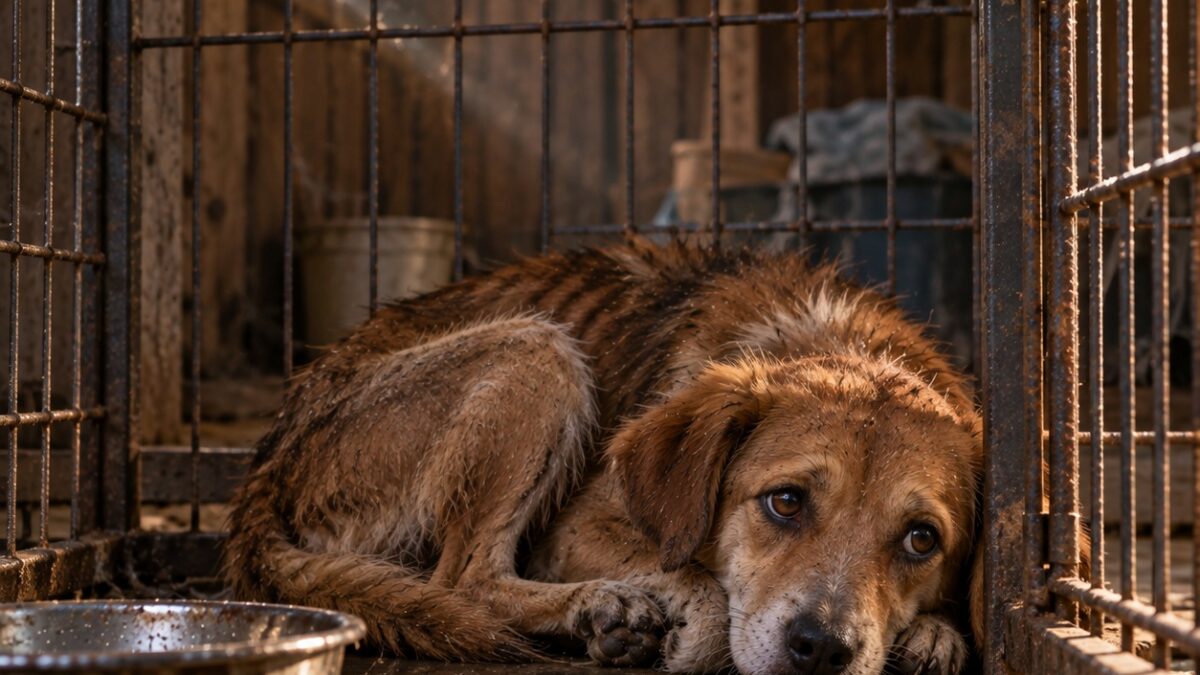
I did not crawl toward Lily because I trusted her.
Not then.
Trust is a big word.
Trust means tomorrow.
I had learned not to believe in tomorrow.
I moved because her hand was warm.
That was all.
Warmth.
The concrete beneath me had been cold for so long that I had forgotten how much a living thing could miss warmth.
My front paw slid forward.
My nails scraped.
Lily did not move her hand.
I stopped.
She stayed still.
Another inch.
Then another.
I could hear her breathing.
Slow.
Careful.
As though she was afraid one wrong sound might break me.
Maybe she was right.
My nose touched the tips of her fingers.
They smelled like soap.
Lavender.
Paper.
A faint trace of honey.
Her hand did not close around my face.
She let me sniff.
Then her thumb moved once.
One small stroke along my cheek.
My eyes closed.
I do not know how long I stayed like that.
A few seconds.
Maybe less.
But in a life measured by years of nothing, one gentle touch can become enormous.
“There you are,” she whispered.
My head felt too heavy.
I lowered it.
Lily moved closer.
“I’m going to pick you up.”
I did not know the words.
I understood the tone.
Her arms slid beneath me.
My whole body tightened.
Then lifted.
I had forgotten what it felt like to leave the ground.
For a moment, panic returned.
The cage moved away.
The floor disappeared.
Light exploded across my eyes as Lily carried me through the shed door.
I pressed my face against her shirt.
The world was too much.
Sky.
Wind.
Birds.
Grass.
Voices.
A car door.
Every smell arrived at once.
Wet soil.
Oil.
Trees.
Some animal far away.
Lily’s skin.
Her heartbeat.
That heartbeat became the only thing I could hold onto.
Steady.
Thump.
Thump.
Thump.
She wrapped me in a blanket inside the car.
It was soft enough that I tried to push my face deeper into it.
“Easy,” she murmured.
Her hand stayed on my side.
Someone in the front seat asked something.
“How long?”
I heard that much.
Lily answered quietly.
“I don’t know.”
Then:
“I don’t want to know right now.”
The car moved.
I expected fear.
Instead, exhaustion took me.
I slept.
Not deeply.
Every turn woke me.
Every brake made my eyes open.
But Lily’s hand was always there.
At the veterinary clinic, strangers touched me.
That should have terrified me.
Maybe it did.
I was too tired to react.
A tall woman with silver-gray hair listened to my chest.
She spoke softly.
“She’s severely underweight.”
Lily’s hand tightened around the blanket.
“How bad?”
“Bad.”
The woman lifted my lip and examined my teeth.
“Dental neglect.”
She checked my ears.
“Skin irritation.”
My paws.
“Pressure sores. Overgrown nails.”
My legs.
“Severe muscle weakness.”
Lily stopped breathing for a second.
“Can she walk?”
“She can. Not well.”
“Is anything broken?”
“No.”
“What about her heart?”
“Strong enough.”
The veterinarian smiled faintly.
“That matters.”
“How old?”
“Maybe seven.”
Seven.
I did not know numbers.
Lily did.
Her face changed.
“She was a puppy when…”
She stopped.
The veterinarian looked at her.
“We don’t know that.”
“I saw the cage.”
“I know.”
“She couldn’t have—”
“Lily.”
That was the first time I heard her name.
The doctor placed one hand over Lily’s.
“Focus on what she needs now.”
Lily looked at me.
“What does she need?”
“Food, slowly.”
The doctor began listing things.
Hydration.
Bloodwork.
Parasite treatment.
Dental care later.
Rest.
Gentle rehabilitation.
Warmth.
Time.
Then Lily asked:
“Does she have a chance?”
The veterinarian looked at me.
I looked back.
My body was weak.
My coat had fallen out in patches.
My teeth hurt.
My legs trembled from standing.
But my heart, apparently, was still doing its job.
“Yes,” the veterinarian said. “She has a chance.”
Lily nodded.
“She’s coming home with me.”
The words meant nothing to me.
But the touch that followed did.
Home.
I would learn that word.
Slowly.
Lily’s house had a yellow front door.
The first time I saw it, I was wrapped in the blanket against her chest.
Flower pots lined the porch.
A wind chime moved beside the roof.
Somewhere behind the house, birds argued loudly in a tree.
Inside smelled like cinnamon, old books, clean laundry, and dogs.
Dogs.
That stopped me.
Lily carried me through the living room.
Pictures covered one wall.
Dogs.
A shaggy black one.
A golden retriever.
A white dog with one brown ear.
Another with gray around the muzzle.
All beside Lily.
Smiling.
Living.
Loved.
I did not understand photographs.
But I understood the way Lily looked at them.
“They were mine,” she said.
I turned my head toward her voice.
“Murphy. Daisy. Lulu.”
She looked at me.
“And now you’re here.”
She had prepared a round bed near the corner of the living room.
Thick cushion.
Blanket.
Water.
No cage.
I did not know what to do.
She lowered me carefully.
My paws sank into softness.
I froze.
The cushion moved beneath my weight.
I tried to stand.
My legs gave out.
Lily immediately sat on the floor.
“No, no. You don’t have to.”
I stared.
She stayed a few feet away.
That first evening, she brought chicken broth.
Warm.
The smell made my whole body hurt with hunger.
I lifted my head.
She placed the bowl close.
Then moved away.
I drank too fast.
Coughed.
Lily reached forward, then stopped herself.
“Slow.”
She took the bowl.
Panic flashed through me.
I tried to stand.
“No.”
Her voice stayed calm.
“I’m bringing it back.”
She waited.
Then offered a little more.
That was our first lesson together.
Food leaves.
Food returns.
The bowl empties.
Another meal comes later.
A door closes.
It opens again.
A person walks away.
Sometimes she returns.
These things sound small when you already believe them.
To me, they were miracles.
That first night, Lily slept in an armchair beside my bed.
I know because every time I woke, she was there.
Lamp on.
Book open across her lap.
Head tilted to one side.
Sometimes asleep.
Sometimes watching me.
The clock ticked.
The heater hummed.
Wind pushed at the windows.
No metal bars.
No leaking roof.
No Gary.
Still, I woke frightened.
My body expected the cage before my eyes remembered the room.
I would jerk awake.
Lift my head.
Search.
Lily would speak without moving.
“You’re okay, Penny.”
Penny.
My name.
Different in her voice.
Not a command.
Not connected to a bowl scraping across concrete.
Warm.
Soft.
“Penny.”
By morning, I understood that the yellow-door house had survived the night.
So had I.
Lily took me into the backyard.
She used a towel under my belly to support me.
My paws touched wet grass.
I froze.
Grass.
Real grass.
Cold.
Soft.
Wet enough that drops clung between my toes.
I bent my head.
Sniffed.
A thousand smells rose from the earth.
Dirt.
Worms.
Leaves.
Rabbit.
Bird.
Rain.
Something blooming near the fence.
I stood there until my legs shook.
Lily did not rush me.
“This is your yard.”
My yard.
I did not understand ownership.
I understood that she smiled when I sniffed.
So I sniffed again.
The first week was mostly sleep.
Food.
Medicine.
Short trips outside.
The veterinarian had warned Lily not to expect too much.
My muscles needed to remember.
My stomach needed to adjust.
My skin needed healing.
Some days I stood longer.
Other days I slept almost the entire afternoon.
Lily celebrated everything.
“Three steps!”
I did not know why three steps mattered.
“Look at you.”
Then five.
Then across the living room.
Then into the kitchen.
The first time I followed her there on my own, she turned from the counter and gasped.
“Penny.”
I stopped.
Her eyes filled.
I almost backed away.
Then she smiled.
“No, sweetheart.”
She crouched.
“Come here.”
I did not.
Not yet.
But I stayed.
That was enough.
Lily talked constantly.
At first, I thought humans simply made noise because silence frightened them.
Gary barely spoke.
Lily could describe an entire morning while making coffee.
“The neighbor’s cat knocked over my planter again.”
She opened a cabinet.
“I’m blaming him even though I have no evidence.”
Another cabinet.
“You should know I have a complicated relationship with evidence.”
She looked at me.
“I was a teacher. We love evidence.”
Teacher.
Another word.
She told me about her childhood dog Murphy.
Her brother Thomas.
Her parents.
Her garden.
A storm that once knocked a tree onto the garage.
A pie she had ruined so badly her mother made her bury it beneath coffee grounds in the trash.
I didn’t understand facts.
I understood rhythm.
Her voice meant normal.
Eventually, normal became precious.
The second week, she gave me a toy.
Small stuffed bear.
Brown.
Round ears.
Something inside squeaked.
I stared.
Lily squeezed it.
Squeak.
I flinched.
She immediately set it down.
“Sorry.”
The bear remained beside my bed.
For an entire day, I ignored it.
That night, Lily found me sleeping with my chin across its stomach.
She stood in the doorway.
Said nothing.
The next morning, the bear moved everywhere I did.
I did not understand toys.
But I understood something soft belonged to me.
The first time I barked, Lily was carrying bacon.
The smell arrived before she did.
My nose lifted.
She stepped into the living room.
I heard a sound.
Dry.
Small.
Ugly.
“Woof.”
Lily froze.
I froze.
We stared at each other.
Her eyes widened.
“Was that you?”
My tail thumped once.
She put the plate on a high table and knelt.
“Penny.”
Her voice shook.
“Do that again.”
I did not.
She laughed.
“You don’t take requests.”
I had barked.
I remembered the old sound differently.
Loud.
Desperate.
Pain in my throat.
This one had simply escaped because bacon existed.
That mattered.
Barking was becoming something besides begging for rescue.
Over the next few months, my world expanded.
First the kitchen.
Then hallway.
Laundry room.
Sun patch beside the sliding door.
Back porch.
Yard.
The couch remained forbidden.
Technically.
Lily would find me staring at it.
“Not yet.”
I would stare harder.
She would laugh.
“You’re manipulative.”
I did not know the word.
Apparently I became good at it.
Visitors were harder.
The first was Thomas.
He knocked.
My whole body changed.
A man.
Male footsteps.
Deep voice.
Tan jacket.
I tried to run.
My legs were stronger by then, but panic made them clumsy.
I slid beneath the kitchen table.
Lily immediately told Thomas:
“Stop.”
He stopped.
“Don’t come closer.”
He did not.
Thomas crouched in the doorway.
Older than Lily.
Same eyes.
Peppermint smell.
He talked to her, not me.
“She looks better.”
“She is.”
“How long was she there?”
Lily’s face hardened.
“We’re not doing that.”
“I was just—”
“I know.”
Her voice softened.
“I don’t want to build her life around what happened.”
Thomas nodded.
“Fair.”
He sat on the floor.
Far away.
For twenty minutes, he ignored me.
That confused me more than attention would have.
He had treats.
I could smell them.
He never offered one directly.
He placed it halfway between us.
Then talked to Lily.
Eventually, hunger and curiosity won.
I crawled forward.
Took it.
Retreated.
Thomas smiled but didn’t move.
“Smart girl.”
Second visit, closer.
Third visit, no table.
Fourth visit, I took the treat from his hand.
Fifth visit, I let him touch my shoulder.
Thomas whispered:
“Look at you.”
Pride.
I knew that tone.
Lily used it every day.
I began collecting safe humans.
Lily first.
Then Thomas.
Dr. Samuels.
Cara at the clinic.
The mail carrier who always spoke softly.
A neighbor named Ellie who waved from across the hedge.
Safe humans became proof that Gary had not represented all people.
That was difficult.
Pain teaches quickly.
Kindness often has to repeat itself.
Lily repeated it.
Every day.
She brushed me.
At first, I flinched when the brush touched my back.
She stopped.
Waited.
Tried again.
Old fur came away.
Matted pieces.
Dust.
Dead skin.
Underneath, my coat grew soft.
One afternoon, she bathed me.
Warm water.
Oatmeal shampoo.
I shook.
She kept one hand on my shoulder.
“Almost done.”
I expected pain when she lifted my paws.
None.
When she wrapped me in a towel afterward, I stood there stunned.
Warm.
Clean.
Held.
“Look at you.”
She kissed the top of my head.
I did not flinch.
That was new.
The new fence arrived in spring.
The old yard was already enclosed in places, but one side was low and damaged.
Lily wanted space where I could be off leash safely.
A truck came.
My body stiffened.
Men.
Metal poles.
Hammering.
Noise.
I stayed on the porch beside Lily.
She never forced me closer.
By sunset, the new section stood tall and secure.
Lily opened the gate.
Unclipped my leash.
“It’s yours.”
I walked into the grass.
Stopped.
Looked back.
Lily stood with both hands clasped beneath her chin.
“Go.”
I took another step.
Then another.
Something happened inside my legs.
They remembered the dreams.
Running.
I tried.
At first, awkward.
Slow.
One circle.
Then another.
My ears moved with the wind.
My tail rose.
I barked.
Loud.
Clear.
Joy.
The sound scared a bird from the oak tree.
I jumped.
Then barked again.
Lily laughed so hard she bent over.
“Look at you!”
I ran until my legs failed.
Then collapsed into the grass.
Not because I had been denied movement.
Because I had used all of it.
There is a difference between exhaustion from confinement and exhaustion from freedom.
One feels like disappearing.
The other feels like being alive.
Lily sat beside me.
“This is how it should have been.”
I pressed my nose against her hand.
She looked away.
Sometimes I think she was trying not to hate the years before us.
Maybe she understood anger can steal time from the life you are finally living.
I began learning words.
Sit.
Stay.
Come.
Dinner.
Walk.
Treat.
No.
Good girl.
Good girl became my favorite.
Whenever Lily said it, my chest lifted.
Not because I understood the phrase.
Because I understood her.
I wanted to be good for her.
Later I learned I did not need to earn love through obedience.
But in those first months, praise felt like a language I could answer.
She bought me a soft pink collar.
Tiny bell.
Silver tag.
PENNY.
Her phone number.
She fastened it around my neck.
“Official.”
The bell jingled.
I turned in circles trying to find the sound.
Lily laughed.
Then she took my photograph.
A week later, it appeared on the wall beside Murphy, Daisy, and Lulu.
I stared at it.
Lily stood beside me.
“Family.”
That word I learned without training.
Family smelled like coffee and lavender.
Family sounded like Lily humming.
Family was Thomas carrying groceries into the kitchen.
Family was a bowl that returned.
A door that opened.
A hand that knew when to stop.
A bed in the corner.
A photograph on the wall.
The first park visit terrified me.
Car ride.
Noise.
Children.
Dogs barking everywhere.
I froze beside Lily’s leg.
She crouched.
“We don’t have to meet anybody.”
I looked toward a golden retriever running after a ball.
My body wanted to hide.
Another part wanted to know.
Lily chose the outside path.
Quiet.
Trees.
Pond.
Ducks.
We walked slowly.
No strangers touched me.
No dogs rushed me.
Lily kept every promise.
The next visit, we stayed longer.
Then came Max.
Max lived across the street.
Golden retriever.
Large.
Bouncy.
Apparently made entirely of enthusiasm.
The first time he galloped toward our porch, I backed behind Lily.
Max stopped.
Then, to my confusion, lay flat on the ground.
Tail beating.
Tongue hanging.
He waited.
I knew waiting.
I understood that.
I stepped closer.
Nose to nose.
Retreated.
Max did nothing.
Again.
Longer.
Then he jumped up and ran toward the yard.
Stopped.
Looked back.
An invitation.
Lily whispered:
“Go on.”
I followed.
I did not know how to play.
Max taught me.
Not by forcing.
By repeating.
Run.
Stop.
Circle.
Chase.
Wait.
Eventually, I barked.
Then again.
This bark was not rescue.
Not fear.
Not bacon.
Play.
Another new meaning.
After Max went home, I slept on the rug with my paws twitching.
Lily brought water.
“You made a friend.”
Yes.
I had.
Summer arrived.
Lily bought a small plastic pool for the backyard.
I distrusted it.
Water inside a blue circle seemed suspicious.
Lily stepped into it.
Rolled up her pants.
“Come on.”
I touched one paw.
Cold.
Another.
Then stood in it.
She splashed lightly.
I jumped.
She laughed.
I wagged.
We stayed until evening.
Later, she dried me with a towel and we watched the sky turn orange.
The world kept offering things I had not known existed.
Snow would come later.
Ocean much later.
For now, water that existed only for play was enough.
Lily began volunteering at the shelter.
Sometimes I went with her.
The first time, barking overwhelmed me.
Rows of kennels.
Metal doors.
Concrete.
My body remembered before my mind.
I stopped.
Would not move.
Lily saw immediately.
“We can leave.”
I looked up.
She meant it.
No disappointment.
No pulling.
That mattered.
I took one step.
Then another.
We stayed near the lobby.
Next visit, farther.
Eventually, I met Rosie.
A brown puppy with floppy ears and no respect for personal space.
She followed me everywhere.
If I lay down, she lay down.
If I stood, she stood.
She chewed my tail once.
I turned.
She froze.
I licked her head.
Rosie decided we were best friends.
Lily laughed.
“Look at you teaching.”
Teaching.
I had thought I knew nothing worth learning.
Rosie showed me otherwise.
When a family adopted her, I watched from beside Lily.
Children laughed.
Rosie jumped.
Tail flying.
For several days afterward, I listened for her.
Lily noticed.
“She went home.”
Home.
That was good.
Missing someone could exist beside happiness for them.
Another lesson.
Lily officially adopted me that summer.
I did not understand paperwork.
I understood the way she sat beside me with a folder.
“If you want to stay…”
She laughed softly.
“As if you get to vote.”
I licked her hand.
She smiled.
“I’ll take that as yes.”
The next day, a heart-shaped tag appeared on my collar.
PENNY.
Phone number.
“If you ever get lost, somebody can bring you back.”
Lost.
I knew that word without language.
I pressed against her leg.
I never planned on leaving.
Autumn came.
Leaves fell.
Lily knitted me a ridiculous blue sweater with a bone-shaped patch.
I hated putting it on.
Loved how warm it was afterward.
She took photographs.
Thomas laughed.
“You’ve become one of those people.”
“One of what people?”
“Dog sweater people.”
Lily pointed at me.
“She gets cold.”
“I didn’t say it was wrong.”
I liked Thomas now.
Enough to steal treats from his coat pocket.
Enough to sleep beside his chair.
Enough that when Lily caught a cold and Thomas stayed with me while she visited the doctor, I did not panic.
That cold passed.
But something else remained.
Fatigue.
At first, tiny.
Lily sat longer in the morning.
Coffee untouched.
Rubbing her temple.
“Just tired.”
I watched.
Dogs know routines.
Lily’s changed.
Her steps slowed.
She stopped carrying large watering cans.
She rested between garden tasks.
Her breath sometimes shortened after walks.
Thomas noticed too.
“You okay?”
“Fine.”
“You don’t look fine.”
“Thank you.”
“Lily.”
“Thomas.”
Sibling language.
Sharp but loving.
I stayed near her feet.
After he left, Lily rubbed my neck.
“You’re the only one who doesn’t interrogate me.”
I licked her fingers.
That became my job.
No questions.
Presence.
Winter arrived.
My first snow.
I stood at the back door.
White world.
Lily opened it.
Cold rushed inside.
I touched one paw.
Snow collapsed beneath it.
I jerked back.
Lily laughed.
“Drama queen.”
Another step.
Then another.
I tasted it.
Cold shocked my tongue.
I sneezed.
Lily laughed harder.
I did not run the way some dogs did.
I walked.
Slow.
Paw prints behind me.
The yard looked new.
Nothing smelled the same.
Inside, Lily wrapped me in a towel.
Warm broth.
Heated blanket.
Snow became another safe thing because I returned from it to warmth.
Christmas came.
Tree.
Lights.
Visitors.
At first, I hid.
Lily checked on me every time.
No forcing.
By Christmas morning, I opened a wrapped present with my teeth.
A plush duck.
It squeaked.
I carried it around the coffee table until everyone laughed.
Thomas gave me a candy-cane-shaped rope.
Lily hung a stocking with PENNY written across it.
My name existed in more places than I could count.
Tag.
Wall.
Stocking.
Vet file.
Shelter papers.
Lily’s journal.
I had spent years existing without being seen.
Now my name appeared everywhere.
January grew quiet.
Lily began working from home more often.
I slept beneath her desk.
“Still there?” she would ask.
Always.
Then came the first real scare.
A branch fell during a snowstorm.
Loud crack.
Crash.
I jumped.
Lily ran to the window.
“Tree limb.”
She checked doors.
Fence.
Outside.
I followed.
The branch had crushed one section of the fence.
She sighed.
“We’ll fix it.”
We.
Lily said we now.
Not I.
Not you.
We.
Spring returned.
She gardened.
I supervised.
Max came home from his family’s winter trip.
We played.
I was no longer afraid of his bark.
The change seemed permanent.
Then Lily had a checkup.
Routine, she told me.
Thomas stayed with me.
When she returned, she smiled.
But her eyes did not.
That night, she brushed my fur for a long time.
“Everything’s okay.”
Her hands trembled slightly.
I pressed closer.
People think dogs do not understand lies.
Maybe we do not understand words.
We understand bodies.
Breathing.
Scent.
Tension.
Eyes.
Lily’s body had begun telling a story her voice would not.
She tired faster.
Sat in the middle of chores.
Held the counter while standing.
One afternoon, after a short walk, she sat on the porch steps.
“I used to walk three miles without thinking.”
I pushed my nose beneath her hand.
She smiled.
“Guess we both slow down eventually.”
I did not like that sentence.
Summer warmed.
Lily rested more.
Thomas repaired the fence.
She stood nearby with lemonade.
He asked again:
“You sure you’re okay?”
“Doctor says rest.”
“What else did the doctor say?”
“Thomas.”
“What?”
“Please.”
He stopped.
That evening, Lily sat with me.
“You don’t ask questions.”
I stayed.
That was enough.
She moved a second bed for me into the sunroom.
Her favorite place to nap.
I slept near her.
Listened to her breathing.
Sometimes too shallow.
Sometimes uneven.
Once she woke disoriented.
“Still here?”
I stood.
Placed my nose against her hand.
Her face softened.
“Always.”
She had more tests.
The day she came home trembling, she sat on the floor and wrapped her arms around me.
“I’m fine.”
She buried her face in my neck.
“I’m just tired of being tired.”
I did not move.
That night, she did not eat.
Pills appeared.
Red.
White.
Blue.
She organized them carefully.
“Still got it,” she joked when one rolled away and she caught it.
Her humor stayed.
Her body changed.
Humans sometimes confuse strength with pretending nothing hurts.
Lily was strong enough to admit some days did.
Just not immediately.
The hospital came after a bad evening.
She sat upright suddenly.
Hand against her ribs.
Breathing wrong.
Thomas arrived quickly.
Then strangers.
Paramedics.
Uniforms.
Equipment.
I barked.
Loud.
Protective.
One reached toward me.
I backed.
Lily pointed weakly.
“Let her come.”
They did not let me ride beside Lily, but someone allowed me into the front of the ambulance.
I sat perfectly still.
Every sound hurt.
Sirens.
Radio.
Doors.
Behind me, Lily lay on a stretcher.
I could smell fear.
Hers.
Mine.
At the hospital, I could not follow.
That was worse than the cage.
A door closed.
Lily disappeared behind it.
I stared.
Waited.
A nurse crouched.
“We’ll take care of her.”
I did not believe her.
Thomas came.
He carried me outside.
For two nights, Lily did not come home.
I stopped eating.
Thomas tried chicken.
Nothing.
Broth.
Nothing.
Treats.
I waited by the door.
The house smelled like Lily everywhere.
Chair.
Blanket.
Bed.
Scarf.
But no footsteps.
I had learned people returned.
Now the old fear came back.
Maybe that lesson had been false.
On the third morning, the lock turned.
The door opened.
Lily stood there.
Pale.
Slow.
Hospital band on her wrist.
But alive.
I ran.
Whined.
Barked.
My tail hit the wall.
She dropped to her knees.
I pushed against her.
“I missed you.”
She cried into my fur.
“So much.”
I did too.
For the rest of that week, Lily slept.
I stayed.
Only left the room when Thomas forced me outside.
Returned immediately.
One evening, Lily rested her hand on my paw.
“If I had found you a few days later…”
She stopped.
I looked at her.
“I might have missed my chance.”
Her eyes filled.
That sentence frightened me, though I did not understand why.
After the hospital, Lily changed how she lived.
Not dramatically.
Purposefully.
She wrote more.
Journal.
Letters.
Computer.
She called people.
Checked on shelter dogs.
Painted.
One afternoon, the shelter told her Charlie, a scarred dog with a limp, had been adopted by a retired couple.
Lily smiled wider than I had seen in weeks.
“He got a home.”
I barked.
She laughed.
“Celebrating?”
Yes.
Every dog home felt personal now.
She painted me.
Not perfectly.
My ears were too large.
My nose slightly crooked.
I thought it was beautiful because she had made it.
She hung it beside Murphy.
“You have a good face for art.”
I wagged.
Lily also started teaching me strange words.
Lamp.
Sofa.
Window.
Not commands.
Objects.
She pointed.
Repeated.
I learned to look where she wanted.
“Lamp.”
I looked at lamp.
“You’re brilliant.”
“Sofa.”
I touched the couch.
“Show-off.”
“Window.”
I looked outside.
Maybe I knew words.
Maybe I knew Lily.
Same result.
The garden became our world.
Lavender.
Marigolds.
Mint.
Rosemary.
Tomatoes.
Bird nests.
A robin Lily named Maggie.
We sat outside for meals.
Lily sipped tea.
I ate apple slices.
She told stories about her mother writing recipes in pencil because ink was too permanent for someone who changed her mind.
I listened.
She showed me a scrapbook.
Murphy stealing socks.
Lily in college.
Cabin trips.
Family.
Her past became part of my present.
One afternoon, she rested her hand on my head.
“You’re my memory keeper.”
I did not understand.
Years later, Thomas would.
Lily brought out an old camcorder.
She filmed me in the yard.
Narrated.
“Miss Penny, bravest dog this side of the Mississippi.”
I barked.
She laughed.
We watched the video later.
Lily whispered:
“That’s a good life.”
I looked at her.
Yes.
It was.
Her illness was never given a name in my world.
Humans may have used one.
Doctors certainly did.
I only knew what it did.
It took energy.
Then appetite.
Then strength.
Slowly.
Lily organized drawers.
Gave away books.
Labeled boxes.
THOMAS.
DONATE.
SHELTER.
She made piles.
She wrote letters.
So many letters.
The basket near the hallway filled.
Sometimes she read them aloud.
Thanking people.
Remembering stories.
Apologizing.
Saying what she loved.
“I don’t want to leave things unsaid,” she told me.
“Words matter.”
I rested my head on her feet.
She found a wooden box that belonged to her mother.
Old movie stubs.
Fabric scraps.
Photographs.
A cheap ring.
A child’s drawing.
Small things that somehow carried whole lives.
She added a photograph of us.
Me at her feet on the porch.
Her hair moving in wind.
“This belongs.”
The box closed.
Another memory saved.
She placed Murphy’s old ceramic figurine beside my photograph.
“Now you both watch me.”
One night beneath stars, Lily said:
“When I was little, I thought stars were holes in the sky so heaven could look through.”
She laughed.
“Ridiculous.”
I listened.
“I wonder who’s looking now.”
Her parents.
Murphy.
Maybe others.
I pushed closer.
“I think they know I’m okay.”
Her hand rested on my back.
I wanted to believe that.
The shelter invited Lily to volunteer again.
We went.
She tired quickly.
Pale.
Leaning on the desk.
I pressed against her leg.
Thomas later told her:
“She knows.”
Lily whispered:
“I don’t want to scare her.”
“She knows.”
He was right.
I did.
Not the details.
The ending.
Animals understand endings earlier than people think.
We smell change.
We hear weakness.
We watch routines collapse.
Lily began writing my story.
She sat at the computer.
Typed.
Read pieces aloud.
“She was small and silent when I found her…”
I lifted my head.
“…but something in her eyes said, I am still here.”
She wrote for days.
Printed pages.
Folder.
Hand-drawn title:
PENNY’S STORY.
She placed it beside my photo album.
“Now it belongs to the house.”
A thunderstorm came.
Lightning.
Rain.
I no longer feared storms.
Lily stood at the window.
Restless.
I joined her.
For a long time, she said nothing.
Then:
“I don’t want to leave you.”
I leaned against her leg.
She crouched.
Held me.
“But if I do…”
Her voice broke.
“I need you to remember everything.”
I licked her chin.
“All of it.”
Her arms tightened.
“Every sound. Every word. Every piece of sunshine.”
I did not understand memory the way she did.
But I remembered.
Cage.
Hand on concrete.
Yellow door.
Bacon bark.
Snow.
Max.
Rosie.
Hospital.
Garden.
Lily.
“You’re my girl.”
Always.
Summer deepened.
She woke earlier.
Tea before sunrise.
Blanket over shoulders.
I curled at her feet.
“They say you measure life in love.”
She stirred honey.
“If that’s true, Penny, I’ve lived a hundred lifetimes.”
Her fingers touched my ears.
“I wonder if you remember the cage.”
I did not.
Not often.
That surprised me.
For years, the cage had been everything.
Now it was a room inside a much larger house of memories.
It still existed.
It no longer owned me.
Lily painted.
Flowers.
Trees.
Me in the grass.
“It isn’t perfect.”
She smiled.
“But you never needed perfect.”
She touched the canvas.
“Just real.”
Thomas came more.
Groceries.
Light bulbs.
Hedges.
Repairs.
He and Lily spoke quietly in the kitchen.
She gave him letters.
“For later.”
He never argued now.
He simply took them.
Lily told me:
“I don’t want to leave anything unsaid.”
She read one letter to a neighbor.
Thank you for waving every morning.
Thank you for the sunflowers.
Kindness doesn’t ask for anything.
Then she looked at me.
“Isn’t that something?”
Yes.
Kindness had entered my cage without asking anything back.
In the attic, we found old marbles.
A blue one fascinated Lily.
“I buried treasure when I was little.”
She laughed.
“My dad made me draw a map.”
She wrapped the blue marble in cloth.
Put it in a tiny box.
We buried it in the garden.
“A piece of us.”
I sniffed the soil.
Years later, Thomas would know exactly where.
One morning, Lily’s breathing was heavier.
She leaned against the counter.
“Just a minute.”
We spent the afternoon on the couch.
Her head rested against my back.
I did not move.
When she woke, she studied me.
“I hope I gave you a good life.”
My tail moved.
“I hope I didn’t waste any of it.”
Impossible.
Not one day.
Not one bowl.
Not one slow walk.
Not one afternoon.
Nothing wasted.
That evening, the window stayed open.
Crickets.
Breeze.
Curtains moving.
“This is my favorite sound.”
The world when it’s quiet.
I knew quiet.
The shed had been quiet.
But she was right.
This quiet was different.
The shed’s silence erased me.
This silence held us.
Before sunrise the next morning, Lily woke me.
“Come on.”
We walked into the garden.
Dew.
Birds beginning.
Earth smell.
She sat on the bench beneath the oak.
“I dreamed about a house like this once.”
I curled at her feet.
“Before I knew what peace felt like.”
She looked down.
“You made it real.”
No.
She had.
But love often lets two beings believe the other one performed the miracle.
We stayed until sunlight reached us.
The morning Lily died, I knew before Thomas did.
The house felt wrong.
Light crossed the bedroom floor.
Lily did not move.
She always moved before the sun reached that far.
I sat beside the bed.
Waited.
Her hand rested near me.
I nudged it.
Nothing.
Again.
Nothing.
I whined.
Small.
Then louder.
“Lily.”
I could not say it.
I pushed my nose beneath her fingers.
Cold.
Not the terrible cold of winter.
Stillness.
I climbed onto the bed.
That was normally allowed now.
I placed my head against her chest.
Waited.
No heartbeat.
Once, long ago, Lily had carried me from the cage and I listened to her heart because it was the only safe sound in the world.
Now there was none.
I stayed.
Maybe waiting becomes instinct when love leaves the room.
Thomas arrived.
“Lily?”
Footsteps.
Hallway.
Bedroom.
Then silence.
He stood in the doorway.
Saw us.
His face changed.
“Oh.”
He knelt.
Touched Lily’s shoulder.
Closed his eyes.
For a long time, neither of us moved.
Then his hand rested on my neck.
“I know.”
He did.
People came.
Quiet voices.
Gentle movements.
I hated them touching the bed.
I hated the door opening.
I hated Lily leaving.
I barked once.
Thomas held me.
“She’s okay.”
No.
She wasn’t.
She was gone.
Humans say okay differently around death.
Maybe they need to.
That evening, Thomas sat with me on the porch.
The sky turned orange.
Garden still.
Lavender moving.
“She loved this place.”
I stared.
“She loved you.”
He rubbed his face.
“You kept her going longer than anybody expected.”
I looked toward the door.
“She told me.”
His voice cracked.
“She said you gave her more time than medicine did.”
Thomas disappeared inside.
Returned with a cedar box.
He set it beside me.
Lily’s smell lived in the wood.
Inside:
A letter.
A navy-blue collar.
Silver tag.
Thomas held it.
Read.
PENNY
ALWAYS LOVED
ALWAYS HOME
He swallowed.
“She had this made.”
Then he opened the letter.
“My sweet girl…”
Lily’s words.
Thomas’s voice.
“If you’re hearing this, then I’ve moved on.”
My ears lifted.
“But don’t be afraid.”
Thomas stopped.
Breathed.
Continued.
“I didn’t leave you. Not really.”
My nose moved toward the paper.
“I left my voice in every room, my scent in every blanket, my touch in every garden breeze.”
Thomas cried now.
Quietly.
“You were my light, my companion, my reminder that even in silence there can be love.”
I pressed closer.
“I need you to keep going.”
Thomas’s voice failed.
He waited.
Then:
“Let Thomas help you.”
His hand shook.
“Let the world show you kindness again.”
I looked at him.
“Chase the wind. Roll in the grass. Bark when the mailman comes.”
A wet laugh.
“Live.”
The porch blurred around Thomas’s tears.
“And when you smell lavender in summer, that’s me.”
Wind moved through the flower pots.
“I’ll be right there smiling…”
Thomas could barely finish.
“…saying, good girl.”
He folded the letter.
Pressed it to his forehead.
Then fastened the collar around my neck.
Cool metal against my chest.
Always loved.
Always home.
That night, I walked through every room.
Lily’s chair.
Her half-read book.
Her scarf.
Bedroom.
Sunroom.
Desk.
Garden door.
I slept on her bed with my face pressed into her pillow.
In the morning, light reached the curtains.
I stood.
Walked to the kitchen.
Thomas sat with coffee.
He looked exhausted.
“Hey, Penny.”
I stopped.
“Hungry?”
My tail moved once.
Thomas smiled through grief.
“Okay.”
He filled the bowl.
Sat.
“We’ll figure it out.”
Together.
He had learned Lily’s word.
We.
The first weeks without her were strange.
Thomas came every day.
At first, he did not move into the house.
He simply arrived before breakfast.
Fed me.
Watered plants.
Read Lily’s instructions.
Sat in the garden.
Played her music.
Sometimes he cried when he thought I was asleep.
I learned Thomas’s grief had different smells.
Coffee.
Peppermint.
Old paper.
Salt from tears.
Some days, I stayed curled in Lily’s chair.
Thomas allowed it.
Other days, I searched the garden.
Her scent lingered everywhere.
Lavender.
Blankets.
Soil.
Sunroom.
Grief is partly searching for a scent that is fading.
One afternoon, a letter arrived from the shelter.
Thomas opened it.
“They’re asking about fostering.”
I looked up.
“One dog.”
He laughed softly.
“Apparently Lily told them we might be interested.”
We.
Even after death, Lily was organizing us.
“No pressure.”
Thomas showed me the letter.
“What do you think?”
I walked over.
Placed one paw on his knee.
He stared.
“Is that a yes?”
Maybe.
A week later, Millie arrived.
Small brown spaniel.
Tail tucked.
Eyes everywhere.
She entered the house and froze.
I recognized her immediately.
Not the exact fear.
The shape.
The way a frightened animal tries to make herself smaller than the room.
Thomas kept his distance.
I did too.
Millie sniffed my blanket.
I let her.
She approached the water.
Drank.
Looked around as if expecting punishment.
None came.
That night, she curled in the far corner of the sunroom.
I lay several feet away.
Not close.
Not touching.
Just there.
The way Lily had been for me.
Millie watched.
I closed my eyes.
The next day, she followed me into the yard.
I walked slowly.
She copied.
I stopped by the lavender.
She sniffed.
Wind moved through it.
For one impossible second, Lily was everywhere.
Good girl.
I heard it without sound.
Millie stayed behind me.
Thomas stood on the porch.
“Lily would be proud.”
I looked toward him.
Maybe.
No.
I knew.
The garden kept blooming.
Life did something I once thought impossible.
It continued without erasing what came before.
Millie learned the house.
Thomas learned to make Lily’s chicken broth.
Badly at first.
I learned that helping another frightened dog did not replace me.
Or Lily.
Love did not work like cages.
There was not only room for one.
Millie eventually slept beside me.
Then against me.
She learned to play.
Not quickly.
A toy fox.
Then a ball.
One afternoon, she barked for the first time.
Thomas froze.
I lifted my head.
Millie looked startled by her own sound.
Thomas smiled.
“Well, look at that.”
I remembered bacon.
Lily’s face.
Was that you?
My tail moved.
Millie barked again.
Clearer.
Joy.
The sound filled the yellow-door house.
For a moment, I understood something Lily had known long before I did.
Healing does not end when you become safe.
Sometimes healing becomes something you give away.
I had spent years waiting for someone to open my cage.
Lily did.
Then I spent years learning the world could be larger than the cage.
Now Millie was learning from me.
How to walk through the garden.
How to trust Thomas’s hand.
How to sleep while a door was closed.
How to believe breakfast would come again.
I did not teach her with words.
Lily never truly had either.
She taught through repetition.
So did I.
Morning after morning.
Safe.
Food.
Door.
Return.
Hand.
No pain.
Night.
Morning again.
Millie changed.
Her tail rose.
Her eyes softened.
She stopped eating as if the bowl would disappear.
The first time she left food unfinished, Thomas stood over it.
Then looked at me.
“You see that?”
I did.
He cried.
I understood why.
Years passed.
Not many.
Enough.
I grew older.
My legs stiffened.
The old cage years had left their marks.
Dr. Samuels—older now too—checked my joints.
Thomas brought me in.
The clinic smelled the same.
Cara was gone, retired.
New technicians.
But Dr. Samuels remembered.
“Penny.”
My tail moved.
He crouched.
“You’re still here.”
Still here.
That sentence followed me through my life.
Lily had seen it in my eyes.
I am still here.
Now I was gray around the muzzle.
Still here.
Millie beside me.
Thomas’s hand on my back.
Still here.
The yellow-door house changed.
Some of Lily’s clothes eventually left.
Thomas could not keep everything.
He asked me, as if I could answer.
“This one?”
Her blue sweater.
I sniffed.
He kept it.
Other things went to people named in letters.
Books.
Paintings.
Jewelry.
Garden tools.
The wooden memory box stayed.
So did Penny’s Story.
So did the photograph wall.
Thomas added Millie.
I stared at her picture beside mine.
Family.
Yes.
I understood that word better than ever.
Thomas found the buried blue marble one spring.
He remembered Lily’s map.
We dug in the back garden.
The little box emerged.
Blue marble.
He held it toward the sun.
Light moved through.
“She was ridiculous.”
He laughed.
Then cried.
I pressed against his knee.
“Good ridiculous.”
Yes.
Thomas began volunteering at the shelter.
Not because he loved crowds.
He did not.
But because Lily had left a note:
You will be lonely if you let yourself.
Go where something needs you.
He listened.
Sometimes Millie went.
Sometimes I did.
The first time I returned to the shelter as an old dog beside Thomas, barking still echoed along metal halls.
My body remembered.
But I did not freeze.
A frightened young dog sat at the back of a kennel.
I stopped.
Looked.
Same eyes.
Not same story.
Never assume the same story.
But fear has familiar shapes.
Thomas watched me.
“You want to sit?”
Yes.
He sat on the floor.
I lay beside him.
We did nothing.
The dog watched.
That was enough.
Lily’s way had become ours.
No pulling.
No forcing.
Presence.
Weeks later, that dog was adopted.
Thomas came home holding the shelter’s photo.
“Good family.”
He placed it on the refrigerator.
I wagged.
Lily would have celebrated too.
Life inside the house became quieter as I aged.
No long runs.
Short yard walks.
Sun patches.
Garden smells.
Millie chased squirrels for both of us.
Thomas learned to slow down.
He once complained:
“You two have turned me into an old man.”
He was already an old man.
I chose not to mention it.
Some evenings, he read Lily’s letters aloud.
Not all.
Some were private.
But one became his favorite.
Dear Thomas,
You always thought I rescued Penny because I had a soft heart.
The truth is I was scared the first day I saw her.
Not of her.
Of what helping her would ask of me.
Commitment.
Responsibility.
Future grief.
I knew if I loved her, eventually I would lose her.
I just didn’t know she would lose me first.
But here is what Penny taught me:
The possibility of grief is not a reason to refuse love.
It is proof love matters enough to hurt.
Thomas always stopped there.
Every time.
Same place.
He would look at me.
“She knew.”
Yes.
Lily knew.
I had learned it too.
I loved Lily even though she left.
I loved Millie knowing one of us would eventually lose the other.
I loved Thomas even as his hair grayed and his hands stiffened.
Loss had once taught me not to bark.
Lily taught me the opposite lesson.
Speak.
Run.
Play.
Attach yourself.
Wait for people.
Trust carefully.
Love anyway.
One summer, Thomas replaced the wind chime.
The old one finally rusted through.
He bought another.
Wrong sound.
I hated it.
Every time it rang, I looked toward the door and felt disappointed.
Thomas noticed.
“This is terrible, isn’t it?”
Yes.
He returned it.
Then searched online until he found one with almost the same tone.
When it rang, I lifted my head.
Lily.
Not really.
But memory.
Thomas sat beside me.
“Better?”
Tail thump.
“Thought so.”
The lavender came back every year.
That was Lily’s promise.
When you smell lavender in summer, that’s me.
I did not understand heaven.
Stars.
Afterlife.
People looked at the sky and imagined.
I understood scent.
Lavender.
Wind.
Warm floor.
Her old blanket.
The pages of Penny’s Story.
If Lily existed anywhere beyond memory, she had chosen good hiding places.
One autumn afternoon, a woman visited the house.
Older.
She carried a cardboard box.
Thomas greeted her.
“Sarah.”
The name from Lily’s letters.
Pie recipe.
The woman knelt near me.
“So this is Penny.”
I wagged.
“I’ve heard about you for years.”
She opened the box.
Inside were letters Lily had sent.
Dozens.
Sarah said:
“She wrote everybody.”
Thomas smiled.
“Of course.”
Sarah gave him one envelope.
“She told me to return this when I was ready.”
Thomas opened it after she left.
Inside:
If Penny is still with you, give her bacon.
Thomas laughed.
I barked.
He laughed harder.
“Unbelievable.”
He cooked bacon.
One small piece.
I ate it.
The sound that escaped my throat was almost the same as that first bark years ago.
Thomas stared.
“Was that you?”
My tail hit the floor.
For a moment, time folded.
Lily stood in the kitchen.
Bacon in hand.
Blue eyes wide.
Was that you, Penny?
Yes.
It was.
The house held every version of me.
The silent dog.
The first bark.
The running dog.
The dog beside Lily’s hospital bed.
The dog who lost her.
The dog who welcomed Millie.
The old dog eating forbidden bacon.
I had once believed a cage defined the size of a life.
I had been wrong.
Years later, when my legs became too weak for the porch steps, Thomas built a ramp.
He painted it yellow.
“Matches the door.”
Millie tested it first.
Show-off.
I walked slowly.
Up.
Down.
Good.
At night, I slept near the sunroom window.
Thomas placed Lily’s old blanket over me.
He had washed it many times.
Her scent was long gone.
Or maybe my nose had changed.
Still, I knew it.
Memory has scents beyond scent.
One evening, Thomas carried Penny’s Story into the sunroom.
He read aloud.
Lily’s writing.
My beginning.
The cage.
Her hand.
The yellow door.
I listened.
Some details I remembered.
Some I had forgotten.
Then he reached a line near the end.
Penny taught me that survival is not the same as living.
Living began when she stopped waiting for rescue and started expecting love.
Thomas stopped.
“Did she really write that?”
He flipped the page.
“She did.”
I closed my eyes.
Expecting love.
That sounded dangerous.
Beautiful.
Both.
Millie slept against my side.
Thomas’s chair creaked.
Wind chime outside.
Lavender through the screen.
Safe.
When you have been abandoned long enough, the hardest thing is not accepting love once.
It is expecting it tomorrow.
That was Lily’s greatest gift.
Not the bed.
Not food.
Not the yard.
Not toys.
She taught my body to believe tomorrow could contain kindness.
Then tomorrow came.
Again.
Again.
Again.
Until kindness stopped feeling like an accident.
The last winter of my life was gentle.
Snow came.
I no longer walked far in it.
Thomas carried me onto the porch once.
Set me down carefully.
Millie bounced through the yard.
I watched.
Snow landed on my nose.
I remembered my first snow.
The surprise.
Lily laughing.
Show pony boots.
Heated blanket.
Christmas lights.
I looked toward Thomas.
He understood nothing specific.
Everything important.
“Good day?”
Tail movement.
“Yes.”
That was enough.
Dr. Samuels began visiting the house.
Not because I was dying immediately.
Because car rides had become difficult.
He checked my heart.
Lungs.
Joints.
“Old girl.”
Thomas looked offended.
“Watch it.”
Dr. Samuels smiled.
“She earned it.”
Yes.
I had.
One afternoon, I could not stand without help.
Thomas supported me.
I ate.
Drank.
Still watched Millie.
Still enjoyed the sun.
Dr. Samuels said:
“Not yet.”
Thomas nodded.
He feared the day.
I recognized that fear.
Waiting for someone to leave.
But Lily had prepared him too.
One evening, Thomas opened her cedar box.
Read the collar inscription aloud.
Always loved. Always home.
He looked at me.
“You were hers.”
I rested my head on his foot.
“And now you’re mine.”
No.
His.
Lily’s.
My own.
Love does not require one owner.
We had learned that.
When my final day came, it was summer.
Lavender blooming.
Of course.
I woke tired.
Different tired.
Thomas knew.
Millie knew.
She lay close.
No playing.
No barking.
Dr. Samuels came.
He sat in the garden with us.
Thomas spread a blanket beneath the oak.
Lily’s bench nearby.
Wind chime.
Flowers.
The yellow door visible from where I lay.
I could smell lavender.
Strong.
Thomas stroked my head.
“I’m not ready.”
Neither was Lily.
Nobody is.
Dr. Samuels waited.
Thomas opened Lily’s letter one more time.
Not all of it.
Only the line.
Let the world show you kindness again.
He cried.
“You did.”
I looked toward Millie.
She pressed her nose against mine.
I had.
I had let Lily.
Thomas.
Max.
Rosie.
Dr. Samuels.
Shelter dogs.
Millie.
The whole enormous world I once feared.
I had let it show me.
Kindness had won.
Not completely.
The cage still existed in the past.
Gary still existed.
Years had been stolen.
Nothing changed that.
Healing is not pretending harm never happened.
Healing is when harm stops being the only thing that happened.
My life became bigger.
So much bigger.
Thomas whispered:
“She’s waiting for you.”
Maybe.
Humans need such ideas.
I liked it too.
Lily under stars.
Murphy.
Daisy.
Lulu.
Garden.
Some enormous field.
No cages.
Maybe.
Dr. Samuels gave me medicine.
My body softened.
Pain disappeared.
Thomas’s hand stayed on me.
Millie beside me.
Lavender.
Wind.
Warmth.
I remembered Lily’s heartbeat against my ear on the first day.
Thump.
Thump.
Thump.
Safe.
My breathing slowed.
The garden light became soft.
If dogs dream at the edge of death, mine was simple.
A cage door opening.
A woman kneeling.
Hand flat on concrete.
You don’t have to come to me.
I’ll come to you.
Then Lily.
Smiling.
Not sick.
Not tired.
Blue eyes.
Lavender.
“I’m here now.”
This time, I believed her immediately.
After I was gone, Thomas buried my ashes beneath the oak near the blue marble Lily had hidden years earlier.
Not beside Lily.
Lily’s ashes had been scattered partly in the garden and partly somewhere Thomas never told anyone.
But he placed my tag in the cedar box.
PENNY
ALWAYS LOVED
ALWAYS HOME
Millie searched for me.
Of course she did.
Room to room.
Sunroom.
Garden.
Porch.
Thomas sat with her.
Did not force her to stop grieving.
He had learned.
Days passed.
Food.
Walk.
Door.
Return.
Love repeated.
One afternoon, the shelter called.
Thomas almost said no.
He looked at Millie.
Then at Lily’s letter.
Go where something needs you.
A quiet senior dog came for temporary foster care.
Old.
Gray.
Frightened.
Millie stood across the room.
Watched.
Thomas sat on the floor.
No pressure.
The old dog stared.
Eventually, one paw moved.
Then another.
The yellow-door house continued.
Not replacing.
Continuing.
The garden kept blooming.
Lavender every summer.
Wind chime.
Photographs on the wall.
Murphy.
Daisy.
Lulu.
Penny.
Millie.
Others.
Each life leaving something behind.
Lily once said words stay behind like footprints.
She was right.
So do dogs.
Not physically.
Not forever.
But in habits.
Thomas still placed bowls where Lily once did.
Millie waited beside frightened fosters because I once waited beside her.
Shelter volunteers learned to sit quietly because Lily had shown them.
The story she wrote about me was copied and shared among volunteers.
One line became something they repeated to new foster families:
Do not confuse silence with peace.
Some dogs stop asking because they stopped believing anyone will answer.
Answer anyway.
I would have understood that line.
I had lived it.
Years after Lily first opened my cage, Gary’s shed probably still stood somewhere.
Maybe not.
I do not know.
That place stopped mattering.
For too long, I believed my story began with confinement.
It didn’t.
My story began before that.
A mother’s smell.
Warmth.
Life.
The cage interrupted.
It did not define.
And my story did not end with rescue either.
Rescue was a door.
Life came after.
Bacon.
Backyard.
Max.
Rosie.
Snow.
Thomas.
Shelter.
Illness.
Garden.
Grief.
Millie.
Lavender.
Love.
That is what I wish humans understood when they see an animal who has given up.
You may not be looking at an empty creature.
You may be looking at a life waiting for enough safety to come back.
Slowly.
Inches.
One meal.
One touch.
One open gate.
One tomorrow at a time.
I stopped barking because no one ever came.
Then Lily came.
And she stayed long enough to teach me that silence did not have to be permanent.
Years later, when her own body began failing and the house filled with medicine, letters, whispered conversations, and fear, she never asked me to save her.
She only asked me to stay.
So I did.
Beside the couch.
Beside the bed.
At the garden bench.
Through hospital nights.
Through weak mornings.
Through the last seasons of her life.
She opened my cage.
I guarded her remaining time.
Maybe that was the bargain.
Maybe love is always some version of that.
You carry me when I cannot stand.
I stay when you cannot walk alone.
You teach me tomorrow can be safe.
I remind you today still matters.
And when one of us has to leave, the other carries the love forward.
Lily carried mine out of a rusted shed.
I carried hers into every room of the yellow-door house.
Thomas carried both of us after she died.
Millie carried what I taught her into the next frightened dog.
That is how love outlives bodies.
Not through magic.
Through repetition.
One kindness teaching another.
One rescued life learning how to rescue.
One open cage becoming an open home.
And somewhere in all of that, the little dog who once stopped barking because nobody came finally understood the truth Lily had been trying to tell her from the very first moment.
I had never been asking for too much.
I had only been asking the wrong people.
Then Lily knelt on the concrete.
Put down her hand.
And answered.








