A whole clubhouse full of armed bikers went silent because a 9-year-old boy pointed at the ceiling. I was standing closest to him when it happened. Close enough to see his hand shake. We’d told his mom a hundred times not to bring him around. A kid doesn’t belong where men keep guns in their waistbands and a federal case is hanging over the president’s head. But there he was, sitting under the old oak bar with a toy motorcycle, quiet as a mouse. I thought he wasn’t paying attention. Then he set the toy down, slow and careful, like he already understood something the rest of us hadn’t figured out yet. He stood up and pointed one small finger at the dark corner above the bar. “Camera,” he said. Just that. One soft word. But it landed in that room like a grenade with the pin pulled. Nobody breathed. The president put his glass down without a sound. The sergeant-at-arms reached behind his back. And every brother in that clubhouse turned at the exact same time to look at the thing a 9-year-old had spotted that none of us had bothered to look for. My name is Walt. I’ve been wearing this club’s patch for twenty-six years. I’d never seen a room of grown bikers go that still that fast. The corner was just shadow to me. A smoke detector. An old water stain. Then Tank moved — our sergeant-at-arms, six foot four, hands like cinder blocks. He dragged a barstool under the corner, and the legs scraped the concrete so loud in the silence it made me flinch. He climbed up, pushed up the ceiling tile an inch. Then he froze. “Son of a—” Tank breathed, yanking his hand back. A small black box wedged in the dark. A glass eye on the front. A thin wire running off into the ceiling. A camera, pointed straight down at the bar. Straight down at all of us. Nobody in this club had put it there. The boy’s name was Eli. His mom, Dana, tended bar for us a couple nights a week. She was barely twenty-six, raising him alone after his father walked out. Eli was small for nine, the kind of quiet kid who watched everything and said almost nothing. Some brothers grumbled about a child being in the clubhouse. But Dana had nobody — no family, no sitter money. And Boone, our president, had a soft spot for that boy the size of a county. “He’s no trouble,” Boone always said. “Leave him be.” So we left him be. And on the worst night of the whole year, that one stubborn kindness saved every single man in that room. That night wasn’t a party. Boone was staring down federal charges — conspiracy, racketeering. For months we’d had a leak. Things said inside these walls turned up where they had no business being. Boone was convinced it was a rat, a brother who’d flipped. He called the meeting to smoke him out. Twenty bikers, every one armed, every one suspicious of the man beside him. Men sitting apart who normally sat shoulder to shoulder. Hands too close to belts. Boone was mid-sentence at the head of the bar, a name half-formed in his mouth, a finger starting to lift toward one of our own. He never finished it. When Tank held that camera up in the light, the room exploded. Chairs went over. Two brothers had each other by the collar. Someone shouted “FEDS,” someone shouted “RAT.” Then Boone roared from deep in his chest. “QUIET.” The room slammed shut. You could hear the refrigerator humming. Boone took the camera from Tank, turned it over in his fingers, and set it on the bar gentle, like it might go off. Then he turned to Eli. The boy had backed into the corner, toy motorcycle clutched to his chest, eyes huge and wet. Boone crossed the room and crouched down, folding all six feet of himself to the floor. This huge man with a gray beard and a federal case hanging over his head, getting small so a child wouldn’t be afraid. “Hey,” Boone said. “You’re not in any trouble, son. I give you my word.” Eli’s chin trembled. “How’d you know it was up there, Eli?” What that boy said next made the whole room go cold again. “Because I’ve seen one before,” Eli whispered. “At my house. In my room.” Boone went still. “The man put it up high in my room. He said it was so he could watch me and keep me safe. But Mom didn’t know about it. He said Mom didn’t need to know.” “What man?” “Mom’s friend. Greg. He comes over sometimes. He fixes stuff. He’s good with computers and wires and things.” “And he told you to keep it secret?” Eli nodded fast. “He said if I told Mom, she’d get real mad at me. He said it was our secret and that’s how I knew he was my friend.” Boone closed his eyes for one second. Then he stood up, and his face was wearing something I’d never seen on him. Past anger. The still, terrible face of a man doing arithmetic and hating every number. Dana came out of the storeroom drying her hands on a bar rag. She walked into a silent room full of frozen men. Saw the black box on the bar. Saw her son crying in the corner. “What happened? Is Eli okay?” “He didn’t do anything wrong,” Boone said carefully. “Dana, you got a friend named Greg? Comes around, fixes things?” The color drained from her face. “Greg. He’s been helping me out for a few months. He set up my internet. He set up the camera at my front door so I could see who’s—” She stopped. Her hand drifted to her mouth. “He was at my apartment last week. He was up in Eli’s room. He said he was fixing the wifi.” Boone lifted the camera where she could see it. “This Greg. He ever spend time alone in this clubhouse?” “Last month. My car wouldn’t start in the back lot. I gave him my spare key and told him to wait inside. He was in here alone for maybe an hour.” The rat we’d been hunting for months wasn’t a brother. It had never been a brother. Here’s the part that turns my stomach. Boone had been one sentence from naming Cisco. Cisco had been jumpy for weeks, sitting apart, snapping at people. Turned out Cisco’s wife had been diagnosed with cancer and he was buried under hospital bills, too proud to ask. That was the whole secret. If Eli hadn’t pointed at the ceiling, Boone might have done something to Cisco in front of all of us that could never have been undone. I looked across the room and found Cisco’s face. He’d gone gray, just now realizing how close the edge had been. Boone sat Dana on a barstool and told her everything — that Greg had put a camera in her son’s bedroom and used her spare key to plant one here. Dana came apart, saying she didn’t know, she swore to God she didn’t know. “This is not on you,” Boone said, holding her shoulders. “A man like that counts on you not knowing. He smiled and fixed your car so you’d trust him. This is on him.” He turned to Eli, still clutching that motorcycle. “And you. You did the bravest thing anybody has done inside these walls in years. You told the truth, son, even when a grown man told you to keep it buried.” “You’re really not mad at me?” Boone’s voice cracked. “Son, you’re a hero. Don’t you ever let anybody tell you different.” We didn’t call the police. That’s not our way. The brothers found Greg. I won’t tell you how, and I won’t tell you a word of what was said. There were more cameras. One in Dana’s living room. Another feeding video to an account watching more than just adults — watching more children than only Eli. The matter got handled in a way that made certain no other child would ever wake up to a glass eye watching from the corner of their bedroom. Not ever again. Dana and Eli moved out within the week. New apartment, new locks. The club paid for all of it and wouldn’t let her say thank you once. And Cisco. His wife’s hospital bills got handled, quiet and anonymous. A brother does not get hunted for the crime of being scared and then get forgotten the moment the real wolf shows his face. Eli’s nearly a grown man now. Tall. Steady. He still calls Boone every year on his birthday. Boone still tears up every time the phone rings and it’s him. Every brother who stood in that clubhouse knows the truth. We didn’t protect that boy.
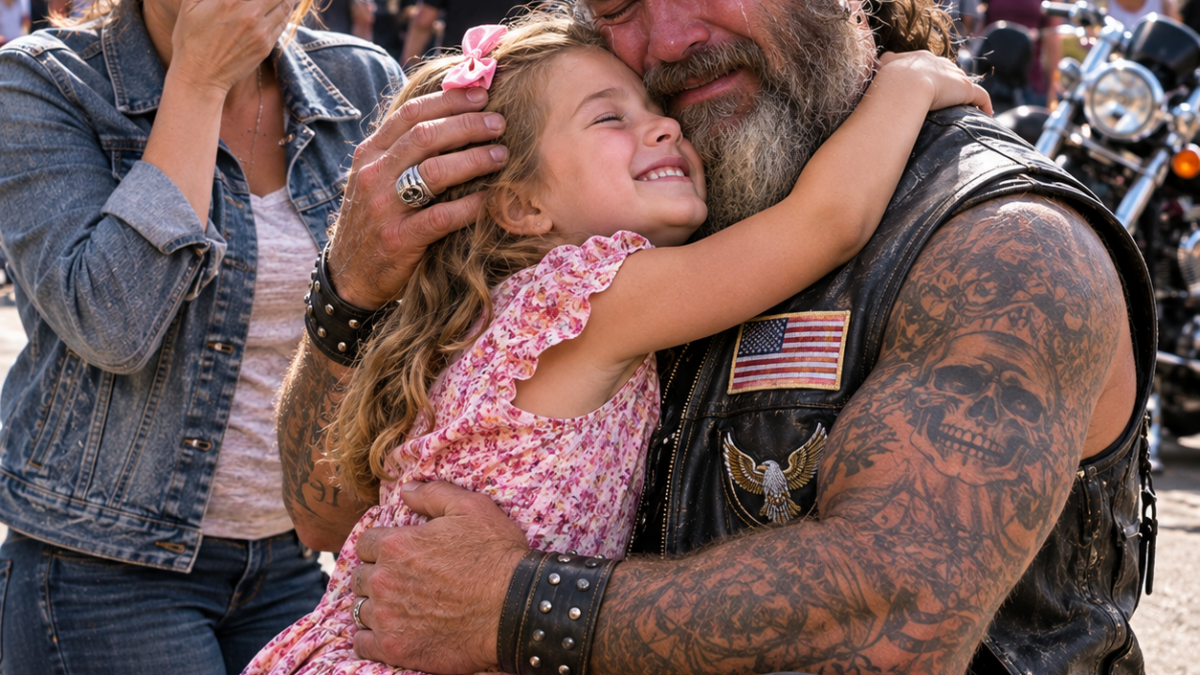
My 6-Year-Old Daughter Ran to a Terrifying Biker and Called Him Daddy—Then I Recognized the Jacket That Saved Her Life
**My six-year-old daughter broke away from me at the county fair, ran straight toward the biggest, roughest biker I had ever seen, wrapped both arms around his leather-covered legs, and shouted, “Daddy!”**
**I was already running toward them, ready to scream for security, when I saw the giant man with skull patches on his vest standing completely frozen while tears rolled through his beard.**
**Then Sara looked up at me and said, “Mommy, don’t be scared—he has the same jacket as the angel who brought me back.”**
For half a second, the entire county fair disappeared.
The Ferris wheel.
The country music coming from the small stage.
Children screaming on rides.
The smell of kettle corn and fried dough.
The announcer somewhere near the livestock barn trying to convince people to enter a raffle for a riding mower.
All of it vanished.
There was only my daughter.
My six-year-old daughter.
And the massive stranger she had just called Daddy.
“Sara!”
I don’t remember pushing through the crowd.
I remember knocking into a teenager holding lemonade.
I remember somebody saying, “Whoa, lady.”
I remember seeing the man’s leather vest before I saw his face.
Black.
Old.
Worn soft at the shoulders.
Large American flag patch high on the back.
An eagle patch beneath it.
IRON HORSE MC.
Several smaller patches I could not read.
And skulls.
Enough skulls that every instinct installed in me by years of news stories, stranger-danger warnings, and being a single mother started screaming at once.
My daughter had her arms locked around this man’s legs.
He was at least six-foot-four.
Maybe two hundred seventy pounds.
Gray mixed through a beard that reached the middle of his chest.
Forearms covered in tattoos.
Heavy boots.
Bandana.
He looked like the kind of man people moved out of the way for without being asked.
I thought kidnapping.
I thought stranger.
I thought get her away from him.
Then he looked down at Sara.
And I stopped.
He wasn’t touching her.
PART2:
Both hands were held out slightly from his sides, almost like he was afraid that even putting one hand on her shoulder might frighten somebody.
His mouth had fallen open.
His eyes were red.
Tears were running freely down his face.
Not one tear.
Not misty eyes.
He was crying.
Silently.
Completely stunned.
“Sara, honey.”
My voice sounded sharper than I intended.
“Come here right now.”
She looked over her shoulder.
And smiled.
Not nervous.
Not confused.
Happy.
“Mommy, it’s okay!”
“No, sweetheart. Come here.”
“But I know him.”
“You don’t know him.”
“Yes, I do!”
She tightened her arms around his legs.
“He’s my angel.”
The biker closed his eyes.
Something inside me shifted.
“Sara.”
She pointed at his vest.
“Look!”
I looked.
“Same flag.”
She pointed again.
“Same eagle.”
My blood went cold.
She said:
“He has the same jacket as the angel who saved me.”
Three months earlier, my daughter had died for almost a minute.
At least that’s how I remember it.
Doctors used different words.
Near drowning.
Respiratory arrest.
Brief loss of consciousness.
Head injury.
They had medical language for it.
I had one memory.
Sara’s body on wet concrete.
Still.
Three months earlier, it had been one of those impossibly hot June afternoons where the air felt heavy enough to wear.
Our community recreation center had a public pool.
Nothing fancy.
One large pool.
Small children’s section.
A few shade umbrellas.
Lifeguard stand.
Sara had been begging to go all week.
I’m a single mother.
At that time, I was working billing for a dental office during the day and doing bookkeeping for two small businesses at night.
Most evenings, I was exhausted before dinner.
Sara knew it.
Which made me feel worse whenever she asked for something simple.
“Mommy, can we go swimming?”
“Saturday.”
“You said Saturday last Saturday.”
“I know.”
“So this Saturday?”
“Yes.”
“Promise?”
“Promise.”
Saturday came.
I kept it.
We packed towels, sunscreen, juice boxes, crackers, and the purple goggles she insisted made her swim faster.
Sara could swim a little.
Not strongly.
Enough to kick from the steps to me.
Enough to float.
Enough that I had started relaxing around water more than I should have.
That’s the part mothers confess only after something happens.
The tiny ways confidence becomes carelessness.
She had been in the shallow section.
I was sitting on the edge.
She asked for her towel because water had gotten in her eyes.
The towel was behind me on a chair.
Maybe eight feet away.
I turned.
I still replay those seconds.
One.
Stand.
Two.
Grab towel.
Three.
Shake it loose.
Four.
Hear a splash.
I don’t know whether it was ten seconds.
Eight.
Twelve.
Trauma turns time into something unreliable.
When I turned back, Sara was gone.
At first, my brain refused to understand what my eyes saw.
Water.
Children.
Floating toys.
Then purple goggles under the surface.
I screamed her name.
Jumped in.
I’m not a good swimmer.
That fact embarrasses me now.
I can keep myself above water.
That’s about it.
Panic made me worse.
I reached her.
Tried lifting her.
My feet slipped.
Someone shouted.
A lifeguard blew a whistle.
Then a man entered the water from the opposite side.
Not dove.
Entered fast.
Powerful.
One second he was beside the pool.
Next he was beside me.
Tattooed arms.
Black shirt.
He took Sara from me.
“Go to the edge.”
I couldn’t think.
“My baby—”
“I’ve got her. Get to the edge.”
Something in his voice made me obey.
He lifted her onto the deck.
Climbed out.
She wasn’t breathing.
Her lips looked wrong.
Everything after that exists in flashes.
Someone telling people to move.
The man tilting her head.
Checking her airway.
Starting compressions.
His hands looked enormous against her chest.
I screamed at him to help her.
As if he wasn’t already doing everything possible.
The lifeguard knelt nearby.
Emergency sirens sounded outside.
The biker gave rescue breaths.
Compressed again.
Then Sara coughed.
Water came out.
She gasped.
It was the most beautiful sound I have ever heard.
The man turned her onto her side.
“Easy, sweetheart.”
Sara coughed again.
I dropped beside her.
Held her face.
“Sara. Baby. Mommy’s here.”
Her eyes fluttered.
The biker stayed until paramedics took over.
I remember one paramedic asking:
“Who started CPR?”
The biker raised one hand.
“How long?”
“Maybe forty seconds. Maybe less.”
“Medical training?”
“Army. Long time ago.”
That was all I heard.
The ambulance took Sara.
I climbed in.
By the time my brain started functioning enough to realize I had never thanked the man who had pulled my daughter out, he was gone.
I asked the lifeguard later.
“Who was he?”
“Don’t know.”
“He left?”
“Yeah.”
“Why?”
The teenage lifeguard shrugged.
“He said you didn’t need a crowd around you. He just wanted to make sure she was breathing.”
“Did he give his name?”
“No.”
“Did anybody?”
“I don’t think so.”
Sara stayed in the hospital overnight.
Mild concussion.
Water inhalation.
Observation.
No permanent neurological damage.
Doctors said we were extremely lucky.
Lucky.
I hated that word for weeks.
I wasn’t lucky.
I had looked away.
A stranger had saved her.
Sara remembered even less.
Fragments.
Water.
A bright sky.
A beard.
And the vest.
For weeks, she drew it.
Black rectangle.
American flag.
Big bird she insisted was an eagle.
Strange little circles that I eventually realized were skull patches.
She called him:
“The angel in the special jacket.”
At bedtime she’d ask:
“Do you think my angel knows I’m okay?”
“Yes.”
“Does he know my name?”
“I don’t know.”
“Can we find him?”
“I tried.”
I posted in the community Facebook group.
Called the recreation center.
Asked the police department whether anybody had recorded his name in the incident report.
Nothing.
One woman remembered motorcycles parked near the recreation center that morning because there had been some kind of fundraiser in the gymnasium.
Toy drive.
Veterans event.
Nobody knew exactly.
Eventually life started moving again.
Sara returned to school.
I signed her up for proper swim lessons.
The first three times she cried in the parking lot.
I nearly let her quit.
The instructor convinced me not to.
“You don’t want fear owning the water forever.”
So we stayed.
Slowly, she learned.
But she never forgot the vest.
Which was why, three months later at the county fair, she saw Jack Morrison from forty yards away and ran.
I didn’t understand any of that yet.
I only knew the biker was crying and my daughter was insisting he was her angel.
The man finally spoke.
“I’m sorry, ma’am.”
His voice trembled.
“I didn’t mean to upset anybody.”
He looked down at Sara.
“She just ran up.”
I stared at him.
“Were you at the recreation center in June?”
His eyes met mine.
Then dropped.
“Yes, ma’am.”
My knees felt weak.
“The pool?”
He nodded.
Sara bounced excitedly.
“I told you, Mommy!”
I couldn’t move.
“You pulled her out.”
“Yes.”
“You did CPR.”
“Yes.”
“You saved her life.”
The big man looked uncomfortable.
“The lifeguards and paramedics did the important part.”
“No.”
My voice came out too hard.
“You pulled her out.”
He said nothing.
“You got her breathing.”
He looked toward the ground.
“I did what anybody would’ve done.”
I laughed.
Not because it was funny.
Because sometimes your body needs somewhere for shock to go.
“No. You did not do what anybody would’ve done. You jumped into a pool and brought my daughter back.”
People were starting to notice us.
Families walking around.
Children carrying stuffed animals.
Two men in matching Iron Horse vests stood twenty feet away watching carefully.
The biker glanced toward them.
Then back at me.
“Ma’am, really, I’m glad she’s okay.”
“You left.”
He looked confused.
“You saved my child’s life and then disappeared.”
“I didn’t want to make things harder.”
“For who?”
He looked at Sara.
Then at himself.
“I know how I look.”
I didn’t answer.
He tugged lightly at his vest.
“Big biker standing around a little girl. People ask questions.”
My chest tightened.
“I didn’t want to become part of your bad day.”
“You were the reason my worst day didn’t become the worst day of my life.”
He swallowed.
Then looked away.
Sara tugged the bottom of his vest.
“You left without saying goodbye.”
He looked down.
She crossed her arms.
“I don’t like that.”
For the first time, he smiled.
Very small.
“I apologize.”
“You have to say goodbye today.”
“Okay.”
“Promise.”
He crouched.
Even crouching, he was huge.
He held up his pinky.
“Promise.”
Sara hooked hers around it.
Then she looked at me.
“Can he come get donuts?”
I blinked.
“What?”
“The donut place.”
There was a food stand twenty yards away selling powdered-sugar mini donuts.
Apparently near-death reunions were easier when you’re six.
I looked at the stranger who had saved my daughter.
“What is your name?”
“Jack Morrison.”
“I’m Amy.”
“I know.”
That startled me.
He saw my face.
“The lifeguard was yelling your name at the pool.”
“Oh.”
“And obviously Sara.”
Sara grinned.
“Everybody knows me.”
Jack laughed.
The sound surprised me.
Warm.
Quiet.
Nothing like he looked.
We sat at a picnic table.
Sara ate donuts at a speed that made me question every nutritional decision I’d ever made.
Jack bought black coffee.
He took his vest off and folded it beside him.
Underneath, he wore a gray T-shirt.
His arms were covered in tattoos.
Some military.
Some names.
Some dates.
Sara talked.
She told him everything that had happened in the three months since the pool.
First grade.
Her teacher.
Her missing front tooth.
New purple bike.
Stuffed rabbit named Mr. Pancake.
Her hatred of peas.
Her best friend Tyler.
The fact Tyler believed dolphins were fish despite repeated correction.
Jack listened like each subject mattered.
No checking his phone.
No pretending.
He asked questions.
“What color bike?”
“Purple.”
“Training wheels?”
She looked offended.
“Not anymore.”
“Impressive.”
“Mommy still runs beside me.”
I said:
“Because you steer toward parked cars.”
“I do not.”
Jack nodded seriously.
“Parked cars move fast.”
Sara considered that.
“That’s true.”
I laughed.
Then she said:
“My friend Tyler says angels don’t wear skulls.”
Jack stopped.
Sara pointed at his folded vest.
“I told him he’s wrong.”
His eyes filled again.
He looked down at his coffee.
“Sweetheart, I’m not an angel.”
“Yes, you are.”
“I’m really not.”
“You saved me.”
“I was in the right place.”
“You breathed for me.”
Jack’s jaw tightened.
Sara continued:
“Mommy said I wasn’t breathing.”
I touched her arm.
“Sara—”
Jack shook his head.
“It’s okay.”
He looked at her.
“You were very brave.”
“No. I was dead.”
Every adult at the table froze.
Six-year-olds have no respect for conversational boundaries.
Jack swallowed.
“You were hurt.”
“And you fixed me.”
“Doctors fixed you.”
“You started.”
He didn’t argue again.
Eventually, I asked why he had been at the recreation center.
“Iron Horse toy drive.”
“You were collecting toys in June?”
“Children’s hospital does a summer program. Kids stuck there miss a lot of normal summer stuff.”
He explained the club raised money for veterans and children.
Toy drives.
Hospital fundraisers.
Home repairs for elderly veterans.
Food baskets.
The kinds of things people rarely associate with men wearing skull patches.
He had been leaving the fundraiser when he heard screaming near the pool.
“Did you really serve in the Army?”
“Yeah.”
“When?”
“Long time ago.”
Later I learned he had served during the Gulf War era.
Combat engineer.
Then worked as a welder for almost thirty years.
He changed the subject every time military service came up.
Sara finished her donuts.
Then announced:
“We should ride the Ferris wheel.”
I looked at Jack.
“You don’t have to spend your whole day with us.”
He smiled.
“I’ve got nowhere important to be.”
We ended up spending almost two hours together.
Ring toss first.
Jack spent twenty-six dollars trying to win Sara a stuffed elephant worth maybe six.
I told him to stop.
Sara told me not to ruin the strategy.
Jack finally landed three rings.
The carnival worker handed Sara a blue elephant.
She named him Jack Junior.
Jack looked like that might make him cry again.
Then we walked through the animal barn.
Sara wanted to pet everything.
Goats.
Sheep.
A calf that nearly pulled her hair into its mouth.
Jack stayed close but never overstepped.
He waited for me to decide everything.
When Sara reached for his hand, he looked at me first.
I nodded.
Only then did he take it.
That tiny moment told me more about him than the CPR story.
He understood boundaries.
He cared whether I felt safe.
After an hour, Sara complained her feet hurt.
Before I could answer, she raised both arms toward Jack.
“Up.”
He looked at me.
“You don’t have to.”
He crouched.
She climbed onto his shoulders.
Suddenly my forty-pound daughter was towering above the crowd on top of a man people were actively stepping around.
She wrapped her hands in his hair.
“Don’t pull the beard,” he said.
“I won’t.”
“Hair either.”
“I need steering handles.”
“Those are my ears.”
“I know.”
He laughed.
Then his expression changed.
Softened.
He carried her through the fair like he had done it a thousand times.
But something about the way he watched her told me he hadn’t.
Later, near the lemonade stand, I asked whether he had children.
His face changed again.
“No.”
The answer came too fast.
“I’m sorry. You don’t have to—”
“My wife passed six years ago.”
“Oh.”
“Cancer.”
He looked toward Sara, who was trying to convince a game operator that one practice throw should be free.
“We tried.”
I understood.
“No kids?”
He shook his head.
“Wanted them.”
His voice cracked.
He cleared his throat.
“Didn’t happen.”
“I’m sorry.”
“Her name was Laura.”
“What was she like?”
That surprised him.
Most people, when told someone died, immediately move away from the subject.
I had learned that after my mother died.
People think mentioning the dead creates sadness.
As if grief has forgotten.
Jack smiled.
“Mean.”
I laughed.
“Mean?”
“Meanest woman I ever loved.”
Then he told me Laura was five-foot-two.
Elementary-school librarian.
Hated motorcycles when they met.
Later became better at maintaining his Harley than he was.
She had wanted three kids.
Named them before they existed.
Two girls.
One boy.
None came.
They looked into adoption.
Then Laura got sick.
Three years later, she was gone.
“I kept thinking we’d have time.”
He stared at the fairground.
“Time’s an arrogant thing to assume.”
I didn’t know what to say.
Then he looked at Sara.
“Saving your girl that day…”
He stopped.
Tried again.
“I hadn’t held a kid in years.”
My throat tightened.
“Jack.”
“I thought she was gone.”
His voice barely worked.
“When I pulled her out.”
He rubbed both hands over his face.
“I remember thinking, not this one too.”
I looked away because I was crying now.
He continued:
“When she breathed again…”
He shook his head.
“I don’t know how to explain it.”
“You don’t have to.”
He smiled sadly.
“Then today she ran at me.”
“And called you Daddy.”
He laughed.
“That nearly killed me.”
“Sorry.”
“Don’t be.”
Sara came running back.
“Ferris wheel!”
The Ferris wheel became the moment I stopped seeing Jack as a stranger.
Not because anything dramatic happened.
Because Sara fell asleep.
We sat in one bench.
Me on one side.
Jack on the other.
Sara between us.
Halfway through the ride, her head tipped against his arm.
Then onto his chest.
By the time we reached the top, she was asleep.
Her mouth opened slightly.
One cheek pressed against the skull patch.
A little drool appeared.
Jack looked horrified.
“She okay?”
“She falls asleep everywhere.”
“She’s drooling.”
“You survived combat. You’ll survive six-year-old saliva.”
He smiled.
Then put one arm carefully around her so she wouldn’t slide.
The Ferris wheel paused at the top.
Below us, the entire fair looked small.
Lights beginning to glow as afternoon turned toward evening.
Jack whispered:
“I’ve missed this.”
“What?”
He looked down at Sara.
“Being needed.”
That sentence stayed with me.
At the gate, Sara made him promise to come to her birthday.
It was three weeks away.
She held out her pinky.
Jack looked at me.
Unsure.
I understood why.
He had been with us only two hours.
He knew he had saved her.
He also knew being invited into a child’s life was different.
“It’s okay,” I said.
He still hesitated.
“Really?”
“Yes.”
Sara corrected me.
“Not okay. Mandatory.”
Jack laughed.
Then pinky promised.
He showed up on his Harley.
But not alone.
Seven motorcycles followed him.
I had invited twenty children.
Their parents began arriving around one.
At 1:15, eight motorcycles turned onto our street.
I watched one mother freeze halfway up the driveway.
Another father moved closer to his son.
Then Jack removed his helmet.
He carried one present.
The other bikers carried more.
Too many.
“Jack.”
“What?”
“We said one present.”
“I brought one.”
I looked at the other seven.
“They made their own decisions.”
The largest biker behind him shrugged.
“Can’t control us.”
His road name was Bear.
Of course it was.
Then there was Tiny.
Tiny was six-foot-six.
Because biker humor apparently stopped developing in middle school.
Red.
Mack.
Jonah.
Pete.
And an older man everyone called Preacher.
Within twenty minutes, every terrified parent had relaxed.
Mostly.
Bear knew card tricks.
Bad ones.
Children loved them.
Tiny painted faces because his granddaughter had taught him.
Watching a giant tattooed biker carefully paint a butterfly on a five-year-old girl’s cheek changed a few opinions.
Jack showed Sara how to sit on his stationary motorcycle.
Feet away from hot pipes.
Hands off controls until told.
Helmet on.
No engine running.
Every safety rule repeated twice.
When the candles came out, all eight bikers stood near the back.
Sara closed her eyes.
Made a wish.
Blew.
I looked up.
Bear was wiping his face.
Tiny claimed smoke had gotten in his eyes.
There was no smoke.
After the children left, Jack stayed to help clean.
“You don’t have to.”
“You keep saying that.”
“Because you keep helping.”
“Maybe stop fighting it.”
He loaded folding chairs.
Took garbage bags outside.
Fixed a loose cabinet hinge I hadn’t mentioned.
At the door, he said:
“Thank you.”
“For what?”
“Today.”
“You came to her birthday.”
“You let me.”
I understood what he meant.
The next four years happened slowly.
That’s important.
Jack did not become family in a weekend.
He became family one ordinary day at a time.
First school play.
He sat in the back beside me.
Sara played Tree Number Two.
No speaking lines.
Jack gave her flowers anyway.
Then Christmas.
He came for dinner.
Brought mashed potatoes.
They were terrible.
Sara ate two servings because Uncle Jack made them.
That was the first time she called him Uncle Jack.
Not Daddy.
I was relieved.
Not because Daddy would have been wrong emotionally.
Because family roles matter, especially with children.
Her biological father, Michael, was still technically in the world.
Just not consistently in hers.
Jack never tried replacing him.
He never told Sara what to call him.
He showed up.
That was enough.
When Sara learned to ride her purple bike without training wheels, Jack ran behind her.
Not me.
I had sprained my ankle two days earlier.
He held the back of the seat.
“Don’t let go!”
“I won’t.”
“You promise?”
“Yep.”
Then he let go.
She rode twelve feet.
Realized.
Screamed.
Crashed into grass.
Stood up furious.
“You said you wouldn’t let go!”
Jack looked guilty.
Then she smiled.
“I did it!”
He lifted her into the air.
I still have the video.
When she got her first A in math, he took us for ice cream.
When she had pneumonia at eight, Jack sat in the emergency room until two in the morning.
Not in the room.
In the waiting area.
He said:
“You’re her mother. She needs you. I’ll be out here.”
When I came out needing coffee, it was already in his hand.
When nightmares about the pool returned, he answered the phone.
Sometimes Sara wanted him.
Not because I wasn’t enough.
Because he represented the moment fear ended.
“Uncle Jack?”
“Yeah, bug?”
“I dreamed about the water.”
“Want to tell me?”
Sometimes they talked ten minutes.
Sometimes forty.
He never told her to be brave.
Never said it wasn’t real.
He said:
“You’re here.”
“You’re breathing.”
“Your mom’s right there.”
“Water isn’t chasing you.”
“Take one breath.”
Then another.
At nine, Sara entered a school talent show.
She played piano.
Terribly.
Jack applauded like she’d performed at Carnegie Hall.
At nine and a half, she got braces.
He brought milkshakes.
At ten, she beat him at checkers three games in a row.
He accused her of cheating.
She informed him he was old.
I watched their relationship become something nobody had planned.
Then career day happened.
Sara’s teacher called.
“Ms. Bennett?”
“Yes?”
“I wanted to discuss Sara’s career-day guest.”
“Jack?”
A pause.
“She says she wants to bring a biker.”
I closed my eyes.
“He’s also a welder.”
“Oh.”
“And a veteran.”
Another pause.
“Oh.”
“And he volunteers extensively.”
“I see.”
“What exactly is the concern?”
The teacher lowered her voice.
“I just want to make sure the guest sends an appropriate message.”
That irritated me.
“What message do you think he sends?”
“I didn’t mean—”
“Because the message I see is that a man can look intimidating and still spend thirty years working, serve his country, raise money for children’s hospitals, help veterans, and save a six-year-old girl’s life.”
Silence.
Then:
“He saved Sara?”
“Yes.”
Longer silence.
“I wasn’t aware of that.”
“That may be the point.”
To her credit, the teacher did not become defensive.
Jack came.
Not in full club gear.
Sara insisted he wear the vest.
He compromised.
Work shirt.
Vest over it.
He brought welding gloves.
Helmet.
Small pieces of metal art.
Photos of bridges and railings he’d worked on.
He talked to the class about welding.
How metal changes with heat.
Why safety matters.
How skilled trades can support a family.
Then one kid asked about his Army tattoo.
Jack explained his service briefly.
No war stories.
No dramatics.
Another child asked about the motorcycle club.
He told them about toy drives.
Veteran home repairs.
Children’s hospital fundraisers.
Then Sara raised her hand.
The teacher called on her.
“You forgot the pool.”
Jack looked at me.
I nodded.
So he told them.
Not heroically.
He said:
“I happened to be standing nearby when Sara needed help.”
Sara interrupted.
“You did CPR.”
“Yes.”
“You saved me.”
“A lot of people helped.”
Afterward, the teacher approached me.
“You were right.”
I waited.
“He’s remarkable.”
I looked toward Jack.
He was helping three kids inspect a welding helmet.
“He is.”
Then I added:
“Sara knew before most of us did.”
The hardest part came later.
Michael returned.
Sara’s biological father had been mostly gone for three years.
Before that, inconsistent.
Phone calls.
Missed weekends.
Promises.
A birthday gift arriving six weeks late.
He moved to Texas after remarrying.
Then that marriage ended.
He came back saying he wanted to be a father again.
I wanted Sara to have a healthy relationship with him if that was possible.
Jack did too.
That surprised me.
Michael didn’t like Jack.
At all.
First time they met, Michael looked at the motorcycle.
Then the vest.
Then at me.
“This is who you’ve got around my daughter?”
Jack said nothing.
I answered.
“He’s family.”
Michael laughed.
“He isn’t family.”
Sara heard that.
She came out of the kitchen.
“Yes, he is.”
Michael looked at her.
“Sara, I’m your dad.”
She froze.
The room changed.
Jack stood.
“I should go.”
Sara grabbed his hand.
“No.”
“Sara—”
“No.”
Michael’s face hardened.
“You call him Dad?”
She shook her head.
“Uncle Jack.”
Then:
“But he acts like one.”
Michael looked like she’d hit him.
I felt sorry for him.
For about three seconds.
Then he said:
“He’s been filling your head.”
Jack finally spoke.
“No.”
His voice was quiet.
“I have never said a bad word about you to her.”
That was true.
Not once.
Even when Michael missed birthdays.
Even when he promised calls and forgot.
Jack always said:
“That’s between you and your dad.”
Michael demanded more visitation.
Then custody discussions began.
I won’t pretend family court worked like television.
Nobody walked in, made one speech about heroes, and had a judge immediately declare Jack Sara’s legal father.
It took months.
Attorneys.
Records.
Michael’s history of missed visits and long absences.
My records.
Sara’s counselor.
A guardian ad litem appointed to consider her interests.
Michael was still her biological father.
That mattered legally.
So did the fact he had been absent.
The court began with structured contact.
Short visits.
No forced overnight stays.
Sara had a voice, though she did not get to simply choose everything herself.
Jack was not a party to the custody case.
He never tried to become one.
He told me repeatedly:
“This isn’t about me beating that man.”
He was right.
It was about Sara.
Eventually, the judge kept primary custody with me and required Michael to rebuild his relationship gradually rather than demanding instant parental authority after years away.
The court acknowledged that Sara had strong established relationships with other trusted adults.
Jack included.
But no judge magically made him family “for all purposes.”
We did the practical things correctly afterward.
I added Jack as an emergency contact at school.
Signed medical authorization allowing him to obtain care for Sara if I could not be reached.
Met with an attorney.
Updated my will.
Created guardianship documents expressing my wish that, if something happened to me and if legally permitted at the time, Jack be considered as one of the people responsible for Sara’s care.
Then I asked him.
We were in my kitchen.
Sara had gone to a sleepover.
Jack was fixing the toaster even though the toaster did not need fixing.
“Jack.”
“Yeah?”
“If something happened to me…”
He stopped.
“No.”
“What?”
“Don’t start a sentence like that.”
“I’m serious.”
“I don’t like it.”
“Neither do I.”
He set down the screwdriver.
I told him what the lawyer recommended.
Emergency planning.
Guardianship preference.
Trust.
College.
All the things parents hate discussing because speaking them aloud feels like inviting disaster.
Then:
“I want you to be one of the people responsible for Sara if I’m not here.”
He stared at me.
His face changed slowly.
This enormous, intimidating man who could lift an engine part I couldn’t budge suddenly looked frightened.
“Amy.”
“She trusts you.”
He shook his head.
“I’m not—”
“You are.”
His eyes filled.
“I don’t know if I can promise to be her father.”
“I’m not asking you to replace anybody.”
“What are you asking?”
“Stay.”
That broke him.
He sat down.
Covered his face.
Cried.
When he finally looked up, he said:
“That little girl saved me too.”
I knew what he meant.
“She didn’t pull you out of a pool.”
“No.”
He looked toward the refrigerator.
Sara’s school photo was held up by a magnet shaped like a taco.
“After Laura died, I was still alive.”
He paused.
“But I wasn’t living.”
I said nothing.
“Work. Ride. Sleep. Repeat.”
He rubbed his beard.
“Then one day I pulled this tiny kid out of water.”
His voice shook.
“I watched her breathe again.”
He looked at me.
“And then she ran into me at a fair like I was somebody worth finding.”
I started crying.
He laughed through his own tears.
“Look at us.”
“Pathetic.”
“Absolutely.”
Then:
“Yes.”
“Yes what?”
“If you aren’t here, I stay.”
That was the promise.
Not father.
Not hero.
Stay.
Last year, the Iron Horse MC held its annual toy drive.
Sara helped.
By then she was ten.
Jack had made her a small vest.
Not club colors.
No pretending a child belonged to a motorcycle club.
Just black denim.
Two patches.
HONORARY HELPER.
And underneath:
JACK’S LITTLE HERO.
I laughed when I saw it.
“She is your hero?”
Jack shrugged.
“Truth in advertising.”
The fundraiser raised just over forty thousand dollars for the regional children’s hospital.
Families.
Veterans.
Local businesses.
Motorcycles lined the parking lot.
The same recreation center where Jack had saved Sara four years earlier hosted part of the event.
That made me emotional before anything even happened.
Near the end, somebody convinced Jack to speak.
He hated microphones.
You could tell.
He stood in front of nearly three hundred people.
Sara beside me.
Jack looked across the crowd.
“We’re bikers.”
People laughed.
He looked down at his vest.
“We’re loud.”
More laughter.
“Some of us look worse than others.”
Bear shouted:
“Speak for yourself.”
Jack smiled.
Then became serious.
“People see leather. Tattoos. Motorcycles. They make decisions.”
He looked toward Sara.
“Sometimes those decisions are wrong.”
The crowd quieted.
“Our club isn’t special because we ride motorcycles.”
He paused.
“What matters is what you do when somebody needs help.”
Then:
“You show up.”
That was all.
No grand speech about being scary heroes.
No bragging.
Just:
You show up.
Sara applauded louder than anybody.
People still stare sometimes.
When Jack picks her up from an event.
When he appears at a soccer game with two other Iron Horse members.
When Sara runs across a parking lot and hugs a man who looks like he should be guarding the gates of somewhere dangerous.
Some people whisper.
Children ask questions more honestly.
“Why does your uncle have skulls?”
Sara says:
“Because he likes ugly jackets.”
Jack pretends to be offended.
Once a new parent at school asked me quietly:
“Is he safe?”
I understood the question.
Four years earlier, I would have asked it too.
“Yes.”
“How do you know?”
I looked across the playground.
Jack was kneeling beside Sara’s bicycle, tightening a loose reflector.
“Because I’ve watched him show up for four years.”
That’s how you know most people.
Not by patches.
Not by tattoos.
Not by job titles.
Not by one good act.
Patterns.
He saved Sara once.
That was extraordinary.
But the thing that made him family was everything afterward.
Birthday parties.
School plays.
Nightmares.
Math tests.
Bike rides.
Emergency rooms.
Bad mashed potatoes.
Phone calls.
Being there when no applause followed.
Sara understands that better than many adults.
Her biological father is slowly rebuilding some contact.
It isn’t perfect.
Maybe it never will be.
I don’t teach her to hate him.
Neither does Jack.
Sometimes adults want stories with neat replacements.
Bad father disappears.
Good man becomes dad.
Real life is messier.
Sara can have complicated feelings about Michael.
She can love Jack.
One does not have to erase the other.
A few weeks ago, we drove past the county fairgrounds.
Sara looked out the window.
“Mom?”
“Yes?”
“Remember when I called Uncle Jack Daddy?”
I laughed.
“I definitely remember.”
“I was six.”
“You were.”
“That was embarrassing.”
“You seemed very confident at the time.”
She groaned.
“Why didn’t you stop me?”
“I was too busy thinking he was kidnapping you.”
She laughed so hard she snorted.
Then she became thoughtful.
“I knew it was him.”
“How?”
“The eagle.”
“Just the patch?”
She shook her head.
“His hands.”
I looked over.
“What about them?”
“I remembered them.”
That surprised me.
Sara had always talked about the vest.
“I remembered his tattoos.”
“From the pool?”
“Kind of.”
Then:
“And his voice.”
She looked out the window again.
“He told me to breathe.”
My throat tightened.
Four years later, she remembered.
Not everything.
But enough.
“Mom?”
“Yeah?”
“Do you think he would’ve found us if I didn’t run to him?”
I thought about that.
Jack had spent three months believing we were simply a mother and child who survived one terrible afternoon.
He had never asked the recreation center for our address.
Never tried tracking us down.
Because he respected the boundary.
So I told her the truth.
“Probably not.”
She nodded.
“Good thing I ran.”
I smiled.
“Good thing.”
Then she said:
“I think he needed us.”
“Yes.”
“So I saved him too?”
“In a way.”
She smiled at the window.
That evening, Jack came over for dinner.
He always enters through the back door now.
I stopped pretending he’s a guest years ago.
Sara was doing homework.
He opened the refrigerator.
“You got anything decent?”
“No.”
“Pot roast?”
“Tuesday.”
“Who makes pot roast on Tuesday?”
“People who don’t organize their lives around your motorcycle club.”
Sara looked up.
“Uncle Jack.”
“Yeah, bug?”
“Mom says I saved you.”
He froze with the refrigerator door open.
I immediately regretted everything.
“Oh, does she?”
I focused intensely on chopping onions.
Sara continued.
“Did I?”
Jack closed the refrigerator.
Walked to the table.
Sat across from her.
“You want the truth?”
“Yes.”
He nodded.
“Yeah.”
She smiled.
“How?”
He thought for a long time.
“Before I met you, I thought all the important parts of my life were behind me.”
Sara frowned.
“You were old.”
“I was fifty-six.”
“That’s old.”
“Thank you.”
I laughed.
Jack continued.
“Then I met you.”
“At the pool.”
“At the pool.”
“You thought I was dead?”
His face changed.
“For a few seconds, I was afraid.”
“But you fixed me.”
“Lots of people helped.”
She rolled her eyes.
“We’ve discussed this.”
Jack smiled.
“Yes, ma’am.”
Then he became serious.
“The day at the fair, you ran up and hugged me.”
“I thought you were my angel.”
“I remember.”
“I was wrong.”
He raised one eyebrow.
“That’s harsh.”
“You’re not an angel.”
“Correct.”
“You swear.”
“Also correct.”
“You snore.”
“I do not.”
“Mom says you do.”
I said:
“Leave me out of this.”
Sara grinned.
Then Jack said:
“But you did something for me.”
“What?”
“You made me want to stay around.”
She stopped smiling.
Not because she was sad.
Because she understood.
Jack continued:
“You gave me things to look forward to again.”
“Like my birthday?”
“Especially cake.”
“My school play?”
“Tree Number Two was your finest work.”
“I hated that costume.”
“You were convincing vegetation.”
She laughed.
Then got up.
Walked around the table.
Hugged him.
Jack closed his eyes.
Put both arms around her.
Four years earlier, he had stood frozen at the county fair, afraid to touch the little girl holding his legs because he didn’t want anyone to misunderstand.
Now she climbed into his lap without asking.
He held her like it was the most natural thing in the world.
Maybe that’s what family is.
Not the dramatic moment.
Not CPR beside a swimming pool.
Not a child screaming Daddy at a county fair.
Not even blood.
Family is permission earned over time.
Trust repeated enough times that nobody has to ask whether you’re staying for dinner.
Someone who keeps arriving.
Someone who tells the truth.
Someone who respects the boundary when it matters and crosses the distance when invited.
Jack saved Sara’s life once.
That is true.
But the reason I call him family is that he kept showing up after nobody needed saving.
He showed up when she needed help with math.
When she lost a tooth.
When she couldn’t sleep.
When her bicycle chain fell off.
When she had a fever.
When her biological father disappointed her.
When he didn’t.
When she wanted somebody in the audience.
When she wanted ice cream.
When she wanted no advice at all.
Those ordinary moments built something stronger than one extraordinary rescue.
Sara is ten now.
Braver than I was at thirty.
If somebody makes a comment about Jack’s appearance, she answers before I can.
“That’s my Uncle Jack.”
Sometimes:
“He saved my life.”
Other times:
“He’s a welder.”
Or:
“He’s a veteran.”
Or:
“He raises money for sick kids.”
Her favorite response came at a soccer game when another mother asked whether the “motorcycle guy” really needed to stand so close to the team area.
Sara heard.
She turned around.
“He’s here because he loves me.”
Then went back to tying her shoe.
I almost applauded.
Jack pretended not to hear.
His ears turned red.
Last Saturday, we went back to the recreation center for the toy drive.
The pool was open.
Sara stood at the fence.
Watched children swimming.
For years, she avoided that exact spot.
This time she asked:
“Can we go in?”
I looked at Jack.
He looked at me.
Then at Sara.
“You sure?”
She nodded.
We went inside.
Sara sat on the edge first.
Feet in.
Then stood.
Put on goggles.
Purple again.
Not the same pair.
Same color.
She looked at Jack.
“Watch.”
“I’m watching.”
She dove.
Clean.
Swam to the opposite side.
Turned.
Swam back.
When she climbed out, Jack was crying.
Of course.
She rolled her eyes.
“You cry a lot for a scary biker.”
He wiped his face.
“Chlorine.”
“We’re outside.”
“Wind.”
“No wind.”
“Mind your business.”
She hugged him.
I stood a few feet away and looked at the place where, four years earlier, I had believed I was watching my child’s life end.
Now she was laughing.
Water dripping from her hair.
Jack beside her.
Alive in ways neither of them had been before that day.
People sometimes ask whether Sara was right when she ran across the fair and called him Daddy.
I used to correct the story.
“He isn’t her father.”
Technically, he isn’t.
Michael is her biological father.
The law knows the difference.
We know the difference.
Jack knows the difference.
But children sometimes understand relationships before adults find language for them.
Sara wasn’t identifying biology that afternoon.
She was identifying safety.
She saw the man whose hands had pulled her from water.
The man whose voice told her to breathe.
The man whose vest stayed in the fragments of memory she carried out of the worst day of her young life.
She ran toward him.
Not away.
Four years later, I understand why.
The best families aren’t always assembled in one way.
Some begin in hospital rooms.
Some around dinner tables.
Some through birth.
Some through marriage.
And apparently some begin beside a community pool when a tattooed stranger hears a mother screaming, jumps into the water, gives breath to a six-year-old girl, and disappears before anyone can thank him.
Then three months later, a little girl spots an eagle patch at the county fair.
Runs.
And refuses to let him disappear a second time.
Jack once told me:
“That little girl saved my life as much as I saved hers.”
I thought it was something people say when they’re emotional.
I don’t anymore.
He pulled her out of water.
She pulled him back into the world.
And somehow, in the middle of both rescues, I got to watch two people who had lost something find each other.
Sara still calls him Uncle Jack.
Most days.
Every once in a while, when she’s tired or frightened, another word slips out.
Dad.
Jack never corrects her.
Neither do I.
Because biology can explain where a child came from.
It cannot always explain who stayed.
And Jack stayed.








