A Biker Confronted My Husband at Our Daughter’s Soccer Game—Then She Ran to Him Instead of Her Dad
A Biker Confronted My Husband at Our Daughter’s Soccer Game—Then She Ran to Him Instead of Her Dad
**Parents were screaming and someone was already calling 911 when my husband charged across our nine-year-old daughter’s soccer field and started throwing punches at a six-foot-three biker in a leather vest.**
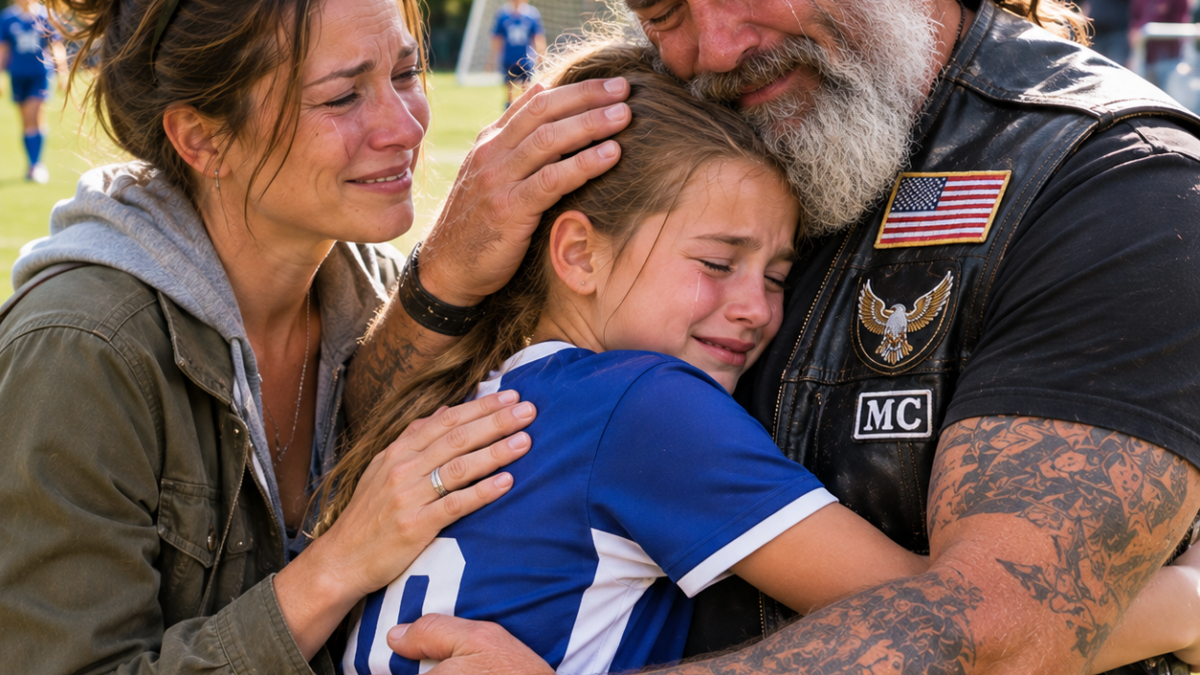
**Everyone assumed the biker was the danger—until Lily dropped her water bottle, sprinted past her own father, wrapped both arms around the biker’s waist, and cried, “Grandpa, please don’t make me go home with him.”**
**Then twenty parents went silent, because for the first time in eleven years, the charming man everyone trusted had lost control in public—and my daughter had just told them which man she was actually afraid of.**
My name is Katie Mitchell.
For eleven years, I was married to a man everybody liked.
That sentence is important.
Brian was not the husband people warned women about.
He did not stagger through bars looking for fights.
He did not scream at waitresses.
He did not show up drunk to family gatherings.
He did not have tattoos across his knuckles or a criminal record anybody could point to afterward and say, “You should have known.”
Brian wore khakis.
Polo shirts.
Expensive watches.
He coached youth baseball.
He shook hands at church.
He remembered neighbors’ birthdays.
If an elderly couple needed help carrying groceries, Brian was the first man out of his car.
He brought homemade cookies to school fundraisers.
He knew how to look people in the eye when they spoke.
He had a good job selling commercial insurance, a clean haircut every three weeks, and the kind of smile that made strangers trust him before they knew why.
When we first started dating, my friends said I had won the lottery.
My mother adored him.
My father did not.
Dad never said much about it at first.
He knew how protective he could be.
His name is Frank Mercer.
Six-foot-three.
Around two hundred forty pounds.
PART2:
Gray-black beard that reached his chest.
Tattoos on both arms.
Harley Road King.
Member of the Iron Wolves Motorcycle Club for thirty-one years.
If you saw my father walking toward you in a parking lot at night, you might cross to the other side.
Children loved him.
Dogs loved him.
Waitresses remembered his coffee order because he tipped too much.
He cried at old country songs and refused to admit it.
When I got engaged to Brian, Dad was the only person who did not celebrate immediately.
Brian had proposed during my mother’s birthday dinner.
Two-carat ring.
Whole family watching.
My mother cried.
My sister screamed.
My friends took pictures.
Dad looked at Brian.
Then at me.
He smiled because everybody else was smiling.
But later, when I walked him outside, he said:
“Something’s off.”
I remember rolling my eyes.
“Dad.”
“I’m serious, Katie.”
“You don’t even know him.”
“I know enough.”
“You know he’s not a biker, so you don’t trust him.”
Dad frowned.
“That isn’t it.”
“Then what?”
He leaned against his Harley.
“I don’t like the way he watches you when somebody else is talking.”
I laughed.
That sounds ridiculous now.
At the time it sounded worse.
Possessive.
Judgmental.
Classic overprotective father who didn’t want another man becoming important to his daughter.
“Please don’t ruin this.”
Dad looked hurt.
Then nodded.
“Okay.”
And he backed off.
That part matters too.
He came to the wedding.
Wore a suit because I asked.
Trimmed his beard.
Shook Brian’s hand.
Told him:
“Take care of her.”
Brian smiled.
“Always.”
The first time he hit me was eight months later.
We had been arguing about money.
Not serious money.
A credit-card bill.
I had bought a dress for a friend’s wedding without mentioning it.
Brian said married people discussed purchases.
I told him he had bought golf clubs the week before.
He said that was different.
I laughed.
He slapped me.
Open hand.
Across the left side of my face.
Hard enough that my ear rang for almost two hours.
We both froze.
Brian stared at his own hand.
Then at me.
“Oh my God.”
I remember the exact way he said it.
Like somebody else had done it.
“Katie.”
I backed away.
“Oh my God, Katie.”
He started crying.
Actually crying.
He dropped to his knees in our kitchen.
“I don’t know what happened.”
I believed him.
That’s one of the things people outside abusive relationships don’t always understand.
The first incident does not arrive carrying the next ten years with it.
It arrives alone.
One slap.
One apology.
One man you love looking horrified by himself.
Brian promised therapy.
Promised it would never happen again.
Bought flowers.
Cooked dinner.
Did laundry for a week.
Three weeks later, he shoved me into a kitchen cabinet.
Afterward, there was another apology.
Another explanation.
Work pressure.
I had embarrassed him in front of friends.
He had been drinking.
I had pushed too hard.
The third time, I no longer remember what started it.
That frightened me later.
Not then.
Then I was too busy learning the rules.
Don’t challenge him when he’s tired.
Don’t bring up money at dinner.
Don’t correct him in public.
Don’t walk away while he’s talking.
Don’t wear the blue dress he says attracts attention.
Don’t make jokes about him in front of other people.
Don’t let the house get messy before he comes home.
Don’t make him repeat himself.
Don’t cry because crying makes him angrier.
Don’t stop crying too quickly because then he thinks you’re being cold.
Every rule came disguised as prevention.
If I could just behave correctly, maybe the next incident wouldn’t happen.
That’s how I lived for years.
The reasons changed.
The blame didn’t.
The reason was always me.
I learned to hide bruises.
Long sleeves in July.
Foundation around my jaw.
A scarf once when he left fingerprints near my neck.
I became good at falling.
Bathroom floor.
Laundry basket.
Slipped on stairs.
Clumsy with groceries.
People accepted it because Brian stood beside me looking concerned.
He would put his arm around my shoulders.
“Katie has always been a little accident-prone.”
Everybody laughed.
I laughed too.
Then Lily was born.
For a while, Brian changed.
Completely.
He adored her.
Held her for hours.
Changed diapers.
Got up at night.
I thought fatherhood had fixed something in him.
For almost two years, he never hit me.
I started believing the earlier years belonged to some version of our marriage we had survived.
Then Lily turned two and one night would not stop crying.
Brian yelled.
I told him to leave the room.
He shoved me.
I hit the edge of the dresser.
Lily stopped crying immediately.
Not because she felt better.
Because she was watching.
That was the first time I saw fear in her eyes because of him.
I should have left then.
I’ve said that sentence to myself hundreds of times.
I should have left.
The problem with “should have” is that it comes with knowledge you only get afterward.
At the time, I had a toddler.
No savings Brian didn’t monitor.
A mortgage in both names.
A husband everybody believed was wonderful.
And a father who had warned me from the beginning.
Calling Dad felt like admitting he had been right.
That sounds pathetic now.
Pride kept me quiet longer than it should have.
So did fear.
Brian never threatened to kill me.
He didn’t need to.
He controlled the bank accounts.
Knew my schedule.
Knew every friend.
Could turn charm on instantly.
He would tell me:
“Who do you think people are going to believe?”
I hated that question because I knew the answer.
Him.
As Lily got older, she noticed more.
At five, she stopped coming into the kitchen when Brian was angry.
At six, she started asking me why I wore makeup inside the house.
At seven, she began listening outside doors.
At eight, Brian grabbed her.
That changed everything.
It was a Thursday evening.
Homework.
Math worksheet.
Lily had forgotten to show her work.
Brian told her to redo the page.
She muttered:
“I already know the answers.”
He told her not to talk back.
She rolled her eyes.
Nine-year-old behavior from an eight-year-old child.
Normal.
Brian reached across the table and grabbed her upper arm.
Hard.
She screamed.
I jumped up.
“Let go of her.”
He squeezed tighter.
“She’s learning respect.”
“Brian, let her go.”
I pulled his wrist.
He released Lily and turned on me.
She ran upstairs.
He told me I had undermined him.
I don’t even remember what happened after that.
I only remember going into Lily’s room later.
Four purple fingerprints were already forming around her arm.
Perfect marks.
His hand.
She looked up at me.
“Mommy?”
“Yes?”
“Was I bad?”
Something inside me broke.
“No.”
“But Daddy says—”
“No.”
I sat beside her.
“You were not bad.”
She touched the bruises.
“Are you going to tell Grandpa?”
That question stopped me.
“Why Grandpa?”
“He won’t let Daddy do it again.”
She knew.
At eight years old, my daughter already understood something I had spent years refusing to admit.
My father was the person we called when we were scared.
I called him.
He answered on the first ring.
“Katie?”
I couldn’t speak.
His voice changed.
“Where are you?”
“Home.”
“Is Brian there?”
“No.”
“What happened?”
I told him.
Only about Lily at first.
Not the years.
Not my ribs.
Not the bruises.
Just:
“He grabbed her.”
Dad said:
“I’m coming.”
“Dad—”
“I’m coming.”
He arrived forty minutes later.
Harley loud enough that Lily ran to the window.
I had never seen her look so relieved.
Dad came inside.
Looked at her arm.
His face changed.
He didn’t shout.
That surprised me.
He sat with Lily.
“Did your dad do this?”
She nodded.
“Did he hurt you anywhere else?”
“No.”
“Has he before?”
She shook her head.
Then:
“He hurts Mommy.”
Dad looked at me.
I could not meet his eyes.
“Katie.”
I started crying.
He understood everything.
Not all the details.
Enough.
He wanted us to leave immediately.
Pack bags.
Go to his house.
Call police.
Photograph everything.
I almost agreed.
Then Brian came home.
He opened the kitchen door and stopped when he saw Dad.
“What the hell is he doing here?”
Dad stood.
He did not move toward Brian.
Did not raise his fists.
Did not touch him.
He simply stood between Brian and the kitchen table where Lily was sitting.
“You put your hands on my daughter or granddaughter again,” Dad said, “and we’re going to have a problem.”
Brian pulled out his phone.
Dad almost laughed.
“Go ahead.”
Brian called police.
Not after Dad left.
While Dad was still standing there.
He told the dispatcher a violent biker had entered his home and threatened to kill him.
Dad never said kill.
I know because I was there.
But when officers arrived, Brian knew exactly how to play the scene.
He changed his voice.
Soft.
Concerned.
“He has always hated me.”
Dad stood near the wall.
Leather vest.
Tattooed arms.
Angry expression.
Brian wore office clothes.
Dress shirt.
Khakis.
No shoes.
He looked like the homeowner.
Dad looked like trouble.
One officer asked me what happened.
Brian stood behind him where the officer couldn’t see.
His eyes locked onto mine.
I froze.
“Did your father threaten your husband?”
I should have told the truth.
Instead:
“They argued.”
“Did he say he would hurt him?”
I hesitated.
That hesitation destroyed us.
Brian’s attorney moved fast.
Temporary restraining order.
Then a hearing.
Dad was ordered to stay five hundred feet away from Brian and our house.
At the hearing, Dad tried explaining.
Brian brought emails showing Dad had disliked him from the engagement.
Photographs of Dad’s club.
Statements about how intimidating he was.
I sat beside Brian.
He kept one hand on my knee.
From the gallery, it probably looked affectionate.
His fingers dug into me whenever Dad spoke.
The judge asked whether I felt threatened by my father.
“No.”
“Do you believe your husband feels threatened?”
Brian squeezed my knee.
“I don’t know.”
That was not enough.
Dad lost.
When we walked out, he looked at me.
Not angry.
Heartbroken.
I couldn’t look back.
The order stayed.
Dad missed Lily’s birthday.
Her school play.
Christmas morning at our house.
He mailed gifts.
Brian returned two of them.
Lily cried.
Then Dad started riding past at night.
He stayed on the public road.
Never stopped.
Never came onto the property.
Just slowed down.
The first time, Lily heard the Harley.
She ran to her bedroom window.
“Grandpa!”
Dad could not hear her.
She waved anyway.
After that, whenever the bike came by, she smiled.
“Grandpa’s checking on us.”
The court called him dangerous.
My daughter heard his engine and felt safe.
Brian hated it.
He called the police twice.
Dad was on a public road and did not violate the order.
Brian tried having the order expanded.
The court refused.
That made him angrier.
After Dad was removed from our lives, things got worse.
Before, Brian worried I might call him.
Now he knew I was too afraid.
In February, he broke my wrist.
We were arguing because I wanted to take Lily to my sister’s house.
He grabbed my arm.
Twisted.
I heard the crack.
At the ER, I said I fell on the garage steps.
Brian sat beside me.
Held my good hand.
The doctor looked skeptical.
Didn’t push.
In April, two ribs.
I told urgent care I fell against the bathtub.
Last month, I walked past Lily’s room after midnight.
Her door wouldn’t open.
I pushed.
Something scraped.
“Lily?”
“Mommy?”
“What is behind the door?”
Silence.
Then:
“A chair.”
“Why?”
Another silence.
“So Daddy can’t come in when he’s mad.”
I sat on the hallway floor after she fell asleep.
That was the night I decided we had to leave.
I just didn’t know how.
I started saving evidence.
Not dramatically.
Quietly.
Photographs of bruises.
Copies of medical records.
A spare debit card.
Important documents hidden at work.
Two sets of clothes in my trunk.
I called a domestic violence hotline from a grocery-store parking lot.
The woman on the phone helped me create a safety plan.
She told me the most dangerous time can be when an abusive partner realizes control is ending.
So don’t announce it.
Prepare.
Document.
Choose the moment carefully.
I called Dad from a prepaid phone.
He cried when he heard my voice.
“I thought you’d stopped trusting me.”
“I stopped trusting myself.”
“Katie.”
“I need help.”
“Say when.”
That was all.
The soccer game happened before our planned exit.
Saturday morning in October.
Bright blue sky.
Cold enough for jackets.
Lily’s team wore yellow jerseys.
She played midfield.
At home, she was careful.
On the soccer field, she became somebody else.
Fast.
Aggressive.
Fearless.
She shouted directions.
Challenged bigger kids.
Slid in the grass.
Every time I watched her play, I wondered how much of her true personality had been trapped inside our house.
Brian loved soccer games.
Not because he cared that much about soccer.
Because people saw him parenting.
Orange slices.
Sports drinks.
Jokes with other dads.
Helping carry cones.
That morning, he was in an excellent mood.
Those were the days I feared most.
Public Brian was charming.
Private Brian sometimes became furious afterward if I didn’t perform happiness convincingly enough.
Ten minutes into the game, I heard a Harley.
One engine.
Distinct.
My body knew before my mind did.
I turned.
Dad rolled into the far side of the public parking lot.
He parked.
Removed his helmet.
Stood beside the bike.
He was well outside the area covered by the restraining order.
The order prohibited him from our home and from approaching Brian directly.
It did not ban him from the entire town or from public recreational areas when we happened to be present.
Dad had spoken to a lawyer before coming.
He stayed far away.
Arms crossed.
Watching the game.
Lily hadn’t noticed yet.
Brian did.
His smile disappeared.
“Stay here.”
I grabbed his arm.
“Brian.”
He pulled away.
Then marched across the sideline.
Straight onto the field.
The referee blew his whistle.
“Sir!”
Brian kept walking.
Children stopped.
Parents stood.
Dad didn’t move.
He waited beside his motorcycle.
Brian reached him.
“You come near my family again, I’ll have you arrested.”
Dad said:
“I’m standing in a public parking lot.”
“You know exactly what you’re doing.”
“Yes.”
“What?”
“Watching my granddaughter play soccer.”
Brian shoved him.
Hard.
Dad took one step back.
That was all.
Several parents started moving closer.
I stood frozen.
Again.
The old habit.
Freeze until the danger chooses a direction.
Brian shoved Dad again.
“You stay away from my family.”
Dad’s voice remained calm.
“I’m not the one your family needs protection from.”
Brian swung.
Wild punch.
Dad stepped sideways.
Missed.
The referee shouted:
“Someone call police!”
Phones came out.
A second parent pulled children farther away.
Dad held both hands open.
“Don’t.”
Brian swung again.
This one landed.
His fist hit Dad’s cheek.
Dad’s head turned.
He touched his face.
Then looked back at Brian.
No punch.
No retaliation.
“That all you got?”
“Shut up.”
Dad’s voice changed.
Not louder at first.
Colder.
“Because you hit a lot harder when it’s a woman.”
Brian froze.
The parking lot went quiet.
Dad continued.
“Or a little girl.”
“Shut your mouth.”
“You want to tell them?”
Parents were watching now.
Every one.
Dad pointed toward me.
“Katie’s wrist.”
My stomach dropped.
“Her ribs.”
Brian looked at me.
Pure warning.
Dad kept going.
“The bruises on Lily’s arm.”
“HE’S LYING!”
Brian shouted it at the parents.
“He’s insane. He’s been stalking us for months.”
Dad’s voice rose enough for the sideline to hear.
“Tell them why your nine-year-old sleeps with a chair jammed under her bedroom door.”
Everything stopped.
No whispers.
No yelling.
Even children seemed quiet.
Brian turned toward the field.
And Lily was looking at him.
She had heard.
Her water bottle slipped from her hand.
It hit the grass.
Then she ran.
Not toward Brian.
Past him.
Straight toward my father.
“Grandpa!”
Dad’s entire body changed.
He opened his arms.
Lily hit him around the waist.
“Don’t go.”
Her voice carried.
“Grandpa, please don’t go.”
Dad knelt.
“I’m not going anywhere, baby.”
She buried her face against him.
Then the sentence that changed everything.
“I don’t want to go home.”
Parents heard it.
Brian stepped toward her.
“Lily Marie, come here.”
She looked over Dad’s shoulder.
“No.”
One word.
Small voice.
Enormous meaning.
Brian’s face changed.
“You come here now.”
Dad stood.
He did not threaten him.
Did not raise a fist.
He simply stepped between Brian and Lily.
A wall.
Tom Peretti, coach of the opposing team, walked over.
Big accountant with three daughters and the personality of somebody who apologized when other people stepped on his shoes.
That morning, he didn’t apologize.
“Maybe everybody should stay where they are until police get here.”
Brian snapped:
“Stay out of my family.”
Tom looked toward Lily.
“She just said she doesn’t want to go home.”
“This is none of your business.”
Another father stepped beside Tom.
Then another.
Not around Dad like some biker gang.
Beside him.
A loose line.
Parents who had watched Brian charge across a children’s soccer game.
Parents who saw him throw the only punches.
Parents who saw Lily choose her grandfather.
One mother walked over to me.
“You okay?”
I couldn’t answer.
She looked at my wrist.
I was no longer wearing a brace.
But the way I held it gave me away.
Her eyes changed.
Police arrived seven minutes later.
Two cruisers.
Four officers.
Brian became Brian again before the doors even opened.
Breathing slower.
Shirt straightened.
Voice controlled.
He pointed toward Dad.
“That man has a restraining order. He attacked me in front of my child.”
Dad said nothing.
The first officer looked around.
“Who witnessed what happened?”
Tom raised his hand.
“I did.”
Brian looked at him.
Tom continued:
“Mr. Mitchell crossed the playing field and initiated the confrontation.”
Another parent:
“He shoved the biker first.”
Another:
“He threw the first punch.”
A woman near the sideline said:
“The other man never swung.”
Another mother added:
“The little girl ran to the biker. She said she was afraid to go home.”
Brian’s mask slipped for half a second.
Officer turned.
“Sir, step over here.”
“You’re listening to them?”
“Step over here.”
“I’m the victim.”
“We’re going to sort that out.”
Then I saw it.
Fear.
For eleven years, I had seen Brian angry.
Disappointed.
Cruel.
Controlling.
Smug.
I had never seen him afraid.
Not of Dad.
Not even of police.
He was afraid of losing control of the story.
Lily took my hand.
Dad’s arm went around my shoulders.
And I finally walked.
Not away.
Forward.
Across the grass.
Toward the officers.
My legs were shaking so badly I thought I might fall.
Brian saw me.
His eyes changed.
“Katie.”
I kept walking.
“Katie, don’t do this.”
That sentence almost stopped me.
Not because I wanted to protect him.
Because my body had been trained for years to respond to that tone.
I squeezed Lily’s hand.
She squeezed back.
Dad stayed beside us.
I looked at the officer.
“He hits me.”
Everything in my chest seemed to collapse after the words came out.
The officer nodded.
“Okay.”
“He’s been hitting me for years.”
Brian shouted:
“She is lying!”
Another officer told him to stay where he was.
I continued.
“He broke my wrist in February.”
“Katie!”
“Two ribs in April.”
Dad closed his eyes.
He had not known those details.
“He grabbed Lily hard enough to leave bruises.”
The officer’s face changed.
“I have pictures.”
“Katie, stop.”
“I have medical records.”
Brian moved toward me.
An officer stepped between us.
“Sir, stay back.”
Then Lily said:
“He scares me.”
No one interrupted her.
“He yells at Mommy.”
She started crying.
“He hurts her.”
Brian’s lawyer wasn’t there.
His church friends weren’t there.
His clients weren’t there.
There were twenty parents who had just watched him throw punches at a man who refused to hit back.
And there was his nine-year-old daughter clinging to the person he had spent eight months convincing everyone was dangerous.
An officer asked whether I wanted to make a formal report.
I looked at Dad.
He didn’t answer for me.
That’s one of the things I love most about him.
After everything, he let the choice remain mine.
I looked at Lily.
Then:
“Yes.”
Brian was arrested that day.
Not simply because I spoke one sentence on a soccer field.
Real investigations don’t work that way.
Officers took statements from witnesses.
Photographed Dad’s cheek.
Obtained videos parents had recorded.
Documented Lily’s statements carefully without interrogating her on the sideline.
Then I gave them what I had spent months collecting.
February ER record.
Fractured wrist.
April imaging.
Two healing ribs.
Clinic visit.
Photographs.
Dates.
Messages Brian had sent afterward apologizing without quite admitting what he had done.
One text said:
I’M SORRY I LOST CONTROL, BUT YOU KNOW HOW YOU PUSH ME.
Another:
DON’T MAKE ME FEEL LIKE THAT AGAIN.
Things I once read as apologies looked very different in an evidence folder.
That afternoon, a domestic violence advocate met us at the station.
She sat with Lily.
Helped me understand what would happen next.
Emergency protective order.
Safe location.
No direct contact.
Attorney referral.
Counseling.
Dad waited outside because technically, until the old restraining order was addressed, everyone wanted to avoid creating additional legal confusion.
He did exactly what he was told.
That night, Lily and I did not go home.
We went to Dad’s house.
Two bedrooms.
Single-story ranch house.
Garage filled with motorcycle parts.
Kitchen cabinets older than I was.
Dad had already bought purple curtains.
I stared at them.
“How long have those been here?”
He looked embarrassed.
“Few months.”
“You bought curtains before you knew we’d come?”
“I hoped.”
He had also bought a small night-light shaped like a motorcycle.
Lily loved it.
The first night, I tucked her into the bed.
She looked toward the door.
Then at me.
“Can I close it?”
“Of course.”
“No chair?”
I almost broke.
“No chair.”
She closed the door.
I stood in the hallway afterward.
Stared at it.
Nothing wedged beneath the knob.
No furniture.
No barrier.
Just a child’s closed bedroom door.
I sank against the wall.
Dad found me.
He sat down beside me.
I whispered:
“I should have gotten her out sooner.”
He shook his head.
“Don’t.”
“I failed her.”
“Katie.”
“I stayed.”
“You survived.”
“I let him—”
“You survived.”
His voice hardened.
“Don’t take Brian’s choices and put them on your back.”
“I should’ve been stronger.”
Dad looked at me.
“You were strong every day you kept that little girl alive inside that house.”
I started crying.
He pulled me against him.
“You were brave when it counted.”
The next week, the old restraining order against Dad returned to court.
This time, I spoke.
Every detail.
The original kitchen confrontation.
What Dad actually said.
Brian’s false claim that Dad threatened to kill him.
The bruises on Lily’s arm.
The pressure Brian put on me at the first hearing.
The judge reviewed the soccer-field videos too.
Dad had stayed in a public area.
Brian approached him.
Brian shoved him.
Brian punched him.
Dad did not retaliate.
The order was vacated.
The judge did not apologize dramatically.
Judges rarely do.
But he did say:
“New evidence materially changes the court’s understanding of the circumstances under which the earlier order was entered.”
That was enough.
Dad walked out.
Lily ran to him.
This time nobody told her she had to stay five hundred feet away.
Brian posted bail.
His attorney called the accusations fabricated.
Said I was manipulating a custody dispute.
Said Dad had spent years poisoning me against my husband.
Brian sent messages through permitted legal channels saying he wanted counseling.
Wanted his family back.
Promised everything could be fixed.
Old Katie might have listened.
New Katie saved the messages.
The criminal case took months.
Not one dramatic four-day miracle where everything became clear.
Statements.
Medical experts.
Child advocacy interview.
Videos.
Witnesses.
Motions.
The soccer parents mattered because they had watched Brian lose control in public.
But the case did not rest on appearances.
It rested on evidence.
My medical history.
Photographs.
Messages.
Lily’s forensic interview.
Records.
Testimony.
Brian eventually went to trial.
Lily did not sit in an open courtroom staring at her father.
The court permitted accommodations so she could testify through appropriate child-witness procedures with support from a trained counselor.
She talked about the chair.
The yelling.
The bruises.
The night Brian grabbed her arm.
She said:
“I thought if I locked my door, he would stay mad somewhere else.”
Nine years old.
That sentence stayed with everybody.
I testified too.
For hours.
Brian’s attorney asked why I stayed.
Why I lied to doctors.
Why I didn’t report earlier.
Why I sat silent during Dad’s restraining-order hearing.
Every question felt like an accusation.
My advocate had warned me.
Abuse cases often come with a terrible paradox.
If you stay, people ask why.
If you leave, people ask why now.
If you report immediately, you’re emotional.
If you wait, you’re suspicious.
At some point, I stopped trying to sound perfect.
I told the truth.
“I stayed because I was afraid.”
“Afraid of what?”
“Him.”
“Yet you continued living with him?”
“Yes.”
“You continued attending social events?”
“Yes.”
“You smiled in photographs?”
“Yes.”
“Why?”
“Because I was afraid of him.”
The courtroom went quiet.
Eventually, Brian was convicted on domestic assault charges and child endangerment-related counts.
His sentence was not the kind of sentence movies would give him.
It wasn’t life.
It wasn’t twenty years.
The judge imposed a prison term, probation afterward, treatment requirements, and strict no-contact conditions while the family-court side continued.
People asked whether I felt justice had been done.
I never knew how to answer.
Justice is a complicated word when eleven years are involved.
No sentence gave me back the woman I was at twenty-six.
No conviction erased Lily’s chair.
But the locks at Dad’s house worked.
Brian could not walk through the door.
We had time.
That was enough to begin.
Six months later, Lily still went to therapy.
So did I.
Mine was harder than I expected.
I thought leaving would make me immediately feel free.
Instead, I jumped when doors slammed.
Apologized constantly.
Asked Dad permission before buying groceries with my own money.
One afternoon he finally said:
“Katie, why are you asking me if you can buy shampoo?”
I stared at the bottle.
Then started crying in aisle seven.
Healing is humiliating sometimes.
You discover how many tiny pieces of yourself somebody trained you to surrender.
What you wear.
How loudly you laugh.
Whether you’re allowed to rest.
Whether buying shampoo requires permission.
Dad never rushed me.
He did not say:
See? I told you about Brian.
Not once.
I asked him why.
“You were right from the beginning.”
He shook his head.
“Being right about him doesn’t mean I was right about what you should’ve done.”
“What does that mean?”
“I saw something bad. You were the one living inside it.”
Then:
“People outside always think leaving is one decision.”
He looked toward Lily kicking a soccer ball in the yard.
“Sometimes it’s a hundred little decisions before the final one.”
That was my father.
The scary biker.
The dangerous man according to court papers.
The man who understood more about fear than almost anybody else in my life.
He never missed another soccer game.
Front row.
Leather vest.
Coffee.
Usually too loud.
The first few weeks, parents stared.
Then Tom Peretti started bringing him coffee.
Tom was the opposing coach who stepped forward that day.
He apologized for not noticing sooner.
Dad told him:
“You couldn’t know what you weren’t shown.”
Tom eventually bought a used Sportster.
Dad mocked it relentlessly.
Called it a “starter bike.”
Tom reminded him his starter bike cost more than Dad’s first three motorcycles combined.
They became friends.
Kids started calling Dad Grandpa Frank.
Not because we asked them to.
He simply became the person who carried extra water bottles, fixed broken folding chairs, kept bandages in his saddlebag, and somehow always had gum.
Parents who once would have crossed a parking lot to avoid him started handing him car keys when somebody needed help with a dead battery.
Appearance hadn’t changed.
Information had.
Lily changed too.
At home with Dad, she talked louder.
Sang in the shower.
Left socks on the floor.
Argued about bedtime.
The first time she slammed her bedroom door, I stood in the hallway smiling.
Dad looked at me like I’d lost my mind.
“She just slammed a door in your face.”
“I know.”
“You’re happy?”
“She isn’t afraid to.”
He understood.
Therapy helped her.
Slowly.
One afternoon her therapist asked her to draw a place where she felt safe.
Lily drew Dad’s garage.
Harley in the middle.
Purple curtains visible through a window that did not actually exist.
Dad framed it.
Hung it above his workbench.
His club brothers started visiting more often.
Not as guards.
We didn’t need an army.
They brought food.
Fixed things.
One rebuilt the back fence.
Another taught Lily how to throw a football.
Every one of them knew Dad’s rule.
No talking badly about Brian in front of Lily.
I asked why.
Dad said:
“She needs to decide what she feels about her father without fifty old men telling her what to feel.”
That wisdom surprised people who thought bikers solved problems by punching them.
Dad had spent his life learning the opposite.
His club had a strict rule about violence at home.
You hit your spouse or your children, you were gone.
No colors.
No club protection.
Dad had seen enough men act tough in public and cruel in private.
He considered domestic abuse cowardice.
But after the soccer game, he became even more careful about threats.
“I almost screwed it up,” he told me once.
“How?”
“I talked too much.”
“You told the truth.”
“I also wanted Brian to know I could hurt him.”
“You didn’t.”
“No.”
He looked ashamed anyway.
“The goal wasn’t for him to fear me.”
“What was the goal?”
“For you to stop fearing him.”
That’s the difference.
Months after the case ended, Lily asked me something while we were driving home from practice.
“Was Grandpa going to hurt Daddy that day?”
I thought carefully.
“No.”
“But he was mad.”
“Very.”
“Daddy hit him.”
“Yes.”
“Why didn’t Grandpa hit him back?”
I looked at her in the mirror.
“Because he knew you were watching.”
She thought about that.
Then:
“So being strong means not hitting?”
“Sometimes.”
She nodded.
That answer seemed to satisfy her.
The following weekend, she asked Dad the same question.
He gave a better answer.
“Being strong means deciding what helps the person you’re protecting.”
“What would hitting Daddy have done?”
“Made the police look at me instead of him.”
Lily frowned.
“So you would’ve ruined it.”
“Pretty much.”
She smiled.
“Good thing you didn’t.”
“Very good thing.”
Last month, during a club charity ride, somebody asked Dad to speak.
He hates speeches.
He would rather rebuild a carburetor in the rain.
The Iron Wolves were raising money for a local domestic violence shelter.
Hundreds of riders came.
Families too.
Lily helped run the children’s table.
Purple Iron Wolves T-shirt.
Temporary tattoos.
Lemonade.
Dad stood behind the microphone.
Leather vest.
Gray beard.
He looked terrifying.
Then he said:
“A lot of people think protecting somebody means fighting.”
The crowd quieted.
“Sometimes it does.”
He paused.
“But most of the time, protecting somebody means showing up enough times that they finally believe they don’t have to face something alone.”
I stood with Lily.
She grabbed my hand.
Dad continued.
“You don’t need a badge to notice fear.”
Another pause.
“You don’t need a uniform to listen.”
Then:
“And you don’t need to throw a punch to stand between somebody vulnerable and somebody hurting them.”
People applauded.
Dad looked uncomfortable.
Lily screamed:
“GO GRANDPA!”
He laughed.
That ended the speech.
Later, Tom asked me if I ever thought about that soccer game.
Every day.
People remember the dramatic part.
Brian charging across the field.
Dad getting punched.
Parents forming a line.
Police arriving.
Those things mattered.
But the moment that changed my life was smaller.
A plastic water bottle falling into grass.
My daughter running.
Past her father.
Toward her grandfather.
Children tell the truth in strange ways.
Sometimes with words.
Sometimes with behavior.
For months, Lily had been telling me.
The chair under her door.
The way she went silent when Brian walked into a room.
The way she listened for Dad’s motorcycle at night.
The way she slept better when she knew Grandpa had ridden past.
At the soccer field, everyone finally saw what I had been too frightened to say.
When danger appeared, my daughter knew exactly which man she wanted to stand behind.
That gave me enough courage to speak.
People still occasionally ask why Dad came to the game if he knew Brian would be there.
The answer isn’t dramatic.
Lily had a game.
He missed her birthday.
Her school play.
Christmas.
Eight months of her life because Brian had successfully turned the legal system into another wall around us.
Dad had spoken with his attorney.
He knew where he could legally stand.
So he parked far away.
Stayed in a public area.
He planned to watch his granddaughter play soccer and go home.
Brian crossed the field.
Brian threw the punches.
Brian showed everybody the man I had been seeing behind closed doors for eleven years.
Dad did not expose Brian.
Brian exposed himself.
Dad simply refused to disappear when it happened.
I think about the first restraining-order hearing more than I want to.
Dad standing there.
Brian’s hand squeezing my knee.
The judge asking questions.
Me refusing to answer properly.
I hated myself for that silence for a long time.
My therapist finally asked:
“If Lily froze because she was afraid, would you call her a coward?”
“Never.”
“Why are you using a harsher standard for yourself?”
I had no answer.
Fear changes what your body can do.
Sometimes survival looks like silence.
Sometimes courage arrives years late.
Late still counts.
One evening, about five months after leaving, I apologized to Dad.
We were in his garage.
He was changing oil.
I said:
“I’m sorry I didn’t defend you in court.”
He kept working.
“Dad.”
“I heard you.”
“You lost eight months with Lily because of me.”
He set the wrench down.
Then looked at me.
“No.”
“Yes.”
“Brian caused that.”
“I could have stopped it.”
“You were afraid.”
“I should have spoken.”
He wiped his hands.
“Katie, listen.”
I did.
“You don’t apologize to me for what you had to do while that man had you scared.”
“But—”
“No.”
His voice softened.
“You came when you could.”
I started crying.
He hated that.
Not my crying.
His own.
Because two seconds later his eyes filled too.
“Damn it.”
I laughed.
He pulled me into a hug.
Lily walked into the garage.
Saw us.
“Why is everybody crying?”
Dad immediately said:
“Your mother.”
Traitor.
Lily rolled her eyes.
Normal.
Beautifully normal.
Today, our lives still aren’t perfect.
There are legal appointments.
Counseling bills.
Moments when Lily asks complicated questions about Brian.
Moments when I miss the man I thought I married.
That is another thing people don’t understand.
You can miss someone who hurt you.
You can grieve a marriage you needed to escape.
You can remember good vacations.
Christmas mornings.
The night Lily was born.
None of those memories erase the violence.
The violence doesn’t erase the fact that some memories were happy.
Humans are inconveniently complicated.
What matters is what I do with the truth now.
Brian is responsible for Brian.
I am responsible for building something different for Lily.
Dad helps.
Not by replacing anybody.
By being Dad.
By being Grandpa.
By showing up.
Every Saturday, his Harley rolls into the soccer parking lot.
Lily always hears him before she sees him.
She turns toward the sound.
Smiles.
Then goes back to warming up.
She doesn’t run to him anymore.
She doesn’t need to.
She knows he’ll still be there when the game ends.
That’s what safety looks like now.
Not a motorcycle.
Not leather.
Not tattoos.
Certainty.
When Dad says he’ll come, he comes.
When he says he’ll wait, he waits.
When Lily says stop, he stops.
When she says she’s scared, he listens.
No argument.
No punishment.
No making her prove it first.
Sometimes the safest person in the park still looks like the scariest.
And sometimes the man everybody trusts is the one a child wedges a chair against her door to keep out.
I learned that appearances can fool courts.
Neighbors.
Teachers.
Church friends.
Even wives.
Children notice something different.
They notice who makes their body relax.
Who makes them smaller.
Who makes them afraid to speak.
Who lets them say no.
Who stays.
The morning Brian attacked my father at that soccer game, twenty parents saw a tattooed biker in a leather vest.
For a few minutes, some of them probably thought they were watching a dangerous man threaten a respectable father.
Then Lily ran.
She didn’t care about Brian’s polo shirt.
She didn’t care about Dad’s skull patch.
She didn’t care who looked respectable.
She knew who had spent eight months riding slowly past our house because he wasn’t legally allowed to come closer.
She knew whose engine meant:
I’m still here.
She knew which man had never once made her afraid.
So she ran toward him.
And once I saw my daughter choose safety in front of everybody, I finally chose it too.
Dad likes to say:
“You don’t need a badge to protect someone. You just need to show up.”
I think he’s only half right.
You have to show up.
But you also have to know when not to fight.
When to listen.
When to wait outside the door.
When to let somebody tell the truth in their own time.
When to stand still while a frightened nine-year-old decides whether she’s ready to come toward you.
My father did all of that.
For eight months, Brian used a court order to make him look like the danger.
Then on one Saturday morning, Brian crossed a soccer field, threw the first punch, and finally showed everyone what my daughter and I already knew.
Dad didn’t have to hit him back.
He just stood there.
And Lily ran to the right man.








